



Abstract
Informal trilogue meetings are the main legislative bargaining forum in the European Union, yet their dynamics remain largely understudied in a quantitative context. This article builds on the assumption that the negotiating delegations of the European Parliament and the Council play a two-level game whereby these actors can use their intra-institutional constraint to extract inter-institutional bargaining success. Negotiators can credibly claim that their hands are tied if the members of their parent institutions hold similar preferences and do not accept alternative proposals or if their institution is divided and negotiators need to defend a fragile compromise. Employing a measure of document similarity (minimum edit distance) between an institution's negotiation mandate and the trilogue outcome to measure bargaining success, the analysis supports the hypothesis for the European Parliament, but not for the Council.
Keywords
Introduction
Secluded decision-making facilitating ‘early agreement’ has become a defining feature of the European Union's (EU) policy process. In fact, informal bargaining prior to the first reading, which takes place in the so-called trilogues attended by representatives of the Commission, European Parliament (EP) and Council, is the main form of legislative deliberation under the co-decision procedure (Brandsma, 2015). Yet, we know surprisingly little about the dynamics of these meetings as few studies explore the determinants of bargaining success in informal trilogues in a quantitative manner. This comes as no surprise given the semi-transparent nature of trilogue decision-making. Information on trilogues is often not made available proactively by the institutions but needs to be requested. This gatekeeping of information even drew criticism amongst some of the member states who recently expressed their worry about the ‘disconnection between the EU's transparency policy and citizens’ expectations’ (Government of Estonia, et al. 2020).
The use of informal modes of decision-making does not only give rise to concerns of public accountability, but also presents difficulties for the study of the legislative process in the EU. Except for resource-intensive expert interviews (e.g. König et al., 2007; Thomson et al., 2012), researchers often lack data to systematically measure and scale actor positions and outcomes. As a result, trilogue bargaining has long remained a black box to scholars of legislative politics in the EU. Yet, we know that the outcomes of trilogue bargaining systematically differ from those of formal co-decision bargaining in many respects (Broniecki, 2020; Costello and Thomson, 2011; Cross and Hermansson, 2017; Häge and Kaeding, 2007). As the institutions do not face formal constraint when meeting informally prior to the first reading, they enjoy more leeway and can engage in direct negotiation over individual provisions (Cross and Hermansson, 2017). This begs the question of how we can analyse and identify patterns of institutional bargaining success in informal trilogues.
Drawing on bargaining theory and empirical accounts of trilogue negotiations, I argue that negotiating delegations can be expected to be more successful in inter-institutional bargaining if they can credibly claim that their hands are tied by the institution that needs to approve the negotiated compromise (Putnam, 1988; Schelling, 1960). The constraint in this two-level game is dependent on the heterogeneity of preferences within the parent chamber. If the members of an institution have similar preferences on an issue, alternative proposals will not find majorities within the chamber. Similarly, in very divided chambers, intra-institutional compromise can be fragile and leave little room for deviation. This study thus proposes that the relationship between intra-institutional cohesion and institutional preference attainment is curvilinear, that is, the bargaining success of an institution is higher at both extremes of intra-institutional heterogeneity compared to intermediate levels. 1
Using the approach employed by Laloux and Delreux (2018), this study compares the initial bargaining positions of the co-legislating institutions, EP and Council, with the compromise reached in trilogue negotiations using the document (dis)similarity DocuToads minimum edit distance algorithm by Hermansson and Cross (2016) to measure and study institutional bargaining success. The hypothesis is tested on
Informal trilogues and institutional bargaining strength in the EU
Informal meetings between representatives of the Commission, EP and Council have become the standard mode of decision-making under the co-decision procedure of the EU. While originally held after the second reading and prior to the conciliation committee in order to provide a forum for discussion outside the more constrained formal procedure, these so-called trilogues were increasingly held at earlier stages in the procedure and eventually led to a rule change enabling ‘early’ first reading agreements in the Treaty of Amsterdam (Farrell and Héritier, 2003). Since then, there has been a steady rise of informal trilogue compromises negotiated prior to any formal interaction between EP and Council which are then rubberstamped by both institutions at first reading (Brandsma, 2015; Bressanelli et al., 2015: 94; Héritier and Reh, 2012: 1137).
Informal trilogues provide an alternative to the formal back and forth of readings between EP and Council. In trilogue meetings, as depicted in Figure 1, the institutions are represented by negotiating delegations tasked with facilitating and finding a legislative compromise within and between institutions (Delreux and Laloux, 2017). For the EP, this delegation includes, but is not limited to, the rapporteur, the shadow rapporteurs, the committee chair and an EP vice president (European Parliament, 2012), whereas the Council is represented by the rotating presidency at the Committee of Permanent Representatives (COREPER) or working party level (Häge and Naurin, 2013; Roederer-Rynning and Greenwood, 2015). 2 Despite their prevalence in recent decision-making, the dynamics of trilogue bargaining have received little attention in the study of EU legislative politics, not least due to their informal nature. The remainder of this section will outline existing work on general co-decision bargaining and its applicability as well as possible shortcomings regarding the study of trilogue bargaining.
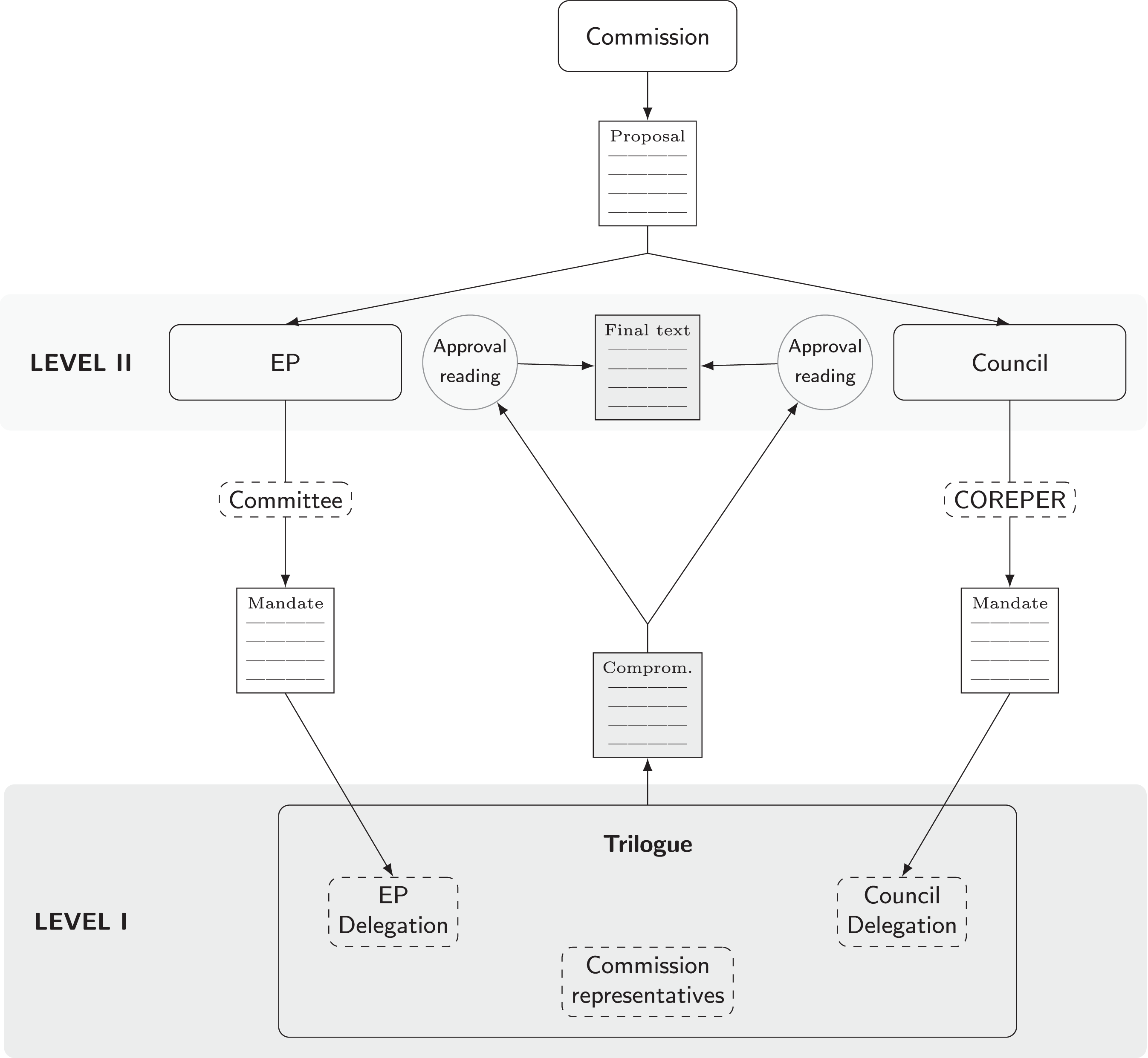
Schematic illustration of the decision-making process in the European Union (EU) making use of informal trilogues.
Costello and Thomson (2011, 2013) contribute two major works investigating the bargaining power and success of EP and Council in the legislative process. The authors assess the success of the institutions for co-decision procedures in the dataset on decision-making in the EU (DEU, cf. Thomson et al., 2012). Costello and Thomson (2013) find that intra-institutional cohesion in the EP seems to enhance the likelihood of EP bargaining success under co-decision. The authors ascribe this effect to the ability of the negotiators to credibly claim that they are constrained by their institution and, thus, cannot accept alternative policies. In their earlier contribution, Costello and Thomson (2011) analyse how the composition of the negotiating delegation of EP and Council influence the bargaining strength of the institutions under co-decision. They find that EP negotiators, while structurally disadvantaged due to the EP's transparent nature, are able to extract bargaining success when they can credibly claim that they are tied to and thus constrained by the plenary as a whole.
Within the literature on co-decision bargaining, conciliation committees, a formal forum aimed at facilitating compromise between EP and Council prior to the third reading, that has gone virtually extinct in recent years, have gathered special scholarly interest. During the seventh EP a mere two cases went to conciliation and in the eighth EP all cases were concluded at first or second reading. 3 Yet, due to its similar mode of engagement, studies of conciliation might still be able to inform trilogue research – keeping a few important differences in mind: First, in conciliation, the Council is represented in full, with representatives of each member state present (Franchino and Mariotto, 2012), whereas informal trilogues rely more heavily on the principle of delegation (Delreux and Laloux, 2017). Second, conciliation compromises are subject to closed rule approval in EP and Council and limited in time and scope (König et al., 2007), whereas trilogues usually take place prior to the first reading and are thus not restricted in time or scope. Finally, whereas trilogues are merely an informal exchange that does not influence the formal progress, the conciliation committee represents the last stage prior to a possible breakdown of negotiations.
Franchino and Mariotto (2012) argue that the outcomes of conciliations are shaped by characteristics of the negotiating delegations and the rules placed upon them. Bargaining success is therefore determined by the value that actors attach to disagreement as well as their institutional constraints. The authors find that the Council, propelled by unanimity constraints, on average, is closer to the conciliation outcome. König et al. (2007) examine conciliation committee bargaining using preference location data on Commission, EP and Council extracted from expert interviews and find that non-cohesive intra-institutional preference distribution weakens the likelihood of bargaining success.
In contrast to the analysis of formal decision-making in the EU, quantitative studies of informal bargaining outcomes and their determinants are rather scarce. A range of studies find that the EP is more successful in early agreements compared to later stage conclusion (e.g. Costello and Thomson, 2011; Häge and Kaeding, 2007). Broniecki (2020) argues that the EP is more successful in first reading early trilogue agreements as it is able to conceal its mandate from the Council. Cross and Hermansson (2017) show that files concluded at first reading following informal bargaining see more successful amendments compared to the formal procedure.
Farrell and Héritier (2004) hypothesize that changes from formal, sequential decision-making towards informal, simultaneous decision-making have empowered the so-called ‘relais’ actors directly involved in the trilogue negotiations, that is, the negotiators of EP and Council. Laloux and Delreux (2018) observe that both Council and EP delegations deviate from their mandate more than necessary to reach a compromise. Other studies, however, do not find these actors to be runaway agents (Laloux, 2021; Rasmussen and Reh, 2013), suggesting that they rather ‘facilitate policy-making among their principals’ and ‘represent their institution in the inter-institutional negotiations’ (Delreux and Laloux, 2017: 302–303). This is further propelled as report allocation has increasingly become a tool for controlling party group loyalty, thus ensuring representativeness (Yordanova, 2011). In the Council, the rotating presidency principle ensures a balance of interests.
In summary, existing research has been occupied with the determinants of bargaining success of EP and Council in the formal procedure, on the one hand, and the differences in outcomes between formal and informal decision-making, on the other hand. The insights from formal bargaining point towards the importance of institutional preference cohesion and delegation constraint for bargaining success. Given the prevalence of informal trilogues as the main forum of legislative bargaining in the EU, how do bargaining outcomes vary in informal trilogue decision-making? And, first of all, how can we study them in a systematic manner?
The seclusion of trilogue meetings and the resulting scarcity of information and data has long been an obstacle to the study of informal decision-making. Similarly, data on positions and outcomes has been scarce with notable exception of the DEU dataset, which contains actor policy positions on around
Theoretical framework
In many inter-national or inter-institutional bargaining situations, the negotiated compromise needs to be ratified at the domestic (or intra-institutional) level effectively rendering the bargaining parties non-unitary collective actors. Schelling (1960: 21–22) assumes actors in bargaining situation to be ‘guided mainly by […] expectations of what the other will accept’ ultimately leading to a ‘paradox that the power to constrain an adversary may depend on the power to bind oneself’ where alleged ‘weakness is often strength’. Adapting Schelling's conjecture, Putnam (1988: 435) models bargaining situations where ‘[n]egotiators representing two organizations meet to reach an agreement between them, subject to the constraint that any tentative agreement must be ratified by their respective organizations’ as two-level games, where the inter-organizational interaction is referred to as level I and the intra-organizational dimension as level II.
The so-called Schelling conjecture therefore emphasizes the role of negotiator constraint and its use as an asset in bargaining. In a model of two-level bargaining, such expectations can be shaped by the level II constraint an actor is able to claim vis a vis their level I bargaining partner (Putnam, 1988; Schelling, 1960). This gives rise to the question of when a negotiator can convincingly claim such constraint. Putnam (1988) argues that the credibility of such claims depends on the size of the intra-organizational winset, that is, the range of deals that will be accepted over the status quo (SQ) by the organization's members. The spatial analysis literature suggests that intra-institutional decision rules and the distribution of preferences within an institution influence its winset, yet produces ambiguous expectations concerning the relationship between members’ preference heterogeneity and the size of the winset. 4
In the context of EU research, Schelling's notion of constraint as a bargaining resource has been shown to play a role in inter-governmental treaty negotiations constrained by domestic ratification (Hug and König, 2002). In terms of EU legislative decision-making, the credibility of rapporteurs claiming constraint in legislative negotiations (Costello and Thomson, 2011) and the constraint posed by parliamentary preference homogeneity has been shown to play a role in determining bargaining success (Costello and Thomson, 2013; König et al., 2007), while national domestic constraints have not been found to exert an influence (cf. Bailer, 2010; Schneider et al., 2010).
How can the trilogue bargaining delegations of EP and Council capitalize on the constraint placed upon them by the need for approval in their parent institutions? Informal trilogues can be thought of as a two-level game, where level II represents the intra-institutional dimension between the negotiating delegations, the EP negotiation team headed by the rapporteur and the Council's headed by the presidency, and their respective parent institutions which need to approve the deal negotiated by the delegation in the inter-institutional level I bargaining (cf. Figure 1). Both institutions negotiate their institutional position internally and adopt negotiating mandates before entering into the trilogue negotiations. Therefore, the negotiators may be able to extract concessions from the other bargaining party if they can claim that their hands are tied by their parent institution. However, the effectiveness of such claims depends on their credibility. If the parent institution's members hold homogeneous preferences in an issue area, the negotiator can convincingly claim that they cannot get another compromise approved within their institution. If the members of an institution have similar preferences on an issue, alternative proposals will not find majorities within the chamber (Costello and Thomson, 2013: 1028; König et al., 2007: 290; Schelling, 1960; Tsebelis, 2002: 45–54).
At the same time, if the preferences in the ratifying institution are highly diverse, the common intra-institutional position might be a fragile compromise in the first place. Such constraint allows the negotiator to stress the difficulty of finding common ground within their parent institution and, thus, again puts them in a favourable inter-institutional bargaining position. Costello and Thomson (2013: 1029) report from interviews with insiders that highly dispersed preferences in the Council have occasionally been exploited by Council representatives stressing the fragile nature of the agreement among member states when meeting with EP representatives. Similarly, EP negotiators have reported that they actively employed ‘tied-hands’ strategies vis a vis the Council by pointing to the difficulty of finding intra-institutional compromise (Delreux and Laloux, 2017: 309–310). This suggests that the relationship between intra-institutional preference heterogeneity and bargaining success in informal trilogues is not strictly linear, but rather curvilinear with relatively higher success at the extremes of intra-institutional preference heterogeneity. Hence, the cohesion of the parent institutions can be assumed to play an important role in determining the success of an institution in inter-institutional bargaining, i.e. the representation of its own position in the bargaining outcome:
H1: An institution is more successful in inter-institutional bargaining if the heterogeneity of its members’ preferences is very low or very high, compared to when it is located in between.
The argument here suggests that institutional cohesion of preferences and the resulting intra-institutional constraint is an important driver behind the credibility of constraint and the resulting success in informal trilogue bargaining for both EP and Council. The mechanisms might further be affected by the differences in internal decision-making and formal constraint between the institutions. While the EP committee proceedings are transparent to the public, the position formulation process in the Council is transparent only to Council members and documents are usually published with delay and thus hardly observable for the EP (Costello and Thomson, 2013; Wøien Hansen, 2014). Yet, while the Council delegation is mainly composed of civil servants at the COREPER level, the EP is represented by politically experienced committee members more accustomed to harder bargaining and strategic demands (Roederer-Rynning and Greenwood, 2015: 1155). Furthermore, the EP decides under simple majority at first reading, whereas the Council decides by qualified majority in most cases. A more challenging voting rule reduces the range of possible agreements and thus influences the bargaining strength of an actor in bicameral bargaining (Schelling, 1960). While the rules remain the same for the Council, the EP decides by absolute majority in the second reading. Therefore, the EP might be more accommodating in trilogues compared to later stages. The Council presidency, in contrast, is keen to conclude early due to its workload (cf. Dionigi and Koop, 2017: 55). Thus, both institutions appear to be structurally (dis) advantaged to some extent.
Research design
This study analyses bargaining success by both EP and Council on 111 legislative procedures subject to the ordinary legislative procedure (formerly co-decision) negotiated and adopted at first reading between December 2012 and January 2017 for which confirmed trilogues took place and negotiating mandates were issued by the institutions as identified by Laloux and Delreux (2018: 1057–1058). Given that the EP adopted important changes to its rules of procedure concerning the requirements for the start of informal trilogue negotiations in December 2012 and 2016, the selection will be restricted to this timespan to keep the intra-institutional procedures for trilogues constant. 5 The remainder of this section will briefly outline challenges in measurement and data collection of EU informal decision-making and present the operationalizations of the variables used in the analysis.
The sample of cases included in this study, although small, contains the full population of confirmed trilogue cases for which a mandate was adopted by both institutions and negotiations were held between December 2012 and December 2016 (cf. Laloux and Delreux, 2018: 1057–1058).
6
This may raise concerns about the generalizability of the findings beyond the studied period. Since the 2016 change to the EP rules of procedure, the decision to enter into trilogue negotiations can be put to vote in the plenary, which may result in a strategic veto by powerful EP groups in case of high intra-institutional preference heterogeneity. Yet, as of April 2021, the EP's Legislative Observatory only records a total of
Measuring bargaining success through text data
Since trilogues are informal in nature, their progress and the success of the two legislative chambers is hard to quantify in a systematic way. In the absence of expert interview data, the study of trilogue decision-making taking actual policy provisions into account is often subject to qualitative analysis (e.g. Delreux and Laloux, 2017; Judge and Earnshaw, 2011). Hermansson and Cross (2016) provide a method of comparing different versions of legislative text throughout the legislative process. Relying on the well-established Levenshtein distance minimum edit distance measure, the authors’ DocuToads algorithm is suitable to the analysis of legislative text as it accounts for the transposition of parts of text within a document common to the legislative process, and its validity for amendment tracking and deviations between actor positions and decision outcomes in EU decision-making has been demonstrated (Cross and Hermansson, 2017; Laloux and Delreux, 2018). The algorithm calculates the minimum number of edit operations (addition, deletion, substitution or transposition) necessary to convert a document a into another document b, denoted as
This examination will rely on the minimum edit distances between the mandates for trilogue negotiations provided by both institutions to their negotiating delegations and the compromise outcome of the negotiations. A key assumption when using edit operations to measure distances between policies is that changes to the policy text, on average, represent substantive policy changes (Cross and Hermansson, 2017: 589–590). Trilogue negotiations in the EU are centred around amendments. Each institution defines its starting position (mandate) as a list of amendments to the Commission proposal, and trilogues are held on the basis of four-column tables containing the initial proposal, the proposed changes by both institutions and a compromise text, all in the form of amendments. Thus, if the text of an actor's proposed amendment is represented in the compromise outcome, it is reasonable to assume that the actor's policy preferences regarding that amendment are reflected in the outcome. Therefore, bargaining success here is defined as preference attainment through the minimization of the differences between an institution's ideal text and the negotiation outcome text.
However, automated text processing and analysis is not without its limitations. As minimum edit distance algorithms do not account for the content of a text, they are likely to give more leverage to larger over smaller amendments: a mere change in the wording of an article may result in a greater edit distance than a change in content that can be expressed in relatively few words, such as a negation or restriction of a provision. Yet, minimum edit distance tracking allows for a more fine-grained analysis of changes to a text than, e.g., binary coding of successful amendments (cf. Hermansson and Cross, 2016: 22–23).
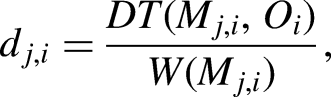
To measure the deviation of each institution, the minimum edit distance between an institution's mandate and the compromise outcome of the inter-institutional negotiations is divided by the number of words in the respective mandate for standardization, similarly to the deviation index by Laloux and Delreux (2018). The deviation d of an institution j from its mandate in procedure i is given by

To calculate the minimum edit distance, proposals and final texts were collected from EUR-Lex. EP and Council amendment table mandates were collected from the Legislative Observatory and the Council register respectively and converted into full texts by amending the proposal texts accordingly. All documents therefore represent full legal texts and can be compared directly. All texts have been stripped of all punctuation and stopwords and words have been lemmatized, that is, reduced to their infinitive form. While pre-processing of the text may neglect differences in content, this has been done in order to reduce noise that may occur due to simple reformulation or restructuring of sentences. Furthermore, all numbers have been excluded in order not to capture differences in the structure of the text that occur due to different formatting and numbering.
For the EP, the committee report provides the negotiating mandate (cf. European Parliament, 2012). For the Council, mirroring Laloux and Delreux (2018), internal analyses have been searched for references mentioning the Council mandate. If no specific mandate was adopted, the general approach was used as the Council mandate. The final texts as published in the Official Journal have been used as the compromise texts. As all files in the dataset were adopted by both institutions at first reading, the final texts correspond to the first reading positions of the EP and thus the trilogue compromise.
Operationalization of independent and control variables
In order to capture the institutional preference cohesion of EP and Council, national party positions by policy area, as indicated by the responsible EP committee, are constructed from manifesto data (Volkens et al., 2018) using the method proposed by Lowe et al. (2011). 7 Manifestos serve to convey the key policy stances parties want to communicate and can be assumed to shape the way other actors perceive their positions. While the national governments are directly represented in the Council, MEPs are elected on their national party's ballots and thus tend to represent their national party's interests to a considerable extent (e.g. Hix et al., 2007).
To construct a measure of preference heterogeneity, the weighted standard deviation of the national party positions in EP and Council at the time of the start of trilogue negotiations is used. For the EP, national party positions are weighted by their seat share in the EP. For the Council, party positions are first aggregated at the national government level using the mean weighted by the party government seat share (Döring and Manow, 2019). The Council heterogeneity is then measured as the standard deviation of the government positions weighted by the (normalized) Banzhaf voting power index to reflect differences in voting power of member states in the Council (Banzhaf, 1965).
This measurement of preference heterogeneity is contingent on the manifesto coding variables selected to scale the institutional preferences within individual policy areas (see the Online appendix). The observed patterns of institutional cohesion are not based on case and issue-specific evaluations of the intra-institutional preferences (e.g. the DEU data), but present a feasible alternative to expert surveys. They are furthermore not endogenous to the variable of interest (vs. roll-call based measures), and take into account the conflict in the parent institution as a whole (vs. time until mandate submission or committee mandate support). The measurement should thus be seen as an approximation of the preference heterogeneity within an institution, where institutional preference statistics are a function of the national parties represented within (e.g. Yordanova and Zhelyazkova, 2020).
The analysis controls for additional legislation-related as well as intra- and inter-institutional factors that might shape the bargaining outcome. Regulation and directive (vs. decision) dummy variables are included in order to capture the effect of the different legal scopes of the respective legislative instruments such as ex-post correction mechanisms available to the Council members in case of directives (cf. Franchino and Mariotto, 2012). A dummy variable indicating whether a proposal amends existing legislation is included in order to indicate the existence of a status quo. Furthermore, the standardized (by proposal length) edit distances between the proposal and the respective institutional mandates, calculated as
Statistical model
In light of the continuous nature of the dependent variable, the analysis will rely on a linear regression model estimated via OLS with an additional squared preference heterogeneity term in order to account for the proposed non-linear effect on bargaining success, such that the systematic component models the variation in mean success

Results
The absolute success variable exhibits slightly different patterns across institutions. The Council seems to enjoy more absolute bargaining success with a rounded mean of
Turning to the regression models, the hypothesis suggests that for the models of absolute institutional success, we should observe
OLS regression analysis.
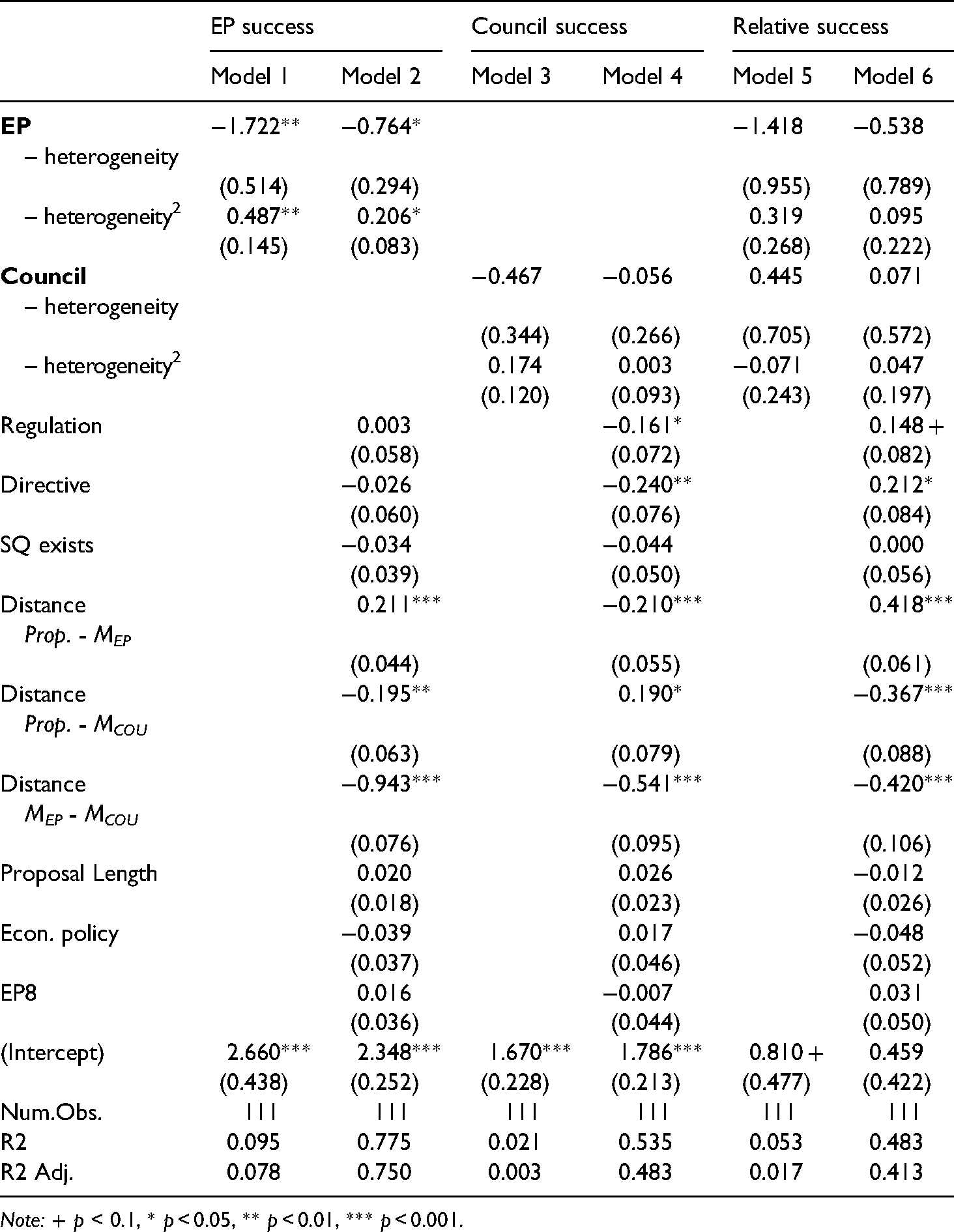
Note: + p < 0.1, * p < 0.05, ** p < 0.01, *** p < 0.001.
To better assess the implications of the regression results of the full absolute success models, Figure 2 shows the expected absolute institutional bargaining success over institutional preference heterogeneity per institution. In the left panel, displaying the expected success of the EP, the hypothesized U-shape of success over preference heterogeneity is clearly visible for the mean expected value with the lower and upper bound of the confidence interval following the general shape with mostly constant distance, but a widening interval towards higher levels of EP heterogeneity. The right panel of Figure 2 displaying the expected absolute Council bargaining success over its preference heterogeneity shows a declining, almost straight mean line with fraying 95% confidence bounds towards the lower and upper extremes of heterogeneity. Substantively, the results in terms of absolute bargaining success suggest that, as hypothesized, the final outcome of a trilogue process, ceteris paribus, is indeed closer to the EP's initial mandate when the preferences for the respective policy area in the plenary are either cohesive or very heterogeneous compared to when they are neither. For the Council, by contrast, the regression results do not support the hypothesized U-shaped relationship.
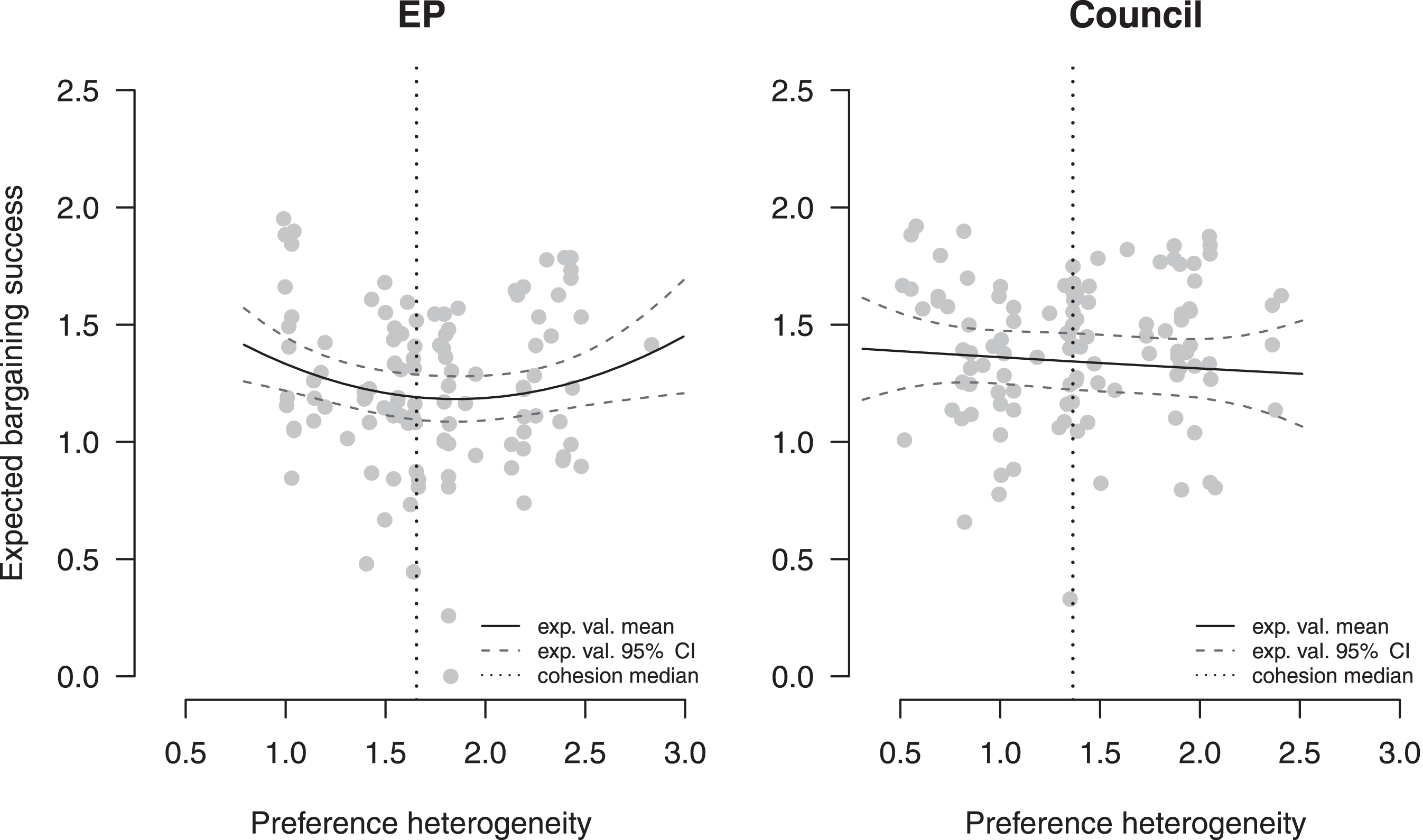
Expected absolute bargaining success of (a) European Parliament (EP) and (b) Council over the range of observed preference heterogeneity for an eighth EP procedure concerning a proposal for a directive containing new economy-related legislation with all other covariate values kept at their means.
Note: Expected value mean and 95%-CI based on
For the relative success model, (
To further assess the relationship between specific values of preference heterogeneity and the expected bargaining success implied by the regression models, Table 2 displays the first differences for scenarios at minimum/maximum and median preference heterogeneity. These are based on the respective full models (2, 4, 6), that is, the difference in expected success at different levels of institutional heterogeneity (cf. King et al., 2000). The values further corroborate the conjecture for the EP: the expected absolute EP success increases, on average, by 0.422 when the EP plenary is most cohesive compared to when it is at its median cohesiveness. Similar, when most heterogeneous, the EP's bargaining success is, on average, by 0.467 higher than at median cohesiveness, suggesting, as hypothesized, a significant increase in bargaining success at the fringes of its preference cohesiveness. Again the values for the Council's absolute as well as the first differences in relative bargaining success across both institutions are not significant at the
First differences.
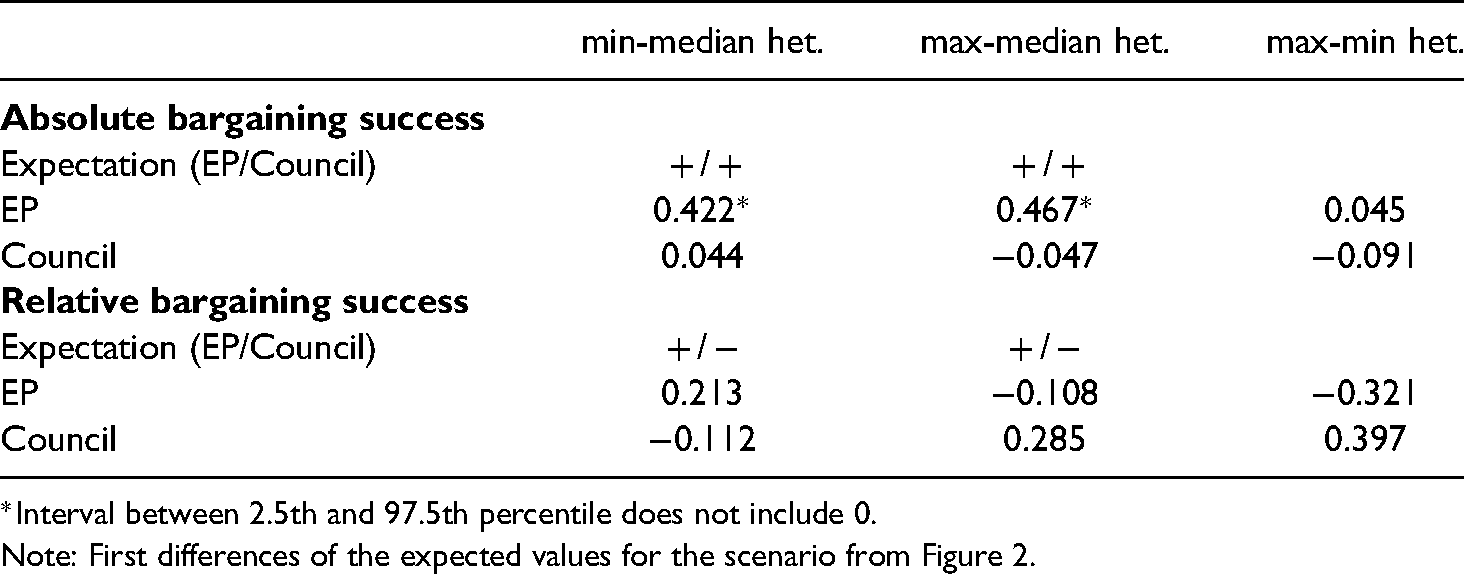
*Interval between 2.5th and 97.5th percentile does not include 0.
Note: First differences of the expected values for the scenario from Figure 2.
With regard to the statistically significant controlled factors, the distance from the Commission proposal of either institution's mandate (Distance
The coefficients for the standardized distance between mandates (Distance
Robustness
To assess the robustness of the presented analysis, I run a range of alternative regression models and specifications, which can be found in the Online appendix. The main finding of the (non-)effect of heterogeneity for the Council and relative success is robust to the inclusion of additional control variables. Models including only the non-squared heterogeneity terms do not show significant coefficients for these terms. Models including alternative dependent variables, namely the raw edit distance as well as the deviation index by Laloux and Delreux (2018) exhibit a significant reverse U-shape effect of preference heterogeneity for the EP. As these measures increase with the distance of the mandate to the outcome, this can be interpreted as further support for the main finding.
Conclusions
This article has studied the determinants of bargaining success in informal trilogue meetings that occur prior to the first reading. While this mode of decision-making is becoming more and more popular in the EU, its outcomes and dynamics are largely understudied in a quantitative context. Leaning on Schelling (1960), I argue that the negotiating delegations of EP and Council play a two-level game, whereby they can use their intra-institutional constraint to extract bargaining success in inter-institutional negotiations. Negotiators can credibly claim that their hands are tied if the members of their parent institutions hold similar preferences and thus do not accept alternative policy proposals or if the institution is very divided and negotiators need to defend a fragile compromise. The results from regression analyses on absolute bargaining success, i.e. the standardized edit distance of the bargaining outcome to the institutional negotiation mandates, reveal a nuanced picture. For the EP, intra-institutional preference heterogeneity exhibits the proposed curvilinear effect on absolute EP bargaining success indicating that the EP enjoys more bargaining success when it is cohesive or very heterogeneous compared to medium levels of heterogeneity. However, the results neither indicate any specific relationship between preference heterogeneity and bargaining success for the Council nor in a relative model comparing the success of EP and Council. Furthermore, in line with previous studies of bargaining success in the EU (e.g. Costello and Thomson, 2013), the compromise is found to be closer to the Council's initial mandate. The results provide several insights into the relationship between institutional cohesion as a factor in bargaining power and success in trilogue bargaining in the EU.
First, for the EP's absolute success, the curvilinear interpretation of Schelling's (1960) conjecture seems to hold. The final outcome of the trilogue negotiations is closer to its initial mandate when its intra-institutional preferences are either distributed heterogeneously or when they are homogeneous compared to in-between. In light of the theoretical argument, this alludes to the conjecture that in EU trilogues credible intra-institutional constraint, induced by cohesive as well as heterogeneous parent chambers, can be used as a bargaining resource in inter-institutional negotiations.
Second, and restricting the former assertion, this pattern cannot be observed for the Council. This permits at least two possible conclusions: either the relationship is not curvilinear or intra-institutional preference heterogeneity does not affect the Council bargaining strategy at all. In the analysed sample, the Council is on average less heterogeneous than the EP suggesting that, for the Council, a claim of constraint due to intra-institutional heterogeneity may be less credible in the first place. In a supplementary Council model (see the Online appendix), however, an alternative specification with a linear preference heterogeneity term does not exhibit a significant effect for heterogeneity. The findings could further resemble a difference in bargaining styles, where the delegations have been characterized as the ‘“adult” solution orientated Council and the teenage Parliament’ (as cited by Roederer-Rynning and Greenwood, 2015: 1155). It seems plausible that the Council's delegation, mostly composed of civil servants, cultivates a less aggressive bargaining style, whereas a political EP delegation of MEPs might stress the constraint due to conflicting interests and resulting fragile compromises. Yet, one might point out that, in light of the generally consensual mode of decision-making in the Council (Häge, 2012; Heisenberg, 2005), its negotiators might also lack credibility when claiming constraint due to heterogeneous preferences among the member states.
Finally, the relative model comparing EP and Council success does not allow for a substantive assertion on the effects of intra-institutional EP heterogeneity on EP success when taking into account the success of the Council, that is, intra-institutional preference heterogeneity does not explain which institution's ideal text the outcome is closer to. Yet, the outcome is, on average, closer to the Council's mandate than the EP's, suggesting that the Council is able to pull the compromise in its direction even when the EP has high absolute success. The reasons for this may well lie within the asymmetric information distribution and differences in leverage between the institutions: while the Council does not publicize its own internal proceedings ex-ante, it is able to closely monitor the EP process. The open structures of the EP make it easy to assess dissent and potential entry points for favourable compromise solutions. Considering the trends towards more trilogue transparency in the EP, this imbalance can be expected to further increase, which is striking considering the importance of (in-)transparency for bargaining power in legislative negotiations in the EU (Broniecki, 2020; Costello and Thomson, 2013). Furthermore, the Council's tougher majority requirements enhance the intra-institutional constraint, and thus leverage, across cases.
The literature on EU legislative politics suggests that the intra- and inter-institutional politics, outcomes and, not least, legitimacy of informal trilogues are different to formal co-decision bargaining (cf. Laloux, 2020). The secluded nature of trilogues limit the systematic knowledge about its dynamics and power structures. This study has aimed to examine an aspect of the intra-institutional dimension in inter-institutional bargaining. Amongst other things, it has shown that recent text-based methods can provide an accessible approach to quantitative research on trilogue bargaining. Thus, a differentiated re-examination and empirical validation of theoretical arguments for trilogue decision-making may be warranted.
Supplemental Material
sj-pdf-1-eup-10.1177_14651165211064485 - Supplemental material for Bargaining power in informal trilogues: Intra-institutional preference cohesion and inter-institutional bargaining success
Supplemental material, sj-pdf-1-eup-10.1177_14651165211064485 for Bargaining power in informal trilogues: Intra-institutional preference cohesion and inter-institutional bargaining success by Maximilian Haag in European Union Politics
Supplemental Material
sj-txt-2-eup-10.1177_14651165211064485 - Supplemental material for Bargaining power in informal trilogues: Intra-institutional preference cohesion and inter-institutional bargaining success
Supplemental material, sj-txt-2-eup-10.1177_14651165211064485 for Bargaining power in informal trilogues: Intra-institutional preference cohesion and inter-institutional bargaining success by Maximilian Haag in European Union Politics
Supplemental Material
sj-R-3-eup-10.1177_14651165211064485 - Supplemental material for Bargaining power in informal trilogues: Intra-institutional preference cohesion and inter-institutional bargaining success
Supplemental material, sj-R-3-eup-10.1177_14651165211064485 for Bargaining power in informal trilogues: Intra-institutional preference cohesion and inter-institutional bargaining success by Maximilian Haag in European Union Politics
Supplemental Material
sj-R-4-eup-10.1177_14651165211064485 - Supplemental material for Bargaining power in informal trilogues: Intra-institutional preference cohesion and inter-institutional bargaining success
Supplemental material, sj-R-4-eup-10.1177_14651165211064485 for Bargaining power in informal trilogues: Intra-institutional preference cohesion and inter-institutional bargaining success by Maximilian Haag in European Union Politics
Supplemental Material
sj-R-5-eup-10.1177_14651165211064485 - Supplemental material for Bargaining power in informal trilogues: Intra-institutional preference cohesion and inter-institutional bargaining success
Supplemental material, sj-R-5-eup-10.1177_14651165211064485 for Bargaining power in informal trilogues: Intra-institutional preference cohesion and inter-institutional bargaining success by Maximilian Haag in European Union Politics
Supplemental Material
sj-R-6-eup-10.1177_14651165211064485 - Supplemental material for Bargaining power in informal trilogues: Intra-institutional preference cohesion and inter-institutional bargaining success
Supplemental material, sj-R-6-eup-10.1177_14651165211064485 for Bargaining power in informal trilogues: Intra-institutional preference cohesion and inter-institutional bargaining success by Maximilian Haag in European Union Politics
Supplemental Material
sj-csv-7-eup-10.1177_14651165211064485 - Supplemental material for Bargaining power in informal trilogues: Intra-institutional preference cohesion and inter-institutional bargaining success
Supplemental material, sj-csv-7-eup-10.1177_14651165211064485 for Bargaining power in informal trilogues: Intra-institutional preference cohesion and inter-institutional bargaining success by Maximilian Haag in European Union Politics
Footnotes
Acknowledgements
The author would like to thank Markus Freitag, Steffen Hurka, Constantin Kaplaner, Nelly Keusch and Nikoleta Yordanova as well as the three anonymous reviewers for their helpful comments. The author would also like to thank Thomas Laloux for providing information on the procedure references covered in  and all the discussants, fellow panelists and panel attendants at the ECPR General Conference 2020.
Funding
The author disclosed receipt of the following financial support for the research, authorship, and/or publication of this article: This research was funded by the Deutsche Forschungsgemeinschaft (DFG, German Research Foundation) – 407514878: ‘EUPLEX – Coping with Policy Complexity in the European Union’.
Supplemental material
Supplemental material for this article is available online.
Notes
References
Supplementary Material
Please find the following supplemental material available below.
For Open Access articles published under a Creative Commons License, all supplemental material carries the same license as the article it is associated with.
For non-Open Access articles published, all supplemental material carries a non-exclusive license, and permission requests for re-use of supplemental material or any part of supplemental material shall be sent directly to the copyright owner as specified in the copyright notice associated with the article.
