



Abstract
The aim of this study was to determine the difficulties experienced by disabled children and their mothers due to the necessity of being at home during the coronavirus 2019 (COVID-19) process. The research is a qualitatively prepared phenomenological-type descriptive study. “Content analysis” was used in the analysis of the interview questions. Semi-structured interview technique was used as the data collection method. It was determined that the disabled child lost the skills he learned during the COVID-19 process; his health was adversely affected; there were disruptions in the education process; behavioral problems began; and he experienced social isolation. As a result, it can be said that both children with disabilities and mothers who care for them try to cope with many difficulties during the COVID-19 process and they are left alone and do not receive support during this process.
Keywords
Introduction
Disability is defined as the deficiency and limitation experienced in the fulfillment of expected behaviors and daily activities as a result of the loss of physical, mental, sensorial, and social abilities of individuals for any congenital or subsequent reason. 1 Among the types of disability; There are people with mental, hearing, visual, orthopedic, language and speech disabilities, mental and emotional diseases, long-term diseases, attention deficit, and hyperactivity disorders. 2 It is estimated that there are more than 1 billion disabled people around the world and more than 2 million in our country according to the 2020 “Statistics Bulletin of the Disabled and Elderly.”3,4 Having a disabled child is very traumatic for families and causes physical, social, economic, and emotional problems. 5 It has been determined that more intense feelings of stress, anxiety, hopelessness, and burnout are experienced especially in mothers who play a major role in the care of their children. In addition to these, having a disabled child causes the deterioration of relationships between spouses, the feeling of guilt, and isolation from society. 6 As primary care providers for children with disability, mothers spend an extraordinary amount of time, physical energy, and emotional labor in supporting their children’s needs, 7 which has grave consequences on both their physical and mental health. 8 For families who take care of a disabled child, this process has become more difficult with the pandemic and has increased the financial and moral burden of families. 9 With the World Health Organization (WHO) declaring the COVID-19 disease a pandemic since March 2020, major changes have occurred in the world and in our country.10,11 While the epidemic, which has become a global threat, caused feelings such as anxiety, fear, and uncertainty, people had to get used to the new social life with the restrictions. 12 While this process affected all individuals and children negatively, it caused more difficulties for disabled children and their families. With the closure of special education centers, a distance education system was introduced, but the fact that this education did not cover all disability groups caused hearing and visually impaired children to fall behind and lose their gains.13-15 According to the results of a study, it was determined that hearing-impaired children could not adapt to online education with hearing aids and had difficulties in developing social skills. 16 The inability to have a daily program in children with autism who are resistant to change caused their routines to change, which caused tantrums and introversion. 17 As children who received physical therapy and rehabilitation services due to social isolation could not benefit from these services, there was progress in their disability levels.13,15 In addition, due to restrictions, home visits could not be made to children with disabilities and they could not be supported at home. 18 Children with disabilities are more likely to have health problems than children with healthy development. Therefore, disabled children are considered to be a risk group in terms of catching COVID-19 disease and having it more severely. 19 However, the fact that the measures taken against the pandemic were not sensitive to the disabled caused the children not to understand the necessity of restrictions and the recommendations for infection control. 17
These problems, which came to the fore with the pandemic, have increased the burden of the disabled child, who is difficult to care for, on families. 20 The closure of special education centers, physical therapy, and rehabilitation units resulted in the full responsibility of the child’s education, physical and social development being given to the family. 21 This situation has increased the burnout, anxiety, and stress levels of parents, especially mothers who provide primary care for the disabled child. 22 The results of the study showed that mothers play a primary role in the care of the disabled child, and they carry heavier physical, emotional, and social burdens. 23 While social support from relatives is important for mothers with disabled children, this social support was also prevented in terms of the risk of transmission of the epidemic. 24 In addition, informing disabled children about the epidemic and protecting them from the risk of transmission increased the care burden of the mother, while the uncertainty of the process increased the level of hopelessness. 25 It has been stated that there are significant increases in domestic violence with the COVID-19 crisis. 26 However, domestic stress has increased due to unemployment and financial difficulties caused by the pandemic, and it is reported that women and children are exposed to more violence. 17 It is thought that mothers who have increased responsibilities in the care of their disabled children encounter problems such as financial difficulties, violence, and lack of social support, which will increase their intolerance to the child and the possibility of experiencing mental problems. It is seen that the role of mothers in the care of disabled children is important. Therefore, in this study, it is aimed to describe the difficulties experienced by children and their mothers due to the necessity of being at home during the COVID-19 process.
Questions of research are as follows:
What are the difficulties experienced by children with disabilities during the pandemic process?
What are the difficulties experienced by mothers with disabled children during the pandemic process?
Material and Method
Type of Research
The research is a qualitative phenomenological-type descriptive study.
Universe and Sample
The universe of the study: It consisted of mothers of disabled children in a rehabilitation center (n = 48). The sample consisted of mothers who could be reached by mobile phone, were literate, volunteered to participate in the research, and did not have mental or hearing disabilities (n = 25). Sample selection is given in detail in Figure 1.
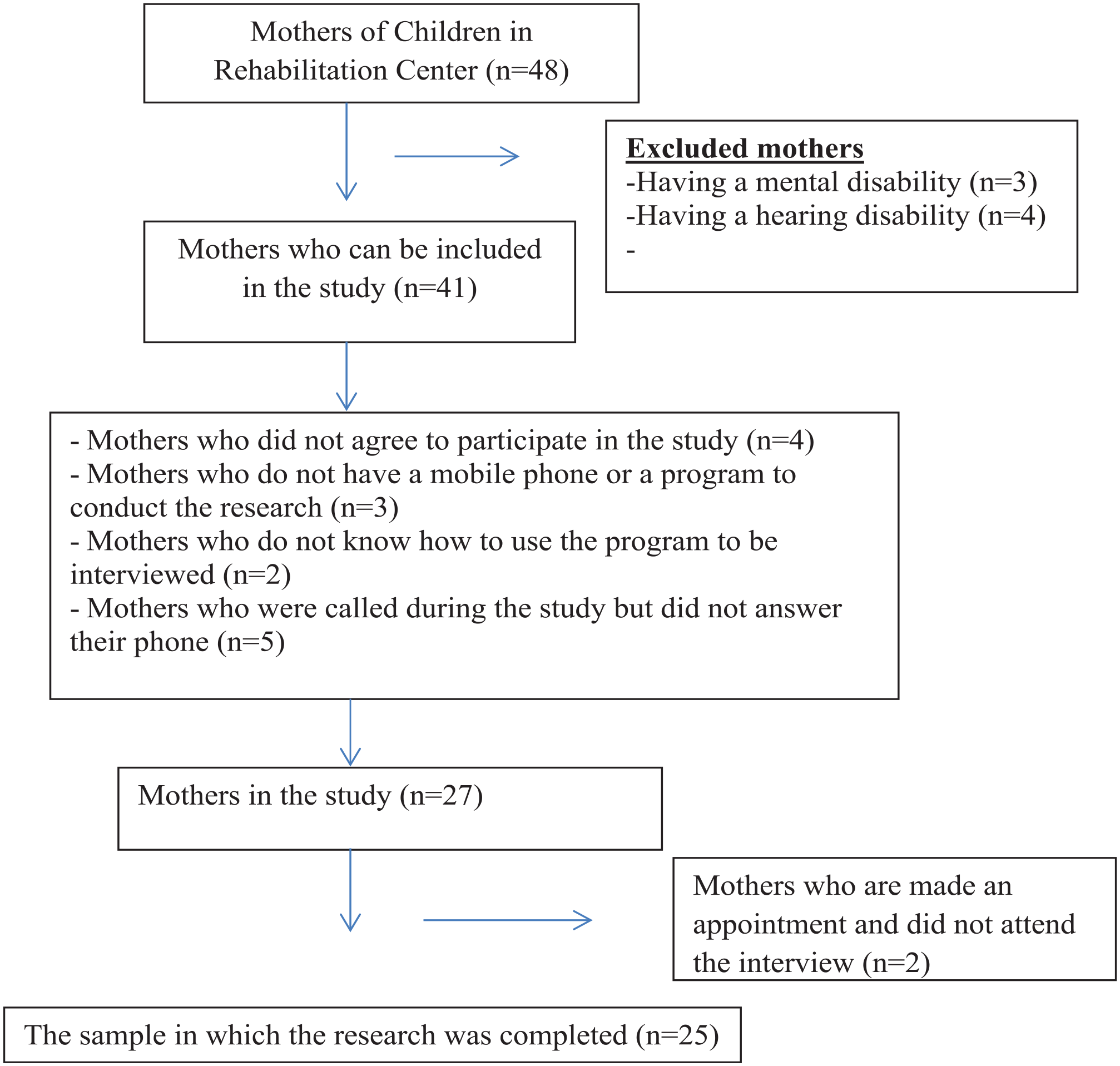
Sample selection.
Research Procedure
Permission was requested to meet and make an interview with the mothers of the children in a private rehabilitation center by the researcher. First of all, the center staff asked the mothers who could participate in the research who were mentally and hearing impaired, if they would like to participate in the interview. The mothers who volunteered to participate in the interview were told to reach the researcher by giving the researcher’s mobile phone number. A suitable day and time were determined for the semi-structured interview with the mothers who voluntarily called the researcher who volunteered to participate in the study. Video semi-structured interviews were provided with the participants. After the interview, all the details of the interview were written down in the mind of the researcher and examined. The same application was made in all interviews. The researcher, who interviewed the participants, has many semi-structured interviews before. To not put both the researcher and the participants at risk during the COVID-19 process, communication was provided via telephone.
Question form
Questionnaire created by the researchers: It consists of socio-demographic data such as age, number of children, number of disabled children, economic status, employment status, and questions about the COVID-19 positivity experienced during the COVID-19 process, and the educational status of the disabled child.
The contents of the interview questions are as follows:
Can you tell us about the difficulties experienced by your disabled child during the COVID-19 process?
Could you tell us about the difficulties you experienced regarding your disabled child during the COVID-19 process?
Data Analyses
Semi-structured interview technique was used to obtain qualitative data, and “content analysis” method was used in analyzing the data. But, as much as possible, the statements of the participants were adhered to. In the analysis process, first of all, the interview records and written forms were deciphered and written separately by 3 researchers and analyzed. Then, the data were analyzed in 4 stages: (1) coding the data, (2) identifying the themes of the coded data, (3) arranging the codes and themes, and (4) defining and interpreting the findings. Researchers determined the themes independently of each other; then, these themes were repeated together by 2 researchers. Evaluated and all 2 researchers agreed themes are revealed.
Reliability and Credibility
For reliability and credibility, participant confirmation and peer debriefing technique was used. After compiling the first codes, the opinions of the participants were verified by the participants for the accuracy of the codes and comments, and if the codes contradicted the participants’ comments, the codes were corrected accordingly. The peer debriefing method was carried out by experts in the qualitative research field. The evaluation of the experts’ comments for reliability was carried out with the intercoder reliability suggested by Miles and Huberman. 27 The experts were asked to examine the data by giving information about the study and the results achieved by the study. After an agreement was reached on the themes selected in line with the analysis and suggestions of the space, they were organized into categories and subcategories. According to the answers given by the experts to the codes, the reliability between the coders was 92%.
Ethical Considerations
The study was approved by the Ethical Commission of a Public university. Written and verbal consent was obtained from the mothers. The research was conducted in accordance with the Helsinki Declaration Principles.
Findings
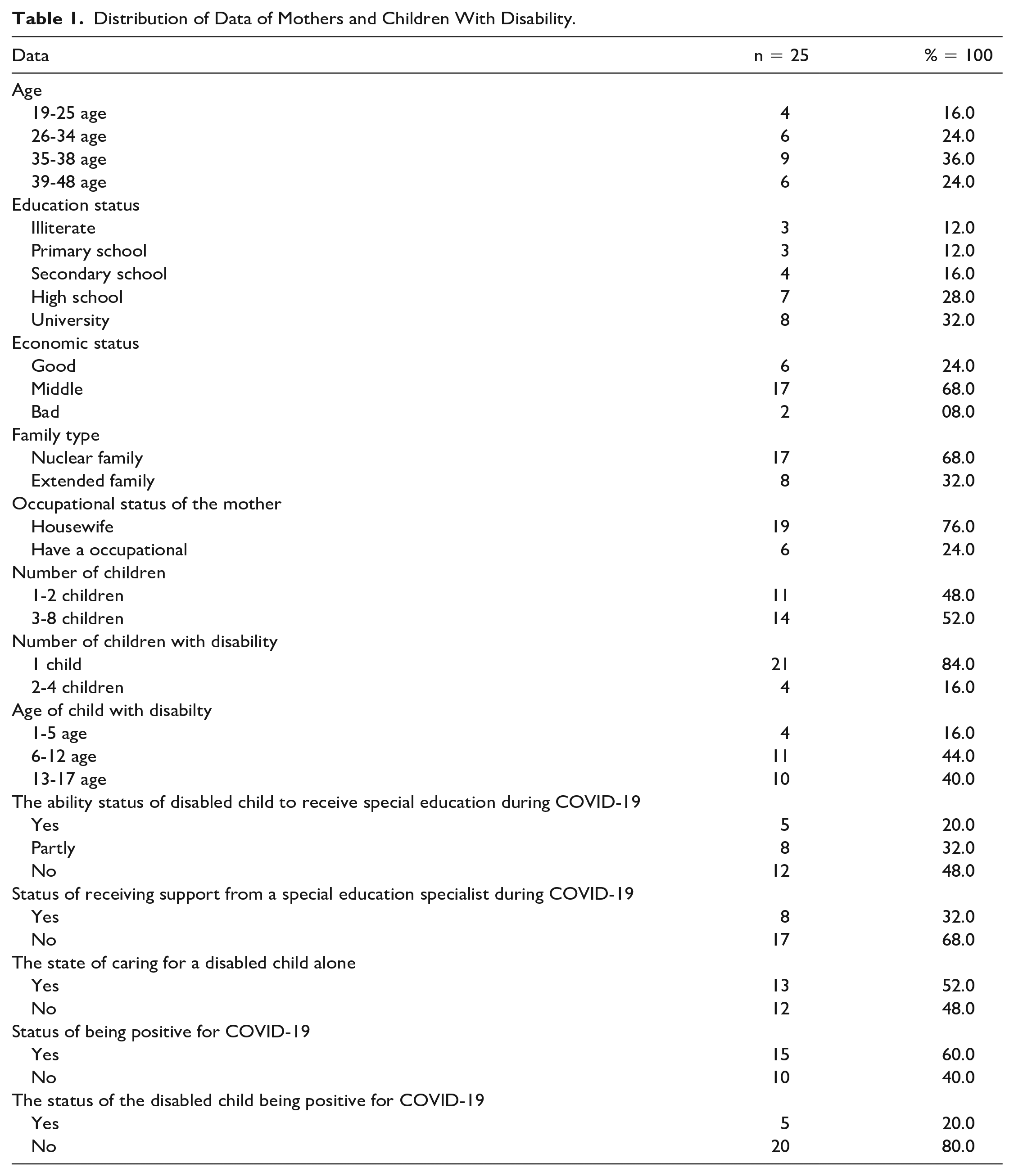
In total, 36% of the mothers are in the 35 to 38 age range, 32% are university graduates, 68% have a moderate economic status, 68% have a nuclear family, 76% are housewives, 52% have 3 to 8 children, 84% have 1 disabled child, 44% have disabled children between the ages of 6 to 12, 52% take care of the child alone during COVID-19, and 60% had COVID-19 positivity. In total, 48% of disabled children cannot receive special education during COVID-19, 68% did not receive support from a special education specialist during COVID-19, and 20% had COVID-19 positivity (Table 1).
Distribution of Data of Mothers and Children With Disability.
Problems Experiencing a Disabled Child
Theme 1: Losing the skills learned
My child had difficulty in performing personal hygiene while he was at home. She used to be able to clean the toilet on her own, but she can’t anymore (participant 1, child 15 years).
My child used to be able to walk on his own, but he has regressed so much during the COVID-19 process that we stayed at home, he can no longer walk alone without help, he does not eat, fill and drink water . . . (participant 8, child 15 years).
Unfortunately, my child’s condition worsened due to the fact that he could not receive education during the compulsory closure periods we experienced during the COVID-19 process, he cannot eat, he cannot do any work, he expects me to meet all his needs (participant 23, child 15 years), (Table 2).
Themes Related to the Problems Identified in Children With Disability.
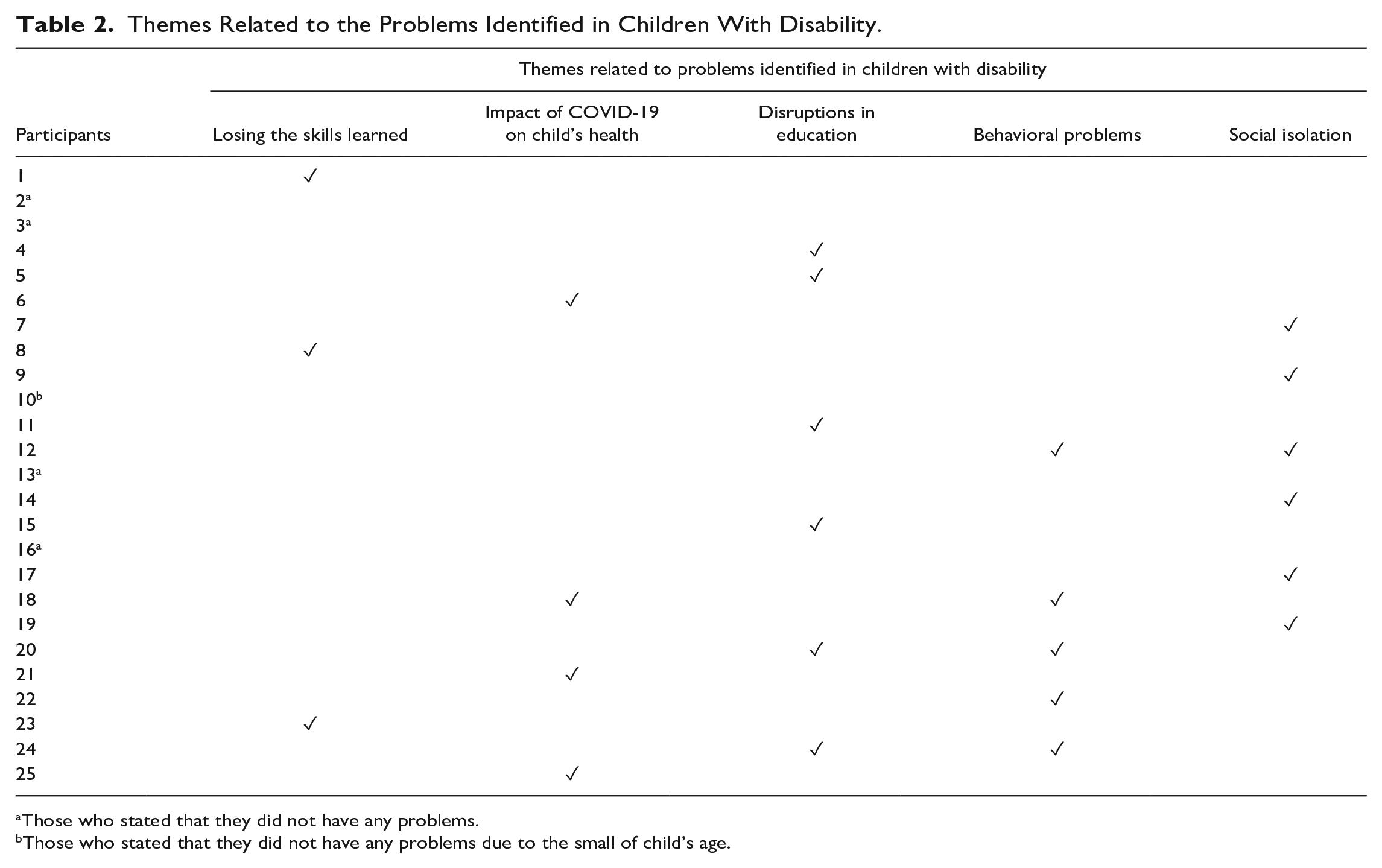
Those who stated that they did not have any problems.
Those who stated that they did not have any problems due to the small of child’s age.
Theme 2: Impact of COVID-19 on child’s health
The biggest problem in the COVID-19 process was getting health care. All appointments were closed, I couldn’t have my child’s check-ups, we couldn’t take his medication, it’s really hard for us (participant 6, child 15 years).
There were problems in my child’s controls during the COVID-19 process. We could not go to our regular check-ups, our hospital appointments were either canceled or we could not get an appointment (participant 18, child 12 years).
My child’s mentally handicapped patient had 2 seizures during the COVID-19 process. Although I was afraid of taking her to the hospital environment, I had to take her to the hospital twice, which made me very nervous (participant 21, child 12 years).
Hand hygiene and social distance are very important in the COVID-19 process, but my child cannot use his wheelchair without using his hands, since he cannot use his feet, he has to do everything with his hands. He can’t follow social distancing either because he has to get help, he has to get support from someone while getting on the school bus, while passing through the school gate, without me (participant 25, child 13 years), (Table 2).
Theme 3: Disruptions in education
We had difficulties in getting special education during the COVID-19 process. Mostly we couldn’t go to the rehabilitation center. Necessary education was not provided for my child while we were at home (participant 4, child 9 years).
We did not receive any training during COVID-19 . . . (participant 5, child 10 years)
During the COVID-19 process, when the rehabilitation centers were open, he had difficulty in understanding the words our teacher said due to his mask and compulsory social distance (participant 11, child 5 years).
We had to take a break from our special education during the COVID-19 process, no one supported us, I tried to organize activities so that he would not forget the skills he learned alone. However, I cannot say that it is very useful. He forgot most of the skills he gained in this process (participant 15, child 11 years).
During the COVID-19 process, we had major problems in getting special education. Distance education has not been very beneficial for us. My child is not learning anything. He also forgot what he knew. He cannot focus on the distance education given and does not want to participate (participant 20, child 15 years).
Since he is not in a friendly environment like in the rehabilitation center, he tries to escape at every opportunity in distance education, so we have difficulties in education (participant 25, child 13 years), (Table 2).
Theme 4. Behavioral issues
He was always at home, there was no distraction, he became a thoroughly aggressive child. He is constantly cursing and shouting (participant 12, child 12 years).
When he went out of the house, my child’s time was running out, now that we are at home, an aggressive situation started in my child and he became addicted to television. He does not listen to me (participant 18, child 12 years).
He is experiencing a great loneliness due to being at home during the COVID-19 process. He always wants to play on the phone and exhibits aggressive behavior toward family members (participant 20, child 15 years).
The child is very bored of being at home all the time. He watches the videos taken by YouTubers on his tablet, and when I do not allow him to watch, he gets angry, becomes aggressive, cannot cope (participant 22, child 17 years)
He had a hard time understanding the situation of being at home all the time. Even though I told him how long he had to stay at home, he wanted to go out. It was very difficult to explain this situation to him. I couldn’t convince him to stay at home, he kept arguing with me, I couldn’t cope with him going out anymore (participant 24, child 15 years), (Table 2).
Theme 5: Social isolation
During the COVID-19 process, she became insensitive to her surroundings, closed in, constantly crying, and does not tell anything when asked what happened (participant 7, child 10 years)
Being at home during the COVID-19 process has made my child very lonely. Very unhappy . . . . (participant 9, child 9 years)
He was alone at home during the COVID-19 process, distanced himself from his friends, withdrawn, does not talk to me as much as he used to (participant 12, child 12 years).
He couldn’t see his friends during COVID-19, which made him very sad . . . . (participant 14, child 5 years).
My child has started to get very bored of staying at home, if we go out, there is a virus, if we stay at home, my child does not stop. Although other children excluded my child even if he went out anyway, and when the virus hit, his body was disabled before, now his spirit is disabled (participant 17, child 8 years).
I had a hard time communicating with my son. He couldn’t find anything to do when his schools were closed during the COVID-19 process. He has no circle of friends, unfortunately, no one accepts him, he has become a very introverted child. He does not talk to us, he does not do what I say (participant 19, child 5 years), (Table 2).
The Problems of the Mother of a Disabled Child
Theme 1: Fear of COVID-19
To protect my child from this disease during the COVID-19 process, I used gloves and masks while preparing his meal. I was careful not to touch him. I was very afraid of getting sick and making him sick (participant 1, child 15 years).
Because I work outside, there is a fear of COVID-19, he cannot love my child as I want, I cannot touch him (participant 17, child 8 years).
Due to the COVID-19 process, I cannot take my child to health check-ups as much as before(participant 21, child 12 years), (Table 3).
Themes Related to Problems Identified in Mothers With Disabled Children.
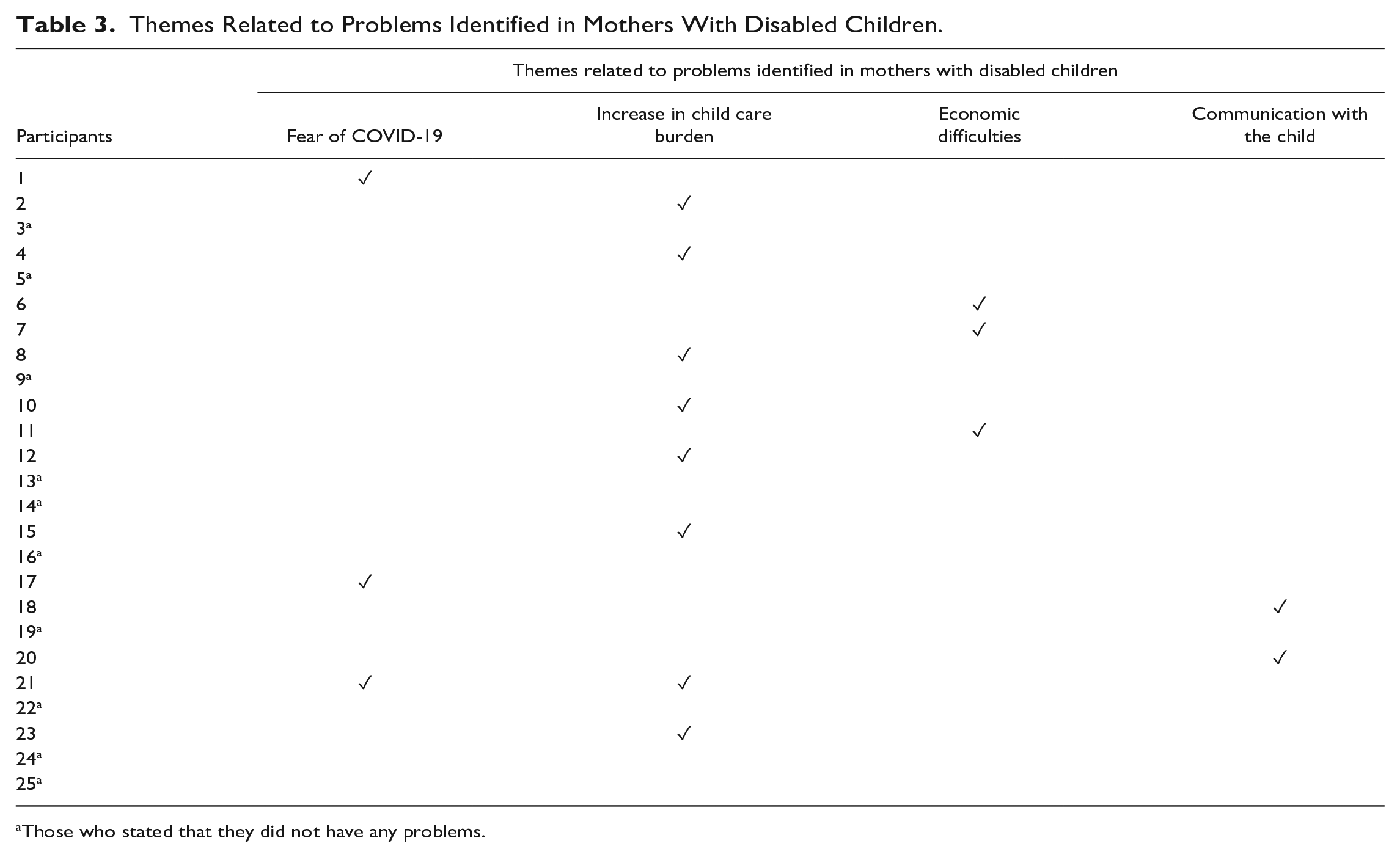
Those who stated that they did not have any problems.
Theme 2: Increase in child care burden
I was unable to take care of my child during the COVID-19 process. It is so difficult that going to work, other children’s needs, housework . . . I can’t handle this much burden anymore, I neglected my disabled child . . . (participant 2, child 12 years).
My child needs to exercise and walk regularly, but I have a lot of work to do, so I can’t take care of him most of the time (participant 4, child 9 years).
During our stay at home, she makes me do her needs by crying all the time. For example, she used to eat her food, but now she makes me do it, she doesn’t even fill her water and drink it (participant 8, child 15 years).
I’m trying to meet all of my child’s needs alone, this situation is pushing me hard. In the past, rehabilitation centers used to take this burden on us. However, now the rehabilitation centers are closed and I find it very difficult to take care of my child (participant 10, child 1 year old).
Being with the child all day, meeting his needs, feeding him, dressing him, cleaning his diaper . . . a lot of work is too hard for me, I neglect my other children. I have no more strength, it is very difficult to meet the needs of my disabled child and to care for him (participant 12, child 12 years).
I have to take care of my child all by myself, my wife does not support, there are other children, I have to meet their needs, no one supports us, it is very difficult to have a disabled child, I try to meet his needs all day . . . (participant 15, child 11 years) .
I have to take care of my child alone during the COVID-19 process, my wife is not with us for some reasons, so I meet all the needs of my child. Although this situation is often tiring, I am happy to look after him (participant 21, child 12 years).
Since we are at home during the COVID-19 process, I have to care for my child alone. This situation is very tiring for me (participant 23, child 14 years), (Table 3).
Theme 3: Economic difficulties
My wife had to leave her job during the COVID-19 process. We no longer have a monthly salary. This situation makes it very difficult for us, we cannot meet my child’s special needs and medications (participant 6, child 15 years).
My child needs special treatment methods, they used to do this in rehabilitation centers. But now we have to go to private paid centers because the rehabilitation centers are closed. These centers are paid and their fees are very high. We do not have enough economic power to cover these fees (participant 7, child 10 years).
Our economic situation has worsened during the COVID-19 period, my wife does not work, we cannot even meet the nutritional needs of my child (participant 11, child 5 years), (Table 3).
Theme 4: Communication with the child
During the COVID-19 process, it affected my relationship with my son so badly. He used to be a loving child on the way to school, we used to chat when he came home from school, but now he doesn’t talk to anyone . . . (participant 18, child 12 years).
During the COVID-19 process, my wife and I tried to take care of our child, but he is very jealous of his brother. No matter how hard I try to talk to him about this situation, I can’t succeed, he doesn’t understand me, he thinks we love his brother more. I don’t know how to solve this situation, being at home all the time changed him a lot, he was not such a child (participant 20, child 15 years), (Table 3).
Discussion
The pandemic, which has negative effects all over the world, has caused special groups such as children, the elderly and disabled individuals to experience even more negativity. 18 Especially disabled people who need other individuals for their care have had difficulty in adapting to the changes experienced with the pandemic. 28 Therefore, families with disabled children were also affected by this situation. During the pandemic, the burden of care of mothers who take care of the disabled child has increased, and this has brought up many problems.1,6 In this qualitative study conducted to determine the difficulties experienced by mothers with disabled children during the pandemic, 36% of the mothers were in the 35 to 38 age range, 32% were university graduates, 68% had medium economic status, and 68% had a nuclear family. It has been determined that 76 of them are housewives, 52% have 3 to 8 children, 84% have 1 disabled child, and 44% have children with disabilities between the ages of 6 to 12. In a study conducted to examine the daily life activities of children with special needs during the pandemic process, it was determined to that 52.5% of the mothers were between the ages of 21 to 30, 42.5% were high school graduates, 75% had a nuclear family and had a middle socioeconomic level. 29
In our study, it was determined that children with disabilities lost the skills they learned during the pandemic process and became unable to meet their personal needs, which they could previously meet on their own.
In line with our study results, it has been reported in many studies that the routines of children with disabilities have changed during the pandemic process, and as a result, they are unable to do the activities they can do Daily.19,20,30-33 On the contrary, according to the results of a study, it was determined that 58% of children could not meet their self-care needs on their own before the pandemic, and 78% of them did not have any change in their self-care skills after the pandemic. 29
It is known that disabled people have a high incidence of multiple long-term diseases and are a population in need of health services the most. 34 Disabled people, who were exposed to certain inequalities in benefiting from health services before the pandemic, experienced this even more after the pandemic. 35 According to our study results, mothers reported that they could not take their disabled children for a check-up due to closure of appointments, could not take their medicines, and could not access health services due to the risk of COVID-19 transmission. Studies in the literature support our research findings and show that disabled children have problems in benefiting from health services during the pandemic process.17,19,32,36 Apart from these, in some studies, mothers have stated that staying at home constantly reduces the physical activity level of children and that they cannot provide weight control due to this.29,31 Therefore, children become vulnerable to obesity and related diseases. 37 While COVID-19 is already a risk factor for people with disabilities, the lack of accessible emergency preparedness plans and health services poses an increased risk. 38 According to Sabatello et al 28 emphasized that with the pandemic, people with disabilities are exposed to inequalities in health services at an increased rate, and it is necessary to make health care plans for this situation. Various suggestions have been made for the disabled to benefit from health services during the pandemic process. Holmes et al 39 recommended the establishment of online clinics as an urgent priority to reduce the effects of COVID-19 on children with disabilities. It has been emphasized that expert support is important in health-related issues during the pandemic process and that telehealth services should be provided to children with disabilities and their families in this process.40,41 It is thought that with telehealth services, disabled people can benefit from health services without the risk of contamination. 42
In our study, it was determined that children with disabilities could not receive education due to the closure of special education centers, distance education was not effective and they forgot the skills they gained because they did not receive any support. In addition, mothers who are responsible for their children’s education stated that they are not sufficient in this regard and that they cannot make the necessary activities for their children’s education. One of the areas where the pandemic has changed a lot is education, and with the closure of schools and special education centers in this process, formal education was interrupted and distance education was started.43,44 The educational difficulties experienced by disabled children, who need more education than healthy children, before the epidemic became more intense with the pandemic.14,45,46 According to the study results of Sardohan Yıldırım and Bozak, which are similar to our study findings, mothers stated that their children did not receive partial or no educational support during the pandemic process, that they could not make their children do activities and homework at home, that their children were not sufficient for online lessons, and that some of them did not have Internet or computer at home. It was determined that they could not benefit from education. However, the mothers stated that they could not get support from a specialist or a teacher during this process and demanded that a teacher or specialist come to their home for the education of their children. 19 The results of the studies in the literature showed parallelism with our study and showed that children with disabilities had difficulties in getting education during the pandemic process, could not benefit from distance education and mothers were not enough to provide education.17,18,20,31,33,47-49 However, in some studies, it has been stated that mothers do not know how to get their children to do activities and it is important for mothers to be educated on this issue.50-53 Another problem is that children with disabilities cannot benefit from distance education due to social inequalities, and there are studies supporting this result.9,19,54 Krishnan et al 16 concluded in their study with disabled adolescents that because the online lessons do not cover all disability groups, the disabled people who use hearing aids cannot adapt to online lessons and cannot develop social skills. While it is important for children with disabilities to receive support from a specialist at home during the pandemic process, it has been reported that children cannot receive support from a specialist at home, similar to our study.20,47,48,55
In our study, it was determined that social isolation causes behavioral disorders in children with disabilities. The mothers stated that they were bored, lonely, aggressive, angry, and withdrawn from staying at home all the time, and that they could not cope with these situations. One mother stated that her child watches YouTube videos on a tablet all the time and cannot prevent it. Looking at the studies in the literature, it has been reported that during the pandemic process, undesirable behaviors occur in children with disabilities; they become aggressive, withdrawn, and experience tantrums.52,55-57 It has been supported by studies that children who are bored of staying at home increase the time they spend in front of the screen.17,19,20,29,31 As a result of all these, it has been reported in many studies that mothers could not cope with the behavioral problems of their children.9,20,47,58 It is seen that our study result is compatible with the literature, and it is thought that it will be important to support mothers to cope with the behavioral problems of their children.
In our study, it was determined that mothers’ children were afraid of having COVID-19, and therefore, they could not touch their children or take them to health check-ups. It is known that disabled children have health problems such as getting sick frequently, metabolic disorders, or low immunity. 59 These existing health problems and disabilities are thought to increase the likelihood of contracting COVID-19 or experiencing the disease more severely. 60 According to the results of many studies, it has been determined that people with disabilities face the fear of becoming COVID-19 during the pandemic process, so they cannot benefit from health services and this situation creates great stress and anxiety on families.28,36,52,61,62 According to the qualitative research results of Sardohan Yıldırım and Bozak, 19 it was determined that a mother could not cope with the fear of infecting her disabled child with COVID-19, and as a result, she started psychiatric treatment. The World Health Organization (WHO) 63 emphasized that children with disabilities are at greater risk of contracting COVID-19 because of their inability to understand and follow the precautions regarding the disease, the necessity of restrictions, and recommendations for infection control, which may increase the anxiety level of families. In addition to all these, it has been reported that the public health information about protection from COVID-19 is not in a format suitable for the hearing and visually impaired, which causes limited access to this information. 64 In addition, studies have emphasized that it is very difficult for the hearing and visually impaired to apply restrictions such as maintaining social distance and limited tactile contact, and in this respect, they become risky for COVID-19. 65 In addition to the fear they experienced about their children, mothers had to give information about COVID-19 and explain the situation.66,67 As a result, it is seen that our study result is compatible with the literature. In line with these, it is thought that it will be important to prepare public health information such as hand washing and use of masks for disabled children, to support mothers on this issue, and to provide health checks of disabled children with telehealth services. According to our study results, it was determined that the care burden of mothers increased as a result of the closure of rehabilitation centers with the pandemic and the loss of self-care skills of disabled children in the process. The mothers stated that they were alone in caring for the child, and that no one, including their spouses, supported this situation, which was very difficult and tiring. It is known that mothers play a primary role in the care of disabled children, and they carry heavier physical, emotional, and social burdens.23,68 Mothers who had difficulties in the care of their disabled children before the pandemic took more responsibility in terms of care, communication, education, and health during the stay at home, so their difficulties increased even more. 21 This situation has increased the care burden of mothers and causes them to be adversely affected psychosocially. 25 When we look at the literature, it has been reported that our study result is compatible with other studies that mothers are alone in this process, and their care burden, anxiety, stress, and burnout levels increase.20,44,56,58,69 One of the important points to be emphasized is that the restriction of social relations due to the risk of transmission of COVID-19 has also eliminated the social support of mothers with disabled children from the environment and close relatives. It is also emphasized that mothers do not receive sufficient support from their spouses.48,70 In line with all these results, it is thought that providing social support and sharing stress and anxiety levels will be important to reduce the care burden of mothers. It is known that as the caregiver’s burden increases, there will be a decrease in coping capacity. 70
According to our study results, mothers stated that their spouses were dismissed due to the pandemic, they had great financial difficulties, and they could not meet the needs of their children. As it is known, families with disabled children are struggling financially due to the intense needs of their children in areas such as health and education. 71 While this is the case, families have begun to experience greater economic difficulties with the layoffs, part-time work, and unpaid leave applications along with the pandemic process. 67 In line with our study results, studies in the literature have also determined that the pandemic process has adversely affected the economic situation of their families, and families with a disabled child have been negatively affected by this situation.18,19,72
In our study, mothers stated that their communication with their children deteriorated during the pandemic process and that their relations were better when they went to school. They also stated that their relationship with their brother deteriorated. During the pandemic, which is a period when social support is most needed, children need to play and communicate with their friends. However, the restrictions made caused children to be isolated from their friends and kept them away from environments that would facilitate coping with this crisis.73,74 When the studies in the literature are examined, it has been determined that the results support our study and that the pandemic causes communication disorders between disabled children and their families, and problems between siblings.21,31,47,58,62 Due to the fact that children who have disabled siblings do not have information about how to communicate with them and how to overcome problems, it is stated that there may be communication disorders between siblings. 75 Therefore, it is thought that there may be increased communication problems and disagreements between siblings who stay at home for a long time due to the pandemic. In a study, it was determined that as the behavior problems of the disabled child increased, their relations with their siblings deteriorated and they moved away from each other. 76 It is an expected result that the relations of disabled children, whose behavior problems have increased during the pandemic process, also deteriorate with their siblings.
Implications for Health Social Work Practice
The pandemic had a negative impact on all segments of society as well as the children with disabilities and their mothers who were responsible for their care burden. Children with disabilities and their mothers faced many problems. Children with disabilities, who have difficulties in communicating in normal life and in accessing health services, have started to experience greater problems during the pandemic process 77 With the closure of schools, distance education started and this situation became a great handicap for handicapped children. Children with disabilities such as hearing, vision, and intellectual disabilities have had problems in keeping up with distance education. 78 However, the support of teachers is very important for handicapped children and their families. It should be ensured that these individuals who are in need of special education receive education regularly and according to their needs. Problems in education are negatively neutral to the lives of these children, so teachers, educators, and social workers should not leave handicapped children and their families alone. 79 During the pandemic period, these children and their families should urgently be supported with social work practice.
Also, increased support for referrals to medical practitioners by health social workers has been shown to assist in lowering the physical and mental health problems faced by mothers with children with disabilities. 77 For this reason, it is very important that health care professionals working intensively during this period support both these children and their families without forgetting this special group and according to their needs.
Conclusion
Unfortunately, the situation of children with disabilities and their families could not be handled and managed well during the pandemic period. COVID-19 has caused confusion in many areas such as benefiting from health services, education, and socialization, and has created a great handicap for children with disabilities and their families, especially from vulnerable groups of society. In this study, it was revealed that the disabled child lost the skills he learned during the COVID-19 process, his health was adversely affected, there were disruptions in the education process, behavioral problems began, and social isolation. In addition, it has been determined that mothers with disabled children experience fear of COVID-19 in this process; the burden of care for their disabled child has increased; they have economic difficulties; and they have difficulties in communicating with their children. Children with disabilities are at risk of being lost amidst the hubbub of the pandemic. Parents of children with disabilities have traditionally been the sole advocates for their children. For this reason, it is important that the health care professionals step in and support the family and the child in case of the problems that arise due to the increase in the burden of care of the parents who take care of their children and the family’s possibilities are exhausted. Health care professionals must provide timely and appropriate support to parents, assist with the ongoing care burden, and provide training on the emotional management of the pandemic process. In the study, most of the mothers stated that they did not receive training from the health care worker. However, parents who are well educated by the health care team are more likely to follow all recommended treatment methods and practices that should be done at home. For this reason, the child who receives continuous and correct treatment and care will provide a smoother life, and consequently, the care burden of the parents will decrease. In addition to health care professionals, it is necessary to make new regulations and support these special children according to their disability through state policies. At this stage, the number of teachers in rehabilitation centers should be increased and individuals with handicapped children should be supported. These mothers and children can be helped more by the support provided to the teaching staff and the implementation of inclusive education policies.
Author Contribution
MYÇ: Contributed to study conception and design; data collection; data analysis and interpretation; drafting of the article; critical revision of the article.
Footnotes
Acknowledgements
The author thanks all the individuals who participated in the study.
Availability of Data and Material
The data that support the findings of this study are available from the corresponding author upon reasonable request.
Declaration of Conflicting Interests
The author(s) declared no potential conflicts of interest with respect to the research, authorship, and/or publication of this article.
Funding
The author(s) received no financial support for the research, authorship, and/or publication of this article.
Ethical Considerations
The study was approved by the Ethical Commission of a Public University. Written and verbal consent was obtained from the mothers. The research was conducted in accordance with the Helsinki Declaration Principles.
The Patient Consent
Patient consent was obtained from the participants in this study.
