



Abstract
Background
Previous research has explored experiences of choral music-making and its benefits for health and well-being.
Purpose
The purpose of this study is to explore what makes engaging in choral music-making meaningful for choral musicians in Canada as illuminated by their experience of the first 18–22 months of the COVID-19 pandemic.
Methods
Semi-structured interviews were conducted with 18 participants who are involved with choral music-making across Canada. Interpretive description was used to analyze the interview data.
Findings
Three themes were identified: (1) music-making contributing to a sense of community, (2) transcendent properties of music-making, and (3) music-making contributing to a sense of self.
Implications
This study provides insight into aspects of music participation which contribute to its meaningfulness, the utility of considering choral music-making as a co-occupation, and the relationship between choral music-making and participants’ self-concept. The findings provide insight on how occupational therapists can support people who engage in this meaningful occupation.
Background
Choral music-making is a diverse and meaningful occupation, enjoyed by people of many different backgrounds, with unique motivations and reasons for engagement. In 2017, Choral Canada undertook a national choral census to count and describe choirs in Canada, and found that there were 27,700 choirs across Canada with 3.5 million choral musicians, about 10% of the total Canadian population in the same year (Hill, 2017). Certain characteristics distinguish choir from other group singing. Jacob and colleagues (2009) make an important distinction between singing as a shared occupation, such as the audience singing along with the national anthem at a sports game, and singing as a co-occupation, as found in choir. They posit that choral music-making requires individuals to interact with one another to communally make music whereas individuals singing an anthem at a sporting event may have little interaction with one another. This distinction makes choral music-making a distinctively social occupation (Jacob et al., 2009). For the purposes of this study, we define choral music-making as a co-occupation in which groups of people sing together, with or without the accompaniment of musical instruments, and with or without an audience.
Meaningfulness of Choral Music-Making
The meaningfulness of choral music-making can be conceptualized with the pan occupational paradigm (POP). Drawing from Wilcock's Occupational Perspective on Health (1998, 2006), Hitch and Pepin (2021) describe four dimensions of the POP: doing, being, becoming, and belonging. Previous research on the meaningfulness of choral music-making, reviewed below, support that choral music-making (doing) can bolster one's sense of identity (being), provide opportunities for growth (becoming), and foster a sense of community (belonging). These four dimensions are intertwined with one another in the meaning-making process.
A sense of community and social inclusion has been described as supporting choral musicians’ sense of belonging. Social inclusion has been linked to a feeling of value and belonging through spending time together, fostering a sense of connection (Batt-Rawden & Andersen, 2020; Camlin et al., 2020). Engaging in communal music-making has been found to facilitate connections among participants, promoting connections through music, creating togetherness and belonging, and providing social benefits (Perkins et al., 2020). Older adult participants in music-making expressed how these social benefits facilitated meaningful experiences by providing opportunities to learn from others and meet new people, despite differences and challenges (Abell et al., 2017; Perkins & Williamon, 2014). Participating in a choir has been found to support immigrants (Adrian, 2013) and refugees (Raanaas et al., 2019) who are transitioning to a new country by building connections and forming a new identity in a new place.
Choral music-making offers opportunities for growth and self-discovery through experiences of accomplishment. Choral musicians in previous research emphasized the importance of engaging in something difficult but rewarding, stating that music-making promotes agency by “opening doors” to enhance self-efficacy, distinguishing their own competence to achieve, commit, and self-motivate (Perkins et al., 2020). The combination of musical challenge and a safe environment has been found to motivate participation in choir and lead to feelings of unity among members of the group (Tonneijck et al., 2008). Professional choral musicians described that the high level of performance they could achieve in professional choirs was motivating for them, despite facing challenges such as higher demands, inflexible contracts, and a lack of sick leave (Walker, 2021).
The bodily experience of choral music-making involves creative and emotional expression, which is interconnected with its meaningfulness for the choral musician. Music participation can provide opportunities for emotional connection, expression, management, and release both individually and collectively (Perkins et al., 2020). The emotional outlet and stress relief that can be experienced through choral music-making offers a cathartic opportunity to express emotions, both personally and collectively, contributing to the meaningfulness of this occupation (Jacob et al., 2009; Southcott & Li, 2018). Barrett and Vermeulen (2019) studied an intrinsic human need to make music collectively, specifically how a communal occupation like choral music-making supports resilience and adds personal and social value to the member's lives, stating “music is the glue that holds the choir together” (p. 53). Davidson and Correia (2001) explored the bodily experience when involved in music-making, highlighting the experience of a state of flow: becoming one with the music and losing a sense of time, “how music can be both a projection of the listener's inner life and the performer's inner life, and at the same time belong to the material realm” (p. 8). Overall, previous research on the meaningfulness of choral music-making suggests that social connection, self-discovery, and emotional release contribute to the meaningfulness participants ascribed to choral music-making.
The meaningfulness of choral music-making can be complicated by the difficulties faced when choral singing is a central source of one's income. Professional choral musicians report facing work-related stressors, including financial instability, competition for paid positions, a lack of sick leave, and at times heavy workload (Walker, 2021). This resembles work-related stresses faced by many professional musicians, who find that certain aspects of professional music-making complicate the meaningfulness of this occupation (Coulson, 2012). For instance, a state of flow, which can be motivating for many musicians, is something that some professional musicians take steps to avoid because of the risk that they will lose a sense of time and practice for too long, causing injury (Guptill, 2012). Despite these stressors, professional choral musicians also describe that this work is highly meaningful and gratifying, with some describing it as being “like a calling” for them (Walker, 2021, p. 107). Thus, the meaningfulness of choral music-making for professional choral musicians is intertwined with the complexities of being financially dependent on it.
We have seen from the literature reviewed above that the meaningfulness of choral music-making is intertwined with the dimensions of human occupation described in the POP. The experiences of choral music-making (doing) intersect with participants’ sense of identity (being) and offer opportunities for accomplishing goals (becoming), while connecting individuals in a collaborative group (belonging). Even while professional choral musicians express conflicting emotions about the struggles to support themselves financially, choral music-making in a professional setting (doing) continues to align with their identities (being), provide a sense of accomplishment (becoming), and connect them to other choral musicians (belonging). Further, the “doing” is so highly interactive that individual choral musicians would be unable to create a semblance of choral music-making without the interplay between musicians. This level of interaction most closely aligns with Pierce's (2009) description of a co-occupation.
Insight into the meaningfulness of choral music-making is necessary for understanding the nature of this co-occupation and to support person-centered occupational therapy practice. Research examining individuals’ experiences of and interpretations of occupations is foundational for elucidating the motivational underpinnings of occupational participation. Such research strengthens occupational therapists’ capacity to foster participation through collaborative relationships that recognize and honour the significance occupations hold in people's lives. Previous research had yet to explore the meaningfulness of choral music-making as understood from an occupational therapy perspective, in a Canadian context, or through the experience of altered engagement in this co-occupation.
Purpose
The purpose of this study was to identify aspects of choral music-making that choral musicians associate with meaningfulness, as illustrated by their experiences during the COVID-19 pandemic. Choral musicians were particularly affected by pandemic-related restrictions, as group singing was identified as high-risk and many experienced drastic changes to their choral music-making (Youngblood et al., 2021). In the Canadian context, pandemic-related restrictions varied by geographic location, with choral singers from across Canada experiencing significant changes to their choral music-making, including the complete absence of choir, meeting online, and singing while masked and physically distant (Lozano et al., 2023).
This study is a secondary analysis of data gathered in a study about changes in Canadian musicians’ occupational engagement during the first 18–22 months of the COVID-19 pandemic (Lozano et al., 2023). During the previous study, participants expressed that their experiences during these first 18–22 months of the pandemic gave them new insights about the meaningfulness of their choral music-making. The present study constitutes a separate analysis of the same interview data with additional participants recruited until no new themes occurred in the data. The initial eleven interviews were conducted September–January 2021 and the additional seven interviews were conducted February–April 2022. While the first study focused on experiences of occupational engagement in choral music-making during the COVID-19 pandemic, the present study is focused on the ways in which choral musicians find choral music-making meaningful, given the context of their altered occupational engagement. Three co-authors from the previous study did not contribute to the present study due to high clinical workload; however, all acknowledged the potential for inquiry into meaningfulness in the data. Three additional co-authors joined the team as the main analysts and another two brought their subject matter expertise to the team. This study further contributes to the science of occupation, advancing the scholarship on meaningful participation in occupation, with a focus on choral music-making.
Research Question
In what ways is choral music-making meaningful for Canadian choral musicians? In this research, choral musicians are defined as singers, directors, and composers who participate in choral music-making in one or more choirs. In the present study, choral music-making includes everything choral musicians do in the process of communally making music with singing voices, such as singing in a rehearsal, playing an instrumental accompaniment, or directing an ensemble. The present study does not include other choir-related activities, such as promoting a concert, planning a season's repertoire, or purchasing sheet music.
Methods
Methodology
Interpretive description guided the data analysis. This qualitative analysis approach is frequently used in health-related fields because of its utility to gain new understandings relevant to clinical practice (Thorne, 2025). Thorne (2025) explains that rather than having strict rules, interpretive description encourages researchers to incorporate their practice field's knowledge and reasoning into the data analysis. Thorne (2025) highlights the importance of gaining new knowledge from the lived experiences of individuals, as it provides context that may influence clinical practice to be “applied to the lives of real people” (p.19). This approach foregrounds the perspectives of clients that can advance nuanced and collaborative clinical practices. The analysis focused on the lived experiences of people and aimed to “describe the essence of a phenomenon” from their perspectives (Neubauer et al., 2019, p.91).
Researcher Positionality
All authors hold privileged social locations, as highly-educated, cisgender, white non-Indigenous researchers and have diverse backgrounds in connection to music-making. We recognize that our connections to music-making are largely made possible by the opportunities provided to us by our relative affluence. Our individual connections to music-making informed our work throughout this project. WM previously worked as a musical theatre actress and musician before pursuing her Master's in occupational therapy. She approached the data with a sense of familiarity informed by lived experience. MG has participated in music-making from a young age, including piano, clarinet, and tenor saxophone. SY engaged in music-making from a very young age to adulthood, notably as a member of a musical theatre group. TB has experience as an occupational therapist, occupational scientist and occupational therapy educator. His community-based research, which includes a focus on community connectedness and human occupation, has influenced his approach to this project. CG is an occupational therapist and full-time academic with extensive experience as a researcher in musicians’ health and well-being, sang in choirs in her youth, and brought her adult experience as an orchestral instrumentalist to this study. TS has extensive experience as both a professional musician and researcher. She has sung in choirs throughout Canada and brought personal experience of choral singing to her roles as co-author, interviewer, and advisor in this study.
Together, the authors’ collective positionality informed the socially constructed lens through which they interpreted the data, co-creating connections and meaning with the participants. We acknowledged this throughout the analytic process and met regularly to identify and address instances where one co-author's perspective was unduly affecting the research. This supported the relevance and applicability of the findings.
Data Collection and Analysis
We recruited participants through a Canada-wide email newsletter for choral musicians as well as by inviting interested ensemble directors to distribute recruitment emails to choir members and professional connections. This combination of purposive and snowball sampling allowed us to include both high-level choral musicians who are engaged in the national choral scene and those who are not. One-on-one semi-structured interviews (n = 18) occurred over Zoom with choral directors, composers, and singers of amateur, semi-professional, and professional levels (see Table 1). Methods of data collection, including recruitment, approaches to interviewing, and data management were consistent between the previous study (Lozano et al., 2023) and the newly recruited participants for the current study. The original interview guide explored participants’ music-making experiences before and during the COVID-19 pandemic, including what meaningful music-making means to them and whether they had been able to engage in meaningful music-making since the beginning of the COVID-19 pandemic. Because of the interview guide's pre-existing questions around meaningfulness of music-making generally and specifically during the pandemic, the interview guide did not need to be changed for the participants who were newly recruited for the present study. The analysis in the present study focused on participants’ understandings of the meaningfulness of choral music-making, in contrast to the previous study, which focused on their experiences of altered occupational engagement during the COVID-19 pandemic.
Participant Characteristics.
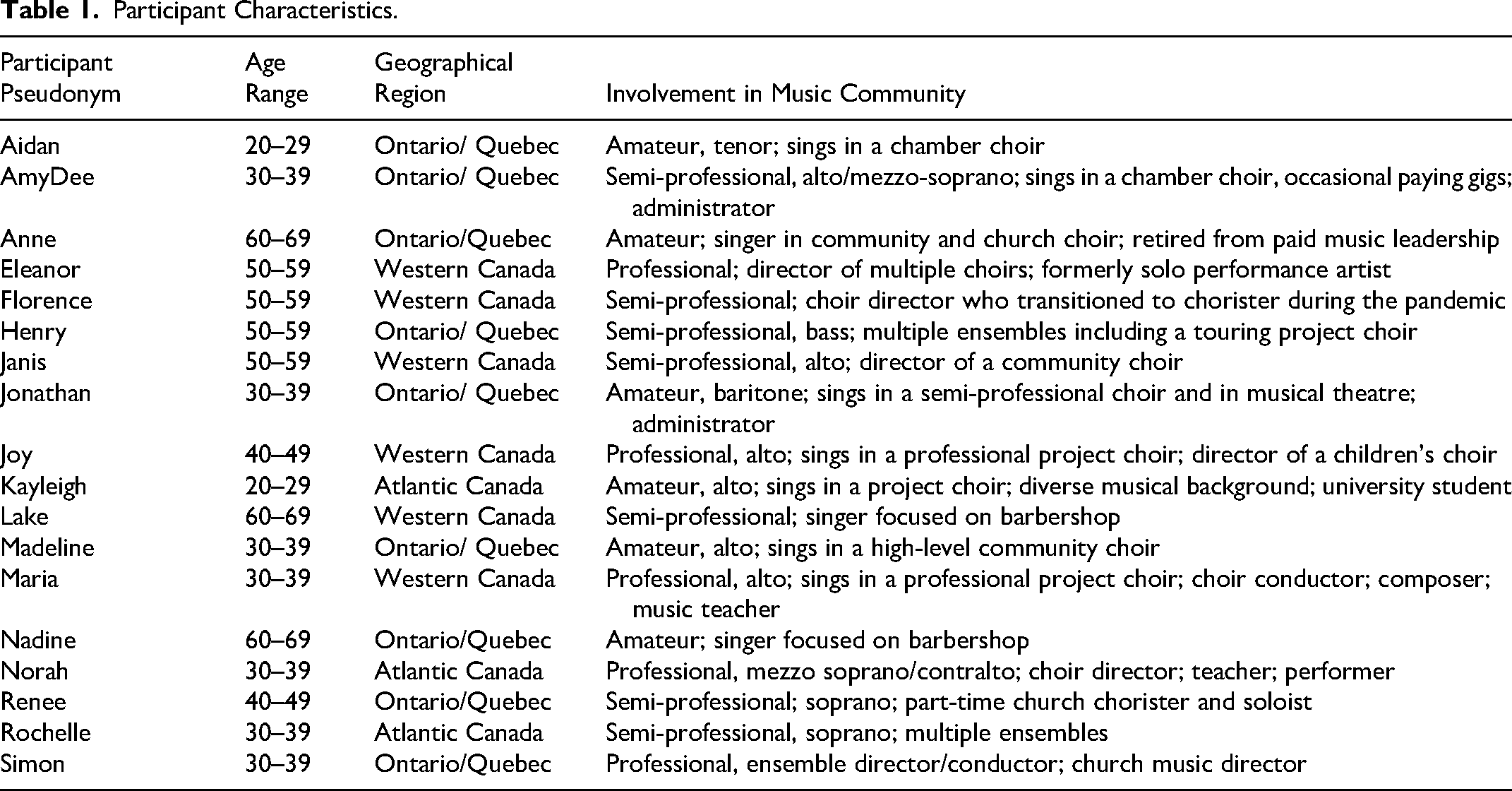
The first three authors (analysts) each analyzed 6 transcripts using the qualitative data analysis software, Quirkos (2024). Reflexive thematic analysis (Braun et al., 2023) guided the analysts’ process and the procedure followed the six steps described by Braun and Clarke (2006). The emphasis on reflexivity in analysis encouraged the analysts to consider their positionality in relation to their interpretive work. This provided insight on how they individually and collectively affected the analysis and thereby allowed collaborative consideration of the wider applicability of the findings. Regular meetings between the analysts and the larger team allowed both a broadening of the analytical view and a focus on that which was directly relevant to the research question. The analysts first familiarized themselves with the data, reviewing the transcripts and making note of preliminary thoughts (1). During the first read-through, the analysts reflected on possible codes and used Quirkos to organize their initial codes into a visual map (2). While analyzing the transcripts, the analysts reflected on their backgrounds and lived experiences in relation to the data. They coded their respective transcripts individually (3) before collaboratively creating a codebook of 22 terms. In the second round of analysis, the analysts applied these codes to the transcripts. The authors then discussed possible overall themes (4), which were revised (5) until settling on the final themes (6). Authors who did not conduct the main analysis consulted and discussed the codebook and resulting analysis of themes. Analysis was done with a focus on the applicability of findings to occupational therapists. Although some co-authors have a music background, the resultant themes and sub-themes reflect the theoretic orientation with occupational therapy (e.g., the POP). For this reason, participants were not invited to review the themes during the analytic process. Procedures for this study were reviewed by the Research Ethics Board at University of Alberta and were approved as research with human subjects following panel review.
Results
The 18 participants (see Table 1) spoke from a range of experiences with choral music-making during the COVID-19 pandemic: all had experienced a complete absence of choir for a time, after which they engaged in an altered form of choral music-making. Ten experienced virtual choir rehearsals, 17 had participated in physically distanced and masked rehearsals, and 11 had sung in smaller groups of choir members. Nine of the participants had contributed to a virtual choir performance in which individuals record their own audio tracks which are later edited together to create the choir's sound, ten participated in livestreamed concerts in which the choir sings together in-person but the audience is not physically present, and 16 had performed in live in-person concerts where the choir members were masked and physically distanced from one another and the audience is present. At the time of interview, none of the participants had had rehearsals or performances which resembled common practice before March 2020, meaning in-person, without masks, and without physical distancing. The findings are organized into three main themes and sub-themes. These are described below and summarized in Table 2 with representative quotations from the data.
Summary of Themes and Sub-Themes with Representative Quotations.
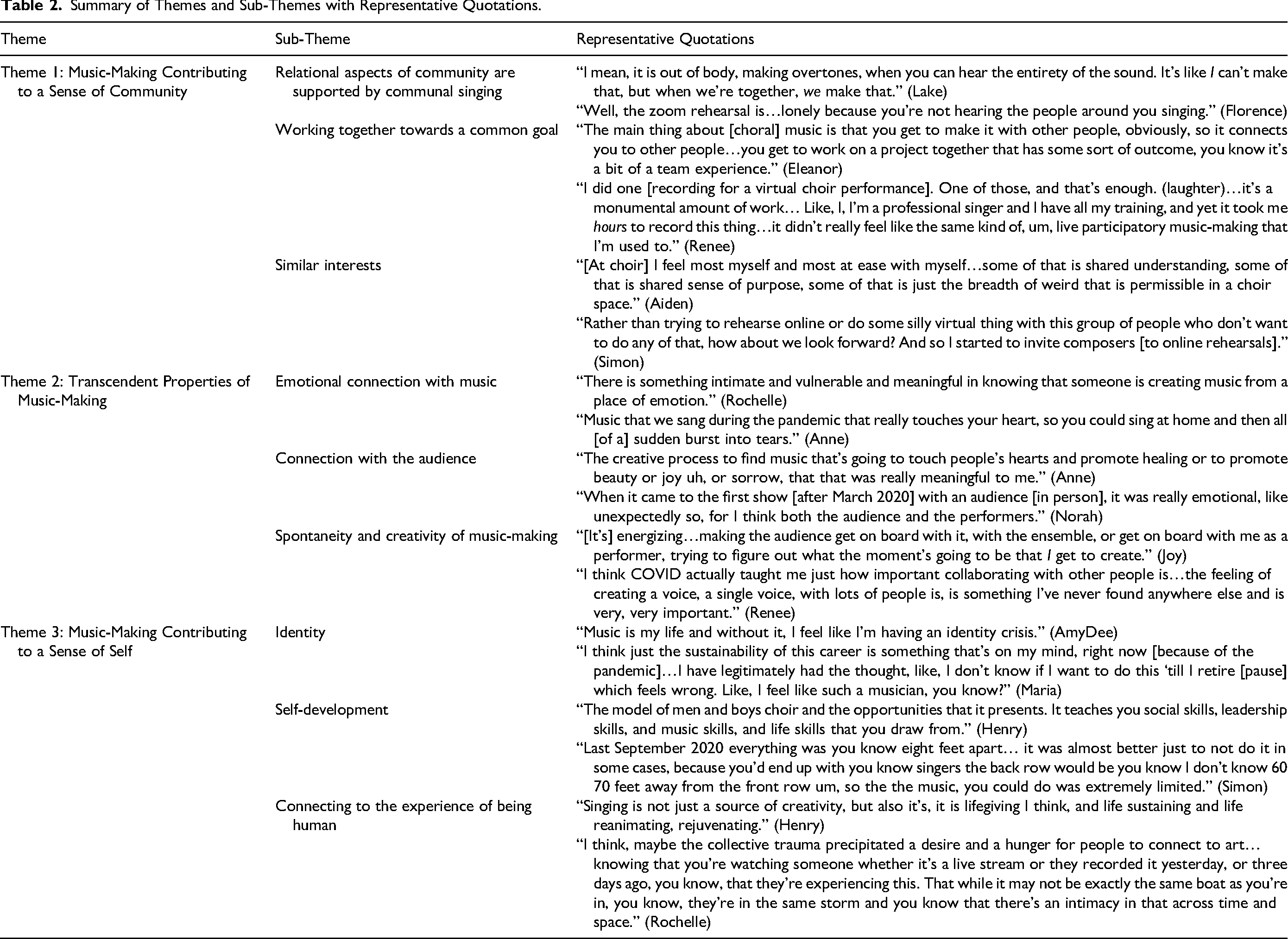
Theme 1: Music-Making Contributing to a Sense of Community
For most participants, the experience of altered choral music-making illustrated the importance of the communal sound for feeling connected to one another. COVID-19 pandemic restrictions forced choral musicians to drastically adapt the ways they engaged in music-making. Because of delays in sound transmission, online audio/video calls do not allow participants to sing together and simultaneously hear one another. Any in-person rehearsals typically involved singers standing physically distanced and/or wearing masks. Participants conveyed increased loneliness as they shifted to these adjusted forms of occupational engagement. “The safety and the warmth and the coziness in the closeness of a choir rehearsal before covid is missing…[zoom] feels in some ways, a lot of the time, like a bunch of isolated individual singers coming together” (Rochelle). Madeleine depicted the added difficulty of not all being in the same location, “you’re not really making music with other people…You’re kind of floating without contact with other people's voices.”
Physical distancing protocols during in-person rehearsals “make it harder to hear, it makes it harder to tune and connect” (Kayleigh), which created both interpersonal and musical distance between singers: “Normally…you can lean over to your alto buddy and kind of silent, kind of under your breath, you have an in-joke. [With distancing] everybody was far away, you just kind of felt like you’re performing like a soloist” (Joy). Despite the struggles, many were relieved to regain access to in-person choral music-making: “we were just grateful we could do something, you know just being able to come back and sing next to one another, even if it was from a distance” (Simon).
Working Together Towards a Common Goal
Participants identified that working together towards a common goal such as a concert was integral to their sense of community. Kayleigh stated, “I do appreciate the camaraderie that comes in having an end goal and prepping for the concert.” For some participants, being in choir gave them an opportunity to feel like part of a greater collective in a world that can be hyper-focused on individualism. Renee noted, “singing [in] a choir now, it really is a united force…and that's not very common these days…being able to find a place where you can come together and really work as a very large team is really special.” For most participants, the shared sense of purpose seemed to be of greatest value. “The whole point is to have something to all do together” (Madeline). Rochelle described that participating in a virtual choir project highlighted the need to feel connected to other musicians. “It just couldn't be for me what choir is. You know, because choir is, by its very nature, your shared instrument.” Renee highlighted the importance of the group to her experience of community: “I can practice by myself as much as I want, but it only really becomes something special when I’m there with other people.”
Similar Interests
Many participants identified choir as the primary manner in which they experienced a sense of belonging and community in their day-to-day lives and contributed to a sense of social engagement with people who have similar interests. AmyDee described “seeing friends and talking, you know nerding out on choir…and seeing people…that care about choir and music-making as much as I do.” For participants who struggled to find community, being in a choir involved a process of “building that connection and sense of safety together” (Joy). As Joy eloquently said, “these are my people.”
At the onset of the pandemic, many participants were forced to consider what new opportunities would be meaningful for them and their colleagues, given the restrictions on in-person singing. The resulting initiatives added social connection over shared interests in a time when other sources of connection (e.g., the communal sound of the choir, the previously common goal of in-person concerts) were suddenly absent. For Janis, being able to observe her fellow choir members in the context of their homes created a unique sense of intimacy that brought about “five minutes of really interesting conversation that we wouldn’t do in person, right? But a neat way of building connection with each other.” Some used social media as a means to share their interest in choir with others. Aidan described, “A lot of the early epidemic was like trying to maintain social connection…I did [a 20-week challenge making choir-related posts on social media], partly because it gave me a rhythm of a thing I had to do every day…and partly because it it gave an excuse to keep talking to choir people.” Janis described how virtual choral music-making was an exciting opportunity to expand her choral community, “being able to drop in on other people's online choirs and see how they do stuff or learn other repertoire…widening the view, to see what else is happening in different places.” Eleanor's virtual choir made choral music-making as a large ensemble accessible to those who would not ordinarily have had access to such an opportunity, enhancing the scope of social belonging to include those in rural and remote areas: “I have people now who sing with me who live in a town of 150 people…there's people like that for whom singing and virtual choir has opened up massive possibilities.”
Theme 2: Transcendent Properties of Music-Making
Emotional Connection with Music
Participants expressed feeling moved by music. “No rehearsal goes by, where I'm not coaching a particular phrase and I'm just so inspired by just how beautiful it is” (Eleanor). Other participants highlighted how the type of music they sing impacts their connection with it: “if I love the piece of music or if there's something that's really [pause] really unique or that speaks to me. That makes it exciting to sing” (Joy). The type of music chosen allowed Anne to “get in touch with [her] emotions” while for others, “The experience of music is quite often ecstatic…I've experienced things through making music that I've never experienced anywhere else” (Renee). Nadine shared that “any piece of music can move me” due to the lyrics or composition. Norah described how after listening to a song, “it's like there's like a cellular shift that has happened.”
Participants described expressing emotions through choral music-making was especially important during the pandemic. Renee explained, “Having somewhere for my emotions to go…all of these things that are very hard to express in, in words…[I] let out a lot of things through the music that I don't have any other avenue for.” Anne described that singing certain pieces of music with her choir created a sense of communal emotional release, even in a virtual context: “[the] music that's been chosen for us to sing [at] each concert…it's been so important as a way of just expressing the sense of loss and…what feelings are in your heart” (Anne). Madeleine shared a powerful experience during an outdoor rehearsal where singers were able to take off their masks when “very suddenly I was just conscious of the vibrations of everyone else's voices around me and I had to stop singing because I was gonna cry.”
Connection with the Audience
Connecting with the audience was a significant part of music-making for many participants. For some participants, creating a special experience for audience members was motivating. “The most important thing for us is…that the audience loves it…These songs that they recognize…these songs bringing a certain emotion…something that speaks to them” (Nadine). Similarly, “for me it's more about an energy and a connection to an audience…I want to make somebody feel something” (Joy). Connecting with the audience was distinct from Theme 1, in which participants found the sense of community in the choir to be meaningful. Here, participants ascribe meaning to their ability to create a transcendental moment between the choir and the audience: “I think the absolute best performances are [when] there's like a sense of communion between the people in the audience and the people singing and, like everyone there” (Aidan). Rochelle described “When you're singing…and you look out in the audience and you see someone with that stupefied look where they're just completely in awe and they are having like a spiritual moment that you helped create with other people.”
Alterations to performances during the pandemic illuminated aspects of performances which were meaningful for participants. Madeline described the experience of recording a performance, masked and physically distanced without an audience, that was later distributed online: “it was such a different atmosphere being in this sterile-feeling room…listening to it afterwards, I was like ‘oh, that sounds a lot better than I thought it would.’ But it wasn't as enjoyable an experience as having a real audience.” Renee described the struggle to energize performances without an audience: “we really feed a lot off the audience, so not having the people there…it was more exhausting than usual. You're having to pull a lot of energy from inside rather than getting it from people in front of you.” Rochelle noted an unexpected emotional connection with audience members of online performances, despite the continued availability of past recordings: “Maybe it was that they needed to know that the music was being created from the emotion of what was happening in those moments” (Rochelle). Henry similarly noted, “people really responded to the singing…they just felt they had to express their appreciation and their joy and that's quite humbling [pause] rewarding.”
Spontaneity and Creativity of Music-Making
Participants highlighted the meaningfulness of creative and spontaneous experiences. “Sometimes there's just like this magical moment where you create a sound and you're like ‘oh that came out of me’” (Rochelle). Madeleine shared that even while singing a familiar piece of music, “there's always the possibility for those little surprises.” She continued, “one of the things that I enjoy about the way that [conductor] conducts is that he does kind of leave a little imaginative space to the individuals so that you pick up on the interpretation of other people.” Participants also described an energy that comes from creating music. “It's complicated and it's lyrical and it's crunchy but it also resolves so wonderfully by the end that it just kind of sends [pause] gets a little shivery” (Kayleigh). Nadine described the sound of harmonies as “thrilling and it's emotional…I think that's what keeps me singing with this chorus. It's the sound that we make together.”
Maria described that in order to experience this spontaneity and creativity in choral music-making, “people have to be supported…you have to feel connected to the people around you.” She went on to elaborate that physical distancing and mask-wearing were barriers to feeling connected, even when her choirs were able to meet in-person: “because people's bandwidth is also preoccupied by the fact that they can't see their music well, they are wearing a mask and they can't breathe as well…and they can't hear me because they're 20 feet away.” Rochelle identified masks as limiting access to creative moments: “as much as I feel I'm still singing my emotion into the music, the interactive collaborative, um, shared experience, where we're feeding off of seeing each other's expressions…that's not happening.”
Theme 3: Music-Making Contributing to a Sense of Self
Identity
For many participants, being a musician was an integral part of who they are. “In terms of identity, yeah, I’m a musician. It’d be one of the first things I would say about myself to someone” (Florence). For Aidan, “it is like, fundamental to my being.” The alignment between identity and activity brought meaning to the experience of choral music-making. “It's nuanced; it's layered…it's not so much like I need to be identified as a musician…but music is so important to, to how I feel fulfilled in the world.” Kayleigh did not realize the importance of choral music-making to her sense of identity until she stepped away from it: “it's like I lost a puzzle piece, and then [when returning to choir, it] just clicked back into place.” For Renee, choral music-making had been a part of her process of developing identity from a young age: “it's definitely a defining aspect of who I am…it has also kind of formed me, as a person, from my youth.”
Participants who gained most of their income from choral music-making, or had previously done so, described a sense of conflict between their identity as professional musicians and the difficulties of the work. Despite being in high demand as a performer, Norah expressed difficulties with persisting in this profession, including a lack of health insurance, sick days, and personal leave. “That's great we get a grant to do [a paid musical project]. But if I fall down and break my leg, Oh well!” Maria expressed doubts that her career would be viable long term, given the difficult experiences so many professional musicians were facing during the pandemic and the culture of underpaying musicians for their work. “The hours that I work for the, like, reasonably meager income that I have, really, is a bummer. [pause] like it's always going to be a labour of love.”
Self-Development
Participants discussed ways choral music-making allowed them to grow and develop as people and not just musicians. For Lake, “it's built my confidence…it kind of built up a persona that I am a singer.” Choral music-making eventually led Janis to being a choral director which helped her discover a new facet of herself: “I’m not naturally inclined to being like a performer you know, although directing a choir…I’ve joked around saying I’m not really an extrovert. I just play one on zoom, right? I play one for choir.” For Norah, music-making was a change agent, creating change in her personally and in those around her: “You listen to a song, I don’t think that it just goes away after you have listened to it.”
Several participants asserted that pandemic-related restrictions, while necessary for safety, limited the ability of the group to improve musically. Simon described that his children's choir struggled to sing at their typical level when meeting in smaller groups. “The confidence from within the group comes because of the numbers. They rely on each other. And that reliance was suddenly removed…so that was that was definitely a challenge for the group, and for me as a conductor.” Creating recordings for virtual performances was time-consuming and frustrating for many participants because the lack of auditory feedback makes it impossible to adjust one's sound to align with the tone, tuning, or artistic interpretation of the group. “Some people wanted to create recordings for services at church which were so exhausting because, I mean, as singers we're very conscious of how we sound…we want to be effective and then it's never, we never quite achieve that.” (Henry). “It's a monumental amount of work…Like, I, I'm a professional singer and I have all my training, and yet it took me hours to record this thing” (Renee).
Connecting to the Experience of Being Human
Participants described that choral music-making informed their sense of self by connecting to their humanity. “Music-making, it just allows you to be human…whether you’re listening to it…if you’re actively participating in music, you’re connecting to what it means to be a human being” (Norah). “Producing music and producing music with other people is something that feels profoundly healthy and profoundly human, [pause] If I don’t do it, I miss it, and I feel like I’m living a less complete life” (Madeleine). Janis ascribed meaningfulness to the process of using choral music-making to help others express their humanity: “I wanted to contribute and have an impact on people's lives…through creative self-expression, through making a channel for that, because I know what it can allow in my own life and that, that people need that experience.” The context of the pandemic motivated many musicians to persist in choral music-making, despite the difficulties of pandemic-related restrictions, in order to help others cope with stress through artistic expression. “We all found a way to achieve something…to help the community rehabilitate as well, because the community was suffering. Is still suffering…we felt the responsibility as singers that we could have something to contribute to the healing.” (Henry)
Discussion
The present study investigated the meaning that 18 Canadian choral musicians ascribed to choral music-making in light of their experiences of altered occupation during the COVID-19 pandemic. Though one's definition of meaning is personal and informed by one's own narrative, three themes were identified throughout: music-making contributing to a sense of community, transcendent properties of music-making, and music-making contributing to a sense of self. The present study provides a novel contribution to the literature by investigating meaningfulness as described by choral musicians in a Canadian context and as illuminated by their concurrent experiences of the COVID-19 pandemic and related public health restrictions.
The findings in this research paper are congruent with literature regarding the role of choir singing in choristers’ sense of wellbeing and of community (e.g., Barrett & Vermeulen, 2019; Perkins et al., 2020). Participants in the current study expressed how choral music-making provided social connections by sharing similar interests and by relying on one another while pursuing shared outcomes. Creech et al. (2014) identified similar findings, how social affirmation was built through musical performance, providing a structure and routine for participants to work towards a common goal. Petrovsky and colleagues (2020) studied how choral music-making encourages a sense of purpose and belonging by providing “a reason to get out of bed in the morning” (p.344). Building social connections with a shared purpose promoted a feeling of safety and belonging. These factors contributed to the meaningfulness of choral music-making in the present and previous research.
The present findings highlight the importance of social connection in perceived meaningfulness of choral music-making. Most participants in the present study felt that the meaningfulness of choral music-making decreased when rehearsals moved online because their experience was disconnected, due to the inability to synchronously hear the collective sound of the group. A small number of participants found that online choral music-making provided opportunities for connection with those in rural and remote areas, which increased meaningfulness for those participants. This resembles Rotenberg and colleagues’ (2021) finding that online occupations provided some social connection but were not as fulfilling as in-person activities. The present findings add nuance, in that online choirs enabled some individuals to connect with those who share their interest in choir. These findings overall support social connection as an important component of meaningfulness in both choral music-making and other occupations, but that online occupational engagement can be specific to the individual and their context.
Participants of the current study described building social connections through co- occupation as a significant contributor to meaningfulness. Pierce (2009) described co-occupation as, “a dance between the occupations of one individual and another that sequentially shapes the occupations of both persons” (p. 203). This characterization aligns with the present participants’ descriptions of their choral music-making, as they valued the experience of musically connecting with others to collaboratively create a sound that would be impossible for any singer alone. The importance of co-occupation was illuminated for participants when their choral music-making was moved online, where singers cannot hear one another synchronously. Singers who engaged in choral music-making online did so by submitting recordings of their singing or by singing along during rehearsals, in either case not hearing the rest of the choir while singing. While Camlin et al. (2020) and Forbes and Bartlett (2020) have investigated choral music-making as an occupation, our findings more closely align with Jacob and colleagues’ (2009) description of choir as a co-occupation. This important aspect of meaning and motivation for participation can be explored in different contexts among various occupations to inform occupational science and occupational therapy practice.
The transcendent properties of choral music-making were important for participants in considering the meaningfulness of choral music-making. Participants of the current study described the value of connecting with the audience during the creative process of performing. Similarly, Davidson and Correia (2001) described a sense of shared energy between choir and audience. The present findings also align with previous research which described choir participation as an emotional outlet. For example, Barrett and Vermeulen (2019) highlighted how music participation provided participants opportunities to manage and express emotions both individually and collectively. In the current study, the participants expressed how engaging in choir allowed them to collectively express their emotions while creating a community with each other and the audience.
Implications for Occupational Therapy Practice
It is important for occupational therapists to understand the meaningfulness of valued occupations in order to collaboratively support participation. Our study findings affirm that the meaningfulness of occupation is intertwined with the dimensions of doing, being, belonging, and becoming (Hitch & Pepin, 2021). In the present study, participants attributed meaningfulness to the ways in which choral music-making related to their personal identity, supported the development of their skills, and gave them opportunities to be spontaneous, to be creative, and connect with the experience of being human. In the rehearsal setting, choral music-making provided opportunities for connection with others over their shared interests and through the communal sound of the choir. Choir provided opportunities to work together towards a common goal, such as working towards a performance or improving the group's sound. The ability to express emotions through music was meaningful for some because of the ability to express their individual emotions, while others found it meaningful to connect with an audience over shared emotions, such as feelings of isolation over the shared experience of a global pandemic. While choral musicians each have their own sense of purpose and meaning around choral music-making, the present findings suggest important considerations for occupational therapists seeking to understand the purpose and meaning which motivate occupational participation in choral music-making and potentially other similar occupations.
The findings of this study highlight how co-occupation is a vital consideration in occupational therapy practice. When participants in the present study were forced to engage in music-making individually instead of interactively as part of a collective, this took away from its perceived meaningfulness. In particular, the lack of feedback from the communal sound of the choir was a significant source of disconnection. This resembles findings from other studies of occupational engagement during the COVID-19 pandemic's initial lockdowns, wherein online social interactions were described as “better than nothing” (Oostlander et al., 2025). For those in the present study who were enabled by virtual choirs to connect with other musicians over shared interests, including with those in rural and remote areas, the increased connection enhanced the meaningfulness of their choral music-making. This suggests that virtual choirs may be a source of social connection or disconnection depending on a variety of personal and contextual factors, such as the musician's access to in-person choir, the importance the musician places on the communal sound of the choir, and the opportunities for the choir to connect socially. At the time of writing, choirs in Canada are no longer restricted by public health policies about COVID-19; however, individuals who are clinically vulnerable, have loved ones who are vulnerable, or who continue to take precautions against illness may experience ongoing alterations to their valued occupation. The present findings suggest that occupational therapists carefully consider the context of the social interaction in choral music-making and other occupations, as well as any barriers to co-occupation.
Occupational therapists working with choral musicians must also consider the relationship between self-concept and choral music-making. This can be conceptualized with the POP (Hitch & Pepin, 2021). For participants of the present study, their sense of identity (being) was tethered to engaging in music-making (doing), as evidenced by the void most participants described when no longer able to engage in choral music-making in the way they were accustomed. This aligns with previous research describing the sense of loss and uncertainty that musicians may experience when injured (Guptill, 2011). The experience of the COVID-19 pandemic illustrated for participants that they found meaning in the communal achievements of the choir (becoming) and the ability to feel connected through both musical sound and social interaction (belonging). Hitch and colleagues (2014) described that the dimension of being “rests on consciousness and creativity” (p.237). The present findings align with this, in that participants described how choral music-making provided opportunities to emotionally connect with music, express their own emotions, be creative and to connect with their sense of being human. If music-making with others is considered part of the process of meaning-making and self-realization, facilitating the participation in choral music-making can be a critical component of nuanced collaborative clinical practices. Occupational therapists are uniquely equipped to assess the functional context and to build collaborative relationships to determine the “why” behind occupations that people value. Thus, the findings of this study can support occupational therapists to continue to be curious and creative in their exploration of that which adds meaning to occupations.
Strengths, Limitations and Directions for Future Research
The analytic process and composition of the research team are strengths of the present research. Throughout analysis, three team members collaborated to build the codebook and establish the thematic structure, regularly consulting with other co-authors to identify the role of author positionalities in interpreting the data. Integrating multiple perspectives throughout analysis supported the broader applicability of the findings. The interviewer in this study is an “insider” to the Canadian choir community and was recognized by some participants from health promotion work the interviewer had previously done. As Thomas and colleagues (2000) articulate, this insider role holds advantages, such as a deep contextual understanding and this can increase trust between interviewer and participant. The combination of “insider” and “outsider” members of the team created opportunities for conversation and debate throughout the research. As Thomas and colleagues (2000) describe, we found that this process enhanced the richness and soundness of interpretation, ultimately supporting trustworthiness of the findings.
This study had several limitations. Data collection via Zoom may have been a barrier to participation, as it required participants to have Internet access. Participants did not receive financial compensation, meaning that only those able to participate for free were able to share their perspectives. This was compounded by the unexpected financial impact the COVID-19 pandemic had on musicians and performing artists overall (Spiro et al., 2021). Participants had diverse experiences of COVID-19 pandemic restrictions across multiple provinces in Canada, and these experiences differ from those of choral musicians in other parts of Canada or in other countries. All participants were Canadian, but we did not specifically inquire into whether participants had immigrated to Canada from another country. None of the participants spoke about an experience of immigrating or about singing in choirs in any country other than Canada.
The interview guide did not specifically ask about participants’ musical training or years spent singing in choirs, focusing instead on understanding how their choral music-making had changed during the pandemic, and whether participants’ occupational engagement in choral music-making had felt meaningful in that time. It is possible that musical training or years of experience has an effect on perceptions of meaningfulness, although none of the participants mentioned such a relationship and there did not appear to be patterns in the data as related to participant age. The interview guide did not inquire about early childhood experiences with music. Some participants mentioned early childhood music-making (Kayleigh, Aidan, Renee, Janice, and Norah), but these were brief, single-sentence, references to their background with music. There is some evidence from previous research that those who have musical experiences in their childhood homes are more likely to engage in music-making as adults, but it is not clear whether this could be related to attributions of meaningfulness (Bonde et al., 2018). Without direct inquiry, we cannot draw inferences about the relationship between early musical experiences and perceived meaningfulness from the present findings. Participants ascribed positive meanings to choral music-making, with negative and neutral meanings ascribed only to the disruption of their occupations during the pandemic. This may be a result of their circumstances at the time of interview, and it is possible that participants would ascribe negative or neutral meanings to choral music-making in different circumstances. Music-making was explored in a specific context (i.e., choir), and thus the data do not provide rich insight on the meaningfulness of music-making in different contexts.
The present findings suggest new areas for research. In the present study, participants described how the meaningfulness of choral music-making contributed to their motivation to engage in it. Future research could examine how intrinsic versus extrinsic motivation impacts music participation, such as engaging in choral music-making as a hobby compared to a main source of income. Research which investigates contexts beyond choral music making would bring nuance to this area of research. Participants in this study described music's ability to lift their mood and facilitate emotional catharsis, both of which could have implications in a clinical setting. Though the therapeutic potential of occupation was not explored in the present study, the authors recognize the value of such research to inform future occupational therapy practice.
Conclusion
This study provides insight on the meaningfulness of choral music-making for choral musicians. The restrictions associated with the COVID-19 pandemic created opportunities for participants to gain greater insight into the meaningfulness of this valued occupation. A sense of community, social engagement, shared sense of purpose, and collective participation in a valued occupation were all important considerations. These were interrelated with the participants’ connection to music, the audience, emotional self-expression and their sense of identity. Perceived meaning-making was affected when a highly valued co-occupation became more solitary due to the COVID-19 pandemic. The perspectives of participants shed light on the significance of purpose and meaning in occupational participation, foregrounding their importance in occupation-based practices. Occupational therapists are uniquely situated to work with choral musicians in facilitating participation in choral music-making. It is imperative that occupational therapists seek to understand the meaning attached to participation in highly-valued occupations and the factors that add value to occupations to best support their clients.
Key Messages
Understanding what makes an occupation meaningful is an integral component of supporting occupational participation. The experience of disrupted occupation during the COVID-19 pandemic has offered insight into key aspects of the meaningfulness of choral music-making.
Choral musicians described that meaningfulness of choral music-making was supported by (1) sense of community, (2) transcendent properties of music making, and (3) the way choral music-making contributed to their sense of self.
Occupational therapists are uniquely equipped to assess the functional context and to build collaborative relationships to understand the “why” behind meaningful occupations. The findings of this study can inform occupational therapists’ inquiries into the meaningfulness of people's valued occupations.
Footnotes
Acknowledgements
The authors would like to thank Choral Canada for their assistance in recruiting participants for this study.

Author Contributions
WM, SY, and MG equally contributed to the authorship of the manuscript. WM, SY, MG and TS shared responsibility in designing and implementing this study, with contributions from CG regarding the original concept for the research question. TS conducted the interviews with study participants. WM, SY, and MG analyzed the data. TS obtained research ethics board approvals and participant recruitment. All authors edited the manuscript and approve of its submission for publication.
Funding
The authors received no financial support for the research, authorship, and/or publication of this article.