



Abstract
In this article, we explore challenges and possibilities as expressed by young people who participated in a music workshop in Norway (MWS). The participants in the workshop had a background referred to as looked after children (LAC) in the Norway. All participants had experiences with foster care or/and residential care. The music activities they reported on took place in a public “cultural house”, and included listening to music, songwriting, playing in a band and performing, led by music therapists. The study is based on a qualitative research methodology, using a thematic analysis of semi-structured interviews, where we ask the following research question; What are the challenges and possibilities of participating in community music therapy for looked after children who have been removed from their families by Norwegian child protection service? To answer this question, we interviewed eleven young adults between the ages of sixteen and 23. We identified three themes; Music is a vehicle for the creation of meaning in a challening life situation, Building peer relationships and sharing life experiences through participation in the music workshop and Dealing with complex emotions and identity through music therapy. Findings are discussed in the light of theoretical perspectives on child protection, music therapy and psychology, and more specifically, trauma informed care and community music therapy. Implications for practice and research are highlighted. We suggest that work with LAC should follow a person oriented and community-oriented approach, where the child is empowered to take part in activities in community settings where support can be found from peers and adults.
Introduction
This study is an evaluation of the impact of a music therapy workshop (MWS) in Norway. The MWS has been an initiative for young people during the past 20 years. The initiative was funded by private and public money, and the music therapists were hired on a part-time basis. The term workshop is used to describe the flexible approach that offers individual- and group sessions to young people in out-of-home care. In the UK, these young people are referred to as looked after children (LAC). Throughout the article we will use the term LAC, a term which in our case included young people up to the age of 23 1 . The music workshop was led by a music therapist with a master degree in music therapy, assisted by volunteers and students from the music therapy education program. Some of the staff members at the residential care unit also participated. As preparation to the workshop, the music therapist met the participants at the institution, or in the home of their foster family. They were invited to participate in activities in a practice room fit for music making and listening, or in a studio, depending on the activity. Individual sessions usually lasted from 30-90 minutes, and group sessions from 1-3 hours. Activities varied from listening to and discussing music, songwriting, playing cover songs, beat making, recording, DJ-ing or mixing music, making music videos, and learning to play an instrument or sing. The music workshop as described in this article normally took place in a public cultural house, where other cultural activities also take place, such as choirs, orchestras or drama groups. As such, the participants were invited to an arena were normal cultural activities take place, and the potential for marginalization and stigmatization is lowered. This line of thinking aligns with notions from a Community Music Therapy (CoMT) perspective. CoMT can be described as an ecologically informed “cultural engagement” (Stige, 2002), as “a way of doing and thinking about music therapy where the larger cultural, institutional, and social context is taken into consideration” (Ruud, 2010, p. 126), and as a collaborative process “attending to unheard voices” (Stige & Aarø, 2012, p. 3). A CoMT approach refer to participatory, salutogenic, and ecologic practices, performed in inclusive, non-clinical settings. CoMT is concerned with how music can be used to create structures of participation and experience of inclusion (Stige & Aarø, 2012). This is a way of understanding music therapy which is particularly relevant for people with a LAC background and their families because these people in a greater extent than others may need facilitated participation at venues in the local community and thereby experience of an inclusive community (Krüger, 2019).
In Norway children and young people who have experienced neglect or abuse are taken care of by The Norwegian Child Protection Services (in Norwegian; Barnevernet). “Municipal child welfare” provides protection to those in need, aided by regional agencies that constitute Bufetat, which is the “governmental child welfare” agency (bufdir.no, 2022).
Some children and young people cannot live at home due to behavioural challenges, struggles with substance abuse, lack of care at home or parents who, for various reasons, are unable to provide care for shorter or longer periods. Even though the main goal of child protection work is to support the child in living with their biological family, some children will still require residential care or foster home placement. Being placed in out-of-home care interferes with fundamental aspects of a child’s life including health and identity (Storø et al., 2017). Hence, when removed from their families, developmental issues such as relationships with parents and friends, school, leisure, health, and education may be present in numerous ways (Paulsen et al., 2017). Further, children and young people living under the care of child protection institutions have higher rates of mental health disorders in comparison to the general child/adolescent population (Kayed et al., 2015).
Recognizing the high prevalence of trauma among children placed out of home, different trauma-informed practices have been introduced across child protection and associated services (SAMHSA, 2014). In Norway, the most common practice is based on the trauma-informed care (TIC) model described by Bath (2015). The model organizes the needs to be addressed around three ‘pillars’: 1) Safety (physical, psychological, social, and emotional); 2) Connections (both nurturing relationships and connectedness to social groups); and 3) Coping (through various strategies, ranging from individual cognitive strategies to social participation) (Steinkopf et al., 2020, Bath, 2008, 2015). As suggested by Krüger, Nordanger and Stige (2018), the model fits well with out-of-home placed children’s own accounts of what they find fruitful with music therapy.
Another important aspect of child protection work is securing processes of participation. The Norwegian Institute for Public Health, proposed an increased focus towards children’s participation in decision making processes as a core theme in child welfare, emphasizing that the knowledge gaps regarding children’s and young people’s participation is substantial (Ormstad et al., 2020). Additionally, most children wish for greater predictability, autonomy, and participation in decision making processes– before, during, and after placement (Jardim et al., 2020). Ensuring participation can be described as a relational process that should be an integral part of daily life in an institution. Some scholars even suggest that institutions should have affiliated health personnel, such as therapists and nurses (Backe-Hansen et al., 2017). We interpret the category of health personnel to include Music Therapists.
Considering the needs described in the above-mentioned studies, interventions targeting children and young people receiving public care should not only aim at addressing complex health issues. They should provide arenas for developing personal resources, such as social adjustment and skills, relatedness, self-esteem, and autonomy, as well as providing individualized and long-term aftercare (Sommerfeldt, 2020). Findings in music therapy research can be supportive in this regard, as Music Therapists seek to facilitate empowerment, identity development, social interaction, emotional regulation, and mastery among adolescents (McFerran et al., 2020; Viega, 2016). Research studies on music therapy among youth indicate positive effects on self-esteem (Gold et al., 2018), social adjustment and behavior (Porter, 2017), as well as negative associations with depression (Albornoz, 2011), and conflict with parents (Colegrove, 2019). So far, music therapy for children in residential care is under-researched (Krüger and Stige, 2015), despite the increasing number of international studies on relational music therapy in child protection settings, as well as CoMT (Zanders et al., 2018; Fairchild and McFerran, 2019; Fansler, 2018). From a Norwegian perspective, Mandal and Bergset (2016) describe experiences in using music therapy as an integrated part of aftercare measures for children living in foster care. Similarly, Wilhelmsen and Fuhr (2018) described how engagement in music activities can be beneficial for individuals in residential care and provide positive relational experiences with adult caregivers (see also Fuhr, 2022). What they call the Music Workshop (not to be confused with the chosen name for the MWS in this article), is an example of a program that offers individual and group sessions where the music therapist meets young people either in their home or in a practice room equipped for music therapy.
As the above demonstrates, the need for practical solutions in child protection is increasing (Bufdir, 2022). Therefore, the purpose of this article is to evaluate the MWS in order to describe how music therapy in an out-of-home setting may facilitate the building of relationships through participation in music therapy experiences such as songwriting, playing in a band and performing. We addressed the following research question: What are the challenges and possibilities of participating in community music therapy for looked after children who have been removed from their families by Norwegian child protection service? We pose this question to learn about the kind of experiences that the young participants had, and then use the knowledge gained to improve the accessibility and quality of music therapy provision for children who has been removed from their families by the child protection services. The research question was investigated by looking through an interdisciplinary theoretical lens drawing from theories and concepts in child welfare, music therapy and trauma psychology.
Method
Research Approach
This study used semi-structured interviews to record participants’ experiences in the MWS, consistent with the exploratory nature of this study. Semi-structured interviews were chosen to gain insights into the participants’ reflections and experiences of music therapy. The study team consisted of three Music Therapists and one Psychologist. Two of the Music Therapists and the Psychologist have a PhD while the third Music Therapistis enrolled in a music therapy PhD program. The first author conducted the interviews and created the transcripts, while the whole team participated in the thematic analyses. The epistemology was informed by phenomenology and hermeneutics, both of which are located within the larger field of constructionism (Kvale and Brinkman, 2014; Matney, 2018). For transparency, and to encourage reflection and conversation, we developed an interview guide (see appendices A and B). This guide was also shown to all participants before the interviews commenced. The interview questions focused on the participants’ experiences concerning topics such as leisure, popular culture, school, and relationships with peers and adults. For example, we asked if they could describe their experiences with the music activities. From this question the participants freely talked about instruments they played and music that they made. We followed the participants' narrative accounts of their experiences participating in the MWS, following the narrative, episodic interview approach (Flick, 2000). Most of the interviews lasted about 45 minutes. All participants were interviewed once. The interviews were conducted in Norwegian language, transcribed and translated to English. The data was then analyzed. Recruitment of participants followed a purposive sampling strategy (e.g. Moser and Korstjens, 2018). Purposive sampling, defined as the selection of participants deemed to have expert knowledge related to the research question (Battaglia, 2011), was selected given our expectation that their previous experience using music in the MWS may deepen their understandings and responses on the topic. The participants lived in the same city, and they participated in the same workshop for 6 months to one year. We interviewed eleven young people between the ages of 16 and 23, who met the following inclusion criteria: 1) they had participated in the MWS; 2) were between the ages of 16-23; 3) they had experienced a minimum of one stay at a residential care institution or foster care home. Three of the participants were above the age of 18, and eight were between 16-18. Ten of the participants were living in residential care, and one was living in foster care. Four of the participants had a background as an unaccompanied refugee, with a minimum stay in Norway of three years. Ten of the participants were boys, and one was a girl.
Description of the MWS
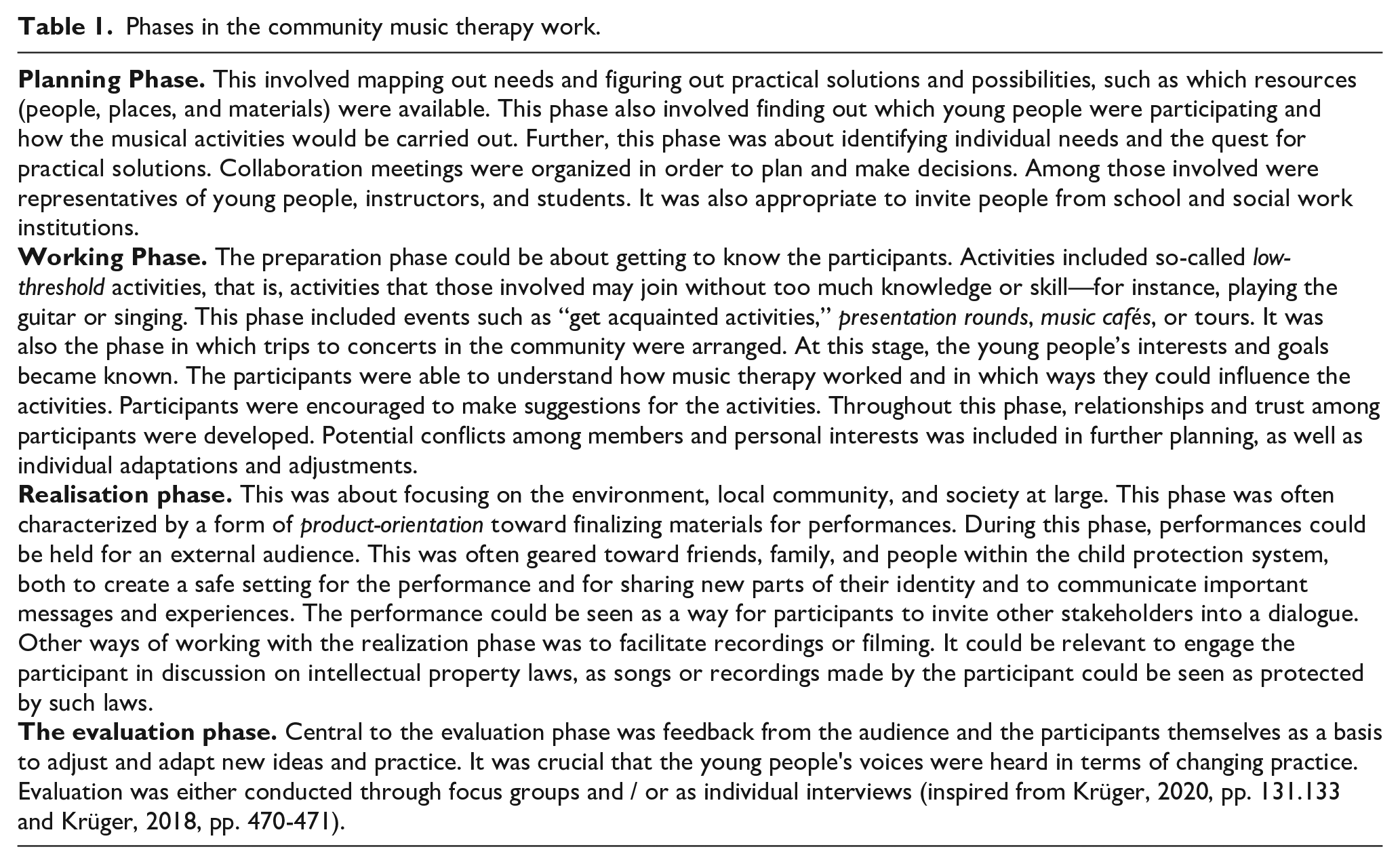
The MWS proceeded through four phases; planning, working, realisation, and evaluating. The phases were not clearly separated, but often overlapped and occurred at irregular intervals. The phases were not governed by rules and procedures. Rather, the participants themselves were involved in determining the progress and content of the different phases. This is consistent with the UNCRC (1989) perspective on participation. The participants joined in activities for a month, or for years. They joined either as a result of social workers “sending” them there, or because they discovered the possibility themselves (Table 1).
Phases in the community music therapy work.
Data Analysis
The data was analysed using a thematic analysis procedure as outlined by Braun and Clarke (2006). An abductive process, characterized by a constant shift between data analysis and review of relevant literature studies, was used to identify codes and create themes (Timmermans and Tavory, 2012). First, interview audio-files were transcribed by the first author to text using Microsoft Word. Second, we as authors familiarized ourselves with the data by reading and re-reading the data, noting down initial ideas. During this phase we had initial meetings to discuss findings. Third, we generated initial codes using colour codes. A thematic analysis was performed in which the codes were grouped into themes and sub-themes. The first and second author were responsible for completing the first three steps, all the authors were involved in a collective analysis process.
Ethical Considerations
The best interests of the child are a fundamental concern in all research 2 and when involving children and young people in research, a set of precautions should be reflected on and implemented (Brooker, 2001). Furthermore, children and young people living in residential care or in foster care are considered a vulnerable group of people and researchers need to act sensitively when approaching this population (Alderson and Morrow 2004). Spriggs and Gillam (2019) have expressed concerns about ‘pressure on the child in research situations.
In their view it can be difficult for a child to say no’ (p. 9), and that they may feel obliged to remain involved because of the importance adult researchers place on the research and children’s participation in research’ (p. 10). In other words, it can be problematic that the two roles bring different qualities. While the role of the researcher is about developing knowledge, the role of the therapist is about helping people. In our case, the dual role had the potential to both create biased answers; (e.g. findings influenced by an already established relationship between the interviewer and the interviewed), and create possibilities to investigate the relationships from the MWS experiences. The National Committee for Research Ethics in the Social Sciences and the Humanities (NESH, 2021) suggests the following four factors as particularly relevant in ethical considerations regarding research with children and young people: the public character and context of their statements, the sensitivity of the information, the vulnerability of those involved, and the interactions and consequences of the research. NESH also notes that it is of great importance to include children and young people’s valuable voice and contributions to research. Their voices can inform our effort in creating a fair and democratic society based on rights and participatory values (Falch-Eriksen et al., 2021). In order to meet the demands of an ethically sound research approach we did the following:
- The participants were informed of the purpose of the study by social workers at the institution or foster parents. Using an information letter, participants were provided with the following information: 1) the length of the interview; 2) steps taken ensure anonymity and protect confidentiality; 3) the right to withdraw from research project at any point up to the start of data analysis. All participants signed an informed consent form before the interview started.
- Regarding the dual role of researchers, in our case the young people knew the first author from previous MWS activities. To minimise the impact of this on the data collected, the interviewer tried to keep the interviews as open conversations, giving the participants a free space to speak in subjective manner.
- The research project (Krüger, 2019) ran from 2013-2019. It was approved by Norwegian Social Science Data Services (NSD, 2022). All of the interviews were conducted between 2013-2016, and handling of data was conducted in relation to the present rules and regulations. Transcriptions was stored on a PC without online ports. The audio files were deleted once the verbatim transcripts were anonymized.
Results
We identified 3 themes each having 2 or 3 subthemes as described below.
Music is a vehicle for the creation of meaning in a challening life situation
This theme reflects the participants’ quotes about the potential for music as a resource for creating meaning, despite at times challenging life circumstances. These quotes relate to experiences of music in “everyday life” and not directly to music therapy. As the quotes illustrate, the participants connect a wide variety of meanings to music. They also convey the many personal difficulties with residential care or foster home placement.
Music is a meaningful part of life
All the participants shared stories about how music for them represented a potential to create meaning, for example in relationships:
I used music a lot during difficult times. I used music in difficult relationships, both with friends and partners. In the world we're living in, how we treat people, how good of a person you can be, music has been a good role model for me (Participant 4).
For many of the young people, music is for them a way to express themselves or to find a way to master everyday life, as this participant told us:
I started writing [song lyrics], and I found that it was a good way for me to express my feelings, my way of getting my thoughts down on paper, since I’m not good at talking with people. I find it easier to record music and publish music online (Participant 2).
As such, music can be a way to get through difficult times: “I feel that I can use music to help me get through difficult times in my life, and to help me move forward” (Participant 7). Doing music is connected to having an active lifestyle: “I think it’s important for all people out there who are interested in staying in shape and being active. It’s very important for me too to stay active, keeping my body active and doing things like music” (Participant 3).
Challenging life situations
To grasp a wider understanding of how the young people expressed themselves, we chose to present examples that include how the participants convey experiences of challenging life situations, such as moving and being relocated: “In the beginning it was turbulent. I struggled a lot with adapting. I had many problems. Got into a lot of trouble. Partially because of my background, moving constantly, never had a place to ‘live’ properly” (Participant 3). The lack of relationships after being relocated can be painful, and lead to isolation, as this participant revealed:
When you’re at an institution there are many days where you’re thinking ‘what’s the meaning now, what am I supposed to do going forward? Then it’s important that you can go to a place where you can smile and be happy. It isn’t good for a young person to always be isolated with their thoughts. For a young person there should always be a way for you to release your thoughts (Participant 8).
Some of the young people expressed that it can be hard to live with adults who are not family or kin, exemplified by the following statement: “The thing is, in child protection you live with people who aren’t your family. They are there because it’s their job. They are social with you because it’s their job to” (Participant 6). The experiences described above can create difficulties in trusting other people: “But when you have a lot to think about, when you’re depressed that get you thinking about other things, then it’s not easy to get them out. And then it’s not easy to trust people either” (Participant 6). Living with adults that have control of your life without knowing them may create lack of trust: “When you feel like they’re talking with you just because they have to (. . .) you lose the willingness to trust them and talk to them openly because you know that they don’t mean what they’re saying” (Participant 6).
Building peer relationships and sharing life experiences through participation in the music workshop
In this section we highlight how participation in the MWS created opportunities to build relationships and share experiences, while also posing some challenges.
Focusing on the activities
When describing their experiences of music therapy, most of the young people described the ability to engage in meaningful conversation while making music, illustrated by this quote where guitar playing was central:
It’s a golden opportunity. If you’re playing guitar, you can keep a conversation going and say ‘that might not be very smart, do you think so?”. In a way doing music activities can distract a person from doing other, potential unhealthy things (Participant 10).
Participant 10 continues: “Like when you're having (music) lessons with an adolescent, you can keep him busy” (Participant 10). Participant 6 elaborates on how the young person and the music therapist are talking while playing the drums.
It’s a lot easier to talk when you’re actually doing music, singing or playing, you have something to discuss, something in common. While I was playing drums, you (the music therapist) asked me a question about how I was doing and what I had been doing that day, if the day had been good. And at the same time, I used to talk about school and if it had been okay or if it had been rough today, while I was playing drums (Participant 6).
The participants also commented on using music technology, exemplified by this quote:
It [music therapy] was exactly like I imagined. Going to a studio a couple of times a week, record, remix, listen. I’ve used it to tell my parents how I feel inside, for example. I’ve never been good at telling them how I’m doing inside. So, the music helps me get my feelings out (Participant 8).
Being real
Many of the young people explicitly shared their experience of being met by the music therapist, and how this meeting held a possibility for establishing relationships. In this meeting, the young people emphasized the importance of transparency; that the music therapist should share some of their own experiences:
You [the MT] have to smile and be happy. You must be willing to «give some of yourselves» and be forthcoming. You don’t need to share your entire childhood, that’s not what I’m saying. But you can share a little of your personal life, maybe. What’s the limit. . . you decide for yourself (Participant 2).
It may be easier to share their life story if the music therapist is forthcoming and willing to share some aspects of their life. This is perceived and described by many of the participants as a way of showing respect. Participant 4 elaborates:
First and foremost, you as an adult must show respect so that they can show you respect. So, I think that when an adult can be a bit open, that makes it easier for a child to open too and start to talk together about things that they might have been through in life or that they struggle with (Participant 4).
Another participant explains how adults in the child protection system are asking stupid questions, and that conversations focusing on challenges may be perceived as disrespect: “There are so many stupid questions, you know. Yes, ‘how are you feeling now,’ and they see that I’m doing completely shit. Struggling with everything. Fuck no, that’s just. . . disrespect” (Participant 5). The participants explain how the music activity facilitates open, mutual, and respectful dialogue. A key factor in this is the building of confidentiality and trust: I say things to you because I trust you. I hope that you don’t go around and tell them things, you know. I struggle a lot with trusting people” (Participant 10).
A platform for peer relationships
Even though relationship building with the music therapists is highly important, many of the young people described relationships established through music therapy sessions with their peers as very important. Writing songs with peers in music therapy can be a channel for the expression of emotions: “First, I started writing, and I found that it was a good way for me to express my feelings. My way of getting my thoughts down on paper, since I’m not good at talking with people. I find it easier to record and publish online” (Participant 2). Sharing music playing together in a trustful relationship seemed to enable exchange of thoughts, feelings, ideas, and stories:
I love the songs that are made here, because I know that the things that are written are about what the people here have been through. For example, like she’s saying, ‘I’ve been through this and that, and I made it into a song.’ But when I listen to it, even if it’s not an amazing song or even if it is, I feel that. . . wow, there are so many feelings here, you feel that ‘yes, I’ve felt that that’s happened to me! (Participant 7).
Many of the participants spoke about the balance between safety and challenge, noting that writing songs and performing can be scary too:
It’s scary to write songs, for example. But it’s a lot of fun when you manage to do it. Because then you see that what seems scaring can be safe, too. Maybe start a bit carefully, and then go further from there. When you’re in a vulnerable situation, it’s good to learn new things and challenge yourself a little (Participant 1).
Dealing with complex emotions and identity through music therapy
The third theme we have chosen to highlight is related to how the participants use music and music therapy to deal with complex emotions.
Working with emotions through music
Most of the participants wanted to express how they used the MWS to work with their emotions, described as letting out frustration. Many of the young people spoke about turning challenges into something meaningful: “You feel stronger, and that you’ve actually managed to turn something that hurts into something nice” (Participant 7). In that sense, music offers possibilities for searching within oneself: “It [the music] sort of becomes a mirror where you can dig around in yourself and see what you’re feeling and who you are. I think music carries that kind of meaning” (Participant 4). Moreover,
Yes, there is a difference. A music teacher, he or she only teaches you music. But a music therapist, they help you with life. Isn't that sort of what it is, too? (. . ..) they help you in life using music. To not think about things that hurt and things like that" (Participant 3).
Performing new identities and establishing a sense of satisfaction
Experiences in music therapy can also be shared with others, such as social workers who then can learn more about how young people are feeling: “For example, I showed that song to my two social workers. I didn’t dare tell them that I love them, but I showed them the song they understood it, you know. So, it’s easier to tell people how you’re feeling” (Participant 1). They can also be shared through organizing and participating in a concert:
Yes. Here you get treated like an adult, almost. Recently I said that we don’t just do music here at [MWS]. When you come here you work with writing lyrics, you play and have fun. And then adults come and say, ‘we have a concert coming up,’ and we get a goal. You want to work hard toward the concert, since it’s a thing you’ve never done before. And the goal is there, it becomes a sort of hope” (Participant 7).
Hope was also elaborated on as a theme by this participant who stated the following about the MWS: “We’ll have to hope so. Hope that it goes somewhere, that it doesn’t just stop somewhere. I hope that I can continue. It’s something I like, it’s my way of getting my thoughts out. We’ll have to hope it continues” (Participant 8). Hope can consist of wishes on behalf of other people:
Every line in that song gives me a lot, and I hope that it gives others something too, even if they might put different meaning into the song or those lines. I hope they can relate to it or make use of it somehow. (. . .) But it makes me very happy, when I see people cry because of that song, because I hope I’ve given them something. And that’s my goal when I’m singing it” (Participant 2).
Discussion
Our findings support previous research that young people convey meaning from musical experiences in multiple ways (e.g. Krüger and Strandbu, 2015; McFerran and Teggelove, 2011). The participants expressed how they actively used music listening, for example, as a resource to cope with emotions and life’s frustrations. The MWS was described as a safe arena to explore feelings and experiences, and to explore new identities. Interaction with the music therapists and other young people facilitated a sense of mastery and the development of trusting peer relationships. Narratives about emotions and difficult life events also allowed for social participation with peers and others, and inclusion in a community. This form of enabling of agency was done in a playful, collaborative manner, characterized by improvisation and dialogue. As active members of a community, the participants learned to trust themselves and others through the music activities.
Previous research in the field supports the use of music as a resource in child protection work Music may, in terms of this line of thinking, be understood as a resource for individual and democratic participation, or as “citizen participation” as Arnstein (1969) has coined the term. Young people’s various usages of music, whether in a recording study, a rehearsal room, a stage, or in the setting of social media such as Facebook, YouTube or Instagram, may be understood as a way of influencing the society where the individual lives. Adults can take part in the young person’s music, either as bystanders, recognizing audiences, active participants, or facilitators of democratic participation (e.g. Murphy et al., 2023). As noted by Bronfenbrenner (1979) and Vygotsky (1978), a child’s opportunity to master life is connected to sociocultural factors such as attachment to peers and adults, reciprocity in relationships, progressive complexity in learning activities, and balance of power (Li and Julian 2012). Further, coping (e.g. Kuper et al., 2020), resilience (e.g. Ungar and Theron, 2020), and emotion regulation (e.g. Cludius et al., 2020) have been identified as key goal areas to be addressed when working with individuals who have experienced trauma. At the microsystem level the participants reported using music to cope with their own complex emotions and to cope with the challenges of everyday life (Bronfenbrenner, 1979) similar to that described by McFerran and Teggelove (2011). The development of coping skills can lead to increased resilience and the possibility of creating spaces for agency, for example in a school or work setting. This observation is important because children under the care of the child protection system often report that they experience a lack of mastery (Storø et al., 2017). A constant challenge in social work with young people is the lack of quality time, and good relationships (Munro, 2011).
From a TIC perspective, attachment includes a sense of belonging to other people, and reciprocity refers to the mutually responsive quality of caring relationships (Bath, 2015). In the development of trusting relationships, the adult facilitating learning activities should provide challenges within the zone of proximal development to develop strengths and potentials (Vygotsky 1978). In doing this, it is crucial to maintain a balance of power as the adult progressively shifts control in the relationship to the increasingly independent child or young person. As we understand from the analysis of the interviews, participants reflected on how activities such as writing songs, recording music or performing music, provided them possibilities for voice and agency, and thus, they were enabled to gradually raise their voice to be heard, another principle of trauma informed practice (SAMHSA, 2014). As songs are being written and performed, the young people create spaces where other people are being put in a situation where they can act and care for them – their voices can be taken seriously and acted upon (Lundy et al., 2011). In line with this way of thinking, the goal would be to move beyond listening to young people’s voices, towards inviting young people to be part of decision-making processes (Hart, 1992).
When a child is seen as vulnerable and in need of protection, the consequence can be that the child’s opportunities to participate decrease (Sanders and Mace, 2006). The young people in this study told us that it is easier to talk about difficult thoughts and emotions while doing music – a golden opportunity as Participant 10 said (see section 2.1.) to develop emotional regulation skills. Thus, the mutual sharing in musical experiences holds the potential to convey important messages that may not be easy to communicate elsewhere. As such, music therapy represents an opportunity in child protection settings to reach a whole span of ways to communicate, from embodied knowledge where emotions and non-spoken language play a crucial role, to spoken word dialogues where young people’s view can be taken seriously based on what they say or how they act through their everyday life actions.
In the future, we recommend research explores the relationships between residential care and foster care and music therapy. A collaborative and participatory action research approach would allow for children and young people to be co-researchers and contribute to the design of future studies. Future research, then, may include studies of how music can function as a tool to facilitate decision-making processes in the child protection system. Following this line of thinking, interventions targeting the child protection population should not only aim at addressing complex health issues, but also provide arenas for developing personal resources, such as social adjustment and skills, relatedness, self-esteem, and autonomy, as well as providing individualized and long-term aftercare (Sommerfeldt, 2020). Music therapy is a promising approach in this regard, as it seeks to facilitate empowerment, identity development, social interaction, emotional regulation, and mastery (Saarikallio, 2019; McFerran et al., 2020). However, though its well documented that music has beneficial effects for many human aspects, music therapy for children in residential care is still an under-researched field in music therapy (Krüger, 2020).
Limitations of The Study
This study has some limitations. First, we interviewed participants from only one music therapy service the MWS. Hence transferability may be limited by features of this setting and service design. Second, the young people we interviewed knew the first author from their participation in the MWS. They therefore may have been more positive about the outcomes of their experience with music to please the interviewer. Third, we did not include informants who did not participate in music therapy within the given context. If we had included other participants than those who participated in the course, we would have been able to compare different groups of answers.
Conclusion
Through this study we have learned that the people who took part the MWS have learnt to care for others. They may experience and understand that a community is better off if all members take their share in building a safe space with possibilities for everybody. Playing in a band or joining a stage performance is a grounded real-life way of learning about democracy and has the potential to create cultures of care. Participants learn that their part matters, and that if they don’t show up, someone else has to take the burden. Our findings remind us that we need to consider many levels of participation when supporting young people. Solutions to individual challenges are best solved by referring to community.