




Abstract
Introduction
The COVID-19 pandemic has posed challenges for choral musicians, who typically need to be in close physical proximity with each other to practice, and to have the presence of a live audience for performances. This paper explores the experiences of high-level choral musicians in Canada during this time of adversity, in order for occupational therapists to be aware of the challenges and strengths of these individuals. For the purpose of this paper, high-level choral musicians refer to those who contribute musically to professional or semi-professional choirs, that is, choirs that are routinely or occasionally paid for their music-making activities. High-level choral musicians engage in music-making with choirs at a professional skill level, even if they themselves do not receive payment. The term choral musicians includes singers, directors, and collaborative pianists. It is important for this population to have professional and psychological support during the pandemic, and through the COVID-19 pandemic's emotional and physiological consequences that will continue to surface in months and years to come (Primov-Fever et al., 2020).
Background
Choir singing is enjoyed by many and is beloved for the sense of purpose, social connectedness, and mental and physical wellbeing it provides (Clift et al., 2010; Dingle et al., 2013; Grunwald Associates & Chorus America, 2019). Multiple qualitative studies have found that participants experience improvements in their mental wellbeing, cognition, and sense of connectedness after choir practice and performance (Bailey & Davidson, 2005; Damsgaard & Brinkmann, 2021; Pérez-Aldeguer & Leganés, 2014; Perkins et al., 2020).
Despite the reported benefits of music-making, professional musicians do not always experience the same levels of wellbeing as amateur musicians (Bonde et al., 2018). Occupational health concerns of professional singers include muscle tension, hearing problems, high production of stress hormones, a higher prevalence of anxiety than the average population, and an above average intake of alcohol and drugs (Bonde et al., 2018; Hildebrandt et al., 2012; Isaac et al., 2017). Musicians in Canada are often self-employed, with minimal additional health coverage, insurance, or employee assistance (Neil, 2010). Viruses, gastroesophageal reflux, and vocal fold nodules are all issues that may render singers unable to use their voice for a time (Guptill, 2014). Importantly, the singer's voice becomes a part of their identity (Turpin, 2022), meaning that when faced with a health issue where their voice is vulnerable to dysfunction, the overall emotional and mental wellbeing of the individual can be impacted (Rohrer, 2017). Though professional musicianship and choral singing comes with risks, choral musicians love what they do, and choirs of all skill levels have been described as places of “artistic creation, wellbeing and community care” (Youngblood et al., 2021). Occupational therapists have contributed to the care of musicians by advocating for more affordable care, public policy development, research, and mental health care among other roles (Guptill, 2014).
In March 2020, choral singing began to be considered dangerous in light of the risk of coronavirus transmission, despite its longstanding association with singer wellbeing. The beginning of the COVID-19 pandemic in many choir communities was marked by “super spreader” events in choirs such as the Skagit Valley Chorale in Washington State, the Amsterdam Mixed Choir, the Berlin Cathedral Choir, and the Voices of Yorkshire choir in England (McKie, 2020). Initial studies attributed these events to the projection of one's voice and resultant increased production of droplets and aerosols (Alsved et al., 2020; Good et al., 2021; Stockman et al., 2021). Though recommendations would later be developed to mitigate risks, in-person choral singing became impossible in many contexts due to the risk of aerosol spread, close proximity of choral musicians, the recent memories of super-spreader events, and the introduction of public health restrictions (Stockman et al., 2021; Youngblood et al., 2021).
Choirs adapted quickly, with many moving to online rehearsals. Research focused in the United States, the United Kingdom, and Israel noted mixed results and satisfaction with this change. Youngblood et al. (2021) surveyed and interviewed professional and non-professional musicians in the United States who reported finding online music-making “less satisfying” or even “exhausting and boring.” Some participants decided not to engage in online rehearsals completely until it was safe to rehearse in-person again, while others found that without a performance to prepare for, they could not find the motivation to practice. A survey conducted by Spiro et al. (2021) found that 85% of musicians and performers felt more anxious at the beginning of COVID-19 lockdowns, which some attributed to the future of their finances and future career, as well as the wellbeing of their family and friends.
With the experience of increased anxiety during the COVID-19 pandemic, professional musicians experienced risks in addition to those associated with contracting COVID-19. Primov-Fever et al. (2020) investigated the experience of professional singers and actors during the first months of the COVID-19 pandemic using the Generalized Anxiety Disorder-7 questionnaire and a “Voice COVID-19 Questionnaire.” Many singers experienced a heightened sense of anxiety at the possibility of harming their own or others’ health through their music-making and recorded significantly higher stress levels than the general population at the time. Some singers experienced “vocal avoidance” and heightened self-awareness and concern about their voice. This is a concern, as choral musicians singing under stress over a long period of time are vulnerable to developing acute or chronic voice disorders (McBroom, 2017). Undoubtedly, the COVID-19 pandemic has created a unique set of challenges to the occupational engagement of choral musicians.
Occupational therapists are well-positioned to assist choral musicians in the recovery process for challenges associated with the COVID-19 pandemic. Many care providers lack knowledge regarding the health of professional singers (McKinnon-Howe & Dowdall, 2018). Occupational therapists can provide rehabilitation, psychotherapy, and support musicians to access appropriate benefits and social services; they can work in public policy development to support musicians’ health, and analyze the physical, mental, and emotional demands of choir (Guptill, 2014). When working in public policy development, occupational therapists embrace concepts of occupational justice to combat experiences of occupational deprivation, disruption, and alienation among others (Whiteford, 2000). Opposing these occupational injustices create a society where people have the freedom and opportunity to choose and engage in occupations that are useful and meaningful in their environment (Whiteford, 2000). As we begin to address the physical and psychological consequences of the COVID-19 pandemic and associated public health restrictions, it is important that occupational therapists and other care providers are aware of the environment and experiences of individuals that they may provide care for.
Purpose
While several studies have articulated the experience of musicians across genres at the beginning of the COVID-19 pandemic, the continued experience of high-level choral musicians in the second year of the pandemic has, to the authors’ knowledge, not been investigated. The purpose of this research project is to investigate the experiences of choral musicians in Canada during the COVID-19 pandemic as they engaged in music-making, in order for occupational therapists to better understand elements that contribute to the occupational wellness or illness of musicians.
Research Question
How do high-level choral musicians experience the occupation of music-making 18–22 months into the COVID-19 pandemic? In this paper, occupation is defined as “all manner of human doing,” including paid or unpaid employment, daily self-care activities, household management, and leisure activities (Townsend & Polatajko, 2013, p. 17).
Methods
Participant Recruitment & Data Collection
Semi-structured interviews were conducted one-to-one over Zoom with 11 high-level choral musicians, defined as singers, directors, composers, and conductors who engage in music-making with professional and/or semi-professional choirs, from across Canada (see Table 1 for brief descriptions of participants). A Canada-wide email newsletter for choral musicians was used to recruit participants. Interested ensemble directors also distributed recruitment emails to choir members and professional connections. This represents both purposive and snowball sampling, allowing us to include both high-level choral musicians who are engaged in the national choral scene and those who are not. The last listed author conducted open-ended interviews with each participant. The interview guide included questions about the participants’ music-making experiences before and during the COVID-19 pandemic, the effects of the pandemic on their music-making engagement, what meaningful music-making means to them, and whether they had been able to engage in meaningful music-making since the beginning of the COVID-19 pandemic (see Supplemental Materials for interview guide). Interviews were transcribed verbatim and analyzed in the qualitative data analysis software program Quirkos. ML, SC, and MK collaboratively analyzed the data. Quirkos was chosen to assist with analysis because of its interactive environment for multiple users to collaborate during data analysis. Ethics approval for this project was obtained from the Research Ethics Office of the University of Alberta.
Participant Characteristics
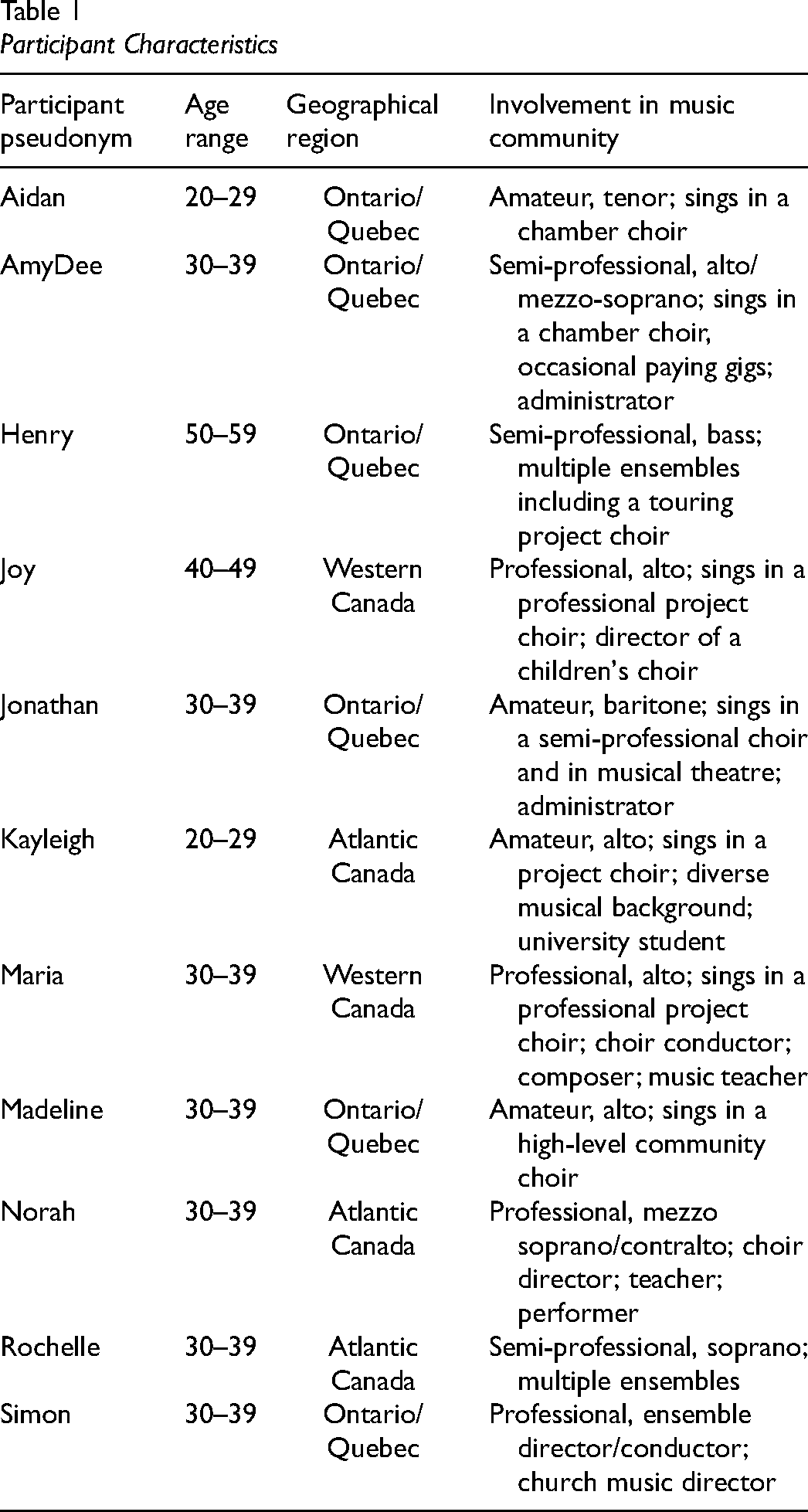
Data Analysis and Interpretation
This project used a phenomenological approach to interpretive description. Interpretive description is a method for qualitative analysis that is commonly used in health-related disciplines for its theoretical integrity and applicability to real-world practice (Thorne, 2016). Interpretive description invites the researcher to integrate knowledge and clinical reasoning from their practice discipline into their interpretation and description of qualitative data, and does not dictate a formal methodology for data analysis. The purpose of interpretive description is to generate new inquiry and insight that leads to deeper understanding of what could be an optimal response in clinical practice. Thorne (2016) writes that clinically-oriented research should be informed by patients’ lived experience, since interactions between healthcare professionals and patients are so intimate and individual. Using a phenomenological approach to interpretive description emphasizes the lived experience of the people served by clinicians, allowing the evidence that guides clinical practice to be more deeply client-centered. Studies done by Shalanski and Ewashen (2019) and Li et al. (2021) followed a similar methodology in bringing phenomenological paradigms to interpretive description research projects.
The findings of a phenomenological study are a compilation of descriptions of the meanings of lived experiences of individuals (Sloan & Bowe, 2014). Hermeneutics, the interpretation of language by an observer, reflects on the content of spoken or written accounts of lived experiences to derive something “meaningful” and “thematic” about that experience (Sloan & Bowe, 2014, p. 4). The assertion that it is impossible for an observer to remove themselves from the process of “essence-identification” led the authors to identify hermeneutic phenomenology as an appropriate branch of interpretive description for this project. Hermeneutic phenomenology acknowledges that the researcher cannot remove themselves from the process of identifying the essences of participant experience. However, through the process of reflexivity, the researcher can both practice critical self-awareness of their assumptions, while making use of relevant prior experience and empathy for the participants to aid analysis and interpretation of the meanings of a text (van Manen & Adams, 2010; Sloan & Bowe, 2014).
This research methodology requires the authors to first “get to know the text” (Sloan & Bowe, 2014, p. 12), and engage with the parts of the information and the whole in a dialogic manner (van Manen & Adams, 2010). The authors ML, SC, and MK read through the interview transcripts individually while reflecting on what the overall themes and meanings of each interview might be. The authors used Quirkos software to inductively code interviews, highlighting text that spoke to the essence of each participant's experience. The authors reflected individually and collaboratively on possible themes within the transcripts, while also considering ways the interview questions, methods, and researcher positionality were related to the themes constructed.
After reading most of the transcripts, authors collaboratively organized the codes into themes, common to several or all of the participants, in the map of visible themes in the Quirkos software. All of the authors met to reflexively discuss how the themes that occurred in the transcripts were similar to elements of their own experience or experiences of other musicians during the COVID-19 pandemic, and critically considered how the experiences were different and individual to the participants’ experiences. The themes that the authors developed in initial readings of the data were used to inform second, third, and fourth readings of the transcripts, in which authors ML, SC, and MK interpreted the ways in which the data could respond to the research question. Themes were revised through this process to ensure the participants’ experiences were portrayed with fidelity and clarity.
Researcher Positionality
Interviews were conducted by author TS, a research associate in occupational therapy who is actively engaged in the Canadian music community as a pianist and vocalist. TS is a member of the national choir community. The shared knowledge of Canadian choir culture supported rapport and candidness in the interview setting. Recruitment materials made clear who would be conducting the interview so that potential participants who were acquainted with the interviewer could make an informed decision about their participation. This may have excluded potential participants who would have felt uncomfortable speaking about their experiences with this author. TS is not a director, manager, or otherwise in a position of power in the Canadian music community. TS did not participate directly in data analysis, which allowed ML, SC, and MK to analyze the data with an outsider's perspective. The combination of insider and outsider perspectives on the research team promoted a rich interactive analysis of the data. Analysis was conducted by authors ML, SC, and MK, three Canadian, cisgender female occupational therapy students who enjoy listening to music, attending live performances, and engage occasionally in amateur music-making activities or music-making as a dimension of their spirituality. These three authors recognize that their background in occupational therapy, which emphasizes the impact of engagement in meaningful occupations on overall health and wellbeing, influenced the research process, particularly their interpretation of the experiences and meaning expressed in the interview data. Furthermore, all authors experienced other forms of disrupted occupational engagement in their personal lives as a result of the pandemic, which situates the research within a shared lived experience between researchers and participants. TS reviewed the findings for community relevance. Group meetings were conducted throughout the data analysis process to facilitate researcher reflexivity. These meetings provided a space for the authors to reflect on personal biases and discuss rationale behind decisions made during data analysis.
Results
Theme 1: Increased Negative Feelings Associated With the Music-Making Experience due to COVID-19 Restrictions
Theme 2: Isolation and Disconnection
Participants recounted the impact that changes to their music-making had on their sense of connection to others. Elements of choral singing that were vital to making participants feel connected to the audience, connected to fellow choral musicians, and a sense of community, became disrupted, resulting in heightened feelings of isolation and disconnection.
Theme 3: Recognizing How Music-Making Aids in Their Own Mental Health, the Participants Used Music-Making to Help Their Communities Cope With the Pandemic
Theme 4: Adapting in Response to COVID-19 Reinforced the Importance of Music-Making
Discussion
The findings of this study detail how the experience of music-making for high-level choral musicians in Canada changed during the COVID-19 pandemic. Fear and anxiety became a significant feature of their experience. As the activity of choral singing was deemed dangerous in the context of the COVID-19 pandemic, participants often contended with discerning whether their participation in choir was “legal.” Other countries around the world also experienced this uncertainty; in Australia, choirs were reluctant to return unless the lifting of restrictions specifically mentioned choir (Salleh, 2021). The implementation of masks and distancing, while creating a sense of safety for participants, also resulted in a less satisfying experience of choir. Beyond these measures being a physical barrier, it obstructed participants’ ability to fully connect with fellow choir members and the audience. This experience reinforced that connection with others is a paramount aspect of the choir experience. Despite the challenges and dissatisfaction with music-making during COVID-19, participants still turned to music-making to cope during this time of adversity. Its use as a coping strategy by participants exhibits how music-making contributes significantly to their wellbeing. The threat of losing choral singing as they knew it reinforced for each of them its importance. Participants described choir as a piece of their identity, what feeds their soul and what adds sparkle to their life. Reuniting with this experience of in-person singing after months of lockdown provided many with a sense of comfort, belonging, and connectedness, even when these same choral singing experiences were altered by pandemic-related restrictions.
The experience of participants feeling anxious and disconnected from music-making aligns with research conducted earlier in the pandemic. During the beginning stages of the pandemic, musicians in various studies expressed how lockdowns limited their engagement in music; some were even reluctant to take part in music at home alone (Spiro et al., 2021). Many individuals “eulogized” their experience of music-making in person and professionally early in the pandemic; they had lost a source of income as well as the ability to rehearse and perform with their colleagues, without an anticipated return to their previous activities (Messick, 2021; Spiro et al., 2021; Youngblood et al., 2021). This temporary loss of music-making may be conceptualized by occupational therapists and scientists as occupational disruption. This is when a person's normal pattern of occupational engagement is disrupted temporarily due to changes in life or the environment (Whiteford, 2000). Lockdowns may have been temporary, but participants in the present study and others (Spiro et al., 2021; Youngblood et al., 2021) described fearing for the future and sustainability of music performance. This suggests that participants felt as though they were under the threat of occupational deprivation, a term used to describe a state in which people are permanently unable to do what is necessary or meaningful in their lives due to external restrictions (Whiteford, 2000).
Throughout interviews in the present study, participants described their experiences of music-making within the COVID-19 pandemic as dissatisfying. Similar studies described online efforts to engage in music as “better than nothing,” but also nowhere near the experience of the choir they knew and to which they longed to return (Youngblood et al., 2021). Cai et al. (2021) found that musicians lost the energy and motivation to engage in practicing music due to pandemic-induced stress. By the time of the interviews in the present study, participants had experienced some manner of returning to making music in person, but still experienced isolation, disconnection, and ultimately a less-than-satisfactory change in the music-making experience. Something crucial seemed to be lost from the original experience of choir, and the participants pointed towards human connection as that necessary ingredient that was still not completely restored in masked and physically-distanced choir spaces. The loss of connection with the audience during performances may explain why participants found the rehearsal process meaningless or purposeless, a sentiment reflected in the experiences of other choral singers (Youngblood et al., 2021). These experiences described by participants and other musicians fit the description of occupational alienation—a term used to describe an experience of “disconnectedness, isolation, emptiness, lack of a sense of spirit, or a sense of meaninglessness” (Townsend & Wilcock, 2004, p. 80) when participating in activities deemed meaningless or purposeless (Wilcock, 2006).
The spiritual aspects of an activity are of particular concern to occupational therapists. Models like the Canadian Model of Occupational Performance and Engagement (Townsend & Polatajko, 2013) and the Occupational Therapy Practice Framework (American Occupational Therapy Association, 2020) include spirituality as a person component. In occupational therapy, spirituality is not synonymous with one's religious values. Rather, it is what motivates people to find meaning and happiness through doing (Kang, 2003), and its meaning is unique to each individual (Mthembu et al., 2015). For amateur choristers, choral singing has been identified to give meaning and purpose to life (Livesey et al., 2012). For the present participants, the spiritual aspects of choral singing were twofold—connection to others and to self. The connection formed with others when making music together was described by several participants as spiritual. Specifically, Joy elaborated on how the community element of choral singing contributes to the feeling of belonging. This reflects the findings of Theorell et al. (2020), which found that both professional and amateur choral musicians identified social connection as what they missed most as a result of disrupted music-making during the COVID-19 pandemic. Choral singing as a form of connecting to oneself was evidenced by participants describing it as a big part of one's identity (Jonathan), what kept them grounded (Rochelle), and an act of taking care of one's spirit (Madeline). For professional musicians, engaging in music-making reinforces their professional identity. Theorell et al. (2020) also noted that professional choral musicians reported missing the aesthetic components of music-making more than amateur choral musicians. Engaging in alternative forms of music-making, which may not allow the individual to experience the aesthetic components of music-making to the same degree during the pandemic may contribute to a diminished sense of self. Participants’ explanations of what engaging in choral singing meant to them indicates that the occupation of choral singing includes spiritual aspects, regardless of whether they used the term “spiritual” or not.
If a person derives meaning from their doing, then disruption of that doing contributes to the feeling of being disconnected from oneself. Furthermore, if choir fosters the formation of connection among choral singers, then its disruption results in feelings of disconnection from others. Therefore, the concept of spiritual deprivation is another way to characterize the experience of choral singing for the participants during COVID-19. Spiritual deprivation is defined as a lack of or loss of meaning, sense of being, becoming, centeredness, connectedness, and/or ability to transcend (Kang, 2003). When circumstantial and environmental forces lead to the prioritization of physical needs, psychological and spiritual needs become neglected (Kang, 2003). In the case of the COVID-19 pandemic, public health restrictions were the circumstantial factor that prevented gatherings such as choral singing in order to protect the physical health of the community. As a result, the implications this had on the psychological and spiritual needs of choral musicians were not immediately taken into consideration. Psychological and spiritual needs therefore constitute important considerations for high-level choral musicians returning to their meaningful occupation of music-making.
It is important to note that the experiences described in this paper are not entirely reflective of Canadian choral musicians who experience certain forms of marginalization. The members of the Canadian choral association which assisted with recruitment are predominantly white. Thus, those who responded to recruitment were not those of visible minorities. Western art music has historically been used as a tool of colonialism in Canada and remains today associated with whiteness and the upper classes (Vaugeois, 2014). Occupational therapists working with musicians who are Indigenous, Black, or people of color should be aware of the colonial history of art music in Canada, but the present findings cannot contribute to the understanding of these experiences. These participants also hold privilege in that they have the time and space to respond to recruitment emails and participate in the interview. Had participation been compensated, perhaps the sample would have been more inclusive to visible minorities.
Implications for Occupational Therapy Practice
Understanding the changes in the experience of choral singing during the COVID-19 pandemic holds value for occupational therapists. Musicians’ health is currently trending towards a more strengths-based, person-centered, and holistic approach (Guptill, 2014; Trondalen, 2013, pp. 864–865). This means that when physical and psychological injuries arise for choral musicians post-pandemic, occupational therapists are well-positioned to be a part of a team to assist in the recovery process. Clearly, the findings of this study support that engaging in choral singing is meaningful to high-level choral musicians, and is therefore within the scope of occupational therapy practice. Occupational therapists can benefit from knowing which aspects of music-making have been impacted during the COVID-19 pandemic and what elements of this experience facilitated or hindered meaningful engagement. Understanding these factors provides a starting point for occupational therapists to know how to help musicians re-engage with their music-making. This includes examining the environment to identify an array of components from masks to government-level policies that support or hinder musicians’ ability to pursue their meaningful occupation (Kirsh, 2015). Occupational therapy's scope of practice uniquely positions the profession to understand the experience of musicians during the COVID-19 pandemic and assist in their recovery on individual and community levels.
Limitations
There are several limitations to this study. Participant recruitment and interviews were completed virtually through online interfaces. Thus, study participation required technological literacy, access to a computer or smartphone, and internet connection. Additionally, participants were sampled from across Canada, in which public health COVID-19 restrictions differed between provinces. The study findings are not representative of the choral musician experience from a specific geographical area in Canada. Instead, results show a generalized view of the music-making experience during COVID-19 as expressed by choral musicians from several Canadian provinces. Moreover, recruitment was not focused on race or gender diversity. Participants were not directly asked about their positions in intersectional power structures such as race or gender. Therefore, the findings do not provide insight on how marginalization may have affected participants’ experiences.
Directions for Future Research
Given the present research data, the authors identify directions for future research. Participants whose primary income source was not music performance spoke of their conscious choice not to pursue music full-time and expressed concern for others who rely on music-making for their income during the COVID-19 pandemic. Those participants did not experience the same extent of income instability or concern for their future careers as many professional musicians had in prior studies (Cohen & Ginsborg, 2021; Spiro et al., 2021). However, participants in the present and other research studies expressed concern for the sustainability and longevity of professional music careers. Even prior to the pandemic, performance-based work was considered unpredictable, with musicians relying on sources of income beyond music (Botstein, 2020; Comunian et al., 2011; Gee & Yeow, 2021; Neil, 2010). Crosby and McKenzie (2021) call for change at the governmental level, advocating for policy evaluations to benefit musicians. Advocating for policy change to enhance a community's ability to engage in meaningful occupations is within the scope of occupational therapy practice, and can be considered a “professional imperative” (Kirsh, 2015). Future research exploring the experience of musicians who choose to pursue or not pursue professional music, and developing ideas for how the profession can be better supported financially and socially, should be considered.
Conclusion
The experience of music-making for high-level choral musicians significantly changed during the COVID-19 pandemic. When the nature in which individuals engage with their meaningful occupation becomes altered, as it did for high-level choral musicians navigating choral singing in the context of the COVID-19 pandemic, it may result in negative impacts to their wellbeing. It is important for occupational therapists to understand the factors that facilitated these changed experiences in order to best support high-level choral musicians in continuing to engage in music-making within the context of the COVID-19 pandemic.
Key Messages
Lockdowns, social distancing, masking, and the concern over the safety of singing led to experiences of anxiety, isolation, and disconnection among choral musicians. The gradual return to singing as it was before the COVID-19 pandemic has been an exhausting and disheartening experience that these choral musicians are still contending with. Despite the challenges, choral musicians persisted to engage in music-making during the pandemic as a way to help them and others cope.
Choral musicians identified that their music-making throughout the COVID-19 pandemic solidified the meaning and importance of choral music. Questions about the role of music in participants’ lives led to answers that were inherently spiritual, such as being essential for identity, belonging, and taking care of their spirit.
Occupational therapists are uniquely qualified to be involved in the return of choral musicians to their meaningful occupation. Occupational therapists can involve themselves on the level of policy and on the individual level regarding the return to choir.
Supplemental Material
sj-docx-1-cjo-10.1177_00084174221145823 - Supplemental material for Losing Life's Sparkle: Experiences of Canadian Choral Musicians During the COVID-19 Pandemic
Supplemental material, sj-docx-1-cjo-10.1177_00084174221145823 for Losing Life's Sparkle: Experiences of Canadian Choral Musicians During the COVID-19 Pandemic by Mary Jo A. Lozano, Stephanie L. Churcher, Madison J. Kirchner and Teri M. Slade in Canadian Journal of Occupational Therapy
Footnotes
Funding
The authors received no financial support for the research, authorship, and/or publication of this article.
Author Contributions
ML, SC, and MK equally contributed to the authorship of the manuscript, with significant contributions from TS. ML, SC, MK, and TS shared responsibility in designing and implementing this study. TS conducted the interviews with study participants. ML, SC, and MK analyzed the data. TS obtained research ethics board approvals and conducted participant recruitment. All authors edited the manuscript and approved of its submission for publication.

Supplemental Material
Supplemental material for this article is available online.
Author Biographies
References
Supplementary Material
Please find the following supplemental material available below.
For Open Access articles published under a Creative Commons License, all supplemental material carries the same license as the article it is associated with.
For non-Open Access articles published, all supplemental material carries a non-exclusive license, and permission requests for re-use of supplemental material or any part of supplemental material shall be sent directly to the copyright owner as specified in the copyright notice associated with the article.
