




Abstract
Introduction
The following introduction is situated around a story which represents my own experience as an Indigenous occupational therapist. It is simply one story among many in my work as a clinician, researcher, and educator in the field of occupational therapy (OT). Readers will note the use of first person instead of the traditional third person, which invites an opportunity to think differently about traditional research reviews.
The Place Where I Begin, yet Have Always Been
The moss bag is a traditional, nurturing Indigenous practice. A moss bag wraps an awasis (infant/child) up tightly using fabric—traditionally made of animal hide. A tie weaves together both sides of the bag to keep baby snug and secure in the bag. It is called a moss bag, because moss was used at the bottom of the bag, keeping baby dry while being antibacterial, similar to the modern-day diaper.
A moss bag is intended to be a baby's first home earth side, emulating the mother's womb and embodying safety, warmth and love. The tie represents the umbilical cord connection between mother and baby and demonstrates the connectedness between the baby and those who support them physically, mentally, emotionally and spiritually. The moss bag is also a teaching tool in that babies learn how to interact with others, respect the earth and all of its gifts—and in turn, learn skills from their relations they too would soon practice. While the moss bag represents and demonstrates warmth and safety, it also embodies the resistance of Indigenous Peoples, as traditional practices are being reclaimed, taught, and practiced. As many Indigenous communities return to making and using moss bags, they centre and affirm the strength of connection and Indigenous knowledges from generations passed.
In the summer of 2021, I read a post on a social media platform, where a rehabilitation professional providing services to a First Nation shared information on torticollis, and therefore the importance of tummy time. Torticollis is a condition whereby the muscles tighten in the neck, causing the head to tilt to one side, and sometimes forward and backwards—it can be both congenital as well as developed due to a side effect (My Health Alberta, 2023). An individual from the community had asked about the use of moss bags in relation to this topic, and asked if it would be appropriate to use moss bags with little ones. The rehabilitation professional noted that it would be in the best interest of the family to not use moss bags due to the limits it places on tummy time and the potential impacts that could have on overall functioning. When I initially read this response to the family, I felt anger and sickness that there was a lack of openness to First Nations knowledge on the use of moss bags resulting in a recommendation against their use.
Fast forward to 2022 and I had the privilege to access moss bags made especially for nitanis (my daughter). We used moss bags to emulate the safety she felt while she grew with me in my womb. Just like many times before, my ancestors used moss bags too. I myself did not get the privilege of growing with a moss bag, and instead was swaddled using blankets, a more accessible practice that is based on moss bags. In a few short generations, there has been a grander shift to accessing our own traditional crafting and ceremonies, many of which have been largely inaccessible, including moss bags. For example, I feel safer wearing beaded earrings at work than my parents did. I need to acknowledge that I am in a better position of safety than my parents or grandparents were for a myriad of reasons such as my employment, as well as ongoing efforts and advocacy of Indigenous people and communities to enact sovereignty, be resilient, and reclaim cultural practices.
At a time of “enlightenment and discovery” in conquering what we now call Canada, settlers established hierarchies of knowledge to legitimate particular ways of knowing and ultimately determine what knowledge was deemed valid and valuable (Smith, 2012). As a result, Indigenous languages, cultures and traditions have become lost over generations (Makokis et al., 2020). Indigenous child rearing is beginning to be formally acknowledged and understood as central to communal and familial well-being (Makokis et al., 2020). As a result, I made space and time to seek out Indigenous knowledges as it relates to Indigenous child rearing. I have since been able to connect with my ancestors who walked before me, which is the most important teaching one has to stay connected to those who walked before us and know that you represent them. I was able to keep connected to my ancestors through the practice of using the moss bag to welcome nitanis earthside.
This paper contends with my desire, and those shared with fellow Indigenous occupational therapists for decolonizing practices in OT. Throughout the paper, the moss bag is used as a metaphor for the desired practices of safety and kinship, and also one of resistance as I amplify the knowledges of Indigenous scholars in a field that predominantly privileges non-Indigenous knowledges. Below, I situate the starting point for this paper.
The Place of Contention
In Canada, colonization has infiltrated all aspects of Canadian society, thereby resulting in extreme inequities in the health and wellness of Indigenous Peoples (Reading, 2015). The premise of “Terra Nullus” by way of the Doctrine of Discovery in the 1400s perpetrated the belief that there was no one occupying what we now call Canada when, in fact, there were Indigenous Peoples living, gathering and hunting on this land (Assembly of First Nations, 2018). Indigenous Peoples were seen as inferior and not utilizing the land “effectively” thus leading Europeans to believe that Canada was an empty place, and presuming their power over Indigenous Peoples. As a result of colonization, Indigenous Peoples’ occupational participation in Canada has been and continues to be negatively impacted (e.g., cultural and ceremonial knowledge being banned, engagement and speaking of Indigenous languages to connect with one another prohibited, etc).
There are more laws and policies against Indigenous Peoples than any other people across Turtle Island (Sockbeson, 2024). For example, as an instrument of control and assimilation, the Indian Act continues to control Indigenous Peoples’ identity, governance, health, education and relationship to the land (National Collaborating Centre for Aboriginal Health, 2014). The Indian Act is grounded in inferiority, the belief that Indigenous Peoples, kinship systems, and traditional knowledges and ways are less than. These beliefs in settler superiority infuse all social systems including education, politics, media, economics and the legal system. Not surprisingly, then, these ideologies are embedded in the creation of the healthcare system and the OT profession (Grenier, 2020).
OT is a profession that can assist with addressing barriers to participation experienced in daily life, as well as taking preventative measures to preserve the health and quality of life through addressing micro, meso, and macro barriers (ACOTRO, ACOTUP & CAOT, 2021). Ramugondo (2018), speaks to these barriers as being context specific, noting that this is an area OT has not yet truly explored. Context, Ramugondo (2018) argues, is important as it goes beyond micro-level clinical practice interactions (person-person, immediate physical environment), and illuminates historical and current contexts as a vital starting point to explore these barriers. For example, in Aotearoa, the OT profession has identified the historical interplay between Maori and settlers, te Tiriti o Waitangi, identifying how macro (systemic) and micro (individual) levels limit the rights to occupations (OT Board of New Zealand, 2022).
OT is a healthcare profession deeply entrenched in colonial and western ideologies that permeate health and education institutions (Grenier, 2020; Pride, 2023). Additionally, research conducted in OT is largely undertaken using non-Indigenous (western) epistemologies, which contributes to western dominance in education and practice. In theory, OT has the potential to support the re-imagining of healthcare alongside Indigenous communities, but this is yet to be realized. Grenier (2020) further notes that white supremacist ideologies are embedded into OT through regulation, accreditation, education and clinical practice standpoints, further perpetuating oppression and inequities for clients and Indigenous occupational therapists. Additionally, there is an understanding, though not well documented, that OT was complicit in the functioning of the Indian Hospitals (Meijer Drees, 2014)—this involvement needs to be further explored (OT TRC Task Force, 2021).
The OT Truth and Reconciliation Commission (TRC) Task Force in Canada, co-chaired by Kaarina Valavaara and Angie Phenix, reminded settlers that “transforming our colonial reality must be a responsibility shared by all Canadians” (OT Truth and Reconciliation Task [TRC] Force, 2023, p. 3) and that “OTs must critically examine current systems and models to increase the relevance and integrity of the profession” (CAOT, 2018, p. 1). In 2021, new competencies were introduced to Canadian occupational therapists. Competency C, named “Culture, Equity and Justice: We respect and continue to learn about traditions and ways of doing” emphasizes the necessity of equity, diversity and inclusion as the basis of clinical practice and education. It states: Inequities exist in our society, and therefore in OT. OTs acknowledge and respond to the history, cultures, and social structures that influence health and occupation. They recognize the social, structural, political, and ecological determinants of health. Competent OTs are conscious of personal identity and privilege. They keep building their understanding of human diversity. They create culturally safer relationships and anti-racist, ethical spaces. They act on situations and systems of inequity and oppression within their spheres of influence. (p. 13)
Recognizing Knowledge that has Always Been
As noted above, OT practice is situated on the premise of white supremacy, where western and eurocentric ways of thinking are presumed superior to all other knowledges, including Indigenous knowledge (Grenier, 2020). By following the status quo of the settler colonial profession, the “logic of elimination” is being enacted, whereby the priority of settler colonialism requires the elimination of those over whom the colonizer requires control (Grande et al., 2018). When considering an alternative, it highlights the action of decolonizing pedagogy, research, practice and education. Linda Tuhai Smith, invites non-Indigenous and Indigenous Peoples to recognize decolonization to be a process that butts heads with colonization and imperialism, to then make space for upholding and centring Indigenous knowledge in research and beyond (2012). Given this, the following paper “refuses” the status quo that is the academy, as well as the profession of OT, and refuses to continue to perpetuate the forces of settler colonialism. Instead, this paper aims to enact decolonizing through Indigenous refusal. Sandy (Grande et al., 2018), a Quechua scholar, describes Indigenous refusal as no longer wanting to be acknowledged by the settler-colonial context and instead create a new Indigenous led path. To me, this paper is not reiterating the typical nuances of OT research, but instead, it is beginning to forge a path outside of traditional literature and practices, much like what has been done by each author included in this review.
With this paper, I refuse to simply include Indigenous knowledges and perspectives in OT. Rather, Indigenous knowledges are the lens with which I approach this literature review and my response to the question: What are Indigenous authors sharing about decolonizing the OT role in therapeutic service provision (within micro, meso and macro levels) with Indigenous families and communities?
Being With the Stories (Methods)
How do I Come to This Work?
As an Indigenous OT with relationship to the land in “Canada,” I have experienced both a lack of belonging and uncertainty over my place to push the status quo of the profession. I will admit, this paper was both difficult and a relief to write. Difficult in that this work is deeply personal, just as it is professional. As an Indigenous person, I do not choose to be political—being born Indigenous in a settler-colonial context makes being Indigenous inherently political. While heavy, this work also gives me hope—the relief I feel is by acknowledging the work already being done, and therefore my responsibility to keep moving it forward alongside Indigenous individuals and scholars, as well as my ancestors who have walked before and my descendants who will walk after me. I look forward to challenging status quo research processes and illuminate Indigenous voices, knowledges, and practices.
Refusing a Review of the Literature
Given this paper's aim is to illustrate decolonizing OT practices, while simultaneously amplifying Indigenous scholars and practitioners, a traditional literature review seemed to be in misalignment. Still, the initial systematic search started with finding articles by means of key words through CINAHL, PsychInfo, Medline, and Scopus using terms such as: (1) Population: Indigenous* Indigenous people* First people* Indian* Aboriginal* (2) macro intervention* macropolitical intervention* systemic intervention* (or split these up) decoloniality* decoloniz* (3) OT or occupational justice. Additionally, there was a primary focus on articles written within the contexts of Canada, the United States, Aotearoa (New Zealand), and Australia, mostly because these are the contexts of which I am most familiar and with which I have relationships. Articles that explored decoloniality and minorities were excluded as the focus was to explore what decolonizing OT means for Indigenous Peoples specifically. Through title and abstract review, I was left with 15 articles. It was at this point I critically evaluated the process of my searching and purpose for reviewing.
Tynan and Bishop (2023) propose another way to engage in decolonized methodologies. They describe the work of Linda Tuhai Smith and state that through literature reviews we can enact relationality, contrary to traditional reviews that emulate and perpetuate hierarchies of knowledge. Furthermore, Tynan and Bishop (2023) identify that this is something that takes time—the propensity to analyze and critique knowledge and research, and beauty that varieties of knowledges bring forward. To go one step further, Indigenous axiologies are built on the necessity of reciprocity to one's relations (Wilson, 2008), in the western research world this would be referred to rigour. Therefore, the current review aims to summarize the authors’ knowledges in the OT profession from their Indigenous perspectives, as accountability to the stories and words shared and interpreted by the reader.
I outline the timeline of working on this paper to illustrate the relationality and reciprocity intended by it. In line with refusing the review of literature, in an ideal world, I would be able to story with the authors, use their names throughout, and fully introduce their nations at the onset of the “results” section. Instead, they are captured in the table of articles (Table 1), along with my relatedness to the stories shared. In line with this journal's submission guidelines, if there are more than two authors, then only the first author is included as per the APA 7 in-text citation guidelines. However, if this were followed, some Indigenous authors would then be excluded. Instead, all Indigenous authors are outlined in the chart for reference alongside the paper citation for easier identification.
Illustration of the Vast Contexts, Perspectives and Wisdom Collected in This Review (Tynan and Bishop).
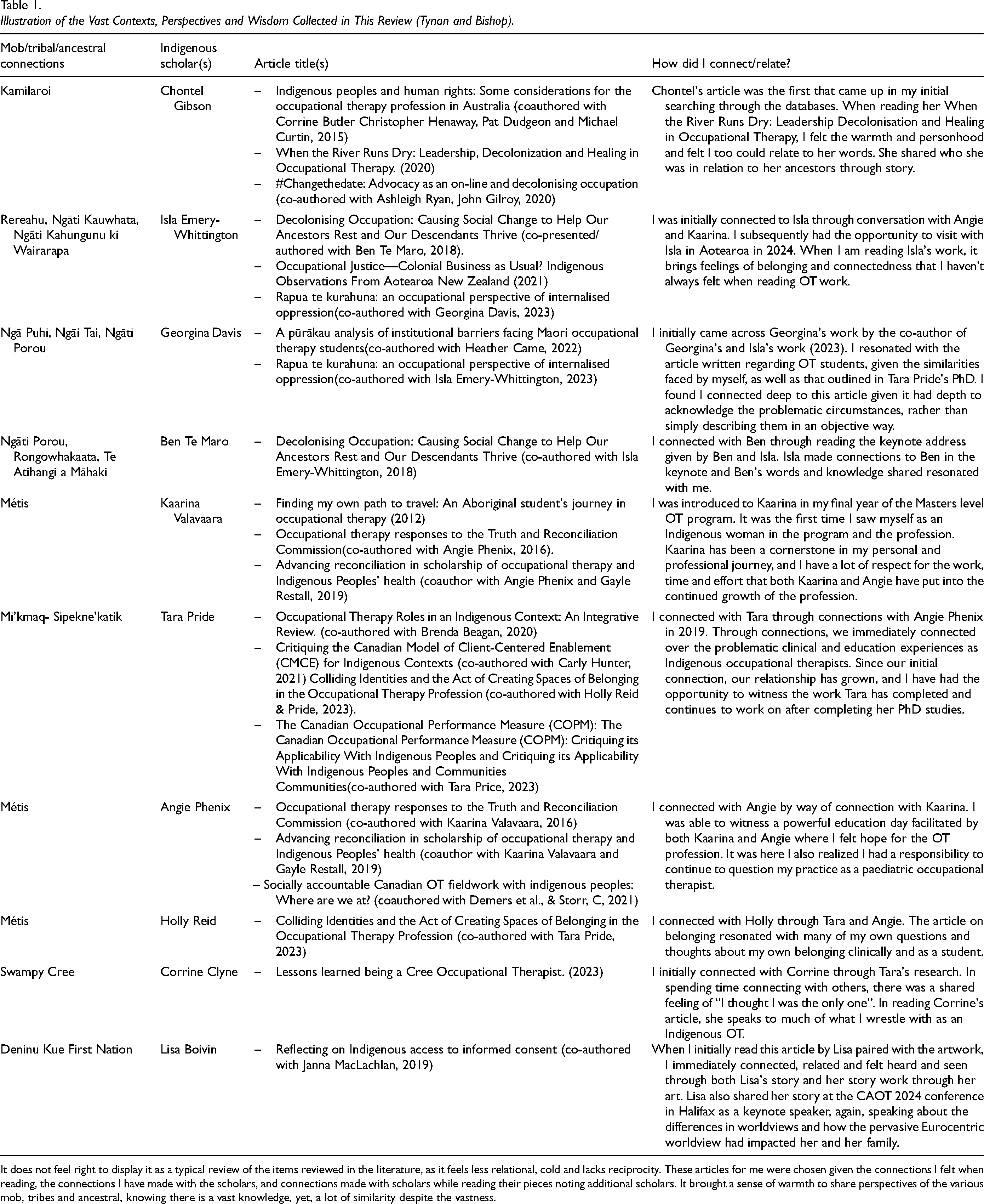
It does not feel right to display it as a typical review of the items reviewed in the literature, as it feels less relational, cold and lacks reciprocity. These articles for me were chosen given the connections I felt when reading, the connections I have made with the scholars, and connections made with scholars while reading their pieces noting additional scholars. It brought a sense of warmth to share perspectives of the various mob, tribes and ancestral, knowing there is a vast knowledge, yet, a lot of similarity despite the vastness.
Following the identification of the initial 15 articles, I was introduced to other similar scholars who were identified through relationships; given articles were included based on the relatedness of the stories that spoke to the research question. It was at this point that two articles were added. There are multiple articles written by the same authors, many of which could be identified as being “non-peer reviewed”. It demonstrates both the complex and complicated relationships with the academy and research from an Indigenous perspective, particularly those with OT knowledge.
Once I began to engage with the papers and authors that felt familiar based on my personal relations with them as well as connectedness to their written words, I began to feel the current review is fulsome enough based on my own understandings and experiences—in the conventional review world, this would be data saturation. Those articles and papers included in the “results” represent connection with the stories shared by each author in relation to the purpose of this paper, and what I hope to learn more about. Relationality is something that cannot be duplicated from one person to the next. Rather, the results shared capture the way I engaged with the author’s work, given my own lived experience. When reading their work, it provided me with validation and feelings of belonging and being seen.
It is worth noting that this is a co-authored paper with Tara Pride, a Mi’kmaw woman registered with Sipekne'katik in Mi'kma'ki. The co-authorship of this paper emphasizes Indigenous knowledges held by, and for, Indigenous authors. This paper was also supported by Tim Barlott as an ally, through providing mentorship, guidance, and support.
Moss Bag Nurturing, Sharing Kinship With the Authors (Results) Moss Bag Nurturing
The imagery of a moss bag holds personal and deep significance for me, symbolizing the essence of collectiveness and relationality. For the purposes of this paper, there are three symbolic aspects of the moss bag that will be illuminated when discussing the micro, meso and macro levels—the fabric, the umbilical cord (tie), and the wholeness of the moss bag. While the metaphor is rooted in the context of children and families, it also holds relevance for occupational therapists who may interpret it as a representation of paediatric practices. Children's spirits embody wholeness, and it is essential to facilitate wholeness with individuals of all ages—a principle that is crucial for fostering connection and decolonizing practice (Makokis et al., 2020; Steinhauer, 2002). In OT, there is a concerted effort to promote children's independence in their daily activities while reducing reliance on caregivers. However, the concept of the moss bag embodies the notion of keeping children in close proximity, allowing them to observe and absorb the actions of their caregivers and community during their formative months and years so that they may emulate these behaviours when the time is right.
Moss bag teachings have not been transmitted easily across generations due to the historical impact of residential schools and the sixties scoop, which significantly influenced the nurturing of Indigenous children and families. Beyond its literal representation, the moss bag embodies themes of reclamation, resistance, and the preservation of traditional childcare practices. It symbolizes the ongoing endeavour to care for our children in our own way. The outcomes of the review will be delineated across micro, meso, and macro levels to encapsulate the process of decolonizing OT, with the moss bag serving as a powerful conduit to illustrate these diverse dimensions.
Snugness of the Moss Bag: Warmth and Safety (Micro)
The moss bag fabric provides the snugness to the awasis and emulates warmth and safety, at a micro level of decolonizing, interactions with one another must provide warmth and safety to those we work alongside. However, before we (as occupational therapists) engage in relationship building, we need to understand and critically analyze the context we are working in to engage in this work meaningfully. From there, we can begin to reconfigure the OT service delivery process.
Relationality to Ones Local Context of Practice
Many ideas were identified in the articles as imperative to being an OT, most notably, the importance to acknowledge the historical underpinnings of the contexts in which we operate. Acknowledging and reflecting on the settler colonial context is vital to breaking down inherent power-differentials across research, clinical and education contexts (Phenix & Valavaara, 2016). Further, we must acknowledge the historical and cultural contexts of Indigenous people to better uphold Indigenous self-determination in practice, as well as addressing trauma experienced within colonial systems (Boivin & MacLachlan, 2019; Clyne, 2023; Gibson et al., 2015; Phenix & Valavaara, 2016). This requires us to reflect on systems, structures, and processes and how they do not serve Indigenous people (Gibson, 2020). Additionally, reflecting on what each of us individually bring to the client–therapist relationship is vitally important, taking an internal look first, analysing our beliefs, familial connections to the land and colonization, to truly address power imbalances (Phenix & Valavaara, 2019).
As registered health care professionals, we are asked to represent our profession “appropriately” both during and outside of work. For example, Ryan et al. (2020) challenged, if Indigenous Peoples are advocating against “Australian Day,” perhaps clinicians should not participate in such celebrations given the complexities of supporting and celebrating official colonizer days. While practicing, it is not enough to sit by and be a bystander when racism is perpetrated, rather it should be addressed by enacting change at all levels, especially as individual clinicians (Davis & Came, 2022).
Relationships
In all reviewed articles, the significance of relationship building and addressing power dynamics within the therapeutic relationship is emphasized and crucial. For instance, articles encourage a shift in perspective toward the initial connections with clients, highlighting that establishing meaningful relationships takes considerable time (Boivin & MacLachlan, 2019; Phenix & Valavaara, 2019; Reid & Pride, 2023; Valavaara, 2016). They also question the feasibility of achieving a balanced therapeutic relationship given western health care and delivery expectations and underpinnings. Similarly, Gibson et al. (2015) stress the importance of avoiding seeing Indigenous Peoples as being passive recipients of OT services.
Furthermore, there is a call to move away from a productivity and efficiency-centred approach and consider slower, more attentive initial visits, which poses a challenge to traditional practice models (Price & Pride, 2023). Time constraints impact the establishment of trust and meaningful relationships, particularly in light of the historical impact of colonization (Clyne, 2023).
Reconfiguring the Practice of Service Delivery
All articles to some extent argued for thinking differently about how we have historically conceptualized OT practice. Emery-Whittington (2021) highlights it is time to unsettle the status quo. Notably, there is a need to dismantle the idea that occupational therapists are the expert in clinical situations, as this implies and propagates power hierarchies (Hunter & Pride, 2021). It is vital to understand that being attached to the health system and working with Indigenous people, inherently creates a power differential. Price and Pride (2023) question the value placed on standardized and structured assessments to support discharge planning, rather than envisioning the family as the primary driver to collectively determining next steps.
Further, it is important to think critically about how we understand occupation itself, recognizing the prominence of individualism in how occupation is conceptualized, which can be oppressive to Indigenous Peoples (Gibson, 2020). We should reframe what occupations look like, as traditionally Indigenous occupations were collective rather than individualized (Emery-Whittington, 2021). Indigenous OTs might reclaim valued and healthful occupations such as dreaming, theorizing, meeting, speaking, and listening that promote reconnection to self, one another, and nature. Indigenous practitioners might also continue to practise “disobedience” in refusing colonial inducements and “dangled carrots” that promote deeper entrenchment within colonial systems. (Emery-Whittington, 2021, p. 158)
Clyne (2023) notes the strength of OT in analyzing skills to employ with existing activities communities are already engaging in to bring forward healing, with the understanding that these activities could look different for each community regardless of being of the same tribe. Additionally, in current times, we can shift focus to the meaningful activity of advocacy which both promotes health and well-being while simultaneously making one more vulnerable against opposing forces (Ryan et al., 2020). Ryan et al. (2020) explored how advocacy against the celebration of Australian Day can be supported and facilitated by occupational therapists.
Lastly, there were a handful of articles seeking to shift the focus of OT services away from systems that have created health inequities for Indigenous Peoples (Price & Pride, 2023). Shifting focus from the individual to community requires a social justice and human rights approach that considers the social determinants of health that impact accessing and using OT services (Hunter & Pride, 2021). Phenix and Valavaara (2019) echo this, noting that in order to address social inequities, we (therapists, researchers, and educators) must critically take a look at ourselves first as part of the initial visits.
The Umbilical Cord Connection (Meso)
The meso level of OT service provision is illustrated to me similarly to the tie of the moss bag, which represents the umbilical cord. The tie of the moss bag symbolizes the greater connection of awasis to their mother, ancestors and community. Here I see the tie as the meso level of OT service provision, connecting the person(s)—occupational therapist, people we work with and communities—to the larger systems at play. For example, very rarely is the occupational therapist working in a silo, rather they are working within organizations (e.g., non-profits), hospitals, and universities by way of educating future clinicians.
Standing With Indigenous Colleagues: Reliably and Quickly
It is evident that solidarity from non-Indigenous occupational therapists is critical for decolonizing practice. In Canada, for example, there are currently two Indigenous occupational therapists with full-time academic and/or teaching roles across the fourteen OT programs. For those in leadership positions mentoring Indigenous occupational therapists and scholars, issuing commitment to reconciliation statements without policy and organizational change needs to end—position statements without action continues to perpetuate racism against the Indigenous workforce and clients who receive services (Emery-Whittington & Davis, 2023). For example, Emery-Whittington and Davis (2023), point to the lack of acknowledgment of racism insidiously embedded within professional regulatory bodies, which aims to protect the public, and accreditation which analyzes education standards. Additionally, prioritizing and valuing Indigenous scholars perspectives, opinions, and expertise must be at the forefront of shaping “best practices” that impact Indigenous people in a positive way rather than a deficit-oriented view (Restall et al., 2019).
One word of caution noted by Gibson (2020) is when organizations engage in “cultural shopping.” She further describes cultural shopping as finding an Indigenous voice that illustrates and fits the organizational narrative, rather than listening broadly to Indigenous voices for advice, guidance, and knowledge that can emerge to drive necessary change. Clinical research representing Indigenous people needs to have authentic interrogation of the authors/researchers relationship with Indigenous Peoples, as well as providing opportunities for Indigenous scholars to exert self-determination over research and scholarship concerning Indigenous Peoples (Restall et al., 2019). For example, addressing guidelines for manuscript submissions that allow space to acknowledge how authors engage with Indigenous communities and secondary data, as the process can be as important as the outcome (Restall et al., 2019).
When programs and preceptors take in Indigenous students they should be confronting colonial realities, and if not addressed, these systems will create further harm to Indigenous students. Reid and Pride (2023) speak to the necessity of clinicians, educators, and researchers to continually reflect on how the professional contexts (practice, education and research) inherently perpetuate harm even if not intended, and therefore taking steps to educate themselves on what is needed to make their OT context more hospitable, such as creating connections and community of which marginalized students and clinicians can connect with. Clyne (2023) notes further it is important when working with First Nations, Metis and Inuit communities, to not pan-Indigenize and to understand the nuances and varied cultural practices even within one First Nation community. For example, Clyne (2023) notes the need to continually address biases, actively reflecting on the actions of being an OT and if they are respecting and upholding the community and family's culture, listening and asking questions, as well as allowing time and space for trust to build. Without active use of these skills, there is harm being perpetuated to Indigenous clients as well as Indigenous OT students by reproducing the OT practices that are in dire need of redressing (Davis & Came, 2022; Demers et al., 2021; Valavaara, 2016).
Indigenous occupational therapists have noted harmful situations across Canada and Aotearoa during their own educational experience. Clyne (2023) recalls a situation where an Indigenous man was labelled as volatile and another allied health professional dismissed acknowledging the trauma voiced by the man and its implication of how he receives care. Davis and Came (2022) demonstrate a situation where a clinical supervisor assumed a Maōri student to be a fluent speaker and able to communicate with a Maōri Elder, leading the student to feel embarrassment and unsafe as they were not fluent as expected by their supervisor.
Furthermore, how can organizations support the development of critical allyship skills for non-Indigenous occupational therapists? Restall et al. (2019) caution against non-Indigenous claiming the title of an “ally” in relation to Indigenous knowledges and perspectives, as this can lead to non-action. Emery-Whittington and Davis (2023) note the term “quiet allyship” of non-Indigenous occupational therapists, is like carrying one's stretcher to the ambulance and leaving it there (Emery-Whittington & Davis, 2023). It does little to heal or displace the harms caused when Indigenous students and clinicians are pushed constantly to the margins within health care and education systems (Reid & Pride, 2023).
Nurturing Indigenous Knowledges
Nurturing means both upholding and recognizing the strengths of Indigenous ways of knowing and being, as well as providing space to nurture oneself in institutional settings that are harmful for Indigenous occupational therapists, students, educators and researchers. Emery-Whittington and Te Maro (2018) make note of the strengths of Indigenous occupational therapists to any practice setting, as it is in our nature to sit, listen and understand the ways in which the communities we work with have inherent nuances that differ from our own, and most importantly we understand the responsibility to our ancestors to do different and create better for our future. They note that Indigenous occupational therapists deeply understand, for example beyond a chronic condition, and how Indigenous Peoples are implicated daily by colonialism, and yet, still show up and engage in daily life despite colonialism being entrenched within everyday life (Emery-Whittington & Te Maro, 2018).
Recognizing the potentially burdensome nature of Indigenous occupational therapists work due to being in the margins and working within colonial health services that have harmed them and their ancestors, many articles underscore the importance of supporting Indigenous clinicians. Many spoke to the importance of creating informal networks of Indigenous clinicians, researchers, and academics that supports knowledge sharing and mentorship is vital across their own contexts (Gibson, 2020; Reid & Pride, 2023; Valavaara, 2016). In institutions such as health authorities, educational institutions, partnering with Indigenous service providers and people is equally essential in determining how and if OT fits in these contexts (Gibson et al., 2015).
It is crucial to create a collaborative and relational space within institutions to care for ourselves as care providers and strengthen relations with the people we interact with (Emery-Whittington & Davis, 2023). This includes creating a community of like-minded clinicians (Reid & Pride, 2023). It is then critical for institutions and leaders to acknowledge that personal and professional belonging impacts how OT students and clinicians engage with themselves and those receiving services in authentic and meaningful ways (Reid & Pride, 2023). Reid and Pride (2023) observed that the time spent on unpaid work alongside existing work responsibilities can be demanding for Indigenous occupational therapists based on their lived experiences.
The Beauty and Significance of the Moss Bag: Wholeness (Macro)
I see the macro level represented by the beauty and the significance of the moss bag for those looking at an awasis bundled inside a moss bag. Earlier, I noted the importance of my relationship with the moss bag, as it is not just an opportunity to reclaim traditional practices but to connect with those who have walked before and continue to walk with my family and me. Macro-level change is much the same in that it is responsive to larger historical legacies, with the opportunity for significant changes in the OT profession. Macro-level change requires elevating Indigenous voices and knowledges to support the profession's growth while supporting Indigenous people, families and communities.
Partnering and Elevating Indigenous Knowledge
Articles described the need for Indigenous worldviews to be formally incorporated into OT training to ease this burden off Indigenous shoulders (Valavaara, 2016), as Emery-Whittington and Te Maro (2018) note that Indigenous people are already allocating energy to simply survive in various colonial systems. Conversely, one article noted the benefit of having an Indigenous clinician to educate and enhance students’ knowledge base for their clinical practice (Demers et al., 2021), yet, it is important to caution that having one/very few Indigenous clinicians or educators is not a suitable formula for macro level change. Davis and Came (2022) participants spoke to the importance of genuine and longstanding relationships within the current western education offerings and illustrate the power of adding more Maōri administrators, liaison officers and placement coordinators, of which their roles are to check in with Maōri students as well as building and maintaining relationships with communities. Price and Pride (2023) highlight that Indigenous ways of knowing and being have been excluded from OT education, research and practice, acknowledging that how to integrate this is a work in progress. Davis and Came (2022) participants highlighted the potential to re-envision education outside of the current western offering, imagining a dedicated program for Maōri students within a Maōri university.
It is essential for organizations and systems to actively value the importance of Indigenous knowledges and allocate resources appropriately. This includes the demonstration of such value by the inclusion of Indigenous Elders in curriculum, competencies, accreditation, and regulatory standards (Gibson et al., 2015). The goal is not to performatively include these knowledges, but to enable them to guide and change processes (Gibson, 2020). Authors have stressed the importance of elevating and making space for Indigenous knowledge in a purposeful, thoughtful way (Restall et al., 2019), rather than as an afterthought once decisions have been made (Gibson, 2020).
Taking the Initiative
It is imperative that at all levels of service provision, there is a critical analysis of the underlying assumptions and biases (White & Beagan, 2020). Gibson (2020) suggests embedding the praxis of decolonization into OT practice, education and research. Resources need to be allocated to those, such as Indigenous researchers, clinicians and educators, who can re-envision and create new models to dismantle the ideologies prevalent in the profession (Emery-Whittington & Te Maro, 2018; Hunter & Pride, 2021). Phenix and Valavaara (2016), called on the profession to discontinue the use of unsuitable tools, this was echoed by White and Beagan (2020) and most recently by Price and Pride (2023).
At all levels, there needs to be more engagement with having “challenging” discussions at a leadership level and actively considering if actions are reinforcing or going against the status quo, despite the potential consequences (Emery-Whittington & Davis, 2023). This is particularly important for non-Indigenous people who are beneficiaries of colonization and do not have to contend with the same resistance and barriers in navigating systems (Emery-Whittington & Te Maro, 2018). Instead of merely responding to competencies in practice, there needs to be a re-envisioning of what education and learning can look like, moving away from the traditional professor-student relationship and addressing underlying colonial ideologies in the curriculum (Davis & Came, 2022). It is clear the current make-up of education programs are not safe spaces, as they do not align with Indigenous ways of knowing and being for Indigenous OT students and for Indigenous people in community receiving services within community (Clyne, 2023; Davis & Came, 2022; Reid & Pride, 2023; Valavaara, 2016). An example was provided by Davis and Came (2022) envisioning providing space and resources to create an Indigenous led and sovereign OT education program that is grounded in community and ways of knowing and being.
Epistemological conversations often begin in higher education, and as such universities play a key role in re-envisioning process (Phenix & Valavaara, 2016). Indigenous ways of knowing and western worldviews differ vastly, and therefore change how education, tools and service is oriented. Phenix and Valavaara (2016) note that one way to do this would be to provide space to examine how assessments and service provision being offered does or does not work for Indigenous people to reconcile the implications on health and well-being. Price and Pride (2023) and Hunter and Pride (2021) offer examples of analysis by exploring a commonly utilized assessments, the Canadian Occupational Performance Measure (COPM), and a model, the Canadian Model for Client-Centred Care Enablement (CMCE) that are taught in educational institutions as well as utilized in practice, being potentially unsuitable for use with Indigenous Peoples. Moreover, implementing a true and honest exploration into the ongoing health inequities experienced by Indigenous Peoples due to the persistent impacts of colonization into OT curricula would be beneficial as a start to addressing the epistemological differences (Phenix & Valavaara, 2016).
Connection and Reciprocity (Discussion)
In conventional traditional review articles, the discussion section is used to support the credibility of the results presented in the article. However, this paper aims to challenge this traditional approach and answer the question: “what are Indigenous authors sharing about decolonizing the OT role in therapeutic service provision (from micro, meso and macro levels) with Indigenous families and communities?” I view the discussion as a way to connect the information provided in the results and to further elaborate on the stories shared by the authors, particularly in relation to existing Indigenous authors outside of the OT community. It serves as an opportunity to illustrate the progression and development of the ideas presented.
In the Canadian context, given the legacy of colonialism, the TRC of Canada was created to engage with survivors of residential schools, families and communities. In 2015, the Truth and Reconciliation report made 94 Calls to Action to facilitate reconciliation, spanning a variety of fields, from education, to health, child welfare to newcomers to Canada. The co-chairs of the OT TRC Task Force released a statement regarding their work with this statement of commitment noting: [the statement] is reflective of the ongoing relationship building represented by all signatories at the time of publication and the collective will to meaningfully advance the TRC of Canada Calls to Action, the Final Report on the National Inquiry into the Missing and Murdered Indigenous Women and Girls (MMIWG) Calls to Justice, and in implementing the United Declaration on the Rights of Indigenous Peoples (UNDRIP) within the profession of OT. (Valavaara & Phenix, 2023) So long as one side sees reconciliation as a question of rights and the other sees it as an act of benevolence, reconciliation will not happen. (Policy Alternatives, 2017, 0:44:00)
Leadership is required across all three levels, beginning with individual therapists on the ground working with people directly to challenge traditional notions of OT service delivery. Organization and institutional leadership are required to make space and truly recognize the importance of leading decolonization efforts so that both Indigenous and non-Indigenous clinicians and students feel supported to enact change. Individuals in senior leadership positions play a crucial role in shaping the models, tools, and assessments for the OT profession. This includes those responsible for accreditation of educational institutions, as well as regulatory authorities who set the standards for the profession. Each of these groups has a vital part to play in the development and regulation of the OT field. It is unclear what actions have been taken toward true reconciliation.
Necessity of Representation, Understanding, and Action
Euro-Western science and research have historically relied on craniometry, which studied skull size and deemed white people superior based on these metrics (Smith, 2012). This pervasive belief in superiority has permeated health and education sectors (Smith, 2012), and influence what knowledges are valued. In the field of OT, which has emerged in the last century, it is crucial to recognize the epistemological differences between Indigenous ways of knowing and Euro-Western understandings of knowledge. For instance, Willie Ermine (1995) describes Indigenous knowledges as holistic and relational, contrasting sharply with the segregated disciplines of OT, speech-language therapy (pathology), and physiotherapy.
For example, I once had a conversation with a non-Indigenous colleague who asked why no one was willing to take a food box from the health centre in a First Nation we were working in, where the boxes were provided with the intention to support overall health and well-being from a nutritional standpoint. I realized that this question was loaded due to the long-standing dependency on systems imposed by the Canadian government on First Nations Peoples. I tried to explain the historical complexities behind this response, but I am uncertain if they truly grasped my point. I recall stories from my family about receiving rations from the Indian Agent, while simultaneously being unable to earn a living from farming, which could have provided greater access to more nutritious food. The food options available were often cheap, non-traditional, and lacking in nutrition. Pausing here, do you understand why I have shared this story? Does it disrupt the academic narrative?
I share the story for a multitude of reasons. One, just because a resource exists does not guarantee that it is beneficial or responsive to a need, or is without feeling judgement or shame. The decision to accept a food box is complex, influenced by unconscious choices shaped by Euro-western policies designed to assimilate Indigenous Peoples into the Canadian narrative. The previous example not only speaks to the necessary increase in representation of Indigenous occupational therapists who “get it” given their own lived experience as Emery-Whittington and Te Maro (2018) note, epistemology and familial history, but also the importance of education on the social determinants of health and underpinnings of education (Phenix & Valavaara, 2016). Why is this important?
Reading (2015) states that colonization and poverty are key determinants of health for Indigenous Peoples, impacting their overall health and well-being. Perhaps the confronting reality is that addressing the systems would lead to less of a need for OT intervention. For example, in the area of paediatrics, OT practice is anchored in western developmental milestone skills, of which do not align for Indigenous people in Canada (Grenier, 2020). In my Nehiyaw teachings, children are not seen to be remediated and intervened, and are rather viewed as a gift to be nurtured in whichever way they need to be. In the context of First Nations people, as a profession have paid very minimal attention to addressing poverty. Blair and Raver (2016) identified in their study that poverty impacted the frontal lobe, hippocampus, and temporal cortex, which are all required to support day-to-day functioning. What if some roles of OT would be null if we collectively tackled the lack of: housing, running water, intergenerational trauma, cultural dissonance, and made it an aim to promote collective occupations for the greater well-being of whole communities?
Reframing Power and Systems
Given many occupational therapists are working within colonial systems, with little to no focus or time dedicated to overhauling the system they are working in, change can be slow or non-existent. Perhaps the most power we can enact is by allocating time and efforts into the relationships with Indigenous Peoples we work with. Relationality is critical in Indigenous worldviews and epistemologies are based on both inward understanding as well as being deeply connected to oneself and all creation (Ermine, 1995). Understanding that relationality is critical for knowledge growth, it seems inherent that occupational therapists need to prioritize relationships with those that surround them. The textbook Promoting Occupational Participation: Collaborative Relationship-Focused Occupational Therapy by Mary Egan and Gayle Restall, outlines the importance of relationships in OT practice, however, in current practice contexts, driven by productivity, efficiency and accountability, with ever-expanding caseloads, significant structural change will be required to make such relational practice the norm.
Cindy Blackstock (2016) describes the action of Mosquito Advocacy in relation to small organizational change, utilizing the metaphor of a mosquito, which is small yet persistent being until they wield the result they seek, the bite, which results in an itch that may last for days. She explains Mosquito Advocacy as encompassing six characteristics: (1) small and agile, (2) goal oriented, (3) infectious, (4) buzzing, (5) swarming, and (6) biting. In the context of OT, this metaphor and action of the mosquito is incredibly meaningful. For example, I’ve heard feedback from clinicians and students state that they do not have time to build meaningful and trusting relationships. If more clinicians push against the requirements of a fast paced, go-go, do the assessment, treat and then discharge, the system will have no choice but to change, and we will begin to see the benefits of challenging the status quo.
For the purposes of clinical practice, the same mosquito metaphor could be utilized to argue that change can happen across all levels of service provision. For example, one OT (small and agile) that is relentless in bringing up multiple incongruencies with practice in an organization (both infectious and buzzing) can possibly be enough to lead to organizational change (e.g., educating on reforming the consent process for service delivery). It should be noted, there is power in the swarm, therefore it is logical to find other socially focused clinicians to band together with rather than facing it alone. I can speak from experience, that I alone faced difficulties and barriers enacting change, however, I was supported by active allies to push for organizational change, which is powerful. For those working in systems, there is power in both advocating for change in policies and structures from the top down and from the ground up.
In the context of OT, we collectively need to reconfigure how we work in these systems, and challenge thinking that we are constrained in systems. In Tara Pride's PhD dissertation (2023), she speaks to decoloniality with the profession of OT, whereby the profession of OT should not simply try to make space for Indigenous knowledges into already existing structures, but rather enact Indigenous sovereignty by empowering Indigenous knowledges to lead change and create what is needed. Ironically, after Price and Pride (2023) published a critical analysis of the COPM tool and its relevance to Indigenous Peoples, the creators of the COPM published a response defending the tools suitability for use with Indigenous Peoples and other diverse groups, claiming it is “culturally sensitive by design” (McColl et al., 2024). The response to Price and Pride (2023) demonstrates what knowledges are deemed valid in the profession of OT, reinforcing these hierarchies of knowledge, despite the analysis presented by Price and Pride (2023), from an Indigenous worldview.
The importance of increasing Indigenous representation in teaching and clinical roles has been highlighted (Demers et al., 2021), of which it is noted that Indigenous occupational therapists feel that they do not necessarily fit within these systems (e.g., Davis & Came, 2022; Reid & Pride, 2023), so one avenue Tara has proposed for this is to create a network of Indigenous occupational therapists who are driven to effect change and problem solve through their clinical and research work by means of creating a sovereign and self-determined community.
Creating our sovereign systems and structures is important and necessary to support Indigenous rights and self-determination, yet we must still attempt to enact change in mainstream spaces—this parallel work also needs to be done. We then consider, as Indigenous occupational therapists, the following questions: How do we ensure we don't overextend ourselves by trying to enact change in mainstream spaces at the expense of collective visioning and creativity to create our own systems? How do we find balance between building relationships within systems and actively challenging those same systems? How do we move beyond mere inclusion of Indigenous Peoples in a system that was set up to entirely exclude and erase us? These are questions that are difficult to answer, but become more feasible to tackle through relationality, love, and collectivism among Indigenous Peoples and communities.
To decolonize the review process, this paper was difficult to write for more reasons than one. It felt intuitive to search and connect what each author shared in this way, particularly when it came to connecting what Indigenous non-occupational therapists and Indigenous occupational therapists have shared. However, from the onset of initiating this process to the completion, I felt deeply wrong as it went against my formal education around research and writing reviews. Spending time with Indigenous authors, both occupational therapists and nonoccupational therapists, was a deeply meaningful experience, as each of these authors has shaped my thinking and work, and has gifted me the words I did not always have been an Indigenous person entrenched in many colonial realms.
Conclusion
Moss bag teachings, as well as the knowledge shared by the authors included in this review are nurturing to the future of OT. The most powerful changes can happen at the micro level to thereby create ripples in larger systems as evident by Cindy Blackstock's example of mosquito advocacy. It is no longer acceptable or just to sit by and do nothing while hoping for systemic changes. We all have a responsibility in our practices, regardless of the systems we are knotted into. We can choose to be mosquitoes within the current existing systems, and we can also choose to be mosquitoes by enacting change in “new” sovereign systems that are created by and for Indigenous Peoples. As the competencies illuminated, we, as occupational therapists are required, at the most basic level, to uphold and support Indigenous rights and self-determination. Occupational therapists working in leadership positions are just as required as front-line clinicians to uphold Indigenous rights. They therefore have a requirement and responsibility to actively redress policies, procedures, as per the competencies. It is no longer enough to point fingers. After all, “Transforming our colonial reality must be a responsibility shared by all Canadians” (OT Truth and Reconciliation Task Force, 2023, p. 3).
Key Messages
Occupational therapists at all service provision levels must contribute to the decolonization of OT to advance the profession.
Engaging in reviews that truly enact decolonial research processes and practices are meaningful acts that moves us closer to decoloniality in the OT profession.
Decolonizing OT involves empowering Indigenous OT students and clinicians to lead initiatives instead of being invited as an afterthought to tackle colonial systems and practices.
Footnotes
Acknowledgements
I want to acknowledge that while there are only a few names on this paper, I could not have written it without the community support of the Indigenous OT collective in Kanata, as well as the strength from my ancestors who have come before me and will continue to walk after me. Additionally, I want to acknowledge Tim Barlott for his allyship with supporting this paper. I am grateful-Ninanaskomon.
Funding
Katelyn Favel is financially supported by a Vanier Canada Graduate Scholarship.
