




Abstract
As a qualitative researcher whose interest lies in collaborative, emancipatory, and decolonizing practices, I have two purposes with this article. First, I explore the history, tenets, processes, and applications of two nascent research methodologies, duoethnography and métissage and put them up against each other to highlight similarities and contradistinctions. Secondly, I examine how these research methodologies naturally align with a relational, Indigenist orientation where the production of knowledge comes from within and between the researchers employing an ethical third space. Using a framework of four practices proposed by Thambinathan and Kinsella (2021), I analyze and illustrate how duoethnography and métissage can be used as decolonizing approaches, and then close the discussion with an invitation to take up these potentially transformational methodologies.
Keywords
The past decade has seen tremendous innovations in approaches to qualitative research. Here I consider two of these recent methodological innovations, duoethnography and métissage, whose greatest kinship is their potential as decolonizing methodologies. I first review the evolution of duoethnography and then explicate metissage. For each I examine their history, tenets and processes as collaborative, narrative methodologies. Their similar constructs of currere and third space of engagement, alongside some contrasting elements are highlighted, leading into ontological and epistemological considerations. After an overview of the scholarly advice on decolonizing research, duoethnography and métissage are analyzed as decolonizing methodologies using a framework for qualitative research practice by Thambinathan and Kinsella (2021). Invitations to engage with these nascent methodologies close the article.
History of Duoethnography
Duoethnography, a social phenomenological research methodology, has its roots in ethnography and bears some similarities in practice to its older sibling, autoethnography, including a tradition of critical self-study. Just as ethnography explores cultures and subcultures alongside the power dynamics within, duoethnography often involves questions of culture and researchers from different cultural backgrounds. It began as a methodology to challenge metanarratives often resulting from solitary writing (Norris & Sawyer, 2012). Duoethnography uses a collaborative approach, “where two or more researchers engage in dialogue on their disparate histories in a given phenomenon. . . to interrogate and re-conceptualize existing beliefs through a conversation written in a play-script format” (Sawyer & Norris, 2013, p. 1). Pioneering practitioners of duoethnography were curriculum theorists early in the 21st century in North America, who examined self as curriculum (currere) and in relation to curriculum (Norris & Sawyer, 2020), with the first publication by Norris and Sawyer (2004). The methodology emerged because Rick Sawyer and Joe Norris, poststructuralist scholars, realized they were at a crisis point in the way they theorized and practiced research, and could no longer pretend they were able to bracket themselves or eliminate their subjective presences within their research activities (Sawyer & Norris, 2015). They felt it impossible to represent their participants’ views, despite the trustworthiness measures they used, such as triangulation, reflexivity, member checks, use of participants’ language, and full and candid reporting. They also felt it dishonest to present study results as solely resulting from participants’ data, because of their influence as researchers on interpretations and representations. Just as concerning for them, they realized they were framing “findings within normative and oppressive discourses” (p. 1). They began to approach research in a dialogic form, exploring their own stories, turning the inquiry lens on themselves, not as the topic of research, but to “engage in dialogic imagination and promote heteroglossia – a multivoiced and critical tension” (p. 1) and explore their values, beliefs, and ways of knowing in a complex relational inquiry. Mulvihill and Swaminathan (2022) viewed Norris and Sawyer as instrumental in forging the connection between philosophical curriculum theory and the duoethnographic methodologies, “specifically pointing to currere and self-interrogation practices, that understand the role culture and subcultures have on the ways researchers make meaning or interpret any process of knowledge construction” (p. 48). Currere as conceptualized by Pinar (1975) is combination of autobiography with curriculum studies. Currere examines the curriculum of everyday life and the various dialectical relationships in one’s life. In currere, this critical examination process unfolds as a regressive, progressive, analytic, and synthetic endeavor, premised on the recognition that conceptualization is transtemporal and changes over time (Norris & Sawyer, 2020, p. 405).
Norris and Sawyer (2020) added to Pinar’s approach with the dialogue between researchers which evolves into transformation through new insights.
Norris and Sawyer resisted any provision of ‘how to’ instructions, and as a result, researchers began to experiment with its tenets (Norris et al., 2012). Collections of duoethnographies were published by Norris et al. (2012), Sawyer and Norris (2013), and Norris and Sawyer (2016). In 2020, Norris and Sawyer highlighted the broad disciplines using duoethnography, to include de/postcolonialism, public pedagogies, spirituality, professional studies (health, language, English as a second language, communication, education, and business), feminist inquiry, lesbian, gay, bisexual, transgender, and queer studies, and studies on color and race. These researchers have juxtaposed counterdiscourses against more dominant discourses of privilege and normativity. Their work has promoted a more just and authentic space of being together. (p. 398).
One example Norris and Sawyer (2020) provided was of four first-generation Black women in academia (McLane-Davidson et al., 2018) who created a circle of respect through co-mentoring and traced their relational stance using duoethnography as their methodology for academic inquiry. Another is the theoretical work of Mulvihill and Swaminathan (2022) on critical duoethnography wherein educational researchers using it must “have a sharp understanding of the historical and sociological context of the project as well as a commitment to focusing on questions related to social justice (e.g., equity, human rights, access to resources and opportunities, democratic participation)” (p. 49) as well as education’s role in society. Critical duoethnography embraces the conventions of dialogic exchange and transformational understandings and insights while putting questions of social justice at the forefront. Duoethnography as a methodology continues to evolve independent of its founders, although attached to foundational practices.
Duoethnography has become a complex system of inquiry with the purpose of exploring how life histories of individuals affect the meanings they assign to their experiences, using two or more voices in dialogue (Norris & Sawyer, 2020). In essence, duoethnographers build and rebuild stories around the many histories and complexities of their lives through conversations and reflections, examining difference as a route toward reconceptualizing their perceptions, using an agreed-upon research context or a question as a starting place. While co-examining personal events, artifacts, and discourses, researchers engage in “dialogic reconstructions of their chosen phenomenon under investigation, representing these items as stories and constructs of their identities and actions” (Norris & Sawyer, 2020, p. 399), basically, as Pinar (1975) described the examination of one’s curriculum of living or currere. Therefore, the act of research is not about uncovering meanings individuals give to their life experiences: rather that meanings can be reimagined and transformed within the inquiry process (Sawyer & Norris, 2013). Both the process and the product figure prominently in the final write-up.
Tenets of Duoethnography
Central tenets of duoethnography initially identified by Norris (2008) were as follows: prescriptive approaches are to be avoided, individual voices should be explicit, differences are strengths, and shifts in perspective are vital. At the heart of the methodology is dialogic practice which creates polyvocal text. The spaces in between the text which, “generated by the reader/participant – is never stable, but rather is representative of multiple shifting meanings. Ideally. . . [leading] to a participant’s shattering and subsequent reformation of meaning and conceptualization” (Norris & Sawyer, 2020, p. 406). The final text is often in script format. Another element important to duoethnography, is the complex notion of currere (Pinar, 1975) which plays a vital role by placing the researcher as a kind of archeologist who examines their life as a curriculum, moving from past to present to future and back. With Pinar (1975) one examines their life history in a process that is “regressive – progressive – analytical – synthetical. . . and it aims for the cultivation of a developmental point of view that is trans-temporal and trans-conceptual” (p. 3), the past and the future informing the present through meditation and creation of pictures in the mind and textual recording. It is hoped the learning and changing done in the process of interrogation of self and co-researcher, questioning beliefs, and reflection through etic and emic perspectives, also happens for the reader of the text. Also imperative is difference between or among the researchers as the “heuristic of difference within a dialogic ethnographic framework has greater potential to yield multiple perspectives on a given topic. The perspective of the other person provides a foundation for a dynamic reconstructed perception of self” (Norris & Sawyer, 2020, p. 402). Therefore, a researcher must not look for similarities and common perspectives with the other(s) but instead seek out a reconstructed self-perception based on the “lens of difference” (p. 402) provided by co-researcher(s). Additionally, researchers must stay vigilant about any power differentials between them and avoid recreating imbalances existing societally.
Norris and Sawyer (2012) laid out five additional tenets to Norris’ (2008) original four, listed by Burleigh and Burm (2022): (1) Life as Curriculum (2) Polyvocal and dialogic (3) Deliberate Juxtaposition (4) Differences are articulated and discussed to interrogate and disrupt stories (5) Question meanings held about the past to invite reconceptualization (6) Universal truths are not sought (7) A form of praxis (8) An ethical stance is a negotiated space (9) Deep layers of trust grow over time and allow disclosure and rigorous conversation (p. 2–3)
From these tenets, called for by those interested in or engaged in duoethnography who sought clarity, researchers can generate their questions and in response, engage in dialogue and reflection to generate data (Burleigh & Burm, 2022). In using the updated tenents, neophyte and experienced duoethnographers alike have guiding principles for core practices, roles, responsibilities, and necessary attributes of co-researchers.
After establishing ethical and operational procedures, researchers can expand their practice through further questions which emerge during dialogues and reflection. Burleigh and Burm (2022) provided and addressed their fundamental methodological questions and process using a duoethnography structure and emphasized, “Dialogue is a crucial component to duoethnography. Through descriptive narration, stories, and examples researchers chronicle their lived experiences, avoiding unnecessary or distracting language” (p. 1). It is worthwhile to note, most studies are conversations between two duoethnographers, apart from a few studies conducted by three or four researchers. Regardless of the number of researchers, allowing oneself to be vulnerable and to trust co-researchers is essential to the process as without trust, disclosure and then interrogation of those stories would be impossible (Breault, 2016).
Limitations
Certain limitations of duoethnography exist due partly to its characteristics as a qualitative methodology and its nascent and evolving nature. Limited generalizability, limited scope, and potential bias are limitations commonly argued with qualitative research, which all could be argued, apply to duoethnography. The methodology is inherently subjective as researchers’ emotions, biases and interpretations influence the narrative to varying degrees. Some may argue the subjectivity is a strength of the approach. Power dynamics between the researchers may influence the process and results, such as between a supervisor and graduate student and therefore traditional roles may be challenged during the process and will need to be negotiated (Docherty-Skippen & Brown, 2017; Formenti & Luraschi, 2015). Dominating personalities can influence the power dynamic in any dialogic exchange and have more influence over data interpretation, potentially skewing the findings which becomes an ethical consideration to be surfaced and traversed. Researchers must stay vigilant about any power differentials between them and avoid reproducing imbalances which exist societally. Other ethical considerations of transparency, consent and confidentiality between researchers become even more vital to be agreed upon, with life narratives and potentially emotional and unsettling topics comprising the data. Further, while duoethnography may aim to represent a diversity of voices, it may not capture fully the experiences of oppressed or underrepresented groups, considering the voices are most often those of scholars in education. For example, voices of racialized women, currently underemployed and living below the poverty line would not be a voice fully captured by an academic. Therefore, some voices may remain unheard. Additionally, as no fixed structure is dictated for duoethnographic writing, some researchers may find navigating the sharing of their conversations and reflections quite daunting, while others may discover the lack of confines to be liberating. Researchers need to negotiate the terrain collaboratively, being flexible and using the experience as part of their learning, sometime gaining profound new insights particularly related to interpersonal relationships, culture, and identity.
Conversational Storytelling as Process
The methodology and decisions made during the research are guided by the tenets. The stages of generating data, analyzing and dissemination are simultaneous, the researchers tell their stories, while moving between explaining and expressing themselves on a quest to understand and avoid solipsism. The intention is not to recant stories, but to “(re)story one’s stories and make that (re)storying explicit through the writing” (Norris & Sawyer, 2020, p. 404), thus the unfolding conversations make up the main part of the final text and the approach. The accounts of lived experiences emerge from the researchers’ interactions, careful listening to each other, and building of the relationship, instead of from question prompts. A variety of artifacts can be used to evoke memories, for example, old photos, yearbooks, recollections of movies, television show, books, and can form an active part of the storytelling and the final write-up. Influences of culture are “at the core” (p. 406) of the research, with stories giving snapshots into what living in a culture, and even in certain places, at certain times might mean. The writing of the duoethnography happens over time, going through iterations and further conversations. Structurally, the methodological decisions are embedded throughout, rather than in a separate section, as the researchers comment on their process inside of the research story. Given the emphasis on knowledge construction, Norris and Sawyer (2020) claimed duoethnography can be thought of as an epistemology as much as a methodology, with the result being transformative for the researchers and witnessed by the reader.
These theorists have invested in two essential issues around proving the legitimacy of the methodology: first how to best represent findings created in a phenomenological text and secondly, how the research contributes to personal growth or change of the researcher (Sawyer & Norris, 2013). Researchers using duoethnography cite certain challenges and limitations as they engage in the process: incongruous observations of experiences with different ages or generations of researchers, (Breault, 2016; Sawyer & Liggett, 2012), shared, non-critical perspectives (not illustrating divergent thoughts) and a power imbalance between co-researchers (Sawyer & Liggett, 2012).
Why might a researcher consider using duoethnography given its somewhat limited uptake since its introduction by Sawyer and Norris two decades ago? Inquirers who are drawn to methodologies requiring reflexivity, which allow distinct voice in their social research, and who are attentive to the link between the personal and the cultural, can be well served by duoethnography. It has an “invitational quality, encouraging us to engage in critical self-study with an aim to changing perspective” (Burleigh & Burm, 2022, p. 1) and provides opportunity to “model a state of perpetual inquiry” (Norris & Sawyer, 2012, p. 17). As duoethnography challenges the tradition of a sole, objective researcher and necessitates collaboration and relationship-building, it is ripe for cross-cultural and cross-disciplinary application to enact and model allyship, especially necessary in educational research (Burleigh & Burm, 2022; Burm & Burleigh, 2017, 2022). It also locates the expertise and authority inside, rather than outside researchers and therefore, it bears this similarity to its close cousin, métissage, a relative newcomer to methodological approaches in Canadian research contexts.
History of Métissage
The word ‘métissage’ originates from the Latin, mixticius, meaning ‘mixed’; and was historically used for referring to woven cloth of various fibres (Chambers et al., 2008). Glissant (1989) first used métissage in linguistic, cultural, and geographical Caribbean Creole contexts, weaving together identities around place and space, analyzing how the cultural hybridity of people from around the world resulted in a kind of cultural ‘Creolization’ or métissage process, resulting in a rapprochement between people and cultures, as they worked past differences that might otherwise have segregated them. Métissage was also used in these times by writers or researchers as an approach to weave autobiographical texts with local cultural knowledge, dialects, and traditions (Lionnet, 1989; Zuss, 1997). The methodology became popularized as a praxis by Canadian postcolonial and poststructural curriculum scholars and writers who worked individually (Chambers, 2004; Donald, 2009) and also collectively (Hasebe-Ludt et al., 2009; Hasebe-Ludt & Leggo, 2018), as they discovered, in “curricular and pedagogical contexts, métissage encourages genuine exchange, sustained engagement, and the tracing of mixed and multiple identities. . . [and] “works against notions of purity by seeking affinities and resonances” (Hasebe-Ludt & Leggo, 2018, p. xxii). Métissage has grown from traditions of storytelling, theatre, and life-writing, and more symbolically, from braiding or the art of weaving (Etmanski et al., 2013). The construct has been described as a theory, a writing praxis, a reading praxis, and a research praxis used to weave autobiographical writing or ‘life stories’ together (Chambers et al., 2008). Métissage is now being used in new ways as a research methodology by scholars across disciplines to challenge the dominance of Western knowledge systems and traditionally accepted methodologies, such as Burke and Robinson (2019) for their respective dissertation frameworks, Cox et al. (2017), exploring their experiences in a critical pedagogy class, Lowan-Trudeau (2015) working with Indigenous environmental education and researchers to explore multiple ways of knowing, seeing and being, and Thomas et al. (2020) investigating how they connected in conversations about decolonization, research, and race. Use of métissage acknowledges and invites contributions from diverse cultures, ethnicities, communities, and orientations.
Tenets of Métissage
Literary métissage, as described by Hasebe-Ludt et al. (2009) follows the concept of lived curriculum as currere (Pinar, 1975), using autobiographical text and engaging in complex conversations with self and others. These three researchers engaged in “questing, questioning, and sojourning in words and worlds. In collaborative research, we trace our mixed and multiple identities, while interrogating possibilities of identity, in textured textualizing, both echoic and embodied. . . verbalizing, quest(ion)ing, visualizing process” (Hasebe-Ludt et al., 2009, p. (2) to capture genuine exchanges outside of conventional curriculum discourses. They viewed their praxis as “political and redemptive. . . [a way] to go out into the world, to embrace it and love it fiercely. . . always returning home with the first of new knowledge, new hope, with ourselves and all our relations” (p. 9). Lowan-Trudeau (2015) was influenced by the earlier practitioners Chambers et al. (2008) in the ways they merged various text, images, and identities in a “creative strategy for the braiding of gender, race, language and place into autobiographical texts” (pp. 1–2). Donald (2009), who created Indigenous Métissage as a methodology during his PhD research, impacted Lowan-Trudeau’s decisions around employing métissage, with his description of the researcher using métissage like the weaver of a braid or a Métis sash to express “the convergence of wide and diverse influences in an ethically relational manner” (p. 142). Using métissage also shows, according to Donald (2009), commitment to go beyond binary and racial differences that otherwise essentialise identities. Further, Lowan-Trudeau (2015) appreciated the emphasis Donald (2012) put on métissage as relationality and the intent to treat both the texts and lives “as relational and braided rather than isolated and independent” (p. 537). A central feature of the methodology for Lowan-Trudeau (2015) then, became the infinity symbol featured on the Métis Nation flag as representative of the interweaving of the Indigenous-Western relationship and ways to explore “contemporary peoples’ lives, experiences and perspectives through a narrative approach” (p. 19). Discovery of a ‘third space’ (Bhabha, 1998) where different knowledges and perspectives can come together, “mix and mingle to form new cultural expressions and understandings” (Lowan-Trudeau, 2015, p. 20) is a tenet demonstrated in most métissage research, as is the concept of thematic braiding while retaining the integrity of the individual researcher’s stories and perspectives (Campbell-Chudoba, 2023).
Limitations
Limitations of métissage as a qualitative, narrative methodology, not unlike those of duoethnography, include limited scope for topic and question type, limited generalizability, and research bias in narratives and choice of artifacts. The inherent subjectivity of the methodology based on its inclusion of personal stories, passions, interpretations, and choices around the weaving together of researcher contributions is unarguable (Campbell-Chudoba, 2023). Its methods are iterative as they depend on insights and realizations emerging from examination of the text and artifacts (Campbell-Chudoba, 2023). The process of weaving stories and ideas from personal, family, and national narratives, and cultural contents can be intricate and challenging, without a prescriptive guide to follow (Campbell-Chudoba, 2023), although the process, like that of duoethnography is part of the product and strength of the approach. To date, although métissage has great potential, it has had limited use and published examples to inspire its uptake.
Métissage Process
Métissage is a “complex and iterative process of writing, braiding, re-writing critical dialogue, reflection, and tension” (Cox et al., 2017, p. 48) with multiple exchanges and conversations between researchers and sometimes participants to discover relationality. Researchers may also gather data from historical entries or archives, documents, diaries, drawings, interviews, or stories (written or oral), curricula (Burke & Robinson, 2019). In curriculum inquiry, researchers create autobiographical text (prose, poetry, scripts) researching and teaching themselves in the process; the texts are then chosen, often by identifying initial themes which may be adjusted as other themes emerge. The lead researcher(s), braids the threads together, preserving individual voices and illuminating the interconnections and differences (Hasebe-Ludt et al., 2009), weaving a new story. The last stage of the research process is usually a collective effort. The braiding itself is “an interpretation of the narratives as well as a form of representation and reporting of the research, individual and collective” (p. 9), texts which provide ongoing dialogic exchange with readers or listeners.
The new narratives may be articles for publication, life writing collections and reflections, essays, or with arts-based inquiry, the creation may be performed, which allows individuals to make visible the impact of the research on themselves and potentially, an audience; formats may be print, video, or live performances of stories, poetry and/or scripts (Chambers, et al., 2008). It is hoped that researchers develop fresh insights and understandings of themselves their work, and others (Hasebe-Ludt & Jordan, 2010), seeking new interpretations and relationships, especially for reconciliation in Canada between non-Indigenous and Indigenous Peoples (Campbell-Chudoba, 2023; Hasebe-Ludt & Leggo, 2018).
Methodological Parallels
Duoethnography and métissage are more alike than different, due to their exploration of self as site of research and their potential for collaborative inquiry. Métissage’s theoretical basis is biography, autobiography, and life-writing, “genres in a state of perpetual flux, constantly transforming and interpenetrating the permeable borders around them” (Hasebe-Ludt et al., 2009, p. 17). Duoethnography’s foundation is also the exploration of and writing about self, with researchers travelling to the past, present and future in search of understanding their life experiences. In both, artifacts are often used to stir and transport the self to past experiences in research stages for both methodologies, items like childhood photos, souvenirs, yearbooks, saved letters, journals, notes, poetry, and these are sometimes incorporated as evidence as part of published research. The autobiographical texts themselves, created within both methodologies, may include memoirs, personal essays, poetry, diaries, journals, letters, scripts, videos, audio recordings, blogs, social media testimonies and conventional biographies and autobiographies, blending non-fictional and the fictional and blurring boundaries between fact, imagination, and interpretation. When we work from memory, factual recall is always in question and is sometimes intentionally or subconsciously distorted. As well, interestingly, in the creative process of recalling, writing, and sharing their stories, researchers may attend to kin such as family, friends, and students, as well as their kinship with the geography of their places/homes, the imaginary landscape of their cultural worlds, the socio-political conditions of their existence, the language which infuses their telling, and the institutions (such as family and academy) within which they live their lives. (Hasebe-Ludt et al., 2009, p. 29)
Thus, the writing may become the realizing or ‘making of kin’ (Thomas et al., 2020) with both methodologies providing substantial flexibility for the deepening of relationships between and among the researchers.
Impact on the reader of a métissage and duoethnography may bear similarities, as the reading of autobiographical text has the power to build imagination, empathy, and familiarization, especially among dissimilar individuals and groups, as texts may reveal not only personal, but also the historical and political contexts of the writers (Ellis & Bochner, 2000; Hasebe-Ludt et al., 2009). As already evidenced, currere is foundational for duoethnography and métissage (life writing) approaches to exploring of self through autobiographical text creation and use. Both methodologies allow researchers to explore their identities and discover how their experiences have been located culturally and socially. The flexibility of process and methods of gathering and compiling data in these evolving methodologies are also mutual characteristics, and with both, the inquiry process is a significant product itself of meaning-making.
A significant similarity between the two methodologies is the affinity for creation of a ‘third space’ between researchers and ideas. The concept of the third space is most attributed to Bhabha (1998), however in practice, seems closer to Elder Willie Ermine’s (2007) description of an ethical space of engagement, where those “with disparate worldviews are poised to engage each other” (p. 193). Māori scholar, Durie (2005) also named such a space as ‘research at the interface,’ a concept used by Indigenous researchers who “use the interface between science and Indigenous knowledge as a source of inventiveness and rather than seeking to prove the superiority of one system over another [and] are more interested in identifying opportunities for combining both (p. 306). Hasebe-Ludt et al. (2009) described the third space as such for literary métissage, Through the creative interplay of life writing texts, métissage becomes a contact zone where dialogue among multiple and mixed social-cultural, racial, (trans)national, and gendered groups can occur. This exchange of ideas and insights – arising from lived experience – constitutes a new space and practice for curriculum inquiry. (p. 35)
Lowan-Trudeau (2015) set out to explore the relationship between Indigenous and Western qualitative research approaches for application in his métissage. He turned to Kovach’s (2021) notion of ‘common ground’ and considered Richardson’s (2004, as cited in Lowan-Trudeau (2015) reading of Bhabha’s third space “as a Métis space, an existential and epistemological meeting place where Western and Indigenous knowledge and perspective collide mix and mingle to form new cultural expressions and understandings” (Lowan-Trudeau, 2015, p. 20). He went on to clarify the relationship between Indigenous and interpretative research approaches in the context of methodological métissage (See Lowan-Trudeau, 2015, p. 21) which show remarkable affinity. However, with an Indigenous research paradigm, tribal customs must be followed and respected and researchers must build relationships with Indigenous people and community, Elders and Knowledge Keepers and be grounded in Indigenous knowledge systems (Kovach, 2021). Therefore, Lowan-Trudeau (2015) concludes that while non-Indigenous researcher must be up front in making the distinction between their identity and their philosophical and chosen methodological approach, “adopting métissage does not mean misappropriating a Métis identity” (p. 29). Non-Indigenous researchers are advised to consider carefully the cultural aspects of the methodology they would like to use while at the same time, pay attention to building trust and good relationships with Indigenous Peoples and communities.
In duoethnographies, a juxtaposition of differences can create a third space for the reader to “focus on those moments or processes that are produced in the articulation of cultural differences” (Bhabha, 1998, p. 1). Duoethnography, according to Norris and Sawyer (2020) can help researchers to become familiar with another set of ideas or cultures and in doing so, come to regard themselves differently. Martin et al. (2011), in describing the space of differences coming together in school-university partnerships, suggests the following: In this hybrid space, partial understandings, held within each of the oppositions, give way to realignment: a going beyond customary boundaries. In the openness of third space, ensuing creative combinations and restructuring of ideas through selective and strategic processes can provide new alternatives to oppositional thinking. (p. 300)
Similarly, educators MacDonald and Markides (2019) were explicit in their duoethnography about intentionally coming together to “form an ethical space of engagement to discuss the complexities of truth and reconciliation in Canada” (p. 94) in hopes they could offer support and direction to others on their own journey of reconciliation. “Ultimately, duoethnography is underpinned by the hope that we can learn to be with each other, not just in tolerance and understanding but in dialogic growth” (Sawyer & Norris, 2015, p. 3) by holding space into which people can incorporate their own stories. Researchers and readers of métissage and duoethnography can locate themselves using currere and the third space of engagement.
Methodological Contrasts
As with any qualitative, narrative methodologies, significant differences do exist in intent, theoretical construct, ethics, and practice between these two conceptualizations. Duoethnography was established as a methodology as an outgrowth of ethnography and autoethnography. It has remained since its beginnings, relatively the same in application, with most evolution seen in conversational styles, search for personal artifacts, examination of impact of place, or use of literature review as a separate entity. Whereas métissage has evolved into use as a methodology, diverging from its roots as a conceptual practice or method of weaving life writing together. The most evident initial move in the evolution was Lowan-Trudeau (2015) with his “métissage of methodical influences that explore contemporary peoples’ lives, experiences, and perspectives through a narrative approach” (p. 19). Lowan-Trudeau brought Indigenous and non-Indigenous research approaches and participants together to create space for both, where the participants were both the researcher and fellow environmental educators. Lowan-Trudeau (2012, 2015) was influenced by Chambers et al. (2008) and by Donald (2012) who refined métissage to juxtapose understandings of Indigenous and Western narratives of place in Canada and “forward new understandings of the relationships connecting” (p. 542) Indigenous Peoples and Canadians. Although practitioners continue to publish about their use of métissage as an arts-based inquiry practice, for example, Bishop et al. (2019) with métissage workshops or Giguére et al. (2019) with teacher professional development, a strong trend exists in dissertations and other published research to have a métissage of methodologies and voices, following approaches of Lowan-Trudeau (2015) and/or Donald (2009), rather than the arts-based approach.
Differences Between Duoethnography and Métissage Methodologies.
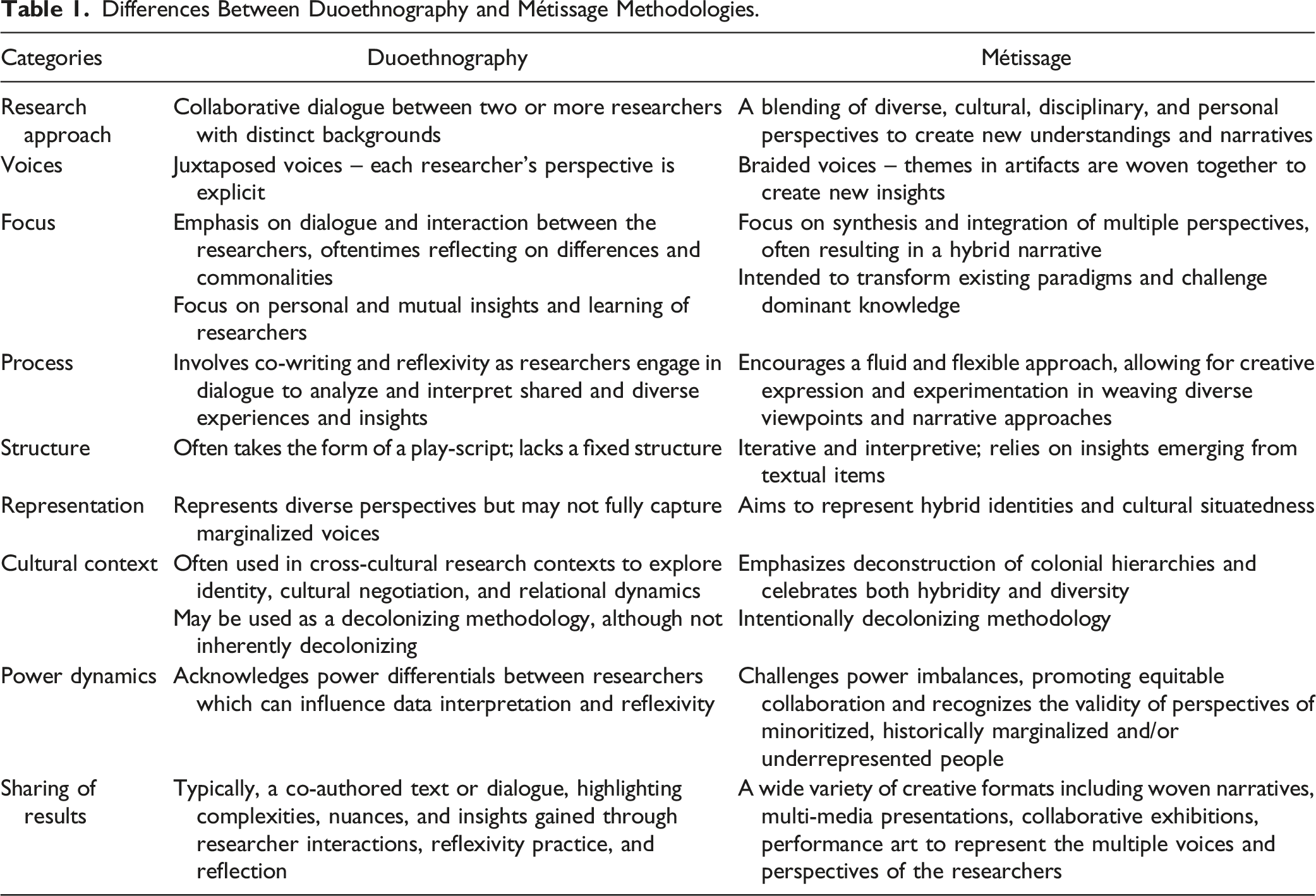
Despite integral differences between the methodologies, both offer unique lenses for understanding complex phenomena, interpretation and experiences and outlets for growth. Their greatest strengths are in their interplay of diverse voices and narratives, requiring a relational mindset and consistency of approach.
Decolonizing Research and Research Methodologies
Intentional decolonizing of research is an urgent call to dismantle the colonial foundations upon which academia rests, unlearning of colonial frameworks, a reverence for ancestral knowledge, and an opening for voices that have not usually been heard or heeded in scholarly conversations. For decades, Indigenous scholars (Battiste, 2000; Smith, 2023; Wilson, 2008) have summoned any who would listen, to respect suppressed Indigenous epistemologies, ontologies and axiologies, and acknowledge as valid, Indigenous ways of knowing, being and doing, including Indigenous research methodologies. Decolonizing educational research means honouring oral traditions, land-based pedagogies, and holistic world views (Battiste, 2000). Research approaches when working with Indigenous communities must also involve consultation, following protocols, and contributing through research results to communities in ways they have specified, including community access to, control ownership and possession of research (Pidgeon & Riely, 2021). As such, following Indigenous research methodology (IM) is an “act of empowerment for Indigenous communities, since it is clearly informed and shaped by Indigenous world views and cultural practices” (Pidgeon & Riely, 2021, p. 2). IM is an act of decolonizing the research process, whether followed by non-Indigenous or Indigenous researchers. Indigenous scholars have provided us with these instructions for decolonizing our research.
Māori scholar and educator, Smith (2023) instructs us that the epistemological approach of a research project shapes it, beginning with what is considered worthy to research, how and what questions we ask, and how we collect and analyse the data. What is considered knowledge in our world’s universities, empiricism, largely derives from Western cannon, a system created around 500 years ago by theorizing of white male scientists in Europe, is but a very small proportion of global knowledge (Hall & Tandon, 2017). The ontological and epistemic stances (what is, and how we know what is) of duoethnography and métissage privilege a relational view of the world similar to what Smith et al. (2023) described as an Indigenist view. Wilson et al. (2019) stated that our relationships “make us who we are and locate us within a whole system” (p. 8). As researchers, we are not separate from the process, “but rather participate in the relationship with what we are learning” (Wilson et al., 2019, p. 8), similar to how Adams et al. (2015) explained Indigenous knowledge as a relational system: Participation – being in relationship to the thing you are leaning about and to the knowledge itself – is essential to the learning process. . . if knowledge is generated through relationship, you literally cannot learn if you take an objective stance outside the thing you’re trying to understand which does take us back to relationality as a core process. (p. 24)
Holding a relational belief system as a researcher can allow for an even richer research experience with either duoethnography or métissage, although one would not necessarily be claiming an Indigenist stance. Integral to Indigenist ontology and epistemology are understandings of the web of relationships with place, ancestors, family and culture and a belief that knowledge has agency and is alive (Wilson et al., 2019).
Both methodologies locate expertise and authority inside, rather than outside the researchers, based on a postmodern philosophy which rejects the supposed distance and objectivity of a positivist or post-positivist researcher. The methodologies are intentionally collaborative, requiring the epistemological orientation of relationship-building to produce new knowledge and insights, especially for duoethnography work. Both open space for the flowering of epistemologies, ontologies, questions, and theories other than those long dominant in academia, for decolonizing and deracializing intellectual colonization and offer opportunity for new architectures of knowledge that allows co-constructing of knowledge between scholars in academia and community. Both inspire inner discovery and mutual learning – changing the way we see ourselves and each other, and in turn we may value other knowledge as discovered in relationship; the knowledge is not discovered or owned, rather, it reveals itself and is experienced because of the relationship and it becomes shared out into the world. To take up either of these methodologies with intention as act of resistance and in believing in no single truth is a move toward the decolonization of knowledge through research.
Although no generally accepted model exists for analyzing the decolonizing potential of research methodologies, foundational decolonizing theories and principles point to certain orientations required for qualitative researchers to decolonize their intentions and practices. Decolonizing requires researchers’ centering non-Western concerns and world views, understanding decolonization theory, and considering the perspectives of those traditionally ‘Othered’ (Battiste, 2000; Datta, 2018; Smith, 2023). Drawing from decolonization theories, Thambinathan and Kinsella (2021) offered four suggestions for decolonizing practice by qualitative researchers: (1) exercising critical reflexivity, (2) reciprocity and respect for self-determination, (3) embracing ‘Other(ed)’ ways of knowing, and (4) embodying a transformative praxis. (p. 3)
I propose that duoethnography and métissage both create space to be used as decolonizing research methodologies, given an aligned topic and the ethical intention by the researcher(s) to reject and resist colonial mindsets, practices, policies and/or structures. An analysis follows of how these four practices fit well with, or are part of, both methodologies.
Practice 1: Critical Reflexivity
Reflexivity is the act of reflecting critically on self as researcher, ‘human as the instrument’ (Lincoln & Guba, 1985), and is an essential requirement of the qualitative researcher, being conscious of the values, biases, and experiences one brings to a study (Creswell, 2013). Critical reflexivity can be used by researchers to examine their positionality, the assumptions embedded in their epistemologies and their power in relation to co-researchers and participants (Thambinathan & Kinsella, 2021). Explicit positioning by the researcher, first talking about experiences with the topic being explored and then discussing how the experiences influenced or shaped the researcher’s perspective and interpretation of the phenomenon are vital to good qualitative research (Creswell, 2013). Reflexivity is a starting point for both duoethnography and métissage and with a critical lens, leads the researcher to ask the kinds of questions they ask, as well as the answers they anticipate. Mulvihill and Swaminathan (2022) described critical duoethnography research methodology itself as a tool for reflexivity. If they are named such, critical duoethnographies by Higgins and Madden (2017) and Madden and McGregor (2013) explored decolonizing places of learning foregrounded with research critical reflexivity. In the métissage by Thomas et al. (2020), the three researchers place their positionality up front and explore temporal questions to forge alliances across their fields of Ecojustice Education, Indigenous Language Revitalization and Decolonial/Equitable Teacher Education. Critical reflexivity is explored even more deeply, where there was more space, in the métissage dissertations of Donald (2009) Lowan (2011), Scott (2021), incidentally, three Indigenous scholar researchers. Another example is the work of Sawyer and Liggett (2012), as educational researchers, who explored their histories and curriculum with colonialism, reaching back into their time as students, then as teachers to unpack the cultural foundations of how they viewed teaching language arts while also critiquing the process of duoethnography. They found by removing “meaning from the safety of story and [examining] it with a raw, existential lens” (p. 646), they were able to realize the influences of colonialism on their lives and work.
Practice 2: Reciprocity and Respect for Self-Determination
Decolonizing research methodologies should, according to Thambinathan and Kinsella (2021) use the principles of reciprocity and respect for self-determination, ethical practices that manifest differently for consent, decision-making about participation and ownership of results when one is working with marginalized community, rather than researchers as the site of study. However, métissage and duoethnography require power-sharing, respect, consent, and decision-making about what stories are told, shared, included, and commented on, when there are perceived or real power differentials among researchers. Differences may be in the form of race, gender, sexual identity, career stage (supervisor and student; teacher and student), cultural identity, patient/professional status, all topics which have been explored in both methodologies. Holding high ethical standards for relationships between co-researchers, while desirous, lends to the validity of a study as explained by Lincoln (1995) with the validity as an ethical relationship criterion she complied from a body of research. The criteria are as follows: positionality (to be authentic, giving context and indicating stance), discourse communities as arbitrators of quality, representation of voice (text having polyvocality), critical/intense self-reflexivity, reciprocity (research relationships as reciprocal, not hierarchical, sacredness of the research process (or regard for how science contributes to flourishing), and “sharing the perquisites of privilege” (p. 284). These criteria, as desired elements in narrative, collaborative methodologies, are all relational and it can be argued, expectations of quality duoethnographies and métissage studies, and which also align with principles of decolonizing practice.
Practice 3: Embracing ‘Other(ed)’ Ways of Knowing
Embracing ‘other(ed)’ ways of knowing involves not only working with people of cultures, lived experiences and norms, but at minimum, realizing one’s biases and worldview, and how those perspectives may hold discriminatory views of the ‘Other’ (Smith, 2023). Western oriented researchers must confront their biases and expand their thinking to understand and include other ways of knowing and theories, recognizing that Western methods and theories are not the only ‘right’ way to do research (Battiste, 2000). The underpinnings of métissage and duoethnography are the bringing together of diverse voices. For duoethnography, distinct voices are heard in the seeking and celebrating of difference, and for métissage, in seeking “rapprochement among disparate, unequal groups, in particular places of Coloniality, without erasing the differences indigenous to each group” (Hasebe-Ludt et al., 2009, pp. 37–38). Bringing people, their stories, perspectives, and beliefs together in a respectful ‘third space’ is another coincident element of these methodologies with decolonizing theory.
Practice 4: Embodying a Transformative Praxis
For researchers who take up emancipatory work, the purpose is to bring forward previously silenced voices and let authentic experiences be heard, a practice of decolonization in research and life (Thambinathan & Kinsella, 2021). Words from Freire (1996) capture the spirit and intent of both methodologies under study here: “Discovery cannot be purely intellectual but must involve action; nor can it be limited to mere activism but must include serious reflection: only then will it be a practice” (p. 133). In Hasebe-Ludt et al. (2009) a section entitled Literary Métissage as Transformative Praxis, reads As research, literary métissage not only describes experience: it is a strategy for interpreting those experiences as documented. Carefully crafted autobiographical texts open apertures for understanding and questioning the social conditions in which those experiences are embedded, and the particular languages, memories, stories, and places in which these experiences are located and created. . . [it] leads to understanding about the self and the other and generates insight about the world and our place in it. (p. 34, 38)
The generative purpose and goal of métissage is, therefore, to impact researcher and reader and guide them to transformative understandings of the world. Similarly, a crucial pedagogical intent of duoethnography for researchers is “transformative engagement, assisting in reconceptualizing their beliefs” (Norris & Sawyer, 2020, p. 402). In both traditions, researchers embark on transformative praxis and then, it is hoped, are in turn transformed by the experience in some way. And while it is hoped that the entire academy is a place of decolonizing, as the goal implicates everyone (Kovach, 2021), decolonizing can be moved forward by those who take up these methodologies, are impacted by their learning, and act on their insights. As Wilson (2008) advised, “If research hasn’t changed you as a person, then you haven’t done it right” (p. 135) and it follows, if internal change has happened, action should follow.
Conclusion
Duoethnography and métissage are two among the many diverse methodologies available to qualitative researchers seeking to create knowledge and achieve understanding, and they may have particular application to contexts where decolonization is urgently warranted. Since they both require shared approaches for the creation of data, they provide vehicles for collaborative inquiry and researcher allyship, across racial, positional, gender and multiple other divides, that have the potential to foster reconciliation. Both approaches highlight the undeniable link between the personal and the cultural, privilege other ways of knowing, and create space for the sharing of “unique, subjective and evocative stories of experience that contribute to our understanding of the social world and allow us to reflect on what could be different because of what we have learned” (Wall, 2006, p. 148). Both methodologies hold much methodological promise.
Footnotes
Declaration of Conflicting Interests
The author(s) declared no potential conflicts of interest with respect to the research, authorship, and/or publication of this article.
Funding
The author(s) received no financial support for the research, authorship, and/or publication of this article.
