



Abstract
The Therapeutic Relationship With Families
The therapeutic relationship in occupational therapy is defined as an interactive process between the therapist and a client that takes place within the context of occupation (Restall & Egan, 2021; Taylor, 2020). This term has been widely used in occupational therapy literature since the 1980s (Peloquin, 1990), often interchangeably with the therapeutic alliance and client–therapist interactions. Key aspects of the therapeutic relationship include communication, trust, emotional exchange, and collaboration (Horton et al., 2021; Taylor et al., 2009). By implementing standard strategies and practice models, the therapeutic relationship aims to facilitate occupational engagement and positive therapy outcomes (Taylor, 2020). Indeed, surveys of over 100 occupational therapists showed that more than 90% believed that the relationship improved outcomes related to occupational performance and engagement (Cole & McLean, 2003; Taylor et al., 2009).
The way occupational therapists view the therapeutic relationship has evolved over time. In the mid-20th century, clients (referred to as “patients”) were typically relegated to a passive role, while therapists held hierarchical power and made decisions about treatment without considering the patient’s perspective or needs (Peloquin, 1990). However, the introduction of client-centered practice in the 1980s marked a significant shift in how clients were viewed in the therapeutic relationship (Sumsion, 2000). The respect of clients, the recognition of their knowledge and power sharing were the main characteristics of the relationship (Sumsion, 2000). Although the client was not necessarily as an individual, the idea that the child was the client, separate from his or her family, persisted in pediatric occupational therapy. In the late 1980s, family-centered practice was developed to acknowledge the family as the unit with whom therapists work (Hanna & Rodger, 2002). This framework recognizes the importance of both the child's and the family’s needs and priorities, and places the family as the experts on their child's well-being and development (Rosenbaum et al., 1998). Family-centered practice embraces both the child's and family's needs and priorities. Families are recognized as the individuals who possess the most comprehensive knowledge of their child and are therefore the primary facilitators of their child's functioning (Rosenbaum et al., 1998). In family-centered practice, the establishment of supportive and power-balanced relationships with families is an essential component (Hanna & Rodger, 2002). This means that therapists must respect and value the family's perspectives and insights while working collaboratively with them to identify goals and develop strategies that support the child's overall well-being (Rosenbaum et al., 1998).
Today, family-centered practice, recognized as the best practice, continues to shape the understanding of the therapeutic relationship in pediatric occupational therapy (Novak & Honan, 2019). A recent systematic review aimed to describe the components associated with family-centered practice. The results demonstrated that establishing an equitable and collaborative relationship, along with implementing a reciprocal and collegial approach, is fundamental to family-centered practice (McCarthy & Guerin, 2022).
The Importance of the Therapeutic Relationship in Pediatric Occupational Therapy
The therapeutic relationship between the therapist and family is important to the process and outcome of occupational therapy. To begin with, the relationship plays a crucial role in promoting a positive perception of the therapy process. When the relationship is positive, it creates a sense of value and co-creation of meaningful experiences from the families’ perspective (King et al., 2020). This positive relationship empowers families and makes them feel optimistic and secure during therapy sessions (D'Arrigo et al., 2020; King et al., 2020).
Furthermore, from the perspective of the families, the therapeutic relationship provides a unique social opportunity for them to express their voice and be heard. This experience is rewarding and motivating for families, as it allows them to participate actively in the therapy process (Curtis et al., 2022). The quality of the relationship between the therapist and the family directly impacts the meaningfulness of the therapy process, underscoring the importance of establishing a strong and positive therapeutic relationship (King et al., 2020).
A supportive therapeutic relationship can also impact families’ outcomes. McCarthy and Guerin (2022) conducted a systematic review of 42 studies realized in early intervention settings to document such impacts. According to their results, a supportive and respectful relationship, with family-centered intervention strategies, promotes children's social, functional, and motor outcomes. It also improves caregivers’ well-being, knowledge, and empowerment. In a systematic review conducted by Kruijsen-Terpstra et al. (2014), 13 studies in rehabilitation settings for young children with cerebral palsy were included, and similar findings were reported. Their analysis underscored the significance of building a relationship based on respect, trust, support, and shared decision-making in combination with comprehensive care. This approach was found to improve the health and well-being of the children, as well as the outcomes of their caregivers. Thus, the importance of fostering a positive therapeutic relationship cannot be overstated, as it has implications for multiple aspects of the therapy process.
Despite consensus on the importance of establishing supportive relationships in occupational therapy, it remains complex. Establishing these relationships with families was identified as an important challenge by occupational therapists (Pereira & Seruya, 2021). The challenge lies in managing a multidirectional relationship in which all family members have distinct values, views, needs, and goals. Occupational therapists need to consider family dynamics as they support meaningful participation and cooperation between each member towards shared goals (Hanna & Rodger, 2002; Pereira & Seruya, 2021). Given the complexity of establishing an effective relationship, it sometimes remains an ideal to be achieved instead of a reality. Unfortunately, some family members report feeling dissatisfied with their opportunities to participate in the relationship (Stefánsdóttir & Egilson, 2016).
The Current State of Research
Due to its complex nature, the therapeutic relationship in occupational therapy has been the focus of several studies in the literature. Qualitative studies, in particular, are valuable for gaining a deep understanding of this relationship’s complexity. However, to date, no meta-synthesis has been conducted to integrate the current qualitative findings on the therapeutic relationship in the context of pediatric occupational therapy practice.
Many qualitative studies have separately explored the experiences of children, caregivers, or occupational therapists. However, since the therapeutic relationship is multidirectional, it is essential to consider the perspectives of all groups involved, including children and caregivers. Therefore, the aim of this study is to provide a thorough interpretation of the experiences of children, caregivers, and occupational therapists regarding the therapeutic relationship in the context of pediatric occupational therapy services. By bringing together the perspectives of all groups, a deeper understanding of the therapeutic relationship can be gained, and how it can be optimized for effective pediatric occupational therapy practice.
Method
An interpretative synthesis approach, specifically meta-ethnography, was used for synthesizing qualitative research. This meta-ethnography was registered with the International Prospective Register of Systematic Reviews (PROSPERO: CRD42022326870). The Meta-ethnography Reporting Guidance (eMERGe) standards (France et al., 2019) were used for reporting this synthesis. The meta-ethnography produces new interpretations that go beyond individual studies and thus contribute to conceptual and theoretical development in a field (France et al., 2019). The originators of meta-ethnography, Noblit and Hare (1988), described meta-ethnography as a means to “Making a whole into something more than the parts alone imply” (p. 28). It is frequently used for qualitative synthesis in healthcare research (France et al., 2019), and in occupational therapy as well (Zedel & Chen, 2021). This synthesis approach has already been identified as useful and accessible to inform occupational therapy practice (Gewurtz et al., 2008). Moreover, given the complexity of the therapeutic relationship, meta-ethnography is relevant since it allows for new interpretations, especially because a vast number of primary studies on the subject exists.
Data Collection
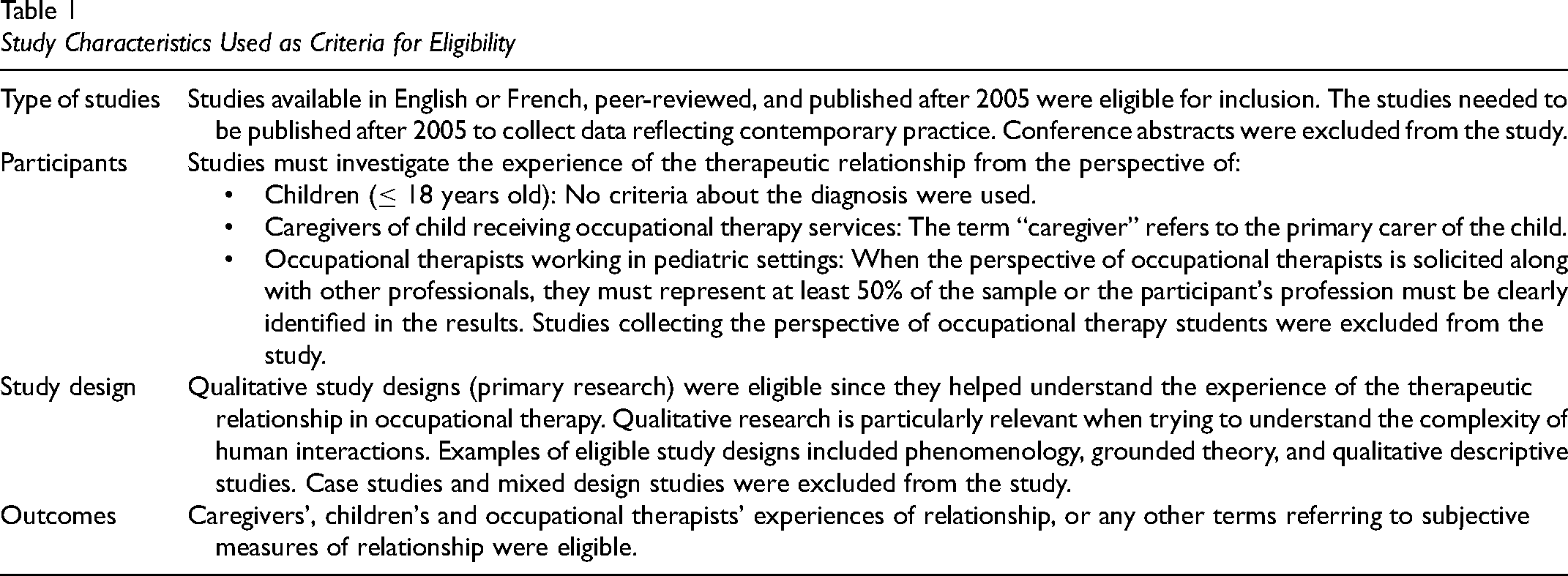
Study Characteristics Used as Criteria for Eligibility
Data Analysis
The data analysis started with reading the studies. The first author carefully read and re-read the full-text papers to become familiar with the content of the studies. At the same time, the first author started to extract participants’ views and interpretations of their experience of the therapeutic relationship in their words (first-order constructs) and themes developed by the authors of primary studies (second-order constructs). This process was facilitated by NVivo 12 software. The software was used to keep track of second-order constructs and memos. Then, a constant comparison was performed to examine how studies were related. The meanings of the second-order constructs from the perspective of the different parties (e.g., caregivers) were compared by creating a pile/group with NVivo tools. Then, the first author used concept maps to show how second-order constructs were related within each paper, after which a refined set of themes (third-order constructs) was generated. The overarching comprehension of the therapeutic relationship was captured by comparing findings of original studies, third-order constructs, and memos. The process of synthesizing the translations was carried out by the first author and discussed with the third author.
Findings
Characteristics of the Included Studies
As shown in Figure 1, the selection process is depicted in a flow diagram. Fourteen articles published between 2007 and 2021 were included in this meta-ethnography.
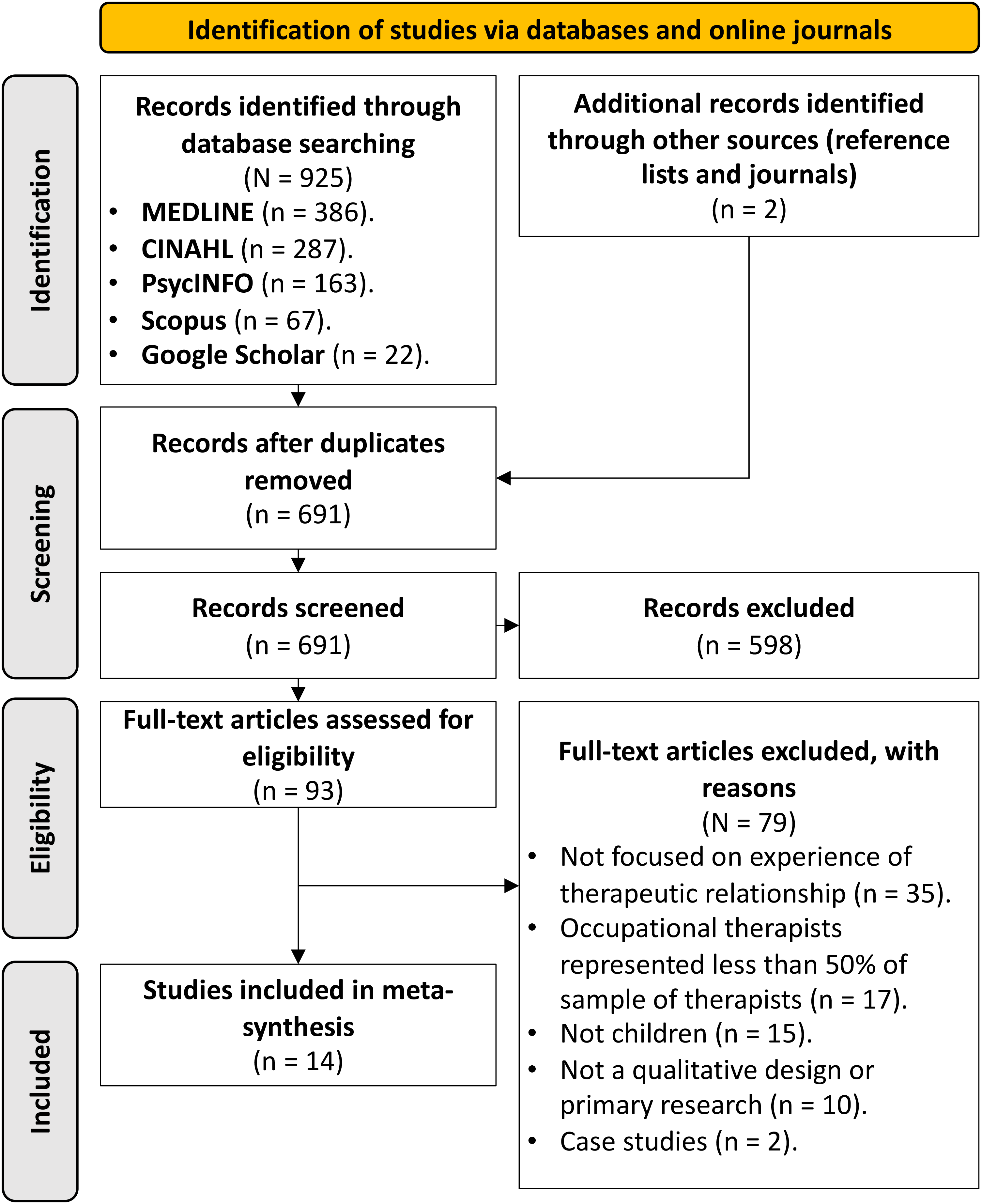
Flow diagram of a systematic review search process.
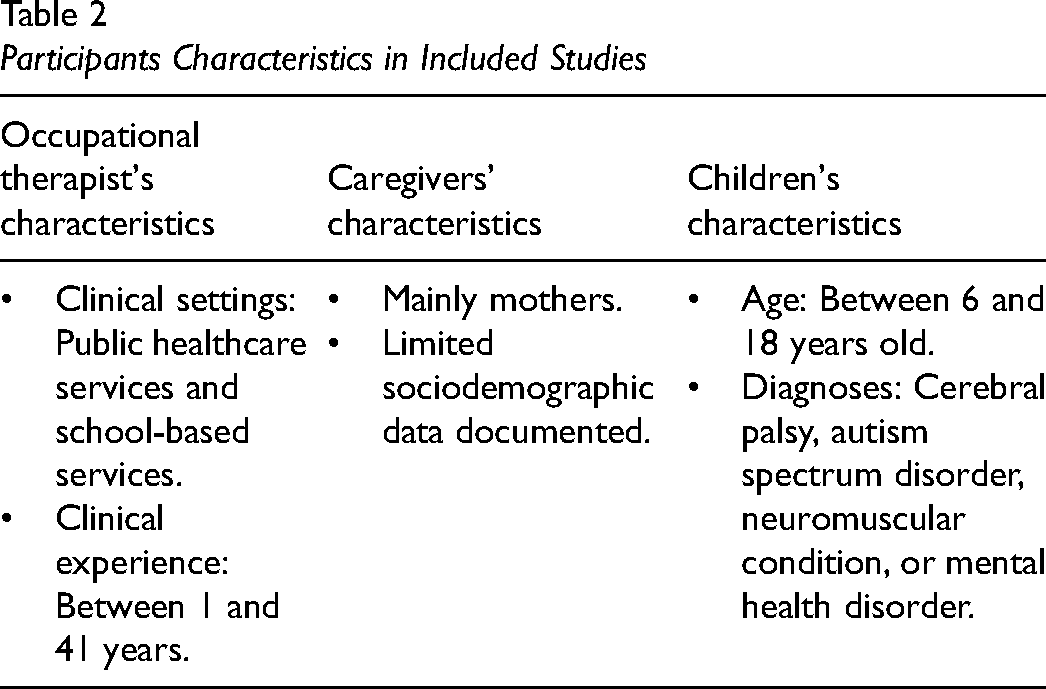
The research designs of included studies were descriptive qualitative research (n = 8), phenomenology (n = 4), ethnography (n = 1), and grounded theory (n = 1). Supplemental Files provide details on included studies (e.g., location, goals, design, main results, etc.). As shown in Supplemental Files, three studies were categorized as KP, eight studies were categorized as SAT, and three studies were categorized as FF. The studies provided perspectives of occupational therapists (n = 9), caregivers (n = 5), and children (n = 3). Their characteristics are presented in Table 2.
Participants Characteristics in Included Studies
Main Findings
The aim of this meta-ethnography is to provide a thorough interpretation of the experiences of children, caregivers, and occupational therapists regarding the therapeutic relationship. The study revealed three main themes: (1) “Relationship's meaning is different depending on the perspective,” (2) “Pivotal components impact the experience of the relationship,” and (3) “Therapeutic relationship empowers change.”
Discussion
The aim of this meta-ethnography was to provide a thorough interpretation of children's, caregivers’, and occupational therapists’ experience of the therapeutic relationship. This study enabled the integration of findings from multiple qualitative studies conducted in diverse contexts and using various methods. The findings of the study prompt two main reflections. Firstly, the study highlights the importance of children's voices in the therapeutic relationship. Although children view the therapeutic relationship as a valuable opportunity to express themselves, their voices are not always given due consideration. Secondly, the study reveals the issue of power dynamics in the therapeutic relationship, where occupational therapists hold a significant amount of power. Addressing these power imbalances is crucial to promoting more equitable and collaborative therapeutic relationships.
Raising Children's Voices in the Therapeutic Relationship
Children associated the therapeutic relationship with a meaningful social experience of having a voice and being heard. However, the opportunity to collect their perspective was often glossed over by occupational therapists. The information sharing was also seen as a process between caregivers and therapists, in which the children were not involved. These findings also resonate with the scoping review of Pritchard-Wiart and Phelan (2018), noting that children's voices are not sufficiently heard in rehabilitation services. This is a considerable concern given the importance of listening to the voices of children in the therapeutic relationship. Curtis et al. (2022) conducted a systematic review that included 19 studies (quantitative, qualitative, and mixed methods studies) exploring children’s voice in occupational and physical therapy. Their results demonstrated how listening to children voices enhanced the child's motivation, as well as their sense of being heard, and valued. The authors further emphasized that hearing children's voices is critically important to keep children engaged in the relationship. Thus, despite the crucial role of hearing children's voices in the therapeutic relationship, occupational therapists seem limited in their ability to do so.
Occupational therapists are encouraged to raise the voice of children in the therapeutic relationship. Occupational therapists should actively search for children's perspectives during therapy (Lundy, 2007). For example, they can use standardized tools to collect children's perspectives regarding their goals, such as the Perceived Efficacy and Goal Setting System (Missiuna et al., 2006) and the Canadian Occupational Performance Measure (Verkerk et al., 2021). Occupational therapists play a crucial role in enabling children to express themselves and ensuring that their voices are heard and taken seriously. However, as highlighted by this meta-ethnography, simply offering children the opportunity to speak is not enough. Some children expressed themselves about their vision but were not listened to. Thus, it is important to ensure that their participation is oriented toward active engagement (Lundy, 2007). The absence of therapeutic actions to pursue their vision, following their consultation, can be more damaging than nonparticipation. The invitation to participate creates expectations that, if subsequently unmet, can lead to frustration in children (Gal, 2017). Thus, it is important to give children the opportunity to express themselves and to make their voice meaningful. In sum, occupational therapists must be mindful not only of providing child-friendly services, but also of creating a culture of respect that empowers children to express themselves meaningfully.
Moving Toward Collaborative Relationship-Focused Occupational Therapy
This meta-ethnography highlights the growing attention given to power dynamics in therapeutic relationships. Occupational therapists recognized that power imbalance within families remains. They acknowledged their power over the choice of some therapeutic goals, especially when family member had cognitive limitations, when the child was young, or when the goals conflicted with their values, such as safety. It is apparent that the values held by occupational therapists are informed by a variety of factors, including the dominant social views that exist within their field (Restall & Egan, 2021). However, this has the potential to reinforce power imbalances, particularly in situations where families hold a lower social position due to factors such as their age, ability, class, colonial history, and ethnicity (Hammell, 2015). However, their discourse was silent about their acknowledgment of how their social positions affect power dynamics. This silence in the broader occupational therapy literature was also observed by Restall and Egan (2021).
Based on our findings, occupational therapists were diligent in establishing respectful relationships with families from diverse backgrounds. However, establishing respectful relationships is insufficient for genuinely sharing power. Thus, the collaborative relationship-focused practice is a relevant avenue for raising awareness about power issues. By encouraging critical reflection on how occupational therapists relate to families, as well as their knowledge, histories, cultures, and economic structures, this practice can help to address power imbalances within the therapeutic relationship. It encourages occupational therapists to do the hard work of identifying their social position and the families’ position impacting relationship building. Client-centered and family-centered practice remains good starting points for addressing power sharing. However, the reflections generated by collaborative relationship-focused practice appear essential to understand the contexts in which the therapeutic relationship occurs and to address adequately power issues (Restall & Egan, 2021).
Limitations
Three main limitations impact the quality of this meta-ethnography. Firstly, the included studies mainly explored the perspective of occupational therapists. The children's and caregivers’ perspectives were underrepresented in included studies. Also, the perspective of caregivers and children with many backgrounds were not represented. In future research, it would be relevant to collect their perspective regarding their experience of the relationship. Secondly, three included studies were categorized as FF from a methodological standpoint. However, removing studies rated as FF had no significant impact on the themes, except on the theme “Children's experiences: Be heard.” Rigorous qualitative studies are needed to capture the perspective of children around the therapeutic relationship in occupational therapy. Thirdly, only the first author conducted this meta-ethnography. Accordingly, different perspectives did not inform the review process. As a result, the review might be influenced by the author's background and own experience as an occupational therapist. Writing the memos helped the author question how her pre-existing knowledge may have influenced the review process.
Conclusions
This meta-ethnography aims to deepen the understanding of the therapeutic relationship from the perspectives of children, caregivers, and occupational therapists. It reveals that these individuals have different interpretations of the therapeutic relationship. Children associate the relationship with an experience of being heard, while caregivers put a strong emphasis on climate of trust. For occupational therapists, the relationship is more about balancing their professional responsibilities with building positive relationships with families. The experience of the therapeutic relationship is significantly impacted by power dynamics, communication, and respect for diversity. Finally, children, caregivers, and occupational therapists emphasize the positive outcomes following their engagement in the therapeutic relationship.
Key Messages
The therapeutic relationship in occupational therapy is important, complex, and its impacts are increasingly understood.
In clinical practice, occupational therapists should listen to children to make their voices meaningful.
Qualitative research in occupational therapy would benefit from the perspective of families, including children and caregivers from multiple backgrounds.
Supplemental Material
sj-docx-1-cjo-10.1177_00084174231186078 - Supplemental material for Exploring Therapeutic Relationships in Pediatric Occupational Therapy: A Meta-Ethnography
Supplemental material, sj-docx-1-cjo-10.1177_00084174231186078 for Exploring Therapeutic Relationships in Pediatric Occupational Therapy: A Meta-Ethnography by Sandrine Gagné-Trudel, Pierre-Yves Therriault and Noémi Cantin in Canadian Journal of Occupational Therapy
Supplemental Material
sj-docx-2-cjo-10.1177_00084174231186078 - Supplemental material for Exploring Therapeutic Relationships in Pediatric Occupational Therapy: A Meta-Ethnography
Supplemental material, sj-docx-2-cjo-10.1177_00084174231186078 for Exploring Therapeutic Relationships in Pediatric Occupational Therapy: A Meta-Ethnography by Sandrine Gagné-Trudel, Pierre-Yves Therriault and Noémi Cantin in Canadian Journal of Occupational Therapy
Footnotes
Funding
The author(s) received no financial support for the research, authorship, and/or publication of this article.

Supplemental Material
Supplemental material for this article is available online.
Author Biographies
References
Supplementary Material
Please find the following supplemental material available below.
For Open Access articles published under a Creative Commons License, all supplemental material carries the same license as the article it is associated with.
For non-Open Access articles published, all supplemental material carries a non-exclusive license, and permission requests for re-use of supplemental material or any part of supplemental material shall be sent directly to the copyright owner as specified in the copyright notice associated with the article.
