



Abstract
Introduction
Investigation of occupations is essential because their performance, value, and meaning relate to health and well-being (Eklund et al., 2016; Erlandsson et al., 2011). Occupational therapy's unique contribution to society lies in its capacity to foster well-being through occupational engagement (Hammell, 2017). Therefore, identifying changes in occupational patterns that occurred during the COVID-19 pandemic can expand occupational therapy's understanding of human occupations. This study explores those changes by gender and employment status and correlations between optimism, positive affect, and daily occupations during a pandemic lockdown as an occupational disruption.
Occupational disruption refers to a time when there is a temporary disturbance in a person's usual pattern of occupational performance and engagement (American Occupational Therapy Association [AOTA], 2014). Israel's first full lockdown can be defined as a time of adversity when a short-term occupational disruption had occurred. The COVID-19 pandemic outbreak in Israel began towards the end of February 2020 (Israel Ministry of Health, 2020a). At the beginning of April, before Passover, an important Jewish holiday for gatherings of families and friends, the Ministry of Health ordered a full lockdown (Israel Ministry of Health, 2020c) that lasted 2 weeks. The directives included restrictions on meeting with other family members and staying home. Going farther than 100 meters from one's residence was permitted only for essential jobs, buying food or essential products, obtaining medicine or essential services, and providing required assistance to a person in a medical or nursing environment (Israel Ministry of Health, 2020b).
During the lockdown, people were forced to stay at home, resulting in a massive shift in how they lived, worked, socialized, and played. People adapted with marked changes in their daily occupations, routines, and habits (Brown, 2021; Engels et al., 2022). Staying at home created many uncertainties in self-efficacy regarding personal health, economic status, and social situations (Lin & Fisher, 2020). The lockdown limited the abilities and freedoms many people viewed as rights or entitlements, and fear of the virus caused intense anxiety and uncertainty (Hammell, 2020).
Previous studies associated even short-term social distancing practices with increased psychological distress, such as panic, emotional disturbances, depression, and lower health-related quality of life during the early days of extreme public health measures (March 31–April 15, 2020) and first wave of COVID-19 (June–July 2020; Best et al., 2021; Levkovich et al., 2021). In a broad view of activities, Lipskaya-Velikovsky (2021) found that 50% of her sample stopped engaging in 16 of their former activities during Israel's first lockdown. Specifically, major changes occurred in the nature of paid work as many employees were forced to work from home, although not everyone could maintain their employment from home (Kramer & Kramer, 2020). In Israel, women perform most unpaid work involved in maintaining the home and caring for family members (Hasson et al., 2021). However, during the lockdown, men became more exposed to—and assumed a greater share of—the day-to-day responsibilities of childcare and unpaid work at home than they had before the lockdown (Levi, 2021).
The Canadian Model of Occupational Performance and Engagement (CMOP-E) describes three purposes of occupation: self-care, productivity, and leisure (Polatajko et al., 2013b). Patterns of daily occupations include the occupations in which a person usually participates during a typical day (Eklund et al., 2016). Patterns are characterized by the complexity of people's occupations in time and space and the social context in which they live and act (Zemke, 2004). They reflect how people use their time and arrange and integrate different occupations into entire days, weeks, or life plans (Polatajko et al., 2013a). Patterns of daily occupations are also affected differently by personal factors such as gender. In Israel, for example, men typically work many more hours than women (Fuchs, 2016).
The World Health Organization (WHO) suggested that resilience is a combination of assets, capabilities, and positive adaptation, enabling people and communities to cope with adversity and protect their health and well-being (Ziglio, 2017). Positive psychology theory focuses on human strengths and adapting behaviors that can promote resilience and help cope with stressful situations (Forgeard & Seligman, 2012; Fredrickson, 2004; Seligman, 2000). One human strength is optimism, the general expectations and belief that good outcomes will happen and affect how people react and adapt to new situations, including challenging and stressful events (Forgeard & Seligman, 2012; Scheier & Carver, 1985). Another psychological theory, broaden and build, recognizes the mutual relationship between positive emotion and enjoyable positive actions, producing an “upward spiral” toward enhanced personal resources and well-being (Fredrickson, 2004). Positive affect reflects positive emotion, emotional well-being, and feelings of joy, contentment, and personal satisfaction relative to a specific environment, object, or situation (Fredrickson, 2004; Radloff, 1977).
This study's novelty and importance are its insights into understanding the link between optimism, positive affect, and engaging in occupations to enhance understanding of ways to build resilience and well-being. Further, investigating involvement in various patterns of daily occupations in routine and adverse times, such as during a worldwide pandemic, increases knowledge central to the occupational therapy profession. Specifically, this study aimed to: (1) identify changes in daily occupations by time use during the COVID-19 lockdown, including differences by gender and employment status, and (2) identify correlations among optimism, positive affect, and daily occupations during the lockdown, in a sample of Israeli adults.
Methods
Procedure and Participants
This study was reviewed and approved by the Ethics Committee of Ariel University (AU-HEA-OSY-20200412). The retrospective, cross-sectional survey conducted during the first and only full COVID-19 lockdown in Israel, which began on April 7, 2020 and lasted 2 weeks. An online survey link was created in Google Forms and distributed through social platforms, such as Facebook and WhatsApp groups, using a snowball method. We explained the study aim, assured anonymity and confidentiality, and stressed that participation was voluntary—the participants could refuse to answer questions without consequences. All participants provided informed consent.
The participants reported retrospectively about a typical weekday before the lockdown compared with their routine during the lockdown. The questionnaires used were translated and tested in a Hebrew version: the Life Orientation Test (LOT; Scheier & Carver, 1985), the Positive Affect Questionnaire (Radloff, 1977), and one item from the Occupational Questionnaire (OQ; Smith et al., 1986). In addition, we asked a few demographic questions on age, gender, COVID-19 sickness, and employment status during the lockdown.
We used a convenience sample. The inclusion criteria were persons aged 20 years and older who read and spoke Hebrew and agreed to participate. The exclusion criterion was employment status that changed but not because of the lockdown (e.g., participants who had quit work or were on sick or military leave going into the lockdown; Figure 1).
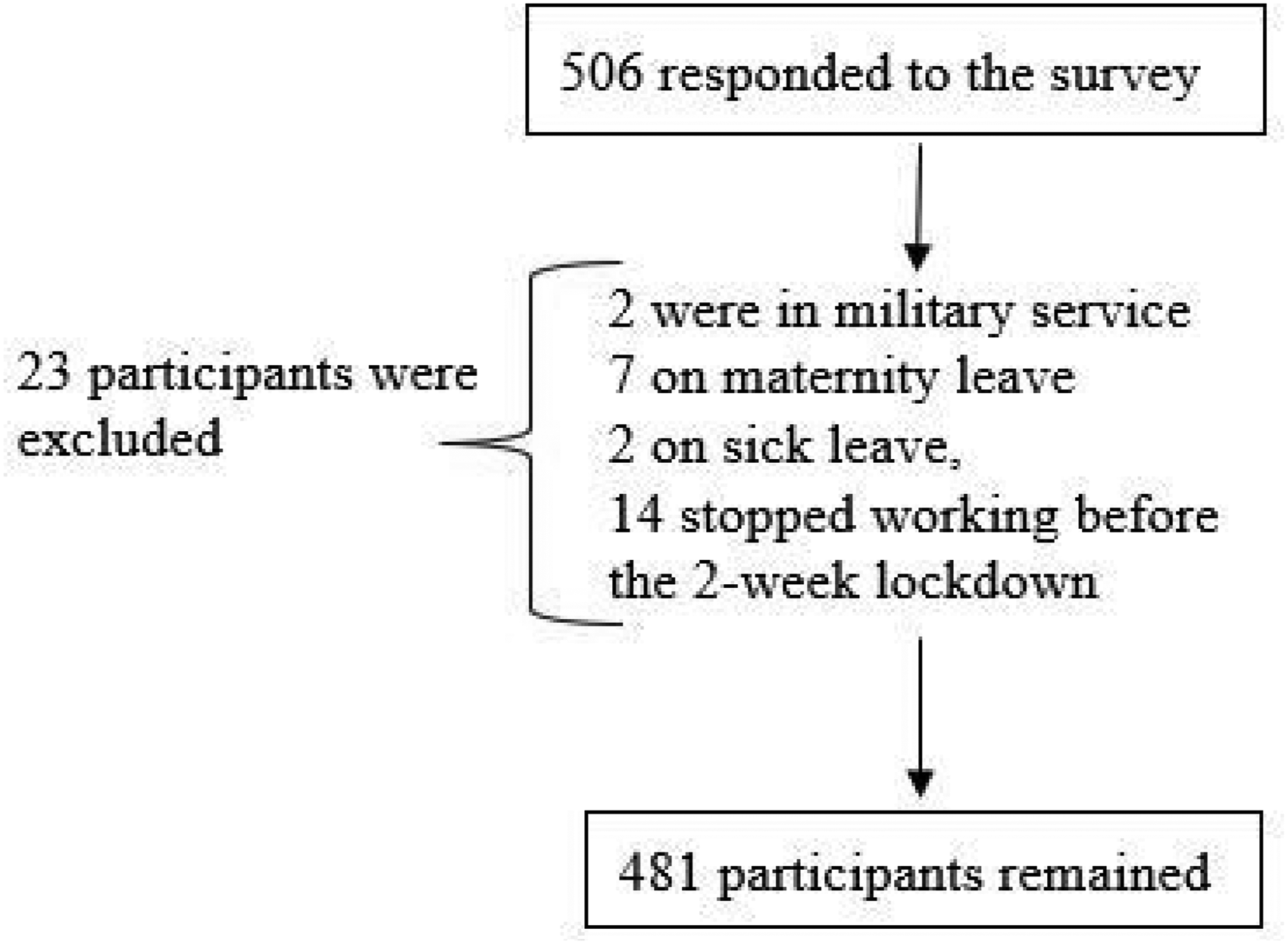
Flowchart of drop-out rate and reasons.
Measurements
Occupational Questionnaire
The OQ (Smith et al., 1986) measures daily occupation performance, habituation, and volition. Developed based on the first version of the Model of Human Occupation (Kielhofner & Burke, 1980), the OQ uses a diary format to list occupations and rate their characteristics on performance (classifies the main occupation), personal causation (quality of the performance), interests (importance), and values (enjoyment of the occupation). This study used only the classification of occupations (occupational performance) to examine changes in the patterns of daily occupations that stemmed from the forced lockdown. Respondents indicate their dominant occupation during each waking hour (05:00–24:00) on a typical weekday and classify it as work, everyday task, recreation, or rest. The questionnaire has demonstrated acceptable test–retest reliability and good concurrent validity (68% and 82% agreement in activities undertaken, respectively; Smith et al., 1986). The Mashav Applied Research translation to Hebrew, with the addition of a sleeping occupation and a catalog by the hour rather than half-hour, was used in this and previous studies in Israel (e.g., Katz, 2011). The results are summarized by the percentage of time classified for the five occupation categories. Note this categorization of work, everyday task, recreation, rest, or sleep differs from the CMOP-E categories of self-care, productivity, or leisure.
Positive Affect Questionnaire
This self-report four-item summary is Part of the self-reported Center for Epidemiological Studies-Depression (CES-D) scale (Radloff, 1977), this four-item subscale rate the degree of positive feelings participants experienced during the past week, ranging from 0 (rarely or never) to 3 (most of the time). Summary scores range from 0 to 12; higher scores indicate higher positive affect. This measure has been used in previous studies among community-dwelling older adults and showed high internal consistency (α = .80) and a weak correlation (r = −.25) with the CES-D's 16 negative-emotion items (e.g., Ostir et al., 2000). The Hebrew translation showed moderate internal consistency (α = .69; Segev-Jacubovski et al., 2022). In this study, internal consistency was moderate to high (α = .81).
Life Orientation Test
The LOT (Scheier & Carver, 1985) self-report questionnaire includes 12 items assessing dispositional optimism in the form of generalized expectancies for positive-versus-negative outcomes. The test comprises four positively oriented items, four negatively oriented items, and four distractor items. Participants rate the extent to which they agree with each statement as representative of their life (“trait approach”) on a five-point scale from 0 (strongly disagree) to 4 (strongly agree). The total score (after reversing the negative item scores) yields an overall optimism score ranging between 4 and 32. Higher scores represent higher optimism ratings. The Hebrew translation of the LOT (Drury, 1989) showed moderate to high internal consistency among older adults with hip fracture (α = .72; Segev-Jacubovski et al., 2022). In this study, internal consistency was moderate to high (α = .75).
Statistical Analyses
For between-group comparisons, the sample was divided by gender (men, women) and into three groups according to employment status: (a) regular work, participants who continued their jobs or education as before the pandemic or retired; (b) reduced work, participants who partially worked at their jobs during the lockdown; (c) significantly reduced work, participants sent home on unpaid leave for those 2 weeks, or self-employed participants with significantly fewer hours. The self-employed were affected more than other types of workers, especially in April 2020 (Kalenkoski, & Pabilonia, 2022).
Descriptive and statistical analyses were performed using IBM SPSS (Version 25) for Windows, with the significance level set at p < 0.05. Parametric analysis was used because a near-normal distribution curve was found for optimism, positive affect, and all occupations examined by skewness and kurtosis. A chi-square test was used to test employment status differences during lockdown by gender. A repeated measures analysis of variance (ANOVA) was conducted with occupations according to the OQ classifications (everyday tasks, recreation, rest, and sleep) as the between-subject independent variables; time (before and during lockdown) and employment status (regular work, reduced work, or significantly reduced work) as the within-subject independent variables; and percentage of day as the dependent variable. Another ANOVA was conducted with gender (men vs. women) as the between-subject independent variable and occupation (everyday tasks, recreation, rest, and sleep) and time (before and during lockdown) as the within-subject independent variables and percent of 19 h of day (5 am to midnight) as the dependent variable. Correlations of positive affect and optimism and daily occupations during the lockdown were tested using Pearson correlation coefficients.
Results
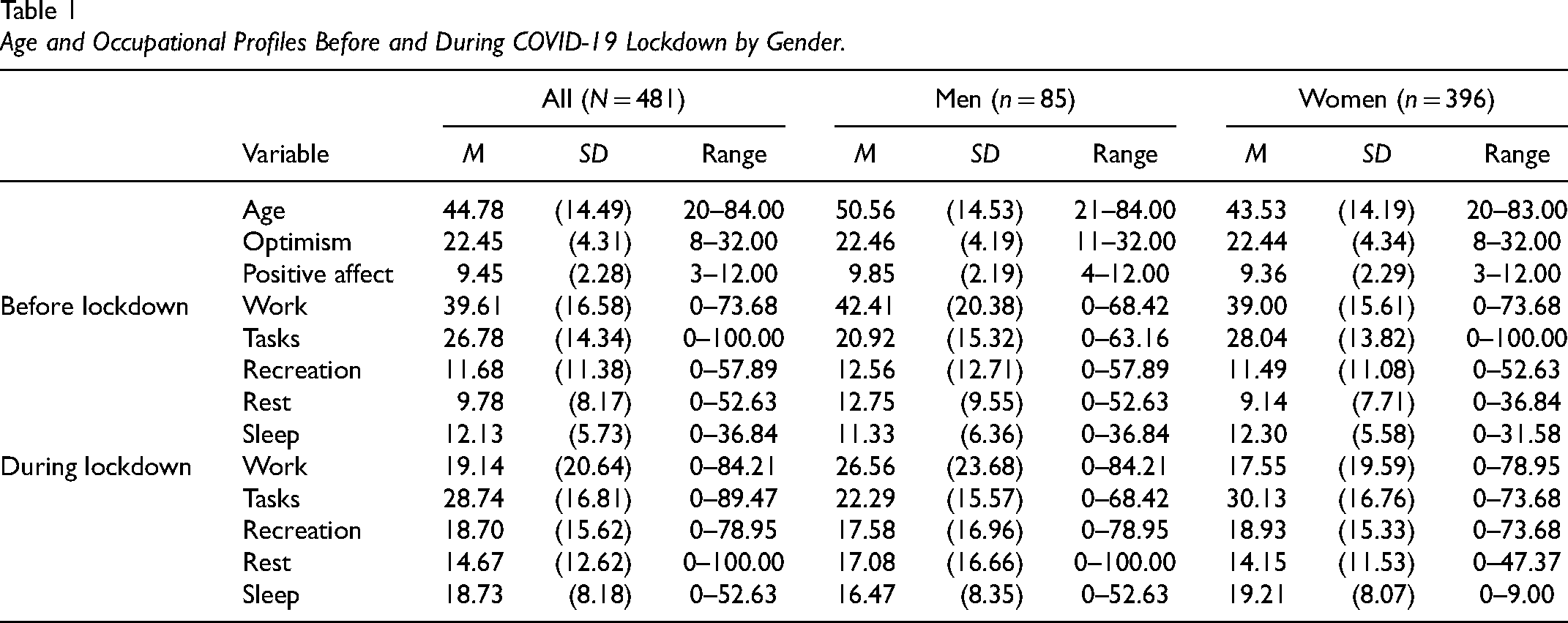
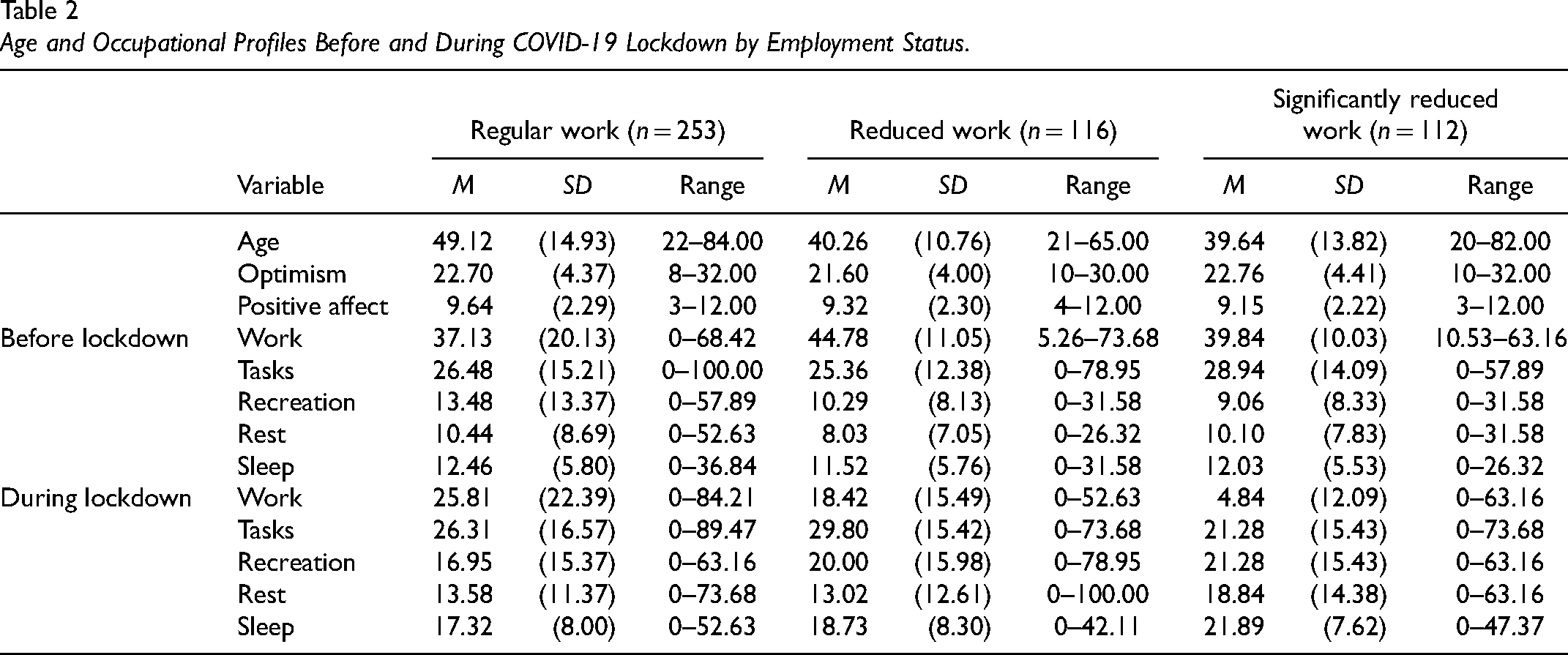
Of the 506 participants who responded to the survey, 23 did not meet the inclusion criteria (Figure 1). The remaining 481 participants ranged in age from 20 to 84 years (M = 44.78 years, SD = 14.49); none were infected with COVID-19. The male-to-female ratio was 85:396. The mean age for men was statistically significantly higher than for women, t(120.8) = 4.05, p < .001, Table 1. Regarding employment status, 253 participants had regular work, 116 had reduced work, and 112 had significantly reduced work, Table 2. The regular-work group was significantly older than participants in the other categories f = 26.61, p < .001.
Age and Occupational Profiles Before and During COVID-19 Lockdown by Gender.
Age and Occupational Profiles Before and During COVID-19 Lockdown by Employment Status.
Changes in Patterns of Daily Occupations by Time: Before Versus During the Lockdown and by Employment Status
Table 1 also presents the percentage of daily occupations (everyday tasks, recreation, rest, and sleep) by time (before or during the lockdown). A significant effect found for time, F(1,478) = 958.72, p < .001, η2p = .67, stemmed from the participants having more time for occupations other than work during the lockdown (20.91) than before (14.85). There was also a main effect for daily occupations, F(3,1434) = 160.67, p < .001, η2p = .25. Specifically, more time was spent on everyday tasks (28.34) than any other daily occupation category (recreation = 15.18, rest = 12.34, and sleep = 15.66). The difference between recreation and sleep was not significant but both differed significantly from rest.
A main effect for employment status, F(2,478) = 14.61, p < .001, η2p = .06. Participants with regular and reduced work spent less time on occupations other than work (17.31 and 17.10 respectively) than did participants who had a significant reduction in work (19.41). Although all groups spent significantly more time in all occupations other than work, this difference was more pronounced for participants who worked less (15.72 vs. 18.56 for regular workers, 13.80 vs. 20.40 for reduced workers, and 15.04 vs. 23.79 for significantly reduced workers), which led to the two-way interaction between employment status and time, F(3,1434) = 95.39, p < .001, η2p = .29.
Finally, there was a two-way interaction between occupation and time, F(3,1434) = 17.42, p < .001, η2p = .04. Although the difference between everyday tasks did not reach significance (26.93 before vs. 29.42 during the lockdown), the difference in the other occupations increased significantly (recreation: 10.95 before vs. 19.42 during, rest: 9.53 before vs. 15.15 during, and sleep: 12.00 before vs. 19.32 during). The three-way interaction did not reach statistical significance, meaning the changes in occupations between employment status before and during lockdown were not larger than expected by chance.
Changes in Employment Status by Gender
As shown in Table 1, there was a significant association between gender and employment status (χ2 = 11.88, p < .01). During the lockdown, 69% of the men continued with regular work compared to 49% of the women. In addition, more women than men had reduced (26% and 14%, respectively) or significantly reduced (24% and 16%, respectively) work.
Changes in Patterns of Daily Occupations by Time: Before Versus During the Lockdown and Gender
Table 1 presents the percentage of time men and women devoted to each occupation category before and during the lockdown, which differed by gender. Compared to men, women reported more time in other occupations and more of them lost employment. Here we present the gender-related results of the ANOVA conducted to test these observations.
There was a main effect for gender, F(1,479) = 10.52, p < .01, η2p = .02. Women performed more occupations other than work than men (women 17.93, men 16.38). There was also a two-way interaction between gender and time, F(3,1437) = 6.21, p < .05, η2p = .01. Both men and women spent significantly more time doing occupations other than work during the lockdown. However, this difference was larger for women (15.25 before vs. 20.61 during) than for men (14.40 before vs. 18.36 during). The two-way interaction between everyday tasks and gender was also significant, F(1,479) = 10.864, p < .001, η2p = .02. Women spent a significantly greater percentage of their time performing everyday tasks (29.09) than did men (21.61). There were no significant gender differences for recreation. However, women spent a significantly lower percentage of time resting (11.65 women vs. 14.92 men) and sleeping (13.90 women vs. 15.76 men). No other effect or interaction with gender was statistically significant.
Tables 1 and 2 present optimism and positive affect as a function of gender and employment status. There were no gender differences in optimism, but men scored slightly higher in positive affect than women. Participants with reduced work were slightly less optimistic than the other two groups, but there were no employment-related differences in positive affect.
Because fewer men than women had reduced work, testing employment status and gender together resulted in very small groups of men with reduced work (14 participants in the reduced work group, and 12 in the significant reduced work group). Therefore, two independent sample t-tests were conducted to test the differences between men and women in positive affect and optimism. Neither effect reached significance, t(479) = 1.87, p = .07 for positive affect and t(479) = 0.03, p = .98 for optimism. Two additional ANOVA were conducted to differentiate optimism and positive affect according to employment status, neither were significant, F(2,148) = 2.0, p = .14 for positive affect, and F(2,148) = 2.95, p = .06 for optimism. Finally, Pearson correlation coefficients showed a small (Cohen, 1988) but significant correlation between positive affect and recreation during the lockdown (r = .098, p < 0.05).
Discussion
This study's goal was to identify changes in the patterns of daily occupations through time use between before and during 2 weeks of the first and only COVID-19 lockdown in Israel by gender and employment status. In addition, we examined which categories of daily occupations correlated with optimism and positive affect during the lockdown. Our results support previous research that occupational disruption happened during the COVID-19 epidemic and that the changes in occupations occurred regardless of employment status during the lockdown. Generally, before and during lockdown, the participants in this research spent most of their time on performing everyday tasks, then on recreation and sleep, and the least amount at rest. However, during lockdown the participants spend more time on occupations other than work (recreation, sleep, and rest) than they had before.
The uniqueness of this study is its use of a tool to examine patterns of main occupations and define the changes in time use during an occupational disruption. The method is relevant and valuable given the great variation among people, their living conditions, and the diverse solutions they adopted during the lockdown.
Comparing our results to previous studies about occupational disruption during the COVID-19 epidemic is challenging because the tools relate to different occupations. For instance, in contrast to our results, a European descriptive cross-sectional survey found leisure, which could be perceived as recreation, to be the most-affected occupation during the lockdowns (Engels et al., 2022). However, dividing leisure into active leisure and quiet recreation shows more precise results. Engels et al. (2021) reported that whereas active leisure (e.g., walking) decreased, indoor leisure or quiet recreation (e.g., reading) increased.
Our results support the positive implications of the lockdown on sleep. Korman et al. (2020) showed the lockdown reduced the gap between workdays and free days for sleep timing and duration. Specifically, workday sleep duration lengthened by about 6%, and free-day duration shortened by 2%. Relative to everyday tasks, our study found the same amount of time to everyday tasks in both (before and during lockdown) periods. Similarly, most indoor activities, such as everyday tasks in the house, caring for family, and self-care did not change among various ages in Belgian (Costenoble et al., 2022; Cruyt et al. 2021). However, in Italy, occupations such as “managing the household” and “cooking” increased during the quarantine (Maritan et al., 2022). Another similar result showed that middle-aged Israelis’ patterns of daily occupations approached those of older adults—when workhour demands diminished, the number of hours spent on everyday tasks, rest, and sleep increased (Segev-Jacubovski, 2021). As expected, social activities such as volunteering, caring for grandchildren, religious activities (Costenoble et al., 2022; Cruyt et al. 2021), social networking (meeting friends and relatives), sports, and hobbies (Maritan et al., 2022) decreased. Finally, a qualitative study shed light on how older adults managed their behaviors by transitioning to virtual activities or performing more activities indoor. New daily activities were generally more sedentary and less meaningful (Rotenberg et al., 2021).
A possible explanation for devoting time to non-work occupations is that everyday tasks and sleep are essential to individual survival, and recreation activity provides satisfaction and fulfilment. Both are biological needs that stimulate occupation and, in turn, promote health (Hocking, 2018; Wilcock, 1993). It is important to identify these changes in occupations, and whether they are meaningful, especially in prolonged emergency situations because loss of meaningful activities has been strongly associated with decreased mental health (Costenoble et al., 2022).
Turning to changes experienced by women and men, our results showed that damage to employment status was more common among women: more women lost their work, but our data do not explain why. Previous findings also found unemployment rate increased especially for women (Hasson et al., 2021; Kalenkoski, & Pabilonia, 2022).
Consistent with our results on the occupation category of everyday tasks, Lipskaya-Velikovsky (2021) found that women performed more activities at home. Moreover, mothers—even those who earned most of the family income—did almost twice as much housework as fathers during the COVID-19 pandemic (Ruppanner et al., 2020). In another time of adversity, the U.S. recession of 2007–2009, Davis and Greenstein (2020) found that although men's housework hours increased and women's decreased, women remained primarily responsible for managing and performing domestic labor. An explanation for the gender differences can be presented through the challenge of the work–family balance that escalates when families have little support (Fisher et al., 2020). In the present study, it is possible women continue to perceive themselves as “family caregivers” through the power of social norms (Major, 1993).
Disruption in daily life activities due to external constraints can be concerning (Lin & Fisher, 2020). Nizzero et al. (2017) claimed that occupational disruption affects identity and social, emotional, and occupational functioning in significantly negative ways. Resilience enables people to cope in times of adversity (Ziglio, 2017). Investigating people's involvement in various occupations and its relation to optimism or positive affect may help uncover occupational ways of building resilience. This study's results indicate a minor significant correlation between positive affect and recreation during the COVID-19 lockdown. This association may reflect the linkage of recreational activities and emotional states of joy and contentment and vice versa. Bobes-Bascaran et al. (2020) found that the ability to enjoy free time was the main protective factor for mental health among older adults in Spain during the COVID-19 pandemic. Overall, keeping to daily routines decreases stress, depression, and loneliness levels and increases self-efficacy during quarantine and social distancing (Lipskaya-Velikovsky, 2021).
This study has several limitations. The convenience sample and online survey may have excluded large groups of potential participants due to educational or economic circumstances. Moreover, gender representation was unequal, age was significantly higher among the male participants, and demographic information was limited. In addition, the OQ (Smith et al., 1986) defines only five occupation classifications, does not include night hours, and does not delve into characteristics of specific occupations.
On the other hand, the participants’ subjective classification of their listes activities is an advantage because it reflects the performers’ perceptions. For example, watching TV could be perceived as recreation for one individual and rest for another. Further research should include other positive psychological variables, such as hope and the importance of enjoyment on the OQ (Smith et al., 1986), which could help in understanding the prioritization of occupations, or could use different theoretical constructions, definitions, or categories of occupation. Results may differ, for example, if using the CMOP-E or other model of occupational performance. Future studies could further investigate the associations between occupations and quality of life. Qualitative studies can generate narratives that complement the statistical data, and longitudinal research could show occupational adaptation in times of adversity. There also is a need for a broader representation of subgroups and populations that particularly suffer in unique situations like the 2-week lockdown, including older adults, disabled people, lonely people, young parents, and large families.
Conclusion
An understanding emerged from this study that the COVID-19 pandemic caused a temporary occupational disruption. This study contributes to understanding the short-term shifts in everyday occupations during dramatic lockdowns because of a pandemic. During the lockdown, study participants spent more time in recreation, rest, and sleep than prior to the pandemic. However, the lockdown affected women and men differently; for instance, more women than men lost their employment. Before and during the lockdown, women spent significantly more of their time doing everyday tasks but slept and rested less than men.
Although people devoted their time differently, the lockdown forced most people to find new ways to engage in their occupations and stay active. Occupational therapists have a broad perspective on human occupation—who, what, when, where, how, and why (Polatajko et al., 2013a)—and changes in occupation when people had to stay in their homes is another aspect to consider. This study suggests that recreation activities were associated with positive affect, referring to feelings of joy; consequently, recreation occupations may help build resilience. These findings imply that early intervention encouraging routines with occupations the person perceives as recreational can contribute to positive affect and help in coping with adversity. This study's results align with the AOTA (2014) and WHO (2001) guidelines emphasizing the importance of participation and occupation to promote quality of life.
Key Messages
The 2-week lockdown in Israel caused a temporary occupational disruption, and people devoted their time differently across daily occupations.
At the same time, the lockdown forced most people to find new ways to engage in their occupations and stay active.
Using OQ to define the changes in time use during an occupational disruption is relevant and valuable method given the great variation among people, their living conditions, and the diverse solutions they adopted during the lockdown
Footnotes

Funding
The author(s) received no financial support for the research, authorship, and/or publication of this article.