




Abstract
To accelerate sustainable development towards more circular business systems, firms must develop advanced dynamic capabilities. This is especially critical in the construction and development (C&D) sector, which has been historically slow to innovate and yet is responsible for building the cities of the future. We draw on the burgeoning literature on dynamic capabilities for circularity to illustrate how organizations can extend current transitional approaches to sustainability towards more transformative business practices. Using multiple examples from the C&D industry, we provide an integrative framework and managerial guidance for any company seeking to develop the dynamic capabilities required to advance circularity.
To mitigate and adapt to the ever-growing environmental concerns caused by climate change, urgent action on an unprecedented scale and scope is required from all business sectors. Not only are we already overshooting the earth’s carrying capacity in terms of energy, water, and other resource consumption patterns, these needs will only continue to grow given a predicted 30 percent increase in global population before the end of this century. More specifically, related to this special issue, to accommodate another three billion humans on the planet (most of whom will be living in urban areas), massive investments in the built environment are necessary, with some estimates suggesting that the new construction required is the equivalent of adding a city the size of Paris to the planet every week for the next thirty years. 1
Unfortunately, the construction and development (C&D) industry has remained stubbornly resistant to change and continues to be a major contributor to environmental degradation. It consumes over half of the world’s raw materials and generates approximately 30% of global solid waste. It is also a primary contributor to global greenhouse gas (GHG) emissions, causing climate change and accounting for 36% of global energy consumption and 39% of GHG emissions, all numbers that will continue to grow alongside population expansion and urban densification. In fact, the United Nations reports that emissions from the C&D industry have recently reached a record high and that achieving its stated decarbonization objectives by 2050 is unlikely. 2
Against this backdrop, some forward-looking C&D companies have nevertheless started to introduce advanced environmental strategies to address sustainability and resiliency concerns and to reduce their overall environmental impact, such as: pursuing green building certifications, installing more efficient energy management systems, and using life cycle assessment tools to map the environmental footprint of their actions, among other sustainable innovations. 3 However, despite some notable progress, the collective impact of corporate action has been insufficient to address the growing state of environmental degradation, surpassing the capacity of what our planet can sustain in terms of climate change, land-system use, and biosphere integrity. 4 This paradox, depicted by both an increase in business adoption of sustainable practices and a continued depletion of the natural environment, has previously been referred to as “the big disconnect.” 5
Current business practices are therefore insufficient. What we need instead is transformational change. This requires moving beyond linear take-make-waste business models, to circular business strategies that provide appropriate solutions for the reduced, efficient, and effective use of resources, the prevention of harmful GHG emissions, and the deterrence of further environmental degradation. 6 While current strong sustainability approaches are important, transformative circular business strategies not only eliminate negative impacts from the outset but also work to provide systems-wide change through principles such as rethinking, redesigning, and reinventing the way business practices integrate with natural systems. 7
For organizations in any sector to achieve meaningful and lasting sustainability impact at scale, they must build dynamic capabilities that advance circular business strategies beyond current efforts, which can best be described as transitional. 8 The objective of this paper is to explore specifically how businesses can do better as they move toward more transformational sustainability outcomes. We begin by reviewing the existing literature on corporate sustainability and the drivers of advanced environmental practices to situate our arguments in the research on dynamic capabilities for circularity. From this literature, we derive, define, and differentiate ten dynamic capabilities for circularity that companies should develop to accelerate fulfillment of strong sustainability goals. We present an integrative multi-level framework that allows managers to reconceptualize, mobilize, and reconfigure more circular business practices, illustrating the practicality of our framework through innovative examples in the C&D industry. Due to its significant environmental footprint, the C&D industry offers a considerable opportunity to address climate goals while building the safe and sustainable cities of the future. Last, we present a sample of tangible actions that managers from any industry can take today to start developing the dynamic capabilities needed to advance more circular and transformative business practices tomorrow.
Corporate Sustainability, Circularity, and Dynamic Capabilities
Corporate Sustainability
Businesses are increasingly called upon to tackle important sustainability challenges, such as climate change, waste reduction, resource depletion, biodiversity loss, and pollution. 9 In turn, companies have deployed a range of corporate sustainability strategies, which are defined as a company’s approach to more effectively managing its environmental practices, including developing the necessary resources and capabilities to respond to the impacts of climate change and associated risks over a long time. 10 Over several decades, management researchers have developed numerous typologies, continuums, and taxonomies to describe variances in how firms address social and environmental issues. Most of these can be summarized along a continuum from reactive, defensive, and accommodative to more proactive sustainability strategies describing how companies progress from merely meeting regulatory requirements to voluntarily taking measures to reduce their environmental impact. 11
At the far end of these corporate sustainability approaches are companies that have integrated a broader spectrum of social and environmental considerations into their strategic decision-making process. This may include such practices as: the utilization of low-impact technologies, life cycle analysis programs, waste minimization efforts, product stewardship practices, total quality management principles, environmental certification programs, the pursuit of green patents, and pollution prevention measures, among other corporate environmental responsibility initiatives. 12 Doing so presents not only opportunities for expanding an organization’s market presence but also contributes to gaining social acceptance and fostering innovation. 13 Research shows that implementing these practices can help organizations gain competitive advantage, improve financial performance, mitigate risk, and enhance the company’s image and reputation. 14
However, a significant gap remains between the rhetoric surrounding corporate environmental efforts and the actual state of the environment that continues to experience rapid deterioration, with associated social impacts. 15 As such, many existing sustainability strategies can only be considered as transitional, as they do not go far enough to address “the big disconnect.” Rather, companies need to pursue even stronger or more transformative sustainability strategies, including a commitment to more advanced circularity practices as a part of overarching sustainability goals.
Circularity
In a business context, circularity refers to using a systems informed approach to recover, retain, or add value to resources by maintaining a circular flow of technical and biological materials, challenging more traditional and linear “take, use, and dispose” business processes. 16 The circular economy is an approach to resource flows where materials never become waste, recirculating into technical or biological cycles to prevent loss and degradation, and decoupling economic growth from virgin resource extraction. This aims not only to reduce pollution, emissions, and energy leakage by slowing, closing, and narrowing material and energy loops but also to extend resource productivity and value while taking active steps to build regenerative benefits through protection and restoration, ensuring biological materials are appropriately re-metabolized into and replenish natural systems. 17
Conceptualized from the outset to draw from existing, rather than new, resources, businesses in the circular economy redesign technical processes in order to integrate refurbishment, repairability, remanufacturing, and circular sourcing of products and materials. 18 In the biological context, circularity prioritizes the efficient cycling and safe ecosystem return of biobased materials, alongside practices that promote resource conservation, restoration, productivity, preservation, and, in best-case scenarios, regeneration. 19 Achieving measurable reductions in virgin inputs, retaining and adding value to existing materials, and pursuing circular practices in ways that improve our social and environmental systems provides a scaffolding for transformational sustainability outcomes that consider and benefit both human and non-human stakeholders. 20
Organizations that pursue transformative circularity strategies may therefore be conceptualized as operating at the furthest end of the continuum, aligning their business goals with strong environmental sustainability, innovation, resource optimization, long-term value creation, recovery, and retention strategies. In so doing, they are not only reducing negative impacts but also increasing positive effects on both the environment and society as well as positioning their business ahead of emerging stakeholders, regulatory, and climate concerns. Sustainability strategies that include circularity thus enable innovative business approaches, emphasizing access rather than ownership, designing duration-appropriate products, improving efficiency in the sourcing process, restoring and refurbishing products, and extending the lifespan of materials to capture or increase residual value. 21
Dynamic Capabilities
While the literature on the circular economy has expanded considerably, research explicitly examining how organizations can develop the capabilities required to advance circularity remains emergent, although growing rapidly. 22 Dynamic capabilities refer to an organization’s ability to “integrate, build, and reconfigure internal and external competencies to address rapidly changing environments.” 23 Dynamic capabilities enable organizations to effectively develop and renew their resources, assets, and ordinary capabilities, transforming them as necessary to foster innovation and respond to market changes, particularly in the context of environmental challenges. 24 Furthermore, dynamic capabilities confer a competitive advantage to organizations due to their path-dependent histories and idiosyncratic processes. 25
Dynamic capabilities are often classified into three dimensions: sensing, seizing, and reconfiguring capabilities. 26 Sensing refers to an organization’s ability to scan the market to identify emerging trends, market shifts, and new business opportunities. Seizing is the ability to take advantage of identified opportunities by mobilizing organizational resources, adjusting strategies, and evolving business models. Reconfiguring is the capacity to reconceptualize internal resources and processes to align with the newly identified opportunities for organizations to remain competitive in fast-evolving environments. 27
Despite the extensive research on the capabilities deployed by firms to implement more proactive environmental strategies, such as developing a shared vision, investing in continuous innovation, fostering cross-functional integration, stakeholder engagement, and organizational learning 28 we know less about what capabilities are required to accelerate the adoption of more transformative circular business practices. The persistence of several significant unresolved environmental challenges, such as climate change, biodiversity loss, increasing waste accumulation, ecosystem degradation, and resource depletion, 29 underscores the need for organizations to further evolve their capabilities. Developing dynamic capabilities in pursuit of circularity thus allows firms to address both existing and future environmental challenges by focusing on systemic change and creating a sustainable and transformative approach to the natural environment. 30
These transformative circular approaches necessitate the evolution of dynamic capabilities that enhance and transform businesses’ utilization of existing capabilities. 31 While existing capabilities enable corporations to operate within their current business environment, advanced dynamic capabilities for circularity can be characterized as the sensing, seizing, and reconfiguring capabilities that enable organizations to rethink, mobilize, and redesign for the circular economy. 32 In other words, dynamic capabilities play a pivotal role in accomplishing both transitional and transformative circular strategies, the degree of which governs a business’s capacity to accelerate toward strong sustainability outcomes. 33
Dynamic Capabilities for Advancing Circularity
We draw on the growing literature on dynamic capabilities for circularity, organized under the three principal categories of sensing, seizing, and reconfiguring capabilities. While previous research, based largely on case study methodologies, has identified dozens of idiosyncratic micro-processes or practices underlying these capabilities, we have instead focused on grouping the dynamic capabilities that these studies have found in common. For example, while some studies have focused on the need for just one specific dynamic capability to advance circularity (e.g., innovative eco-design capability), others have documented as many as sixty-five dynamic capabilities, 34 making it challenging for managers to ascertain exactly where to begin on the journey from transitional to transformational change.
As such, our objective was to categorize the multitude of dynamic capabilities into a framework that can be used as a practical tool to help advance circularity in business practices. At the same time, we mapped the dynamic capabilities found in the literature on to common circular economy principles such as the Ellen MacArthur Foundation’s ReSolve framework and the new ISO 59000 circular economy series to ensure alignment with best practices. We identified ten overarching dynamic capabilities that we grouped into managerial, organizational, and interorganizational levels, to aid understanding of the change levers for use by individuals, leaders of organizations or organizational units, and as agents of change outside of traditional firm boundaries. We then theoretically induced labels for these dynamic capabilities from the literature and applied them to a model of dynamic capabilities for circularity as seen in Figure 1.
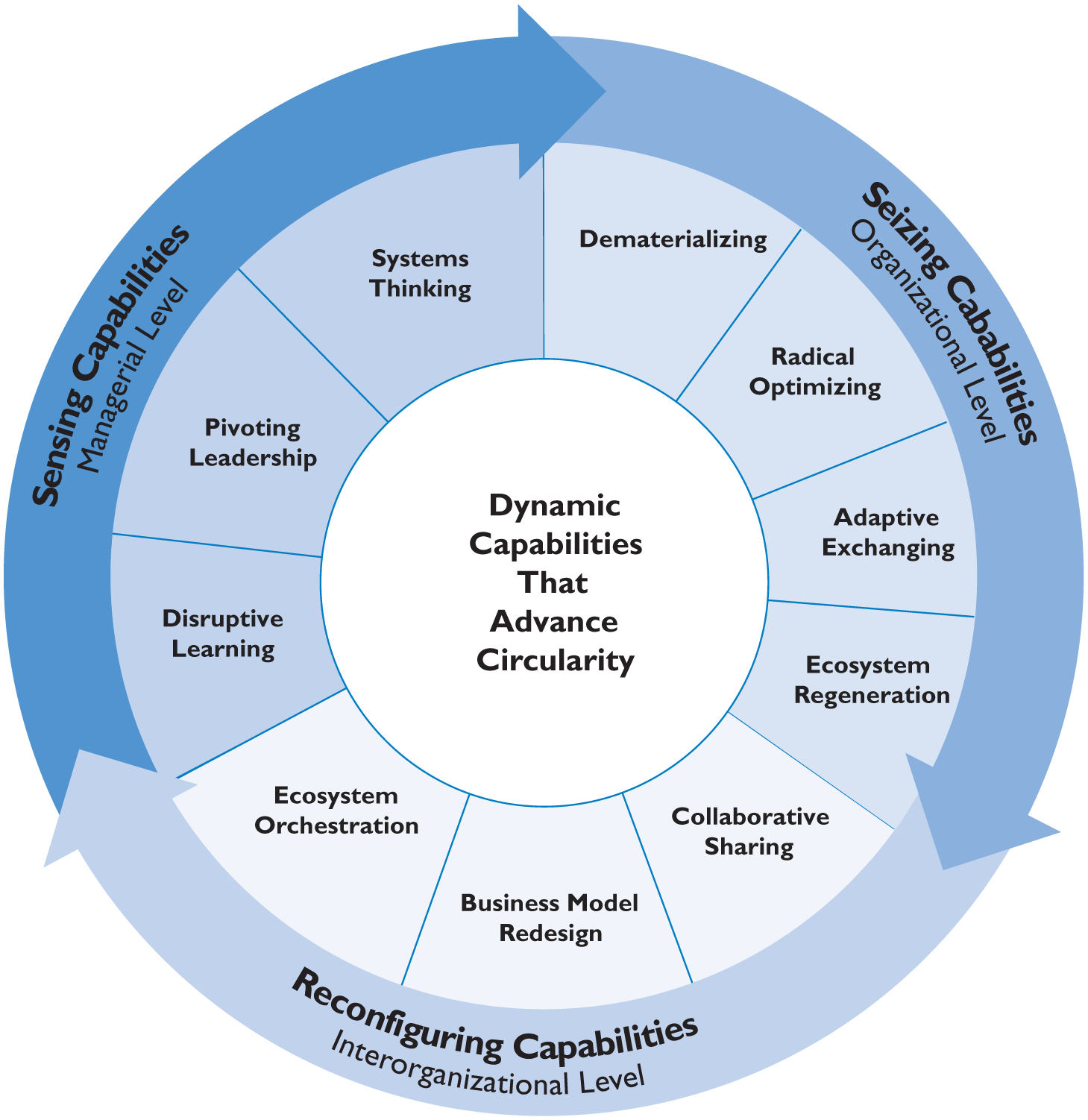
The dynamic capabilities that advance circularity.
In defining and differentiating the dynamic capabilities required for circularity, we use illustrative examples from the C&D industry. We chose this industry for several reasons. First, the C&D industry holds immense significance due to its global reach and substantial social, environmental, and economic impact. With over 100 million people employed in construction globally, the industry acts as the backbone for economic value creation through structures and assets, contributing a remarkable 6 percent to the world’s GDP, generating annual revenues of nearly $10 trillion, and adding value reaching $3.6 trillion. 35 Second, the C&D industry has also been characterized as extraordinarily slow to innovate, especially with regard to environmental issues, and yet offers perhaps the greatest opportunity for transformational change. 36 Last, most C&D projects involve multiple actors such as real estate developers, urban planners, landowners, investors, designers, architects, builders, and material suppliers who traditionally operate in a take-make-waste linear manner. This makes the sector ripe for implementing more circular cross-industry solutions. Applying circular economy principles is estimated to provide over $400 billion to this sector in primary resource benefits such as energy savings alone. 37 As such, the C&D industry is an ideal context in which to study dynamic capabilities, especially the more proactive sensing, seizing, and reconfiguring capabilities that can contribute to transformative innovation opportunities in circular cities. 38
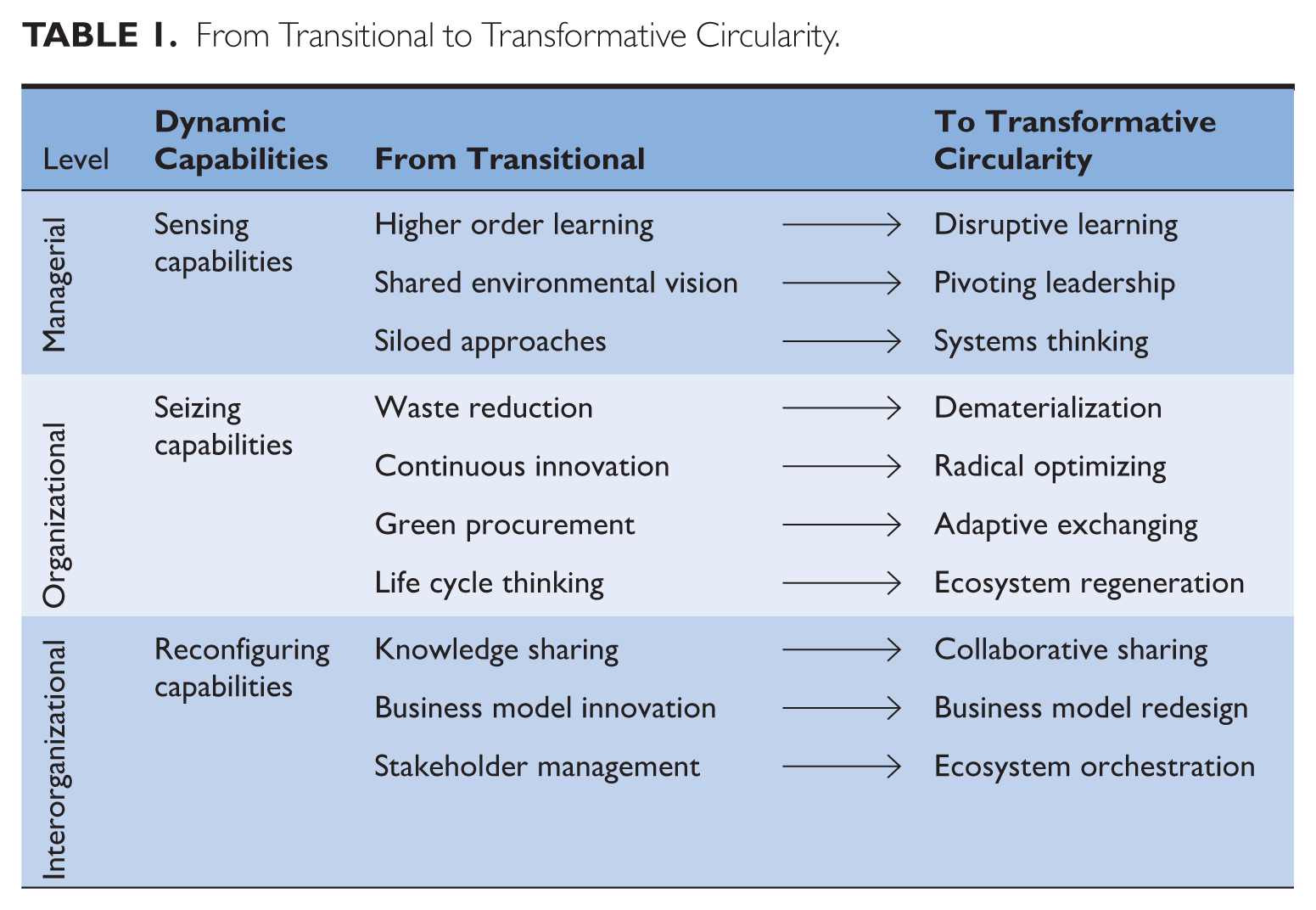
We begin by classifying the dynamic capabilities for circularity (sensing, seizing, and reconfiguring), which are considered higher-order dynamic capabilities. Under these, we define and describe how each dynamic capability moves organizations from transitional to more transformational approaches as summarized in Table 1. At first, the nature of these dynamic capabilities differs not so much in kind but more in degree of intensity and commitment. That is, organizations pursuing strong sustainability will already possess some transitional dynamic capabilities that enable better environmental outcomes; however, in order to advance to transformational circular business practices, efforts to intentionally develop advanced dynamic capabilities are required.
From Transitional to Transformative Circularity.
Sensing Capabilities
Sensing is a vital organizational capability that involves market scanning to identify emerging trends, market shifts, and new business prospects. 39 Sensing is deeply intertwined with managerial capabilities that encompass the skills to effectively learn, analyze, and interpret information. 40 In the pursuit of fostering circularity within organizations, three main dynamic capabilities emerged from the literature as imperatives at the managerial level: disruptive learning, pivoting leadership, and systems thinking capabilities. We classify these at the managerial level as they can most easily be initiated by individuals seeking to accelerate corporate sustainability objectives.
Disruptive Learning Capability
This refers to an organization’s ability to seek new information, insights, and perspectives that test conventional thinking and disrupt existing practices. In the dynamic capability for circularity literature, disruptive learning capabilities have been described as fast market monitoring, active knowledge-seeking, obsessive technology scanning, idea generation, and experiential learning. 41 It has also been linked extensively to cross-sector learning-lab partnerships, experimentation, and rapid prototyping. As a dynamic capability, disruptive learning encourages a culture of advanced curiosity and research, allowing organizations to remain agile and responsive to emerging trends, technologies, market shifts, and rapidly evolving environments.
Disruptive learning is an evolution from higher-order learning, which has been previously identified as a dynamic capability required for more transitional strategies. 42 Higher-order learning, also known as double-loop learning, is the capability to develop new interpretations to changes in ambiguous business contexts such that existing routines and processes are questioned. While this capability is no doubt important, disruptive learning goes beyond retrospective re-interpretations of contextual changes to encompass active sensing capabilities that deliberately explore alternate business paradigms. For example, one study found that advancing circularity required sensing capabilities including: open dialogues with disruptive stakeholders, focused attention on systems-based sustainability challenges, and actively searching “for new sustainable technologies to transform markets towards sustainable developmental changes.” 43 Similarly, other studies have identified sensing capabilities such as scanning the market for new start-ups and new legislation, and using tools such as product journey maps, customer surveys, and participating in circular economy-related courses. Disruptive learning capabilities are characterized by heightened external sensitivity and intentional knowledge-seeking through the active use of sustainability-oriented instruments and experiments. This goes beyond transitional dynamic capabilities, such as identifying social or environmental opportunities and threats as part of routine organizational learning activities.
In the C&D industry, the dynamic capability of disruptive learning can be most easily observed in companies that take an active role in seeking out new knowledge, new learning opportunities, and new research and development partnerships. 44 For example, the real estate development team at Windmill Developments (Ottawa, Canada) illustrated this disruptive learning capability by traveling to other eco-friendly C&D projects around the world to learn about the most advanced neighborhood-wide sustainability solutions. The team explored strategies for low-carbon construction, renewable energy integration, and circular economy principles, engaging extensively with supportive community members and contentious stakeholders alike. Drawing inspiration from these global best practices, Windmill designed the master plan for Zibi, Canada’s most sustainable neighborhood and the first to adopt the One Planet Living (OPL) framework, ensuring that every aspect of the project, from water management to waste reduction contributes to a sustainable urban ecosystem. They have subsequently established an OPL learning center and continue to welcome curious visitors from around the world. 45 This disruptive learning capability allowed the company to envision a zero waste, zero carbon community, rather than a more narrowly constrained less environmentally harmful C&D project.
Pivoting Leadership Capability
Building on disruptive learning capability, pivoting leadership capability refers to the ability of leaders/managers to radically re-interpret complex situations and make swift, decisive shifts in strategies, operations, or business models when existing environmental strategies no longer align with market demands or environmental changes. 46 Given the ever-mounting environmental and social issues plaguing the planet, sensing the need for drastic change requires pivoting leadership capability that enables leaders to move away from existing paradigms toward entirely new mindsets—for example, moving from a short-term profit focus to long-term value creation or from incremental GHG emissions reductions to eliminating GHG emissions altogether. 47 This has been previously described as “breaking the sustainability barrier,” defying traditional business approaches to sustainability toward zero waste, zero-emissions business models. 48 As the famous analogy suggests, if a car is speeding down a highway heading south, simply stepping (or even slamming) on the brakes will not in any way cause the car to head north. To do this, a directional pivot is required. In some areas, such as GHG emissions, it may already be too late to pivot entirely. However, opportunities for addressing other environmental issues, such as resource extraction, still offer the potential for a transformative change in direction. 49
It is easy to see how pivoting leadership capability goes beyond “developing a shared environmental vision,” which has long been argued to foster greater employee participation and commitment to more proactive environmental decision-making. 50 An organization’s shared vision is the beliefs and values held by employees regarding its mission and objectives, providing a basis for action in innovation processes. 51 While a shared environmental vision can act as a strong foundation, encouraging alignment and convergence toward achieving environmental objectives, and adopting advanced sustainability practices, pivoting leadership capability is the ability to shift away from previously shared visions altogether. Breaking the sustainability barrier requires a pivot away from incrementally better practices and steering the organization toward the pursuit of bold, alternative courses of action.
In the context of the C&D industry, research has shown how Rock Trade Industries, a small Australian quarrying company, deployed pivoting leadership capability in pursuit of more sustainable outcomes. Rock quarrying is by definition an unsustainable practice, stripping the earth’s surface to get to the resources underneath, typically generating over 80 percent waste in the process. In 2007, after having operated quarries in this same destructive manner for over 150 years, the new owner of Rock Trade Industries decided to upend how the organization had historically managed operations, setting instead a new vision to achieve zero waste and 100 percent utilization of its extracted resources. Coupled with disruptive learning capability (relentless learning, research, experimentation), engaging pivoting leadership capability enabled the company to devise a strategy that moved away from previous practices, converting 100 percent of its waste into ninety new products serving the C&D industry. While this case also illustrates multiple other dynamic capabilities for circularity, without this first sensing capability of pivoting leadership, it would be very difficult to go against prevailing industry norms.
Systems Thinking Capability
This is the ability of the leaders of an organization to comprehend complex scenarios and recognize the interconnectedness and interdependencies among various elements within a system. 52 Within the context of circularity, a system thinking capability enables organizations to understand the broader implications of their actions, cumulative impacts and decisions on both technical and biological cycles. 53 It encourages whole problem-solving and the identification of opportunities for circularity across the entire value chain moving away from take-make-waste approaches to circular solutions. Furthermore, with systems thinking capability, organizations can pinpoint key intervention sites, anticipate potential environmental risks, and design interventions that address broader systemic impact.
Systems thinking capability expands beyond the dynamic capabilities associated with transitional strategies (e.g., green design), which are often siloed approaches within particular departments in an organization. 54 Systems thinking capability requires rethinking linear processes focused on improving individual components or products, to embracing a comprehensive evaluation of the sustainability of the entire system, known as the “wholeness principle.” 55
While systems can range from global to national or municipal scales, our focus is on examples within the C&D context that define system boundaries where managers can meaningfully exert influence. For example, the planning and design team behind the Eden Project in Cornwall, England, exemplify systems thinking capability at the organizational leadership level. The Eden Project is a unique mine rehabilitation venture, where a plant-based visitor attraction and educational center has been constructed on the site of a 160-year-old exhausted quarry. Lead by visionary CEO Tim Smit, Eden is the world’s largest greenhouse and has been described as a “feat of engineering” conceived of as a series of bubble-inspired domes built to adapt to the unstable and irregular shape of the site. Smit’s belief that “the parts of something are intimately interconnected and explicable only by reference to the whole” ensured that the entire project was designed to demonstrate the relationship between plants, people, and resources: 83,000 tons of remediated waste was turned into soil, other construction materials were reclaimed, 0%–4% annual waste was sent to landfill, and all building and environmental management systems were part of cross-linked efficiency measures. The collection of more than one million plants and on-site nursery links visitors to how nature is interconnected to industrial and human systems for food, medicine, textiles, etc., and embodies this through providing food production and wildflower restoration, using cyclical rainwater, composting, and geothermal systems. These elements reveal how systems thinking capability enabled the Eden leadership team to envision a project that advanced circular practices, embedding interconnectedness at its organizational core. 56
Seizing Capabilities
Seizing capability refers to an organization’s ability to effectively mobilize its internal resources and competencies to capitalize on identified opportunities. 57 In the context of sustainability strategies, seizing capabilities allow businesses to mobilize their internal capabilities to pursue progressively more circular opportunities and turn regular organizational routines into dynamic capabilities. Such capabilities exist at the organizational level as they require resource commitments within and across multiple departments of the firm. From the circularity literature, four dynamic capabilities emerge as prerequisites for effectively seizing more circular opportunities: dematerializing, radical optimizing, adaptive exchanging, and ecosystem regenerating capabilities.
Dematerializing Capability
Dematerializing capability involves a dedicated focus on the absolute reduction of material usage without compromising functionality or value. Organizations proficient in dematerializing capability excel at mobilizing resources toward product, service, and process redesign to minimize resource consumption, redirect and recover waste. 58 Material and resource systems embrace circular design principles and innovative manufacturing techniques aimed at reducing the demands for virgin resources and energy. 59 Dematerializing capability goes beyond siloed waste reduction capabilities which have previously been attributed to transitional environmental strategies. 60 While waste reduction is important, dematerializing takes a more intentional approach by searching for ways to design products and services that eliminate the use of new resources, avoid waste from the outset, and recapture materials, accelerating positive environmental impact.
Within the C&D context, the Urban Mining and Recycling (UMAR) Experimental Unit at the Swiss Federal Laboratories in Dübendorf, Switzerland, stands as a prominent example of dematerializing capability. The UMAR project represents a paradigm shift in resource management where waste is not an option. The project’s design is rooted in the principle that all construction must be built with reclaimed material resources, and those resources must be fully reusable, recyclable, or compostable. The UMAR apartment is also designed for disassembly, material storage, management and leasing at the end of its service time, fundamentally altering how materials are approached not just at the very outset of construction, but also in future use. 61 This example shows that dematerializing capability in the C&D sector is possible.
Radical Optimizing Capability
Whereas dematerialization capability focuses on waste elimination, radical optimization capability drives organizations to mobilize resources in pursuit of radically optimizing all processes, products, or services to maximize efficiency in pursuit of environmental sustainability. Radical optimizing capability includes rethinking all processes to not just eliminate waste but also reuse and repurpose materials, prolong asset life spans through reduced maintenance, decrease resource usage, and implement reverse logistics for maximum recovery of materials after consumption. 62 While improving product performance, radical optimization entails leveraging technologies such as big data, automation, and remote sensing to enhance circular processes as well as simplifying products via standardization or modularizing components. 63
This capability goes beyond continuous innovation capabilities by embracing pioneering innovations that deliver sweeping improvements in environmental sustainability. While continuous innovation capabilities have been defined as: “the ability to innovate and continuously improve operations while reducing environmental impact,” 64 radical optimizing capability mobilizes the restructuring of all existing processes, reimagining workflows to align with circularity principles. This dynamic capability goes beyond transitional efforts to improve existing products and services, to generate entirely new processes that transform socio-technical systems and deliver meaningful environmental benefits. 65 In the dynamic capabilities for circularity literature, this has also been referred to as exploitative, disruptive, or even heretical optimization capability. 66
Although continuous innovation has netted several improved environmental building and design technologies (e.g., green roofs, heat pumps, etc.) within the C&D sector, these have delivered only incremental improvements with regard to waste or global GHG emission reduction. In contrast, C&D organizations that have developed radical optimization capabilities have reimagined entire processes within this industry, including those operating in the booming segment of off-site, modular, or 3D construction. For example, The Broad Group from China radically optimized construction processes such that 90 percent of building components are prefabricated off-site, reducing production waste to less than 1%. Their building designs incorporate recycled steel, are earthquake resistant, include indoor microclimates with purified air, and deliver five times the energy efficiency of traditional buildings, all while drastically reducing construction timelines from years to mere days, and reducing the total cost of construction by 40 percent in the process. 67 This type of radical optimization capability is therefore critical to advancing transformative circularity.
Adaptive Exchanging Capability
This capability focuses on the organization’s capacity to establish adaptive mechanisms for substituting resources. This refers to the intentional process of replacing existing elements within a business model, product, or service with more advanced environmentally and socially sustainable alternatives. 68 Adaptive exchanging capabilities include the ability to design opportunities to replace resources, materials, technologies, or processes that have become less viable or sustainable with innovative alternatives that align with circular economy principles.
This is moving progressively along the continuum from more green procurement practices attributable to transitional strategies. 69 While it is undoubtedly important for organizations to continue to look for less environmentally damaging materials, adaptive exchange suggests a more radical capability of completely replacing inputs with fully circular ones from the beginning of the design process.
Adaptive exchange capabilities are also evident in organizations operating in the C&D industry. First, the move to power both existing and new buildings with renewable energy sources instead of fossil fuels is growing exponentially. 70 However, other innovative material exchange opportunities are also being explored. For example, the 40 ft Hy-Fi demonstration building in New York was manufactured using mushroom bricks that were organically grown and composted at the end of their useful life, while the facade of the EcoPark pavilion in Taipei was built entirely from recycled polyethylene terephthalate (PET) bottles. 71 Similarly, the company Use-It in South Africa has innovatively produced environmentally friendly bricks by repurposing waste soil and rubble into building materials, effectively recapturing and transforming discarded materials into valuable resources. 72 Another prime example is the case of Black Mountain, which utilizes waste wool from the sheep wool industry to create natural and non-toxic insulation material. 73 Substituting in more sustainable materials designed to be reabsorbed into their respective technical or biological systems reduces reliance on virgin resources and drives both environmental conservation and circular innovations in the C&D sector.
Ecosystem Regeneration
Ecosystem regeneration capability can be understood as the capacity to challenge conventional business practices that treat nature as a resource to be exploited and/or managed. It involves actively creating conditions that support the remediation, regeneration, and co-evolution of human and earth systems in a mutually beneficial and interdependent relationship that goes beyond short-term financial motivation. 74 Ecosystem integration capability involves deliberate interaction with the natural environment by understanding the ecological dynamics, identifying opportunities for restoration, and implementing initiatives to develop the capacity to live within our planetary boundaries, ensuring both ecosystem and human well-being. 75 This seizing dynamic capability allows organizations to mobilize resources toward contributing to the resilience of ecosystems, promoting biodiversity, and fostering a positive impact on the natural environment.
Within transitional strategies, many organizations actively seek out environmentally friendly solutions to their operational challenges. However, businesses that develop ecosystem regeneration capabilities go beyond life cycle assessments and harm reduction approaches to seek out solutions that safeguard, restore, and improve environmental conditions. Developing ecosystem regeneration capability entails considering the intricate interdependencies between organizational activities and the natural capital the environment provides. 76 For example, while a company following transitional strategies might implement incrementally more environmentally friendly processes based on product or service life cycle analysis, install environmental management systems, or gain eco-certifications, those pursuing ecosystem regeneration go further by incorporating biophilic principles, steward remediation of soil and water, and implementing continuous protection and conservation for long-term preservation of the ecosystem services that we depend on. 77
In the C&D industry, this means conceiving of buildings and surrounding land as dynamic entities and processes—not things—for example, by designing buildings that function like trees and forests, producing more energy and clean water than they use. Early examples of C&D firms with ecosystem integration capability include Earthship Biotecture, which was founded by visionary US architect Michael Reynolds more than fifty years ago. Earthships are fully self-sufficient homes built from recycled materials that eliminate energy and water bills by harnessing natural thermodynamic properties to heat and cool the home, capture rainwater for personal use, and grow fruits and vegetables for community consumption. 78 These early environmental efforts have since led to a plethora of nature-inspired building designs at various scales—from buildings such as the Bosco Verticale in Milan, Italy, where 2 residential towers incorporate more than 900 trees, 5,000 shrubs, and 11,000 plants into its facade, increasing oxygen, cooling the immediate area, and absorbing 30 tons of carbon dioxide every year, to villages such as Wildpoldsried in Germany that through a combination of energy positive solar houses, biogas digesters, windmills, and small hydro plants produces 321 percent more energy than it needs. Developing an ecosystem regeneration capability is thus integral to advancing transformative circularity, especially in the C&D sector.
Reconfiguring Capabilities
Reconfiguring capabilities drive fundamental changes both within the organization and across its value chain, fostering its ability to transform culture and values, build credibility, and navigate dynamic environments. 79 Reconfiguring involves the deliberate and continued renewal of the organization’s capabilities to transition toward becoming a circular business and implementing new circular business models. These capabilities often necessitate interactions with external partners, suppliers, or other stakeholders, and are therefore at the interorganizational level. We identify three reconfiguring capabilities: collaborative sharing, business model redesign, and ecosystem orchestration capabilities.
Collaborative Sharing Capability
This is an externally oriented dynamic capability that enables organizations to depart from traditional notions of private ownership to embrace collective resource utilization and ownership. It involves “the act and process of distributing what is ours to others for their use and/or the act and process of receiving or taking something from others for our use.” 80 Collaborative sharing capability centers around establishing collaborative networks and platforms for resource sharing. In the context of transformative circularity, this capability encourages partnerships and alliances that promote the shared use of resources, assets, and knowledge. It enhances resource utilization efficiency and fosters circularity by extending the lifespan of products and materials.
This shift toward collaborative sharing among organizations goes beyond traditional notions of knowledge or information sharing associated with more transitional forms of corporate sustainability. It entails a broader scope that extends to the sharing of resources such as materials, equipment, facilities, and expertise, all with the goal of fostering innovation, operational efficiency, and overall sustainability. In contrast to traditional knowledge sharing, which primarily focuses on the exchange of intangible intellectual assets and feedback with employees, customers, and organizational experts, this approach recognizes the value of tangible resources. It recognizes how collaborative utilization of these resources can yield remarkable benefits across various domains. This capability enables organizations to collectively address challenges and transform opportunities in ways that can lead to profound positive impacts on both their operations and the environment.
Many examples of collaborative sharing capabilities are emerging in the built environment sector. A noticeable example can be found in White Gum Valley (WGV) in Australia, where the Evermore apartment complex was the first residential development in the country to create a shared solar battery system where residents use blockchain technology to trade renewable energy. This collaborative sharing capability has been described as “a ‘citizen utilities’ approach, where a distributed, decentralized, decarbonized and democratized energy market is created,” delivering net zero carbon power through innovative peer-to-peer trading. 81 Other sharing platforms like Dozr (construction equipment), Faber (construction personnel), and Floow2 (excess organizational resources) also facilitate business-to-business sharing in line with circularity principles. 82 These examples underscore the importance of developing collaborative resource sharing networks as a dynamic capability in the built environment sector.
Business Model Redesign Capability
Business model redesign capability refers to the ability of a firm to redesign how it operates and offers products and services. This includes changes to its resource base not only by recombining existing assets or integrating recaptured resources to capitalize on identified opportunities but also reimaging the model to consider all human and non-human stakeholders affected, building in non-financial benefits, and taking accountability for any negative impacts created. 83 Organizations equipped with redesign capabilities are more likely to reconsider sources of value creation and value capture to incorporate interconnected and circular opportunities that reduce dependency on virgin sources and add value to existing stocks. This includes transforming business models such as converting an organization from one-time sales to providing “product as a service,” where the company retains ownership, and customers pay for the service instead of the product itself, thus decoupling revenue from new resource extraction. 84
Redesigning capability goes beyond sustainable business model innovations, which tend to focus on tactical adjustments to increase financial value within the existing business framework (e.g., changing certain partners or suppliers). In the context of transitional sustainability strategies, business model innovation typically focuses on optimizing and rearranging existing resources to profit from changing market dynamics and customer demands, often leading to only incremental improvements. In contrast, business model redesigning capability involves altering the entire architecture of how the organization functions to intentionally design-in social and environmental benefits alongside economic benefits. It challenges paradigms, disrupts industry norms, and reshapes how value is created and captured, looking beyond profit as the primary barometer of success and acknowledging our interdependence on natural capital. 85
In the context of the C&D industry, the application of business model redesigning capability can not only be readily seen in organizations that have shifted from selling products (e.g., carpets) to selling services (e.g., maintaining carpet tiles), but may also soon be seen in C&D businesses that conceive of “every part of a building as a temporary service, rather than owned. From the facade to the lightbulbs, each element would be rented from the manufacturer, who would be responsible for providing the best possible performance and continual upkeep, as well as dealing with the material at the end of its life.” 86 For example, Triodos Bank in the Netherlands, designed by RAU Architects and Ex Interiors and developed by EDGE, is not just the first large-scale, 100% wood, re-constructible office building, the structure also serves as the country’s first temporary “material” bank. Every material in the building has been logged and designed for easy disassembly—every element can be reused. This type of business model challenges traditional models to have more far-reaching impacts on sustainability in the long-term future.
Ecosystem Orchestration Capability
Ecosystem orchestration capability centers on the organization’s ability to coordinate and influence its broader business ecosystem, specifically acting as a catalyst for systemic change. By ecosystem we mean the “collaborative arrangement through which firms combine resources to deliver a solution.” 87 Ecosystem orchestration capability therefore refers to the set of deliberate, purposeful actions taken by an organization to transform marketplace opportunities. 88 It revolves around an organization’s ability to strategically align various actors within its ecosystem including suppliers, customers, regulatory bodies, and even competitors to collectively achieve joint objectives. 89 This may extend as far as collectively developing a market and infrastructure for reused products, as well as fostering general cultural acceptance of remanufactured products.
Ecosystem orchestration goes beyond traditional notions of stakeholder management or integration associated with transitional strategies. For example, stakeholder integration has been defined as “the ability to establish trust-based collaborative relationships with a wide variety of stakeholders, especially those with non-economic goals” 90 and has then been linked to improved organizational waste management and energy efficiency. Ecosystem orchestration, however, goes further by creating collaborative networks, partnerships, and alliances with various stakeholders to create closed-loop systems; it involves navigating the scale-up process collaboratively with suppliers, buyers, and other intermediaries and coordinating the complex challenges associated with “asset recovery, matching supply to demand, marketplace variations, and managing profits across a complex dynamic network.” 91
In the C&D industry, ecosystem orchestration is best illustrated by the deliberate planning and development of manufacturing zones using the principles of industrial symbiosis. Industrial symbiosis is the use of the geographical proximity of factories to physically exchange materials, waste, and other by-products to lower costs, improve efficiencies, and minimize environmental impacts. 92 The most famous, and most studied, of these industrial symbiosis developments is Kalundborg, Denmark where several large manufacturing plants including an oil refinery (Statoil), a biotechnology/pharmaceutical company (Novo Group), a producer of plasterboard (Gyproc Nordic East), and a soil remediation company (Soilrem), among others, work in concert with the power plant (Asnaes) to exchange excess water, steam, gas, and other waste by-products that become inputs into each other’s manufacturing processes. 93 Each company within this network has had to develop ecosystem orchestration capabilities to negotiate contracts, trades, shared processes, and other economic and environmental initiatives in pursuit of closed-loop transformations. Examples of smaller-scale industrial networks from (e.g., Sweden’s Green Zone and BioFuel Region) and France’s Dunkirk region to larger-scale eco-industrial parks (e.g., Nanjing Chemical Industrial Park) 94 have since grown exponentially showing that ecosystem orchestration is a dynamic capability that can be developed in pursuit of transformative circularity.
Summary
While we recognize that many of these dynamic capabilities are interdependent and interwoven, and hence our itemization may be considered somewhat forced, we nonetheless believe it is useful to illustrate how each of these dynamic capabilities can contribute to advancing an organization’s sustainability and resource management approach toward greater circularity. Each dynamic capability, whether enacted individually or in combination, represents a significant shift toward strong sustainability practices. They compel organizations to rethink not only how they create and capture value but also how they collaborate, learn, and adapt within broader ecosystems. Taken together, these dynamic capabilities enable firms to transcend transitional sustainability efforts and instead embrace deeply embedded, systemic change aligned with circular transformation.
Managerial Implications
Having explored the dynamic capabilities required in the pursuit of more circular practices, a central question remains: what does this mean for you? We propose a series of managerial actions organizations can take to develop the sensing, seizing, and reconfiguring capabilities needed to advance more circular strategies in any sector to contribute to a more circular and sustainable world. Table 2 illustrates how to implement each dynamic capability drawn from insights from this discussion. We sought to link each dynamic capability with a sampling of the types of actions that could be immediately put into place along with real world examples of what these could look like in practice.
How to Develop the Dynamic Capabilities Required for Advancing Circularity.
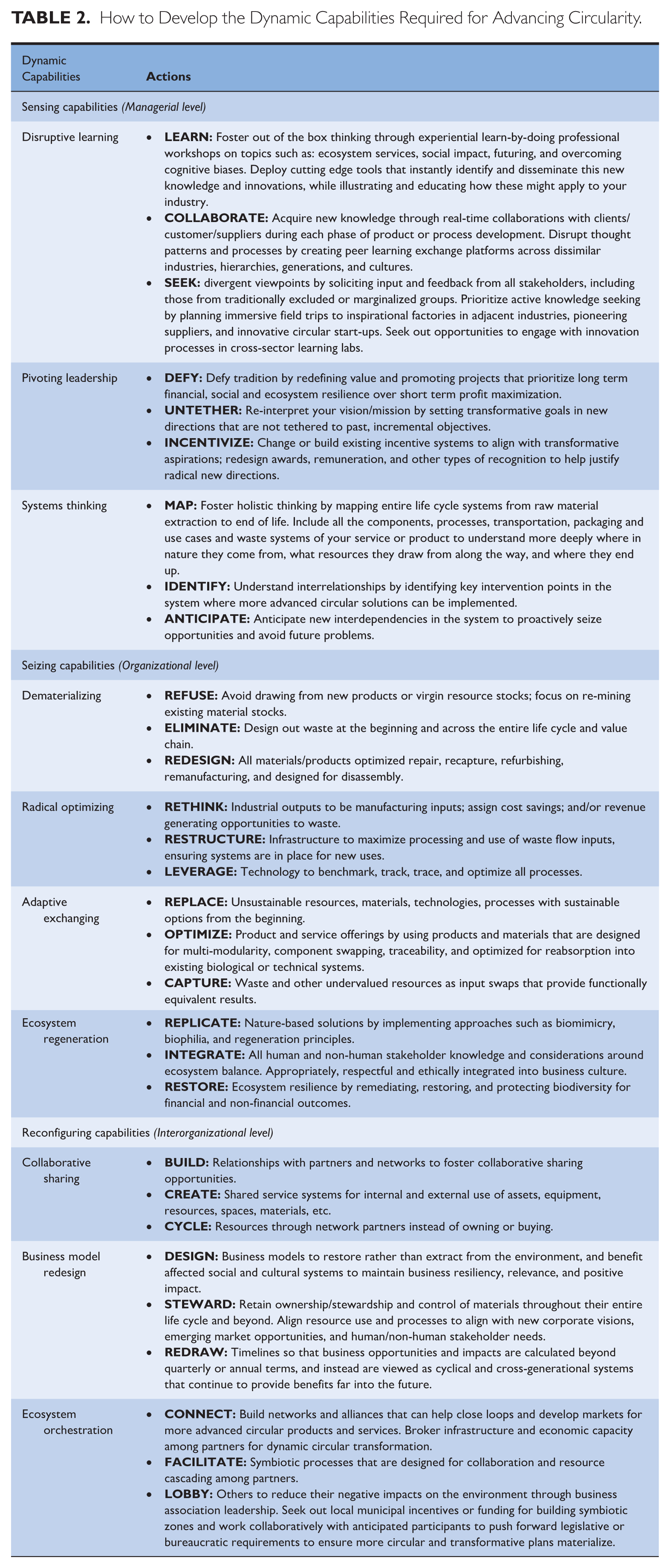
For example, disruptive learning capability is about intentionally seeking out participatory and immersive learning experiences, and so we have suggested activities such as field trips to factories in adjacent industries, experiential workshops, real-time collaborations, peer learning platforms, etc. that could help develop this dynamic capability. To develop systems thinking capability, we suggest mapping the interconnections among the entire life cycle of the organization’s touchpoints from raw materials to post-use remining, remanufacturing, and looping processes, identifying intervention points throughout systems-wide initiatives to implement advanced practices, and anticipating social and environmental interdependencies so as to seize opportunities and avoid or mitigate risk and future issues along the value chain. Similarly, to develop dematerializing capability, our suggested actions are to design products and services with recovered resources from existing systems rather than extracting virgin materials, designing out waste from the outset, and optimizing materials and products for value retention and recapture.
This table was designed to create a bridge between the theoretical grounding from the dynamic capabilities for circularity literature and the manager level actions that can be taken to advance toward more transformative sustainability outcomes. These actions are intended to work together, and effectively change the culture, and mission of the organization as a whole.
On Caution and Optimism
Our objective was to take an in-depth look at the dynamic capabilities required to accelerate beyond transitional to transformative circular strategies and provide some clarity for managers looking to develop these dynamic capabilities at the individual, firm, or interorganizational levels. That being said, we are well aware that many structural and systemic barriers, as well as institutional and organizational challenges, exist in this transition. 95 For example, we know that lack of standardization, an inconsistent regulatory framework, absence of vertical and horizontal collaboration, stakeholder pressure, consumers’ inaccurate perceptions, and technological expertise account for both internal and external barriers to the transition to a circular economy. 96 We also acknowledge that these barriers are further amplified in the C&D sector, where general awareness of the principles of circularity, as well as incentives for transformational change, are low. 97 We understand that it is a tall order for any business to develop all ten of these dynamic capabilities or for any manager to implement all our suggested actions; there may also be unpredictable implications in the combination or sequencing of dynamic capability development. Unintended side effects are a potential externality that would be best explored through a systems thinking lens to ensure that what at first may seem like a good solution does not result in rebounds (i.e., waste wool use that when exhausted at scale starts to pull from virgin sources to meet demand), or unrealistic expectations/deflection to future recipients of the issues to be resolved (i.e., recycled materials will degrade over time, and cannot remain indefinitely in the technical material system flow), or presumptions of outcomes without adequate contextual considerations (i.e., assuming that circular tactics will guarantee regeneration, or that regeneration strategies are appropriate for all processes).
We also acknowledge that some may find our list of dynamic capabilities for circularity incomplete. While we have sought to offer a representative, rather than comprehensive, review of the ever-growing amount of literature on dynamic capabilities for circularity, there are no doubt many different valuable capabilities that can also support organizational transformation. Most notably, previous research has identified that creating an organizational culture that supports circularity is a dynamic capability in and of itself that is essential to advancing circularity. 98 Nevertheless, we believe that it is in the continuous enactment of these overarching ten dynamic capabilities that organizational culture forms. As illustrated in Figure 1, while the process of developing these dynamic capabilities might start with sensing capabilities and move into seizing and reconfiguring capabilities, this process is iterative such that the organization must continually cycle through these practices to advance toward more transformative outcomes. As such, an organizational culture that supports these processes emerges with the continuous development of the dynamic capabilities for circularity. Normalizing this cyclical set of capacities also provides foresight advantages as climate changes and new sustainability regulations emerge, and those who can most quickly sense and act on impending changes will be well-positioned for beneficial opportunities and risk mitigation. Seeking circular solutions must eventually become routinized so that circularity becomes the taken-for-granted approach across all business practices.
Despite these limitations, we believe that the C&D examples provided throughout, in addition to the long list of practical managerial actions that can be taken, are reasons enough to be optimistic: developing dynamic capabilities for circularity is not only possible but is already happening. Several inspirational books and case studies document the many and varied ways in which businesses, not just in the C&D sector, have been able to push beyond transitional strategies to deliver more circular and transformative outcomes. 99 A key factor in this transformation, evident in many of the examples provided, is that the most impactful and effective approaches are not siloed and one-off projects that employ only individual dynamic capabilities but rather represent a full commitment to an integrated approach. The sheer scale of the C&D industry, with its consumption of half of the world’s raw materials and associated waste, means that successful transformation of these companies will have a significant and resoundingly positive impact across social and ecosystem environments. These impacts affect not only today and the near future but, in light of building longevity, carry forward into the long-term future as we continue to grow in population and infrastructure needs. As such, the lesson we should take is that there is reason for cautious optimism as organizations develop and routinize dynamic capabilities that transition us to more transformative circularity practices.
Footnotes
Acknowledgements
We gratefully acknowledge that this project was supported by funding from the Social Sciences and Humanities Research Council of Canada (SSHRC).

Notes
Author Biographies
Daina Mazutis is the Endowed Professor of Ethics, Responsibility and Sustainability at the Telfer School of Management, University of Ottawa, where she is also the Director of Sustainability, Director of the Green Academy and Co-Lead of the Center for Sustainable Impact/pour l’Impact Durable (CSSID) (email:
Afolasade Nubi is a PhD candidate at the Institute of the Environment, University of Ottawa, and a researcher with the Economics and Environmental Policy Research Network and the Smart Prosperity Institute, specializing in organizational adoption of circular economy and waste reduction practices to advance sustainability transitions (email:
Emma Segal is a PhD candidate at the Institute of the Environment, University of Ottawa, and a designer and educator for organizations around the world specializing in design-led transformational change for circular and sustainable futures (email: