




Abstract
The rise of digital technologies and open innovation has revolutionized innovation practices, creating new opportunities for moving born-physical open innovation settings to metaverse-like virtual environments. This study explores a virtual corporate-startup collaboration program in the energy industry to understand how digital feature usage facilitates trusted relationships and enables successful pilots. This article presents a framework that emphasizes the strategic use of digital information and interaction features for targeting and bonding with partners. Program managers can tackle the unrealized metaverse through ubiquitous program management and overcome social barriers through adaptive social engineering of digital interactions. This article also provides an outlook on evolving technologies and hybrid designs.
The rise of digital technologies and open innovation (OI) is inherently intertwined and has fundamentally transformed innovation practices over the last decades. 1 On one hand, some OI settings, such as online communities, 2 open-source software development, 3 and crowdsourcing, 4 are “digital natives” as they have emerged based on digital technologies. On the other hand, digital technologies are increasingly used in settings that traditionally rely on the co-location of actors “born-physical’’ OI settings. Corporate-startup collaborations, 5 for instance, traditionally rely on in-person interactions. Representatives of corporates tap into local startup ecosystems with the aim of conducting pilot projects in which they explore startups’ innovative solutions, test their integration within the business units, and examine the potential for commercial rollout. 6 For example, Enel—Italy’s largest electricity utility—has a distributed network of Innovation Hubs, where innovation managers scout for and collaborate with local startups in different geographical areas (e.g., Silicon Valley, Tel Aviv). 7
With digital technologies’ improved affordance to mimic physical interactions, 8 new opportunities arise for such born-physical OI settings to go digital and move to virtual environments often described as preliminary forms of the metaverse. 9 While the vision of the metaverse is a decentralized virtual world in which individuals can interact as if they were at the same physical location through digital technology and virtual reality (VR) features, virtual environments that exist nowadays vary in their feature coverage and the extent to which they already reach this vision of the metaverse. 10 Following leading startup accelerator programs such as Techstars Anywhere, which launched an entirely virtual startup accelerator in 2017, corporates are beginning to experiment with virtual environments as preliminary forms of the metaverse. 11 For example, as of summer 2023, beta-I—a global facilitator of corporate-startup collaborations—lists three in-person programs, seven hybrid programs, and two entirely virtual programs on its website. 12 One of their virtual programs is in collaboration with COPEL—a Brazilian electricity utility—and offers an entirely virtual six-month program. 13 Our study explores these new virtual corporate-startup programs to uncover how born-physical OI settings can effectively go digital.
Managing such programs is difficult—already in the physical world—as startups and corporates have fundamentally different cultures, processes, and needs. 14 Managers face several challenges on the pathway to successful pilots, including the paradox of disclosure 15 —individuals want to protect strategically relevant knowledge but typically need to share some knowledge for the initial matchmaking between corporates and startups. Overcoming these challenges requires trusted relationships, as formal and detailed contractual frameworks are often less suited to govern the early stages of innovative pilot projects. 16 Ultimately, trust can only be built by the individuals who operate on the front lines of OI. 17 Yet, prior work suggests that trust is built via co-location and in-person interactions. 18 Drawing from prior research, we define “trusted OI relationships” as the extent to which individuals perceive their relationships with external partners as high quality, reciprocal, and trustworthy. 19 Absent physical proximity, it remains unclear how virtual corporate-startup collaboration programs can instill such trusted OI relationships that build the foundation for successful pilot projects.
Prior literature has already uncovered the advantages of complementing born-physical settings with digital features, including increased efficiency and access to more diverse knowledge sources. 20 Yet, we know little about the affordances of digital features in novel virtual environments that follow the vision of the metaverse and a “digital-first” logic, 21 thus entirely replacing in-person interaction. These virtual environments allow users to enter virtual rooms, see other users’ avatars, and enter realistic virtual representations of company booths. They provide an integrated interface and physical metaphor with different communication features. 22 Moving corporate-startup collaborations to such virtual environments could allow corporates to cut costs by reducing business travel, increasing scalability and reach, and reducing emissions from air travel. But how does leveraging digital features in these virtual corporate-startup programs enable individual managers to develop trusted OI relationships as a foundation for successful pilots?
Background and Context
Governing Corporate-Startup Collaboration through Trusted OI Relationships
Corporate-startup collaboration can occur in different formats, 23 contingent on whether it leverages outside-in versus inside-out knowledge flows and relies on equity investments. We focus on outside-in corporate-startup programs that are often managed by program managers who facilitate interactions between the two unlikely allies. Program management can reside in-house—that is, run by employees of the corporate—or it can be powered by an external accelerator, such as Techstars, Y combinator, or Plug and Play. 24 In these programs, corporates aim to implement pilot projects that are particularly important in strategic corporate-startup engagement. 25 Successful pilots are a crucial outcome for OI and strategic corporate-startup engagement as they allow firms to test, evaluate strategic fit, and ultimately commercialize startups’ innovative solutions. 26 Thus, corporate innovation managers need to identify and evaluate startups and engage in internal matchmaking to find suitable business units to test the startup’s solution. This task is challenging as innovation managers need to convince business unit managers of the startup’s potential and compete for the business unit’s limited resources. 27 Similarly, entrepreneurs face a real risk of making “false bets” and committing their scarce resources to engagements with uncertain returns, given that corporates’ processes and timelines fundamentally differ from those of startups. 28
Tackling these issues ultimately depends on the individual representatives of corporates and startups who are operating at OI’s front lines. 29 They need to create and maintain relationships to exchange knowledge with their external collaborators. 30 However, these managers face the paradox of disclosure: while they need to protect the organization’s intellectual property (IP) and may thus be limited in sharing strategically relevant knowledge, they also need to disclose some relevant information to their partners to ignite fruitful relationships. 31 For instance, matchmaking between startups and business units requires the participating managers to reveal knowledge about their respective innovations and needs in early discussions. This often happens even before the first contracts are signed. In addition, contracts often fail to fully capture OI partnerships’ novelty, uncertainty, and complexity or are too costly and tedious to set up. 32 As formal contracts become less relevant, and firms resort to IP-light models, 33 informal governance mechanisms—such as trusted relationships—become increasingly relevant. This is particularly relevant in strategic, rather than financial, corporate-startup engagement as it involves closer collaboration and integration of technologies. 34
Trust operates as a foundation of knowledge sharing by encouraging the disclosure of knowledge to others and granting others access to one’s own knowledge. 35 It further increases the perceived veracity of knowledge; when knowledge is received from a trusted partner, the recipient is more likely to accept the knowledge at face value. Individuals’ trusted OI relationships—relationships with external partners perceived as high quality, reciprocal, and trustworthy—are thus of fundamental importance for effectively implementing pilots at the firm level. 36 High quality refers to the depth of relationships that go beyond superficial contacts and make knowledge sharing among partners possible. Reciprocity means managers can expect to receive knowledge in return when sharing knowledge with partners. Trustworthiness refers to an individual’s belief in the agreements and promises made by other individuals (e.g., about not sharing knowledge with third parties). Our focus is not on single dyadic relationships, but on the trust and reciprocity engrained within an individual’s entire set of OI relationships. This can include the formation of new trusted relationships and/or the strengthening of existing relationships.
Prior studies reveal that a critical lever of trusted relationships between OI partners is co-location and personal interaction. 37 Yet, with the rise of new digital features and the metaverse, there is an opportunity to move corporate-startup collaborations to virtual environments that lack these physical properties. How can firms leverage digital features in virtual corporate-startup programs to enable individuals to develop trusted OI relationships that constitute the foundation of successful pilots?
Trusted OI Relationships in Virtual Environments: Leveraging Digital Features
Digital-native features include, for instance, posting information in online communities, commenting on the posts of others, creating profiles that others can visit, or sending direct messages. 38 On crowdsourcing platforms, individuals can post and comment on ideas 39 and create profiles that display information about them and their activities. On IP-sharing platforms, individuals can browse through profiles and databases of patents and reach out to the IP provider with direct messages. 40 The purposeful use of such features enables individuals to build relationships in digital-native settings. 41 Accordingly, with the rise of new features (e.g., metaverse technologies), the information systems literature describes an ontological reversal from digital technologies as enablers of physical interactions (i.e., physical-first) to “digital-first,” where interactions happen mainly in virtual environments and physical interactions follow only if necessary. 42
As we aim to explore digital features in corporate-startup collaborations as a born-physical OI setting, we need to consider a broader range of relevant features that have affordances to replace physical interactions. Affordances describe the action potential—that is, what a user can do with a technology feature. 43 For instance, prior studies on virtual work reveal how web conferencing features with the affordance of bilateral or multilateral meetings mimic and replace in-person interactions. 44 While web conferencing has existed for a long time, the affordances of web conferencing features evolve constantly, enabling, for instance, branded virtual backgrounds, collaborative work with sticky notes, and customized settings for breaking hundreds of participants up into smaller group discussions. 45 These evolving affordances increasingly provide a metaphor for born-physical settings, mimicking co-located interactions. This is in line with technological developments in the realm of the metaverse, which aims at providing users with an experience of navigating through and entering virtual places, seeing and interacting with avatars of other users, and providing realistic booths where information can be accessed. 46
Virtual environments used for corporate-startup collaborations have the potential to combine digital-native features with those that mimic physical interactions. Leveraging these features can enable individuals to develop trusted OI relationships as a foundation for successful pilots between corporates and startups.
Research Design
Research Setting: A Virtual Corporate-Startup Program in the Energy Sector
We conducted our research in the setting of a global corporate-startup program in the energy sector. The energy sector is transitioning from a centralized emission-intensive system toward a renewable and decentralized system in which multiple actors need to co-innovate. This makes OI a strategic imperative for the industry. In response, in 2016, several international electricity utilities joined forces to collaborate with startups working on innovative solutions that could help utilities survive, navigate, and accelerate the energy transition. The program aims to enable knowledge exchange, build relationships, and explore collaborations among the participating companies.
The greatest benefit for us in [the program] was the chance to build relationships, also on a personal level, with some of the most relevant people in the energy sector all over the world. Because it opens up options for our international expansion and for large-scale collaborations in the future. (Startup participant)
Like other corporate-startup programs, 47 the annual program used to follow a structure of four co-located “modules,” during which participants met in person for a week to intensify their collaborative activities. Given the global spread of participants (40 countries and five continents) and the program’s focus on decarbonization, the utilities deliberated moving some or all modules online to enable more individuals from the member firms to participate and to reduce the carbon footprint of the program that results from air travel.
We’re all working on decarbonization, [why] take hundreds of people and fly them to Sao Paulo, Dubai, and Singapore when you can also do it digitally. The other good thing is that by doing things digitally, you can have more people participating. (Utility participant)
Since our study was set in 2020, the COVID-19 pandemic forced the decision to move the program to a virtual environment. Thus, the program was structured around four virtual one-week-long modules facilitated by program managers. These program managers were hired from an external OI-specialized consultancy, but they operated under the close guidance of the eight corporate members of the program. Another specialized external vendor designed the virtual environment. Similar to other tools on the market, the environment graphically imitates a physical space where users can enter different rooms, see other participants in the same room, and access four different features. First, users could enter a room with company booths. Each booth portrayed information about the company, such as product, size, or strategy, as well as information about its participating individual members, including names, pictures, functions, short descriptions, and video introductions. Second, users could enter the main auditorium with an embedded multilateral web conferencing tool. The auditorium provided a timetable with an overview of planned sessions and their starting dates and times. Third, each company had its meeting booth where users could book and enter bilateral web conferencing meetings. Fourth, the organizers invited all participants to engage in chat groups of a direct messaging application, allowing individuals to contact each other directly. The following quote describes these features: The [virtual platform] brings all participants to a central point and brings a physical metaphor for meeting other participants and for retrieving information from the booths. And there are multiple means of interaction, which are the meeting booths where people actually interact [through web conferencing]; the auditorium, where we host our group sessions, and [the messaging application] where the continuous conversation happens. (Program manager)
In this setting, we closely tracked how 150 individuals participated in the program and used the features in the virtual environment (over four consecutive virtual events). After running an entirely virtual program in 2020 and 2021, the program alternated between virtual and co-located modules in 2022 and 2023 and is expected to continue with a mix of virtual and co-located elements.
Data Collection and Analysis
We employed a mixed methods approach to examine the relationship between digital feature usage in the virtual environment and trusted OI relationships as a foundation for pilots. First, we explored our assumption that trusted relationships at the individual level are important for pilots at the firm level. For this purpose, we collected information about the pilots signed between the utilities and startups at the end of the program.
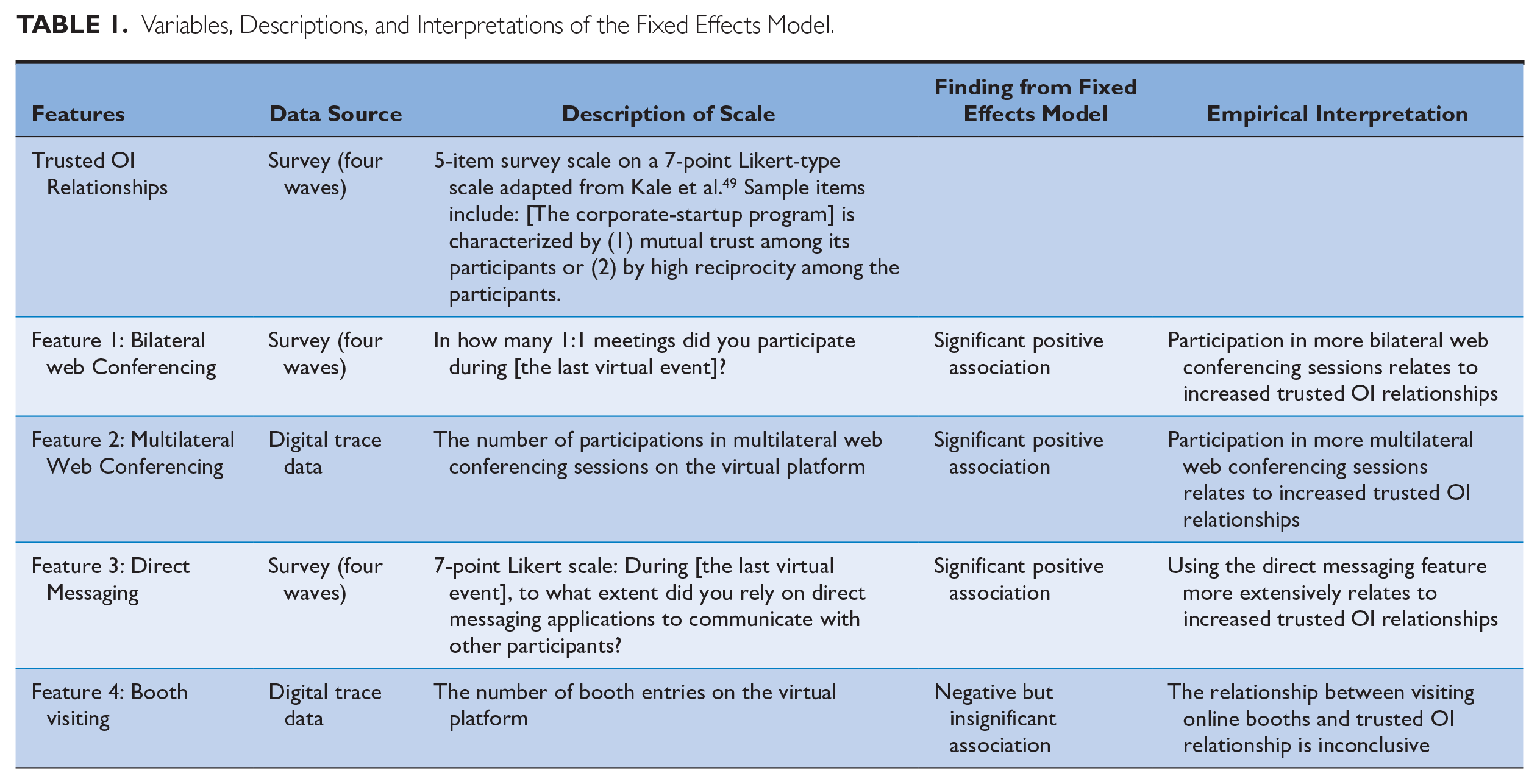
As we are mainly interested in the individual-level trusted OI relationships that can be directly linked to digital feature usage, as part of a larger research project, we collected four waves of survey data and digital trace data from the participants. The survey collected information on trusted OI relationships and feature usage that could not be captured via digital trace data. Table 1 provides an overview of our main variables and measures. Seventy-four individuals answered at least two of the surveys and were thus included in the analysis. We then employed fixed-effect panel regression analyses to test for associations between the usage of features and trusted OI relationships. Finally, we complemented our quantitative analysis with a qualitative analysis of 19 in-depth semi-structured interviews, 120 hours of observations, and 4,700 chat messages, following best practices in qualitative research. 48
Variables, Descriptions, and Interpretations of the Fixed Effects Model.
How Participants Develop Trusted OI Relationships
A Foundation for Pilots Between Corporates and Startups
Our results show that the more the individual participants of a firm were collectively able to build and strengthen trusted OI relationships over the four virtual events, the more pilots their firm signed at the end of the program. Figure 1 shows the average of individuals’ trusted OI relationships (per firm) grouped by success regarding signed pilots. The individuals of firms that signed two or more pilots have significantly higher trusted OI relationships (on average) than those from firms that only signed one or no pilots. This suggests that trusted OI relationships relate to successful pilots between corporates and startups. Accordingly, one of the startup CEOs explains, I think we have built up a really good level of trust in the virtual environment. I am not saying that it [pilots] can’t be done [without that trust], but it is definitely much easier doing pilots with different utilities when you have this [trust]. You know, with [the partnering utility], it would just be really hard to share and implement anything if I didn’t have that level of trust with [the utility’s innovation manager].
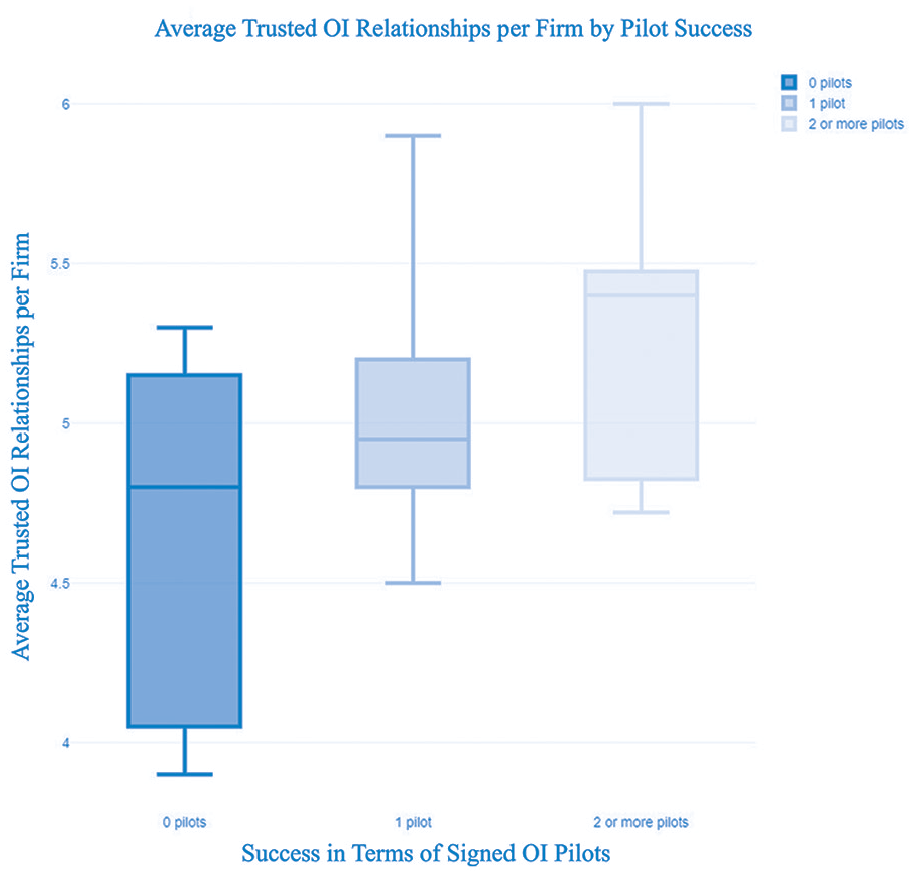
The role of trusted open innovation relationships for implementing pilots between corporates and startups.
The positive association between trusted OI relationships and pilots at the firm level warrants further investigations into how trusted OI relationships can be built, especially in a virtual environment that lacks co-located interactions. Thus, in the following, we uncover how digital feature usage facilitates trusted OI relationships.
The Impact of Digital Feature Usage on Trusted OI Relationships
Our survey data reveal that individuals differ substantially in the extent to which they built trusted OI relationships during the virtual modules. This is visualized in Figure 2. Some individuals established trusted OI relationships throughout the program, that is, the level of trust remained high across the four virtual modules, forming almost a straight line (see the bold line in Figure 2). Others only perceived trusted OI relationships at some points in the program but not at others, that is, the level of trust in their OI relationships zig-zagged across the virtual modules (see the dashed line in Figure 2). Finally, some individuals were unsuccessful in building trusted OI relationships, that is, their levels of trust were positioned at the lower end and decreased or remained on similar levels over time (see the dotted line in Figure 2). Accordingly, for some individuals, trusted OI relationships in a virtual setting are a reality, as one participant explains: “Despite it being virtual, I got to know a lot of new people and built good relationships with many other participants.” Yet, others were less successful, “In this virtual format . . . making meaningful connections was difficult.”
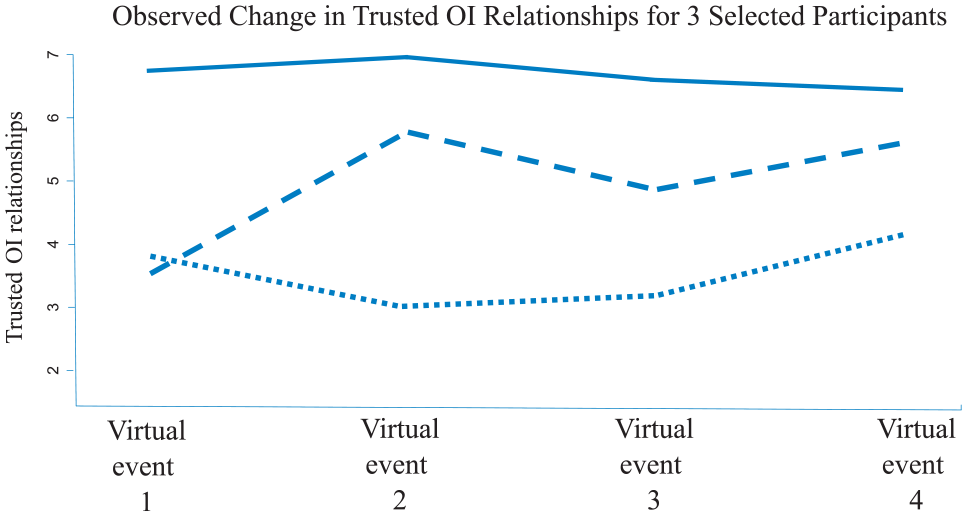
Different developments of trusted open innovation relationships for participants.
Hence, we find that even in the same virtual setting, there is significant heterogeneity in the levels of trust engrained in individuals’ OI relationships, which may have important implications for OI performance at the firm level. We thus need to better understand to what extent this heterogeneity relates to individuals’ usage of digital features provided on the virtual platform. We discovered that individuals who used bilateral and multilateral web conferencing and direct messaging were more successful in establishing trusted OI relationships. Visiting online booths, however, seems to be less relevant for trusted relationships.
Figure 3 illustrates that direct messaging might be more effective than web conferencing. When an individual uses the direct messaging feature to a great extent, the graph in Figure 3 illustrates that trusted OI relationships increase strongly over the course of one virtual module. Accordingly, trusted OI relationships decrease when direct messaging feature usage is low. This increase or decrease in trusted OI relationships is steeper for direct messaging compared with web conferencing. Furthermore, the graphs in Figure 3 illustrate the difference between a person participating in seven multilateral and eight bilateral sessions and another person participating in one multilateral and two bilateral sessions. The graphs show that the increase/decrease is steeper for bilateral compared with multilateral web conferencing. Interestingly, for visiting booths, the graph implies that an increase in feature usage could be related to a decrease in trusted OI relationships.
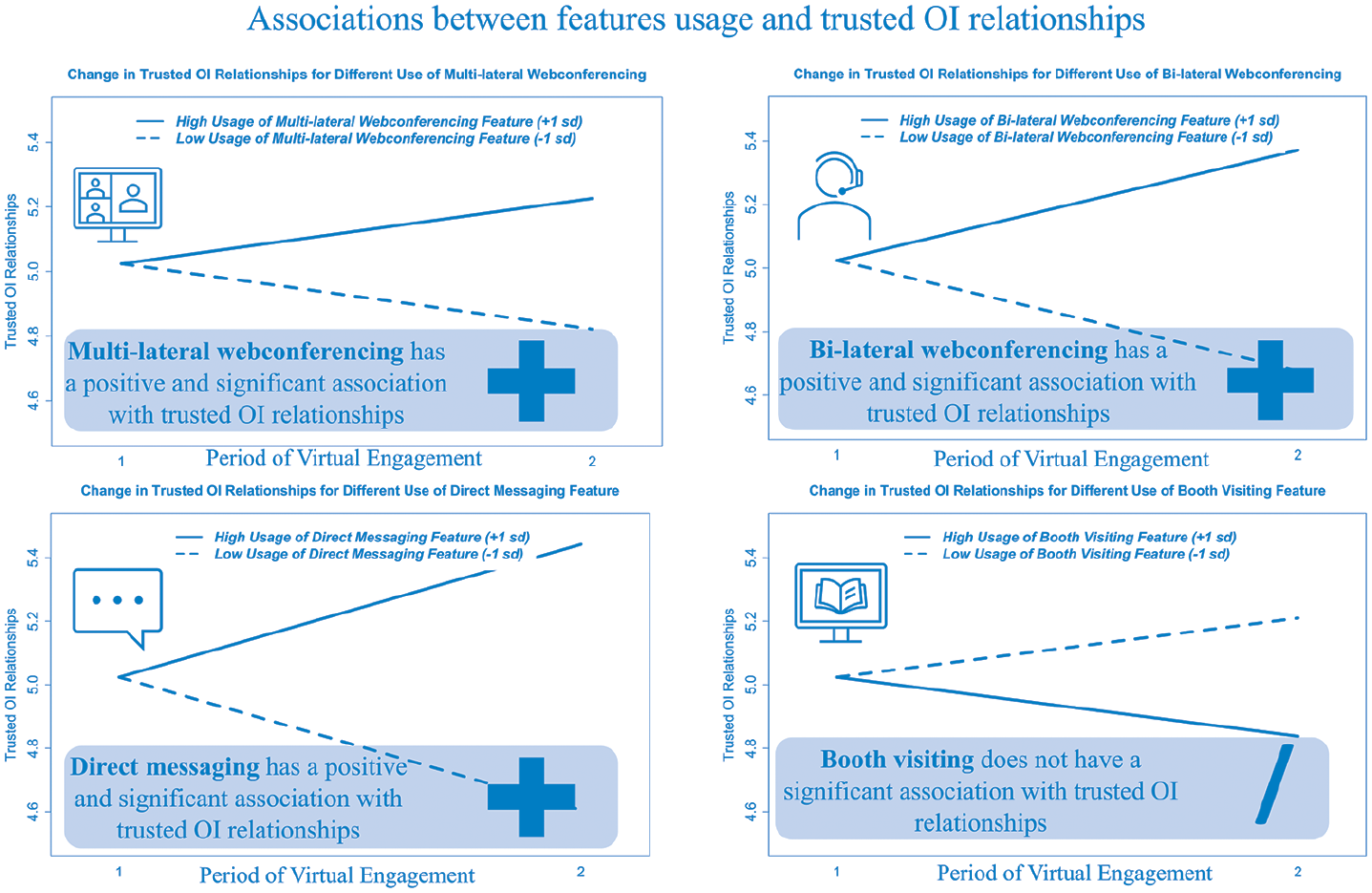
The association of four digital features with trusted open innovation relationships.
These findings imply that to develop trusted OI relationships, individuals might be well advised to prioritize specific digital features (e.g., direct messaging) over others (e.g., visiting online booths). Overall, our findings show that using different digital features in virtual programs does indeed explain to some extent why individuals are more successful in establishing trusted OI relationships.
Digital Interaction Features as Enablers of Group-Level, Intimate, and Prolonged Digital Bonding
An alternative route to establishing trusted OI relationships—in the absence of personal interaction in a physical place—is to engage in digital bonding. The different affordances of digital features played a crucial role in this digital bonding. For instance, the affordance of multilateral web conferencing to support the visual appearance and oral communication stimulated individuals to diverge into private topics. Accordingly, we often observed that multilateral web conferencing sessions took interesting and unexpected turns when there was room for individuals to talk about their values and personal experiences. This aspect of group dynamics and relationship building goes beyond “business talk.” It is crucial for group-level digital bonding between corporate and startup managers, which translates into trusted OI relationships.
The closest we got to building personal relationships was in a [multilateral web conferencing] session with 15 participants, all startup people. And there was a lot of bonding going on. It was the first time we really had open discussions about wine and about electric vehicles. It was like having a beer together at seven o’clock . . . everyone felt relaxed and started to talk. (Startup participant)
The bilateral version of the feature enabled a more intimate form of bonding. Interviewees mentioned that the deliberate action of booking and participating in private meetings further deepened trusted relationships.
Conversations are never in-depth if there are more than two people, I find. So, I had my two best conversations during [the virtual event] when I was reaching out to one utility member over the platform at a really late time in the evening. And we just had a chat. (Startup participant)
Our analysis also explains why direct messaging strongly associates with trusted OI relationships. While direct messaging does not afford oral communication and visual impressions of other participants, it affords a more constant stream of communication. While co-location provides a rather continuous bonding experience as individuals spend several days together, the bonding experience is frequently interrupted in a virtual setting. For example, the experienced bonding could abruptly end after individuals leave a web conferencing session and “return” to their physical environment at home. To counteract these interruptions, individuals used the direct messaging feature to post pictures and send messages during or right after web conferencing sessions, as well as throughout the entire day. Thus, direct messaging enabled a prolonged digital bonding between corporate and startup managers.
The other form of communication that I think was useful was [the direct messaging application]. And I think it worked pretty well because there was constant communication. And it was really easy because everybody used it and you could interact with others. It’s almost like having professional relationships, sometimes in a group, sometimes privately. So, I think the whole setup was good, the day-to-day communication flow was excellent. (Utility participant)
This interplay of a group-level, intimate, and prolonged experience of digital bonding between corporate and startup managers explains how individuals successfully leveraged digital features for establishing trusted OI relationships.
Leveraging Digital Information Features for Identifying and Contacting OI “Targets”
While our results suggest no direct association between visiting online booths and trusted OI relationships, our qualitative insights reveal that online booths still played an important role. Online booths lack interactive elements that would directly enable trust in OI relationships. Yet, the online booths served as an important enabler of the other interaction features (e.g., direct messaging). Specifically, visiting booths allowed individuals to gather information about other participants that was not publicly available. This information enabled managers to identify relevant OI “targets” and then contact them in a more meaningful way via the interaction features. By combining both features, participants could leverage information from the booth to customize messages in the direct messengers and inform conversations in web conferencing sessions. The following quote illustrates, At some point, I was quite disappointed because I wasn’t really engaged. So, I started to go through all the booths that were on the platform. And it was funny: because for many people, I totally forgot that they were here, or I just didn’t end up in the same session with them. So, I started to become a bit more proactive and messaged some of them. And actually, the response has been quite good. (Startup participant)
How Program Managers Can Address Functional and Social Barriers in Virtual Corporate-Startup Programs
Our analysis uncovered several functional and social barriers to building trusted OI relationships in virtual corporate-startup programs. Interestingly, the program managers emerged as important actors for circumventing some of these barriers.
Tackling the Unrealized Metaverse through Ubiquitous Virtual Program Managers
We identified two functional barriers to building trusted OI relationships in virtual environments: the unrealized metaverse and the virtual time-space dilemma.
Functional barrier 1: The unrealized metaverse
While the usage of digital features plays an important role in facilitating trusted OI relationships, we uncovered that the design of these features can also constitute a barrier. For instance, the affordance of online booths for identifying OI targets depends on the quality of the booth design and the information it contains. While many booths provided valuable information, they also varied in quality, and the design of the booths sometimes made it cumbersome to access valuable information. Design flaws of features naturally limit their usefulness in supporting trusted OI relationships. More specifically, the lack of information due to design flaws limits an individual’s ability to assess an OI target’s relevance and prepare for direct interactions through the other features.
How well it works depends a lot on the design and quality of the booth. Some were just very generic and didn’t really add any information or value, and some were a bit more specific, and that helps a lot to understand what another person is about and to then tune your message. (Utility participant)
In addition to the design of the available features, the limited range of features constitutes another barrier. The virtual program provided individuals with a physical metaphor of seeing other participants in the same room. It offered various features with affordances for virtual interactions, thus creating a preliminary form of the metaverse. However, the provided features lacked affordances for non-verbal communication that VR features could have provided. Hence the metaverse was not entirely realized. The lack of non-verbal communication affordances—that is, the unrealized metaverse—limited individuals’ abilities to benefit from the interaction features (e.g., web conferencing). Interestingly, this seems to be a more important issue in virtual compared with physical settings and for non-native English speakers who depend more on non-verbal communication.
I am not an English native, so I am not so much proficient in English. So sometimes I am hesitant about making English chatting, actually. Especially when you are talking in front of a larger group. And if I could attend a physical [event], it’s much easier for me, because I can use, for example, body language rather than oral communication. So, when it comes to relying only on oral communication [in a virtual setting] it is more difficult for me. (Utility participant)
Functional barrier 2: The virtual time-space dilemma
Another barrier to trusted OI relationships in virtual settings is the issue of time zones—that is, the virtual time-space dilemma. The affordance of digital features to enable communication across large geographical distances is generally a key advantage of virtual programs as it increases access to distant knowledge sources. However, it also entails challenges regarding individuals’ abilities to schedule and leverage interactions when time zones differ. These challenges are particularly pronounced for the digital feature of web conferencing. While asynchronous direct messaging might be one way to cope with time zone differences, the synchronous nature of web conferencing makes it difficult for individuals in different time zones to benefit from its affordances.
[When] we all are together in a physical place, we will have jetlag, but at least we are all in the same time zone at a certain point. And that doesn’t happen in a virtual setting because everybody’s still in their own time zone. So, it is very uncomfortable to join the web conferences for someone at some time . . . the only convenient tool remains the [direct messaging application]. (Startup participant)
Tackling functional barriers: Ubiquitous virtual program managers
In our analysis, it emerged that the three full-time program managers played a crucial role in tackling these functional barriers. First, the program managers led by example, kicking off every networking session with positive energy. Second, the program hosts ensured that at least one would always be available for emergency response in the case of confusion or technology glitches—this meant 24/7 support. Third, throughout the day, they initiated conversations in multilateral web conferencing sessions and the direct messenger. In the virtual program, they were prominent figures that seemed ubiquitous to participants. As such, they infused energy that participants consistently described as crucial for countering frustration with the unrealized metaverse and exhaustion due to the virtual space-time dilemma.
The team [of program managers] did a fantastic job keeping the energy and the excitement up. They have been participating in every session, they start the Smalltalk, they facilitate, and they are always around. Also, they were always available for questions. Did they actually ever sleep? They helped a lot in getting everybody out of their comfort zone a little bit and be open and share . . . I think without the team [of program managers], things would have been very different. (Utility participant)
Tackling Social Barriers through Adaptive Social Engineering of Digital Interaction
As the virtual program progressed and individuals became more acquainted with its digital features, underlying social barriers such as “the digital onlooker effect” and a “lack of serendipitous interactions” became more apparent.
Social barrier 1: The digital onlooker effect
While individuals may also face social barriers in co-located settings, the virtual environment led to new or amplified social barriers. For instance, related to the multilateral aspect of virtual communication, the presence of other “silent” participants in the chat or the web conference sometimes limited an individual’s ability to interact with potential new contacts (i.e., “strangers”). When individuals intensified discussions with a specific OI target, there was typically someone else—the digital onlooker—listening and watching.
I have the feeling that in a meeting with more than five or six people, it becomes difficult to interact, especially if they’re strangers. Because imagine, you’re in a room with 10, 15, or 20 strangers, and then there are like three people talking and ten other people you don’t know, are listening. It sort of changes the social dynamics a little bit, which makes it weird. Imagine if you met someone at a networking event in person. And then you have ten people standing behind you that you didn’t know, and they’re just listening but not talking. (Startup participant)
Social barrier 2: The lack of serendipitous interactions
While it is well known that individuals tend to return to “usual suspects” in their networking activities, the available features in virtual OI generally make it easier for individuals to inform themselves about potential new OI targets and contact them through multiple features. Yet, the lack of shared experiences in physical spaces and opportunities for serendipitous interactions (i.e., having lunch together or walking together to the next location) seems to limit some of the advantages of the virtual setting.
In a non-virtual setting, we would have probably been better placed to mingle and speak with new people in their free time to get in touch. I think we didn’t do as much of that. Because it was virtual, you had to reach out to somebody new in a random part of the chat on [the direct messaging application], so there was a natural obstacle. (Startup participant)
Similarly, some participants had mixed feelings about using digital features when they compared them with in-person interactions. The rich materiality of physical spaces in more “traditional” OI settings leaves many options to navigate a networking playing field and smoothly deal with potential rejections. The virtual format, however, is less forgiving, and interviewees consistently explained how the lack of serendipity limits them.
If it was a live situation, then I’m sure it would have been a lot easier. Of course, here, it was possible [to build relationships], but I’d say you had to force it a bit more. It’s like you’re looking for friendships but usually, they tend to happen more spontaneously. Here, there wasn’t a lot of spontaneity. So, it was more like looking for a boyfriend or girlfriend, which is different, and it’s more about whom you want to target and then to go after them. (Startup participant)
Tackling social barriers: Adaptive social engineering of digital interactions
We find that program managers addressed these social barriers through the adaptive social engineering of digital interactions. We observed that fewer participants would often facilitate better conversations, enabling individuals to assess the fit of potential OI targets and to engage in more effective digital bonding. The program managers realized that to mitigate social barriers, they needed to “engineer” the number of participants on the spot, for instance, by allocating participants into breakout rooms. The importance of such engineered digital interactions is also illustrated here: So, what the [program managers] set up is some kind of what I would call “speed dating” with other participants. And actually, after this speed dating, I set up . . . three follow-up meetings. So, it’s like we met randomly in these network sessions, and then we agreed in the session on a follow-up meeting. So that’s where the interaction works. (Utility participant)
Interestingly, however, there was an instance of a session where the program managers were missing. This unexpected lack of facilitation led to a form of beneficial serendipity: Yesterday, we were supposed to do a startup panel. But somehow, we ended up one hour too early in the [multilateral web conference meeting] . . . But it wasn’t bad actually, because we just started to chat. And it wasn’t like a forced fun type session, it was just people having a chat. And that was really just people talking about what they do, what their company values are, how they try and translate that. It wasn’t really structured or anything, but it was fantastic. It was a session where it did really feel like we were actually engaged on a sort of human level. (Startup participant)
Following this surprisingly positive consequence of a lack of facilitation, the program managers adapted some of their planning to allow for more serendipity in the digital interactions between participants. Hence, the program managers’ adaptive social engineering helped address both the digital onlooker effect and the lack of serendipity.
Discussion
In this study, we investigated a virtual corporate-startup collaboration program to better understand how individuals’ digital feature usage facilitates trusted OI relationships and, ultimately, enables pilots between corporates and startups. Our emerging framework (see Figure 4) provides important implications at different levels and an outlook for research and practice on virtual collaboration.
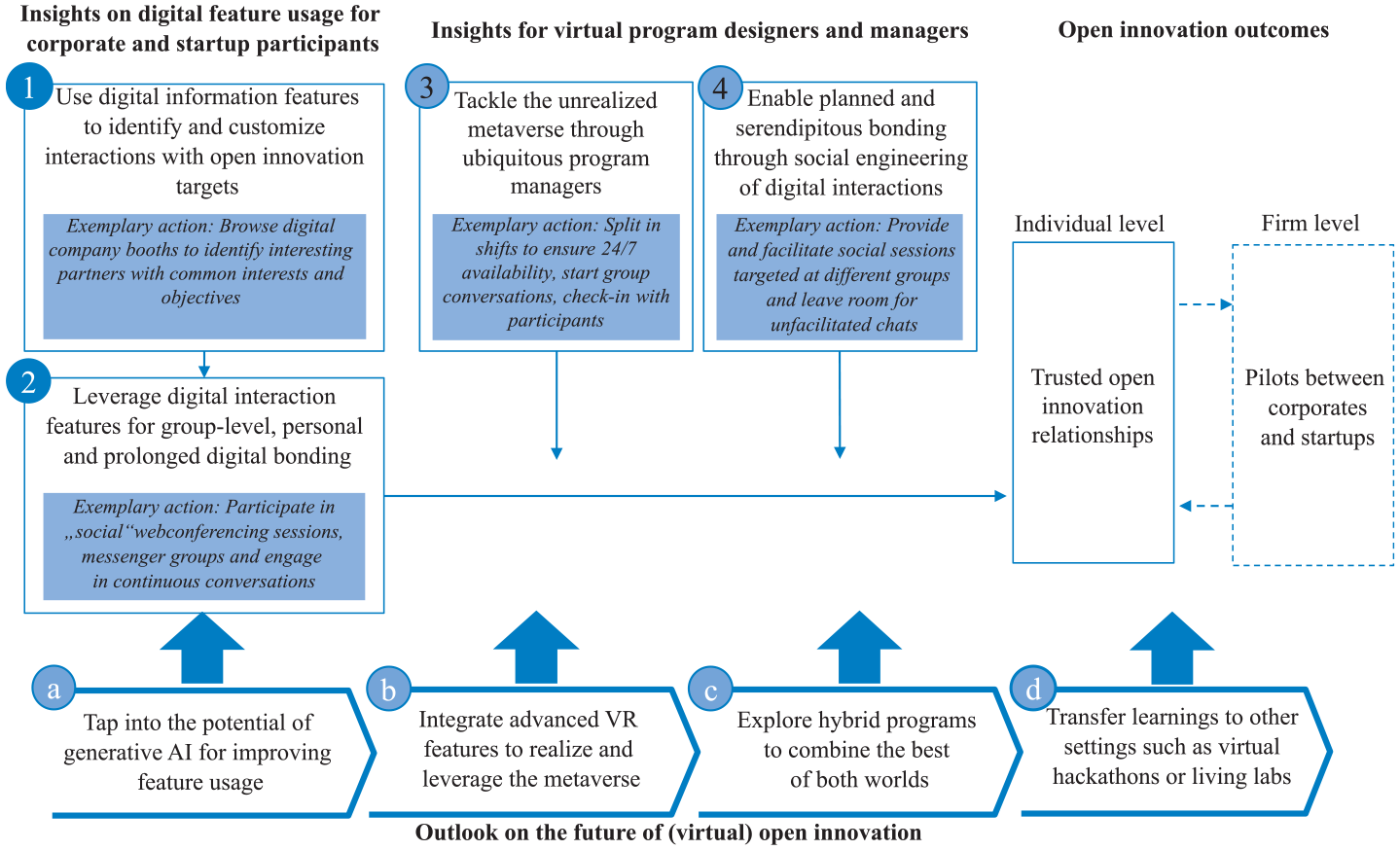
A framework and outlook for virtual corporate-startup collaboration.
Implications for Managers’ Use of Digital Features in Virtual Programs
Our framework provides implications for managers’ strategic use of digital features in virtual collaboration programs. Importantly, our findings suggest that simply using a feature does not automatically relate to increased trust and reciprocity. Instead, it requires dedicated practices of using and combining different features. Thus, managers are advised to leverage digital information features (such as company booths) to identify and customize interactions with OI targets, as well as digital interaction features (such as direct messaging and web conferencing) not only for “business talk” but also for group-level, intimate, and prolonged digital bonding.
Use Digital Information Features (e.g., Digital Booths) to Identify and Customize Interactions with OI Targets—Using digital information features, such as virtual company booths, operates as a first step to relationship building. While managers are often overwhelmed with the information available in virtual environments, our findings are an important reminder for managers to systematically scan and use the digitally available information. Combined with digital interaction features (e.g., direct messaging), they can increase the likelihood of fruitful and trusted relationships. Information from online booths can be used to identify and contact OI targets that are likely to be suitable pilot partners. Thus, managers using digital information features in virtual programs are less likely to “waste” time chasing unsuitable targets. Managers can then use the acquired information to customize their messages to potential OI targets. This increases the likelihood of starting new relationships on the right foundation.
Leverage Digital Interaction Features for Group-Level, Intimate, and Prolonged Digital Bonding—In contrast to co-located programs,50-52 participants in virtual programs always face distractions from their home environments and daily operations. Accordingly, they might often prioritize other things over using digital interaction features for digital bonding and only resort to “transactional business talk” on these features. However, digital interaction features, such as direct messaging applications and bilateral/multilateral web conferencing, are at the core of developing trusted OI relationships in virtual corporate-startup programs. Using them also for personal conversations enables a group-level, intimate, and prolonged experience of digital bonding between participants. The trust developed through digital bonding can help managers in initial pilot discussions when they need to exchange strategically relevant knowledge, often without relying on contractual frameworks. As indicated by our exploratory findings leveraging digital features for building trusted relationships can translate into tangible benefits at the firm level, such as commercial pilots.
Implications for the Design and Management of Virtual Corporate-Startup Programs
Our framework extends prior work on designing and managing corporate-startup programs 53 by explicating practices for how program managers can address functional and social barriers to building trusted OI relationships in virtual programs. Depending on whether a program is run in-house or is powered by external accelerators, 54 these design implications are relevant for corporate managers as well as for third-party accelerators who may operate as intermediaries and offer their services for running virtual programs.
Tackling the Unrealized Metaverse through Ubiquitous Program Managers—While digital features have improved affordances to mimic physical interactions, functional barriers can limit these affordances. For instance, individuals might be able to see other participants when they enter different rooms in a virtual environment. Yet, options for approaching them directly might be limited and not go as smoothly as in an in-person setting. So far, virtual environments are often still an unrealized metaverse that lacks, for instance, features with VR technology. Accordingly, design flaws in digital features and limitations in non-verbal communication operate as potential barriers to trusted OI relationships in virtual environments. Program managers should be aware of these limitations and avoid raising expectations about the metaverse. Importantly, our framework suggests that these barriers can be addressed by ubiquitous program managers. For example, different time zones require program managers to always be available and deal with potential exhaustion and scheduling tensions. By being ubiquitous, they can constantly infuse energy into the digital interactions between participants, motivating them to leverage digital features and mitigating their potential frustrations with the unrealized metaverse. Importantly, setting up ubiquitous program management requires significant resources and an entire team of program managers.
Enabling Planned and Serendipitous Bonding through Adaptive Social Engineering of Digital Interactions—In addition to functional barriers, our findings outline social barriers that constrain digital bonding and trusted OI relationships in virtual corporate-startup programs: the digital onlooker effect and the lack of serendipitous interactions. While these social barriers might, to some extent, also be present in co-located settings,55,56 our findings suggest that new barriers emerge and are intensified because of the digital nature of interactions. For instance, compared with co-located onlookers, “digital onlookers” can be present with a turned-off camera in web conferencing, increasing the discomfort of being watched and listened to. Program managers need to be aware of these social barriers. Importantly, our findings suggest that program managers can tackle these barriers through adaptive social engineering of digital interactions. They are advised to plan useful interaction settings, sense emerging barriers, and adapt their planning accordingly while leaving room for some digital serendipity. Skilled program managers can be crucial for facilitating the digital bonding between corporate and startup managers, especially in virtual programs. Organizations should thus consider making sufficient resources available for hiring a team of trained and experienced online facilitators equipped with skills to engineer virtual interactions and the passion for infusing energy into a virtual corporate-startup program.
In sum, our framework paints a picture of how trusted OI relationships between individual representatives of corporates and startups can be established in a virtual environment that lacks in-person interaction in a physical space. Our work and the resulting framework and recommendations are, of course, subject to some limitations. First, we examine one specific case of an OI program in the energy industry and draw from a rather small sample size in our quantitative analysis. Thus, findings might be less generalizable to other industries and other program forms. Second, while the program participants had already deliberated about going virtual, the final decision to move the entire program to a virtual environment was forced by travel restrictions related to the COVID-19 pandemic. This left limited time for planning and designing features. Our qualitative findings already point to the important role of the quality of features for unlocking trusted OI relationships. Future research thus needs to dive deeper into this, for example, by comparing programs with features of varying quality and by investigating larger samples of different virtual programs and digital features. Third, the program did not include state-of-the-art metaverse technologies (e.g., VR). We can thus only speculate on these more advanced technologies in our outlook. Relatedly, we do not have data that allow us to compare physical with virtual programs. Thus, we cannot make an evidence-based recommendation on implementing virtual rather than physical programs or vice versa. Finally, given that our findings highlight the role of program management, future research needs to further uncover and systematically compare how such program management can be best delivered in-house or via a specialized intermediary. This would expand prior work that has begun to map the complementary activities that intermediaries may provide. 57
Still, the program at hand and other anecdotal evidence (see examples in our introduction) suggest that virtual programs are an increasingly relevant form of corporate-startup collaboration. Compared with physical programs, they offer multiple benefits, such as options for including more participants, expansion to other geographies and industries, and lower costs and emissions for air travel. Given these potential advantages, managers are likely to increasingly consider moving corporate-startup collaboration to virtual environments. Despite the abovementioned limitations, we think that based on our study, we can provide useful insights for those managers.
An Outlook on the Future of Virtual OI
We provide four “outlooks” with preliminary recommendations for managers on how to embrace virtual corporate-startup collaboration in (future) times of the metaverse.
Outlook 1: Tap into the Potential of Generative AI for Improving Feature Usage—Generative AI, including large language models (e.g., ChatGPT), has recently emerged as a crucial driver of creativity and innovation. 58 In the future, designers and managers of corporate-startup programs should thus explore the integration of these features. Company booths, for instance, could be extended with AI-based chat options that are trained with company data (i.e., transfer learning). As such, managers could better extract information from the booth and thus enhance their abilities to identify OI targets upfront. Similarly, direct messaging applications could leverage generative AI to provide in-app suggestions for customizing first messages to potential OI targets.
Outlook 2: Integrate Advanced VR Technology to Realize and Leverage the Metaverse—We identified limitations of the (unrealized) metaverse as one of the barriers to building trusted relationships in virtual environments. While individuals in the program at hand had access to a wide range of features and a virtual environment that mimics a physical venue, participants did not have access to VR technology, an important element of the metaverse. 59 With the recent focus on metaverse technologies by Meta and the launch of Apple’s Vision Pro glasses, VR technology offers new affordances with ample opportunities for novel experiences of digital bonding. 3D immersion would allow representatives of startups and corporates to, for instance, realize and implement technology demos of solutions in virtual environments by jointly “walking through” VR demos. The piloting process between corporates and startups could thus be further facilitated by the evolving digital bonding affordance of VR technology.
Outlook 3: Explore Hybrid Programs to Combine the Best of Both Worlds—As other work practices seem to move toward hybrid formats, 60 future management research and practice should consider how to best combine physical and virtual elements of corporate-startups programs. For instance, a program design alternating between virtual and physical elements could be most beneficial. In virtual pitch events, more startups from dispersed geographic locations could be invited to give a first pitch to the corporate managers. In other phases of the program, co-location can help to overcome social barriers and enhance relationship building for a smaller “core group” of managers (e.g., startup CEOs and corporate innovation managers).
Outlook 4: Transfer Learnings to Other Settings Such as Virtual Hackathons or Living Labs—We derive our findings from the specific context of corporate-startup programs. However, companies—including corporates and startups—often engage in multiple forms of OI. While some forms of OI (e.g., crowdsourcing, online communities, open source) are digital-native, born-physical OI settings such as hackathons or living labs might also become increasingly virtual. 61 Managers could leverage the presented insights for nurturing trusted relationships in other forms of born-physical OI settings, including virtual hackathons or living labs. Participants might, for instance, enjoy participating in metaverse hackathons or living labs where they can use VR technology to brainstorm and present demo solutions. While trusted relationships might be less important in these settings compared with corporate-startup programs, they are still likely to be an important enabler of team-level performance and innovation.
To conclude, this study suggests that when born-physical OI modes move to (preliminary forms of) the metaverse, leveraging digital features and program management can be the key to successfully developing trust and implementing pilots between corporates and startups.
Footnotes
Acknowledgements
The author(s) would like to thank Stephen Comello for his invaluable guidance, input, and support in this research project. We are also grateful for the friendly reviews by Chris Tucci and our colleagues at the University of St.Gallen and Vrije Universiteit Amsterdam. We are also thankful for the time and insights that our industry partners and interviewees offered to us. Finally, we want to thank the editor, Marcus Holgersson, and three anonymous reviewers for their valuable feedback and guidance.
Declaration of Conflicting Interests
The author(s) declared no potential conflicts of interest with respect to the research, authorship, and/or publication of this article.
Funding
The author(s) disclosed receipt of the following financial support for the research, authorship, and/or publication of this article: This research was funded by a research grant of the Swiss National Science Foundation under the National Research Program 77 on Digital Transformation with the Grant Number: 407740_187381.
Notes
Author Biographies
Lukas Falcke is an Assistant Professor at the KIN Center for Digital Innovation at the School of Business and Economics, Vrije Universiteit Amsterdam, and a Visiting Assistant Professor at the Centre for Digital Transformation, Department of Management and Entrepreneurship, Imperial College Business School, London (email:
Ann-Kristin Zobel is an Associate Professor of Management at the Institute of Management and Strategy at the School of Management, University of St.Gallen (email: