



Abstract
Open Innovation (OI) has become a key part of corporate strategy, and many firms have adopted dedicated organizational functions to leverage OI. However, current literature lacks insights into how firms deploy such functions and what they do. To address this issue, this article provides insights from interviews with senior managers in dedicated OI functions in 20 different firms. The findings reveal three ways that firms can employ these functions and the key practices for which they are responsible. Finally, dedicated OI functions can change over time as the firms’ OI capabilities mature.
Open Innovation (OI) has journeyed far beyond the realm of management buzzwords, proving itself as an essential strategic tool for long-term corporate survival and success. What began as a niche concept has now become a cornerstone of corporate strategy, embraced by scholars, industry leaders, and policymakers alike. 1 The key idea of OI is to combine external and internal knowledge flows for better innovation outcomes, which can include, for example, increased innovation performance, access to new capabilities and know-how, shared innovation costs and risks, reduced time-to-market, and increased creativity. 2 However, as companies invest and dive into OI, they often face challenges and hurdles when it comes time to implement OI and turn the idea into action. 3 For example, typical OI roadblocks include developing dynamic capabilities, 4 creating strategic fit with the organization’s business models, 5 translating internal projects outside organizational boundaries, 6 incorporating external knowledge, 7 and building meaningful networks and ecosystems with external partners. 8
To address these issues, many companies, such as Procter & Gamble, Unilever, L’Oréal, Henkel, Bayer, Enel, Clorox, and BMW, have assembled dedicated OI units and formalized OI teams, 9 giving rise to a new breed of OI specialists. 10 This trend is also visible in the rapidly growing number of OI-related job postings and positions on platforms like LinkedIn, where firms are increasingly seeking experienced professionals who could help them implement, manage, and leverage OI. 11 However, despite the increasing interest and buzz around dedicated OI functions, prior research lacks insights into how firms assemble and deploy them, what they do, and how they evolve over time.
For example, while contemporary OI research has noted that leading firms have begun to employ specific innovation units to manage OI, 12 it has not unpacked these structures, their governance modes, and implications for OI in detail. Furthermore, prior research has focused mostly on relatively informal or narrow OI specialist roles and practices while shedding less light on the broader organizational roles and practices of more formalized OI professionals, as per job title or job function. These are important gaps since, without a better understanding of how to leverage and manage dedicated OI functions, it is challenging for firms to move beyond the “traditionalist” view where OI is confined to R&D units and instead considers more strategic approaches where OI is instilled in the broader organizational DNA. 13
Therefore, to address this gap, we draw empirical insights from an extensive multiple case study and interviews with senior managers in formalized OI functions in 20 different large firms across a wide range of industries.
Background
In the literature, OI is formally conceptualized as a “distributed innovation process based on purposively managed knowledge flows across organizational boundaries, using pecuniary and non-pecuniary mechanisms in line with the organization’s business model.” 14 This has been traditionally divided into outside-in and inside-out, and more recently, outside-out and inside-in forms of OI, which offer different strategic pathways for leveraging and monetizing external and internal knowledge sources. 15
While it is widely understood that OI can lead to improved innovation and performance outcomes, managing this process is usually a challenging task. 16 There is a large body of literature that has considered different organizational challenges to OI, and they are often considered from an internal or external perspective. For example, internal challenges typically include issues such as cultural realignment, strategic or business model fit, not-invented-here syndrome, organizational inertia, internal rivalry, and capability development. 17 In turn, external challenges typically include issues such as how to identify and incorporate knowledge flows from outside organizational boundaries, manage external partners and other stakeholders, and build broader innovation networks and ecosystems. 18
To address these challenges, companies usually need to change their traditional organizational structures and knowledge creation and integration models, 19 establish new governance models to manage OI activities, 20 and shift the corporate mindset. 21 Previous studies have illustrated several ways in which companies can change or transform their operations to manage and leverage OI. 22 These approaches cover areas such as how firms can open up and transition from a closed to OI strategy; 23 leverage inbound and/or outbound innovation; 24 and collaborate with internal business units, 25 intermediaries, 26 or external stakeholders. 27
Companies can adopt one or more of these approaches simultaneously, and sometimes, more decentralized OI activities can evolve into a more systematic and formally managed OI approach over time as organizational maturity in OI increases. 28 However, high levels of formalization do not always positively influence all forms of OI. 29 Therefore, companies should strategically choose to centralize or decentralize OI activities, depending on the form of OI they want to pursue. 30
At the same time, previous studies have also examined individual-level approaches to OI. This research has highlighted different roles that individuals can adopt in an OI environment, such as idea scouts and connectors, 31 change agents, 32 integration experts, 33 gatekeepers and shepherds, 34 or facilitators, tacticians, and sensegivers. 35 However, these studies usually focus on R&D professionals and/or general managers who do OI activities informally on top of their formal roles but not on formalized OI professionals with specific responsibilities. This has two key limitations. First, informal roles often emerge as a response to specific situations and are thus not formally recognized or have explicit organizational expectations. 36 This makes it also difficult to include them as a part of the selection, performance, and reward systems and as a basis for systematic organizational capability development. 37 Second, most previous studies on informal OI roles consider only a few selected roles 38 or specific collaboration contexts, 39 which provides limited insights into their broader organizational applicability. However, what is still missing from the literature is a deeper empirical analysis of how firms use dedicated OI functions that employ formalized OI professionals.
Methodology
Given that employing dedicated OI functions is an emerging but underexplored management practice, 40 we adopted an abductive and qualitative multiple-case research strategy. 41 This allows us to explore the full range of roles and practices that dedicated OI functions are responsible for in different industries and compare empirical insights with existing literature, thus improving the generalizability of the findings.
We used theoretical sampling logic to identify firms that employed dedicated OI functions and/or formal OI professionals while excluding third parties who operated as OI consultants or intermediaries and resided outside focal organizations. To increase the diversity of our sample and gain rich insights from different contexts, we selected firms that operated in different industries and in both consumer and business-to-business markets. Our final sample includes 20 different firms, and an overview of the sample is described in Table 1.
Overview of the Firms and Respondents in the Study.
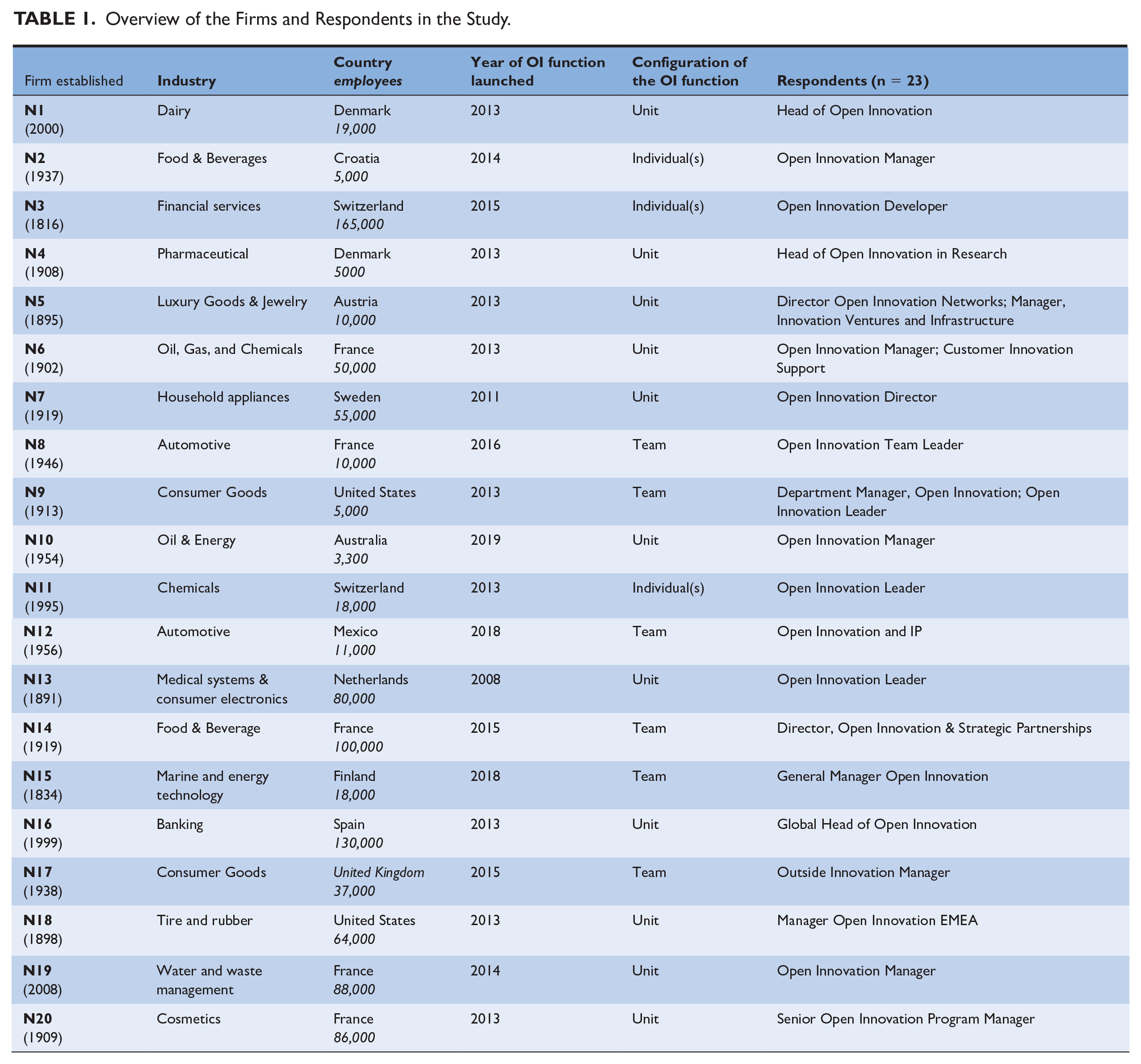
To collect our primary data, we followed an elite informant protocol, which relies on interviewing experienced “key decision makers who have extensive and exclusive information and the ability to influence important firm outcomes.” 42 Thus, we conducted expert interviews with 23 experienced senior managers who held key leadership positions in dedicated OI units (such as the Head of an Open Innovation unit or Open Innovation Manager/Director/Leader) and had the power to shape their firm’s (open) innovation strategy.
We analyzed the data by using an abductive coding approach whereby first-order codes are derived from the data, and second-order categories are developed in conjunction with existing literature. Our analysis focused on exploring: the organizational configuration (composition and location in the organizational chart); roles, practices, and objectives; and key advantages and challenges of dedicated OI functions and formalized OI professionals. This approach was informed by earlier literature, 43 which suggests that specialist resources can be organized around different organizational configurations and that different configurations involve specific activities, goals, and trade-offs. We triangulated the insights from the interviews data with a large set of secondary data such as internal company materials (presentations on OI strategy and newsletters), external announcements, and other publicly available documents (e.g., websites, podcasts, news articles, and information on LinkedIn profiles of OI professionals).
Leveraging OI Professionals as Individuals, Teams, or Units
Following our sampling criteria, all the firms in this study employed formal OI professionals or dedicated OI functions. Apart from one early OI adopter that formed the OI function in 2008 (i.e., shortly after the OI paradigm was introduced), most companies in our sample had formed OI functions in the last 5 to 10 years. These functions are formalized structures within companies that are responsible for managing and executing OI activities. They have their own strategic goals, accountability rules, and resources and are usually tasked with identifying and collaborating with external partners, such as startups, universities, research centers, and other companies, bringing external knowledge to the organization and developing new products, services, or business models. However, it became quickly apparent from the data that firms employed these dedicated organizational structures in different ways, depending on their specific organizational goals and resources. As the Head of Open Innovation from N1 explained, When people talk about open innovation, they believe in one single type that fits everyone, but when you go down to the nitty gritty, not all companies are the same, and within the companies, there are different areas that do open innovation in different ways and need different results. (N1)
Our analysis indicates that while the exact configuration and scope of dedicated OI functions differed across the companies, three distinct approaches were apparent from the data:
individual OI professionals within existing organizational units;
team of OI professionals within existing organizational units; and
OI professionals in separate and centralized organizational units
First, some firms employed formal OI professionals in individual roles. For example, N2 employed only one Open Innovation Manager at the corporate level, reporting directly to the CEO, and N11 had just one dedicated OI Manager, who is part of a larger Innovation Excellence and Incubation team. The key advantage of individual roles is that they are usually the least costly and resource-intensive to implement and relatively easy to integrate into existing organizational structures. However, their main disadvantage is that the influence, reach, and resources of a few key individuals are often limited and can hinder the scope and impacts of innovation efforts. This means that individual OI roles are often most suitable for facilitating incremental innovations closer to the organization’s core strategy: In open innovation, there’s only one person. That’s only me . . . If we have a challenge from a business unit and they want to look for an idea, scout for the idea, and then slowly move it into the market, we will always submit an open innovation proposal to the project team . . . I facilitate the project, but I only manage the open innovation component of it. And then my colleagues from the other group, like the innovation excellence, I call it the innovation police. Or the I garage group and expertise from the different business units will come together to support me . . . Our aim is to have one OI support for each business unit in the future. (N11) But we were doing open innovation quite for a while before, just with much lower manpower, so it was my colleague doing it alone, the screening and starting of start-ups and all this transformation work with a colleague, so they were only two people, and of course they could not do huge innovation projects, and they also did not have quite that huge budget as we do right now. (N3)
Second, some firms had OI teams that were embedded in other functions, such as R&D, marketing, or corporate ventures. Their role was often supportive and subordinate to the host function and focused on specific areas of OI. For example, in N15, the OI team was placed in the digital transformation team, and in N17, the OI team was placed under the R&D department but worked closely together with the marketing department. The key advantage of OI teams that are embedded in other functions is that they already have more buy-in and support from the host function and face, thus, less internal resistance. At the same time, their main disadvantage is that they have limited independence and resources, and any expenditure or investment they want to make is always out of the host functions’ own budget. This means that team-based OI roles often have the potential to facilitate more radical innovations that can occur both in the core or non-core areas of the organization’s strategy: We formed a transformational team from different departments. It includes strategic planning, quality, HR, procurement, of course, R&I, and marketing, all the people who are touching the innovation path . . . it cannot be just run through one central team, or in this case, it will be special projects which are around for very high-level individuals with our organization. If we were looking at the global region, it needs to go through the embedded teams with local champions who have the same philosophy. But again, we believe that there is this sort of underlying structure that can be adapted basically to any geography. (N14) My team does not have a budget. The R&D team as a whole, especially the two brands, every brand gets a certain amount of money that they look to spend on certain new product development throughout the course of the year. The open innovation team within the [name] business unit actually doesn’t have money allocated to us. We request certain things like tools, and if we need an outside consultant or something like that to take out of the R&D budget, and it’s usually granted. But then, when it comes to forming a partnership or a proof of concept, we need to fight for that budget. We need to sell internally to showcase that it’s a valuable partnership to move forward with. And then that’s where I need to find different stakeholders within R&D to put their budget behind the partnership. Sometimes, that’s with R&D; sometimes, that’s with marketing; sometimes, that’s with the corporate venture arm. So, really, it’s a challenge. (N17)
Third, some firms had centralized OI units, departments, or corporate functions that had their own autonomy, resources, and budget and were independently responsible for spearheading the OI activities in their companies. For example, N5 had a special OI Network unit, and N18 and N20 had dedicated OI departments.
44
The key advantage of centralized OI units is that they have the most resources and legitimacy to drive organizational-wide change and develop new OI initiatives. However, their main disadvantage is that they are often very costly and resource-intensive to implement, and since they are a separate organizational unit, they can face internal resistance from other organizational units. This means that dedicated OI units often have the potential to facilitate more explorative and transformational innovations that are further from the organization’s current core operations and focused on building innovation capabilities that are needed to compete in future markets: We are an independent department with resources split half-half in between [location] and [HQ] . . . We are ten persons with quite a separate geographical area of operation . . . a small but ubiquitous and dynamic organization that will help in sizing opportunities coming from the external world . . . it is a central group coordinating all these OI activities. (N18) The moment that there’s a central function, you’re scouting for solutions, and you find solutions which are potentially relevant and fit within the [company]’s scope. You still need a team to work on these solutions, and that team typically comes from one of the business teams, so that means that as a central function, you need to bring that solution to a business team. And that team will not automatically embrace the solution that you, as a central team, have found. It’s a form of Not Invented Here, which is partly the classical Not Invented Here Syndrome, in terms of, “This is new. Who says that I should work on this?” Whereas an open innovation function, you go through the whole journey. You know why this solution is interesting. If you push that to a business team, it’s new for them. You will automatically get some pushback. (N13)
Typology of OI Professionals’ Key Practices
After establishing the three dominant organizational structures that firms in our sample used to leverage OI professionals, we examined the key practices for which they were responsible. As OI professionals can be employed in various organizational configurations, their specific roles and practices can vary considerably, depending on the specific industry and organizational context.
However, based on data analysis, we were able to aggregate different practices depending on two dimensions: the focus of the OI professional’s role; and the primary stakeholders they engaged with. The former dimension describes whether OI professionals are (primarily) focused on developing structures or influencing actors that enable the organization to leverage OI. Structures include strategies, processes, and systems, and they are usually considered the “hard” and more formal aspects of OI management. Influencing actors involves educating, building relationships with, and convincing key stakeholders, and these are usually considered the “soft” and more people-centric aspects of OI management. The latter dimension describes whether OI professionals engage with internal or external stakeholders. These dimensions are in line with prior literature, which suggests that OI change agents’ key tasks require them to navigate between “hard” (structural, processual) and “soft” (relationships, trust, expectations) aspects of OI 45 and engage with both internal and external stakeholders. 46
Based on these dimensions, we derive a typology that describes four “archetypical” practices that OI professionals are usually responsible for: Operational Development, Internal Championing, External Scouting, and Ecosystem Orchestration (see Figure 1). This typology helps to explain what dedicated OI professionals do and with which primary stakeholders.
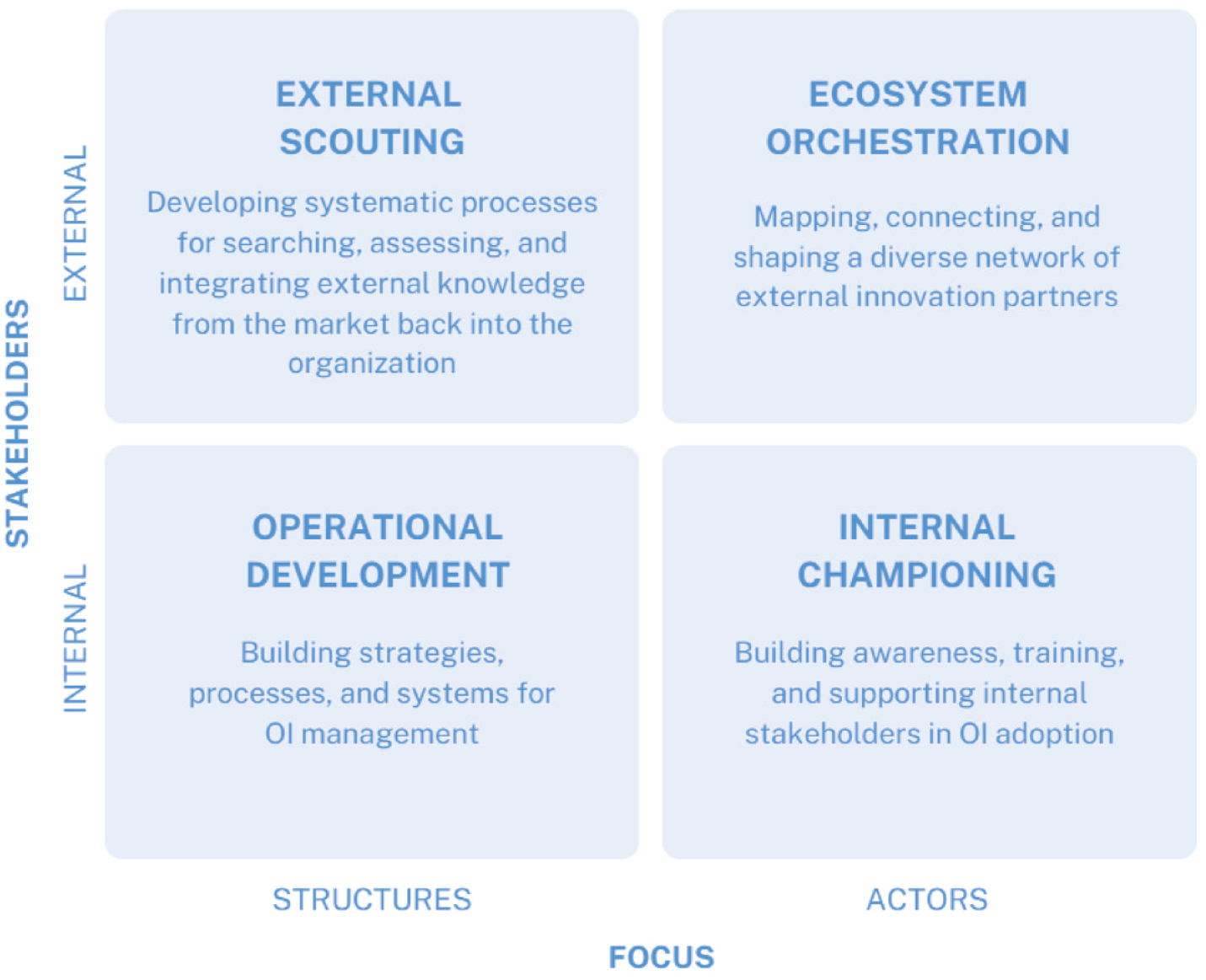
Typology of OI professionals’ key practices.
Operational Development
Operational Development is focused on building strategies, processes, and knowledge management systems that enable the deployment and usage of OI in the organization. This is usually the first and most critical practice, especially during the early stages of OI adoption. Many OI professionals explained that it was imperative to build internal capabilities before they could start thinking about leveraging external partners or knowledge flows: The first one [task] is building internal capacities for accepting the knowledge from the outside world. The second major point is to build capacities to bring knowledge from the outside world into the company. The company cannot accept the knowledge if it’s not capable of doing so . . . You must build it before you go beyond the border. (N3)
Strategy development for OI involves formulating clear guidelines, objectives, and goals for leveraging external ideas, technologies, and collaborations. In many cases, OI professionals had relatively free reign to develop or shape their OI strategy as long as it was aligned with the organization’s broader strategic vision: We received the topic of open innovation as a mandate with kind of the parameters of go find new partners for technology innovation. We were really kind of thrown into cold water and set your goal, build up your network, and focus on technology innovation. So that was how it started, and even our budget was strategic and exploratory. So, we were looked at from kind of day one as, okay, if we’re going to put together some sort of formula structure to approach breakthrough and radical innovation, then open innovation should be the correct approach. (N5)
While the OI strategy outlines what to do and with whom, OI professionals were also responsible for developing organizational processes that help to operationalize the OI strategy in practice. Several interviewed OI professionals explained that they used existing frameworks, such as the “Want, Find, Get, Manage” Model,
47
and often experimented with and iterated different models to make them fit into their context. For example, the role of the OI unit in N3 was to develop processes that could help their company “do innovation in an open, faster, leaner and more agile way than before” by focusing on explorative initiatives, and they had developed their OI processes based on the lean startup approach. Another OI professional, who had prior experience from Unilever (who had adopted the “Want-Find-Get-Manage” model in the early 2000s) explained that “We are focusing our interactions on a number of open innovation models or testing open innovation models, instead of following the frameworks that have worked in other companies.” As the respondents explained, OI strategy is the technical part of how to get knowledge from external sources for the company . . . We also created a rule book for innovation, so it’s not a strategy, but it is a formal institutional way of dealing with innovation, to have a rule book that would deal with the incentivizing and organizational governance or management of innovation for the company level . . . I’ve gone beyond strategy to a more detailed way of approaching the innovation . . . It was defined through an action plan . . . which was operationalized and institutionalized through a rule book and process that is applied right now on the company level. (N2) We decided to create something that we call our open innovation playbook, that supports individuals and businesses in engaging in open innovation. So, it starts with how I find the right partners to work with. How do I make sure that we have the right mindset and values and go into using service design for ideation, concept creation, et cetera? It’s supporting the organization, and that’s what my team is responsible for. And then, of course, we have the businesses who then actually apply that and work in the open innovation project. (N15)
Developing knowledge management systems was often related to the internal knowledge management platforms that help to collect, integrate, and share information on existing and potential external partners and their technological portfolios for internal use. Such knowledge management systems are usually implemented after the first stages of OI adoption, as they build on the inputs from external activities and on engagement with various types of partners, as well as existing collaborations across various business units: We talk about open innovation, and then the real kicker here is these new innovations happening right now, with every single partner, we have a directory structure for the documentation that we exchange, and this will now be integrated into [name of program] . . . so this does in fact to find the context of the relationship and the context of the conversation . . . it goes through the entire conversation history that we’ve had with the particular company regarding a particular topic . . . And the idea is then we’ve created a tool to support networking . . . It essentially drives internal communication and internal networking . . . which is essential to make an open innovation network operational . . . if you look at the kind of tools and processes to support open innovation . . . It’s the [name] tool, which supports the entire process from first contact to closure. (N5)
Internal Championing
Internal championing is focused on advocating, supporting, and driving an organization’s OI culture and mindset and convincing internal stakeholders about the need for and benefits of OI adoption. Many OI professionals explained that for OI to work, it is not enough just to develop the right strategies, processes, and systems; you also need to drive the cultural change that makes people adopt them and more open to external ideas and technologies. As the OI professionals explained, It was also kind of back and forth with the hiccups relating to that building formalized or having some kind of internal practices and working within changing the internal culture and building different platforms for knowledge management, and also building the innovation ecosystems . . . which is a quite interesting setup, but it does make sense because a lot of what we do, it’s around enabling and empowering people, ensuring that everyone can be part of innovation, that there is an innovation culture in the organization, that we have the right towards processes, et cetera in place so that people in the businesses are able to innovate. (N15) It was really an innovation evangelization role . . . instead of Proudly Invented Here to Proudly Found Elsewhere, so basically, it was a lot of work of changing people mindset. (N18)
Awareness building is usually the first step of internal championing, and it centers on informing and educating internal stakeholders about the principles, benefits, and processes associated with OI. This can be done via multiple communication channels, such as internal newsletters, blogs, company websites, and digital platforms, or by organizing internal events and workshops. For example, many of the interviewed firms organized specific innovation days for employees (N1-4, N16), cross-functional innovation workshops, or “OI awareness events” (N3): We have done a little bit of internal promotion. It is up to us to bring it up in the newsletters or on our website, and it can’t go in the general statement if no one knows you. And that is one thing that I realize it’s very important to make OI work. In reality, you need to have good external communication, but you also need to have good internal communication. I spent more energy on external promotion, and then I looked internally. We must make those bridges happen. If you are really good at making this commitment outside, it’s going to stop at you if you haven’t done the internal process well, internal awareness. Also, for internal promotion, we use other people in our company to brand the OI platform, which is needed, otherwise no one knows about this platform. (N4)
After building awareness about OI, the next step was often deploying more systematic internal training to equip internal stakeholders with the knowledge and skills to conduct and integrate OI activities into their own business processes. This included usually building OI excellence by documenting the best practices in different OI initiatives, sharing lessons learned, and designing and delivering training programs for employees on how to search for external ideas and engage with and manage external networks: What we did, in the beginning, was a growth of innovation training, and then I did a little training and events with teams to explain better crowdsourcing and open innovation. (N12) We have a ton of team meetings where we share best practices, where we help each other out and say, “Hey, I have a challenge here. Help me out.” We have quarterly team skill-building sessions. We do a lot of going out and finding new ideas about innovation. (N5)
Finally, many OI professionals used community building as a means to support and drive OI in their organizations. This included, for example, forming OI Communities of Practice (N13) or OI “clubs” (N2) that include honorary members or assigning informal roles and titles to other employees, such as OI champions or OI Ambassador (used in N4, N5, N7, and N18). The engagement and integration of other employees in internal OI communities help to cultivate a shared mindset, organizational culture, and a common mission among the members, which is then easier to spread to other employees and business units in the organization. As one OI manager explained, We label them as honorable members of the Open Innovation Club (. . .) They have the title of innovators . . . They are members of the Open Innovation Club. They gather around in the innovation club and disseminate the idea in their own business units. Up until now, we have had more than 150 members registered . . . They have their own meetings. They bring new ideas to the table. They communicate it back to their own business units, et cetera. They even bring some non-members, just to show how cool it is to be a member of an open innovation club . . . The members are the members, regardless of their formal position within the organization. Are they workers, or are they managers? It doesn’t matter. They are gathering around the idea of open innovation. (N2) Over the last two years, we’ve created an open innovation ambassador program within [N7] to create some expertise on open innovation processes, mechanisms, and methodology. That helps reinforce the connection between my team and the departments that are our stakeholders. We now have more than 100 ambassadors, and they can manage challenges on their own. (Company N7 Website)
External Scouting
External scouting is focused on developing systematic processes for searching, assessing, and integrating external expertise, knowledge, and technologies from diverse sources in the market back into the organization. Many of the interviewed OI professionals explained that it was their responsibility to scope what knowledge their organization needed and then develop the means to access, attract, and leverage that knowledge from the external market: At that time, we simply had a vision that we have to look outside or start looking at research and development research from other companies. So, we went completely across industries because we have this customer growth already, we said we wanted to go across industries, and we want to cross-fertilize, and my role was to communicate the search fields, what we are looking for, to go outside, go to conferences, go to networks, and let us say transform. (N5)
A key part of external scouting is searching for external technologies, innovations, and ideas that have the potential to impact the organization’s business positively. This included proactively scanning the external environment—including the broader industry landscape, startup ecosystem, research institutions, and other relevant sources—to discover novel and valuable innovations. However, many OI professionals also explained that it was often challenging to look for external expertise and knowledge if the potential external stakeholders were not aware of their needs in the first place. Therefore, the search process often involved also opening up their own organizational processes and letting the market know about their innovation needs and capabilities. This was usually done by networking and attending industry and academic events, employing innovation contests and challenges, or leveraging internal or intermediary platforms that match external expertise with specific innovation needs or objectives: Our mandate was more kind of this cross-industry perspective, talk with partners from other industries and see if there’s something that we can immediately bring into our pipeline. And, of course, it was technology-focused . . . let’s say, interpret or kind of transform the technology into some applications that make sense for our business. (N5) No one will use an open door if no one knows that it exists. So, if you open up the process and you have a good innovation platform in the company, and no one knows about it, nothing will happen. You need to promote it—attend conferences, write papers, network—to make it happen. (N4) Crowdsourcing platforms are an excellent source of getting very rapid and low-cost solutions. You need to frame your problem well and you need to choose your particular platform specifically for the nature of the problem that you have. You need to understand how you’re going to take that solution forward and build it into something in the future. But in terms of accessing a very large amount of talent and getting quite a lot of testing and value for free, it’s a really good option. (N10)
OI professionals were also usually responsible for assessing external opportunities. This was often a complex and time-consuming process, requiring a deep understanding of both the technology and the potential partner. The OI professionals explained that they had to be able to evaluate many diverse external ideas, technologies, or innovations to identify those that were suitable and had the highest potential to be used in their organizations. Sometimes, this included just technology testing before passing the potential product or technology to the R&D department for further validation; and at other times, this could include a more full-scale business case analysis, partner testing, and customer prototyping: I’m like a first gate for those startups; we test the technology, and if we see the technology fits our needs, then I pass the opportunity to other colleagues so they can make an investment, or they can establish a partnership. (N9) If someone in a totally different department has an idea which is not core business and is not actually their job, they can come to us and get in the normal process so we stream an idea, it can be anything from a customer, from start-up, from an entrepreneur, from intrapreneurs, from an external university, whatever. We screen it internally . . . We evaluate the idea. We do a business case around it, we try to evaluate the potential, we speak to post-customers, and then we do a board pitch . . . And then, we can go to the next stage and do customer laps or . . . do a prototype and test this prototype. (N3) You have to do some work to validate what capability those external partners have, and that takes some time . . . it’s not like you can just rate them, there are not some key indicators that will tell you that they’re going to be the right group and you’re going to get a good outcome. It’s really about establishing a common understanding and doing the due diligence to understand that they’re going to be the right group. And that takes some time. And because it’s a new field, that’s an ongoing effort. (N10)
Finally, it was usually the OI professional’s responsibility to facilitate the integration of external knowledge and technology back into their organizations. This often involved finding suitable collaboration and knowledge-sharing modes that align with and support operational and cultural integration, as well as developing complex contractual and legal arrangements that sufficiently protect each partner’s intellectual property: Once my team finds a company to work with, ultimately, we have to make a deal with that company to partner with them, whether that’s a joint development agreement, whether that’s a licensing deal, whether that’s a simple procurement deal because they’re a supplier, or it’s even an investment . . . if we were looking to pilot or integrate the actual technology or innovation back into our product line to develop new products, then the deal looks like from an R&D standpoint, how do we do a joint development agreement or licensing deal? My team can handle that . . . (N17)
Ecosystem Orchestration
Ecosystem orchestration is focused on mapping, connecting, and shaping a diverse network of external partners that can range from customers, suppliers, and supply chain partners to research institutions, policymakers, and startups in different industries. This was often considered the most advanced practice and critical, especially in the later stages of OI adoption. Many OI professionals explained that tapping into their ecosystem partners was imperative if they wanted to unlock radical innovations and novel breakthrough solutions: The challenges we face in our industries are so big that no player alone can solve them. So, we need ecosystem approaches to be able to really serve our customers and create value for our customers and societies. So, by default, through our strategies, by saying we need to work in an ecosystem and partner up with others, open innovation was a key capability that we would need to enable our organization to deliver on the strategies we set out. (N15) In our mind, open innovation is the leveraging of all the ecosystem actors, no matter what their profile is . . . connecting with the ecosystem to unlock our common problems and doing it in reciprocal mode is where we think that we can probably make a difference, and that will create new business models that are not available today to the company. (N14)
Ecosystem orchestration usually starts with ecosystem mapping, which involves identifying the key actors and their roles, existing connections, and capabilities in specific geographical and technological areas or broader knowledge and technology domains. For example, N15 focused on mapping ecosystems around sustainable societies with smart technology, N14 on FoodTech, and N5 on Glass 3D printing, as well as other technology domains based on current business needs and Horizon 3 innovation strategy: We do a fair bit of analysis looking at mapping the ecosystem for the particular field of interest and looking at the adjacent domains that could potentially solve those problems. And then, from there, we determine what kind of partnerships we would look to establish based on many different factors, including the critical mass of the capability, the ability to communicate effectively, and in some cases, the past relationships and the strength of those relationships, and the depth and breadth of reach that they have into the innovation ecosystem. (N10)
Many OI professionals explained that one of their key tasks was connecting different actors in the ecosystem. They often regarded themselves as relationship managers or network brokers whose job was to facilitate introductions and interactions between internal stakeholders and external experts with complementary needs and capabilities. This usually required very good internal and external networking skills and a broad understanding of the different business units’ needs and potential market opportunities in different fields and technology domains: The second role [of the OI unit] is developing ecosystems, connecting business units and especially R&I and, say, procurement parts of their organization with innovators around the globe . . . you would need to figure out what would be the right ecosystem to connect with, right? And that sometimes will require maybe searching or scouting, or sometimes building [it] . . . But you see this as ecosystem building. Once you figure out what ecosystem is right, you must figure out the partners. And you would need to borrow them, scout them, and test them internally within our organization. (N14) We are specialized in the external environment and . . . it’s part of the job of facilitating those interactions and being a sounding board for people who need to go externally, to access different resources externally . . . we not only influence where we partner and who we partner with, but we also influence how we partner and what sort of models we use for partnering to best get the value from those interactions. (N1) It can be like . . . finding and connecting with external experts . . . we bring in an expert who will sit with our team for a day and help us understand a new space or help us build a strategy or bring in an advisor to help us develop our concepts. It could also be taking the team out of the building to experience immersion. So go out and see what’s happening in the rest of the world . . . you might go to a technical forum or an industry organization, looking those people up, you might go online and say, who are the influencers in this space? (N9)
Finally, several OI professionals emphasized that it was not enough to map and connect to existing ecosystems; they also had to assume an active role in shaping their ecosystems. This involved envisioning different future scenarios and influencing the conditions in the market, policy, and broader society to create a more favorable environment for innovation. For example, many organizations in our sample employed open business models with venture capitalists, SMEs, and other cross-industry partners to pool resources for novel innovations, public-private partnerships with universities to facilitate scientific breakthroughs that can disrupt markets (N1), and corporate venturing initiatives and accelerator programs to support startups with technologies that could be eventually transferred to their portfolios: Connecting and figuring out how to operate and navigate in this [ecosystem] . . . We will help consult and guide it and build new connections. Because whatever we see today is the rear-view mirror vision . . . So basically, that ecosystem is available today. It serves the immediate needs. But if you really need to look at the stage three horizon, you need to continue developing ecosystem connections because new ideas will emerge. Not necessarily just in the hotspots today, but the hotspots will continue to appear . . . And that’s done through networking and connections with the other industry players. Leaders, thinkers, venture capitalists, and entrepreneurs are the tissue around the ecosystems. (N14) We tried to create the best network for the different functions in the company so that, as a whole, the company is a well-connected functioning node of many networks that bring value to the company . . . it includes, of course, the formal aspects of open innovation, of finding and incorporating technologies, but also the informal aspects of creating the network, managing the network, and tuning the network for creating the best value. (N1)
Transition Trajectories for Open Innovation Functions
Based on our analysis of the key organizational structures and practices for OI professionals, we can also identify typical transition trajectories that explain how and why the organizational structures for OI functions evolve over time.
For example, organizations with fewer OI capabilities or that were in the early stages of OI adoption usually started from individual OI roles that are often easier and less resource-intensive to implement and then gradually expanded toward more centralized, systematic, and resource-intensive structures for OI functions. This gave them time to experiment with different structures and mechanisms to find the best fit for their business, develop evidence of success that generates organizational buy-in and support for more resource investments, and change the culture and mindset within the organization: I think the role is getting bigger and bigger because businesses understand more and more the value that open innovation can provide and they are more and more looking for support, “Can you help us find the right partners? Can you help us manage our innovation funnel?” And things like that. I think it’s definitely growing . . . we also always try, as a company, to establish capabilities centrally . . . I would see that the central function will grow. (N15) The bright scenario would be that it [the OI function] will go into a certain scale. We can think about a certain percentage of R&I activities that will be done this way with the implication of external partners . . . if we can move into a double-digit percentage of the effort through open innovation, that would be fantastic . . . for me, the success would be we’re talking about double-digit effort through open innovation methods within R&I activities. (N14)
In contrast, organizations with more mature OI capabilities or that are in the later stages of OI adoption usually started from more centralized structures, with the goal of gradually moving toward more decentralized approaches and spreading the established OI capabilities back to local business units. This included two different trajectories. For example, organizations with several business units with varying levels of OI maturity often chose a Hub-and-Spoke approach, where they kept the central OI function while establishing satellite teams operating in different business units and geographical areas. In this case, the central functions still set the overall OI strategy and policy, while the local OI teams maintained the flexibility to adapt and implement OI initiatives that cater to their specific operational contexts and local market dynamics: I think right now it’s very important to be centralized because the businesses are not there yet. There are different levels of maturity and working in open innovation. They all have different needs, and they currently approach it differently . . . I think from that perspective right now, as we are still in their capability phase, it’s quite important to be centralized. (N15) We dissolved the open innovation function and created a community of practice instead of a central function. Giving the responsibility around open innovation to the individual businesses to create more skin in the game and as such, what we have seen since then is that the impact of open innovation increased, not necessarily the number of activities that we do, but the impact of it did increase . . . that’s how we change from a central function to the dissolved function, with open innovation champions. (N13)
At the same time, organizations with the most mature and systematic OI capabilities envisioned a future where the internal and external OI processes and practices are institutionalized across all organizational units, and the responsibility for conducting them can be redelegated to or embedded in the everyday roles of individual employees. Thus, in the most mature stage, OI would become a “new way of working for everyone” and a “new innovation DNA.” However, when the responsibilities for OI management become more decentralized and spread across individuals in different business units, there is always a risk that the organization might lose its explorative vision and move back to incremental innovation activities: I think in ten years, what I really hope is that my job doesn’t exist, that everyone has the skills, and the company has already ingrained the best way of working in all the operations and all the innovation processes. So, the company can teach new people who are recruited into the company how to do it, and everyone can work with these tools similar to me. There doesn’t have to be an open innovation function, but everyone does innovation, and everyone does open innovation because it’s the only way of doing innovation . . . That’s the end game. It takes some time, but once you set it up, I think it’s normal that the companies can run it and should run it on their own. (N1)
Overall, while OI capabilities and the stage of OI adoption in firms seem to be the key factors that drive the choice and evolution of the configuration for the dedicated OI functions, our analysis sheds some light on other possible reasons that might influence this decision. For example, firms with a strong organizational legacy and asset-intensive offerings usually had more difficulties implementing the change needed to leverage external knowledge and thus needed to establish more centralized OI units to drive the new OI strategy, internally and externally. In contrast, firms with less organizational heritage, service-intensive offerings, or less risk-averse cultures were usually more open to experimenting with external knowledge and thus needed less formal OI roles and teams to facilitate required organizational changes.
Conclusions and Implications
Theoretical Implications
While contemporary OI research has noted that leading firms have begun to employ specific innovation units to manage OI, 48 they have not unpacked these structures and their implications in detail. This study expands these insights by providing a new and more granular understanding of how firms can assemble and deploy dedicated OI functions and their key implications. By doing so, we offer three key contributions to the current OI literature.
First, we show how firms can employ dedicated OI functions in three different ways (as individuals, teams, or units) and describe the key advantages and challenges of each approach. This advances previous research by illustrating how firms can employ dedicated specialists to implement and manage OI 49 and what kind of organizational structures or governance modes this involves. 50 Furthermore, we show that there is not only one best or ideal organizational structure or governance mode for employing dedicated OI specialists, but three alternative approaches that have their own distinct advantages and disadvantages.
Second, we develop a typology that captures four key practices that dedicated OI functions are responsible for: Operational Development, Internal Championing, External Scouting, and Ecosystem Orchestration. This helps to integrate insights from previous studies that have focused on relatively narrow or informal OI roles and practices 51 and showcases a fuller repertoire of higher-level practices for which formalized OI specialists are responsible. In particular, the findings indicate that the role of dedicated OI functions is focused primarily on building (open) innovation capabilities and enhancing innovation performance in their organizations. Thus, their practices are mostly focused on inside-in and outside-in, and partially outside-out types of OI practices, but seldom on inside-out types of OI practices. 52 This is because the responsibility for monetizing internal knowledge and technologies (e.g., licensing out intellectual properties) is often outside the scope and mandate of the dedicated OI functions.
Finally, we show how dedicated OI functions dynamically evolve as the firms’ OI capabilities mature. While a few prior studies have considered how the broader organizational OI practices can evolve, 53 we complement and expand these insights by demonstrating how and why the structures of dedicated OI functions may change over time.
Managerial Implications
For managers, this study offers several actionable insights. First, it underscores that strategic OI management requires dedicated specialist resources and formal structures. Expecting other organizational actors, especially traditional R&D departments and innovation managers, to take care of OI is not often sufficient. Therefore, firms should invest in and establish formal roles, teams, or units that are responsible for developing, managing, and overseeing OI initiatives and processes in their organizations. This is particularly important at the early stage of OI implementation as it often announces, internally and externally, a new strategic shift and breaks free from path dependency and rigidities. 54
Second, it demonstrates the key organizational structures that leading firms use to manage OI and highlights their key advantages and challenges. Managers should carefully assess their specific needs, such as the complexity and scale of OI activities, available resources, and current OI capabilities, and select or tailor specific structures of dedicated OI functions to align with their organization’s unique characteristics and needs.
Third, it highlights the key practices for which dedicated OI functions are responsible. Managers should consider whether and to what extent these practices are already integrated into their OI strategies and develop clear guidelines and support mechanisms that empower responsible managers to carry out these practices effectively. For example, while many organizations can focus on operational development and create organizational OI strategies and processes, it is often much more challenging to conduct internal championing, external scouting, and ecosystem shaping without dedicated OI resources. Thus, managers should take a critical look at their current OI practices and ensure that they are all sufficiently addressed to maximize the benefits of OI in competitive landscapes.
Finally, OI functions, once established, are not just static structures but evolve over time as the firms’ OI capabilities mature. Thus, managers should be aware that the role and composition of dedicated OI functions may need to change and adapt to changing circumstances, including evolving organizational needs, shifts in the competitive landscape, and advancements in OI practices. This can include providing ongoing training, staying informed about the latest trends in the market and OI, and conducting periodic assessments about organizational OI capabilities and their fit to current organizational needs and the external innovation landscape.