



Abstract
This article analyzes the connection between gamification and business success, focusing on customer retention, new customer acquisition, and transforming user perceptions. Based on a qualitative comparative analysis of 40 high-profile gamification projects, it shows that a combination of three key features—virtualization, social comparison, and tangible rewards—explain the various pathways to success. Each pathway requires the presence—and sometimes absence—of different design features, and firms do best when they focus on one or two objectives rather than all three at once. The article presents a framework for designing and implementing gamification more strategically and effectively, noting the ethical questions that arise.
However, making gamification work is easier said than done, and success is far from assured. 4 Even major players such as Google News and Facebook, despite their size and formidable tech savvy, have failed to turn gamified elements such as badges and awards into user engagement. On the contrary, companies such as Duolingo, Nike, and Alibaba have scored big with strategies that, on the face of it, seem very similar. So, what makes the difference between failure and success? How can we say when an investment in gamification will pay off? The relatively limited research into gamification to date has focused on which game features users like and respond to. 5 However, this work implicitly assumes that gamification elements will lead to specific outcomes. As a result, it risks oversimplifying how, when, and why gamification can actually help firms on a business and strategic level.
We argue that success with gamification is about more than merely creating a fun and exciting game, or one that is technically sound. Instead, it is about bringing genuine benefits to a firm and choosing the right approach for the aims it wants to achieve. To understand when gamification works, we first have to consider how user motivation, gamification design, and business objectives are linked together. By doing so, we can shed light on the different pathways that lead to particular business objectives, and hence to gamification success.
To test our ideas, we explore a wide range of gamification efforts—both winners and losers—and employ a rigorous methodological tool, Qualitative Comparative Analysis (QCA), 6 to draw causal inferences and reveal the conditions for success and failure with gamification. This systematic analysis allows us to draw a roadmap for businesses to tailor their gamification strategies to their unique needs and objectives. We also explain how effective gamification can boost firms’ competitive advantage—and how unsuccessful efforts can erode it.
Data and Methods
In this article, we aim to build a systematic model to explain what drives gamification failure or success, combining the richness of case study analysis with the intellectual rigor of comparative methods. Our chosen method, QCA, is well suited for identifying necessary and sufficient configurations connected to particular outcomes—that is, the critical factors that must be present if a particular objective is to be achieved. QCA is also ideal for small- to medium-sized samples with rich qualitative evidence such as ours. By using this method, we can identify the design features associated with success and failure and how gamification can help firms achieve their objectives, leading to a framework showing how firms can create value through gamification, as we explain in Figure 1.
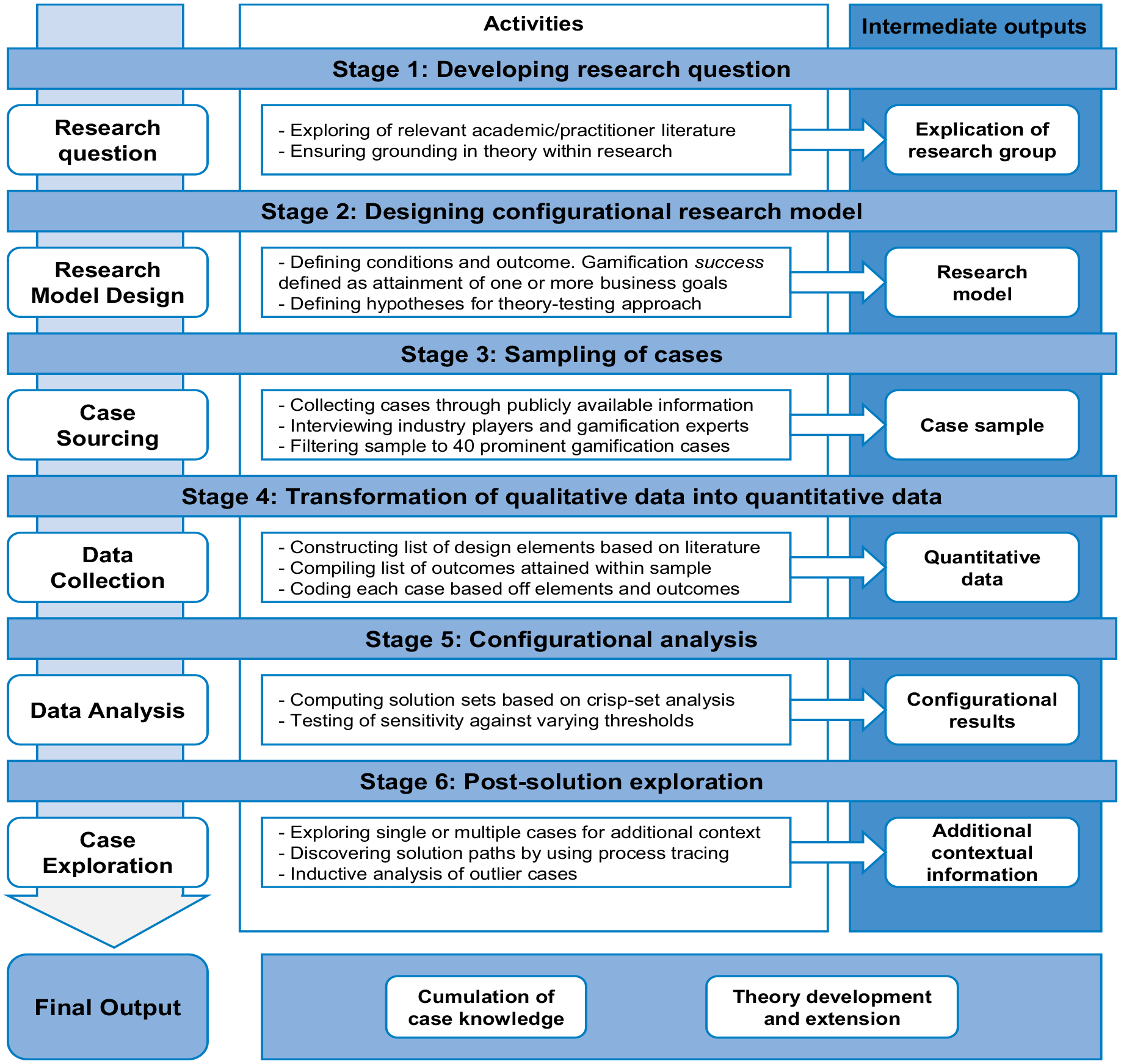
Call-out box on qualitative comparative analysis process.
First, in our sampling stage, we followed a multistep process to select our gamification initiatives. We carried out a thorough review of past gamification projects that had attracted extensive coverage in news outlets and/or academic journals. We also interviewed 10 gamification experts (including managers, game developers, programmers, and consultants) to confirm the balance of our sample. This yielded a list of 40 gamification initiatives (“cases”). 7 Table 1 describes some of the more noteworthy cases within our sample.
Descriptions of Select Gamification Initiatives.
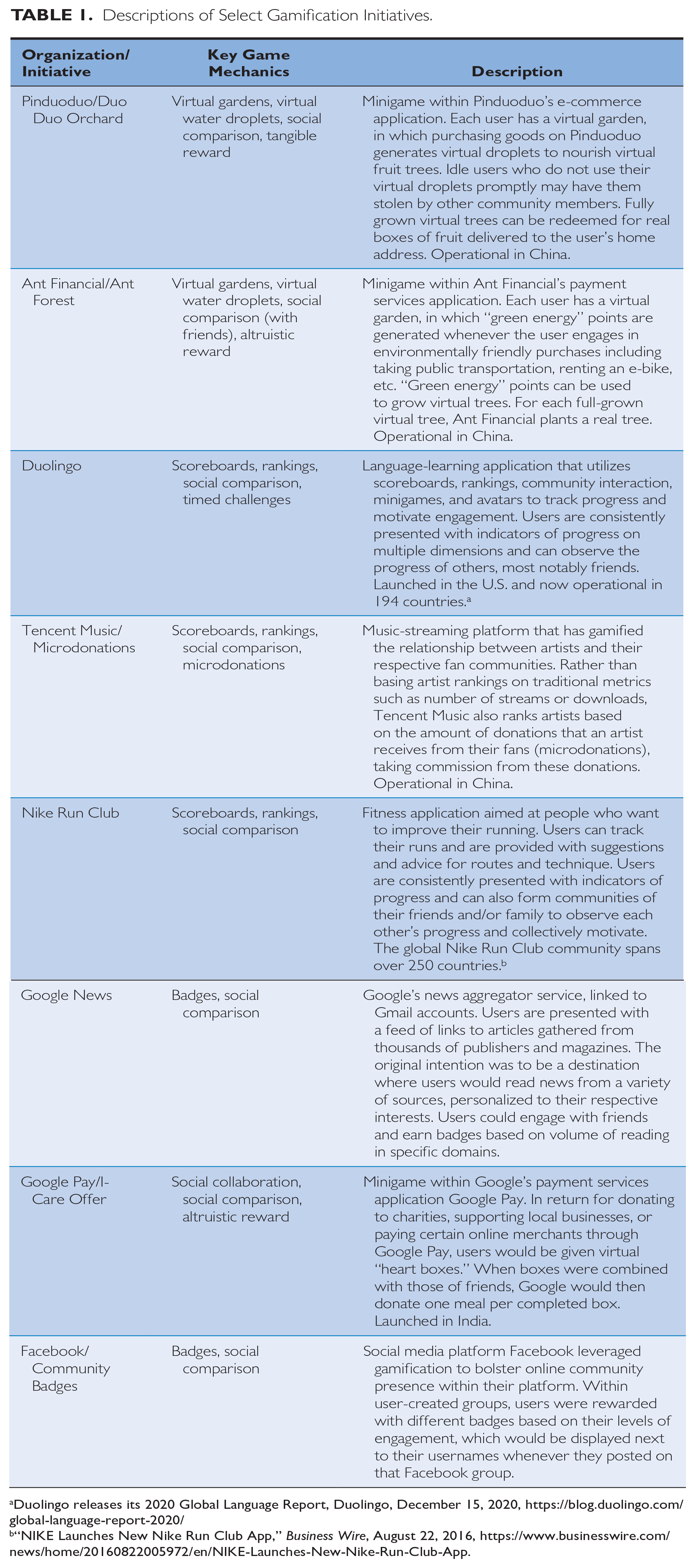
Duolingo releases its 2020 Global Language Report, Duolingo, December 15, 2020, https://blog.duolingo.com/global-language-report-2020/
“NIKE Launches New Nike Run Club App,” Business Wire, August 22, 2016, https://www.businesswire.com/news/home/20160822005972/en/NIKE-Launches-New-Nike-Run-Club-App.
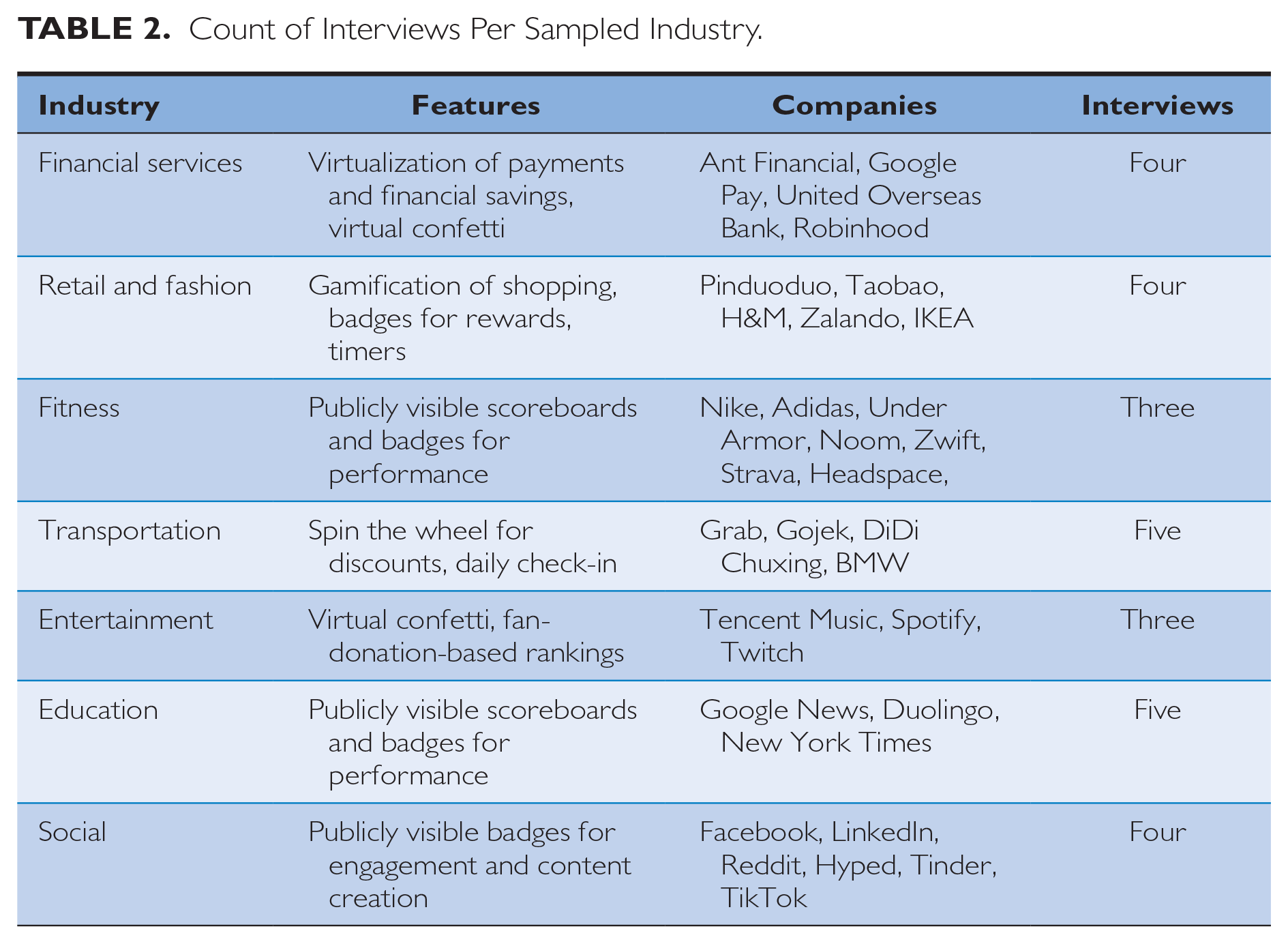
Second, in our scoping stage, 8 we used prior literature to compile an exhaustive list of gamification design elements. We then went on to identify the business objectives for each of our sample cases. Each case was rated as a success if it had attained one or more of its objectives, and a failure if it had not; seven of our 40 cases qualified as failures. Finally, by reviewing publicly available information and cross-checking with our interviewees, we mapped out the design elements and objectives for each case. Table 2 denotes the number of interviews we conducted per sampled industry.
Count of Interviews Per Sampled Industry.
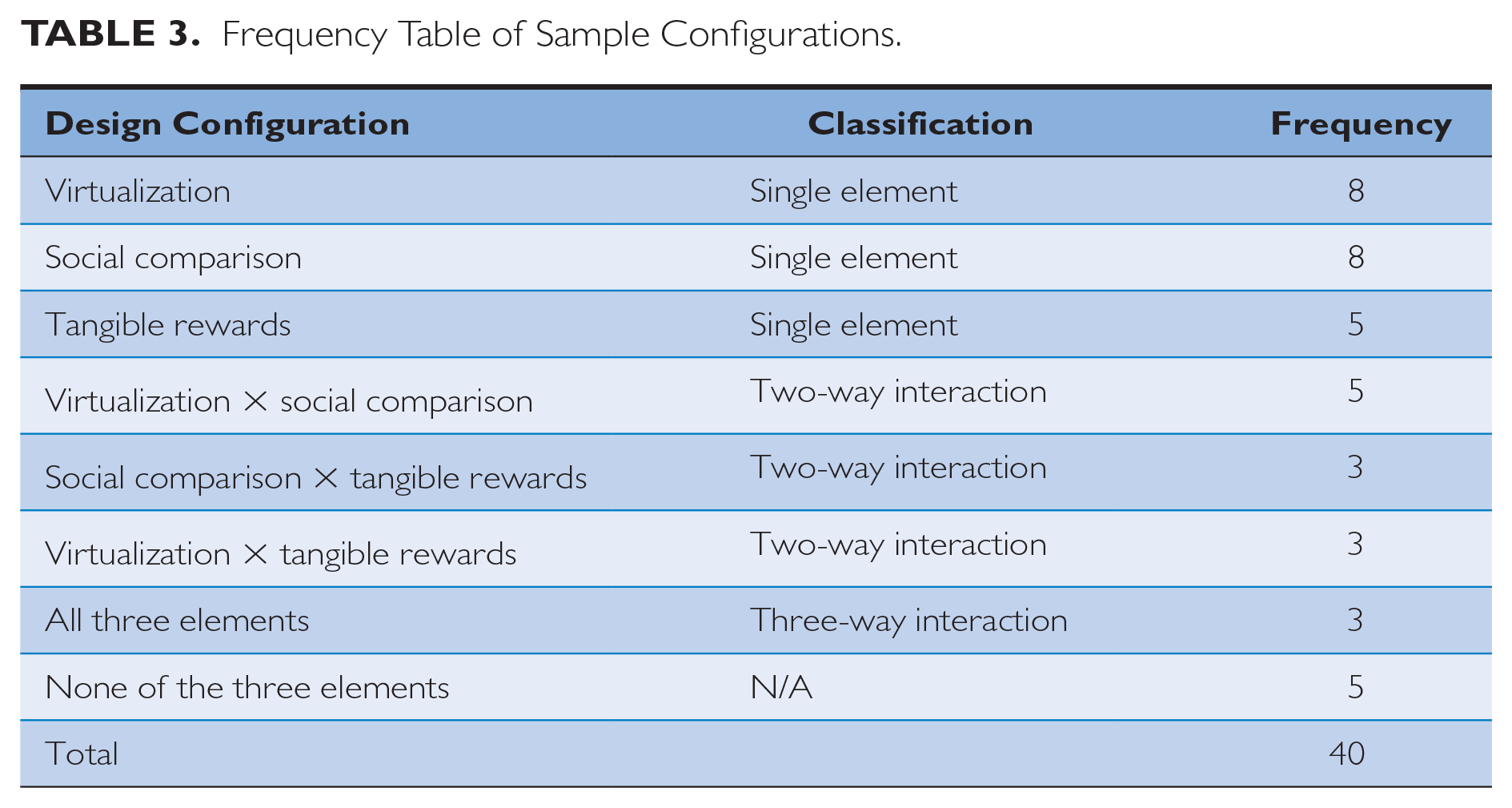
In our third step, simplifying, we constructed a truth table that captured all the possible configurations of gamification design elements and mapped them to their corresponding outcomes. Using Boolean minimization, we reduced the truth table to simpler configurations, representing the most parsimonious explanations for our outcomes. For example, while gamification researchers often point to “story-like narrative” as being critical to sustained engagement, we found that it was not actually a necessary precondition for gamification success—in other words, firms do not necessarily need to bring narrative into their games in order to achieve any of the business objectives we identified. This left us with preconditions that were associated with success (virtualization, social comparison, and tangible rewards), which, however, required additional scrutiny as they appeared in some cases and not others. Table 3 describes how these success outcomes were distributed amongst our sample.
Frequency Table of Sample Configurations.
This led us to our fourth step, iterating, where we derived pathways (also known as “configurations”) leading to each objective, so we could explain which features underpin success. We also reverse-engineered the pathways that lead to gamification failure, to reveal what managers should avoid.
In QCA, pathways represent specific combinations of conditions that lead to a particular outcome. Intriguingly, while some pathways depend on the presence of a factor, others may depend on its absence. In other words, in our context, incorporating certain design features may actually prevent a firm from achieving its objective—so success depends on selecting what is most likely to work, as opposed to throwing lots of ideas at the wall and hoping some of them stick. This is the merit of employing a more rigorous analysis based on Boolean logic emphasizing necessary and sufficient conditions, lest we mistake method for experimentation.
Finally, based on these analyses, we built a framework to help decision-makers make better choices about gamification based on the objectives they want to achieve.
Findings
What makes for a successful game? Our analysis revealed that various combinations of three design features—virtualization, social comparison, and tangible rewards—explained the success or failure of a gamification initiative. These combinations form distinct pathways leading to one of three strategic objectives: customer retention, new customer acquisition, or transforming user perceptions. Moreover, there may be two or more pathways leading to the same objective, showing that firms may have several alternative options to reach their goal and that effective tactics differ. 9 These pathways are labeled R1–3, A1–3, and T1 in Figure 2.
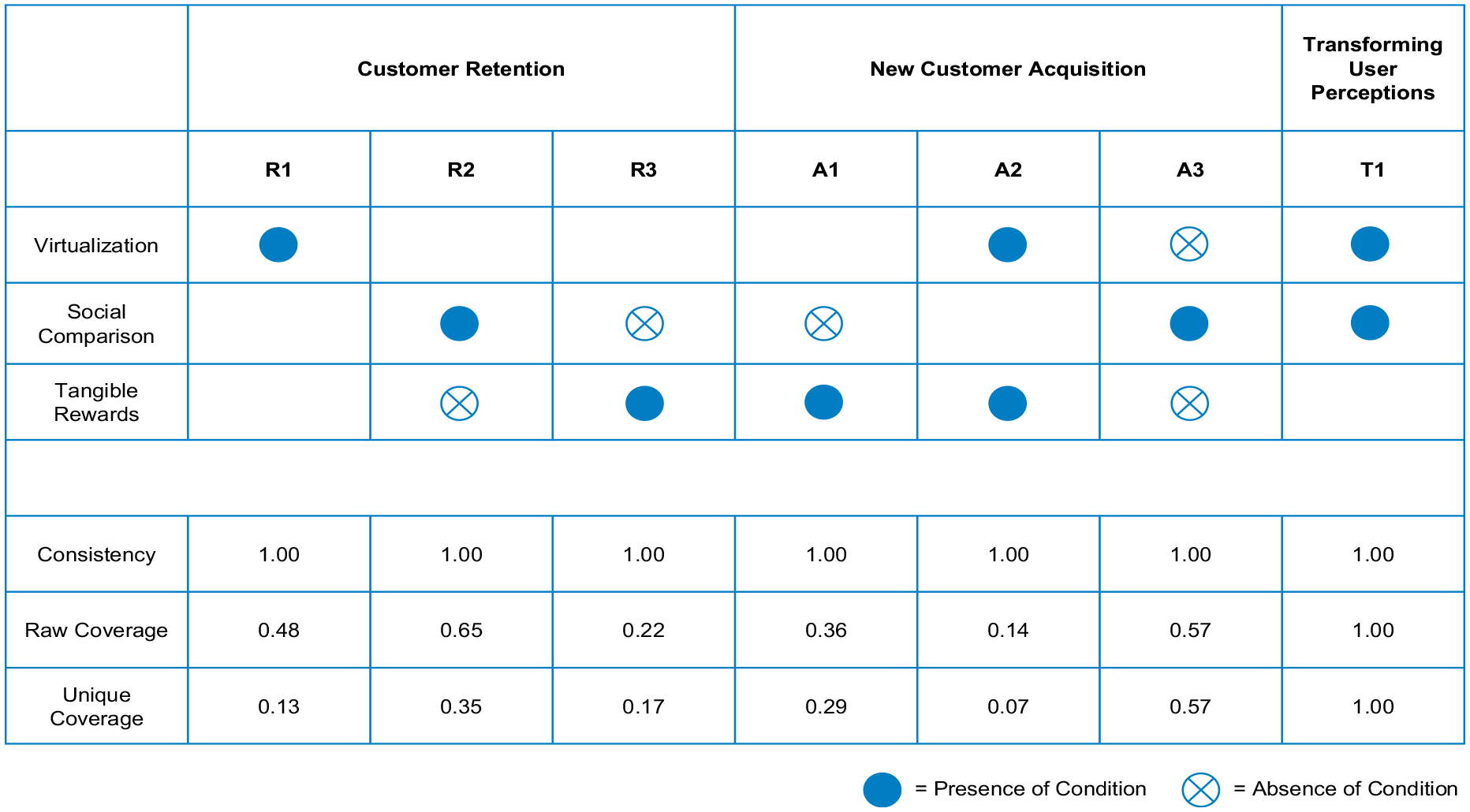
Qualitative comparative analysis configurations linked to strategic objectives.
Our analysis reveals the three design features that have consistently underpinned success and the pathways through which they benefit the firms who use them. Organizations can use these to create a strategy for gamification, along with the most appropriate priorities and KPIs for different initiatives depending on their objectives. We hope that this richer, more nuanced guidance will ultimately prove more helpful than a reductive “silver bullet” solution that purports to work in every case, or blind experimentation that ignores configurations and pathways. In Figure 3, we also present some patterns derived from outlier cases, which touch on more extreme forms of incentives.
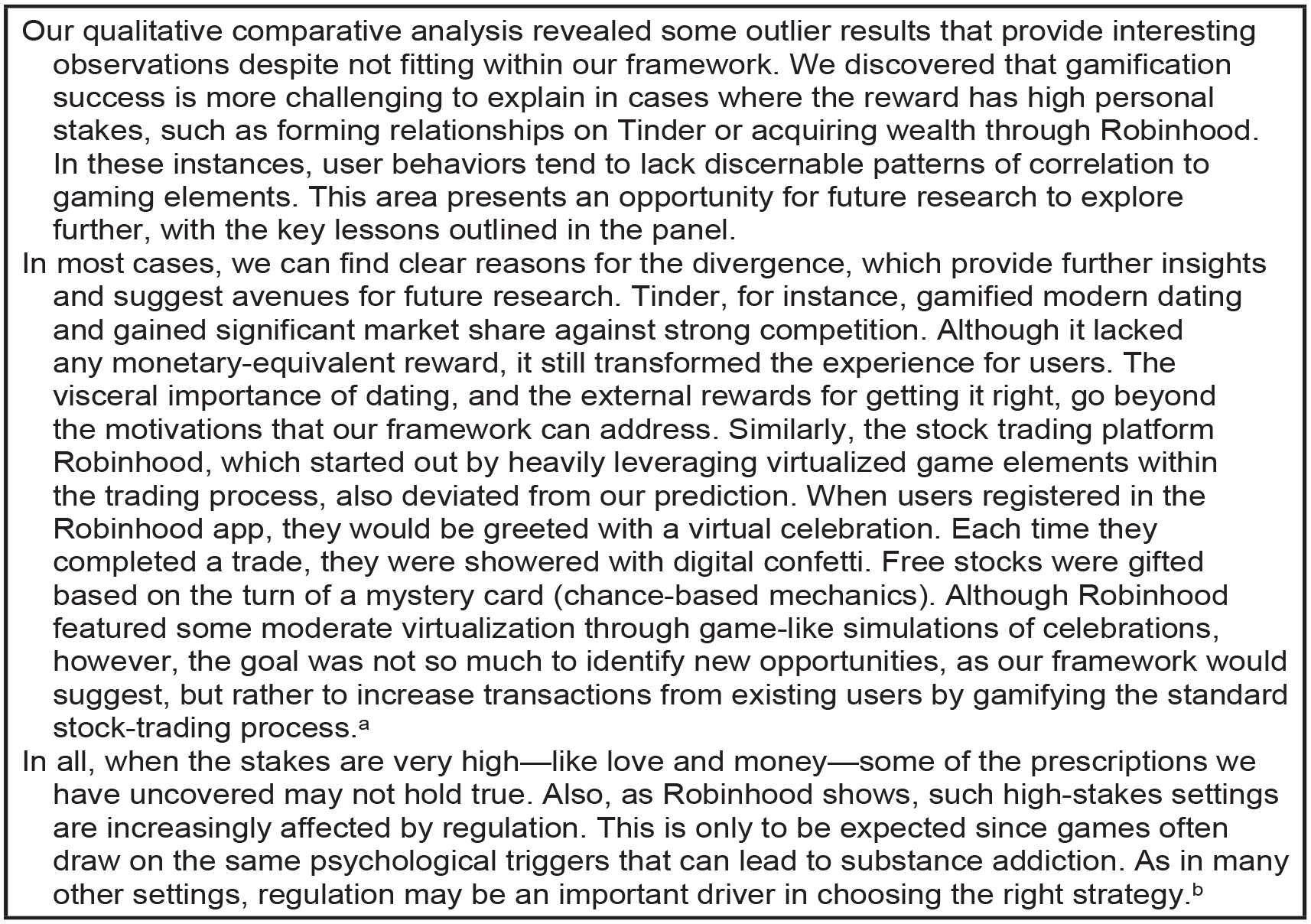
Learning from the outliers in our sample.
Below, we present an overview of our framework, set out the three key strategic objectives, and link them with corresponding design features and KPIs.
Objective 1: Customer Retention
Once a firm has securely locked users into a game, it can generate more value from them—but achieving customer retention is a long-term endeavor. Businesses must persuade users to engage frequently, over a long period, and commit time, attention, or resources along the way. By doing so, they can turn their game into users’ “go-to”: a firm fixture in their daily routine that they will habitually turn to as a sort of behavioral “default.” 10 Gamification can be the nectar that brings users back to the flower, and the effect is even stronger when social community and comparisons are thrown into the mix. While conventional wisdom often points to tangible rewards as the only way to retain customers—citing loyalty programs such as air miles and store cards—this neglects the addictive appeal that games can offer in themselves.
Our QCA results reveal three pathways to achieving customer retention. The first (R1) is through virtualization, which we define as the transposition of real-world activity and elements into a virtual format through virtual avatars, virtual profile spaces, and even augmented or virtual reality (AR/VR). Virtualization allows gamification initiatives to retain users regardless of other design features. This is evidenced by a variety of initiatives across a range of industries, including IKEA’s AR-based home décor app, Tencent Music’s virtualized profile spaces and avatars, Duolingo’s virtual language-learning progress space, and more. Duolingo, for example, constantly updates users’ virtual avatars, visualizes their progress in virtual “maps,” and rewards their successes with virtual gems. By creating an immersive parallel universe that users can mentally inhabit and explore, virtualization seems to engross players in and of itself.
The second pathway to user retention (R2) is implementing social comparison based on desirable user identities, but without offering any rewards beyond those built into the game itself. Behavioral economics has repeatedly shown that offering extrinsic rewards such as cash significantly reduces intrinsic motivation, 11 and this pathway illustrates a similar principle. However, while social comparison boosts retention, it bears repeating that the user identities involved must be desirable. Consider digital fitness tracking. Fitness apps that are centered on the user tracking their own statistics have fairly weak lock-in because users do not have much invested in the platform and can switch to another one relatively cheaply. To combat that, Nike Run Club offers badges and scoreboard ranks that gain social value over time, showcasing users’ commitment and dedication 12 and keeping them tightly bound to the app. This well-designed user identity is further strengthened by the choice to confine comparisons to users’ friends and family. Google News, on the contrary, provides an example of a poorly chosen target identity. By basing social comparison on the sheer volume of news stories consumed, the tech giant’s news-aggregation platform achieved worse retention than the New York Times’ news quizzes, which rewarded memory and insight rather than mere reading stamina.
Another crucial point is that users need some form of existing community to which they can project their identity. Recent research has shown that the appeal of socially based strategies lies in extensive installed bases and recognizable brands. 13 In contrast, unknown brands with small installed bases may find that their lock-in efforts backfire because users feel let down by the “ghost town” atmosphere. A socially driven lock-in mechanism will not work in a setting that is too sparsely populated for social comparisons to be made.
Drawing on less noble but equally predictable facets of human interaction, some Chinese apps have identified the benefit of allowing players not only to support their friends’ efforts amicably, but to steal others’ in-game currency while jealously guarding their own (droplets in Ant Forest and Pinduoduo Orchard). Since either performing or preventing thievery demands a relentlessly vigilant presence on the app, such features elicit a level of engagement that is almost obsessive—and ethically questionable, a point we address later.
The third pathway to retention (R3) is based on the traditional understanding of what gamification does: offering users tangible rewards in return for desired behaviors. For example, initiatives like points-based loyalty schemes motivate the user solely with extrinsic rewards such as cash, vouchers, and discounts. This strategy is commonly used by ride-hailing firms such as Grab, Gojek, and DiDi; loyalty programs such as Starbucks Points; and e-commerce initiatives such as Taobao’s Packets. The strategy inevitably works. However, as the previous two pathways demonstrate, there is far more to lock-in than just throwing money at users, and brands who can bring more ingenuity and originality to their games may be able to achieve the same level of lock-in at a lower cost.
Objective 2: New Customer Acquisition
Attractive games can bring in new users, who may eventually become customers. This can benefit firms either by creating new revenue streams directly or by boosting interest or brand equity by association. This latter goal might account for the intense interest in gaming and the Metaverse 14 as evidenced by initiatives such as Gucci and Nike’s ventures in partnership with Roblox. However, B2B firms also want to cement their position. One such is SpringStudios, which is aiming to shift from “end-to-end” advertising and production into virtual events, for firms who want to take advantage of “Metaverse-as-a-Service” and establish a (limited) foothold in this virtual world.
Again, conventional wisdom would suggest that the best way to acquire customers is through tangible rewards and targeted marketing. However, our QCA results again illustrate that there are three separate pathways to gaining new customers. The first (A1) is to offer tangible savings and rewards, but without facilitating social comparison. We speculate that this could be because excluding social comparison concentrates users’ motivations on extrinsic rewards.
Tangible rewards bring in additional sales that are directly bundled with further tangible benefits, which can become even more enticing when they incorporate an element of chance, or even gambling. Two classic examples are digital loyalty programs that bundle purchases with points that can be accumulated and redeemed for additional physical goods later on (e.g., Starbucks Rewards) and schemes that offer cash or credit-equivalent rewards through chance-based mechanics such as “Spin the Wheel” or dice rolling. An earlier example was McDonald’s highly successful (offline) Monopoly game, but the same technique has also reaped handsome rewards for digital platforms such as Grab, Gojek, and DiDi.
The second pathway (A2) is more nuanced: combining virtualization with tangible rewards. This approach allows for a far more differentiated experience where users compete in virtual arenas for real-world rewards—like winning prizes at a carnival. Taobao Packets leverages chance-based mechanisms that create virtualized eggs for users to grow by repeatedly interacting with the platform. When each digital egg eventually hatches, the user receives a random reward. Similarly, Pinduoduo’s Duo Duo Orchard allows users to use virtual droplets, which are distributed randomly and may be stolen by other players, to water their own choice of virtual fruit trees. Fully grown trees entitle users to have real fruit delivered to their homes.
Finally, the third pathway to customer acquisition (A3) is to focus solely on social comparison and exclude both virtualization and tangible rewards. The important caveat here is that such a strategy can only be pursued when the desirable user goal is closely related to self-improvement—as, for example, in fitness with Nike Run Club and Strava, and in knowledge-based learning with the New York Times’ quizzes.
As technologies mature, we also see (digital) games and physical experiences begin to merge. Burberry, for instance, has created a unique gamified experience in its Shenzhen store, 15 at the epicenter of the Chinese tech scene, through a partnership with Tencent, WeChat’s parent. The rationale here is that while Chinese customers begin their buying journeys on social media, they still want an in-store, experiential element that they can then share online. Aiming to bring these two elements together, the Shenzhen store allows visitors to share directly to social media and unlock specific digital-only offers. Thus, the game becomes a means to engage customers in the digital and physical (“phygital”) realms at the same time. 16
Objective 3: Transforming User Perceptions
Perhaps the most fascinating observation from our research was that gamification can also help users understand their own preferences, and allow firms to shape them. Traditionally, tools such as marketing and advertising have been seen as the only way for firms to shape consumer perceptions. But we find that gamification, if done right, can achieve the same result at a far lower cost.
Our QCA findings reveal just one pathway (T1) to transforming user perceptions: combining virtualization with social comparisons centered on promoting desirable user identities. For example, Ant Financial’s Ant Forest game leverages virtual gardens in conjunction with a social comparison mechanism based on being eco-conscious. Users can compete against each other based on the well-being of their respective gardens. In the process, they learn why Ant payments are greener and more ethical than those of its rival, WeChat Pay. The key to the success of these games was selecting KPIs to correspond with the strategic goals of boosting online engagement and increasing user investment.
Tencent Music, China’s largest music-streaming platform, has aimed to persuade its user base that the best mark of appreciation for an artist is to make a donation. It reinforces this idea by ranking artists based on donation figures rather than streaming numbers, pitting fan groups against each other, and even altering the way artists engage with their fanbases. This dynamic is paired with virtualized interfaces indicating user loyalty and progress based on Tencent’s commission structure.
This example also shows why firms might want to engage in a transformation of perceptions. As Tencent discovered, such a fresh approach can allow the upside of games to be directly monetized—in its case, providing the firm with a cut of the revenues it generates for bands while promoting the value of donations. Second, a firm might benefit because of the associated boost to the brand image that a game provides, as BMW shows with its Points program. Alternatively, a game could create goodwill that a firm can monetize through platform engagement (Ant Forest) or sales growth (Duo Duo Orchard).
Mistakes to Avoid
Running QCA on the gamification projects that failed to achieve any of their objectives also yielded some fascinating insights. We discovered two “pathways to failure,” along with some cautionary tales from cases that we excluded from our analysis yet still warrant examination.
Mistake 1: Neglecting All Three Critical Factors
Our results show that the first pathway involved failing to incorporate any of the three critical design features (virtualization, social comparisons, or tangible rewards). While such poorly thought-out initiatives are rare, there are a few examples. Zalando’s Lounge attempted to gamify the online retail experience by telling users every 20 minutes that their shopping bags had “expired” and making them choose between “add more time” and “check out.” By neglecting all three of the essential components of gamification, Zalando failed to achieve any desirable strategic outcome. 17 A similar story unfolded when H&M attempted to reward users with virtual points for watching advertisements. The company scrapped the gamification feature shortly after launch.
Mistake 2: Incorporating Undesirable Social Identities
Our QCA results also shed light on why Big Tech firms such as Google and Facebook, despite apparently having all the ingredients of a great gamification initiative, have repeatedly failed to create one. Incorporating undesirable social identities and attempting to promote them will cause gamification to fail, regardless of which other features are incorporated.
To put it bluntly, users will not buy into social identities or comparisons they do not like or cannot relate to. Google News, for example, wrongly inferred that users cared about sharing how much they read, when they actually wanted to show how well they understood. Google’s misapprehension led it to award badges based on breadth of reading rather than depth of learning. On the contrary, The New York Times was able to successfully lock users in through weekly quizzes that did reward learning. Similarly, Facebook badges rewarded users for how much they contributed to Facebook groups. But users do not want to be seen as people who spend endless hours on Facebook—to judge by the unpopularity of the badges, at least. As a result, this initiative—despite funding, support, and interesting design—did not succeed.
Advice for Managers
Much of the advice on gamification either tries to offer a “one size fits all” formula or emphasizes superficial measures of success over high-level strategic objectives. By deploying the powerful Boolean logic of QCA, we take a deeper dive into the many subtle connections between features and objectives, showing how gamification projects can result in very different outcomes depending on which features are brought in—and, crucially, which ones are left out.
Our findings suggest that managers planning gamification initiatives can improve their odds of success by following these five tips:
■ Look beyond engagement—Although it is the most widely used metric of performance, focusing on engagement as an end in itself, or in a generic way, tends to be counter-productive. Firms that focus narrowly on engagement without a clear sense of how their game will add strategic value often run into difficulties.
■ Define the strategic objectives—Different goals (acquiring customers, expansion, and refining market positioning) call for different design elements and mechanisms. Once a firm knows its objectives, it can give designers and engineers a clear brief to work to and choose the right KPIs to gauge success.
■ Align design with strategic objectives—For instance, if the desired strategic outcome is user lock-in, one route to success is to design a game featuring social comparison based on desirable user identities while excluding tangible rewards. On the contrary, if the goal is to shape users’ values and beliefs, the game needs to hold their attention over the long term—for example, through engagement in virtual worlds and social comparison. If a firm is happy with rapid but precarious growth, tangible rewards in isolation may be enough.
■ Choose KPIs specifically attuned to reflect strategic objectives—Choosing the right KPIs will prevent the project from being led astray by “nice to have” wins that are irrelevant to the strategic goal. For example, if a business wants to gain market share by selling more to its existing users, it should not focus on the number of new users it attracts. In India, Google Pay wanted to increase transactions from existing users but instead designed a game based on attracting new ones. As a result, it did not achieve either goal. Conversely, Ant Forest’s main goal was to shape user perceptions, and it rightly focused on measuring user interaction.
■ Don’t try it all in the name of experimentation—Avoid attempting everything under the guise of experimentation. One of the mantras in the digital arena is that success often requires experimentation and numerous iterations to achieve optimal results. While there’s truth in such aphorisms, our configurational analysis suggests that “trying it all” is counter-productive and associated with failure. Some strategic clarity and understanding of which paths work are important in gamification.
Digital Ethics and the Future of Gamification
So far, we have looked at what is most effective in gamification—but we also have to consider what is ethical. While ethics may not have affected business performance so far, they are increasingly being discussed as governments seek ways to combat addiction to gaming and the digital world. At the same time, firms need to clarify their position and take a more ethical stance on how their games work, how people use them, and the broader impacts they may have. 18 Below, we set out the main questions concerning the ethics of gamification.
■ Is gamification always a good thing?—As we have seen, gamification can be good for firms—but it can also be bad for users, as gamified experiences play on their neuroactivity. Encouraging users to chase rewards and desirable identities may cultivate what is increasingly recognized as a form of digital addiction. Just like addiction to alcohol or recreational drugs, digital addiction may lead to mental health concerns—particularly in young children, whose value system is still being formed.
■ Should regulators step in?—Digital addiction is already a major area of regulatory discussion, albeit with wide variation between countries, particularly in East Asia. China, for example, has sharply tightened its limits on the time and in-game money that children can spend in games since 2019, and ramped up its restrictions even more, with the growing concern about the growth of the “metaverse.” 19 On the contrary, in August 2021, Korea abandoned its notorious “Youth Protection Revision Act,” which set play-time limits for children under 16, a decade after it was passed. Meanwhile, few Western countries have shown any willingness to act on gaming addiction, and discussions remain wide open when it comes to the need for regulatory action on gamified apps.
■ What will digital ethics mean for firms?—Without strict regulation, firms that design gamified features will consistently aim to maximize their returns. However, that story could change if they begin to consider their digital ethics—just as it did with ESG. The negative consequences of digital addiction could harm firms’ reputations, spurring them to act more ethically. More ethical choices, in turn, may improve companies’ image as socially responsible actors, potentially bringing long-term intangible benefits (i.e., forestalling strict regulation, sustaining brand image, and improving access to capital).
■ What will happen in the Metaverse?—The Metaverse can be seen as an extreme version of today’s gamified apps, with user-enticing features ramped up to the max and a correspondingly heightened risk of addiction. Hence, the Metaverse is a kind of prototype for the future of gamification—essentially, virtualization on steroids. As recent research on the lackluster performance of the metaverse suggests, it was the sluggish development of AR/VR technologies (which are developing, just not as quickly as some expected) and, mostly, the lack of valuable end-uses that hampered the growth of the metaverse. 20 As we think about how to use the metaverse to the advantage of a firm, we may be well served to think about the types of benefits that can arise.
That said, in our research, we took a crisp-set QCA approach, meaning that we did not consider the extent to which an initiative is virtualized. To better understand the way that the metaverse may affect business, we must focus on the extent to which an experience can be virtualized and then gamified. This goes beyond what we have done, and we expect that such a project, technically speaking, must address the “extent of virtualization and gamification” of an activity as its focus. This means also switching from a “crisp set” QCA with well-defined boundaries to a “fuzzy-set” approach, where virtualization is operationalized as a continuous measure on a scale, which should bring fresh insights that move beyond our observations in this article.
Conclusion
In this article, we explored the business value of gamification and showed that while it is certainly an exciting prospect, success is far from guaranteed. Gamification can help realize one or more of three distinct strategic objectives and identify the pathways to success with each one. For gamification to be effective, firms must choose the design elements that suit their objectives and the right KPIs to measure success. However, while our findings highlight some specific pathways to success, trying all possible benefits and all possible strategies may be counter-productive. Firms can use our framework to increase their odds of success by aligning their design choices with their strategic aims. After all, to win the game, one must first understand the rules.
Footnotes
Notes
Author Biographies
Michael G. Jacobides is the Sir Donald Gordon Professor of Entrepreneurship & Innovation and Professor of Strategy at the London Business School. He is the Lead Advisor of Evolution Ltd, a boutique advisory focusing on strategies in a digital context, Academic Advisor of BCG’s Henderson Institute, and Chief Digital Economy Advisor at the Hellenic Competition Commission (email:
M. Dalbert Ma is a PhD Candidate in Strategy and Entrepreneurship at the London Business School (email:
Konstantinos Trantopoulos (PhD, ETH Zurich) is Research Fellow at IMD Business School and Founding Partner at Rheneia Partners (email:
Vasilis Vassalos is a Professor at the Department of Informatics and the Director of the MSc in Data Science at the Athens University of Economics and Business. He is the Chief Technology Officer of the Hellenic Competition Commission as well as a Director of AI at AISERA, Inc (email: