



Abstract
This article presents principles and practical guidelines for how managers can succeed in growing the intelligence of their organizations by harnessing the complementary strengths of humans and artificial intelligence (AI). Organizational intelligence is the ability of collectives of intelligent human and digital actors to solve problems and adapt. Six principles for human-AI collaboration in organizations are explored—addition, relevance, substitution, diversity, collaboration, and explanation—and how they play out in leading organizations is discussed. Finally, practical guidelines are outlined for how leaders can enable their organizations to successfully make the change.
While organizational problem-solving and adaptiveness have been core concerns to organization science for decades, 6 both the realities on the ground and the repertoire of available organizational mechanisms in the digital era have vastly outpaced the traditional formulas. 7 Organizations—large and small, young and old—are currently experimenting with new organizational forms in order to become fast and agile, collaborative and inventive—hallmarks of organizational intelligence. Due to recent developments in organizational practice, technology, and research, two critical questions need to be addressed: how can we use AI to make organizations more intelligent? And how can we organize collaboration between human and digital actors effectively?
Organizational Intelligence
Intelligence refers to the ability to acquire and apply knowledge to solve problems and adapt. 8 While intelligence has been associated primarily with individuals, some researchers study it at a collective level and find that a group’s problem-solving performance can be explained by collective intelligence factors such as the diversity of participants, social skills, and collaborative practices. 9 Many problems are so big and complex that it takes the collective efforts of hundreds or thousands of people to solve them. Furthermore, organizational design grows increasingly sophisticated with larger organizational size. 10 This suggests that organization-level intelligence may be different than collective intelligence at the group level. Organizational intelligence is a high-potential but understudied domain. 11
As an extension of the definition of individual intelligence above, I define organizational intelligence as an organization’s ability to acquire and apply knowledge to solve problems and adapt. Before diving into the specifics of how AI can help make organizations more intelligent, let me outline what we know drives problem-solving capabilities and adaptiveness (i.e., intelligence) in human organizations. Drawing on research on collective intelligence, collaborative innovation, and organization design,
12
I propose that organizational intelligence is a function of the intelligence-in-use of participating actors, their composition, organizational architecture, and organizational culture as specified in equation 1 and explained below. Equation 1. The Organizational Intelligence Function Organizational Intelligence = f(Actor Intelligence-In-Use, Actor Composition, Organizational Architecture, Organizational Culture)
Actor Intelligence-In-Use
An organization’s intelligence grows with the intelligence of its actors, implying that it increases when an organization adds new intelligent members (e.g., recruitment) or exchanges current members with more intelligent ones. 13 Organizations often do not put people’s cognitive and physical abilities to full use. 14 In most organizations, we find high-skilled people doing mundane work such as educated lawyers in public agencies spending most of their days on simple case handling, managers spending much of their time on routine administrative tasks such as reporting and scheduling, and professors grading piles of exam papers. This implies that most organizations could significantly increase their intelligence by automating or outsourcing routine work and deploying people to roles where they get to use more of their abilities.
Actor Composition
The composition of a collective is important to its problem-solving abilities. First, relevance matters—the knowledge and skills its members have to match the nature of the problems it aims to solve. 15 For instance, one would not engage a group of accountants to solve a patient’s medical problem even if their IQ would be on par with that of an experienced team of doctors.
Second, the diversity of participants positively affects collective problem-solving performance, and may in some cases be more important than their individual abilities. 16 Actor diversity becomes progressively more important as problems to be solved grow in complexity and require exploring novel solutions. 17 This is a key rationale behind the move toward organizing work in cross-functional teams that enterprises across many economic sectors are adopting currently—often inspired by Spotify’s agile organizational model. 18
A diverse community of actors can generate a greater number and variety of alternative solutions to a problem, increasing the odds of finding effective solutions. Research on crowdsourcing finds that diversity often trumps ability in the process of finding novel solutions. 19 However, it requires collaborative values and skills as it can also be a source of conflict, misunderstanding, and delays. 20
Organizational Architecture
Work structure and processes influence performance on both group and organizational levels. 21 One should expect the impact of organizational architecture 22 on organizational intelligence to increase with group and organizational size—as coordination across time and space among people who may not know each other is necessary, and direct mutual adjustment becomes increasingly insufficient. The effect of organizational architecture on an organization’s intelligence may be positive or negative, depending on whether the design enables collaboration among complementary actors or causes underutilization of people’s capabilities and keeps complementary actors and resources apart.
Organizations excelling in problem-solving and adaptiveness tend to have organic structures with high levels of flexibility and autonomy. 23 Hierarchical designs work quite well for well-defined problems that can be decomposed into stand-alone sub-problems assigned to different organizational units. 24 However, when problems are not clearly defined upfront, change happens frequently and unpredictably, sub-problems are interdependent and require coordination across units hierarchical structures tend to hinder rather than enable complex problem solving. 25 For exploration and adaptive problem-solving, designs enabling self-organization at scale are more conducive to organizational intelligence. In such organizational forms, actors self-organize and are guided by shared values, rules, and protocols. 26 The protocols allow actors to effectively identify and mobilize collaborators and resources, collaboratively solve problems, share knowledge and ideas, and distribute rewards. Through shared values and norms, actors know what they can expect from fellow members—providing a basis for trust-based collaboration. 27
In order to act intelligently, an organization has to be able to
sense the environment and identify needs and problems;
identify and mobilize relevant actors and resources (within or beyond organizational boundaries);
enable actors to collaborate effectively to solve problems and provide appropriate responses to the environment;
learn, accumulate, and share knowledge and other resources;
set goals, focus attention, and prioritize actors and resources in ways that enable the organization to fulfill its purpose. 28
To enable this, a self-organizing collective of actors needs transparency and combinatorial capabilities. Transparency allows actors to find each other, group, and collaborate as well as identify and mobilize resources. They have to be able to disclose their own and observe other actors’ knowledge, skills, availability, preferences, and objectives to self-organize successfully. 29 Problem-solving is combinatorial in nature and intelligent behavior of multi-actor systems requires combinatorial capabilities—the ability to combine actors, resources, ideas, and information. 30 Organizational structures and practices that support combinatorial capabilities are necessary to reap the performance benefits of diversity. 31
Organizational Culture
An organization’s culture (its underlying norms, values, and assumptions that define the correct way to think and behave) 32 influences its ability to creatively solve problems and develop organizational intelligence. 33 Trust and psychological safety are important for people’s willingness to share their ideas, opinions, and knowledge. 34 This is essential in surfacing diverging views, which are particularly useful when novel solutions are necessary. Trust grows in social settings characterized by transparency, norms of reciprocity, and expectations of fairness. 35 Experimentation and creativity thrive in cultures tolerating failure, with a learning orientation and a mastery climate. 36 Intelligent organizations nurture cultures (and structures) where data and merit trump seniority in decision-making. 37
Organizational culture and architecture are conceptually distinct but interdependent in practice. For example, trust, transparency, and sharing tend to mutually reinforce each other. 38 When everybody can observe each other’s actions and contributions, they tend to behave according to community norms. 39 It stimulates trust—and the active use of problem-solving tools such as design thinking techniques tends to stimulate a culture of experimentation and learning and vice versa. 40
The cultural shift in Microsoft under Satya Nadella’s leadership, which also involves changes in organizational architecture, is instructive. The software giant was previously known for a highly competitive culture that inhibited collaboration and learning across units. Nadella’s focus on a growth mindset, learning, and experimentation along with disbanding the company’s forced ranking performance management system are credited with sparking a cultural transformation embracing collaboration and innovation. Since his appointment, the software giant has transformed itself into a leading cloud computing and office productivity provider with promising positions in AI, virtual reality (VR) technology, hardware, and gaming, as well as social and software platforms—all accompanied by a soaring stock price. 41
While the three other factors in the organizational intelligence function (i.e., actor intelligence-in-use, actor composition, and organizational architecture) can be directly changed by management decisions, organizational culture can be influenced more indirectly by management communication and behavior, can typically take a longer time, and can often involve the three other factors as a means for cultural change.
Combining Human and Artificial Intelligence
People are not the only intelligent actors in organizations anymore. With AI, technological systems become more than just tools as they take on actor properties. In today’s organizations, people and technology perform the work together. We need to take this into account when we organize. AI affects work in two major ways: automation and augmentation. 42 First, AI-enabled automation refers to situations in which digital technologies perform a set of activities without human involvement, 43 for example, when banks automate the handling of credit card applications. Second, intelligent technologies also create opportunities for digital augmentation—situations where the technologies support, accelerate, and improve human work, 44 such as when epidemiologic models informed public health policy decisions during the COVID-19 pandemic. In addition, digital technologies afford new and improved means for human as well as digital actors to communicate, which may enable new and improved ways to organize activities across time and space. 45
Digitalization allows organizations to turn stand-alone assets into interactive objects and interactive objects into intelligent actors. By equipping assets with connectivity and communication capabilities, they become interactive objects that can be observed and operated remotely, and they become points of data capture that can be processed and acted upon by people and intelligent systems in networks of connected objects and actors. Infusing interactive objects with AI—the ability to sense, comprehend, act, and learn—turns them into intelligent actors. AI consists of multiple technologies that enable computers to perceive the world (e.g., computer vision, audio processing, sensor processing); analyze and understand the information collected (e.g., natural language processing, knowledge representation); make informed decisions or recommend action (e.g., inference engines, expert systems); and learn from experience including machine learning. 46 Infusing objects with intelligence endows them with actor properties, implying that with some degree of autonomy, they can act on inputs from other actors and the environment—transforming organizations into collectives of intelligent human and digital actors. However, the definition does not imply (or exclude) human-like consciousness, moral agency, or intrinsic value on behalf of the digital actor.
When employing intelligent human and digital actors, we can derive five distinct configurations of intelligence in organizations depending on the different forms of collaboration (or the lack thereof) among people and intelligent technology involved in solving a problem or performing a task, as illustrated in Figure 1:
Individual intelligence: when a human individual works independently (without intelligent technology)
Collective intelligence: when multiple people collaborate in their work
Automated intelligence: when work is automated with intelligent technology (no human involvement)
Augmented intelligence: when a person uses or collaborates with intelligent technology to improve, accelerate, and/or support their work
Augmented collective intelligence: when multiple people and intelligent technologies collaborate in their work.
The article focuses on the role of AI in organizations and how it interacts with humans, that is, automated, augmented, and augmented collective intelligence. 47
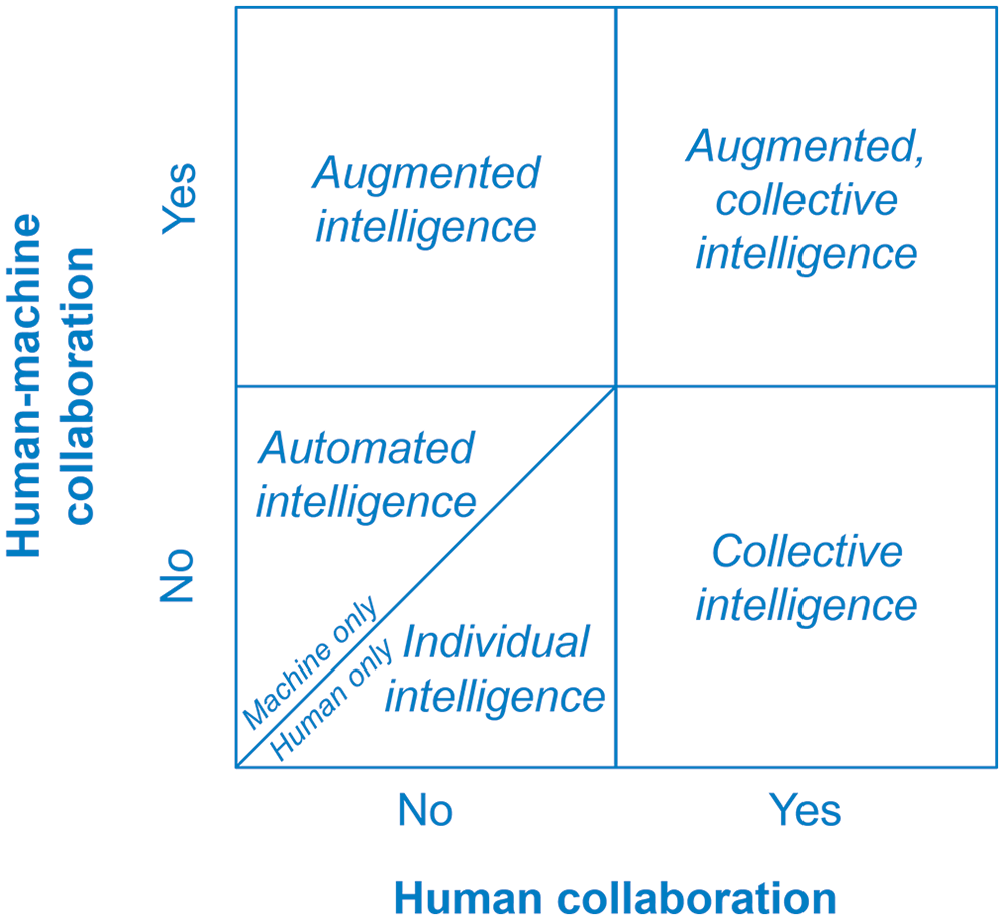
The human-machine organizational intelligence matrix.
Six Principles for Designing Intelligent Organizations
Equipped with the factors of the organizational intelligence function and the human-machine intelligence matrix, we can make sense of the role of intelligent technology in organizations and derive design principles for intelligent organizations consisting of human and digital actors complementing each other.
Starting with the fundamentals involving the actor intelligence-in-use factor: #1 The Addition Principle: Adding actors with higher levels of intelligence—human or digital—increases organizational intelligence. Adding a greater number of intelligent actors—human or digital—does the same. #2 The Relevance Principle: The type of intelligence must match the nature of the problems to be solved.
Currently, AI solutions can match or exceed human intelligence in sophisticated but very specialized domains such as diagnosing particular types of skin cancer, route planning in transportation networks, energy optimization in data centers, and board games like Chess and Go. 48 Machine intelligence excels at detecting patterns in large volumes of data and making predictions from these. Predictive maintenance is an example of a mature application of big data and machine intelligence in the operation of industrial equipment, infrastructure, and transportation. Delta Air Lines collaborates with Airbus and uses the European aircraft manufacturer’s Skywise platform for the collection and analysis of data from their aircraft and ground operations. A new aircraft collects data on 14,000 variables from equipment and sensors during operations, which feeds into the analytics platform. The software allows the airline to predict which parts need servicing or replacement before they fail. According to Delta, predictive maintenance has allowed the airline to reduce maintenance-related cancelations from more than 5,600 in 2010 to only 55 in 2018—greatly improving reliability. 49
While humans can cope with solving ambiguous problems—in fact, ill-defined problems provide fewer constraints on human problem solvers and may lead to novel and better solutions—intelligent machines need highly specified problems that match their functionality to perform well.
50
This implies that task allocation to intelligent digital actors must be much more specific than to their human colleagues who can deal with ambiguity and span multiple functional domains with relative ease. However, the recent developments in Large Language Models (LLM), ChatGPT in particular, highlight that this constraint may not be absolute as these systems take on more general intelligent properties. #3 The Substitution Principle: Replacing intelligent humans with intelligent machines does not make an organization more intelligent, but rather more efficient.
Automation may have several possible benefits such as improved cost efficiency, capacity, 24/7 operation, speed, quality, and accuracy 51 —desirable outcomes, indeed, but these do not necessarily lead to greater problem-solving and adaptive abilities for an organization. In fact, intelligent automation yields higher organizational intelligence under two conditions: when the intelligence of the digital actor is higher than the intelligence-in-use of the human actor it replaces, as outlined above, and when automation allows for better use of the freed-up human intelligence in performing non-automatable and more value-creating tasks. In the latter case, the human actor will make greater use of its abilities—that is, increase its intelligence-in-use and contribute to making the organization more intelligent. A recent study by Acemoglu and Restrepo on the effect of automation on labor and productivity provides some credence to this argument. 52 They find that productivity is mainly driven by the reinstatement effect—the creation of new tasks in which human labor has a comparative advantage—rather than the displacement effect of automation on human labor—where technology replaces humans.
The Associated Press’ automation of a major segment of its financial news reporting highlights both the replacement and reinstatement effects. The news agency expanded its quarterly earnings reporting from approximately 300 stories to 4,400 with the help of AI-powered software robots.
53
In doing so, technology freed up journalists to conduct more investigative and interpretive reporting. Through automation and the new human-machine division of labor, the agency could increase its news reporting output more than tenfold and publish more quality journalism, utilizing the capabilities of their journalists much better. #4 The Diversity Principle: Increasing the diversity of intelligent actors, such as hiring people with different knowledge, skills, and mindsets as well as deploying different forms of artificial intelligence, improves an organization’s ability to solve complex problems and adapt.
This highlights an important point, drawing on the actor composition factor—that introducing AI solutions with abilities that are significantly different than those of their human counterparts contributes more to organizational intelligence than technologies emulating human capabilities. For example, banks and financial institutions use machine learning algorithms trained on enormous data sets to detect transactions possibly associated with money laundering and terrorist financing, which human specialists investigate further. Computer algorithms deal with large volumes of data and probability calculations much more efficiently than humans, while people cope better with complex judgment calls. 54 Artificial humanoid intelligence is a special case of AI, which is philosophically and culturally intriguing, but of less importance to organizational intelligence as it provides little complementary benefits to human intelligence. Therefore, AI promises to bring about the next level of the cross-functional team—hybrid teams of humans and machines with complementary capabilities (i.e., augmented collective intelligence in Figure 1).
The interplay between a vast number of diverse human contributors and bots on Wikipedia highlights this principle. Bots make about 40% of the 45 million monthly edits on Wikipedia (during the first ten months of 2022) 55 and coproduce the online encyclopedia together with their human colleagues. They perform different roles such as Generator, Fixer, Connector, and Tagger—each specialized in particular tasks. 56 They have even been called “Wikipedia’s immune system” due to their role in combating vandalism on the encyclopedia. 57 Even though the bots are human delegates performing tasks as specified by their human creators, they trigger complex human-bot and bot-bot dynamics through their interactions with humans and other bots guided by the community’s rules and protocols (i.e., its organizational architecture). 58
AI is currently being used to generate a greater variety of alternative solutions in contexts such as drug discovery, generative design, and venture capital. 59 The venture capital firm EQT Ventures uses its Motherbrain AI system to identify unknown companies with big potential. The system combines supervised and unsupervised machine learning and monitors several million companies using financial data such as funding, social network activity, app and web ranking data, and more. Motherbrain greatly expands the number and variety of available investment opportunities previously constrained by professional networks and the startups contacting EQT Ventures directly. The company’s investment professionals perennially input their assessments of companies—training the system to focus on the right opportunities. The system supports the full investment decision process from lead identification to evaluation and decision and helps EQT’s investment professionals prioritize their time focusing on the leads with the highest potential and appropriate maturity. So far, the company has invested in nine companies fully sourced by the system. Motherbrain is increasingly used throughout EQT including its Growth and Private Equity funds.
The example highlights the complementary relationship between EQT’s team of high-caliber investment professionals and the intelligent system. The system harvests data from diverse sources, makes inferences, and provides recommendations to its human colleagues. They, in turn, enter investment leads identified through their networks, widening the opportunity set, and share their assessments with the system and each other—triggering a learning process, involving both machine and human learning, consistently improving decision effectiveness and organizational intelligence over time.
This leads us to the high-order principles that involve all or most of the factors in the organizational intelligence function to enable the complementarity among diverse intelligent human and digital actors to collaborate and understand each other and behave responsibly. #5 The Collaboration Principle: Organizational intelligence requires collaborative skills from both human and digital actors.
Collaboration becomes increasingly difficult as actors become more diverse and have less in common such as people from different professions and vocations, human and digital actors, and digital actors based on different technologies (i.e., actor composition and the diversity principle). The developers in EQT Ventures are working hard to make the interaction between the Motherbrain system and the investment professionals as friendly and convenient as possible. They have integrated all the employees’ calendars with the intelligent system, which identifies leads-related meetings and directly after such a meeting sends a push notification in Slack asking them about the meeting and provides them with a link allowing them to swiftly tap in their assessment on their phones.
So far, human-machine interaction has been done on machine terms. We typically communicate with information technology through a keyboard, mouse, and screen, and it may often call for proficiency in computer coding. New human-machine interfaces are improving machines’ abilities to interact with humans on our terms through natural language, gestures, and in the future even through our thoughts. 60 Conversational technologies such as Amazon’s Alexa and Apple’s Siri have become household services and architects can now explore different architectural designs via 3D VR goggles together with their clients.
During the design and construction of the new main county hospital in Østfold, Norway, nurses and other hospital employees could “walk” around in a VR version of the hospital. The VR simulation allowed them to give feedback to designers and later to train in their new place of work—speeding up the transition and improving the quality of service when they made the physical move into the new buildings. 61 Merging the digital and the physical realms even more, using computer vision and augmented reality glasses, Aris MD’s XR device overlays and anchors 3D imagery from computed tomography (CT) scans to the human body—revealing its intricate layers. Reportedly, the device allows surgeons to be better informed and more accurate in their work, improving their effectiveness and reducing the chances of medical errors.
Such new interfaces make human-machine interaction more intuitive, multiplex, and tolerant to ambiguity, but still, all forms of collaboration require some understanding of “the other” whether that is another human being or a technical system. Therefore, human managers and workers in the intelligent organization have to be bilingual—able to understand and communicate with both human and digital colleagues.
62
It calls for AI literacy among most workers and managers. In fact, Daugherty and Wilson propose eight fusion skills—abilities for combining the relative strengths of a human and machine to create a better outcome than either could alone—for hybrid human-machine organizations. Examples of such fusion skills include “intelligent interrogation” of AI systems, “reciprocal apprenticing”—that humans and machines mutually train each other, and “judgment integration” where human decision-makers incorporate machine and human inputs when making judgment calls.
63
The Collaboration Principle highlights the interplay between all four factors in the organizational intelligence function: actor diversity (composition) triggering a need for collaborative skills (actor intelligence-in-use) and culture supported by organizational architecture. #6 The Explanation Principle: Intelligent organizations seek explanations and act responsibly.
Explainable AI is a major challenge as most AI systems, deep neural networks in particular, operate as “black boxes” with complex and nearly inexplicable algorithms derived from patterns in large data sets. 64 Algorithmic explainability is critically important to the development of the intelligent organization for at least three reasons. First, machine learning allows us to discover answers before we can explain them, accruing a form of intellectual debt, which can be problematic. 65 When an algorithm appears to work and its human users do not understand how, people are not able to identify the situations where and when the algorithm is not applicable nor how to correct the problem. Second, it is crucial to be able to explain AI models for accountability and bias detection purposes. Amazon’s issues with gender bias in its now-discontinued recruitment selection system are a case in point. 66 Regulation such as the EU’s General Data Protection Regulation (GDPR) scheme requires a right to an explanation of AI-based decisions. 67
Third, explainability is important for human learning and motivation. A better understanding of algorithms and machine behavior enhances human learning in environments with extensive human-machine interaction. Human beings need purpose and shared goals to gain intrinsic motivation and bring some alignment to collectives of autonomous, self-organized actors 68 and to ensure that their digital colleagues contribute to the same. In fact, understanding AI systems and explanation of their outputs are critical for managers to trust their advice in decision situations. 69 It is also important to keep in mind that different decision-makers and other stakeholders have different requirements for explanations depending on their needs and capabilities. For example, data scientists, clinicians, and patients may require different levels and forms of explanations from an AI-powered medical diagnostics system.
The development, application, and quality assurance of intelligent systems call for both technical and judgment skills—where judgment draws on human experience, expertise, ethical reasoning, empathy, and holistic thinking. 70 Recent technological and societal developments demand ethical judgment beyond legal compliance regarding environmental, privacy, social, political, and trust concerns. Examples include carbon emissions (from energy, manufacturing, and transportation sectors), clustered regularly interspaced short palindromic repeats (CRISPR, a gene editing technique) and gene editing in human beings, fake news in social media, the use of drones and autonomous weapons in military operations, and facial recognition in surveillance and law enforcement. 71 In path-breaking areas like these, leaders and organizations must show ethical judgment and respond to potential unintended consequences of new technology and stakeholder reactions. In fact, employee activism is on the rise with Amazon, Google, and Microsoft workers demanding that their employers put ethics over profits by refusing to offer AI services to the U.S. military and facial recognition to law enforcement as prominent examples. 72 Google’s tight restrictions on facial recognition services are a deliberate ethical choice with significant potential financial downside and are most likely a response to internal and external pressures. 73 The recent launch and stellar growth of Open AI’s ChatGPT service has increased the awareness in business and the public of the potential of AI but also raised significant concerns about responsible use and potential harmful effects from the powerful technology. 74
Making Intelligent Change Happen
The quest for intelligent organizations has profound implications for organization design and leadership. The underlying theme of the six principles is to design for complementarity—complementarity among diverse human actors across different disciplines and geographies as well as diverse digital actors, each with a highly specialized skill set. The intelligent organization enables and enhances the positive synergies among networked human and digital actors and builds true hybrid human-machine cross-functional teams across the organization. It challenges managers to redefine the division of labor—to avoid making people do machine work. The rapid development of intelligent technologies allows organizations to strategically automate and augment human labor in ways previously not possible. This provides a unique opportunity to rethink the division of labor and end the current systematic underutilization of human capabilities in organizations. While protecting jobs from automation may seem like a considerate and caring thing to do, the benefit is only temporary, and it reduces the time and resources available for workers and organizations to retrain and adapt and may dramatically reduce the prospects of organizational survival and long-term employment.
But a critical question remains: how can managers translate the six principles for human-AI collaboration into action and successfully transform their organizations? While the principles are general, there is not a universal blueprint for what organizational intelligence looks like for every organization or a one-size-fits-all roadmap for change. Organizations vary extensively in terms of the nature of their business, the target end-state, and their current culture and capabilities, including to what extent they have adopted AI already—and their approach to change should reflect this. Nonetheless, most organizations must address some common, hard choices when navigating the change journey toward greater intelligence. These questions involve change readiness and resistance, talent strategy, organizational structure and the locus of change, and combining speed and responsibility.
Question 1: How Should We Overcome Resistance and Build Readiness for Change?
Change is hard, and the sweeping, rapid changes required to integrate AI and transform into an intelligent organization is a formidable task. In addition to technical and functional challenges, the organization may not be ready for change. Resistance to change may stem from differences of opinion or interests, lack of knowledge, fear, uncertainty of outcomes, poor communication, and lack of trust. 75 Therefore, to build readiness for change, leaders should articulate a compelling vision for change, encourage participation, and develop their own and workers’ digital mindsets and skills. Articulating a compelling vision for change is important for motivation, direction, and alignment and it is top management’s responsibility 76 although they often would benefit from the collective insights of their organization in the process. Participatory approaches to change have several advantages as they allow for mutual learning and joint problem-solving between the workforce and management, which typically improve solutions and plans, increase ownership and commitment, and improve the likelihood of success. 77 It especially makes sense here as organizational intelligence involves the mobilization of the collective intelligence of all organizational actors. Recent research demonstrates the critical role digital mindsets play in technology-enabled change, in particular, how developing growth/expandable-sum mindsets enable collaborative exploratory learning and socializing technology into the fabric of the organization. 78
Finally, digital skills are the antidote to fear of technology. People who have the skills and habit of adapting technology to their own needs are significantly less likely to fear that AI will threaten their jobs. 79 Technology skills give managers and workers a sense of mastery and agency as well as it allows them to a greater extent to see the opportunities AI brings and envision a positive role for themselves in the transformed workplace as well as it allows them to better understand the constraints of the technology.
Question 2: Should We Hire New Talent Or Develop Our Current Workforce?
Building and renewing the digital, functional, and interpersonal skills necessary to qualify as an intelligent organization is a daunting challenge. While recruiting people with needed specialist and general management skills will continue to be important, it cannot resolve the transformational challenge. If history is a guide, the current deficit of data scientists suggests that the labor market will not be able to supply enough new candidates for future high-demand skills. Increasingly organizations must develop them within the current workforce, which calls for broad-based efforts in improving AI literacy in most organizations. It is also important as the new digital skills must be combined with domain and business-specific understanding. The ability to reskill and upskill at a large scale and high pace is imperative for aspiring intelligent organizations.
Managers in the intelligent organization lead a hybrid workforce of intelligent human and digital actors and they must understand what the members of their workforce can do, which problems they can solve, and how to mobilize them in complementary teams. This requires them to be “bilingual”—to have both people and technical skills. The time executives could ignore technology and delegate all choices regarding technology development and use to subordinates is definitely over. In fact, it is likely that the whole workforce of intelligent enterprises must be bilingual and master human-machine fusion skills.
Question 3: Should We Drive Change from the Center Or the Edge of the Organization?
Leaders mobilize for change and must empower the frontline. While change certainly involves top management, it will not be the locus of transformation—a broad-based mobilization is needed for at least two reasons. First, employee and user involvement tend to lead to better system-process fit and greater acceptance of change. Second, the intelligence of an organization should not be constrained by the limited insight and intelligence individual managers can impose on their workforce—it requires the mobilization of the insights, skills, and creativity of all organizational members.
A common recommendation from the research on how to combine innovation with efficient operations is to organize disruptive, exploratory activities in separate units detached from the rest of the organization. 80 Distinct centers of excellence (COEs) on critical new competency areas can be useful for driving learning, disseminating innovation, and acting as change agents inside the organization—especially in the initial phase. However, it is essential to realize that human-AI collaboration and the principles of organizational intelligence must permeate the whole organization, not just some detached units. The mission of COEs on AI is not to maximize their own expertise in isolation but to enable and accelerate an intelligence transformation of the organization at large. Over time, using AI to grow organizational intelligence should be a distributed capability, supported by centralized units if necessary.
Nonetheless, top management plays a critical role in setting direction, being role models, developing culture, and enabling infrastructures for collaboration and problem-solving. The travel-booking site Booking.com promotes an experimentation-friendly culture where “anyone can test anything” without managerial approval. The more than 25,000 tests run annually by employees all over the company are enabled by a centralized testing architecture making tools for experimentation as well as the designs and data from prior and ongoing experiments available to all. 81 This highlights the interplay between shared infrastructures and distributed experimentation and learning.
Question 4: How Do We Move Fast and Responsibly in Adopting AI?
The rapid pace of technological development and the associated transformation of work, fierce competition, and changing customer and societal expectations force organizations to act fast to capitalize on new opportunities and deal with new challenges. However, the infamous tech industry ethos of “move fast and break things” does not apply anymore. The new ethos should be “move fast and responsibly.” AI can give your organization superpowers. Whether that turns you into a superhero or a supervillain remains to be seen. As Uncle Ben advised the young Peter Parker in the Spider-Man comic, “With great power comes great responsibility.” 82
Good intentions are necessary but not sufficient. Algorithmic accountability requires equal shares of explanatory power and human judgment. The intelligent organization grows skills and a culture for transparency and explanation, including AI algorithms being able to justify their reasoning. Any problem-solving organization seeks to understand a set of problems to provide possible solutions, but in the AI-powered enterprise, skills and systems for explaining models and decisions as well as detecting and mitigating algorithmic bias are critical capabilities. Systems and skills in explainable AI must be coupled with human judgment to result in responsible behavior. While the cost of some forms of intelligence is decreasing rapidly, 83 the premium on judgment is not. We need human judgment to establish purpose and goals (including goal functions for AI algorithms), allocate work, integrate inputs from human and digital actors, assess the risks and consequences of algorithmic bias, develop and enforce responsible practices, and more. 84 So, does your organization recruit for, develop, and encourage critical thinking, ethical reflection, empathy, and disciplined experimentation? If not, it is time to pivot.
Conclusion
The domain of organization design is exposed to a confluence of powerful forces for change. Rapid and unpredictable change in the competitive environment, the emergence of ubiquitous intelligent technology, and the consistent decline of routine work render conventional static organizational designs inadequate and provide a vastly expanded repertoire of available ways to organize work. These developments shift the main challenge of organizing from efficiency to that of intelligence. Anchored in the research on organizational problem-solving, self-organization, and recent developments in intelligent technologies, I propose six design principles for the intelligent organization and a set of actionable guidelines for how to make the change.
My discussion and proposals are foundational and not nearly exhaustive. We are still in the early stages of developing and studying intelligent organizations. My ambition is to advance a set of principles and recommendations based on our current knowledge that can inform and inspire the questions, hypotheses, and experiments of practitioners and scholars alike.
Footnotes
Acknowledgements
I would like to thank Øystein D. Fjeldstad, Charles C. Snow, H. James Wilson, Claudy Jules, Kathrin Reinsberger, Ragnvald Sannes, Ragnhild Kvålshaugen, Anders Dysvik, and three anonymous reviewers for helpful inputs and comments to this manuscript.
Notes
Author Biography
Vegard Kolbjørnsrud is an Associate Professor at the Department of Strategy and Entrepreneurship at BI Norwegian Business School and a Senior Research Fellow with Accenture (email: