




Abstract
Organizations increasingly seek benefits from design and design thinking beyond product and service creation. Building on a case study of OP Financial Group, this article showcases interconnected organizational actions to extend the utilization of design from offerings to operations and strategy. Organizing, aligning, and displaying actions work together to consolidate and embed design in organizations, offering a combinatory approach to navigating the integration-differentiation paradox. The results highlight the importance of multipronged efforts to extend the impact of design. Synergy among the three types of actions builds momentum and resilience in change efforts at different levels of design utilization.
During the past decades, design has consistently increased in its scope of application and utilization in organizations. Building on a long tradition of design scholarship and practice, 1 the current widespread traction of service design and design thinking has positioned design more upstream in organizational decision-making 2 and as an overarching approach to innovation in organizations. 3 Case studies demonstrate examples of industrial design developing from creation to facilitation to strategic innovation in companies, 4 and practitioner-oriented reports and surveys display increasing interest in leveraging design for organizational benefit. 5 While design can be considered from multiple perspectives, 6 the current study focuses on design utilization with the objective of driving innovation at the level of the strategy or business model for competitive advantage. 7 Building on previous works by Björklund et al. and Sahakian and Ben Mahmoud-Jouini on design as a dynamic capability, 8 we characterize design as “a human-centered approach and a professional creativity practice defined by processes and attitudes involving users, empathy, and multidisciplinary collaboration.” 9
In line with the view of design for competitive advantage, several studies have shown design utilization to improve product, service, and brand performance. 10 Practitioner reports have further illuminated the positive effects of higher levels of design utilization on organizational profitability, agility, learning, management, and innovation through, for example, earlier identification of key needs and more seamless collaboration across functions and units. 11 However, design approaches often clash with dominant organizational practices and cultures, 12 requiring new organizational capabilities to overcome points of friction in order to benefit from design. 13 Indeed, studies suggest scaling design requires navigating a paradox of integrating design while simultaneously differentiating it within the organization to provide a novel yet effective contribution. 14 This approach is fitting given the design emphasis on combinatory both/and thinking rather than forcing either/or choices. 15 Yet, few studies have examined the unfolding of changing needs and emergent capabilities, focusing instead on specific interventions or initiatives. 16 This article builds on previous studies on how leaders can navigate the integrating-differentiating paradox in scaling design 17 by taking a holistic perspective that examines the interconnected organizational actions through which design utilization can be extended.
Extant research shows that leaders may need to both alternate and balance their approaches in scaling design as a distinctive yet integrated contributor to organizations. For example, Mutanen 18 described the decades-long process of moving from two to seven in-house designers in an industrial engineering corporation, Metso. First, Metso transitioned from expert-centered alliances and individual projects to modular design and tools. Then, Metso moved to process-oriented development. These transitions required promoting industrial design as a distinct and valuable part of product development. 19 Similarly, Fayard and colleagues have examined how service design advocates have constructed an occupational mandate by arguing for distinct skills and professional values in organizations. 20 Yet, in the case of Metso, moving to more strategic utilization, even within product development, required integrating design into technology strategy and scaling local design capabilities to organization-wide capabilities in product development. 21 Similarly, Perks, Cooper, and Jones found integration was key in attaining a more central organizational role for design in the 18 companies in their multiple case study of design within product development. 22 They note that integration required “broad business backgrounds” from the designers, and that not all designers were willing or able to transition to newer, broader roles. They also found that those organizations where design took a process leadership role often leveraged external designers to help build capabilities for internal designers. 23 As such, design professionals themselves are portrayed as an active party in extending the role of design.
The few extant studies examining how design is built as an organizational capability beyond product and service development further highlight the need for a balancing act between differentiating and integrating design. 24 Based on a multiple case study of 12 companies of varying sizes, Micheli, Perks, and Beverland 25 found that moving to more comprehensive levels of design requires resolving six tensions: having just the right amount of top management support, leadership for the design function, awareness of design’s role and contribution within the organization, cross-functional coordination, formalized product and service development processes, and evaluation of design. 26 In a similar vein, Gemser, Calabretta, and Quint 27 identified five pairs of opposing design leadership behaviors required to scale design: being transformative yet affirmative, being commanding yet accommodating, being proactive yet responsive, being intuitive yet systematic, and being holistic yet specific. Sahakian and Ben Mahmoud-Jouini, 28 in turn, followed the building of design capability at a French insurance company from no design to approximately fifty in-house designers. They found the company required a more linear process of designing, managing design, and spreading design alongside a more cyclical process of building on design expertise, advocating for design’s benefits, anchoring it in cultural changes, and renewing it in relation to organizational processes, structures, and objectives. The case highlights the active role designers must play in simultaneously building both deep design expertise concentrated in design teams and wide capabilities distributed across the organization. 29
These results have been echoed in design thinking research that demonstrates a need to balance different types of design capabilities in integrating design into organizations 30 and the need to integrate design practices into key performance indicators of the organization. 31 The ease of creating this balance and integration depends, in part, on organizational culture and innovation context, such as customer centricity, collaboration, and the length of development cycles. 32 Yet, how these factors shape transformation efforts over time remains unclear. The courses of action that are necessary and available may vary relative to different types and degrees of design utilization in organizations. In design management practice, several models have emerged to depict these different types of design utilization across organizations and time. The Design Ladder by the Danish Design Centre 33 represents one of the earlier and more widely used frameworks, depicting four steps for design in organizations: non-design, design as a finishing touch, design as process, and design as strategy. Similar divisions are seen in more recent models; for example, InVision 34 depicts five levels of design adoption, ranging from producers, connectors, architects, and scientists to visionaries (with the number of organizations currently fitting the description decreasing as one progresses to the higher levels). Other models combine the systematicity of design usage and scope of design usage. The Design Value Scorecard 35 ranks organizational design maturity from initial/ad hoc to optimized across the areas of development and delivery, organization, and strategy and business models. The Design Maturity Matrix 36 ranges from initial to driven application in empathy, mastery, character, performance, and impact. Such models suggest that moving to higher degrees of utilization is desirable, and indeed, many sought-after benefits of design seem to kick in only at more strategic levels of design utilization. 37 Yet, reaching such strategic levels may require particular care in navigating the integrating-differentiating paradox. For example, Nusem, Wrigley, and Matthews 38 tracked the development of design utilization from no design to external consultants and eventually to incorporating a small design team in the strategy, customer, and marketing department of an Australian aged care non-profit, through a cycle of demonstrating, conceptualizing, implementing, and integrating design. They found that moving design off-site into a design hub to encourage disruptive thinking helped to implement design in a new business model but also alienated the rest of the organization to a degree. Although creating the hub resulted in widespread interest and desire for design, its distinct, off-site status also made it difficult to integrate design into work outside of the hub. 39
To understand how different organizational actions interconnect and evolve over time to advance design utilization in organizations, the current study examines a decade-long case study of a financial corporation that moved from add-on use of design and a handful of designers to strategic utilization of design and a design team of over one hundred designers. We identify interconnected actions of organizing, aligning, and displaying design capabilities in the organization during the change process, and we propose a meshwork developmental framework to support extending design capabilities in organizations at different utilization levels.
Research Setting: Design at OP Financial Group
Our research zooms in on the case of OP Financial Group, the largest financial services company in Finland, with some 13,000 employees and over one billion euros in annual revenue. The company offers services in banking, insurance, and wealth management for both business-to-consumer and business-to-business markets. The company has been a pioneering user of design in Finland, starting to build design capabilities at a relatively early stage and becoming one of the national benchmarks for utilizing design through sharing its experiences in various formats. 40
This study focuses on the scaling up of design in the organization, spanning a ten-year period from 2008 to 2018. During this decade, OP went from starting to discuss design and hiring its first designers to integrating a large design function into development activities and business strategy creation in 2018. We created a retrospective case study based on a combination of insider (emic) and outsider (etic) perspectives on the OP change processes. The author group was divided into two internal and two external analysts, and used a mix of interviews, archival, and autoethnographic data. 41 The two internal authors were employed by OP during the studied period as the Head of Customer Insight and Head of Design; as such, they played key roles in some aspects of the change process. They had privileged access to internal documentation from presentations, strategy processes, development-gate decisions, and metrics documentation, which were the primary anchoring points for establishing the facts about the case study. In addition, public documentation (such as the report “Stepping Up Design Maturity: Lessons from OP” 42 ) and press releases were examined to gain a nuanced understanding of the case context.
The final interview data set comprised 14 interviews with 13 OP employees and managers who had longitudinal and encompassing experience on how design had been introduced and utilized in the organization. The interviewees included designers hired early in the process (and retained throughout the study period), design managers, and a range of executives (e.g., vice presidents of business units and heads of branding) who were in prominent decision-making roles in relation to design issues and utilization. These semi-structured interviews covered a range of perspectives and time periods in the change process.
We assessed OP’s progress by using the Design Ladder model, which OP adopted in 2015 to communicate design. Analysis revealed broad themes to track how the utilization of design changed in the organization. We used these themes to determine the key phases in the process and to reference the Design Ladder.
We then abstracted these themes into three broad categories of actions: organizing, aligning, and displaying design capabilities in the organization.
Organizing actions encompassed the variety of actions taken to organize design as a function and capability within the organization: acquiring design competence (whether in-house or external), organizing it and the supportive functions in the organization, and organizing the ways of working in design activities (whether by designers or non-designers).
Aligning actions focused on creating structures and culture elsewhere in the organization that aligned with design.
Displaying actions included a variety of actions capturing, showcasing, and sharing design and its impact internally and externally. 43
Interconnected Organizational Actions for Change
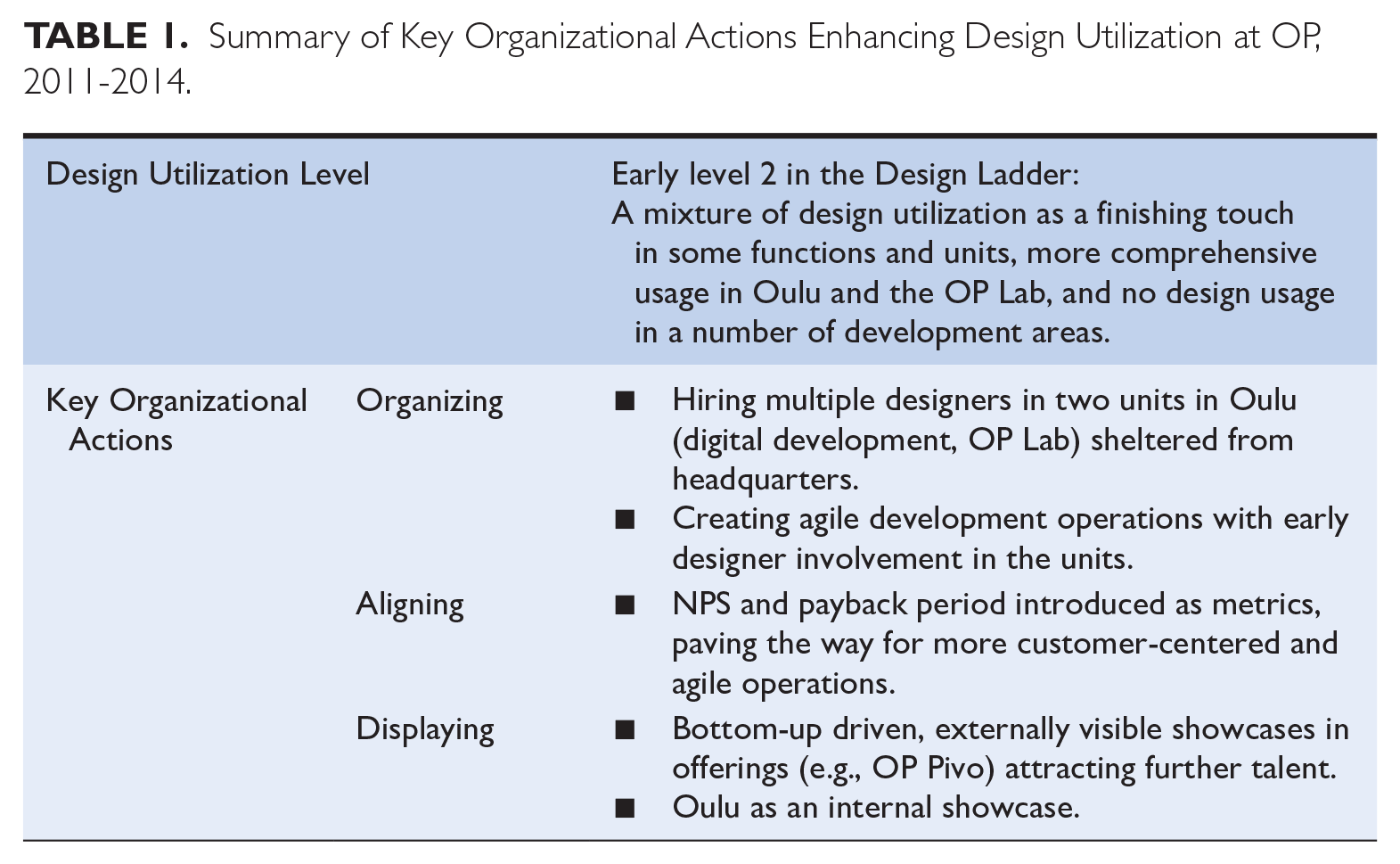
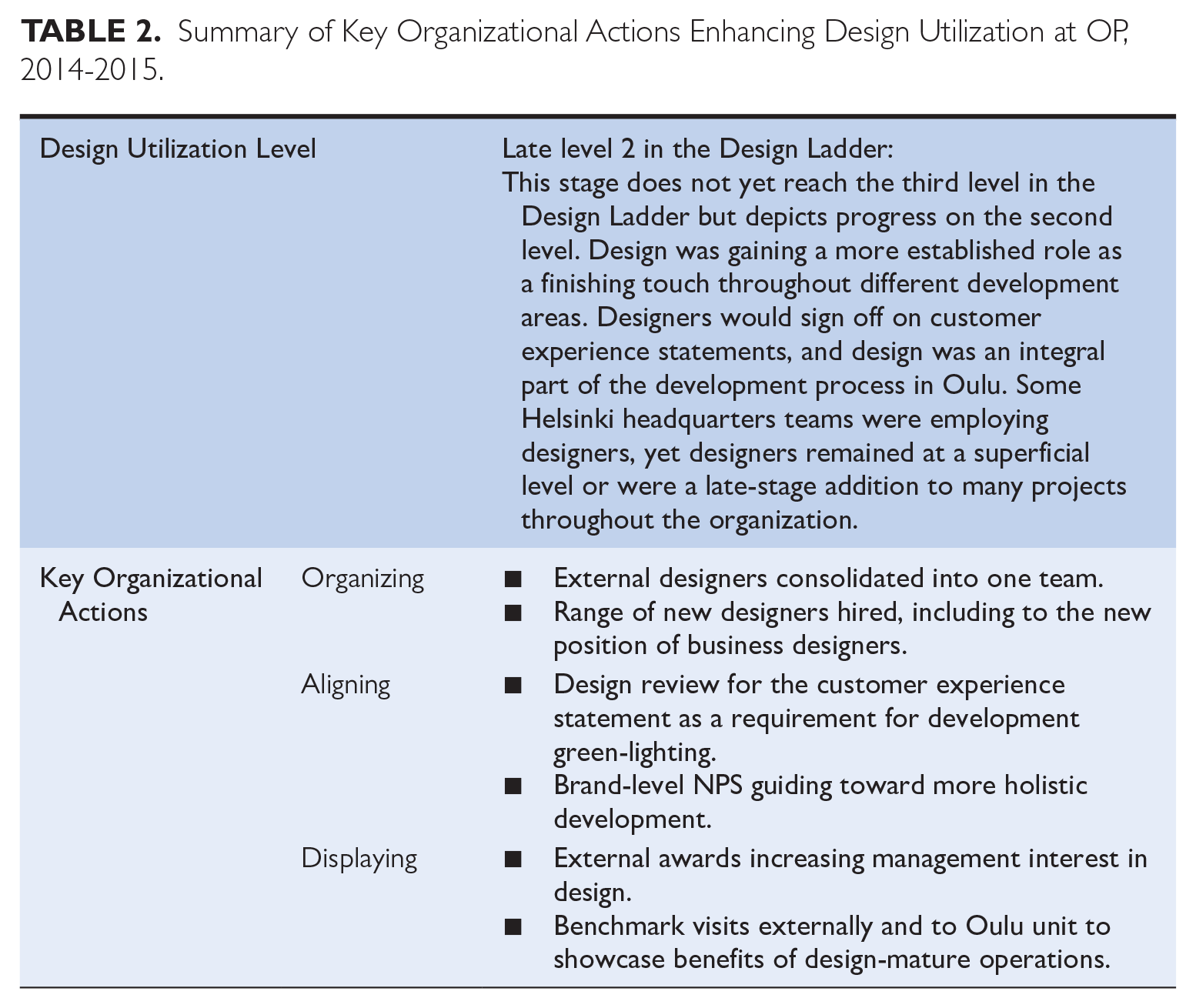
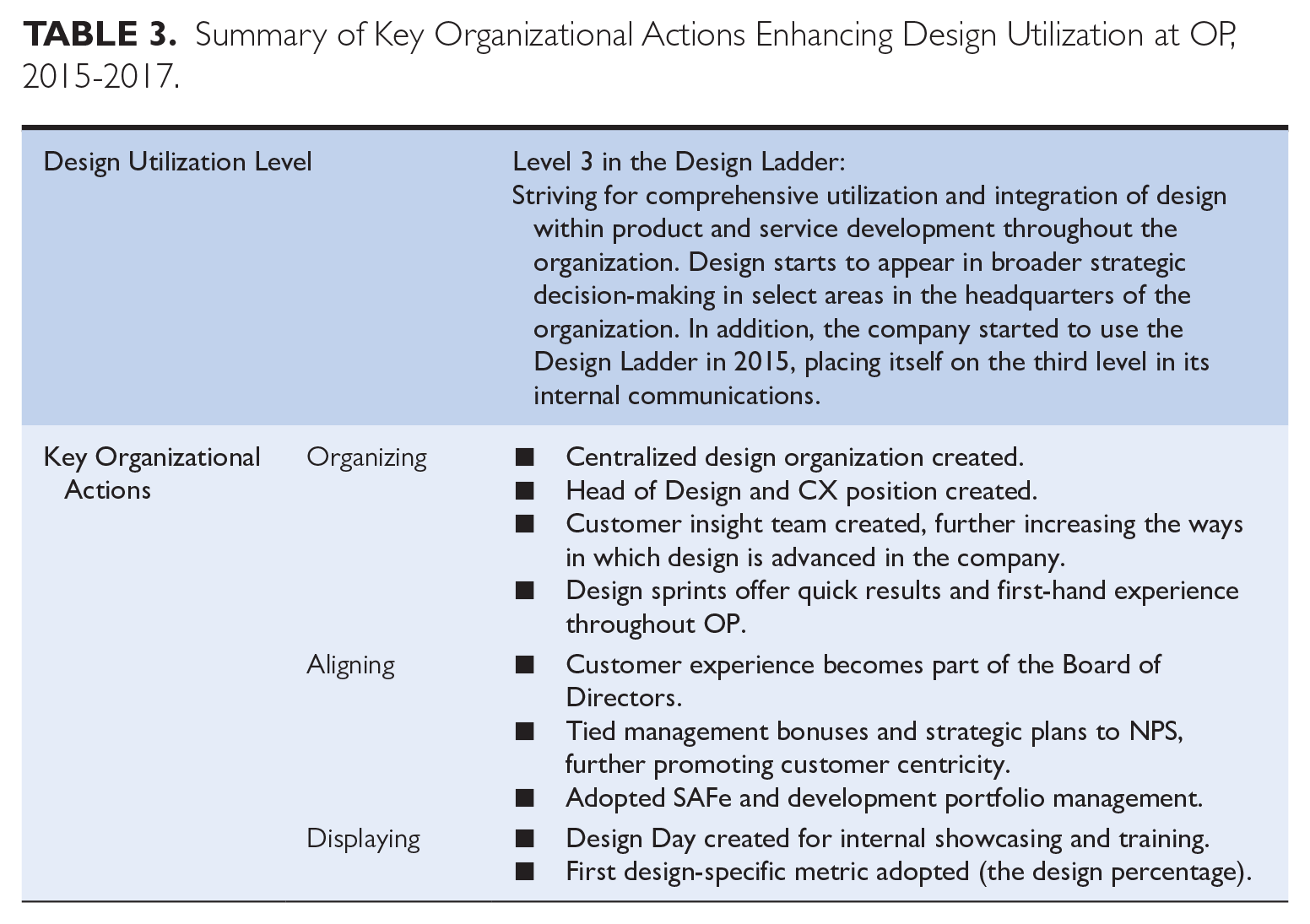
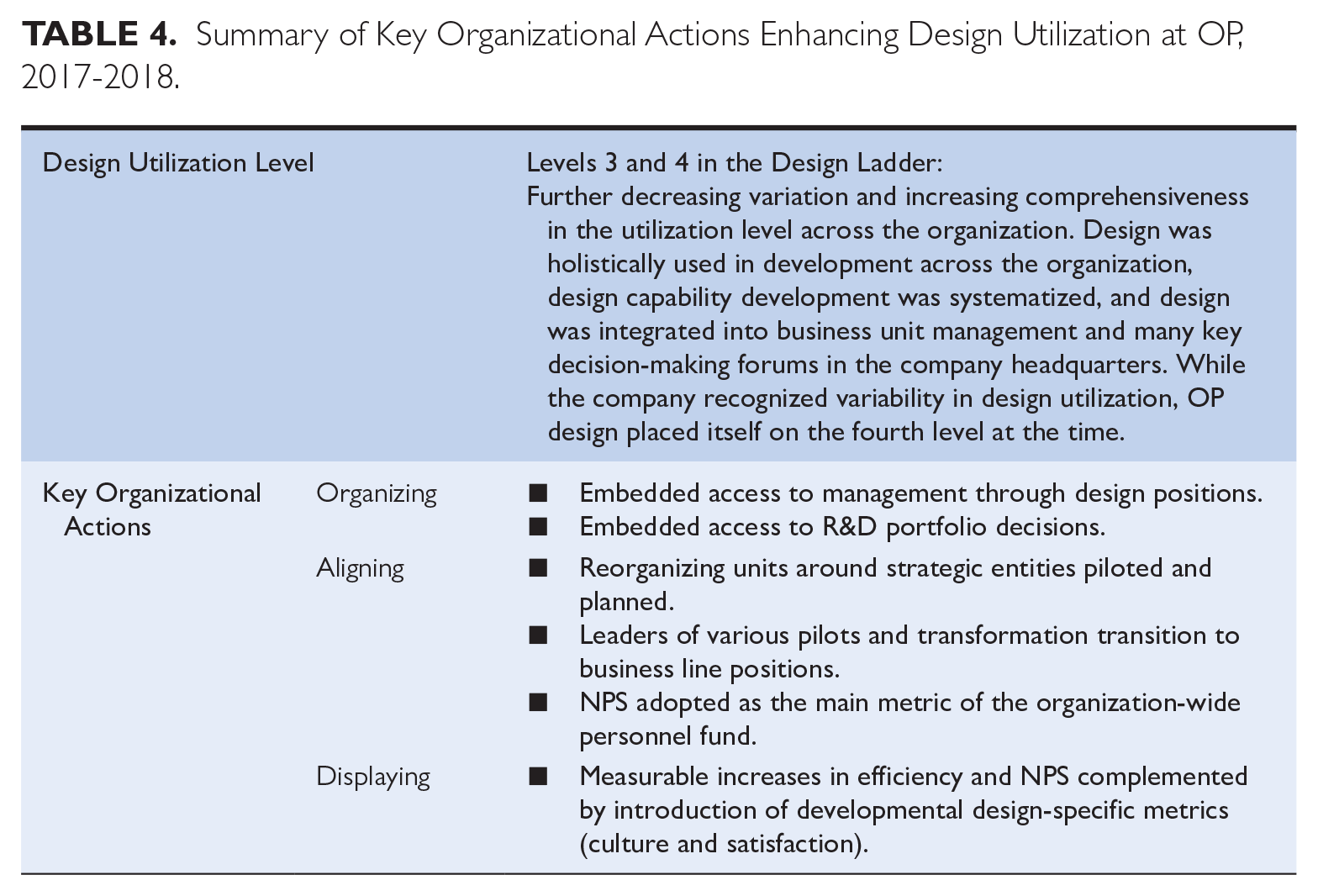
Examining the utilization of design at OP, we identified five distinct phases. Each phase displayed a range of organizing, aligning, and displaying actions that were taken in the company, but with different foci and relative emphases across different phases. Below, we describe each phase in more detail, and key actions are summarized for each phase of active design utilization in Tables 1–4.
Summary of Key Organizational Actions Enhancing Design Utilization at OP, 2011-2014.
Summary of Key Organizational Actions Enhancing Design Utilization at OP, 2014-2015.
Summary of Key Organizational Actions Enhancing Design Utilization at OP, 2015-2017.
Summary of Key Organizational Actions Enhancing Design Utilization at OP, 2017-2018.
Non-Design in the Organization: Starting Point in Technology-Driven Innovation
While innovations played a key role in OP’s activities, design professionals played no role in the development or launch of products and services before the study period. Development tended to be technology-driven and was based on waterfall projects, building on organizational understanding rather than originating from user or customer needs. Service design entered the discussion in 2008, which connected to customer needs. The conviction started to emerge that consulting customers before a single line of code was written would result in better products and services. This starting point matches the first level in the Design Ladder throughout the organization, with either no or only sporadic design utilization across different functions and units, and no in-house designers.
The Early Stages of Design as a Finishing Touch: A Tale of Two Cities
In the early stages of bringing design to OP, design started to gain a foothold in Oulu, a city of approximately 200,000 inhabitants in northern Finland and somewhat sheltered from the company headquarters in Helsinki. In 2011, Nokia, a major Finnish mobile phone and technology company, decided to shut down its offices in Oulu, 44 leaving plenty of mobile application expertise available. In response, OP established a digital development unit in Oulu, with mobile and web expertise at its core. The company hired ex-Nokia digital developers and its first in-house designers, mostly user experience designers and some service designers focusing on mobile and web development.
The Oulu subsidiary, some 600 km away from the headquarters, stayed under the radar and adopted new ways of working rooted in the experience of employees who had previously worked at Nokia. In the new unit in Oulu, which was less burdened by legacy practices, a cultural shift toward customer centricity and agility took hold, while product and service development in the Helsinki headquarters stayed technology-driven and in a waterfall model of development. As one interviewee recounted, It was understood in Oulu that it’s cheaper to fix things with an eraser than with a sledgehammer. Administration [there] was not allowed to prevent [design teams from] doing things. This was not the case in [the headquarters], where development was still done in the waterfall model, in the ways of the old world.
The company also established an innovation incubator, OP Lab, in Oulu with a few designers in the Helsinki area; the lab also flew under the radar thanks to its distance from other business units.
Different organizational subcultures also meant different timing and locating of design. In Oulu, designers continued to practice habits they had learned at Nokia. They were part of the development teams from the beginning, rather than being involved at the end (if at all) for fine-tuning user interfaces and visuals. Designers working together with digital developers accelerated development and increased customer self-servicing through digital channels. The number of users grew, and the user experience improved. An increasing number of business leaders in the company headquarters became interested in “the Oulu model” and saw the model as a proof of concept for the rest of the organization that designers are needed. Outside talent became interested in the company thanks to externally visible showcases deriving from the Oulu digital development unit and the OP Lab. As a result, OP attracted more designers and design-minded applicants. As one interviewee remarked, “One reason why I went to OP, or why I dared to go there so to speak, was that they had launched Pivo [a digital customer application].”
At the time, design was strongly connected to mobile and web development, and analytics within digital channels (e.g., active users, logins, unique users) can be regarded as the first attempts to measure the impact of design. Although the primary goal was to monitor service use and the related experience, OP did seek out correlations between analytics and internal actions and changes. In 2012, Net Promoter Score (NPS) surveys were introduced to measure the customer experience, representing a genuine leap forward in showcasing design impact and ushering in customer centricity. Soon, OP measured NPS in all channels, although only at the level of touchpoints.
At this level of design utilization in the organization, the emphasis was on organizing the design function locally, in a fertile cultural ground sheltered from the headquarters. However, even at this early stage, broader aligning and displaying actions helped enable organizing actions and create a foundation for subsequent broader organizational scope. Introducing new metrics and examples, as well as externally visible showcases, created internal demand for and understanding of design, paving the way to securing further resources (Table 1).
The Latter Stages of Design as a Finishing Touch: Taking Note of Design
In 2014-2015, the scope of design positions was expanded, and sourcing external design resources was centralized into one team (rather than all teams buying their own projects and resources). Managers saw design-centric benchmarks at visits and events, which made them interested in adding business designers to their teams, something seen as rare at the time. 45 Nine new design positions were opened during the summer of 2015 in business design, service design, and user experience (UX) design, planting the seed for an internal design agency team at OP. In particular, the presence of business designers helped to extend perceptions of design from user interface design to strategic design; business designers’ presence also increased the perceived business relevance of design.
In 2014, OP won national Grand One digital services prizes, and its Pivo mobile app was a Red Dot Design Award winner. This boosted internal interest in design. As one interviewee remarked, “CEOs live from the external world, external praise, and external attention—and I’m not talking about just [OP] but in business in general. That makes [external awards] important.” Overall, design at the time was still regarded mainly as a finishing touch and cost. “In banking, products and services were designed by engineers, during breaks between coding. When the customers complained that they were unable to use them, small, retrospective fixes were made to try and meet customers’ wishes,” one of the first Helsinki-based designers at the time explained. 46 Design was done if time and money allowed, but it was not viewed as indispensable to product and service development. This resulted in design being used in very few projects and being regarded as a luxury rather than a necessity. Whenever design expertise was wanted in a project, it had cost implications. This led to business unit representatives discussing the matter first and only bringing in designers when they needed concrete user interface diagrams. Occasionally, business unit representatives would bring in designers to create slides used to pitch a project to executives.
In 2014, OP also began measuring the customer experience at the brand level in addition to the touchpoints and service-use measures. A customer experience statement, signed by a designer, was introduced as part of internal quality assurance in the stage-gate development process: no project plans would be approved without it. This requirement helped create a customer-centric culture and position design as an important part of that culture. However, it is noteworthy that confirmation was sought from a specialist, rather than the customer directly, that a product or service met the customers’ needs. Business leaders from Helsinki headquarters continued to visit, enabling Helsinki to gradually adopt the agile and integrated Oulu development model. In OP’s design publication, one designer described the gradual learning among the business leaders in Helsinki: At the project’s kick-off meeting, someone asked, “What are designers doing here? The user interface design phase is still a year away.” At the next meeting, the designer presented a rough prototype, which sparked a positive reaction, leading to the adoption of a new, faster, and more experimental approach.
47
At this level of design utilization in the organization, organizational actions emphasized a combination of organizing the design function to expand access to design and displaying actions to broaden managerial interest in design throughout the organization. At the same time, organizing and aligning actions helped establish demand for further organizing actions and intensified the impact of design. Added structural elements scaled up interfacing opportunities through increased customer centricity (Table 2).
Design as an Integral Part of the Development Process: Multipronged Integration
A four-pronged organizational connection of design to strategic management started to emerge at the brand, innovation lab, insight, and customer experience (CX) teams, units, and leaders in the company. In 2015, while service channel development was customer-centric and mainly planned by in-house designers, large product and service innovations and business concepts deep within the business units were purchased from external providers. The head of design reflected that We realized that in-house design expertise was being used at the end of the development process, but most design done at the beginning of the process was outsourced. This was expensive, and too many concepts remained at the “great idea” stage, gathering dust in drawers.
48
The company viewed this imbalance of later-stage, in-house design and upstream, outsourced expertise as a brain drain. In 2016, OP decided to establish a Channel Experience Unit and created an internal design office. The unit was charged with creating channel-independent concepts. Later it was renamed to Design and CX, and the role Head of Design and CX was formed, further establishing the profile of design in the organization. National awards also continued to increase the visibility of design, which by then was connected to the organization’s transformation, both internally and externally. For example, the company won a media award for the 2016 Chief Digital Officer of the year and 2017 Grand One Organizational Renewal of the Year. In the C-suite, CX gained ground when the first the Chief Digital Officer and later the Chief Communications Officer were appointed responsible for CX in the company.
Cultural change toward customer centricity advanced because roles outside of design became involved in design-related activities. For example, OP adapted the Google Design Sprint framework and began testing it in selected projects. After the first sprint in May 2019 created a working, customer-tested business concept in three days, approximately 23-day sprints were carried out in autumn 2015. Business decision-makers joined in co-creation and customer validation, and word soon spread, further increasing interest in design. While the sprints were a success, they also clarified the need and built appetite for broader changes, with the Head of Design and CX reflecting that “the design sprints built understanding that adopting just one method will not [be enough to] address all problems and increase the design maturity of the organization.”
In late 2015, OP organized the first internal Design Day. This one-day internal training session on design thinking was fully booked in minutes and was later repeated twice a year for several years in a row. The C-suite was also becoming more interested in customer insight and measured customer experience, in part because it became possible to track brand-level CX relative to competitors’ as NPS data became available. That development, in turn, increased the perceived value of designers in the company. In 2017, a multi-professional customer insight team with design capabilities was formed, supporting increased customer centricity. A bold vision of design management backed the scaling up of OP’s design expertise and the rollout of its design culture: “We are transforming OP’s corporate culture from product and system-oriented to customer-centric.” 49
Overall, transitioning to more overarching, holistic structures in the organization created more space for design impact beyond individual projects in the company. On the customer-centricity side, OP created a ten-person matrix team focused on customer experiences, led by the brand director and reporting to the Communications Officer who had responsibility for CX in the C-suite. The team included members from design, customer insight, brand and HR. On the development side, similar silo-crossing resulted from transitioning to Scaled Agile Framework (SAFe) as a development model, introducing portfolio management. There were four portfolios, and while designers participated only in the implementation phase in three of these, in one of the portfolios, designers played an integral role in the analysis and review phase. As such, designers began to shape the development agenda, instead of just following it. Design influence started to expand from “how” to also “what” in the company. Designers were part of release trains and development teams, covering, at best, the whole range of product and service development from ideation to launch. Because design ways of working are inherently agile—including quick experiments, validation, and iteration—these changes also built the foundation for later adoption of enterprise-wide agile.
Finally, metrics for displaying and evaluating design impact were developed further. The new Customer Insight team harmonized the former NPS jungle, making touchpoint NPS more reliable. Brand- and touchpoint-level NPS was widely used as a basis for management bonuses as well as a metric for strategic goals. The company began to supplement user- and customer-focused metrics with internal design metrics to track reach, as the growing number of designers in the company led to a growing need to understand the scale and impact of their input. The company adopted the Design Ladder model to visualize the development of the organization’s design maturity and began to measure a design percentage. A design manager assessed development projects to determine the extent to which they used design from ideation to launch. The manager looked at project documentation, interviews, and tracking to make a simple used/not used distinction across projects. This metric showcased the rapid growth of design from just 10% in January 2015 to 39% in December 2015, to 78% by end of 2016. By 2018, the metric surpassed 90% saturation, indicating a wide integration of design into product and service development processes, and was then discontinued.
At this level of design utilization, the meshwork between the key organizational actions had expanded to many interrelated sequences, building on previous organizing, aligning, and displaying actions. In this phase, organizing actions expanded beyond the design function. Greater emphasis was put on displaying actions throughout the organization, to scale visibility, and on aligning actions, particularly to encourage management to integrate design into key structures and decisions throughout the organization (Table 3).
Design Distributed Widely in the Company: Consolidating Design in Business Decisions
In 2017, the centralized in-house design team was up and running, with designers working around customer-centric service entities. The use of externally sourced design expertise was rationalized, and partnerships with external design agencies were formed. One team recruited and outsourced all designers, systematizing competence building. In-house designers were increasingly embedded in business decision forums, R&D management teams, and development portfolio management, while external designers strengthened service and UX design competence. Access to management was crucial. One interviewee said, “they [designers] might sit there in the executive meeting silent for three hours but are ready to jump into the conversation when the time is right.” With this access, designers could make the judgment call themselves rather than only being invited to the table for limited topics. Designers thus began to demonstrate their skills and value beyond the preconceived roles of designers. Furthermore, a growing number of people that had been leading pilots and transformation efforts in R&D, CX, or Design started to become integrated into mainstream business unit management duties at OP, bringing with them the design mentality and spreading it across the company. Efforts were also made to increase management access to customers, for example, inviting managers to join customer interviews and data analysis.
With customer experience being seen as a driving factor for business, justifying and selling design internally was no longer difficult. Design reduced service development time and cost, as demonstrated by monthly tracking of feature turnaround time. In addition, internal satisfaction with the use of design at different stages of the development process was measured in quarterly surveys, and an organization-wide measurement of the maturity of OP’s innovation and design culture was piloted once. These measures complemented the steadily high NPS metrics, providing more information on how and where design capabilities and impact could be developed further. Non-designer interest in applying design methods and tools continued to increase and was supported with sprints, training, and events. The internal Design Day trainings, in particular, provided a face for those succeeding in design, helping to consolidate the largely invisible layer of non-designer design activity in the company. While insufficient for translating immediate interest into organizational change on their own, these events contributed to the foundation of cultural change at OP. In 2017, touchpoint- and brand-level NPS became key metrics in employee evaluation, incentivizing all 13,000 employees to become more customer-centric.
Designer involvement in strategy was particularly evident in planning a reorganization of OP. Following the 2016 OP strategy, the company advanced plans for reorganizing around strategic service entities in 2017. The strategy was to evolve from a finance business to a customer-centric service business, and OP communicated the strategy widely, including in leading professional publications. Strategic service entities provided a logical basis for categorizing and grouping products and services in a more customer-centric way, promoting thinking across business boundaries. Designers and management participated in a series of workshops intended to transform the way business was led, but implementation of these plans was later revised in a leadership change. Design was positioned closer to top management, and for example, created company-wide mappings of existing services and needs for upper management.
At this level of design utilization, organizational actions to enhance design emphasized alignment, which was enabled by organizing design for sustained access and demonstrating its effectiveness. Furthermore, aligning actions broadened from development, customer, and management structures and practices to the organizational structures and incentives at large (Table 4).
Implications for Managers: Extending and Intensifying the Use of Design for Organizational Change
While previous studies and design management literature have identified different stages and contextual factors supporting the utilization of design in organizations, 50 the current case study sheds light on the process of how different organizational actions and their interrelations contribute toward enhancing the utilization of design. The results highlight how the change process at OP relied not only on the actions of designers or top management but—similar to findings by Sahakian and Ben Mahmoud-Jouini 51 —was also the sum of efforts in different parts and positions at the organization to organize, align, and display design. In doing so, we complement previous studies on the balancing acts leaders need to engage in to navigate the integration-differentiation paradox in scaling design. 52 We shed light on the holistic nature of complementary, interconnected organizational actions to extend design utilization in organizations. We could see a virtuous meshwork of action among:
Organizing actions that consolidate design and establish spearhead units and positions to intensify the impact of design.
Aligning actions that connect design to the long-term strategic priorities of digitalization, customer centricity, and agility efforts in the company and extend the foundation for design impact by advancing the integration of these into the processes, structures, and metrics of the organization.
Displaying actions that show the impact of design to attract further interest and spur change.
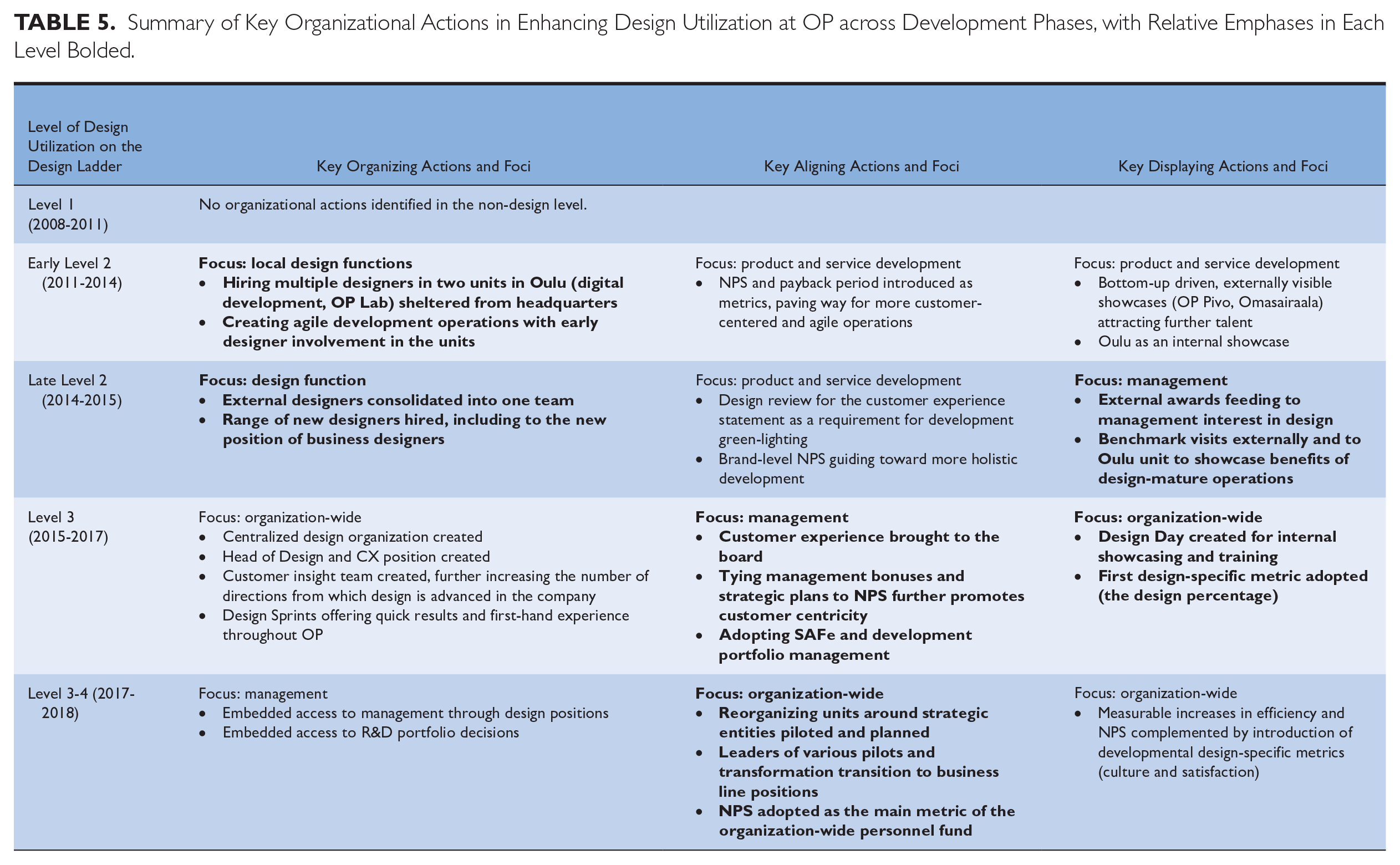
These three activities act together, supporting each other in elevating the impact of design but with different emphases and scopes at different levels of design utilization, as can be seen in the case of OP Financial (Table 5).
Summary of Key Organizational Actions in Enhancing Design Utilization at OP across Development Phases, with Relative Emphases in Each Level Bolded.
Organizing Design to Intensify Its Impact
Organizing activities have often been examined in studies on scaling design and viewed as a balancing act in simultaneously integrating and differentiating design. 53 Viewed in isolation, the current study echoes previously found shifts from first focusing more on the design function and differentiation to then reorganizing for a more integrated role for design in the organization and a greater emphasis on more extensive levels of design utilization. 54 However, examining organizing actions together with aligning and displaying actions offers novel insights into how such a transition can be enabled. Organizing actions in the current study highlighted creating conditions where design had sufficient intensity to create impact. At first, design was sheltered in two separate units; later, design consolidated and spread throughout the organization once the number of designers grew, instead of being distributed throughout the organization right away. Change agents were first concentrated in areas where parts of the organization were actively seeking the benefits of elevating design. As a result, multiple, cascading messages increased the likelihood of design taking a hold 55 because the initial organizing actions created a foundation for subsequent displaying actions to support further organizing. In the case of OP, repeated re-organizations of the design function were required to match evolving needs and opportunities in increasing the impact of design. First, design was adopted in two units on the second level, followed by consolidating external design, and then consolidating all design on the third level of the Design Ladder. Having more than one design-intensive unit—first, the Oulu digital development and the Innovation Lab, later the design unit, the customer insight unit, and the champions in R&D and brand—also enabled cascading messages upward in the organization, amplifying the voice of design.
Organizing the design function and making it visible has long been recognized as important, typically discussed in terms of design management. 56 However, the current study also highlights the impact of establishing specific types of design roles as an organizing action. The importance of a design lead and internal design agency aligns with design management literature, 57 and it’s important to pay attention to the establishment of business designers that spread the ownership of design into the core business development processes and brought new competencies within service design ways of working. Here, the job profile, rather than hierarchical positioning, created new access points for designers in the established forums of company decision-making, enabling OP to move to distributed access on the fourth level of the Design Ladder. This move was, in turn, possible because of the long line of aligning actions that created fertile opportunities to make design part of such decision-making. These relatively modest and grassroots investments within the company emphasize the role of organizing actions in effectively targeting design resources for impact as opposed to acquiring and growing expertise or consolidating resources (for instance, in a center of excellence) as previous studies imply. 58
Organizing design around the right issues in the right places—Key questions for leaders to consider where design can have the most impact
Where can you provide sufficient operating room and scale for design to have an impact? In the early phases of bringing in design, this may require pooling resources and sheltering design from incompatible organizational practices.
What kind of roles can gain traction and access for design in the organization? Moving to more comprehensive or strategic usage of design may require job redesign or creating new roles to capitalize on the value of design and link it to other operations of the organization.
Where can spearheads of change be identified, and how can they best be pushed forward? It is important to find change agents and champions in different business units and organizational levels.
How can the designers in the organization benefit from one another? Different configurations and policies of the design function may be called for supporting sharing across designers and consolidating their impact in different stages of design maturity.
Aligning Actions to Extend Design Utilization with a Compatible Foundation
While designers advocated for aligning actions at times, it is noteworthy that these actions were targeted at non-design and broader structures and that non-designers played key roles in advancing these actions. 59 Previous research has emphasized integration in the sense of creating direct interconnections between design and other organizational processes and decision-makers, and the research illuminates such actions. 60 The current study complements this work by shining light on the importance of aligning actions that create indirect interfaces between design and various parts and processes of the organization. Such aligning actions both prefaced integration actions to create fertile ground and capitalized on their success to create further demand and safeguards. These activities may be particularly important for creating resiliency, and the current results highlight how such efforts contributed to and enabled advancing design from the early phases of OP’s transformation. Indeed, Nusem, Wrigley, and Matthews 61 identified the limited staying power of design in the organization as a challenge, suggesting a fifth step to the Design Ladder, where “design utilization is identical to the fourth stage, only with additional safeguards.” The case of OP emphasizes how organizational actions required for such safeguards trace back to activities pursued during lower levels of the ladder.
Of note, aligning actions were crucial for but not focused on design. Alignment targeted a variety of broader business goals and processes, creating opportunities for design to interface with the organization. In the case of OP, process, organization, measurement, and incentive changes for more agile and customer-centered operations all paved the way for demand and space for design utilization. Brand, R&D, CX, and digitalization executives were key allies for designers in the change process, seeking similar changes in the organization even if rooted in different perspectives. Indeed, past research demonstrates a wide variety of potential compatibility in allies 62 and the benefits of piggybacking on other issues in selling change. 63 In particular, the overall restructuring of the development process, albeit beyond the control of designers and design managers, played a large role in creating opportunities for designers to demonstrate impact as well as to join in more upstream decision-making. Similarly, moving from the third (design as process) to the fourth (design as strategy) step on the Design Ladder without taking steps to de-silo the organization would have been difficult even with a range of organizing actions. This finding contributes to the design integration literature by underscoring organizational action taken beyond the control of design and designers as key to organizations’ ability to extend the scope of utilizing design. This finding also raises questions about the sufficiency of the dominant view that design teams, design managers, and the creation of widely compatible expertise are the conditions that make an organization capable of utilizing design widely and deeply. 64
In the case of OP, important drivers for design emerged early. Continued commercial and competitive successes of service design, and the associated drive toward customer centricity, became equated with design. The gradual formalization of the customer focus—including the customer experience statement, tests, and other measures—bolstered design, expanding the demand for design throughout the organization. Establishing a customer insight function supported designers with current and topical customer understanding and thus increased the performance of designers. Whereas top management support and internal design promotion are well recognized in design management, 65 the OP transformation journey underscores the importance of incorporating design into other fundamental business operations, including in this case, customer focus and the overall transformation of the company’s R&D function. Identifying and reaching relevant people across the company and making design relevant to them facilitated and improved the incorporation of design into company operations and decision-making. Such a broader perspective in effect sidesteps the integration-differentiation paradox. While design leaders may need to perform a balancing act themselves, 66 other leaders may not face such a choice. Aligning action can provide both/and opportunities for design allies to advance their own agendas while creating opportunities for extending the impact of design.
Weaving design into the organizational fabric—Key questions for leaders to consider where and how design is best aligned with other operations of the company
How might you leverage arguments and approaches that already fit into your organization to extend the demand for and impact of design? Consider where organizational values, traditions, and initiatives currently align with design to identify allies and points of leverage—and start identifying these points when your organization is at lower levels of design utilization.
What are the key forums and other parts of the organization that design should be integrated into? Interfacing actions help coordinate design efforts beyond the design workforce.
What needs to change for design approaches to be compatible with the organization? Higher levels of design utilization cut across the organization, so changes might be needed in, for example, development processes or organizational structures to create alignment and resiliency.
How can design be redesigned to make it compatible with the logics and instruments of business operations that benefit from it? Consider how to adapt the processes and outputs of design to best serve different business operations. Adopt terminology that resonates in the organization to help position design and designers.
Displaying Design to Capitalize on Achieved Impact to Spur Further Change
Unlike aligning actions, displaying actions were specifically focused on design and were typically advocated for by designers and various leaders at OP. Displaying actions highlight the active efforts required for the diffusion of design, as neither the results, processes, nor opportunities of design travel in the organization of their own accord. 67 Indeed, Micheli, Perks, and Beverland 68 emphasized the need to generate awareness of the role and contribution of design to elevate it in an organization. We provide further insight on the variety of these actions and highlight the key connective role they play in the transformation process. These actions capitalize on the impact that organizing and aligning actions enable, thereby spurring further change. Organizing inspiring internal design days, organizing evidence, entering and winning competitions, and displaying top management support for design were pivotal in justifying the investments in design and the reorganization necessary for design to be utilized. In the early phases of design utilization, displaying actions focused on internal showcasing and leveraging external recognition of the results. These displaying actions were enabled by earlier organizing actions to spark and increase interest in design and pave the way for integration and further investment in design. It is noteworthy that the displaying actions emerged both from the top management as well as from the designers, and over the years also increasingly from the middle as metrics began to play a larger role in displaying actions.
Indeed, metrics and measurable targets are essential to running a business and were prominent in both aligning and displaying actions. While aligning actions focused on broader, aligned metrics that helped to create demand and staying power for design, displaying metrics linked to design per se enhanced the importance of design. Here, the results suggest that a mix of external and internal metrics is needed to support the elevation of design 69 and that this mix is likely transitional in nature. At OP, design’s alignment with customer focus favored NPS as the early external metric, but in just a handful of years, it became overused and saturated. The internal metric of design percentage worked well at the second level of the Design Ladder, but it also became saturated at the third level. At the fourth level, feature turnaround time, satisfaction with the use of design in different project stages, and gauging the culture of customer centricity in the company were introduced together with trials of other metrics. The implication here is that any one metric is not better or worse per se. Instead, a metric’s adequacy rests on the alignment of design with the company’s broader strategic targets, contingencies in what metrics become popular, and the internal trajectories of a given metric’s use. At the same time, while initial displaying actions emphasized showcases, moving to more extensive levels of design utilization required more systematic and quantitative evidence in the form of metrics to attract and justify further organizing actions.
Capturing hearts and minds—Key questions for leaders to consider how the value of design is best displayed
What mix of channels and measures creates the greatest and fastest awareness of design and its value within the organization? Displaying design both internally and externally synergistically creates traction for design utilization.
What are adequate ways to set targets and measure the value of design and its use in the organization at different levels of design usage? As the use of design becomes broader and more elevated, the need for metrics changes. As such, decisions about metric use need to be revisited to ensure metric effectiveness.
How can you engage and get the attention of key decision-makers and allies at different levels of design utilization? Providing experiential connections and contextualizing performance can help to spark and deepen interest in design.
How can you best tailor the messaging on what design is, what value it brings, and what actions are required to deliver that value to different organizational functions? In addition to organizational storytelling, adding design and customer experience metrics to balance scorecards that already include business metrics can focus organizational attention on supporting higher levels of design utilization.
The Meshwork of Organizing, Aligning, and Displaying Actions
Our organizational action perspective highlights that design maturity does not materialize by its own innate force nor from any one line of action the organization should pursue. Instead, our organizing, aligning, and displaying meshwork model (Figure 1) shows that the interplay between such organizational actions supports a gradual widening and deepening in the utilization of design and in realizing ever greater value from design operations. Our core finding is thus that the types of organizational actions we identify in this study should be tactically planned and coordinated such that one action type can support another and enable further actions.
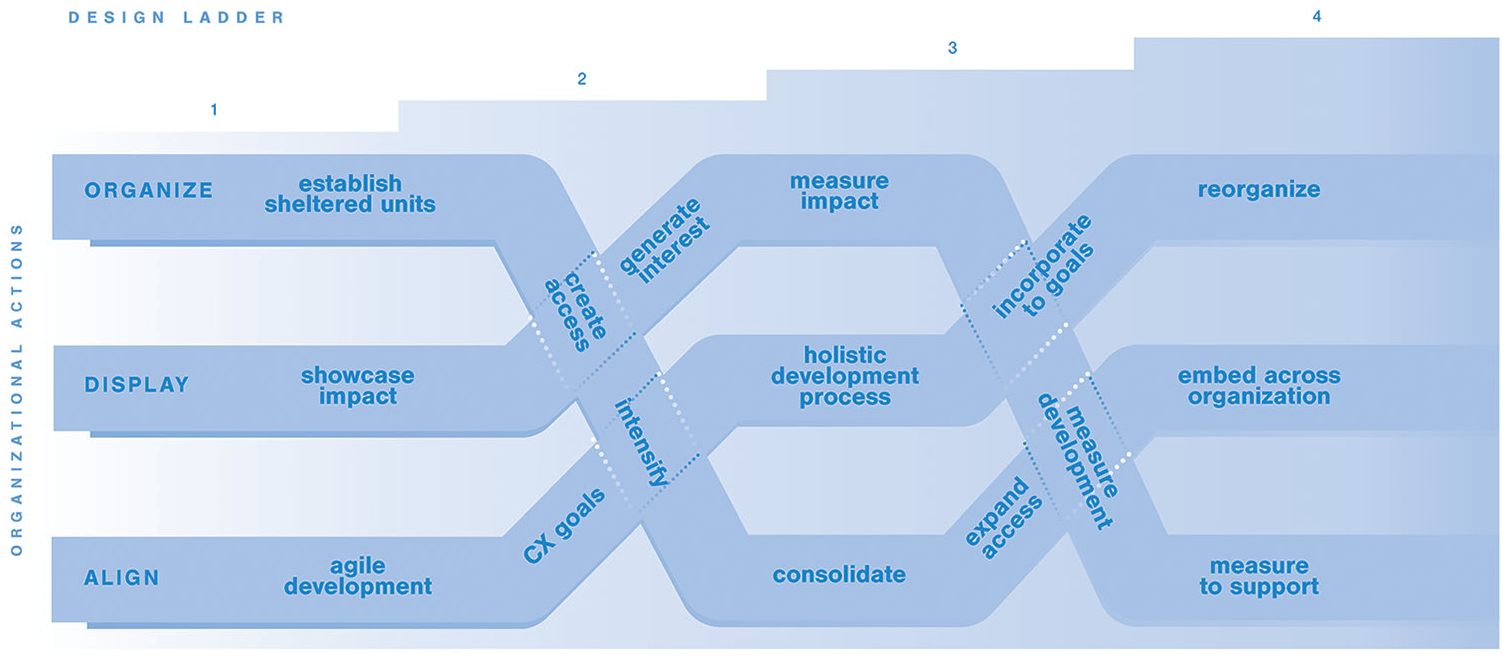
Extending design utilization through the organize-align-display meshwork of intertwined organizational actions supporting each other in the course of the change process.
While many previous studies highlight the need for design leaders to navigate the integration-differentiation paradox through a balancing act of just the right levels of, for example, design centralization and distinctiveness, 70 the current study suggests this type of navigation of the paradox is less prominent on the organizational level. Instead of needing to optimize limited output, as within the level of the design function, the organizational level of the design transformation at OP Financial highlights the importance of combinatory actions—the both/and nature of the organizing, aligning, and displaying actions that create synergies across design and non-design actors, practices, and processes. Multiple actors and processes were involved in these actions, showing that having more of one does not create an imbalance or limit the effectiveness of other types of action, a finding that stands in contrast to the opposing poles in balancing actions. However, the results suggest that the absence of one type of action will constrain the others, limiting the demand, access, and effectiveness of actions taken. As such, the results extend previous research on organizing the design function or capability 71 by illuminating how aligning and displaying actions connect, constrain, and catalyze design organizing actions, and vice versa, on the holistic level of organizations at large.
Furthermore, the meshwork model contributes to understanding how such integrative synergies can be sought at different levels of design utilization. The case of OP Financial suggests that, at lower levels of design utilization, transformation efforts are well served by building momentum by initially emphasizing more local and focused design organizing, and then complementing those efforts with targeted displaying and aligning actions to create a foundation for demand. As initial results are showcased, the emphasis shifts more to a combination of organizing and displaying to create further access, supported by a combination of aligning and organizing to start scaling impact. This creates the foundation for more organization-wide, multipronged efforts and emphases, and a growing focus on aligning, first in combination with displaying actions for strategic actors or parts of the organization, and later throughout the organization as access and mandates are consolidated through interconnected actions. Thus, while organizing, aligning, and displaying actions are interconnected throughout the transformation process, their relative emphases, scopes, and intersections shift in order to leverage progress already made and to build a foundation for further utilization.
Conclusion
Examining the long-term development journey of OP Financial Group, a major financial services organization in Finland, we find synergies across a range of interconnected organizational actions in deepening and widening the use of design. While earlier works offer a good basis for approaching design capability development, the current organizational action framework highlights concerted efforts throughout the organization that build design utilization, leveraging and relying on both design capabilities and other capabilities connected to innovation, customer understanding, business creation, management, and so forth. As such, the organizing, aligning, and displaying actions meshwork framework can be particularly helpful for design managers in search of allies and champions, as well as non-design managers keen to benefit from design capabilities.
In the current study, displaying actions pursued through several different channels from the grassroots and top management helped design to be heard more widely in the company and create demand for the capability. Meanwhile, the more gradual and concentrated actions in aligning design ensured its relevance and deeper personal appraisals of its merits, gradually increasing the compatibility of design with organizational routines and structures. The organizing actions, in turn, gradually expanded design across different operations and their different logics, concentrating resources in a manner that could quickly make an impact with relatively few resources. These actions then paved the way for wider-ranging integration efforts by leveraging displaying and aligning actions to create further access. Together, these three sets of actions produced a meshwork of rapidly widening awareness of design and its value, and deeper engagement with design in different operations and divisions with different organizational logics. The meshwork elevation of design also made design increasingly resilient because design had not just many, but many kinds of carriers in the company. Gradually, design became part of everyday routine, which resulted in more deployment of design.
The study suggests that extending the impact of design requires a suite of organizational actions that work in concert with one another. Past research has produced a wealth of insights into design management and the cultural tensions that can emerge between design and dominant organizational approaches, as well as the constituents of design capabilities. 72 The current study highlights the need to consider organizational actions as a dynamic meshwork beyond the capabilities built by and in design teams and managers. The organizing, aligning, and displaying actions framework can help leaders identify, build, and leverage synergies available at different design utilization levels.
Footnotes
Acknowledgements
The authors thank Liisa Säkkinen and Mari Kiirikki for access to the 12 interviews they conducted at the case company, as well as Anna Kuukka for helping to create the visualizations of the study. In addition, Tua Björklund thanks Emil Aaltonen Foundation.
Funding
The author(s) disclosed receipt of the following financial support for the research, authorship, and/or publication of this article: This research has been funded in part by a research grant from the Emil Aaltonen Foundation.

Notes
Author Biographies
Tua Björklund is an Associate Professor at Aalto University and the Director of the Design Factory co-creation platform in Finland (email:
Pia Hannukainen is the Head of CX, Digital Channels at OP Financial Group, having previously worked as the Head of Customer Insight and Head of Design at OP (email:
Tuomas Manninen is the VP, Brand & Customer Experience Design at Finnair, having previously worked as the Head of Design and Customer Experience at OP (email:
Sampsa Hyysalo is a Professor of codesign at Aalto University and head of research at the Department of Design (email: