



Abstract
Although agility is often associated with rapid speed and flexibility, having processes for “deep reflection” is also crucial. This includes the need for collective dialogs across and outside organizations to build greater awareness of, and attention to, strategic issues. How do managers involve a wider range of stakeholder voices in strategy as they pursue agility? This article identifies three practices that synergistically contribute to agility and conceptualizes them in a framework for managers called the “Strategy Making as Polyphony Wheel.” The work outlines several implications for managerial practice and research.
There are numerous examples of this occurring in organizations from different industries and sectors. For example, IBM has drawn much attention for its “Strategy Jams,” which have brought together IBMers and external stakeholders (including suppliers, customers, and partner organizations) to discuss strategic issues. 6 Ericsson’s “Strategy Perspectives” online community is being used to generate and share various perspectives on strategic issues that can generate articulation and reflection on strategy. 7 Wikimedia has long used its “Movement Strategy” initiatives to generate content for new long-term strategic plans and direction setting. 8 Furthermore, Adidas’s “Business Logic” strategy workshops brought together select employees and external experts to discuss how to strategically deploy new technological capabilities for production processes. 9
The role of multiple voices and their input into strategy making has been widely discussed. For example, work on strategic agility has emphasized high-level capabilities such as co-strategizing processes, and having quality internal dialog about strategy, as enablers for sharpening strategic alertness and allowing organizations to feed dialog into organizational learning and decision-making. 10 Having collective dialog around strategic issues is, in this sense, a pathway to agility. 11 Furthermore, work on the “opening” of strategy 12 has emphasized how organizations are including a wider range of stakeholders in strategy processes and are being more transparent in sharing strategic information. This work has done much to promote different practices of inclusion and transparency in organizations. However, bringing together these streams to provide a detailed account of how specific practices of managers contribute to the agility of organizations is an important next step.
There is a need to better understand how managers leverage “polyphony” for agility. The microactivities and capabilities that underpin agility are numerous and multifaceted. How do managers involve a wider range of stakeholder voices in strategy as they pursue agility? The notion of polyphony is used here as it accentuates focus on what is mutually important in the streams of the literature mentioned above. Leveraging multiple voices is now an imperative feature in strategy making.
Prevailing Perspectives on Agility and the Role of Reflection and Dialog
There is no agreed-upon definition or theory of agility in organizational and management literature. The importance of flexibility, adaptability, and speed, which are often synonymous with agility in organizations, have long been emphasized. For example, Peter Drucker argued that dynamic organizations rely on foresight where elaborated forecasting provides a better idea of what their future strategic imperatives might be. 13 Agility is often seen as a differentiator for organizations, especially in dynamic or volatile environments. 14 In a similar vein, the literature has positioned agility as an essential ability for organizations to quickly or reflectively adapt to discontinuities and take advantage of emerging opportunities 15 when considering the increasingly rapid transformation and uncertainty of the business environment. 16 Essentially, organizations need to combine foresight with insight as they pursue agility. 17
This emphasis on insight demonstrates the importance of deep reflection, and agility has multiple dimensions that go beyond the need for greater speed and flexibility. This “agility as slowness” perspective argues that fast speed is not always advantageous and can even have detrimental effects on organizations and their performance. However, works that explicate the role of reflection remain nascent and understudied in comparison to those that align agility with speed and flexibility. The role of reflection is burgeoning, but it does still require further exploration. 18 For example, works on strategic agility have mentioned the importance of strategic sensitivity. 19 Essentially, they explain that having an ongoing dialog with stakeholders about strategy is an important consideration for agility, as it will help to sharpen strategic alertness and allows organizations to feed outputs from dialog into organizational learning and decision-making. 20 Following these evolving views, agility stands contrary to views that it requires radical and quick change. 21
Another area of research that can help us to understand more about the practices used by managers to leverage polyphony for agility is work on “open strategy.” Specifically, this openness implies that strategy making is now more focused on inclusion and transparency for stakeholders, both internal and external to organizations. 22 Stakeholders who are not typically involved in strategy making are being given the opportunity to contribute to strategic development, implementation, and/or decision-making. 23 This stream of work has done much to unpack and guide understanding about how managers demonstrate inclusion and transparency in strategy making. 24 Organizations’ openness in their approach to strategy can have various manifestations and conditions for use. 25 A 2011 interview as part of the “Rethinking Leadership” series for Forbes highlighted that rising levels of participation in strategy making were becoming increasingly prominent and necessary due to notable driving forces. In particular, these forces relate to changes in organizational structures, social-cultural norms, and technological developments. 26 This openness, in turn, affords managers novel opportunities to create a feeling of community or “energy” across and outside their organizations. 27 But openness also needs to be treated with caution and used appropriately. 28 While this work offers promise in diving deep into the practices and processes of strategy making, it lacks emphasis on the role of open strategy in relation to deep reflection and as a pathway to agility.
Agility is about more than having greater flexibility and speed, it is also about reflection and dialog. This perspective can help guide our understanding of how organizations encourage and enable “strategic sensitivity” and openness in strategy making in their pursuit of agility. 29 Specifically, this involves the practices used by managers to involve multiple voices as part of their aim to be more agile.
Project Background and Method
The research and iterations of the framework were developed from 2014 onward. An exploratory research design was adopted to study the guiding research question, and the research draws on insights from 39 different organizations of varying sizes from the private, public, and third sectors and from several industries. Details about the organizations are shown in the findings; the names of some organizations have been anonymized. A mixture of primary and secondary data concerning the practices of managers was collected from these organizations. This study followed a purposive sampling approach to collect data, which enabled the choice of appropriate case organizations and participants based on the qualities that they possess. 30
Academic literature was reviewed to form a theoretical background for this study, and this was cross-referenced with emerging evidence by conducting background research using numerous secondary sources. Opportunities to collect primary data were presented through author networks and through involvement in ongoing research and consultancy projects. One way to further explore the knowledge and experience of selected stakeholders was through in-depth semi-structured interviews. These were conducted, where possible, to refine the phenomenon and to ask questions of those involved in relevant initiatives to better understand the intricacies of their managerial practices. 31 This led to further opportunities to observe strategy making in several of the case organizations, which also involved access to some of the platforms used for strategy making, as well as access to strategy meetings and workshops.
Managerial Practices for Engaging, Harnessing, and Integrating Polyphony
This research has identified three practices to show how managers leverage polyphony. Tables are used in this section to show an overview of the collected data, with select examples expanded (e.g., by using quotes from participants from interviews and archival data) to show illustrations of the three practices in more depth. Many of the organizations in this study demonstrated more than one of the practices, but to keep the tables concise, organizations are only shown in one of the tables to offer illustrative insights from across cases.
Engaging Multiple Voices around Strategy Dialog (Engaging Polyphony)
Engaging multiple voices around strategy dialog (or “engaging polyphony”) is an important practice through which managers can sensitize and educate wider stakeholder groups on the strategy of an organization so that they can be more alert to the changes in their environment. This includes providing updates on strategic information, priorities, and programs and can occur through various mechanisms (such as being hosted on internal web pages in organizations, shared through internal communication channels such as email or corporate blogs, or through external channels such as social media platforms). In sharing such information, managers can also provide a clear rationale for strategic decisions, as well as clarity or justification for future actions of their organizations.
Examples of engaging polyphony as a practice
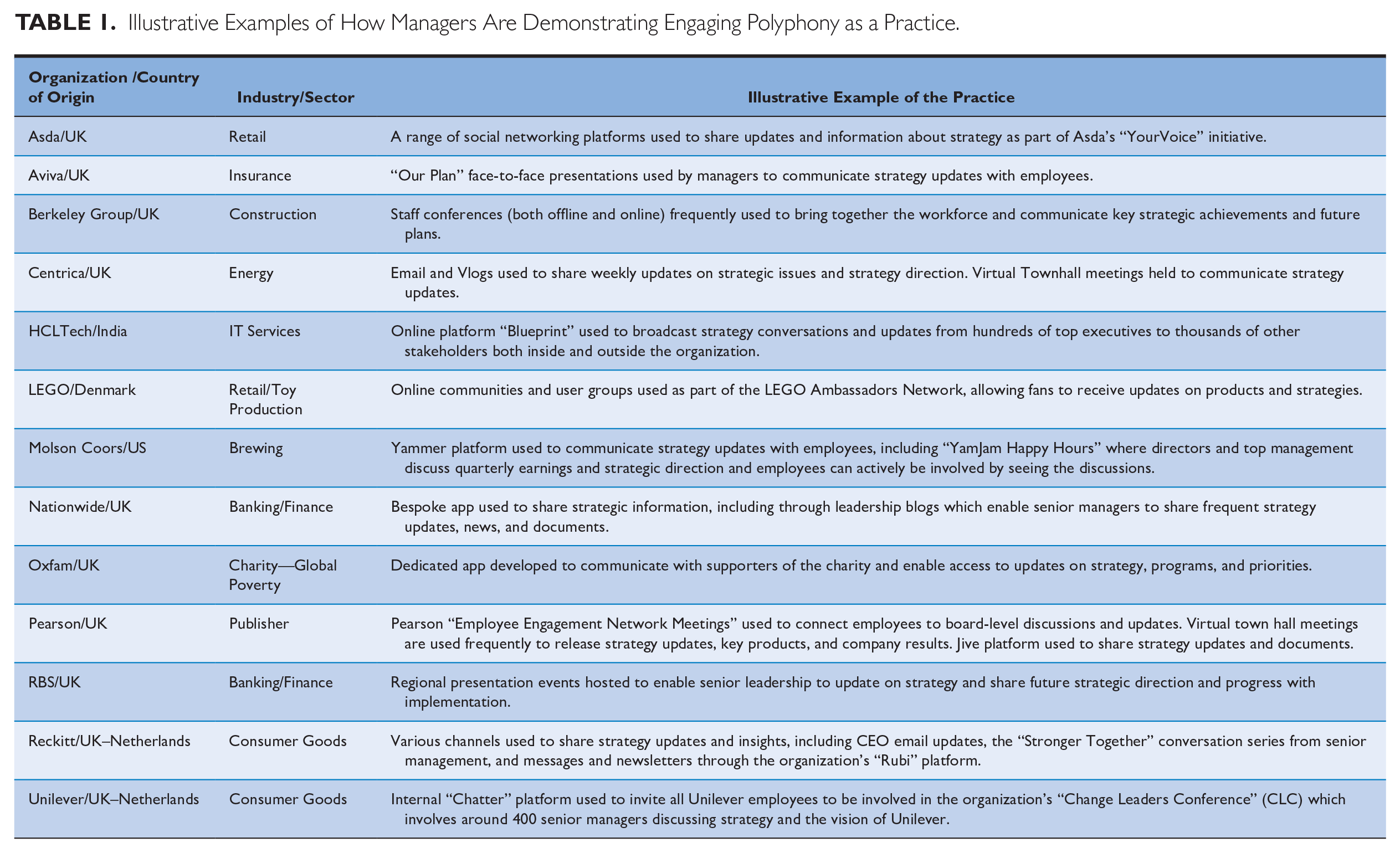
There were various examples of this practice in the collected data. This showed a primarily asynchronous method of engaging multiple voices around strategy dialog. For example, Centrica has used different channels internally to ensure employees are kept updated on strategy. The energy market in the United Kingdom has been rife with turbulence in recent years due to geopolitical concerns and subsequent rises in wholesale and consumer energy prices. Engaging represents a form of agility where managers can share information on such issues and their strategic responses. Regular email communications and top management vlogs have been used by Centrica to share weekly updates on strategic issues and strategy direction, while the CEO has shared various updates on “longer-term growth strategy.” In a similar vein, uncertainties have been prominent in the banking sector with market turbulence and competition from challenger banks. U.K. financial institution Nationwide is another example where engaging polyphony was used to share information and updates about strategy to employees, including through a mobile app and “leadership blogs” where senior managers share updates through frequent posts. A manager involved in this initiative stated that “we are able to get all sorts of information sent out of the app, quickly and easily . . . the business world has changed and so have the expectations of our people [to know more about strategy].”
There were more comprehensive examples of engaging that involved managers using channels such as face-to-face presentations, workshops, and virtual town halls to broadcast live discussions and updates about strategy. For example, the fast-moving consumer goods firm Unilever has long focused on its sustainable development plans as a key part of its strategy and as a route to competitive advantage. Unilever has opened its Change Leaders Conference, which has enabled upward of 400 managers to discuss strategic issues related to sustainability goals and other concerns in a more collaborative and open way. The conference is then broadcast through Unilever’s internal social collaboration platform “Chatter” to Unilever employees worldwide with the aim, according to a Senior Internal Digital Channel Manager at Unilever “to increase awareness of the company strategy.” At Brewing giant Molson Coors, employees have been engaged around strategy as a means for the organization to be more agile, with the platform Yammer used for what the organization has called “YamJam Happy Hours.” This involves directors and top management discussing strategic issues and where employees can see these discussions retrospectively. An Enterprise Social Networking Evangelist at the organizations explained that this was “sparking discussion and interest in strategy and organizational goals amongst staff.” Table 1 shows a range of case organizations and further illustrative examples of how managers are demonstrating engaging polyphony.
Illustrative Examples of How Managers Are Demonstrating Engaging Polyphony as a Practice.
Conditions for engaging polyphony and its effect on agility
Engaging polyphony is an essential practice for managers to connect with a wider range of stakeholders. For managers to obtain input into strategy, they must begin by sensitizing and educating stakeholders about the current strategic direction and explaining the role they can play. Figure 1 shows engaging as part of the framework of this study. After strategy issues are shared with a wider range of voices, engaging can lead to dialog, as well as opportunities for commenting, discussions, and Q&As.
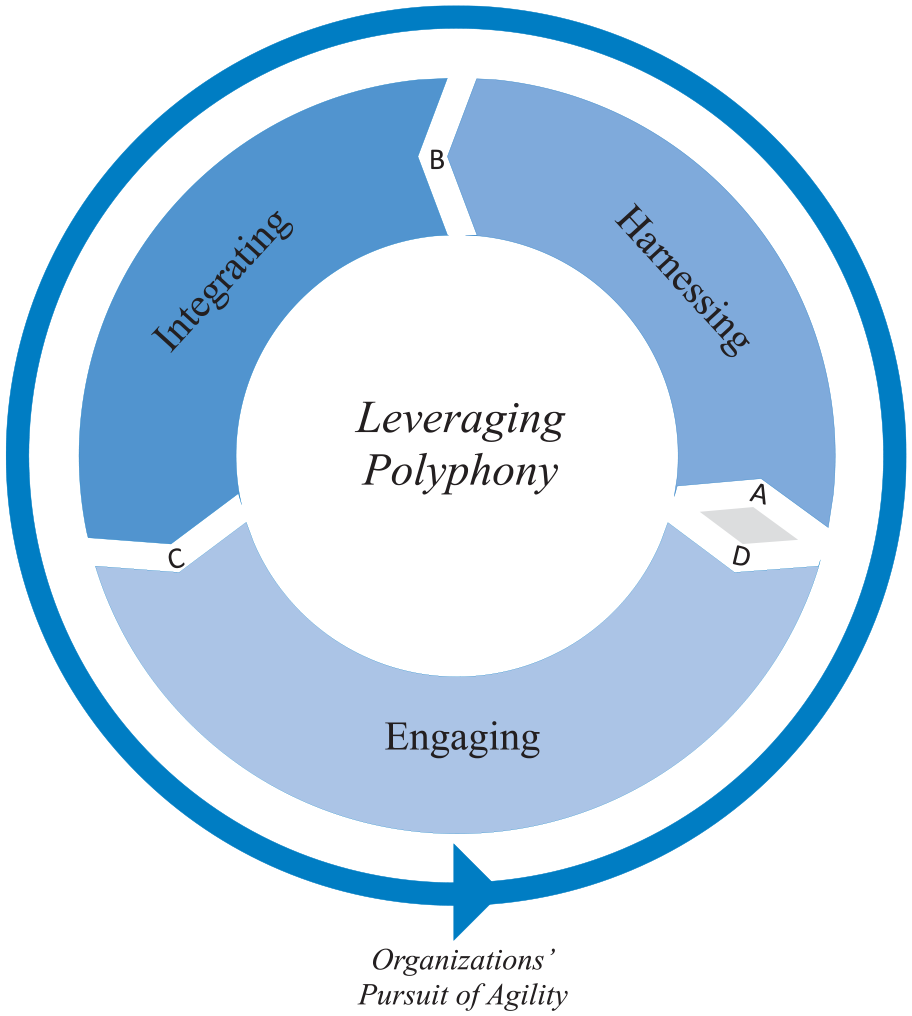
The strategy making as polyphony wheel: a framework encompassing three managerial practices for leveraging multiple stakeholder voices in the pursuit of agility.
One of the benefits of engaging as organizations pursue agility is that it ensures that stakeholders are more connected to the strategy and can see what needs to change for the company to deliver its strategy. Information and insights on strategy can be widely and frequently dispatched as needed (e.g., the use of blogging at Nationwide) or be structured as part of major updates (e.g., as seen at Unilever). A commonality in these cases and other examples explored in this article is that this practice can allow organizations to be more visible to their various stakeholders. This is key to fostering increased trust in how organizations are handling strategic issues and deploying resources. In turn, this ensures commitment and increased alignment on strategic issues inside, and in some cases outside, organizations.
However, there are potential unintended consequences of engaging. This includes the sharing of sensitive information, and how this might push the boundaries of what organizations have traditionally kept secret. In this sense, while organizations hope to reap the benefits of being more transparent around strategy, this can be a two-way street in that organizations might need to handle raised expectations for further information sharing. This can also bring risks around information leakage as information is more difficult to contain and control, which in turn could impact competitiveness or even breach privacy and data legislation. This means that a careful balancing act is needed by managers, as they hope that any potential loss of control is outweighed by heightened agility. Another downside is the potential complexity of shared information and how this is interpreted, or indeed misinterpreted. Managers must be careful to ensure communications are clear, concise, and unambiguous. Sharing information, and developing channels to do so, could also be resource intensive, and this raises tension on the potential costs and risks of engaging versus the potential rewards. To counter this, managers need to consider and ensure the former does not outweigh the latter.
Harnessing Multiple Voices in Strategy Dialog (Harnessing Polyphony)
The second practice is harnessing multiple voices in strategy dialog (or “harnessing polyphony”), where managers enable a range of stakeholders to express their voice through dialog in the form of sharing ideas and opinions on strategy. This can occur through channels that enable feedback from stakeholders, such as by commenting or completing surveys. However, it can also enable more comprehensive discussions, such as through online forums and ideation events.
Examples of harnessing polyphony as a practice
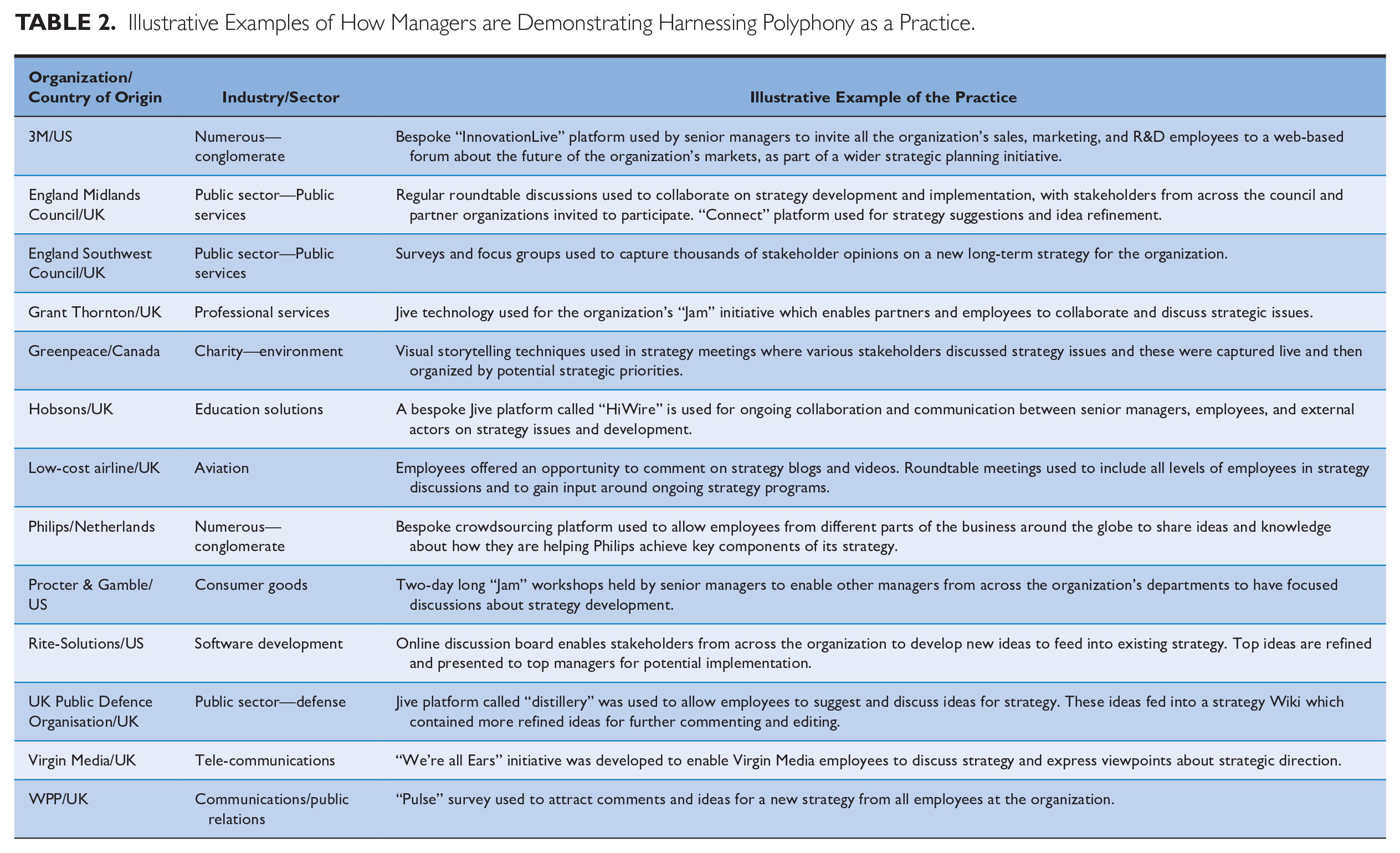
Managers demonstrated this practice in a variety of ways. Several organizations built on engaging by letting stakeholders comment on content such as blogs and videos, or by offering ideas through surveys. For example, in the cases of WPP and a U.K. local council, these organizations were developing longer-term strategies and needed to be agile in understanding stakeholder views in their environment and ensuring strategic direction was well-aligned with them. Surveys were used by managers to obtain comments and ideas from employees and service users for a new strategy. Similarly, in the aviation industry, where turbulence during the COVID-19 pandemic brought commercial operations to a standstill, gathering diverse viewpoints has helped to inform ongoing issues. For instance, employees at a low-cost airline were offered the opportunity to comment on content such as blog posts and videos about strategy. Another example was at conglomerate Philips, where an initiative invited employees from different parts of the business around the globe to share comments on how they are achieving the key components of the organization’s strategy. According to a manager facilitating this, it aimed to “create dialogue, discussion, and debate about how these key components of the strategy are being achieved.”
Organizations also harnessed stakeholder voices through channels for extensive discussion. For example, at education solutions provider Hobsons, a bespoke Jive platform called “HiWire” has been used for ongoing collaboration and communication between senior managers, employees, and external stakeholders on strategy issues and development. At Grant Thornton, Jive has been used for “Jam” initiatives to allow over 4,000 partners and employees to collaborate on strategy. An Online Communications Manager at Grant Thornton explained that this formed an ambition to be more “dynamic and agile” by gathering viewpoints on future direction, stating that through Jam: “people could be bold, speak up and have engaging conversations [about strategy]. We wanted to see them collaborate and to talk openly about the future of the organization.” A manager emphasized that these discussions have also, in turn, “increased awareness and alignment to strategic direction.” Similarly, Virgin Media’s “We’re all Ears” listening project has allowed employees to discuss and express viewpoints about strategy, including key priorities such as sustainability. A manager explained this ensured that the organization could “check in with our staff and our other stakeholders, to get a better understanding of what they thought about our sustainability strategy. . .we wanted to use our listening project to make our sustainability strategy even stronger.” Table 2 details various case organizations with illustrative examples of how managers are demonstrating harnessing polyphony.
Illustrative Examples of How Managers are Demonstrating Harnessing Polyphony as a Practice.
Conditions for harnessing polyphony and its effect on agility
Harnessing polyphony is key for organizations to nurture voices in an active dialog about strategy, including those stakeholders from across, and outside, organizations. However, there are different degrees by which managers can do this (e.g., by allowing feedback or comments or by enabling more extensive discussions to take place). As shown in Figure 1, harnessing can build on engaging.
Harnessing polyphony has various effects as organizations pursue agility. In a positive sense, it ensures more diversity of voices in the strategy process and provokes new thinking outside traditional groups of organizational strategists. It is a pathway for those who are not traditionally involved in strategy making to voice opinions and ideas, share knowledge, and ask questions. It can enable creativity and experimentation, and there is potential here for organizations to be able to focus on joint sensemaking and monitoring for the entirety of an organization, particularly where they have a complex structure involving distinct strategic business units and departments (e.g., as seen at Philips). This means that organizations are less likely to have biases in strategy making or develop tunnel vision. Managers harness polyphony to offset some of their control and ownership over strategy with the potential hope of being able to exploit voices for superior strategic insights and decision-making.
However, there are also potential pitfalls for agility. As the boundaries of strategy making are opened to multiple voices, there can be blurred responsibilities for developing strategy and this might lead to confusion about the extent to which others are being involved in such processes. This can also be an issue for managers as they experience information overload as they gather a range of disparate viewpoints that can be difficult to process and manage. This will, undoubtedly, require prioritization of some issues and pushback on others. There is the potential for stakeholders to become disillusioned if there is a lack of consistency in their inclusion in strategy making, and if a lack of action emerges from their input. Ultimately, harnessing requires careful planning and management, but again this could also be costly in terms of using managerial and other resources (e.g., building bespoke systems for collaboration, organizing workshops, or purchasing digital collaboration channel licenses). As one of the participants of this research, a senior manager at a large low-cost multinational airline stated: “There is a fine line between openness and chaos and there have to be clear boundaries in strategy work.” This insight builds on prior work that has considered the design of participation in strategy making, including the need to focus on specific topics for discussion, have a clear timescale, and some demonstration of output. 32 Again, it is important that managers consider their control and ownership over strategy in order to tap into stakeholder voices and get something back from those being included in strategy. In this sense, harnessing involves a need to clearly define the boundaries of strategy work from the outset, or at least refine these boundaries iteratively as they go along with the process over time.
Integrating Multiple Voices in Realized Strategic Action (Integrating Polyphony)
The third practice, integrating multiple voices in realized strategic action (or “integrating polyphony”), sees managers translate the multiple voices of stakeholders into explicit strategic action. Ideas or opinions help to form the contents of formal strategic plans or inform realized actions such as the implementation of strategy. This practice, therefore, goes beyond harnessing polyphony, where contents may begin to emerge, and allows managers to feed voices explicitly into strategy development and implementation. This practice demonstrates that managers can create a more concrete commitment to realizing strategic action and intent from a wider range of stakeholders in organizations.
Examples of integrating polyphony as a practice
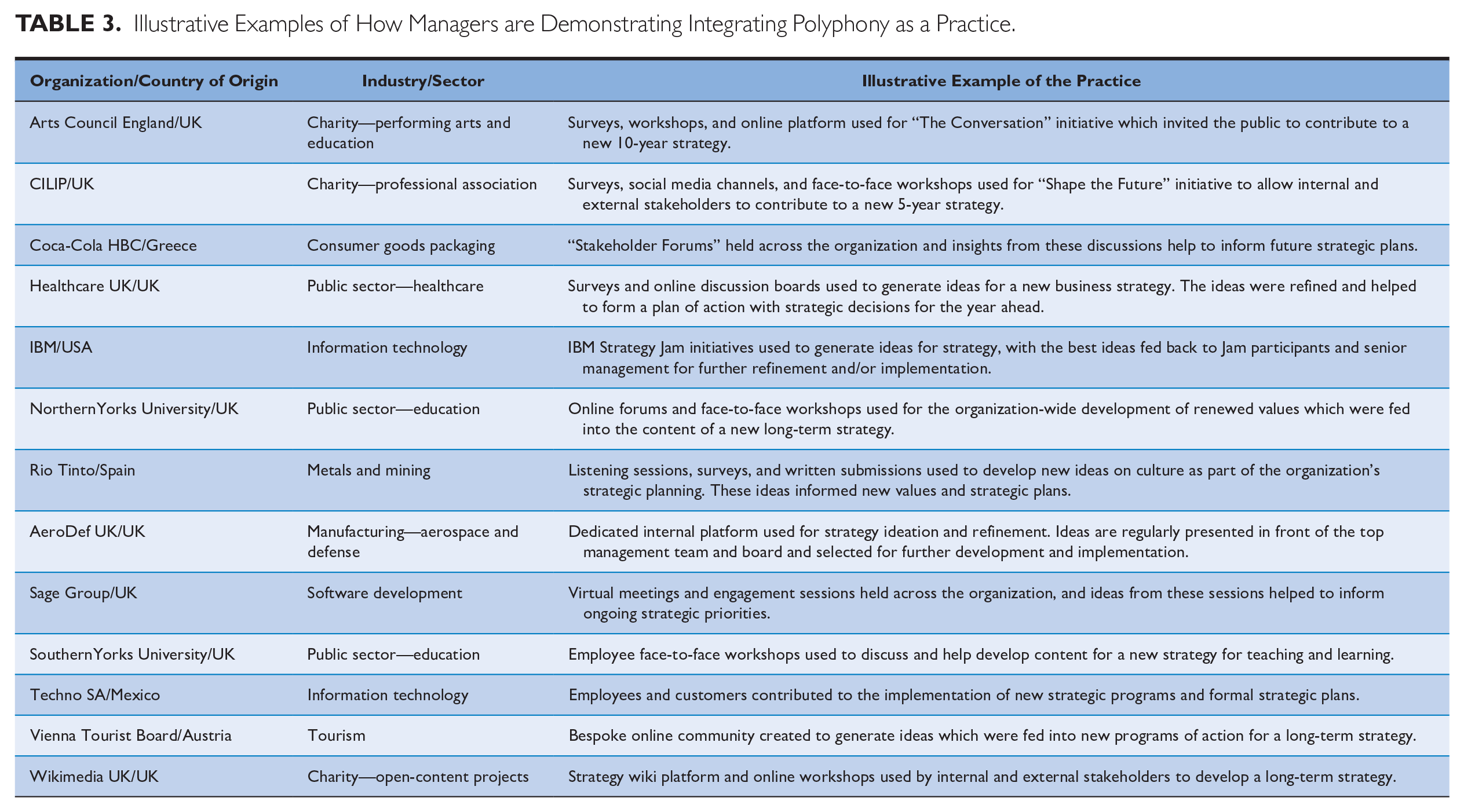
This practice manifested in several ways, each of which demonstrates how managers can use the voices of stakeholder groups to change their strategy and adapt to their environment. For example, in some cases, managers took the insights collected through harnessing polyphony and began to integrate these into strategy contents. For example, in two U.K.-based universities, where agility is required for these institutions to be at the forefront of research excellence, pedagogical practice, and real-world impact, ideas and opinions collected from internal stakeholders including staff and students were integrated into new long-term, formal strategic plans. Meanwhile, at U.K. Healthcare, ideas collected through surveys and online discussion were refined and helped to form a new plan of action for strategic decisions to navigate challenges in their environment for the year ahead. Similarly, in the tourism industry, where agility and reflection are important in understanding and responding to changing tourist trends, the Vienna Tourist Board hosted strategy discussion events through which key strategic issues were discussed by both internal and external stakeholders. These then directly informed the content of a new 5-year tourism strategy for Vienna, most notably the development of three strategic orientations that help Vienna adapt to the global tourism environment. As explained in the strategic plan, they are “the instrument to attain our ambitious goals.” As a lead on the project explained, this allowed the organization to co-create the tourism strategy. . .it’s a challenge to include all these stakeholders and to create one platform where they can share and discuss their ideas and their opinions and to select the most important points, but this is what we were able to achieve.
The practice also informed the direct implementation of strategic action. An example of this was at the United Kingdom-based professional association CILIP, where the organization developed a new 5-year strategy to adapt to the changing needs of its membership community. The community directly informed new mission and vision statements and five key priorities for implementation. This included the creation of new advocacy campaigns and a renewed membership payment model. As CILIP’s CEO explained: “There are genuinely some things which I can point to which were directly crowdsourced, which were directly co-created.” CILIP management filtered the content of the new strategy based on what they perceived to be the most pressing issues raised by the community and provided justification and feedback on how they have used stakeholder voices to inform areas of the strategy and plans for future implementation. They also communicated how they would work with stakeholder groups as part of an ongoing relationship to ensure their views were heard as part of the ongoing strategy implementation. Furthermore, in IBM’s Strategy Jam initiatives, ideas were generated, and there were processes to allow participants to vote on the best ideas, which were then discussed in more detail before being fed back to senior management for further refinement and implementation. As a senior member of the Jam team explained: You can see who came up with the ideas, but then we need to find ways to refine and support those ideas. We take the best ideas from a Jam and give them a mandate to be integrated into informing our organizational change.
Table 3 shows a range of case organizations and further examples of how managers are demonstrating the integrating polyphony practice.
Illustrative Examples of How Managers are Demonstrating Integrating Polyphony as a Practice.
Conditions for integrating polyphony and its effect on agility
At the core of integrating polyphony is the ability to incorporate a diversity of viewpoints from stakeholders into realized strategic actions. As Figure 1 shows, integrating follows harnessing. Integrating also has an important relationship with engaging as once voices inform realized action, they are then communicated again with stakeholders in the form of tangible strategic plans or updates.
Integrating allows organizations to have heightened strategic alertness as managers can frame strategic issues, which are informed by key stakeholders. This helps with conforming strategy in line with the needs of various internal and external stakeholders. Indeed, by integrating they can consider and utilize a diversity of voices as they develop and implement strategic priorities and programs. Importantly, this also gives legitimacy to the strategy and strategic direction of organizations. At Arts Council England and CILIP, this practice also offered managers the opportunity to build ongoing relationships with different stakeholder groups about strategy by working closely on intricate details of strategic programs and their implementation.
However, with this comes the challenge of balancing input with decision-making. As Whittington and colleagues state in their work on openness in strategy making, “Inclusion and transparency do not extend to the transfer of decision rights with regard to strategy: openness refers to the sharing of views, information, and knowledge, not a democracy of actual decision making.” 33 This also alludes to prior work on the differing dynamics and degrees of participation in strategy making, 34 and when such processes need to be more open or more closed. 35 A potential pitfall emerges as organizations may develop an overly narrow focus on issues that are raised through harnessing voices, particularly where “louder” or more powerful voices are present. This has the potential to lead to other issues or opportunities being missed, or again to certain stakeholders becoming disillusioned if they do not feel their voice has been heard or acted upon. This was evident in cases in this work, particularly those in local government organizations where some stakeholder groups have greater numbers, or power, compared to others. Opening strategy can therefore put pressure on managers to leverage voices for their benefit, along with needing to provide some evidence of how these voices are being represented in new strategic plans or subsequent decision-making. It is difficult to manage the numerous demands that arise through involving diverse voices, and this can lead to pitfalls for organizations as they aim to develop and implement a coherent strategy. 36 Mutual concessions are important here too, and managers must find appropriate ways to manage how ideas and opinions raised are integrated into strategy so that this does not hinder agility. This can be achieved through prioritizing feedback based on its prevalence in discussions, and by providing justification on these priorities to ensure transparency (as seen at CILIP), or by allowing stakeholders to vote and mutually refine emerging strategy contents (as seen at IBM).
Using the Three Practices Together in the Pursuit of Agility: An Illustrative Example
The three practices can be synergistic as organizations pursue agility. An illustrative example at multinational insurance provider Aviva demonstrates the practices being used together. Aviva’s need to be more agile and to leverage multiple stakeholder voices was grounded in the highly competitive nature of the insurance industry. Senior management sought to discuss performance, growth and divestment options, and product development across markets with those who were working in different areas of the business. Managers at Aviva began engaging multiple voices around strategy dialog as part of a U.K.-wide initiative called “Our Plan.” This initiative involved senior managers at Aviva traveling around the United Kingdom and delivering strategy presentations to communicate ongoing changes to Aviva’s strategy, including objectives, successes, and plans for implementation. Our Plan was widely praised and helped Aviva achieve an award for “best communication of organizational strategy” given by the Institute of Internal Communications in the United Kingdom.
It also proved to be a catalyst for harnessing multiple voices in strategic dialog. Aviva employees provided explicit feedback at the sessions and there were opportunities for comments and Q&A with senior managers. This had a cumulative effect that led to Aviva launching complementary initiatives within and beyond the U.K. setting, such as an online social system on the Aviva World intranet, which enabled staff to have an hour each month to digest updates regarding strategy. This included videos and interviews with top management and viewers could also leave comments and ask questions. There were also more comprehensive live Q&A opportunities, including with the CEO who was “adamant that no question is off limits.” This was also coupled with an online forum where strategy issues were discussed, and according to one manager involve “active conversations. . .with many challenging questions being asked.” A Head of Global Digital Channels at Aviva commented that we now use video more regularly to communicate our financial results or explain strategy. . .our senior teams have really embraced video streaming once they could see the impact of sharing key issues with employees. . .our people really value being able to have two-way interactions and get those burning questions answered.
In turn, this led Aviva to develop a new initiative to try to take the many ideas and discussions being harnessed and start integrating multiple voices in realized strategic action. A company-wide competition called the “Customer Cup” invited all Aviva employees from a range of markets around the world to work in teams and develop innovative ideas on how to improve areas of the business and the organization’s strategy. For example, in 2015, the competition generated 680 ideas across 18 markets. As a lead involved in the project explained “those teams went through a rigorous process and were whittled down to a top 10. . .where the ideas are presented to members of the Group Executive, including the Group CEO.” The top idea was awarded £10,000 to help take it toward potential implementation as part of Aviva’s strategy. One such example included a winning team developing and implementing a new strategy for customer communications relating to complex schemes such as pensions, where there was concern about the approach taken to ensure customers understood these products and their benefits. This resulted in a 40% higher retention of schemes compared to the previous year, and this demonstrates how Aviva used new ideas to change elements of their strategy in order to adapt to their environment.
The Strategy Making as Polyphony Wheel: A Framework for Managers
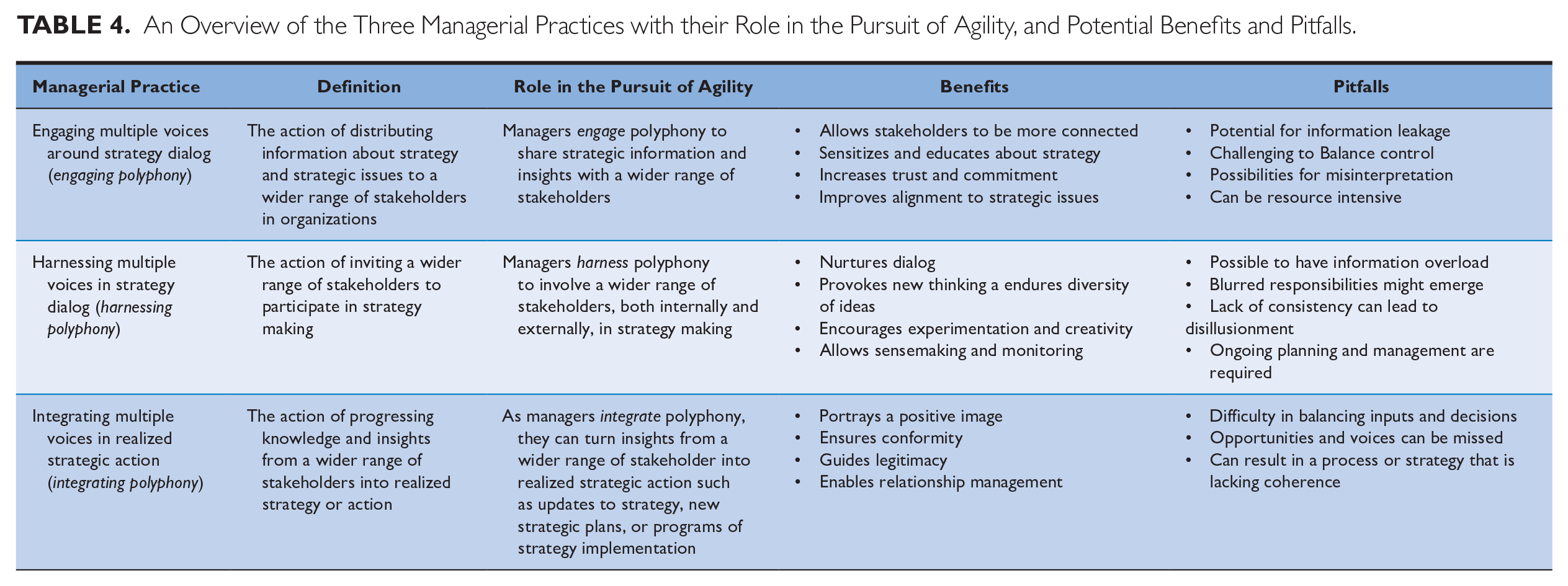
The three managerial practices identified through the findings reveal how managers leverage polyphony by engaging, harnessing, and integrating multiple voices. Each practice is summarized in Table 4, where they are given a definition to provide conceptual clarity in tandem with Figure 1, the strategy making as polyphony wheel framework. 37 The role of each practice, in addition to a range of potential benefits and pitfalls as organizations pursue agility, is also presented.
An Overview of the Three Managerial Practices with their Role in the Pursuit of Agility, and Potential Benefits and Pitfalls.
As noted, the framework demonstrates several relationships between the three managerial practices where they can be used as part of an iterative loop. This loop starts with engaging, which acts as a foundation for managers as they leverage polyphony. This is a starting point for the process, through which management can sensitize and educate stakeholders about strategy so that they can be more alert to key strategic issues and their environment. Engaging can lead stakeholders to then see how they can feed back their own insights through harnessing (e.g., commenting on strategy information/documents), which is a bottom-up process, as shown in point A. Point B shows how, after harnessing polyphony, managers move to synthesis and take the collected ideas and opinions and use these to inform realized strategy action through integration. In this regard, harnessing acts as a prerequisite to integrating. As points C and D show, managers can continue to use engaging to share the outputs or resultant action of strategy making over time. For example, in the case of harnessing, this is a switch back to engaging to share the analytics and other output from a strategy discussion initiative. In the case of integrating, it is a progression to engaging for sharing new strategic plans or details regarding strategy implementation.
This essentially shows the wheel as a complete loop (as per the illustration of Aviva) and how the practices contribute to agility synergistically. The holistic use of practices provides guidance on how managers follow this loop iteratively, starting with engaging, then harnessing, then moving to synthesis (integrating).
Implications for Managerial Practice
This study provides prescriptive advice to managers who are involved in strategy making. The strategy as polyphony wheel provides in-depth understanding, through evidence from a range of organizations and industries, regarding how managers can leverage polyphony in their environment. The findings of this work are relevant to managers from across contexts, as was a core consideration of the research design. By explicating the managerial practices of engaging, harnessing, and integrating polyphony, practitioners can use these insights as a basis to develop or enhance their own approaches to being reflective about strategy and incorporating others into strategy making in different ways in their pursuit of agility. The conceptualization of the practices in a framework, which can be used as a strategy making tool, means that managers can experiment with these practices, including how they complement each other to work synergistically.
Furthermore, as organizations and managers are facing a more multifaceted and uncertain world, driven by various macroenvironmental factors and by the expectations and demands of key stakeholders, they can benefit from leveraging polyphony in the face of such concerns. Specifically, the wheel offers a means of deep reflection for agility 38 tapping into dispersed knowledge and insight from across, and outside, organizational boundaries. Organizations and managers can draw on this research to understand the benefits of polyphony for managing or responding to macroenvironmental issues and the disparate demands and tensions of stakeholders while benefiting from fresh ideas, and know-how. This includes situations where organizations are constrained by multiple external pressures and where organizational survival or prosperity might depend on agility and responsiveness to internal and external ideas, needs, and expectations.
This study has identified potential pitfalls for agility too. The framework and associated practices should not be seen as a silver bullet and there are certain scenarios where their use must be approached with caution. For example, speed and flexibility are still important considerations for agile organizations and decisions sometimes need to be made quickly, without the time or opportunity to involve a wider range of stakeholders. Overall, the framework enables increased insight for managers regarding different approaches to leveraging polyphony when uncertainty in their internal and external environment is considered and in which conditions the three practices can be used. The practices might differ and have variations across contexts but have not been developed from any one context, rather they have been informed by managerial practice and strategy making from organizations across several industries and sectors.
Contributions to Existing Literature and Conclusion
This study argues that the microactivities and capabilities that underpin agility are numerous and multi-faceted and that it is important to understand in more depth how managers leverage multiple voices into strategy making as an activity that can help their organizations to be more agile. This work adds to streams of agility literature that emphasize the importance of “agility as slowness” and that having processes for deep reflection are an essential part of an organization’s pursuit of agility. 39 This stands contrary, but also complementary, to the prevailing view that agility is about rapid speed and flexibility. It is also about reflection and having practices that involve stakeholders around, and in, strategy dialog and how dialog can inform realized strategy action.
By explicating the managerial practices associated with the engaging, harnessing, and integrating of polyphony, this study provides more fine-grained depth on how organizations can be more strategically sensitive. It complements existing broad capabilities that organizations should acquire, such as having heightened strategic alertness, utilizing co-strategizing processes, and ensuring quality internal dialog about strategy. 40 In simple terms, this research zooms in on strategic sensitivity as a key tenet of agility in organizations and elaborates on some specific managerial practices that enable this to be achieved.
Finally, this work contributes to streams of research on openness in strategy. It accentuates the importance of openness from the perspective of voice and polyphony, building on existing work that shows how organizations are being more inclusive and transparent in their strategy making. It also complements work that shows the advantages and disadvantages of openness 41 and offers insights into how open forms of strategy making can be designed. 42 This includes guidance on the different tools and techniques managers can use to leverage multiple voices in their environment (e.g., face-to-face and online channels). 43
In conclusion, this research offers managers three clear ways in which they can leverage polyphony. Strategy making today is a process that often draws on multiple voices, and this can be beneficial for deep reflection in the pursuit of agility. Managers must, however, be able to select the opportune time to use and potentially combine these practices, as each can offer unique benefits but also potential pitfalls.
Footnotes
Acknowledgements
The author thanks Stéphane Girod, Julian Birkinshaw, Christiane Prange, and the three anonymous reviewers for their invaluable comments and advice that helped to improve this article.
Notes
Author Biography
Josh Morton is a Lecturer (Assistant Professor) in Strategy and Innovation at Leeds University Business School, University of Leeds, UK (