




Abstract
Human pressure continues to deteriorate social-ecological systems at alarming rates, risking destabilization and collapse. This provokes questions on the efficacy of corporate approaches to sustainability management and how business schools are preparing managers. A systems approach to sustainability management is gaining attention for its potential to resolve the disconnect between corporate sustainability practices and social-ecological system needs. Business school education can play an important role in fostering its adoption, yet educators may lack experience with teaching a systems approach and how to effectively integrate it within courses. We contribute to sustainability management and business education by offering a learning framework with a systems perspective. This framework consists of five conceptual moves leveraging systems thinking concepts that establish a strong theoretical foundation for learning. We further illustrate these moves through practical teaching examples and provide recommendations for the integration of a systems approach into sustainability management education.
Keywords
Introduction
Corporate engagement with sustainability management has become standard practice for a large majority of the largest corporations of the world for over a decade (KPMG, 2022). Sustainability management, defined as “the formulation, implementation, and evaluation of both environmental and socioeconomic sustainability-related decisions and actions” (Starik & Kanashiro, 2013, p. 12), has simultaneously gained much traction within the business school curriculum (PRME, 2024). Corporates, educators, and learners alike are recognizing its significance to business activities (Sulkowski et al., 2020; Swaim et al., 2014).
Yet, despite this engagement, macro-level indicators reveal a potential “disconnect” with social-ecological systems needs. Six out of nine biophysical boundaries at the planetary scale are now judged to be transgressed (K. Richardson et al., 2023) with the pace and scale of business and industry transitions far off-course to successfully mitigate climate and ecological collapse (Boehm et al., 2023). Societal challenges such as wealth inequalities, hunger and food security, and labor rights persist with indicators offering that progress has stagnated or regressed in many parts of the world (United Nations, 2024). This has provoked scholars to question the efficacy of corporate approaches to sustainability management and how business schools are equipping and training current and future managers (Earle & Leyva-de la Hiz, 2021; Edwards et al., 2021). To strengthen corporate practices of sustainability management, some scholars advocate for firms to engage with a systems approach (Marcus et al., 2010; Whiteman et al., 2013) and call for business schools to adapt educational offerings to support a shift away from firm-centric approaches that neglect important social-ecological system dynamics (Waddock & Lozano, 2013).
Teaching a systems approach to sustainability management encourages learners to engage in nonlinear, synthetic and adaptive thinking founded upon systems thinking (Capra, 1996). Systems thinking is defined as “a discipline for seeing wholes. It is a framework for seeing interrelationships rather than things, for seeing patterns of change rather than static ‘snapshots’” (Senge, 2006, p. 68). It seeks to support managerial decisions that embrace holistic and relational understandings of firms as part of complex social-ecological systems that coevolve over time (Bagley et al., 2020; Edwards et al., 2021). Business activities on sustainability are then understood in terms of how they fit together to impact social-ecological system functioning (Ackoff, 1974). It calls for managerial decision-making based on insight into the complex dynamics of social-ecological systems to broaden horizons for understanding and addressing societal challenges in new and different ways (Sterman, 1994).
Scholars have progressed teaching a systems perspective by advocating that learners should learn how to think in systems (Colombo, in press), offering experiences of programs integrating systems thinking (Waddock & Lozano, 2013) and interdisciplinary systems-based pedagogical philosophies (Bagley et al., 2020), detailing how adopting different perspectives on systems has implications for teaching (T. Porter & Córdoba, 2009) and, within the larger context of management learning and education, identifying the core elements of thinking systemically (Atwater et al., 2008).
At the same time, the existing literature highlights the hesitation of educators to transition their courses toward a systems approach and obstacles to be overcome. Management educators are perceived to be more accustomed to linear, reductionist, and firm-centric sustainability approaches (Earle & Leyva-de la Hiz, 2021) and may feel they lack sufficient knowledge and experience to teach it effectively (Waddock & Lozano, 2013). Most management educators have limited exposure to systems thinking (Atwater et al., 2008) and simply associate it with seeing the bigger picture of organizational problems (Moosmayer et al., 2019; T. Porter & Córdoba, 2009). For others, the complexity of a systems approach may be a barrier, with concerns about the impact on course preparation time and course evaluations (Edwards et al., 2021; Waddock & Lozano, 2013).
In this study, we aim to build upon extant literature by providing support targeted at educators inexperienced with a systems approach. We develop a learning framework for a systems approach to sustainability management education leveraging theoretical concepts of systems thinking. Our framework comprises five conceptual moves: developing a complex adaptive systems (CAS) mindset, identifying structure and form of systems, understanding behavioral dynamics of systems over time, intervening in systems, and systems-embedded reflection. We propose that these conceptual moves help educators challenge the traditional, linear reductionist approach to problem-solving and enable learners to view societal challenges as outcomes of social-ecological system behavior over time. In addition, we provide illustrative examples of teaching each of the five conceptual moves to inspire educators and make the approach more tangible.
Our work makes two main contributions to discussions on how business school education can close the sustainability management disconnect. First, we conceptualize sustainability management from a systems perspective by offering a structured process that can be replicated for learners on pre- and post-experience programs. Our work contributes to the ability of educators to navigate a dense field and provides guidance on how systems concepts can specifically inform and bolster teaching practices on sustainability management. Second, by offering practical guidance and extensive illustrations (both in the manuscript and a separate Supplemental Appendix), we provide starting points for inexperienced educators, lowering the barriers to integrating a systems approach within curricula.
Toward a Systems Approach to Sustainability Management
Traditional approaches to sustainability management education can be criticized for downplaying and neglecting important dynamics of social-ecological system functioning (Bagley et al., 2020; Edwards et al., 2021). Learners are taught to improve the sustainability performance of the firm and pursue the business cases of “doing good” that offer maximal financial return (M. E. Porter & Kramer, 2011). Sustainability management is reduced to finding economically optimal solutions for firms (Giacalone & Thompson, 2006) instead of seeking the most beneficial improvements to greater wholes.
By overlooking the connectivity between firms and social-ecological system behavior, important information is missed on how business actions contribute or undermine progress of tackling societal challenges. Managers may make decisions that pursue firm sustainability at the expense of social-ecological system performance (Clément & Rivera, 2016), overlook how actions fit together and aggregate with those of other firms (Grewatsch et al., 2023), and neglect how, why, and when social-ecological systems may fundamentally change (Whiteman et al., 2013; Williams et al., 2021). Hence, traditional approaches fall short of equipping learners with the right skillsets (Earle & Leyva-de la Hiz, 2021) to effectively tackle societal challenges due to a lack of consideration and integration of interaction effects and system reactions.
In contrast, a systems approach to sustainability management education focuses on the dynamic interactions of firms with stakeholders, ecosystems, and feedback loops (Bagley et al., 2020). Unlike traditional methods concentrating solely on firm performance, this approach develops learners’ awareness of how firms operate within broader social-ecological systems, encouraging them to recognize the positive and negative impacts of firms on societal challenges (Williams et al., 2021). It emphasizes collaboration, interdisciplinary approaches, and behavioral insights to address challenges considering biophysical limitations and integrative complexities (Waddock & Lozano, 2013). Ultimately, a systems approach equips learners to comprehend challenges within context and as outcomes of system behavior over time.
While the importance of teaching a systems approach to sustainability management is gaining recognition (Bagley et al., 2020; Earle & Leyva-de la Hiz, 2021), increased diffusion is hindered by several hurdles. Educators must find teaching approaches that effectively guide learners to become “systems thinkers” (Atwater & Pittman, 2006). Yet, educators and learners may struggle to engage with systems thinking as it is commonly new or unfamiliar and is likely to challenge accustomed linear ways of thinking of cause and effect (Sweeney & Meadows, 2010). A survey of business school faculty found that most educators were either unfamiliar with systemic thinking or defined it narrowly (Atwater et al., 2008). On the contrary, it is rich with systems concepts that novice educators must navigate, structure, and make tangible for learners to deeply engage and understand their usefulness. Furthermore, learners’ reactions to systems thinking can be mixed, and educators must find ways to convey how it enriches the understanding of real-world business dynamics to avoid rejection by learners (Lourenço, 2013).
A Learning Framework for a Systems Approach to Sustainability Management
To advance understanding on sustainability management with a systems approach and address the hurdles faced by novice educators, we offer guidance through a learning framework that integrates problem-solving approaches of systems thinking (Ackoff, 1974; Forrester, 1994; Meadows, 2008; Senge, 2006; Sterman, 2001). Our framework (see Figure 1) leads learners through five conceptual moves of a learning process focused on addressing societal challenges.
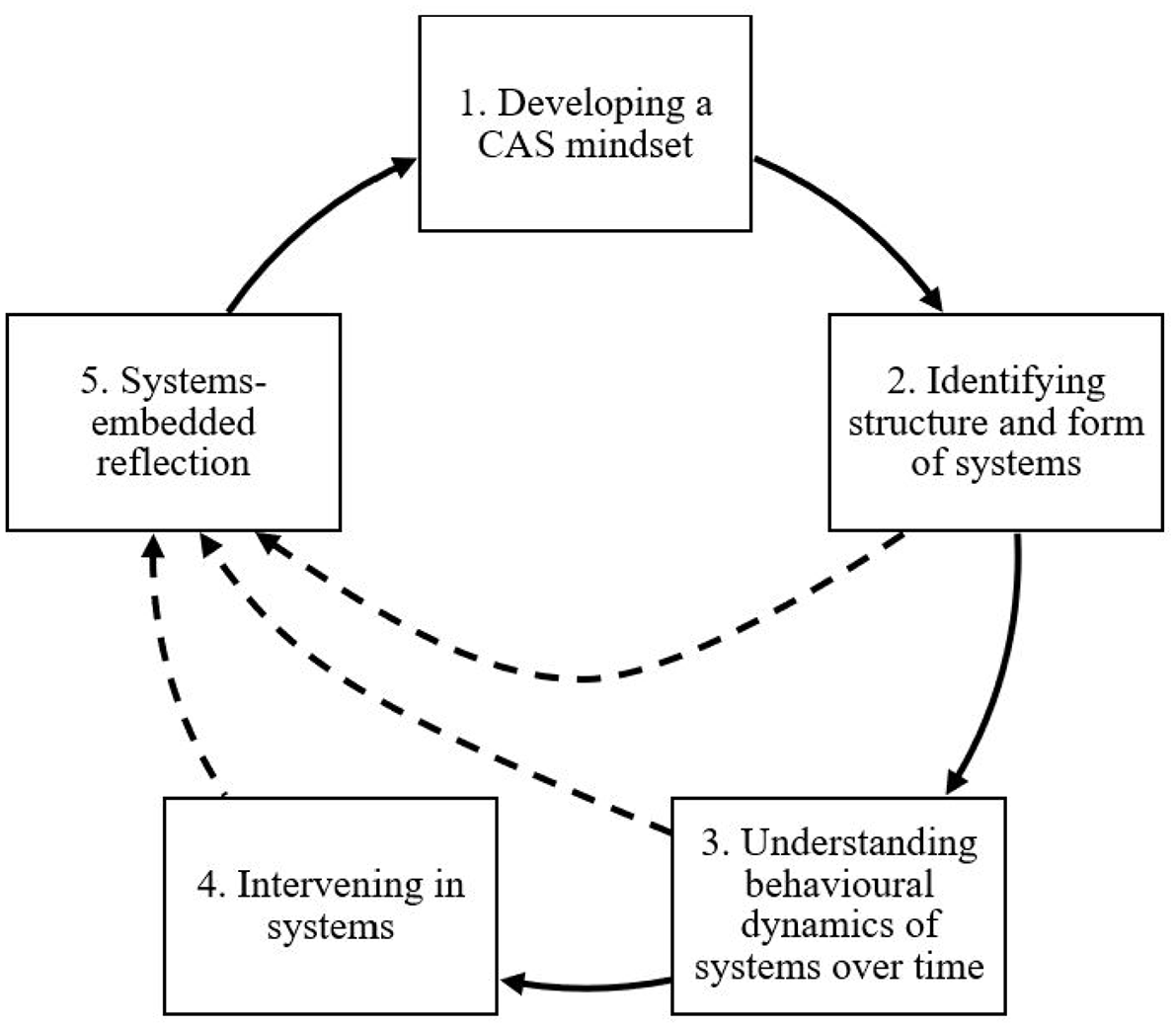
A Learning Process for Sustainability Management Education With a Systems Approach.
First, we propose developing learners’ business mindsets by recognizing the embeddedness of firms within wider social-ecological systems that continuously coevolve. Second, we suggest that learners learn to conduct deep inquiries to uncover the underlying mental models and complexities driving surface events associated with societal challenges. Third, we suggest that learners engage with system dynamics over time and explore factors that contribute to the improvement or aggravation of societal challenges. Fourth, we propose that learners gain experience in understanding how firms can create interventions to effectively change system behavior toward desired states. Finally, we propose that learners’ reflective capabilities are nurtured through holistic evaluation and self-reflection, and by updating mental models and increasing self-awareness. We emphasize that systems-embedded reflection is an ongoing process throughout the learning journey, continually reinforcing learners’ CAS mindsets.
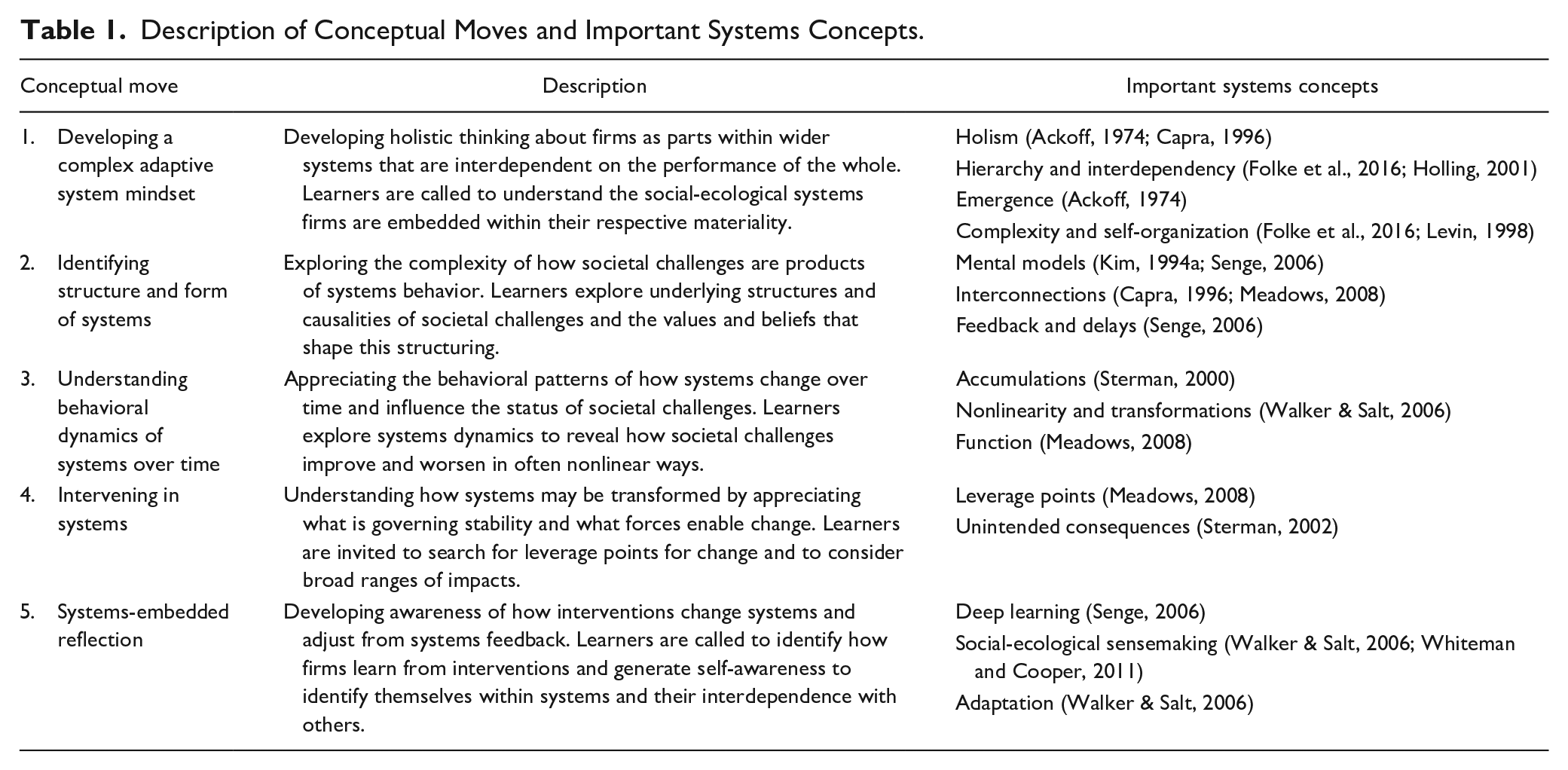
For the framework, we incorporate systems concepts that enable learners to understand the rhythm and movements of systems that generate societal challenges and how solutions can be created to address them. Our framework guides when systems concepts may be introduced to learners, enabling a gradual building of competence. Systems concepts are not exclusive to one conceptual move, and educators should draw upon concepts already covered. For instance, feedback loops are necessary to understand system structures and will subsequently help learners understand system behavior over time. We acknowledge there is no definitive placing or list of systems concepts (Kast & Rosenzweig, 1972), and that educators should emphasize to learners that it is their use in combination that forms CAS mindsets. Table 1 provides an overview of the conceptual moves, their descriptions, and important systems concepts.
Description of Conceptual Moves and Important Systems Concepts.
Developing a CAS Mindset
Learners develop an understanding of firms as embedded within societies and ecologies that together comprise a CAS mindset (Levin, 1998). Contrary to externalizing perspectives that see business as separate or only partially overlapping with the domains of society and the natural environment (Marcus et al., 2010), companies are viewed as component parts within a whole that are inextricably linked to other components through interactions and interdependencies. Societal challenges are understood as dynamic, changing through a process of coevolution involving firms within complex entanglements. A CAS mindset enables learners to embrace complexity and understand firms as inherently situated and interdependent within broader contexts (Shrivastava & Kennelly, 2013). Learners move away from context-agnostic thinking and seek to understand contextual factors influencing the prevalence of societal challenges and the suitability of context-relevant solutions. Therefore, our first conceptual move draws on the key systems concepts: holism, hierarchy and interdependency, emergence, and complexity and self-organization.
Holism
Holism concerns seeing the integrated whole in which companies are a part (Capra, 1996). In contrast to analytical reductionism, which seeks to foster understanding by disaggregating and isolating individual parts, holism seeks to put parts together and develop insights about their collective relations and functioning. While management education often disconnects firms from the places where their activities unfold (Marcus et al., 2010), a holistic worldview prompts learners to understand firm behavior and performance in reference to the social-ecological systems in which they reside (Ackoff, 1974; Whiteman et al., 2013). Social-ecological systems have unique geographic locations, histories, politics, cultural sensitivities, and finite biophysical limits that constrain and enable firm behavior (Shrivastava & Kennelly, 2013). By broadening the scale and “zooming out” (Schad & Bansal, 2018), the focus of learners elevates beyond the firm to how social-ecological systems behave, and what are the needs and priorities of social-ecological systems that should be managed to maintain a range of desirable states (Dyllick & Muff, 2016).
Hierarchy and Interdependency
The concepts of hierarchy and interdependency refer to viewing the world as sets of interacting subsystems that aggregate to larger ones. Firms are seen as subsystems nested in structures of lower- and higher-order systems that form social-ecological systems (Holling, 2001). These systems evolve from the bottom up (i.e., a person is needed to start an organization) with higher-order ones serving rather than controlling lower levels (Meadows, 2008). The functioning of subsystems is interdependent, meaning that a subsystem can only be managed by understanding its interconnections. Higher-order systems such as societies, which are larger and slower to change, can act to constrain firms’ behavior through conditions such as prevailing cultural norms and values. Lower-order systems such as employees are smaller and change faster, and may disrupt firms, for example, by changing mindsets regarding the purpose of the firm and campaigning for firm transformation. Learners become sensitized to identifying hierarchies, the interconnectivity between lower- and higher-order systems, and the pace of change at each level. Importantly, learners appreciate that optimizing the functioning of a subsystem (e.g., a firm or industry) at the expense of higher- and lower-order systems may decrease functioning of the overall system (i.e., suboptimization; Meadows, 2008).
Emergence
Emergence is the process whereby the properties of a system become visible when it becomes evident “how the parts fit and work together” (Ackoff, 1974, p. 3). Emergent properties cannot be readily explained or predicted by examining individual parts or pairs of interactions (Clayton & Radcliffe, 1996; Walker & Salt, 2006), as they are born through patterns of aggregation (Levin, 1998). In this sense, systems are functionally indivisible, as interaction effects are lost when they are broken down (Ackoff, 1974). Emergence teaches learners that the sustainability of social-ecological systems cannot be understood by simply seeking to analyze companies and other actors’ performance individually and without reference to each other. To do so would render potential synergies, trade-offs, and unintended consequences between actants and subsystems invisible (Grewatsch et al., 2023). Instead, the sustainability of firms needs to be examined with respect to how they contribute with others to the larger whole.
Complexity and Self-Organization
The concepts of complexity and self-organization concern the nuances of social-ecological systems and how they change over time in potentially unpredictable ways (Folke et al., 2016). Living systems are complex, with a multitude of parts and interactions. Understanding how they work is likely to be difficult, and the subtleties of cause-and-effect chains only become apparent over time (Senge, 2006). They also change as actants (e.g., firms, animals) interact with one another and their environment, and evolve themselves (Clayton & Radcliffe, 1996). Learners are taught to become at ease with complexity and to reject overly parsimonious understandings of societal challenges and solutions. Learning about the self-organization of actors and systems helps learners recognize that reactions to firm activities can change as elements respond in different ways and system structures take new shapes. Solutions for tackling societal challenges move from static ideas that will always work, to seeing how firms can positively influence the change process within social-ecological systems (Senge, 2006).
Identifying Structure and Form of Systems
A systems approach teaches learners to exercise caution before intervening in societal challenges. Unlike management approaches that call for fast action, learners are encouraged to follow Jay Forrester’s advice: “Don’t just do something, stand there.” By taking time to understand how and why societal challenges behave as they do, learners resist the urge for quick fixes, untested assumptions, and preexisting norms of problem-solving (Sterman, 2002; Sweeney & Meadows, 2010). Learners are taught to view societal challenges as “symptoms of underlying system structure” (Meadows, 2008, p. xiii). This structure is understood through investigating how system components are interconnected to form a functioning entirety (Ackoff, 1974). Learners realize that firm-specific urgent issues, such as labor conditions, are tied to wider societal challenges rooted in epochal problems, such as poverty and racism, and cannot be addressed in isolation or with short-term actions. Gaining knowledge of system structures prompts learners to question why systems are structured this way and enables them to “zoom in” (Schad & Bansal, 2018) on dominant underlying visions, values, and norms that shape them. The second conceptual move focuses on mental models, interconnections, and feedback and delays as key system concepts.
Mental Models
Mental models refer to the set of values, beliefs, and assumptions of how people see the world. They influence how systems are created and structured and determine the actions we take to improve how systems work (Kim, 1994; Senge, 2006). For example, a car manufacturer that values speed will likely design a very different vehicle than a manufacturer that values safety above all else. Mental models are normally implicit and rarely openly stated (Senge, 2006). By making them explicit, reflections on real-world observations can be deepened by understanding day-to-day events as products of system structures that are themselves determined by our shared beliefs and values. This opens a more future-oriented management approach focused on determining how systems should be structured and why, rather than reacting to the consequences of their structuring (Kim, 1994). To explore the structures and forms of systems, learners need to consider the mental models that might be underlying the behavior of firms and other actants. Mental models reveal insights into the underlying reasons for societal challenges and their persistence, as solutions that come into conflict with prevailing values and beliefs are difficult to implement (Senge, 2006). For instance, a manager who believes that firms should maximize short-term profitability is unlikely to implement carbon reductions that will harm economic returns. Learners develop the ability to clarify their mental models and embrace their evolution (Senge, 2006), as they gain insights into system structures and encounter conflicts with their assumptions and beliefs (Meadows, 2008).
Interconnections
Interconnections concern the relationships that hold elements of a system together (Meadows, 2008). How elements are arranged and entangled in a configuration determines the form of a system and helps explain how a system operates and why (Capra, 1996). For instance, the engine, wheels, and seats only become a car when the elements are interconnected in a certain way. Causal connections that explain why variables of elements change (e.g., the speed of a car) can be explored to understand why societal challenges exist and persist in a system. Multiple causations can be revealed, including those that may be distant in time and space, overcoming human biases (Sterman, 2000). By identifying firm connectivity within networks and understanding the flow of information, materials, and money, both among firms and between firms and other actants in society and ecosystems (Kurucz et al., 2014), learners are taught to (re)conceptualize how they understand firms in reference to how they act as components within systems. Traditional firm boundaries are blurred, and even distinctions between humans and non-humans become muted as learners adopt a relational view of the world. Rather than separate entities, businesses are viewed as social-ecological systems with complex networks of interactions and interdependencies that inform their behavior and potential (Ingold, 2011).
Feedback and Delays
The concepts of feedback and delays refer to how actions generate reactions and counteracting forces that alter the environment over time and inform subsequent actions (Sterman, 2001). A feedback loop is a “closed chain of causal connections” (Meadows, 2008, p. 27) typically categorized as those that amplify an effect (positive feedback loops) and those that dampen an effect (balancing or negative feedback loops). Feedback loops help learners develop closed loop thinking about why societal challenges persist and how firms are part of these causal connections and act to reinforce or break feedback loops. Firms’ actions have immediate impacts, but also delayed consequences that can be temporally distant, highly uncertain, and may result in solutions for today but creating the problems of tomorrow (Senge, 2006). Delays refer to the time lag between cause and effect as materials and information flow through the system (Sterman, 2001). Recognizing delays helps learners understand long-term consequences and reduce the risk of instability or breakdowns by taking corrective action when unnecessary (Senge, 2006).
Understanding Behavioral Dynamics of Systems Over Time
Building on an understanding of the structure of a system, learners can seek to gain an appreciation for the state of societal challenges and their patterns of change over time. Managerial decisions are understood as having short-term effects that generate cycles of actions and reactions that determine the longer-term behavior of systems and societal challenges (Sterman, 1994). Rather than viewing single events of societal challenges such as protests or extreme weather events in isolation, learners understand them as behavioral patterns in systems influenced by fast-paced effects of temporally proximate actions combined with slow-paced effects of those from the distant past (Meadows, 2008). Learners gain an appreciation for nonlinear dynamics of change and the crossing of potential threshold points whereby underlying dynamics driving behavior of societal challenges may fundamentally transform. The third conceptual move draws on the key systems concepts of accumulations, nonlinearity and transformation, and function.
Accumulations
Accumulations are stocks of materials and information that have built up over time (Meadows, 2008). All flows accumulate in stocks somewhere in a system. Stocks characterize the current state of a system and provide a record of changing flows in and out (Meadows, 2008; Sterman, 2000); when these rates are equal, the current state persists (Sterman, 2000). Stocks decouple inflows and outflows, allowing them to be independent (Meadows, 2008), and act as buffers that delay effects. For instance, a reservoir delays heavy rainfall from moving quickly downstream and can prevent flooding. Accumulations can be counted or measured, but they can be difficult to manage as some are not very visible and are intangible (Kim, 1994). For instance, accumulations of physical goods or financial assets may be far easier to measure and manage than accumulations of willingness to change. Considering accumulations may also yield insights into the pace of change (Meadows, 2008) within systems and reasons why firm initiatives have yet to make substantive improvements to sustainability. For instance, an initiative to convince customers to wash clothes in colder water may take time to succeed when customers’ willingness to change is low.
Nonlinearity and Transformation
The concepts of nonlinearity and transformation describe nonproportional cause and effect relationships (Clayton & Radcliffe, 1996). Nonlinear relationships are common in social-ecological systems where changes are amplified or dampened through feedback loops (Biggs, et al., 2021). Small changes may lead to large consequences (Biggs et al., 2021), and the relations between variables can also change over time as social-ecological systems adapt and evolve (Walker & Salt, 2006). Considering nonlinearity highlights to learners that the behavior of social-ecological systems is difficult to predict and may surprise them. An intervention to improve sustainability that seems successful in the short term may not be in the longer term, and what worked at one point of time may not work in the next.
Transformation refers to a fundamental nonlinear change whereby the state of the system surpasses thresholds and operates under a new regime that breaks with the past (Walker & Salt, 2006). Transformation is episodic and often caused by sudden shocks that push systems into new ways of operating, with new structures and feedback (Walker & Salt, 2006). Transformations are difficult or impossible to reverse (Yorque et al., 2002) and can have catastrophic impacts for firms and all living beings. Learners are called to identify potential thresholds and the precariousness of social-ecological systems to exceed them (K. Richardson et al., 2023; Whiteman et al., 2013). They become aware of thresholds that have already been transgressed or encroached at different levels (e.g., local, national, global) and recognize that all systems need to be managed in relation to thresholds (Walker & Salt, 2006). Learners connect firm activity to threshold limits by asking whether current behavior is driving encroachment on thresholds and assessing whether corporate sustainability targets are suitable to avoid transgression. For instance, learners observe that a firm reduces its carbon footprint but not at the magnitude required for the average Earth temperature to remain well below 2°C of global warming.
Function
Function refers to the observed purpose of a system that results from its parts and their interactions (Meadows, 2008). Functions of systems may diverge from those intended by the actors within a system and be undesirable to all as they represent the aggregated functions of subsystems (Meadows, 2008). For instance, the stated purpose of a firm may be to achieve environmental sustainability and restore the integrity of the biosphere. Yet, observations over time may reveal consistent environmental pollution, indicating that the collective actions of individuals and departments are not aligned with the desired function of the organization. Learners become less susceptible to rhetoric and greenwashing, and instead seek to understand functions of firms by identifying system components, their relationships, and the functions of subsystems. For instance, learners may find that firm aspirations for sustainability are being held back by functions of departments to grow or maximize output, or by individuals seeking to maximize short-term economic returns.
Intervening in Systems
Firms’ actions are understood as affecting social-ecological system behavior and observed as societal challenges. Learners are taught that firms’ actions on sustainability should be focused on maintaining the functioning of social-ecological systems within regimes desirable for humans and business activity (Holling, 2001; Whiteman et al., 2013). Learners are prompted to question whether and how firms can operate in ways that contribute to the sustainability of social-ecological systems, and if adaptation or transformation to business actions is needed. Interventions of sustainability management begin by seeking how to enhance the functioning of social-ecological systems most effectively and if firms have the competencies to pursue these actions, can accrue them, or can offer support to other actors who are creating a desired change (Dyllick & Muff, 2016; Sulkowski et al., 2018). The fourth conceptual move draws on the key systems concepts of leverage points and unintended consequences.
Leverage Points
Leverage points are the places in the system that are most amenable to interventions for change (Holling, 2001), whereby small actions may create large changes to system behavior (Meadows, 2008; Senge, 2006). Leverage points counter the common assumption that changing systems requires large, resource-intensive actions, thereby mitigating feelings of helplessness. The concept enables actors to use resources efficiently and move toward tackling root causes of undesirable system behavior rather than simply treating symptoms (Ballé, 1994). Leverage points are typically not obviously apparent and can be far removed from where problems surface (Ballé, 1994; Senge, 2006). Learners are taught to first take time to understand how systems behave and to identify leverage points before acting. Contrary to conventional business sustainability practices, actions are focused on improving sustainability performance at the system level rather than the firm level. For example, amplifying a successful change initiative or empowering the local community may be a more impactful use of firm resources than tackling the environmental footprint of its own operations. Considering leverage points helps learners develop a wider view of opportunities for innovation and potential achievements that may extend far beyond traditional firm boundaries.
Unintended Consequences
Unintended consequences are effects and system responses from actions that are not generated by targeted design. They draw attention to how actions that change one part of the system may impact another part of the system and provoke unexpected responses (Sterman, 1994). These consequences can be substantive, causing actions to fail to solve societal challenges, and even exacerbate them as the “cure becomes worse than the disease” (Senge, 2006; Sterman, 2002). By referring to unintended consequences as “side effects,” managers often avoid responsibility for failure, as they are deemed unpredictable or attributed to the actions of others (Sterman, 2002).
Systems thinking prompts learners to adopt a broad lens to understand firms’ actions and to expand their mental models by recognizing side effects as simply effects that we can seek to identify and take responsibility for (Sterman, 2002). This moves learners’ thinking beyond considering outcomes for organizational performance to assessing firms’ actions based on their contributions to the larger social-ecological systems in which they are embedded (Ackoff, 1974). Additionally, they learn how unwanted effects can be better predicted and avoided, and firms can more effectively consider the coherence and sequencing of actions over time as they open and close opportunities for change and impact the potential effectiveness of future actions (Stroh, 2015).
Systems-Embedded Reflection
Reflection involves thoughtful examination of experiences, actions, and their outcomes. Through reflective practices, learners gain an understanding of their own feelings, how their own thoughts have developed, and how future decisions and underlying rationales may change. While reflection is advised for all management courses, a systems approach highlights reflection of the embedded and relational nature of sustainability management within the socio-ecological context. Systems-embedded reflection moves learners away from blaming individual actors for societal challenges to seeking information about the relationships between actors and elements that structure the behavior of the system (Senge, 2006). This enables a more holistic reflection by bringing together different versions of reality and overcoming biases and preconceptions. This empowers learners as agents of systems change to take a more active role in their own learning by identifying additional learning needs, monitoring their progress, and adjusting their learning strategies. This conceptual move draws on the key system concepts of deep learning, social-ecological sensemaking, and adaptation.
Deep Learning
Deep learning concerns entering a cycle whereby feedback on decisions from the real world is actively received and used to confront underlying mental models that shape decision rules (Senge, 2006; Senge et al., 1994; Sterman, 1994). This double-loop learning (Argyris, 1985) aims at interrogating and developing attitudes and beliefs about how systems function and what changes are desirable (Senge et al., 1994). Learners reflect on aspects such as possible flaws in their understanding of causal relationships and whether changes to values may inform new decision rules that permit more effective decisions (Sterman, 1994). Learners gain greater awareness of the default thought patterns used in problem-solving and consider their appropriateness for effectively addressing societal challenges (Sweeney & Meadows, 2010). They engage in continuous learning cycles by revisiting and challenging their mental models through feedback, triangulated data, and seeking discrepancies to refine their understanding (Sterman, 1994; Sweeney & Meadows, 2010). Finally, learners are encouraged to overcome defensive mechanisms and instead be open to updating mental models and accepting that new ones may be preferable (Sterman, 1994).
Social-Ecological Sensemaking
Social-ecological sensemaking refers to an unfolding process whereby people materialize meanings of environments and how they are changing (Weick et al., 2005). It follows a process of enactment, selection, and retention whereby people notice and bracket cues, create possible meanings, and select and retain plausible stories for future use (Weick et al., 2005). A systems approach to sensemaking draws attention to parts of the system that are currently visible and how more of the system can come into view (Senge, 2006). Making sense of the impact of an intervention moves from interpreting cues only about direct impacts (e.g., number of people trained, number of people with access to freshwater) to understanding the ripples that reverberate across the system. Learners are encouraged to evaluate interventions by examining their impact on the overall system, including their influence on others’ agency and change initiatives (Grewatsch et al., 2023), and to consider both short- and long-term effects (Forrester, 1971).
Fast-moving (e.g., weather patterns) and slow-moving variables (e.g., nutrient contents of soil) (Walker & Salt, 2006) can help to determine the behavior of social-ecological systems. Learners are taught to consider how firms can develop greater sensitivity to changes to these variables through their embeddedness (Whiteman & Cooper, 2011; Williams et al., 2021) and reduce delayed perceptions of changes that inhibit effective action (Meadows, 2008).
Adaptation
Adaptation concerns the capacity to adjust and modify actions as a learned response to internal and external changes to maintain a core way of functioning (Folke et al., 2010). It highlights that the world is ever changing and there is a need to embrace and work with change (Walker & Salt, 2006). Instead of focusing on finding “optimal” solutions within fixed parameters (e.g., the optimal number of cattle for a field based on rainfall and soil nutrients), it advocates for assessing cross-scale impacts on the adaptive capacities of individuals, organizations, and social-ecological systems, such as how cattle grazing effects Earth systems’ ability to regulate climate (Walker & Salt, 2006). Learners are taught to assess how systems have reacted and pushed back against solutions aimed at changing its conditions (Senge, 2006). Adaptation requires the ability and willingness to modify solutions based on feedback and recognition of when active transformation is more desirable than adaptation.
Illustrations of Teaching a Systems Approach to Sustainability Management
We complement our conceptual arguments by offering illustrative examples of teaching practices for each of the five conceptual moves. We draw these examples from our own experiences, other educators, and existing literature. The examples offer a wide variety of pedagogical options for sustainability management courses, ranging from full sessions to integrated course elements that can be delivered in-person and virtually, and are suitable for both pre- and post-experience learners. We offer an overview in Table 2 and specify teaching requirements in the description of each example below. We offer further detailed guidance through learner exercises with teaching notes and instructions in the Supplemental Appendix.
Overview of Illustrative Teaching Practices.
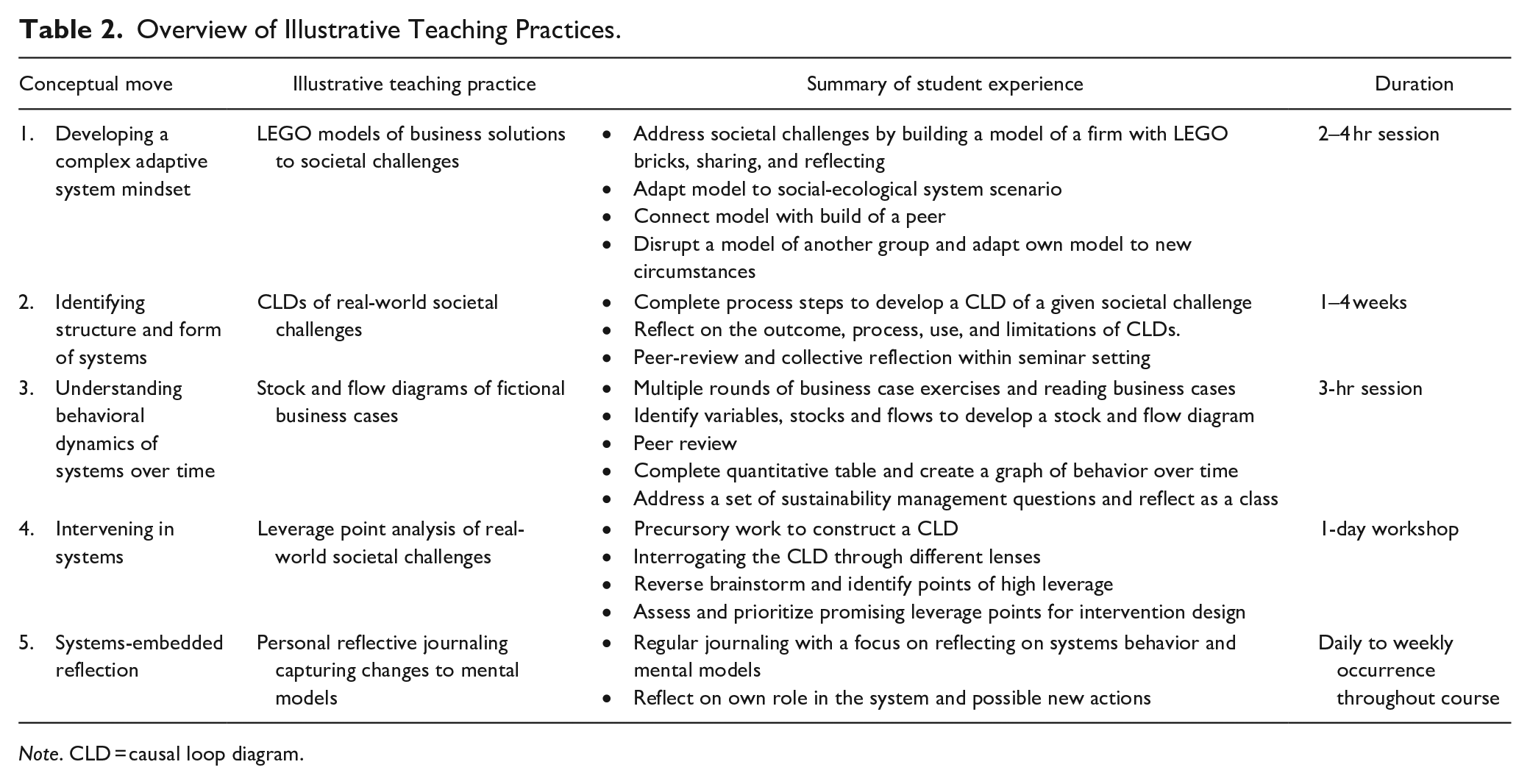
Note. CLD = causal loop diagram.
Conceptual Move 1: LEGO Models of Business Solutions to Societal Challenges
LEGO bricks (sometimes colloquially referred to as “Legos”) provide learners hands-on experiences to develop a CAS mindset. Tangible and tactile, LEGO bricks are well known and provide playful opportunities to “think with hands” (LEGO Serious Play, 2010). The teaching practice emanates from a constructionist learning theory that learners may benefit from constructing real models (Papert, 1980). It helps to reduce the abstract nature of systems concepts as learners encounter them through their builds and experience their applicability to managing for sustainability.
Learners are divided into groups (suggested 4–6 persons) and are guided through multiple rounds of exercises that follow an adapted process structure of LEGO Serious Play: set challenge, building, sharing, and reflection. First, learners are set a building challenge. Second, learners respond by building or adapting a model created with LEGO bricks drawn from a communal resource pile. Builds may be literal or metaphorical representations and are constrained by limited build time. Third, learners share explanations and meanings of their builds within their groups. Sharing invokes reflections on what has been built and why, and group members may ask questions to gain further insight. Fourth, learners are called upon to reflect on their learnings of the round for managing for sustainability. Reflection is steered by the educator and occurs within learner groups and plenary settings.
Below, we offer an example of a 135-min session for pre-experience learners. The session moves through five rounds with time allowed for starting instruction and group formation (10 min), break (15 min), and final reflection (15 min). We recommend longer sessions of 3 to 4 hr and offer an expanded session guide in the Supplemental Appendix. The first two rounds do not include reflection stages.
In a first round (15 min), learners individually build a generic fictional company such as an automobile or clothing manufacturer. In a second round (15 min), learners are tasked to adapt their models to include a business solution to address a societal challenge of their choice. For instance, adding solar panels to address climate change. In a third round (20 min), each group member is assigned a social-ecological system scenario that provides a limited set of information regarding ecological and social conditions and important social-ecological interactions. Learners are challenged to consider the implications to the firm and the business solution they have created and adapt their model to the given conditions. For instance, a learner assigned a social-ecological scenario with long periods of winter darkness, but persistently windy conditions may decide to supplement solar panels with wind power generation. This highlights to learners how managing for sustainability is context specific. Without understanding the social-ecological system in which firms operate, solutions may not be oriented or effective for addressing the most pressing challenges (addressing holism). Solutions are facilitated and constrained by social-ecological systems such as the availability of land, wind, and sunlight, and direct replication from one context to another may not be effective as conditions alter (addressing hierarchy and interdependency).
In a fourth round (25 min), learners connect their builds with a group member to form a group build. Learners are tasked to consider what properties are now evident through the combination (addressing emergence) and may adapt the group build. For example, if both have solar panels, learners may reflect on the lack of diversity in renewable energy provision and decide to add an alternative energy source. In a fifth round (20 min), pairs of learners are invited to create new circumstances for a corresponding pair of learners. Learners may add or remove LEGO bricks and/or verbally inform the team of changes to social-ecological systems. For instance, a team build may have its solar panels removed due to shortages of scarce metals or may be informed of changes to the social-ecological system to change due to climate change. Learners return to their own models and are challenged to adapt to the new circumstances. This reflects that social-ecological systems are not static but change over time in ways that may be hard to predict (addressing complexity and self-organization). Firms contribute to this change and are impacted by it in a process of coevolution. This may make current business activities unsuitable in the future and solutions to societal challenges ineffective.
Sessions should be held in a relaxed learning environment to support creativity and confidence in learners to express themselves through their builds and verbal explanations without judgment. Sessions are performed in-person with the number of learners limited by the availability of LEGO bricks and facilitators (suggested 2–3 groups per facilitator). Teaching online is possible but not advised due to difficulties including the need for learners to master a building software and the time required for builds. Educators can also develop facilitation skills through certified LEGO Serious Play facilitator programs. Further guidance on the LEGO Serious Play method can be found within the open-source document LEGO Serious Play (2010) and the video “LEGO Serious Play: Introduction” at https://www.youtube.com/watch?v=Ucn5QqhtxaU
Conceptual Move 2: Causal Loop Diagrams of Real-World Societal Challenges
Causal loop diagrams (CLDs) are a systems mapping technique that help learners explore the structures underlying societal challenges by creating visualizations of complexity. CLDs foster learners’ relational thinking as they explore the causal relations between variables (addressing interconnections) and closed loop thinking as causal chains and feedback loops are constructed and time lags are considered (addressing feedback and delays). CLDs help learners communicate their perceptions of causal structures and to be specific about their understanding of what determines the observed societal challenges (addressing mental models).
Figure 2 depicts a simplified CLD of water extraction developed in Vensim software. Causal connections between variables are depicted by arrows that form either balancing feedback loops or positive, reinforcing feedback loops depicted by symbols B or R and the direction of the loop. If an increase in the first variable causes an increase in the second variable it is marked with a positive polarity (+), and if it would cause a decrease in the second variable it is marked with a negative polarity (−) all else equal. Significant time delays are represented with two lines crossing the causal connection (║).
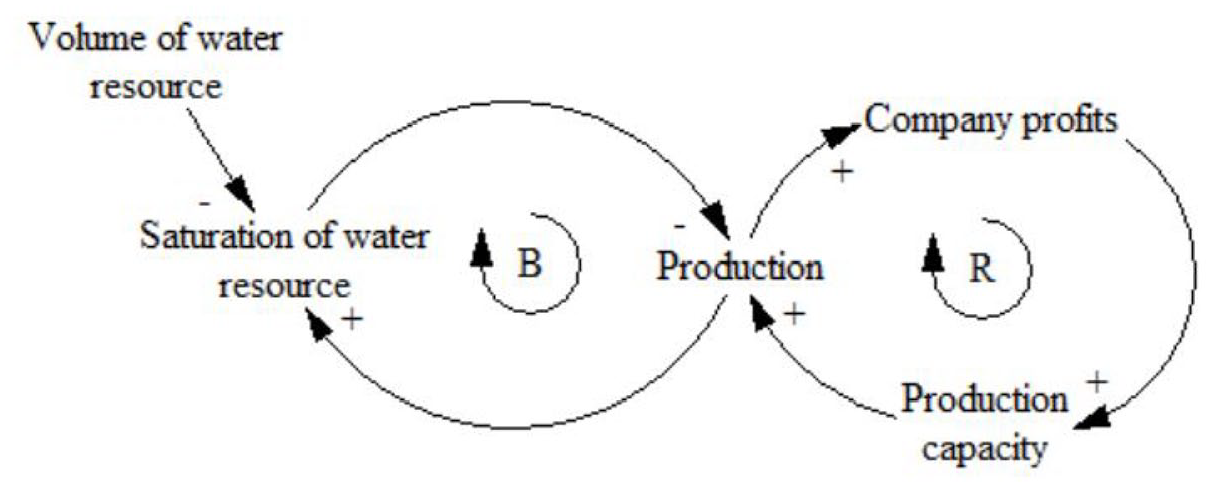
Simplified Causal Loop Diagram of Water Extraction.
CLDs are suitable for use in pre- and post-experience taught programs and for diverse class sizes. We recommend CLDs as a team-based exercise conducted outside class and completed over single or multiple weeks, combined with small group seminars. This allows for detailed mappings, incorporating desk research and iterative mapping sessions, with time to gain stakeholder input and validation. Learners are divided into groups (4–6 persons) and are provided with an exercise worksheet with a set challenge and are tasked to submit evidence on three aspects: CLD building process, CLD outcome, and CLD reflection. CLDs can be drawn by hand or using free software like Kumu (https://kumu.io), making them suitable for online teaching. All learners work on the same selected real-world societal challenge from well-defined starting questions. For instance, understanding household food waste in Rotterdam, the Netherlands is preferable than asking learners to create a CLD of the food system. Challenges need to be place specific (e.g., places differ with municipality recycling schemes), limited in scope (e.g., household food waste instead of climate change), and familiar to learners.
Learners should encounter several challenges in creating CLDs. Common struggles include boundary setting, ambiguous polarities, differentiating correlation with causation, and finding an appropriate level of aggregation. Guidance from educators should support, but not remove these challenges. For instance, learners can be prompted to avoid creating “spaghetti diagrams” and follow Kim’s (1992) basic rule: “If I were to double or halve this variable, would it have a significant effect on the issue I am mapping.” Inexperienced learners may struggle to identify and form feedback loops. They may create CLDs with few or no feedback loops, or prematurely create feedback loops that omit important variables or relationships. While learners are enthusiastic to discover multiple causes of societal challenges, they may overlook significant downstream consequences for feedback loops, for example, a relationship between environmental destruction, environmental awareness, activism, and pressure on firms for change. Guidance should instruct learners to build CLDs from individual variables and their direct relationships, highlighting both cause and consequence to develop feedback loops. Furthermore, instructions should prompt learners to consider both perceived positive and negative consequences, whether intended or unintended by actants that influence them (Kim, 1992).
Conceptual Move 3: Stock and Flow Diagrams of Fictional Business Cases
Stock and flow diagrams (SFDs) provide visual explanations of systems and are central to the field of system dynamics. SFDs explicitly identify the accumulations of materials and information in a system and overcome some limitations of CLDs (see G. P. Richardson, 1986). SFDs promote dynamic thinking by enabling learners to draw graphs of behavior over time and build simulation models using software like STELLA or Vensim. SFDs can be used across all pre- and post-experience levels, with case exercises tailored to the experience and comprehension of a cohort. We recommend at least a 3-hr session to move through a few exercises and allow time for reflection.
Figure 3 depicts a simplified SFD of water in a lake developed in STELLA software. Stocks are represented by rectangular boxes, connected by an inflow and outflow represented by double arrows with valves that regulate their flow rates. Clouds represent the source and sink of flows and mark the boundaries of the modeled system. Variables are intermediary functions of stocks, constant parameters, or exogenous inputs and are represented by circles. Connectors, represented by arrows, show how parts of the system influence each other.
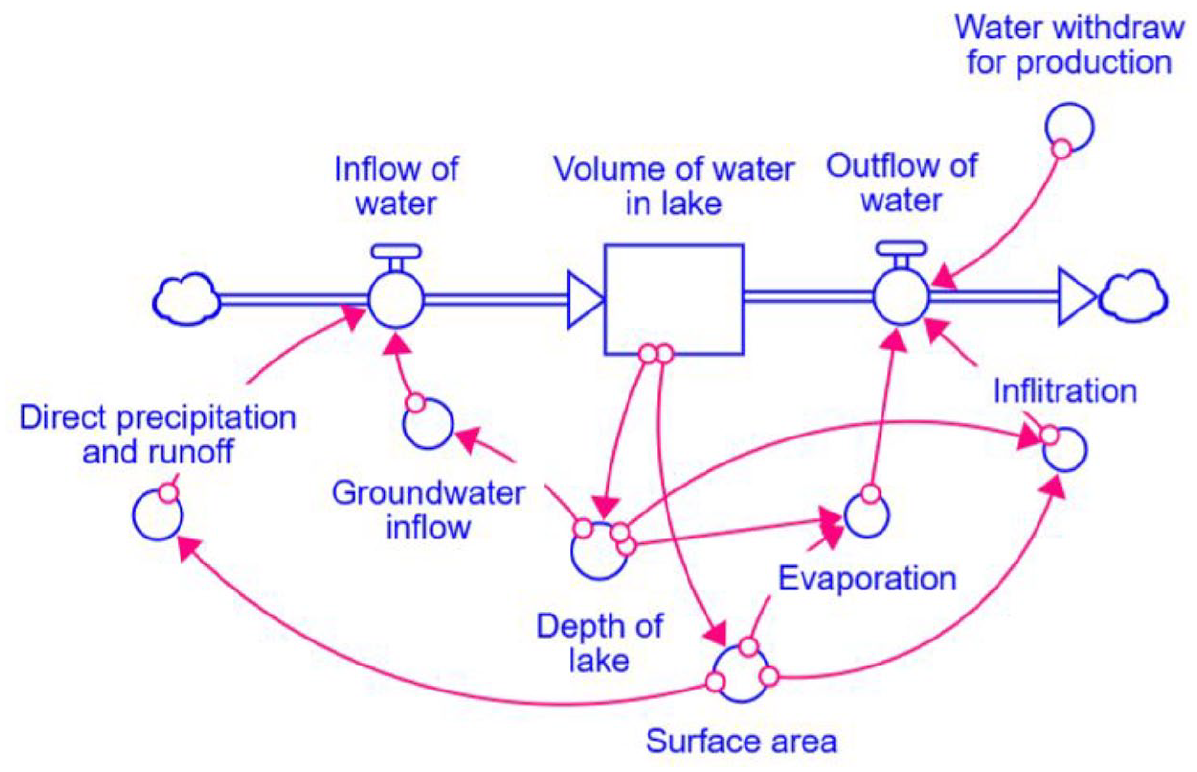
Simplified Stock and Flow Diagram of Water in a Lake.
Learners are presented with a series of four fictional business case texts (150–500 words), that describe different sustainability management situations with quantitative values (e.g., the amount of plastic waste entering and being cleared from the ocean each week; see Ticotsky, 2013). With each case, the educator can increase the text length and difficulty level for developing different types of SFDs. For example, learners may begin with a simple business case describing air pollution and the economic activity of a factory. A more complex case then incorporates thresholds, such as numbers of animal species or pollution levels, whereby a fundamental shift in system behavior occurs (addressing nonlinearity and transformations).
For each business case, learners move through a five-step process. First, learners identify the important variables, stocks and flows and draw a SFD. Learners familiar with CLDs can construct simple versions of these as an intermediary step. Second, within small groups, learners conduct peer reviews to develop SFD interpretation skills and learn how the same system can be perceived differently before the educator presents a proposed solution. For simple exercises, learners can draw tables of quantitative values and calculate missing values, such as stock levels from known inflows and outflows. Third, learners draw simple behavior-over-time graphs (addressing function), either on paper or in Excel. More complicated SFD exercises require simulation modeling. Educators can teach simple systems simulation modeling or prepare models in advance and ask learners to predict what they think will happen when running simulations. Fourth, learners use the SFD and graphs to tackle a specific question posed within the case. For example, “Company A wants to address the problem of household food waste by doing X. Is this a good idea? What else do you need to know?” Fifth, and finally, each business case discussion concludes with a group reflection before moving to the next one with questions such as “What affects the change of the stock?” (addressing accumulations), “What are the important implications of how Company A manages for sustainability?,” and “What other situations does this exercise remind you of?”
Building simple SFDs help learners understand how behavioral dynamics can be manipulated (e.g., how stock levels can be altered) and provide insight to system behavior over time. While easy to comprehend, SFDs are difficult to create and require practice to render accurately. Therefore, educators should build up complication gradually using easy to understand examples. Models should be simple, with educators emphasizing they will not perfectly match reality and rely on ceteris paribus assumptions. Learners often struggle with nonlinearity and misunderstand the patterns of behavior between flow rates and stock changes (Sterman, 2002). Educators should reinforce key learnings through examples and behavior-over-time graphs, such as when inflows exceed outflows, stocks increase, and vice versa.
Conceptual Move 4: Leverage Point Analysis of Real-World Societal Challenges
Leverage point analysis (LPA) is an emerging technique developed in the field of systems design (Stroh, 2015). LPA seeks to help learners find places in the system that are susceptible to change whereby major improvement to the behavior of a system can be generated with restricted intervention effort (addressing leverage points). Systems scholars across multiple disciplines are developing LPA (Murphy & Jones, 2020), and there currently is no standardized approach for educators to apply.
Learners work in small groups on the same real-world societal challenge. LPA requires learners to prepare a CLD in advance and can be complemented with systems exploration, such as stakeholder interviews and analysis, historical and current change analysis, and key system tensions. LPA is a precursor to building interventions and can be taught as a first day of a two-day systems innovation workshop. In the workshop, learners progress through exercises to identify and select leverage points for intervention design on the second day. Workshops can be held in-person with analogue or digital CLDs, or online with digital CLDs.
In the morning session, learners consider the current behavior of a system and construct a shared vision for its desired behavior. For instance, an agricultural system in Somerset, England that enhances biodiversity. This is followed by a guided application of analytical lenses to deepen learners’ understanding of the societal challenge’ causal structure and change potential through the CLD. Educators can choose analytical lenses for learners to apply (with at least two recommended), including. network analysis, enablers and inhibitors analysis, and performance gap analysis (lenses are outlined in the Supplemental Appendix). Each lens requires learners to identify places in the CLD with identifying symbols and make written remarks.
In the afternoon session, learners use this analysis to identify points of leverage by interrogating variables, connections, and loops. Learners start by discussing their marked-up CLDs, reverse brainstorming what would worsen the societal challenge, then flipping the ideas to identify system improvements (Stroh, 2015). Learners identify at least five leverage points, noting their location in the CLD (e.g., variable, connection, loop) and desired influence (e.g., add new connection or variable, weaken feedback loop). Learners reflect on the work of Meadows (1999) to consider how the leverage point may act to change the system, such as changing information flows and the goal of the system. The day ends with learners prioritizing leverage points, considering their impact, feasibility, and key assumptions behind each (The Omidyar Group, n.d.). Learners rank leverage points and can start working with the highest ranked ones for intervention design on a second day of a workshop.
LPA helps learners integrate different system interrogations, like CLDs, tensions, and stakeholder analysis, which may otherwise feel disconnected. LPA enables thought experiments on how to change the societal challenge under focus and explore what may be the consequences (negative or positive) of potential interventions (addressing unintended consequences). It stimulates learners to consider the current wealth of the system and move beyond the idea that the answer always lies a new product or service. For instance, closing a performance gap may involve shifting the desired performance level instead of the actual performance level (e.g., the desired quantity of televisions in a home). Learners may focus on variables (i.e., aspects of system elements) and need educators to stimulate relational thinking (i.e., how elements are connected and arranged to form the entirety). Learners easily engage with strengthening relationships and feedback loops but may need prompting to consider weakening them.
Conceptual Move 5: Personal Reflective Journaling Capturing Changes to Mental Models
Developing the reflective capabilities of learners can be difficult, as educators need to engage with the thoughts, feelings, and experiences of individuals. To permanently capture the emotional aspects of systems thinking, a few studies have highlighted the use of personal journals to develop learners’ reflective practices through the process of writing with regular commitment (Gray, 2007; Pavlovich et al., 2009). Journaling can enhance learners’ awareness of themselves, others, and the systems in which they are embedded, as it requires them to explore their personal engagement with academic course content throughout the learning process. Writing a personal reflective journal is “a journey of exploring one’s learning” (Pavlovich et al., 2009, p. 38) through reflections-in-action (Schön, 1984) generated through an intuitive inner dialogue. Unlike logs or diaries, which are simply recordings of events and their stories, a journal documents deliberate thoughts and analysis (Gray, 2007). It is a product of reflective writing, which contains learners’ personal reflections and reactions, stories, metaphors, and critical events.
Personal reflective journals may be utilized in courses in different ways, ranging from reflective practices during each session to developing reflective term papers (Pavlovich et al., 2009). We recommend at least weekly journal entries to build learners’ habits of reflection and enable them to recognize changes over time. Journaling is suitable for both pre- and post-experience programs and can be digital or paper based. Educators may make journaling mandatory and can choose if it will be a graded assessment. Educators can encourage systems-embedded reflection by exploring questions such as: “What have I learned about systems behavior?” (addressing social-ecological sensemaking), “How should my mental models about societal challenges change?” (addressing deep learning), “What have I learned about my role in the system?,” “What emotions did I feel in my learning journey as a systems actor this week and why?,” and “What have I learned that I would like to now apply in my decision-making?” (addressing adaptation). Educators should emphasize that when writing the journal entries, learners need to move away from the passive, neutral voice generally used in academic writing to a more personal writing style that captures how and what learners feel (their hearts) and think (their souls; Waddock & Lozano, 2013).
To provoke successful self-reflection through journaling, educators need to recognize and address learners’ potential hesitation (Miller, 2017). Ensuring wide acceptance involves accommodating perceived barriers about time and trust. Learners generally prefer journaling exercises that are brief and less structured (Hendrix et al., 2012). Novice learners tend to favor semi-structured journals, which provide some guidance while allowing personal expression. In contrast, more experienced learners often prefer free-writing journals, which offer greater freedom and flexibility. Furthermore, learners frequently express concerns about the confidentiality of the information they share, particularly regarding their feelings and emotions (Hendrix et al., 2012; Miller, 2017). Educators must build an environment of emotional safety guaranteeing anonymity and handling sensitive information with care. If journals are graded, educators need to provide learners with clear assessment criteria to ensure that subjective thoughts and feelings are not being evaluated (Pavlovich et al., 2009).
Prudently Advancing a Systems Approach to Teaching Sustainability Management
We motivated our study by the critical notion that a systems approach to sustainability management may help to bridge the disconnect between corporate practices and social-ecological systems decline. We argue that sustainability management educators may support this paradigm shift by cultivating the cross-scale understandings and decision-making of current and future managers. At the same time, we highlight the hesitance of educators to move taught courses in this direction (Waddock & Lozano, 2013) and the need for further guidance on developing curricula and pedagogical approaches (Bagley et al., 2020; Edwards et al., 2021).
By introducing a learning framework for sustainability management with a systems approach, we have aimed to deepen educators’ processual understanding of important conceptual moves and how theoretical systems concepts may be utilized to develop learners’ knowledge and capabilities to address societal challenges. While some educators may choose to incorporate systems thinking–based ideas such as science-based targets for business into their teaching, we contend that without grounding learners in theoretical concepts such as threshold crossing and systems transformations, they may lack a profound understanding of the rationale behind these practices. Therefore, our framework not only offers a method for educators to teach systems concepts but also underscores the importance of cultivating a comprehensive understanding of why these concepts are vital in driving meaningful sustainability transitions within businesses.
In the following section, we share some final suggestions for how to prudently adopt systems thinking in sustainability management education.
Impacting Managerial Behavior on Sustainability Management
While early studies are beginning to offer empirical evidence on the benefit of systems thinking to sustainability performance of firms (Schulte & Paris, in press), research on the impact of systems education on learners in practice is nascent and further insight is needed as to whether it may induce addressing societal challenges at the pace and scale required. Developing individual capabilities in systems thinking is likely to take time and requires investment from learners to keep engaging with development of their thinking. Learners may have entrenched ways of thinking that they resort to (Sweeney & Meadows, 2010), or struggle to apply a systems approach within their managerial role and functions. Additionally, learners on pre-experience programs will likely need to retain systems thinking capabilities for long periods of time until they reach positions of managerial decision-making within firms. Future research is needed to investigate the influence of teaching a systems approach on the application, retention, and development of systems thinking capabilities.
Advancing the Systems Approach Learning Process
We have formulated the systems approach as a learning process that can be adopted by educators to teach sustainability management. This approach aligns with previous studies of Edwards et al. (2021) and Waddock and Lozano (2013) who advocated for a paradigm shift in management education to address complex societal and environmental challenges through systems thinking. Our study complements this work by formulating the systems approach into a learning process that educators can apply to shape the curriculum of their courses.
By identifying and explaining the important systems concepts of each conceptual move, our learning framework helps educators become familiar with the underlying theory of systems thinking and when and how it can be pertinent to achieving the learning goals of sustainability management classes. We have carefully selected and explained the key systems concepts that are most relevant to achieving learning goals without overloading learners with excessive theoretical knowledge. Yet we acknowledge that further systems concepts are available (see Kast & Rosenzweig, 1972) and can be applied to teach alternative systems approaches to sustainability management. We welcome scholars to offer alternate learning processes and engage with further systems concepts that unlock learner insights on sustainability management.
Furthermore, we encourage educators to experiment with new teaching practices for sustainability management education across the outlined five conceptual moves. A potential avenue to explore is how systems thinking can be used to deepen learners’ understanding of social-ecological systems behavior and the embeddedness of firms. For instance, using a causal loop diagram exercise in conjunction with teaching the stages of the hydrological cycle to develop insight on water scarcity and the connection with business activities.
Teaching Single or Multiple Approaches
Educators may teach sustainability management from a systems approach or blend it with other approaches. Teaching a plurality of approaches within the same course may strengthen learner’s ability to critique approaches (Dyck & Caza, 2022) and reduce the risk of learner rejection (Lourenço, 2013). Yet learners may struggle to deeply engage with the outlined process, limiting their development of CAS mindsets. Learners may have difficulties switching between approaches, requiring educators to allocate extra class time to present topics in multiple ways. If a systems approach is used exclusively, educators should encourage learners to reflect on its strengths, limitations, and alternative approaches by writing journals throughout the course. Future research may explore how educators can navigate these trade-offs in teaching single or multiple approaches within a sustainability management course.
Difficulties in Adopting a Systems Approach
Adopting a systems approach in pedagogy can be challenging for educators and learners, as it requires collaborative knowledge creation. Both learners and educators are expected to actively participate in the education process, working in small groups, collaborating on assignments, and developing new mental models of societal challenges. The danger of this learner-centered approach (Forrester, 1993) is that learners become overwhelmed and unwilling to change a more passive learning behavior. Learners generally find it difficult to engage in systems thinking; certain tasks, such as entertaining openness to various, sometimes conflicting, viewpoints do not always come naturally (Roome, 2005), as learners tend to draw on their own perspectives and values when evaluating issues.
Educators may struggle to transition from controlling the learning environment to facilitating critical thinking and toward reflective exploration (Waddock & Lozano, 2013). As a facilitator, the educator is not only the “subject matter expert” (Moosmayer et al., 2019, p. 928), but also responsible for (a) defining the issues, objectives, and overarching framework of the course’ scope; (b) organizing ideas related to the course challenges; and (c) orchestrating class activities, methodologies, and team dynamics crucial for learner success (Hogan & Broome, 2020). Thereby, the educator must maintain a neutral position, ensuring that his/her opinions, ideas, or knowledge do not influence the learners’ decisions (Schwarz, 2005). Limited guidance is available on how to become a systems facilitator (Hogan & Broome, 2020), and we encourage studies to offer more ideas and support.
Conclusion
A systems approach to sustainability management is gaining recognition for its potential to strengthen corporate practices and bridge the disconnect with the deteriorating state of social-ecological systems. Sustainability management education may play an important role to develop its understanding by current and future managers and enhance its diffusion in practice. Yet, educators may lack familiarity of its conceptualization and how it may be effectively integrated into taught courses. We believe our learning framework enhances the conceptual clarity of a systems approach and offers educators necessary guidance and tangible examples for implementation. We encourage sustainability management educators to explore and adapt this approach, aiming to nurture business leaders capable of decision-making that embraces firms as part of coevolving, complex social-ecological systems.
Supplemental Material
sj-pdf-1-bas-10.1177_00076503251324569 – Supplemental material for Teaching a Systems Approach to Address the Sustainability Management Disconnect
Supplemental material, sj-pdf-1-bas-10.1177_00076503251324569 for Teaching a Systems Approach to Address the Sustainability Management Disconnect by Steve Kennedy, Sylvia Grewatsch, Lara Liboni and Luciana Oranges Cezarino in Business & Society
Footnotes
Acknowledgements
The authors would like to thank the editor Tobias Hahn and the anonymous reviewers for their enthusiasm, guidance and dedication. They would like to thank Sander Fleuren, Hannah Medenwald, Gyula Zsombor Szijjártó, Daniele Dalla Vecchia and Matias van Vliet for their assistance in developing the illustrative teaching practices. They also appreciate the feedback from Tima Bansal, Kim Ceulemans, Oliver Laasch, Gordon Rands, Garima Sharma and the members of Department of Business-Society Management at Rotterdam School of Management. The first author is Scientific Advisor to MOSS Consultants & Capital.
Declaration of Conflicting Interests
The author(s) declared no potential conflicts of interest with respect to the research, authorship, and/or publication of this article.
Funding
The author(s) received no financial support for the research, authorship, and/or publication of this article.

Supplemental Material
Supplemental material for this article is available online.
Author Biographies
References
Supplementary Material
Please find the following supplemental material available below.
For Open Access articles published under a Creative Commons License, all supplemental material carries the same license as the article it is associated with.
For non-Open Access articles published, all supplemental material carries a non-exclusive license, and permission requests for re-use of supplemental material or any part of supplemental material shall be sent directly to the copyright owner as specified in the copyright notice associated with the article.
