




Abstract
To understand ethical consumer choice, it should be studied from a holistic, configurational perspective. We use fuzzy-set qualitative comparative analysis (fsQCA) (N = 715) with a randomized experiment in the context of animal welfare to examine (a) the interdependencies of factors aiding or impeding ethical choice, and (b) whether ethical choices occur differently in a loss frame than in a gain frame. We identify several alternative pathways to ethical choice and non-choice, and within these pathways, we reveal substitution effects, complementarities, and contingencies, reflecting the complexities of consumer choice. Furthermore, we demonstrate how ethical choice results more easily in a loss frame, and non-choice more easily in a gain frame, but how framing can also be irrelevant in certain situations. We contribute theoretically to ethical consumer choice in general and to food choice in particular by showing how it is the interplay of several factors in complex configurations that determines whether the situation favors ethical choice or non-choice. We outline important management and policy implications of our findings.
A thorough understanding of ethical consumer choice 1 is required so that it can be effectively promoted: by businesses designing and communicating the options available for choice, by regulators discouraging certain choices and encouraging others, and by consumers themselves rethinking their values and reflecting upon their choices. Indeed, interest in consumers in relation to business-society relationships has been steadily increasing, and ethical consumer choice has received significant academic attention (Carrington et al., 2021; Schlegelmilch & Öberseder, 2010).
Previous literature has identified several elements affecting ethical consumer choice, such as ethical attitudes (Carrigan & Attalla, 2001), social norms (Cialdini & Jacobson, 2021), social influence (White et al., 2019), demographics (Mohr & Schlich, 2016), product attributes or functionality (Bangsa & Schlegelmilch, 2020), and price-related issues (Janßen & Langen, 2017). Despite these findings, there are still important gaps in understanding the intricacies of consumer decision-making in ethical choice situations. We point to two such gaps that motivate our study, namely the interdependencies between factors affecting ethical choice and the impacts of framing on ethical choice.
First, the consumer is typically encountering a bundle of simultaneous factors affecting ethical choice and needs to resolve their trade-offs, dependencies, and synergies (Longo et al., 2019; Olson, 2013), but the joint effects and interdependencies of these individual factors are not well understood. As pointed out by Celestine et al. (2020), it is apparent that an integrative view of the combined impact of diverse influencers is needed to advance understanding of ethical decision-making. Such an integrative view would open the door to refining and nuancing the theory on ethical consumer choice in an important way.
Second, ethical consumer choice is likely to depend on how the ethical issue at stake is being framed. This affects what mental processes are activated in the consumer’s mind (Carfora et al., 2021) and thus what role ethical and other considerations will take among the bundle of factors influencing choice. It is key to note that making an ethical choice can be looked at both from a gain frame (gain: achieving a positive outcome) and from a loss frame (non-loss: avoiding a negative outcome). However, the persuasiveness of gain and loss frames is still unclear (Grazzini et al., 2018) in the context of ethical consumer choice, even though this distinction is in practice omnipresent and thus potentially an important component for explaining ethical choice.
In this article, we address both these issues. Our research objective is to explore how factors affecting ethical consumer choice interact under different ethical frames to result in (non)choices. Methodologically, we take the view that consumption choices typically exhibit causal complexity, defined as “complex interdependencies among multiple explanatory factors that combine to bring about an outcome of interest” (Furnari et al., 2021, p. 778). In contrast to statistical approaches, which may omit important insights as they tend to examine isolated factors in symmetrical correlation, a configurational approach is particularly suitable for studying causal complexity (Ibid). We follow this approach and carry out a large-N fuzzy-set qualitative comparative analysis (fsQCA) to uncover how different factors are intertwined in influencing ethical consumer choice. Moreover, we incorporate a randomized experiment in our design as this allows us to examine the impacts of different ethical frames on the bundles associated or not with ethical choice. Both the fsQCA and the incorporation of a randomized experiment in it are novel approaches that enable new insights into our research question. Our empirical example comes from animal welfare in food production.
Our findings shed new light on the phenomenon of ethical consumer choice. We identify multiple pathways to consumers’ ethical choice and non-choice and witness several kinds of interdependencies among the factors that constitute those pathways. Furthermore, we demonstrate the impact of framing: when the same ethical issue is presented in a loss frame (avoiding unethicality), ethical choice results more easily, and when it is presented in a gain frame (achieving ethicality), ethical non-choice results more easily, but framing can also be irrelevant in certain situations. Overall, through our configurational theorizing process, we contribute to ethical consumer choice in general, and food choice in particular, by unbundling ethical consumer choice into a fine-tuned picture, showing how it is the interplay of multiple factors in complex configurations that determines whether the situation favors ethical choice or non-choice. This also contributes to the literature on business and society by increasing the understanding of ethical issues not as an isolated, atomistic factor, but as part of diverse combinations in which ethics and other factors interact. Our findings also have important managerial and policy implications as they point to potential ways of promoting ethical consumer choice more effectively, including through framing practices that fundamentally challenge current approaches.
Literature Review and Conceptual Framework
When the consumer is contemplating an ethical choice, many factors are present, pulling in different directions: those that promote the choice (which we call “accelerators”) and those that hinder it (which we call “brakes”). We focus on selected key factors based on previous literature and combine them with the framing of the ethical issue and with consumer gender. Below, we discuss all these elements and their interdependencies and summarize this in a conceptual framework for our study.
Factors Affecting Ethical Choice
“Accelerators” Promoting Ethical Choice
Consumers’ ethical attitudes are important motives for ethical choice (Newholm & Shaw, 2007). Ethical choice may be based on a desire to contribute toward a cleaner environment, improved human rights, or other environmental or social issues (Schaefer & Crane, 2005). This can happen out of consideration of the rightness of such action, the good produced by such action, or of the kind of person one wants to be (Garcia-Ruiz & Rodriguez-Lluesma, 2014). However, the impact of ethical attitudes on consumption depends on the importance of the ethical issue (Carrigan & Attalla, 2001), and for ethical considerations to motivate ethical choice, the issue must have sufficiently high moral intensity (“extent of issue-related moral imperative,” Jones, 1991: 372) in the eyes of the consumer. The importance of the ethical issue relates to the concept of moral identity: moral identity has been found to be a predictor of moral behavior, but which specific moral traits are essential parts of the individual’s self-concept can vary between individuals (Aquino & Reed, 2002). Ethical importance gauges to what extent the issue forms part of the moral identity of the individual.
There can be also other sources for consumer demand for ethicality, as has been recognized by many studies that have questioned consumers’ ethical attitudes as the only predictor of ethical choice (Carrigan & Attalla, 2001; Carrington et al., 2010). Green and Peloza (2011), for example, found that corporate social responsibility could create three forms of value for consumers: emotional, social, or functional. Thus, social pressure can be an important motive for ethical choice, as people generally want to comply with the social norms and expectations of their relevant reference groups (Costa Pinto et al., 2020; Davies & Gutsche, 2016). The existence of this motive requires both that there is some party that creates pressure for the consumer to consider ethicality in their purchasing decision, and that this party is sufficiently significant for the consumer so that they will want to comply with the pressure. Also this point relates to moral identity, since the moral identity of an individual may have a social referent, for example, a specific person. (Aquino & Reed, 2002).
Consistent with the findings of Green and Peloza (2011), the motivation for ethical choice can also be based on the perceived quality and functional benefits associated with the product (Delmas & Lessem, 2017). What kinds of benefits are perceived depends heavily on the product or service in question. In the case of food, for example, they can relate to hedonic benefits, such as taste, or to health benefits. Perceived benefits can affect choice regardless of whether the perceptions are accurate.
In sum, in our framework, we conceptualize that ethical importance, social pressure, and functional benefits can act as “accelerators” and thus promote ethical consumer choice.
“Brakes” Hindering Ethical Choice
While consumers’ ethical choices may be hindered by many factors such as availability, consumption habits, or lack of knowledge (Wiederhold & Martinez, 2018), the most frequently identified barrier to ethical choice is related to price (van Doorn & Verhoef, 2015). Since many ethical products are more expensive than otherwise similar but less ethical products (Osburg et al., 2017), the price level may become a constraint for ethical consumer choice, as recognized in previous literature (Aschemann-Witzel & Zielke, 2017).
However, the question of price is likely to be more complex than the absolute price level alone, and so the individual’s high price sensitivity or perceived unfairness in the price distribution may have an impact on the acceptability of the price. Price sensitivity refers to consumers’ reactions toward perceived prices and price changes. Those consumers who favor low prices in general and who easily change previously used brands to lower-priced ones if price differences exist are called price-sensitive consumers (Ramirez & Goldsmith, 2009). Their price sensitivity may constitute a barrier to choosing the ethical product alternative if a price premium is involved (van Doorn & Verhoef, 2015).
Fairness and unfairness perceptions of price are additional key concepts when considering the acceptability of prices for ethical products. To accept a premium price, consumers need to trust not only that there is a justified reason behind the premium (in other words, that the ethicality of the product is genuine) but also that the premium is fairly distributed along the supply chain (Gielissen et al., 2008). Moore (2004) reported this kind of price distribution uncertainty about certified Fair Trade products (see also the study by Pedregal & Ozcaglar-Toulouse, 2011). If the premium lacks transparency and the ethical cause is not credible (Busch & Spiller, 2016; Pedregal & Ozcaglar-Toulouse, 2011) and if the seller fails to communicate the reasons behind the premium, the premium may not be accepted.
How large a role price information plays in buying decisions depends on the product category (Osburg et al., 2017). In routine choices such as food choices, rational judgments may be bypassed, and difficult attribution evaluations substituted with attitudinal reflections (Köster, 2009). In those cases, how consumers perceive a price may be more impactful than the actual, absolute price information. In this study, we conceptualize that a perceived unfairness of the price distribution and the individual’s high price sensitivity operate as “brakes” that hinder consumers’ ethical choices when a price premium is involved.
Framing
Framing effects are central to decision-making and human judgments. When talking about framing (specifically, valence framing), the key point is that the same, objectively equivalent information can be presented in positive or negative terms (Levin et al., 1998), for example, in marketing communications. Levin et al. (1998) distinguish between risky choice framing, attribute framing, and goal framing, all of which differ in what is framed and have different underlying processes. Of these, the most interesting for us is goal framing where one frames differently the implied consequences of behavior, focusing attention alternatively on how the behavior could help obtain a positive result (message in gain frame) or avoid a negative result (message in loss frame).
The best-known theory in the context of framing is prospect theory (Kahneman & Tversky, 1979), but other theories have also been put forward (Nan et al., 2018). A key insight about framing relates to information processing, and in this study, more precisely to loss aversion which is rooted in prospect theory. Loss aversion means that negative information has a stronger impact on human judgments and further on behavior than comparable positive information both in risky choice situations and in situations without risk (Tversky & Kahneman, 1991). Even if loss-framed messages seem to be more effective than gain-framed messages in goal framing (Levin et al., 1998), previous literature also contains some contradictory findings, and the persuasiveness of different frames is still unclear (Grazzini et al., 2018). More knowledge is therefore required on both negativity and positivity bias in decision-making (Unkelbach et al., 2020), especially when causal complexity is present.
Typically, the literature on ethical consumer choice takes the perspective of achieving ethicality, but the other side of this is avoiding unethicality. Achieving ethicality (gain frame) and avoiding unethicality (loss frame) may be asymmetrical in terms of their stakeholder value implications (Lankoski et al., 2016). Indeed, according to regulatory focus theory (Camacho et al., 2003; Higgins, 1997), when pursuing their goals, individuals can focus on promotion or prevention. When in a promotion focus, individuals are more sensitive to information about achieving a positive outcome, and when in a prevention focus, they are more sensitive to information about avoiding a negative outcome, as people tend to make decisions in accordance with their regulatory focus. While this regulatory focus can be a permanent characteristic of an individual, it can also be temporarily induced, including through priming (Camacho et al., 2003). Loss aversion with goal framing suggests that it is the information about avoiding unethicality that will be more influential in affecting behavior. In addition, Unkelbach et al. (2020, p. 116), in their overview of how positive and negative information is processed differentially, summarize that people “attend more to negative information, recall it more, and weigh it more heavily.” We include goal framing in our framework and examine whether the impact of ethics-related information presented in a loss frame is different from that of ethics-related information presented in a gain frame.
Gender
Sociodemographic factors are one of the most investigated predictors of consumer behavior. Some studies paint a profile of an ethical consumer as a middle-aged, well-educated woman (Mohr & Schlich, 2016), but findings on the impact of sociodemographic factors on ethical consumer choice are still inconsistent (Lehnert et al., 2015). Of the different consumer characteristics that are worth exploring more profoundly, in this study, we focus on gender whose importance in ethical decision-making is widely recognized (Celestine et al., 2020). 2
Gender is a challenging topic since it captures gendered roles, norms, stereotypes, identities, and cultural traditions (Bloodhart & Swim, 2020 ; Cornish et al., 2016). Yet, it deserves to be considered among the factors potentially affecting ethical choice. It has been repeatedly shown that gender plays a role in ethical consumer choice, even if the mechanisms behind this are not yet well understood. Luchs and Mooradian (2012) showed that gender differences could be explained by differences in personality traits; women being for example more agreeable than men. Dalton and Ortegren (2011) suggested that the differences might be due to the possibility that women are more prone to social desirability bias than men. Gender differences can also be related to gender roles or identity congruencies, for example, when considering ethical consumption less masculine and more feminine as found by Brough et al. (2016; also Shang & Peloza, 2016).
Whatever the reasons behind the differences, it is well documented that women tend to pay more attention to the consequences of their consumption choices. For example, women have been found to be more concerned about animal welfare issues (Cornish et al., 2016), more likely to purchase Fair Trade products and to promote Fair Trade consumption (Morrell & Jayawardhena, 2010), and more likely to buy organic food (van Doorn & Verhoef, 2015) than men.
Although gender differences are not clear in relation to price acceptability, previous literature recognizes that women could be more prone to making ethical choices even with a premium price. For example, women have been found to be more willing to pay a premium for ethical products (Petersen et al., 2021; Taylor & Boasson, 2014). In relation to certified responsible food produce, men were found to be more price sensitive and to lack trust toward ethical products delivering on their promise (Gassler & Spiller, 2018).
In sum, we include gender in our conceptual framework to explore whether the ethical choices of men and women are differently shaped under causal complexity.
Interdependencies Between Factors Affecting Ethical Choice
We argue that ethical consumer choice is a phenomenon that is likely to exhibit causal complexity where there are complex interdependencies among multiple explanatory factors (Furnari et al., 2021). It thus becomes essential to understand these interdependencies. Table 1 outlines the potential types of interdependencies between factors affecting ethical choice from several perspectives: what the nature of an interdependency can be conceptually, what that would mean in Boolean terms (AND, OR, or NOT), how that translates into QCA results, and what that would mean applied to our research problem. The table also shows variations in the interdependencies.
Interdependencies Between Factors Affecting Ethical Choice.
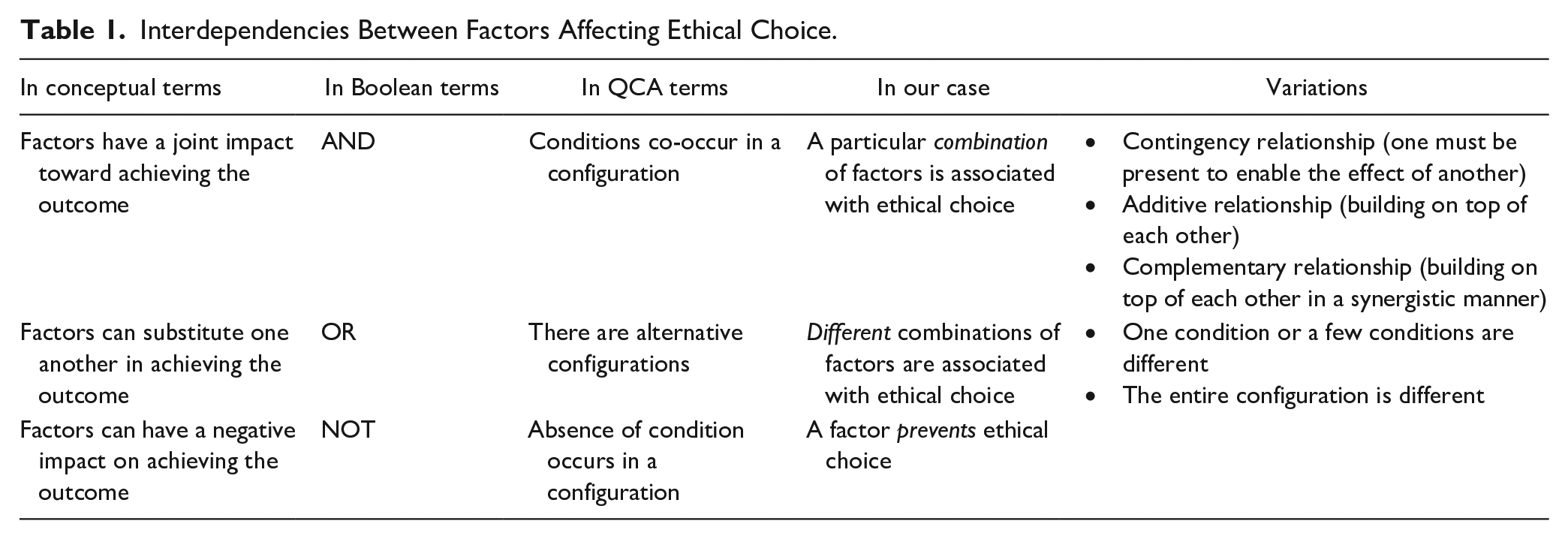
Note that when interpreting QCA results, an AND-type interdependency is often referred to as a complementarity relationship, and the conditions are regarded as complements to one another (in a QCA context, the explanatory factors are called conditions). However, if complementarity is taken to mean that conditions reinforce one another in a synergistic manner (i.e., two components are complementary when more of one raises the return on more of the other; Milgrom & Roberts, 1995), it cannot be automatically assumed that all AND-interdependencies are complementarity relationships. Table 1 lists also two other variations. One is that conditions relate to one another in an additive manner. Another possibility is a contingency relationship where one condition is needed for the other to have an effect (Furnari et al., 2021). Such a relationship delimits the applicability domain of the configuration. If the relationship really is complementary, Markard and Hoffmann (2016) further distinguish between unilateral vs. bilateral complementarity, and complementarity between similar vs. different elements. The latter is based on the concepts of pooled and symbiotic complementarity, respectively, by Grandori and Furnari (2009).
In sum, there are different possible relationship types between explanatory factors. Several relationships can co-exist at the same time in a configuration, and two factors can relate to one another in different ways in different configurations. Through these relationships, the factors produce “multifaceted interdependencies” (Furnari et al., 2021), which reflect and capture the rich and complex social realities. QCA is well suited to uncovering these relationships, and it has often been used for that purpose (Meuer, 2017; Misangyi & Acharya, 2014; Saka-Helmhout et al., 2021; Slager et al., 2021).
Summary of Conceptual Framework
Taken together, our conceptual framework suggests that “accelerators,” “brakes,” ethical framing, and gender can combine in complex ways, producing configurations that are, or are not, associated with ethical choice when a price premium is involved. This is illustrated in Figure 1.
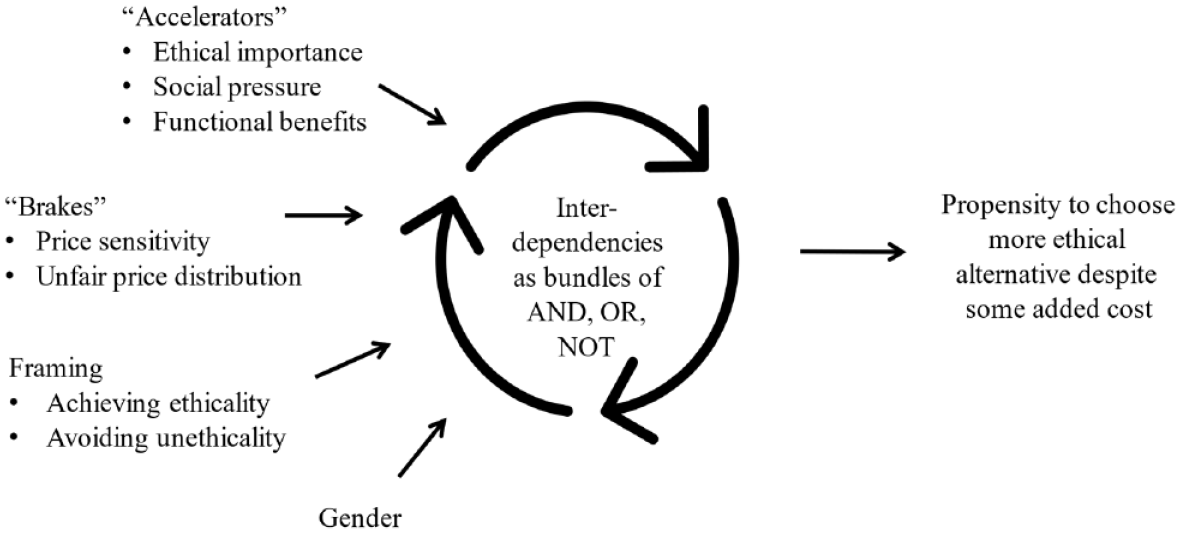
Conceptual Framework.
Data and Methods
Design
To collect the data, we conducted an experimental vignette survey where we manipulated the framing of the ethical issue. With this method, it is possible to combine the experimental design and survey methods (Atzmüller & Steiner, 2010). A vignette was the appropriate method to create a realistic and informative description of a hypothetical, complex situation and to include important variables in a controlled manner (Aguinis & Bradley, 2014). Vignette surveys are widely used in consumer, marketing, and management studies (Jin et al., 2022, using scenarios in an fsQCA study), and Oll et al. (2018) see them as particularly promising for business and society research.
Our empirical example comes from animal welfare in food production, more specifically animal well-being or suffering during transportation and slaughtering. We chose this example for several reasons. Food production and consumption have significant sustainability impacts (Tukker & Jansen, 2008). Food choices are often characterized by low involvement and little cognitive effort and are determined by habit (Ji & Wood, 2007), wherefore it is particularly important to understand widely the factors that may, even unconsciously, guide those choices (Köster, 2009). Within food sustainability issues, meat consumption is a prominent topic as it relates to several ethical and environmental issues (Poore & Nemecek, 2018).
Animal welfare is an emerging research topic in the food choice literature (Cornish et al., 2020) and an important factor influencing ethical consumer choice, particularly in relation to meat consumption (Bastian & Loughnan, 2017). Animal welfare during transportation and slaughtering deals with questions that include conditions in transportation vehicles, travel distances, or stunning methods. Not only do these issues raise ethical concerns, but they can also affect product quality (Njisane & Muchenje, 2017; Petracci et al., 2010). Taking care of animal welfare during transportation and slaughtering raises costs and thus selling prices (Appleby, 2005), wherefore consumers might have to trade off monetary gains (cheaper prices) against the well-being of animals. Based on the components of moral intensity by Jones (1991), we can expect animal welfare during transportation and slaughtering to be of high moral intensity and consequently an issue where the impacts we want to examine may be clearly visible.
The vignette (Supplemental Material 1) describes a hypothetical situation where the respondent is at a grocery store with a chosen companion (friend or family member), buying meat to prepare a meal for themself and the companion. The respondents were asked to report their choice 3 between two products that differ from one another in terms of animal welfare during transportation and slaughtering and in terms of price. The choice between two alternative products captures the choice situation more realistically than asking whether the individual would buy the more ethical product or not. The presence of a shopping companion was introduced to gauge the impact of social pressure, one of the elements in our conceptual framework.
The framing of the ethical issue was implemented with a between-person design (Aguinis & Bradley, 2014). There were two versions of the questionnaire that were randomly assigned to respondents: one that spoke about animal well-being in Product A compared to Product B (“well-being,” gain frame, reverse-coded in analysis) and another that spoke about animal suffering in Product A compared to Product B (“suffering,” loss frame). A strength of the between-person design is that it allows us to explore the influence of the ethical frames so that alternative scenarios cannot contaminate each other. In QCA, a sufficiency relationship is not enough to prove causality, but with an experimental design, causality claims may be made with more confidence, in this case, regarding the impact of framing. However, using QCA in connection with an experimental design is still extremely rare.
After reporting their choice between Products A and B, the respondents answered questions related to the “accelerators” and the “brakes” that were used as conditions in the analysis (Supplemental Material 2). In addition, several demographic characteristics could be relevant here; of these, our data contained gender, age, income, and education. However, to avoid complications during the analysis, in QCA, it is recommended to keep the number of conditions at a moderate level, usually between three and seven (Oana et al., 2021, p. 9 & 213). Hence, we could include only one demographic condition in our model in addition to the other six conditions. Previous literature strongly suggests that gender would be a fruitful choice, and to verify this choice, we examined some descriptive statistics. Cross-tabulations for the outcome (choice of ethical alternative despite some added cost) showed that gender was statistically significant in the overall data (p < .001), as well as in both the well-being (p = .022) and suffering (p = .003) samples. Age class was not statistically significant in the overall data (p = .053) nor in the suffering sample (p = .528) but was significant (p = .026) in the well-being sample. Income class was not statistically significant in any of our tests (overall data p = .052, well-being sample p = .421, suffering sample p = .468), and neither was education (overall data p = .230, well-being sample p = .541, suffering sample p = .318). These preliminary analyses confirmed that gender was the best choice for inclusion in the fsQCA analysis in this case.
Data Collection
Our data were collected in 2013 in a Northern European country through the consumer panel of a market survey company. The panel is representative of the adult population of the country. The data contain altogether 1,033 responses; a response rate of 80% was reported by the company. Panel members randomly received the questionnaire either in a well-being frame or in a suffering frame.
Missing data (all the “don’t know” responses) were deleted case-wise, resulting in altogether 715 remaining cases contained in two datasets, the well-being sample (n = 376) and the suffering sample (n = 339). While having the response option “don’t know” can result in missing data, not having it can result in unreliable data (Durand & Lambert, 1988), so we chose to offer this option for all survey items except the actual ethical choice itself (the outcome). We verified that the discarded cases did not differ statistically significantly from the remaining cases in terms of education, income level, and age. Similarly, the resulting suffering and well-being samples did not significantly differ from one another in terms of these variables. Hence, we conclude that the data constitute a good basis for comparisons between the suffering and well-being frames.
Analysis Method
Qualitative comparative analysis (QCA) is a set-theoretic method which, based on Boolean algebra, identifies necessary and sufficient combinations of conditions for the occurrence and non-occurrence of an outcome. It was originally developed by Ragin (1987) and has since been further expanded and refined in many ways (Oana & Schneider, 2021; Ragin, 2008; Rihoux & Marx, 2013). Its fuzzy-set version, fsQCA (Ragin, 2009), allows for set memberships to be fuzzy and thus enables a more nuanced analysis. Although the method was originally developed for small-N situations, it is increasingly being used also to analyze large-N data (Greckhamer et al., 2013). Recent applications with ethics-related topics include those in the study by Halme et al. (2020), and the large-N surveys of individuals by Celestine et al. (2020), Delmas and Pekovic (2018), and Jin et al. (2022). Our approach to QCA is condition-oriented, realist (emphasizing substantive interpretability), and exploratory (Thomann et al., 2022; Thomann & Maggetti, 2020).
Regarding the choice of analysis method, our sample size would allow both QCA and more traditional methods based on statistical inference, such as regression, structural equation modeling (SEM), or ANOVA. Several reasons strongly point to QCA because of how QCA features (Misangyi et al., 2017; Ragin, 1987; Schneider & Wagemann, 2012) correspond to the nature of our research problem in ways that statistical methods do not.
First, QCA allows for equifinality, the possibility of arriving at the same outcome through multiple routes. In our case, consumers may have different reasons for choosing the ethical product alternative. By contrast, equifinality is not captured with inferential statistical techniques; with those methods, something that is important but only applies to a subset of the sample may even be deemed insignificant (Cragun et al., 2016).
Second, QCA can bring to light conjunctural causation where it is the combined effect of multiple conditions that produce an outcome. In our case, it is likely that combinations of particular “accelerators,” “brakes,” framing, and gender, rather than individual and isolated conditions, make a consumer choose the ethical alternative. With inferential statistics, accounting for multiple conjunctural causation happens through interaction effects, but their amount is often limited by degrees of freedom, and their interpretation is very difficult when more than two variables are involved (Vis, 2012).
Third, QCA can reveal asymmetrical causation where the conditions leading to the outcome and the non-outcome are not mirror images of one another. In our case, reasons to choose and not to choose the ethical alternative may well be different. However, statistical techniques assume that the influence of a variable is symmetrical (Cragun et al., 2016).
In sum, QCA relaxes several assumptions that underlie most statistical techniques, namely permanent causality, uniformity of causal effects, additivity, and causal symmetry. The approach is also non-linear and non-probabilistic (Berg-Schlosser et al., 2009). An added benefit of the QCA method is that it does not suffer from omitted variable bias (Fainshmidt et al., 2020). Furthermore, a core difference between QCA and statistical methods is that while regressional analytic methods are based on linear algebra and results are interpreted in terms of covariation to address effects-of-causes–type questions, QCA is based on Boolean algebra, and results are interpreted in terms of necessary and sufficient conditions to address causes-of-effects–type questions (Oana et al., 2021, pp. 5–6; Thiem et al., 2016). Thus, the methods are not direct substitutes for one another, and for the purposes of this article, where our aim is to holistically analyze the combinations of conditions leading to choice and non-choice, QCA is the more beneficial method.
We conducted a fuzzy-set QCA (N = 715) using the R packages QCA (Dusa, 2019b) and SetMethods (Oana & Schneider, 2018). The conditions and outcomes for the fsQCA together with their fuzzy calibration protocol are presented in Supplemental Material 2. The conditions related to framing and gender were calibrated to a crisp set. Everything else was calibrated to a fuzzy set. Our calibration method was the recoding method (also called theory-guided calibration), which is particularly appropriate for Likert-type survey responses (Oana et al., 2021, p. 38), and we used six-value scales that are still appropriate for large-N studies (Rutten, 2022). In doing the calibrations, we carefully considered the nature of the raw data scale (unipolar or bipolar) as well as the substantive meaning of each item to be calibrated. Hence, the calibrations are not necessarily symmetrical, and each item is not necessarily calibrated in the same way. Membership in the set “High social pressure” was calibrated as a conjunction of two items: importance of the issue as an ethical question to the shopping companion and importance of the opinions of the shopping companion, since both are required for social pressure to arise toward making the ethical choice. Membership in the set “Net functional benefits,” in turn, was calibrated as a disjunction: perception of a positive contribution to sensory attributes or perception of healthiness of the product, since either one could provide net functional benefits even alone.
In configurational theorizing, conceptualizing similar attributes as higher-order constructs can be useful to achieve parsimony (Furnari et al., 2021). We therefore calculated two metaconditions based on the calibrated conditions. The conditions High ethical importance, High social pressure, and Net functional benefits jointly promote the ethical choice and compose the metacondition Accelerators. The conditions High price sensitivity and Unfair price distribution jointly hinder the ethical choice and compose the metacondition Brakes. Both Accelerators and Brakes were calculated by taking the sum of the calibrated component scores and dividing it by the sum of the maximum possible calibrated component scores. This calculation method results in values on a 0–1 scale and best captures the extent of “accelerating” or “braking” at the metacondition level. To avoid scores of 0.5 that are problematic for QCA, we added a constant of 0.001 to all fuzzy scores below 1 in the metacondition-level analyses (Fiss, 2011).
We examined the calibrated sets and the metaconditions for potential skewness and found that the share of cases >0.5 ranged from 31.75% to 74.41%. Against the rule of thumb of not having fewer than 20% of cases on either side of the cross-over point (Oana et al., 2021, p. 48), there is thus no problematic skewness in the data. We chose five as the frequency threshold for our analyses since ours is a large-N application. This threshold ensures that at least 80% of the cases are included (Greckhamer et al., 2013). The raw consistency threshold within the analyses was 0.80 (but see exception for Configuration #5), and the proportional reduction in inconsistency (PRI) threshold was 0.5 (Oana et al., 2021, p. 96). We used the necessity analysis in QCA for necessity and the enhanced standard analysis (ESA; Schneider & Wagemann, 2012) for sufficiency. There was no model ambiguity in any of the results (Baumgartner & Thiem, 2017).
There has been some debate about which solution type should be used in reporting QCA results as the intermediate solution may contain redundant conditions, but the most parsimonious solution may fail to guarantee sufficiency (Dusa, 2019a). At the metacondition level, there is no limited diversity in our data, so the question does not arise. At the level of individual conditions, we present the intermediate solution, but also the most parsimonious solution can be inferred from Table 3 as we distinguish between core and peripheral conditions (Fiss, 2011). For the intermediate solution, we made the directional assumptions that the presence of “accelerators” contributes to choice as does the absence of “brakes,” and vice versa for non-choice. We made no directional assumptions about the impact of frame or gender.
Finally, we carried out robustness tests (Oana & Schneider, 2021). For the metacondition-level findings, the sensitivity range for the raw consistency threshold is 0.76–0.81 for choice and 0.71–0.75 for non-choice, and the sensitivity range for frequency cutoff is 1–26 for choice and 1–49 for non-choice. For the individual-condition-level findings, the sensitivity range for the raw consistency threshold is 0.80–0.81 for choice and 0.80 for non-choice, and the sensitivity range for frequency cutoff is 5–7 for choice and 5–8 for non-choice. The metacondition-level findings are thus more robust for changes in key QCA parameters than the individual-condition-level findings, which is natural because they are presenting a higher-level view.
Findings
In QCA, the empirically observed cross-case regularities must be interpreted based on substantive and theoretical knowledge to get to the potential underlying mechanisms (Rutten, 2022). Thus, this section presents the results of the fsQCA analyses and complements them with an in-depth discussion of the discovered configurations. We describe, explain, and label configurations associated with ethical choice and non-choice—an important stage in the configurational theorizing process (Furnari et al., 2021)—and elaborate on the nature of interdependencies that manifest themselves. In examining the interdependencies, we interpret there to be substitutability when there are alternative routes to ethical choice between configurations, pooled or symbiotic complementarity when similar or different conditions reinforce one another (respectively), and contingency when a configuration is limited to a particular gender.
To best understand the phenomenon at hand, we analyzed our data in two steps: first at the metacondition level for a clear and reliable big picture view, and then at the level of individual conditions to obtain more nuanced insights. We conclude the section by describing the overall narrative contained in the findings.
Metacondition Level: A Clear Picture Emerges
First, the analysis contained only four conditions: the two metaconditions of whether there was a high level of “accelerating” and “braking,” accompanied by whether the respondent was female and whether the ethical issue was presented in terms of suffering.
Choice of the Ethical Alternative, Metacondition Level
We began with the analysis of necessity and found that there were no necessary conditions for choice, nor were there necessary combinations of conditions.
Moving on to sufficiency, the solution is presented in Table 2 following Fiss (2011) notation.
Results for fsQCA Analysis at the Level of Metaconditions (N = 715).
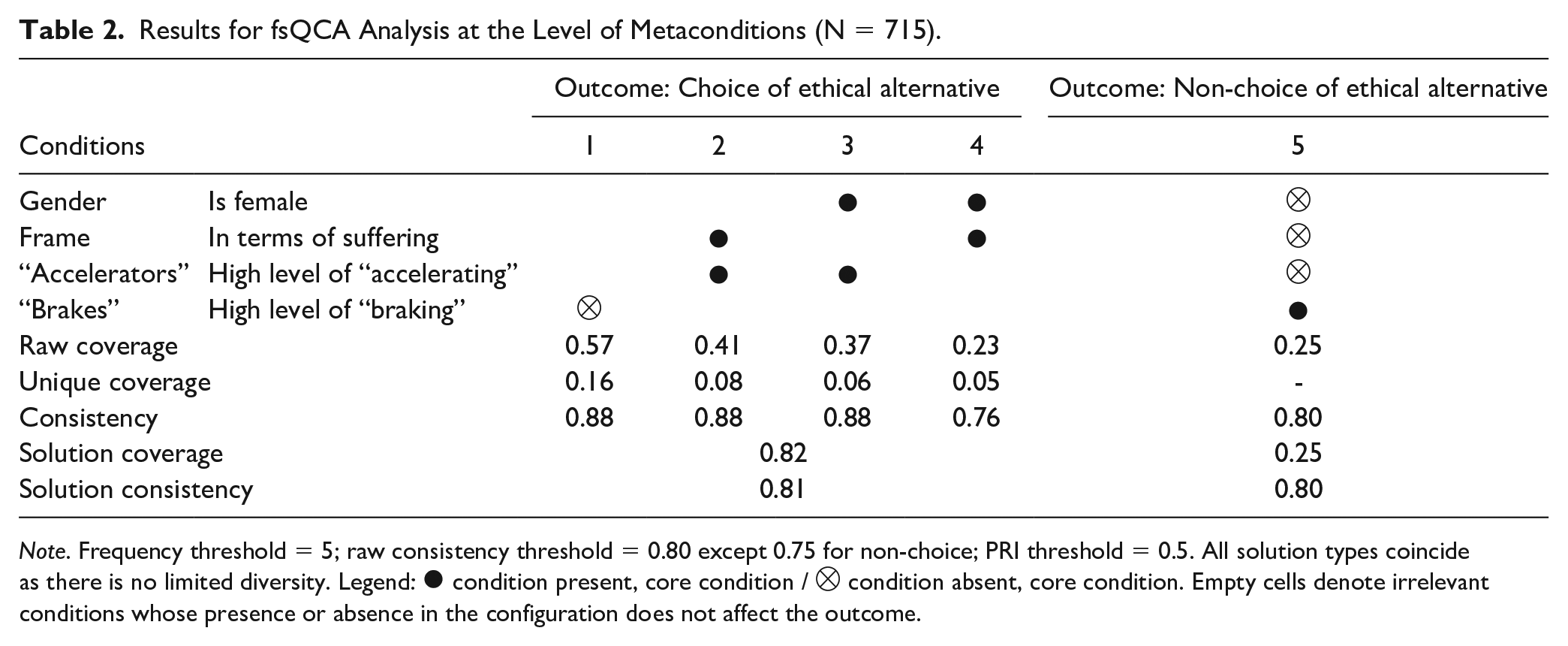
Note. Frequency threshold = 5; raw consistency threshold = 0.80 except 0.75 for non-choice; PRI threshold = 0.5. All solution types coincide as there is no limited diversity. Legend: ● condition present, core condition /  condition absent, core condition. Empty cells denote irrelevant conditions whose presence or absence in the configuration does not affect the outcome.
Four configurations were associated with the choice of the ethical alternative when examined at the level of metaconditions. Their consistencies ranged between 0.76 and 0.88, raw coverages between 0.23 and 0.57, and unique coverages between 0.05 and 0.16. The coverage of the entire solution was 0.82, and its consistency was 0.81. The findings thus provide a consistent picture that explains a large share of the phenomenon of ethical choice.
Choice Configuration 1: No Brakes
This configuration shows that the absence of “brakes” was individually sufficient for ethical choice. In the absence of “brakes,” how the other conditions were configured did not matter for the outcome. This is the only configuration where one condition was sufficient for choice independently of the others, and it also had the highest raw and unique coverage. This shows how the “brakes,” that is, the price-related considerations, are a powerful barrier to ethical choice (Aschemann-Witzel & Zielke, 2017). Importantly, however, they are a barrier that can be overcome and has been overcome in three configurations in Table 2 where “brakes” were irrelevant.
Choice Configurations 2 and 3: Gas With Support
These configurations show that “brakes” can be present or absent if you can overcome them with “gas.” In other words, the presence of “accelerators” can be a substitute for the absence of “brakes.” However, “acceleration” alone was not sufficient but needed additional support. The support came from framing the matter in terms of suffering (#2), or from the female gender (#3), so these two conditions can again substitute one another in providing the needed support. In Configuration 2, the loss frame (suffering) had symbiotic complementarity with “accelerators,” being a different-type condition that reinforced their effectiveness. In configuration 3, the female gender acted as a contingency. Previous literature provides ample evidence that women are more prone to making ethical choices than men (Lehnert et al., 2015), so Configuration 3 would mean that the presence of “acceleration” is sufficient for ethical choice but for women only.
Choice Configuration 4: Women Avoiding Unethicality
When the female gender and a suffering frame combine, they can together substitute for the absence of “braking” as well as for the presence of “acceleration.” This is yet another pathway to ethical choice. However, it had the smallest raw coverage and low consistency, and this configuration disappeared in the individual-condition-level results discussed below. Cornish et al. (2016) show literature evidence that women might be more sensitive to animal welfare issues than men. As our empirical example has high moral intensity, presenting it in the suffering frame was enough to result in ethical choice for a large share of women.
Non-Choice of the Ethical Alternative, Metacondition Level
There were no necessary conditions nor necessary combinations of conditions for the non-choice of the ethical alternative. All truth table rows remained below the raw consistency threshold of 0.80, so for these analyses, a lower threshold of 0.75 was used to obtain some insight to the results, albeit slightly less consistent than for the other configurations.
There was only one sufficient configuration for non-choice. Its raw coverage was 0.25, and its consistency was 0.80. The figures indicate that the discovered configuration was consistent but that it explained only a small part of the non-choice of the ethical alternative. There may thus be several ways for non-choice to occur, but they did not emerge as consistent configurations.
Non-Choice Configuration 5: All Odds Against Choice
In this configuration, there were no blank cells, but all the conditions were configured to push toward non-choice. Pressing the brake pedal (“brakes” present) and releasing the gas pedal (“accelerators” absent) effectively stops the ethical choice from happening. The well-being frame further reinforces non-choice. These are manifestations of symbiotic complementarity as different types of conditions come together in obstructing choice. The gender condition was a contingency that delimited the configuration to men only. While non-choice itself is rarely the primary focus of previous studies, and thus, it is difficult to compare results, we note that each element in configuration 5 is the antithesis of what previous literature suggests to promote ethical choice.
Individual Condition Level: The Picture Obtains More Nuance
In this section, we break the metaconditions into their constituent conditions and examine three separate “accelerators” and two separate “brakes.” Whether the respondent was female and whether the ethical issue was presented in terms of suffering remain as conditions. We base our discussion on the core conditions and complement it with the peripheral conditions; however, with the latter, the empirical evidence is less solid (Haesebrouck, 2021).
Choice of the Ethical Alternative, Individual Condition Level
There were no necessary conditions or combinations of conditions for ethical choice. The condition “High ethical importance” did achieve a consistency of 0.92 and a coverage of 0.78. These figures suggest necessity in terms of empirical consistency and empirical relevance, and the condition is also conceptually meaningful (Schneider, 2018). Yet, examining the XY plots revealed that there were cases above the diagonal, including deviant cases with high ethical importance “out” but nevertheless outcome “in” (Schneider, 2019). Hence, we conclude that even high ethical importance was not a necessary condition for ethical choice.
Since limited diversity was present, we conducted an ESA (Schneider & Wagemann, 2012). The results of the sufficiency analysis are in Table 3.
Results for fsQCA Analysis at the Level of Individual Conditions (N = 715).
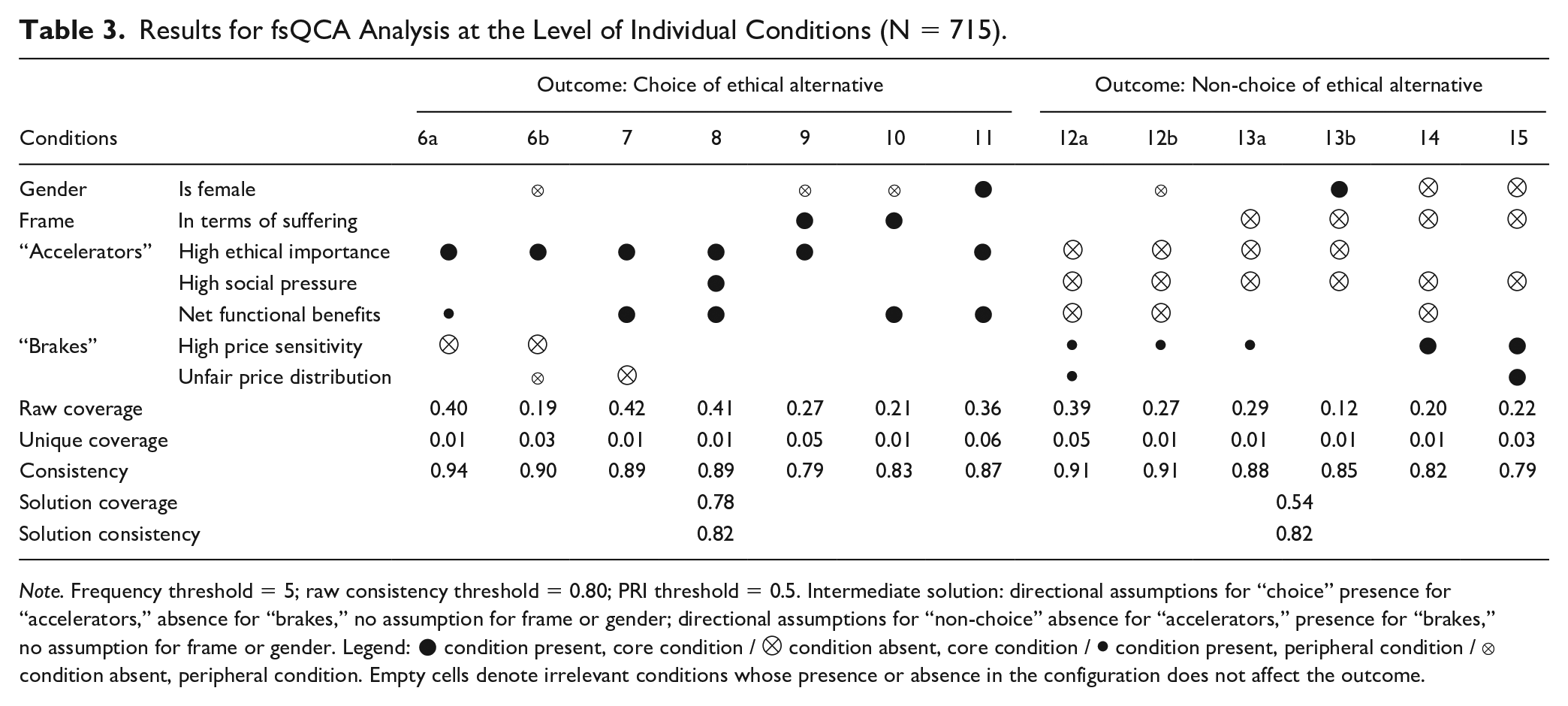
Note. Frequency threshold = 5; raw consistency threshold = 0.80; PRI threshold = 0.5. Intermediate solution: directional assumptions for “choice” presence for “accelerators,” absence for “brakes,” no assumption for frame or gender; directional assumptions for “non-choice” absence for “accelerators,” presence for “brakes,” no assumption for frame or gender. Legend: ● condition present, core condition / condition absent, core condition / • condition present, peripheral condition /  condition absent, peripheral condition. Empty cells denote irrelevant conditions whose presence or absence in the configuration does not affect the outcome.
Seven configurations (from 6a to 11) were associated with the choice of the ethical alternative when examined at the level of individual conditions. Their consistencies ranged between 0.79 and 0.94, raw coverages between 0.19 and 0.42, and unique coverages between 0.01 and 0.06. The coverage of the entire solution was 0.78, and its consistency was 0.82. Thus, the findings paint a consistent picture that can explain a large share of the phenomenon.
Choice Configurations 6a-b and 7: Favorable Balance
What looked like “no brakes” at the metacondition level (#1) on a closer look was revealed to contain the presence of some “accelerators” as well. The configurations testify to a need for some motivation to undertake the ethical choice, as well as some absence of barriers to further facilitate that choice. This is an example of symbiotic complementarity where both the “accelerators” and “brakes” need to be favorably configured for choice to occur. The frame was irrelevant. Notably, however, these configurations which largely correspond to the “traditional” view on determinants of ethical choice (a combination of ethics-related and price-related considerations) do not capture the full picture on ethical choice: together they covered only less than half of choice outcomes, and many other choice configurations existed too. The configurations 6a and 6b differed in terms of their peripheral conditions, which added the presence of another “accelerator” (#6a), or the absence of another “brake” and delimited the configuration to men (#6b).
Choice Configuration 8: Full Gas
This configuration contained the presence of all three “accelerators.” It can be compared to driving with full speed and is an example of pooled complementarity. Ethical, social, and functional motives to choose the ethical alternative were present, and they jointly made the “accelerators” so strong that it no longer mattered how the other conditions were configured. This echoes the findings of Green and Peloza (2011) who found that emotional, social, and functional values provided by ethicality could enhance each other and the overall value for the consumer.
Choice Configurations 9 and 10: Gas With Suffering
At the metacondition level we saw how in one variant of “gas with support” (#2), the support came from the suffering frame. This can be identified at the individual condition level as well. Here, there was additional evidence of substitutability, since the required “acceleration” came from ethical importance (#9) or from functional benefits (#10). So indeed, ethical importance is not the only possible “accelerator” and not a necessary condition for ethical choice. Internally, both configurations demonstrated symbiotic complementarity. These configurations show that when the issue is presented in a suffering frame, fewer “accelerators” suffice, and yet the configuration of the “brakes” does not matter. Thus, choice results more easily under a loss frame. However, the peripheral condition of not being female suggested a contingency, which would mean that a suffering frame plays a part in facilitating the “choice” decision for men only. This requires further research, considering the weaker empirical backing of a peripheral condition.
Choice Configuration 11: Women and Gas
In one metacondition-level variant of “gas with support” (#3), the support came through the female gender, and the same occurred here. Whereas in configuration #8, which applied to both genders, all three sources for “acceleration” were required for choice, and in the case of women, two sources were enough, and the frame was still irrelevant.
Non-Choice of the Ethical Alternative, Individual Condition Level
There were no necessary conditions nor necessary combinations of conditions. Six configurations were associated with the non-choice of the ethical alternative. Their consistencies ranged between 0.79 and 0.91, raw coverages between 0.12 and 0.39, and unique coverages between 0.01 and 0.05. The coverage of the entire solution was 0.54, and its consistency was 0.82. Again, the resulting picture is consistent. However, the non-choice findings were again able to explain only slightly over half of the phenomenon of non-choice (which is nevertheless much more than in the metacondition-level findings).
Non-Choice Configurations 12a–b: No Reason to Choose
All the motives to choose the ethical alternative were absent in these configurations. This is another example of pooled complementarity, now manifested through the pooled absence of “accelerator” conditions. These configurations were the antithesis of the choice configuration #8 where the “accelerators” were all present. The frame was again irrelevant. Peripheral conditions suggest that both “brakes” were present (#12a), or that there was high price sensitivity and the configuration applied to men only (#12b).
Non-Choice Configurations 13a–b: Little or No Reason to Seek Ethicality
In these configurations, most motives were absent, and the issue was presented in a gain frame which created weaker incentives for ethical choice. Peripheral conditions brought in additional price sensitivity (#13a) or limited the configuration to women (#13b).
Non-Choice Configurations 14 and 15: All (Kinds of) Odds Against Choice
Echoing the metacondition-level non-choice configuration 5, there were both “accelerators” and “brakes” working against ethical choice, and framing and gender were configured in a way that was less favorable for choice. Notably, high ethical importance could be present or absent—no matter what your ethical views were, the result was non-choice under these conditions.
Overarching Narrative: Findings Against the Conceptual Framework
Importantly, as part of the configurational theorizing process, we are not only interested in discovering and understanding the individual configurations associated with ethical choice and non-choice but also in identifying the overarching narrative that those configurations jointly provide across configurations (Furnari et al., 2021). Hence, in this section, we look at how the “accelerators,” “brakes,” the frame, and gender play out in our results and against the conceptual framework.
First, we observe that all our “brakes” indeed work against ethical choice. Whenever they play a role in a configuration, they are never present in configurations associated with ethical choice, and never absent in configurations associated with non-choice. Both our individual “brakes” figure in some choice and non-choice configurations; thus, both matter for choice and non-choice. The importance of high price sensitivity is obvious already based on previous research (Ramirez & Goldsmith, 2009). The role of unfair price distribution can be interpreted so that for ethical choice to materialize, the individual must be able to trust that they will not be “fooled” but that the price premium will truly end up benefiting the right party (see the study by Busch & Spiller, 2016, for organic foods; Gassler & Spiller, 2018, for palm oil; Taylor & Boasson, 2014, for Fair Trade).
Second, correspondingly all our “accelerators” work toward ethical choice. Whenever they play a role in a configuration, they are never absent in configurations associated with ethical choice, and never present in configurations associated with non-choice. All three of our individual “accelerators” are relevant for choice and non-choice. The role of high social pressure is intriguing: It figures in only one choice configuration but in all the non-choice configurations. It seems that a lack of social pressure is an important enabler that allows the individual not to make the ethical choice. This is consistent with Delmas and Lessem (2014) who found that publicly disclosing information on energy conservation was particularly effective to reduce the energy use of above-median users. High ethical importance, in turn, figures in most configurations. With this high-moral-intensity topic, it is an important—but still not necessary—condition, and high ethical importance alone is not sufficient for ethical choice.
Third, framing matters for ethical choice so that presenting ethicality in a loss frame (avoiding unethicality; suffering) is conducive to ethical choice, and presenting it in a gain frame (achieving ethicality; well-being) is conducive to non-choice. This finding is consistent with the theoretical suggestions of Levin et al. (1998), as well as with the findings that van Dam and De Jonge (2015) obtained in relation to ethical labeling, and it is especially noteworthy since it comes from the between-person experimental design. We can say that the framing shapes the information environment and thus constitutes the “terrain” on which the “accelerators” and “brakes” jointly operate, and the slope of this terrain either facilitates or hinders ethical choice. Thus, presenting ethicality in a gain frame is akin to driving uphill—thus more effortful to result in ethical choice—whereas presenting it in a loss frame is akin to driving downhill, and thus more easily results in ethical choice. However, there are important refinements to this finding. If the case for ethical choice is strong enough based on the constellation of “accelerators” and “brakes,” the framing is irrelevant, but when there is only slight motivation for ethical choice, the suffering frame provides the final support that is required to turn the decision into ethical choice. As for non-choice, it requires that the ethical issue is presented in a well-being frame, which makes it easier for the individual not to choose the ethical alternative. Only if there are no motives for ethical choice at all is the framing irrelevant.
Fourth, gender plays a role in ethical consumer choice. There are gender-specific configurations for both choice and non-choice, and for both men and women. Keeping with the idea of driving, our findings thus suggest that women and men are different drivers. However, there are also configurations that are shared by both, indicating that the impact of a condition on the outcome is not uniform but depends on the configuration that the condition is part of.
Fifth, as to the relationships between conditions, the findings indeed demonstrate multifaceted interdependencies. We find substitutability at both configuration and condition level. There is complementarity in both symbiotic and pooled form, and there are contingencies. All this comes in complex combinations, with several interdependencies co-existing in one configuration.
Thus, the overall narrative based on our findings across the configurations can be summarized in a metaphor of a car driving toward a goal (representing a consumer making an ethical choice). There are “accelerator” powers pulling the car toward the goal, as well as separate “brake” powers pulling it away from the goal. The slope of the terrain, that is, the framing, defines the combination of powers that enables the car to reach the goal, so that a gain frame is like driving uphill, and a loss frame is like driving downhill. Finally, the driving style of the individual also matters in navigating toward the goal amid all these forces.
Discussion and Conclusions
The configurational theorizing process consists of the stages of identifying individual elements potentially affecting the outcome (which here is ethical choice), discovering configurations among those elements that are associated with the outcome, and finally describing, explaining, and labeling the individual configurations and the overall findings across configurations (Furnari et al., 2021). Having gone through all these stages, we next discuss the theoretical contributions derived from our results, followed by managerial and policy implications, limitations, and suggestions for future research.
Theoretical Contributions
This study differs from previous literature in several respects, allowing us to examine the elements that influence ethical choice and non-choice in a novel way.
First, we have a distinct theoretical aim to discover interdependencies. Instead of attempting to identify additional factors affecting ethical choice, we turn our gaze on truly understanding the interplay of known factors affecting such choice. To this end, our conceptual framework provides a broad perspective, incorporating a set of “accelerators” and “brakes.” We treat these “accelerators” and “brakes” as two separate groups of factors that can be simultaneously present and intertwined, thus showing how they, together with framing and gender, can be traded off against one another in complex ways.
In addition, our methodology differs from previous literature on the topic. Instead of using traditional statistical methods, we use fsQCA whose features make possible a holistic analysis of causal complexity and the separate examination of choice and non-choice, thus empirically enabling the different and novel perspective that our theoretical aim requires. Previous literature has also called for such a novel approach, especially in ethics-related and business-related research (Celestine et al., 2020; Fainshmidt et al., 2020). Furthermore, our methodology is original in that it includes combining a randomized experiment with the fsQCA. This helps to validate and strengthen the results. It also contributes to QCA literature by demonstrating this possibility since ours is one of the first studies to do this. Moreover, the use of personalized vignettes in QCA studies is also new and offers interesting opportunities since vignettes can be used creatively to build and manipulate situations of causal complexity. Our design corresponds to real-life choice situations, thus making the empirical study sounder and strengthening the contributions.
Through our findings, we make five contributions to previous literature as outlined below.
Clarifying the Role of Single Factors vs
Configurations of Factors in Determining Ethical Consumer Choice.
Our findings clearly demonstrate the limited role that single factors play in determining ethical consumer choice. We show that no single factor is necessary for ethical choice—not even consumers’ own ethicality. We also show that no single factor alone is sufficient to determine ethical choice; not even price sensitivity is an insurmountable barrier to consumers. Instead, we show how the impact of any factor on ethical choice is shaped by all the other factors that co-occur in the same configuration. Thus, it is not the impact of single factors but the interplay of multiple factors in complex configurations that determines whether the situation favors ethical choice or non-choice.
This means that a diverse range of factors needs to be identified to form a full picture of ethical consumer choice. That has been the goal of many studies, and for example, a vast number of factors influencing food choice have already been identified (Köster, 2009; Symmank et al., 2017). However, it also means that we should be cautious about any interpretations that rely on single factors and should rather be looking at holistic models of several factors. Such studies have been conducted, often utilizing SEM models and regression models with interactions (for a review, see the article by Chen & Antonelli, 2020). Nevertheless, the issue that persists is that the interpretation of complex interactions between multiple factors is challenging with these methods. Therefore, more research on how different factors interact with each other in the consumer’s decision-making has been called for, including by Chen and Antonelli (2020) in the case of sustainable and healthy food choices. Employing the QCA method is thus a much-welcomed addition to the literature on ethical consumer choice. However, all this does not change the fact that individual factors can still be important even if none of them alone determines ethical choice.
Revealing and Describing Substitution Effects Within and Between Configurations
We show how there are substitution effects at play in ethical consumer choice: an individual factor can be a substitute for another within a configuration so that the configuration will still result in ethical choice, or whole configurations can be entirely different and yet be substitutes for one another. This makes it evident that there is no one single route to ethical choice but several possible, alternative routes. Sobal and Bisogni (2009) note how because food choice decisions are personal, situational, and changing in time, it is impossible to capture their full complexity through one model. Our findings respond to this notion and confirm that identifying several, co-existing alternative configurations provides a more detailed and complete analysis of ethical choice. This is especially important considering how consumer choices are becoming increasingly individualistic, and consumer segments more fragmented.
Revealing and Describing Complementarities Between Factors in Configurations
We outline complementarity relationships where the factors boost or offset each other within a configuration. The presence of complementarity means that a factor may not have a fixed impact on ethical choice or non-choice but that its impact is conditioned by the other factors in the same configuration. Our results contain instances of all our factors becoming relevant or irrelevant depending on the constellation of the rest of the configuration. For example, high price sensitivity of the consumer is irrelevant for choice in five configurations (whether it is present or absent does not influence the outcome), but it matters for choice in two configurations where the choice relies heavily on the ethical importance of the issue. This suggests that research efforts to capture the impact of specific factors on ethical choices in a fixed manner are likely to be inadequate, especially for such a complex topic as food choice.
Demonstrating the Asymmetry of Choice and Non-Choice
Our findings show that the effects can be asymmetrical so that even if the presence of a factor contributes to ethical choice, its absence does not necessarily contribute to ethical non-choice, and vice versa. However, an implicit assumption in previous research is usually that non-choice is the mirror image of choice. This need not be the case, though, as evidenced by our findings on social pressure from an ethically-minded shopping companion. Social pressure had an important role in curbing non-choice (non-choice was possible only in the absence of social pressure) but not in promoting choice (social pressure was mostly irrelevant in the choice configurations). Such asymmetry can provide one explanation for the diverse findings that have been recognized to exist concerning the influence of social norms on behavior (Melnyk et al., 2022; Shulman et al., 2017). Generally speaking, the potential for asymmetry carries the important message that to fully understand the phenomenon of ethical choice, we need to study it in both directions: what contributes to ethical choice, but also explicitly and separately what contributes to ethical non-choice.
Highlighting the Role of Framing in Ethical Choice and Boundaries to That Role
Our results show how ethical choice results more easily in a loss frame, which can complement the “accelerators” and provide the final support to turn the decision into ethical choice. Furthermore, we show how non-choice results more easily in a gain frame, which makes it easier for the individual not to choose the ethical alternative. But we also show how framing can be irrelevant in certain situations, namely when the case for choice (non-choice) is already strong enough based on the favorable (unfavorable) constellation of the “accelerators” and “brakes.”
These results highlight the important role of framing for ethical choice. Framing is omnipresent—the ethical issue will always be framed from some perspective, even if that is not consciously attempted—and its impact ought to be better acknowledged when researching marketing communications around ethical choice. Still, framing, as any other single factor, does not determine the outcome alone but again as part of a configuration where it is embedded with other messages and factors that relate to the choice situation and where it can also become irrelevant. There are thus boundaries to the effectiveness of framing, but they will be hard to identify if the framing effect is studied in isolation. Recognizing this can help to accommodate conflicting findings in previous literature concerning the role of framing (Grazzini et al., 2018; Unkelbach et al., 2020).
Summary of Theoretical Contributions
Taken together, all these contributions unbundle ethical consumer choice into a fine-tuned picture and significantly advance the literatures on ethical consumer choice in general and food choice in particular. They also take forward the literature on business and society by increasing the understanding of ethical decision-making not as an isolated, atomistic factor, but as part of diverse combinations in which ethics and other factors interact.
Managerial and Policy Implications
Consumers face countless ethical choice situations daily, in the domain of food but also in all other areas of consumption. A thorough understanding of ethical consumer choice can therefore help to obtain considerable positive societal outcomes in practice. By incorporating the insights from our study into their strategies, business managers and policymakers can promote ethical choices more effectively.
Individual factors like the consumer characteristics of ethicality and price sensitivity have received a lot of management attention in ethical consumer choice, and our findings confirm their relevance. However, as we show, other factors are relevant too, including factors related to the product (functional benefits) and its marketing practices (unfair price distribution) or the choice situation (social pressure). Managers have more control over these factors and should make use of them explicitly, for example, by ensuring a fair and transparent distribution of the eventual price premium for ethicality and making ethical social norms salient in the choice situation. Beyond this observation, however, it is crucial for managers designing and communicating ethical offerings not to focus on single factors affecting choice but to consider holistically the relevant factors and particularly their interdependencies.
One significant point is that because of substitutability between factors and configurations, there is not only one possible route to ethical choice. Managers therefore need to understand the varied decision-making logics of increasingly fragmented consumer groups. To reach a large number of consumers, marketing communications should be tailored to meet the individual requirements of these different groups. With modern technology and diverse communication channels, this is now more achievable than ever before.
It is also important for managers to realize how factors affecting ethical choice can offset or reinforce one another. For example, even if the targeted customers are highly price sensitive, this may be overcome if functional benefits are communicated clearly to support ethical choice, and communications about the ethical issue are framed differently to evoke a loss frame. On the other hand, such complementarity also means that even a relevant factor may not be sufficient to bring about ethical choice on its own, but it may need to be reinforced by a set of other factors. Managers therefore need to view the relevant factors as an integrated whole.
In addition, managers would benefit from understanding not only what promotes ethical choice but also what promotes ethical non-choice. Due to the asymmetry demonstrated in this study, preventing non-choice is likely to call for tailored communications. For example, according to our results, instead of ethical persuasion to choose the sustainable alternative, men might be receptive to messages that make social norms salient, highlight the functional benefits of the ethical product, and reinforce confidence in price fairness.
Policymakers should take advantage of the possibilities offered by framing—and managers should be prepared for this. Even if framing is in certain situations irrelevant, it is by no means an insignificant tool. In current shopping environments, ethical issues are typically approached from a gain frame; for example, eco-labels and advertising emphasize alternatives that are more ethical. Based on our findings, it could be more effective if the unethical alternatives were singled out instead (loss frame). This in turn might strengthen the impact of social norms. Public health experts have already suggested climate-damaging products to come with smoking-style warnings (Harvey, 2020), and negative labeling for ethics has been called for (Grankvist et al., 2004; Petersen et al., 2021; van Dam & De Jonge, 2015). There is, though, the need to carefully examine this implication in light of research on guilt-related messages and backfiring (Peloza et al., 2013). More wide-spread use of universal labeling requirements (e.g., traffic-light labeling) or other disclosure obligations that also evoke the loss frame could be a game-changer for business-society relationships.
Limitations and Future Research
Concerning limitations, since our study was a survey with imaginary scenarios, the responses measure only stated choice in a hypothetical situation and not real-life behavior. Field experiments could address this limitation in future research. Furthermore, we encourage investigating the nature of interdependencies within and between configurations profoundly. With our large-N, condition-oriented study, we cannot tease out whether our complementarity relationships are really synergistic or merely additive, so future qualitative studies or case-oriented QCA studies would be needed to continue further on the path that we have signposted here.
Future research can explore the impact of additional consumer characteristics since in this study, we could include only gender. Characteristics such as age, income, and education can generally influence ethical consumer choice. Moreover, in this specific empirical case, cultural and religious backgrounds may have a bearing on how consumers react to particular methods of animal husbandry and meat production. However, it is important to note that in contrast to regression-based methods, QCA does not suffer from omitted variable bias. This means that even if some potentially relevant factors are absent from our analysis, this does not bias the results that are obtained but will only decrease explanatory power (Fainshmidt et al., 2020). In this study, though, the explanatory power of the results is good as evidenced by the high consistency and coverage figures. Thus, while the current results are already sound, examining additional factors can bring even further nuance to the understanding of ethical consumer choice.
It is a limitation of the study that there was no screening question to identify vegetarian and vegan respondents and remove their responses from the data. We assume that such respondents have opted out from completing the survey, since the vignette spoke about buying meat to prepare a meal which they would also eat, and the first question (without a “don’t know” option) was about a choice between two meat products. Even so, an explicit screening question would have been preferable.
In this study, we have examined only one, high-moral-intensity issue, but ethical issues differ from one another in ways that may be relevant for our findings. To examine the boundaries of the findings, future research should therefore establish how the results might be different for different types of ethical issues. The same goes for different products that are being chosen (e.g., food vs. other products), different geographical contexts, or different time periods. Formal set-theoretic theory evaluation (Oana et al., 2021) is a procedure that could be used to compare such findings to discover what parts of the findings are perhaps universal (across contexts) or permanent (across time) and what parts are situation-specific.
Finally, we implemented the framing experiment in terms of how ethicality was framed. However, prices too could be subjected to similar framing effects, as the same price difference can be expressed in terms of the ethical product being more expensive (a loss frame) or in terms of the unethical alternative being cheaper (a gain frame). It would certainly be worth implementing a similar study for price framing in the context of ethical questions. While we leave this to future research, loss aversion would suggest that price increases receive more attention if prices are presented in a loss frame—as is typically the case. Importantly, if similar framing impacts were to be found regarding prices compared to what we have found regarding ethicality, that could mean that the default way of presenting ethicality (“choose the ethical alternative even if it is more expensive”) would be doubly ineffective compared to “avoid the unethical alternative even if it would save you money.”
Supplemental Material
sj-docx-1-bas-10.1177_00076503241291304 – Supplemental material for Unbundling Ethical Consumer Choice: A Configurational Analysis With a Framing Experiment
Supplemental material, sj-docx-1-bas-10.1177_00076503241291304 for Unbundling Ethical Consumer Choice: A Configurational Analysis With a Framing Experiment by Leena Lankoski and Sari Ollila in Business & Society
Footnotes
Acknowledgements
The authors gratefully acknowledge the editor and the anonymous reviewers for their valuable comments.
Declaration of Conflicting Interests
The author(s) declared no potential conflicts of interest with respect to the research, authorship, and/or publication of this article.
Funding
The author(s) received no financial support for the research, authorship, and/or publication of this article.

Supplemental Material
Supplemental material for this article is available online.
Notes
Author Biographies
References
Supplementary Material
Please find the following supplemental material available below.
For Open Access articles published under a Creative Commons License, all supplemental material carries the same license as the article it is associated with.
For non-Open Access articles published, all supplemental material carries a non-exclusive license, and permission requests for re-use of supplemental material or any part of supplemental material shall be sent directly to the copyright owner as specified in the copyright notice associated with the article.
