




Abstract
This article investigates how firms address the stability-change paradox inherent in sustainability transitions through the maintenance and utilization of a portfolio of sustainability-oriented partnerships. Drawing on a retrospective case study of Dong/Ørsted, a Danish energy company, we demonstrate the varying manifestations of the stability-change paradox during different phases of the company’s transition, influenced by both exogenous and endogenous factors. Furthermore, our findings reveal how Dong/Ørsted employed their partnership portfolio to implement diverse responses to manage the paradox. Based on these findings, we argue that partnership portfolios can serve as spatiotemporal pockets, enabling organizations to effectively address and leverage the temporal and spatial aspects inherent in sustainability paradoxes. In addition, we highlight how partnership portfolios facilitate sustainability transitions by creating and leveraging different forms of collaborative value.
Addressing sustainability challenges at the organizational level entails grappling with paradoxes (i.e., elements that are logical in isolation but appear “absurd and irrational when occurring simultaneously”; Lewis, 2000, p. 760). Extensive research has shown that sustainability presents organizational actors with paradoxes arising from competing time horizons (Slawinski & Bansal, 2015), divergent organizational logics (Nicholls & Huybrechts, 2014), and conflicting stakeholder demands (Jay, 2013). A prominent paradox in the context of sustainability is the stability-change paradox (Rosales et al., 2022), which arises when organizations strive to transition from unsustainable to more sustainable business practices (Hahn, Pinkse, et al., 2015). Sustainability transitions are likely to exacerbate tensions between stability and change as they are grounded in contradictory logics. Even so, stability and change are closely linked, and organizations must embrace both to successfully realize these transitions (Farjoun, 2010; Smith & Lewis, 2011).
Past studies indicate that partnerships can be a means for firms to identify and harmonize conflicting demands, thus serving as a response to paradoxes (Savarese et al., 2021; Stadtler & Van Wassenhove, 2016). However, most of these studies have scrutinized individual or singular partnerships leaving a gap in our understanding of how firms utilize a spectrum of partnerships to navigate such paradoxes. This oversight is significant given that many firms maintain diverse sets of partnerships, which can offer them a wide array of resources and capabilities (Austin, 2003; Cui & O’Connor, 2012). These can be instrumental in devising innovative strategies to handle the inherent paradoxical tensions (Lavie et al., 2011).
We aim to bridge this gap in the literature by investigating how firms leverage what is termed a “partnership portfolio” (Gutierrez et al., 2016; Horan, 2022; Wassmer et al., 2017) to address the stability-change paradox in sustainability transitions. Such portfolios include cross-sector partnerships (CSPs) with non-private sector entities, like universities, public organizations, NGOs, and community groups (Bryson et al., 2015; Van Tulder et al., 2016). They also encompass inter-firm (B2B) partnerships with customers, suppliers, and competitors (Meschi & Norheim-Hansen, 2020; Norheim-Hansen, 2018).
Although some scholars posit that these partnership portfolios can “balance multiple and potentially conflicting goals of individual partnerships and partners in ways that support each partner and, in turn, support the organization’s broader sustainability-based goals” (Wassmer et al., 2017, p. 141), there is a lack of empirical evidence to substantiate this claim. Consequently, our study seeks to address the pivotal question: How do firms navigate the stability-change paradox in sustainability transitions using their partnership portfolio?
We address this inquiry through a longitudinal investigation of a single case organization, Dong/Ørsted, examining its partnership portfolio from 2006 to 2019. Initially a company heavily reliant on fossil fuels, Dong successfully transitioned into Ørsted, a leading figure in the green energy sector. This makes it an intriguing case for our research question. Our abductive analysis indicates that Dong/Ørsted strategically configured its partnership portfolio, adopting a spectrum of responses to adeptly handle the stability-change paradox. This paradox manifested differently throughout the company’s sustainability transition. Specifically, we demonstrate that the partnership portfolio enabled Dong/Ørsted to deploy multiple response strategies concurrently, adjusting dynamically based on the manifestation of the paradox in each phase.
Based on these findings, our article offers two theoretical contributions. First, we enhance the ongoing discourse on paradox management (Jarzabkowski et al., 2013; Schrage & Rasche, 2022; Smith & Lewis, 2011) by illustrating the significance of addressing paradoxes through partnership portfolios. Drawing from our findings, we introduce the concept of partnership portfolios for sustainability as “spatiotemporal pockets” which are arenas that enable firms to engage in multiple response strategies simultaneously, addressing both the spatial and the temporal dimensions of the paradox while keeping the paradox alive for organizational actors. Second, we augment the existing literature on sustainability-oriented partnerships (Gray & Stites, 2013; Wassmer et al., 2012) by highlighting the various forms of collaborative value that partnership portfolios can offer in organizing sustainability initiatives.
The remainder of this article is structured as follows: the theoretical background section presents the existing scholarly research on paradoxes and partnership portfolios. The methods section provides an explanation of the case context and details the procedures employed for data collection and analysis. Moving on to the findings section, we introduce the different periods that Dong/Ørsted experienced during its sustainability transition, highlighting the emergence of the stability-change paradox in these periods as well as the partnership portfolio configurations that facilitated effective responses to this paradox. Following the discussion of the findings, the article concludes by providing a summary of the theoretical contributions made and suggesting potential avenues for future research.
Theoretical Background
The Stability-Change Paradox in Sustainability Transitions
Paradoxes are defined as “contradictory yet interrelated elements that exist simultaneously and persist over time” (Smith & Lewis, 2011, p. 382). Existing research has illuminated how paradoxes emerge prominently in scenarios marked by plurality, scarcity, or change, such as organizational restructuring (Jarzabkowski et al., 2013), innovation (Andriopoulos & Lewis, 2009), and sustainability (Van der Byl & Slawinski, 2015). Central to this article is the stability-change paradox, which is especially relevant for sustainability transitions. This paradox represents the organizational necessity to uphold a level of continuity (stability) while concurrently propelling forward-reaching changes toward sustainable business practices (Hahn, Preuss, et al., 2015; Rosales et al., 2022).
These notions of stability and change are contradictory; the essence of fostering change, which often entails experimentation, runs counter to the concept of providing a stable and predictable organizational setting (Andriopoulos & Lewis, 2010). Yet, they are also interrelated within the realm of sustainability transitions. Achieving successful transitions means firms must adjust their current products or production processes (Kennedy et al., 2017; Rey-Garcia et al., 2021). Simultaneously, an inherent degree of stability is pivotal to ensuring these transitions receive broad organizational endorsement (Hejjas et al., 2019; Lüscher & Lewis, 2008) and that they leverage a firm’s extant capabilities and experiences (Farjoun, 2010). In this sense, while change, in the long run, underpins stability, a foundational degree of stability creates the immediate conditions essential for enacting long-term shifts. Significantly, these elements are persistent, coexisting, and unfolding throughout multiple phases of a transition journey.
Organizational actors faced with paradoxes have a range of response strategies at their disposal, typically classified into defensive and active approaches. Defensive strategies, such as regressing or separating tensions, may offer temporary relief but fail to enable organizations to effectively navigate and embrace paradoxes over the long term (Smith & Lewis, 2011). In fact, in extreme cases, these defensive responses can even result in organizational failure or collapse (Sundaramurthy & Lewis, 2003). Conversely, active strategies, such as acceptance and synthesis, empower organizations to recognize paradoxes as inherent to the process of organizing and to navigate the tensions they entail (Jarzabkowski & Lê, 2017; Lüscher & Lewis, 2008). For example, an active response may involve the continuous balancing of tensions (Grigore et al., 2021; P. P. Li, 2016; X. Li, 2019), which acknowledges that “the apparently contradictory poles of [paradox] can coexist within the same organization depending on specific situations, contexts, and time” (Pauluzzo, 2022, p. 312). By balancing contradictory poles, organizations navigate the complexities of paradoxes and find dynamic equilibrium, enabling them to adapt and thrive in a constantly evolving landscape (Smith & Lewis, 2011).
Partnership Portfolios as Responses to Paradoxes
To effectively address paradoxes, organizations frequently establish collaborative relationships with one or more entities, which are commonly referred to as “partnerships” (Ferraro et al., 2015; Sharma & Bansal, 2017). Our study focuses on sustainability-oriented partnerships, which involve collaborations with external organizations to achieve positive social and environmental outcomes (Dzhengiz et al., 2023). While partnerships can introduce their own paradoxes (Henry et al., 2022), research highlights their overall value in helping actors balance competing demands (Dzhengiz & Patala, 2023; Stadtler & Van Wassenhove, 2016). However, existing research has overlooked an important aspect: the fact that firms engage in multiple partnerships simultaneously with diverse organizations, forming what is known as a “partnership portfolio for sustainability” (hereafter PPS; Wassmer et al., 2012, 2017). While the portfolio approach has gained recognition in the domains of strategy and innovation literature, which primarily focus on firms’ inter-firm (B2B) commercially oriented partnerships (Hoffmann, 2005; Lavie, 2007), its application in the context of sustainability-oriented partnerships has been limited. Although some scholars have explored firms’ portfolio of CSPs (Van Tulder & Da Rosa, 2012), these studies often neglect the firms’ inter firm partnerships and fail to consider the dynamic nature of portfolios over time. Consequently, various researchers have called for a stronger focus on studying firms’ PPS (Austin, 2003; Gutierrez et al., 2016; Wassmer et al., 2012).
In our conceptualization, a PPS includes (a) CSPs with governments, universities, communities, sponsorship partners, and NGOs (Selsky & Parker, 2005; Van Tulder et al., 2015) and (b) inter-firm (B2B) partnerships (Chen et al., 2017; Lin & Darnall, 2014; Norheim-Hansen, 2018) with customers, suppliers, and other businesses in the value chain, all established explicitly to address sustainability goals. By considering both inter-firm partnerships and CSPs, we seek to gain a comprehensive understanding of how firms navigate sustainability paradoxes. While these distinct partnerships typologies present distinct legal, cultural, and social challenges (Albers et al., 2016; Rufin & Rivera-Santos, 2012), analyzing them within the single portfolio umbrella allows us to capture the systemic nature of firms’ paradoxical responses to sustainability challenges. Indeed, previous research has shown the benefits of partnership portfolios in obtaining critical resources, creating and capturing value, and adapting to technological changes (Asgari et al., 2017; Hoffmann, 2007; Niesten & Stefan, 2019). However, empirical evidence is lacking on how firms build and utilize their PPS to respond to paradoxes and specifically help firms navigate the stability-change paradox throughout their sustainability transition journey.
To sum up, we argue that a firm’s PPS can be a powerful mechanism for managing the stability-change paradox inherent in sustainability transitions. Collaborating in multiple partnerships allows firms to learn diverse problem-solving approaches and reframe paradoxical tensions (Beckman & Haunschild, 2002; Jarzabkowski et al., 2019). In addition, a PPS provides access to resources, capabilities, and knowledge that stimulate creativity and experimentation thanks to the diverse set of partners it contains (Lucena & Roper, 2016), which enables firms to develop innovative solutions to paradoxical tensions (Miron-Spektor et al., 2011; Smith et al., 2010). Moreover, a PPS can help incorporate stakeholders from different backgrounds, facilitating learning about diverse stakeholder demands and orientations (Van Tulder & Da Rosa, 2012). Therefore, maintaining a PPS keeps the stability-change paradox alive within organizations, fostering pluralistic and paradoxical thinking (Soderstrom & Heinze, 2019). The central focus of our article is, therefore, to assess how organizations utilize their PPS to address the stability-change paradox in sustainability transitions.
Methodological Approach
Research Setting
To examine how firms use their PPS in addressing the stability-change paradox, we chose a retrospective longitudinal single case study approach. This approach, which resembles business histories, enables us to situate the paradox within its context, capture the emergence of responses, and maintain critical independence without anonymizing the organization’s identity (Decker et al., 2015). We selected an electric utility organization operating in an environment with strict environmental regulations, growing competition from renewable energy players, and decreasing legitimacy of fossil fuels (Patala et al., 2017). Within this context, several utilities in Europe have signaled a transition toward sustainability (Afewerki & Steen, 2022), making it a suitable setting to investigate the stability-change paradox. Among these players, we chose Dong/Ørsted due to its widely acknowledged sustainability progress in previous research (Abraham-Dukuma, 2021; Afewerki, 2019; Afewerki & Steen, 2022; Madsen & Ulhoi, 2021). Dong, once considered “Denmark’s dirty secret” (Pearce, 2009), has transformed into the first “green energy supermajor” (Sheppard, 2020), garnering praise even from critical NGO leaders (Sauven, 2017). Therefore, Dong/Ørsted represents a revelatory case (Yin, 2018) that aligns with our research objective.
Data Collection
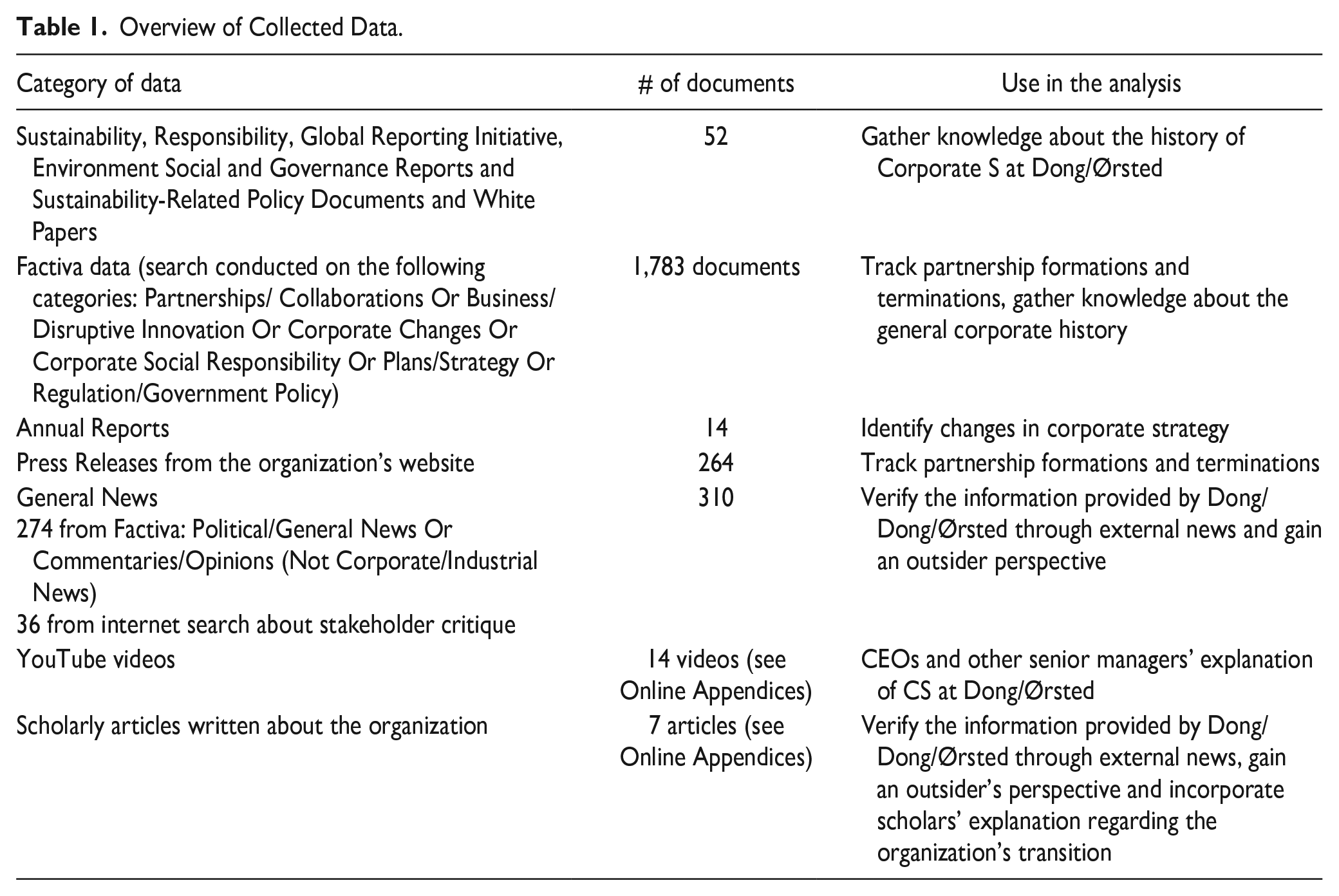
We followed the standard practice of using archival data in retrospective cases (Bizzi & Langley, 2012; Welch, 2000). We adhered to prior research on partnership portfolios (Lavie & Singh, 2011) that utilized the Factiva database to establish a sequence of events, enabling us to construct a comprehensive timeline depicting the evolution of the partnership portfolio. To validate partnership announcements, we triangulated the information with organization reports and press releases. To ensure an external perspective and address potential greenwashing (Velte, 2020), we gathered data from corporate and industrial news, press releases from sources other than Dong/Ørsted’s website, and business news. We also searched for stakeholder responses to Dong/Ørsted’s activities on the internet. Moreover, we conducted a literature search in the Web of Science to ensure that we include articles about Dong/Ørsted. We identified seven relevant academic articles (for details, see the Online Appendices) as secondary data sources. We collected data from the inception of the company in 2006 until early 2020, which we define as the end of Period 4. During this final period, we observed that no new ideas or themes were emerging in the data, indicating that we had reached thematic saturation (Guest et al., 2006). Table 1 provides a summary of our data collection efforts.
Overview of Collected Data.
Data Analysis
Our retrospective approach requires us to adopt abductive reasoning (Wadhwani & Decker, 2017), which can be defined as “a process whereby actors infer and apply implications from a narrative to their particular context” (Bartel & Garud, 2003, p. 330) and follows an analytical framework that goes back and forth between theory and data (Dubois & Gadde, 2002; Richardson & Kramer, 2016). Put simply, abduction involves identifying and describing the phenomena that deserve study and establishing the boundaries of plausible explanations which can later be incorporated into a theoretical framework for testing and verification (Bamberger, 2018). In this study, we also provide plausible explanations regarding the role of partnership portfolios for sustainability in response to the stability-change paradox.
For us, this abductive approach meant two rounds of coding (see Figure 1). During our first-stage qualitative coding, we developed the historical account of the partnership portfolio, corporate strategy, corporate sustainability, and the external context at Dong/Ørsted. In addition, we applied temporal bracketing (periodization) in this stage to discover distinct phases of the sustainability transition, the manifestation of the paradox, and portfolio reconfigurations.
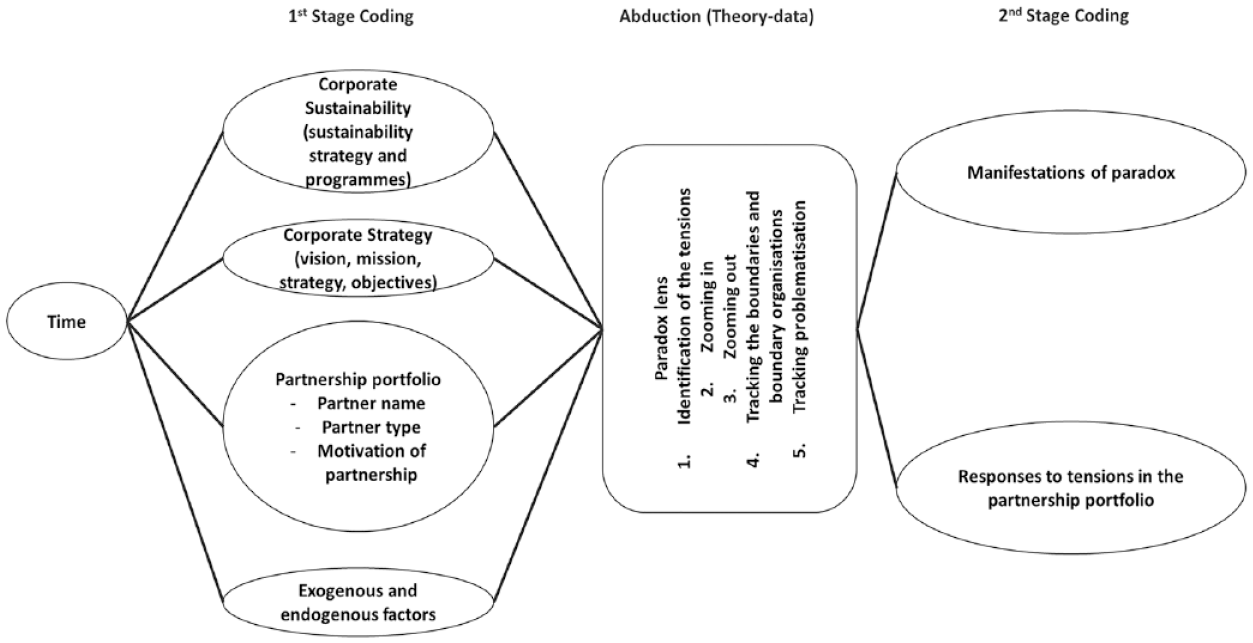
Our Approach to Coding and Data Analysis.
Periodization
To address our research question regarding the stability-change paradox and its responses within the PPS, we incorporated a temporal aspect through “periodization” or “temporal bracketing” (Wadhwani & Decker, 2017). We delineated periods by pinpointing data discontinuities, akin to the critical incident technique (Durand, 2016). From our codes, we identified 153 critical incidents, such as shifts in the stability-change paradox and both exogenous and endogenous factors impacting Dong/Ørsted.
This analysis revealed four distinct phases: Period 1 (2006–2008), post-merger, and foundation of Dong, where coal assets and investments still dominated. Period 2 (2009–2012) marked a strategy shift away from coal, targeting a green energy majority by 2040. Period 3 (2013–2016) followed financial challenges and leadership change, prioritizing wind energy. However, justifying oil and gas assets became challenging during this period. Period 4 (2017–2019) saw the divestment 1 of these assets and a rebranding to Ørsted. Each phase had unique manifestations of the paradox and distinct PPS responses.
Coding and Analysis of Dong/Ørsted’s PPS
We identified two partnership types in PPS: (a) CSPs involving NGOs, governments, universities, community groups, and multistakeholder platforms addressing social/environmental issues and (b) B2B (inter firm) partnerships with business entities like customers, suppliers, and competitors (see also Table 2).
Partnership Types, Partner Organizations and Example Partners From Dong/Ørsted’s PPS.
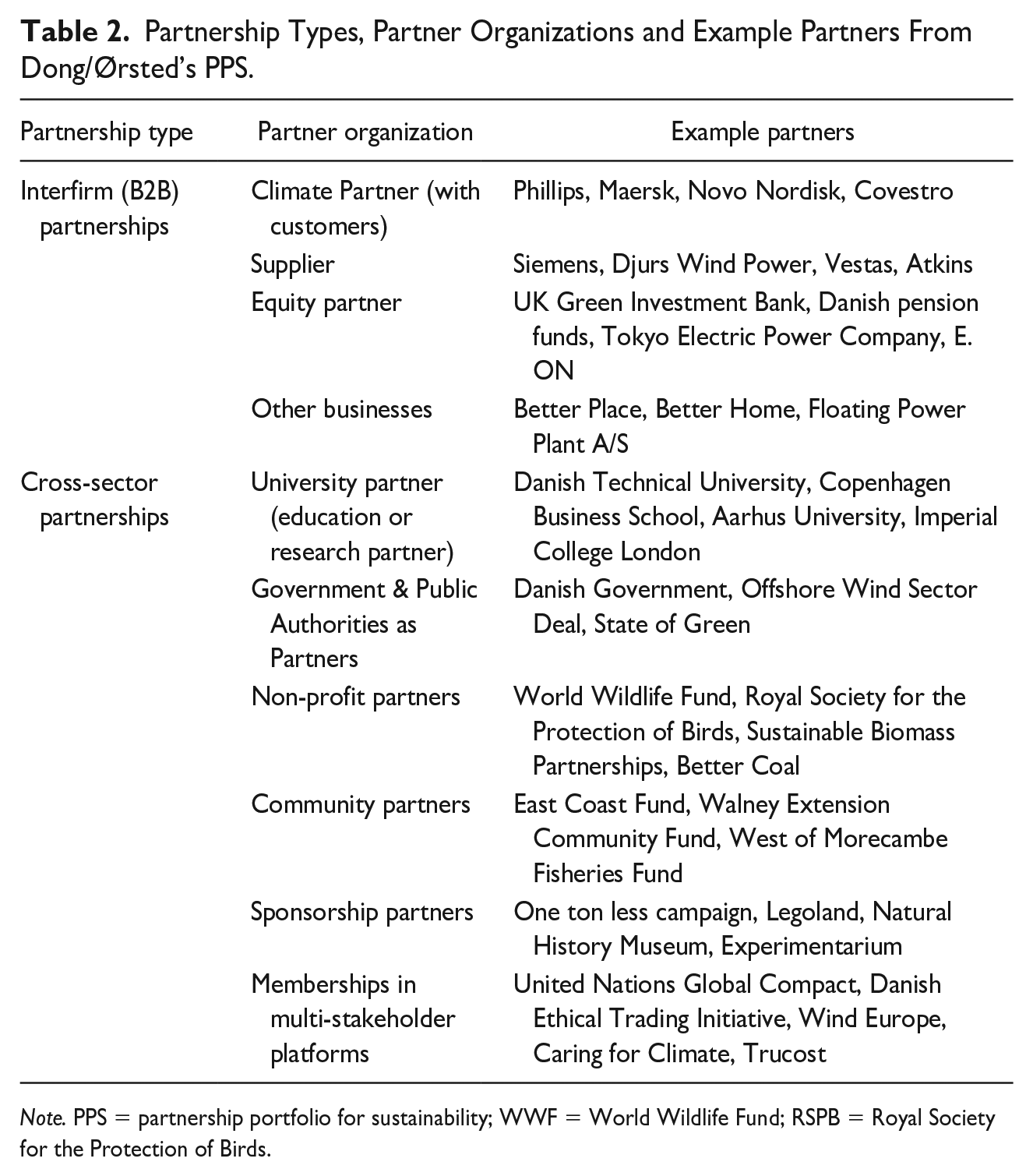
Note. PPS = partnership portfolio for sustainability; WWF = World Wildlife Fund; RSPB = Royal Society for the Protection of Birds.
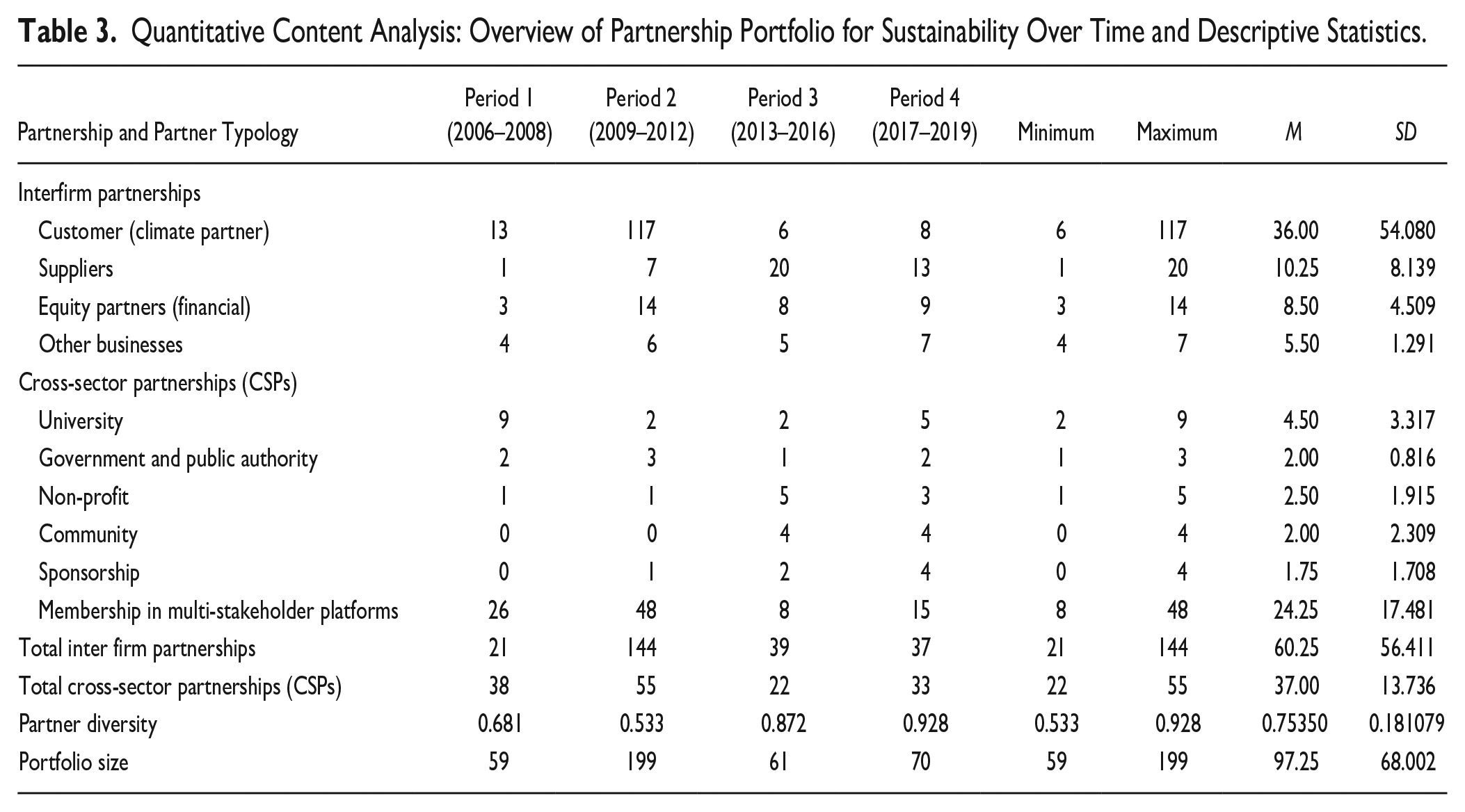
Stakeholders were only categorized as “partners” if there was an official partnership announcement and we only focused on partnerships that had implications for the organization’s sustainability transition. This criterion yielded 389 partnerships (comprising 241 inter-firm and 148 CSPs) spanning from 2006 to 2019. Our initial qualitative coding was enriched by a quantitative examination, shedding light on both the portfolio’s evolutionary trajectory and the diversity of partners within it. The Shannon diversity index 2 was instrumental in assessing partner diversity.
Table 3 maps out the progression of the PPS over time and provides a comprehensive breakdown of portfolio composition and descriptive statistics. The overarching trend shows an expansion in both the number of partners and their diversity, although there’s a notable decline in partner diversity in Period 2, attributed to a surge in climate partnerships with customers. This statistical overview sets the stage for a deeper dive into the unique characteristics of each phase, which we elaborate upon in the Findings section, showcasing our qualitative data. For instance, Period 1, as illustrated in Table 3, is marked by an emphasis on memberships and partnerships with businesses outside the value chain and universities. Period 2 shifts the spotlight to climate and equity partnerships, reflecting a change in the firm’s focus. By Period 3, supplier ties and community partnerships take center stage, capturing the firm’s evolving priorities against the stability-change paradox. Thus, these quantitative findings form a scaffold on which our qualitative insights are further constructed and interpreted and prepare us for the following analysis of paradoxes in our second coding stage.
Quantitative Content Analysis: Overview of Partnership Portfolio for Sustainability Over Time and Descriptive Statistics.
Paradox Analysis
In our coding’s second stage, we adopted the paradox perspective. Initial coding revealed that Dong/Ørsted’s transition encompassed inherent tensions between stability and change within the PPS, aligning with the three paradox traits: contradiction, interrelatedness, and persistence (Smith & Lewis, 2011). We analyzed each period with respect to this paradox and its responses.
For deeper insight into the firm’s sustainability transition (see Figure 1), we employed three techniques: zooming in and out, tracking problematization, and observing boundaries (Jarzabkowski et al., 2019). By zooming in on “corporate strategy” and “corporate sustainability” from reports and releases, we discerned how the firm perceived and responded to the paradox. Zooming out, we studied partnership statements to understand the paradox’s systemic links outside Dong/Ørsted’s boundaries. By tracking problematization, we pinpointed manifestations where Dong/Ørsted highlighted stability-change tensions, evident in both endogenous and exogenous factors. Statements reflecting these contradictions were coded, especially those mentioning partnership responses.
Findings
This section presents insights into the sustainability transition undertaken by Dong/Ørsted, providing an analysis of the tensions between stability and change as well as endogenous and exogenous factors that have shaped this journey. Our findings highlight Dong/Ørsted’s strategic response in the form of developing a PPS. This PPS has been actively modified by Dong/Ørsted, incorporating new partners and adjusting the diversity and composition of the portfolio to address the tensions between stability and change. In this section, we summarize the manifestation of the stability-change paradox across different time periods, identify the factors that trigger paradox salience, and elucidate Dong/Ørsted’s responses through the utilization of its PPS.
Period 1: Coal or No Coal?
Manifestation of the Paradox
In Period 1, we observed that the central contradiction was about whether to keep coal investments or not, motivated by exogenous factors, including stakeholder pressure. Dong acknowledged the paradox of stability and change by admitting that “the use of renewable energy must be increased in the years ahead, but it [was] simply not feasible to secure a stable energy supply based on renewable energy alone” (Dong Energy, 2006). Dong’s vision also reflected this contradiction since it was “to provide a stable and CO2-neutral energy supply” (Dong Energy, 2007). Dong posited the improvements of coal-fired thermal power plants concerning emissions legitimating coal and other fossil fuels as the short-term answer while promoting renewables as a long-term solution.
Factors Triggering the Paradox
In period 1, the drivers of the paradox were primarily exogenous, starting with the Kyoto Protocol coinciding with the operationalization of the European Union Emissions Trading Scheme (EU ETS), which led to the formation of carbon markets in Europe. Concerns over climate change grew, and the forthcoming climate summit in Copenhagen further reinforced the salience of the paradox. Dong responded proactively and engaged with various stakeholders, including the World Wildlife Fund (WWF) Denmark. Gitte Seeberg, the Secretary-General of WWF, criticized Dong’s continued investments in fossil fuels, noting that these were “harmful to the climate and millions of people around the globe, and this might harm ‘[Dong’s] investors’” (Dong Energy, 2008). During the 2009 climate summit, climate protests at the headquarters targeted the organization’s continued investment in fossil fuels (Ringstrom, 2009), with the media further scrutinizing the organization for greenwashing with its wind investments while continuing to invest in greener coal technologies in Germany and Scotland (Pearce, 2009). These exogenous factors reinforced the tensions between stability and change and motivated Dong to suspend new coal-fired power plant investments. Martin Neubert, CEO of Dong’s offshore-wind business, explained:
We experienced strong local opposition against the idea of building a coal-fired power plant on the Mecklenburg-Vorpommern coastline. This was the first clear sign telling us that the world was beginning to move in a different direction, and we concluded that here was no sustainable way of realising the project. Also, in 2009, the global renewable-energy agenda was positioned strongly at the United Nations COP15 climate summit in Copenhagen, supported by the Danish government and our board of directors. (Neubert, 2020)
Hence, in Period 1, the paradox surfaced in the decision to continue investing in coal or not and was triggered mainly by exogenous factors.
Paradox
Response: Engage in Different Partnerships That Address Stability and Change Separately
Dong’s approach in the initial period was to employ separation strategies by using coal as an energy source while simultaneously participating in climate projects to reduce CO2 emissions. This approach was exemplified by Dong’s endeavors to establish partnerships for carbon capture and storage (CCS) to offset emissions. For instance, Dong collaborated with Peel Energy and subsequently with RWE Npower to develop a CCS demonstration plant in the United Kingdom. In addition, Dong formed a strategic partnership with WV Energie AG for the construction of a coal-fired power plant in Germany, which CEO Anders Eldrup stated would support their existing activities in Germany and leverage their core competencies in clean coal technology (Dong Energy, 2016). In this context, Dong positioned their coal plants as “clean” and emphasized the potential for coal-fired power plants to be sustainable if cleaner processes were implemented.
Concurrently, Dong entered into several CSPs with multi-stakeholder platforms, including the UN Global Compact and its Nordic Network, Danish Council for Sustainable Business Development, and Green Growth Leaders (GGL). These partnerships facilitated engagement with industry peers, governments, and NGOs, enabling Dong to address sector-related challenges and sustainability concerns. Dong also established partnerships with universities and other research institutions such as DTU, GEO, and GEUS. One noteworthy project involved the study of underground CO2 storage to better understand its reactions and contribute to future standards (Dong Energy, 2008). Hence, in Period 1, Dong responded to the paradox by employing different partnerships (inter firm and CSPs) that enabled them to address short-term survival (i.e., stability) and increase awareness for the long-term changes necessary (i.e., change) separately.
Period 2: Phase Out Fossils—Slow or Fast?
Manifestation of the Paradox
Whereas period 1 was marked by whether to continue investing in coal, in phase 2, the central contradiction was about whether to phase out fossils slowly or faster. This contradiction was maintained until the decision to divest oil and gas (start of period 4). In 2011, their annual report captured this contradiction as follows:
Modern society is using more and more energy. At the same time, we want to slow down the impact on the environment to which traditional energy production contributes. This is the dual challenge that we are facing. Dong Energy sees it as its task to work concertedly on both fronts. On a sound business basis, of course. We are producing more energy by increasing our production of oil and gas, which will remain necessary sources of energy for many years to come. At the same time, Dong Energy is a world leader in wind energy, and we are currently bringing row after row of new offshore wind turbines on stream. (Dong Energy, 2011)
During this period and subsequent ones, new contradictions began to surface as a result of the accelerated construction of offshore wind farms. These constructions raised concerns among stakeholders regarding their social and environmental impacts, thereby highlighting the stability-change paradox and necessitating a shift toward more sustainable practices in the renewable energy sector due to exogenous factors.
Factors Triggering the Paradox
Period 2 marked a significant shift for Dong, as it changed its coal-related objectives and began exploring the conversion of existing coal plants to biomass or natural gas, a transition driven by both exogenous and endogenous factors. Dong introduced a new strategy known as “85-15” during this period, with 85% of its energy portfolio consisting of fossil fuels and 15% from green sources. The ambitious goal of the strategy was to reverse this ratio by 2040. Given the prevailing wind farm technology in 2009 and Dong’s historical reliance on fossil fuels, this target was considered radical within the organization (Reguly, 2019). As Jakob Askou Bøss, Senior VP of Corporate Strategy & Stakeholder Relations, explained:
When you are an oil and gas and coal company and someone comes along and says those are no longer the future, there would be resistance. Fossil fuels were seen as our core competence, where we had our growth strategy. Our employees said we are the best in the world in coal-fired power plants—we are the benchmark. There was quite broad and profound scepticism about the plan. (Reguly, 2019)
Another interviewee from Dong pointed out:
Before, leading up to COP 15, Dong was part of an environmental discussion about coal. Now, we have a different strategy. When we started our journey away from coal, there were internal discussions about whether this was the right strategy . . . . Because the premise behind the argument to move away from coal was that the energy markets would transform fundamentally towards more green energy and that this would be where the value creation would be in the future. It turned out to be true, but it was hard to prove back then. It required strong leadership to hold the course away from coal. (Toft & Rüdiger, 2020, p. 13)
Thus, this change in strategy kept the paradox alive in the organization and surfaced through the decision of whether to phase fossils slowly or fast.
Paradox Response: Develop Partnerships to Synthesize Change and Stability
In Period 2, Dong continued to address the stability-change paradox through a combination of separation and synthesis strategies. Similar to Period 1, the organization remained involved in CSPs with academic partners and multi-stakeholder platforms that focused on separating the tensions associated with the paradox. However, in this period, Dong also developed a synthesizing approach by forming partnerships that aimed to simultaneously address the opposing poles of the paradox. A prominent example of this synthesizing strategy was the establishment of climate partnerships, explained as follows:
Dong Energy provides [a partner] with energy consulting services, including guidance on energy-consumption audits and energy efficiency improvements. In exchange, the partner’s resulting financial savings are earmarked for the purchase of renewable energy certificates from [. . .] Dong’s wind farms. (Novo Nordisk, 2007)
By establishing climate partnerships with significant stakeholders like major industrial customers, governments, and institutions, Dong successfully tackled the challenge of balancing stability and change. They achieved short-term stability by securing capital for the electricity sold from their offshore wind farms (Afewerki, 2019; Afewerki & Steen, 2022). Simultaneously, they laid the groundwork for agreements that foster long-term change by partnering with prominent industrial players such as Novo Nordisk, Novozymes, Philips, Ericsson, and Maersk and advising these energy customers to implement changes in their internal organizations for energy efficiency and climate change.
During this period, Dong engaged in not only climate partnerships but also equity partnerships with various entities such as pension funds, mortgage funds, and investment banks. Notable partners included Pension Denmark, PGGM, and Dutch Ampère Equity Fund. These equity partnerships played a crucial role for Dong as they facilitated capital acquisition through the pooling of resources and the sharing of risk. Specifically, Dong achieved this by divesting shares in wind farms, allowing them to effectively develop and finance wind farm projects. While in Period 1, equity partners were often competitors from the energy market, in Period 2, there was an increased risk of losing strategic capabilities to competition and a greater need for capital. Therefore, Dong needed new types of equity partners like these pension funds, which they explain as follows:
Gradually, institutional investors such as Danish PKA and Pension Danmark entered into project partnerships at earlier stages of the development, where risks of delays and budget overruns are at their largest. This demonstrated a growing understanding of offshore wind farms as a new asset class and greater confidence in the projects being delivered on time and on budget. (Ørsted, 2019a)
Similar to the climate partnerships, these equity partnerships enabled Dong to reconcile stability and change as these partnerships allowed the organization to make new green investments (i.e., ensure short-term stability) while simultaneously reducing environmental impacts through improved access to capital for constructing wind farms (i.e., ensure long-term change). All in all, Dong thus employed a combination of separation and synthesis strategies within its PPS during this period.
Period 3: Oil and Gas Legitimacy Crisis
Manifestation of the Paradox
In Period 3, the content of the stability-change paradox was mainly about whether to divest oil and gas investments or hold on to them. Investing in oil and gas and renewables simultaneously led to a legitimacy crisis as Dong had to justify why they were still in the fossil fuel business while ambitiously trying to steer the organization toward renewables. The following statement captures how the paradox persisted in this period:
The long-term goal is to transform the energy system to more renewable energy and make the use of energy more efficient. This transition must be financially sound and provide energy at a reasonable price. . . . The transition towards low-carbon energy at an affordable price will be a long process, and there is no silver bullet. We believe that concentrating on a mix of domestic resources and reducing the costs of renewable energy is the right solution. This is why Dong Energy is focussed on two areas for growth—offshore wind and oil and gas exploration and production. (Dong Energy, 2013)
As the stability-change paradox persisted, Dong faced challenges in its oil and gas investments. The deteriorating European oil and gas market in this period created an unfavorable environment for this aspect of their business. The ongoing decline in prices resulted in financial losses, accentuating tensions and highlighting the importance of economic considerations in their transition. In response, Dong made the strategic decision in late 2016 to assess the future of its oil and gas unit. Subsequently, in the following year, the organization announced the divestment of this unit and completed the sale to INEOS, a multinational chemical organization.
Factors Triggering the Paradox
In Period 3, Dong faced financial challenges due to significant losses in the European gas markets and long-term projects that did not generate immediate profits. This coincided with the appointment of a new CEO. Under the new leadership, Dong redefined its areas of growth, focusing on renewables (biomass and offshore wind) and oil and gas. In 2014, Dong introduced “The DONG Energy Way” and a new mission and vision aligned with its “2020 strategy.” The mission aimed to develop green, independent, and economically viable energy systems, while the vision was to lead the transition to renewable energy (Dong Energy, 2014). These factors shaped the stability-change paradox in period 3.
Two other exogenous factors intensified the stability-change paradox in this period: the UN General Assembly and the UN Climate Change Conference (COP 21), leading to the adoption of the Paris Agreement. Moreover, Dong’s expanding offshore wind business also created stakeholder concerns, particularly regarding its impact on social objectives. One example was the Renescience Northwich waste-to-energy plant, which faced criticism from certain stakeholders, which further contributed to the salience of the paradox:
Liam Byrne, [ a local community member] addressed committee members about his concerns, has since branded Tuesday’s meeting a “grotesque farce.” . . . The additional tonnage of garbage that Dong intends to transport from around the UK means that plans have now been approved for more than a million tonnes to be treated in the town every year. We are truly on course to become the rubbish capital of the UK. (Barrett, 2016)
In addition, Dong’s offshore wind farm constructions generated biodiversity concerns: The Royal Society for the Protection of Birds (RSPB) targeted Dong due to concerns about the wind farm technology in the North Sea (Gosden, 2016). A representative of RSPB articulated this contradiction as follows:
The offshore wind industry was important for the UK to cut its carbon emissions and fight climate change. However, the Hornsea project [a leading project of Dong] poses an unacceptably high risk to seabirds that nest on the Yorkshire coast. . .Many of the birds that nest there fly out to feed where these wind turbines are being proposed, just over 60 miles away. Combined with the impacts of other offshore wind farms, we are deeply concerned about the future of these seabirds (BBC News, 2016)
Hence, in this period, exogenous factors, such as the Paris Agreement and endogenous factors, including the appointment of a new CEO who initiated a new strategy, made the stability-change paradox salient.
Paradox Response: Create Collaborative Platforms to Synthesize Stability and Change
During Period 3, the PPS was a focal point to address the stability-change paradox, for which Dong utilized both separation and synthesis strategies. For instance, they formed a partnership with Legoland to educate children about green energy through play, effectively addressing long-term change separately. Furthermore, the synthesis strategy developed in period 2 continued. However, addressing the tensions arising from the social impact of Dong’s offshore wind activities required a different approach. To this end, Dong actively facilitated the establishment of collaborative platforms, enabling the synthesis of competing demands in a novel manner compared with the previous period which they did through developing collaborative platforms with various actors.
For instance, Dong developed a collaborative platform-based model for local supplier partnerships. Referred to as the Anholt model, this approach was initially implemented during the Danish Anholt offshore wind farm constructions in 2012-2013. Jan Bo Allermann, Chairman of Djurs Wind Power which is the entity that represents this local collaborative supplier platform, shares that:
When Dong Energy built the Danish Anholt offshore wind farm in 2012 and 2013, a business network of local small and medium sized enterprises won orders worth more than 60 million euro—primarily as subsuppliers to the project’s main suppliers. This created 330 jobs. It was made possible because carpenters and bricklayers, transport and logistics companies, crane suppliers and many others from the local business community set up an organization called DJURS Wind Power and systematically prepared for the requirements and terms applicable in the offshore wind industry. Also, it was possible because Dong Energy created a model for how the local suppliers could supply the project’s main suppliers. The keywords in this model are communication and organization. The model is simple, but the example of the Anholt offshore wind farm shows that it is effective. (Dong Energy, 2013)
To sum up, Dong enabled the creation of a platform entity where many local suppliers can join and benefit from Dong’s offshore wind construction, operations, and maintenance, thus, enhancing its impact on the place they invest overall through job creation, training, and other economic and social benefits.
In a similar vein, Dong also implemented a collaborative platform approach with communities, exemplified by their partnership with an independent grant-making charity called GrantScape. This platform facilitated the establishment of various community benefit funds, starting with the West of Morecambe Fisheries Fund in the United Kingdom, which aimed to support local fishermen near the offshore projects. Leveraging the collaborative platform and the insights provided by local advisory boards, Dong was able to engage with local charity groups and respond to the needs of communities surrounding their wind farms. This platform played a vital role in mitigating the social pressures associated with the transition journey. Moreover, these collaborations contributed to the revitalization of areas where Dong invested, aiding communities in degenerated and deprived neighborhoods. For example, through the East Coast Community Fund, Dong aimed to allocate approximately £10 million to community projects in Lincolnshire, Yorkshire, and North Norfolk in partnership with local communities. Darren Ramshaw, Head of the East Coast Region, expressed:
[Grimsby] town has become a leading light in the development of offshore wind for the country and has really embraced the skills and opportunities that have become available within this exciting sector. East Coast Community Fund has already funded 97 deserving projects, sharing a total of £1 .1 million. These include inspirational causes such as the Hornsea Inshore Rescue lifeboat replacement project and Hull Children’s University social development project for deprived communities. (Ørsted, 2019b)
By establishing collaborative platforms with local charities and NGOs, Dong actively addressed place-based tensions that were previously overlooked in its PPS. These partnerships enabled Dong to provide immediate stability to the communities in the short term. Simultaneously, they facilitated initiatives focused on education, social inclusion, and skill development within the local communities, contributing to long-term change for both the company and the region. This period thus showcased Dong’s ability to create collaborative platforms through which they synthesized conflicting stability and change in a novel manner.
Period 4: Making Offshore Wind Sustainable
Manifestation of the Paradox
Following its oil and gas sales, Dong changed its name to Ørsted (Hill, 2017). Instead of promoting renewables as sustainable (often the case in previous periods), Ørsted started to address sustainability issues in renewable energy. Henrik Poulsen, who led the significant periods of transition at Dong/Ørsted as a CEO, said:
As a business, you have to make a profit, but you also need to make a broader contribution to society. We learned that these things aren’t in opposition to each other. In fact, they go hand in hand. (Ørsted, 2021)
The statement showed how the mindset about the transition became more paradoxical over time. In alignment, the stability-change paradox in this period was about furthering the transition by creating net zero emissions while increasing Ørsted’s global footprint.
Factors Triggering the Paradox
Period 4 heralded a significant change in the organization’s identity from Dong to Ørsted. Ørsted further announced its plans to go carbon neutral by 2025 and began working with its suppliers to decarbonize its supply chain by 2040. Beyond, Ørsted formed a new business unit for renewables to diversify its renewable energy portfolio, including onshore wind, solar, and energy storage. In this period, Ørsted underwent a wave of change mainly driven by endogenous factors. Their change is best reflected in Ørsted’s new vision to “create a world that runs entirely on green energy must take place sustainably” (Ørsted, 2017). Ørsted set objectives that “by 2025, [it] will be carbon neutral in scope 1-2, and by 2040, [it] aims to become carbon neutral across our entire carbon footprint (scope 1-3)” (Ørsted, 2019c, p. 5). Ørsted also developed a biodiversity policy as they were aware of the contradictions between biodiversity and offshore wind development:
For offshore wind farms, there are typically both positive and negative effects on the local environment. [. . .] offshore wind can provide local increases in marine biodiversity that can positively affect some environments. At the same time, there are temporary [negative] environmental impacts [. . .] we count the noise impact on sensitive species, such as marine mammals, when installing foundations and impacts on coastal habitats when installing the transmission cables. In operation, offshore wind farms can affect certain bird species that migrate or feed in or near the area. (Ørsted, 2019c, p. 27)
These changes in objectives and strategies can be attributed to the endogenous factors that perpetuated the stability-change paradox. However, it is essential to consider an exogenous factor as well. Prior to 2017, offshore wind projects received government support and subsidies. Dong’s substantial expansion of offshore wind farm projects between 2012 and 2016 resulted in significant cost reductions during construction. However, in 2017, despite concerns among offshore wind developers and stakeholders, a transition to subsidy-free bids for offshore wind farm constructions commenced by Ørsted. This shift signaled a new phase in the policy landscape of offshore wind development for Ørsted and other industry players (Jansen et al., 2020). In this final period, the paradox was thus triggered mainly by endogenous factors, although the new phase of offshore wind farm bids without government subsidies also played their part as exogenous factors.
Paradox
Response: Develop a Balanced Portfolio by Adding New Partners and Transforming Existing Relationships
In Period 4, the response strategy to the stability-change paradox can be characterized as “balancing” for two primary reasons. First, our evaluation of the PPS revealed a high level of partner diversity during this phase (see Table 3 for partner diversity calculations). This finding illustrates how the portfolio was continuously adjusted throughout our analysis to address the stability-change paradox, resulting in a balanced portfolio with a relatively equal distribution of partners across partnership types.
In addition, new forms of inter firm and CSPs were established to harness synergies between the paradoxical poles. Notably, the organization expanded its partnership portfolio to include both former critics and new business partners. Among these additions were environmental nongovernmental organizations (NGOs) that had previously scrutinized Dong’s operations as critical stakeholders. While the organization had limited stakeholder engagement with such NGOs in previous periods, it marked a significant shift during this phase as Ørsted forged formal partnership agreements with them. The driving force behind these collaborations was the desire to address the impact of offshore wind farms on biodiversity and contribute to the sustainable development of renewables. For instance, Ørsted collaborated with Natural England to conduct surveys of bird populations around its wind farms, aiming to gather crucial insights that could help alleviate uncertainties regarding bird communities in offshore areas (Ørsted, 2017). Also, one of the former critics, RSPB, became a partner. Lucy Wright, Principal Conservation Scientist at the RSPB, said:
Ørsted and the RSPB are pleased to be working together to improve understanding of the behaviour of seabirds around offshore wind farms, which have become an important part of the UK’s energy system. It is hoped that, in the longer term, this study will help both wind farm developers and conservationists understand how to best build renewable energy developments in harmony with nature Ørsted. (2017, p. 24)
In this period, Dong also transformed another former critical stakeholder into a formal strategic partner: WWF. Dong had engaged in a “stakeholder dialogue” with WWF since the first period, even facing open scrutiny from the organization during its initial stages. Over time, this dialogue progressed into a formal partnership during period 4 which focused on public education about climate change. WWF also provided external consulting support to Ørsted in the development of their new biodiversity policy (Ørsted, 2018). Beyond this, WWF explained their aims as follows:
Test ways for the offshore wind build-out to support and enhance ocean biodiversity, starting with a habitat restoration project in the Danish North Sea [and] . . . work with governments on how to find space for both offshore wind expansion and nature protection, for example through tender requirements that favour positive biodiversity impact. (WWF, 2019)
Another new type of partnership added to the PPS in this period pertained to business partners that helped Ørsted’s with the establishment of a new business unit focused on renewables, including solar and battery storage. For instance, Ørsted collaborated with ABB to pioneer the integration of a battery storage solution into an offshore wind farm. These partnerships played a crucial role in enhancing the economic sustainability of renewables, fostering synergies among different technologies, and effectively addressing the stability-change paradox.
In Period 4, we observed that the company employed a paradoxical response strategy that encompassed not only separation and synthesis but also the balancing of the stability and change paradox. To achieve this balance, the company took proactive measures by establishing partnerships with stakeholders who were previously critical of their operations, such as RSPB and WWF. Furthermore, the company expanded its focus to encompass a broader range of sustainability issues within their portfolio, including biodiversity, which had not been previously addressed. This strategic diversification of issues addressed in PPS allowed the company to effectively navigate the stability and change paradox and respond to the challenge of making renewables sustainable.
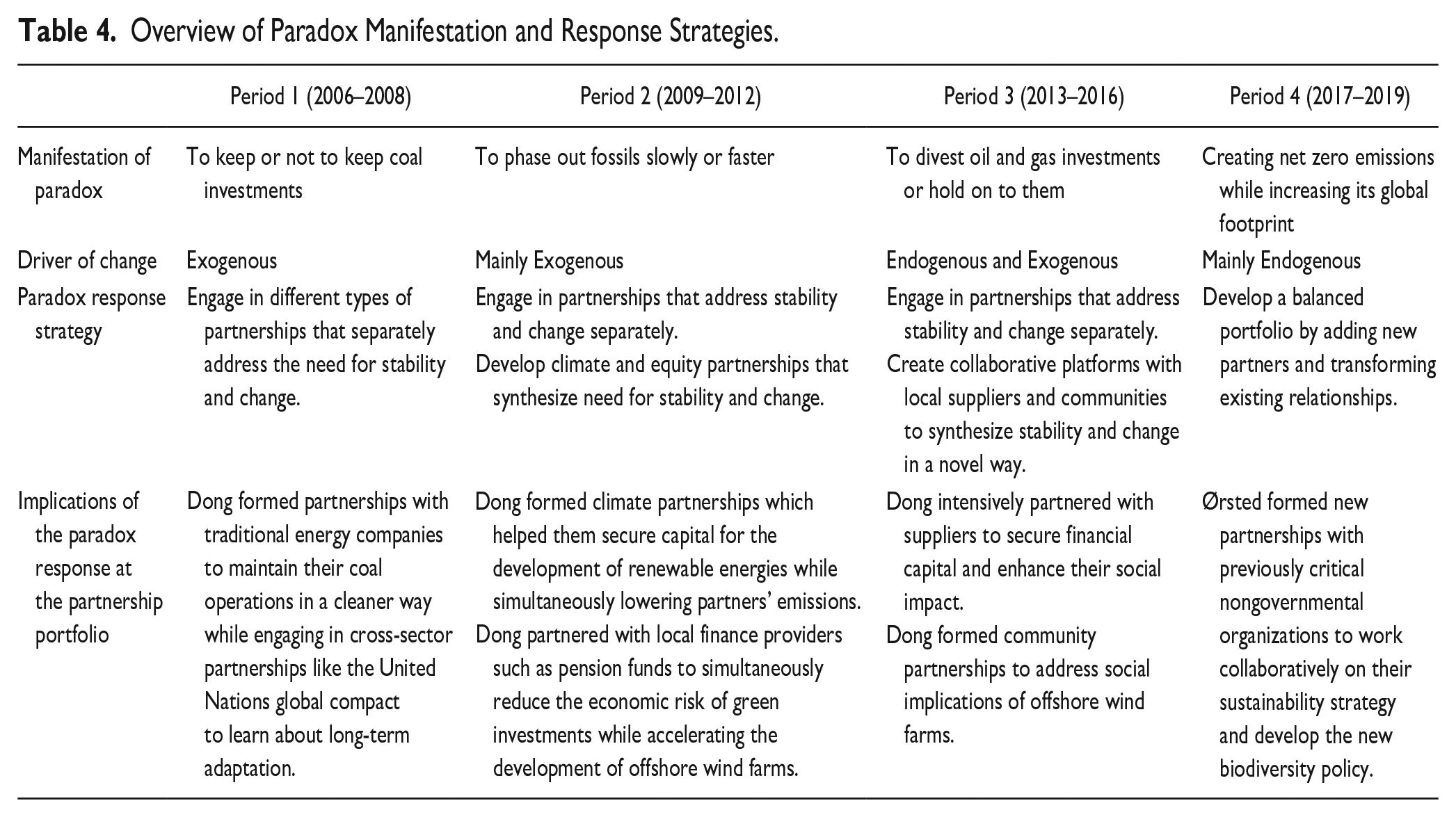
All in all, our findings highlight the presence of the stability-change paradox throughout the different periods of Dong/Ørsted’s sustainability transition. The paradox manifested differently due to the influence of specific endogenous and exogenous forces. In the earlier phases, the paradox presented as a trade-off between retaining coal investments or divesting them (Period 1), and deciding on the speed to phase out fossils (Period 2). During these phases, the paradox was primarily driven by exogenous forces. In the later phases, the paradox emerged from the dilemma between divesting oil and gas assets versus maintaining these investments (Period 3), as well as striking a balance between achieving net zero emissions while expanding Ørsted’s global footprint (Period 4). Dong/Ørsted exhibited varied responses in its PPS to navigate this paradox throughout their journey. In Period 1, the company formed partnerships addressing either stability or change (mainly separation). By Period 2, Dong/Ørsted maintained these while also forging collaborations that combined both elements, especially through climate and equity partnerships (synthesis). In period 3, they added collaborative platforms with suppliers and communities for a novel synthesis of stability and change. By period 4, Dong/Ørsted employed a balancing approach in their PPS through the addition of new partnerships with businesses and transformed relationships with previously critical NGOs and non-profits. Our findings are comprehensively summarized in Figure 2 and Table 4.
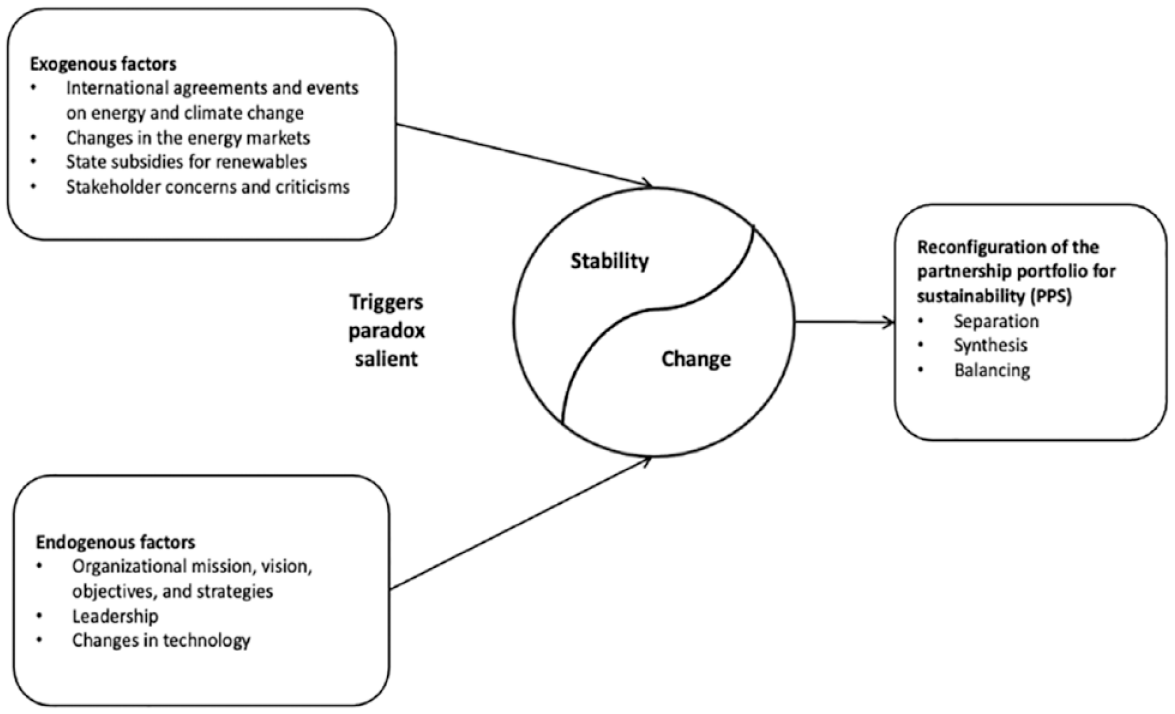
Conceptual Model Based on Our Findings.
Overview of Paradox Manifestation and Response Strategies.
Discussion
Partnership Portfolios as Spatiotemporal Pockets
In our study, we investigated how firms’ PPS can effectively address the stability-change paradox in sustainability transitions. Although previous research has recognized the value of PPS in this context (Dzhengiz, 2018, 2020; Lashitew et al., 2018; Wassmer, 2010), there is limited empirical evidence on its workings. While studies on paradox management have shown that organizational actors switch between different response strategies over time (Jarzabkowski et al., 2013; Schmitt & Raisch, 2013; Schrage & Rasche, 2022), our study highlights that maintaining a PPS enables organizational actors to employ multiple paradox response strategies simultaneously according to the manifestation of the paradox at hand. Therefore, we conceptualize PPS as “spatiotemporal pockets” in which paradoxes can be addressed by separating and integrating contradictory goals both spatially and temporally through engagement with various stakeholders while keeping the paradox alive for organizational actors. While prior studies mentioned the existence of such spatiotemporal pockets as arenas where active responses to paradoxes can be developed (Hahn et al., 2017), empirical investigations of PPS as spatiotemporal pockets have been absent.
Our study sheds light on the spatiotemporal nature of PPS, emphasizing both their spatial and temporal dimensions. Our findings highlight the spatial pockets established by the PPS, as firms can address the paradox using spatial separation and synthesis strategies through the PPS. Initially, these pockets act as interaction hubs, allowing members from diverse groups to deliberate on the complexities and tensions of sustainability transitions. This facilitated the company’s harmonization of stability and change by establishing consistent physical environments where actors from varied institutional backgrounds collaboratively addressed long-term changes. Consistent with studies emphasizing the significance of “spaces” in tackling grand challenges (Chatterjee et al., 2023; Ometto et al., 2019; Ungureanu et al., 2021), our research indicates that partnership portfolios can be instrumental arenas for navigating diverse stakeholder demands, promoting sustainable transitions (Dzhengiz & Patala, 2023; Ometto et al., 2019).
Moreover, the PPS showcases paradoxical actions across diverse spatial scales. For example, the company’s collaboration with WWF enabled them to tackle global biodiversity concerns, devising policies for widespread application. Concurrently, partnerships with local entities in areas like former fishing towns facilitated regional revitalization. These multi-scalar approaches not only strike a balance between stability and change but also reflect the capacity of the PPS to respond to the paradox across varying spatial tiers (Randles, 2007), aligning with insights from previous studies on spatial scales (Bowen et al., 2018; Kim & Kim, 2022; Slawinski et al., 2019).
PPS proves adaptive to distinct periods, demonstrating temporal scales, tailored to resonate with the waves of change and to capture the “temporal dimensions of past, present, and future” (Hydle, 2015, p. 643). This temporal adaptability manifests itself, especially in partnership terminations and formations. For example, during Period 1, the prevailing paradox response strategy led to collaborations with partners such as WV Energie to pioneer clean coal technologies and carbon capture solutions. However, by Period 2, as the strategic landscape evolved, these partnerships were deemed redundant and consequently terminated, making way for new partnerships.
Despite these shifts, in alignment with the stability-change paradox, the portfolio consistently served as a temporal pocket. It maintained certain long-standing partnerships, ensuring stability amid change. This notion of “temporal work” aligns with previous research emphasizing the delicate balance portfolios strike between immediate and future-oriented goals (Liao, 2016; Slawinski & Bansal, 2015). For instance, Dong/Ørsted, leveraging its portfolio, managed to secure short-term capital by divesting shares in equity partnerships. At the same time, they pursued long-term aspirations through strategic collaborations, like the one with ABB, anticipating the combinative synergies essential for the future energy ecosystem.
To sum up, our study highlighted the paradox businesses face in trying to remain stable while also needing to change. We found that the combination of different partnerships in a portfolio, influenced by both time and location, helps navigate this tension. For instance, long-term partnerships in specific regions, such as with Vestas and Siemens, anchor stability by providing consistent resources and expertise. Conversely, establishing new partnerships in various places introduces elements of change. By mixing short-term and long-term collaborations, both locally and globally, companies can weave together these temporal and spatial factors. This strategy effectively enables them to strike a balance between maintaining stability and embracing necessary change. Understanding the interplay between time and space is pivotal for businesses (Kim & Kim, 2022) especially when grappling with the stability-change paradox.
Bringing the Portfolio Perspective to Sustainability Partnerships
In addition to our contributions to the literature on paradox management, our findings also have implications for the literature on sustainability-oriented partnerships (Crane, 1998; Dzhengiz et al., 2023; Stadtler & Lin, 2019). Traditionally, the portfolio perspective has been extensively studied in the context of commercially oriented partnerships (also referred to as strategic alliances) aimed at enhancing innovation (Cui & O’Connor, 2012; Duysters & Lokshin, 2011) or financial performance (Castro & Roldan, 2015; Jiang et al., 2010). However, our study extends this perspective by applying it to the realm of sustainability. Extant research has explored the role of partnerships in developing sustainable innovation (Lin, 2016; Rey-Garcia et al., 2021) and creating societal impact (Van Tulder et al., 2016). Thus far, these studies often take partnership as the unit of analysis, and very few studies take a portfolio approach when studying sustainability-oriented partnerships. An exemption pertains to Gutiérrez and colleagues (2016), who showed that firms would utilize their portfolio in different ways in different phases of developing a sustainable product or service offering. Their findings suggest that firms mainly engage CSPs when entering a new market or developing a new sustainable product or service while collaborating with interfirm partners in phases of product scaling (Gutierrez et al., 2016).
Like Gutiérrez and colleagues (2016), our findings show that in the early phases of a sustainability transition, firms benefit from engaging in CSPs as these partnerships allow firms to learn about long-term adaptations and reach out to their institutional environment. On the contrary, business partners such as suppliers and customers (inter-firm partnerships) enabled Dong’s sustainability transitions in later periods by securing financial resources and increasing the speed of change. Nevertheless, unlike existing research, our findings also showed that engaging with CSPs was valuable again in the later stages of sustainability transitions, as CSP collaborators can serve as strategic partners to co-create sustainability policies. While engagement in CSPs in earlier phases was more transactional, in later periods, the mode of engagement with these partners became increasingly transitional (i.e., characterized by interdependence, reciprocity and collective action; Austin & Seitanidi, 2012). In a similar vein, while Dong/Ørsted engaged with interfirm partners in earlier phases mainly to secure financial resources, in later periods, they formed partnerships that helped them to secure capital while at the same time educating partners to lower their emissions, thus becoming more transitional in their mode of value creation.
As such, our findings highlight that different types of partnerships and partner diversity within a portfolio may create and leverage different types of collaborative value (i.e., the transitory and enduring benefits resulting from the interaction of the collaborators; Austin & Seitanidi, 2012; Le Ber & Branzei, 2011) that unfold in varying phases within a sustainability transition. In doing so, a portfolio enables organizations to address various challenges inherent in such transitions, which may require different modes of engagement. Our findings emphasize that the value of maintaining a portfolio with multiple partners is bigger than the collaborative space of a single partnership.
Limitations and Future Outlook
While our study provides valuable insights into the role of PPS in responding to stability-change paradox inherent in sustainability transitions, it is important to acknowledge our limitations. First, our findings are based on a single case of Dong/Ørsted’s transition from a fossil-fuel-intensive utility to a renewable energy leader. Therefore, caution should be exercised in generalizing the results to other firms. Our analysis follows an abductive approach (Bamberger, 2018), and we do not claim causality but rather propose partnership portfolios as one plausible explanation for this firm’s successful response to the stability-change paradox.
In addition, our study primarily relies on archival sources, limiting our ability to assess the impact of partnership portfolios on environmental or social performance (Ashraf et al., 2019), partnership outcomes (Clarke & MacDonald, 2016), or societal impact (Van Tulder et al., 2016). Future research should employ cross-sectional designs to explore these aspects more comprehensively. Furthermore, while our findings highlight the importance of mergers, acquisitions, and divestments of unsustainable assets in the transition journey of Dong/Ørsted, future research should delve deeper into these inter-organizational responses within the framework of partnership portfolios (Pereira et al., 2022).
It is worth noting that Dong/Ørsted’s ownership structure, being majority owned by the Danish state, has influenced its transition story and paradox response strategies through state policies (State of Green, 2021). Exploring how partnership portfolios facilitate firms’ responses to state policies and the potential impact of state ownership on paradox responses in the sustainability context would be fruitful avenues for future research.
Our findings indicate that partnership portfolios can help address the tensions between exploration and exploitation, aligning with previous research on commercially oriented partnerships (Lavie et al., 2011). Future studies should further explore the interplay between exploration, exploitation, and partnerships in the context of sustainability transitions.
Finally, we highlight that PPS are not the sole means for organizations to engage in complex response strategies nor do they constitute the only spatiotemporal pocket in an organizational context. Still, by specifically exploring PPS, we open up avenues for further exploration of complex response strategies that combine multiple approaches to manage paradoxes.
Conclusion
In this study, we explored how firms can navigate the stability-change paradox during sustainability transitions by leveraging a partnership portfolio for sustainability (PPS). Taking inspiration from the evolutionary journey of Dong/Ørsted, we illuminated the various facets of this paradox and detailed how Dong/Ørsted continually adapted its PPS in response to the evolving paradox of stability and change. Our research offers two pivotal contributions. First, we introduced the notion of PPS as “spatiotemporal pockets.” This enriches the paradox management discourse (Jarzabkowski et al., 2019; Lüscher & Lewis, 2008) by providing a dynamic multiple-response strategy. This strategy uniquely enables organizations to apply diverse responses, such as separation, synthesis, and balancing, concurrently. While extant literature suggests that organizations alternate between response strategies (Jarzabkowski & Lê, 2017; Schrage & Rasche, 2022), our insights highlighted the versatility of PPS. These pockets empower organizations to deploy a spectrum of strategies at once, contingent on the paradox’s manifestations.
Second, we integrated the portfolio lens, typically associated with strategic alliances, into the domain of sustainability-oriented partnerships (Crane, 1998; Dzhengiz et al., 2023; Stadtler & Lin, 2019). We demonstrated that these portfolios amalgamate inter-firm collaborations and CSPs, with each partnership playing a unique role throughout a sustainability transition. In essence, we shed light on the role of partnership portfolios in helping firms address the intricacies of sustainability transition and its intrinsic tensions and generate different types of collaborative value.
Supplemental Material
sj-docx-1-bas-10.1177_00076503231211214 – Supplemental material for The Role of Partnership Portfolios for Sustainability in Addressing the Stability-Change Paradox: Dong/Orsted’s Transition From Fossil Fuels to Renewables
Supplemental material, sj-docx-1-bas-10.1177_00076503231211214 for The Role of Partnership Portfolios for Sustainability in Addressing the Stability-Change Paradox: Dong/Orsted’s Transition From Fossil Fuels to Renewables by Tulin Dzhengiz, Leona A. Henry and Khaleel Malik in Business & Society
Footnotes
Acknowledgements
We would like to thank Business & Society editor Frederik Dahlmann and three anonymous reviewers for their valuable comments and suggestions. We owe a special thank you to Jonatan Pinkse, Elizabeth Krull, Dimitri Gagliardi, and Shukhrat Nasirov for their constructive feedback at the Manchester Institute of Innovation Research (AMBS) Paper Development Workshop. We also would like to thank Kai Hockerts, Minna Halme, Samuli Patala, Michael Hodson, Paul Upham, and Rod Bain for their feedback on earlier versions of this manuscript. We would also like to thank the conference participants of the Academy of Management 2020 and Cross-Sector Social Interactions (CSSI 2020) for their valuable comments and encouragement which helped the development of the article further.
Declaration of Conflicting Interests
The authors declared no potential conflicts of interest with respect to the research, authorship, and/or publication of this article.
Funding
The authors received no financial support for the research, authorship, and/or publication of this article.

Supplemental Material
Supplemental material for this article is available online.
Notes
Author Biographies
References
Supplementary Material
Please find the following supplemental material available below.
For Open Access articles published under a Creative Commons License, all supplemental material carries the same license as the article it is associated with.
For non-Open Access articles published, all supplemental material carries a non-exclusive license, and permission requests for re-use of supplemental material or any part of supplemental material shall be sent directly to the copyright owner as specified in the copyright notice associated with the article.
