




Abstract
Cross-sector partnerships (CSPs) between nonprofits and businesses are increasingly implemented in response to humanitarian crises. These partnerships are motivated by ideals of alignment as stakeholders strive to find the “sweet spot” between humanitarian and business interests. However, this article shows that the ideals of alignment differ from the actual practices of alignment in the CSPs, and sweet spots are not merely found but constructed in and through changing relations of power. Based on an ethnographic case study of partnerships between a global humanitarian organization and five technology companies, the article deploys a theoretical lens from critical humanitarian studies to analyze how alignment in CSPs comes about in practice. This analysis demonstrates that in the construction of alignment, the companies’ interests become the priorities with which humanitarian organizations must align their and their beneficiaries’ needs. Consequently, while the discourse of sweet spots perpetuates an ideal of alignment where all partners benefit equally from the partnership, it legitimates power imbalances and asymmetrical alignment in practice.
Cross-sector partnerships (CSPs) between for-profit companies and nonprofit organizations have become widely recognized as instruments to address societal “grand challenges,” such as the forced displacement of more than 80 million people globally (United Nations High Commissioner for Refugees [UNHCR], 2021). CSPs are voluntary collaborations between organizations in two or more sectors that address a problem considered too complex for one sector to handle in isolation (Selsky & Parker, 2005). As such, CSPs rely on a win-win philosophy of merging skills and resources from different sectors to tackle “wicked problems” and bring about systemic change (Clarke & Crane, 2018; Kolk & Lenfant, 2015, p. 423) in areas such as sustainability (DiVito et al., 2021; Gray & Stites, 2013; Lubberink, 2021; Pedersen et al., 2021) and development (Ber & Branzei, 2010a; Kolk et al., 2008; Vestergaard et al., 2019).
In humanitarian and development sectors, institutional frameworks like the United Nations (UN) Sustainable Development Goals and the UN Global Compacts have strongly promoted CSPs as part of a broader push for innovation in aid (Müller & Sou, 2020; Sandvik, 2017; Utting & Zammit, 2009). These frameworks encourage CSPs that leverage companies’ core business practices to serve both humanitarian and business interests (UN Global Compact, 2015). As such, discourses of win-win solutions and shared value (Porter & Cramer, 2011), well-known among practitioners of corporate social responsibility (CSR), are permeating the humanitarian sector. Companies and humanitarian organizations are encouraged to find what practitioners working in this field today colloquially refer to as “the sweet spot” where profit and purpose align. However, as businesses become humanitarian partners, there is a need to critically assess the assumptions of shared objectives and values in corporate humanitarian collaborations. CSPs are increasingly implemented to address humanitarian problems, in which the intended beneficiaries such as refugees have little influence on the problem definitions and outcomes of CSPs. Therefore, more research is needed on the actual practices of CSPs to understand how and for whom they create value.
Based on ethnographic fieldwork with one of the world’s largest refugee aid organizations and their corporate partners from the technology sector, this article examines how alignment between humanitarian and business interests is pursued and constructed in refugee-focused CSPs. By analyzing interest alignment as a set of distinct practices, the article finds that sweet spots are not discovered but rather constructed. In these alignment practices, business interests become the priorities to which humanitarian organizations must align their and their beneficiaries’ needs to receive funding. The article concludes that the discourse of finding sweet spots in refugee-focused CSPs perpetuates this power asymmetry.
The process of interest alignment in refugee-focused CSPs takes place within broader and ongoing discussions over how to solve humanitarian problems in ways that create shared value. Yet this value is shared unequally between humanitarian organizations and their corporate partners. The process of finding alignment in CSPs is thus distinctly political because it involves “the continuous negotiation and struggle over definitions of reality” (Garsten & Sörbom, 2017a, p. 5; see also Seitanidi, 2010, p. 4). As such, refugee-focused CSPs are an important site for studying the political implications of businesses’ changing societal roles and responsibilities in humanitarian aid.
In highlighting the politics of alignment, the article contributes to two emerging debates within the business and society literature. First, the article engages with a critical stream of literature that seeks to uncover the operation, practices, and political implications of CSPs, for example, by questioning how and for whom CSPs create value (Ber & Branzei, 2010b; Vogel et al., 2022, p. 17). The findings in this article provide novel empirical evidence of the practices and politics through which partnership alignment comes about. Second, the article contributes to emergent scholarship on corporate engagement in humanitarianism (Hotho & Girschik, 2019) by demonstrating the centrality of power dynamics in CSPs. While the literature on CSPs emphasizes the importance of considering political dimensions of CSPs (Selsky & Parker, 2005, p. 867) and recognizes their often asymmetric power relations (Dewulf & Elbers, 2018), the extant literature tends to reproduce normative assumptions about the win-win-win benefits of CSPs by discussing them in “functional, normative, and managerial terms” (Selsky & Parker, 2005, p. 866; see also Laasonen et al., 2012). Moreover, existing literature has focused on producing frameworks to optimize CSPs and identify business cases (Crane et al., 2014; Feix & Philippe, 2020; Girschik et al., 2020). By integrating theory from critical humanitarian studies in the analysis of interest alignment, this article identifies three key power dynamics that influence CSPs and should be considered in research on business-humanitarian engagements.
CSPs in Humanitarian Aid
Various frameworks have been offered to characterize CSPs between business and humanitarian nonprofits, centered, for example, on the constellation of actors involved, the nature of their collaboration, or their geographical level and aims. Vestergaard et al. (2019) define CSPs in development contexts in terms of their issue, scope, and function. CSPs can focus on issues such as health, education, or poverty alleviation and address these issues with varying scopes. Micro-level partnerships often focus on a specific project, country, or activity. Meso-level partnerships usually focus on a particular sector or supply chain, and macro-level partnerships target broader issues with global activities (Kolk et al., 2008; Vestergaard et al., 2019, p. 5). CSPs’ function, or “targeted solution” (Stadtler & Karakulak, 2022), can include the provision of services and goods, fundraising, advocacy, and awareness raising or influencing policies and governance processes.
Based on Austin’s (2000) influential “collaboration continuum” of philanthropic, transactional, and integrative CSPs, Thomas and Fritz (2006) distinguish between philanthropic partnerships (i.e., low-level engagement primarily focused on the provision of cash or goods) and integrative partnerships (i.e., high-level engagement focused on utilizing core competencies of partnering organizations). Humanitarian logistics partnerships are an example of the latter (Nurmala et al., 2017; Pascucci, 2021; Rueede & Kreutzer, 2015). These two CSP categories are similar to what Haigh and Sutton (2012) term philanthropic collaborations, which “advance social welfare by facilitating the delivery of humanitarian organizations’ services” and strategic collaborations that “realize exclusive benefits for the firm, while advancing social welfare through the activities of the humanitarian organization” (Haigh & Sutton, 2012, p. 274).
Despite these helpful distinctions, the line between nonprofit and for-profit interests is blurry in both philanthropic and strategic CSPs, and “benefits for the firm” are not always linked directly to profits. Hotho and Girschik (2019) highlight that even philanthropic and nonprofit engagements in humanitarian aid can be driven by instrumental rationales. From a business perspective, these include (a) access to new markets, (b) reputational benefits both externally (improving moral legitimacy with consumers and other stakeholders) and internally (motivating and retaining employees), (c) the reduction of risks and interruptions of supply chains, and finally (d) the opportunity to build relationships and gain influence with governments, local communities, and international organizations. Moreover, CSPs with nonprofits can be a way for businesses to respond to stakeholder and consumer pressure (Pedersen & Pedersen, 2013; Thomas & Fritz, 2006; see also Stadtler, 2011, pp. 88–89) and implement their increasingly expected CSR activities (Nurmala et al., 2017, p. 90; Seitanidi, 2010; Seitanidi & Crane, 2009; Skagerlind et al., 2015).
Nonprofits and aid agencies, on the contrary, operate in a context of increased competition for funding. As a result, more nonprofits adopt an entrepreneurial orientation and proactively seek out partnerships with the private sector (Al-Tabbaa et al., 2022) to acquire funding, goods, and operational expertise that will improve efficiency in aid delivery (Nurmala et al., 2017, p. 90; Thomas & Fritz, 2006, p. 117). CSPs also help nonprofits achieve visibility and brand recognition, which is critical for their survival and growth (Al-Tabbaa et al., 2022, p. 1029). In this sense, nonprofits and humanitarian organizations operate increasingly like firms (Joachim & Schneiker, 2018) and “speak to us just as any brand would do” (Sharma, 2017, p. 1). However, it is not clear from extant research how this instrumentality and resource dependency shape what CSPs are and do.
Interest Alignment in CSPs
The concept of alignment is widely applied in CSP literature to analyze the merging of partners’ interests (Stadtler, 2011), organizational cultures (Gray & Stites, 2013), institutional logics (Vogel et al., 2022), values and objectives (Ber & Branzei, 2010a), shared value creation processes (Austin & Seitanidi, 2012a, 2012b; Ber & Branzei, 2010b; Murphy et al., 2015), purpose definitions (Cloutier & Langley, 2017; Eden & Huxham, 2001), goals and solutions (Stadtler & Karakulak, 2022), and power asymmetries (Berger et al., 2004; Dewulf & Elbers, 2018). Although scholars argue that no type of cross-sector collaboration is better than others, it is a common notion in the literature that CSPs closer to the integrative end of the collaboration continuum will have more impact and yield higher levels of shared value (Austin, 2000, p. 79; Thomas & Fritz, 2006, p. 122). The potential for creating this collaborative value is claimed to be contingent on finding the “organizational fit” (Austin & Seitanidi, 2012a, p. 729; Berger et al., 2004) and a shared “articulation of the social problem” at hand (Austin & Seitanidi, 2012b, p. 931). Thus, while it is widely assumed that businesses and nonprofits will have differing or even conflicting objectives and interests (Laasonen et al., 2012, p. 533; Selsky & Parker, 2005, p. 856; van Tulder & Keen, 2018, p. 318), alignment is still presented as the ideal to strive for in CSPs (Brand et al., 2020) and an indicator of the transformational potential of a CSP (Murphy et al., 2015; Seitanidi & Crane, 2009; Seitanidi et al., 2010; Stadtler, 2011). In this sense, the literature mirrors the practitioner discourse on finding sweet spots for CSPs.
Consequently, the dominant focus of the extant literature is to provide theories and frameworks for overcoming organizational differences, mitigating the tensions that arise from them, and strengthening CSP alignment. Recent examples include developing a “framing plurality” approach (Klitsie et al., 2018), analyzing partners’ underlying ideologies and moral worlds (Cloutier & Langley, 2017), or using broker organizations to navigate tensions (Stadtler & Karakulak, 2020). These studies express a normative interest in achieving alignment (Laasonen et al., 2012, pp. 537–538), but lack a discussion of the politics or power dimensions of alignment.
Alignment, in this article, refers to the alignment of interests in CSPs between business and humanitarian actors. Broadly, interest alignment refers to the accommodation of differing priorities into a partnership that benefits all parties. In CSP research, interest alignment has commonly been understood in relation to the “fundamental CSR challenge” of striking a balance between economic and social interests (Stadtler, 2011, p. 86). The notion of interests tends to be narrowly defined as economic self-interest, for example, but as urged by Cloutier and Langley (2017), partner interests must be considered in close connection with their “deeply help, ideological or moral beliefs” (Cloutier and Langley, 2017, p. 122). As such, what individual partners view as being in their interest is shaped by and shapes the partnership’s purpose, goals, and objectives.
Moreover, the notion of alignment tends to be understood as a two-sided effort of “meeting in the middle.” Stadtler’s (2011) influential framework for theorizing interest alignment in CSPs emphasizes the compatibility of a business’ economic interests and the social goals of a partnership. The framework indicates that sustained interest alignment is more likely in a partnership where economic and social interests are linked “through a reciprocal relationship” (Stadtler, 2011, p. 91), through which economic success is dependent on the success of the partnership’s social goal. In an asymmetric relationship, on the other hand, economic interests will hamper the realization of social goals and interest alignment will not be possible. Thus, interest alignment is connected to notions of reciprocity, symmetry, and mutual benefits.
However, since CSPs are rarely perfectly symmetrical, there is a need to examine more carefully whether partners actually do meet in the middle and to which extent each partner must “move” or align to meet the other’s preferences. To do this, I apply a theoretical framework from critical humanitarian studies, as outlined below.
Alignment Through a Critical Lens
Contrary to existing literature that views alignment as a fixed and ontological fact, I argue that alignment is more usefully understood as the product of alignment practices that unfold in and through power relations. To analyze these power relations, I integrate an interdisciplinary body of literature on new actors and alliances in humanitarianism (Barnett, 2022; Olwig, 2021; Richey & Ponte, 2014).
This literature theorizes how businesses access new forms of power by entering the sphere of humanitarianism, a sphere that was previously limited to nongovernmental organizations (NGOs), nonprofits, and governments. The literature recognizes humanitarianism as a distinctly political field with various long-standing power imbalances between governments, donor agencies, NGOs, and recipients (Barnett & Weiss, 2008). Importantly, NGOs and nonprofits are not considered as neutral or powerless actors in this field, but rather as organizations with their own interests and political relations (Krause, 2014). Scholars have documented the workings of power in business–humanitarian engagements by studying the structural and discursive power of businesses to shape norms and ideals, set humanitarian agendas, and increase political influence through CSR initiatives and CSPs (Blowfield & Dolan, 2014; Dolan & Rajak, 2016; Garsten & Sörbom, 2017b). For example, studies have highlighted how CSR initiatives enable businesses to reframe humanitarian problems and solutions in ways that depoliticize their own business activities and cast them as virtuous (Cinnamon, 2020; Rajak, 2011, p. 18). Scholars have recently called for a re-politicization of CSPs to “move from the slippery ‘global’ toward the scale of the everyday, the intricacies of how partnerships work and how they fundamentally shift, and have the potential to shift, power-relations” (Richey et al., 2021, p. 3).
Conceptualizing alignment through this lens enables an analysis of the politics of CSPs that centers the actual practices of these partnerships and connects them to the discursive power of ideas. That is, how certain ideas, such as CSPs between nonprofit and for-profit actors, become idealized and mobilized as preferred solutions to societal challenges (Olwig, 2021; Utting & Zammit, 2009). In the conceptual framework of this article, practices are understood as the activities of and in partnerships as opposed to the ideal and theories of partnerships. Politics refer to the processes and relations of power that shape the partnerships, their outcomes, and their definitions of alignment and value. This use of the term draws on the notion of “politics of humanitarianism,” which examines how political interests, ideologies, and power relations impact the delivery of humanitarian assistance, the prioritization of needs, and the allocation of resources (De Lauri, 2016). To show how these relations of power play out in practice, I use the term power dynamic, which describes how this power is distributed, wielded, and expressed in the interactions between nonprofits and tech companies in CSPs.
Research Design
To support the theoretical framework of this article, I adopted a critical and interpretive methodology (Tracy, 2012, p. 40). Accordingly, I coupled qualitative ethnographic methods with an explorative and abductive analytical approach (Schwartz-Shea & Yanow, 2012, p. 26) described below.
Empirical Setting
The International Rescue Committee (IRC) is one of the largest global aid organizations in the world working with refugees, and partnerships with the tech sector are critical to their work. 1
The president of the IRC since 2013, David Miliband, formerly worked as an advisor to the United Kingdom’s Prime Minister Tony Blair before joining Parliament and serving as foreign secretary under Prime Minister Gordon Brown for the Labour Party. From these positions, Miliband brings to the IRC a political philosophy that enthusiastically embraces the role of the private sector in helping solve social, environmental, and humanitarian challenges. In an interview with Fast Company, Miliband explains that he has pushed his staff to pull in more private funds because government grants are too restricted: “The private money has greater leverage. It is our venture fund” (Shaer, 2016). Thus, while the IRC has a long history of engaging with private sector companies, mainly through philanthropic donations and fundraising campaigns, the organization is starting to incorporate private sector partners more strategically into its financial and operational strategies. This development is not specific to the IRC, but rather typical for contemporary humanitarian organizations (Barnett, 2022), which positions the IRC as an exemplary case for studying the alignment between business and humanitarian interests in CSPs. Thus, although this article’s analysis is context-specific, the cases reflect a development beyond the five partnerships studied here.
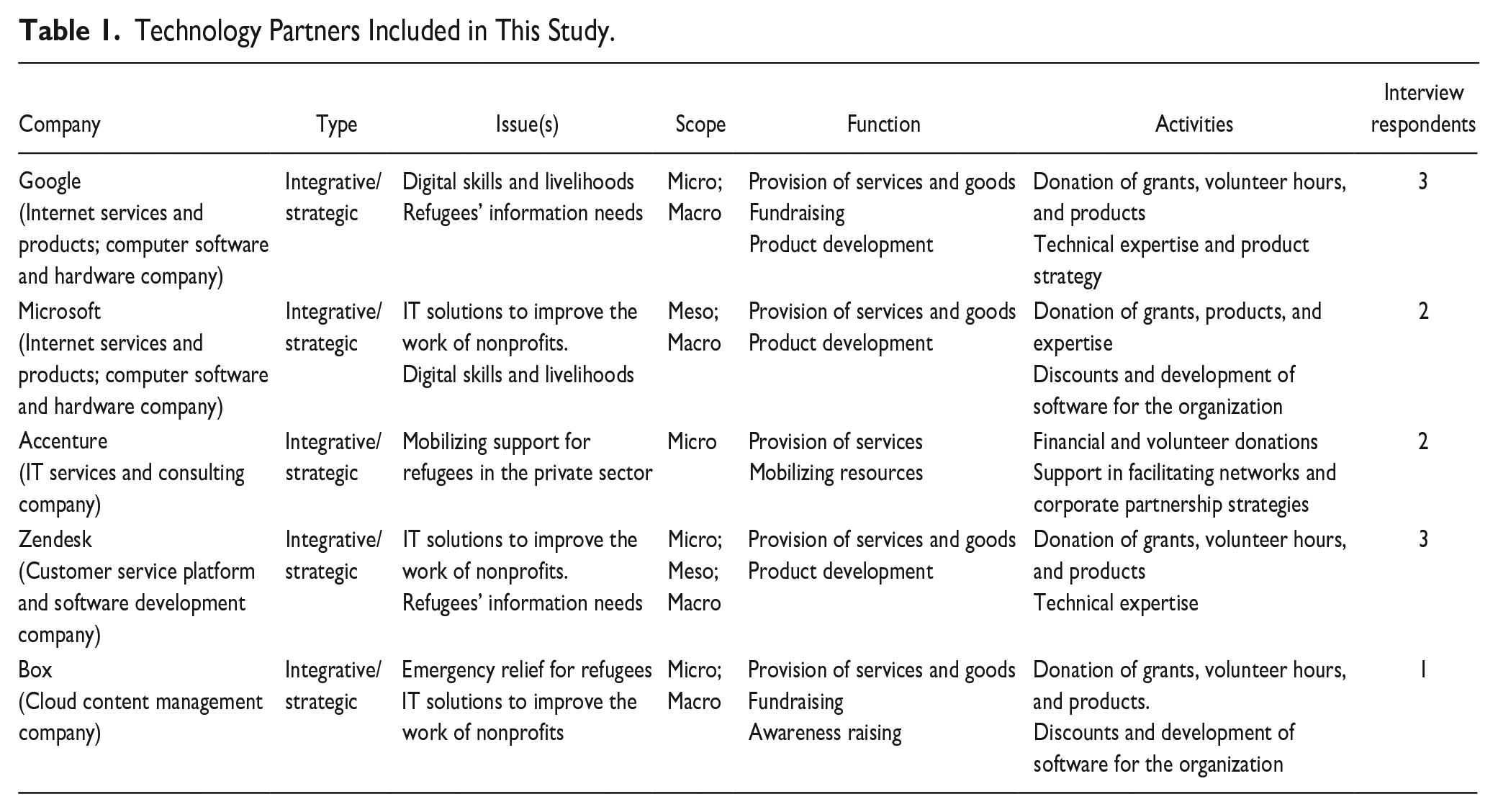
In recent years, the IRC has developed a broad portfolio of partnerships in the tech sector with diverse companies such as Google, Microsoft, Meta, Airbnb, Mastercard, Salesforce, Twilio, Intel, and more. Having historically branded themselves as operating within a version of capitalism committed to social improvement through innovation and disruption (Atal, 2021), companies from the tech sector have been positioned as particularly crucial partners in the shift toward more efficient and innovative aid for refugees (Culbertson et al., 2019; PwC Global Crisis Centre, 2017; UNHCR, 2016). Technology companies, in this article, refer to for-profit corporations in the tech sector that design and sell digital technology, software, and internet services. These businesses are also referred to as internet companies (Flyverbom et al., 2019) and technology platform businesses (Atal, 2021). This article uses data collected from the IRC’s partnerships with Google, Microsoft, Zendesk, Accenture, and Box (see Table 1 for an overview). These partnerships were selected based on the following criteria: (a) They include a technology company as the corporate partner; (b) They focus on refugees as their main issue (but diverge in their specific focus and function); (c) They are all integrative/strategic partnerships rather than purely philanthropic; (d) My access as a researcher was agreed consensually between the businesses and the IRC. As such, the partnerships were all considered successful by both partners and were not selected to exemplify particularly asymmetrical partnerships; and (e) at the time of research, all partnerships were ongoing and at stages where aligning processes, such as project implementation and bilateral meetings, could be observed. While these five partnerships constituted the main sites of data collection for this article, their specific focus and characteristics are not the subject of analysis. Rather, the partnerships provide empirical insights into the practices of alignment and how these practices contrast the ideal of alignment.
Technology Partners Included in This Study.
Data Collection
Data collection followed the “extended case method” (Burawoy, 1998; Wadham & Warren, 2014). In this method, data from empirical cases are collected ethnographically, examined interpretively with attention to their specific empirical contexts, and used to illuminate broader societal issues or processes. While I applied ethnographic methods, data collection did not look like traditional ethnographic fieldwork as prolonged immersion in a single, bounded, and distant (geographically and/or culturally) field site with participant observation as the main method. Rather, data collection was fragmented and polymorphous and the boundaries between being “in” and “out” of the field were blurred.
Between September 2019 and January 2022, data were collected through “polymorphous” engagement with informants across dispersed sites (Gusterson, 1997). Literature on “studying up” influenced my strategy for gaining access (Nader, 1972; Ortner, 2010) as I sought out what Souleles calls interstitial spaces: “events and sites at which a population that is hard to access presents itself to the public” (Souleles, 2018, p. 53). Through meticulous research on the social media platform LinkedIn, I established contacts that developed into gatekeepers and secured research access to the IRC. Interviews and fieldwork trips were organized through these gatekeepers. This access influenced my data sample, which contains more data from IRC employees than their corporate partners. Moreover, my previous experience working with international NGOs shaped data collection through an insider perspective on the practices, structures, and language of such organizations (Henriksen, 2018). Thus, my position can be characterized as both an insider and an outsider, a position familiar to anthropologists doing fieldwork in organizations in general (Garsten & Nyqvist, 2013) and humanitarian agencies specifically (Fassin, 2011). This position has implications for how I collected data (e.g., by determining where and when I was allowed to collect data) and for my interpretation of these data (e.g., shaping what I included and excluded in my analysis), as I outline below.
Data were collected through two rounds of fieldwork in New York and San Francisco, in which I observed IRC’s work on corporate partnerships with the tech sector. I followed three teams, in which employees are engaged in CSPs with tech companies. In total, I spent 11 months “in the field,” including 1 week at the IRC headquarters in New York City in January 2020 just before the COVID-19 pandemic hit. I put the field in quotes to indicate that the field was both a physical and virtual space that I was never completely disengaged from. For example, I continued to collect data online after my trips to New York and San Francisco. Likewise, while I was in San Francisco some data were collected online. Due to the pandemic, the IRC teams shifted to online work, which enabled me to follow their work, interact with informants virtually and generate “thick” data in between field trips.
My two main methods for data collection, participant observation and semi-structured interviews, were thus conducted both in person and online. However, the pandemic did limit the opportunities for participant observation. Thus, my data sample contains more interviews than field notes, which in turn shaped my analytical process to rely more on interview quotes than observations. I did participant observation and recorded field notes at (a) five events and summits about private sector engagement in humanitarian and refugee aid, (b) seven internal meetings in the IRC teams, and (c) three meetings between IRC teams and their corporate technology partners. At these meetings, I was introduced as an independent researcher. In addition to these activities, I recorded field notes after every interview to describe the interview setting, the body language of the interviewee (when possible), and details of the interaction (Emerson et al., 2011, p. 18). I wrote a journal with personal and analytical reflections throughout my time in the field (Sanjek, 1990, p. 108), in which I documented my own feelings and biases as I immersed myself in the professional lives and perspectives of my interlocutors. These field notes total more than 100 pages.
Semi-structured interviews were conducted with 52 key informants from the IRC, the technology companies partnering with the IRC, and other relevant stakeholder organizations. Of these 52 participants, 35 came from nonprofits or aid agencies (IRC, Mercy Corps, and Nethope), 10 came from the technology companies included in this study (Google, Microsoft, Zendesk, Box, and Accenture), and seven informants had different affiliations (e.g., the business consortia Tent Partnerships for Refugees and the nonprofit Techfugees). The interviews were between 20 and 80 min each in duration. I conducted in-person interviews with 13 of the 52 informants and the remaining through Zoom, Teams, or telephone. I identified participants through “snowball sampling”, utilizing my informants’ networks to gain access, which explains the majority of informants from the nonprofit sector. I interviewed IRC employees involved in corporate partnerships from different positions (in different departments and of different ranks) to include multiple partnership activities.
To follow partnerships over time, I conducted 20 follow-up interviews with selected informants, prioritizing IRC employees and corporate managers who were directly involved in partnerships. The aim of the research was not to conduct an ethnography of the nonprofits or the companies specifically, but of the middle space in which they meet to observe processes of alignment. I included interviews from both sides to try to balance corporate and nonprofit views on the partnerships. However, my data collection emphasizes the perspectives of the IRC to pay particular attention to the nonprofit perspective of alignment practices in CSPs. Following an ethnographic commitment to the emic perspectives of my interlocutors (i.e., their experiences with and ideas about CSPs in refugee contexts), the interviews followed a loosely structured interview guide, which allowed the conversation to go in directions decided by the informants. I phrased interview questions to encourage open-ended and descriptive responses to generate rich and detailed data on the narratives, developments, and practices of CSPs.
Data from company and nonprofit reports, blog posts, and other internal and publicly available documents were used to triangulate findings from interviews and observations. For example, several of the technology companies publish blog posts about their partnerships with the IRC. I used these blog posts to substantiate the descriptions of partnership activities and discourses I collected through interviews and observations.
Data Analysis
Throughout data collection, I coded my data through an open and explorative coding strategy (Saldaña, 2021, p. 148). Consequently, data collection and analysis were not separated stages but involved iterative movements between empirical data and theory, which then shaped subsequent data collection (Locke et al., 2020). While methodological literature often refers to this movement between data and theory as either inductive or deductive logics of inquiry, the term abduction has been proposed to describe an analytical approach that begins with an empirically observed puzzle, surprise, or tension (Kennedy & Thornberg, 2017; Timmermans & Tavory, 2012). The analytical process of this article reflects an abductive approach, which is less stepwise and linear and more circular than induction and deduction: “The back and forth takes place less as a series of discrete steps than it does in the same moment: in some sense, the researcher is simultaneously puzzling over empirical materials and theoretical literatures” (Schwartz-Shea & Yanow, 2012, pp. 27–28).
My analytical interest in alignment was sparked by the observations made at the events I attended. These events focused on CSPs with businesses in the humanitarian field. Looking through my field notes, I noticed that ideas of alignment were dominant in discussions on how to partner with the private sector. In my interviews, this pattern reappeared as discussions of the sweet spot partnerships. The repeated mention of sweet spots among practitioners and participants in the field was puzzling, as it resembled classic CSR narratives while being presented as a move beyond traditional CSR or philanthropy. I then reviewed critical theory on the narratives, discourses, and power relations of CSR to situate the sweet spot discourse in a theoretical framework that scrutinizes widely agreed-upon or taken-for-granted narratives. This theoretical orientation guided my next round of interviews and fieldnote readings. I narrowed the data set to focus on interviews with participants from the IRC and tech companies directly involved in CSPs to analyze how the sweet spot discourse and ideals of alignment are expressed in partnership practices. As such, information from both the IRC and the company side of the partnerships informs the analysis, although the majority of the data were collected with the IRC. While the five partnerships differ in their issue focus, scope, and activities, the collected data enabled an analytical strategy for identifying patterns and similarities. I interviewed at least one corporate manager from each tech company involved in partnerships with the IRC from each tech company (see a distribution of these interviews in Table 1), while the interviews with IRC employees did not focus on one partnership in particular.
Selected interviews and field notes were subjected to several rounds of coding in NVivo. First, I conducted a round of structural coding (Saldaña, 2021, p. 130) to generate broad analytical nodes about how the concept of alignment appeared in the data. This coding helped separate the quotes and observations into useful segments such as “the ideals of alignment” and “practices of alignment.” I then applied a strategy of pattern coding to each data segment (Saldaña, 2021, p. 322) to interpret the data according to my evolving theoretical framework on interest alignment and power. I categorized data within each segment by developing statements that captured the major themes and patterns of actions described by participants. For example, the quotes and observations within the “ideals of alignment” segment were grouped into pattern codes such as “impact” and “beyond CSR,” corresponding to the words used by participants to describe the ideal of alignment.
Through this coding, I found that the alignment of humanitarian and business interests was pursued in the field through a set of distinct practices, which focused on (a) strategies, (b) needs, and (c) projects. Rather than analyzing the varying degrees of alignment in partnerships (and thereby reinforcing the idea that alignment should appear), these categories enable a critical analysis of how alignment is constructed in practice.
Findings: Practices of Alignment in CSPs for Refugees
In the following sections, I analyze alignment as ideal and practice in the CSPs between the IRC and their technology company partners. The analysis unfolds across three types of observed alignment practices, which I categorize as strategy alignment, needs alignment, and project alignment. These practices are distinguished in terms of their particular activities, organizational level, and level of collaboration between partner organizations (see Figure 1). The analysis demonstrates each practice’s underlying power dynamics and implications for the partnership. The findings are not temporally ordered according to partnership timelines or stages of development because the practices did not follow an organized and linear process. Rather, the practices often overlapped and were closely interwoven. For clarity, informants from technology companies will be referred to as corporate managers, while informants from the IRC will be referred to as IRC employees from this point forward. All informants are anonymized, names are pseudonyms, and quotes from corporate managers are not linked to their specific company. I begin by analyzing the ideal of alignment as it emerged in the field.
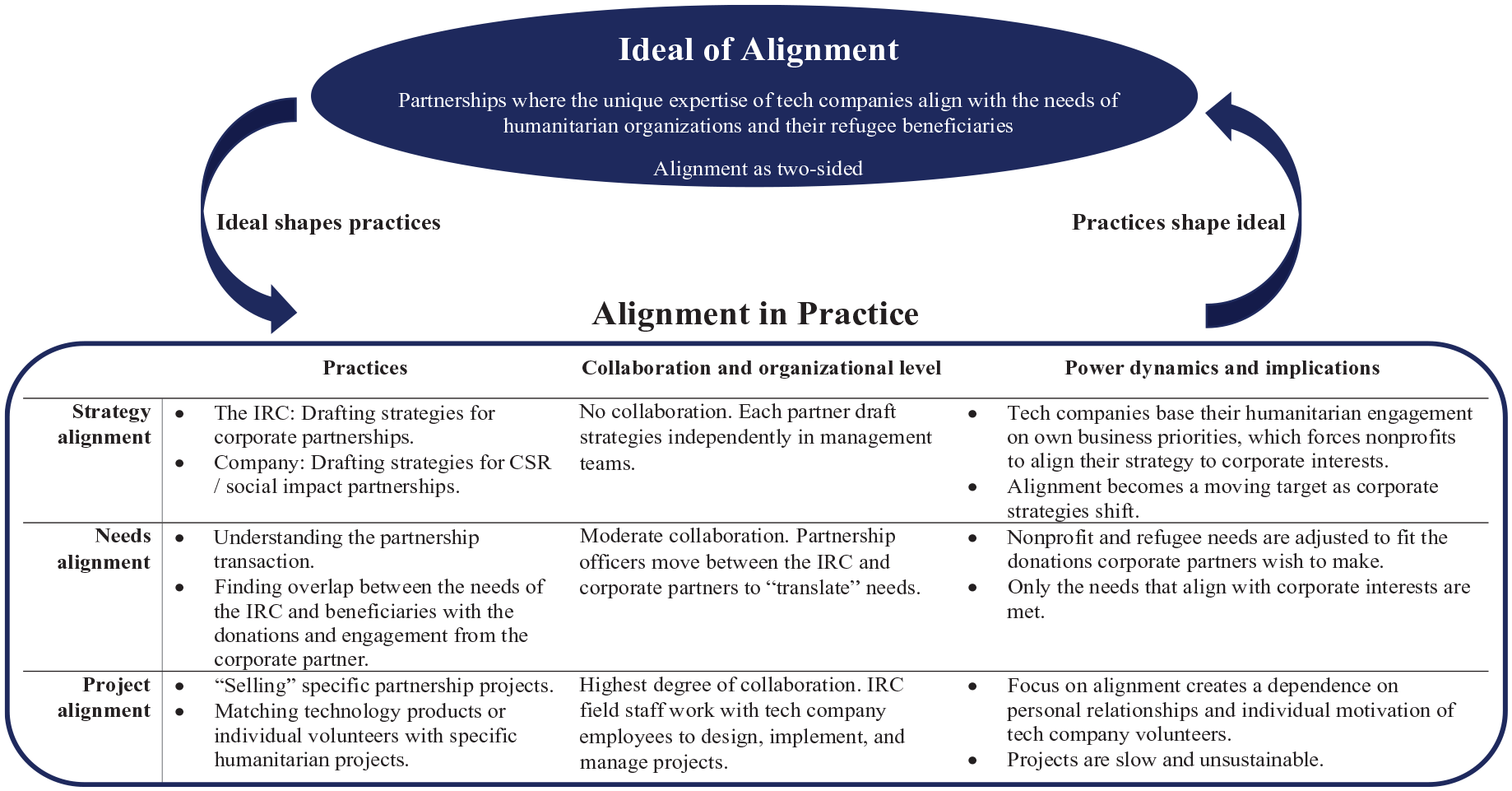
Alignment as Ideal and Practice.
The Sweet Spot Discourse: Alignment as Ideal
The ideal of finding a sweet spot in refugee-focused CSPs is situated in a historical context of increased private sector engagement in humanitarian action. In this context, nonprofits compete for funding from donors, who often favor nonprofits that engage in private-sector partnerships (Sandvik, 2017, p. 6). At the same time, some technology companies seek to legitimize their technologies and public image by associating with charitable and humanitarian work. Thus, the current humanitarian landscape facilitates an interdependence between businesses and nonprofits.
Informants from both the IRC and the technology companies recurrently brought up an ideal of alignment that mirrored instrumental CSR logics (Garriga & Melé, 2013) of win-win solutions and business cases for doing good. For example, one corporate manager described how partnerships need to simultaneously make “business sense” and be good for the world. During an interview about his company’s partnerships with humanitarian organizations, he enthusiastically described the perfect partnership as “that big chocolate cake that does not make you gain weight.” This notion was echoed by corporate managers from other companies but also from employees at the IRC, expressing that a partnership hits a sweet spot when it extends the for-profit mission of the company as well as the social mission of the nonprofit. As such, the ideal of alignment was similar across the IRC and its corporate partners.
However, there were diverging views on the role of financial donations in these ideals of alignment. Finding the sweet spot was often described by informants from both the IRC and the tech companies as a move away from traditional CSR solutions. A corporate manager explained that while companies are often asked for money, “true value is actually when you can engage a company’s capabilities or can really embed that social impact within the value chain of a business.” Financial donations were described as merely the tip of the iceberg of CSPs, whereas their true potential was to be unleashed by aligning the core business and the humanitarian mission. Some in the IRC organization (mainly mid-level employees working as “partnerships officers”) subscribed to this logic and argued that it was important for the IRC to “capitalize” on the willingness of tech companies to contribute in other ways than cash donations. Top-level management at the IRC, however, was still assessing partnerships in terms of fundraising and therefore highlighted the importance of including financial donations from corporate partners. Despite these differences, both the IRC and their corporate partners pursued partnerships with the aspiration of aligning their interests. In this endeavor, alignment as an ideal for CSPs was articulated as an extended form of corporate responsibility that required companies to do more, be more helpful, and have more impact.
According to IRC employees, the organization often needed to spend vast amounts of time implementing donated technologies into humanitarian programs that were too complicated or did not solve an actual need. Aware of this issue, a corporate manager explained that the goal of his team, which he referred to as the “social impact team” within his company, was to be as “helpful as possible.” His team pursued this goal by looking for partnerships where their technology could be donated to allow nonprofits “to do what they do more efficiently and help more people than they may be helping today.” This approach to finding alignment between the technological product and the humanitarian mission was presented as a way to help companies capitalize on their social impact initiatives. One corporate manager explained that prioritizing the partnerships, where his company’s technology would be “uniquely helpful” and have the most impact, benefited the company by generating more positive media attention and better branding opportunities. Informants thus used the language of sweet spot partnerships to describe both a movement away from traditional philanthropy and an extension of the humanitarian responsibility of companies, in which their contributions were perceived as more helpful and impactful while also generating more value for the company.
These articulations of the sweet spot are fueled by what scholars have referred to as a “partnership ideology” (Utting & Zammit, 2009) that promotes private sector collaborations as panaceas for development and social change (Olwig, 2021). In this partnership ideology, the emphasis on engaging a company’s core business skills rather than merely their financial support is discursively linked to an urgent need for private sector skills, particularly from the tech industry, to innovate and fix the international refugee regime. Businesses have been recognized as important partners in humanitarian aid for refugees (Müller & Sou, 2020), based on a perceived failure of the state-led refugee regime. Similarly, since the 1990s, partnerships between business and development sectors have been propagated as pragmatic solutions to governance issues and “state failures” (Utting & Zammit, 2009, pp. 41–42).
The mass displacement of more than 80 million people is frequently referred to by humanitarian agencies and NGOs as the global refugee crisis. This crisis covers a range of geographically dispersed emergencies, including civil wars in Syria and South Sudan, economic collapse in Venezuela, and the violent persecution of Rohingya in Myanmar, all of which resulted in mass displacements (UNHCR, 2020, p. 6). The term global refugee crisis refers also to a current crisis of institutionalized refugee governance, in which rising displacement globally is met with a concurrent decline in states’ willingness to provide asylum and humanitarian assistance to refugees (Gammeltoft-Hansen & Tan, 2017, p. 29). This governance crisis is not new, however, and Western policymakers and scholars have long called for a paradigm shift in the international refugee regime to manage migration flows more efficiently and “innovate” the global refugee regime (Betts & Collier, 2017; Betts et al., 2012).
The current predominantly state-led refugee regime is criticized for being inefficient, unsustainable, and creating a dependence on aid. To mitigate these limitations, scholars argue that global businesses can offer “creative and sustainable alternatives to state-led humanitarian dependency” (Betts et al., 2012, p. 3). Similar calls have been launched from humanitarian organizations (International Committee of the Red Cross, 2018; UN Global Compact, 2015), political institutions (e.g., The White House, 2016), and private sector consortia such as the Tent Partnership for Refugees and the Refugee Investment Network (Dyssegaard Kallick & Roldan, 2018; International Chamber of Commerce [ICC], 2019). Taken together, these actors advance a strong mandate for businesses to assume responsibility in the global refugee crisis.
The need for innovative technology is based on claims about the more advanced technology needs of refugees relative to other humanitarian beneficiary groups and the increasingly vital role of digital technology and internet access for refugees on their journeys (Fisher, 2018; Gillespie et al., 2018). Digital technology, in this sense, is presented as a tool of empowerment, enabling refugees to “better help themselves” (Culbertson et al., 2019, p. 7). At the same time, reports highlight a growing need for digital technology for governments to manage migration and refugee flows (PwC Global Crisis Centre, 2017). Governments and humanitarian agencies increasingly sub-contract the development of these digital technologies to technology companies (Lemberg-Pedersen & Haioty, 2020). As such, technology companies are positioned as key actors in the refugee crisis, serving the innovation and technology needs of NGOs, border agencies, and refugees themselves.
This particular configuration of “the partnership ideology” shaped the ways in which informants imagined and defined the sweet spot in refugee-focused CSPs. That is, partnerships where the humanitarian needs of refugees align perfectly with what technology companies do best. For example, Microsoft describes their commitment to “helping nonprofits access deeper levels of innovation to address social challenges—using our technology and expertise to help humanitarian organizations scale the impact of the workers on front lines, manage and allocate aid, and help populations who need it most.” The company does so through a shift from “a traditional approach of corporate social responsibility, to an approach of ‘total social impact,’” in which they “use the power of technology to route information, skills, and knowledge in better ways to displaced people” (all quotes from Spelhaug, 2019).
These quotes demonstrate the underlying relationships and context for CSPs between technology companies and humanitarian agencies, in which CSR discourses on shared value have traveled to the domain of refugee aid. In this context, private sector innovation and expertise is perceived as critical to tackling the refugee crisis. The sweet spot in refugee-focused CSPs, then, is articulated as partnerships that mobilize the unique expertise of tech companies and align them with the needs of humanitarian organizations and their refugee beneficiaries. However, as the next three sections show, this ideal is contrasted by the practices of alignment in which refugee needs are rather aligned to corporate priorities.
Practices of Strategy Alignment
In the practices of strategy alignment, top-level staff such as directors and senior management, draft broad strategies for corporate partnerships (on the nonprofit side) and social impact (on the business side). These strategies are produced independently within the companies and the nonprofit and do not pertain to only one specific partnership. As such, both the IRC and their corporate partners develop internal partnership strategies, in which they define their current and future partnership needs and goals. These strategies are expressions of each organization’s interests. But in the alignment of these strategies, shifting corporate priorities become the benchmarks to which IRC’s strategies must be aligned. Moreover, to attract funding from tech partners, the IRC is increasingly required to incorporate their technology solutions, which in turn shapes IRC partnership strategies.
In line with other large aid organizations that prioritize private sector partnerships (Thomas & Fritz, 2006, p. 118), the IRC has formalized its work with corporate partners, for example, by assigning specialized staff to corporate partnership teams. In the words of one senior advisor at IRC, the teams have gradually shifted from what she called an “opportunistic approach” (i.e., exploiting opportunities as they arise) to an approach that involves setting priorities in advance for corporate engagement. New staff members were hired to streamline partnership processes in the hopes of abandoning the more ad hoc practices of the past. The IRC partnership teams now conduct regular assessments of their operational needs to pursue new partnerships.
An IRC employee from one of these teams explained that because the organization has a limited capacity for managing partnerships, they compile a “top ten” list of potential partners by carefully assessing IRC’s technology needs: We know that most tech partners, if you want financial resources from them, you also have to want other things from them, like their technology, and so we are trying to be really conscientious about what kind of technology needs the organization has.
As demonstrated in this quote, the IRC reviews its technological needs partly because to attract funding from corporate technology partners, the IRC must also “want” their technology (see also Culbertson et al., 2019, p. 14). Therefore, the IRC must find a technological need that aligns with the products offered by technology companies. The social impact teams of technology companies, on the other hand, look for suitable humanitarian issues to fit their company’s products and mission. Selected issues become part of a corporate social impact strategy that outlines how a company plans to generate social impact through its business activities. Several corporate managers explained that the work of selecting these issues consisted of finding humanitarian problems where the benefits of the company’s existing technological solutions could be amplified for more impact.
However, while both the IRC and their corporate partners produce partnership strategies, the work of aligning these strategies fell disproportionately on the IRC. In fact, an important task for the IRC partnership teams was to remain part of the corporate social impact strategies to ensure long-term commitment. A senior IRC employee explained that the partnership teams evaluated and revised their strategies for each partnership every year. When I asked whether this work followed annual meetings with each partner, she responded with a sigh: “It does not usually work as lockstep as that. Our strategy planning is never the same time as theirs, so more likely we will set a strategy and then probably adjust our strategy if they have a new strategy.”
This indication was confirmed in a following interview with two corporate managers. One of them explained: “I think you go where technology companies are going. Technology companies do not randomly do something in humanitarian (aid), they do things that align with what they are doing as a company.” The other manager concurred that partnerships would follow “the strategic focus” of the companies and added: “We shift pretty rapidly (. . .) technology companies are very similar in that they tend to pivot over time as their strategies shift over time.” Shifts in corporate priorities were described by informants as, for example, shifts to a main focus on cloud technology or artificial intelligence, which in turn defined their engagement in humanitarian action.
These quotes portray alignment not as a merge of two sets of strategic interests, but as a one-way movement steered by the corporate priorities of technology companies. As these priorities shift, the focus to which nonprofits must align, shift too. As a result, the senior employee at IRC emphasized the need to build corporate partnerships that align on multiple levels: “That is the whole point of developing a strong multi-faceted relationship—so they cannot leave you so easily” she laughed. “If you were not, it is a lot easier to just go with the whims and the waves and what the popular topic du jour is.” Addressing the specific challenges of partnering with technology companies, she continued: “Because they (technology companies) are growing and changing so much, their strategies are changing pretty quickly, so the point for us is to make sure that we are always part of those strategies.” CSP literature suggests that partners must continually seek out new activities that generate shared value to sustain the success of CSPs (Austin, 2000, p. 81). However, as the above findings indicate, the work on sustaining those points of shared value falls predominantly on the nonprofit, as their needs for funding and resources do not change with the same speed as corporate priorities. More importantly, while corporate strategies change, the refugee needs they aim to address do not.
In the alignment of organizational strategies, the corporate “social impact” strategies become the benchmarks to which nonprofits must align their strategies. To remain part of these rapidly shifting strategies, the partnership teams at the IRC relied on what they defined as “creative thinking,” which is the focus of the following section.
Practices of Needs Alignment
The alignment of needs is carried out by IRC partnership officers, who are employed at the nonprofit headquarter, but are positioned below directors and senior management. Needs, in this case, are different from strategies because they are more specific (i.e., a strategy can focus on engaging with a particular section of the tech sector, while new computers and phones are a specific need linked to that strategy), but they are still more general than actual humanitarian projects or programs that detail and plan how to deploy the donations needed. Needs can refer to the nonprofit’s needs or the needs of refugees, and these will not necessarily be the same. Just like businesses, humanitarian organizations have funding or brand visibility needs that are separate from the needs of refugees such as shelter, medical help, and legal recognition.
In contrast to the ideals of integrative and transformational CSPs (Austin, 2000; Pedersen & Pedersen, 2013), the IRC partnerships with tech companies had clear transactional underpinnings. Thus, the aspirational idea of shared value (implying a common objective) was contrasted by the practices of alignment within the partnerships, which sought rather to accommodate the separate values of nonprofits and companies through transactions. In these transactions, the needs of both the IRC and their refugee beneficiaries were aligned through “creative thinking” to fit the donations tech partners wished to contribute. One IRC employee, who was managing a partnership with a tech company that aimed at developing software solutions for the IRC, described: They (tech companies) are not just nice. I mean they are nice, but they are not just nice. The quid pro quo is we get them to build us a tool, they get our understanding of how data is logically arranged in our world such that they can use that intellectual property to build other tools that they might one day sell.
The employee therefore recommended to not view corporate partners as ATM machines: “It is essential to understand that there is a transaction happening here (. . .) understanding what they are trying to achieve is central to how to leverage resources from them.”
At the IRC, corporate partnership officers performed this work of understanding the details of the transactions. One partnership officer described the job as figuring out what the companies want from a partnership, go to the IRC field staff to discuss how this aligns with their needs on the ground, and then draft a strategy for how to partner in a way that works for both.
Drafting a strategy, another partnership officer explained, involved a large amount of “creative thinking” in figuring out how to align the needs of each partner: “We are the bridges between the IRC and the companies, but also the interpreters,” he said, pointing to their role as translators of corporate and NGO worlds.
2
The vignette below, from a meeting between a partnership officer, Jessica, and IRC field staff in Oakland, illustrates these practices:
January 28th, 2020, Oakland, California
Jessica arrived as the last person for the meeting. She was carrying her white suitcase and explained that she was flying back to New York right after this meeting. She worked at the headquarters in Manhattan. She said hello to me and to the Regional Director of IRC Northern California, Alice, as well as two other IRC employees who had joined us on a Teams call—Marie from the Sacramento office and Dana from the office in San Jose. We were sitting in a small meeting room in the IRC Oakland office, which is a local resettlement office for refugees in Northern California. The office ran language classes and offered help with green card applications. After a short round of introductions, the four started discussing volunteer opportunities for technology employees because Jessica had received many requests from technology companies in this regard. Alice thought it was a great idea to have technology employees volunteer, but she said the enthusiasm from technology companies to volunteer was almost too much for IRC’s capacity. It was difficult and time-consuming to find volunteer tasks and organize the volunteer work. They agreed however that it was strategically an efficient way to engage the companies and hopefully get them to donate money. Alice, Marie, and Dana started discussing different volunteer opportunities already in place: citizen workshops, empowerment workshops, and mentor programs. Jessica asked if the mentor programs could run virtually, which would attract more technology people, but Marie replied that the program required at least one face-to-face meeting every other month. “Is it feasible to travel from San Francisco to Sacramento for volunteer work?” Jessica asked. Alice shook her head. “That is easily a three-hour drive each way,” she said, and Dana added that even going from San Francisco to San Jose was probably too much of a hassle. The four discussed which types of volunteer work might be interesting for the technology employees. “You won’t get 15 Googlers doing yard work,” said Jessica. They want to donate their expertise, not just their time, she added. Marie said that her office ran smartphone literacy workshops for refugee women in Sacramento and asked if Google would be interested in volunteering for that. Jessica was sure they would be but added: “Google is usually not willing to travel, but they love to host!” Jessica said it would be great to compose a menu of volunteer opportunities that the IRC could send to companies. They decided to produce a “corporate engagement deck” (a brief presentation with simple slides comparable to a deck of cards) for each local IRC office in California. After this discussion, the three local office managers started listing their in-kind donation needs to Jessica. Alice mentioned phones and computers. She and Jessica exchanged telling smiles and Alice added that she knew how hard it is to get technology companies to donate products. Marie said that they also needed computers, bus and train tickets, bikes, and helmets. “And I just want to throw this out there: Gift cards. Giving the gift of choice” she said. I could tell by Alice and Jessica’s faces that gift cards were almost impossible to get. Marie explained that it would really ease her workload because her “clients” would be able to just buy what they need. Jessica concluded that it might be helpful if Alice, Marie, and Dana each compiled a list of in-kind needs to send her. Then she could have a look and see which needs “speak to tech people” and which ones are “appropriate to ask for.”
3
This meeting demonstrated several important aspects of the “creative” construction of alignment. First, the unequal amount of work in finding alignment was clear. As I had spent time with and conducted individual interviews with several of the present employees, I was aware of their differing views on corporate tech partnerships going into the meeting. While Jessica, the partnership officer, was positive toward partnering in ways that suited the corporate partners, the local staff was generally less enthusiastic and more skeptical about the usefulness of such partnerships. Consequently, local employees focused more on the transactional component of partnerships and saw them largely as a way to establish a funding relationship (consistent with the findings of Binder & Witte, 2007).
The regional office of IRC Northern California operates on a 12 million budget annually, of which 20% comes from private donations including from corporations, individuals, and foundations. According to employees, the balance between public and private funding at the IRC was changing due to a decline in public funding. Prioritizing partnerships with the tech sector was part of an overall strategy to bring in more private funds to compensate for this decline in public funding. However, while this strategy followed the ideal of aligning corporate and humanitarian interests, IRC employees experienced that they had to do most of the aligning. One IRC employee explained: Their [tech companies] perspective is tying product and money. Obviously, money is essentially what helps our programs run. But most of the corporate partnerships has some combination (. . .) We have companies that will give us donations of their product whether through credits or actual stuff. And then most want to be involved in some way in engaging their employees. A lot of my work revolves around employee engagement and ensuring that companies that we partner with feel part of the IRC, the work that we do, and sort of understand and feel the benefit of how we are helping people. We have employment workshops where we will do job readiness classes for refugees and newcomers. And a group of [tech] employees might come and do mock interviews. We provide all the curricula; we facilitate the day. They [tech employees] really just come, and we train them and then we spend about two-three hours in a workshop with them and IRC clients.
Second, the meeting clearly illustrated the power dynamics that shape alignment practices, as the corporate partners ultimately determined the terms of any encounter, including the content, scope, and location of their engagement. The IRC employee quoted above also commented on this power dynamic, as she explained: It is a difficult balance, you know, building a partnership and having the autonomy to run the programs. And to use the expertise that we have and not sacrifice that at the expense of funding. The more corporations want to get involved, the more they control within our systems.
Moreover, she described, with the movement to donate products and time rather than money, corporations also increasingly sought to influence humanitarian programs by bringing in experts and “donating expertise.” This power dynamic is linked to the discourse of sweet spots and its emphasis on utilizing the core capacities of a business. Even though phones and computers were the most pressing need, technology partners preferred to contribute with expertise. This desire to be “uniquely helpful” shaped what they wanted to donate their time to—digital literacy workshops, not yard work. Consequently, the alignment of needs and contributions became a task for the IRC employees of highlighting some needs over others in ways that align with corporate priorities. The final section of the analysis below illustrates how IRC employees bring this transactional understanding to their corporate partners to create alignment for specific projects.
Practices of Project Alignment
The alignment of projects cuts across organizational levels and involves top-level staff, partnership officers, and field staff in local country offices, who implement the projects designed in CSPs. The level of collaboration between nonprofit and corporate partners is highest in the alignment of projects, as employees from both sides collaborate on the day-to-day design and operation of projects. The alignment of projects happens throughout a partnership as one partnership can include multiple projects. The previous sections have illustrated how the strategies and needs of the IRC and their beneficiaries are aligned with the priorities of corporate tech partners. But this one-sided alignment also happened in relation to specific humanitarian projects, which to receive support from partners, needed to fit the commercial interests of tech partners and the individual motivations of corporate volunteers.
In a follow-up Zoom interview with an IRC partnership officer, who had just secured a large grant from a technology company to support a project for refugees in Italy, I asked him how he had approached this task. It is about “representing the needs on the ground” in a compelling way, he replied. “So how do you do that?” I probed. He chuckled and said: Lots of experience. This becomes the ‘salesy’ part of the job (. . .) They [technology companies] advertise that they are nimble, they advertise that their technology is customizable, and allows people to build solutions that are tailored to their specific needs. So, you have to speak that language.
To speak the language, the partnership officers regularly attended events and summits to stay updated on developments in the “tech for social impact” space and held biweekly meetings with their teams to discuss potential new partners. Furthermore, the teams consulted with market analysts about which social impact causes the tech sector was currently prioritizing. This knowledge was presented internally in the IRC in quarterly reports on market trends and “giving trends” of the tech sector. 4 This knowledge, one IRC employee explained, enabled them to better communicate “alignment of programmatic areas” with their technology partners. As such, finding alignment involved framing the needs of refugees in a way that matched what the companies were trying to sell.
However, these alignment practices were not only performed by IRC employees. Although the IRC is increasingly required to integrate technology solutions as part of a partnership transaction, a financial donation from the company is usually still required. The partnership teams I followed during my fieldwork were all situated within the fundraising department of the IRC. According to informants, this fundraising department worked primarily to secure financial funds rather than products and expertise. As such, the success of partnership teams was still measured on their ability to raise money through corporate partnerships. And while technology companies are eager to donate their expertise and sometimes software solutions, nonprofit organizations need money to operate (Schleifer, 2020).
Thus, some of the smaller companies in my sample (relative to the dominant tech companies like Google and Microsoft) needed to more creatively “sell” their contribution to the IRC to secure a partnership. One corporate manager explained that his job included “sales-y discovery calls with newer humanitarian organizations” to understand if his company could help them. Over the course of several months, the company had been pursuing a partnership with the IRC, which had been difficult to formalize because the social impact team could not offer sufficient financial donations. During a lunch meeting between two of the company’s social impact managers and an IRC employee in San Francisco in January 2020, 5 the corporate managers probed about IRC’s specific humanitarian projects to find potential overlaps with their company’s expertise. Thus, a partnership sweet spot, rather than already existing and ready “to find,” is constructed through negotiations on both sides of a CSP.
In this negotiation, both IRC employees and corporate managers emphasized the importance of personal relationships. Long-term trust building between partner organizations is known as a crucial factor for the success of CSPs (Berger et al., 2004, p. 69), and according to my informants, this trust was usually created and sustained between individual employees on both sides of the partnership. However, this reliance on personal connections between the partnership teams, which were situated in the headquarters of the organization, created challenges for the IRC employees working at the field level to implement the partnership projects. One IRC employee who worked on a project involving multiple corporate partners described how the nature of the partnership relationships, characterized by personal connections and ideals of alignment, halted the execution of the project: Even though we technically have access to what you would consider the best designers and developers in the world, it is actually kind of hard to engage in that way (. . .) It is easier when you are paying them, and there is a contract versus the strategic alignment that is required with a technology company.
The challenge was twofold. First, the employee explained, it required a lot of work to provide corporate partners, who might be motivated by an exciting new project or a desire to do good, with the necessary knowledge to work in a specific humanitarian context. Second, the execution of projects depended on the personal motivations and interests of corporate volunteers: It is actually hard to find a designer to work on this particular project, and then also make a case for why this is a project they should work on (. . .) I think it is the nature of that relationship that makes it very hard to execute. I mean, it is kind of the opposite of agile and quick turnaround, right?
Thus, in contrast to portrayals of the tech sector as agile and fast-paced, the nature of the partnerships with technology companies made their work less efficient in some cases.
The Contrasts of Alignment as Ideal and Practices
Taken together, the above findings demonstrate how alignment is expressed as an ideal and as concrete partnership practice. Figure 1 illustrates these practices, how they differ and interlink, what power dynamics they reveal, and the implications of these dynamics for the partnerships. Overall, the findings in this article demonstrate that interest alignment in CSPs between business and humanitarian actors is deeply influenced by power dynamics and does not reflect the ideal—both among CSR practitioners and in the CSR literature—of a balanced, two-sided “meeting in the middle.” Consequently, research on CSPs and business–humanitarian engagement must consider the politics of alignment to understand how CSPs operate and with whose interests at their core. Below I suggest three key power dynamics central to the alignment of humanitarian and business interests derived from my analysis.
Discussion: The Power Dynamics of Alignment
While the ideal of alignment is not realized in practice, this ideal was still articulated by both IRC and corporate employees (although challenged internally in the IRC by local employees). The ideal of sweet spots was thus an ideal not only from the business perspective, even as it draws on familiar CSR discourses. The difference between the ideal and practices of alignment, then, is not only the result of direct power dynamics between the businesses and the IRC. Rather, as this article has shown, the ideal is constructed at a broader scale and influences both business and nonprofit actors in the humanitarian sector. I argue that this institutional ideal of sweet spots and the “partnership ideology” in fact legitimizes the asymmetrical power dynamics in CSPs. This process of legitimization is expressed through three dynamics, as outlined below.
One-Way Translation of Business Strategy Into Social Value
The emphasis on creating CSPs that leverage a company’s core business is key to the sweet spot discourse. This notion translated in practice into a one-sided alignment where humanitarian strategies were aligned to shifting corporate strategies. Alignment thus becomes a moving target for nonprofit partners, who have to continuously align to and incorporate corporate partners’ new commercial and technological priorities into humanitarian strategies. In this way, the particular ideal of finding a sweet spot between technology companies’ core business and the needs of refugees legitimizes a one-way translation of business strategies into social value, through which the production of social value is defined and limited by business interests.
Adjustment of Needs to Match Solutions
The emphasis in the sweet spot discourse on the need for business expertise and innovation supported a focus in practice on product donations and volunteer hours rather than cash donations. This finding is consistent with larger philanthropic trends in the tech industry, as technology companies are eager to shift from product donations to “digital transformation” initiatives (Cheney, 2018). Such initiatives focus on training humanitarian organizations and their beneficiaries in using the companies’ technology tools (Henriksen & Richey, 2022), and in return, companies expand their user group and gain knowledge about their product needs. As a result, corporate partners offer technological solutions, and nonprofit partners are tasked with the “creative thinking” necessary to find the needs and problems that fit these solutions. The alignment between humanitarian needs and corporate solutions thus appears in practice as transactions, through which nonprofit and refugee needs are adjusted to fit the products and donations corporate partners prefer to contribute.
Project Selling for Employee Engagement
Finally, the emphasis on how corporate partners can be uniquely helpful became visible in practice as a need to align humanitarian projects to the commercial interests of corporate partners in ways that helped tech companies promote their products as unique and distinguish themselves from competing companies. Moreover, nonprofit employees are required to capture the interest of corporate volunteers. Thus, the alignment of projects to corporate partners’ social impact programs, including grants and volunteer hours, emerges as a negotiation and “selling” of humanitarian projects.
In sum, these three dynamics show how the sweet spot discourse, which emphasizes the need for technological innovation and business engagement in the humanitarian sector, supports an ideal of alignment between the interests of business and aid organizations. This ideal, in turn, legitimizes asymmetrical alignment in practice. Consequently, the emphasis on finding CSP sweet spots displaces and shifts the humanitarian motives of CSPs in favor of corporate interests. This analysis also shows how the ideal of alignment shapes partnership practices across organizational levels and how these practices are interlinked. For example, the practices of alignment at the needs and project level might not have a good chance to succeed unless the partners achieve two-sided alignment at the strategic level. 6 However, given the power imbalance, this alignment is not likely to happen.
The empirical settings of this study indicate important avenues for future research. First, the partnerships included in this study were accessed through the nonprofit, and the data, therefore, highlight the NGO perspective on behalf of the businesses’ perspectives. In addition, this article’s analysis was aimed at identifying patterns in the practices of alignment across the five partnerships, because I wanted to understand the ideal of sweet spot partnerships as a common sense emerging in the field of humanitarianism. To add nuance to these findings, future research could focus on differences in CSPs or include different types of organizations. Most importantly, however, the perspectives of refugees themselves are missing from this work. As my findings show, nonprofits and businesses increasingly speak the same language of sweet spots and alignment and operate increasingly from the same instrumental and market-based logics. But even if these actors manage to find sweet spots of aligned interests and mutual benefit, this does not necessarily translate to a sweet spot for refugees. Further research is needed to document how the pursuit of partnership sweet spots, and the power relations in which sweet spots are constructed, affect the lives and experiences of humanitarian beneficiaries (see also Pallister-Wilkins et al., 2023).
While the management literature recognizes to some extent that CSPs are shaped by power relations, negotiations, and conflicting values (Cloutier & Langley, 2017; Dewulf & Elbers, 2018; Eden & Huxham, 2001), the normative ideal of finding alignment is persistent. Underlying this ideal is the assumption that CSP stakeholders share common goals and have even levels of power. But asymmetric power levels are in fact often the reason why CSPs frequently fail to effectively address the challenges they aim to resolve (Gray et al., 2022). Moreover, as recent research has shown, CSPs emerge within historical and structural inequalities and power imbalances which they risk further exacerbating (Olwig, 2021). Following the lead of scholars who increasingly call for a re-politicization of the role of corporations in creating social change (Feix & Philippe, 2020; Girschik et al., 2020) as well as the taken-for-granted narratives and ideals of CSR (Brand et al., 2020; Laasonen et al., 2012), this article has provided empirical and theoretical ground for similarly re-politicizing the ideal of alignment in CSPs. In the cases analyzed in this article, the IRC must increasingly align its needs to corporate strategies, in effect orienting refugee aid toward profit motives. As the discourse of sweet spots conceals this essentially profit-driven nature of CSPs, it legitimizes the infusion of business interests into humanitarian aid. Thus, while CSPs are based on ideals of shared value, the practices outlined in this article show that the generation of value for refugees is increasingly dependent on the simultaneous creation of value for companies.
Conclusion: Repoliticizing Alignment in CSPs
CSPs between nonprofits and technology companies are increasingly popular in the humanitarian field and in response to refugee crises. Such partnerships are often celebrated as innovative and transformational collaborations that move beyond traditional CSR approaches and find sweet spots that yield benefits for businesses, nonprofits, and aid recipients. However, this article has demonstrated that while CSPs are presented as integrative, they still rely on transactional relations and negotiations, in which business interests are often favored. Thus, despite the win-win-win hype surrounding CSPs in the humanitarian sector, there is reason to question who actually wins. Focusing on interest alignment as a political process, this article provides empirically grounded insights into how alignment comes about and the power relations that shape this process.
Based on these findings, I argue that the power relations of CSPs are linked to and legitimized by the discourse of sweet spots and the ideal of alignment. This ideal is persistent among CSR practitioners, but also in CSP literature. While the ideal of alignment perpetuates notions of shared value, reciprocity, mutual benefits, and “meeting in the middle,” this ideal, in fact, legitimizes power imbalances and asymmetrical alignment, in which nonprofit partners are expected to do more of the aligning. As such, the findings of this article challenge the dominant understandings of interest alignment as (a) a neutral and balanced two-sided effort to accommodate interests evenly and (b) an ideal to strive for in CSPs. The empirical model developed in this article offers a foundation for asking new important questions about interest alignment in CSPs. What kind of partnership practices does the ideal of alignment encourage in CSPs? How does strategy-, needs- or project alignment look in other CSP cases? What power relations are revealed in these practices and how do they shape partnerships? By providing this empirically grounded framework for analyzing the politics of alignment, the article encourages further critical examination of interest alignment in CSPs.
Theoretically, the article contributes to scholarship on interest alignment in CSPs by drawing attention to the power relations that shape alignment and by providing a novel theoretical framework through which to understand them. By analyzing ethnographic material through the lens of critical humanitarian studies, this article suggests three key power dynamics that shape CSPs in the humanitarian field: the one-way translation of business strategy into social value, the adjustment of needs to match solutions, and the project selling for employee engagement. Future research on CSPs and business-humanitarian engagements needs to consider these and other power dynamics to understand how CSPs operate, whose interests they prioritize, and whom they create value for.
Practically, the findings indicate that concerns about the efficiency and sustainability of state- and NGO-led refugee aid can similarly be raised for refugee-focused CSPs. Increasingly, nonprofits must find ways to implement the technological products and expertise that technology companies want to contribute rather than being guided by the actual needs of refugees. This dependence on the social impact strategies of technology companies challenges the sustainability and efficiency of partnership projects, as these strategies shift rapidly, and alignment becomes a moving target. While integrative sweet spot partnerships are promoted as mechanisms to innovate, optimize, and fix the refugee system, this article shows that maintaining such partnerships requires significant resources from nonprofits. As such, integrative CSPs are likely to be more beneficial for businesses, allowing them to donate their expertise rather than money, while nonprofits in the humanitarian field will benefit more from long-term philanthropic partnerships. The pervasive discourse of sweet spot partnerships is thus skewed toward the interests of business. Ultimately, the findings of this article suggest that incorporating business value as a measure of success in humanitarian work risks shifting the terms of accountability such that refugee-focused CSPs will be measured primarily on their ability to create value for businesses rather than protection, freedom, and safety for refugees.
Footnotes
Acknowledgements
I gratefully acknowledge Lisa Ann Richey and Sine Plambech for their ongoing support of the research presented in this article. I am deeply thankful to Verena Girschik for her generous support and brilliant feedback at various stages of this work. Thank you also to the members of the Centre for Business and Development Studies at Copenhagen Business School for helpful input on an earlier version of this article. Finally, I would like to thank the two anonymous reviewers and the special issue editorial team for their detailed comments and support in improving this article.
Declaration of Conflicting Interests
The author declared no potential conflicts of interest with respect to the research, authorship, and/or publication of this article.
Funding
The author disclosed receipt of the following financial support for the research, authorship, and/or publication of this article: This work was supported by the Independent Research Fund Denmark under Grant 9055-00020B.
Notes
Author Biography
