




Abstract
Refugee crises are one of the grand challenges of the 21st century. Despite the theoretical importance attached to value created for beneficiaries in the partnership literature, research tends to focus on internal processes and value created for partners and partnerships, leading to widespread calls to further specify the value created by partnerships for beneficiaries. Applying an analytical framework from the value creation and social impact literatures, we report on a study of multiple social partnerships of a nongovernmental organization in the refugee issue field. Our results demonstrate that frames of refugees held by partners and in partnerships’ implementation contexts shape the value creation activities undertaken for beneficiaries, and determine whether value is created and what types of value. The dual contribution of this article comprises a rare empirical study of value creation activities for beneficiaries (here, refugees) and theorization of how and when implementation context affects value creation by partnerships.
Keywords
Europe is a garden. We have built a garden . . .
Most of the rest of the world is a jungle. And the jungle could invade the garden.
Multiple global refugee crises comprise one of the grand challenges of the 21st century (George et al., 2016). Alongside an increase in reasons to flee (e.g., the intensifying climate crisis or increased instability and persecution inside borders; Berchin et al., 2017), the length of time for which displaced persons remain outside their home countries has also increased beyond historical norms (Devictor & Do, 2017). Tragically, in their new homes, refugees face serious economic and social marginalization (Newman et al., 2018). Politicians at the highest level give speeches framing refugees as a “jungle” invading “our garden” (Borrell, 2022). This situation has significantly increased the perceived responsibility of businesses and their willingness to engage in partnerships with social partners to support refugees (Hesse et al., 2019). These partnerships promise to deliver value for refugees by synergistically combining diverse partners’ distinct resources and knowledge (Austin & Seitanidi, 2012a, 2012b; Le Ber & Branzei, 2010c).
Despite the conceptual and theoretical importance attached to value created for beneficiaries in the partnerships’ literature, research attention has tended to focus on internal processes and value created for partners and the partnership 1 (Kolk et al., 2008; Vestergaard et al., 2020). Thus, partnership researchers identify a general lack of value created at the macro-level (Le Pennec & Raufflet, 2018), for instance, for partnerships’ beneficiaries. Empirically, research on the refugee issue field is even more scarce. This limited understanding compounds important theoretical and societal problems. Theoretically, it is no longer rigorous to assume that value creation activities inevitably and immediately lead to value created for beneficiaries (Andonova et al., 2022; Austin & Seitanidi, 2012a; Stadtler, 2016; Trujillo, 2018; Vestergaard et al., 2020). Partnerships’ value creation activities (including setting goals, organizing tasks, distributing responsibilities) deserve—and receive—research attention; research is also required that specifies further the types of value created for beneficiaries and the boundary conditions under which value creation activities may actually create value. In the absence of this knowledge, at the societal level, partners may design less impactful and efficient value creation activities. Thus, this article contributes to extant research by further specifying the partnership literature with insights from the value creation and social impact literature, thus improving analytical purchase on the internal and external factors that may affect the path from value creation activities to value actually created.
To do so, we use frames theory. The value creation literature identifies both material and nonmaterial factors that intervene in the gap between value creation activities and value created (Vanclay et al., 2015). Nonmaterial factors include the ways in which beneficiaries are perceived, represented, and labeled, that is, the frames of refugees held by partners and in partnerships’ implementation contexts. Frame theory offers useful conceptual tools for the identification of which aspects of reality are highlighted at a particular time and how that frame motivates different types of action or inaction to create different types of value for beneficiaries. In this study, the beneficiaries of studied partnerships are refugees.
We focus on a case study of a nongovernmental organization (NGO) and its partnerships with businesses worldwide. Our case study organization aims to provide for the different needs (job services, integration support, accommodation support, health services, etc.) of refugees and is anonymized in this study as EVERYNEED. To achieve their objective, EVERYNEED works in partnership with different business partners from different sectors in the different implementation contexts worldwide, and therefore provides a suitable empirical context in which to examine the variety of types of value created for refugees, with reference to the ways in which different frames shape what value may be created, if any.
We found two dominant frames of refugees were adopted by EVERYNEED: refugees as humanitarian or development concerns. Frames of their business partners included a frame of refugees as recipients of charity (e.g., through corporate social responsibility [CSR]), and another in which refugees were framed as employee or customer. These four frames shaped the type of value creation activities undertaken collaboratively in EVERYNEED’s partnerships. Frames of refugees in implementation contexts (including those held by governments and publics) influenced the extent to which value creation activities may actually create value for refugees. Our analyses reveal that these partnerships had the potential to create three different types of value for refugees: Necessities, Capabilities and Social and/or Political Value. Our main findings are that social partnerships’ Capabilities Value creation activities are limited to the set of activities congruent with the frames of refugees in the context. Where the contexts’ frames do not allow Capabilities Value creation, partnerships can undertake influence activities, with the intention of changing those frames and/or the social and political reality in which refugees live. Value creation activities for Necessities Value may be undertaken regardless of the frames in the implementation context. Nevertheless, Necessities Value creation activities would also be limited.
Our study holds important theoretical and practical implications for social partnership research. First, we identified different types of value that might be created for refugees; thus, we contribute to the emerging body of literature on value creation for beneficiaries in social partnership studies (Le Ber & Branzei, 2010b; Trujillo, 2018; Vestergaard et al., 2020). Second, this research contributes to nascent research that underlines the importance of contextual factors in value created by partnerships, by identifying the effects of frames in the implementation context. Thus, our research extends existing refugee studies that describe refugees’ contexts (Aydemir, 2022; Cooper et al., 2017; Egres, 2018), by theorizing how frames in the implementation context influence what types of value can be created for refugees, and how that shapes refugees’ lives. Our research has also important practical implications as it helps partnership practitioners identify how they might more effectively address refugee crises and increase the value created by businesses through partnerships to improve refugees’ ability to enjoy their human rights.
Theoretical Background
The social value created by partnerships for refugees is underresearched, despite myriad, long-term ongoing global refugee crises. In the following section, our review of the existing partnerships research on value created reveals that while these studies offer deep insights into internal partnership value creation and functioning, partnerships’ external impacts for beneficiaries can usefully be further specified with reference to the social impact and value creation literatures. Material and nonmaterial factors may constrain or enable different types of value created, including the ways in which beneficiaries (refugees in this article) are perceived, represented, and labeled. We then show that frame theory offers useful conceptual tools to examine how different frames of refugees motivate different types of action or inaction to create different types of value for refugees, before specifying our research questions.
Social Partnerships and Value Created for Beneficiaries
Social partnerships bring partners from different sectors together to collaboratively address a social, economic, or environmental issue (Selsky & Parker, 2005; Stadtler & Karakulak, 2022; Waddock, 1991). Although there is a long history of cross-sector partnering, partnerships have become even more widespread with the emphasis and incentives of the Sustainable Development Goals (SDGs, particularly Goal 17) and Agenda 2030 (UN General Assembly [UNGA], 2015). Cross-sector partnerships have been given a variety of labels, including NGO–business partnerships (Seitanidi & Crane, 2009), business–humanitarian partnerships (Andonova & Carbonnier, 2014), multistakeholder partnerships (Karakulak & Stadtler, 2022), and public–private partnerships (Quélin et al., 2017). For brevity, in this article we refer to “partnerships.” Creating social value is widely acknowledged as the raison d’être of partnerships (Austin & Seitanidi, 2012b; Le Ber & Branzei, 2010a). Thus, Austin (2010) argues that value creation “motivates, sustains and produces impact from cross-sector partnering.” (p. 13). In the partnership context, value creation “entails a set of activities (including understanding their nature and purpose), the resources” to undertake these activities collaboratively, and the governance of these processes (Lashitew et al., 2020, p. 12).
These definitions indicate that the research attention of partnership studies has fallen on value creation activities (rather than value created) and the processual factors influencing partners and partnerships. For instance, the choice of partner organizations is an important variable in partnership success that is widely analyzed. Other success factors include the compatibility of partner resources (Weber et al., 2017) as well as alignment of partner interests (Murphy et al., 2015), capacities (Clarke & MacDonald, 2019), and world views (Cloutier & Langley, 2017). Given the differences between partners working together across different sectors, many studies focus on managing this partner diversity, for example, through different governance models (DiVito et al., 2021), appropriate business models (Villani et al., 2017), and relational coordination (Caldwell et al., 2017).
In addition to the internal value created for partner organizations (meso-level) and for the individuals working for the partnership (micro-level), Austin and Seitanidi’s (2012b) value chain of collaborative value creation introduces the notion of macro-level impacts external to the partnership for society and beneficiaries. In the evaluation tradition, Van Tulder and colleagues (2016) describe the chasm between social value creation activities (outputs) and the outcomes or impacts (value created) that may (or may not) result from these activities, and the complexity of how these different aspects may be interrelated through impact loops. In the same vein, Stadtler (2016) highlights the indirect (as well as direct) effects of partnerships on creating value, and how these may vary over time.
Despite the partnership literature conceptualizing value created for beneficiaries as the raison d’être of partnerships and theoretical efforts in this regard, these articles tend to focus more on success factors at the partnership and partner levels (Kolk et al., 2008; Vestergaard et al., 2020); the focus of our article is rather on beneficiaries. Thus, Le Pennec and Raufflet (2018) argue that existing partnership studies “tend to underspecify the definition and types of value” they seek to create externally (p. 818). Recent research identifies the extent to which partnerships may actually deliver less than they promise, or even disrupt certain types of value created as they emphasize others (Andonova & Faul, 2022). Thus, in addition to examining value created for partners and partnerships (internal), partnership researchers urge researchers to analyze the social value created by partnerships (externally), particularly value created for beneficiaries as examined in the study we report (Austin & Seitanidi, 2012b; Le Ber & Branzei, 2010b; Trujillo, 2018; Vestergaard et al., 2020, 2021). To gain better analytic purchase on the types of value created external to partnerships, we now further specify the partnerships literature with insights from the value creation and social impact literatures.
Value
Value creation, as a concept, has been central to theory development in diverse branches of management research, including strategy (Porter & Kramer, 2011), business ethics (Pies et al., 2010), and social impact (Harrison & Wicks, 2013), and is also a key concept used frequently by business leaders (Fink, 2019). While value created has been at the center of management research, historically the value that counted—and was counted—was financial value created by firms (Friedman, 1970); other aspects of firms’ impacts (such as social and environmental impacts) were widely theorized as “externalities” that did not need to be counted (Bithas, 2011; Harrison & Wicks, 2013). Whereas much business literature in the past focused on a single—financial—bottom line, there has been increasing demand from businesses, stakeholders, and societies more broadly to extend the conceptualization of business impacts to environmental, social, and governance factors (Alhaddi, 2015; Sharma, 2020; Zhou et al., 2020).
To address this more expansive conceptualization of value created by businesses, new concepts of value have been introduced. For instance, Porter and Kramer’s concept of value creation underlines that improving business competitiveness requires “identifying and expanding the connections between societal and economic progress” (Porter & Kramer, 2011, p. 66). This conceptualization thus highlights that business success depends on more than profit-making. Another expanded value creation concept, Bottom of the Pyramid approaches, highlights social value creation through satisfying the demands of low-income customers while simultaneously profiting from these transactions, creating economic value for the business (Hart & Prahalad, 2002). Thus, there are many synonyms used for social value creation, including social impact, social wealth, value created, social investing, corporate social responsibility, or corporate performance (Hietschold et al., 2022; Lindgreen et al., 2021; Siemieniako et al., 2021). To conceptualize these more-than-financial gains, we adopt the definition of social value as “the creation of positive changes in society by addressing pressing social problems” (Islam, 2020, p. 3) and “hence, social value is the value derived by an individual beneficiary” (Hietschold et al., 2022, p. 6). These positive impacts can be seen in people’s way of life, culture, community, health and well-being, fears and aspirations, environment, political system, or personal and property rights and how such changes are experienced (Vanclay et al., 2015). This is not to deny the amount and quality of benefits created for partners who engage in collaboration. To complement the substantial existing literature that studies impacts internal to partnerships, our focus in this article is on the value created for beneficiaries affected by such collaborations.
We distinguish value creation (activities) from value created (outcomes or impacts). Firms might work to create value; however, this does not necessarily mean the value is created or whether the value created is what it is intended initially by the value creation activities. Value is realized when the potential beneficiary benefits from it (Hietschold et al., 2022). Here, value creation is defined as the intention and activities to create value; in contrast, value created is whether these intentions and activities result in positive outcomes or impacts for beneficiaries.
To make sense of this wide diversity of social value that may be created, the most frequently used categorization (Becker, 2003) classifies social value created at three levels: macro-level impacts on larger social systems (e.g., economic, institutional, or legal development that creates social value); meso-level effects on collective actors (e.g., organizations and networks changing what they do to create social value); and micro-level impacts on individuals (e.g., addressing vulnerabilities of or development for certain populations). Tracking social impact is, for Becker (2003), a normative obligation: Actors should take responsibility for the consequences of their actions. Siemieniako and colleagues’ (2021) systematic review adopts the same framework to categorize existing studies on interorganizational collaboration. In this review, meso-level impacts (on collective actors) were most frequently reported, and micro-level (on individual beneficiaries) the least frequently reported.
The conceptual labels of micro-, meso- and macro-levels used in Becker’s (2003) social impact review are infinitely scalable and can be ascribed to levels of organization from atomic or cellular scales to social or interplanetary scales. Thus, in the partnership literature, Austin and Seitanidi (2012b) use the same labels (micro, meso, and macro), but with different definitions of each. Whereas Austin and Seitanidi’s (2012a, 2012b) framework for partnership impacts concurs with the labels in Becker’s (2003) categorization of impacts on society (macro), it privileges factors internal to the partnership in its definitions of meso- and micro-levels. Thus, extant partnership literature helpfully draws attention to factors internal to partnerships that affect their functioning and success (Austin & Seitanidi, 2012a, 2012b; J. Yin & Jamali, 2021), but arguably has underspecified value created external to partnerships. The social value literature complements the partnerships literature by further specifying the types of value that may be created external to the partnership, for society (macro-level), organizations (meso-level), and individual beneficiaries (micro-level).
In addition, in the same way that the partnership literature draws attention to internal factors, the broader value creation literature emphasizes contextual factors that enable or constrain if value creation turns into value created. External success factors may be material (finance, time, and office space) or nonmaterial (ideas, feelings, and discourses). The social value creation literature identifies examples of nonmaterial factors, including “fears and aspirations, . . . how such changes are experienced” (Vanclay et al., 2015, p. 2). The rigorous empirical identification of such intangible factors is important, but challenging; therefore, we turn to frame theory.
Partnership Value Creation and the Role of Frames
Frame theory is useful because it provides an analytical tool to observe both how a problem is constructed and what solutions are proposed, and then how these motivate action or processes (Snow & Benford, 1988). Here, we study frames of refugees, what value creation activities are undertaken, and then which factors may constrain these activities actually creating value.
Frame theory has mostly been used in communication studies but has recently provided an important theoretical lens in organization studies. In their review, Cornelissen and Werner (2014) identify the use of frame theory in various theoretical domains, including managerial cognition, decision-making, communication, organizational change, social movements, and institutional research. Irving Goffman (1974) defines frames as representations of how individuals or groups “locate, perceive, identify and label what happens in the world around them” (p. 21). Snow and Benford (1988) argue that frames matter because they are used to identify a problem (diagnostic), to suggest solutions (prognostic), and to motivate action (motivational). Thus, frames highlight “certain aspects of perceived reality” (Entman, 1993, p. 52) but not others; which aspects are highlighted shape the solutions that may be designed and the actions that may be taken with the intention of creating social value for beneficiaries. This is not to imply that only frames should be considered; the material reality that is framed also matters. Thus, Purdy and colleagues (2019) define global warming as “both an objective phenomenon and a set of meanings that we label a frame” (p. 411). Equally, refugee crises worldwide are a material reality, and different meanings ascribed to that reality are made and communicated through the different frames of refugees that are held inside and outside of partnerships that attempt to create social value for refugees.
First, frames are mutable; they are constructed and deployed flexibly over time. For example, in their longitudinal study, Ansari et al. (2013) identify the different frames of climate change held by the scientific community, politicians, and international organizations and describe how the frames in each of these communities co-evolved over a 40-year period. Frames may be shaped by macro-level factors such as culture (Zald, 1996), institutional logics (Thornton et al., 2012), or existing master frames in the field (Reinecke & Ansari, 2016) and might change depending on, for example, scientific facts (Ansari et al., 2013), tragic visuals (Klein & Amis, 2021), or emotions (Rauch & Ansari, 2022). In addition, frames may be changed thorough micro-level interactions with different actors (Rauch & Ansari, 2022; Reinecke & Ansari, 2021) such as between partners (Gray & Purdy, 2018). Studying frames and their mutability thus enables a more nuanced and agile examination of factors that influence social value creation in grand challenges such as refugee crises, the contours and framing of which may change rapidly in comparison with changes in institutional logics or cultures.
Second, frames motivate action. Frames “determine whether most people notice and how they understand and remember a problem, as well as how they evaluate and choose to act upon it” (Entman, 1993, p. 54). Therefore, frames have an important strategic function and can be used to legitimize one action over others. This ascribes an immense power to frames. For example, the global warming frame of the 1980s legitimized gradual and incremental change, whereas more recent frames of climate crisis or climate emergency demand more swift, decisive action. The plurality of frames of any issue can constitute opportunities for co-creation of social value (Klitsie et al., 2018); nevertheless, where frames cannot be reconciled, they may rather constitute barriers to full cooperation and value creation. Thus, in frame theory, social, environmental, or economic value may be created for beneficiaries where one or more partners adjusts their frames through “framing contests that shape the outcomes” (Kaplan, 2008, p. 744) to reach frame convergence (Noy, 2009) or frame fusion (Le Ber & Branzei, 2010c). In contrast, the frames held by certain important stakeholders may overpower those of others, shaping value creation activities in a direction that maintains the status quo. Equally, the public or media framings of important social issues (Klein & Amis, 2021), such as the refugee crises studied in this article, may block certain value creation activities while enabling others. Therefore, we analyze frames in this study because they allow us to identify which aspects of an issue are highlighted while intentionally or unintentionally overlooking others (Entman, 1993), and how this selectivity shapes action toward those aspects that are highlighted at the expense of those that are not.
Much existing literature analyzing refugee framings has focused on political and media representations of refugees (Aydemir, 2022; Egres, 2018; Klein & Amis, 2021; Ramaprasad et al., 2015) rather than that of NGOs or businesses. However, these studies were rather descriptive, analyzing different frames of refugees without examining the impacts of those frames on value creation activities or value created for refugees, as is the focus of this article. Frames are not often used in partnership studies. However, a few empirical studies adopt a framing lens to study the internal functioning of partnerships, for instance, studying how frames affect relationships between partners (Klitsie et al., 2018) and their innovation process (Le Ber & Branzei, 2010c). Our contribution, therefore, is to analyze the impact of frames on social value created for beneficiaries; specifically, we investigate the ways in which the frames of beneficiaries held by partners and in partnerships’ implementation contexts affect which value creation activities may be undertaken, if any, and therefore constrain the types of social value that might be created.
Thus, we argue that frames of refugees—that is, how refugees are perceived and labeled—influence what types of value may be created for these beneficiaries of social partnerships. We employ Snow and Bedford’s (1988) theorization of frames as shaping problem and solution definition as well as enabling or constraining actions regarding the issue framed. The frames that partners bring to a social partnership shape how they understand the social problem they seek to address, and also what social value creation activities they may design and implement, which ultimately determine what type of social value may be created (although it may not be). In addition, we highlight that frames of refugees in implementation contexts (held by governments and public, for example) shape which social value creation activities may be undertaken. Therefore, we employ frame theory in this study to provide a snapshot of the frames of refugees in the partnerships studied between 2018 and 2019 and also to examine the actions that these frames motivate, and what social value may be created by the partnerships studied for these beneficiaries. The study we report here analyzes the types of value created external to the partnerships studied at individual, collective, and societal levels, and also the ways in which frames of refugees in the context (macro)—as well as internal partners’ frames of refugees—constrain value creation and value created for beneficiaries.
Research Questions
In sum, the partnerships literature ascribes great importance to the value created for beneficiaries, and the social impact literature offers a useful framework for analyzing different levels of value created (for individual refugees, on organizations and networks, and on society more broadly). This article contributes an empirical study on value created for refugees by business–NGO partnerships, using an inductive approach to examine the consequences of different frames of refugees on the types of value that might—or might not—be created for refugees by these partnerships. Thus, two research questions motivate this inquiry:
Method
In this section, we first describe our research context and the way it helps us to answer the research questions before explaining how we collected and analyzed our data.
Research Context
To address this research gap regarding how frames of refugees enable or constrain partnership value creation activities and value created, we conducted an inductive case study of partnerships of a global refugee organization (that we anonymize as EVERYNEED) with different business partners. The case study design allowed us to focus on different partnerships of EVERYNEED and stakeholders in the partnership implementation context in depth, and ultimately answer how and why questions (R. K. Yin, 2009). 2
EVERYNEED is an important actor in the issue field of refugees. Issue fields are defined as the larger community of actors that frequently interact within the context of a societal challenge (Hoffman, 1999; Scott, 1995). Financially, EVERYNEED depended on donations from businesses, governments, and individuals. Operationally, staff in the local offices of EVERYNEED oversaw actions, attempting to address the needs of the refugees in the country. Organizationally, EVERYNEED hired from different sectors to work in different departments dealing with different refugee needs. In the global turn toward partnerships precipitated by the SDGs and Agenda 2030 (UNGA, 2015), EVERYNEED has made partnering with businesses a priority to address refugee needs.
This empirical context is appropriate for answering our research questions. First, to achieve its objective to provide for all refugee needs, EVERYNEED partners with a myriad of business actors globally and locally. This provides an opportunity to observe a variety of partners, partnerships, and their value creation activities. Second, as EVERYNEED is active in numerous countries, it also provides an opportunity to observe the link between different frames of refugees in different contexts and value creation activities and value created for refugees.
Data Collection
We adopted an inductive case study design and used a variety of methods for data collection (see Table 1), including interviews, archival data, and observations.
Data Sources.
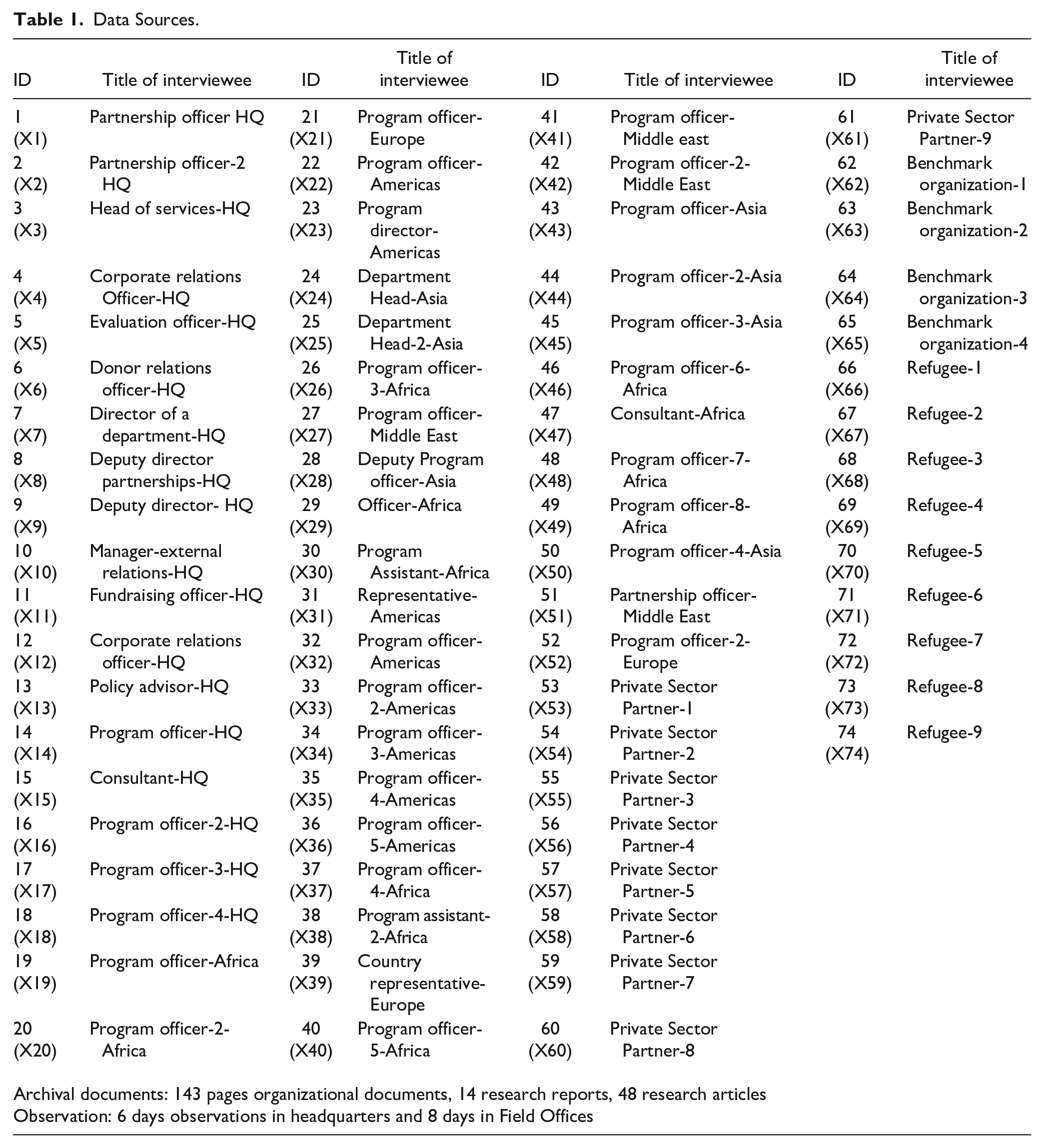
We gathered data via interviews with 52 EVERYNEED staff members at their global headquarters and local offices in 18 countries between September 2018 and August 2019. Interviews lasted from 45 min to 2 hr. All the interviews were conducted in English. The first and second authors conducted the initial first 10 interviews together, discussing key methodological and substantive points arising immediately after. Data collection was part of a bigger research project. Our research focus was EVERYNEED’s partnerships with business, rather than the public sector or other NGOs. The initial interview sample was identified by EVERYNEED with the goal of capturing the breadth of partnership work across the organization. This deliberative sample included participants from among the most informed agents who were most involved in partnership work globally or locally, from different operational departments and fundraising. We supplemented that initial sample by purposive sampling from this informed group, asking our interviewees to recommend additional participants as headquarters might not be fully informed regarding local partnership work. We also sent e-mails to local offices to suggest us names of the employees who worked for partnerships. This also helped us to address bias in case EVERYNEED’s research department provided a biased—safe—sample. On our field visits to two different countries, we also had informal communications with other staff members of EVERYNEED and took extensive notes to record these conversations after each encounter.
In addition to our interviews with EVERYNEED staff, we also conducted interviews with nine of EVERYNEED’s business partners. To select partner organizations, we used a variety of sources. First, we conducted desk research and identified the main global partners of EVERYNEED (i.e., multinational companies working with EVERYNEED in different countries). Second, we solicited the names of the local businesses that were working with local offices. We reached out to 15 different business partners and received positive responses from nine of 15. We also had some informal communication with EVERYNEED partner organizations while in EVERYNEED field offices, capturing these data through extensive fieldnotes at the end of the day.
Overall, through our interviews with EVERYNEED and business partners, we have reached out for information from approximately 41 local partnerships and four global partnerships (see Online Appendix). Local partnerships we studied were established by either local small medium enterprises (SMEs) or global multinational companies (MNCs) operating in the country. Global partnerships were established by global MNCs and were operating in more than one country.
We started our interviews by asking interviewees to give us examples of partnerships they formed and asked questions to better understand the partnerships such as the following: “Who are the partners?” “What are they doing?” “What kind of legal arrangements do the partners have?” “How long has the partnership been active?” “How many refugees have they reached?” and “Who started the partnership?” After gaining more information about a partnership, we asked our informants to answer questions regarding each partnership. In the second part, we started asking specific questions about these previously addressed partnership and gained specific insights into how frames influenced partnerships and their value creation, for instance, we asked, “What are the external challenges (i.e., policy environment, perception of the public) that affect your partnerships?” “How do you think your business partner sees refugees?” “How does public perceive refugees and how does that influence your partnership work?” and “How does the policy environment affect your partnership?” We also engaged in communications with EVERYNEED members and other stakeholders during our field visits. This was an opportunity for an informant check as well as to gather more input from them. These interactions also gave us a better insight into EVERYNEED’s organizational culture and their functioning regarding partnerships. In addition to our informal observations at headquarters, we also had the opportunity to spend 5 days at one field office and 3 days at another. During these occasions, we took field notes. These short field visits equipped us with information regarding how the country offices functioned in relation to the headquarters, and how they coordinated partnerships and built relationship with partner organizations.
In addition to the 74 interviews that were our main source of data, we also benefited from organizational documents. The 143 pages of organizational documents we analyzed include the EVERYNEED website, their annual reports, and publicly available partnership reports. These documents improved our understanding of how EVERYNEED’s frame has shifted. We also studied 14 research reports on the issue of refugees, which provided us with a better understanding of the refugee issue field. In addition, we also consulted academic articles at the intersection of refugee studies and frame studies. To do so, we searched for articles that were published between January 1, 2015, and December 31, 2019. We chose 2015 as our start date because of the increasing interest in refugee issues due to the Syrian refugee crisis. We chose to stop the search at the end of 2019 because we had interviews only during 2019. We used web of science and used three keywords for our search: [fram*] and [refugee] and [name of the country]. We scanned the abstracts of each article first to see whether they were relevant to our research (for instance, some articles were on medical issues, or about the education system in the host countries). This search overall gave us 48 articles. These academic articles helped us to better understand the country conditions and experiences of refugees in these countries. Overall, these documents allowed for triangulation, which also helped prevent impression management and informant bias (Eisenhardt & Graebner, 2007).
Data Analysis
We adopted an iterative approach to data analysis (Gioia et al., 2013) and followed a two-step approach to qualitative inductive data analysis to fully capture the richness of our data. We created a database of all the available documents (interview transcripts, archival documents, and field notes) and used NVivo for data analysis. First, we aimed to develop a better understanding of the overall refugee issue field. We created case story boards that included the most influential actors, their power positions, and country-specific contexts, and also tried to gain more understanding of the conditions of the refugees and their needs. At this stage, we also created detailed tables that summarized the different partnerships in different contexts, including who the partners were, the activities they were engaged in, and possible other factors that might influence value creation. We noticed that governments’ and publics’ frames fundamentally influenced value creation activities and value created for refugees. The first and the second authors worked together on this exercise.
We studied 41 local partnerships in 14 countries and four global partnerships based on analysis of our interviews and documents (see Online Appendix). Our initial assumption was that each partnership might show different characteristics because business partners were different and partnerships operated in different countries. Therefore, in our initial analysis, we wrote short vignettes of partnerships in the same country and the factors that were influential. However, this initial mapping exercise showed us a rather counterintuitive outcome: Country conditions and business partners’ frames of refugees showed a resemblance in our cases. Therefore, we decided to inquire about the common factors that influenced value creation, and not focus on each country one by one.
We assembled our data into codes with similar messages (Corley & Gioia, 2004). We used open coding (Locke, 2001) to fully capture the frames existing in the refugee issue field, and partners’ existing frames of refugees and value creation for refugees. This coding exercise was conducted by the first author. The first author discussed the outcomes of this exercise with the second author regularly. After each discussion meeting, the first author continued to code data by making necessary adjustments that came out of these discussions. Given both authors collected data and created case boards together, disagreements about the coding were minimal. This initial analysis yielded that partnerships’ value creation activities were numerous and, as with partners’ frames of refugees, external conditions were also important for value creation activities and value created. We used first-order codes to classify this vast amount of data (Van Maanen, 1979). Then, by using axial coding, we looked for relationships between and among these first-order codes, which allowed us to group them in second-order concepts. We created second-order concepts (Gioia et al., 2013) by comparing our informants’ rapports and archival documents, academic articles, and iterated between data sources. In the final step, we built aggregate dimensions by examining the relationships between our second-order concepts, iterating with the literature on value creation in partnerships (Austin & Seitanidi, 2012a, 2012b; Le Ber & Branzei, 2010b, 2010c) and framing (Gray et al., 2015; Purdy et al., 2019; Reinecke & Ansari, 2016) and refugee studies (Aydemir, 2022; Cooper et al., 2017). The aggregate dimensions are frames of partners, frame(s) in the implementation context and types of value. This process gave us 25 first-order codes, seven second-order concepts, and three aggregated dimensions (see Figure 1).
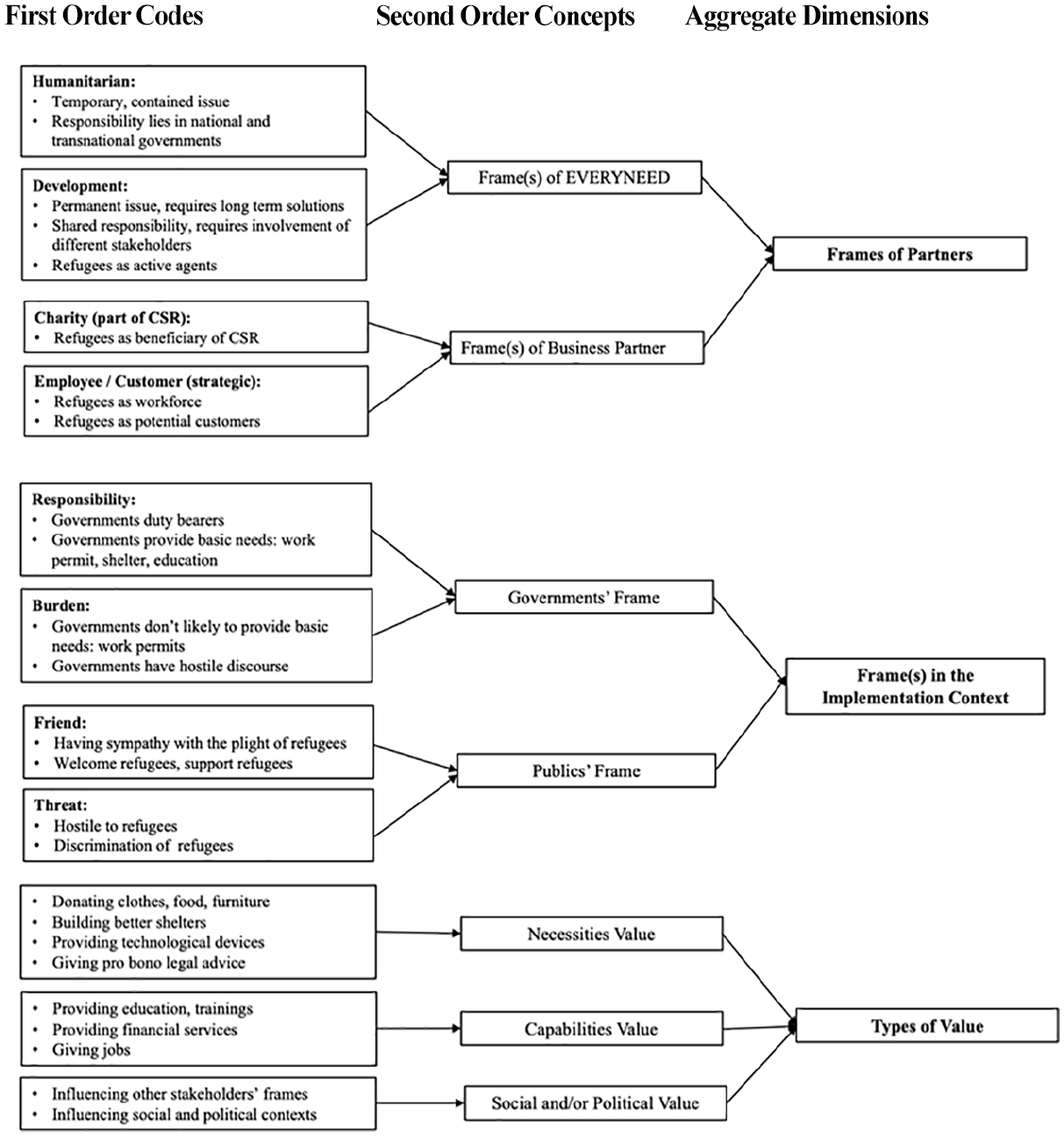
Coding Schema.
Findings
We report our analysis in three main sections: frames of partners, frames in the implementation context, and types of value.
Frames of Partners
We found that EVERYNEED has been changing its frame, and at the time of our research, they had two active frames, and their business partners had two (different) active frames of refugees, all four of which affected value creation activities and value created. In this subsection, we start describing EVERYNEED’s frames and consecutively illustrate business partners’ frames (see Online Appendix).
EVERYNEED’s Frame of Refugees
EVERYNEED was an important organization at the center of the global refugee issue field. We found their frames were shaped by global actors, including United Nations (UN) agencies, global refugee NGOs, and national governments (most particularly high-income countries). Our interviewees highlighted changes over time in the global policy documents that frame refugees and affected all organizations working in the refugee issue field, in particular the 1951 Convention (UNGA, 1951), the Comprehensive Refugee Response Framework (UN High Commissioner for Refugees [UNHCR], 2016), the Global Compact on Refugees (UNGA, 2018), and the Sustainable Development Goals (UNGA, 2015). We found two frames were dominant for EVERYNEED at the time of the study: humanitarian and development frames.
Frame 1: Refugees as a Humanitarian Concern
The long-standing humanitarian frame was codified in the 1951 Refugee Convention, defining a refugee as: A person who is outside of his/her country of nationality or habitual residence; has a well-founded fear of persecution because of his/her race, religion, nationality, membership in a particular social group or political opinion; and is unable or unwilling to avail himself/herself of the protection of that country, where they may be classed as refugees and be guaranteed basic rights. (UNGA, 1951)
This document has so far dominated the global refugee issue field and represented widely how refugees were framed globally, centering the responsibility of governments to uphold refugees’ rights and protection, with little role for local populations and businesses. This definition stressed the main responsibility of national governments and international relief agencies was to provide for refugees’ basic needs, including shelter, safety, and food. Since the aftermath of World War II, this frame has continued to be highly influential in the refugee issue field.
Nevertheless, due to changes in the understanding of the experiences of refugees, this frame had come to be seen as insufficient. Regarding the limitations of this frame, one of our interviewees stated that “there is a reluctance in the humanitarian sector to look at longer-term solutions to housing, infrastructure . . . this is not actually the right way to go . . . money could be better invested in more sustainable solutions” (X15). Similarly, Efe (2019) highlighted that “in humanitarian and aid discourses, asylum seekers/refugees are represented as passive agents” (p. 63). The humanitarian frame constructed refugees as temporary, and solutions were restricted to meeting basic needs through temporary measures. As governments and relief organizations were responsible for responding to these needs, the agency of refugees and the relevance of other actors in finding solutions were overlooked.
Frame 2: Refugees as a Development Concern
In contrast to the 1951 humanitarian frame, the development frame reflected changes in the understanding of the situation of refugees: Refugees stay in host countries longer than previously assumed, and meeting their needs, therefore, requires different solutions. As one of our interviewees (X23) stated, An average refugee stays in a camp for 17 years. That is not a humanitarian situation. That is development. Are they getting educated? Are they healthy? What are they going to do? We are sort of stuck in this 1970s idea that humanitarian is distinct and separate. It is like, “give them the tent, give them the food, and get out of here.” It is not like that anymore.
The development frame recognized that refugees need more than protection; to live in dignity, they needed decent work, education opportunities, and more in the places where they were. International documents were influential in codifying “this idea of the whole government, whole of society; and linking development activities with humanitarian aid” (X21). This new frame defined the role of refugees in society differently, and as one of our interviewees stressed, this then changed the role of business: Now . . . they [business partners] have to consider refugees as part of the population. So, in case they think about any project, they have also to include refugees, since they exist and are contributing to the local economy. (X46)
This new frame opened the solution space to encompass more durable, long-term activities; broadened the definition of groups that might benefit from these solutions to include not only refugees but also host communities; internally displaced persons, returnees, asylum-seekers, and stateless people; and conferred agency and responsibilities onto a broader set of actors, including NGOs, communities, business, and refugees themselves rather than only governments and international organizations.
Overall, we found that these two frames coexisted within EVERYNEED influencing the value creation activities and value created. The new development frame intersected and interlocked with—but did not yet replace—humanitarian frame. Our analysis also demonstrated that EVERYNEED has been shifting from humanitarian to development frame. This has been exemplified in the organizational structure of the EVERYNEED; they have recently created new departments (i.e., education, livelihoods, innovation, and partnerships) that were in line with the development frame in addition to already existing departments that focused on providing for refugees’ immediate needs.
Business Frames
We found that businesses had two frames of refugees: refugees as charity and refugees as employee or customer.
Frame 3: Refugees as Recipients of Charity
Here, refugees were framed as the beneficiaries of business actors’ charity “within their Corporate Social Responsibility” (X26). Similarly, when a given company’s strategic focus in terms of CSR included refugees, they were more likely to be active in this domain. Our findings illustrate that this framing was mostly used by MNCs. This has been the dominant frame for business for some time as they saw “this [refugee issues] is a short-lived thing” (X17). This led to a short-sightedness by business, and the charity frame influenced when and how they would intervene. This was critiqued by EVERYNEED members as the charity frame robbed refugees themselves of agency and social usefulness.
Frame 4: Refugees as Employee or Customer
In contrast to the previous frame, Frame 4: Refugees as employee/customer placed refugee populations within firms’ core business logic as potential employees or customers. This frame was motivated mostly by businesses’ economic interests. Through the influence of national governments, global governments, and NGOs, some companies started gaining an awareness of refugees’ presence in their country and the length of their stays in host communities. Thus, refugees might provide new business opportunities. One of our interviewees clearly expressed how this frame functioned: “Refugees are a labour force at the end of the day, they are an opportunity for growth, the opportunity for profit, they are market and also they can buy things, buy stuff” (X2).
Especially when there was a lack of labor supply in particular industries (i.e., construction, textile, and agriculture), refugee employees came to rescue. One of our interviewees expressed the motivation of companies as follows: “they [companies] are all looking for employees; there are a lot of vacancies right now, a lot of demand for labour. The local population is not satisfying the demand that the industry has for manual labour” (X22). Global refugee advocates were also advocating “to reserve a certain percentage of their staff appointments for refugees” (X43).
We found these two frames were adopted by different business partners of EVERYNEED. Many interviewees referred to MNCs deploying the charity frame more frequently mainly because their headquarters were far from refugee hosting countries, whereas local SMEs would evoke the employee/customer frame due to (a) lack of labor in their home countries, especially where the home population were not eager to take up on the dangerous jobs with lower wages and/or (b) the SMEs’ desire to contribute to the growth of their home country. For instance, “one small factory in Turkey hired 350 [refugees]; I have seen them” said one of our interviews comparing it with an MNC which “hired what, only 10-12” (X10).
Frames in the Implementation Context
We found that frames that existed in the implementation context influenced partnerships’ value creation activities and the value created. Our findings show that value creation was shaped by the frames of refugees in implementation contexts, with two main influential factors: the governments’ and publics’ frames.
First, we found two active frames used by governments at the time of our research: “refugees as a responsibility and as a burden.” Domestically, a government’s frames mattered because they had the authority to implement these frames by legislating—or not—for the de facto fulfillment of refugees’ de jure rights in the international conventions that states have ratified (right to work, education, health care, etc.), in addition to setting the legislative and tax contexts in which businesses operated. For instance, many countries’ domestic legal frameworks prevented refugees from working (Bailey & Williams, 2018; Wake & Barbelet, 2020), and therefore actions were required to support the implementation of economic rights. One of our interviewees commented on how governments’ frames might also influence the general public: “It is a highly politicised issue, unfortunately . . . unfortunate public narrative that prevails and shapes the opinions of many people” (X44).
The “refugees as a responsibility frame” reflected the emphasis on international human rights and refugee conventions of host country governments as “duty-bearers,” stressing that governments were sensitive to refugees and welcomed refugees in their countries. For instance, some governments’ frames of refugees were “guests,” and these governments adopted an open-door policy (Efe, 2019). This evoked hospitality, however, reinforced the idea that the issue was rather temporary. As governments determine legal systems, when governments framed refugees as their responsibility, they provided better conditions for refugees as exemplified by one of our interviewees (X23): The legal framework in our country is so favourable for refugees in terms of them having rights, labour rights, etc., which is not the case in other places, and also that refugees have freedom of movement. They can live wherever they want to in the country. It is not a camp situation; it is not a situation where they are restricted. There are some restrictions when they are in the asylum process, but the government seems to be a little bit open to looking into this now.
In some countries, this approach became so fruitful that unemployment numbers had decreased, thanks to newly opened refugee businesses (Chatty, 2017).
Conversely, the “refugees as a burden” frame represented refugees as bringing new challenges to the host country, and where reported we found the willingness of governments to shoulder their responsibilities in international law was limited. All our accounts agreed that the “refugee issue is very political” (X2). Some governments even pursued hostile discourse against the refugee community by “threatening them with deportations” (X67), calling them illegals, or “threatening them with limiting their rights” (X54). In some cases, governments ignored refugees and instead delegated their responsibility to the international community or other countries. Those that did take on their obligations found it economically difficult to do so and lamented the inaction of the global community as expressed by one of the government officials: Countries around the world are turning inwards but this is an issue that must be looked at more holistically because we all know that refugees are an international obligation. One and a half million refugees are not an obligation for our country. . . We are a poor country, and it is time for the international community to wake up. (Archival Material, Research report, 2021)
More dire consequences of this frame were manifested as wrongdoings of some governments such as arresting refugees in the streets to deport them, closing refugees’ businesses, using police forces to track refugees, not allowing refugees to leave camps, not approving their diplomas earned at local universities, and more.
Second, we found two public frames of refugees were influential: refugees as friends and refugees as threats. 3 The “refugees as friends” frame stressed sympathy with the plight of refugees, sometimes inviting empathy by asking members of the public to consider the extreme circumstances that would drive a person to flee their home. 4 On this basis, we found that the public seeing refugees as friends also worked to support the refugees by engaging in community activities, frequently working in a volunteer capacity. For instance, one of our respondents stressed the empathetic response to the influx of refugees into their country: “That triggered a significant wave of solidarity across the whole—all different sectors, I would say. So, there was an incredible amount of volunteering. . .” (X21). In addition, in some countries a sense of duty or common religion influenced local populations to see refugees as friends and the public was eager to help them by providing them with food, clothes, and so on (Chatty, 2017; Efe, 2019).
In the “refugees as threat” frame, in contrast, the local population was hostile to the idea and reality of refugees in their country. Our findings illustrate that in this case, refugees were framed as stealing opportunities and resources from host communities, whether they be jobs, welfare, school places, or social services. Agblorti and Grant (2019) give some examples of host–refugee conflicts as misunderstandings during football matches, stolen telephones, misunderstandings over transport fees, and land. One of our interviewees commented similarly: “There is xenophobia and a kind of negative discourse around the refugee population” (X45). Another instance was raised by our interviewees: “There are a lot of misperceptions about refugees who are often being linked with terrorism, security incidents, drug trafficking, etc” (X44). Where there were fewer opportunities (in education, health, jobs, etc.) for the local population, the public tended to see refugees in a more negative light, and this evoked the fear of the “other” (Efe, 2019) and fed some existing anxieties. For instance, in situations where communities were more exposed to refugees, they became more hostile to the idea of the refugee (Hangartner et al., 2019). Consequently, this might lead to serious exploitation such as higher rents, unpaid jobs, and worse working conditions (Ilcan, 2018; see Table 2 for data excerpts). In sum, we found the frames of the governments and public could impede or promote the creation of some types of value and not others.
Data Excerpts.
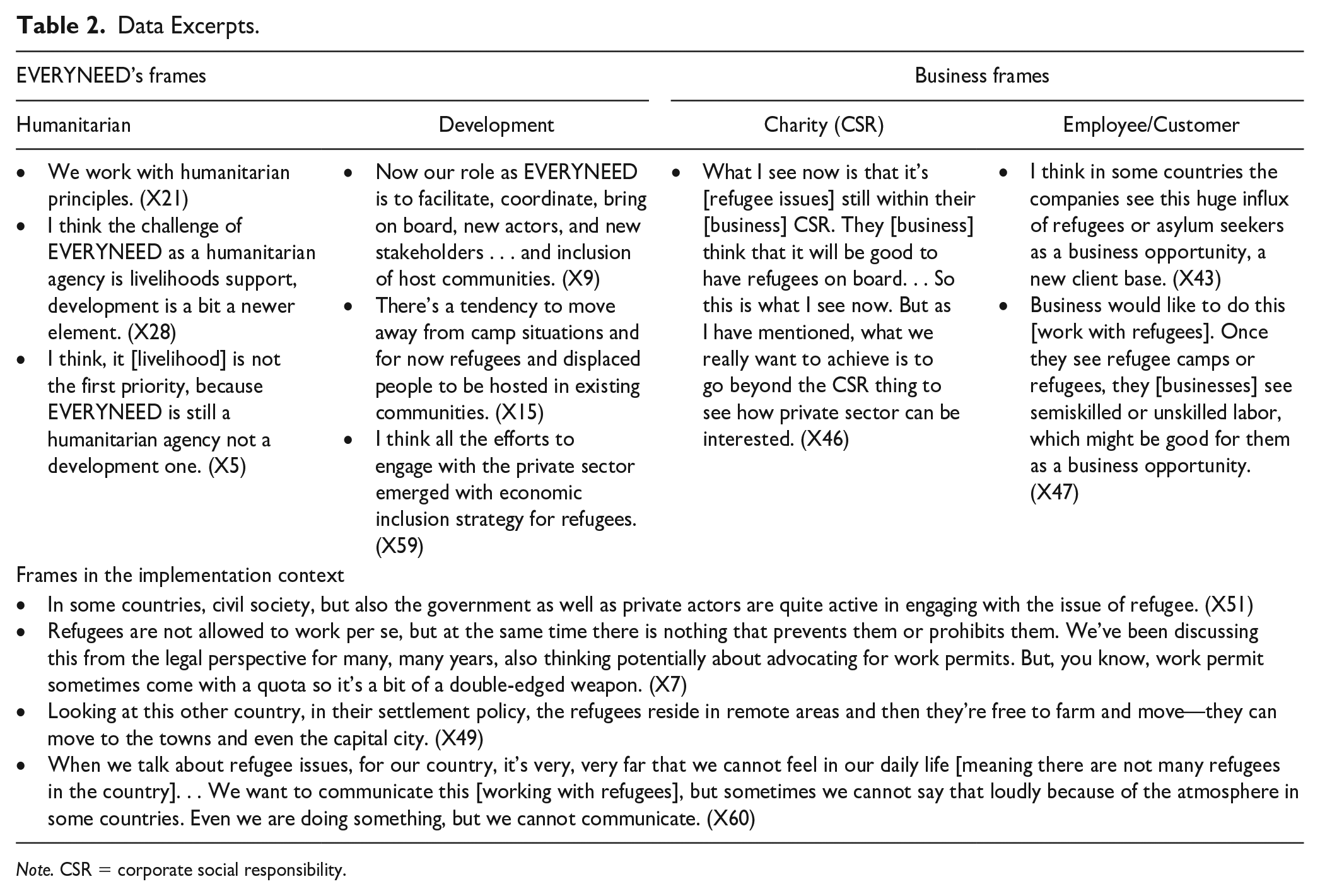
Note. CSR = corporate social responsibility.
Types of Value
We found that how actors deployed and responded to the frames of refugees mattered because these frames resulted in different types of value creation activities: Frames determine how partners interpreted the situation and consequently their organized value creation activities. Our analysis reveals three different types of value might be created for refugee populations as a result of partnerships between EVERYNEED and its business partners: Necessities, Capabilities and Social and/or Political Value. Our findings also showed that the first two types of value functioned within the boundaries of the existing frames; the third reached past these boundaries to influence those frames that were constraining active value creation activities in that context.
Necessities Value
Humanitarian and charity frames generated actions to provide for refugees’ immediate needs (shelter, food, clothes, etc.) and legal protection, creating what we call Necessities Value for refugee populations. Some examples of activities to create that type of value were “distributing clothes” (X56) and “phones” (X20), “innovating for better accommodation” (company website), and “developing technologies to verify refugee identity” (company website). Another form of activity we observed within partnership with law firms was “providing pro bono legal advice and representation for those claiming asylum” (X58).
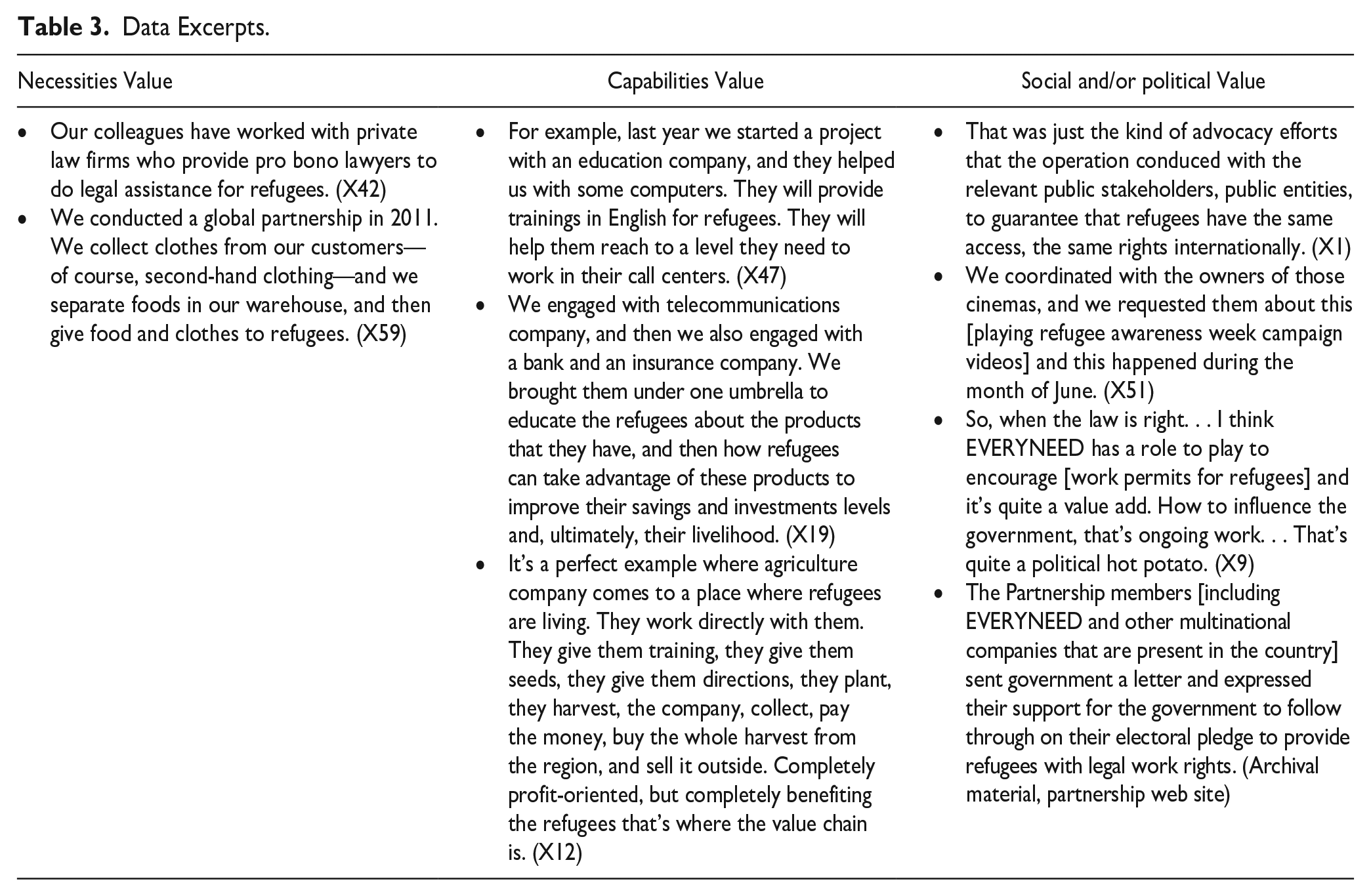
In this form of value creation activity, partnerships tended to be brokered at global headquarters with multinational corporations far from field operations, and thus the businesses’ interactions with refugee populations were limited. Due to governments not ensuring refugees’ right to work, EVERYNEED deployed a humanitarian frame, seeking out and responding to business partners requesting to work toward supplying the basic needs of the refugees (for more examples of this type of work, see Table 3). In these situations, business partners (especially SMEs) were not eager to overtly create Capabilities or Social and/or Political Value as they were afraid of the reaction of their customers (public) or governments.
Data Excerpts.
While this supported the core mission of EVERYNEED, it also created operational challenges, “including ensuring the safety and quality of donated products” (X45) and organizing the distribution of these products. Most of these activities were initiated in the global north, and therefore, although they were instrumental in creating some immediate Necessities Value for refugees, they sometimes took attention away from what had been defined by field offices as the priority needs on the ground. For example, surplus shoes were donated, which required “EVERYNEED staff time to be diverted from other activities to receive and log the shipment of shoes from the manufacturer, then repack, dispatch, transport and track that donation to field operations” (X8). Overall, Necessities Value activities mainly aimed to address refugees’ immediate needs.
Capabilities Value
The second type of value that might be created was Capabilities Value, which moved beyond CSR to extend firms’ core strategic business activities to refugees. In creating this type of value, EVERYNEED mobilized a development frame, enabled by the recent shift in the global agenda. The majority of the partnerships we studied fell into this type and motivated to cover refugees’ needs to be able to help them sustain their lives themselves, without being dependent on aid. This focused on areas such as health, education, and economic participation. Some main activities were “vocational trainers provided skills development for work and entrepreneurship.” (X47). Hospitality and textile industries set recruitment quotas for refugees, and banking and insurance companies “modified their products or access requirements to provide financial services to refugees” (X25). Capabilities Value activities included innovation in the “manufacture of particular products, development of new products or modifying products in response to needs of refugees” (X15). This also included providing services such as mobile telephony, insurance, or banking. One of our interviewees explained why these services were important as follows: “It was not easy for refugees to open bank accounts because the institutions perceived them as the riskiest segment of the population . . . after the partnership, banks now have begun opening accounts” (X47).
This type of value was important for not only adult refugees but also refugee children and teenagers. For instance, “we [EVERYNEED] had a partnership with them [a local IT company] for a while on teaching them [refugee teenagers, adults] coding” (X21), which aimed to create value for refugees while at the same time producing the skilled labor the IT firm needed but was lacking locally. In another example, EVERYNEED worked with an MNC to provide some training in information communications technology (ICT) to refugees, and these trainings were actually market-driven . . . [and] to put them [refugees] on the agenda, to include them in the system, and at the same time to help the refugees to get jobs afterwards. (X26)
In Capabilities Value creation activities, the business partner tended to be global or national or mostly local SMEs, whose centers of operations were closer to the refugee populations they served, and the partnerships could be brokered through field offices or global headquarters. In this regard, the implementation context seemed to influence Capabilities Value creation activities more significantly. When governments in the given countries had a responsibility frame, this translated into granting refugees’ residence permits, diplomas, education certificates, and so on, which were important documents that would help refugees. This increased the number of capability-oriented partnerships, especially the ones that focused on increasing refugees’ education and skills. Partnerships initiated by EVERYNEED had an important mission in these circumstances; this was due to many businesses being unaware of the refugee field: “It is not on their radar, and they do not know that refugees have the right to work” (X22). When there was a demand in the local market for employees, this also increased the number of capability-oriented partnerships that provide jobs.
On the contrary, when the public deployed a threat frame—even if government had responsibility frame—this made the conditions more complex for EVERYNEED, partners, and partnerships. Thus, although refugees were allowed to work, Capabilities Value created could be restricted or distorted. For instance, The second thing when it comes also to the risk, when we are really posting some refugees who are doing well, especially the women, and they start a business and they start to get income, they will be exposed, especially in the camp. So other refugees or members from the host community can know that this woman is doing a business, she has money, so she can be, let us say, harassed easily. (X40)
Another risk arose where creating economic value for the business partner was prioritized while providing Capabilities Value for refugees: The private sector, when they provide training to our refugees and they [refugees] are able to produce some very high-quality jewellery. But they can only sell it to this firm because of copyrighted design and colour scheme, each and everything came from the private sector. (X44)
In this example, the refugees were doing paid work, but the employer was exercising monopsony power by tying their labor to just one employer. Another complication that arose with Capabilities Value creation activities was the risk of exploitation and lower wages, reported frequently by our interviewees, particularly where governments denied refugees or asylum seekers legal pathways to work.
Social and/or Political Value
Where refugees were framed as a burden and/or a threat, partners undertook value creation activities with the intention of creating Social and/or Political Value, but much less frequently. Social and/or Political Value creation activities aimed to influence both the frames and material conditions in the implementation context, to enable (rather than constraining) Necessities and Capabilities Value creation activities and also positively impact refugees’ enjoyment of their human rights. In this tricky situation, EVERYNEED’s work was restricted, and they deployed a development-oriented frame to influence the main stakeholders in the implementation context. On that front, the business partners that they engaged with were mostly of a charity frame but with a future orientation of the employee/customer perspective. The business partner had a future outlook in this type of value creation activity because they knew if they worked toward recognition of refugees, it would bring them future customers and employees. We found that compared with SMEs, MNCs were more active in influencing activities due to their capacity to influence governments and publics at scale.
In this vein, partnerships conducted advocacy aimed at influencing national governments’ and the publics’ frames of refugees and to influence social and political realities. For example, “a consortium of consumer goods firms came together to improve refugees’ working conditions and promote their human rights” (X24). In addition to direct legal assistance, law firms also “find emblematic cases and make cases for the rights of refugees in certain areas” (X54), and entertainment businesses supported through “communication campaigns by showing short informative videos on cinemas, covering taxis with slogans to raise awareness for refugees” (X17).
The main concern raised by our interviewees was that advocacy targets—and potential business partners who might want to engage in the other types of value creation activities—did not have a deep enough understanding of the refugee issue field: “So, you go to them and then they still ask you questions, ‘Are they [refugees] here? Are they here?’ So, probably we should double our advocacy interventions outside” (X30), which indicated additional efforts and resource commitments from EVERYNEED. Thus, the framings of refugees as a burden or a threat restricted other value creation activities but, in some cases, undertook Social and/or Political value activities, which aimed to unblock these constraints (see Table 3 for data excerpts).
Discussion
In this section, we summarize our findings and discuss our contributions to the literature on value creation for refugees by social partnerships. What is missing from the extant literature is an elaboration of the links between partners’ frames of refugees and those in the implementation context, and how distinct frames shape different value creation activities and the value created for refugees. Our study contributes a model (Figure 2) that reveals the ways in which value creation activities and value created depend on refugee frames internal to the partnership (partners) and external to the partnership (implementation context). Our objective is to develop propositions about the effects of frames of refugees on value creation activities of partnerships for refugees, an issue that has suffered from scant research attention.
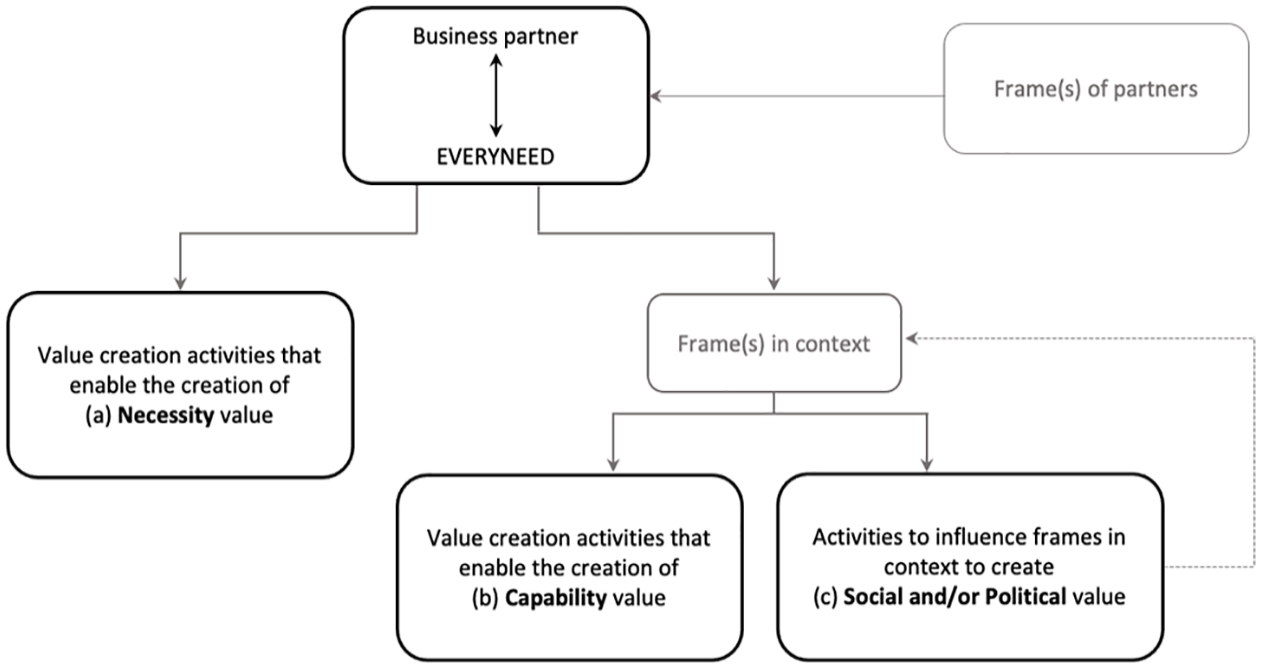
A Model of the Effects of Frames of Refugees on Value Created for Refugees by Social Partnerships.
Our model shows that there are three main forms of value creation for refugees: Necessities, Capabilities and Social and/or Political Value. We adopted Islam’s (2020, p. 3) definition of social value: “the creation of positive changes in society by addressing pressing social problems” and Becker’s (2003) classification of macro-, meso- and micro-level impacts outside the partnership. Some of the categories of social value created by interorganizational collaboration identified in Siemieniako and colleagues’ (2021) systematic review were identified in our study (see Online Appendix); our study also identified additional types of value that might be created for refugees. Necessities Value created micro-level benefits, whereas Capabilities Value created value for refugees at micro-, meso- and macro-levels. While macro-level value in the form of Social and/or Political Value was targeted by partners, our research design did not allow us to systematically track the actual value created. We could, however, identify it as a goal of value creation activities and, therefore, worthy of future research attention.
We differentiate between the type and ambition of goods and services provided: Necessities Value is created to meet more immediate humanitarian and human needs, whereas Capabilities Value is created for longer term development and economic factors, that is, a person’s “actual ability to achieve various valuable functionings as part of living” (Sen, 1993, p. 30). Thus, beyond distributing goods, services, and resources to refugees to fulfill immediate needs, actions to create Capabilities Value recognize the importance of enabling and developing refugees’ capabilities to convert available resources into improvements in the life they can lead. However, partners’ value creation activities cannot lead to value created for refugees in a hostile context. Thus, in contexts where frames of refugees are not conducive to creating value for refugees (for instance, when the government’s frame of refugees is burden and public’s frame of refugees is threat, similar to contexts described by Cooper et al. [2017] and Van Gorp [2005]), partners may seek to create Social and/or Political Value by influencing the frames of refugees held by the public and/or government. In addition to securing refugees’ human rights, creating this value would shift nonproductive frames in the context that could make the context frames of refugees more amenable to creating Necessities Value or Capabilities Value. Such activities may also seek to influence more broadly the social, legal, and regulatory context in which refugees live out their daily lives in ways that would allow them to avoid persecution and violence, and to better enjoy their human rights.
The Effects of Frames on Value Created for Refugees: Three Propositions
Our contribution is not to only identify frames of refugees held by partners and in the implementation context but also their consequences. Our objective is to develop propositions about the effects of frames of refugees on value creation activities of—and ultimately value created by—partnerships for refugees, an issue that has received limited research attention.
EVERYNEED’s Frames of Refugees
The type of value created for refugees by partnerships depends on the type of value creation activity undertaken by partners, which differs depending on the partners’ frames of refugees. In our study, EVERYNEED’s frame of refugees has changed over time and was used flexibly depending on their business partners’ frames. Over time, the refugee situation has changed, with increasing protracted refugee displacements requiring a “development” response (particularly toward economic self-sufficiency) in addition to the organization’s traditional “humanitarian” rapid response (to provide for immediate needs). Thus, the demands on EVERYNEED have changed: regarding both what value they might create for refugees and the value creation activities they undertake. During the time of our study, EVERYNEED held two frames of refugees (humanitarian and development). EVERYNEED’s adoption of the development frame in addition to its traditional humanitarian frame expanded the number and types of partners and types of value that these partnerships might create.
Interaction of Different Partners’ Frames of Refugees
We found that business partners had two different frames as charity, on one hand, or employee/customer, on the other hand. EVERYNEED deployed one or both of their frames of refugees flexibly in their partner negotiations, depending on the frame of the business partner. When the business partner’s refugee frame was “charity,” this activated EVERYNEED’s “humanitarian” frame, which led to the partnership designing Necessities Value creation activities. In contrast, when the business partner’s frame of refugee was “employee or customer,” this activated EVERYNEED’s “development” frame, which led to Capabilities Value creation activities. Some business partners might work with EVERYNEED on both Necessities and Capabilities Value creation activities; most focused on either one or the other.
Despite the multiple frames of refugees that exist in the refugee field, in our study we did not find frame contestation, convergence, or fusion between business and NGO partners (Kaplan, 2008; Le Ber & Branzei, 2010c; Noy, 2009). Nevertheless, we identified frame dynamics in which the NGO partner activated one of its two main frames of refugees in response to the frame(s) of the commercial partner (humanitarian-charity; development-employee/customer). Thus, partnership value creation activities may persist in the absence of frame convergence, where one partner holds more than one frame, and they choose to deploy them flexibly.
Frames in the Implementation Context
Our model demonstrates that the ambition of two types of value creation activities can be blocked or reduced by the governments’ or publics’ frames of refugees in the implementation context. The effects of the frames of refugees in the implementation context are less important for Necessities Value creation; Capabilities Value creation takes place when the refugee frames in the implementation context are “refugees as responsibility.” Where the frames of refugees in the implementation context are not conducive to Capabilities Values creation for refugees, partners can turn to influence activities to attempt to create Social and/or Political Value. These value creation activities seek to change frames of refugees in the implementation context such that it becomes amenable to creating Capabilities Value as an outcome. These influence activities can also seek to directly affect the social and political macro-context, to allow refugees to better access and enjoy universal human rights. Thus, we propose that
Next, we discuss theoretical and managerial implications of our research.
Value Created for Refugees by Social Partnerships
Our research builds on and extends the academic research on partnership value creation (Austin & Seitanidi, 2012a, 2012b; Le Ber & Branzei, 2010b, 2010c; Murphy et al., 2015; J. Yin & Jamali, 2021) by focusing on value creation for beneficiaries of the partnerships, specifically refugees as beneficiaries of partnerships. In this specification, our study addresses the importance of not only internal (partners’ frames; see, Klitsie et al., 2018; Le Ber & Branzei, 2010c) but also external factors (frames existing in the implementation context) to create value for beneficiaries.
With this study, we contribute to partnership research by identifying the main forms value that might be created for refugees as a result of the value creation activities of business–NGO partnerships (i.e., Necessities, Capabilities, and Social and/or Political Value). Although studies of partnerships—mostly theoretical—have identified various types of value created (Austin & Seitanidi, 2012b; Le Pennec & Raufflet, 2018), their main focus more broadly was unpacking the value created for partners (which they call micro- and meso-level), paying less attention to the value created for the broader society (which they call macro-level) and even less so to beneficiaries (Trujillo, 2018; Vestergaard et al., 2020, 2021). As a managerial implication, we posit that understanding different types of value created for beneficiaries is important for partnerships because each type of value created comes with different risks and benefits for the partners and beneficiaries.
Although research has examined the influence of contexts—mostly national—on CSR more generally (Campbell, 2006; Matten & Moon, 2008; Welford, 2005), research is lacking on the effect of contexts on the value created by social partnerships (Rein & Stott, 2009). On this basis, we argue that as frames emerge because of national and institutional factors (Gray et al., 2015), they are an important representation of contextual variables and highly relevant in understanding the effects of partnership implementation contexts on value created, especially for refugees. Although both Lashitew et al. (2020) and Siemieniako et al. (2021) consider the importance of low-income country contexts on social value created by partnerships, they do not go beyond this economic distinction. Our study contributes by identifying the ways various frames of refugees in implementation contexts may constrain the value creation efforts of partnerships.
By bringing the implementation context into picture, we also highlight the political space partnerships occupy. Thus, although partnerships and their members may seek to create social value by addressing grand challenges, their capacities might be limited by broader political dynamics and their embeddedness in a political context. For example, business partnerships that attempt to undertake Capabilities Value creation activities are unlikely to lead to value created for beneficiaries if the frames of refugees in the implementation context are not conducive. Thus, we assert that in addition to internal conflicts or lack of resources (Kolk et al., 2008), lack of partnership capacity to navigate political dynamics and tensions might also contribute to partnership limitations and failure (Andonova et al., 2022).
Furthermore, our work highlights the responsibility and perception of business in refugee matters and portrays the way the perception of NGOs changes in approaching refugee matters. Holding businesses responsible in refugee matters requires understanding where they stand. In this research, we did that by looking at their frames of refugees. In this regard, one surprising finding in our research was that the issue of refugees was overlooked by businesses because of an incorrect—temporary—framing of refugees by the public and businesses. Thus, a lack of knowledge about refugees invisibly prevented businesses from working to address the issue.
Finally, we argue that change in EVERYNEED’s frame is also a clear indication of the direction the refugee issue field is taking. The choice of direction has important implications for the distribution of responsibility in terms of addressing refugee issues and overall understanding, such as more efforts from NGOs as well as governments to focus their attention on refugee integration rather than only focusing on immediate needs (UNHCR, 2016). Given the change in refugees’ reality globally, creating Social and/or Political Value is even more important for refugees to enjoy their human rights.
Conclusion
Our examination of value creation for beneficiaries extends existing theoretical and empirical academic research on partnership value creation. Theoretically, we employ the social value creation literature to further specify the existing partnership literature to theorizing value created external to partnerships, for beneficiaries. Empirically, we extend the partnerships and frames literature to examine the effects of frames of refugees on what value may be created for them as beneficiaries. At the same time, this research addressed more practical questions regarding how partnerships might take into account both internal and external factors when designing value creation activities, to better work toward creating value for their beneficiaries. From a practical perspective, this study indicates that paying attention to frames in different contexts can provide insights into the specific type of value creation that is possible, and is therefore likely to make businesses’ contribution more impactful.
Supplemental Material
sj-docx-1-bas-10.1177_00076503231157715 – Supplemental material for Value Creation for Refugees by Social Partnerships: A Frames Perspective
Supplemental material, sj-docx-1-bas-10.1177_00076503231157715 for Value Creation for Refugees by Social Partnerships: A Frames Perspective by Özgü Karakulak and Moira V. Faul in Business & Society
Footnotes
Acknowledgements
We are very grateful to Prof. Colin Higgins for his editorial guidance and three anonymous reviewers. We also would like to thank participants of Business & Society Special Issue workshop as well as University of Sussex Responsible Business Research Seminar participants. We thank our interviewees for their time and collaboration. We also thank Marieke de Wal and Marije Balt for their insights during the initial stages of this project.
Declaration of Conflicting Interests
The authors declared no potential conflicts of interest with respect to the research, authorship, and/or publication of this article.
Funding
The authors received no financial support for the research, authorship, and/or publication of this article.

Supplemental Material
Supplemental material for this article is available online.
Notes
Author Biographies
References
Supplementary Material
Please find the following supplemental material available below.
For Open Access articles published under a Creative Commons License, all supplemental material carries the same license as the article it is associated with.
For non-Open Access articles published, all supplemental material carries a non-exclusive license, and permission requests for re-use of supplemental material or any part of supplemental material shall be sent directly to the copyright owner as specified in the copyright notice associated with the article.
