




Abstract
Means–ends decoupling, the institutionally induced implementation of ineffective practices, has become increasingly common. Extant theory suggests that means–ends decoupling has real consequences, which makes it unstable and difficult for organizations to sustain. Yet little is known of how, and with what outcomes, firms organize such means–ends decoupling. We examine organizing via multiple qualitative and longitudinal case studies of how Swedish fast fashion retailers implement and manage the collection of used garments. We find that firms combine two organizational arrangements: structural and temporal core–compartment separations, which mitigate consequences of means–ends decoupling by obscuring and justifying efficiency gaps. Thereby we provide a theoretical explanation for how means–ends decoupling can persist over time.
The concept of decoupling has been used to describe how firms respond to societal expectations by adopting formal structures without implementing corresponding practices (Boxenbaum & Jonsson, 2017; Graafland & Smid, 2019; Meyer & Rowan, 1977). Although such so-called policy–practice decoupling is suggested to protect both the legitimacy and the operational efficiency of firms, this pretense has arguably become less feasible, and perhaps increasingly risky, as transparency and accountability have increased substantially in most organizational contexts (Bromley & Powell, 2012; Wijen, 2014). Thus, to live up to societal expectations without the risk of being shamed and punished for deceiving stakeholders (García-Sánchez et al., 2021; Lyon & Montgomery, 2015), organizations increasingly go beyond smoke and mirrors and actually implement practices in response to institutional pressures.
However, these implementations give rise to a new form of decoupling, in this case between means and ends. Means–ends decoupling (Bromley & Powell, 2012) describes situations where, in response to institutional pressures, organizations engage in activities that are weakly linked to their goals and turn out to be largely ineffective (Wijen, 2014). Because means–ends decoupling goes beyond window dressing and entails the implementation of actual practices, it also has concrete consequences for the organization: diverting resources from key activities, increasing internal complexity, and generating perpetual reform (Bromley & Powell, 2012). Still, as means–ends decoupling remains largely understudied, in particular empirically, little is known about how means–ends decoupling is organized and how organizational arrangements relate to these suggested consequences.
There are three important reasons why the organizing of means–ends decoupling matters for research: First, means–ends decoupling is already prevalent among organizations and on the rise, and as it comes with organizational consequences (Bromley & Powell, 2012), scholars should be interested in it. Second, institutional scholars regularly refer to decoupling as a key response to the institutional complexity (Greenwood et al., 2011) and rampant rationalization (Bromley & Meyer, 2015) that characterize most organizational contexts. Nevertheless, the extant theory seems to suggest that both policy–practice and means–ends decoupling are difficult to sustain (Dick, 2015). Thus, by better understanding the organizing of means–ends decoupling, we probe whether decoupling really could function as a core organizational response to institutional complexity (Boxenbaum & Jonsson, 2017). Finally, the organizing of means–ends decoupling should also be of interest for scholars who seek to understand how organizations take and sustain real action on pressing socio-environmental issues, as means–ends decoupling involves going beyond window dressing and taking real action (Wijen, 2014).
We examine the organizing of means–ends decoupling by analyzing how several Swedish fast-fashion retailers have, for several years, organized the collection of used garments via in-store take-back systems. Used garment collection exemplifies means–ends decoupling as it has little, if any, link to the retailers’ core goal of selling new trendy clothes and seems also vaguely linked to positive environmental outcomes. Collected clothes are exported, first to sorters in Eastern Europe and then to Asian and African markets, where it is questionable if they do any environmental good (Brooks, 2019; Nörup et al., 2019; Roos et al., 2019). Meanwhile, fashion retailers are broadly criticized for their poor environmental performance, and lately, such criticism has focused on the amount of textile waste that fast fashion generates (Ellen MacArthur Foundation [EMAF], 2017).
We contribute to the emerging means–ends literature by introducing two concepts that describe how decoupled means can be conveniently organized: structural core–compartment separation and temporal core–compartment separation. We argue that structural and temporal core–compartment separations can mitigate organizational consequences of means–ends decoupling: The former reduces internal perceptions of the efficiency gaps that are suggested to arise from means–ends decoupling, whereas the latter justifies the existence of these gaps. Thus, as these ways of organizing reduce the likelihood of internal criticism against decoupled means, our conceptualizations provide an explanation for why means–end decoupling, despite its apparent ineffectiveness, could be quite persistent.
From Policy–Practice to Means–Ends Decoupling
Since introduced by Meyer and Rowan (1977), decoupling has been instrumental in explaining the ambiguities of organizational responses to institutional pressures. As an idea, decoupling explains that organizations align with institutional pressures to gain legitimacy from key constituents and thereby survive but also acknowledges that these pressures are often contradictory and in conflict with the production activities of organizations and their need for internal efficiency (Boxenbaum & Jonsson, 2017). To deal with contradictory pressures, firms then decouple their formal structures from their practices, so that structures align with institutional pressures whereas practices respond to efficiency needs (Meyer & Rowan, 1977). Decoupling alleviates an organization’s problem of living up to contradictory institutional and competitive pressures, which would potentially render it both legitimate and efficient. However, it “carries with it a risk of detection where it would no longer confer legitimacy, but probably shame, on the organization” (Boxenbaum & Jonsson, 2017, p. 21). Thus, decoupling occurs particularly in contexts in which there is little scrutiny from external stakeholders (cf. Fiss & Zajac, 2004, 2006; Hensel & Guérard, 2020).
In an important revitalization of decoupling research, Bromley and Powell (2012) referred to the above-mentioned type of decoupling as policy–practice decoupling and argued that it has become less feasible, and more risky, as transparency and accountability have increased in most organizational contexts. They based their claims on Power’s (1984) observation of an emerging audit society with “increasing emphases on monitoring and tracking organizational activities” (Bromley & Powell, 2012, p. 2). Researchers have also identified not only other trends, such as the tendency of markets to punish decoupling firms (García-Sánchez et al., 2021), but also the proliferation of social media, which by increasingly shaming firms that decouple makes organizational pretense and empty policies more costly (Lyon & Montgomery, 2013). In parallel, much empirical research has shown the difficulties of sustaining policy–practice decoupling over time (Haack et al., 2012; Hallett, 2010; Tilcsik, 2010), for instance, because pressure groups use firms’ adopted policies against them (Bartley & Egels-Zandén, 2015). Difficulties can also result from internal constituents driving external causes (Hallett, 2010), such as when people hired in connection to some decoupled policy refuse to act as ceremonial props and instead attempt to implement real action (Tilcsik, 2010). Thus, Bromley and Powell (2012, p. 35) conclude that the viability of policy–practice decoupling is decreasing in the transparency- and accountability-oriented contemporary organizational context, where “the alignment of policy and practice becomes a moral obligation, and it is often monitored through the channels of hard and soft law combined with various counting and accounting tools.” The consequence is that organizations increasingly do, in fact, go beyond smoke and mirrors and implement real activities in response to institutional pressures. However, as mentioned, this generates a new kind of decoupling: between means and ends.
With means–ends decoupling, organizations implement activities aligned with adopted policies, but as policies are justified through rationalized myths rather than substantive evidence, activities’ link to outcomes is weak or uncertain. This is particularly so as rationalized myths often emerge from societal domains where it is difficult to establish a cause–effect relationship, for instance, concerning social-environmental governance (Wijen, 2014). Thus, policies and their corresponding activities may be both weakly linked not only to the implementing organization’s core goals but also to the goals intended with the policy as such (Dick, 2015; Dick & Coule, 2020).
Many empirical observations of means–ends decoupling stem from nonprofits (Bromley et al., 2012; Dick & Coule, 2020) or public organizations (Bromley & Powell, 2012; Dick, 2015). For nonprofit organizations, decoupled means are exemplified by activities for measuring and reporting quantified “results,” although what is measured does not align with nonprofits’ missions (Dick & Coule, 2020). For public organizations, such as universities, means–ends decoupling can also be seen in the numerous organizational units doing things that seem to counteract teaching and research (Bromley & Powell, 2012). Although means–ends decoupling has received less academic attention in the business context, Wijen (2014) argues that it arises when firms implement socio-environmental standards. Here standard-setters’ efforts to offset superficial adoption lead to the enforcement of “concrete and uniform rules, strong incentives, and transfers of ‘best practices’ to ensure substantive compliance by adopters” (Wijen, 2014, p. 304). These efforts render standards ineffective, however, as reducing the flexibility of implementing firms makes firms unable to address the situated complexities of the socio-environmental issues they face. Thus, strict enforcement of standards induces decoupled activities that address neither business nor socio-environmental goals.
Bromley and Powell (2012) suggest that means–ends decoupling is not confined to the implementation of such schemes as rankings, standards, and measuring systems, but also refers to other cases of institutionally induced implementation that is decoupled from ends. One such example is Dick’s (2015) analysis of the practice of accommodating part-time work in the British police, a means at odds with the operational efficiency of the force. She argues that the implementation of decoupled means makes efficiency gaps salient. These gaps refer to the conflicts between implemented means and “the logic of efficiency, because technical activities require diverse and customized solutions” (Seo & Creed, 2002, p. 226). Such conflicts are suggested to make means–ends decoupling unstable and imply that this decoupling is difficult to sustain, at least without effort. Thus, given the emergent state of research into means–ends decoupling, we need more empirical research in general, particularly in business and particularly in uncertain business environments, as Seo and Creed (2002) assert that tensions over efficiency gaps increase with environmental uncertainty.
Because contradictory activities are really implemented in means–ends decoupling, organizational consequences are more decisive than for policy–practice decoupling. In other words, while firms avoid the risk of being exposed as fraudulent, they instead face new internal challenges. More precisely, Bromley and Powell (2012) suggest three consequences of means–ends decoupling: internal complexity, perpetual reform, and diversion of resources.
First, internal complexity arises because implementing real responses to contradictory external pressures entails that one internalizes the complexities and inconsistencies of these pressures (Greenwood et al., 2011). As a consequence, contemporary organizations are laden with subunits that are only moderately related to each other. Such units may be internally well aligned and harmonious, but tensions between units are exposed as they are to coordinate and justify their actions to each other. Internal complexity, therefore, makes organizations more laborious to manage (Bromley & Meyer, 2015) and gives rise to internal subcultures (Kok et al., 2019). Bringing together contradictory values and goals in action can be highly challenging, even for resource endowed and ambitious market leaders (Hengst et al., 2020).
Second, because decoupled means are ineffective in achieving their intended outcomes and deal with issues that are causally indeterminate, perpetual reform is a likely consequence, as means have to be continuously revised to live up to their intentions (Bromley & Powell, 2012). Thus, perpetual reform stems from a functional gap rather than an efficiency gap (Wijen, 2014) and emerges as rational myths become more elaborate and internalized (Bromley & Powell, 2012). In theory, reform could, over time, couple means to ends, as implemented practices increase in precision, but given the indeterminacy of many rationalized myths, this may never happen (Dick, 2015).
Third, the implementation of practice generally comes with some cost or effort, and, by definition, implementing a practice that cannot live up to ends represents a diversion of resources that could have been used for other more suiting tasks. Internal complexity and perpetual reform also result in an additional diversion of resources: Subunits, and the management needed to coordinate them, consume many resources that are needed elsewhere (Bromley & Meyer, 2015). Moreover, perpetual reform may also consume manpower and organizational attention, as means that are not serving core functions are reformed over and over again.
Thus, extant theory suggests that the organizational consequences of means–ends decoupling actually comes to exacerbate and expose its gaps to organizational members. In other words, just as it has been argued that the consequences of policy–practice decoupling expose its limits, it can be argued that the organizational consequences of means–ends decoupling do the same thing. Over time, this exposure could fuel discontent and criticism among organizational members, just as Seo and Creed (2002) suggest that perceived gaps prompt critical reflection and change attempts. A likely consequence can be a desire to stop implementation, and thereby also means–ends decoupling (Dick, 2015). These processes should be particularly evident when organizations are under stark competitive pressure. In other words, extant theory suggests that means–ends decoupling, through the organizational consequences it brings, actually carries with it a mechanism of its own undoing.
Thus, as the maintenance of policy–practice decoupling is made difficult from the exposure of gaps between policy and practice, so should also means–ends decoupling be difficult to sustain but for the above-mentioned reasons. Here Dick (2015) found that means–ends decoupling could be maintained if managers perceive latent, or hidden, reasons for implementing seemingly ineffective means. In other words, she points to the importance of the way organizational members, particularly managers, justify means–ends decoupling. Although this is one important finding in terms of how firms seem to deal with means–ends decoupling, we need to know more about the ways that firms organize it, and if they, through their organizing, can in any way deal with the above-mentioned organizational consequences. How organizations arrange decoupled means is important: means–ends decoupling already constitutes a ubiquitous feature of contemporary organizing and seems to be increasing (Bromley & Meyer, 2015; Bromley & Powell, 2012). Moreover, how means–ends decoupling is organized relates to the question of its stability. The theoretical debate over the persistence of policy–practice decoupling has been pivotal, and the persistence of means–ends decoupling seems of equal importance. As most, if not all, contemporary organizations face contradictory external demands, we need to understand how and if decoupled responses can be stable over time, or if firms should seek temporary, and shifting, responses. Moreover, means–ends decoupling does not only concern issues of organizational functioning and survival, because a better understanding of how firms take and sustain real action on pressing socio-environmental issues is of concern to wider society (Wijen, 2014). Thus, with the above in mind, we pose the following research question:
Method
Case Study and Case Selection
We conducted a multiple inductive case study inspired by Eisenhardt (1989). Multiple case studies are suited for theorizing in a number of situations, including the one we faced, where prior concepts and theory are missing, and they are particularly useful as they “permit a replication logic in which cases are treated as experiments, with each serving to confirm or disconfirm inferences drawn from the others” (Santos & Eisenhardt, 2009, p. 645). We sampled our cases theoretically by selecting five firms from the same industry implementing the same type of decoupled means (used garment collection) and employing the same type of fast-fashion production practice, thus we kept variability low to make replication across the cases meaningful.
Our case firms are Infashion, Leisure, Modern, Hyped, and Japanista, five anonymized Swedish fast-fashion firms that by 2016 had all started collecting used garments in their stores. Garment collection represents a decoupled mean as it neither aligns with firms’ ends of selling cheap and trendy garments nor has any clear positive environmental impacts. Garment collection is also a novel trend in apparel retailing, where used clothing has traditionally been collected and sold by charities (Corvellec & Stål, 2017).
Our case firms are under both strong institutional and competitive pressures, so an adequate organization of means–ends decoupling seems badly needed: Competitive pressures stem from their lagging behind in the digitalization race, being consistently outcompeted by e-commerce. As our firms have seen consumers switch from store to online shopping, their growth has stalled, shares plummeted, and profits dropped. For instance, Japanista filed for debt reconstruction twice, Modern saw its sales drop every year between 2016 and 2019 and Leisure’s stock value almost halved in 2019. Even Infashion, once a pride of the stock exchange, has seen its shares plunge.
Fast fashion is also subjected to institutional pressure, being accused of driving a water-, chemical-, and fossil fuel–intense mass production that wreaks havoc on waterways and enslaves women workers in its Asian producer countries (Allwood et al., 2015). Recently, in the wake of criticism against garment waste, Swedish authorities suggested to legislate an extended producer responsibility for fashion firms (Swedish Environmental Protection Agency, 2013, 2016), and several firms joined voluntary industry commitments (Stål & Corvellec, 2018) and working groups in anticipation of the issue (Corvellec & Stål, 2019). In parallel, the idea of the circular economy, “an industrial economy that is restorative or regenerative by intention and design” (EMAF, 2017, p. 22), has gained prominence in fashion (Stål & Jansson, 2017).
Data Collection
We primarily used interviews that we complemented and verified against firms’ sustainability reports from 2016 to 2019 (see Table 1). Our interviews were done 2016 and 2020, which allowed us to explore change, but little had actually changed, although we did discover that Japanista in 2017, when threatened twice with bankruptcy, ceased its collection. However, in 2020, when Japanista’s business had stabilized, the firm was about to start collecting again. Moreover, in 2020, Leisure changed its collection partner, but the arrangement of the collection had remained largely stable between 2016 and 2019.
Case Studies and Data.

In 2016, the first author interviewed sustainability managers (chiefly responsible for planning and organizing collection) from four of the firms (two different managers from Japanista) along with two industry representatives and one regulator. As we were not allowed an interview with Infashion’s sustainability manager, we relied on a newspaper interview with her (Åkerlund, 2016), as well as a 1.5-hr video presentation of Infashion’s circular strategy (Infashion, 2014). Moreover, Infashion publishes very thorough reports, so many details could be gleaned from them. Indeed, in the 2016–2019 reports there were on average 25 pages about Infashion’s commitment to lead the circular transition of the fashion industry and their garment collection. To understand garment collection, in practice, we also made multiple in-store observations, handing in our own bags of secondhand clothes and in talking to store clerks we realized that staff appreciated collection. In 2020, the first author interviewed four sustainability managers from three of the five firms. Infashion did not return our calls and modern could not find the time due to corona cutbacks, so for them, we had to rely on their latest sustainability reports. To understand how institutional pressures were progressing, we again interviewed an industry representative about the still ongoing regulatory process.
We asked our interviewees to describe the details of how garment collection was arranged; how activities were linked to other production activities, for example, design, sourcing, logistics, and retail; how collection was offered to and perceived by customers; and how it was related to their profitability and environmental impacts and listened to them describe garment collection as important for achieving circular fashion. All interviews were recorded and transcribed verbatim. Initially, we wanted to interview more respondents from each firm but were repeatedly told that this was not necessary as other employees did not know much about these activities. Although we did not understand this at first, we later realized that this made sense as the compartmentalization that we identified explained our difficulties in gaining access to more respondents. Over the course of the interviews, and years, we found less variation in what respondents said and what we read in sustainability reports and became convinced that the limited number of respondents from each firm was less of problem.
In addition to the case data, we used information from an 8-year research project focused on circular fashion, where we found abundant life cycle analyses and market data on Swedish business models, textile recycling, and secondhand use (Research Institute of Sweden, 2019). This information evidenced that fashion’s environmental impacts stem from its production steps: cotton cultivation (pesticides and fossil fuel), weaving (fossil energy), cloth preparation (dyeing chemicals and fossil energy), and sewing (fossil energy); thus, if garment collection is to have positive environmental impacts, it has to replace as many as possible of these production steps. However, it is largely unknown whether secondhand garments and recycled materials from collection really replace consumption (Roos et al., 2019), as both reuse and recycling of fast fashion are difficult (Sandin & Peters, 2018). Most of the garments collected by our case firms are either downgraded into filling material or exported to final destinations in Africa and Asia, where it is uncertain if consumption of new clothes is offset (Nörup et al., 2019). Thus, the opacity of the value chain for secondhand clothes makes it highly uncertain whether garment collection has any positive environmental impact at all or just relocates clothes across the globe (Watson et al., 2016).
Data Analysis
As Eisenhardt (1989) suggests, we started by writing up separate case descriptions. We then coded each case separately, moving from in vivo codes, via axial coding, to the first-order themes, and, while adjusting the wording of in vivo codes and themes a bit, arrived at a clear understanding of how each firm had arranged its garment collection.
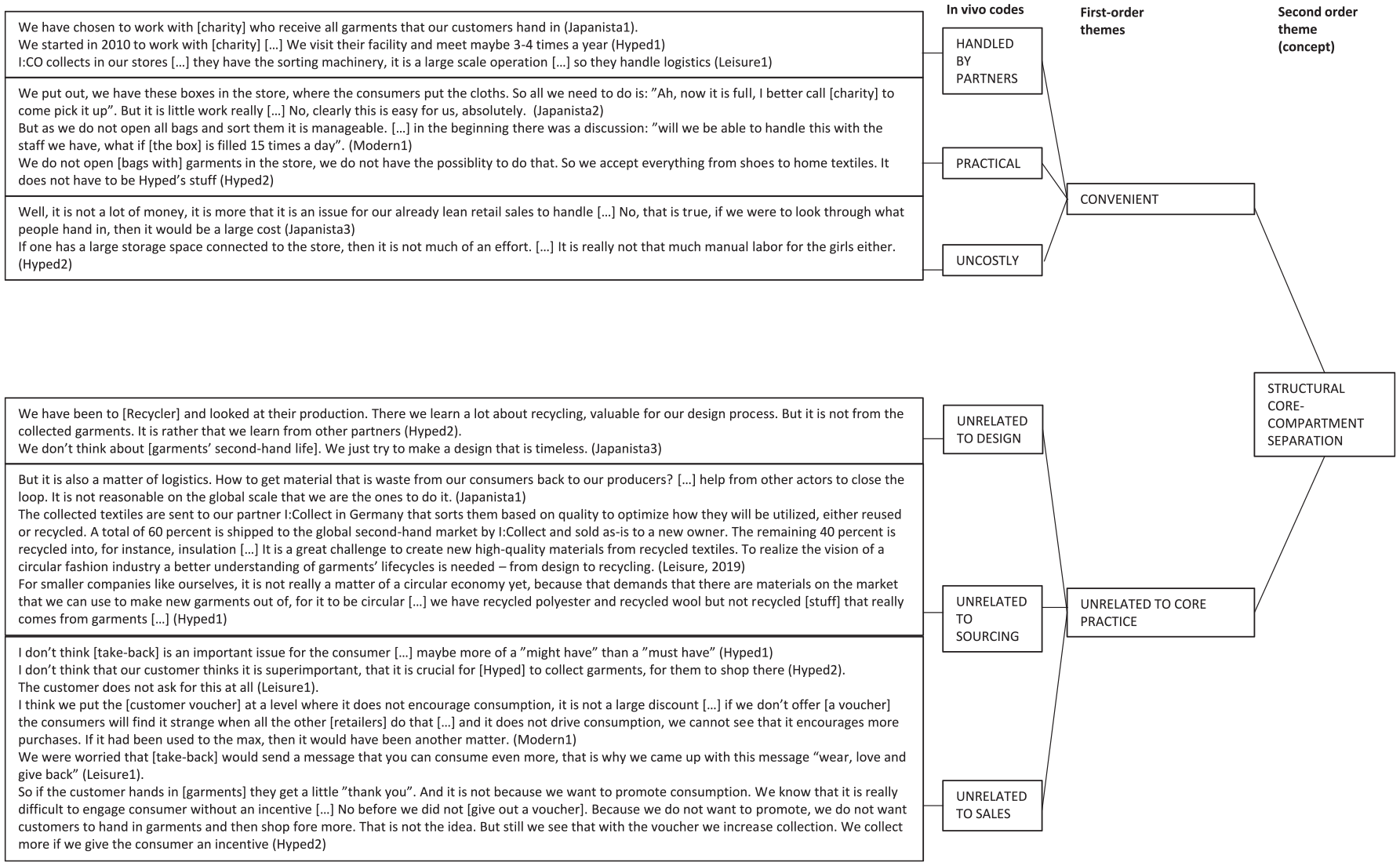
We then tested our emerging first-order themes across the cases, finding that we could replicate them to a high degree. We found remarkable similarities across cases already in the vivo codes, although the exact activities that codes referred to differed. For instance, all firms had chosen partners to take care of all the sorting and exporting activities beyond the collection in the store, but they had chosen different partners. Moreover, not all firms used collection boxes or handed out vouchers to incentivize consumers, but we still found that collection was organized to be very practical and effortless for store personnel. Thus, we thematized the organization of the decoupled mean as “convenient” because the heavy and costly sorting work was outsourced to partners.
In parallel, we analyzed the collection’s links to fashion firms’ core practices, namely, how clothes are designed, sourced, or marketed toward consumers, and did not find that the garments collected were in any way used for production practices, neither as material to make new clothes nor as inspiration for designs. More importantly, our respondents described taking active steps to make sure that garment collection was not used to promote an increase in sales. In aggregate, this led us to label garment collection as being “unrelated to core practice.”
We combined these above-mentioned themes into “structural core–compartment separation” (see Figure 1), a concept that refers to how garment collection (the decoupled mean) is conveniently and structurally arranged in a compartment separated from fast fashion production (core).
Structural core–compartment separation.
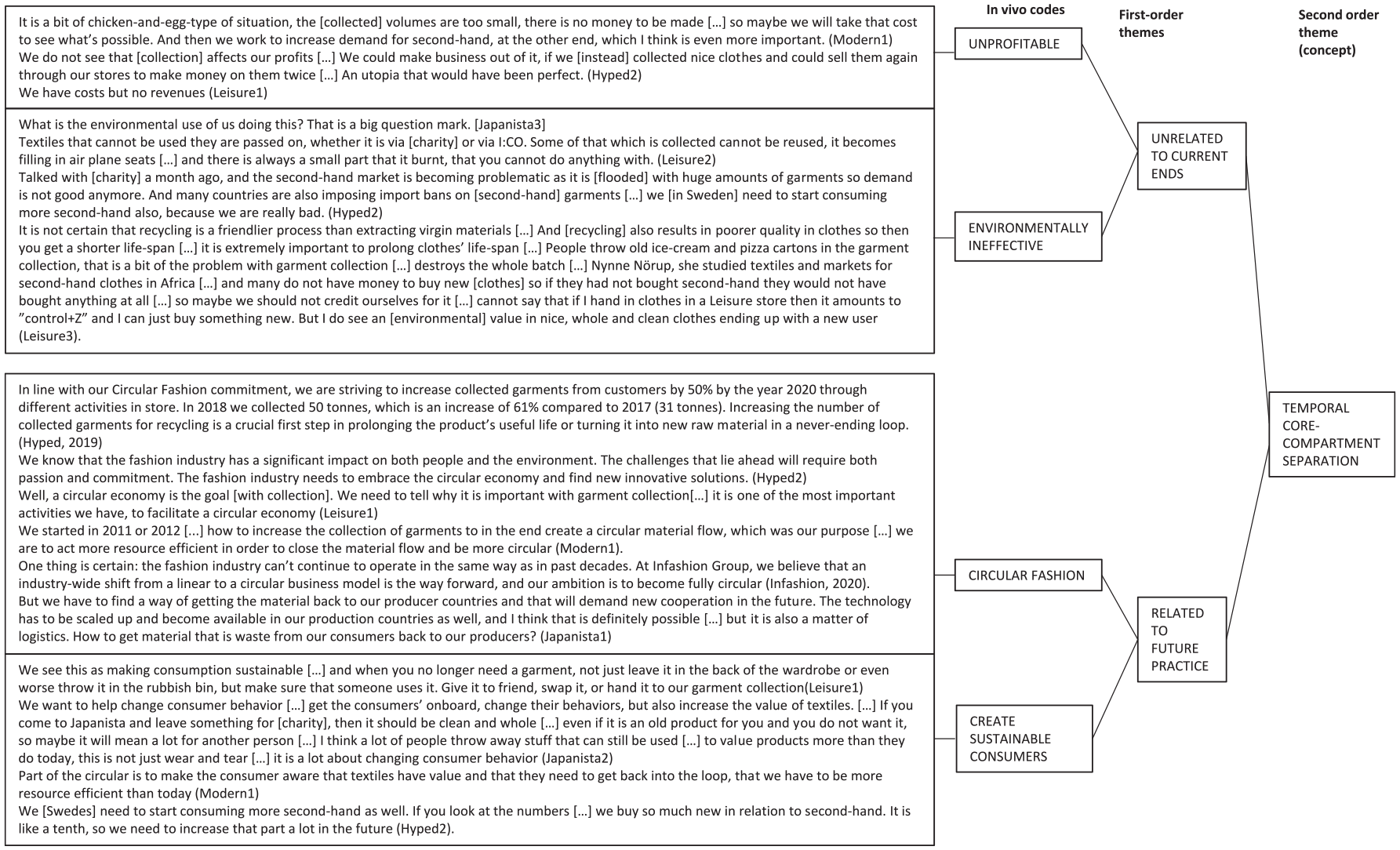
In reflecting on “structural core–compartment separation,” we found that it did not constitute the only organizational arrangement to be found in the data. The energy that our respondents put into featuring used garment collection as a means for systemic change toward a future circular fashion system led us to code each case in view of different possible “ends,” and eventually a second concept, “temporal core–compartment separation,” emerged. With this arrangement, used garment collection is organized separately from core practice, not just structurally, but across time. We found that, on one hand, garment collection is presently seen as unprofitable and undetermined in terms of positive environmental impacts. On the other hand, respondents argue that in the future, when fashion has become circular, garment collection will make both environmental and economic sense, as firms will then be able to use collected garments as valuable inputs. In such future circular fashion practice, used garment collection would be integrated as a key activity to control material supply (Figure 2).
Temporal core–compartment separation.
Findings
Below we proceed to present and empirically exemplify structural and temporal core–compartment separations.
Structural Core–Compartment Separation
Convenient
Garment collection is arranged very conveniently in collaboration with partners, either national charities or I:Collect, a private company. Partners already have organizations set up and do all the sorting of collected garments, which is labor-intensive and thus expensive. Moreover, retailers accept all types of brands and even broken garments, so store personnel does not have to open bags and check what consumers hand in. Consumers simply drop their bags of clothes in a box, placed conveniently close to the cash register so that sales personnel can verify that a consumer has handed something in and deserves to be rewarded with a voucher. Thus, the collection does not interfere with the work of personnel, especially as the volumes collected in each store are quite modest.
So all we need to do is: “Ah, now it is full, I better call [charity] to come pick it up.” But it is little work really . . . clearly this is easy for us, absolutely. (Japanista2)
We found that all retailers have arranged collection in a way that is handled by partners, practical and at hardly any cost for retailers. The laborious burden of sorting the material is passed on to the partners, whereas collection is conveniently organized for retailers.
It can be dirty and it can be really nice stuff so we need someone that has the possibility to sort it. (Hyped2)
All possibilities to use collected garments to replace production activities and thus mitigate the environmental impacts of fast fashion are thereby also passed on to partners, who have the actual control over how and where collected garments end up.
Unrelated to core practice
Fast fashion is about offering consumers trendy garments at a low price. It is a production practice premised on tight links between design, sourcing, distribution, and retailing (Cachon & Swinney, 2011). Tight links are needed to facilitate fast response, as trends wax and wane quickly. This begs the question if garment collection is anyway used for the various activities that make up fast fashion practice. For instance, as firms are attempting to increase the use of recycled inputs, one could think that collected garments were in some way recycled to become new materials used as inputs for the clothes they produce themselves; this is, however, not the case. This is explained by recycling and sorting technology not being advanced enough to handle the type of flows that retailers’ garment collection generates. And even if it was, the recycled textile would have to be transported back to producer countries. Regarding the marginal recycling that is presently done, other leftovers, of uniform quality, are used instead: Yes, there is no direct link to us today. But we have had a couple of these remake-projects where they have used left-over garments, but they have been garments that have been unsold in the store, . . . some smaller projects, but not with collected garments. (Hyped1) [N]othing goes back to Japanista’s production, we make sure that it is reused somewhere else instead. (Japanista2)
The case firms’ use of recycled input is, in fact, marginal. Infashion uses only 2.2% recycled inputs in total (Infashion, 2020), whereas Hyped uses a mere 0.1% (Hyped, 2020). Furthermore, recycled polyester, the most used recycled material, is not actually made out of old clothes at all but comes from PET bottles.
Even if collected garments are not used, the information gleaned from what gets handed in could still be valuable for designers, as it can help them learn what makes their own designs tear or last longer. Nevertheless, the collection arrangement makes this impossible as used clothes are not returned to the respective design departments but mixed and processed regardless of their origins. Instead, partners provide sustainability managers with general information about the received garments, such as which percentages are exported or downcycled.
We are told . . . how much that is downcycled. We get some of that statistics from them. (Hyped2) About 50–60% of the textiles are sorted for re-wear or reuse . . . About 35–45% of the textiles are recycled to become products for other industries or made into new textile fibers. (Infashion, 2020, p. 50)
Managers do not even know which foreign markets clothes end up in, as partners sell to international used clothes and textiles intermediaries before they reach their final destinations (cf. Brooks, 2019).
Finally, consumers do not really ask for collection but it could nevertheless be interpreted as a sales tactic, a scheme devised to get consumers to replace the old items in their closets with new ones, especially as firms reward consumers that hand in garments with vouchers. Infashion, Leisure, and Modern offer a 50 SEK voucher on a new purchase per bag of textiles. Hyped did not at first, but it started with vouchers to boost collected volumes.
When you hand in a bag of textiles you get a 50 SEK discount on a purchase above 300 SEK. You can get max two discounts each time. (Infashion, 2020, p. 47)
Yet respondents claim to make efforts to counter such effects: We were worried that [collection] would send a message that you can consume even more, that is why we came up with this message “wear, love and give back.” (Leisure1)
The voucher is argued to be an incentive that is needed to teach consumers this new behavior: We offer our customers incentives for sustainable actions, for example through brand-led garment collection schemes. (Infashion, 2020, p. 23)
We understand the above-mentioned examples as describing that collection is arranged to have few, if any, activity links to the core practice of designing and selling garments. This arrangement reduces the need to coordinate and integrate collection with core practice, which makes sense as collection has little effect on firms’ ends, and the integration of contradictory activities demands effort (Hengst et al., 2020). It combines with the convenient arrangements described above to make sure that the collection does not interfere with the operation of fast fashion production.
Temporal Core–Compartment Separation
Unrelated to current ends
Respondents agree that garment collection has little positive economic effect for them; it is described as providing “only costs, not revenues” (Leisure1). This is mainly because the fast fashion clothes they collect are difficult to sell again as vintage, and sorting out vintage clothes is labor-intensive and therefore expensive when done in Sweden. In addition, the environmental use of collecting clothes is also recognized as questionable because our respondents do not know what happens to collected clothes after they are passed on to partners. There are no life cycle analyses to prove that exporting clothes to developing countries reduces the demand for virgin clothes and their associated environmental impacts.
Related to future practice
Although these acknowledgments of the collection’s marginal environmental benefits could reduce the motivation for doing it, collection is justified through reference to a particular rational myth centered on the economic and environmental necessity, and realism, of fashion becoming circular. In this myth, garment collection is positioned as both a “bridge” toward this future and a possible component in the future circular fashion. In circular fashion, used clothes would either be sold again or recycled into material inputs for new ones, and the use of virgin material would be marginal (instead of the other way around; EMAF, 2017).
Garment collecting in our stores is one step on our circularity journey, inviting our customers to become part of the solution and help expand the lifespan of garments and increase reuse or recycling of materials. (Infashion, 2020, p. 37) A circular economy is the end goal. If you are not saying why you are doing things, people cannot understand why garment collection is important. (Leisure1)
In this circular fashion, future garment collection would be economically and environmentally meaningful as it would provide retailers with valuable resources while reducing the environmental impacts of virgin production. In other words, the “compartment” would become part of the core; all that separates it is time: At [Infashion] we believe that an industry wide shift from a linear to a circular business model is the only solution. (Infashion, 2019, p. 18) The challenges we all face are not small, but we know what we need to do. We need to use resources in the best way and move towards a circular economy that values economic aspects equally to the social and environmental ones. (Modern, 2020, p. 41)
Collection is argued to speed up the transition to this circular fashion future by creating sustainable consumers with changed behavior who have become supporters of a circular fashion offer. Such sustainable consumers would take better care of their clothes, buy more secondhand, and stop putting used clothes in the rubbish bin.
We want to help change consumer behavior . . . get the consumers onboard, change their behavior . . . (Japanista2) Part of the circular is to make the consumer aware that textiles have value and that they need to get back into the loop, that we have to be more resource efficient than today. (Modern1)
We interpret collection as unrelated to present ends but motivated by its potential to create sustainable consumers and circular fashion. It is a narrative arrangement, where firms make use of and contribute to an emerging rationalized myth of circularity. It puts forth the separation between core and compartments as one across time: The compartment (collection) is argued to be (part of) the future core, when industry and consumption will have transformed. Because these accounts claim that it is time that separates core and compartment, we conceptualize this as temporal core–compartment separation. We interpret this arrangement as being able to motivate perceived efficiency and functional gaps as gaps are described as merely temporary, to be overcome on the way toward the future of fashion. Such motivation would make it easier for organizational members to understand why these activities are needed and why they may presently be ineffective.
Discussion
To understand the implications of structural and temporal core–compartment separations, we now discuss them directly in relation to the three organizational consequences suggested by Bromley and Powell (2012).
Outcomes of Structural and Temporal Core–Compartment Separations
The prior theory proposes that the implementation of decoupled practices makes them internally complex, as implementation fragments organizations and makes them difficult to manage and integrate (Hengst et al., 2020). We suggest that structural core–compartment separation mitigates such difficulties: First, the convenience of structural core–compartment separation should work to significantly reduce the burden on management; second, compartmentalization saves the operators of mismatched activities from the frustration of having to try to fit them together. For instance, as collected garments are exported rather than used as inputs, fashion designers do not need to adapt their designs to what they can make from old clothes and textiles but retain their creative freedom. Moreover, retail staff does not have to mix the handling of new clothes for sale with the sorting of received dirty ones. Structural compartmentalization then reduces the risk that employees at various organizational levels encounter and experience efficiency gaps and grow frustrated with them.
Nevertheless, even if structural core–compartment separation hides efficiency gaps, it cannot do so completely and for all organizational members. For instance, the managers that are responsible for implementing a decoupled mean, and continuously oversee its arrangement, remain aware of gaps, and from Seo and Creed (2002) we learn that such awareness should prompt at least a certain amount of critical reflection. That, in turn, calls for ways for managers to justify, for themselves and others, this situation and its disconnectedness. Here temporal core–compartment separation provides such a justification, as it construes efficiency gaps as merely temporary. It makes for a second way of mitigating the negative effects of the internal complexity that follows from means–ends decoupling. Thus, in relation to internal complexity, we suggest that whereas structural core–compartment separation reduces the exposure of efficiency gaps, temporal core–compartment separation instead justifies them.
Perpetual reform could consume resources and divert organizational focus, regardless of whether reforms occur in waves or through the continuous tinkering with activities. Unlike the efficiency gaps discussed above, perpetual reforms are driven by the exposure of functional gaps, the realization that an implemented mean is not working to achieve its intentions (Bromley & Powell, 2012). That notwithstanding, structural core–compartment separation should also be able to obscure such gaps, at least among a majority of organizational members, as what is being done and its effects are effectively “hidden” inside a compartment. The consequences of these types of means are difficult to determine to begin with (Wijen, 2014), and compartmentalization adds to opacity. In our study, it seems highly unclear what really happens to collected garments, as they are sent to multiple foreign markets. Nevertheless, the potential of structural core–compartment separation to eternally hide functional inadequacies should perhaps not be overestimated, as eventually, external stakeholders may start to investigate, and expose, what is going on “inside” the compartment. However, this could take time and be difficult. Similar to what we suggested above in relation to internal complexity, managers that organize compartmentalization remain reasonably aware of functional inadequacies, even if issues are complex and opaque. This awareness may trigger their appetite for reform, which could be a problem for an organization’s ability to maintain means–ends decoupling. Yet again we suggest that temporal core–compartment separation should work to dampen this appetite as functional gaps are construed as temporary.
Finally, we have argued that the diversion of resources is both a consequence of means–ends decoupling in itself and exacerbated by internal complexity and perpetual reform. Again, we suggest that structural core–compartment separation can mitigate such consequences: As structural separation makes implementation expedient and convenient, it reduces the direct costs of means–ends decoupling. Furthermore, as activities are compartmentalized, it reduces the perceptions of resources being diverted, simply because these activities are hidden from view. Moreover, by pointing to the necessity and realism of fulfilling a rationalized myth, temporal core–compartment separation arguably justifies that resources are used to attain that future but also that changes will necessarily take considerable time and be difficult to succeed with.
Contributions to Decoupling Research
Extant theory suggests that means–ends decoupling appears quite unstable, ineffectiveness is generally difficult to defend, and over time, these difficulties should accumulate (Dick, 2015). However, with the exception of Japanista, we did not really encounter difficulties or instability. We suggest that this is because organizations, through structural and temporal core–compartment separations, find convenient ways of dealing with means–ends decoupling. Thus, we suggest that such organizing can actually render means–ends decoupling quite persistent. Certainly under severe economic hardship, such as that experienced by Japanista, when a firm is really fighting for its economic survival, even these highly convenient arrangements do not suffice. Under such circumstances, firms likely cancel all activities not directly related to core economic ends so that means–ends decoupling is discontinued (Japanista also stopped sustainability reporting and dismissed staff).
In Figure 3, we summarize our theoretical contribution, building on how the two concepts we introduce explain how organizing can mitigate the instabilities of means–ends decoupling, so that this decoupling can persist over time. Especially when these two ways of organizing are combined, they should enable firms to solve the conundrum of living with contradictory competitive and institutional pressures, to be both legitimate and efficient, in a manner that seems more convenient and less risky than engaging in pure pretense. Thus, to the debate regarding the stability of decoupling we submit that persistence seems possible if certain organizational arrangements are in place. In other words, we caution against writing off decoupling as merely a transitory phenomenon and suggest that decoupling deserves continuous attention as a key organizational response to the institutional complexities that organizations face.

Organization and mitigation of means–ends decoupling.
Contributions to Research on Justification and Organizational Temporality
That temporal core–compartment separation serves to justify gaps within means–ends decoupling warrants further reflection. Justification has been much discussed within institutional theory, particularly in relation to the institutionalization of new practices (Barley & Tolbert, 1997). In a general sense, justification sits within the broader tradition of referring to how meaning relates to organizational practice (Zilber, 2017), for instance, when it comes to matters of change or maintenance (Stål et al., 2015). For instance, Greenwood and colleagues (2002) examined how new legal practices were justified by being aligned with professional values and argued that justification was necessary, although not sufficient, for new practices to diffuse across organizations. What we would like to add to their account is that justification comes in many different forms, in our case in the use of imageries of the future. Moreover, we position justification not as a stepping stone toward change but rather as a possible explanation and rationalization for a decoupled status quo, serving on one hand to dampen organizational members’ appetite for reform but also to ward off criticism against efficiency gaps. With that, we find a justification that refers less to professional values but instead aligns practices with external rational myths by engaging with organizational temporalities.
Because of this latter point, where we see the use and reference to the distant future, we gather some implications for the ongoing conversation on how time and temporality matters in organizing (Hernes & Schultz, 2020; Reinecke & Ansari, 2015) and corporate sustainability (Mazutis et al., 2021; Slawinski & Bansal, 2012; Slawinski et al., 2017). Here it is pointed out that organizations operate with two contrasting orientations to time: linear (Cronos, quantitative, measurable) and process time (Kairos, meaningful, floating; Reinecke & Ansari, 2015). Corporate sustainability scholars have argued that firms need process, rather than linear, orientations to time to engage with the systemic nature of sustainability and its manifold issues (Mazutis et al., 2021) and avoid short-termism (Slawinski et al., 2017). Temporal core–compartment separation (where temporality is used to provide meaning rather than to measure progress) also seems informed by such a process orientation, as we found the distant future to be very loosely connected to the present. In other words, we found few concrete plans, timetables, or deadlines to substantiate how garment collection is to bring about a circular fashion. To us, this suggests that while process time may provide a corporate sustainability strategy with important flexibility and openness (Reinecke & Ansari, 2015), it also comes with the risk of becoming too lax to be effective.
We find support for our skepticism of process time in Hernes and Schultz (2020). Although they argue that reflecting over a distant future can prompt change, they suggest that “effective” reflection is related to clear events that ground activity and change. Without the possibility of anchoring a distant future in examples of singular or exemplary events, for instance, some more concrete definition (or point in time) when a firm’s fashion will have become circular, it seems that an overly processual orientation to time may actually sustain rather than transcend decoupled practices. In other words, we would like to caution against overly optimistic views about the depth and reach of the sustainability implementation that can stem from processual orientations to time, as flexibility swings both ways. Thus, to the ongoing discussions of how temporal orientations inform corporate sustainability we submit the following: Although reflections over distant futures can motivate change, as Hernes and Schultz (2020) suggest, such reflection likely needs elements of both processual and linear temporal orientations to be effective. In other words, it is necessary to balance and combine the openness of the processual orientation with the efficacy of the linear one. Otherwise, loose reflection over the future may just as well serve to justify the status quo and maintain decoupled means.
Contributions to Corporate Sustainability Research
These arguments bring us to our last point, namely that our introduction of structural and temporal core–compartment separations contributes to critical sustainability research that seeks to take the environmental effectiveness of corporate sustainability seriously (Ergene et al., 2021). From such a perspective means–ends decoupling matters not because there is a decoupling between implemented action and firms’ goals (Bromley & Powell, 2012), or perhaps even between actions and intentions (Wijen, 2014). Rather what matters is whether implemented actions have any chance of bringing an end to corporate unsustainability. Here core–compartment separation implies that even if corporate sustainability practice, and the push for greater accountability and transparency, increasingly involves businesses going beyond smoke and mirrors, there is still much opportunity for firms to carry on with harmful core practices, such as mass-producing fast fashion, in parallel. In other words, via compartmentalization, much of the business-as-usual can continue. Thus, structural and temporal core–compartment separations come across as a type of greenwash that goes beyond product marketing and corporate communication. It involves real action but of a symbolic rather than substantive nature. With that we align and add to recent attempts to broaden the notion of greenwash (Lyon & Montgomery, 2015) beyond being merely about misleading consumers (Delmas & Burbano, 2011). As we have argued throughout, the audience for the type of greenwash we have encountered may just as well be the employees or even managers themselves. It is also important to point out that such a broad notion of greenwash recognizes that it is not necessarily deliberate (Lyon & Montgomery, 2015). To be sure, we do not suggest that the organizational arrangements we observed have been intentionally designed to sustain the “evils of fast fashion,” rather we simply suggest that they may have this effect.
Thus, from a greenwash perspective, structural and temporal core–compartment separations are problematic, not because they mitigate efficiency gaps but because these arrangements delay more radical, but necessary, change. Hence, structural and temporal core–compartment separations create inertia at a point in time where forceful responses to unsustainability are desperately needed. The prevalence of core–compartment separation offers one possible explanation for why the greening of corporate action occurs (Kok et al., 2019) in tandem with increasing environmental damage (Dyllick & Muff, 2016). In other words, the fact that firms are increasingly taking real action to address environmental unsustainability, sometimes even going far beyond legal demands (Hahn et al., 2017), matters less when actions are compartmentalized from those core practices that generate damage. Understanding how, when, and with what effect firms organize means–ends decoupling is a crucial first step toward changing these things.
Conclusion
This article contributes to research on decoupling by investigating how, and with what outcomes, firms organize means–ends decoupling. By analyzing Swedish fast-fashion retailers’ implementation of used garment collection, we discover two different ways of organizing: structural and temporal core–compartment separations. These concepts help understand why means–ends decoupling could be quite persistent, contrary to what extant theory suggests. This because these ways of organizing both justify and conceal efficiency gaps that could, if revealed, disrupt means–ends decoupling.
These concepts are not industry-specific, but further research is needed to clarify their boundary conditions. For instance, the example of Japanista indicates that the convenience of core–compartment separation is not enough to sustain means–ends decoupling when economic pressures become extreme, when there is the threat of imminent bankruptcy. Nonetheless, as the other case firms also experienced moderate competitive pressures we feel confident that these organizational arrangements are not just effective in good times. Moreover, there are conditions under which firms cannot fully control how to organize means–ends decoupling, when institutional pressure details how practices are to be implemented (Wijen, 2014). Under such conditions, we may find fewer, or not so convenient, examples of structural core–compartment separation. Further still, as temporal core–compartment separation draws on preexisting rational myths as building blocks for its narrative arrangements, it may work less well when myths do not provide that possibility. Indeed, widespread myths that refer to systemic changes in the future may be particularly useful for temporal core–compartment separation. While more diverse cases would have increased and clarified the conditions covered by our conceptualization, we prioritized consistent conceptual development in relation to a new phenomenon and therefore sought to restrict empirical variation. Furthermore, while compartmentalization made it difficult for us to gain access to more respondents per firm, our findings would have benefited from more observations of firms’ internal processes, but decoupling, and compartmentalization, are difficult phenomena to gain access to insofar as respondents are hesitant to have them fully displayed. Finally, while we found little variation over the 5 years that we followed decoupling, 5 years can seem short. It may be relevant to follow the organizing of means–ends decoupling over an entire economic cycle, as organizing may depend on the strength of economic pressures.
From a practical perspective, while “our” managers already seemed to know how to conveniently organize, our findings could help other managers understand how they can organize means–ends decoupling to make it more stable and avoid internal criticism. Such organizing will likely not make organizations more environmentally sustainable, but it can help organizations face contradictory demands better and make life easier for managers and employees. However, our conceptualizations should also be of interest to external (and internal) stakeholders that take a serious interest in sustainability and want to know how they can push “their” organizations to take substantive action. In particular, such stakeholders may be interested in how to avoid too much organizational stability as the persistence of unsustainable practices does not benefit environmental progress. In that sense, understanding how, and with what effects, firms organize can be a first step in trying to influence practice. Such efforts may actually be about exposing, rather than hiding, some types of gaps, to counter complacency and force others to reflect, and ultimately, act.
Footnotes
Acknowledgements
We are thankful for the supportive and constructive comments from associate editor professor Sébastien Mena and three anonymous reviewers and also for the kind help of our interviewees as well as the aid and support of assistant professor Maira Babri, who read and commented on an earlier version of this text.
Declaration of Conflicting Interests
The authors declared no potential conflicts of interest with respect to the research, authorship, and/or publication of this article.
Funding
The authors declared the following potential conflicts of interest with respect to the research, authorship, and/or publication of this article: We acknowledge the financial support of Sweden’s innovation agency Vinnova (Grant 2016-03496_6), the Swedish Energy Agency (Grant 44087-1), Kamprad Family Foundation Entrepreneurship, Research, and Charity, (Grant 20160063) and Sweden’s research council for sustainable development FORMAS (Grant 2019-00520).
