




Abstract
The influence of environment on social entrepreneurship requires more concerted examination. This article contributes to emerging discussions in this area through consideration of social entrepreneurship in South Africa. Drawing upon qualitative case study research with six social enterprises, and examined through a framework of new institutional theories and writing on new venture creation, this research explores the significance of environment for the process of social entrepreneurship, for social enterprises, and for social entrepreneurs. Our findings provide insights on institutional environments, social entrepreneurship, and the interplay between them in the South African context, with implications for wider social entrepreneurship scholarship.
Keywords
It is two decades since the end of apartheid and South Africa’s first democratic elections. Upon gaining office in 1994, the then and current African National Congress Government committed to the social, economic, and political transformation and development of South Africa, and to addressing the legacies and imbalances of the previous apartheid system. However, to date, progress in transforming South Africa’s society and economy has been mixed. South Africa is still one of the world’s most unequal countries, scoring 63.4 on the Gini index 1 (World Bank, 2009), while national poverty levels, although declining, remain stubbornly high, with 31% of South Africa’s population living below the national poverty line (Central Intelligence Agency World Fact Book, 2014).
Other prominent sustainable development challenges faced by South Africa include chronic unemployment, estimated at 25% (Trading Economics, 2014); low national skill and education levels; a high HIV/AIDS prevalence rate estimated at 19.1%, with around 6.3 million South African’s living with HIV and more than 2.4 million AIDS orphans (UNAIDS, 2014); high crime rates; and limitations in basic service provision (e.g., access to clean drinking water; Africa Check, 2013). There are limits to the capacity of South Africa’s government to address these varied problems. While there may also be insufficient profit-making potential or an absence of requisite functioning market institutions to encourage engagement with these issues by traditional businesses. It is in these “institutional voids” (Mair, Martí, & Ventresca, 2012) or “gaps” (Kolk, 2014) that South African social enterprises are often active.
Business has a key role to play in South Africa’s transformation and development. This includes not only traditional for-profit businesses, particularly through corporate social responsibility (CSR) activities, but also social enterprises which combine economic and social objectives, with the latter “built-in” to their operating models. In line with global trends, and developments in the rest of Africa, there is increasing interest in and engagement with social entrepreneurship and innovation in South Africa, as mechanisms for addressing complex “wicked” sustainable development problems. This is reflected in growing international and domestic research on social entrepreneurship in South Africa (e.g., Karanda & Toledano, 2012); the creation of learning hubs for knowledge exchange (e.g., the Bertha Centre for Social Innovation and Entrepreneurship [BCSIE] at the University of Cape Town); and the formation of practitioner networks (e.g., The African Social Entrepreneurs Network 2 [ASEN]).
However, while there is growing academic interest in social entrepreneurship in South Africa, and across Africa more widely (Kerlin, 2008), at present, this research remains quite nascent and fragmented. To date, there has been limited consideration of how wider and ongoing debates about the definition and characteristics of social entrepreneurship, social enterprises, and social entrepreneurs play out in African environments. These limitations are highlighted in a recent contribution by Rivera-Santos, Holt, Littlewood, and Kolk (2015), which examines quantitatively social entrepreneurship across sub-Saharan Africa, finding evidence of the significance of African contextual dimensions for understanding social entrepreneurship in such settings. Their findings support incorporating the consideration of the environment into social entrepreneurship research to enrich our understanding of the phenomenon globally, while they also call for more in-depth research of the kind conducted in this article examining the interplay between social entrepreneurship and the environment within and across African countries (Rivera-Santos et al., 2015).
The need for greater consideration of the influence of environment on social entrepreneurship is further recognized in wider literature. For instance, Mair and Martí (2006) comment how “social entrepreneurship has different facets and varies according to the socioeconomic and cultural environment” (p. 40). Similarly, Bacq and Janssen (2011) note that “the influence of the external environment on the individual, the process and the organization has only received little, if not to say no, attention in the social entrepreneurship literature” (p. 387). Furthermore, much of the current academic discussion around the nature of social entrepreneurship is occurring in United States and European forums, drawing largely upon understandings, experiences, and data from the developed world. There is a need to bring in more disparate voices and knowledge to develop richer, more inclusive understandings in the field.
Drawing upon case study research with six social enterprises, this article explores how social entrepreneurship in South Africa is shaped by its environment, and particular institutional arrangements and contextual factors. Discussions are informed by writing on new institutional theories, with work on new venture creation by Gartner (1985) deployed as a framework for analyzing how environment influences social entrepreneurship as a process (e.g., locating business opportunities and marketing products and services), social enterprises (including their strategies for growth and resource acquisition), and the social entrepreneur (including his or her characteristics). This article contributes to our knowledge of the South African institutional environment. It adds to our understanding of the phenomenon of social entrepreneurship in South Africa. Finally, it provides insights on the dynamic interplay between social entrepreneurship and the environment in South Africa, with implications for wider social entrepreneurship scholarship.
The article is structured as follows. We first review the state of the field in social entrepreneurship literature, focusing particularly on definitional debates and work engaging with the themes of environment, and social entrepreneurship in Africa, while also locating our study and its contributions in relation to such work. We then reflect on the research methodology and introduce the case studies. This is then followed by discussion of the environment for social entrepreneurship in South Africa. The influence of that environment on the process of social entrepreneurship, social enterprises, and social entrepreneurs is then analyzed. We conclude with detailed discussion of article’s contributions to knowledge and theory, and reflect on potential areas for future research.
Literature Review
In his highly cited work, Gartner (1985) describes a framework for new venture creation integrating four interrelated elements, namely, the individual(s) who start the venture; the organization they create; the processes underpinning the new venture’s foundation and development; and the surrounding environment. Unpacking these elements, Gartner first suggests that factors such as age, education, previous work experience, as well as psychological dimensions such as the need for achievement and risk taking propensity are important characteristics in describing and differentiating entrepreneurs. Second, Gartner contends that contrary to the approach adopted in much of entrepreneurship research, it is important to consider the characteristics of the organizations being created (which he describes particularly in relation to strategic choices such as the competitive strategies firms chose). Third, in describing the process of new venture creation, Gartner identifies six dimensions of this process: (a) locating a business opportunity; (b) accumulating resources; (c) marketing products and services; (d) producing a product; (e) building an organization; and (f) responding to government and society. Finally, Gartner identifies a host of environmental variables, from living conditions to venture capital availability, barriers to entry, and the bargaining power of suppliers and buyers. Gartner develops his framework and identifies these variables drawing upon extant literatures. Yet he concludes by stating that neither his list of variables nor his wider framework claim to be definitive and that he is rather arguing for descriptions of new venture creation that are more comprehensive, and which recognize and appreciate the complexity and variation present in this phenomenon.
Gartner’s (1985) framework is adopted and adapted to structure discussions and inform our analysis in this article, including our selective engagement with Gartner’s wider variables. Attention focuses particularly on three of his identified relationships: between the environment and the process of (social) entrepreneurship, between the environment and the (social) enterprise, and between the environment and the (social) entrepreneur (see Figure 1).
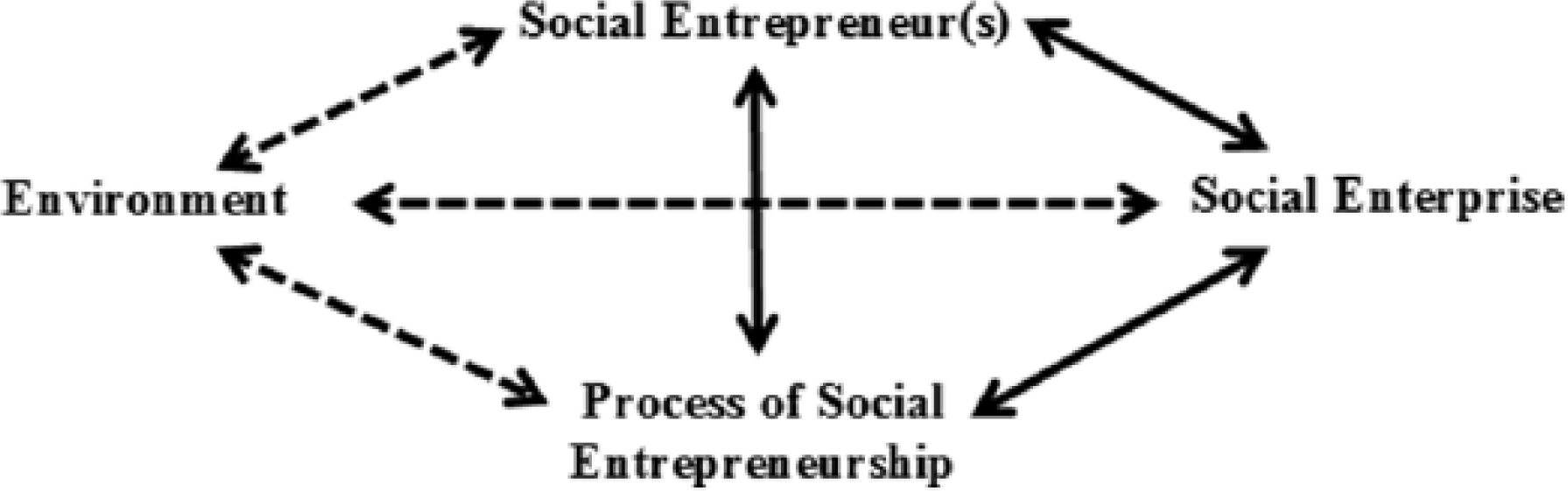
Gartner’s framework adapted for this research.
Gartner’s (1985) framework has been deployed in wider social entrepreneurship literature. For example, Bacq and Janssen (2011) use it to structure their literature review and analysis of the state of the social entrepreneurship field and, in particular, to consider whether research from different geographical spaces focuses on different elements of his framework (e.g., the U.S. Social Innovation School with its strong emphasis on the entrepreneur and his or her characteristics vs. the European EMES 3 approach which stresses collective governance mechanisms and focuses much less on individuals). Bacq and Janssen’s work illustrates how Gartner’s framework can be adapted, with criteria such as social mission, and its relationship with productive activities, added as part of their comparison of different understandings of the process of social entrepreneurship. They further introduce the criteria of (appropriate) legal forms, and constraints on profit distribution, to consider different understandings of what constitutes a social enterprise.
In this article, Gartner’s framework adds structure to discussions and also variables for analysis. The qualitative in-depth case study approach adopted here, furthermore, aligns well with Gartner’s arguments regarding recognition of heterogeneity and complexity in the phenomenon of new venture creation.
The Environment
The importance of the environment and its influence on new venture creation has long been recognized in wider entrepreneurship literature (Low & Macmillan, 1988), with calls for it to be given greater attention in social entrepreneurship research (Haugh, 2005). Early recognition of the significance of environment in social entrepreneurship studies can be found in writing by Mair and Martí (2006), while more recently, it has been discussed in relation to social bricolage (Di Domenico, Haugh, & Tracy, 2010), the legal forms adopted by social enterprises in different countries (Peattie & Morley, 2008), its manifestations in particular national contexts (e.g., Germany; Engelke, Mauksch, Darkow, & von der Gracht, 2016), and how characteristics such as the relative importance of formal and informal institutions (Rivera-Santos, Rufín, & Kolk, 2012), and the quality of economic and physical infrastructures (Partzsch & Ziegler, 2011) affect the emergence of such ventures.
Munoz (2010) proposes a more geographically orientated research agenda on social entrepreneurship, identifying the need for greater engagement with space and place in understanding issues such as social enterprise impact, the characteristics of social entrepreneurs, and interactions between social enterprises and policy, including how these relationships are mediated by issues of power and agency. Bacq and Janssen (2011) meanwhile, in their review of the state of the social entrepreneurship research field, also consider the influence of geography on social entrepreneurship definitions, on the process of social entrepreneurship, and on organization characteristics. They conclude by calling “for further research on the role of the environment in social entrepreneurship . . . maybe on the basis of theoretical frameworks like contingency and new institutional theories” (Bacq & Janssen, 2011, p. 391). Finally, and as discussed earlier, Rivera-Santos et al. (2015) recently examined social entrepreneurship across sub-Saharan Africa and its relationship with environmental characteristics, where they identify the need for “more fine grained analyses” (p. 21), of the kind conducted in this article, at country and even community levels.
This article responds to these varied calls to pay greater attention to the environment and contextual dimensions in social entrepreneurship research, with these studies also providing strong justification for our work. However, drawing upon new institutional theories, our study further contributes toward the need identified for more theoretically engaging social entrepreneurship scholarship (Dacin, Dacin, & Matear, 2010; Santos, 2012).
New institutional theories are now widely deployed across the management discipline, with studies drawing particularly upon more sociological traditions (Di Maggio & Powell, 1983; Scott, 2001). Central to new institutional theories is the idea that organizations and their behaviors are shaped by the institutional environment in which they are located (Scott, 2001). The degree of agency organizations have relative to their environments, as well as their role in establishing and influencing such environments, is a significant area of difference between new and old institutional theory (Barley & Tolbert, 1997).
Institutional environments are commonly considered to comprise three principal components, the regulative, normative, and cognitive “pillars” (Scott, 2001). When applied at a national level of analysis, the regulatory pillar represents the laws and rules in a particular country promoting certain types of behavior and restricting others. The normative pillar meanwhile refers to more general values, norms, and beliefs about acceptable types of behavior by and within organizations. Finally, the cognitive pillar focuses on individual understandings and how certain types of behavior become embedded. New institutional theories posit that organizational structures and behaviors develop to reflect the legislative, normative, and cognitive requirements of institutional environments, adherence to which ensures legitimacy. Isomorphic processes are suggested to drive this process, for example, coercive isomorphism linked to the regulatory pillar where organizations adhere to national legal frameworks or mimetic isomorphism where organizations move toward “best practice” in an area of activity, where this practice is regarded as particularly legitimate in an organizational field.
New institutional theories have been applied in the study of organizations in transition economies, for example, economies in East and Central Europe after the fall of communism (Roth & Kostova, 2003), where authors note the tendency that some older inefficient institutions persist even after radical institutional change, and that new institutional structures are in part often built on pre-existing ones. Roth and Kostova (2003) introduce the notion of “institutional imperfections” to describe scenarios where there is a gap between a desired institutional arrangement and the actual institutional form during periods of transition. This writing and these ideas have salience for South Africa, which underwent its own major economic, social, and institutional upheavals and transitions following the end of apartheid.
Engagement with new institutional theories can also be found in subsistence market literatures. For example, Rivera-Santos et al. (2012) analyze the impact of institutions on the structure of partnerships in subsistence markets (see also De Soto, 2000; Rivera-Santos & Rufín, 2010). These studies emphasize the uniqueness of the institutional environment in subsistence markets, where normative and cognitive institutions are suggested to prevail, with regulative institutions playing a much smaller (or negligible) role. It is suggested that in subsistence markets, business ecosystems are often characterized by a higher prevalence of structural holes, with regulatory gaps also often prevalent. Informed by this literature, it may be questioned where South Africa is positioned on a spectrum between subsistence markets with serious institutional gaps (at least in formal/regulatory terms) and developed countries with more established/mature institutions.
The subsistence markets literature is also useful in developing notions of institutional “voids” or “gaps.” For example, Parmigiani and Rivera-Santos (2015) identify five types of institutional voids, including product market, labor market, capital market, contracting, and regulatory. While Kolk (2014) suggests that institutional voids should not be conceived as spaces “empty” of institutions, but rather that informal rules or arrangements may exist yet they may be insufficient to enable the overall proper functioning and development of markets. Kolk proposes the term institutional “gaps” as an alternative to “voids” reflecting the varying degrees to which institutions may be present or absent in such markets. These literatures again raise questions about the presence and absence of institutions and the types of gaps or voids that exist in the South African environment and the roles social enterprises play in filling these.
Within the social entrepreneurship literature more specifically, the use of new institutional theories as an explicit theoretical lens remains limited. In one early example, Dart (2004) explored the global proliferation of the social entrepreneurship agenda using institutional theories to understand the role of socio-political context in this process. More recently, Nicholls (2010) deploys new institutional theories to examine the microstructures of legitimation that have characterized the emergence of social entrepreneurship as a field of research and practice. However, both these studies focus on social entrepreneurship at a macro and global level rather than examining its particular manifestations in a specific country context, as occurs in this article. In this article, new institutional theories are deployed as a lens not only to understand the environment for social entrepreneurship in South Africa but also to inform our analysis of how this environment influences processes of social entrepreneurship, social enterprises, and social entrepreneurs.
Social Entrepreneurship, Enterprises, and Entrepreneurs
Shared understandings and definitions of social entrepreneurship, social enterprise, and social entrepreneur remain elusive and are complicated by environmental factors. Social entrepreneurship has been defined as a process “involving the innovative use and combination of resources to pursue opportunities to catalyze social change and/or address social needs” (Mair & Martí, 2006, p. 37). Given the developing world focus of this research, and its engagement with new institutional theories, a further useful definition is that offered by Seelos and Mair (2005) who propose that “social entrepreneurship creates new models for the provision of products and services that cater directly to basic human needs that remain unsatisfied by current economic or social institutions” (p. 48). In this article, we deploy the term social entrepreneurship in two ways. First, we use it to refer to the overarching field of social entrepreneurship research and practice. Second, applying Gartner’s (1985) framework, social entrepreneurship is conceived as a process, for example, Bacq and Janssen (2011) define social entrepreneurship as “the process of identifying, evaluating and exploiting opportunities aiming at social value creation by means of commercial, market-based activities and of the use of a wide range of resources” (p. 388).
Consensus on the definition of social enterprise is similarly lacking, yet some frequently discussed characteristics can still be identified. For example, the centrality of a social or ethical mission is a common element in many definitions, with the primacy given to social over economic value creation suggested to be a key boundary condition separating such enterprises and “traditional” businesses (Dees, 2003; Defourny & Nyssens, 2006; Munoz, 2010; Peattie & Morley, 2008). Income generation through trading is another widely discussed trait and a way in which social enterprises can be distinguished from charities (Langdon & Burkett, 2004; Smallbone, Evans, Ekanem, & Butters, 2001). Other commonly identified attributes include stakeholder participation in governance (Defourny & Nyssens, 2006; Thompson & Doherty, 2006), limited profit distribution or profits reinvested for social purposes (Langdon & Burkett, 2004), a non-profit maximizing approach (Defourny & Nyssens, 2006), and innovation in addressing social problems (Dees, 2003). To date, discussion of the characteristics of African social enterprises and how they may differ from such ventures in other parts of the world remains limited. As highlighted by Rivera-Santos et al. (2015), there is also a need for greater consideration of variation across the African continent. Particularly pertinent may be the consideration of countries with different colonial histories, those in peaceful versus conflict affected states, those with varying levels of corruption, and those at different stages of economic and institutional development (e.g., subsistence economies vs. an emerging economy like South Africa).
Finally, there is the social entrepreneur, the individual(s) who found(s) the venture. A significant body of work now exists on social entrepreneurs and their characteristics (Catford, 1998; Chell, 2007; Peredo & McLean, 2006), often emphasizing their heroic “changemaker” status. Yet, in more European research traditions, the collective rather than individual nature of social entrepreneurship is often highlighted (Spear, 2006), with the social entrepreneur frequently accorded a secondary role (Bacq & Janssen, 2011). Furthermore, some studies highlight the potential for social intrapreneurs driving positive behavior change from within organizations (Mair & Martí, 2006).
Research on Social Entrepreneurship in South Africa
Literature and research on social entrepreneurship in South Africa remains relatively sparse. In one early example, Thompson and Doherty (2006) considered the social enterprise “Play Pumps” as part of an insightful, but descriptive, review of international cases. To date, perhaps the most comprehensive study of South African social enterprises was conducted by researchers at the University of Johannesburg supported by the International Labour Organization (ILO) and Belgian government. This study involved case study work with 24 South African social enterprises with an emphasis on best practice learning, and examining their backgrounds and history, business models, their target market, and issues of replicability. From this research, various tools, guides, and training materials were developed as well as reports addressing themes like impact measurement (Fonteneau, 2011) and appropriate enabling policy responses (Steinman, 2010; Steinman & van Rooij, 2012). While this work also offers significant insights, particularly for practitioners and policy makers, its theoretical engagement and contributions to wider social entrepreneurship scholarship are more limited.
Moving beyond the social enterprise as the unit of analysis, Urban (2008) quantitatively examines the intentions of South African students to engage in social entrepreneurship activity, and the skills and competencies required for success. In further justification for this article, Urban (p. 347) comments that social entrepreneurship is not only under-researched in a South African context, but given the sustainable development challenges the country faces, social entrepreneurship is also critical as “a phenomenon in social life.” In a more recent study, Karanda and Toledano (2012) consider narratives and discourses of social entrepreneurship, reflecting on how the meaning of “social” changes in South African and wider developing world contexts. Their study is conceptual but posits that the phenomenon of social entrepreneurship including its practice is highly contextual, again providing support for this article.
Limited academic work on social entrepreneurship in South Africa can be partially supplemented by practitioner literature, for example, Fury (2010) discusses social enterprise development in South Africa, and opportunities to create a virtuous cycle of investment, start-up, and impact, particularly in relation to Broad-Based Black Economic Empowerment (B-BBEE), a theme which is further explored in this article. Meanwhile, Meldrum (2011) considers social impact measurement and the application of European models to African contexts with reference to social enterprises in the Western Cape. Organizations such as the Social Enterprise Academy Africa (SEAA), ASEN, and UnLtd South Africa have also made a range of training materials available for social entrepreneurs. However, while useful, such work retains a strong practitioner rather than scholarly focus.
In summary, there is much about social entrepreneurship in South Africa that we still do not know. This study aims to contribute toward addressing some of these gaps, while also providing insights to enhance our understanding of social entrepreneurship across sub-Saharan Africa, the wider developing world, and globally.
Social Entrepreneurship in South Africa
The practitioner organization SEAA (2014) describes social entrepreneurship as “a way of doing business that makes positive social and/or environmental changes,” while ASEN (2014) defines social enterprises as “the organizations social entrepreneurs have established to put their innovations into practice encompassing small community enterprises, co-operatives, NGOs using income generating strategies to become more sustainable, social businesses or companies that are driven by their desire to bring social or environmental change.” Finally, UnLtd South Africa (2015) identifies social entrepreneurs as “passionate people who are committed to deliver sustainable solutions to social challenges in South Africa.” These local definitions illustrate the growing embeddedness of social entrepreneurship in South Africa. Yet interestingly, they also suggest a significant international influence on the definition of social entrepreneurship, enterprise, and entrepreneur in the South African context, and in how these terms are deployed by local practitioner groups.
Social entrepreneurship has quite a long history in South Africa with the U.S. Ashoka Foundation first establishing offices in the country in 1991 (there are now more than 300 Ashoka Changemakers in Southern Africa, many in South Africa). However, as early as 1892, South Africa’s first co-operative was formed in Pietermaritzburg, while during the apartheid period, South Africa also developed a strong civil society and tradition of social activism. Yet it is over the last 10 to 15 years in particular that social entrepreneurship as a phenomenon, and the social economy in South Africa, has blossomed. For instance in 2001, PhytoTrade Africa, the trade association of the Southern African natural products industry, was established with the aim of alleviating poverty and protecting biodiversity. Three years later in 2004, Cooperation for Fair Trade in Africa (COFTA) was formed, including South African members. More recently in 2009, ASEN was created (though this suspended activities late 2014), and in 2012, the SEAA began, both based in South Africa. As previously discussed, growing practitioner activity has also been accompanied by increasing academic engagement, for example, in 2010, the Centre for Social Entrepreneurship and the Social Economy (CSESE) was founded at the University of Johannesburg. The burgeoning of social entrepreneurship in South Africa is perhaps best typified by Johannesburg and CSESE hosting the 2011 Social Enterprise World Forum. Table 1 provides an overview of key events in the history of social entrepreneurship in South Africa.
Key Events in the History of Social Entrepreneurship in South Africa.
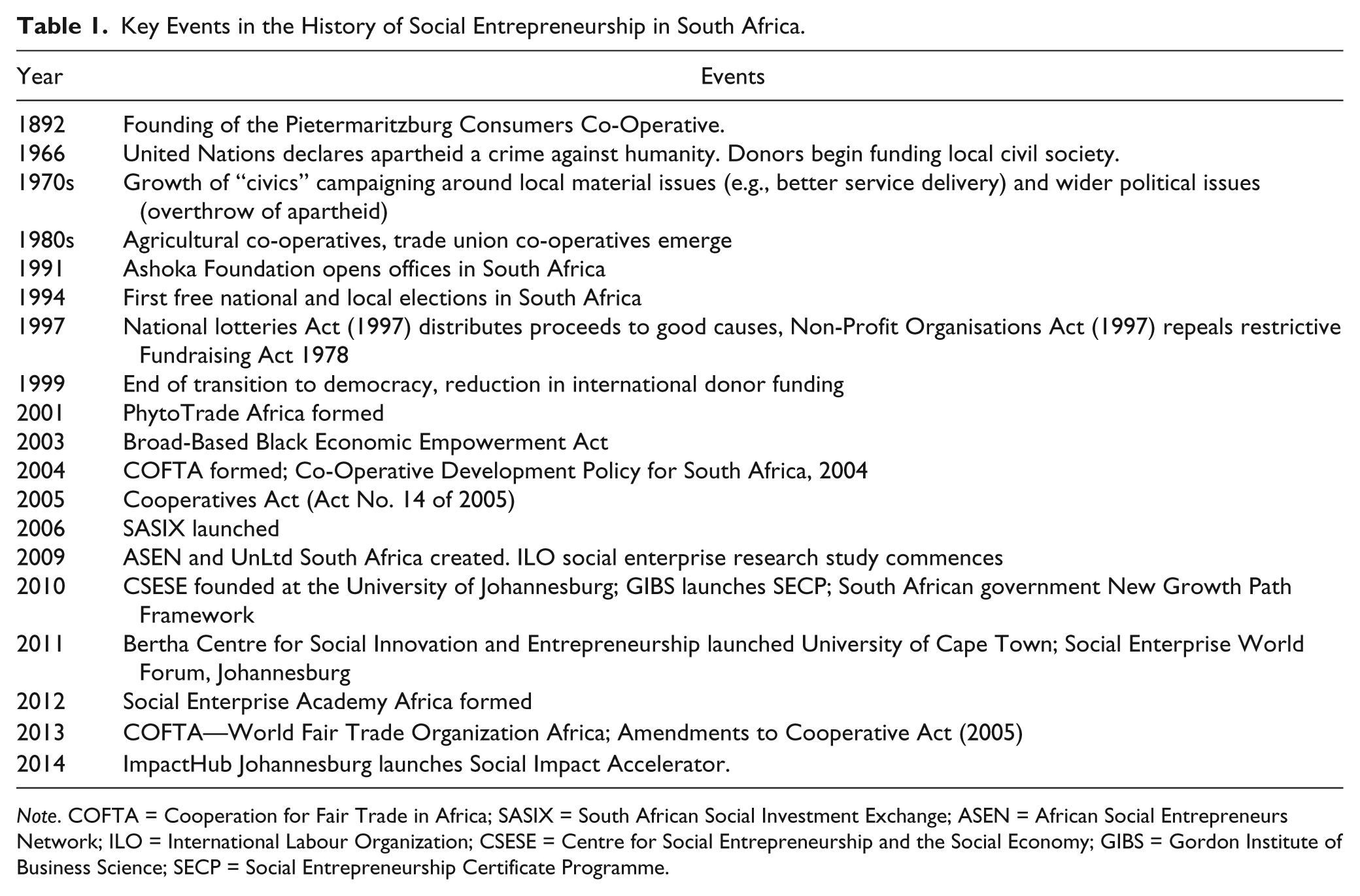
Note. COFTA = Cooperation for Fair Trade in Africa; SASIX = South African Social Investment Exchange; ASEN = African Social Entrepreneurs Network; ILO = International Labour Organization; CSESE = Centre for Social Entrepreneurship and the Social Economy; GIBS = Gordon Institute of Business Science; SECP = Social Entrepreneurship Certificate Programme.
Method
This article draws upon case study research with six South African social enterprises. Table 2 provides a more detailed description of the cases including their age, location, social and/or environmental missions, the economic foundation of the venture, and the primary data collection undertaken with each case for this research. Access to, and the participation of, the cases was gained through a local social enterprise network (ASEN). The cases were selected on the basis that they represented a variety of ages (from 3 to 25 years), were of different sizes, had different social and/or environmental missions, had different economic foundations, and to cover more than one region (e.g., Western Cape and Johannesburg and Gauteng). This approach had benefits in providing a broader perspective on the landscape of social entrepreneurship in South Africa.
Case Study Social Enterprises.
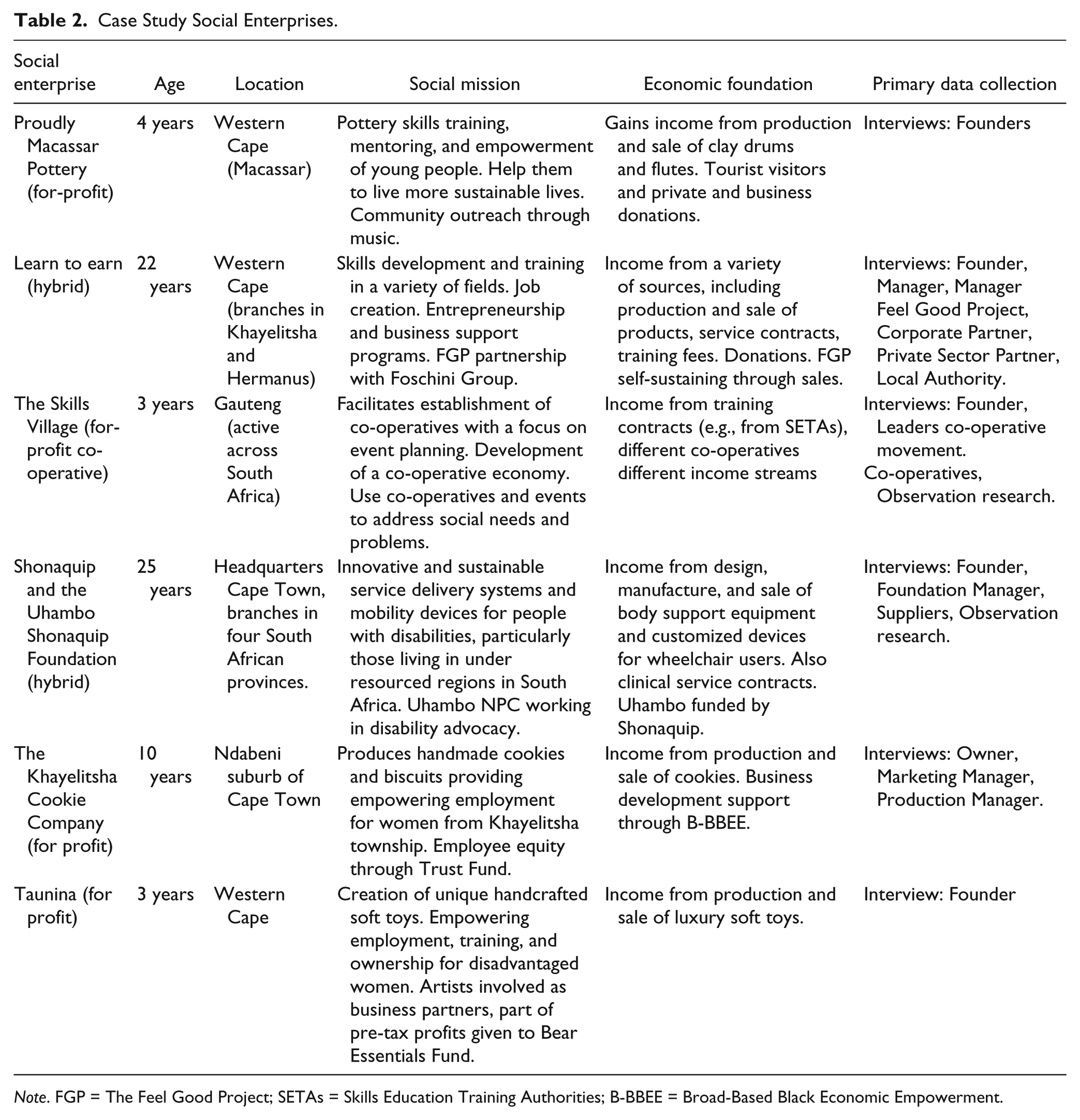
Note. FGP = The Feel Good Project; SETAs = Skills Education Training Authorities; B-BBEE = Broad-Based Black Economic Empowerment.
The case studies and their founders self-identified as social enterprises. Self-identification has been widely used in social enterprise research to mediate some of the definitional ambiguities previously outlined (see Lyon, Teasdale, & Baldock, 2010; Mair, Battilana, & Cardenas, 2012). Yet recent research by Rivera-Santos et al. (2015) has also identified challenges in such an approach, and the need for care and reflexivity when it is adopted.
An exploratory inductive approach was used in this research, building knowledge from the ground up through analysis of the case study data and case comparison (Eisenhardt, 1989). Qualitative data collection methods were primarily used including individual and group interviews, and observation research. This was supplemented with analysis of secondary materials (e.g., annual reports), while wider analysis of legal and policy documents, practitioner literature, and media sources was also undertaken as part of developing an understanding of the institutional environment for social entrepreneurship in South Africa. In total, 25 interviews were conducted, including with the founders of the six cases, managers in the ventures, external partners, and supporters (e.g., private sector actors, government representatives, and co-operative leaders). These interviewees provided diverse insights on the relationship between social entrepreneurship and the environment in South Africa, for example, its influence on business models, on strategies for resource acquisition, the characteristics of social entrepreneurs, and so on.
Data were collected during fieldwork in November 2011, and May to June 2012. Participants were identified through engagement with the case organizations to manage issues of access and trust, although the actual data collection was carried out independently. Verbal informed consent was ensured, wherever possible interviews were recorded although participants were given a choice in this with recording equipment placed in full view of respondents. An interview guide was used, but with a flexible approach adopted in discussions to allow for following of emergent themes. Recordings were then transcribed for data analysis. Data analysis followed an inductive coding process informed by the aims of the research (e.g., to explore the relationship between social entrepreneurship and the environment in South Africa). Key themes were identified from the data, for example, information pertaining to characteristics of the South African environment, to the process of social entrepreneurship, to social enterprise operating models and strategies, and to the characteristics of social entrepreneurs, with these themes then further unpacked. Finally, through a reflexive sense-making process involving the identification of cross cutting themes and relationships, inter case analysis including the identification of similarities and differences, and reference to the Gartner framework, understanding was gained of the contextual embeddedness of social entrepreneurship in South Africa.
Findings
The Institutional Environment
Regulatory aspects of the South African institutional environment for social entrepreneurship will first be explored. Explicit engagement with social entrepreneurship in either policy or legislation by South Africa’s government remains limited. Unlike the United Kingdom’s Community Interest Company, or the B-Corporation in the United States, there is no specifically designed legal form for social enterprises in South Africa, with this gap identified as an obstacle to sector development (Steinman & van Rooij, 2012). Accordingly, social enterprises come in a variety of legal forms, with Legal Resource Centre (LRC; 2011) identifying three principal groupings: (a) non-profit entities including Voluntary Associations, Trusts, Section 21 Companies/Non-Profit Companies (NPC) 4 ; (b) for-profit entities including co-operatives and private companies; and (c) hybrid structures where social enterprises divide their aims, objectives, and activities between two or more legal entities (e.g., combining a for-profit private company with a not-for-profit organization like a trust). Our case studies comprise of four for-profit social enterprises and two hybrid structures (see Table 2). One area for future research, and to extend and enhance our study, might be to focus more on social enterprises adopting exclusively non-profit legal forms.
Varied legislation is significant in informing the activities of social enterprises in South Africa, including legislation relating to non-profits such as the Non-Profit Organisations Act (1997), to co-operatives (e.g., the Co-Operatives Act, 2005), to wider business legislation (e.g., the Companies Act, 2008), and to empowerment legislation such as the Broad-Based Black Economic Empowerment Act (2003, as amended in 2013). 5 This article focuses in particular on this Act, the aims of which are transformation and the empowerment of previously disadvantaged South Africans, also known as Broad-Based Black Economic Empowerment (B-BBEE). B-BBEE is a critical concern in wider business and society relationships in South Africa (Andreasson, 2011; Arya & Bassi, 2011). Since the end of apartheid, if not before, for-profit businesses in South Africa and particularly corporations have been under pressure to engage with the national empowerment agenda, to gain or retain legitimacy, and to secure their social licenses to operate.
The aforementioned National Broad-Based Black Economic Empowerment Act (2003), and amendments to it, allows for South Africa’s Government to issue “Codes of Good Practice” in relation to B-BBEE. The first full iteration of these Codes was gazetted by South Africa’s government in 2007 and encompassed seven elements. These seven elements of the Codes formed the basis for the creation of a Generic Scorecard against which company B-BBEE performance could be assessed. Babarinde (2009) describes these seven elements, their indicators, and the relative weighting given to them in the B-BBEE scoring process, as follows: (a) Ownership—the transfer of ownership to Blacks (20 points), (b) Management Control—the share of Blacks in senior management (10 points), (c) Employment Equity—alignment with the Employment Equity Act (15 points), (d) Skills Development—the share of payroll devoted to training (15 points), (e) Preferential Procurement—procurement from “Black-owned” firms (20 points), (f) Enterprise Development—investment in “Black-owned” firms (15 points), and (g) Socio-Economic Development—supporting community initiatives (5 points).
Based on their overall B-BBEE performance, companies achieve a B-BBEE status from Level 1 to Level 8 (with Level 1 the highest B-BBEE contributor level) and a corresponding procurement recognition level. Companies can claim points for their own B-BBEE scorecard by procuring from B-BBEE compliant businesses, particularly those that have achieved higher B-BBEE levels. Companies set their own targets and measure progress internally or through an auditor. The 2013 amendments to the National Broad-Based Black Economic Empowerment Act (2003) were accompanied by the issuing of new “Codes of Good Practice” on B-BBEE. These Codes reduced the scorecard elements from seven to five by combining Management Control and Employment Equity into Management Control (15 points), and combining Preferential Procurement and Enterprise Development into Enterprise and Supplier Development (40 points). The data collection on which this article is based was carried out prior to these amendments. While we view that they do not substantively alter the findings, we are cognizant of these changes, which are ongoing, in our discussions. One avenue for future research building upon this study might be to consider in greater depth, what difference, if any, these changes have made to the practice of B-BBEE in South Africa including implications for social enterprises.
While engagement with B-BBEE is voluntary, and there are no direct financial penalties for noncompliance, it is a key criterion in winning public sector procurement and service contracts, particularly in light of legislation like the Preferential Procurement Policy Framework Act (2000) and the more recent Preferential Procurement Regulations (2011). There are further “business case” benefits for engaging with B-BEEE, including difficulties in finding other businesses to sell too if a company does not embrace the transformation agenda, priority access to finance from banks for B-BBEE compliant companies, and the potential to tap into a key emerging market as the transformation of South Africa’s society continues. Finally, there are tax incentives for socioeconomic development activities and B-BBEE procurement. As will be explored further in later discussions, B-BBEE legislation has significant implications for social enterprises in South Africa, with for-profit enterprises and particularly the corporate sector engaging with social enterprises through the framework of B-BBEE. This legislation also has implications for relationships between social enterprises and South Africa’s government, particularly where social enterprises are entering into procurement contracts and undertaking service provision.
A final significant regulatory dimension of the institutional environment in South Africa relates to national policies such as the Co-Operative Development Policy for South Africa (DTI, 2004), and more recently the New Growth Path (RSA, 2011) with it accords on National Skills, Basic Education, Local Procurement, and the Green Economy. Indeed the role of the social economy, including social enterprises, in sustainable job creation is explicitly recognized in the New Growth Path framework.
However, to understand the institutional environment in South Africa and its influence on social entrepreneurship, it is important to also consider the environment’s normative and cognitive dimensions. It should first be noted that while engagement by social enterprises with transformation and empowerment issues may be encouraged by regulation, there are also pressing normative expectations, and it is perhaps even cognitively taken for granted, that organizations and individuals across South Africa should contribute to addressing these legacy issues and the country’s wider sustainable development challenges. Other more normative influences on social entrepreneurship and enterprises in South Africa include emerging practitioner networks and a growing number of training and support providers, for example, SEAA, UnLtd South Africa, Greater Good South Africa, ImpactHub, the Bertha Foundation and the BCSIE, and the International Centre for Social Franchising among others. Such organizations may exert mimetic isomorphic influences on social enterprises moving them toward “best” or “common” practice in the field. These organizations often have strong international links with global social enterprise organizations and networks, for example, SEAA is an affiliate of the Social Enterprise Academy Scotland, while CSESE was launched with support from the ILO. Other domestic actors are also engaging with U.S. organizations such as Ashoka (which has had an office in South Africa since 1991) and the Schwab Foundation. These examples show that South Africa does not exist in a vacuum, with the emergence and local understandings and practices of social entrepreneurship reflecting the interplay of domestic and international influences, and informed by global developments in the social entrepreneurship field (Nicholls, 2010).
In the “Literature Review” section, this article introduces notions of institutional “voids” and “gaps” and questions where South Africa should be located on a spectrum between subsistence markets and developed countries (with mature and established institutions). We suggest that South Africa occupies a somewhat intermediate “emerging market” position (Khanna & Palepu, 1997). Formal institutions in South Africa are relatively strong, and in many areas, its economy is advanced. For example, South Africa has a sizable manufacturing sector estimated at 17% of GDP (RSA, 2014), which is dominated by medium and large companies, while regulation governing business activity is mature and largely enforced. However, concurrently the informal economy remains an important part of South Africa’s overall economy. For example, in South Africa’s 2012 Labour Force Survey, it was suggested that more than two million people were active in the informal economy (excluding the agricultural sector), while some recent estimates have valued the informal economy at around 28% of South Africa’s GDP (South African LED Network, 2014). This coexistence of the formal economy with a large informal economy often necessitates South African social enterprises to be active in both, perhaps providing linkages between them to address institutional gaps.
Environment and the Process of Social Entrepreneurship
As outlined previously, Gartner (1985) identifies a number of variables in the process of new venture creation. These variables are adapted to inform the following discussions of the influence of environmental characteristics on the process of social entrepreneurship in a South African context.
Opportunities for South African social enterprises, and the nature of the social needs addressed by them, reflect the country’s socioeconomic context and institutional environment. Illustrating this, the low skill and education level of many previously disadvantaged South Africans are widely recognized as a key national development challenge. This is reflected in legislation such as the Skills Development Act (1998) and Skills Development Levy Act (1999), and policy documents such as the National Skills Development Strategy III (RSA, 2012). Skills development and training is furthermore regarded as a key mechanism for addressing some of South Africa’s broader social challenges which include economic exclusion, unemployment, crime, and HIV/AIDS. Reflecting the overall significance of education and skills development needs in South Africa, five of the six case studies carry out work linked to training, education, and wider personal development. For example, the social enterprise Learn to Earn (LtE), through its training centers in the Khayelitsha and Zwelihle townships, provides training in a variety of fields, including sewing, woodwork, baking, basic education, and life skills, and since its inception has trained more than 9,000 unemployed people. Through its business resource centers, LtE also runs entrepreneurship and business support programs, engaging in informal markets and with informal economy actors.
The interview quotation below illustrates these deficiencies in skill, education, and employability in the South African labor market, and the linkage role that South African social enterprises are playing to address these institutional gaps. However, interestingly, it also suggests that social needs in South Africa may be different from those in other parts of sub-Saharan Africa: there is a difference between you go to a rural community in Mozambique and you say like literally there is nothing . . . there are jobs but they fall to skilled people, or semi-skilled people and these guys don’t have that, there are tonnes and tonnes of people who simply cannot find a job because they don’t have what you need to get you through the door. Even someone who is a receptionist you need to be able to speak clearly in English. (Interview with Social Entrepreneur)
In the field of training and skills development, there are significant opportunities for South African social enterprises. For example, LtE carries out contract work for the Cape Town city authority, while another case study, the Skills Village (see Table 2), delivers learnerships on behalf of South Africa’s government and industry, administered through the country’s Sector Education and Training Authorities (SETAs). Yet, as illustrated by the following quotation, caution was also advised in some interviews in relation to training for training’s sake, without adequate consideration of the appropriateness of skills imparted, and whether necessary supporting institutions (e.g., market linkages) were in place: I mean, the reality is there are actually a lot of people who sew in this country; I don’t think that’s a skill I should be teaching. I personally think you could train them in a lot of other things which are needed . . . so we’re not going to scale for the sake of scaling. (Interview with Social Entrepreneur)
Further illustrating the influence of environment characteristics on the needs and opportunities addressed by social enterprises is the case study Taunina. This is a social enterprise which produces luxury soft toys for the international market while providing employment opportunities for asylum seekers and refugees, particularly women, from nearby unstable states like Zimbabwe and the Democratic Republic of the Congo. South Africa is one the world’s leading destinations for asylum seekers (United Nations High Commissioner for Refugees, 2012), as well as receiving large numbers of economic migrants. Yet the capacity of South Africa’s government and institutions to administer and meet the needs of these groups is limited, while on the ground, migrants also face issues of xenophobia constraining their livelihood activities. It is in these gaps and in response to these particular needs that Taunina, and indeed other South African social enterprises, is active.
The nature of the social needs addressed by South African social enterprises might be contrasted with those targeted by social enterprises not only in developed countries but also in most developing countries. In the former, social enterprises often, although not exclusively, address higher order needs associated with “self-actualization.” In the latter, social enterprises frequently focus on the provision of basic needs. Aligned with earlier discussions, we would again locate South Africa in an intermediate position. A large proportion of its population receive some kind of social grant (child grants, state pension, etc.), and this relative social safety net contrasts with most other sub-Saharan African countries, yet such support still does not reach the levels of most developed countries. As a result, South African social enterprises might be considered to engage particularly with middle-level needs, and perhaps more with basic needs than developed country social enterprises, and more with higher level needs than developing country social enterprises.
The influence of environmental characteristics on the process of social entrepreneurship can be further discussed with reference to the Shonaquip case study, which manufactures and sells disability equipment specifically designed for the rugged African terrain, and with the goal of making this equipment available in low-income communities. This example shows how a South African social enterprise has first developed its products to overcome challenges in the physical environment. Such challenges in part are linked to limitations in the physical infrastructures provided by South Africa’s government, for instance, the poor condition of many road surfaces in townships and rural communities creating particular accessibility challenges for people with disabilities. Shonaquip has furthermore developed an overall approach to resource accumulation which reflects its institutional environment and which allows it to serve these low-income markets.
Environmental characteristics can also influence social enterprise product marketing activities. In one of our case studies, the Khayelitsha Cookie Company, it was suggested in interviews that the social ethos of the company and particularly its relationship with the Khayelitsha township could potentially be detrimental to sales among some segments in the South African market. This challenge is illustrated in the interview quotation below, and contrasted with what might be expected in the developed world. The quotation also illustrates how the company adapted its product marketing practices accordingly: You get people who will buy the cookies for what we stand for and the ethos of the company, but in South Africa it is not as relevant as the rest of the world. So if we had to do the same product in Europe we would have actually got a lot bigger sales than we are currently getting. So in South Africa the people are a bit sceptical to support organisations like ours, due to the corruption that happened and also the people when they see Khayelitsha the first thought they get is it is getting baked in a shack in Khayelitsha . . . with our new retail packaging we literally had to reduce who we are and focus on pictures of the product to get people to actually buy. (Interview with Social Enterprise Manager)
This environmental challenge was also discussed in other interviews from the perspective of deceptive marketing by competitors: There are also like horrendously negative stories, where people are selling these amazing empowerment projects, where they actually control these women who come in and they’re so desperate, they pay them piecemeal, terrible wages . . . they put the fear of God into them and they control them like slaves. (Interview with Social Entrepreneur)
However, overall, across the cases, limited funding for marketing was a common theme, for example, in interview statements such as “how do we, with virtually zero marketing budget, build this brand” and “we don’t have marketing spend, because the company has not been profitable up to date.” Limited resources for marketing is a challenge for most small and medium sized enterprises (SMEs), but for social enterprises, this can be a particularly acute, especially as margins are often already small, and it can be difficult to justify resources not used to directly address the venture’s social mission. Often the cases relied on skilled volunteers for their marketing work.
Finally, environmental factors influence processes of production, although these processes also often reflect the embedded mission of social enterprises and it can be difficult to disentangle the two. For example, the Proudly Macassar Pottery operates in a challenging local environment, the Macassar Township community, working with young people described as often living “quite chaotic lives.” Accordingly, it adopts some flexibility in production, at least with non-apprentices, to encourage engagement and build bridges. Similarly, the Khayelitsha Cookie Company produces handmade cookies, and in the process creates empowering employment. Yet, because of its social mission, it struggles to compete, at least on price, with mechanized biscuit producers.
Environment and the Social Enterprise
In this section, we consider how the South African institutional environment influences social enterprises. As discussed in the “Literature Review” section, Gartner (1985) identifies a number of ways in which the institutional environment can influence businesses, particularly in relation to the competitive strategies firms adopt. As in the previous section, his variables are adapted to inform the following discussions.
We focus first on social enterprise strategies for resource acquisition and growth, and in particular, how they are being informed by the institutional environment in South Africa, and especially legislation, regulations, and norms relating to B-BBEE. As outlined earlier, South Africa’s government has legislated a role for business in national transformation and empowerment through the Black Economic Empowerment Act (2003) and related policies. This B-BBEE legislation and scorecard incentivizes engagement not only by the corporate sector with “Black-owned” SMEs but also many social enterprises, which are often strong in Black management and ownership, and may significantly focus on skills development as part of their embedded social mission. Accordingly, many South African social enterprises have a high B-BBEE rating, as illustrated by the following interview quotation: We are the best you can get. So the B-BBEE scorecard is made up of how much equity the staff owns in the business, your black employees, so like if you have got more than 80% or 90% black people working in your factory that counts and gives you a higher score, also the wages that you pay, how that is set out, so that all determines your B-BBEE scorecard . . . Most of the companies you find in South Africa are on like a level 5 and we are a level 1, and the triple A is for all the additional stuff that we do which other companies don’t. So the higher your rating, and basically it works on if you are like on level 2 then you can claim 100% of tax spend back on the products you are buying. With us you get 135% back. So that is the get back, so there is a financial advantage as well for companies using us as a supplier. (Interview with Social Enterprise Manager)
Procuring from, investing in, and supporting social enterprises through philanthropy can also significantly benefit larger businesses in meeting their B-BBEE targets. So a company may provide Enterprise and Supplier Development support to a social enterprise that has high levels of Black Ownership, Black Management Control, and which invests heavily in Skills Development. These companies can then procure from that same social enterprise amassing cumulative B-BBEE points. Both Fury (2010) and Steinman and van Rooij (2012) suggest that B-BBEE legislation in South Africa has the potential to create a virtuous cycle of investment in, and growth of, financially sustainable social enterprises as part of tackling the country’s key socioeconomic challenges. Although, the interpretation of B-BBEE Codes by some accreditation agencies can exclude non-profit social enterprises from receiving enterprise development funding (Steinman & van Rooij, 2012), and it is as yet unclear whether this issue has been resolved in the new codes.
South African social enterprises are adopting strategies for resource acquisition and growth that recognize these opportunities related to B-BBEE and interaction with the corporate sector. Organizations such as Impact Amplifier and the Tourism Enterprise Partnership (TEP) are key facilitators in this process of recognition and engagement by social enterprises. For example, Impact Amplifier seeks to bridge the gap between social investors and the social enterprise sector, while TEP is a NPC in the Western Cape, but is also active across South Africa’s provinces, which channels corporate investment into small, medium, and micro tourism ventures, including many social enterprises. This investment facilitates the growth of SME social enterprises, while also allowing corporates to access Enterprise and Supplier Development points for their B-BBEE scorecards. However, social enterprises are not only acquiring financial capital but also support for infrastructure development, equipment, and training and expert volunteer support. Across the cases growth strategies entailing significant engagement with the corporate sector were observed, this included entering into supply chains but also longer term strategic partnerships and the creation of joint ventures.
Across the case studies, we map these relationships, identifying three main types of strategic interaction between social enterprises and the corporate sector:
1. Enterprise Development and Procurement—Enterprise Development and Preferential Procurement were important, and often interlinked, elements of the 2007 B-BBEE Codes of Good Practice. Reflecting this, in the more recent 2013 iteration, they are combined in the element Enterprise and Supplier Development. Nevertheless, at the time of this research, several of the case studies were receiving enterprise development funding, which was playing a significant role in their growth strategies. For example, the Khayelitsha Cookie Company had received enterprise development assistance from a number of larger companies, particularly purchasers. In one instance, a loan was given to equip a new factory extension; in another, machinery was purchased with donated money. This significance of Enterprise Development assistance in the growth strategies of social enterprises in South Africa is illustrated by the following interview quotation: look it is very important, a lot of our stuff is able to happen because of enterprise development as part of the B-BBEE Scorecard, fundamentally CSI or Corporate Social Investment is about social enterprise development, so companies are looking for worthy causes to sustain and support, so those are critical, it makes it easy in terms of funding because people are looking for opportunities as opposed to you have to go and look for them. (Interview with Social Entrepreneur)
Such relationships were similarly encountered in the Proudly Macassar Pottery case, which alongside support from a local musician, and organizations such as “UnLtd South Africa” had received support from the TEP’s Enterprise Development Programme, which as discussed above acts as a vehicle for corporate investment in SME tourism ventures, including social enterprises.
In the study, it was found that Enterprise Development assistance was often intertwined with Preferential Procurement from social enterprises, while more widely, many large South African companies are investing in their SME suppliers, including social enterprises. The benefits for social enterprises of entering into such supplier relationships can be significant, although there are also challenges. Social enterprises are targeting the creation of such relationships in their strategies for growth and upscaling. These enterprise development and procurement type relationships between social enterprises and corporates will continue, or may even intensify, after the recent amendments to the B-BBEE Codes of Good Practice and Scorecard.
2. Capacity building—As previously discussed, addressing South Africa’s skills and education gaps is a national development priority. Accordingly, skills development is an important part of the B-BBEE scorecard. Across the cases, a variety of training and capacity building relationships were encountered. For example, the employees of Taunina received outside training in areas such as finance and nutrition, as did employees of the Khayelitsha Cookie Company. At a managerial level, some of the cases were also receiving mentorship support from CEOs and directors in affiliated businesses.
3. Partnerships—Finally, innovative strategic partnerships between social enterprises and corporates are emerging. For example, the relationship between the Learn to Earn case and the Foschini Group in their joint venture Feel Good Project (FGP). The FGP is registered as an NPC, and opened its first store in May 2009. The store stocks reconditioned customer returns, limited samples, rejects and overruns from various Foschini Group brands, and is staffed by previously unemployed people who are given a chance to undertake training and gain experience relevant to the retail supply chain. At its Khayelitsha repair center, other Learn to Earn trainees have also been taught how to repair clothes and about the clothes finishing process. The FGP illustrates the potential for long-term strategic partnerships between social enterprises and the corporate sector to create social value, and to address institutional gaps in the labor market (e.g., the limited availability of individuals with skills and experience relevant to the retail sector). These kinds of multi-actor partnerships are increasingly common in South Africa, informed both by these national institutional changes (e.g., B-BBEE) and global developments, that is, social innovation. The following interview quotation illustrates the opportunities for mutual strategic benefit through such partnerships: About 3 or 4 years ago our Corporate Social Investment (CSI) took a different direction and we wanted to move away from the position of just sort of giving money and off the organisation goes . . . for me it is a great example of how a CSI project is adding value to the organisation. First of all we are training people for an area of the business where there is a large turnover of staff, we dispose of our customer returns in a responsible environmental way, and we are giving people who are generally earning a lower LSM [Living standards measurement] access to a brand in South Africa that has been around for many years. (Interview with Social Enterprise Partner Representative)
South African social enterprises operate in an environment characterized by limited state resources and support, and declining international donor funding. In this context, findings from the cases suggest that in their strategies for growth and resource acquisition, South African social enterprises are increasingly looking toward the country’s corporate sector and the opportunities created by B-BBEE legislation. In turn, South Africa’s corporate sector is recognizing social enterprises as valuable vehicles for their CSR activities, for meeting B-BBEE requirements, and thus helping them maintain legitimacy, and, in some instances, for addressing institutional gaps.
A further illustration of the influence of environmental characteristics on social enterprises in South Africa relates to the legal forms adopted, particularly in the absence of a dedicated legal status for social enterprises (e.g., a CIC or B-Corp), which in turn has implications for operations. Of the three social enterprise groupings identified by LRC (2011) and discussed earlier, the final hybrid structure is perhaps most illustrative as it involves social enterprises establishing multiple interconnected legal entities, across the different areas of their activity. For example, the Learn to Earn case is a hybrid with three main components, a training non-profit public benefit organization, the NPC Business Resource Centre, and the FGP which is also a NPC. Meanwhile, the Shonaquip case comprises a for-profit company and the NPC Shonaquip Uhambo Foundation.
South Africa’s institutional environment creates opportunities for social enterprises, for example, B-BBEE legislation has catalyzed engagement between social enterprises and South Africa’s corporate sector, with benefits for both and potentially wider society. Yet, there also remain challenges. For example, across the interviews and cases, implementation of government policy and legislation was identified as a recurrent problem, for example: You know government is full of fantastic stuff and documents and booklets they put out but the weakest area is implementation, how do you implement it, how do you make it happen. (Interview with Social Entrepreneur)
The notion of “institutional imperfections” (Roth & Kostova, 2003) might be usefully applied to consider existing legislation around transformation and its implementation, including how it relates to social enterprises, for example, the difficulties experienced by some social enterprises in accessing Enterprise Development (now Enterprise and Supplier Development) assistance. Historically, imperfections in support for organizational development have also been an issue for co-operative social enterprises in South Africa. For example, while the 2005 Cooperatives Act encouraged co-operative registration and growth in the sector, co-operative mortality was also very high, with observers suggesting that the motivation for founding many co-operatives was to access government incentives rather than long-term co-operative development. Other problems included the targeting of the most marginalized who may lack the skills to make co-operatives work, a gender bias and focus on old women “Gogo Grannies,” and inadequate training (Steinman & van Rooij, 2012). Recent amendments to the Cooperatives Act aim to address some of these imperfections, yet clearly to date, these issues have had negative implications for social enterprise development in South Africa.
Another challenge for social enterprises, associated with the South African environment, relates to the potential for “mission drift” when social enterprises are engaging with the corporate sector and B-BBEE. South African social enterprises face significant resource constraints, so gaining a high B-BBEE rating, and associated resources or access to supply chains, can be very appealing for social enterprises which may increasingly look to align their business models and strategies with B-BBEE frameworks. However, while there is an overlap between B-BBEE and wider national sustainable development priorities, some important issues are barely addressed (e.g., environmental sustainability or HIV/AIDS). Social enterprises must ensure they do not neglect such issues when seeking corporate funding. An additional challenge for resource constrained social enterprises in engaging with the corporate sector is the costs associated with reporting and auditing. These demands can be extensive and can use resources which could be invested in the organization’s social mission, as illustrated in the following interview quotation: Everyone is jumping on the bandwagon so now you need to also certify what the employment conditions are, which your staff work. You need to measure their happiness from zero to five . . . but again it does take quite a lot of management time as well to conduct these audits and clear the findings. Before you wipe your eyes you are looking at 150,000 Rand purely on audits that you are spending in a year. (Interview with Social Enterprise Manager)
Environment and the Social Entrepreneur
Finally, we will consider the influence of the environment on the social entrepreneur, again drawing upon and adapting Gartner’s (1985) framework and variables. In all six cases studies, the social entrepreneur founders were over 30, were well educated, most had significant prior work experience, and came from relatively advantaged backgrounds. For example, the initial founder of the Khayelitsha Cookie Company was an American student, with the venture then taken over and developed by two successful South African businessmen. In social entrepreneurship literature, it is suggested that not only financial but also social capital plays a key role in venture start-up and success (Mair & Martí, 2006). Social capital mobilized to access resources, expertise, and networks played a key role in the cases, as illustrated by the following quotation: Networks that really helped the company are my relationships that I had in the industry because I have been in the hospitality industry for 15 years now. So it is relationships that you build selling a different product in the trade and then you go back and sell a new product, so you know the different people and when you go back and you start putting the word out you know what different skills people have and their experience, and they are very open they will give you two or three or four hours of their time. (Interview with Social Enterprise Manager)
The social entrepreneurs in the cases possessed significant social capital, were comparatively well positioned financially to start their ventures, and had relevant knowledge, skills, and experience to draw upon. This does not mean that they have not, and do not continue to, overcome significant adversities; for example, one social entrepreneur described how they “don’t get paid for anything they do,” while another had chosen to relocate with his family to a township community. These kinds of sacrifices are illustrated in the following quotation: he was like you guys are idiots . . . he said look at the skill you have got and you are wasting it for a company that is not making money, and we were like you don’t understand, this is what we are passionate about. We can all three of us earn much higher salaries by working for corporates and applying our talents there, but we are here by choice. (Interview with Social Enterprise Manager)
However, in the South African environment, informed by historical imbalances and legacies of apartheid, the distribution of skills, knowledge, financial, and social capital typically needed for venture start-up, including social enterprises, remains skewed toward particular groups. Although, practitioner organizations such as SEAA, and social entrepreneurs themselves, are working to bridge these capability gaps, as illustrated in the following interview quotation: And I think, within our impoverished communities, there’s this incredible wealth of creative talent, which is being made to pitch itself against, you know India and Asia in a very negative sense, and lacks the guidance of, kind of, design expertise, but once they’ve got it, they’ve got it. And they can’t possibly understand the design required by external markets, because they never, they’re not involved with it. (Interview with Social Entrepreneur)
Many of the social entrepreneurs in the study might be considered “outsiders” to their target beneficiaries or communities. This can have implications for their ventures, with embeddedness and co-creation widely regarded as crucial in the design of appropriate interventions and business models (Seelos, Mair, Battilana, & Dacin, 2010), as well as in gaining community legitimacy and ownership which have implications for long-term venture sustainability. To varying extents, the cases recognized these issues and were working to become more locally embedded.
Conclusion
In this article, we have explored the influence of the environment on social entrepreneurship. More specifically, informed by Gartner’s (1985) framework on new venture creation and new institutional theories, we have examined how environmental characteristics influence the process of social entrepreneurship, social enterprises, and social entrepreneurs in South Africa through analysis of six case study examples. Figure 2 provides a summary of our findings regarding these relationships as informed by the Gartner (1985) framework.
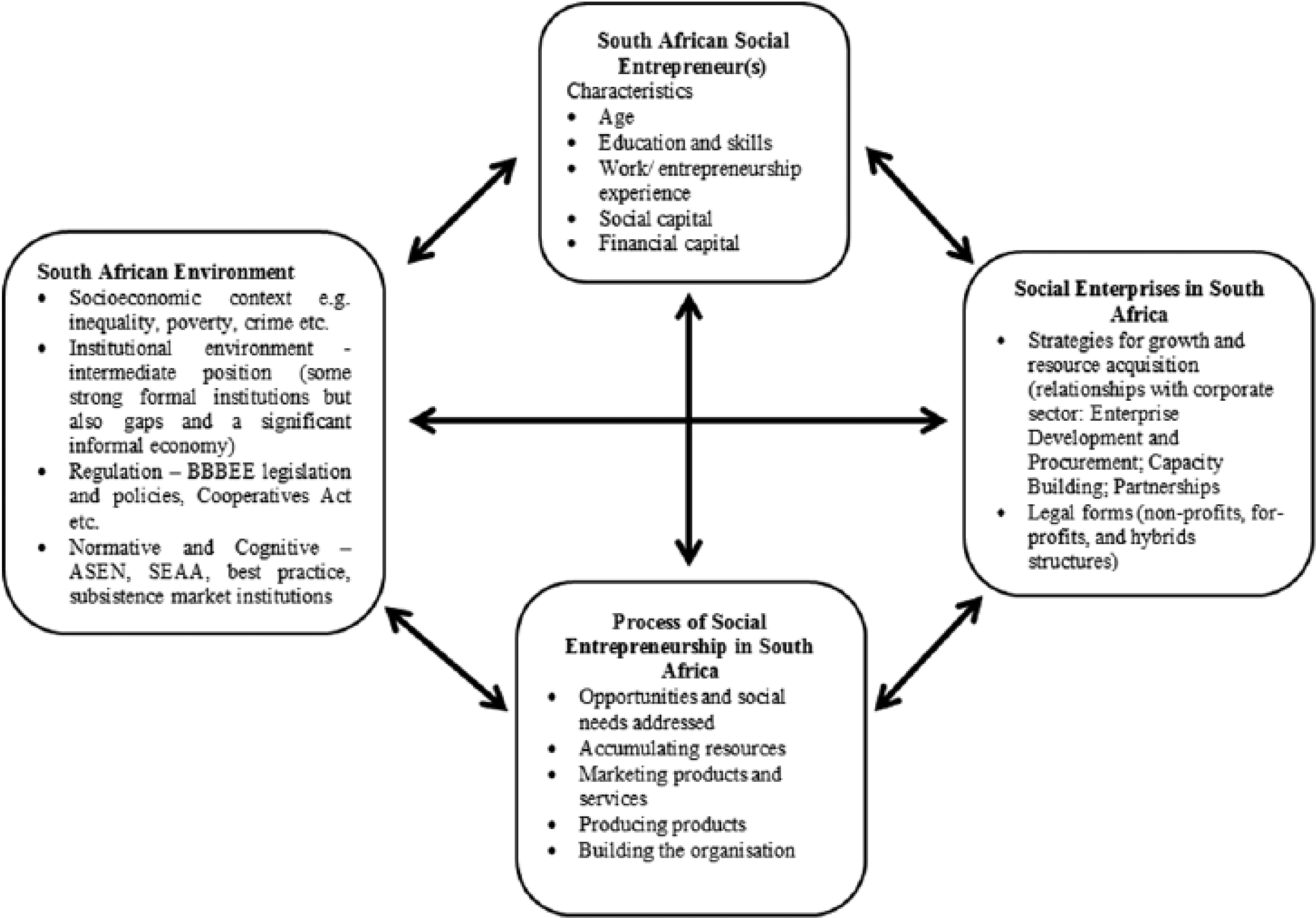
Summary of findings: The influence of environment on social entrepreneurship in South Africa.
We recognize both limitations in our research and scope for further enquiry. In relation to the former, it is first acknowledged that our engagement with Gartner’s framework is selective. We have not (at least explicitly) examined all of the relationships in his framework. For example, we do not directly address the relationship between the process of social entrepreneurship and the social enterprise, or the social enterprise and the social entrepreneur, although in our analysis, we have tried to remain cognizant of their interconnectedness. We have also not engaged in detail with all of his variables (e.g., the risk taking propensity of social entrepreneurs), while in some instances, we have either adapted his variables or considered additional ones, which were a better fit with our research aims. Yet Gartner (1985) himself identifies that neither his framework nor variables are definitive and rather argues for descriptions of new venture creation that are more comprehensive and which recognize and appreciate its complexity and variation, something we feel this research achieves.
At several points in the article, areas for future research are identified; for example, all of the cases are for-profit or hybrid social enterprises and there would therefore be value in also considering non-profit South African social enterprises. There is also the potential for interregional comparison within South Africa (e.g., Western Cape vs. Kwa-Zulu Natal). Given South Africa’s ethnic diversity, and recent findings by Rivera-Santos et al. (2015), regarding the influence of tribal identification on social entrepreneurial perceptions and practices, such an interregional study across South Africa, might be particularly illuminating. There is furthermore significant scope for comparison across sub-Saharan African countries, perhaps drawing upon Gartner’s (1985) framework or applying other relevant theoretical lenses. Research might also focus in detail on just one of the relationships in the Gartner framework (e.g., between the individual social entrepreneur and the environment), or perhaps look at one or a limited number of variables. Finally, across social entrepreneurship research, and particularly in relation to Africa, there remain few quantitative studies. There is therefore a need for quantitative research examining social entrepreneurship in South Africa that can also contribute to wider understandings in the field.
This article and the case of South Africa have implications for policy and practice. The creation of an enabling environment for social entrepreneurship remains a challenge in both developed and developing countries. While South Africa’s empowerment legislation and policies have been widely criticized, including in places in this article, they have played an important role in South Africa’s burgeoning social economy. There not only remain challenges for South African social enterprises in how they engage with B-BBEE and the corporate sector but also significant opportunities. South Africa’s successes and failures therefore provide insights for policy makers globally, but especially those in developing countries where fostering inclusive pro-poor growth is a particular imperative, and where institutional gaps are more prevalent and the need for social enterprises more urgent. The cases introduced in this article also provide insights for practitioners, for example, in terms of possible engagement with the corporate sector, with government, and in the successful navigation of the South African institutional environment.
There are several contributions of this article. First, drawing upon new institutional theories, we provide an analysis of the South African institutional environment, including how South Africa may be positioned on the spectrum between subsistence markets with serious institutional gaps and developed countries with relatively mature institutions. South Africa is suggested to occupy an intermediate position, with this finding having implications for future social entrepreneurship and wider subsistence markets research in the country, as well as being an area for possible future more in-depth enquiry. This article also contributes to hitherto limited work on social entrepreneurship in South Africa, with existing work often more practitioner oriented, conceptual, or utilizing different research approaches. This study furthermore contributes to the limited research on social entrepreneurship in the wider sub-Saharan Africa context and addresses the need identified by Rivera-Santos et al. (2015) for more “fine-grained” analysis of social entrepreneurship in sub-Saharan Africa at the country or community level.
Second, the influence of the institutional environment in South Africa on the process of social entrepreneurship, social enterprises, and social entrepreneurs has also been analyzed. This article has therefore responded to widespread calls in the literature that social entrepreneurship research should pay greater attention to environmental characteristics (see Bacq & Janssen, 2011; Di Domenico et al., 2010; Mair & Martí, 2006). This article has furthermore demonstrated the significant influence of the environment on social entrepreneurship in practice, by drawing upon empirical research with South African social enterprise cases. This reinforces arguments made by Rivera-Santos et al. (2015) among others, with implications for wider social entrepreneurship research. In this article, the influence of the environment on social entrepreneurship is also explored in a relatively novel way adapting and deploying Gartner’s (1985) framework. Use of this framework, and the article’s engagement with new institutional theories, also responds to calls for more theoretically informed social entrepreneurship scholarship as a way to advance the field.
Finally this article, and the wider Special Issue of which it is a part, demonstrates the insights that research in African contexts and African data can bring to mainstream management debates. South Africa provides a rich and dynamic canvas for the study of social entrepreneurship. We need further research on social entrepreneurship in South Africa, and other non-Western and non-traditional contexts if we are to more fully understand this important global phenomenon.
Footnotes
Acknowledgements
The authors thank the editors and the anonymous reviewers for their very constructive feedback.
The article was accepted during the editorship of Duane Windsor.
Authors’ Note

Declaration of Conflicting Interests
The author(s) declared no potential conflicts of interest with respect to the research, authorship, and/or publication of this article.
Funding
The author(s) disclosed receipt of the following financial support for the research, authorship, and/or publication of this article: The financial support of the Economic and Social Research Council is gratefully acknowledged (RES-061-25-0473 awarded to Principal Investigator Diane Holt).