




Abstract
The Reggio Emilia Approach (REA) to early years education has attracted considerable attention over the past decades, with a growing interest in its adoption internationally. Despite a substantial body of qualitative research in the field, there remains a gap in understanding how the REA has influenced teaching pedagogies beyond the REA context. This study presents a metasynthesis of qualitative studies on Reggio-inspired practices in Australia, examining 23 articles published over the last two decades. Findings confirm the significant impact of the REA on research, teaching and learning, cementing its status as a promising avenue. Yet integrating it into Australian early years education poses challenges, necessitating proactive measures such as educator and policy maker involvement, professional development, resource support, and a rethink of conventional teaching methods.
Introduction
Past decades have seen the expansion of interest internationally in the adoption of the Reggio Emilia Approach (REA) as an inspirational philosophy and pedagogy in early years education, leading to an adoption of Reggio Emilia–inspired approaches in early years settings in many countries, including Australia. While evidence is promising that these curriculum and pedagogical approaches positively contribute to children’s learning, questions have been raised about how the features found in the schools and infant-toddler programmes within the Reggio Emilia region might manifest themselves in other contexts, and the implications of doing so. To date, these questions appear to be primarily individually rather than systematically answered. The unique values and principles of the REA are contextual and cannot be replicated elsewhere (Merz & Glover, 2006), emphasising the need to examine its influences and explore how it could be implemented in other settings. While valuable information can be obtained from individual studies, they cannot offer a comprehensive view of practices inspired by the REA.
Since the early 1990s, there has been a notable increase in publications concerning the REA. Despite this, only one systematic review exists on this topic (Emerson & Linder, 2021). Most publications focus on specific aspects of the REA, such as its impact on critical thinking (Santin & Torruella, 2017), its application with infants and toddlers (Lewin-Benham, 2010), or provide brief overviews of its implementation (Alsedrani, 2021). Whilst Emerson and Linder’s integrative review seeks to comprehend the subject matter, they acknowledge a crucial shortfall: ‘the results of the review reveal the lack of outcome research to support the efficacy of the implementation of Reggio-inspired practices and the varied nature of this body of literature’ (p. 428). This gap suggests a disconnect between past research findings and future practices, which impedes progress in this area.
This study employs a qualitative metasynthesis approach to collect, analyse and synthesise findings from multiple empirical studies conducted in Australia, specifically examining teachers’ experiences in early years services inspired by the REA. In this metasynthesis, the term REA will be utilised to describe the approaches, practices, pedagogies, and beliefs of teachers as a means of synthesising the research literature.
The pedagogical approaches of the REA
The concept of the school as a living organism is at the heart of the REA. Originating in the small Italian city of Reggio Emilia in the aftermath of World War II, this approach, born out of a desire for a more liberating educational experience for children, has evolved into a broader movement that emphasises the capability of young children. Underpinning the REA is an attempt to create schools in which ‘children [are] taken seriously and where even the youngest could acquire the skills and values of collaboration and critical thinking necessary [for] a free and democratic society’ (New, 2007, p. 6). This reflects a civic commitment to children and a vision of education as a dynamic and engaging process (Hans, 2019; McNally & Slutsky, 2017). The REA is known for fostering the development of identity, citizenship, collaboration, and a sense of rights and commitments in children. The image of the child is that of one who is ‘strong, powerful, and rich in potential and resources’ (Rinaldi, 2013, p. 18). The principles that underpin the REA emphasise relationships, play the role of space and time, involvement of parents and the community (McNally & Slutsky, 2017). Documentation, projects, attention to the visual arts and a child-centred focus are central elements of the REA. A significant emphasis in the REA is the connection the early childhood education and care settings have with families and the community which are seen to be active partners in the children’s learning.
The idea of the child as a competent, and active learner and explorer are key to the REA (Gandini, 2011). Children are enabled to take ownership of their learning. It is crucial to establish an environment where children can develop meaningful connections with adults, peers, materials and communities. As the ‘third teacher’ (Strong-Wilson & Ellis, 2007), the environment fosters children’s exploration, discovery, and the construction of knowledge, where children can interact with their surroundings and engage in meaningful experiences and the implementation of the progettazione (or project-based pedagogies) shapes the way children collaboratively engage as co-constructors of the learning. The use of pedagogical documentation to shape the dialogue between educators is fundamental to the way the projects unfold as through their one hundred languages children have agency in taking their learning forward.
Children are encouraged to ‘develop a sense of intellectual autonomy while belonging to a group’ (McNally & Slutsky, 2017, p. 1934). Rather than adhering to a fixed way of learning and expressing, the REA places a strong emphasis on children’s enquiry, recognising that children learn, and express learning through what Malaguzzi described as 100 languages of children (Edwards et al., 2012). These languages play a key role in fostering learning, as they provide children with a plethora of means to communicate with themselves and others through a variety of modes, including word, movement, drawing, painting and play. The REA recognises that all children have an opinion, a voice and hold valuable knowledge which can generate thoughts about the issues which affect them (Harcourt & Hägglund, 2013). They are enabled to take on the tasks of tackling the important issues that impact them as global citizens (Farini, 2019). Significance lies in the fact that the curriculum rejects the conventional approach of dictating what children learn, avoiding a subject-based focus and the reliance on teacher knowledge, a sharp contrast to the idea of standardisation and regulation.
The current study
Qualitative metasynthesis is a systematic method for analysing data across multiple qualitative studies, facilitating the identification of common themes and practices in the research literature (Walsh & Downe, 2005). Emerson and Linder’s (2021) integrative review has influenced the adoption of a single-country metasynthesis approach in this study. Their review emphasises the importance of considering contextual factors in shaping teachers’ Reggio-inspired practices, cautioning against assuming uniformity across different contexts. As highlighted by Erwin et al. (2011), qualitative metasynthesis not only helps discern practices but also assists in understanding their contextual nuances. Given the diversity of teaching practices, beliefs, and professional distinctions, focusing on practices inspired by the REA within a single country is deemed more appropriate than cross-national comparisons. While qualitative metasynthesis holds promise, it’s crucial to acknowledge and address its limitations. Quality concerns, such as criteria for data selection, must be carefully considered, similar to other qualitative methodologies. To enhance credibility and ensure transparency in the research process, strategies such as member checks and peer debriefing are employed in the current research.
For a comprehensive understanding of teachers’ practices with the REA in Australian early years settings, the metasynthesis involves an in-depth interpretation of qualitative findings from selected studies, surpassing a mere assimilation of existing literature. This review comprises five stages: defining the focus, assessing publication quality, extracting relevant data, identifying and synthesising key themes, and verifying the analysis for validity to derive conclusions.
The research questions that frame this study are as follows:
What are the key elements of the REA that have been implemented in early years practices in Australia?
How can these findings inform future research and practice?
As Trew and Squires (2019) noted, the pedagogical approach of the REA has influenced the practices of early learning professionals worldwide, making this metasynthesis a crucial initiative not only in Australia but also for the wider international community in Reggio-inspired contexts.
Methodology
Initial search
We collected articles from multiple databases: Web of Science (30), Springer (955), JSTOR (169), ERIC (1098), Scopus (13), Australian Education Index (306), Australia and New Zealand Database (3368), Google Scholar (425), Education Source (20), and ProQuest (5076). To ensure we did not miss any pivotal sources, we also conducted keyword searches in specific journals known for their authoritative contributions to this field. This step was crucial as some influential journals, such as ‘The First Years: New Zealand Journal of Infant and Toddler Education’, are not included in the scholarly databases. By targeting these journals directly, we were able to include relevant publications that were otherwise overlooked.
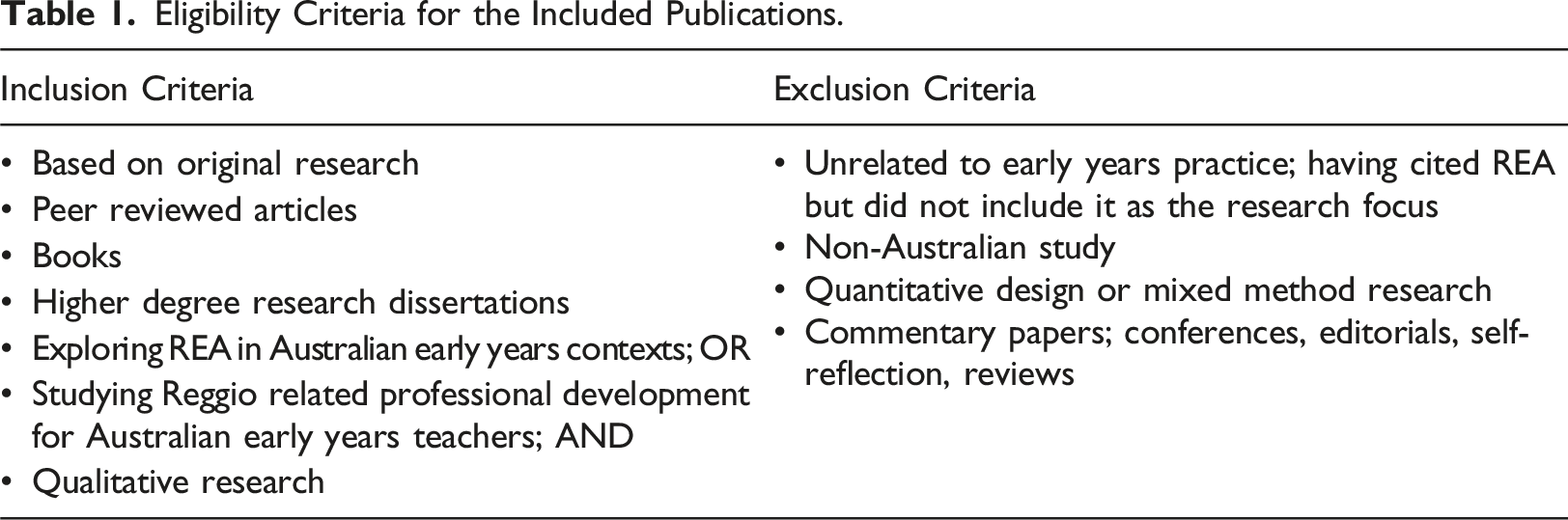
Eligibility Criteria for the Included Publications.
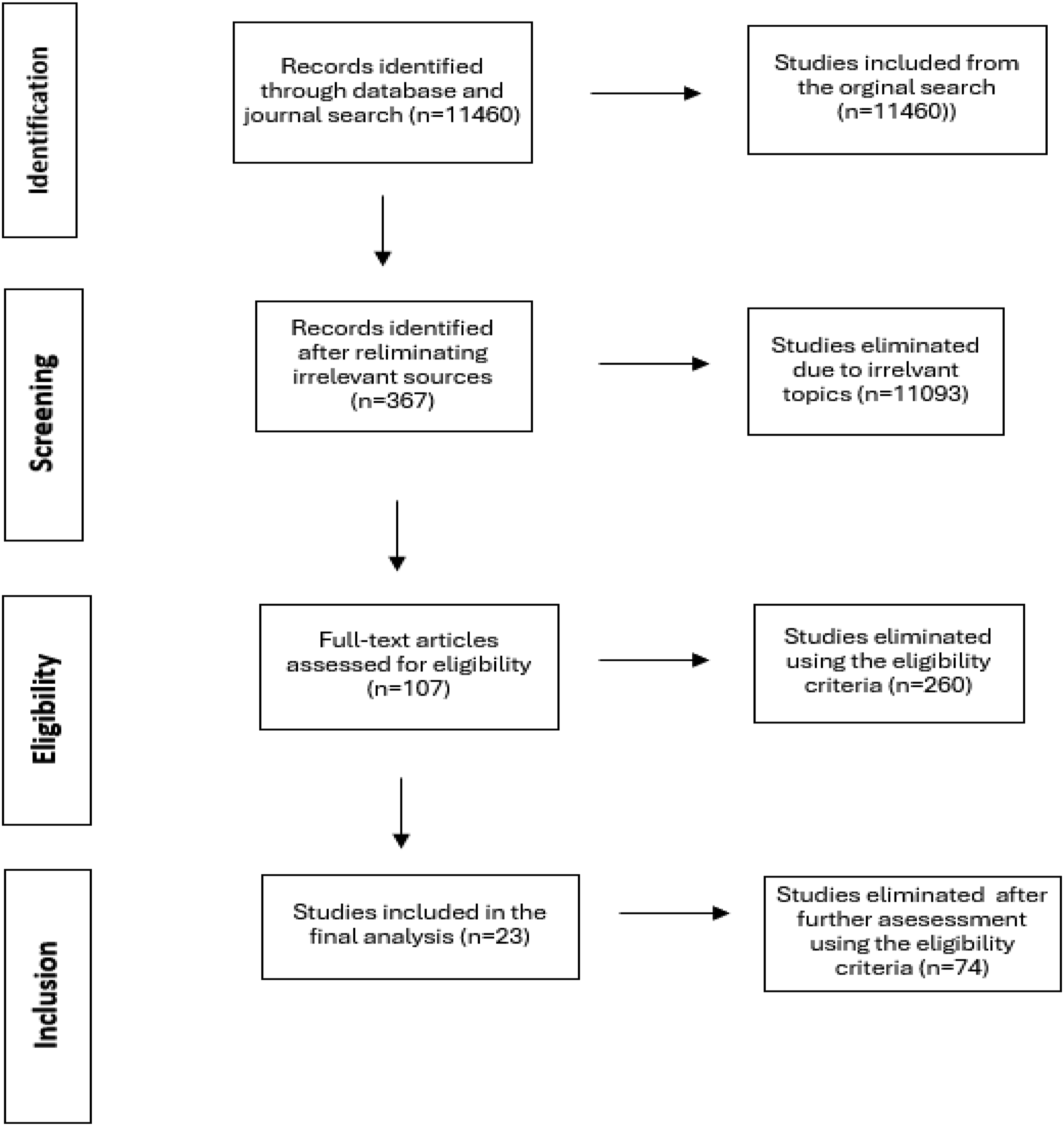
PRISMA flow diagram of the studies included in the metasynthesis.
Data analysis
The initial analysis aimed to preserve the integrity of the original research by creating codes for each publication, emphasising both the research design and findings. Analytic statements and participant quotes aligned with the study’s focus were extracted and assigned unique codes related to elements of the REA, challenges, and benefits. These codes were collectively analysed to identify overarching themes. Following Major and Savin-Baden’s synthesis approach (2010), a framework comprising first, second, and third-order constructs was employed to reinterpret the data. First-order constructs included quotes directly from original participants, second-order constructs comprised interpretive themes developed by the original researchers, and third-order constructs emerged from the interpretation of the first and second-order constructs, forming the basis for analytical themes. By synthesising and interpreting these constructs, a higher level of understanding was achieved, addressing the research questions posed in this metasynthesis.
For instance, participants expressed that ‘pedagogical documentation was really good to be able to keep going back to and reflect on’. The original researchers interpreted this as illustrating how teachers developed a discourse that united the language of critique with the language of possibility. These insights were systematically organised into the role of pedagogical documentation in fostering a collaborative professional environment. Additionally, relevant scholarly studies, such as those by Edwards et al. (2012) and Emerson and Linder (2021), informed the development of analytical themes.
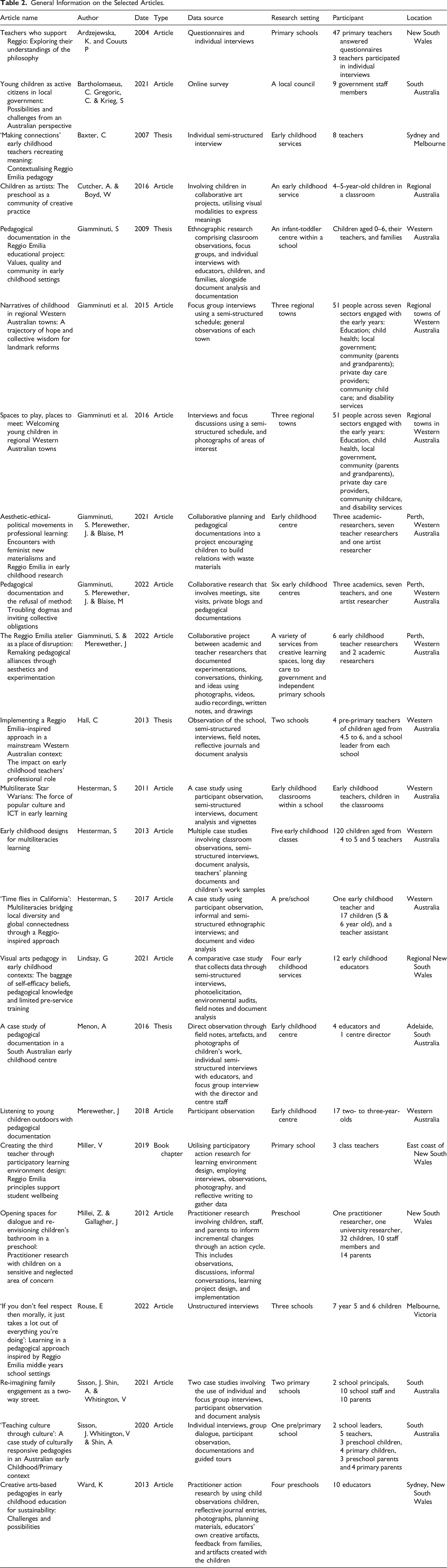
General Information on the Selected Articles.
Findings
Themes and Subthemes of the Selected Studies.
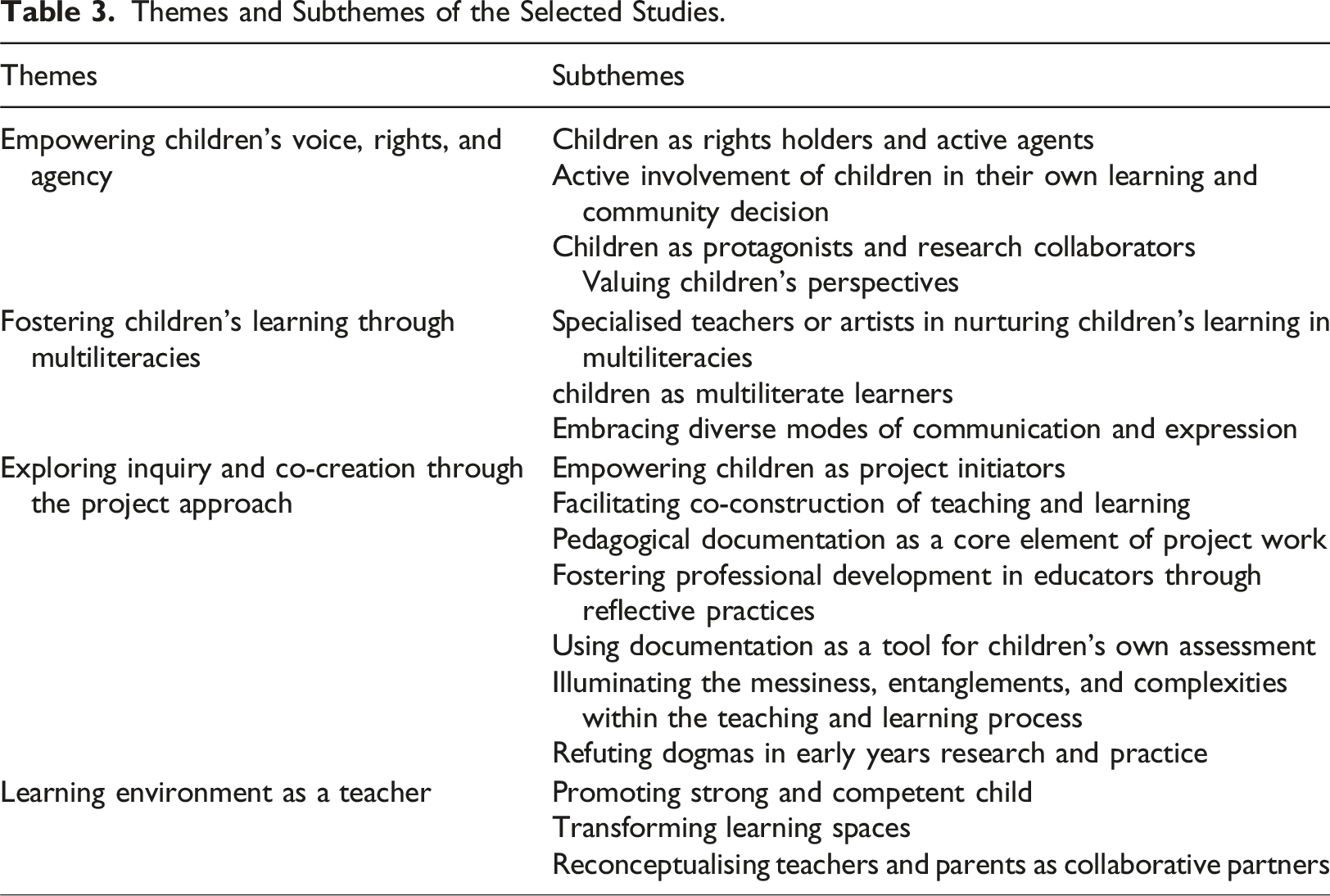
Empowering children’s voice, rights, and agency
The REA has sparked scholarly discourse concerning the fundamental nature of childhood and the crucial role of children as rights holders and active agents in their learning experiences. For instance, Rouse (2022) elucidated how REA practices have instilled in school students a sense of agency as democratic citizens – endowed with strength, resilience, and a profound curiosity about their surroundings. Similarly, Bartholomaeus et al. (2021) conducted a detailed exploration into the perspectives of local government personnel regarding the active citizenship of children within their respective communities. Their findings further highlighted the profound impact of REA principles in promoting children’s engagement and participation within broader societal contexts.
In the realm of early childhood education, there has been a discernible shift towards integrating children as active participants, protagonists, or co-researchers, acknowledging their substantial role in societal contexts. Hesterman (2011) illustrated how educators embracing the REA regard children as authors and inventors, possessing the capacity to navigate their educational journey and serving as central agents in their own educational journey. Similarly, Merewether (2018) demonstrated the effectiveness of listening to children in research, emphasising the imperative of suspending adults’ preconceptions, fostering receptivity to children’s perspectives, and nurturing an environment conductive to children’s influences.
Fostering children’s learning through multiliteracies
Another overarching theme is the promotion of children’s learning through multiliteracies, particularly evident in the experiences of teachers specialising in music or art, which align with the REA and the concept of atelier. For example, Nyland et al. (2015) examined how a specialised music program, led by a professional opera singer, nurtured children’s musical abilities. Their study focused on children’s engagement with various musical materials, songs, games, and instruments, and their ability to demonstrate intellectual insights. The researchers found that the selection of materials by the music specialists, coupled with their openness to learning from children, catalysed the construction of children’s knowledge. This approach empowered children to develop theories and strategies to test their hypotheses. The researchers concluded that the participating children did not exhibit exceptional abilities; rather, they were treated with respect, and their voices were valued in a learning environment where music held significance. This finding concurred with the work carried out by Cutcher and Boyd (2016) as well as Hesterman (2013) who discussed that the support of teachers and artists was crucial in facilitating rich, multidimensional learning experiences that extended beyond traditional literacy to include visual and performative arts.
Research on specialised learning programmes by Hesterman (2011) and Ward (2013) highlighted the potential for children to develop as multiliterate learners, proficient in diverse modes of communication. These studies endorsed the notion of ‘hundred languages’, emphasising various ways children expressed themselves across a wide array of communicative forms and recognising the crucial role of teachers in embracing these diverse expressions. Their findings provided significant insights into understanding children’s communication modes.
Moreover, investigations into the integration of popular culture and information and communication technology (ICT) have similarly showcased children’s abilities to engage with, interpret, and create meaning through multiple literacies. These studies contributed valuable insights into how ‘the hundred languages’, for example, costumes and story scripts were used for expressive purposes in early childhood settings (Hesterman, 2011, 2017).
The role of educator self-efficacy in supporting multiliteracies is crucial, as research by Lindsay (2021) shows that early childhood educators’ confidence, skills, and knowledge in visual arts significantly affect their pedagogical choices. Educators with low visual arts self-efficacy may unintentionally restrict children’s opportunities to engage with visual arts, impacting the diverse modes of expression advocated by the Reggio Emilia-inspired notion of ‘hundred languages’. Linsay’s findings suggest that unless limiting self-efficacy beliefs are addressed through constructivist-informed training, the visual arts curriculum may be compromised, limiting children’s holistic development in multiliteracies.
Exploring inquiry and co-creation through the project approach
Researchers influenced by the REA considered project approach crucial in enhancing children’s learning experiences, fostering collaborative research, and improving teaching practices (Giamminuti, 2009; Hesterman, 2011; Sisson et al., 2021).
In various scenarios, project topics have been initiated by children, stemming from classroom discussions (Hesterman, 2017), group interactions (Hall, 2013), or children’s problem-solving endeavours (Hesterman, 2011). Examples illustrate how engaging in projects empowers children to assess themselves and reflect on their learning processes (Hall, 2013).
Moreover, the project approach has demonstrated its effectiveness as a tool for data collection in collaborative research endeavours, involving both adults and children (Giamminuti et al., 2016; Mereweather, 2018). Examining the application of progettazione in Australia, Mereweather (2018) observed that researchers and teachers aligned their conceptualisation with the original Reggio Emilia framework in the research design and implementation. Studies by Cutcher and Boyd (2016), Miller (2019), and Nyland et al. (2015) explored how adults carefully designed projects to offer collaborative research opportunities with children. Hall (2013) emphasised that these projects, or the process of progettazione, were instrumental in facilitating the ‘co-construction of teaching and learning’ (p. 25).
Documentation was closely intertwined with project work. Menon (2016) asserted that pedagogical documentation encapsulated the essence of project work, fostering an environment where teaching and learning converge to create ‘a new culture of childhood’ and meaningful REA-inspired provocations (Giamminuti, 2011, p. 4). Essentially, pedagogical documentation functioned as a valuable tool, fostering teachers’ reflective practice and professional development. For instance, Menon’s study illustrated how educators initiated a project on tadpoles and frogs, using a ‘Tadpole Wonder Wall’ to document and guide children’s theories, nurturing curiosity and engagement. Incorporating a storybook and nonfiction resources, educators encouraged hands-on exploration with figurines and iPads, further enhancing the learning experience. The project’s progression included the introduction of a video clip depicting the complete transformation of a frog.
Several studies emphasised the role of documentation in promoting teachers’ reflective practice and professional development (Giamminuti et al., 2021; Menon, 2016; Merewether, 2018). Contrary to the view that documentation merely served as tools for recording and communication, these studies advocated for its potential to transform thinking and foster nuanced understanding. The process was described as creating ‘an entangled mess’ (Giamminuti et al., 2021, p. 443) or ‘an interconnected and ever-changing assemblage’ (Merewether, 2018, p. 259), fostering unease and disruption, yet enabling collaborative cognitive advancements.
Embracing the concept of visible listening inherent in pedagogical documentation, teachers also shared their work with parents, thereby enhancing family-school partnerships (Giamminuti, 2009; Sisson et al., 2021). However, these studies have brought forth specific challenges. First, the difficulty in determining the intended audience for the documentation was noted (Mereweather, 2018). Second, while efforts were made to involve parents as partners in their children’s documentation, they were primarily recipients of information about their children’s learning programmes and progress (Hesterman, 2013; Sisson et al., 2021). Lastly, the importance of ensuring that children were adequately informed and able to provide genuine consent for the use of their documentation was highlighted (Menon, 2016).
Another significant aspect of combining project work and pedagogical documentation was the illumination of the messiness and complexities inherent in teaching and learning. In their study investigating the interconnections between human participants and non-human materials within a yearlong project centred on waste, Giamminuti et al. (2021) highlighted the value of project work and documentation in deepening their understanding of the importance of non-human materials and their relationships with humans. Drawing from the REA which recognised materials and non-humans ‘as key protagonists and interlocuters in teaching-learning-research’, the researchers found that project work and documentations served as ‘techniques of deliberate imprecision’ (p.442), enabling them to capture the non-linear intricacies inherent in the learning and teaching environment.
As educators increasingly integrated pedagogical documentation and project work, Giamminuti and Merewether (2022) stated potential risks in understanding children’s learning and implementing strategies. Their study exploring educators’ use of pedagogical documentation with children reported that despite educators’ intentions to challenge early childhood norms, they encountered several challenges, including the presence of various assessment tools, compliance measures, and accountability requirements that could potentially hinder teachers' attempts to understand children’s learning.
Learning environment as a teacher
From a REA perspective, a thoughtfully designed learning environment served as the ‘third teacher’ (Miller, 2019), deemed vital for both theoretical and political research in education, resembling ‘an aquarium that reflects the ideas, ethics, attitudes, and culture of its inhabitants’ (Malaguzzi, 1998, p. 50). The selected studies have illuminated various concepts related to children’s learning environment, such as promoting a positive child image, transforming learning spaces, and cultivating collaborative relationships.
Menon’s (2016) research revealed a strong connection between educators’ endeavours in shaping the learning environment and their confidence in the capabilities of ‘the strong and competent child’ (p. 56). Similarly, Ardzejewska and Couuts (2004) noted that teachers' recognition of the importance of learning environment positively influenced their understanding of children’s roles. This observation resonates with Hall’s (2013) research, where participating teachers fostered children’s competence and strongly advocated for children’s involvement in shaping the learning environment.
In her study, Baxter (2007) discovered that early childhood teachers initiated their engagement with the REA practices by modifying their environments. This finding aligned with Hall’s (2013) research, which observed that teachers initially implemented REA by reorganising their spaces to enhance aesthetic and natural elements, making resources more accessible to children, and creating areas conducive to creativity and interaction. Hall documented specific changes such as integrating natural lighting and materials and delineating distinct areas for various activities like art and construction. These modifications were directly inspired by the teachers’ admiration and experiences with the environments at the Reggio Emilia centre (Baxter, 2007; Hall, 2013). Additionally, some teachers established dedicated ateliers for arts or creative activities, influenced by REA principles that prioritised aesthetics, material accessibility, and nurturing relationships between the centre and the children’s families.
However, Baxter’s (2007) study yielded surprising results as none of the teachers reported making changes to their outdoor environments. Additionally, her research highlighted a lack of support for teachers in obtaining necessary resources for environmental enhancements, coupled with instances of conflict among colleagues regarding such changes. Hall’s study also noted a lack of resources to support teachers’ desired alternations, accompanied by some teachers’ indifference towards exercising their creativity in designing the environment (2013). Consequently, both studies concluded that the teachers established connections between REA thought and their own contexts, and the processes of connection and adaptation were highly individualised. It is worth noting that Hall’s research and the study conducted by Sisson and Lash (2017) in South Australia presented contrasting findings to Baxter’s study. They reported that teachers embraced an emergent curriculum inspired by REA principles, which included the incorporation of outdoor learning environments.
While parents undeniably play a crucial role in shaping children’s learning environments, findings of some selected studies have prompted a reassessment of the family-teacher partnership, revealing both challenges and opportunities. Hall (2013) noted that parents often struggled to fully engage with and understanding the Reggio philosophy, hindering its effective implementation in children’s learning environments. Similarly, the investigation by Sisson and colleagues (Sisson et al., 2021) revealed a gap between the idealised teacher-parent relationship and its real-world manifestation. Conversely, Millei and Gallagher’s (2012) study exemplified collaborative initiatives among educators, children, and families, transforming physical spaces like bathrooms into vibrant social and cultural hubs within early years settings. These findings highlighted that by harnessing both the physical and relational dimensions of the environment, educators can foster stronger collaboration with families, ultimately enriching children’s educational experiences.
Discussion
This study explored the application of REA in Australian early years education, shedding light on its inspiration, significance, and challenges. Through an in-depth examination of the past studies, this study synthesised qualitative insights and revealed the potential of the REA to shape educational approaches in early years education. The findings highlight the profound influence of the REA’s in inspiring research, teaching, and learning, reinforcing its position as a compelling pathway to consider, echoing similar investigations into the REA implementation conducted worldwide (e.g. Harcourt, 2015; McNally & Slutsky, 2017). The efforts of early years professionals inspired by the REA, particularly in the Southern and Western regions of the country, have contributed to a gradual evolution in the conceptualisation of childhood, pedagogy and research. These endeavours have encouraged the development of educational approaches that prioritise the individuality and capabilities of young learners, while also nurturing reciprocal connections with their communities.
At the core of ‘the process of transformation’ (Baxter, 2007, p. 37) – the essence of implementing the REA in Australia – lies the assumption that significant improvement and betterment can be achieved through and by teachers’ changes in thinking about and teaching children, especially when accompanied by a rational understanding between the similarities and differences involved. Studies have revealed a range of transformations, including the creation of enriched learning environments (Baxter, 2007), the emergence of a new culture of childhood (Giamminuti et al., 2015), alterations in children’s relationships with their surroundings, transformative research (Giamminuti et al., 2021), the adaptation of literacy teaching methods to provide culturally relevant learning experiences (Hesterman, 2017, p. 357), changes in professional relationships (Sisson et al., 2020), and the generation of new constructions and representations of reality through knowledge transformation (Hesterman, 2011, p. 88).
However, as observed by Emerson and Linder (2021), the process of transplanting the Reggio approach is still shaped by personal and contextual factors. In the Reggio Emilia region, the implementation of the REA is deeply ingrained in its cultural and historical fabric, evident in the use of open-ended materials, natural elements, and unique ways of community involvement. In Australia, although interest in the REA has been growing, educators need to be mindful of the imperative to connect REA practices with their own policy and regulatory standards and adapt these practices to suit their specific circumstances through the use of local resources and experiences (Giamminuti, 2009).
So, how can early childhood professionals effectively integrate REA while staying aligned with their values, standards, and experiences? Within the Australian context, the Early Years Learning Framework consistently emphasises key principles such as children’s rights, agency, community participation, ongoing projects, documentation of learning, and conducive learning environments (Australian Government Department of Education, 2022). These principles closely resonate with the tenets of the REA, presenting an opportunity for synergy between the REA and Australian educational approaches. However, challenges arise when attempting to merge the REA with broader educational values. Lindsay’s (2021) research on educators’ self-efficacy in visual arts reveals a key barrier: early childhood educators who lack confidence and skills in visual arts may unintentionally limit children’s access to diverse expressive modes, a core element of the ‘hundred languages’ in the Reggio Emilia Approach (REA). Lindsay found that these low self-efficacy beliefs often stem from educators’ own childhood experiences and are insufficiently addressed in traditional pre-service training, highlighting a critical need for targeted professional development. Another challenge lies in the necessity of ongoing professional development. While some early childhood professionals have pursued opportunities such as visiting the Reggio Emilia Education Project and participating in related activities (Hall, 2013), implementing the REA requires teachers to move beyond learning the philosophy; it calls for them to adopt roles as facilitators and researchers in children’s learning. Despite broad encouragement for educators to engage in critical and reflective thinking and research, many continue to find it challenging to move away from conventional, structured teaching approaches (Giamminuti et al., 2022).
Research consistently emphasises the significance of team collaboration for the successful implementation of the REA. Educators are urged to collaborate closely, leveraging both policies and contextual knowledge. This includes respecting unique backgrounds, such as honouring and incorporating First Nations values and expectations, as well as fostering cultural diversity within the learning environment (Australian Government Department of Education, 2022). Such collaboration entails sharing ideas, reflecting on practices, and collectively designing learning experiences that harmonise with both REA principles and Australian educational values. Moreover, involving families and the wider community is essential for cultivating an enriching learning environment, fostering children's connections with the broader world and nurturing a sense of belonging.
Access to rich resources, both human and non-human, is another aspect that needs to be addressed. The REA emphasises the learning environment, which should be carefully designed to inspire children’s curiosity and exploration. Educators need access to a diverse array of materials, spaces and equipment that promote creativity and expression. Moreover, engaging with experts, both within and outside the education field, can offer valuable insights and guidance in implementing the REA.
The adoption of the REA has elicited diverse perspectives among educators, sometimes resulting in resistance to changes within the learning environment. Recognising and respecting this diversity is paramount, refraining from passing judgement on differing viewpoints. Instead, the focus should remain on considering the potential benefits for children and fostering collaborative efforts among all stakeholders involved in their lives. It is essential for professionals to come together and engage in open dialogue, actively listening to opposing perspectives. Through this process, they can strive to find common ground that integrates the principles of the REA in a manner that respects the practices and values of the Australian education system. Notably, despite its significance, only a few researchers have demonstrated a dedicated commitment to ongoing research in this area. For instance, Giamminuti contributed six out of the 23 selected publications, highlighting the necessity to encourage more researchers to engage in this field.
Limitations
While the metasynthesis process employed in this review has proven to be a valuable methodology, offering a comprehensive analysis of relevant qualitative studies and extracting significant themes, certain limitations must be acknowledged.
First, there was notable variability in the quality and depth of the included studies, which could have impacted the overall rigour of the findings. Differences in methodological approaches, sample sizes, and contexts may have affected the consistency of the data synthesised, raising concerns about the comparability of results across studies.
Second, the interpretative nature of metasynthesis inherently relies on the researchers’ ability to accurately analyse and synthesise the findings. This process is highly subjective, and while efforts were made to minimise bias, the reliance on interpretation introduces a risk of selective focus. This emphasises the importance of having grounded expert knowledge to guide the process. In this regard, the expertise of the second author, who has extensive experience in teaching and researching the Reggio Emilia Approach (REA) in early years education, was crucial in mitigating these issues.
Third, although the studies analysed cover many aspects of REA principles and practices, gaps in the research are also evident. For instance, although the findings provide useful insights into teachers’ implementation of REA, their concentrated focus on Australian early years education has limited our ability to identify similarities and differences in implementation between Australia and the original Reggio context. Expanding the scope to include comparative studies could offer early years professionals critical insights on how to meaningfully adapt REA practices within their own settings.
Additionally, the limited scope of the review may affect the generalisability of the findings. While the selected studies offer valuable insights, they do not encompass the full range of REA practices in diverse early years contexts, further limiting the applicability of the results to broader educational settings.
Conclusion
This article was motivated by a professional curiosity about the implementation of Reggio-inspired practices and their impact on the evolution of values, research, and practices in Australian early years education. Through a metasynthesis of 23 qualitative studies, we identified a range of themes and subthemes that enrich the ongoing exploration of the Reggio Emilia Approach (REA) in Australia. Positive outcomes included a growing sense of trust and confidence among early years professionals in adopting the approach, alongside increased exploratory and creative engagement among children. These outcomes were intricately linked to the specific contexts of educators’ research and teaching efforts.
However, the success of REA’s implementation depends heavily on sustained investment in teacher support. As the approach gains momentum in Australian settings, its full potential will only be realised if educators, policymakers, and institutions collaborate to adapt and sustain these practices within local contexts. Ultimately, this work highlights the need for environments where educators feel empowered, children thrive, and innovative teaching becomes the norm. Achieving this requires proactive strategies, such as enhanced professional development, improved resources, and a rethinking of conventional teaching methods.
Footnotes
Declaration of conflicting interests
The author(s) declared no potential conflicts of interest with respect to the research, authorship, and/or publication of this article.
Funding
The author(s) received no financial support for the research, authorship, and/or publication of this article.
