




Abstract
Physical inactivity has become increasingly prevalent among young children in early childhood education and care settings. One promising way to intervene and promote physical activity in these settings is to develop children’s physical literacy. Where most children spend their weekday in early childhood settings in the care of early childhood educators, the educators are viewed as ‘change agents’ and become responsible for developing children’s physical literacy. Thus, early childhood educators must possess adequate skills, knowledge, and practices to promote such development. However, research has yet to conceptualize a theory which identifies the significant capabilities and competencies that make early childhood educators, what we propose, an Effective Early Childhood Physical Literacy Pedagogue. Therefore, this paper draws on early childhood research regarding physical literacy, physical activity, and active play, to present a conceptual model theorizing an Effective Early Childhood Physical Literacy Pedagogue. Within this model, we propose educators’ professional identity and implementation of play-based pedagogy are essential characteristics of an Effective Early Childhood Physical Literacy Pedagogue. Furthermore, educators’ physical literacy capabilities (psychomotor, affective, social, and cognitive) are recognized as the vehicle that drives the aforementioned characteristics to be the Effective Early Childhood Physical Literacy Pedagogue. This conceptual model provides implications for future research to appropriately assess and target physical literacy interventions towards early childhood educators.
Keywords
Introduction
Physical activity (PA) for young children has well-known benefits, including its’ capacity to promote the development of gross motor abilities, alleviate anxiety, and encourage social interactions, among other physical and emotional health outcomes (Hinkley et al., 2020). Because of this, the World Health Organization’s (WHO, 2019) guidelines on PA suggest that infants should be physically active as much as possible each day, and that toddlers and pre-school children should engage in at least 180 minutes of PA, 60 of which are of moderate-to-vigorous (MVPA) intensity.
According to global data, 27% of children under three, and 87% of preschool children are enrolled in centre-based Early Childhood Education and Care (ECEC) services and of those children, most spend more than 30 hours per week in these settings (OECD, 2022). Alarmingly, one systematic review has revealed that approximately half of these children spend most their day sitting rather than being active, have low PA levels (O’Brien et al., 2018), and fail to meet PA guidelines (Tapia-Serrano et al., 2022). As a result of the COVID-19 pandemic, the rate of sedentary behaviour further increased in children attending childcare. Due to the reduced space availability and play equipment options offered (Lafave et al., 2021), children experienced a significant loss in opportunities for engaging in PA, which ultimately hindered opportunities for developing physical capabilities and meeting developmental milestones (Hashimoto et al., 2021).
Children under the age of five experience significant growth and development (Santrock, 2021), and begin to develop attitudes, knowledge, skills, and habits that can influence long-term engagement in PA (Schmutz et al., 2018). One promising way to intervene, promote increased PA, and meet PA guidelines is to develop physical literacy (PL) (Belanger et al., 2018; Brown et al., 2020; Cairney et al., 2019a; Clark et al., 2022). Conceptually, PL is the integration of multidimensional competencies and capabilities which influence participation in PA (e.g. movement competence, positive affect, knowledge) and contribute towards the prioritization and engagement in lifelong PA (Cairney et al., 2019b). According to Cairney et al. (2019b), PL is considered a fundamental determinant of PA when conceptualized in such a way.
Given the large amount of time spent in centre-based ECEC services, this setting becomes an opportune environment to promote PL and subsequent PA (Lahuerta-Contell et al., 2021). Further, the Early Childhood Educators (ECEs) employed within this setting become responsible for promoting children’s engagement in a whole range of human movement behaviours (Connelly et al., 2018; Martyniuk and Tucker, 2014). ECEs then are positioned as ‘agents of change’ (Nolan and Raban, 2015) and thus need to possess certain skills, knowledge, and practices that would facilitate the promotion of young children’s PL. However, there is little in the way of theory which identifies the significant capabilities and competencies that make ECEs, what we are calling– an Effective Early Childhood PL Pedagogue, while considering the identity and profession of an ECE (Haydn-Davies, 2010; Lugossy et al., 2022). Commensurately, there are no measures which evaluate ECEs’ pedagogy in relation to PL, and due to this, there is a paucity of studies exploring the measurable influence of ECEs’ PL pedagogy on children’s PL.
Due to the significant role that ECEs play in young children’s holistic development and increasing research exploring how they promote PL in young children, it is critical to first develop a conceptual model which can subsequently inform the development of a measurement tool to assess these individuals. Therefore, the current paper presents a conceptual model theorizing an Effective Early Childhood PL Pedagogue in ECEC contexts based on findings from early childhood research surrounding physical literacy, physical activity, and active play. Moreover, this paper seeks to provide an evidence-based conceptualization of how ECEs can best promote PL.
What is physical literacy
Physical literacy is a fundamental feature of human existence, whereby individuals communicate and express themselves through movement, all traversing along their own PL journey. As one of many types of literacies, ‘learning to move could be considered the first literacy we truly need to acquire as humans’ (Ydo, 2021: 2). Previous studies examining PL in the context of ECEs (Buckler et al., 2021; Buckler and Bredin, 2021) alongside Whitehead’s (2019) conceptualization, identify the following as core domains of PL: motivation, confidence, physical competence, knowledge, and understanding to value and take responsibility for lifelong engagement in PA. Recently, a review by Young et al. (2023) found that the concept of PL has evolved to a multiverse of PL ideologies, and has evolved from being positioned as ‘PL as health-promoting PA, PL as motor competence, and PL as phenomenological embodiment’ (p. 59).
In coordination with the ideology that PL is a health-promoting PA cosmos (Young et al., 2023), the current paper is grounded in PL as defined by the Australian Physical Literacy Framework (APLF). The APLF defines PL as the integration of several elements within physical, psychological, social, and cognitive learning domains, which contribute to lifelong movement and PA (Sport Australia, 2019). More specifically, it includes capabilities beyond Whitehead’s (2019) definition, such as collaboration, perceptual awareness, connection to place, and self-regulation. We argue that the APLF provides a broad, health promotion understanding of PL, and explicitly positions it as a learning construct, and therefore, the current paper situates ECEs’ PL within that framework.
Conceptual model of an effective early childhood PL pedagogue
Haydn-Davies (2010) previously conceptualized the role of general educators in promoting PL and argued there are three key factors which facilitate PL: climate of interactions, practitioner qualities, and teaching skills. The climate of interactions refers to a supportive, and positive environment provided to learners. Practitioner qualities includes capabilities such as practical knowledge, self-confidence, empathy, and patience (Haydn-Davies, 2010). Finally, teaching skills consists of the educators’ planning, delivery, and evaluation skills, and regular engagement in critical self-reflection within the context of PL and movement (Haydn-Davies, 2010).
This conceptualization (Haydn-Davies, 2010) broadly describes attributes of general educators, and thus needs to be revisited and adjusted to reflect the unique role of an ECE. With this, it is important to consider factors beyond the climate of interactions, practitioner qualities, and teaching skills, which help promote PL in young children (Haydn-Davies, 2010). While such factors are applicable to ECEs, we need to also consider their professional identity, play-based pedagogical practices and pedagogical knowledge all in relation to promoting PL in young children, as those overarching elements are central to the role of an ECE (Oberhuemer, 2005).
Previous research has attempted to identify the significant capabilities and competencies specific to ECEs, and what they can develop and possess to effectively promote PL in young children. A recent integrative review by Lugossy et al. (2022) assessed evidence surrounding this topic and found ECEs’ confidence to promote PA, role modelling of PA, demonstration of movement competence, knowledge of PA, and motivation to be active, to be significant capabilities for promoting PL in young children. Whilst Lugossy et al. (2022) reports on important findings, one of the most notable limitations of this study regards the limited view of PL. Specifically, most studies included in the review, only investigated associations between ECEs’ behaviours and individual components of PL (e.g. motor competence), not all domains of PL (Lugossy et al., 2022). This is important because such an approach does not depict PL as a holistic concept; the amalgamation of not only movement competence, confidence, knowledge, or motivation, but much more capabilities (Sport Australia, 2019). Despite this, Lugossy et al.’s (2022) results provide some evidence of how ECEs’ behaviours can promote domains of PL in young children.
Based on these early findings, it is evident that educators should possess specific capabilities related to both their profession and PL to promote young children’s PL. In relation to ECEs, professional identity and early childhood education pedagogy are two fundamental contributors to how practices are implemented. We argue that PL capabilities, when presented alongside identity and play-based pedagogy, synergistically produces the Effective Early Childhood PL Pedagogue. Further, the attributes manifest into three measurable constructs: Perceived PL capabilities, Knowledge of PL, and Practices to promote PL. The model illustrated in Figure 1, is both theory and action– where presumably, knowledge and embodiment of PL, when combined with ECEs’ professional identity and play-based pedagogy, deliver the aforementioned measurable constructs. The concepts which underpin the model will be described in more detail below.
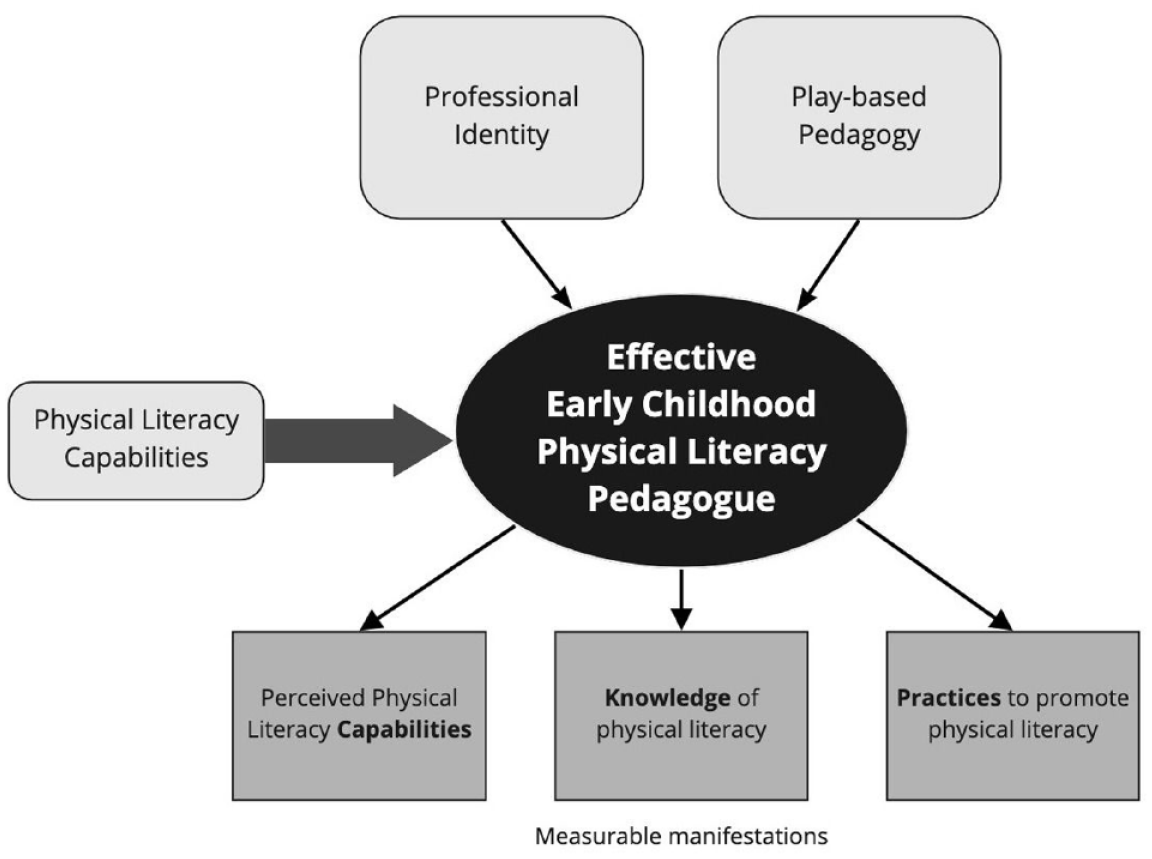
Conceptual model of an effective early childhood physical literacy pedagogue.
Professional identity
Professional identity is traditionally defined as the perception of self within a professional context, and how that is communicated (Ortlipp et al., 2011). Discourse in early childhood research emphasizes that professional identity is not exclusive from personal identity; it is ‘about who we are, rather than the part we are playing’ (Lightfoot and Frost, 2015: 402). It is shaped by values, beliefs, experiences, and more, is central to educators’ sense of purpose, self-efficacy, motivation, commitment, and overall effective practice (Day et al., 2006). In order to conceptualize who an Effective Early Childhood PL Pedagogue is, it is important to consider who the ECE is at their core, their professional identity, and the role they have in effectively promoting PL.
In the field of Early Childhood Education, the majority of ECEs’ identity is formed by early years curriculum policies, practices, and learning frameworks. All of which describe the role and importance of the educator in children’s learning and development, outline professional responsibilities, and guide ECEs’ curriculum decision-making, pedagogy, and practices (Ortlipp et al., 2011). In most cases, ECEs’ responsibilities are described using language such as develop, provide, encourage, support, and create (Ortlipp et al., 2011). Findings from Howells et al. (2023) analysis of 12 national early years curriculum policies and practices surrounding physical play echoes this sentiment. For example, in Australia, educators are to ‘plan for’ and ‘participate in energetic PA with children’ (Howells et al., 2023: 263), and in Ireland, ‘the educator is tasked with enhancing and extending’ physical play (Howells et al., 2023: 265). However, ECEs are more than their responsibilities; they maintain a role that involves ‘ways of knowing, being, experiencing, and acting’ (Harwood et al., 2013: 5). Below we draw on literature to support who an Effective Early Childhood PL Pedagogue is, and what they do, in relation to their professional identity.
Ways of knowing and being: Who ECEs are
Educators are valuable role models, who are crucial and vital to children’s holistic development (Crichton et al., 2020; Ministry of Education and Culture, 2011; Skolverket, 2019), and have special vocational education, knowledge, attitudes, and work ethic (Ministry of Education and Culture, 2011). According to Whitehead (2010), they maintain natural exuberance during active play, and accept children’s developmental individuality, without comparison or instilling a sense of failure. Educators see children’s learning as integrated and interconnected and recognize the importance of social connectedness in promoting holistic development (Australian Government Department of Education [AGDE], 2022).
At their core, an educator maintains an identity already aligned with the concept of PL (Whitehead, 2010). As a fundamental human capability, PL involves the holistic interconnectedness of physical, psychological, social, and cognitive competences that help build skills, knowledge, and behaviours necessary to engage in lifelong PA (Cairney et al., 2019a; Sport Australia, 2019). Based on this notion, PL is intertwined within their professional identity as they are physically, emotionally, cognitively, and socially competent role models for children. ECEs’ competencies and knowledge of holistic development underpins their practices, and in essence, are inherently physically literate.
Ways of experiencing and acting: What ECEs do
Educators take a holistic approach to children’s cognition, physical, personal, social, emotional, and spiritual well-being (AGDE, 2022). In relation to promoting PL, they are responsible for implementing practices which stimulate, promote, and develop children’s holistic self, including their cognitive, physical, psychological, and social abilities (Research Institute of Education, 2004). Further, they are responsible for developing and teaching pedagogical activities and organizing environments that inspire children’s curiosity and enjoyment, and promote risk-taking (Skolverket, 2019).
ECEs promote children’s ability to take responsibility for their own health and well-being and provide opportunities for children to enhance their holistic capabilities that lead to lifelong healthy habits and attitudes (AGDE, 2022; Research Institute of Education, 2004). They effectively use communication and provide an encouraging learning environment that supports children in developing their physical literacy (Ministry of Education and Culture, 2011).
According to findings from Howells et al. (2023), in many countries ECEs are required to engage in particular practices related to supporting children’s PL. For example, in Finland, physical play is regarded as a daily practice, where educators are to encourage and support children during unstructured play experiences. Meanwhile in Italy, educators provide children opportunities for physical exploration, allowing them to ‘communicate through their bodies’ (Howells et al., 2023: 265). It would seem that across several countries which enact early year curriculum policies and practices, ECEs share similar ‘ways of acting’ (Harwood et al., 2013: 5) in regard to supporting PL.
Overall, an Effective Early Childhood PL Pedagogue holds themselves accountable for meeting cognitive, physical, psychological, social, and spiritual needs of children. They do this by providing high-quality learning experiences and environments where children feel happy, confident, and competent, and learn new things (e.g. how to balance; Whitehead, 2010). Based on this, an Effective Early Childhood PL Pedagogue will hold an identity where they are competent, capable, knowledgeable, responsible, resourceful, engaging, respectful, and caring leaders and teachers of young children (Ontario Ministry of Education, 2014). They will also understand the interconnectedness of physical, cognitive, social, and psychological capabilities, and will engage in relevant practices that promote positive feelings, competence, knowledge, confidence, and understanding in young children.
Play-based pedagogy
As described previously, an Effective Early Childhood PL Pedagogue will engage in certain practices to promote PL in young children. But how do we determine what practices support PL? In this section, we explore play-based pedagogy, one of the most dominant pedagogies in early childhood frameworks and describe specific practices an Effective Early Childhood PL Pedagogue will engage in to promote young children’s PL development.
Play-based pedagogy has been described as the way in which children learn and develop through purposeful, free, and playful exploration, with minimal adult involvement or scaffolding (Pyle and Danniels, 2017). Evidence recounts play-based pedagogy as one of the most effective approaches for developing children’s social-emotional skills, executive function, and physical development (Bunker, 1991; Olive et al., 2021; Stegelin, 2005; Stevens-Smith and Stegelin, 2015). As a result, play-based learning is considered one of the foremost pedagogies that underpin early childhood curricula (Walsh et al., 2010).
Since play is a natural phenomenon that nurtures holistic development in young children (Bubikova-Moan et al., 2019), play-based pedagogy has been regarded as a significant approach to promote children’s PL (Maude, 2010; Whitehead, 2010). It is therefore important to consider how ECEs’ can implement play-based pedagogy to promote children’s PL.
While there are numerous frameworks which encourage play-based pedagogy (Howells et al., 2023), to our knowledge, only one study has investigated its’ impact on children’s PL. In Wales, the Foundation Phase is a play-based curriculum that guides and develops learning in children between ages three and seven (Department for Children Education Lifelong Learning and Skills [DCELLS], 2015). Children’s holistic development is at the centre of the play-based curriculum, and emphasis is placed on outdoor environments as a valuable resource for promoting children’s curiosity, learning, and agency (DCELLS, 2015; Wainwright et al., 2018).
Wainwright et al. (2018) explored the Foundation Phase as a naturalistic intervention, following a three-phase mixed method approach. Children’s physical competence and environment interaction, confidence, and motivation were key variables assessed (Wainwright et al., 2018), which are only a small number of elements of PL, but nonetheless are important characteristics for children’s development of PL (Cairney et al., 2019a; Haydn-Davies, 2010; Whitehead, 2010).
Analyses of physical competence and environment interaction between the two time points revealed a significant improvement in children’s locomotor skills (Wainwright et al., 2018). One of the most important factors related to this improvement was the ability for children to interact with, and learn and play in outdoor environments, which is a common finding within the literature (Branje et al., 2022; Moghaddaszadeh and Belcastro, 2021; Spencer et al., 2021).
Further, the analyses found significant improvements in children’s perceived competence and confidence in their movement abilities between the two time points (Wainwright et al., 2018). The most influential factor associated with these changes seemed to be the opportunities available for children to engage in physical activities, as well as the autonomy supportive climate because of the play-based curriculum (Wainwright et al., 2018). This is consistent with Whitehead’s (2010) argument regarding the importance of educators in being supportive to promote autonomy for children to develop their PL.
Regarding motivation and engagement, analyses found children were highly involved and motivated to engage in movement in various learning contexts (Wainwright et al., 2018). The key factors associated with these results include the child’s ability to engage in child-directed free play, implementation of teacher-directed activities, and children’s ability for children to move and play in outdoor environments (Wainwright et al., 2018). The balance of both child- and adult-directed play is one of the most significant promotors of developing PL, as they provide children opportunities to explore movement and the environment, connect with others, and ultimately develop independence, and knowledge, competence, and confidence in movement (Maude, 2010).
Wainwright et al.’s (2018) study offers important insight for ECEs to be an Effective Early Childhood PL Pedagogue. The implementation of free play (Usher, 2018), opportunity to explore and play in outdoor environments, and child- and adult- led activities are all important factors in developing children’s motivation, confidence, and movement competence (Wainwright et al., 2018). Based on the results of this single study, a play-based approach affords opportunities to develop PL. The nature of play allowed for children to enjoy learning, and explore their environment, their movement, and their abilities, which leads to the development of competence, confidence, motivation (Wainwright et al., 2018). As such, we suggest an Effective Early Childhood PL Pedagogue will engage in practices rooted in play-based pedagogy. What is missing, however, is how the ECEs’ PL professional identity and implementation of play-based pedagogy can help transform educators into an Effective Early Childhood PL Pedagogue.
Physical literacy capabilities
Major theories of behaviour change have been previously used to explain how individuals engage in movement behaviours. Specifically, Albert Bandura’s Social Cognitive Theory has been influential in guiding educators, researchers, and policymakers in determining how to promote healthy behaviours in early childhood contexts (Bandura and Walters, 1977; Rhodes et al., 2019). This theory recognizes that learning is a behavioural and cognitive process and occurs in a social context consisting of the dynamic and reciprocal interactions between the individual, environment, and behaviour (Bandura and Walters, 1977). Due to this, it has been argued that ECEs’ intentions and behaviours to promote healthy behaviours in young children (e.g. physical activity) are explained by their own self-efficacy (Bruijns et al., 2023).
As a critique, when considering the holistic nature of PL, Bandura’s theory of self-efficacy (Bandura and Walters, 1977) disregards a wider lens of affective and social factors that equally contribute to ECEs’ ability and interest to promote lifelong movement in young children (Cairney et al., 2019a). While self-efficacy is a strong indicator of promoting PL and subsequent PA, it alone is insufficient in explaining how an ECE promotes PL and becomes the Effective Early Childhood PL Pedagogue. For this to happen, we need to recognize the reciprocal and interconnected nature of PL (Cairney et al., 2019a), and consider additional elements such as their cognitive and social capabilities.
As previously mentioned, Sport Australia (2019) defines PL as the holistic integration of physical, psychological, social, and cognitive capabilities, which help build the skills, knowledge, and behaviours to lead active lives. The APLF describes 30 elements within these domains that contribute to an individual’s PL (Sport Australia, 2019). Following this definition, it is therefore important to consider additional elements of PL in addition to self-efficacy which enhance ECEs’ capacity to promote PL in young children. This section will review research exploring which PL capabilities are noteworthy in promoting young children’s PL.
Physical (psychomotor)
Sport Australia (2019) refers to this domain as the physical (psychomotor) capabilities (e.g. motor skills, balance, coordination) that contribute to PL. In regard to these capabilities, there is limited research exploring the relationship between ECEs’ physical capabilities and their ability to promote PL in young children. Of existing literature, Lugossy et al.’s (2022) review provides some evidence surrounding the impact of ECEs’ personal health and wellness on their ability to promote children’s PL. Lugossy et al. (2022) found evidence to suggest a relationship between ECEs’ high engagement in PA– a known precursor to motor competence, and their ability to role model PL behaviours for children and engage in practices that promote children’s PL (Lugossy et al., 2022).
Apart from Lugossy et al.’s (2022) study, no research has established relationships beyond ECEs’ motor skills, and their ability to promote PL in young children. However, some literature explores the need for motor competence in Physical Education (PE) teachers, which can be applicable to ECEs given they share similar responsibilities for promoting children’s holistic development.
PE teachers often play a significant role in developing children’s motor skills, which contributes to developing PL (Whitehead, 2010, 2019). During instruction, PE teachers will often need to demonstrate a physical movement/skill to children which requires knowledge of how and confidence to do so, and importantly, some level of motor competence (Francesco et al., 2019). Applying this logic to the role of an ECE, consider a scenario where an educator has the knowledge and confidence to demonstrate a one-footed hop. Without the necessary balance and coordination, how can they adequately demonstrate this motor skill to children?
Since there is a significant gap in research exploring the relationship between ECEs’ motor skills and promoting PL, we argue that competence in any physical capability is adequate for an ECE to be the Effective Early Childhood PL Pedagogue.
Psychological (affective)
Regarding psychological (affective) capabilities, Sport Australia (2019) emphasizes the role that feelings, attitudes, and emotions have in an individual’s PL. Literature has emphasized the importance of confidence and self-efficacy for ECEs to promote PL among children in their care (Durden-Myers et al., 2018; Lugossy et al., 2022). More specifically, ECEs are more likely to promote PL and provide high quality instruction when they feel confident in their personal ability to participate in, role model, and provide a conducive environment for children to develop PL (Lugossy et al., 2022; Simpson et al., 2022).
Beyond these elements, affect has been found influential in facilitating motivation towards engaging in movement (Cairney et al., 2019a; Whitehead, 2010), which is a key domain of PL (Cairney et al., 2019a; Whitehead, 2019) that influences ECEs’ promotion of PL. According to Gleddie and Morgan’s (2021) PL praxis for physical education settings, the trained educator is central to how PL is implemented in high quality programmes. Importantly, knowledge, skills, and motivation are requisite for developing children’s PL and being a trained educator.
A systematic review of 24 studies evaluated the relationship between different affective states and future PA engagement and found that a basic affective response during moderate intensity PA was significantly related to future engagement in movement behaviours (Rhodes and Kates, 2015). As a result, this study provides implications for ensuring ECEs experience enjoyment during movement, which can subsequently increase their likelihood to engage in movement, particularly with young children.
In another study conducted by Buckler et al. (2021), few elements of PL were assessed in ECEs, including their motivation. The statistical analysis revealed that motivation was unrelated to ECEs’ intentions and behaviours to provide daily PL and PA activities (Buckler et al., 2021). This finding, however, needs to be interpreted with caution due to how ECEs’ intentions and behaviours were measured. These items were measured by asking ECEs’ about their behaviours and intentions to provide movement activities and develop motor abilities (Buckler et al., 2021), which are both minor elements of PL (Whitehead, 2010). It may have produced a different result to ask about intentions and behaviours to provide and develop other capabilities in children such as confidence, knowledge, understanding, and therefore does not indicate motivation is not important for ECEs’ to promote PL in young children.
While the findings surrounding ECEs’ motivation as a precursor to promoting PL are ambiguous, we can refer to Self-Determination Theory (SDT) for explaining why it is a significant capability. According to Deci and Ryan (1985), SDT regards the degree of motivation an individual holds towards desired activities. An ECE with the self-efficacy and motor competence might be able to engage in PL-related practices, but without the desire, nor motivation to do so, there is no engagement in such activities. Therefore, it would be essential to be motivated to promote children’s PL.
Social
The social domain is regarded as the relationships individuals have with others in active contexts, highlighting the importance of certain elements for contributing to PL (e.g. collaboration; Sport Australia, 2019).
There is qualitative evidence to demonstrate the importance of teamwork and maintaining positive relationships to promote PL in young children. For example, a qualitative study exploring Queensland ECEs’ perceived PL capabilities found collaboration and positive relationships within the classroom are vital to promoting PL because they can ‘bounce ideas off one another’ and ‘reflect on what is working and what isn’t’ for building children’s PL (Barratt & Cairney, 2021).
Research outside of ECEC contexts suggests that adults generally promote movement behaviours when they belong to a social circle, engage with others, feel a sense of community (Bjørgen and Svendsen, 2015). Kindergarten educators in Bjørgen and Svendsen’s (2015) study perceived social interactions and just ‘being together’ (p. 265) is at the core of physical activities. This contributes to the notion that social elements of PL are important to educators’ facilitation of activities that can promote PL development.
It is possible that ECEs’ ability to implement PL-related practices is also affected by their direct social interactions and relationships in ECEC settings. Despite the limited research conducted on this association, these social elements are important contributors to ECEs’ promotion of PL and must be considered when designing interventions and measures.
Cognitive
Within the cognitive domain exist specific elements important to PL including but not limited to knowledge, reasoning, and risk-taking (Sport Australia, 2019). These elements of cognition are essential to educators’ capacity to promote PL development in young children (Durden-Myers et al., 2018). Of the limited number of studies exploring cognitive abilities in ECEs, Buckler and Bredin (2021) examined ECEs’ knowledge and cognitive competence of PL, and their application to PL-practices. Statistical analyses found there were two major areas of knowledge related to their PL-practices: (1) knowledge of motor development and PA, and (2) children’s physical competence (Buckler and Bredin, 2021).
In addition to the importance of ECEs’ knowledge to promoting PL, a later study by Buckler et al. (2021) found that educators’ understanding of the importance and benefits of PA were significantly related to their self-reported provision of PL. Despite the measurement limitations of this study, these findings suggest that knowledge and understanding of general and age-specific motor competence and PA-related elements play a key role in ECEs’ capacity to promote PL in young children.
Outside the context of ECEs, evidence from studies of PE teachers has found knowledge an important facet of promoting PL in their classrooms. For example, Sum et al.’s (2021) professional development intervention for primary PE teachers provides useful findings regarding cognition. Analyses of qualitative data found the intervention provided teachers with increased knowledge, which resulted in a perceived ability to incorporate PL in their classes (Sum et al., 2021). Further, Essiet et al.’s (2022) mixed-method investigation of Australian teachers’ perceptions of PL revealed that, if they are provided with adequate knowledge regarding the concept, they were willing to implement its concepts in their classroom.
Significant capabilities
Due to the limited research exploring the relationship between each PL domain and ECEs’ promotion of PL, we have presented a small number of PL capabilities that are most significant. These include motor competence, knowledge, understanding, motivation, confidence, enjoyment, relationships, and collaboration all in relation to movement. Importantly, these capabilities are relevant to each ECEs’ dis/abilities and individual contexts, meaning that any ECE can be an Effective Early Childhood PL Pedagogue, whether they possess one or all capabilities. The aforementioned are merely few that have been found significant precursors to ECEs’ promotion of PL in young children.
Measurable manifestations of an effective early childhood physical literacy pedagogue
Based upon the concepts described which shape an Effective Early Childhood PL Pedagogue, we suggest that these inputs will be manifested as three overarching constructs: ECEs’ perceived PL capabilities, their knowledge of PL, and play-based practices to promote PL. This in turn creates the opportunity to develop a measurement tool that can assess the Effective Early Childhood PL Pedagogue. However, first the appropriate steps in tool development need to be conducted, in order to explore and confirm our suggested overarching concepts.
Conclusion
In this conceptual paper, we have argued that ECEs’ professional identity and use of play-based pedagogy are essential for an Effective Early Childhood PL Pedagogue. Educators’ PL capabilities are recognized as the vehicle to drive ECEs’ professional identity and pedagogy to be an Effective Early Childhood PL Pedagogue. Our model posits an Effective Early Childhood PL Pedagogue understands the interconnectedness of physical, cognitive, social, and psychological PL capabilities, and engages in play-based pedagogical practices that promote positive feelings, competence, knowledge, confidence, and understanding in young children. Importantly, an Effective Early Childhood PL Pedagogue possesses critical elements of PL, including knowledge and understanding, motor competence, motivation, confidence, and enjoyment.
It is important to recognize the model we present primarily focuses on ECEs’ intra- and inter-personal factors and is exclusive of external factors such as childcare centre policies. From a socio-ecological perspective (Rhodes et al., 2019), our model presents a narrow number of elements which impact the conceptualization of an Effective Early Childhood PL Pedagogue. As well, the scarcity of empirical research investigating the relationships between educator PL domains and children’s PL limits the breadth of our described capabilities most significant for an ECE to possess to promote PL. Future research should investigate these relationships in ECEs with disabilities to provide an inclusive lens to which we conceptualize an Effective Early Childhood PL Pedagogue. Nevertheless, our model provides a map of accessible characteristics ECEs may possess that are most relevant to their own ability, without seeking external resources.
An ECE remains a meaningful constituent in the role of promoting health behaviours in young children from a socio-ecological perspective. This paper helps to understand ECEs’ role in effectively promoting PL in young children attending childcare, which can help educators and researchers to plan and execute effective pedagogical interventions. Further, as previous studies have sought to measure ECEs’ PL and related practices (Buckler et al., 2021; Buckler and Bredin, 2021), this paper provides critical implications for future research assessing an Effective Early Childhood PL Pedagogue and investigating the relationship between ECEs capabilities and young children’s PL.
Footnotes
Declaration of conflicting interests
The authors declared no potential conflicts of interest with respect to the research, authorship, and/or publication of this article.
Funding
The author disclosed receipt of the following financial support for the research, authorship, and/or publication of this article: JB is supported by the Australian Government Research Training Program (RTP) Scholarship and RTP Tuition Fee Offset Scholarship from the University of Queensland.
