



Abstract
The visibility of female role models in science is vital for engaging and retaining women in scientific fields. In this study, we analyse four senior secondary science courses delivered across the states and territories in Australia: Biology, Chemistry, Environmental Science, and Physics. We compared male and female representation within the science courses by examining the mentions of male and female scientists along with the context of their inclusions in the syllabuses. We find a clear gender bias with only one unique mention of a female scientist. We also find a clear Eurocentric focus and narrow representation of scientists. This bias will contribute to the continuing low engagement of women in scientific fields. We outline possible solutions to address this issue, including the accreditation of scientific discoveries to include female scientists and explicit discussion of structural barriers preventing the participation and progression of women in science, technology, engineering, and mathematics (STEM).
Keywords
Introduction
Women are underrepresented in the fields of science, technology, engineering, and mathematics (STEM) (Nimmesgern, 2016). This lack of diversity in STEM can have detrimental effects through the reduction of innovation and problem-solving (Bose et al., 2011; Hofstra et al., 2020; Hong & Page, 2004; Medin & Lee, 2012; Phillips et al., 2022; Swartz et al., 2019). In Australia, there has been a decreasing trend for the number of school students enrolling in STEM subjects over the last few decades (Georgiou & Crook, 2018; Kennedy et al., 2014), and girls, in particular, have lower STEM participation rates and lower STEM aspirations in school than boys (Jaremus et al., 2019; Wang & Degol, 2017). Additionally, the self-confidence of girls participating in STEM subjects decreases with increasing age (Department of Industry and Resources, 2022). Such an obvious gender disparity suggests women are more likely to be ‘left behind’ in the digital revolution, according to a recent report from the United Nations Educational, Scientific, and Cultural Organisation (UNESCO) (Bello et al., 2021).
Unfortunately, various recent attempts to increase the participation of women in STEM often address one symptom and ignore many others (Blickenstaff, 2005; McKinnon, 2022). Furthermore, recent research has shown access to STEM education alone is inadequate at encouraging and retaining participation of women in STEM fields (Harkavy et al., 2015). Many programmes in Australia aimed at increasing the participation of women in STEM studies, and careers lack the evidence needed to assess any measurable impacts (Department of Industry and Resources, 2022; McKinnon, 2022).
Research into the gender disparity in those studying or working in STEM fields reveals a complex system of interacting factors, often compounded by multiple circumstances (Harkavy et al., 2015; Marchand & Taasoobshirazi, 2013). However, there is increasing evidence to show a sense of belonging is critical for students to continue to pursue careers related to STEM (Hausmann et al., 2007; Lewis et al., 2017; Tellhed et al., 2017; Wang & Yu, 2023; Zumbrunn et al., 2014). Unfortunately, women are more likely to experience a weaker sense of community relative to men within STEM fields, ultimately contributing to the gender gap in STEM fields (Lewis et al., 2017; Master & Meltzoff, 2020; Rainey et al., 2018). Vulnerable or uncertain belonging has also been linked to lower expectations in STEM careers for members within socially negatively stereotyped groups (Lewis et al., 2017; Walton & Cohen, 2007). For example, exposure to negative perspectives and stereotypes of women in science has been shown to decrease the performance of women in science courses (Marchand & Taasoobshirazi, 2013; Picho et al., 2013), and minor hindrances can have larger impacts on those experiencing vulnerable belonging (Master & Meltzoff, 2020). Conversely, access to positive and relatable role models has been shown to reduce implicit stereotypes and inspire pro-STEM careers and attitudes (Young et al., 2013).
The relatability of the role models to individuals is a key factor for those role models to have a positive impact on often negatively stereotyped groups (Adam & Harper, 2023; Bamberger, 2014; Buck et al., 2008; Conner & Danielson, 2016).
For children to develop a positive sense of identity and belonging, it is important for them to have access to accurate and authentic role models who share their gender and cultural backgrounds throughout their lives (Adam, 2021; Adam & Barratt-Pugh, 2020; Adam et al., 2021; Derman-Sparks & Task force, 1989; Gollnick et al., 2009; Harlin & Morgan, 2009). For example, exposure to real women in STEM encourages other women to develop their STEM identities and ‘see themselves’ as potential scientists (Phillips et al., 2022; Steinke, 2017).
Despite the Australian Women in STEM Decadal Plan identifying ‘Visibility’ and ‘Education’ as key focus areas for an inclusive and diverse STEM workforce (Australian Academy of Science, 2019), there is increasing evidence the educational materials and representations of scientists in the media continue to be extremely stereotypical and male dominated, particularly when it comes to perpetuating the ‘lone male genius’ trope (Aladé et al., 2021; Caldwell & Wilbraham, 2018; Keast, 2022; Kerkhoven et al., 2016; Lawlor & Niiler, 2020; Mitchell & McKinnon, 2019; Previs, 2016; Rosa & Silva, 2020; Steinke & Long, 1996).
Concerningly, gendered stereotypes seem to be developed as early as childhood (Conlon et al., 2023; Finson, 2002). Furthermore, access to relatable and authentic role models at the critical stages of early education and career trajectories can be essential to female and other underrepresented students to develop a sense of belonging both in the field and more broadly (Keast, 2022; Steinke, 2017). Yet, studies on the representation of women in science textbooks for all stages of learning have found consistent trends of low to no representation of women in STEM fields (Kerkhoven et al., 2016; Powell & Garcia, 1985). This exclusion of women has extended into poor representation of women and other minorities in STEM fields across multiple media representations, including television and children’s books (Caldwell & Wilbraham, 2018; Previs, 2016; Steinke & Long, 1996). Persistent gender bias in textbooks and popular media can impact girls by depleting their motivation, self-esteem, and participation in STEM (Rosser & Potter, 1990). In turn, this may undermine their education and limit their career expectations and aspirations (UNESCO, 2016). Thus, the gendered representation of scientists in educational materials, particularly at key career and educational stages, poses a significant hindrance to engagement in and pursuit of STEM careers for women.
In this article, we examine the instances where men and women are mentioned in Australian Senior Secondary Science Curricula of Biology, Chemistry, Environmental Science, and Physics. We compare the context of these mentions to determine whether a gender bias is present and to what extent such a bias may be impacting the content of the science courses.
The authors note that for the purpose of this article, we use binary notions of gender and gender identity (male and female) in our analysis and reporting. We recognise and acknowledge the importance of diverse gender identities including appropriate use of personal pronouns and inclusive language. While this article highlights the invisibility of women, the recognition or acknowledgement of gender diverse scientists in a broader sense of gender diversity may be the subject of a future paper.
Methods
Data Collection
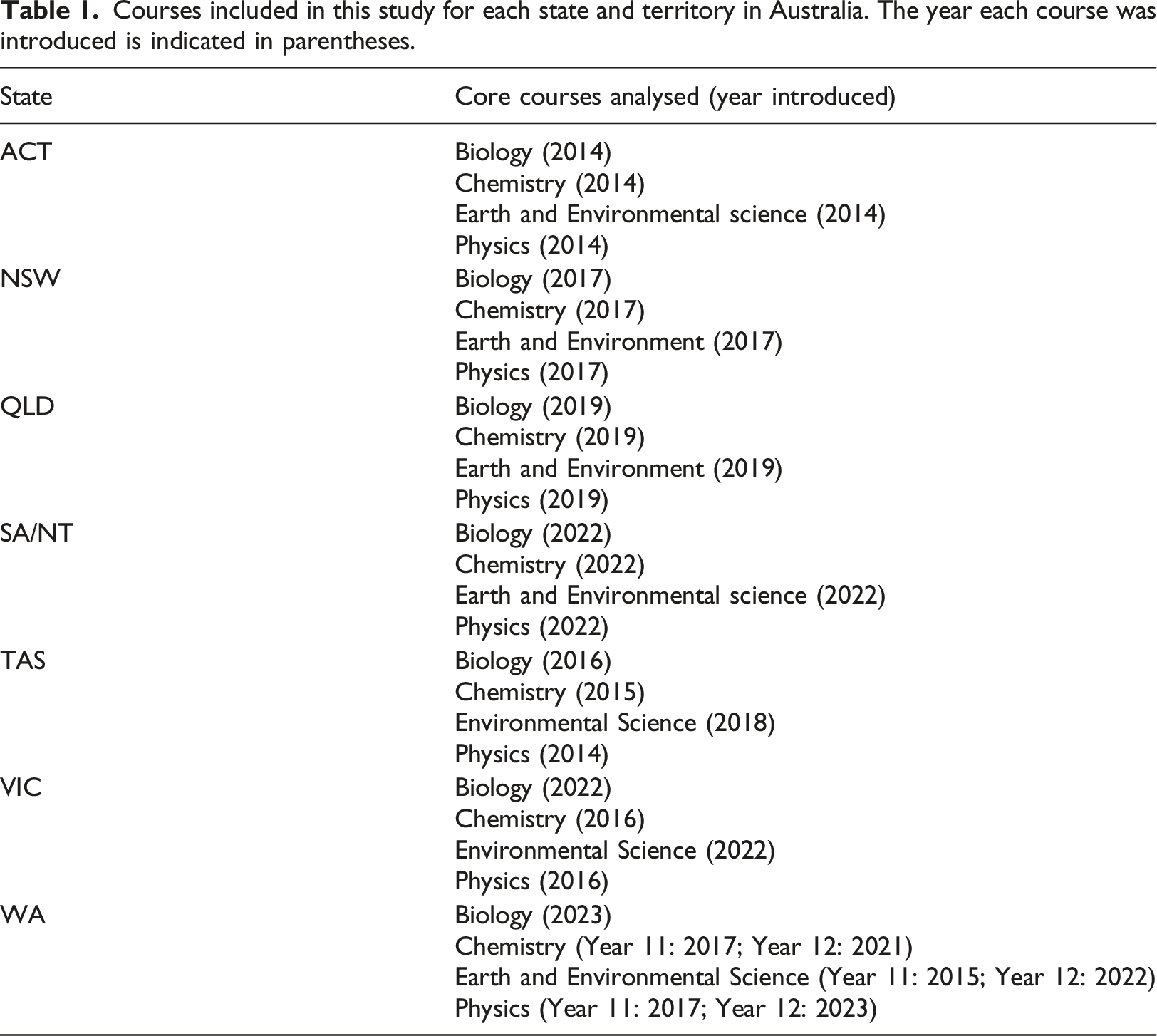
Data are drawn from the latest curriculum for senior secondary science courses offered in Australian Capital Territory (ACT), New South Wales (NSW), Northern Territory (NT), Queensland (QLD), South Australia (SA), Tasmania (TAS), Victoria (VIC), and Western Australia (WA). We note that the Northern Territory follows the same curriculum as South Australia, so their analysis is combined. All courses analysed were the most recent versions available at the time of writing.
Courses included in this study for each state and territory in Australia. The year each course was introduced is indicated in parentheses.
Data Analysis
We conducted a content analysis of each curriculum to identify core topics covered by each state. The syllabuses were interrogated for explicit inclusion of the names of scientists and classified according to the context of the inclusion. The data were separated into male and female lists and numerical representation.
For each mention of a name, we classified the mention into one of two categories depending on the intended subject of the sentence. The categories were the following: (1) ‘scientist’: the scientist themselves; or (2) ‘concept’: the scientific law/results named after a scientist. For example, in the New South Wales Physics course, the syllabus states ‘analyse the contribution of Schrödinger to the current model of the atom’, where the scientist, Schrödinger, is the subject of the mention and hence is classified as a mention of a ‘scientist’. Whereas, the scientist, Snell, is not the intended focus when the syllabus mentions ‘Snell’s Law’ and hence was classified as a mention of a ‘concept’. Exceptions were made when the scientist’s name is not a part of the commonly agreed concept nomenclature (e.g. ‘Ruhmkorff coil’ in South Australia/Northern Territory Physics syllabus, which is more commonly known as an induction coil) or for unnecessary name inclusions within an already defined concept (e.g. Rutherford’s name is not needed to further identify the ‘gold foil experiment’ in Queensland’s Chemistry syllabus). In these cases, the mention was classified as a ‘scientist’. In cases where the scientist was not the intended subject of the sentence and the law/experiment was named after multiple scientists, for example, the Hertzsprung–Russell diagram, this was only counted as a single ‘concept’ mention.
Each module included a content focus, a short paragraph of information, and overview relating to that module. This content is non-examinable and intended to provide background context for students. Mentions of scientists in these sections were also included and classified according to the intended subject of the sentence. Mentions of concepts that were named after scientists but where the contributing scientist was not obvious (i.e. uncapitalised mentions such as ‘volts’, ‘ohmic’, and ‘galvanic’) were not included.
Mentions of scientists in any glossaries were also not included.
Results and Discussion
We performed an analysis of the courses listed in Table 1. In Figure 1, we show the breakdown of mentions of ‘concepts’ compared to ‘scientists’ for each subject across each state and territory. Of these mentions we also examined the number of mentions of male and female scientists. Physics consistently had the highest number of mentions of the total concept mentions across all states and territories (445), with 54% of these mentions. Likewise, of the total mentions of scientists for all states and territories (137), Physics accounted for 56% of the mentions. Environmental Science had the fewest mentions, with only 2% of the total 445 concept mentions and 9% of the total 137 scientist mentions occurring within Environmental Science syllabuses. Summary of number of names of scientists named for each STEM course and state the scientific concept is the focus of the sentence mention (left) and where the scientist is the focus of the mention (right). Mentions of women are indicated by dark shading; mentions of men are indicated by light shading.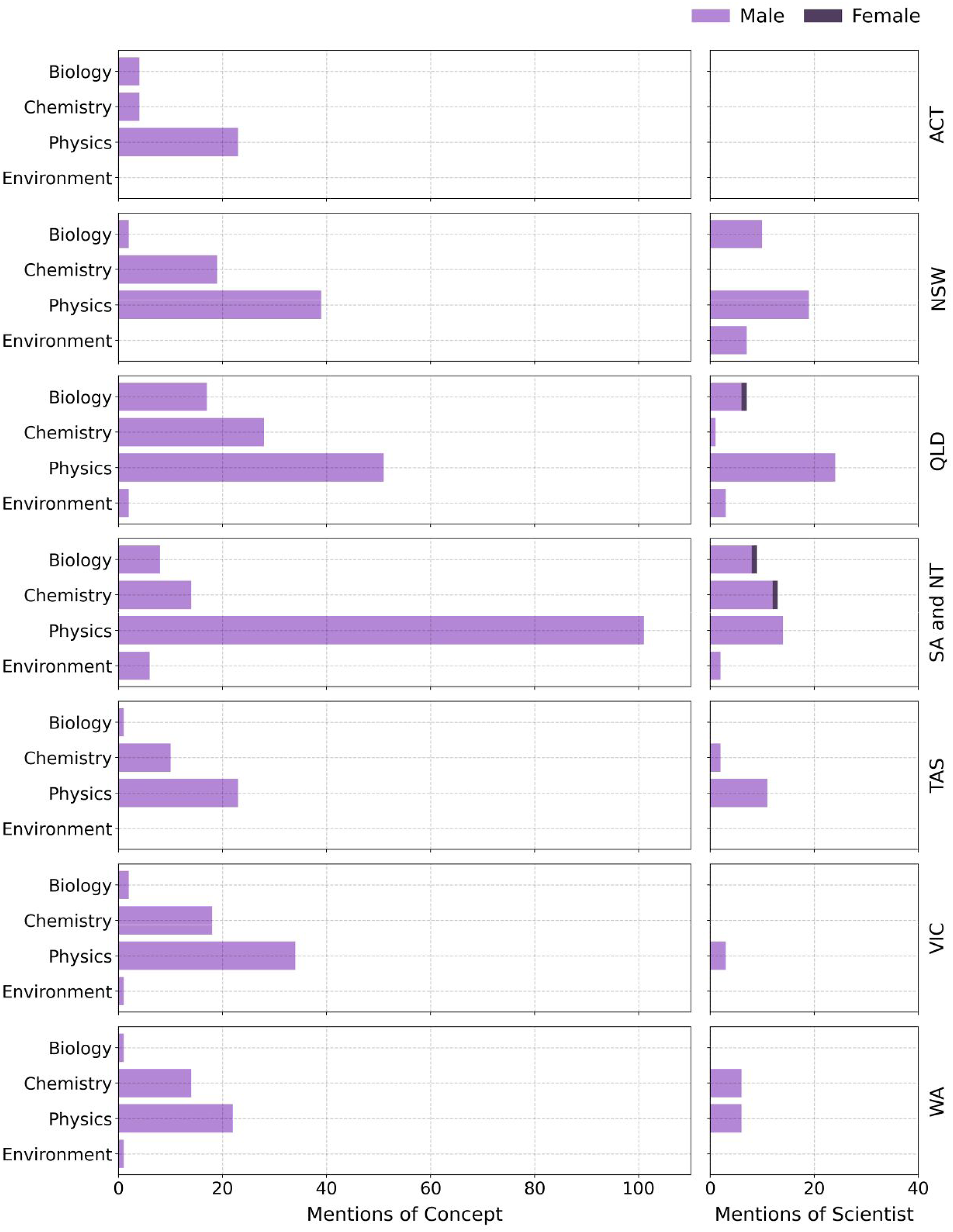
In Figure 2, we show the percentage of male and female scientists of those mentioned in the syllabuses for each state and territory. The only mention of a female scientist in any course for any state is Rosalind Franklin, who was mentioned once in the Queensland Biology syllabus, and once each in the South Australia/Northern Territory Biology and Chemistry syllabuses. Percentage of men (light shade) and women (dark shade) named in STEM curricula for states and territories across Australia.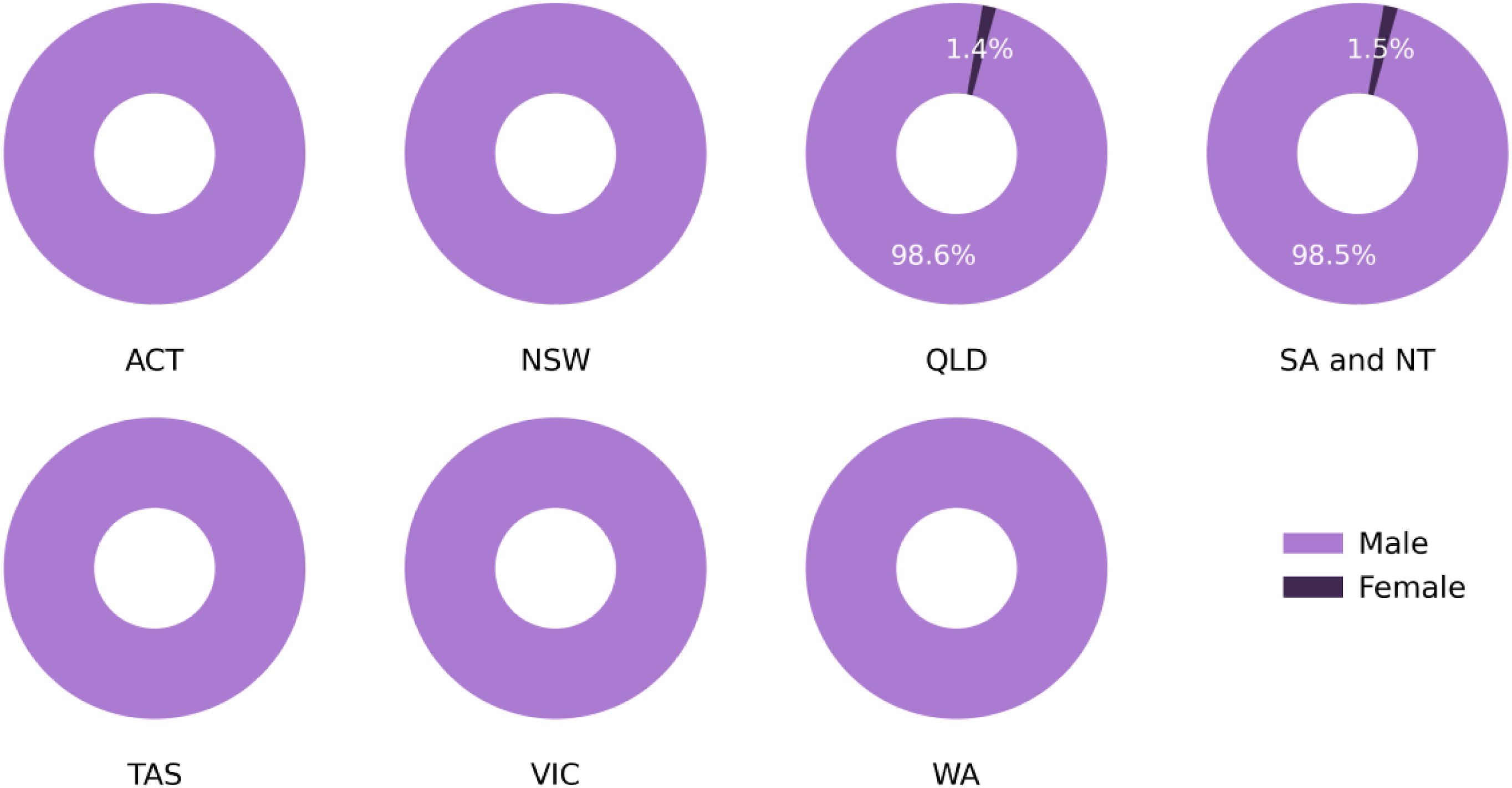
In Figure 3, we show the percentage of mentions that are classified as a ‘concept’ or a ‘scientist’. Given many of the laws and models studied at high school level are named after male scientists, nearly all the mentions in the courses were of male scientists and their associated concepts. The Australian Capital Territory was the system with the lowest proportion of ‘scientist’ mentions (0%). Victoria also recorded very few mentions of ‘scientist’ with just 3 mentions, accounting for only 5% of all mentions in that state. New South Wales was found to have the highest proportion of ‘scientist’ mentions, where 38% of mentions were ‘scientist’. A full summary of our analysis can be found in Table A1 in the Appendix. Percentage of mentions of the science concepts (light shade) compared to mentions of the scientists (dark shade) in STEM curricula for states and territories across Australia.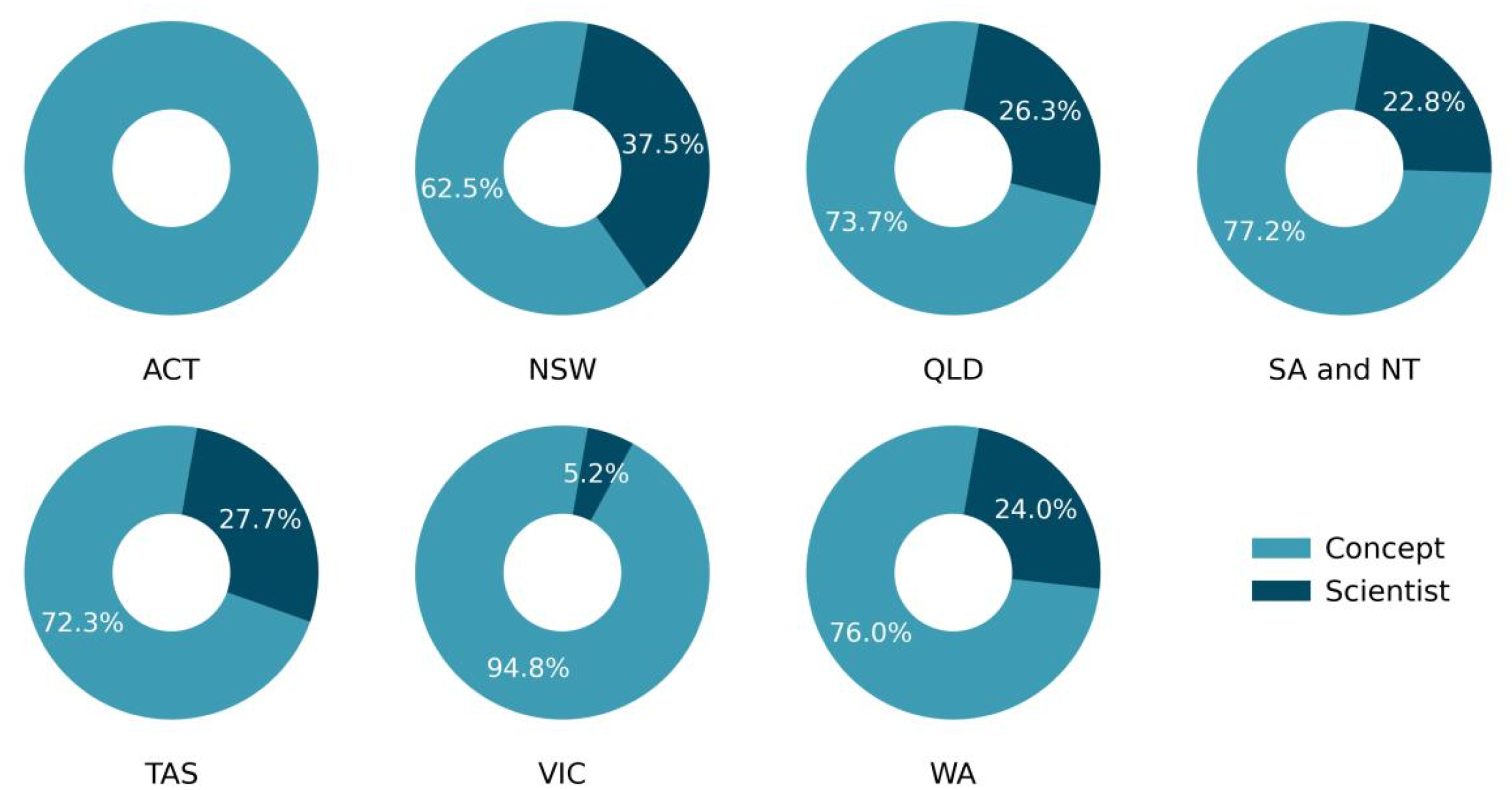
Students across all states and courses will be exposed to gendered representations of scientists. We hereby discuss the approaches and gender representation of each state and territory, the overall impressions of STEM courses in Australia, and the implications on participation and engagement of female students. Particular focus is given to New South Wales in the discussion, which recorded the highest proportion of ‘scientist’ mentions.
Australian Capital Territory
The compiled data was taken from the Australian Capital Territory Board of Senior Secondary Studies (BSSS), an entity responsible for the certification of senior school studies aimed towards ACT college (Years 11 and 12) students. Of the 14 science subjects offered by the BSSS, our analysis focuses on the four core science subjects: Biology, Chemistry, Earth and Environmental Science, and Physics, with all being applicable to the BSSS T (a tertiary preparation) package, but only the Biology and the Earth and Environmental Science subject offering an additional A (accredited, a non-tertiary preparation) package. For the two-year certification, we analysed the four topics per subject, with each topic taking a semester to complete.
Regarding the mentions of scientists across all subjects, 100% were classified as concepts, with no direct instruction to mention specific scientists by their full name. Further, for every scientist mentioned via concept, 100% were identified as male. Physics has the most mentions (23 mentions), while Earth and Environmental Science has the least (0 mentions). For the latter, the subject focuses towards non-anthroponym nomenclature (i.e. not named after a person). This approach is also identified for concepts listed in Biology and Chemistry, where non-anthroponyms were specifically chosen over their anthroponym counterpart (e.g. in Chemistry, VSPER theory is mentioned instead of its scientist-orientated name Gillespie–Nyholm theory).
Additional notable results include the following: • The concept names mentioned in Physics almost exclusively refer to equations or constants derived by (and thus named after) the scientist, with ‘Newtonian Physics’ (2 mentions), ‘Einstein’s Theory of Special Relativity’ (1 mention), and ‘Bohr’s Model’ (3 mentions) being the only non-mathematically based mentions. • All scientists mentioned are of Caucasian descent, despite the Science as a Human Endeavour (SHE) aspect of courses stating ‘…appreciate the contributions of diverse cultures to developing science...’ (all Australian Capital Territory syllabuses p. 5) and ‘...involves a diverse range of scientists working within an increasingly global community of practice...’ (in the Earth and Environmental Science and the Physics syllabuses, p. 11). • Under the general capabilities for each course, it states to prioritise Aboriginal and Torres Strait Islander histories and cultures, Asia and Australia’s engagement with Asia, and Sustainability, where applicable (although excluding Earth and Environmental Science, there is no specific mention of these priorities in the core course content).
While the Australian Capital Territory does a commendable job at applying non-anthroponym nomenclature, there is a lack of both gender and race diversity when names are mentioned. STEM courses in the Australian Capital Territory would benefit from a distinct effort to include an equal number of contributions from female scientists, and directly address the historical attempts to suppress female notoriety within the specific subject that is being addressed, particularly for subjects that reference scientists.
New South Wales
The New South Wales school curriculum is outlined by the New South Wales Education Standards Authority (NESA). The main focus of analysis was the four core STEM topics for Physics, Chemistry, Biology, and Earth and Environment for preliminary (Year 11) and higher school certificate (HSC, Year 12). However, secondary focus was also given to two further subjects introduced in 2017: Investigating Science (Years 11 and 12) and Science Extension (only Year 12). Science Extension records the lowest enrolment numbers of any science subject for New South Wales (681 students in 2022) but the second highest percentage of female students after Biology (62% compared to Biology 65% on 2022).
In 2022, Investigating Science recorded a higher enrolment than Earth and Environment with 2, 807 students, yet had the second lowest percentage of female students enrolled (42%) after Physics (22%). Thus, while not part of the core four STEM subjects of this study, Investigating Science and Science Extension are clearly worth consideration as a popular choice for all students and female students, respectively.
Across the four key STEM subjects except for Chemistry, New South Wales focuses on the ‘scientist’ over the ‘concept’ with the highest proportion of mentions of ‘scientist’ for each subject except for Chemistry compared to every other state. Furthermore, while each state has a content focus at the start of each module, New South Wales appears to be the only state that uses this section to introduce the historical context of the module. That is to say, other states and territories outline the topics covered in the module, while New South Wales covers the relevant scientists and moments of discovery. For example, the content focus for Physics Module 7: The Nature of Light states ‘Prior to the 20th century, physicists, including Newton and Maxwell, developed theories and models about mechanics, electricity and magnetism and the nature of matter’. The use of the content focus to provide historical context highlights the unique approach of New South Wales to focus on the ‘scientist’ over the scientific concepts.
Other notable results for the New South Wales courses include the following: • In Earth and Environment, 5 of the 7 mentions are included as examples rather than in the core compulsory content and all 7 mentions are classified as ‘scientist’. • 13 mentions are in the content focus section, 7 of which (54%) are classified as ‘scientist’, and all of which are male. • Core subjects include a ‘Depth Study’, in which students are tasked with an investigation or activity to build on content within the syllabus and build on the engagement with STEM as a whole. • Investigating Science records one ‘scientist’ mention of Marie Curie, in Module 2: Cause and Effect - Inferences and Generalisations, the context of this mention is only in relation to Henri Becquerel (a male colleague). • Investigating Science also mentions two female cartoon characters, namely, Edna Krabappel and Maggie Simpson. Thus, students enrolled in Investigating Science are exposed to more examples of female cartoon characters than female scientists. • Science Extension records one ‘scientist’ mention of Barbara McClintock in Module 1: The Foundations of Scientific Thinking. This mention is included only in a dot point where students choose a single scientist/concept to investigate further. This list contains the four ‘scientist’ mentions: Lavoisier, Einstein, Wegener, and McClintock. As such, there is no requirement for students to learn of McClintock, and three of the four listed scientists to select from are male. • Almost 50% of the mentions in Investigating Science and Science Extension are non-examinable as they are included in the content focus sections for the modules.
It is also worth noting the Investigating Science course appears to be specifically designed to help students develop critical skills required for conducting scientific research by investigating the processes involved in previous scientific discoveries. The dot points outlining the requirements for students to design their research projects appear to specifically try to demonstrate the collaborative nature of science and shift away from the ‘lone male genius’ narrative. Yet, Investigating Science makes repeated mentions specifically of individual scientists and their discoveries, completely contradicting the aim of the course to demonstrate the collaborative nature of science. Furthermore, Module 8 of Investigating Science, ‘Science and Society’, states in the content focus ‘Students explore the impacts of ethical, social, economic and political influences on science and its research’ (p. 57), yet nowhere in this module is there any reference to the impacts of gender discrimination or biases of scientific research.
The only two mentions of female scientists are included as either examples (and are non-compulsory) or in relation to male scientists. Neither female scientist is in any of the four core STEM subjects. As Investigating Science enrolment increases since it was introduced in 2017, the larger proportion of mentions of fictional female cartoon characters compared to female scientists poses a particularly concerning representation of female scientists for many STEM students in New South Wales, especially as these characters become even less relatable as they fade from popular culture.
New South Wales would benefit from shifting focus on the scientist and the ‘lone male genius’ narrative towards the collaborative nature of science and the modern applications of scientific knowledge. Furthermore, the Depth Studies offer a unique possibility for improving female representation, with no comparable project in any other state. The Depth Studies could be modified to include a section of investigation into the contributions of female scientists in the chosen area. Such a student-driven approach could help engagement of female students and directly address gender biases in STEM.
Queensland
The Queensland Curriculum and Assessment Authority (QCAA) defines the senior curriculum by two streams: (1) general syllabus and (2) applied syllabus. Science courses in both syllabus streams contribute towards the Queensland Certificate of Education (QCE); however, the general syllabus is targeted towards students who are more likely to pursue tertiary education. The Physics, Chemistry, Biology, and Earth Science and Environment subjects sit within the general syllabus. A secondary focus was also given to the Psychology, Aquatic Practices, and Agricultural science subjects as unique courses offered in Queensland; however, the results of these secondary focus courses were not included in the overall Queensland statistics to ensure that Queensland remained comparable to other states.
The curricula of Physics, Chemistry, Biology, and Earth Science and Environment focus primarily on the ‘concept’ of the science with 74% of mentions compared to 26% mentions of ‘scientists’ (see Figure 3). Unlike most other states, except for South Australia/Northern Territory, there was one female scientist (Rosalind Franklin) mentioned once each in the Physics and Chemistry syllabuses. However, like most other states and territories, the mention of scientists is dominated by males, with 68 unique male scientists mentioned across the four subjects (see Table A1).
It is also important to note: • The Psychology syllabus was also analysed as a unique case study. The syllabus references suggested material which included 53 mentions of female scientists. The psychology syllabus demonstrates the historical bias in favour of male scientists, which accounts for the high number of mentions (over 150) in the compulsory syllabus. However, it also shows how this can be counteracted with the suggested syllabus that includes the work of more female scientists from more recent times. • During the analysis, the inclusion and representation of Indigenous science was also noted. Indigenous science was mentioned thoroughly in the Environmental Science syllabus, and there were multiple references in the Aquatic Practices and Agricultural Science syllabuses. Students were encouraged to investigate how Indigenous Australians have contributed to science and why Indigenous science is important to present day society.
The Queensland curriculum structure provides ample opportunity to include the work and recognition of female scientists, especially in the SHE sections. Furthermore, the approach taken in the Psychology syllabus to include reference material that supports a more diverse body of scientists should be replicated across all subjects.
South Australia and the Northern Territory
The Year 11 and 12 curriculum in South Australia is set by the South Australian Certificate of Education (SACE). The Northern Territory also follows this course. We analysed Stages 1 and 2 of Biology, Chemistry, Earth and Environmental Science, and Physics.
South Australia recorded the highest number of mentions of ‘scientist’ and tied largest number of ‘concept’ mentions (36). However, Physics recorded 101 of the ‘concept’ mentions, 35 of which are of ‘Newton’s Laws’. Excluding these mentions, South Australia is similar to the gender representation and ‘scientist’ versus ‘concept’ representation to other states.
Other noteworthy findings include the following: • Particular effort appeared to be made to avoid mentioning the specific scientists in some cases, instead referring to ‘the Nobel prize winning scientists’. • Most of the mentions of both ‘concept’ and ‘scientist’ are included typically as examples for teachers. • There is a large focus on SHE modules for all topics in all courses. • There are several links to external resources, for example, to TED talks, to supplement the course content. The extra links may be of use in minimising the workload of teachers and potentially contextualising some science concepts. Future analysis of the gender representation within the linked resources is recommended in a future study.
The South Australian curriculum would benefit from expansion of the SHE dot-points to address gender discrimination and biases more directly in STEM fields. Furthermore, a shift away from the ‘lone male genius’ narrative to a collaborative narrative could be made by avoiding unnecessary mentions of ‘concepts’ named after male scientists when other descriptors are available.
Tasmania
The Tasmanian curriculum for senior secondary subjects is set by the Office of Tasmanian Assessment, Standards, and Certification (TASC). The courses are categorised by levels which tally to a total number of credit points. We analysed the following TASC courses: Biology (level 3), Chemistry (level 4), Environmental Science (level 3), and Physics (level 4). We note there is a course called Physical Sciences (level 3) which is recommended preparatory work for Physics and Chemistry, but in the interest of comparison with other curricula across Australia we omitted this course from our analysis. • Physics accounted for the majority of mentions in Tasmania with 11 mentions of ‘scientists’ as well as 23 ‘concepts’ mentions. • Chemistry was the only other course with mentions classified as ‘concept’ (2). • In both Physics and Chemistry, there is more emphasis on scientific concept over the scientist. • Mention was rarely made of groups of people that worked on theories. • Biology only had one mention which was classified as a ‘concept’ in the entire curriculum (Punnet squares). • Environmental science had no mention of either concepts or scientists.
The Tasmania curriculum would benefit from mentions of female scientists in the context of human endeavours in examinable content. It would also benefit from discussions of collaborative science to shift away from the ‘lone male genius’ narrative and actively addressing gender biases, especially in Chemistry and Physics which recorded high numbers of mentions (particularly of men) compared to Biology and Environmental Science.
Victoria
The school curriculum in Victoria is outlined by the Victorian Curriculum and Assessment Authority (VCAA). Our analysis focused on four key STEM subjects, all of which fall under VCCA’s Victorian Certificate of Education (VCE) courses. We analysed Units 1/2 and Units 3/4 of Biology, Chemistry, Environmental Science, and Physics.
Across all subjects, Victoria focuses on the scientific concepts over discussions of scientists and their contributions, with 95% of mentions being of a ‘concept’. Given the ‘concept’ over ‘scientist’ approach and since the majority of scientific concepts, method, and laws are named after male scientists (due to a number of historic factors), there are no female scientist mentions across the curricula. Additional findings of note include the following: • The omission of commonly used law names (e.g. Lenz’s law and Faraday’s law), these are instead presented with descriptions of the law or with equations. • The addition of statements to consider the contributions of Aboriginal and Torres Strait Islander knowledge and perspectives for the courses updated in 2022 (Biology and Environmental Science). • The lack of discussion in examinable content of contributions by groups of scientists and collaborative science.
The Victorian curriculum would benefit from the discussion of collaborative science to move away from the ‘lone male genius’ narrative and inclusion of scientific contributions by female scientists.
Western Australia
There are two main types of Western Australia Certificate of Education (WACE) courses: The ATAR courses and the General courses. Only the Year 11 and 12 Biology, Chemistry, Earth and Environmental Science, and Physics ATAR courses were examined.
There are no mentions of female scientists in any of the examined Western Australian syllabuses, whereas male scientists are mentioned 50 times across the courses. Of these mentions, 76% are classified as a ‘concept’. Chemistry and Physics account for the majority of the mentions, with 40% and 56% of the total mentions, respectively. The Biology and Earth and Environmental Science syllabuses have only one ‘concept’ mention apiece.
Other noteworthy findings include the following: • The only mention of a scientist in the Earth and Environmental Science syllabus is an unnecessary inclusion, as students are told that minerals can be characterised by a number of features, one of which is their hardness. The addition of the name of the hardness scale (i.e. Mohs scale) is odd as this is the only mention of a scientist in the syllabus and the clarification in this instance is not necessary to the understanding of the topic. • All four syllabuses encourage teachers to incorporate diverse knowledge and perspectives in their teaching, yet there is no assessable course content to match this encouragement. • All courses include a ‘Representation of the cross-curriculum priorities’ section. Though there is no acknowledgement of the contribution of diverse genders, these sections do include statements to consider the Aboriginal and Torres Strait Islander knowledge and perspectives as well as Asia–Australia endeavours.
The Western Australian syllabuses would benefit from a more authentic representation of the contributions, knowledge, and perspectives of diverse groups, particularly including them within the core content of each course.
National Trends
In the vast majority of cases, students are only exposed to scientists via relevant discoveries being named after the scientist who discovered them. Historically, such naming conventions only provided recognition to male scientists as female scientists were excluded from formal recognition at institutes and often had their work miscredited to male colleagues (Parks, 2020). Consequently, without significant contextual introduction, many students are implicitly being taught that only male scientists have made discoveries of note and that only male scientists are formally recognised for their work. Students are thus almost exclusively being taught scientific concepts through the narrative of the ‘lone male genius’. Such a pedagogy has recently received criticism for propagating the incorrect perception of the way modern scientific discoveries are made (Keast, 2022; Parks, 2020). Furthermore, such an approach prevents female students from being able to perceive where they can fit into such a system clearly designed for the individual (male) genius. Such implicit biases have been shown to decrease the performance of women in physics classrooms (Marchand & Taasoobshirazi, 2013). Thus, the clear discrepancies in mentioning male scientists, even if only through the discoveries named after them, are likely continuing the stereotype that only men have made significant contributions to science, whilst simultaneously impacting the current and future performance of females in science courses. This poses a particular threat in Physics, which has the highest number of mentions for each state.
The Lone Male Genius Versus the Teamwork Mentality
Particular effort has clearly been made in the Queensland and South Australia/Northern Territory courses, and to a lesser extent the Western Australia courses, to shift away from the ‘lone male genius’ narrative. For example, on several occasions, references are made to investigate the ‘multiple individuals’ who contributed to a specific scientific discovery, particularly in the SHE outcomes. While this works to address the problematic narrative of individuals making scientific advancements, it also tends towards glossing over the contributions of women unless actively sought out. While it is possible that teachers are addressing this in the classrooms, there is no direct instruction to ensure women are included in the ‘many individuals’. The course outlines could be modified to include a specific outcome for the SHE modules that address the contributions (or lack of contributions) of women to various SHE outcomes. Such an approach can also encourage a student-driven approach to investigating the contributing scientists. As discussed above, shifting from the narrative of individual scientists has been shown to have positive outcomes on the attitudes and engagement of students, particularly female, in STEM courses (Cheng et al., 2020; Parks, 2020).
On the other extreme end of this, New South Wales is the only state that actively reinforces this ‘lone male genius’ narrative. Unlike other states, New South Wales has no formal SHE modules that would address such discrepancies in the core science subjects. While the content focus section for each module has the potential to address the discrepancy and introduce discussion of the structural barriers women traditionally faced in the relevant fields, the content focus sections mention male scientists exclusively. This is particularly noticeable in the New South Wales Physics curriculum, in which the content sections are heavily historically focused yet only through the lens of ‘lone male genius’ scientists. Without proper introduction to the contextual awareness surrounding the lack of gender diversity, students in New South Wales may be particularly vulnerable to a gender-biased perception of scientists.
For each state, Chemistry and Physics were consistently the subjects that recorded the highest number of mentions, and these mentions are overwhelmingly of male scientists. It is interesting to note that socially, Chemistry and, in particular, Physics are viewed as the ‘hard’ sciences, while Biology and Environmental Science are often considered the ‘soft’ sciences. The notion of ‘hard’ versus ‘soft’ sciences is also often considered synonymous with ‘male’ versus ‘female’ dominated sciences (often evident in the enrolment numbers of these subjects) (Light et al., 2022). The consistently large number of mentions of scientists in Chemistry and Physics lends itself to these subjects being dominated by masculine identities and reinforces the notion of them being a ‘hard’ science.
Ethnicity in Science, Technology, Engineering, and Mathematics
The STEM curriculum across all states has a clear ‘Eurocentric’ focus, demonstrated in Figure 4, typically only including science discovered around the ‘Age of Enlightenment’ (1600s–1800s). This is evident from the common names mentioned across all states (e.g. Maxwell and Newton). This approach not only results in the lack of education on contributions from other geographical, ethical, and cultural areas but also reinforces a warped pedagogy of learning complex concepts via the chronological order of discovery. However, as mentioned, there is little evidence supporting the use of such a pedagogy (Keast, 2022; Parks, 2020). Indeed, recent research has shown that introducing general relativity physics to primary and middle school students through simple and explicit strategies has improved participation and perception of concepts traditionally thought of as complex and mathematical as long as 10 years after the initial intervention (Adams et al., 2021; Kersting et al., 2021). In particular, the introduction of general relativity (instead of classical mechanics) to middle-school girls has shown an increase in the perception of an interest in physics by female students (Kaur et al., 2020; Kersting et al., 2021). The introduction of relativistic physics to younger age groups before the introduction of traditional classical physics goes against the typical chronological pedagogy. Percentage of scientists from each region/continent mentioned across curricula in Australia.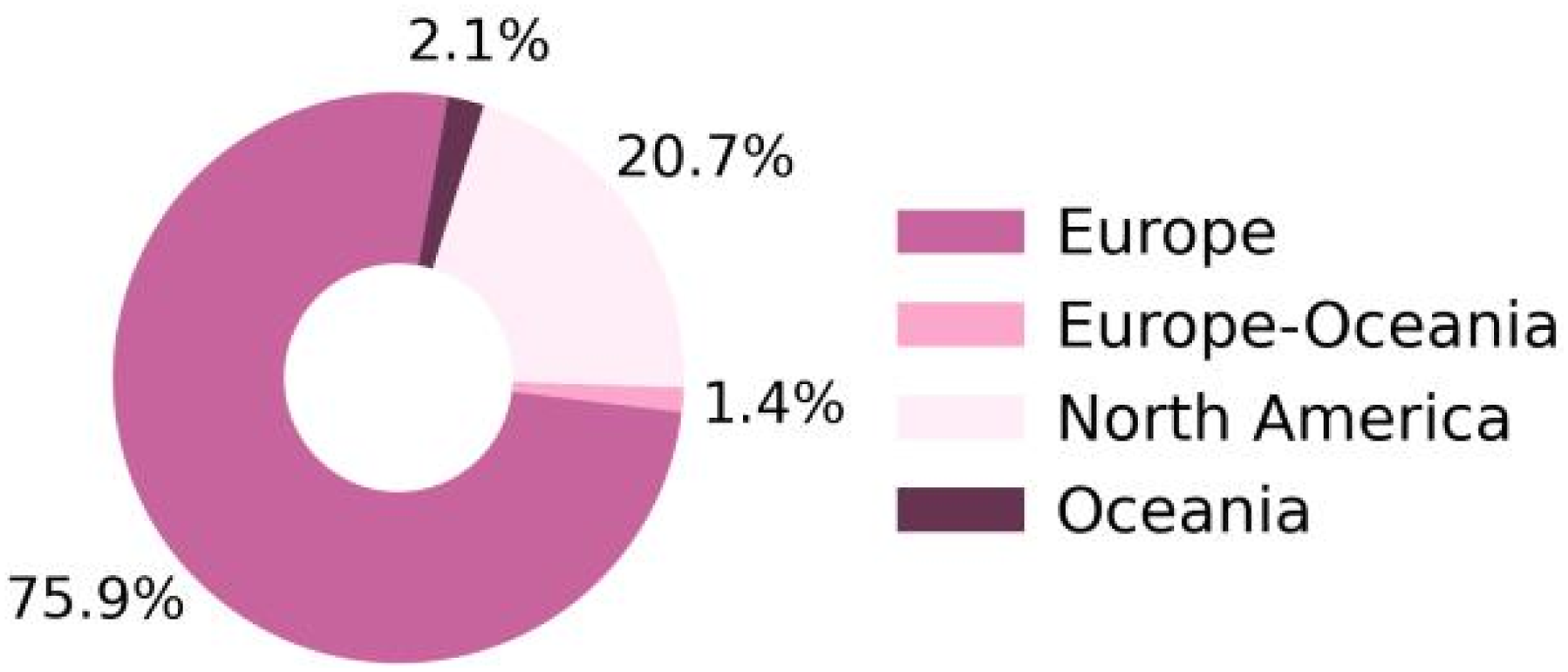
Future Directions and Recommendations
The lack of mentions of scientists themselves, particularly people of colour (POC), queer scientists, and female scientists, poses a significant hindrance to students in these minority groups as they develop their STEM identities. Similarly, as an Australian curriculum, there is a noticeable lack of mentions of Australian scientists, with whom students in Australia might associate and relate to more readily. Access to relatable role models is crucial for the participation and positive attitudes towards science (Adam, 2021; Adam & Barratt-Pugh, 2020; Adam et al., 2021). We present here a number of short- and long-term strategies to tackle the gender disparity in STEM courses in Australia. We note, at the time of writing, the Queensland Curriculum Assessment Authority (QCAA) is in the process of a full curriculum review for high school courses and development of new courses addressing the issues raised in this study.
Firstly, there are numerous examples of historical and modern female scientists who have made significant contributions to each field covered in this study. Short-term actions should focus on correcting the accreditation of scientific discoveries to include female scientists. While curricula can be edited to include the names of a broader range of scientists, it is worth noting that simply mentioning their names does not address the problem at large.
The following is a non-comprehensive list of notable female scientists who made significant contributions to common topics currently included in all curricula. We include this list to highlight that core topics that are universally covered by all states and territories have significant contributions by women that are not being included; however, simply including names of female scientists should not be considered a complete solution to the gender bias present as this would be a purely tokenistic effort without meaningful discourse for students. • Rosalind Franklin (Biology): Pioneer in understanding the molecular structures of DNA. • Nettie Stevens (Biology): Discovery of sex chromosomes in 1905. • Fiona Wood (Biology): Australian scientist who developed ‘spray on skin’ for burn victims, particularly in response to the Bali bombings. • Marie Curie (Chemistry and Physics): Discovery of radioactivity and radiation phenomena • Dorothy Crowfoot Hodgkin (Chemistry): Determination of the structure of biochemical structures using X-Ray techniques. • Maria Goeppert-Mayer (Chemistry): Development of the nuclear shell model of the atom. • Eunice Foote (Environmental Science): Discovery of the heating effect of CO2 in the atmosphere. • Marie Tharp (Environmental Science): First scientific map of the Atlantic Ocean floor and first evidence of tectonic plates. • Emma Johnston (Environmental Science): Australian scientists working on marine communities and maintaining Australian estuarine biodiversity. • Jocelyn Bell-Burnell (Physics): Discovered the first radio pulsars in 1967. • Michelle Simmons (Physics): Australian scientist who developed single-atom transistors and showed Ohm’s law holds for atomic scale conductors. • Lise Meitner (Physics): Worked with radioactive isotopes and helped to discover nuclear fission.
A more comprehensive list is available in the supplementary materials.
This study identified that the majority of mentions in courses across all states and territories were typically concept mentions, for example, where the concept is named after the (typically male) scientist who ‘discovered’ it. The use of concepts associated with male scientists (e.g. Newton’s laws) is widespread, and thus removing them from coursework entirely could lead to confusion among students, especially those who pursue STEM education further and are faced with unfamiliar naming conventions as they pursue STEM studies and careers. However, there are several instances where the names of scientists are added despite there being a widely accepted alternative that does not reference the name of a scientist. The South Australia/Northern Territory Physics curriculum, for example, references a ‘Ruhmkorff coil’ despite the terms ‘induction coil’ or ‘spark coil’ being widely used and accepted in Physics more broadly. The convention of naming discoveries or inventions after individual scientists has largely fallen out of favour in modern science, particularly during the 20th Century (Caso, 1980). Thus, curriculum materials would benefit from careful examination of the value in maintaining such historical names, particularly when clear alternatives already exist.
It is incredibly important for students from minority groups to have access to relatable role models. However, solely mentioning notable female scientists is inadequate at tackling the broad issue of gender representation in STEM in the longer term. While expensive to implement, a broader investigation of the current pedagogy for science in Australia is needed to address the underlying narrative of the ‘lone male genius’. Including mentions of female scientists is important, but without the historical and contextual background of women in STEM, it runs the risk of becoming tokenistic. Furthermore, the inclusion of female scientists exclusively paired with the barriers they faced and the unique circumstances leading to their success continues to teach the narrative that only exceptional female scientists have a place in science. Thus, there is a significant benefit that can be gained from the teaching of both the female scientists who have made contributions, and the structures and barriers preventing their formal recognition and participation in scientific developments (Cheng et al., 2020; Parks, 2020). Many states and territories have designated modules related to the contextual background of each module, for example, typically within the SHE modules. This section presents a perfect opportunity for the explicit discourse surrounding the gender representation in each field. Many SHE outcomes currently have a broader application, for example, in the South Australia/Northern Territory Biology course a specific SHE outcome states ‘Explore how the ideas of different scientists have led to the current model of membrane structure...’. This section of the curriculum can easily incorporate an additional element regarding the gender bias for a given field.
Most states and territories also include a statement at the beginning of the syllabus acknowledging that students should also prioritise ‘Intercultural understanding’, particularly learning of Aboriginal and Torres Strait Islander histories and knowledge (e.g. Aboriginal constellations in the Western Australia Physics course). These sections often explain that learning of the diverse intercultural understanding of content is a fundamental aspect of the course, and yet, almost entirely, the assessable units for each course in each state do not include any section where this content would be applicable. The only significant exception to this is the Earth and Environmental courses. Without the active inclusion of Aboriginal and Torres Strait Islander knowledge and history with the core content, the inclusion of these priority sections appears tokenistic, as there is no attempt to include the diverse understanding into the course itself. Furthermore, the encouragement to consider diverse contributions is not assessable, and there is no structure given to the statements. The implication is that teachers must choose to present these diverse perspectives to students. For example, syllabuses state that ‘Teachers may find opportunities to incorporate the [cross curriculum] priorities into the teaching and learning program’ (Western Australia Biology, p. 7 [Year 11] and p. 8 [Year 12], Earth and Environmental Science, p. 7, and Physics, p. 8 syllabuses) for the relevant course, but there is no mention of any specific knowledge, contribution, or perspective of any minority group within the assessable course content.
While this article highlights the invisibility of women from a binary gender perspective, we recognise and acknowledge that contributions have been and continue to be made by gender diverse scientists. The issues highlighted, particularly in this discussion, are relevant for other minority groups, including POC, people with disabilities, the queer community, and various ethnic, religious, cultural, and socioeconomic backgrounds. A design of a new pedagogy that moves away from the ‘Eurocentric’ narrative should also seek to incorporate a more diverse inclusion of scientific knowledge and developments. Such a pedagogy would also work to address a perception of superiority in Western science.
Footnotes
Declaration of Conflicting Interests
The author(s) declared no potential conflicts of interest with respect to the research, authorship, and/or publication of this article.
Funding
The author(s) received no financial support for the research, authorship, and/or publication of this article.

Appendix
In this appendix, we provide some summary statistics.
More materials, including the raw data and scripts for analysis, are available on GitHub upon request.
In Table A1, we provide a summary of all the data collected for all states and territories for Biology, Chemistry, Environmental Science, and Physics.
Breakdown of concepts and scientists mentioned for each subject, by gender across all states and territories.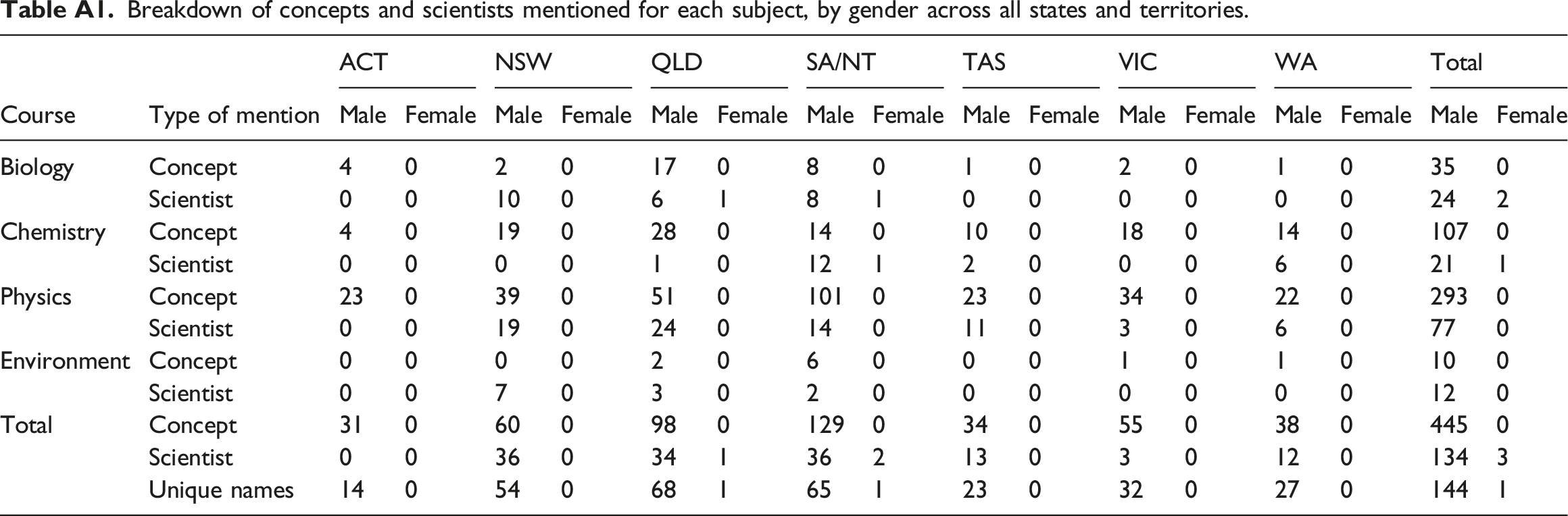
Course
Type of mention
ACT
NSW
QLD
SA/NT
TAS
VIC
WA
Total
Male
Female
Male
Female
Male
Female
Male
Female
Male
Female
Male
Female
Male
Female
Male
Female
Biology
Concept
4
0
2
0
17
0
8
0
1
0
2
0
1
0
35
0
Scientist
0
0
10
0
6
1
8
1
0
0
0
0
0
0
24
2
Chemistry
Concept
4
0
19
0
28
0
14
0
10
0
18
0
14
0
107
0
Scientist
0
0
0
0
1
0
12
1
2
0
0
0
6
0
21
1
Physics
Concept
23
0
39
0
51
0
101
0
23
0
34
0
22
0
293
0
Scientist
0
0
19
0
24
0
14
0
11
0
3
0
6
0
77
0
Environment
Concept
0
0
0
0
2
0
6
0
0
0
1
0
1
0
10
0
Scientist
0
0
7
0
3
0
2
0
0
0
0
0
0
0
12
0
Total
Concept
31
0
60
0
98
0
129
0
34
0
55
0
38
0
445
0
Scientist
0
0
36
0
34
1
36
2
13
0
3
0
12
0
134
3
Unique names
14
0
54
0
68
1
65
1
23
0
32
0
27
0
144
1