




Abstract
A sense of belonging is an important factor for the persistence of girls in the study of physics. Content and imagery that presents the field as a masculine domain will undermine belonging and make it more difficult for girls to establish a physics identity that is congruent with their gender identity. The physics syllabus, final examinations and commonly used textbooks associated with the New South Wales Higher School Certificate were examined for gendered content. It was found that an emphasis on the history of physics in the syllabus has resulted in content and images in which male figures significantly outnumber female figures. This gendered content will be counter-productive to other efforts to increase the participation of girls in physics and suggestions on how this can be addressed are made.
Introduction
A gender disparity in the study of science, technology, engineering and mathematics (STEM) subjects is common to many countries and at all levels of education (Chavatzia, 2017). This disparity is particularly pronounced in the study of physics, with women and girls typically making up only around one-fifth to one-quarter of the cohort. A self-reinforcing cycle exists where the low representation of women in physics generates the image of physics as being stereotypically male pursuit, which may then perpetuate the gender disparity. This article will examine the relative representations of males and females in the syllabus, examinations and textbooks associated with the New South Wales (NSW) Higher School Certificate (HSC) and how this has evolved over the past 25 years.
The NSW HSC is a program of study usually completed during the final 2 years of secondary school. Students can select from a wide range of over 100 courses (including languages) with English being the only compulsory course. The achievements of students are measured and reported using both school-based assessments and formal external examinations. An externally administered, high-stakes final examination contributes to half of the student’s HSC mark in each course. The marks achieved in the HSC are used in the determination of university admission.
There has been a long-term downward trend in the proportion of students choosing physics as a HSC course and the percentage of those that are girls has also been declining (see Figure 1). The NSW trends are consistent with the national trends and a similar pattern is observed for enrolments in advanced mathematics (Jaremus et al., 2019; Kennedy et al., 2014; Wilson & Mack, 2014). It is too early to determine whether the slight increase in the past few years will be sustained. In 2020, girls made up 23.2% of the students studying HSC physics; only 5.3% of girls elected to study physics compared to 19.2% of boys. In contrast, 46.9% of students studying HSC chemistry and 63.7% of students studying HSC biology were girls (NSW Education Standards Authority, 2021). It should also be noted that HSC enrolments are recorded as either ‘female’ or ‘male’ with no option for the inclusion of non-binary genders (NSW Education Standards Authority, 2021). The gender of a student, as recorded on their school enrolment, can differ from their biological sex assigned at birth. Percentage of students studying HSC physics that were female for the years 1991–2020 (NSW Education Standards Authority (2021). Complete Board of Studies NSW Statistics Archive. http://www.boardofstudies.nsw.edu.au/ebos/static/ebos_stats.html).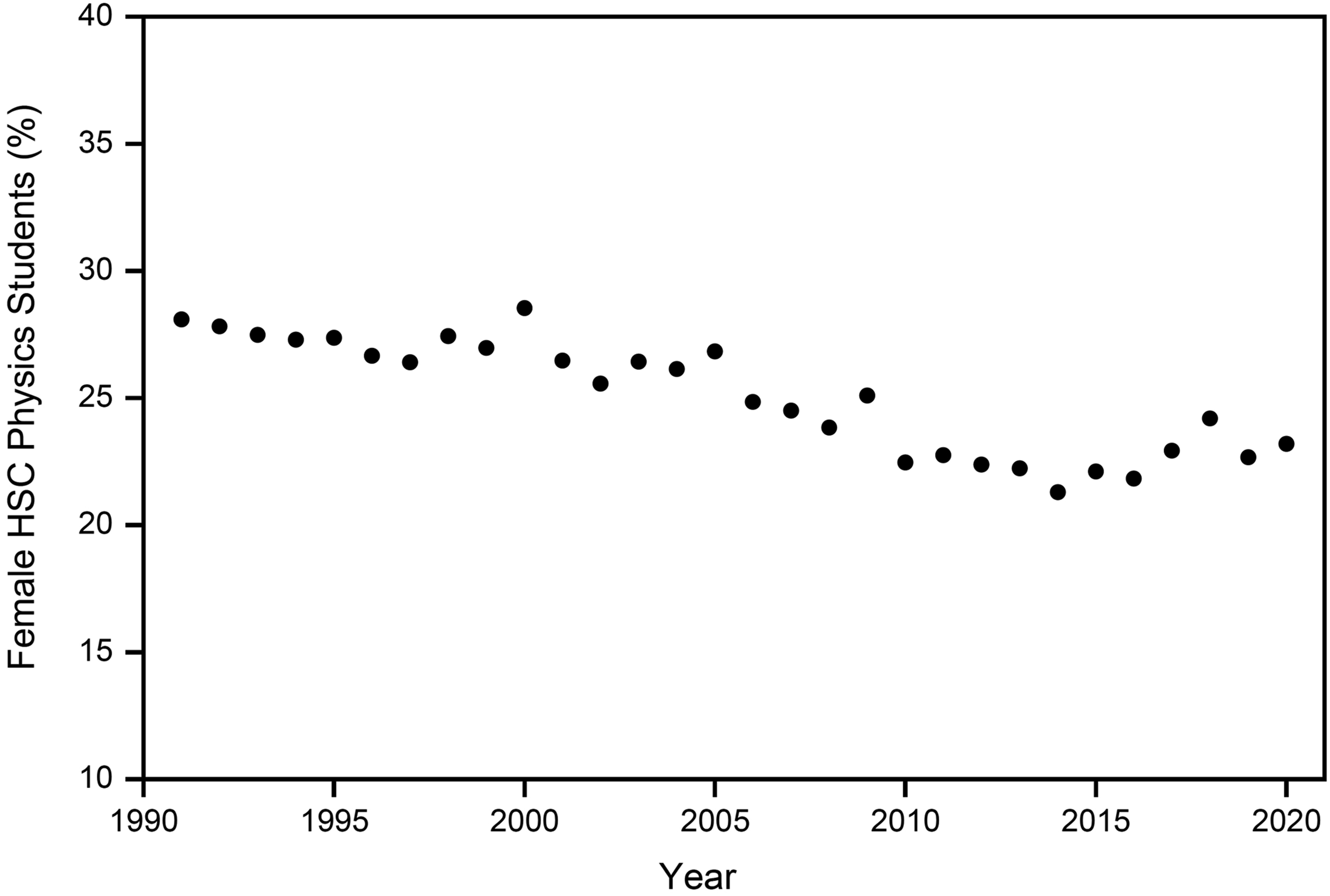
Completion of high school courses in physics and advanced mathematics is not usually a pre-requisite for entry into science or engineering degrees at universities in Australia. Nevertheless, the avoidance of these subjects is an indication that girls are not planning to engage in further study and/or careers that will rely on physics knowledge.
A substantial body of research into the gender disparity in physics exists and reveals a multitude of complex, dynamic and interacting factors. There are many comprehensive review articles available on the topic (Blickenstaff, 2005; Cheryan et al., 2017; Eddy & Brownell, 2016; Kelly, 2016; Wang & Degol, 2017). A theme that has emerged in the recent literature has been the importance of belonging for persistence in the study of physics (Lewis et al., 2017). Belonging encompasses the feeling of being a valued, accepted and legitimate member of a group and is a powerful motivator of human social behaviour (Lewis et al., 2016). Minor incidents can have an oversized effect on someone who is already experiencing uncertainty about belonging (Master & Meltzoff, 2020). Simply being a member of an underrepresented group can cue uncertainty of belonging, which may be further exacerbated by the environment or by interactions with others. Sexual and gender harassment are explicit and unacceptable incidents that impact belonging (Aycock et al., 2019), but there may be other signals students receive which are more implicit or subtle.
The imagery and stereotypes regarding the practitioners of physics can impact belonging. Adolescence is a critical time for the establishment of gender identity and the decision to continue with the study of physics into adulthood will involve reconciling one’s gender identity with the prototypical physics identity. Physics has historically been dominated by men, with women previously being excluded from the practice and their achievements often overlooked (Rossiter, 1995). As highlighted by Archer et al. (2010) ‘A sense of self is constructed as much through a sense of what/who one is not, as much as through the sense of who/what one is’. This experience is particularly salient for the choices of girls regarding physics if they observe a persistent imagery of it being the domain of men.
Much emphasis has been placed on the availability of female role models in STEM to counter existing stereotypes. For a stereotype to be broken, multiple counter-stereotypical examples need to be observed. Therefore, isolated role models may have limited effectiveness in changing gender-science stereotypes (Millar et al., 2015). There is also evidence that it is not sufficient to just observe a role model but it is important to be able to connect and identify with them (Bamberger, 2014; Buck et al., 2007; Conner & Danielson, 2016). The efforts of individual women to substantively change stereotypes may be undermined if other aspects of the environment remain stereotypically masculine.
Women and racial minorities have been observed to be underrepresented in television programs related to STEM (Alade et al., 2020; Steinke & Long, 1996), in online resources (Kerkhoven et al., 2016; Moreau & Mendick, 2012) and in children’s books and magazines (Caldwell & Wilbraham, 2018; Previs, 2016; Rawson & McCool, 2014). The popular program The Big Bang Theory, although a mostly sympathetic portrayal of the life of research physicists, on deeper analysis presents some problematic gender and science stereotypes (Filipova, 2017; McIntosh, 2014; Weitekamp, 2017). Although educators have limited capacity to alter the imagery present in the wider community, they do have some control over the educational resources used in their teaching and can choose those that present a diversity in imagery that reflects the diversity of their students.
Examination of older physics textbooks has consistently shown a gender bias with the number of images and References to men significantly outnumbering those to women (Powell & Garcia, 1985; Taylor, 1979; Walford, 1981; Whiteley, 1996). Other minority groups have also been underrepresented. It has previously been noted that the greater number of images of men can arise from discussion of the historical figures involved in the development of physics knowledge, who are almost exclusively men (Walford, 1981). Furthermore, the contributions of significant women scientists and astronomers have often been neglected, particularly in earlier decades (Laçin-Şimşek, 2011; Larsen, 1995). Of considerable concern is that the same gender biases remain in some modern resources (Lawlor & Niiler, 2020; Rosa & Gomes da Silva, 2020).
More fundamentally, educational resources are often developed in response to the relevant teaching syllabi and, therefore, it is important to examine these for any gendered content. The syllabus for HSC physics has been through a number of major revisions over the past 20 years. In particular, the syllabus in place for 2001 until 2018 moved away from the previous traditional and formula-based approach to one which included integration of topics; a contextual basis for concepts and inclusion of the history of physics and its societal impact (Binnie, 2004). As a consequence, HSC physics examinations became less mathematically intensive and with a greater emphasis on written answers. The most recent change to the syllabus, from 2019 onwards, returns HSC physics to a more mathematically intensive course, without explicit inclusion of contextual, historical or social aspects of the nature of physics, and with a greater emphasis on scientific practice by the implementation of “Depth Studies” (Georgiou & Crook, 2017). Furthermore, as the HSC includes a final high-stakes examination, past examination papers play an important role in driving teaching emphasis and any associated inherent gender bias.
This work examines gender representations found in the NSW HSC physics syllabus, in past examination papers and in the images found in some widely used textbooks. The relevance for belonging in physics for girls studying physics will be discussed and suggestions of alternative strategies will be provided.
Method
Topics covered in the NSW HSC Stage 6 Syllabus.
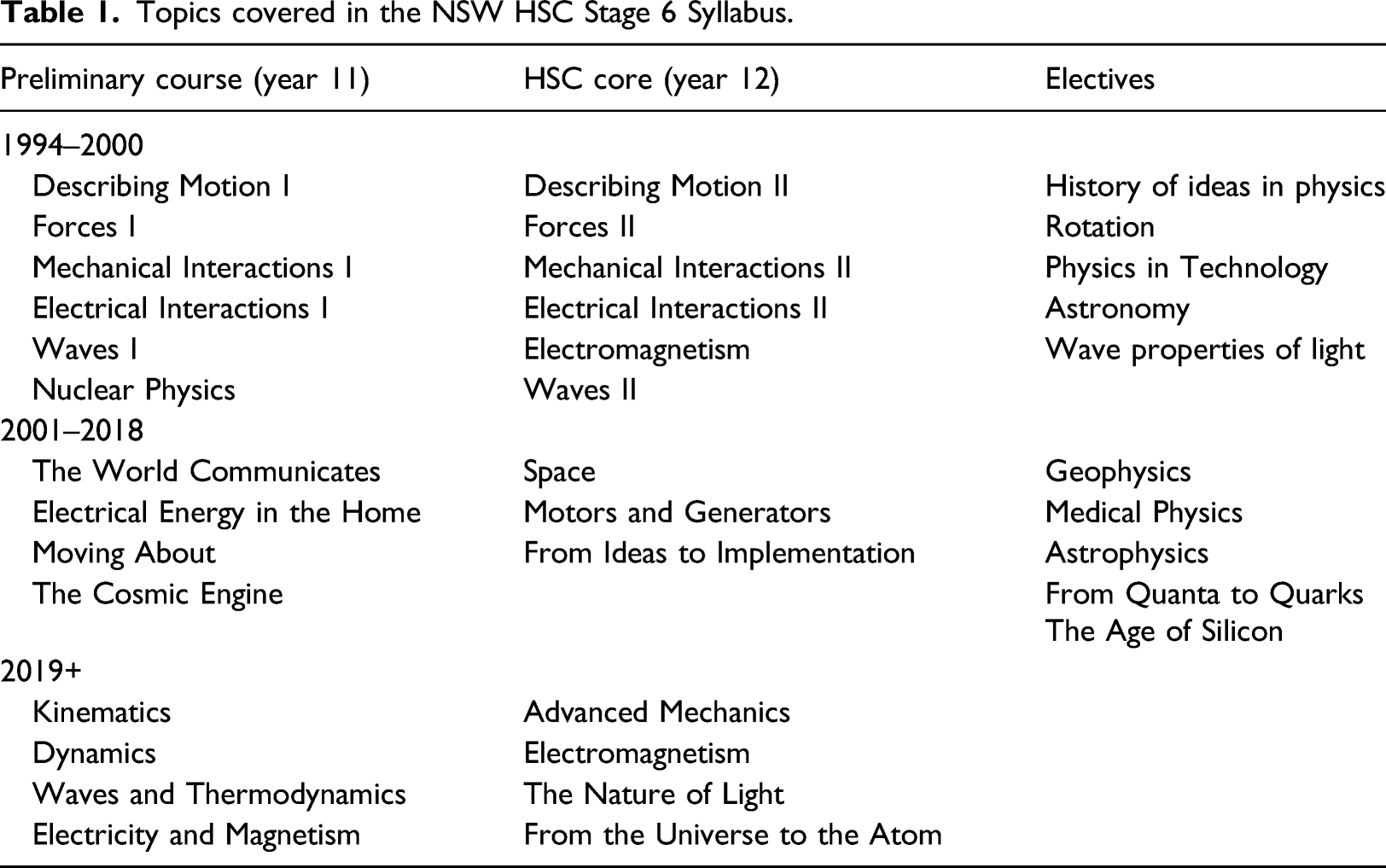
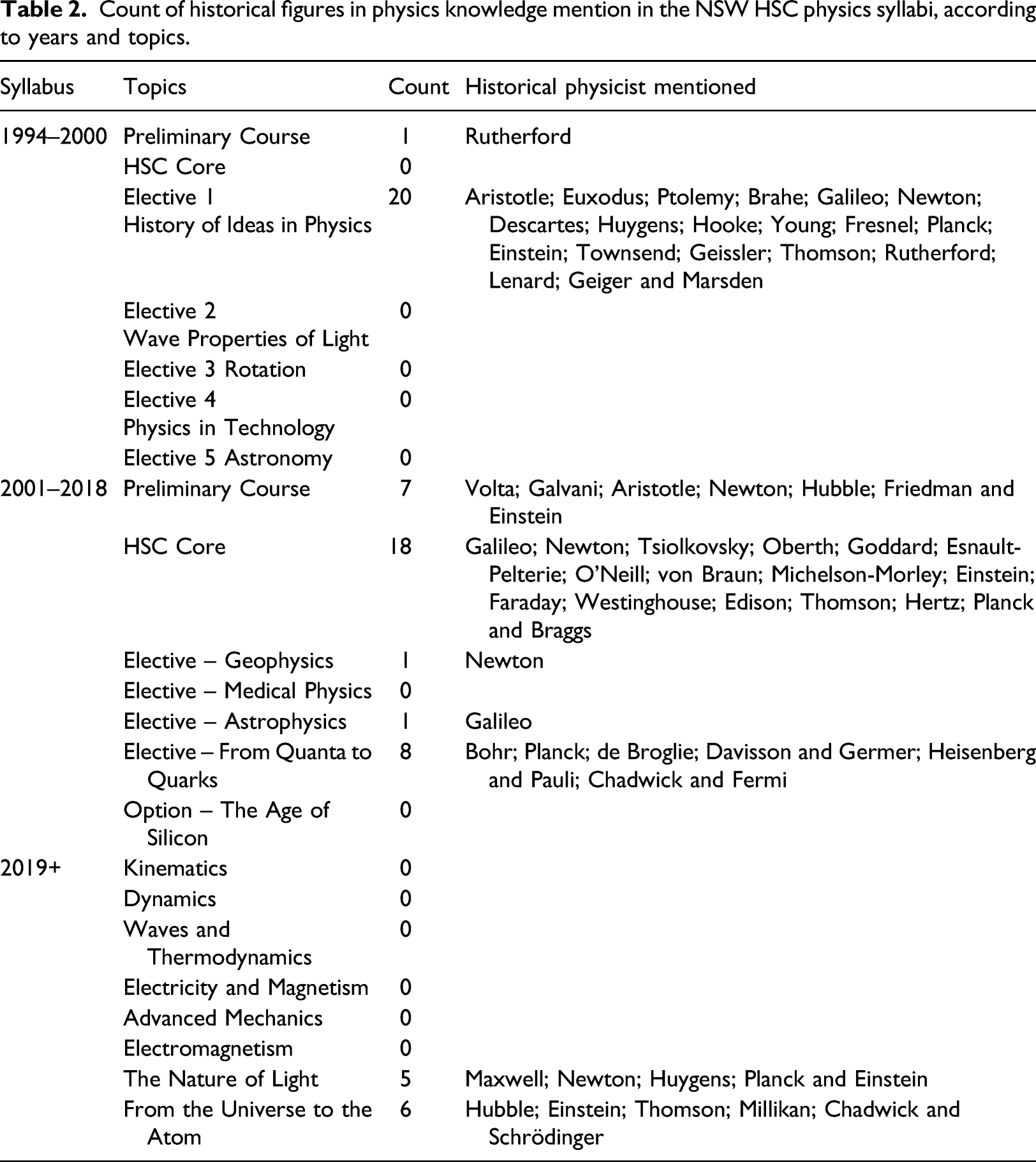
Many fundamental laws and theories in physics are designated by the name of the person who discovered or proposed them. Attempting to teach physics without reference to these terms would leave students unprepared for further study or practice in physics. Therefore, these instances were not counted. Examples of terms excluded from the count are Newton’s Laws of Motion; Hertzsprung-Russell Diagram; Huygens principle and the Geiger-Marsden experiment. Individuals were included where the sentence structure or context indicated active participation by the individual concerned. For example, ‘investigate Maxwell’s contribution to the classical theory of electromagnetism’ was included but ‘conduct investigations quantitatively using the relationship of Malus’ Law’ was not. Similarly, individuals were included where the sentence structure indicated the person was the subject of the sentence, not the law or principle named after them. For example ‘discuss Einstein’s and Planck’s differing views’ would be included but ‘identify Planck’s hypothesis’ would not. The Supplemental Material gives the details of which instances were counted and which were not.
The questions in past papers from the external HSC examination were similarly analysed. In addition, References to or images of other individuals were also counted. Many questions made reference to ‘a student’, ‘an astronaut’, ‘a person’ or similar expressions, and the accompanying names, pronouns, drawings or images sometimes indicated the gender of the individual and sometimes they did not. In the latter case, the count was assigned as a gender neutral individual.
Finally, the image content of 12 widely used HSC Physics textbooks was analysed for gender, as listed in the References. Textbooks were chosen on the basis that they were available in libraries of the local government area and so likely to be representative of those used by students studying physics for the HSC. Only one textbook covering the syllabus of 1995–2000 was able to be sourced. Images containing human figures were classified as photographs or reproductions of historical figures in physics; photographs of other individuals; cartoons or drawings of human figures or pictograms of human figures. The gender of the individuals was determined from their name, accompanying information or other gendered aspects of appearance. Where potential for ambiguity in gender was identified, a second coder was used, with no conflicts in assignment of gender identified. Some images of individuals could not be classified as male or female (e.g. an astronaut in a space suit) and these were assigned as gender neutral. Some images contained pictograms of human figures and if no information regarding gender of the pictogram was provided in the accompanying text, the gender was assigned on the basis of which gender would choose to enter a toilet facility indicated by that pictogram.
There is inherent subjectivity in the classification schemas used in this work. Firstly, the method of classification is a subjective choice. Secondly, each decision about how to classify an instance under the chosen classification schema is also be subjective. However, the main conclusions of this work are unlikely to be changed by different approach. Details of the gender classifications performed are provided in the Supplemental Material.
Results
Count of historical figures in physics knowledge mention in the NSW HSC physics syllabi, according to years and topics.
Counts of male, female and gender neutral individuals as they appear in the NSW HSC physics examinations, collated according to common syllabi.
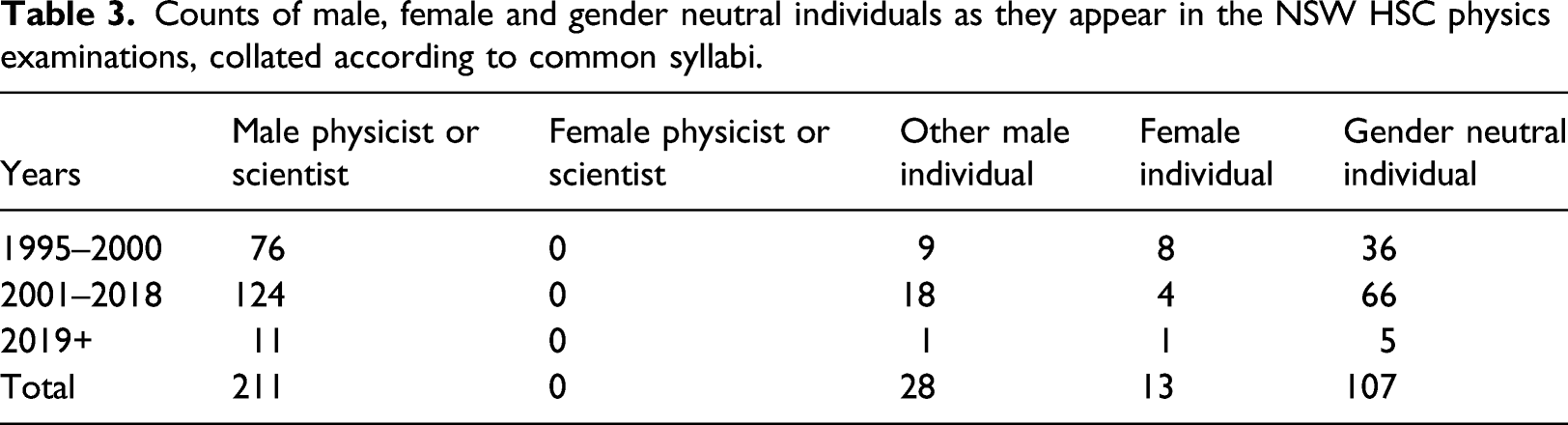
A year-by-year breakdown is shown in Figure 2. In the past 25 years, male physicists have been mentioned in the examinations a total of 211 times and not a single female physicist has appeared. Consistent with the syllabus, for the 1995–2000 examination questions, 72 of the 76 mentions of historical male physicists occurred in the elective ‘History of Ideas in Physics’. For students not taking this elective, the examinations of this period were relatively gender neutral, in contrast to the later periods when male physicists were included throughout the compulsory parts of the examination. Counts of mentions of male or female individuals in the NSW HSC physics examinations.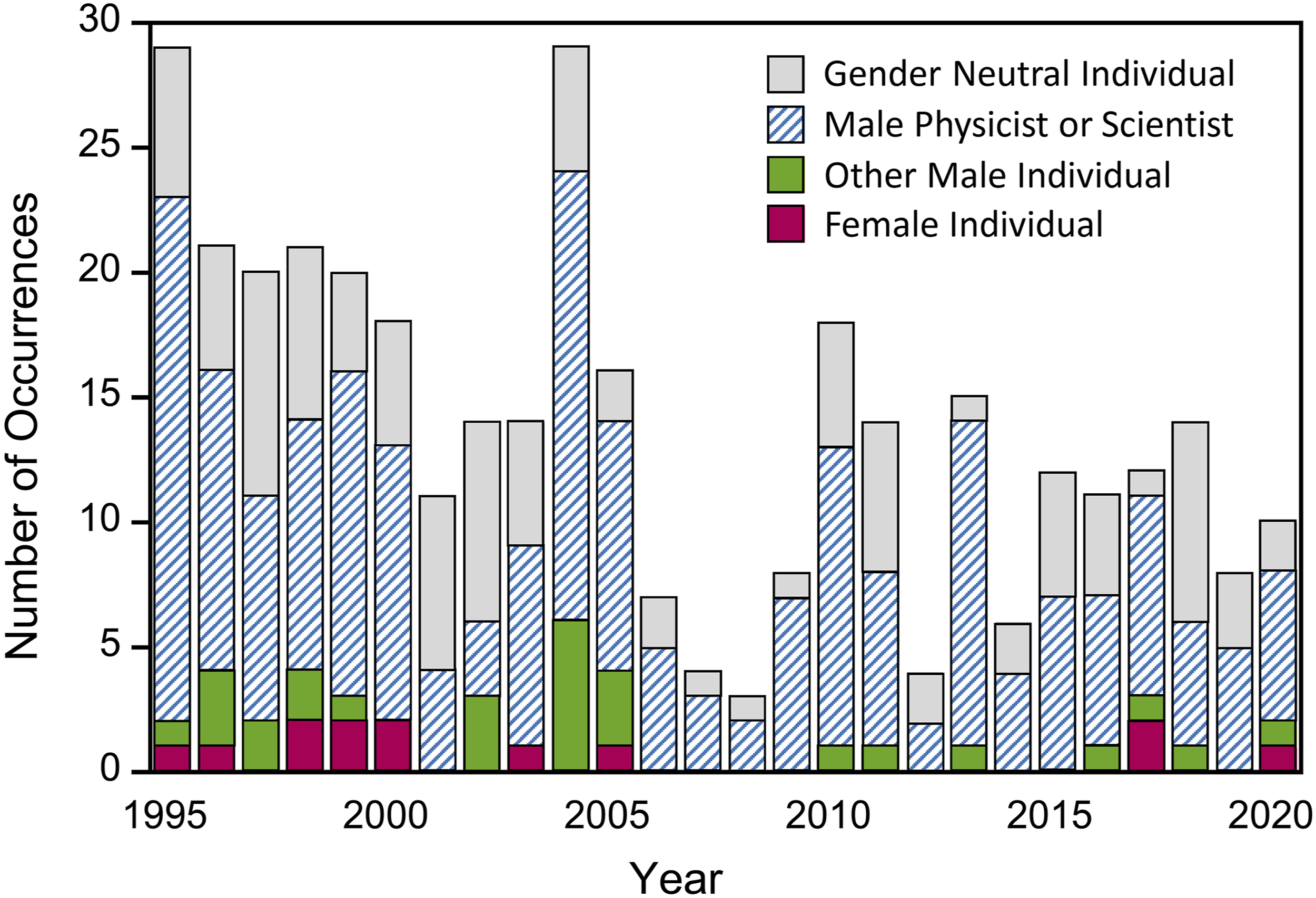
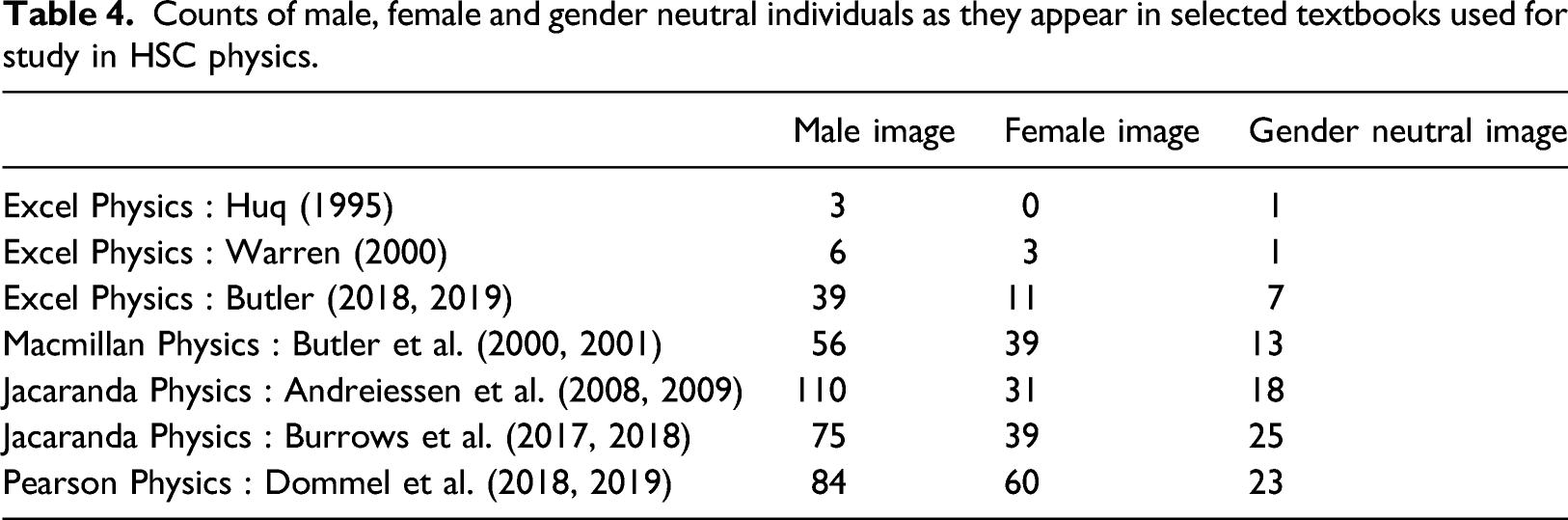
Counts of male, female and gender neutral individuals as they appear in selected textbooks used for study in HSC physics.
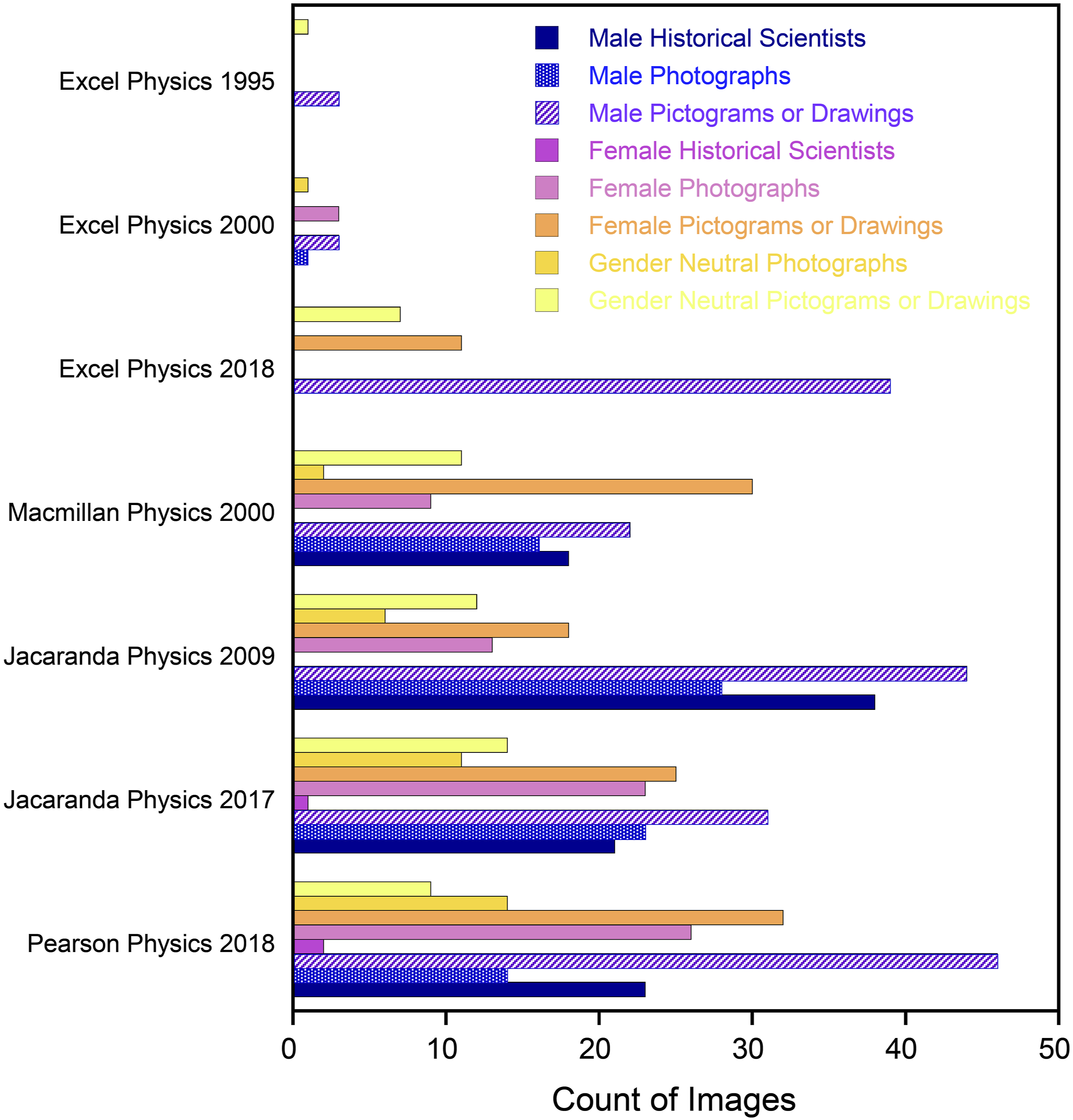
Counts of male, female and gender neutral images as they appear in textbooks used for study of NSW HSC physics, according to category of image.
In some cases, the same cartoon figure was used multiple times in nearby figures to illustrate related concepts. This accounts for the high male pictogram count in Pearson Physics Dommel et al. (2018, 2019) and high female pictogram count in Macmillan Physics Butler et al. (2000, 2001). It could be argued that these multiple instances of related images should have been counted as a single instance. The Excel Physics series, as moderately priced books, have few photographs or drawings and any human figures are represented by pictograms. The most recent edition of this text has more pictograms than previous editions, but has applied the masculine default of using male pictograms in most instances. This is consistent with the masculine default applied to pictograms in other contexts, such as pedestrian signals and traffic signage.
Discussion
Students studying physics in the NSW HSC will be exposed to gendered content, predominantly through the explicit inclusion in the syllabus of the history of ideas in physics, which is dominated by men. Prior to 2000, this was only the case for students who studied the History of Ideas in Physics elective, but it has been the case for all students since that time. The syllabus in place from 2001 to 2018 included content regarding 23 men (and no women) and there is a clear gender imbalance in the examinations and textbooks from that period. It also appears that insufficient care was taken to provide gender balance in the representation of other individuals in the associated examinations and textbooks. Although it is not possible to claim a direct causal relation to the observed decrease in the proportion of girls taking physics during that period, it is likely to have eroded the sense of belonging of girls studying physics and was counter-productive to other efforts to increase female participation.
In the most recent examinations and textbooks, improvements have been made. As an illustration, in the Jacaranda Physics series, a previous photograph of four male rowers was replaced by four female rowers for the latest edition. In both Jacaranda Physics Burrows et al. (2017, 2018) and Pearson Physics Dommel et al. (2018, 2019), pictures of female physicists, who do not appear in the syllabus, have been included. It appears that a conscious effort has been made by the authors and editors of these texts to provide a better gender balance in their images, within the constraints of the syllabus their text supports. It is disappointing that for the most recent syllabus revision, more effort was not made to include some content on significant discoveries made by female physicists. For example, given that both radioactivity and nuclear fission appear in the syllabus, it would have been appropriate to have included mention of Marie Curie and Lise Meitner.
The Excel Physics textbooks do not include any photographs or reproductions of historical figures in physics which, in principle, should lead to a more gender neutral content. The images in this series are predominantly line drawings, diagrams and some pictograms. The most recent edition of this book has increased the number of pictograms of human figures, and these are overwhelming male pictograms. It is possible that the authors or editors were applying a masculine default (as observed in traffic signals for example) and that the pictograms were intended to be viewed as gender neutral. However, explicitly female pictograms are included in the text in some places, which then implicitly suggests to the reader that the others are male. It is hoped that in future editions, the Excel Physics series gives consideration instead to using a balanced mix of male and female pictograms.
Although time-consuming, it would be interesting to see if extending the study of the textbooks to a content analysis of the text in addition to the image content would reveal similar trends. There are also many other resources available to students and teachers of physics, such as educational websites and videos that are now widely used in teaching and these have not been examined here. Such resources may play an important role in forming the picture that students form of the prototypical physicist and their sense of belonging. For practical reasons, the study has been restricted the syllabus and resources of the NSW HSC. Although it is anticipated that the other Australian states, and indeed other countries, would reveal similar trends, extension to other jurisdictions in future work would be valuable.
While the term ‘gender’ can be given many different meanings, gender in this article was used in the context of self or other identification as male or female. More widely, the existing research into gender participation in STEM rarely includes or examines the experience of gender diverse individuals. A limitation of the work presented here is that it contributes to perpetuating a simplistic female–male binary view of the relationship between gender and physics. Furthermore, the issue of other underrepresented minorities was not addressed. Intersectionality is an important aspect of identity development and more research on how the imagery of teaching resources of students influence the different and interacting aspects of their identity is warranted.
There is a tradition in physics teaching of framing the development of our current understanding of the physical laws as a chronological process of key experiments and theories developed and conducted by the great (male) minds in physics. It is very common for teaching materials to include photographs of these individuals, even though the pedagogical value of such a practice has never been examined. An argument can be made that such an approach acts to humanise what can be an abstract subject. However, by doing so, the field is presented as being the domain of the male, white, Western genius. This image is incompatible with the identity of many of the students we wish to attract to the field. Furthermore, it has been shown that students are not interested in famous scientists and their lives and the girls were even less interested than the boys (Sjøberg & Schreiner, 2010).
The historical development of the ideas of physics can be a useful aid to teaching the key concepts, as the famous experiments and process of discovery can mimic and guide the students own cognitive process of developing an understanding of key concepts. Furthermore, science is a human endeavour and should be seen and understood that way. However, we need to start taking much greater care to avoid generating the impression that physics is a subject about the achievements of dead white men. To tell the history of physics, without explicitly talking about how the social structures of the time excluded most women from contributing, is to only tell part of the story (Parks, 2020). It has been shown that the aspect of high school teaching that most predicted their choice of a physics career by college women was the inclusion of discussions around the underrepresentation of women in physics (Hazari et al., 2013). This was more important than single sex classrooms, having a female teacher, visits by female physicists or discussing the work of female physicists. An explicit discussion of the historical basis for the absence of women in physics allows this to be perceived as dynamic norm, rather than static norm, and therefore encourage students that there has been a collective change in behaviour and attitudes over time (Cheng et al., 2020).
Understanding the causes of the low participation of girls and women studying and working in physics will require asking much larger questions about the social construction of gender, our societal values and how these are connected to the nature of physics itself. These larger questions notwithstanding, physics should not present itself as more explicitly gendered than is necessary. Curriculum and teaching pedagogy need to be examined carefully from the viewpoint of how a physics identity is presented. In particular, any aspect of the curriculum and pedagogy that makes it more difficult for girls to associate physics with their gender identity will be particularly damaging to their sense of belonging. Learning resources should present physics as being conducted by diverse people, and although some progress has been made in the past decades, the data presented in this article suggests there may be more effort required for the NSW HSC.
Current NSW HSC physics teachers will be constrained to teach from the existing syllabus, which continues to be intrinsically gendered on the basis of an emphasis on the achievements of dead white Western men. Three suggestions for teachers to help ameliorate the possible negative impacts on belonging include the following: 1. Carefully examine the available educational resources for diversity and choose those that best reflect the diversity of the student population. 2. Include an explicit conversation about how the social structures of the time previously excluded women from participating in physics and how their contributions were sometimes actively overlooked (see Lock & Hazari, 2016 for an example lesson). 3. Use the flexibility of the current syllabus around context and in the Depth Studies as an opportunity to reference the work of modern female physicists.
Conclusion
An analysis of the syllabus, final examinations and textbooks associated with NSW HSC physics demonstrates that they contain gendered content and imagery, which predominantly arises from the inclusion of content around the history of physics, a history that has been dominated by men. This masculine image of the field may impact belonging for female students and be counter-productive to other efforts to improve the gender diversity of the field. Strategies that can be used by teachers to counter inbuilt bias include careful selection of educational resources, explicit discussions of the reasons why women are excluded from the history of physics and efforts to reference the work of modern female physicists.
Supplemental Material
sj-xlsx-1-aed-10.1177_00049441211059239 – Supplemental Material for Gender Bias in New South Wales Higher School Certificate (HSC) Physics
Supplemental Material, sj-xlsx-1-aed-10.1177_00049441211059239 for Gender Bias in New South Wales Higher School Certificate (HSC) Physics by Vicki J Keast in Australian Journal of Education
Footnotes
Acknowledgements
This work was inspired by preliminary studies conducted by Thomas Zentano, Madelon Gilham and Michael Clancy.
Declaration of conflicting interests
The author(s) declared no potential conflicts of interest with respect to the research, authorship, and/or publication of this article.
Funding
The author(s) received no financial support for the research, authorship, and/or publication of this article.

Supplemental Material
Supplemental material for this article is available online.
References
Supplementary Material
Please find the following supplemental material available below.
For Open Access articles published under a Creative Commons License, all supplemental material carries the same license as the article it is associated with.
For non-Open Access articles published, all supplemental material carries a non-exclusive license, and permission requests for re-use of supplemental material or any part of supplemental material shall be sent directly to the copyright owner as specified in the copyright notice associated with the article.
