




Abstract
This paper describes a classroom demonstration that showcases how pre-existing beliefs (e.g., stereotypes) influence problem-solving. Across four studies, participants solved riddles with gender stereotype-consistent (e.g. doctor is male) or gender stereotype-inconsistent (e.g., doctor is female; barber is female) solutions. Solve time, perceived difficulty, and perceptions of the demonstration and how it influenced learning were measured. Studies 3 and 4 extended Studies 1 and 2 by measuring objective learning through a quiz on gender stereotypes and bias. Results indicate that students solved the stereotype-inconsistent riddles slower than stereotype-consistent riddles. Stereotype-inconsistent riddles were rated as more difficult to solve than stereotype-consistent riddles. Subjectively, participants perceived the demonstration to be an effective tool, enhancing their knowledge about gender stereotypes. Objectively, participants performed better on the quiz when they solved stereotype-inconsistent riddles than stereotype-consistent riddles. These findings suggest that using stereotype-inconsistent riddles in class can help understanding about gender stereotypes and bias.
Gender stereotypes are beliefs about the attributes that describe men and women, especially in how they differ (Lips, 2007). Gender bias occurs when members of one sex are treated differently than members of the opposite sex (Lips, 2007). However, teaching about gender stereotypes and bias can be a daunting and difficult task. One reason is that people are under the impression that they do not stereotype and that gender bias no longer exists (Ganske & Hebl, 2001; Stephens & Levine, 2011). In addition, stereotypes occur at conscious (or explicit) and unconscious (or implicit) levels (Amodio & Devine, 2006; Greenwald & Banaji, 1995; Greenwald et al., 2002). Therefore, an individual may explicitly believe that they do not stereotype, but unbeknownst to them stereotypes can be automatically activated and influence their behavior (Blair, 2002; Devine, 1989; Greenwald & Banaji, 1995; Kunda & Spencer, 2003; Wheeler & Petty, 2001). Therefore, a classroom demonstration was created to illuminate the importance of gender stereotypes, specifically by illustrating how these stereotypes can influence students’ performance on a cognitive task.
Individuals rely on stereotypes to save cognitive effort (Macrae, Milne, & Bodenhausen, 1994). Once a stereotype is activated, information that is congruent with the stereotype (or expectation) tends to be stimulated (Lepore & Brown, 1999; Wyer, 1998), and can influence cognitions and behaviors such as impression formation, memory, and decision-making (Bodenhausen, 1988; Cantor & Mischel, 1977; Ellis & Nelson, 1999; Peters, Jelicic, & Merckelbach, 2006; Posner & Keele, 1970). Gender stereotypes also influence how information is processed (Bem, 1981; Eagly & Mladinic, 1989; Eagly, Wood, & Diekman, 2000; Workman & Freeburg, 1997). For instance, when hearing a story that contains gender-consistent and gender-inconsistent information, individuals were more likely to remember the gender-consistent information because it better matched their expectations (or stereotypes) (Ganske & Hebl, 2001). Likewise, young children will re-label occupations to match their stereotype-consistent expectations (e.g., female doctors become nurses) (Barak, Feldman, & Noy, 1991; Cordua, McGraw, & Drabman, 1979; Rosenthal & Chapman, 1980). When individuals do not match expectations, evaluations of these individuals tend to be extreme (see expectancy-violation theory, Jussim, Coleman, & Lerch, 1987). For instance, those in stereotype-inconsistent occupations (e.g., female leaders or doctors) are evaluated more negatively than those in stereotype-consistent occupations (Heilman, Wallen, Fuchs, & Tamkins, 2004).
Gender stereotypes can also impede problem-solving. Stoeger, Ziegler, and David (2004) presented female participants with a logic problem (or riddle). In this problem, a father and son get into a car accident. The father is killed and the son is rushed to the hospital. The surgeon enters the room and proclaims they cannot operate on the boy because he is their son. Participants needed to solve the riddle with the answer being that the surgeon is the mother. However, Stoeger and colleagues (2004) found that gender stereotypes (e.g., men are doctors) prevented participants from solving the riddle (only 32% of the participants correctly solved the riddle). When Stoeger and colleagues (2004) changed the riddle to be about a mother and a son, 80% of the participants came up with the correct answer (i.e., surgeon is the father) and many reported that the answer seemed obvious.
The findings from Stoeger and colleagues (2004) are intriguing because gender stereotypes prevented individuals from solving a problem. If riddles like this were used in a classroom, they could potentially assist students’ learning about stereotypes because students would explicitly experience implicit stereotypes interfering with their ability to solve a problem, and this could showcase the pervasiveness of gender stereotypes and bias (Ganske & Hebl, 2001; Hebl, 1995; Knight, Hebl, & Mendoza, 2004; Myers, 2008; Sheldon, 1999). Four studies were conducted to examine whether using riddles whose solutions violate gender stereotypes interfered with cognitive performance and consequently assisted subjective and objective learning about gender stereotypes. In Study 1, students solved a stereotype-consistent (i.e., answer is father is the doctor) and a stereotype-inconsistent (i.e., answer is mother is the doctor) riddle. The amount of time it took to solve the riddle and the perceptions of difficulty served as cognitive performance measures. Subjective learning was measured through perceptions of how the demonstration contributed to learning about gender stereotypes. Study 2 extended Study 1 by including an additional gender-inconsistent riddle to examine if the demonstration worked with other riddles (i.e., the riddle is about a barber who is female 1 ). Study 2 also explored if solving the stereotype-consistent riddle had the same effects on students’ cognitive performance and subjective learning as solving the stereotype-inconsistent riddle, based on Stoeger and colleagues’ (2004) findings. Study 3 investigated whether the demonstration also led to gains in objective learning by administering a quiz that assessed knowledge about gender stereotypes and bias at the end of a classroom discussion. Since Study 3 tested the demonstration in a real course environment along with classroom discussion, Study 4 was conducted to examine the effects of the demonstration by itself (without classroom discussion) on objective learning of gender stereotypes and bias.
Based on past research (Stoeger et al., 2004), it is predicted that the stereotype-inconsistent riddle will interfere with cognitive performance by taking longer to solve and being perceived as more difficult than the stereotype-consistent riddle. It was also predicted that students would show greater subjective (i.e., self-report) and objective (i.e., quiz scores) learning because past research shows that exposing students to their own biases assists learning about stereotypes and bias (Ganske & Hebl, 2001; Hebl, 1995; Knight et al., 2004; Myers, 2008; Sheldon, 1999).
Study 1
Method
Participants
Twenty-nine students attending a Social Psychology course participated. To preserve anonymity, demographic information was not collected. Thirty-seven students were enrolled in the course (26 males; 11 females).
Dependent measures
Cognitive performance (solve time and perceived difficulty)
The amount of time it took participants to solve the riddles was used to examine if stereotypes influenced cognitive performance (or behavior). Solve time was measured by having participants record the start and stop times for the riddle(s) they solved. The solve time, in seconds, was calculated from these times. Participants indicate the perceived difficulty of the riddle(s) on a nine-point Likert-type scale (1 = very easy; 9 = very difficult) as another indicator of cognitive performance.
Subjective learning
Subjective learning was measured by having participants indicate on a nine-point Likert-type scale (1 = strongly disagree; 9 = strongly agree) if the demonstration: (a) was enjoyable; (b) was valuable; (c) was educational; (d) was helpful in thinking about stereotypes; (e) should be incorporated into class; and (f) aided comprehension of stereotypes. A principle axis factor analysis with a varimax rotation showed that the six questions loaded together as one factor (Eigenvalue = 4.57; Cronbach’s α = .94).
Procedure
Study 1 used a within-participants design. Participants received a packet that contained both the stereotype-inconsistent and stereotype-consistent riddles (counterbalanced; see Appendix A). Before starting the first riddle, participants indicated their start time. After solving the riddle, they recorded their stop time, and rated the difficulty of the riddle. Participants then solved the second riddle, recording their start and end times, and reported the difficulty of the second riddle. Participants then engaged in class discussion on stereotypes and bias. At the end of the class, participants answered the six items measuring subjective learning and provided any additional comments (open-ended format).
Results
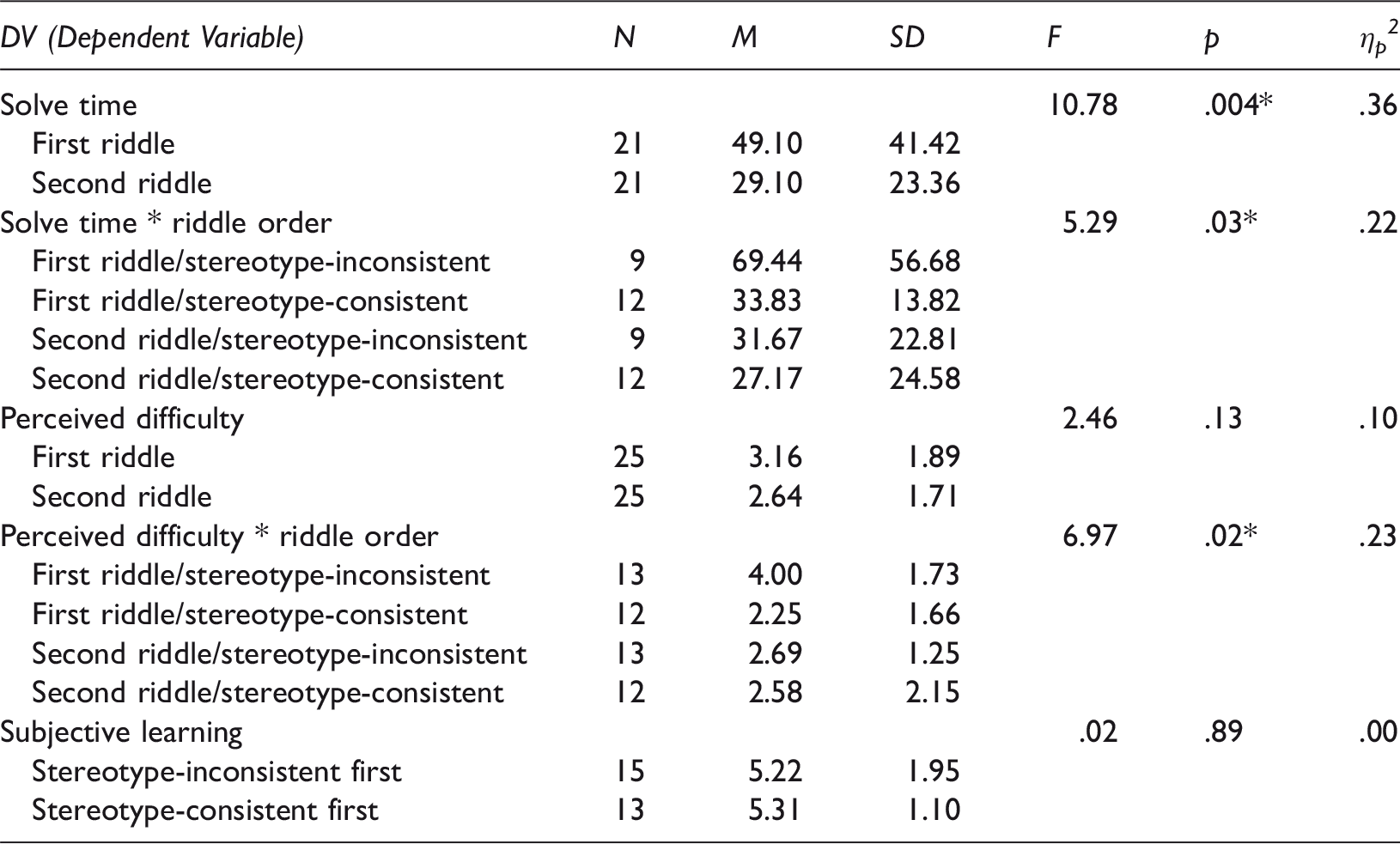
Means And Standard Deviations For Type Of Riddle On Solve Time, Perceived Difficulty, And Demonstration Perceptions in Study 1
p ≤ .05.
Cognitive performance (solve time and perceived difficulty)
There was a within-subjects effect for solve time, such that participants took longer to solve the first riddle than the second riddle, F(1, 19) = 10.78, p = .004, ηp2 = .36. There was also an interaction between the riddle order and the solve time F(1, 19) = 5.29, p = .03, ηp2 = .22. Simple effects analyses showed that when solving the first riddle, participants were slower when the riddle was stereotype-inconsistent than stereotype-consistent, F(1, 19) = 4.46, p = .002, ηp2 = .19. There were no differences in solve time for the second riddle, p = .67. Participants who saw the stereotype-inconsistent riddle first solved the first riddle significantly slower than the second (stereotype-consistent) riddle, F(1, 19) = 13.64, p = .002, ηp2 = .42. Participants who saw the stereotype-consistent riddle first solved both riddles at the same rate, p = .46. There was no between-factors effect for the riddle order, p = .12.
There was no within-subjects effect for difficulty, p = .13. However, there was the predicted interaction between the riddle order and perceived difficulty, F(1, 23) = 6.97, p = .02, ηp2 = .23. Simple effects analyses showed that when solving the first riddle, participants perceived the riddle more difficult if they solved the stereotype-inconsistent than stereotype-consistent riddle, F(1, 23) = 6.63, p = .02, ηp2 = .22. There were no differences in perceived difficulty for the second riddle, p = .88. Participants who saw the stereotype-inconsistent riddle first perceived the first riddle to be significantly more difficult to solve than the second (stereotype-consistent) riddle, F(1, 23) = 9.22, p = .01, ηp2 = .29. Participants who saw the stereotype-consistent riddle first perceived both riddles to be equally difficult, p = .47. There was no between-factors effect for the riddle order, p = .14. In conclusion, as predicted, solving a stereotype-inconsistent riddle affected cognitive performance by slowing down the ability to solve the riddle and increasing perceptions of the difficulty of the task.
Subjective learning
Those who solved the stereotype-inconsistent riddle first reported the same amount of subjective learning as those who solved the stereotype-consistent riddle first, p = .89. A one-sample t-test was conducted to compare the average subjective learning rating (regardless of riddle) to the mid-point (4.5) on the scale. This analysis showed that subjective learning perceptions (M = 5.26, SD = 1.59) were higher than the mid-point on the scale, t(27) = 2.54, p = .02. As predicted, participants reported that the demonstration helped their understanding of stereotypes.
Study 2
Stoeger and colleagues (2004) found that the solution to the stereotype-consistent riddle was obvious to participants. Thus, it is possible that the stereotype-consistent riddle is less helpful in understanding gender stereotypes. Study 2 tests this by having participants solve one riddle (rather than two). Study 2 also included an additional stereotype-inconsistent riddle about a barber to examine if the demonstration worked for other types of riddles. It was predicted that the stereotype-inconsistent riddles would limit cognitive performance and increase subjective learning more than the stereotype-consistent riddle.
Method
Participants
Forty-five students attending a Social Psychology course (out of 49 enrolled; 35 males were enrolled) participated, but to ensure anonymity, demographic information was not collected.
Procedure
In this between-participants design, participants were randomly assigned to solve the stereotype-consistent doctor riddle, stereotype-inconsistent doctor riddle, or the stereotype-inconsistent barber riddle (see Appendices A and B). Participants recorded their start and finish times and reported how difficult the riddle was to solve. Participants engaged in class discussion on stereotypes and bias. At the end of the class, subjective learning was assessed. As in Study 1, a principle axis factor analysis with varimax rotation showed that the six questions assessing subjective learning reliably loaded together (Eigenvalue = 3.88; Cronbach’s α = .86).
Results
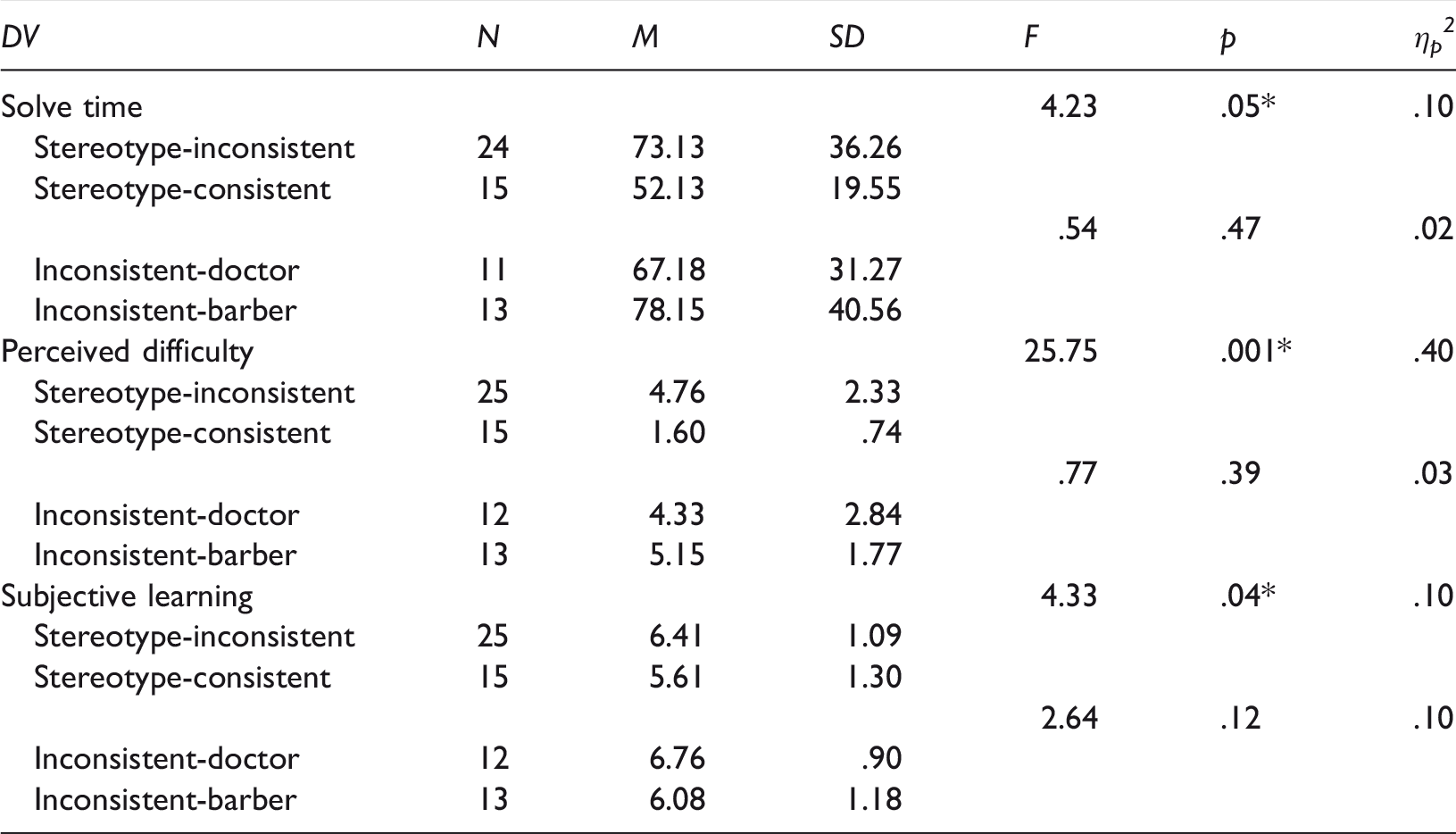
Means And Standard Deviations For Type Of Riddle On Solve Time, Perceived Difficulty, And Demonstration Perceptions In Study 2
p ≤ .05.
Cognitive performance (solve time and perceived difficulty)
Both stereotype-inconsistent riddles took longer to solve than the stereotype-consistent riddle, F(1, 37) = 4.23, p = .05, ηp2 = .10. Likewise, both stereotype-inconsistent riddles were perceived as more difficult to solve than the stereotype-consistent riddle, F(1, 38) = 25.75, p < .001, ηp2 = .40. As predicted, stereotype-inconsistent riddles interfered with cognitive performance and perceptions of difficulty of the task.
Subjective learning
As predicted, the stereotype-inconsistent riddles resulted in greater subjective learning than the stereotype-consistent riddle, F(1, 38) = 4.33, p = .04, ηp2 = .10. In sum, the stereotype-inconsistent riddles were more helpful in participants’ understanding of gender stereotypes than the stereotype-consistent riddle, and it did not matter which stereotype-inconsistent riddle was solved.
Study 3
Study 3 extends Studies 1 and 2 by measuring objective learning. To do so, participants took a 10-item quiz on gender stereotypes and bias. Study 3 utilized a larger sample size from two different classes, which allowed for the collection of demographic information.
Method
Participants
A total of 81 students participated (39 males; 41 females; 1 unreported). Forty-six participants were enrolled in a Psychology of Gender course and 35 were enrolled in a Social Psychology course. The sample was 69% White (27% minority; 4% unreported).
Measures
Objective learning
In addition to the measures used in Studies 1 and 2, objective learning was assessed with a 10-item multiple-choice quiz on gender stereotypes and bias. Items were taken from the Lips (2007) Sex & Gender 6th Edition test bank. Questions assessed what gender stereotypes were, attributes associated with gender stereotypes, the activation of gender stereotypes, what sexism was, different forms of sexism (e.g., hostile, benevolent, modern), and the role of gender occupational stereotypes (e.g., social role theory). Each correct response earned one point, with a maximum of 10 points. The reliability of the quiz items was moderate, Cronbach’s α = .67. Higher scores indicate greater knowledge about gender stereotypes and bias.
Procedure
Study 3 replicated Study 2 except for including a 10-item multiple-choice quiz on gender stereotypes and bias to assess objective learning. The quiz was administered at the end of class (prior to the six questions assessing subjective learning). A principle axis factor analysis with varimax rotation showed that six subjective learning questions reliably loaded together (Eigenvalue = 4.41; Cronbach’s α = .93).
Results
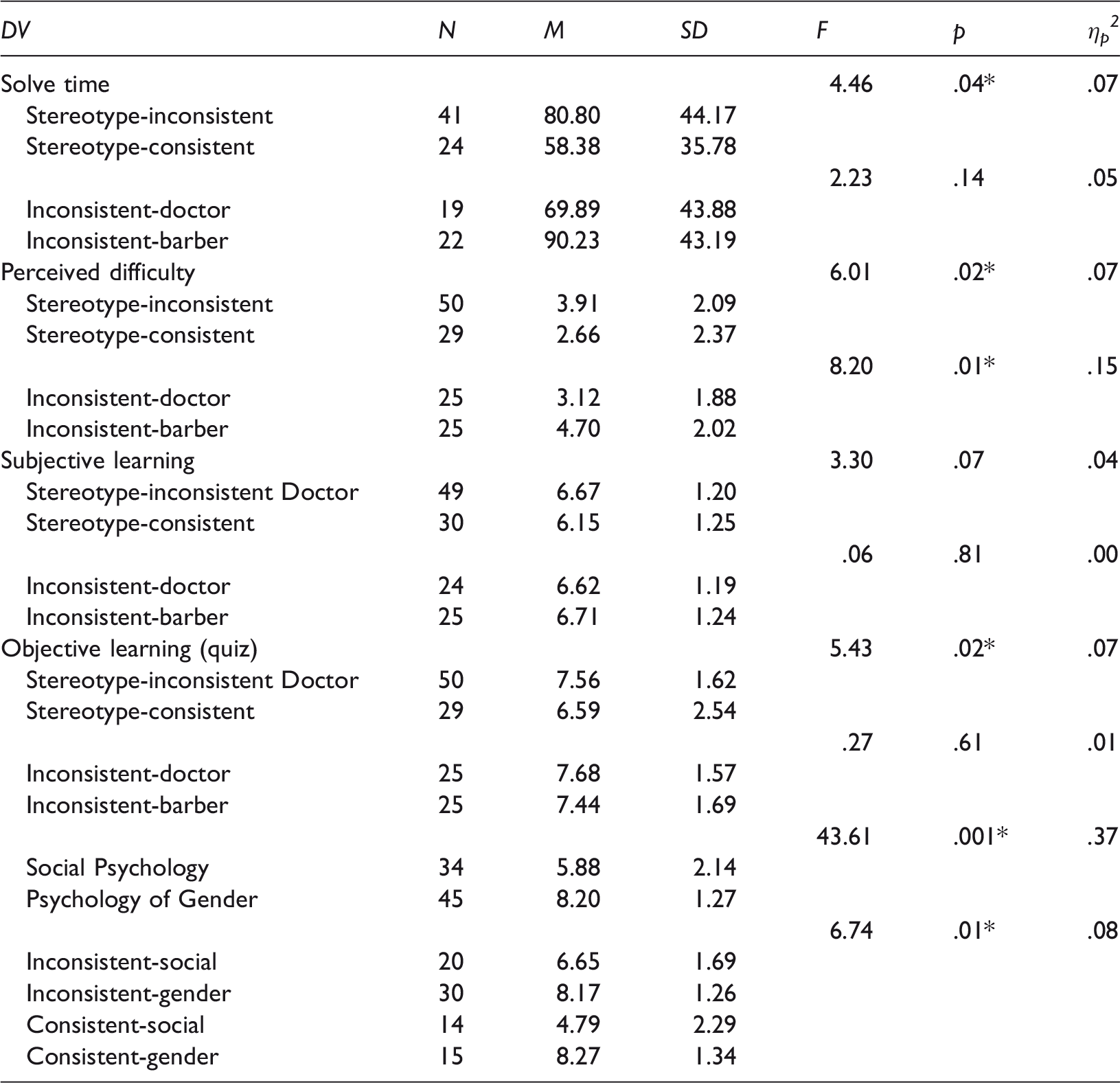
Means And Standard Deviations For Type Of Riddle On Solve Time, Perceived Difficulty, And Demonstration Perceptions And Learning In Study 3
Cognitive performance (solve time and perceived difficulty)
As in Study 2, stereotype-inconsistent riddles took longer to solve than the stereotype-consistent riddle, F(1, 63) = 4.46, p = .04, ηp2 = .07. Stereotype-inconsistent riddles were also perceived as more difficult than the stereotype-consistent riddle, F(1, 77) = 6.01, p = .02, ηp2 = .07. In this study, the stereotype-inconsistent barber riddle was perceived as more difficult than the stereotype-inconsistent doctor riddle, F(1, 48) = 8.20, p = .01, ηp2 = .15. As predicted, stereotype-inconsistent riddles interfered with cognitive performance.
Subjective learning
Those who solved the stereotype-inconsistent riddles reported greater subjective learning than those who solved the stereotype-consistent riddle, F(1, 77) = 3.30, p = .07, ηp2 = .04.
Objective learning
Participants performed better on the quiz if they solved the stereotype-inconsistent riddles than if they solved the stereotype-consistent riddle, F(1, 75) = 5.43, p = .02, ηp2 = .07. There was also main effect for the class taken, such that those on the Psychology of Gender course outperformed those on the Social Psychology course, F(1, 75) = 43.61, p < .001, ηp2 = .37. There was also an interaction between the riddle and the class taken, F(1, 75) = 6.74, p = .01, ηp2 = .08. A simple effects analysis showed that Psychology of Gender students performed equally well regardless of the riddle solved, p = .85. However, Social Psychology students performed better when they solved the stereotype-inconsistent than the stereotype-consistent riddles, F(1, 75) = 11.07, p = .001. Thus, the class demonstration is effective for different classes.
Study 4
One limitation of Study 3 is that objective learning was measured at the end of the class, so it is hard to disentangle whether gains in learning resulted from the demonstration, the class discussion, or both. Study 4 examines whether objective learning occurs by solving the riddle without class discussion.
Method
Participants
Participants were recruited through participant pools at several universities. Thus, the participants were enrolled in different psychology courses (e.g., Introduction to Psychological Science, Mental Health, Psychology of Gender, Neuroscience, Morality). Fifty percent of the participants were enrolled in Introduction to Psychology Science. Ten participants were removed from the analysis because they did not read the riddle correctly. Sixty-six participants were included in the analysis (20 males, 45 females, and 1 other). The sample was 79% White, and 64% were in their first or second year of undergraduate study.
Procedure
After clicking the link to begin, participants learned they would be solving a riddle and answering questions about the riddle. Participants were randomly assigned to the stereotype-consistent doctor, stereotype-inconsistent doctor, or stereotype-inconsistent barber riddle. As participants read and solved the riddle, a timer (displayed on the page) recorded the solve time. In Qualtrics, reaction time was measured by recording when participants first clicked on the page (in seconds) and when they last clicked on the page (in seconds). Thus, the solve time in Study 4 was created by subtracting the first click time from the last click time (i.e., last click – first click). After solving the riddle, participants indicated on a nine-point Likert-type scale how difficult the riddle was to solve. The correct answer was revealed, and participants indicated if they solved the riddle correctly. Then participants took the same 10-item quiz that was administered in Study 3 to measure objective learning. While the reliability in Study 3 was moderate, the reliability in Study 4 was poor, Cronbach’s α = .12. 2 Participants then answered the six subjective learning items and completed demographic information. A principle axis factor analysis with varimax rotation showed that six subjective learning questions reliably loaded together (Eigenvalue = 3.99; Cronbach’s α = .90).
Results
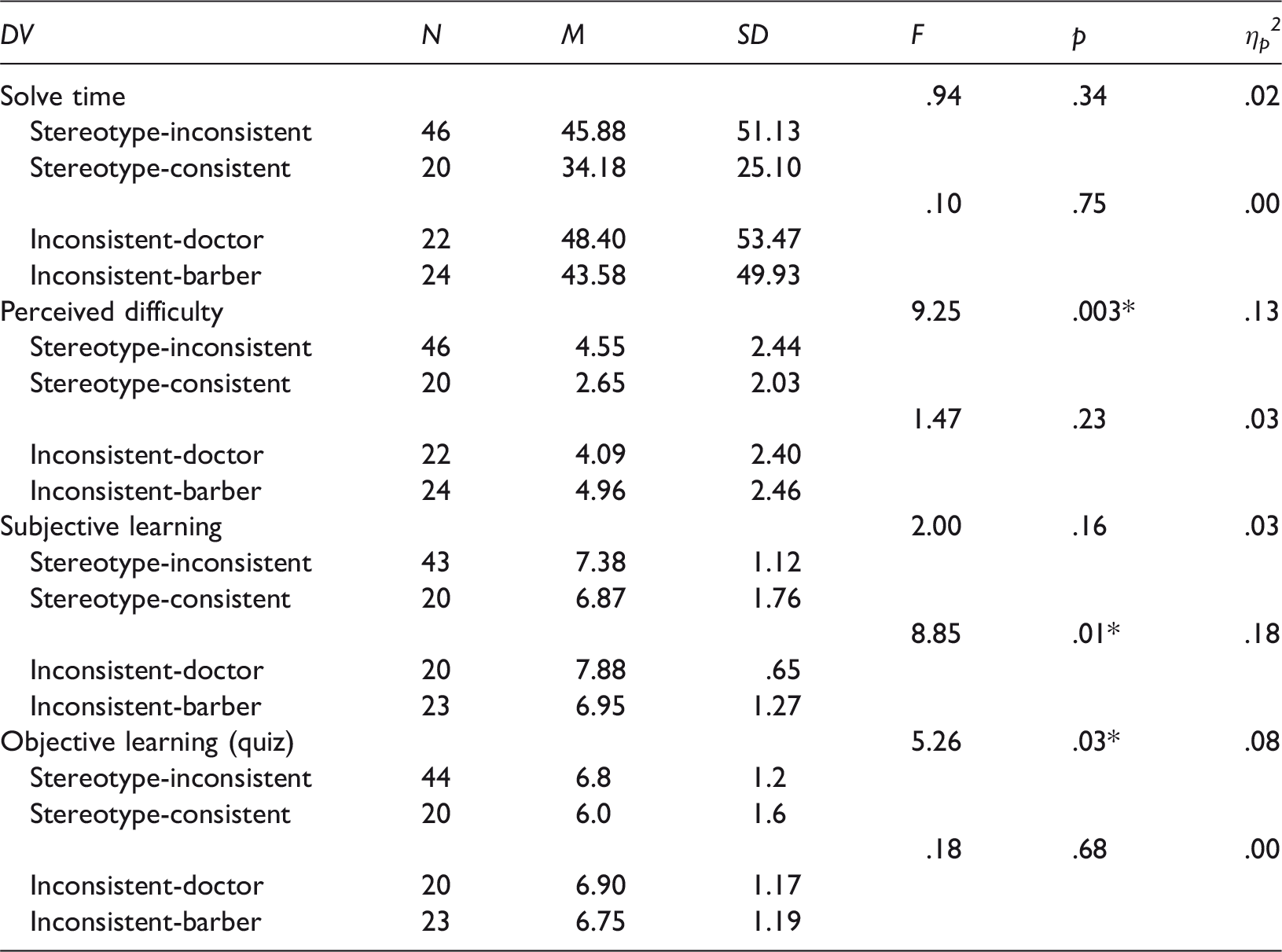
Means And Standard Deviations For Type Of Riddle On Solve Time, Perceived Difficulty, And Demonstration Perceptions And Learning In Study 4
p ≤ .05.
Cognitive performance (solve time and perceived difficulty)
The stereotype-inconsistent riddles were solved at the same rate as the stereotype-consistent riddle, p = .34. This finding is inconsistent with the cognitive performance findings of Studies 1–3, where the stereotype-inconsistent riddle was solved more slowly than the stereotype-consistent riddle. But, consistent with the findings of Studies 1–3, the stereotype-inconsistent riddles were perceived as more difficult than the stereotype-consistent riddle, F(1, 64) = 9.25, p = .003, ηp2 = .13.
Subjective learning
The stereotype-inconsistent riddles resulted in the same amount of subjective learning as the stereotype-consistent riddle, F(1, 61) = 2.00, p = .16, ηp2 = .03. Interestingly, the stereotype-inconsistent doctor riddle resulted in more subjective learning than the stereotype-inconsistent barber riddle, F(1, 41) = 8.85, p = .01, ηp2 = .18. Thus, in this study, the stereotype-inconsistent doctor riddle led to the most subjective learning.
Objective learning
Participants performed better on the quiz if they solved the stereotype-inconsistent riddles than the stereotype-consistent riddle, F(1, 62) = 5.26, p = .03, ηp2 = .08. As predicted, solving the stereotype-inconsistent riddles led to increased knowledge about gender stereotypes and bias.
General Discussion
Overall, four studies demonstrate that gender stereotype-inconsistent riddles help students learn about gender stereotypes and bias. Echoing previous work (Stoeger et al., 2004), stereotype-inconsistent riddles tended to slow cognitive performance and were perceived as more difficult than stereotype-consistent riddles. As predicted, the demonstration tended to result in increased subjective learning. Moreover, the demonstration increased objective learning about gender stereotypes and bias. Study 3 demonstrated that solving stereotype-inconsistent riddles resulted in greater objective learning within a classroom setting than solving stereotype-consistent riddles. Study 4 confirmed that the objective learning gains were a direct result of solving the stereotype-inconsistent riddle. As predicted, the findings suggest that solving stereotype-inconsistent riddles helps students learn about gender stereotypes and bias, most likely because the riddle helped expose the effects implicit stereotypes can have on cognition and behavior (Ganske & Hebl, 2001; Hebl, 1995; Knight et al., 2004; Myers, 2008; Sheldon, 1999).
The findings also suggest that the demonstration could be implemented by having students solve one of the riddles or both the stereotype-inconsistent and stereotype-consistent riddles. One limitation to the stereotype-consistent riddle is that people who solved this riddle believed it was “too easy” (see Stoeger et al., 2004). They also do not experience implicit stereotypes impeding their performance.
While the findings generally suggest that solving stereotype-inconsistent riddles helps students learn about gender stereotypes and bias, there were a few inconsistencies in the findings in relation to cognitive performance and learning. For cognitive performance, participants in Studies 1–3 solved the stereotype-inconsistent riddle slower than the stereotype-consistent riddle, but in Study 4 both riddles were solved at the same rate. One possible reason for the null findings in Study 4 could be how solve time was measured in Qualtrics (i.e., it was based on participants’ first click on the page and their last click on the page). While further research would need to investigate this, three out of the four studies (along with past research, Stoeger et al., 2004) showed that the stereotype-inconsistent riddles slowed cognitive processing.
In addition, the stereotype-inconsistent barber riddle was rated as more difficult to solve than the stereotype-inconsistent doctor riddle in Study 3, but not in Studies 2 or 4. While not significant in Studies 2 or 4, the mean difficulty rating tended to be higher for the stereotype-inconsistent barber than doctor riddle, indicating a similar, albeit non-significant, trend in the other studies. In addition, an exploratory examination of the solutions for the riddles in Studies 2–4 indicated that participants tended to be unable to solve the stereotype-inconsistent barber riddle (most common solution was “himself”). Thus, one limitation to the stereotype-inconsistent barber riddle is that it can be difficult to solve.
In relation to subjective learning, solving the stereotype-inconsistent riddle led to increased subjective learning in Studies 2 and 3. However, subjective learning was equal in Studies 1 and 4. In Study 1, participants solved both riddles, so it is not surprising that there was no difference based on what riddle they solved first. In Study 4, the means for the subjective learning trended toward the stereotype-inconsistent riddle resulting in more subjective learning than the stereotype-consistent riddle, but it was not significant. One reason for this could be due to the fact that those who solved the stereotype-inconsistent doctor riddle reported significantly more subjective learning than those who solved the stereotype-inconsistent barber riddle. Since Study 4 was conducted without a classroom discussion, it is possible that the implicit stereotype-inconsistent doctor riddle resonates with individuals more than the stereotype-inconsistent barber riddle. Future work would need to further investigate this possibility. Overall, the demonstration seems to help increase subjective learning, especially when students solve a stereotype-inconsistent riddle. When implementing the demonstration in the classroom, it might be helpful to note that the stereotype-inconsistent doctor riddle was perceived to be a bit more beneficial.
In terms of objective learning, the reliability of the 10-item quiz in Study 4 was poor. One reason for this was that there was more variability in the item responses than in Study 3. For example, one item was answered correctly by 96% of participants and another item was only answered correctly by 17% of the participants. This may be due to the fact that Study 4 was run online, at several universities, with students taking several different psychology courses, whereas Study 3 was run at the same university, with students taking one of two classes that dealt with stereotypes and bias (Social Psychology and Psychology of Gender). Instructors wishing to measure objective learning will need to think carefully about what items to include in their measure. While the reliability was poor in Study 4, those who solved the stereotype-inconsistent riddle still outperformed those who solved the stereotype-consistent riddle.
One general limitation of the demonstration is that while it helps increase explicit knowledge about gender stereotypes and bias, it does not change the implicit stereotypes held by students. Another limitation is that some students reported in the open-ended comments that they had heard the doctor riddle before. However, these students also reported that the riddle was still an effective tool. One possible solution is to use the barber riddle, as most students had not heard that riddle before (however, as discussed above, this riddle can be more difficult to solve). The doctor riddle can also be modified to focus on a nurse entering the surgery rather than a doctor, and the answers can still be stereotype-consistent (nurse is mother) or stereotype-inconsistent (nurse is father).
In sum, the demonstration can be used to ask questions during class that probe at why solving the stereotype-inconsistent riddle was more difficult, in order to help start discussion on explicit and implicit beliefs and how they influence other areas of cognitive performance, such as memory (Allport & Postman, 1947; Ganske & Hebl, 2001). It can help students understand that everyone relies on stereotypes in certain situations (Devine, 1989). The demonstration can be used to help introduce reasons people stereotype, modern sexism, and modern prejudice (Dovidio, Kawakami, & Gaertner, 2002; Gaertner & Dovidio, 2005; Glick & Fiske, 2001). This demonstration also provides a natural transition to social role theory and how occupational gender stereotypes influence career choices and opportunities (Eagly et al., 2000; Franken, 1983; O’Keefe & Hyde, 1983).
Overall, the results suggest that this demonstration should work in any psychology course addressing stereotypes and bias. Students also reported in the open-ended comment section that the demonstration provided them with first-hand experience of the power of stereotypes. For instance, many students commented that they could not believe how difficult it was to solve the riddle, that they usually consider themselves free of stereotyping, but the demonstration opened their eyes to how influential stereotypes can be on their cognitions and behaviors. Thus, solving stereotype-inconsistent riddles, in the classroom and outside the classroom, helped students learn about gender stereotypes and bias as well as the implicit and explicit roles that gender stereotypes can have on cognitive performance.
Footnotes
Declaration of Conflicting Interests
The author(s) declared no potential conflicts of interest with respect to the research, authorship, and/or publication of this article.
Funding
The author(s) received no financial support for the research, authorship, and/or publication of this article.