




Abstract
The oral language proficiency of students in early education is crucial as teachers draw on this as a resource when developing literacy. There is a need to better understand what this oral language resource consists of at school entry, particularly the diversity amongst children so as to address inequalities. This article reports a study on a key component of oral language, namely productive vocabulary. It profiles the oral language vocabulary in approximately 3.6 million words produced by a large sample of almost 800 children under the age of five. The results are reported in a productive vocabulary resource, structured as a list of 2767 vocabulary targets. This profile represents highly productive vocabulary presumably known by most children as well as more advanced vocabulary not part of every child’s oral language. The article demonstrates the pedagogical implications of this research in the context of the National Literacy Learning Progressions of the Australian National Curriculum.
Keywords
Introduction
Oral language proficiency at school entry is one of the foundations of literacy (Humphry et al., 2017). While oral language continues to develop through the school years, the oral language that students have in the early years of formal education is particularly crucial, as teachers draw on their students’ oral language as a resource when teaching them to read (Konza, 2016a). There is a need for educators to understand what this oral language resource consists of up to the age of starting school (approx. age 4/5, kindergarten/Year 1), both in terms of what might be expected from the general population of children and the diversity of proficiencies, enabling us to address inequalities that impede literacy development in the early years (Hill & Launder, 2010). The focus of this article is productive vocabulary, a key component of oral language. After decoding skills, vocabulary is the most important predictor of reading comprehension in the early years (Biemiller, 2012). A child’s vocabulary consists of two funds of knowledge: receptive vocabulary (words students can understand) and productive vocabulary (words they can use to express themselves; Hiebert, 2020). Receptive vocabulary size is larger than productive vocabulary and becomes increasingly crucial to reading as school progresses. However, oral language productive vocabulary is particularly important in early childhood as children engage in learning through speaking, self-talk, private speech and dialogic talk that support higher-order thinking (Konza, 2016a).
Educational research has long been interested in what vocabulary students know to determine whether there is a progression to acquisition and/or what evidence can be drawn on for vocabulary selection (Green, 2020; Green & Lambert, 2018; Hiebert, 2020). The current study offers a profile of the oral language productive vocabulary based on approximately 3.6 million words produced by a large sample of children aged under five, i.e. the approximate age for children starting school. The results are reported as a frequency ranked productive vocabulary resource for vocabulary pedagogy. For example, a simple yet powerful theory of vocabulary selection for children with smaller vocabularies is to consider the vocabularies of similar aged students with larger vocabularies, selecting target vocabulary from the words that peers know on the basis that the vocabulary is within the zone of proximal development for the less proficient (Biemiller, 2012). An oral language productive vocabulary list can facilitate this pedagogy by representing those words highly productive for most children as well as the more advanced vocabulary not part of every child’s oral language competence. Such a profile also allows teachers to leverage the words expected to be in the oral language vocabulary of children starting school so as to scaffold from these new vocabulary, and draw on them when teaching children to read (Konza, 2016b). The article proceeds as follows. The first section reviews the research on literacy development and oral language, followed by a more specific review of vocabulary knowledge across the school years and vocabulary selection theory. Next, the methods of the current study are described, followed by a discussion of the results. The pedagogical implications are discussed with a focus on the National Literacy Learning Progressions of the Australian National Curriculum. These progressions describe common developmental sequences Australian teachers should expect students to progress through during literacy development (Roberts, 2020).
Literacy development and oral language vocabulary
Oral language is a construct that represents both social and psychological processes that support literacy development. Whorrall and Cabell (2016) define it as ‘various skillsets including vocabulary (receptive and expressive), syntactic knowledge, and narrative discourse processes (comprehension and storytelling)’ (p. 336). Children with more advanced oral language are better at task management, self-direction and understanding the increasingly abstract language of schooling (Amorsen & Miller, 2017; Konza, 2016a). For Hill and Launder (2010), oral language is ‘the foundation for beginning reading as children draw on the meaning, syntax and the phonology of spoken language as a bridge to emergent literacy’ (p. 240). It has been repeatedly found that a child’s oral language proficiency when starting school predicts reading achievement both in early primary and middle school (Whorrall & Cabell, 2016). Paatsch et al. (2020) report that within the oral language construct, vocabulary is one of the strongest predictors of literacy outcomes and explains most of the variance in reading comprehension. Leveraging children’s early vocabulary knowledge for reading development is crucial, as Konza (2016b) notes, because ‘a student is more likely to be able to read a word that is within their oral vocabulary and to read related words’ (p. 2).
Children start school with diverse oral language proficiencies. Those from vulnerable communities and lower socio-economic backgrounds are significantly disadvantaged, in part from less vocabulary input during childhood (Hart & Risley, 1995). As Konza (2016a) states, it is difficult to learn to read ‘without a wide vocabulary and familiarity with language structures … these are, in most cases, already well developed before a child begins school’ (p. 5). However, in interviews with South Australian teachers, Hill and Launder (2010) report many were concerned about the unequal distribution of oral language proficiencies at school entry. Children who have restricted vocabulary need immediate support if they are to achieve similar literacy outcomes to their peers and Biemiller (2012) argues ‘our chances of successfully addressing vocabulary differences in school are greatest in the preschool and early primary years’ (p. 35).
Vocabulary knowledge across the school years
Research on vocabulary as a predictor of literacy outcomes has largely been based on estimates of the number of words that students know, i.e. their vocabulary size (Konza, 2016b). Amorsen and Miller (2017) suggest the average vocabulary size for children starting school is about 4000–5000 words. However, the methods researchers use to estimate vocabulary size vary, and therefore so do estimates of vocabulary size. Anglin (1993) used a dictionary sampling method, based on the theory that if a dictionary has, for example, 250,000 entries and student can define 10% of a random sample, then the student might know about 25,000 words. Testing 32 children from Years 1, 3, and 5 on 196 words from Webster's Third dictionary, Anglin (1993) reports that Year 1 (age 6) students might have a receptive vocabulary of up to 10,000 words, while Year 5 students (age 10) may know up to 40,000. The method is problematic and likely overestimates given subsequent research. In an investigation of primary school students, Biemiller and Slonim (2001) based estimates on 100 word samples from the Living Word Vocabulary (Dale & O'Rourke, 1981) that lists 44,000 words and their suggested progression throughout the years of schooling. They directly tested student knowledge of the vocabulary using multiple choice questions and report a kindergarten vocabulary size of approximately 3500 words, 5200 words by Year 2 and 8400 by Year 5 (Biemiller & Slonim, 2001).
Coxhead et al. (2015) studied 243 secondary school students (aged 13–18) in New Zealand. They tested knowledge of the most frequent 20,000 words of English, as represented by the British National Corpus. This method relies on developing a vocabulary profile in the form of a ranked frequency wordlist from which knowledge of random samples is tested at progressively less frequent word-frequency bands, e.g. 100 words from within the first 1000 most frequent words, 100 words from the 2–3000 band, etc. Vocabulary development, in general, progresses from more frequently used words to less frequently used words. As Massaro (2016) notes ‘more frequent occurrences of a word would be analogous to a highly likelihood of the word being in the child’s vocabulary’ (p. 880). Those with larger vocabularies know more words that are less frequent and those with smaller vocabularies operate mostly with higher frequency words. Coxhead et al. (2015) report that students in Years 7–8 have vocabulary sizes of approximately 6400 word families, increasing to about 9400 by Year 10–12. They also find a wide range of vocabulary knowledge, with some students knowing up 17,000 word families.
Vocabulary selection theory
Australia, consistent with many countries, does not have a curriculum either at the federal or state levels that extensively specifies the vocabulary to be taught at specific year levels. There are several reasons for this. One is that research into what words should be taught to whom an ongoing research programme is so we are not yet at a stage where the evidence-base exists for a detailed vocabulary curriculum that would be widely agreed upon (Hiebert, 2020). Another is the common research-to-practice translation challenge of disseminating research to practitioners (Biemiller, 2012). Yet another is, as Whorrall and Cabell (2016) suggest, ‘there is no universal answer to the question of which words to teach. A teacher knows his or her students and can choose what is appropriate for that particular classroom’ (p. 336). Furthermore, a long standing debate has existed over the efficacy and efficiency of explicit vocabulary teaching (Krashen, 1989), though as Hiebert (2020) points out, detailing in curriculum the target vocabulary known to facilitate reading does not mean that every word will need to be explicitly taught.
Despite the challenges of establishing a vocabulary curriculum, several significant vocabulary selection theories have influenced curriculum in Australia and elsewhere. One significant approach to vocabulary selection has been frequency based. A word’s frequency in the language indicates its importance in that more frequent words cover more of the vocabulary in any given text, and the more words one knows in a text, the more they are likely to comprehend it (Nation, 2016). Sight words are another example of frequency-based vocabulary selection that are particularly influential. The original sight word list by Dolch (1936) consisted of 220 of the highest frequency words from a corpus of children’s literature and 95 of the most commonly occurring nouns. The idea of sight words is that most high frequency words have difficult orthophonemic mapping and occur so frequently that it is more efficient for beginning readers to learn them by sight. Recent work, however, has shown such words display systematic grapheme–phoneme correspondences (Miles et al., 2018). Sight word lists are still recommended vocabulary resources in curriculum documents internationally and in Australia (ACARA, 2014). Beyond sight words, Nation (2016) proposes frequency as the primary information around which to structure a vocabulary curriculum, beginning with a general service list of the first 2000 words containing most function words and covering up to 80% of texts, then progressively moving through mid-frequency words up to the first 10,000 word families of English, finishing with academic vocabulary and low frequency words. The goal for general functional literacy should be knowledge of the most frequent 10,000 word families, as these cover 95–98% of vocabulary in most texts, a threshold shown to correlate with comprehension. Hiebert (2020) similarly argues for a common core vocabulary in primary school based on the most frequent 2451 word families (expanding to 5586 word forms) in school textbooks. This vocabulary covers approximately 90% of vocabulary in primary school texts (Hiebert, 2020).
Another well-known theory of vocabulary selection has been the ‘Three Tiers’ model (Beck et al., 2013), commonly recommended in Australian curriculum documents, e.g. The Literacy Teaching Toolkit of the Victorian Department of Education). In this model, Tier 1 words are highly frequent (spoken language) items that may not need teaching. Tier 2 words are those encountered across a range of texts, with high utility for academic literacy, and are those which in the context of a target text would impair comprehension if not understood. Tier 3 words are discipline-specific (e.g. chromosome) and can be taught in subject areas when needed. Tier 2 words are therefore recommended to be the bulk of vocabulary targets selected by teachers. A characteristic of this model is that vocabulary be taught in context, so it is argued no list of Tier 2 words can exist because the texts chosen by teachers vary and therefore so do the Tier 2 words needed to comprehend these texts. The approach has several advantages, for example, authentic texts used in classrooms are not typically levelled for word frequency, so vocabulary may arise that impairs comprehension and a frequency-based vocabulary curriculum too stringently followed might therefore not support reading comprehension in these contexts. The model also has disadvantages, one being that the ‘in-context’ argument can be too stringently followed for all vocabulary selection, ignoring the evidence that the general utility of a word is indexed by objective frequency across texts. Since research has suggested making subjective judgements of utility is not always easy for teachers, it seems possible to provide more scaffolding for teachers’ vocabulary selection though combining the three tiers model with frequency-based vocabulary profiles (Hiebert, 2020).
Biemiller (2012) proposed a vocabulary selection theory based on using vocabulary known by students with larger vocabulary sizes as learning targets for students with smaller vocabulary sizes. In this model, teachers prioritise for the bottom 40% of struggling learners those words known by the majority of their age-matched peers. For students with a vocabulary size appropriate to their Year level, target vocabulary should be selected from words known by most students at the Year level above. Biemiller (2012) suggests that about 1600 words should be taught as a common vocabulary for all students by Year 2. Having a list of potential vocabulary targets with information on which are highly productive and which are productive in the vocabulary of learners with larger vocabulary sizes can therefore assist in vocabulary selection for students with smaller vocabularies.
The aim and research questions
This aim of this study was to profile the oral language productive vocabulary of a large sample of children up to approximately the start of school (less than 5-years-old) in order to develop a resource for teachers to support vocabulary selection. Profiling the possible productive vocabulary of children starting school is useful as it reveals to teachers the words common amongst children. It also reveals the more advanced, less frequent vocabulary not productive in all children but that can be selected as vocabulary targets for children with more restricted vocabularies. As McLachlan (2019) notes, ‘differences in the levels of knowledge and awareness that children have during their preschool years can affect the efficiency with which they transition into conventional literacy’ (p. 13).
Based on the review of previous research and given the aim of the study, the research question that guided this study was:
Which word families appear productive in the oral language vocabulary of children at the approximate age of initial formal schooling?
Using the resulting oral language productive vocabulary profile generated from research question 1, the article explores its pedagogical implications for vocabulary selection and curriculum planning.
Method
Participants and materials
Productive vocabulary is extracted from preschool aged children’s oral language interactions and organised by word families (inflectional and derivation forms of a root) and ordered frequency of use. This study drew on the CHILDES database (https://childes.talkbank.org; MacWhinney, 2000), the largest repository of children’s oral language interactions collected by researchers. Six thousand four hundred and eighty-nine transcripts and approximately 3,646,236 million words were extracted from 42 corpora, representing the oral language production of 785 English-speaking children (approx. 369 female) from the UK, USA and Canada. All corpora are cited in the data-sources appendix, and full descriptions are available at https://childes.talkbank.org/access/. Approximate words per age range are: 4–5 (764,989 words), 3–4 (953,225 words), 2–3 (1,784,813), 0–2 (143,209). The transcripts represent children from different socioeconomic, racial and ethnic backgrounds, though most of the sample consists of white, middle class, native speakers. Several corpora lack rich descriptions of demographics, so the current study focuses only on vocabulary use by age and not by other variables such as SES status. While this study aims to develop an oral language productive vocabulary profile for Australian and international teachers, it is using the CHILDES database and its transcripts from children in the UK, USA and Canada because substantial data on Australian children are not available. Nevertheless, vocabulary instruments developed on English language data from the UK, USA and Canada have a history of successful use in language development research within Australia, with only minor adaptations (Reilly et al., 2010).
Procedure
The author, with the assistance of a research assistant, developed ad-hoc python and regex code (Hunt, 2019) to clean the transcripts, for example, removing XXX in transcriptions used by researchers as placeholders when words were unclear. The data structure was converted to a format in which children and interlocutors were set off on consecutive lines and age was XML tagged around each utterance, e.g. <AGE_4Y07M> I'm just going to play </AGE_4Y07M>. All vocabulary in utterances between tags by speakers under five-years-old was then extracted and a wordlist generated through Wordsmith version 7 (Scott, 2016) which ranked every word by frequency.
Following this, the challenge was to isolate potentially productive vocabulary since the initial raw wordlist contained around 29,000 items but inspection suggested around 60% were non-words such as hmm, ahh, aak or produced only once or twice in the transcripts. Extremely low frequency words presented a methodological challenge since on the one hand research has shown it can tap the construct of vocabulary size (e.g. in two language samples where one student uses more words only once or twice and the other more repetition of high frequency words, it is the former student who likely has a larger productive vocabulary). Yet, on the other hand, many of these very low frequency items seemed overly advanced for pre-schoolers, e.g. arthritis, indivisible, and analysis of the transcripts indicated they often occurred in interactions such as (1).
(1) Examples of produced but not productive vocabulary
(1b) Mother: ‘she's probably got some aches and pains in it. You know like arthritis
Child (age 4Y06M): ‘What's arthritis?’
Mother: ‘well it's what Nana has. When you get old your bones wear out’
Child (age 4Y06M): ‘oh, like you’ (ENG-UK-Thomas)
While arthritis is produced, it is problematic to suggest that this production means it is part of the child’s productive language. To try to hone in on productive vocabulary, the decision was made that the final resource list only vocabulary produced by children at least three times in every million words, in at least three different transcripts. This is not a perfect solution, since it is possible that some words produced only once or twice in a 3.6 million word corpus are productive for some children, just not frequently produced. However, face validity was obtained for these metrics by trial and error with different metrics, inspecting the resulting lists for which words stayed and which were removed, and transcript examination.
All words were manually inspected and the following removed: proper nouns (e.g. people, products), swear words and vocabulary not in the BNC-COCA lists (i.e. the most frequent 30,000 English words). Vocabulary from the same word family were grouped together based on the memberships in Nation (2016), since word family knowledge is included in the Australian Curriculum’s National Literacy Learning Progressions (ACARA, 2014). Variant spellings were grouped together, e.g. mum/mom, and contractions added to the word families; for example, productive use of didn’t and doesn’t within the do word family, which technically they are not, but, given the aim of the research, was considered useful information for teachers.
Results
The oral language productive vocabulary profile
The oral language productive vocabulary profile represents 2767 vocabulary targets, expanding to approximately 5195 word family members. As an estimate of productive vocabulary size, it is consistent with the receptive vocabulary sizes of children starting school in previous research, namely approx. 3500 at kindergarten (Biemiller, 2012); 5000 at Year 1 (Amorsen & Miller, 2017). It is slightly lower than these receptive estimates, since it is a measure of productive vocabulary, and children, like adults, know more words than they produce. The complete profile is available in the Supplementary materials of this journal. Table 1 illustrates the organisation of the resource. The leftmost column contains headwords (the most frequent word family member), followed by the frequency of the word family (Freq of Family) and estimated production per million words (Freq per Million), then the individual word family members with their raw (Raw Freq) and normalised (Freq per Million) frequencies.
The structure of oral language productive vocabulary profile.
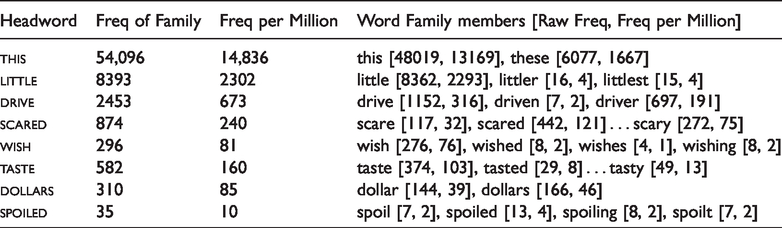
As reflected in Table 1, it was decided the headword need not necessarily be the root form, e.g. scare, spoil or dollar, but rather the most frequent member of the word family. Not all roots of word family members were produced, so it would be odd to list them as vocabulary targets, and if the root form is not the most productive in the vocabulary of children, then it is arguably better to start with the most productive form when teaching a word family.
Table 2 shows random samples of the vocabulary in the first 500 most frequent words (an arbitrary frequency band for illustrative purposes) in the productive vocabulary profile, the next 501–1000 most frequent and so forth. This represents a progression from widely known and productive core vocabulary to less known words from those with larger vocabulary sizes (e.g. amongst the most frequent vocabulary are I, yeah, a, it, you, that, the, no, is, go, and amongst the least frequent are precious, delicate, tender, express, terrific, property).
The oral language productive vocabulary profile.
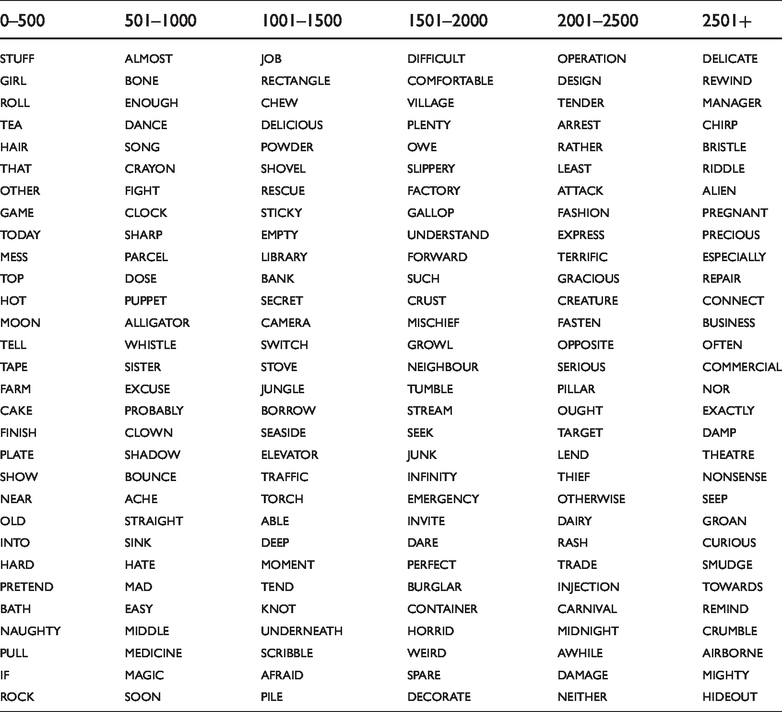
Vocabulary is progressively more difficult in Table 2 across the frequency bands. The first 500 words include general words such as stuff, mess, vocabulary about the here-and-now (e.g. today), body words such as hair, deictics such as that, near, simple verbs show, tell and nouns prominent in children’s discourse such as farm, moon. More multisyllabic child relevant vocabularies are represented in the 501–1000 most frequently produced words such as crayon, puppet, magic, motion verbs such as bounce, and more non-concrete language such as enough, almost, probably, soon. In the next frequency band from 1001 to 1500, richer descriptive vocabulary is produced including sensory adjectives delicious, sticky, nouns that are simple but reflect growing background knowledge such as bank, job, library, camera, abstract nouns such as secret, and abstract verbs such as borrow, rescue. Verbs for specific actions such as chew are produced that can be used in place of higher frequency general vocabulary such as eat. The 1501–2000 word band shows adjectives for emotions such as comfortable, horrid, weird, multisyllabic verbs such as understand, tumble, invite, decorate, concepts such as infinity, emergency, perfect and labels such as village, burglar, factory, container. Some words produced between 2001 and 2500 require significant background schemas such as arrest, and a variety of words that require some degree of knowledge of their relationship to other words including antonyms (e.g. fasten, damage, serious, gracious, opposite, rather, least, neither). In the final band are complex verbs such as remind, crumble, connect, seep, bristle, adverbs such as often, towards, exactly, especially, descriptive words such as airborne, delicate, mighty, curious, nouns such as manager, theatre, alien, nonsense, and connectives such as nor.
Pedagogical implications
The oral language productive vocabulary profile presented in this article can support vocabulary pedagogy. The Australian Curriculum (ACARA, 2014) notes that ‘due to its importance in literacy development, vocabulary is included within and across’ (p. 4) the development progressions for speaking, listening, reading, viewing and writing. The following section will illustrate how the profile might be used with reference to the benchmarks for vocabulary in the speaking sub-element of the National Literacy Learning Progressions. Speaking progression 1 (
In
In addition to providing an evidence-based oral language productive vocabulary profile, the results of this study can also be used to support the individual needs of students. Students enter school with different levels of vocabulary knowledge (Konza, 2016b), some privileged and others disadvantaged by the home language environment (Hart & Risley, 1995). To narrow this gap, teachers need to evaluate their students’ vocabulary knowledge. There are several ways in which this list could be used by teachers. A teacher could gain an approximate estimate of the individual needs of a child by sampling some words from different frequency ranges in the oral language productive vocabulary profile and asking a student to repeat a word and produce it in a novel sentence. If a student cannot do this for a sample of, we suggest, 10 words from a particular frequency range such as the 1500–1600 word band, then this may be a good starting point for their vocabulary needs. Current language acquisition research suggests the child would likely have knowledge of higher frequency items but not the lower frequency vocabulary (Nation, 2016). Alternatively, in the manner of the Communicative Development Index (Frank et al., 2017), a teacher could ask parents if they had heard their child produce a sample of words from the vocabulary profile. Indeed, experienced teachers have excellent professional knowledge of what words are commonly known and not known by age cohorts based on their years of experience. Such teachers may be able to look at the list and decide which is Tier 2 or necessary for a particular learner. A final point is that while a teacher can decide to teach these words explicitly, the existence of a vocabulary profile does not necessitate that the words be explicitly taught (Hiebert, 2020). In context and incidental learning arising from engagement with rich and compelling input is an effective pedagogical option. From the current wordlist there are clear clusters of related vocabulary that could be targeted through careful text selection (e.g. custard, gravy, muffin, saucer, fruit, rice, spaghetti, and, doctor, injection, medicine, sick, nurse, hospital).
Limitations
The primary limitation of this study is generalisability from the CHILDES database. Though the largest available sample of child oral language, it is not a random sample and cultural diversity is underrepresented so we cannot say that the vocabulary profile developed in this study represents the productive vocabulary of all children in all contexts. It is not an Australian database, and future research should work toward creating an Australian database. Rather, it is just one evidence-based representation of this construct. Sample representativeness by age is also a limitation in that the 2–3 year olds produced more words than 3–4 and 4–5 year olds (about twice as much). The potential problem with this in terms of the results is the productive oral language profile could underestimate what older children coming to the first year of school know. Another limitation is that the metrics decided on (e.g. stipulating that an item not occur only once) though reasoned, possibly excludes some productive vocabulary. Finally, computational linguistics often works with data noise that can affect the precision of word counts, for example, the fact that standard English spelling is not always used in the transcription of oral language and that many non-words exist.
Conclusion
This article was motivated by several streams of prior research in literacy development, oral language, vocabulary knowledge across the school years, and vocabulary selection theory, perhaps most specifically the combination of Konza’s (2016b) suggestion that ‘a student is more likely to be able to read a word that is within their oral vocabulary’ (p. 2) and Biemiller’s (2006) proposal that ‘the best words to teach to children with restricted vocabularies would be the words already known by those with larger vocabularies’ (p. 48). A profile of the oral language productive vocabulary is presented for a sample of 3.6 million words produced by almost 800 children in the lead up to starting school. The results have been structured as a list of 2767 vocabulary targets that can be used as a resource for vocabulary selection by teachers.
Supplemental Material
sj-xlsx-1-aed-10.1177_0004944120982771 - Supplemental material for The oral language productive vocabulary profile of children starting school: A resource for teachers
Supplemental material, sj-xlsx-1-aed-10.1177_0004944120982771 for The oral language productive vocabulary profile of children starting school: A resource for teachers by Clarence Green in Australian Journal of Education
Supplemental Material
sj-xlsx-2-aed-10.1177_0004944120982771 - Supplemental material for The oral language productive vocabulary profile of children starting school: A resource for teachers
Supplemental material, sj-xlsx-2-aed-10.1177_0004944120982771 for The oral language productive vocabulary profile of children starting school: A resource for teachers by Clarence Green in Australian Journal of Education
Footnotes
Acknowledgements
All data used in this study are available as open access.
Declaration of Conflicting Interests
The author(s) declared no potential conflicts of interest with respect to the research, authorship, and/or publication of this article.
Ethics
The work reported has not been previously published in present or revised form and is not being considered for publication in other venues. The author will not allow the manuscript to be so considered before notification in writing of an editorial decision.
Funding
The author(s) received no financial support for the research, authorship, and/or publication of this article.

Supplemental Material
Supplemental material for this article is available online.
References
Supplementary Material
Please find the following supplemental material available below.
For Open Access articles published under a Creative Commons License, all supplemental material carries the same license as the article it is associated with.
For non-Open Access articles published, all supplemental material carries a non-exclusive license, and permission requests for re-use of supplemental material or any part of supplemental material shall be sent directly to the copyright owner as specified in the copyright notice associated with the article.
