




Abstract
Student persistence is important for students, faculty, and universities and online faculty mentoring supports student persistence to graduation. The online learning environment is increasingly a choice for more undergraduate students, and it continues to grow in popularity as an attractive option for adults. It is crucial to find ways to increase persistence and graduation especially given the increased use of virtual learning during the COVID-19 pandemic. Attrition rates in online learning can be high for a variety of reasons, including persistence and engagement. Faculty mentors in the online environment can strengthen connections and relationships with undergraduate students, and it is important to ask for and evaluate these student perceptions. This mixed methods study surveyed and interviewed undergraduate students in an online university to understand both their experiences with faculty mentoring in the online environment and the potential of a faculty mentor program in a large online university. The purpose of this study was to explore the perceptions and experiences of four undergraduate student mentees with their faculty mentor at a large online university using mixed methods research design. In addition, survey data from one department are analyzed to guide future mentoring programs in online learning environments. Findings from the study indicate belief that mentoring and encouragement from faculty would enhance students’ scholarly experience. Students indicated they would like to participate in a faculty mentoring program, and it was clear that students welcome and appreciate the opportunity to further cement a professional relationship between themselves and faculty. This article makes a unique contribution to higher education research, providing a potential model for others seeking guidance in mentoring in online higher education. The data analysis and research indicate that a larger scale mentoring program might be more valuable for students.
Keywords
Introduction
The relationships between faculty and students are important to support student persistence in the college environment and are even more important in the online learning environment where additional challenges are faced by students. When there is a lack of connection between students and their professors, the student can feel disconnected and find it hard to stay motivated, and this is especially true with the use of digital media in online environments. This lack of intrinsic motivation and disconnect can lead to lack of satisfaction with the college experience and poor completion rates in the online environment. The online learning environment presents special challenges due to the nature of online learning. It can be difficult to engage and motivate undergraduate students in the online environment due to the learning platforms and lack of in-person contact. Researchers have found that lack of persistence and noncompletion is even higher in the online environment than in traditional face-to-face universities (Atchley et al., 2013). In contrast, evidence suggests that students that are involved with a faculty mentor have greater skills in making decisions, setting goals, and are happier in college (Long, 2010). It is imperative for online universities to explore effective methods to utilize faculty mentors for undergraduate students that are specific to the needs of the online learner. As the growth rate of student enrollments in online education continues to surpass the growth rate of the total higher education student population, understanding the connections between persistence and support for students in the online environment is critical (Atchley et al., 2013; Delnoij et al., 2020).
Online mentoring is an important and effective strategy to support students in successful persistence to graduation by providing support that is not provided through other means in an online university. An example is a student who was enrolled in an undergraduate course with a project-based learning component. This student chose to compose an original e-book for the final assignment of the course, which was an innovative and creative application of the course material. The course instructor recognized the value of this original work and asked the student if they would like a mentor to work toward disseminating this excellent academic material from the course. The student agreed, and the faculty member and the student worked together and created a podcast where the student showcased their work. The podcast was presented at a peer-reviewed conference to very favorable feedback. This student develops a deep sense of satisfaction with both the mentoring process and the online university experience. This student indicates that none of these connections were made prior to the mentoring opportunity. The student successfully persists to graduation and praises the role of the online mentoring process in their success. In addition, this student still keeps in close contact with the faculty mentor and has shared career successes with their mentor.
This study explores how students view both their experiences with online faculty mentoring and the potential of a faculty mentor program in a large not-for-profit online university. The purpose of the study is to explore the perceptions and experiences of four undergraduate student mentees with their faculty mentor at an online university. In addition, survey data from one department are analyzed to guide future mentoring programs that can be used in a variety of online learning settings.
The research on mentoring relationships at the university level can be found across many settings and a variety of procedures (Romsa et al., 2017; U.S. Department of Education, 2016). Many studies of mentoring can be found in health-related settings and graduate schools (Carpenter et al., 2015; Hollingsworth and Fossinger, 2002; Holzweiss et al., 2014; Sgro et al., 2017). McKinsey (2016) advocates for informal mentoring programs where the mentoring is unplanned and natural. In addition, there are mentoring programs for online university faculty mentoring new faculty (Dorner et al., 2020). Further needs must be considered as the population of learners evolves in the higher education environment and diversity of learners increases. Higher education institutions face increased accountability measures and unique characteristics of millennial and 21st-century learners that may require nontraditional teaching methods (Romsa et al., 2017). Though there are many forms of mentoring research, there is a paucity of current research on the use of faculty mentors with undergraduates in the online environment (Cramer and Prentice-Dunn, 2007; McKinney, 2016). It is important to explore further the role of mentoring specifically in the undergraduate setting by faculty in an online higher education institution. In addition, it is critical to determine student perceptions of mentoring in the online undergraduate university. University faculty can then tailor mentoring programs to meet the specific and individual needs of the students in the online university setting.
Definition of mentoring
The term mentoring is used in many different ways and has been defined as coaching and counseling and has been shown to increase retention of college students (US Department of Education, 2016). Providing students with access to both informal and formal mentoring has become significant as evidenced by the increased number of mentoring programs in higher education. Mentoring may be an effective strategy for addressing issues facing many institutions today including increasing persistence and degree completion, enhancing student-centered outcomes, and broadening the educational experience for diverse student needs (Chelberg and Bosman, 2019). Mentorship is defined (Olesova and Campbell, 2019) the process where mentees learn new skills and share values and culture with mentors who they respect. This is an important distinction as it indicates that it is important to explore the values and culture of both students and faculty and to carefully match the student mentee with a similar faculty mentor when possible. Increasing general involvement with faculty was predictive of academic success by DeFreitas and Bravo (2012) without a specific structured mentoring program. This is an important finding as it indicates that increased faculty time with individual students can lead to academic success and improved persistence and completion. Additionally, connected relationships between students and faculty via mentoring have been closely associated with positive achievement attitudes, including student self-efficacy and student satisfaction (Hoffman, 2014). These positive findings on the relationship between mentoring programs and academic success provide motivation for online universities to find ways to incorporate effective mentorship programs for students in the online university.
Theoretical foundations of online mentoring
Coaching, remedial teaching, and mentoring have been shown to increase completion rates in higher education (Andersen and West, 2020; Delnoij et al., 2020). Though much of this research indicates that a variety of methods can be effective for mentoring, the authors of this study use the definition of mentoring proposed by Long (2010), which is defined as undergraduate students and faculty mentors in a structured academic mentoring program focused on building relationships between the faculty mentor and the undergraduate mentee. This focus on relationship-building mentorship programs is important as it aligns with this university’s mission, and values, and shared goals to increase student success in a diverse online environment. Relationship-based mentoring is a recognized theoretical framework for mentoring programs and has been used in multiple studies in higher education (Andersen and West, 2020).
It is especially important to develop relationships in the online environment, and the current COVID-19 pandemic has revealed that strategies used in the in-person environments do not always work in an online environment. Online pedagogy must focus on relationship-building, and it is imperative for online mentoring programs to develop strategies that strengthen relationships between faculty and students.
Importance of training for relationship-building
It is important for any online mentorship program to include clear, structured training for the faculty mentors as per university guidelines and shared values to support the emotional needs of diverse students. Cramer and Prentice-Dunn (2007) advocate for in-depth training of faculty mentors including pairing mentors with experienced mentors, providing resources, constructive feedback, and continued training to develop relationships. The pairing of new mentors with experienced mentors with appropriate training and documentation for the faculty mentors is especially important in the online learning environment with the goal of relationship-building. Developing professional, respectful mentoring relationships should also include faculty training on culture and anti-racism for mentors (Lechuga, 2011; Posselt, 2018). It is important for mentors to have training on how to avoid implicit and explicit bias and how to ensure that the mentoring relationship is professional and of high quality. Balu and James (2017) indicate that mentoring is a learned skill and that mentors can improve mentoring relationships through practice. Current research suggests that formal mentoring should include specific training and resources for mentors with consistent follow-up including constructive feedback.
In keeping with the theoretical framework of support for students and relationship-building, online support services in the form of coaching and mentoring have been associated with improved academic outcomes and can increase persistence rates (Jacobi, 1991; US Department of Education, 2016). Online mentoring programs can identify strategies to overcome both academic and life challenges while in school and can be tailored to individual students based on their specific support needs. Online mentorship programs should be a holistic process for student support, focusing on the whole person rather than a checklist of completion (Cramer and Prentice-Dunn, 2007; Jacobi, 1991). Support services for online students are even more critical for the success of mentoring programs due to the diverse nature of the students attending online universities and the potential for isolation. In addition, online higher education students have perceptions of quality mentoring programs that must be addressed through assessments of the mentoring, relationship-building process.
Benefits of online mentoring programs
Student mentoring in higher education contexts can be of substantial importance to successful learning experiences. This is perhaps even truer of online environments, in which there may be greater challenges for students to combat isolation and become part of the learning community, as compared to on-ground environments. The online context for higher education, and the related virtual and digital elements, will have an impact on the delivery of and effect of mentoring. It is important to study how mentoring can mutually benefit the triad in the online mentoring process: the university, faculty, and student. Delnoij et al. (2020) found that faculty–student interaction significantly improved university completion which has long been a measure important to the sustainability of universities. Long (2010) studied the reciprocal relationship of mentoring on both faculty and students and revealed that both benefit greatly from mentoring programs with higher graduation rates and higher satisfaction in the educational process. It is crucial that mentors and mentees are matched appropriately in order to achieve these benefits from online mentoring (Andersen and West, 2020).
Challenges to online mentoring programs
Though studies indicate there are benefits of online mentoring programs, Potter et al. (2009) found that some faculty report that the high amount of time devoted to mentoring undergraduate students in a research format was not compensated by decreased teaching loads and was burdensome to some faculty. It is critical that online mentoring programs respect the time factor required of faculty and offer benefits to faculty that are perceived as valuable to the faculty. Universities can assist this process with clear procedures and guidelines for online mentoring programs. Hernandez et al. (2017) found that mentee-perceived similarity of the faculty based on gender, race, and demographics to the undergraduate mentor was the most important factor associated with mentee’s perceptions of high-quality mentorship. It is not always possible to have similar mentors and mentees, which presents a challenge to the online mentoring process. In addition, in delivery of online teaching and learning, the participants often do not even know the gender, race, or any demographic information on either the mentor or mentee. These challenges are unique to the online higher education environment. It is clear that there are benefits to the university, faculty, and students with mentoring programs, and it is important to determine how best to choose and train mentors, assess the quality of the mentoring, and monitor the effectiveness of the mentor relationship. Despite these challenges, the benefits of online mentoring far outweigh the challenges, and this study seeks to add to the literature on online mentoring.
Gap in the literature
There are many studies that evaluate mentoring in the in-person higher education environment, but there is less literature on the online university mentoring process. There is also a gap in the literature on how students perceive mentoring in the online environment in higher education (Andersen and West, 2020). Mentoring students should result in benefits for the student and it is important to evaluate the perceptions of students of the online mentoring process in order to improve mentoring programs at universities. This small study utilizes an online mentoring program with the addition of a survey of student perception of the mentoring experience. The perceptions of students can assist universities in designing online mentoring programs that meet the diverse needs of online students.
Importance of the study
Mentorship in higher education can be a difficult process. It is, however, a noteworthy factor in the development of undergraduate students to support a sense of identity and belonging in the online university. Arguably, the benefits of faculty mentoring for higher education students and universities far outweigh the costs of building a program (Cramer and Prentice-Dunn, 2007; McKinsey, 2016). Studies indicate that there is a need for further research in the effectiveness of mentoring, specifically at the undergraduate level (Dorner et al., 2020; McKinsey, 2016; Romsa et al., 2017). Dorner et al. (2020) identified that student perceptions of faculty presence was critical to meaningful support in a mentor relationship, and faculty mentoring has the potential to provide support that otherwise might not be available in an online setting. Higher education institutions must have a stronger understanding of how faculty and student relationships need to evolve in the online environment in order to align to students and their diverse needs in the workforce. Further research is also needed to examine the importance of relationships, student satisfaction, and the role of technology in interactions (Romsa et al., 2017).
Mentoring in higher education continues to develop, specifically in the online environment where faculty are mostly independent and highly educated in their field (Olesova and Campbell, 2019). The impact of mentoring has long been considered to be a growth-related and retention strategy for higher education and one which has a positive impact on learning and confidence (Chelberg and Bosman, 2019). In addition, the continued increase in the availability of online teaching and online learning platforms indicates that research is needed on the effects of mentoring students at online universities. This study addresses the gap in the literature by focusing on one faculty mentor and the experiences and perceptions of four undergraduate student mentees. The addition of survey data from students in an undergraduate program can guide future mentoring programs in the online university undergraduate environment. The current COVID-19 pandemic has revealed that online learning is very different from in-person learning and that strategies specific to the online environment must be used for effective teaching and learning. This study specifically utilizes the online platform for mentoring between students and faculty and surveys students about the perceived benefits. This study can add to the growing body of research on the effectiveness of online mentoring programs to persistence and graduation in higher education.
Research methodology
Research design
The purpose of this mixed methods study was to consider student interest and involvement in an online higher education faculty mentoring program. Students face pressures to achieve in their education, often while coping with a unique online education environment (Cramer and Prentice, 2007; McKinsey, 2016). Research suggests that mentoring as an educational approach in higher education can address the critical components needed for student success. Mentoring can foster a sense of belonging in students, helping them feel part of a supportive environment that encourages motivation and persistence (Chelberg and Bosman, 2019; Hoffman, 2014). Therefore, the research question proposed was What are the perceptions of online students regarding faculty mentoring related to scholarship and professional activities? In the phenomenological method, the fundamental goal is to arrive at a description of the nature of a particular experience and gain perspectives from people involved within their natural settings (Creswell, 2014; Padilla-Diaz, 2015). A phenomenological research framework was employed to provide qualitative and quantitative insight, creating the mixed method research design used in this study (Davison, 2014). The influx of technology and innovations to program and curricular structure in higher education has accelerated in the past several years, especially in the last year due to COVID-19 restrictions and virtual access. Current research and understanding of appropriate design and data interpretation is critical across online higher education environments (Stahl et al., 2019). There remain few accounts in the higher education literature of using mixed methods, and the researchers felt mixed methods fell in the spectrum that offered a third way to conduct research that blended ideas from both qualitative and quantitative models. This mixed-methods study used a concurrent parallel design where the qualitative and quantitative data were obtained at the same time. Both types of data were compared and contrasted during interpretation (Creswell and Clark, 2007). The qualitative data involved individual interviews with participants that had participated in a faculty mentoring activity. The quantitative data source was the results from two surveys focusing on interest and experiences from faculty mentoring activities. It is clear from the literature the importance faculty mentoring plays in the educational experience for students; however, it is not clear how students perceive their involvement and the potential for mentoring in this specific online environment (Lechuga, 2011). All the participants in this research study were undergraduate online higher education students having interactions with faculty.
Participants
Demographic information of participants.
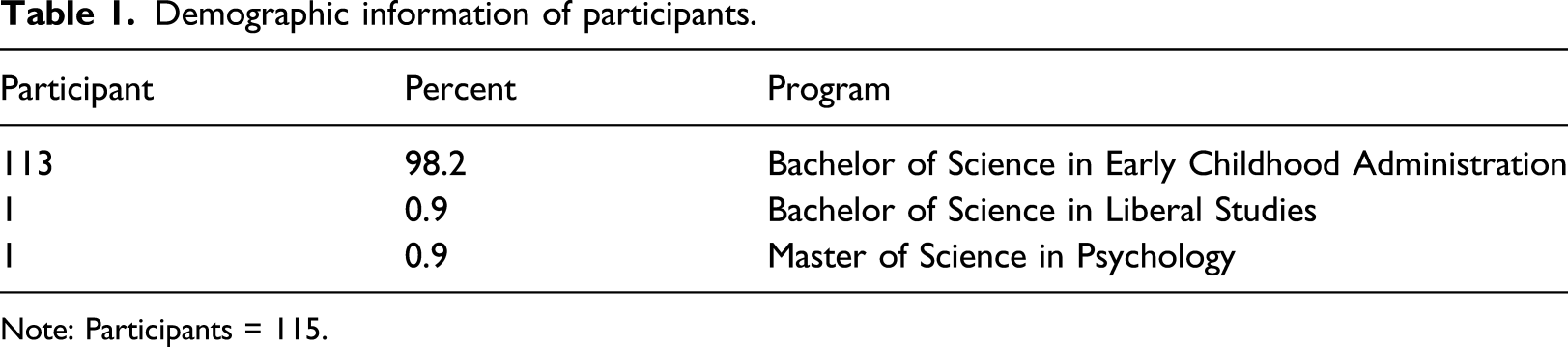
Note: Participants = 115.
Ensuring trustworthiness and rigor
Validity in mixed method research means appropriateness of the tools, processes, and data. The process of triangulation establishes validity, controls bias, and strengthens mixed methods studies. The use of phenomenological research in a mixed methods approach establishes validity for the results of research by focusing on specific lived experiences in a number of variations (Davison, 2014; Mayoh and Onwuegbuzie, 2013). Triangulation was utilized in this study through two surveys and semi-structured interviews. Additionally, the process of member checking was utilized to provide an opportunity for any inaccuracies to be amended (Creswell, 2014).
Data collection and analysis
Data were analyzed for patterns and themes emerging as a natural phenomenon in the research process. The focus of data analysis for this study was to identify the common elements repeated in each of the research participants (Padilla-Diaz, 2015). This phenomenological analysis included horizontalization of data, which included listing relevant topics expressed, grouping information into themes, and adding applicable participant descriptions (Creswell, 2014). Three sources of data collection were used with multiple participant pools in this study. Survey one was sent via email to all online students currently enrolled in the Bachelor of Science in Early Childhood Administration program. Survey one asked students to respond on related benefits of faculty mentoring, characteristics of faculty mentors, and interest in participating in faculty mentoring. Survey one participant views generated themes focused on support, relationships, and professional development, with an overwhelming interest in participating in faculty mentoring at 0.857 percentage rate of “yes” to a 0.142 percentage rate of “no.” Survey two was sent via email to four online students that had participated in a faculty mentor activity. Survey two asked students to respond to interactions with the mentor, the effect of mentoring on their future goals, how mentoring supported growth and learning, and their relationship with the mentor. These four students were also asked specific semi-structured interview questions regarding their experiences during faculty mentoring. Participant opinions in survey two and in interviews generated similar themes of support, relationships, and professional development, directly aligning with responses from survey one. Another interesting finding among all participants was the common perspective of the value in faculty mentoring.
Results
Identify at least three benefits that you expect to receive from participating in a faculty mentoring program.
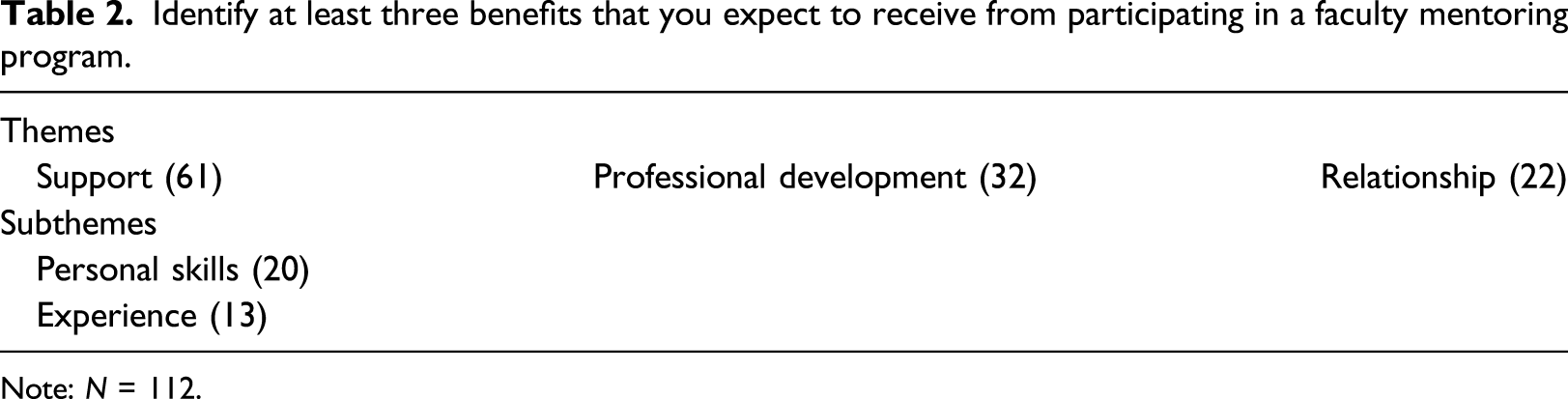
Note: N = 112.
Support was the highest ranking benefit reported by participants with subcategories such as (a) encouragement and motivation, (b) keep on track, (c) accountability, (d) help, and (e) guidance. Both mentoring and collaboration with faculty have been shown to be related to higher academic outcomes (DeFreitas and Bravo, 2012). Although most students responded with an overwhelming sense of perceived positive benefits from faculty mentoring, the scope of interest encompassed more than a professional connection.
What characteristics do you believe would make a good faculty mentor?
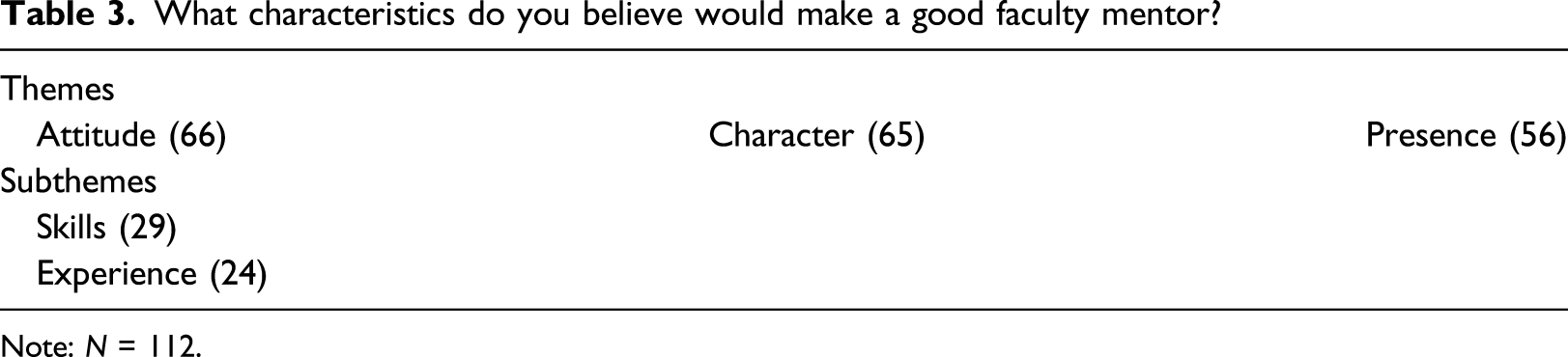
Note: N = 112.
Chelberg and Bosman (2019) report that faculty mentoring is an essential strategy in assisting students to navigate the challenges of higher education. Students appear to have varied ideas regarding important characteristics for a faculty mentor.
The highest ranking characteristic report by students in the study was attitude. The subcategories expanded to include (a) kindness/compassion, (b) patience/understanding, (c) trustworthiness/honesty, (d) enthusiasm/passion in the field, (e) open-minded, (f) encouraging, and (g) humor. Specific behaviors in attitudes faculty mentors present can influence student development, and students report that having had an enthusiastic mentor helped them feel more engaged in their careers and thrive better in their work (Carpenter et al., 2015; Perez et al., 2016). Further, faculty mentors that communicate with understanding and care can provide a framework for students to rely on during a potentially daunting higher education path (Cramer and Prentice-Dunn, 2007).
If a faculty mentor experience was offered to you, would you choose to participate?

Note: N = 112.
Why or why not? Please explain.
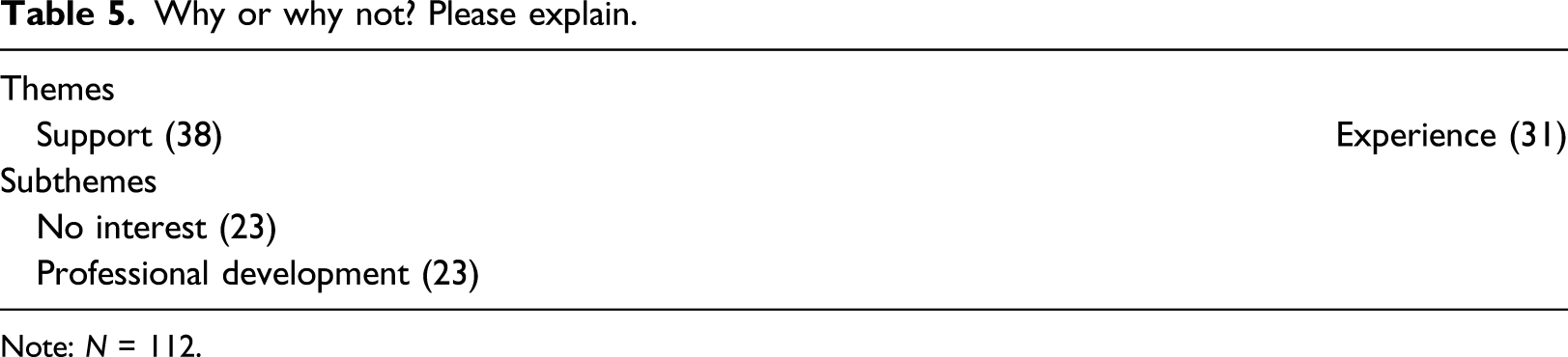
Note: N = 112.
Faculty mentor survey.
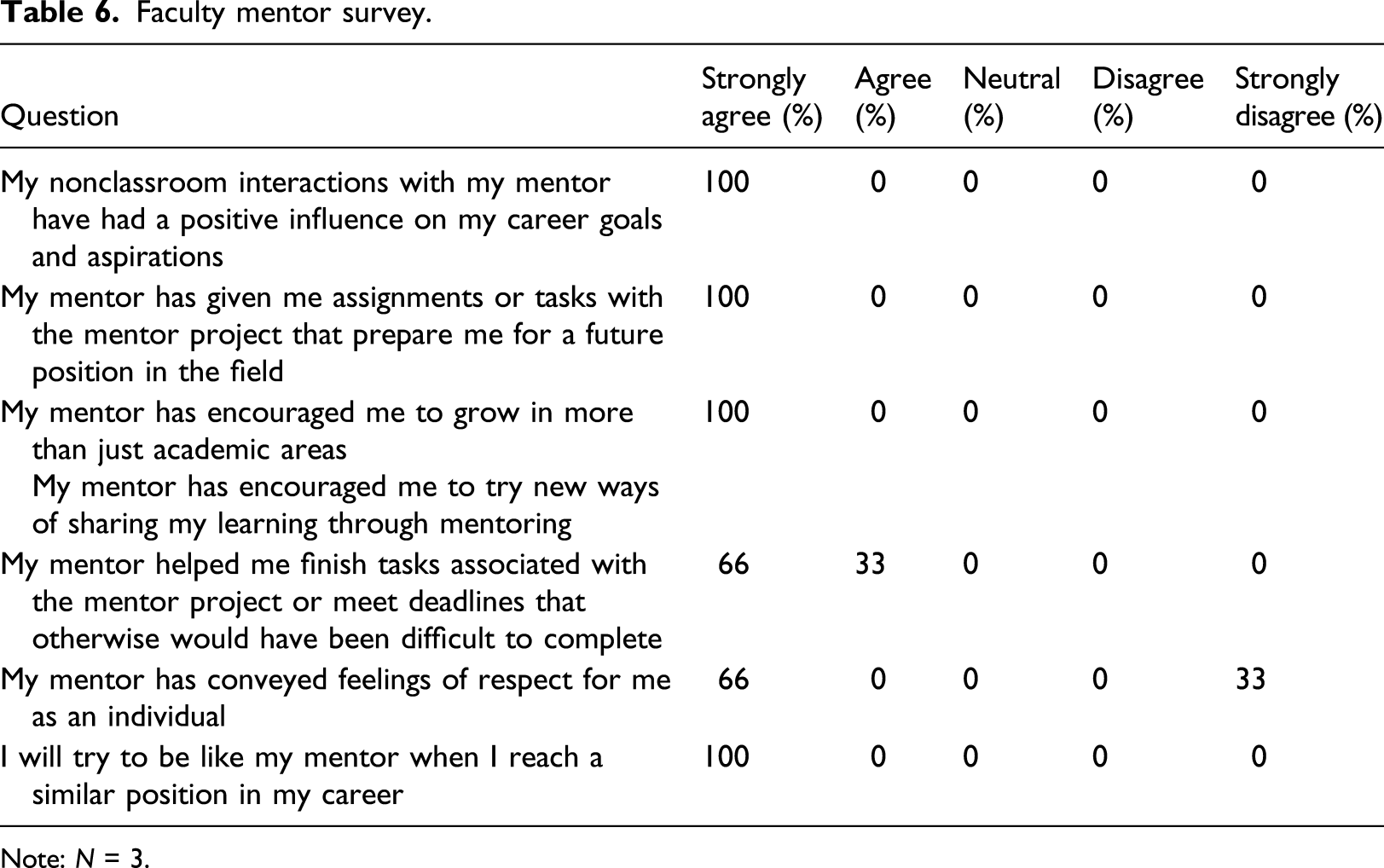
Note: N = 3.
It is important to note that the fourth student volunteered to participate in the mentoring process, but did not complete the process. That student cited upcoming graduation and time restraints as the reason for noncompletion of the mentorship program. This student also did not participate in the research. It would be interesting to learn how universities and faculty can better support students who are interested in a mentoring opportunity while still meeting time constraints.
Faculty mentee interview.
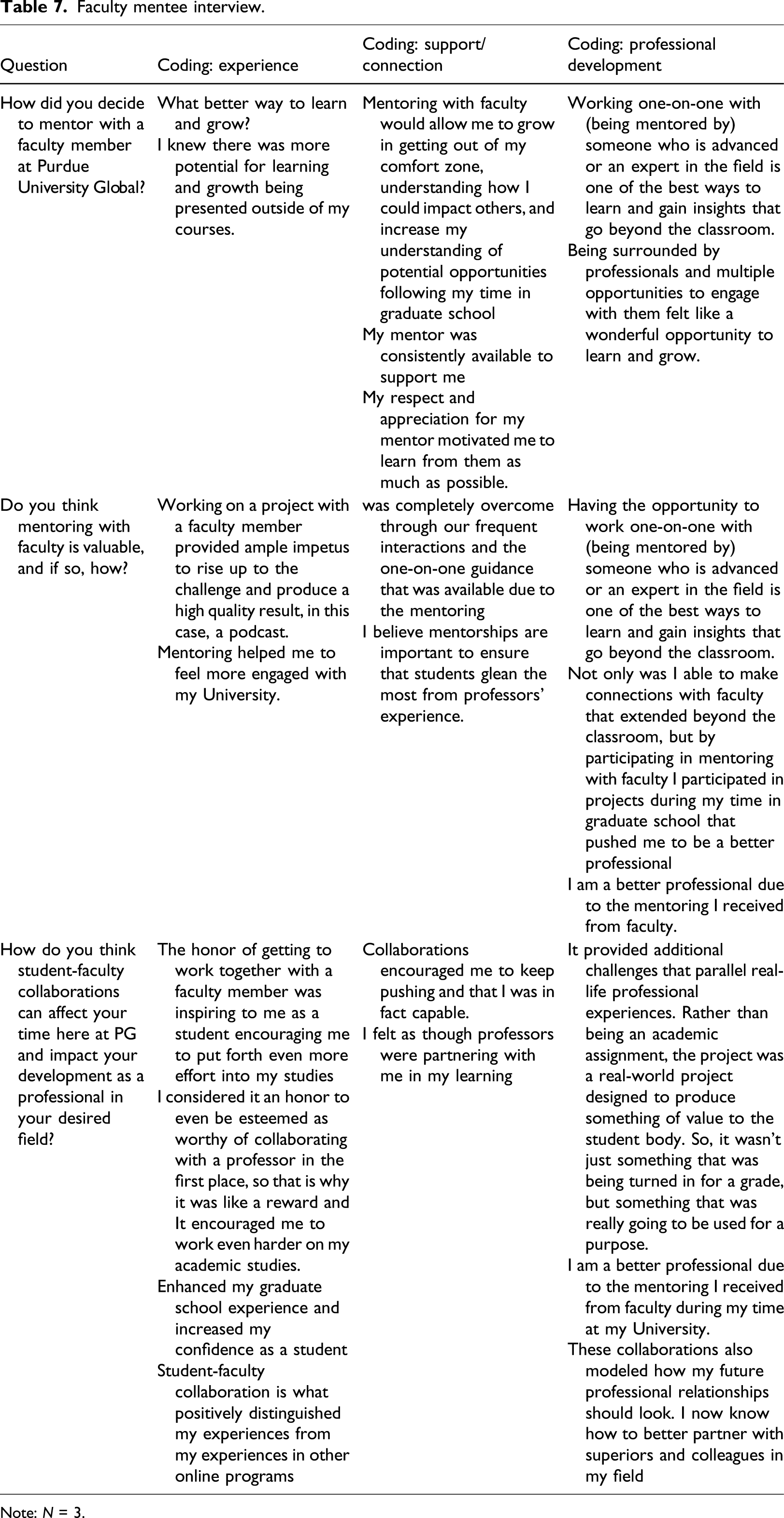
Note: N = 3.
It is significantly clear that students that participated in a faculty mentoring activity felt it benefited them in many ways. Three overall themes emerged that align with survey one responses as well: experience, support/connection, and professional development. Further, student interview responses support research that indicates mentoring should be a distinct relationship that is removed from teaching. Mentoring is personal and individualized, as indicated in student comments such as “I felt as though professors were partnering with me in my learning,” and “I considered it an honor to even be esteemed as worthy of collaborating with a professor in the first place, so that is why it was like a reward and It encouraged me to work even harder on my academic studies.”
Findings
Posselt (2018) states a faculty mentoring relationship can present students with a durable structure for challenge and support, both essential for student development. Support from faculty can bridge student motivation with their professional futures. Professional development along with career support, networking, and references were reported by the study participants as a perceived benefit of faculty mentoring in an online program. A faculty mentor can support, advise, and guide students with less experience into a professional world. Further, mentoring of students in online programs can affect student retention, program completion, and career advancement (Carpenter et al., 2015). Hoffman (2014) confirms that relationships with faculty outside of the classroom can help students set and meet career goals while building confidence in readiness for the job market. These are important skills for online undergraduate students and can lead to professional growth and career readiness.
Relationships, noted as thematic in the data analysis, along with coaching, faculty connections, and respect as subcategories, was ranked high as a perceived benefit of faculty mentoring in this study. Moreover, personal skills and experience was noted in this research study as a perceived benefit. A large variety of subcategories including leadership skills, goal setting, and sense of success became evident in the data analysis process. Students reported the importance of character in a faculty mentor. Within character were conveyed multiple subcategories, the highest being supportive, personable, and respectful. Students express a desire to have faculty mentors who are interested and supportive, who take time outside of class, and who treat them with respect (Carpenter et al., 2015; McKinsey, 2016). Hoffman’s (2014) study aligns with this perception stating out of class exchanges are associated with increased levels of enthusiasm toward their field of study and increased enjoyment of the learning process. In addition, students indicate that mentors who reassure students and act as a strong model committed to the process encourage them to learn new skills and build a sense of connection (Hoffman, 2014; Holzweiss et al., 2014). Presence, noted with subcategories as providing guidance, availability, and taking interest in students, was also evidence in student responses. Cramer and Prentice-Dunn (2007) denote that successful mentors are relatable to students and provide students a sense of belonging. Faculty availability in online settings can encourage not only student intellectual development but also student attitudes toward education and orientation toward success in their careers. Faculty mentors that express knowledge in the field and that provide genuine means for availability and connection to students are important to the success of mentoring relationships with students (Hoffman, 2014; McKinsey, 2016).
Participants’ perceptions on the benefits of the mentoring program believed faculty mentoring would be an enriching experience that could allow for additional support to aid in goal development, accountability, and an opportunity to make connections. Comments included the following: “These would be relationships that would be valued and last a lifetime with an overall impact on the individuals involved,” “If a student feels faculty members care about them as a person, encourage their goals and dreams, and challenge them academically, it has a positive lifelong impact,” and “I think having mentor would have helped me with the rougher parts of school and would have been more focused to get things done. I feel like I could have had one on one if the mentor was somebody in my career field. I think I would have had more skills added as well if the mentor was in my career field.”
Participant responses included subcategories of lack of time, too busy, and time zone differences. Some examples of student responses are provided as follows: “Right now as classes are getting harder and require more of my time… its harder being pulled in different areas especially when you work full time,” and “I have three kids, class, and work that takes from morning until dinner. Then back to the computer, never leaving the house.” Research suggests that mentoring interactions with support, career focus, and relationships are related to better academic achievement for higher education students (Balu and James, 2017; DeFreitas and Bravo, 2012; Posselt, 2018). This may be especially true given the findings in this study for online environments.
Students who have positive interactions with faculty have been shown to have better outcomes in higher education and to have a greater likelihood of persistence and completion of programs (DeFreitas and Bravo, 2012; Hoffman, 2014). Benefits also include greater engagement, increased effort, persistence, and improved student self-efficacy (DeFreitas and Bravo, 2012; Hoffman, 2014). It is important to note that the themes from this study are important to the triad of the university, student, and faculty and that these are mutually beneficial for all involved in online higher education. Again, gaining experience, support and connection, and professional development remained a high perception among both students that had participated in a faculty mentoring activity and students that had not. Engagement and relationship were also shown as major categories and common threads across surveys and questions. Even though a certain percentage of students did not feel they wanted to participate in a faculty mentoring program, the data analysis shows a majority of interest. It will be important for universities and faculty to support students in mentoring programs and to clearly define roles and responsibilities. Since both faculty and students indicate that time can be a barrier to participating in mentoring relationships at the university level, it is critical for both universities and faculty to determine how to streamline mentoring programs so that time is efficiently used and the reward is great.
Conclusion
The focus on experiences to identify insights common throughout research and analyzing and interpreting data through a mixed methods, phenomenological study provided communicable and accessible findings (Davison, 2014; Mayoh and Onwuegbuzie, 2013). The purpose of this research study was sufficiently served by this method, which was to understand student perceptions on faculty mentoring. There were several themes that emerged both within and across the research question, interviews, and surveys: experience, support/connection, and professional development. Researchers became aware of student interest in faculty mentoring and the overwhelmingly positive perceived benefits to their overall education experience. This research can be used to guide the online university in building and sustaining larger mentoring programs that can be aligned with diverse student needs across the university.
Online faculty have a unique opportunity to serve as individual connectors, informational supports, and professional role models for students. Faculty mentorship programs can bolster student self-efficacy, happiness, and goal-setting behavior. Mentoring of students from a holistic perspective can facilitate remarkable outcomes (Cramer and Prentice-Dunn, 2007; McKinsey, 2016). Participants in this study indicate belief that mentoring should be separate from teaching responsibilities and that the encouragement and benefits from faculty mentoring would enhance their scholarly experience. Though the students began their relationship with the faculty mentor as a student in a class, it was clear that the addition of the mentoring opportunity further cemented the professional relationship between the student and faculty member.
The interview and surveys conducted in the research show how a faculty mentoring program might play a critical role in shaping student experiences, professional advancement, and connections (Holzweiss et al., 2014). In particular, students that had participated in a faculty mentoring activity reported a multitude of benefits aligning directly with the overall themes of experience, support/connection, and professional development. The corroborating research and student responses in this study further support the importance of supportive faculty, perhaps in the form of faculty mentoring, especially in an online environment where many students may have feelings of isolation (Carpenter et al., 2015; Cramer and Prentice-Dunn, 2007; Hoffman, 2014). These results align with previous research in support of the use of mentoring programs for undergraduates and add to the body of literature on mentoring.
The results of this research can be used to inform online higher education programs regarding the overall perceived positive benefits from participation in a faculty mentoring program. Studying the perceptions of students of an online mentoring program gives insight into the student experience, which is an important measure for universities. Further, there is evidence to inform online faculty of the characteristics that students believe faculty should hold as a mentor. The similarities in values and experience between the faculty mentor and the student mentee allow these shared experiences to cement the professional mentoring relationship. While the students that participated in a faculty mentoring activity focused solely on a particular activity led by a mentor and saw these as valuable experiences, the data analysis and research indicate that a larger scale mentoring program might be more valuable for students (Chelberg and Bosman, 2019; DeFreitas and Bravo, 2012; Hoffman, 2014). By understanding perceptions of both students interested in mentoring and students who have participated in faculty mentoring, online faculty and administrators can better prepare mentoring activities and programs to meet the distinctive needs of online higher education students. This research adds to the growing body of literature in support of the use of mentoring programs in an online undergraduate higher education program. This research bridges the gap in the literature on mentoring programs at fully online universities in addition to surveying students’ perceptions of the mentoring process. These are crucial data that can assist online universities in meeting the challenges of the current pandemic and the aftermath of the pandemic and the use of digital media in many aspects in higher education. It will be important to continue this research in a variety of online university settings with diverse mentors and students while continuing to survey the student perceptions of their experience with the online mentoring process. The rapidly changing environment of online higher education requires thoughtful processes to meet the needs of diverse student populations.
Footnotes
Declaration of Conflicting Interests
The author(s) declared no potential conflicts of interest with respect to the research, authorship, and/or publication of this article.
Funding
The author(s) received no financial support for the research, authorship, and/or publication of this article.
