




Abstract
This study examined the relationships between pre-service science teachers’ teaching self-efficacy, locus of control, attitude towards science teaching and teaching anxiety. A conceptual model of these relationships was examined using data collected from 356 pre-service elementary science teachers. Data were analysed using descriptive statistics, zero-order correlations and path analysis. Results showed that attitude towards science teaching was linked positively and teaching anxiety negatively to pre-service science teachers’ science teaching self-efficacy. Additionally, pre-service science teachers’ locus of control was found to be related positively to attitude towards science teaching and related negatively to science teaching anxiety. Finally, pre-service science teachers’ attitude towards science teaching had a negative effect on science teaching anxiety. These results point to the importance of positive role modelling and increased teaching practice in pre-service science teacher education to emphasise the effect of teachers’ attitudes and efforts on student performance.
Introduction
Science is an essential learning area in curriculum and instruction from early grades to high school worldwide. International student achievement tests such as PISA and TIMSS give rise to discussions about the quality of national education programs, as education stakeholders look for ways of improving their educational systems. In Turkey, for example students’ low scores on international achievement tests (e.g. PISA, 2006, 2009, 2012; TIMSS, 1999, 2007) prompted the Ministry of National Education (MONE) to comprehensively review the curriculum and develop a new science curriculum that places greater emphasis on scientific literacy in primary and middle school (MONE, 2013). Additionally, Turkey’s Higher Education Council (YÖK, 2007) restructured the teacher-education program, revising course contents and adding new courses in order to train qualified and effective science teachers. A similar situation occurred in Australia, where the Australian Ministry of Education conducted a review of teacher-education programs to ascertain whether or not they provided teachers with the practical skills needed for the classroom in order to ensure the development of a pool of effective science teachers (Teacher Education Ministerial Advisory Group, 2014).
Affective development is a necessary component of teacher development and one of the key features of teaching effectiveness. In order to monitor teacher development and teaching effectiveness, an understanding of teachers’ affective development is required. Self-efficacy of science teachers, locus of control, attitude towards science teaching and teaching anxiety are considered affective attributes of teachers that influence their teaching practice; therefore, investigating these attributes should begin as early as the pre-service years.
Teacher effectiveness has been shown to be one of the significant factors in student learning (Mendro, Jordan, Gomez, Anderson, & Bembry, 1998; Sanders & Rivers, 1996). Teacher characteristics such as teaching self-efficacy, attitudes toward teaching, teaching anxiety and locus of control affect teacher effectiveness in various ways. Below, each of these constructs is discussed separately first followed by considerations regarding the interrelationships among these constructs
Teaching self-efficacy
Self-efficacy is a key construct within the social cognitive theory and defined as ‘people’s judgments of their capabilities to organise and execute courses of action required to attain designed types of performances’ (Bandura, 1986, p. 391). Self-efficacy influences not only how individuals feel, think, motivate themselves, and behave (Pajares, 1997) but also the selection of activities, effort and persistence (Pintrich & Schunk, 2002). Since people select and participate in an activity based on their belief that they are able to accomplish the task, self-efficacy is an important mediator of all types of behaviour.
Given the important role of teachers’ self-efficacy on their practice, it is crucial in the teaching context. Tschannen-Moran, Woolfolk-Hoy, and Hoy (1998) defined teacher self-efficacy as ‘a teacher’s belief in his or her own capability to organise and execute courses of action required to successfully accomplish a specific teaching task in a particular context’ (p. 233). According to their proposed model, self-efficacy is developed by the resultant consequences arising from the interaction between the evaluation of the factors that make teaching difficult – analysis of teaching task and its context – and the evaluation of self-perceptions of personal teaching capabilities – analysis of teaching competence. Research on teacher self-efficacy revealed that teacher self-efficacy is one of the teacher characteristics that has been significantly linked to teaching behaviour and performance (Riggs et al., 1994), as well as instructional strategies (Holzberger, Philipp, & Kunter, 2013; Morris-Rothschild & Brassard, 2006; Ross, 1998; Tschannen-Moran et al., 1998; Wolters & Daugherty, 2007). Indeed, teachers with a high sense of efficacy implement various teaching methods (Weiner, 2003) and try different materials and approaches (Cousins & Walker, 2000; Weiner, 2003). They show greater commitment to teaching (Coladarci, 1992) and desire to improve their teaching (Weiner, 2003) than teachers with lower self-efficacy. In addition, teachers with a high sense of efficacy work with difficult students longer and are more tolerant of student errors (Ashton & Webb, 1986; Fuchs, Fuchs, & Bishop, 1992; Gibson & Dembo, 1984). On the other hand, teachers with a low sense of efficacy tend to feel disenchanted with teaching, show lower job satisfaction (Ashton, 1984; Caprara, Barbaranelli, Steca, & Malone, 2006; Klassen et al., 2009; Tschannen-Moran et al., 1998), and get burned out sooner (Skaalvik & Skaalvik, 2014) than teachers with higher self-efficacy. Thus, teacher self-efficacy is significantly related to student achievement (Ashton & Webb, 1986; Bandura, 1993; Goddard, Hoy, & Woolfolk-Hoy, 2000; Hoy, Sweetland, & Smith, 2002), student motivation (Midgley, Feldlaufer, & Eccles, 1989) as well as teacher motivation (Senler & Sungur-Vural, 2013), and teacher success (Ham, Duyar, & Gumus, 2015). Given the centrality of this concept warrants the examination of factors associated with teaching self-efficacy.
Teacher locus of control
The other characteristic of an effective teacher is locus of control, a concept developed by Rotter (1966) based on the social-cognitive theory. Similar to self-efficacy, locus of control is a cognitive-behavioural attribute that refers to what an individual believes with regard to control over life events. Locus of control is conceptualised on two dimensions, namely internal locus of control and external locus of control. Individuals with an internal locus of control believe that the outcomes of events are a result of their own actions. They take responsibility for and attribute results to their own efforts and abilities, and, thus, they believe they have the ability to change things. On the other hand, individuals with an external locus of control believe that the outcomes of events are the results of external factors such as luck, chance, fate and powerful others. As they believe they have no control over these factors, they tend to blame others and believe that personal effort is unlikely to make a difference to outcomes. While internal locus of control is associated with handling, external locus of control is associated with defending (Vickers, Conway, & Haight, 1983).
Teacher locus of control is defined as teachers’ perceptions of personal control over or responsibilities for student performance (Rose & Medway, 1981). As it determines teachers’ teaching practices and motivation in classroom, considerable research has been undertaken on teacher locus of control. Findings of this research suggest that teacher locus of control is related to student achievement (Murray & Stabler, 1974; Weiner, 1985), students’ perception of classroom (Sadowski, Blackwell, & Willard, 1986; Sadowski & Woodward, 1983) as well as their psychological empowerment (Wang, Zhang, & Jackson, 2013), motivation (Anderson, Hattie, & Hamilton, 2005; Czubaj, 1996), anxiety (Pigge & Marso, 1990; Smith, 1997), self-efficacy (Parkay, Grenwood, Olenjik, & Proller, 1988), self-concept (Thomson & Handley, 1990), job attitude (Bedel, 2008; Cheng, 1994; Smith, 1997), job satisfaction (Bein, Anderson, & Maes, 1990; Sünbül, 2003), tenure (Sadowski, 1993; Sherman & Giles, 1981), and teaching performance (Sadowski & Woodward, 1983; Sadowski et al., 1986). Smith (1997) stated that internal locus of control orientated pre-service teachers tend to be less anxious, more successful and more reflective. Additionally, external locus of control orientated pre-service teachers has more negative attitudes toward the teaching profession (Bedel, 2008). Thus, in the present study, it was proposed that teacher locus of control is directly as well as indirectly linked to teaching self-efficacy through its effect on attitude toward teaching and teaching anxiety.
Teaching anxiety
Teaching anxiety is defined as feelings which restrain teachers from being able to start, continue or finish a teaching task (Thomas, 2006) and can affect performances and effectiveness. Teachers with higher anxiety prefer teacher-directed instruction (Czerniak & Haney, 1998), tend to avoid trying new teaching methods (Thomas, 2006), and get burned out sooner (Byrne, 1994). Anxious teachers also make their students anxious (Doyal & Forsyth, 1973 as cited in Pigge & Marso, 1991) and perform poorly (Koran & Koran, 1981). Based on the Bandura’s (1986) social cognitive theory, anxiety is negatively linked to self-efficacy due to thoughts of possible failure. Indeed, this relationship was demonstrated in the studies on various subjects (Rezaei & Zamani-Miandashti, 2013; Schwarzer, Bäßler, Kwiatek, Schröder, & Zhang, 1997; Shelton & Mallinckrodt, 1991), especially in chemistry education (Kurbanoglu & Akin, 2010, 2012). In the light of this evidence, teaching anxiety was hypothesised to be associated with teaching self-efficacy directly in this study.
Attitudes towards science teaching
In general, an individual’s attitude towards his or her profession has an impact on his or her performance. In an educational context, a teacher’s attitude towards teaching a subject or course influences how s/he teaches (Turkmen, 2013). Moreover, a teacher’s attitude is related not only to his or her motivation and enthusiasm, but also to his or her students’ attitudes and achievements (Pigge & Marso, 1997). Whereas a number of studies have focussed on student attitudes towards science (e.g. George, 2000; Koballa & Crawley, 1985; Koksal & Berberoglu, 2014; Ornstein, 2006), pre-service teachers (e.g. Cartwright & Atwood, 2014; Chin, 2005; Minger & Simpson, 2006), teachers (Manning, Esler, & Baird, 1982; Van Aalderen-Smeets, Walma Van Der Molen, & Asma, 2012), and parents (e.g. George & Kaplan, 1998; Perera, 2014), fewer studies have been conducted on attitudes towards science teaching. It is also noteworthy that while some titles suggested that studies focussed on attitude towards science teaching they actually used scales which measured attitude towards science. Nevertheless, studies of teachers’ attitudes towards science teaching have shown that pre-service teachers have a positive attitude towards science teaching (Tekkaya, Çakıroğlu, & Özkan 2002; Türkmen, 2002, 2008) and that methodology courses contribute to improving this attitude (Bayraktar, 2009; Turkmen, 2007). Given that other studies have uncovered a relationship between attitude and anxiety (Hong & Koh, 2002; Kargar, Tarmizi, & Bayat, 2010; Kurbanoglu & Akin, 2010, 2012), a relationship between attitude towards science teaching and teaching anxiety was proposed in the study described in this article. Furthermore, although the literature is inconclusive regarding a relationship between attitude towards science teaching and teaching self-efficacy, this study hypothesised a positive relation between these two variables.
Taking into consideration this body of research, as the crucial factors influencing teachers’ practices, these affective constructs need to be examined holistically. Therefore, the aim of the present study is to examine the relationships among pre-service science teachers’ teaching self-efficacy, locus of control, attitude towards science teaching, and by proposing and testing a conceptual model. More specifically, the present study addresses the following research questions:
Does locus of control affect pre-service science teachers’ attitude towards science teaching, teaching anxiety, and teaching self-efficacy? Does attitude towards science teaching affect pre-service science teachers’ teaching anxiety and teaching self-efficacy? Does teaching anxiety affect pre-service science teachers’ teaching self-efficacy?
The conceptual model is displayed in Figure 1 in which arrows indicate paths which hypothesise direct effects – for example of locus of control on teaching anxiety – as well as indirect effects – for example of locus of control on self-efficacy through teaching anxiety. As suggested by the abovementioned studies (e.g. Bedel, 2008), a path was proposed from locus of control to attitude towards science teaching. Related literature (e.g. Smith, 1997) also suggested a negative relationship between locus of control and anxiety. Therefore, a path was proposed from locus of control to teaching anxiety. A path was also specified from locus of control to teaching self-efficacy based on the related studies (e.g. Parkay et al., 1988). Moreover, drawing on previous studies (e.g. Bandura, 1986), a path was proposed from teaching anxiety to teaching self-efficacy. Although the relationship between attitude towards science teaching and teaching self-efficacy remains inconclusive, a path was proposed between these two variables. Finally, a path was specified from attitude towards science teaching to teaching anxiety, given that a relationship between these two variables has been indicated by previous studies (e.g. Hong & Koh, 2002). It is hoped that the findings of this study will give insights to teacher preparation program planners about how to train pre-service science teachers to become effective teachers, and to improve science education in the future.
Path diagram of the proposed model of factors related to science teacher self-efficacy. Loc: locus of control; att: attitude towards science teaching; anx: teaching anxiety; self.eff: science teaching self-efficacy.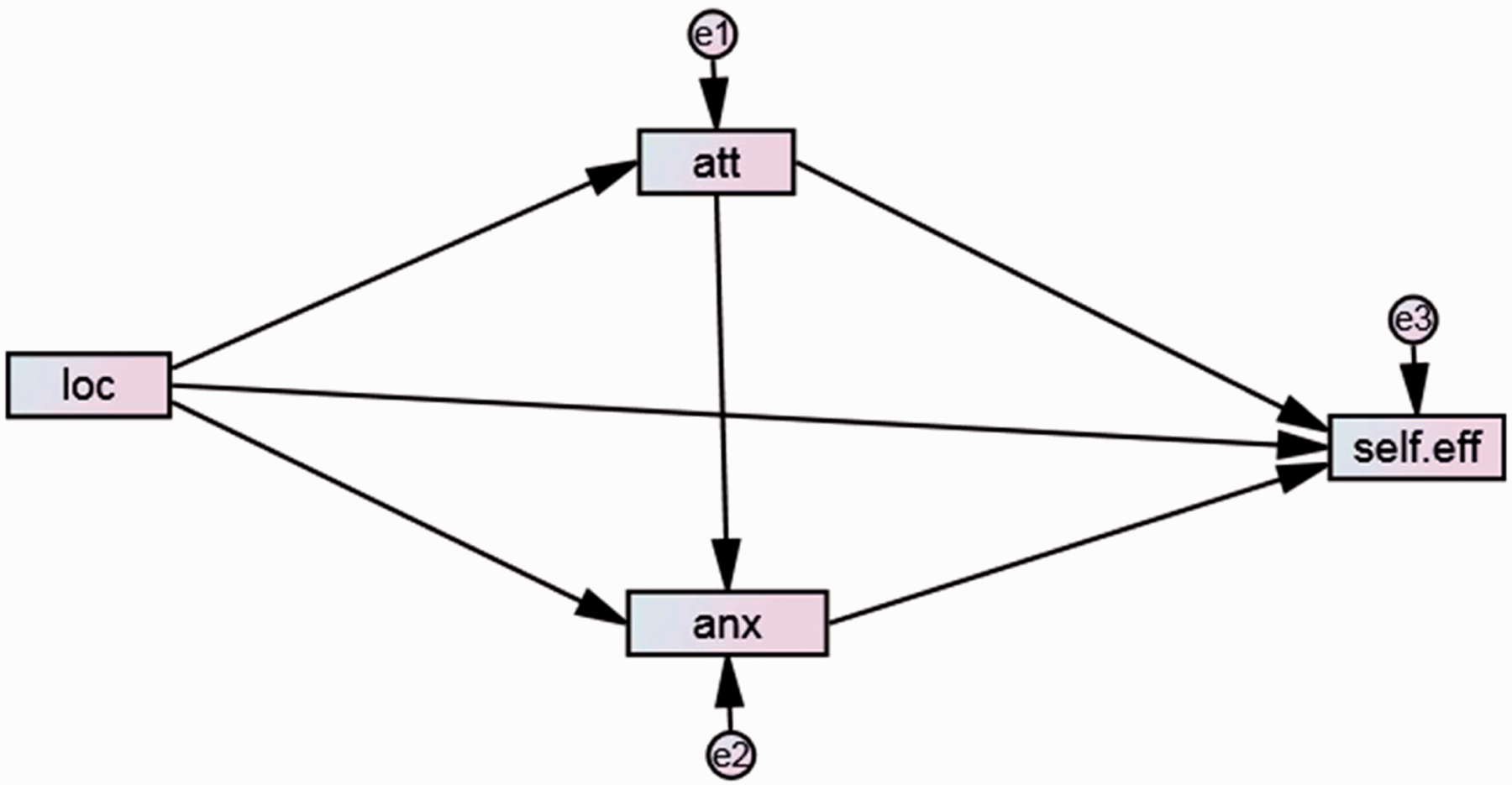
Methodology
Participants
A total number of 356 (153 males and 203 females, mean age = 22.53 years) pre-service teaching students who were training to become primary school science teachers and who were in their last year of university participated in the study from five universities in Turkey. All of the universities involved in the study were public universities that followed the same teacher education program, offered by the Higher Education Council. During the four years, pre-service elementary science teachers are required to complete several courses including mathematics, earth science, physics, chemistry, and biology, as well as special subject training and pedagogy.
Instruments
Sample items of the data collection instruments.
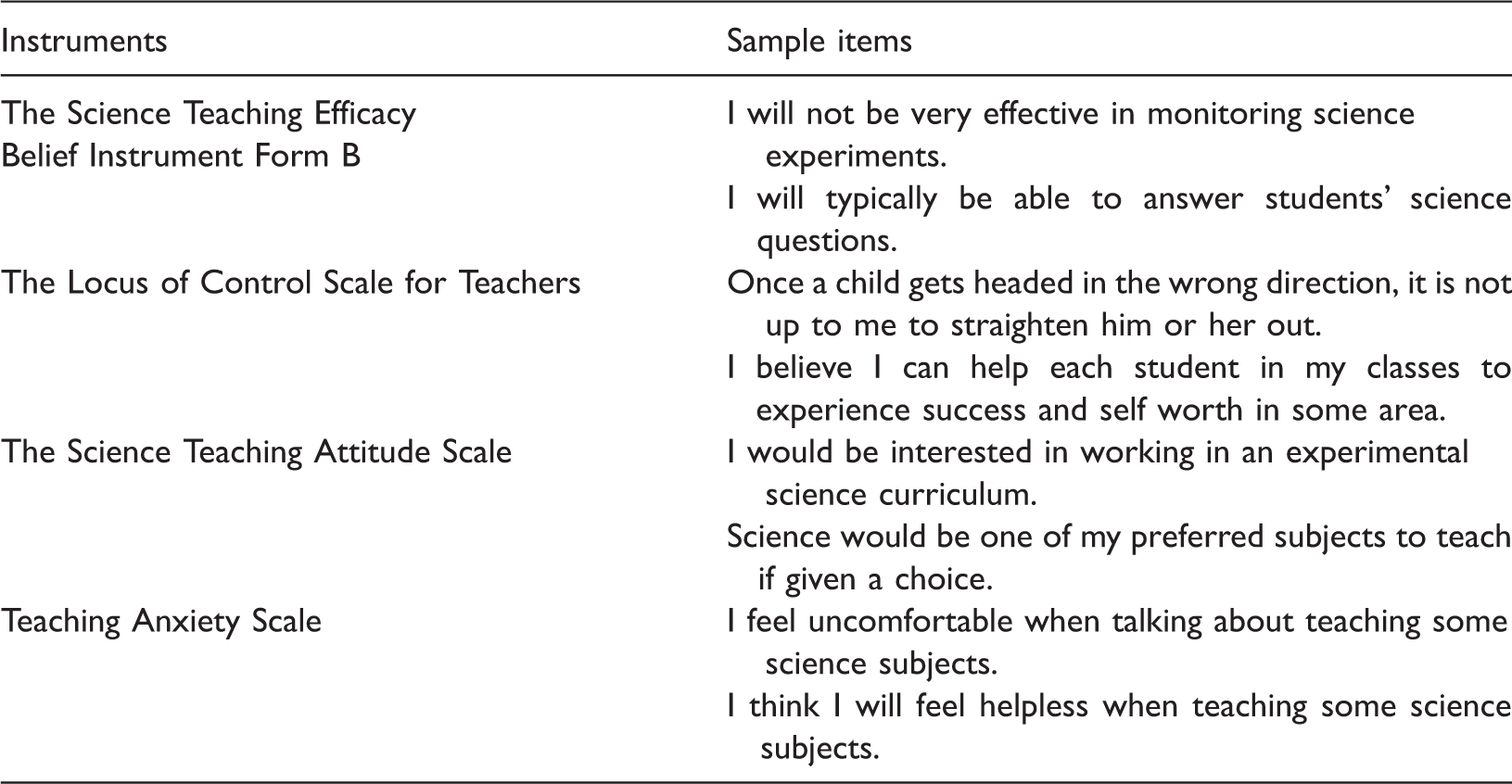
The Science Teaching Efficacy Belief Instrument Form B. The Science Teaching Efficacy Belief Instrument Form B (STEBI-B) (Enochs & Riggs, 1990) was designed to measure self-efficacy beliefs of pre-service teachers regarding science teaching. It consists of 23 items in three sub-scales, namely Personal Science Teaching Efficacy (PSTE) and Science Teaching Outcome Expectancy (STOE). It is a five-point Likert type scale and response categories range from 5 – strongly agree to 1 – strongly disagree. The STEBI-B was translated and adapted into Turkish by Tekkaya et al. (2002). The reliabilities in terms of Cronbach’s alpha of the PSTE and the STOE were 0.86 and 0.79, respectively (Tekkaya et al., 2002). Since the current study did not focus on STOE, the STOE subscale was omitted. The reliability in terms of Cronbach’s alpha of the PSTE was 0.82 in the present study.
The Locus of Control Scale for Teachers. The Locus of Control Scale for Teachers (LCST) (Sadowski, Taylor, Woodward, Peacher, & Martin, 1982) was used to assess pre-service science teachers’ locus of control. This 20-item scale is a self-report instrument based on Rotter’s theoretical foundations on locus of control to measure teachers’ beliefs that their own behaviours influence student performance and classroom events. Internal and external orientations consist of an equal number of items. For each item, the participants were asked to rate themselves on a five-point Likert-type scale ranging from 5 – completely agree to 1 – never agree. High scores on the scale indicate internal locus of control. The scale was translated and adapted into Turkish by Bulus (2011). The reliability of that scale was reported by Bulus (2011) as α = 0.82. The reliability for this scale in the current study was α = 0.72 for the present study.
The Science Teaching Attitude Scale. The Science Teaching Attitude Scale (Thompson & Shrigley, 1986) was designed to measure pre-service teachers’ attitude towards science teaching. It consists of 22 items in a five-point Likert scale format. Response categories were accomplished by assigning a score through 5 – strongly agree to 1 – strongly disagree. The science teaching attitude scale was translated and adapted into Turkish by Tekkaya et al. (2002). The reliability of the Turkish version of the scale in terms of Cronbach’s alpha was 0.83 (Tekkaya et al., 2002). The reliability for this scale in the current study was α = 0.82.
Teaching Anxiety Scale. The Teaching Anxiety Scale (Peker, 2006) was originally developed to measure pre-service teachers’ mathematics teaching anxiety. It is a 23-item-scale with five-point Likert type ranging from 5 – completely agree to 1 – never agree. The reliability of the scale in terms of Cronbach’s alpha was reported as 0.91 (Peker, 2006). Permission was granted by the researcher who developed the original scale to adapt it from the original focus on mathematics to science for the current study. The reliability for this scale in the current study was α = 0.94.
Data analysis
Path analysis is a form of structural equation modelling (SEM) that examines direct and indirect relationships between variables (Kline, 2011). Testing a proposed model with a set of specified relationships among variables by relying on ‘theoretical, empirical and common-sense knowledge of a problem’ is recommended (Cook & Campbell, 1979, p. 307). To examine the hypothesised model, AMOS 20 was used in this study to conduct path analysis and examine the relationships among pre-service science teachers’ teaching self-efficacy, locus of control, attitude towards science teaching and science teaching anxiety.
Results
Descriptive statistics
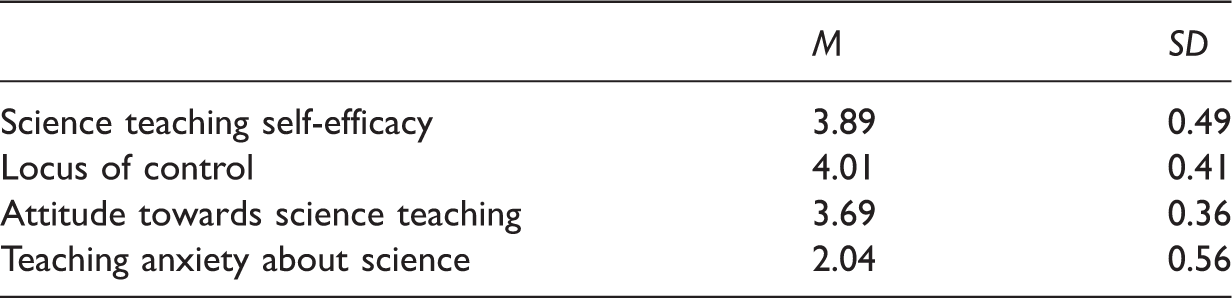
Descriptive statistics.
Zero-order correlations among pre-service science teacher science teaching self-efficacy, locus of control, attitude towards science teaching, and science teaching anxiety
Zero-order correlations.
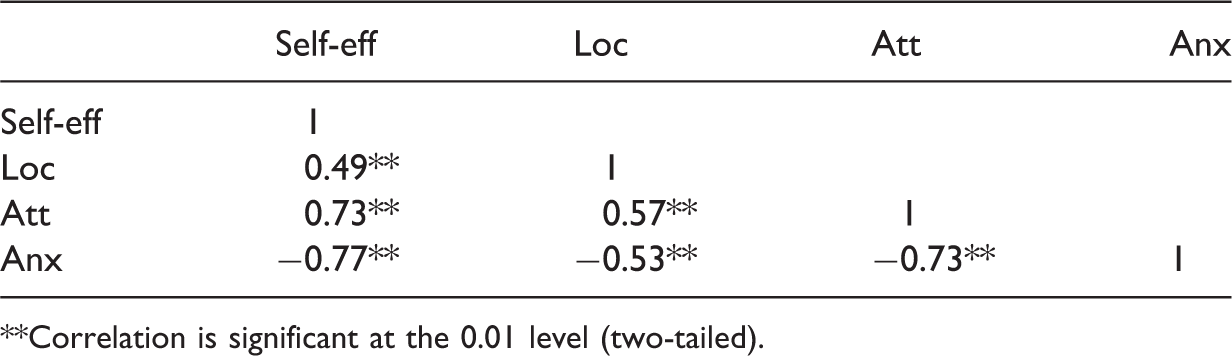
Correlation is significant at the 0.01 level (two-tailed).
The highest positive correlation coefficient emerged between science teaching self-efficacy and attitude towards science teaching (r = 0.73) while the lowest correlation was observed between science teaching self-efficacy and locus of control (r = 0.49). The highest negative correlation was found between science teaching self-efficacy and science teaching anxiety (r = − 0.77) and the lowest negative between locus of control and science teaching anxiety (r = −0.53).
Path analysis
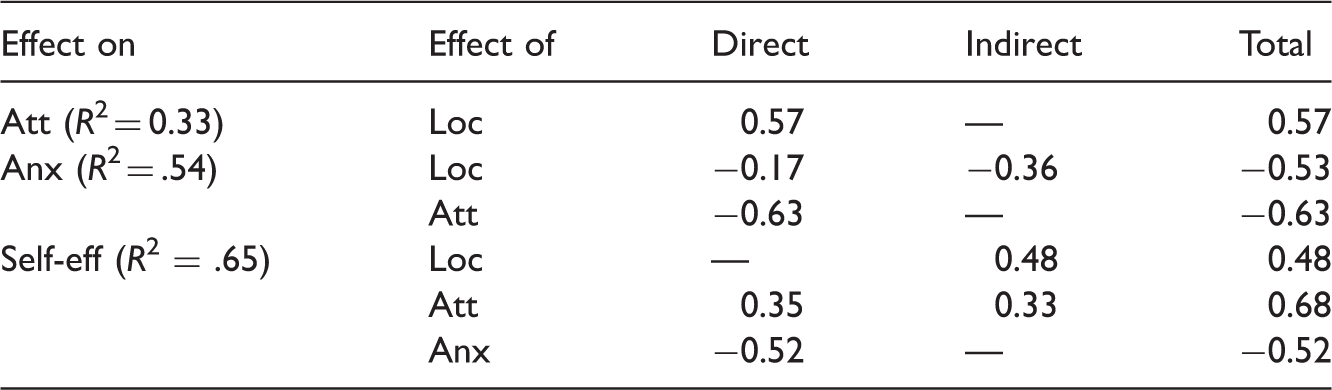
In order to examine the relationships among pre-service science teacher science teaching self-efficacy, locus of control, attitude towards science teaching, and science teaching anxiety, a conceptual model (Figure 1) was proposed containing all the variables as observed variables and analysed by path analysis utilising AMOS 20. The resulting fit indices did not indicate a perfect fit. Modification indexes suggested locus of control to be unrelated to teaching self-efficacy. This evidence supported those studies (e.g. Saracaloğlu, Certel, Varol, & Bahadır, 2012) that found no relationship between locus of control and self-efficacy rather than studies which reported a link between those concepts (e.g. Parkay et al., 1988). Hence, the path between these variables was removed. The goodness-of-fit measures (Hu & Bentler, 1999; Schumacker & Lomax, 1996) indicated a good fit of the data to the model (χ2/df = 0.33, RMSEA = 0.00, TLI = 1.00, GFI = 1.00, CFI = 1.00). The final model which shows the coefficients for the significant paths is presented in Figure 2.
Path diagram of the final model of factors related to science teaching self-efficacy. Loc: locus of control; att: attitude towards science teaching; anx: teaching anxiety; self.eff: science teaching self-efficacy.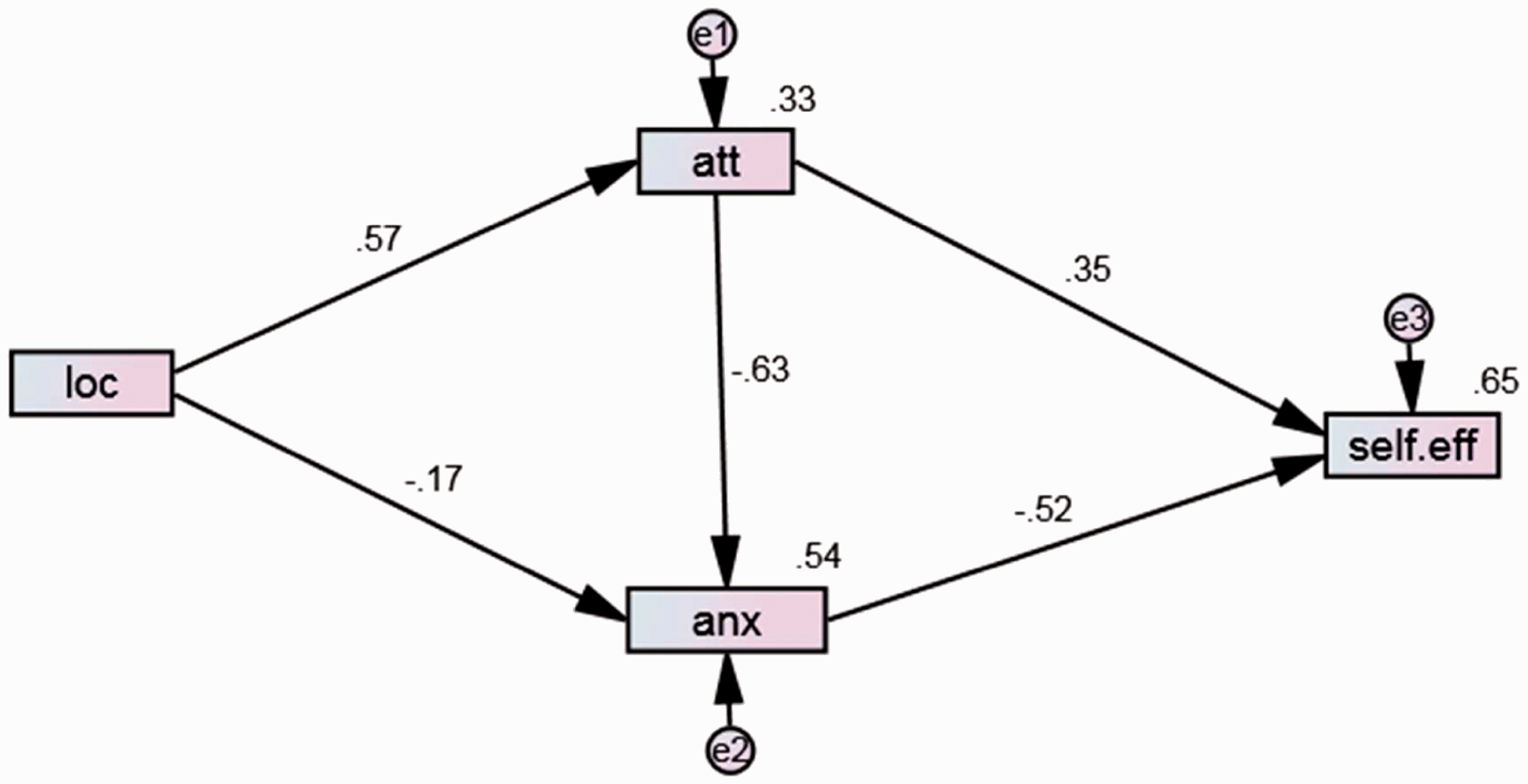
Direct, indirect, and total effects.
Discussion
The main purpose of the present study was to investigate the relationships among the teaching self-efficacy, locus of control, attitude towards science teaching and science teaching anxiety of pre-service science teachers. It was predicted that both locus of control and attitude towards science teaching would be positively linked to teaching self-efficacy.
Although no direct association was found between locus of control and science teaching self-efficacy, attitude towards science teaching was found to be positively associated with science teaching self-efficacy. This finding that pre-service science teachers with a positive attitude towards science teaching also believe they have the ability to teach science effectively. Similarly, Ramey-Gassert, Shroyer, and Staver (1996) demonstrated that a belief in science teaching efficacy correlated positively with attitude towards science and choosing to teach science. Sarikaya (2004) and Velthuis (2014) also showed that attitude towards science teaching was a significant factor in the belief of science teaching efficacy.
The present study confirmed the hypothesised relationship that science teaching anxiety is negatively associated with science teaching self-efficacy. In other words, pre-service teachers who are anxious about teaching also have a lack of confidence in their ability to teach science effectively.
Likewise, the hypothesised positive effect of locus of control on attitude towards science teaching was confirmed. In other words, pre-service science teachers who believe they are responsible for student performance and that student-level outcomes are related to their own effort and ability are likely to have a positive attitude towards science teaching. This is consistent with the findings of Haury (1989).
Concerning the relationship between locus of control and science teaching anxiety, locus of control was found to be negatively associated with science teaching anxiety. This finding is in agreement with Marso and Pigge (1998), and suggests that pre-service science teachers with a greater internal locus of control experience less teaching anxiety. Indeed, pre-service science teachers who believe in their abilities to control student learning and their learning environment tend to be more comfortable with teaching.
The results of the present study also showed attitude towards science teaching to be negatively linked to science teaching anxiety. This is in line with the results of earlier studies (Kurbanoglu & Akin, 2010, 2012) and implies that pre-service science teachers with a negative attitude towards science teaching are likely to be more anxious about science teaching.
The findings of the present study have some practical implications for science teacher education programs. Educating pre-service science teachers with a high degree of self-efficacy requires developing their attitudes towards science teaching in a positive way. Since the related literature suggests that pre-service science teachers’ attitudes towards teaching are linked to their knowledge and skill levels (Merwin & DiVesta, 1959 as cited in Pigge & Marso, 1986), designing content-knowledge and pedagogy courses in a way that will assist pre-service science teachers in developing their knowledge and skills in pedagogy and content-knowledge of science teaching should also help to promote positive attitudes. When planning courses and instructional methods, teacher educators should also consider the relationship between science teaching methodology and the attitudes of pre-service teachers towards teaching (Turkmen, 2007). Additionally, research conducted in Australia by Hurst and Cooke (2014) found that professional learning and social constructivist teaching style are beneficial in developing pre-service teachers’ positive attitudes. Thus, the courses in teacher education programs should be directed in this way.
Given the effect of role models on attitudes (Taylor, Peplau, & Sears, 2006), pre-service science teachers’ attitudes towards science teaching may also be improved by observing peers, mentor-teachers, and teacher-educators who exhibit positive attitudes. In addition, considering that teaching experience has been found to improve attitudes towards teaching as well as decrease teaching anxiety (West, Watson, Thompson, & Parke, 1993), pre-service science teachers should be given more opportunities to teach in real classroom settings as part of teaching-practice courses. Indeed, Pigge and Marso (1991) revealed that increasing pre-service teachers’ knowledge and skills related to teaching through teaching practice led to a decrease in teaching anxiety. Such a decrease in teaching anxiety should, in turn, increase the self-efficacy of pre-service science teachers.
Regarding locus of control, teacher educators can develop the internal locus of control of pre-service teachers by designing their courses so that pre-service science teachers are able to realise the link between their own efforts and their future students’ accomplishments. This can also help to improve the teaching efficacy of pre-service science teachers. As suggested by Abaan, Duygulu, and Ugur (2012) peer mentoring can also be used to develop the internal locus of control of pre-service science teachers.
A few potential limitations of the current study should be noted while interpreting the results. One limitation is connected with the use of self-reported data as the sole source of information. In general, participants tend to respond in socially desirable ways, which can lead to bias. In order to verify the consistency and accuracy of findings, future studies may collect qualitative data to complement quantitative findings and provide a more in-depth understanding of the observed relationships. Another limitation relates to the type of sample from which data were analysed. Participants of this study were limited to pre-service science teachers in their last year at selected universities. In order to identify differences in variables across grade levels, this study may be replicated using pre-service science teachers in all four years of university. Moreover, longitudinal studies may provide further insights on this important topic.
Still, the findings of the current study in terms of locus of control, attitude towards science teaching and science teaching anxiety should go a long way to improving the teacher self-efficacy through strengthening locus of control and attitude towards science teaching as well as decreasing science teaching anxiety, and ultimate result in increases in students’ performance in science.
Footnotes
Declaration of conflicting interests
The author(s) declared no potential conflicts of interest with respect to the research, authorship, and/or publication of this article.
Funding
The author(s) received no financial support for the research, authorship, and/or publication of this article.