




Abstract
The purpose of this study was to examine the possible effects of the simultaneous inclusion of self and other ratings of principal instructional leadership on teachers’ self-efficacy beliefs. Special attention was given to the case where principal and teacher ratings were incongruent and exhibited a self-other rating disagreement regarding the principals’ effectiveness in instructional leadership. The data used in the analyses were taken from the Organisation for Economic Co-operation and Development’s (OECD's) Teaching and Learning International Survey (TALIS) conducted in 2008 and involved information from 672 principals and 11,323 teachers in four OECD countries located in the broader Asia-Pacific region. The study tested a set of hypotheses based on a multi-source assessment framework for the analysis of leadership performance. Results indicated that principal–teacher incongruence regarding principal instructional leadership was significantly and negatively associated with teacher self-efficacy across all four countries. The findings suggest that multi-source assessment can provide unique performance-relevant information about leadership that would not be captured by traditional single-source ratings alone.
Keywords
Background to the study
“Principal leadership is second only to teachers” is perhaps one of the most common statements in educational leadership literature (Hallinger & Heck, 1996; Leithwood, Louis, Anderson, & Wahlstrom, 2004). Despite this bold assertion, leadership in school settings still presents complex conceptual and methodological challenges to educational researchers. Notwithstanding the significant progress in theory building that supports educational leadership as a scholarly field, consistent empirical evidence of the effect of principal leadership on educational outcomes, particularly in the form of a direct influence on student learning, is still lacking (Clark, Martorell, & Rockoff, 2009; Kurt, Duyar, & Calik, 2012). Empirical studies suggest the presence of an indirect influence of leadership on educational outcomes primarily through teachers and other contextual conditions (Dinham, 2007; Ham & Kim, 2015; Louis, Dretzke, & Wahlstrom, 2010; Quinn, 2002).
In addition to methodological limitations in examining school leaders’ influence on educational outcomes, complex, nonlinear, and unique dynamics that often emerge in school and classroom contexts present additional challenges. What works in one school might not necessarily work in another. Different contextual conditions, needs, and expectations at school sites require principals to be capable of presenting context-specific skills and practices to become effective leaders (Dorfman, 1996; House et al., 1999). While effective principals have been identified, the unique nature of various context-specific issues and varying context-appropriate approaches to tackle such issues have resulted in a lack of a parsimonious understanding of the conditions of effective educational leadership (Fuller & Hollingworth, 2014; Leithwood, Harris, & Strauss, 2010; Southworth, 2002).
The psychology and organizational behavior of each individual employee represents additional complexities in the effort to detangle the effect of leaders on educational outcomes. In this regard, studies of organizational behavior have shown that individual members in organizations tend to have different implicit theories of leadership (Barnett & McCormick, 2004; Yammarino, Spangler, & Dubinsky, 1998). Guided by his or her personal agency, each employee actively interprets a situation and communicates it to others through his or her own perceptual perspective. Similarly, the formal and informal groups with which each employee is affiliated also exert influence in shaping each employee’s perceptions and behaviors in organizations (Bandura, 2001; Luthans, 1998; Ras & Duyar, 2013).
Contemporary approaches to leadership, which encourage participative and distributive leadership strategies and practices, might also contribute to the complex nature of leadership in the educational context. For instance, the need for new methods to appraise school leaders’ performance and effectiveness has become more evident in an era when the empowerment and involvement of all subordinates in decision-making is valued and expected. As a result, subordinates’ appraisals of their leaders’ effectiveness have become one of the main measures in leadership appraisals. What makes things even more complicated is that “at any time, any leader will be perceived differently by those he or she works with” (Dinham, 2007, p. 264). In other words, while some employees will welcome a new approach or want collaboration, others will cling to the past or will want decisiveness. Further, given today’s expanding range of school leadership responsibilities and tasks, school leaders are often expected to become a kind of “multifunctional miracle beings” or “superheroes of schools” (Huber, 2004, p. 672).
Given such complexity, an essential question is whether or not educational research is equipped with appropriate methods and techniques to capture the leadership effects of principals on educational outcomes from multiple perspectives, including both their own (i.e. self) and others’ (e.g. subordinates, peers, or supervisors) perceptions. The question, then, arises from both the developmental and the evaluative perspectives—what it means if teachers and principals “agree” or “disagree” on the principals’ leadership effectiveness.
Practices for the assessment of leadership effectiveness in the private sector would hold important clues to address these issues. In the private sector, “multi-source feedback” or “self-other agreement” appear to be prominent methods for the assessment of leadership effectiveness. The interest in both self-other agreement such as “360° feedback” and its relationship to performance and other individual and organizational outcomes has amplified dramatically in the last three decades (Atwater & Yammarino, 1992; Atwater, Ostroff, Waldman, Robie, & Johnson, 2005). The goal of such multi-source feedback mechanisms is to increase leaders’ awareness of their strengths and weaknesses and to provide information about how others view them, resulting in increased self-awareness (Church, 1997).
In educational leadership, some studies are starting to recognize that the self-other agreement of principals’ effectiveness could become not only (a) a valuable method of appraisal of effectiveness but also (b) an important concept in the form of self-awareness toward increasing the effectiveness of leaders (Devos, Hulpia, Tuytens, & Sinnaeve, 2013; Ham & Cha, 2012; Park & Ham, 2014).
The purpose of the current study was to examine the applicability of self-other agreement as a method of assessment of principals’ leadership effectiveness. Specifically, this study explored the effect of self-other agreement regarding principals’ instructional leadership between principals and teachers on teachers’ self-efficacy beliefs in four countries. Teachers’ self-efficacy—used in the present study as a measure of principal leadership effectiveness—has been identified in educational literature as one of the most agreed-upon attributes that contributes to teachers’ increased teaching quality and greater accountability for student learning. The findings of the current study might help to (a) identify the gaps between principals and their subordinates, (b) allow principals to make appropriate alignments in areas where gaps are present, and, as a result, (c) present opportunities for improving educational outcomes such as the self-efficacy levels of teachers. By focusing on specific gaps in self and other ratings, principals would be equipped with accurate knowledge on areas that would contribute to their effectiveness as instructional leaders. To our knowledge, this study is the first attempt to examine systematically the effect of principal–teacher perceptual agreement on teachers’ self-efficacy beliefs. 1 By using multiple lenses in the assessment of principal instructional leadership and its effects on teacher self-efficacy as an important aspect of work attitudes, this study could provide valuable insights into more realistic assessments of principals’ instructional leadership practices. Such realistic assessments could play a crucial role in the effort to assess accurately principals’ instructional leadership effectiveness and to develop their leadership capacities more effectively.
Theoretical foundations
Below, the three constructs that are central to the current study, namely teachers’ self-efficacy, instructional leadership, and self-other agreement are reviewed in more depth. As recommended by Kozlowski and Klein (2000), teachers’ self-efficacy—which is considered to be the dependent construct of interest or outcome—will be reviewed first. This will be, then, followed by a review of prior research regarding the link between the outcome and what are considered to be its predictors in this study, namely instructional leadership and self-other agreement.
Teachers’ self-efficacy beliefs
The relationship between the effectiveness of teachers and the learning outcomes of students has received much attention (Allinder, 1994; Buddin & Zamarro, 2009; Goddard, 2002). Given this evidence, both educational researchers and practitioners agree that teachers are one of the most important school factors, perhaps the most important one, affecting student learning. This, in turn, has encouraged educational researchers to investigate the conditions associated with teachers’ effectiveness in schools. Here, teacher self-efficacy has been one of the most agreed-upon attributes that is strongly linked to teachers’ effectiveness (Caprara, Barbaranelli, Steca, & Malone, 2006). Self-efficacy is defined as a strong determinant of teachers’ capabilities of improving the learning outcomes of students, even for the most difficult students (Tschannen-Moran & Hoy, 2001). A substantial body of literature indicates that teachers’ self-efficacy contributes to their increased teaching quality and greater accountability for student learning (Goddard, 2002; Rockoff, 2004; Ross & Gray, 2006).
Social cognitive theorists define self-efficacy as a sense of confidence regarding the performance of specific tasks. Social cognitive theory is concerned with “human agency” or the ways in which people exercise some level of control over their own lives. One of its pioneers, Bandura (1986) defined the construct of self-efficacy as “people’s judgments of their capabilities to organize and execute courses of action required to attain designated types of performances. It is concerned not with the skills one has but with the judgments of what one can do with whatever skills one possesses” (p. 391). Social cognitive theory argues that individuals can affect their own actions and possess the skills to control their own thought patterns and emotions. These beliefs, in turn, are considered to guide behaviors. Self-efficacy influences self-regulatory processes in that it determines how environmental opportunities and impediments are perceived. High levels of self-efficacy stimulate greater effort and persistence, which, in turn, promote positive perceptions of one’s own capabilities (Pajares, 1997). Individuals with high levels of self-efficacy tend to regard difficult tasks as challenges, whereas those who doubt their capabilities tend to consider difficult tasks as threats (Bandura, 1997).
Social cognitive theory notes that one’s self-efficacy is a key factor in workplace performance. In the educational context, research has shown strong connections between teacher efficacy beliefs—both self-efficacy and collective efficacy—and teacher behaviors that foster student achievement (Buddin & Zamarro, 2009; Goddard, 2002; Rivkin, Hanushek, & Kain, 2005; Rockoff, 2004; Smith, Hoy, & Sweetland, 2002). In addition, this research has indicated that teachers’ self-efficacy is crucial to success. Teachers with high self-efficacy beliefs are generally more able to handle difficult students and are greater risk-takers, mostly because of reduced fear of failure. Students also benefit from these teachers by exhibiting higher motivation and ultimately showing higher academic performance (Gibson & Dembo, 1984; Ross & Gray, 2006).
Principal instructional leadership and teacher self-efficacy
Whether or not principal leadership has any effect on student achievement and school effectiveness has been discussed extensively (Kurt et al., 2012; Louis, Leithwood, Wahlstrom, & Anderson, 2010). Although there is an increased interest in exploring the relationship between principal leadership and educational outcomes, the pertinent literature still lacks convincing evidence regarding its effect on student learning and achievement. In contrast, a strong link between teachers, especially their self-efficacy beliefs, and student achievement has been well established in the literature (Buddin & Zamarro, 2009; Goddard, 2002; Rivkin et al., 2005; Rockoff, 2004; Smith et al., 2002). As a consequence, more attention has been given to the possible indirect effects of principal leadership on student learning through principals’ influence on teachers’ efficacy beliefs. This line of research appears promising given the strong effects of teachers’ efficacy beliefs on student achievement (Ross & Gray, 2006).
Still whether or not principal instructional leadership affects teacher self-efficacy needs to be explored more fully. Moreover, if evidence supports such a link, how could this be explained from the perspective of contemporary approaches to instructional leadership which view instructional leadership as a collaborative team process? Does the evaluation of principals’ leadership effectiveness from multiple sources (i.e. teacher and principal) support the relationship between principal instructional leadership and teacher self-efficacy? To address these questions, changes in the understanding of principals’ instructional leadership over time need to be considered.
Most definitions of principals’ instructional leadership include leadership practices which focus on the improvement of student achievement (Copland, 2003; Leithwood et al., 2004; Reeves, 2003). Instructional leadership is succinctly defined as “direct and indirect behaviors that significantly affect teacher instruction and, as a result, student learning” (Daresh & Playko, 1995, p. 33). Although models and descriptions of instructional leadership differ, most researchers agree that instructional leadership is composed of elements that are fundamental to improving teaching and student learning (Blase & Blase, 1999; Copland, 2003; DiPaola & Hoy, 2014; Leithwood et al., 2004; McEwan, 2003; Supovitz & Poglinco, 2001; Waters, Marzano, & McNulty, 2003). The increasing global emphasis on improved teaching and learning in general and accountability for student success in particular has reinforced the instructional leadership role of principals worldwide (Gumus & Akcaoglu, 2013; Hallinger, 2005; Ham & Kim, 2015; Lee, Walker, & Chui, 2012).
Standards and accountability movements along with research on effective schools led to an increased focus on instructional leadership movement in the 1980s. While critics identified limitations in the logic and pertinent empirical support (Barth, 1986; Cuban, 1984; Lee et al., 2012; Townsend, Acker-Hocevar, Ballenger, & Place, 2011), instructional leadership was strongly identified as a normative and desirable role that principals need to fulfill to be effective (Hallinger, 2005). In addition, government educational agencies and legislatures throughout the world have emphasized that principals need to be instructional leaders. In a review of the literature that examined principal evaluation in the United States, a group of researchers concluded that most districts’ evaluation systems commonly emphasize principals’ instructional leadership practices (Davis, Kearney, Sanders, Thomas, & Leon, 2011). Meanwhile, the changing policy environment puts principals at risk of being dismissed, demoted, or transferred. As Hallinger (2005) wrote, “Given the passage of formal government standards for education through[out] the world, principals who ignore their role in monitoring and improving school performance do so at their own risk” (p. 2). High-stakes accountability requirements magnify the importance of methods to assess principals’ performance accurately, effectively, and fairly.
Instructional leadership as a construct evolved around several prominent models. Hallinger and Murphy (1985) developed a model with three major functions of instructional leadership, including defining the school mission, managing the instructional program, and promoting a positive school climate. Each function entails a series of behaviors for effective instructional leadership. Murphy (1990) refined the model developed by Hallinger and Murphy (1985). Murphy’s model consisted of four dimensions including developing mission and goals, creating an academic learning climate, promoting quality instruction and monitoring student progress, and developing a supportive work environment. The model developed by Patterson (1993) recognized the importance of student learning as the ultimate outcome of instructional leadership. Different from his contemporaries, Weber (1996) noted the need for a team approach to instructional leadership. He perceived principals as coordinators who served as the single point of contact. Alig-Mielcarek and Hoy (2005) developed a model of instructional leadership with three core functions that incorporate the fundamental properties of earlier models. The three functions included defining and communicating shared goals, monitoring and providing feedback on teaching and learning processes, and promoting school-wide professional development. All these functions are directed to the common mission—increasing student learning by improving instruction.
Acknowledging the imperfections of his original model, Hallinger (2011) called for improvements in measuring the impact and substance of instructional management behaviors while considering organizational settings and contexts of schools. Synthesizing earlier models of instructional leadership, several more comprehensive models have also emerged in the last decade. Some of these new models are conceptualized as “leadership for learning” or “learning-centered leadership” (Rhodes & Brundrett, 2009; Southworth, 2004; Timperley & Roberson, 2011). Management functions and leadership roles of principals have been incorporated into these new models. School leaders are perceived as change agents who not only put education and learning of students at the center of attention but also transform their schools as learning organizations (Huber, 2004). These approaches target both summative and formative purposes of leadership assessment, measure leadership development over time, and consider context-specific attributes of different school settings. Valuing feedback by multiple stakeholders and using data from multiple sources in the analysis of principal leadership are also common attributes of these new approaches.
The Vanderbilt Assessment for Leadership in Education (VAL-ED) developed by Porter et al. (2008) is also a notable model of instructional leadership. Aligned to the Interstate School Leaders Licensure Consortium (ISLLC) standards in the United States, the VAL-ED uses a multi-rater assessment protocol that consists of a set of items framed around six core components (i.e. features of effective schools) and six key processes (i.e. leadership behaviors). More recently, DiPaola and Hoy (2014) introduced another synthesized model of instructional leadership. The role of effective instructional leaders in this model is to create a climate that is “instrumental in helping principals enable teachers to guide students to academic success” (pp. 7–8). This type of climate of academic optimism or press (i.e. focus on excellence in student learning) can be attained in schools in which teachers develop a collective trust and efficacy.
Early literature conceived instructional leadership as a role carried out exclusively by the school principal. As Hallinger noted (2005), there was little discussion of instructional leadership as a collaborative team effort which is shared among all stakeholders. Even the school personnel such as teachers, department heads, or even to assistant principals were forgotten actors in leading schools in the early studies. Contemporary approaches to instructional leadership, however, perceive instructional leadership as a team process that is carried out by collaborating teachers and principals, rather than seeing it as the task or role carried out by principals alone (Elmore, 2000; Fullan, 1991; Hallinger & Heck, 2011; Huber, 2010; King, 2002; Marks & Printy, 2003; Spillane, Halverson, & Diamond, 2001).
This new understanding calls for an active and collaborative form of instructional leadership in which principals work with teachers to shape the school as a workplace in relation to shared goals, teacher collaboration, teacher learning opportunities, and student learning (Cha & Ham, 2012; Drysdale & Gurr, 2011; Hargreaves & Fullan, 2012; Sergiovanni, 1994). The multi-source assessment methodology employed by this study supports the modern approach to instructional leadership and attempts to examine the effects of principals’ instructional leadership on teachers’ self-efficacy from a self-other agreement perspective that simultaneously considers both the teachers’ and principals’ points of view.
Self-other agreement and leadership effectiveness
The use of multi-source assessment for both feedback (i.e. evaluation) and developmental purposes (Dalton, 1996) is growing. A large proportion of private organizations is using multi-source evaluation for both purposes, and the use of this method is increasing (Church, 2000). Parallel to its increased use, the self-other agreement concept has spurred a wealth of research (Atwater & Yammarino, 1992; Church, 2000; Fleenor, McCauley, & Brutus, 1996). The cornerstone of self-other agreement research is the notion that self-awareness, or self-understanding, is a key leadership capability, which is enhanced by fewer discrepancies between self and others’ ratings (Day, 2000). The theoretical rationale for the importance of self-other agreement and its relation to performance and other outcomes stems from the notion of self-awareness. Moshavi, Brown, and Dodd (2003) identified self-awareness as one’s ability “to self-observe,” “to accurately compare one’s behavior to a standard,” and “to assess others’ evaluations of the self” (pp. 407). Wicklund’s (1979) theory of self-awareness suggests that self-aware individuals attend more to others’ perceptions of them and, therefore, can utilize this information to appropriately change their behavior positively. Ashford (1989) noted that leaders need to develop proficiency in observing and evaluating their behavior in a manner that is consistent with others’ perceptions and evaluations.
In their seminal work, Yammarino and Atwater (1997) presented a self-other assessment model in which leaders whose self-ratings are in agreement with others have superior individual and organizational outcomes. In a landscape of contemporary perspectives on leadership in which subordinate involvement in decision-making is expected and encouraged, the accurate (i.e. in-agreement) assessment of principals’ instructional leadership would lead to positive outcomes. The utilization of self-other assessments would help administrators to identify gaps, correct their mistakes, and tailor their behaviors to the expectations of supporters (Atwater et al., 2005; Smircich & Chesser, 1981). As discussed earlier, the modern understanding of instructional leadership, which suggests a collaborative team approach and the involvement of teachers in decision-making and responsibility-taking processes, appears to be very fitting for the use of self-other agreement as a method of examining the effects of principals’ instructional leadership on educational outcomes such as teacher self-efficacy beliefs.
Further, the self-other agreement method has methodological advantages over self-assessments. Self-ratings often suffer from a leniency or common method bias and cannot be accurate predictors of performance (Conway & Lance, 2010; Podsakoff & Organ, 1986). Self-other ratings capture information from both others’ (e.g. supervisors, peers, or subordinates) ratings and self-ratings, thus providing valuable insight into administrators’ leadership performance. Although existing studies generally use either teacher ratings of principals’ leadership behaviors or principals’ own perceptions of themselves, neither approach seem to be fully accurate.
In organizational literature, it is assumed that leaders’ self-ratings is subjective and often inflated (Bass & Yammarino, 2008), whereas the ratings by subordinates tend to be influenced by their personal experience with their leaders and their perceptions of leadership (Brown & Keeping, 2005; Dinham, 2007; Luthans, 1998). Some educational researchers also argue for the usefulness of the self-other ratings approach as an alternative way to assess school administrators’ leadership performance (Devos et al., 2013; Park & Ham, 2014).
Hypotheses
Based on the research reviewed above, three hypotheses were developed to explore the applicability and effect of self-other rating agreement between principals (i.e. self) and teachers (i.e. others) of principals’ instructional leadership on teachers’ self-efficacy. The first and main hypothesis of the study was as follows: H1: Principal–teacher rating incongruence regarding the principal’s instructional leadership performance negatively affects teacher self-efficacy.
This hypothesis was concerned with the effect of the absolute magnitude of rating disagreement between principals and teachers on teacher self-efficacy, without the attention paid to principals’ “overestimation” or “underestimation” of their leadership performance vis-à-vis the teachers’ ratings. Thus, the following supplementary hypotheses were examined simultaneously in this study: H2: Principals’ positive self-appraisal of their instructional leadership performance positively affects teacher self-efficacy, with the degree of principal–teacher rating incongruence held constant. H3: Teachers’ positive appraisal of their principals’ instructional leadership performance has a positive effect on teacher self-efficacy, with the degree of principal–teacher rating incongruence held constant.
Whereas H1 focuses on principal–teacher incongruence as an absolute magnitude affecting teacher self-efficacy, both H2 and H3 draw attention to the ratings by principals and teachers, respectively, allowing for a multifaceted and interactive perspective on the effect of self-other rating agreement or incongruence.
Methods
Data source and analytical technique
The Teaching and Learning International Survey (TALIS) 2008 of the Organisation for Economic Co-operation and Development (OECD) was the data source for the study. This international survey dataset presents a unique opportunity to examine a self-other agreement perspective on leadership practices because the survey questionnaires asked teachers and principals two matched sets of questions regarding principals’ leadership practices. In addition, the data used in the current study included extensive contextual information gathered from a total of 11,323 teachers and 672 school principals in Australia, Malaysia, South Korea, and Turkey.
Atwater and Yammarino (1992) noted that there are a variety of individual and organizational factors that affect self and other ratings and, ultimately, self-other agreement. Given the differences in cultural values and school contexts across cultures, cross-national variations might exist with respect to the effect of self-other ratings of principals’ instructional leadership on teacher self-efficacy. We believe that these four countries, which are all countries from the broader Asia-Pacific region that participated in TALIS 2008, constitute a good combination for a cross-national analysis; although they are all located in the broader Asia-Pacific region, they show considerable differences in terms of sociocultural backgrounds. Considering these differences, we hope that the findings from this study will not only allow for intriguing cross-national comparisons but also provoke further inquiry into schools as organizations from broader international perspectives.
The teachers selected for TALIS 2008 were a nationally representative sample of lower secondary (ISCED level 2) teachers within each country (OECD, 2010a). The study used a stratified two-stage probability sampling design in which teachers (i.e. second-stage units) were randomly selected from each of the randomly selected schools (i.e. first-stage units) in each country. To ensure reliable estimation and modeling while allowing for some non-response in the survey, the minimum size of the target sample was set at 20 teachers within each of the selected schools wherever possible. The target population of the survey included teachers in all subject areas and their principals. However, the survey was restricted to those who taught regular classes in ordinary schools, excluding teachers working with special needs children or adult learners.
As the TALIS data files contained hierarchically structured data from individual teachers and their school principals, hierarchical linear modeling was used in the analysis in which teacher-level and school-level variables were considered simultaneously to explain the variation in teachers’ efficacy beliefs (Raudenbush & Bryk, 2002; Snijders & Bosker, 2012). In this way, differential variance between schools was taken into account to yield improved estimates of regression coefficients and standard errors. In the analysis, teacher-level data constituted level-1 variables while the school-level variables were used at level 2.
Outcome variable: Teacher self-efficacy
Items used to construct the measure of teacher self-efficacy: Factor loadings and Cronbach’s alpha coefficients.
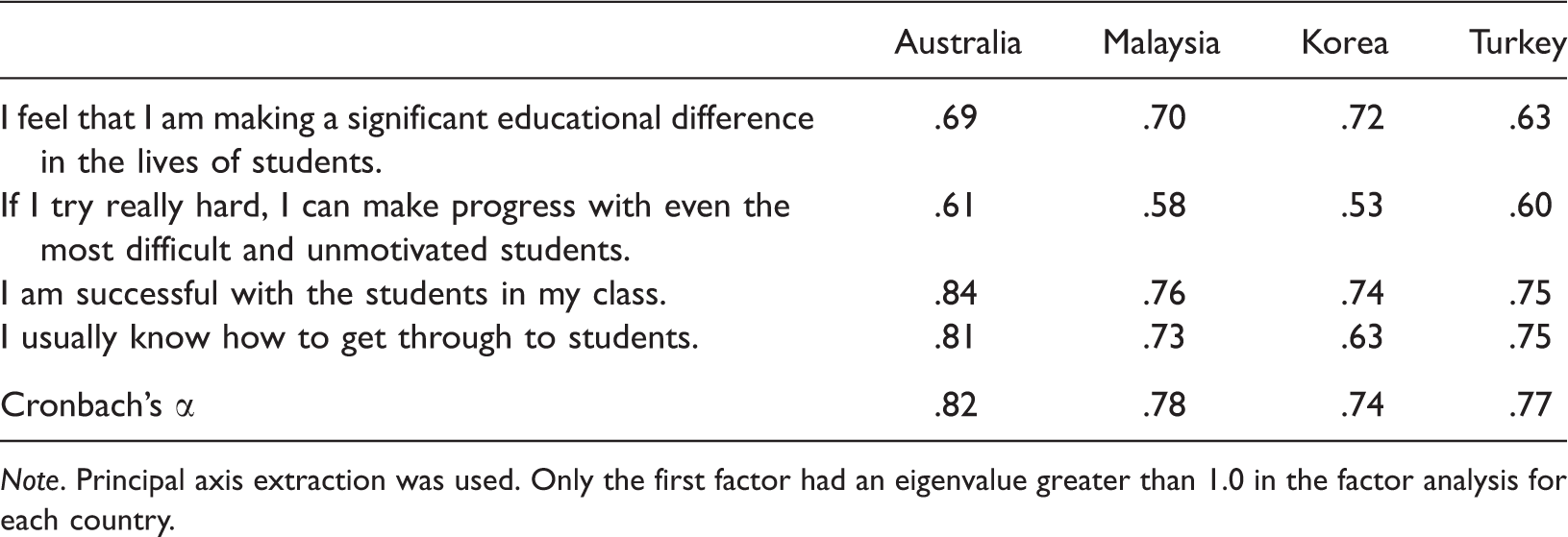
Note. Principal axis extraction was used. Only the first factor had an eigenvalue greater than 1.0 in the factor analysis for each country.
Main predictor variable: Principal–teacher incongruence
Questionnaire items used to measure principal instructional leadership, teacher-perceived and principal-reported.
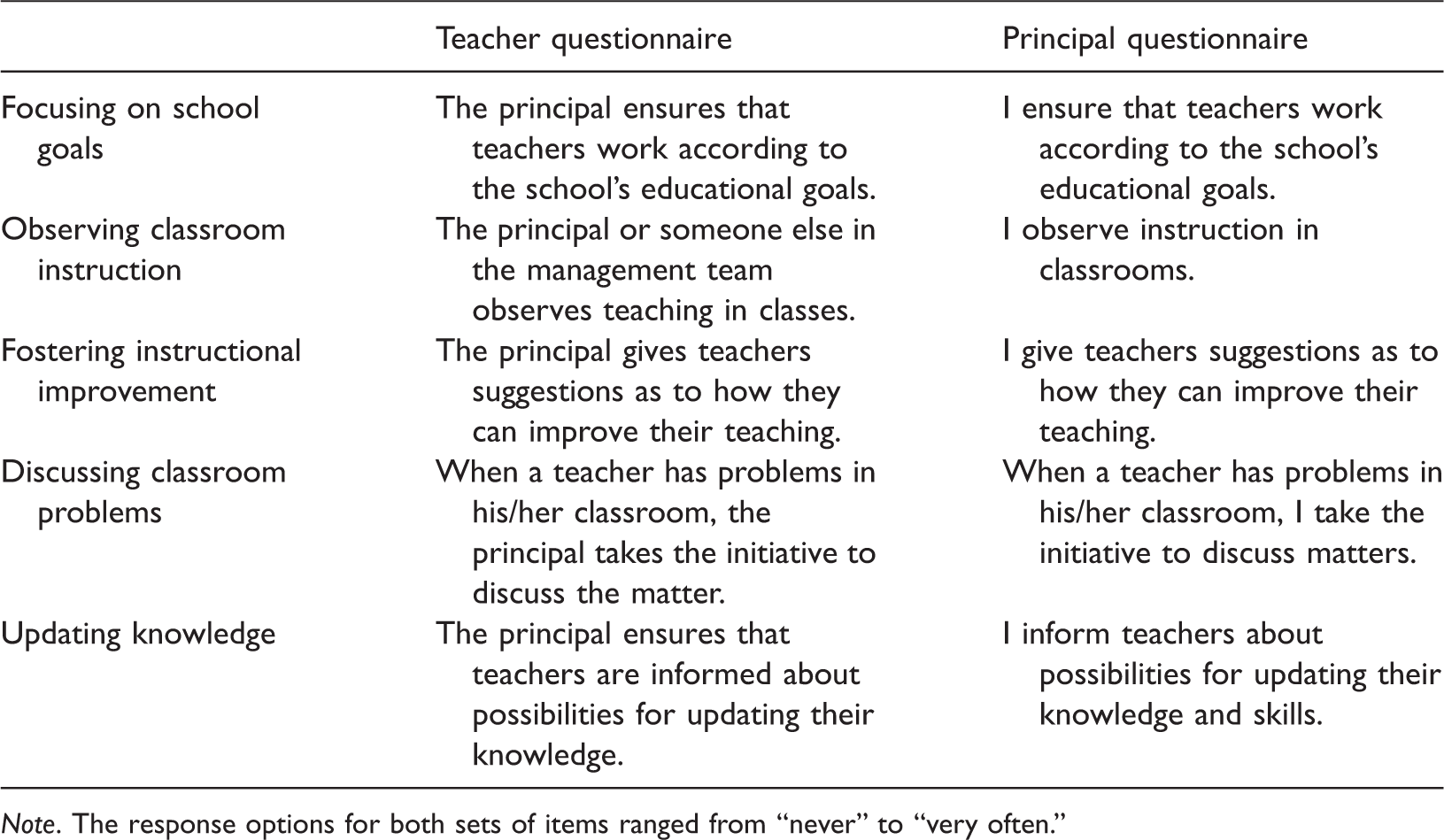
Note. The response options for both sets of items ranged from “never” to “very often.”
More specifically, these two leadership variables, from which INCONGRU ij was derived, were constructed as follows:
The first variable, LEADPRIN j , captured the degree to which the principal of a given school believes herself/himself to be an instructional leader. The principal’s self-perception of how frequently she/he undertook the following activities was used to create the variable: “I ensure that teachers work according to the school’s educational goals,” “I observe instruction in classrooms,” “I give teachers suggestions as to how they can improve their teaching,” “When a teacher has problems in his/her classroom, I take the initiative to discuss matters,” and “I inform teachers about possibilities for updating their knowledge and skills.” The variable ranged from zero (=I “never” do any of these things) to three (=I do all of these things “very often”).
The other variable, LEADTCHR ij , reflected the extent to which a teacher perceived her/his school principal as an instructional leader. A teacher’s perception of how frequently the following activities took place in her/his school was used to create the variable: “The principal ensures that teachers work according to the school’s educational goals,” “The principal or someone else in the management team observes teaching in classes,” “The principal gives teachers suggestions as to how they can improve their teaching,” “When a teacher has problems in his/her classroom, the principal takes the initiative to discuss the matter,” and “The principal ensures that teachers are informed about possibilities for updating their knowledge and skills.” This variable ranged from zero (=these activities “never” happen in this school) to three (=all of these activities “very often” happen in this school).
Additional predictors of interest: Ratings by principals and teachers
As shown above, INCONGRU ij captured the absolute magnitude of rating disagreement between principal j and teacher ij . Absent from this measure was the information about who gave a higher rating when incongruence occurred. To include this information in the model, a dummy variable was constructed. This variable was coded one if LEADPRIN j minus LEADTCHR ij was a negative value, and coded zero otherwise. When this dichotomous variable, which we call the teacher’s appraisal dummy (TCHRAPPR ij ) in this study, equals one, this indicates that teacher ij gave a higher rating than principal j estimated, suggesting that the principal received a more positive appraisal than she/he expected concerning her/his own leadership performance; that is, in Yammarino and Atwater’s (1997) words, the principal “underestimated” her/his leadership performance. Further, LEADPRIN j was added to the model because the principal’s self-rating of her/his leadership performance in a given school might be a significant predictor of the self-efficacy of teachers in the school. While INCONGRU ij measures principal–teacher incongruence, both LEADPRIN j and TCHRAPPR ij capture ratings by the principal and the teacher, respectively, allowing for a more multifaceted and interactive perspective in regard to the effect of rating (dis)agreements on the level of teachers’ self-efficacy beliefs.
Other teacher and school context variables
The model included the following contextual variables that have been shown to be important in educational settings and which might also affect teacher self-efficacy.
Three teacher-level context variables were included. Graduate degree (GRADEDU): a dichotomous variable indicating whether a teacher has a graduate degree (coded one) or not (coded zero). Teacher experience (TCHREXP): the length of a teacher’s experience as a school teacher, ranging from one (=less than one year) to seven (=more than 20 years). Female teacher (FEMTCHR): a dichotomous variable indicating whether a teacher is female (coded one) or male (coded zero).
Unweighted descriptive statistics for variables.
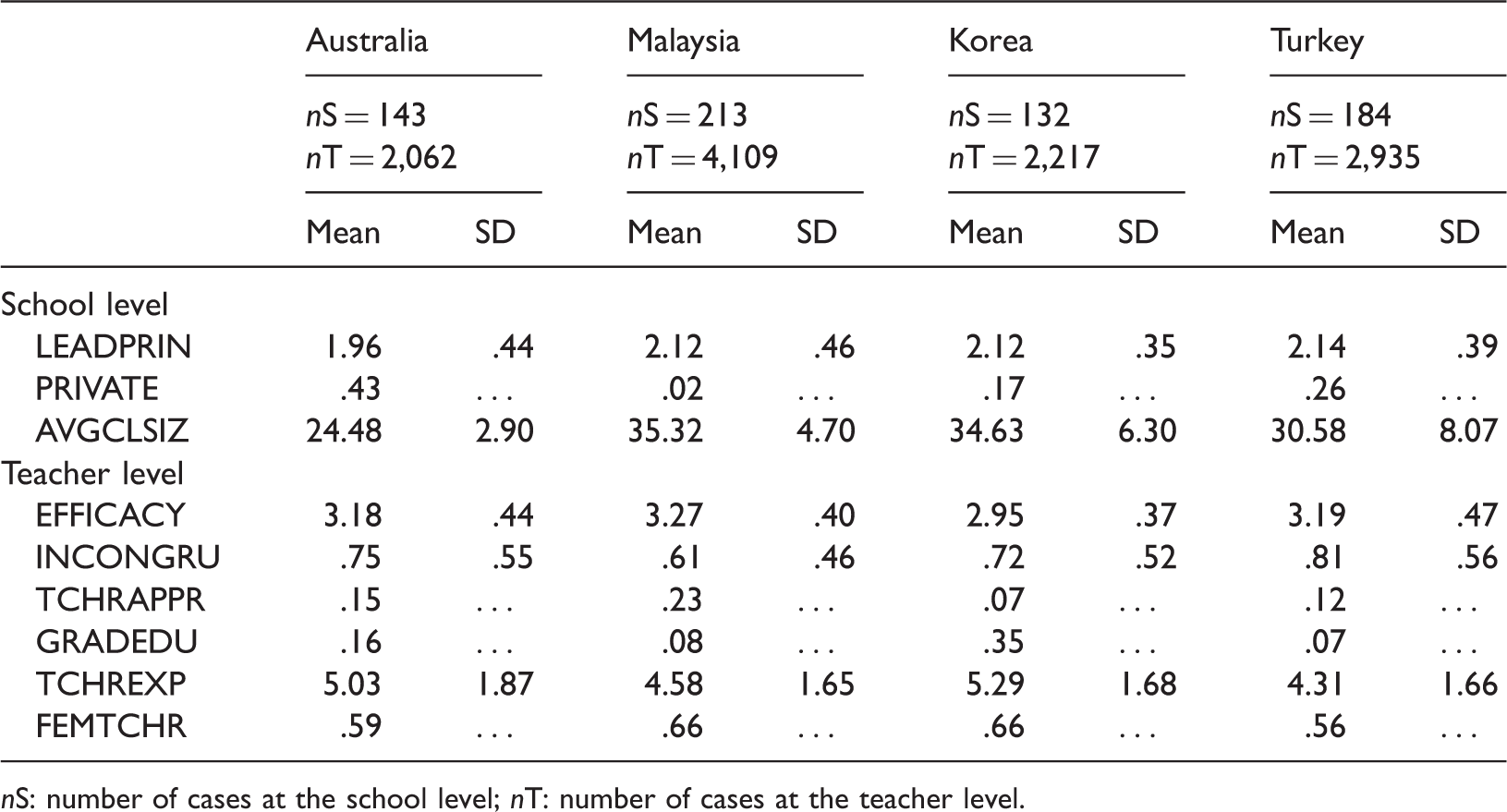
nS: number of cases at the school level; nT: number of cases at the teacher level.
Model
Hierarchical linear modeling was used in this study, and both teacher-level and school-level variables were simultaneously considered to predict teacher self-efficacy. Considering the hierarchical structure of the data with teachers clustered within schools, using a multilevel modeling strategy is an effective analytic approach whereby differential variance between schools is taken into account to yield improved estimates of regression coefficients and standard errors. Specifically, our model was specified as follows:
At level 1, for the ith teacher in the jth school,

At level 2, the intercept, β0
j
, was specified as follows:

The slopes in the level-1 equation were treated as fixed. Thus, the slopes were specified as follows:

Results
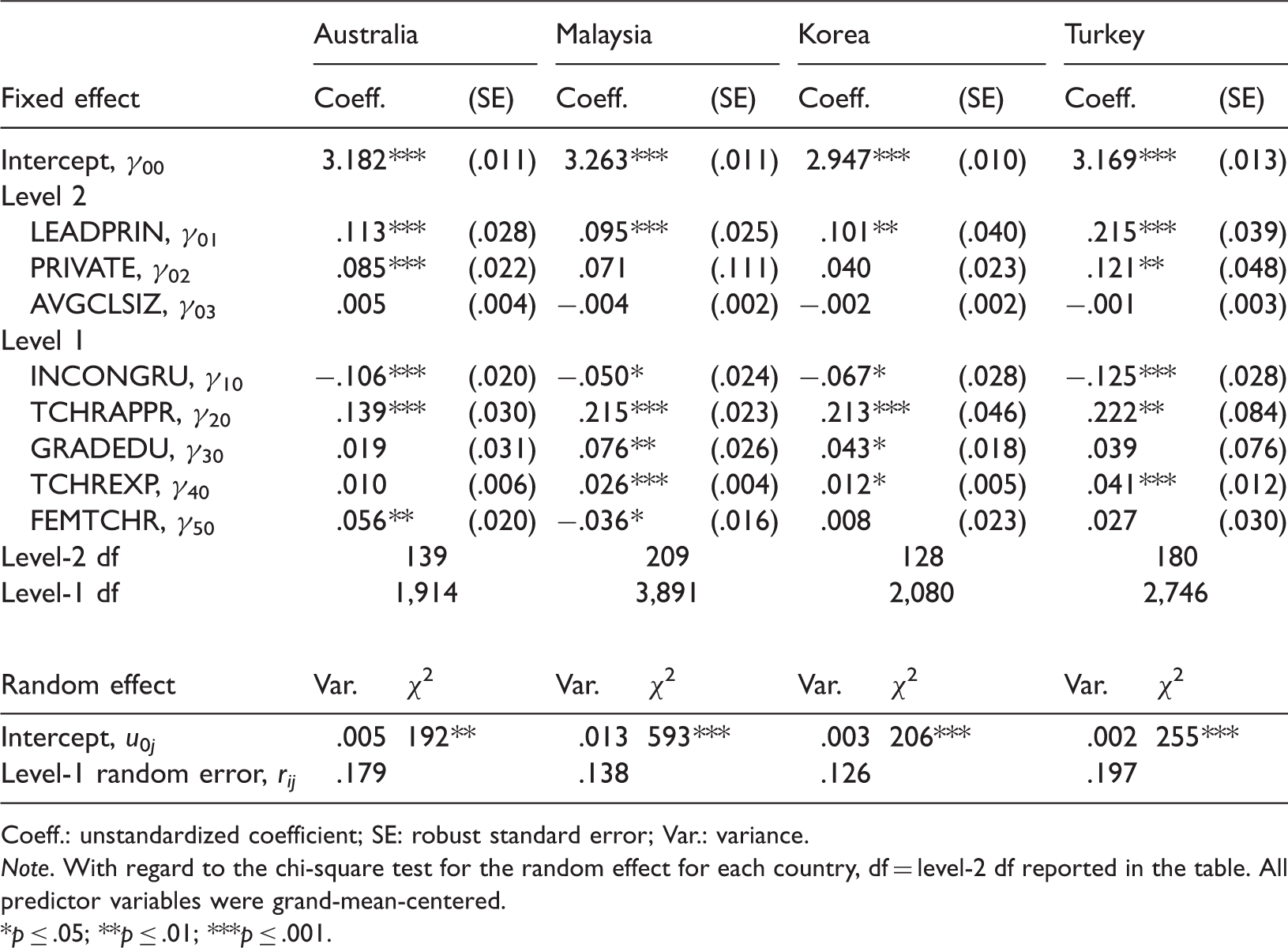
Hierarchical linear model for teacher self-efficacy: The effect of principal–teacher perceptual incongruence regarding principal instructional leadership.
Coeff.: unstandardized coefficient; SE: robust standard error; Var.: variance.
Note. With regard to the chi-square test for the random effect for each country, df = level-2 df reported in the table. All predictor variables were grand-mean-centered.
p ≤ .05; **p ≤ .01; ***p ≤ .001.
This finding should be interpreted within the context of our analytic model, in which two other important variables were simultaneously taken into account as additional predictors, namely principal-reported instructional leadership and teachers’ appraisals of principal instructional leadership. The effects of these two variables were both strongly positive in all four countries.
Specifically, the effect of principal-reported instructional leadership was significant at the p ≤ .001 level in Australia (γ01 = .113), Malaysia (γ01 = .095) and Turkey (γ01 = .215), and at the p ≤ .01 level in South Korea (γ01 = .101). These results supported H2, which stated that principals’ positive self-appraisal of their instructional leadership performance positively affects teacher self-efficacy, with the degree of principal–teacher rating incongruence held constant. Also, the effect of teacher’s appraisal on teacher self-efficacy was significant at the p ≤ .001 level in Australia (γ20 = .139), Malaysia (γ20 = .215) and South Korea (γ20 = .213), as well as at the p ≤ .01 level in Turkey (γ20 = .222). This evidence supported H3, which stated that teachers’ positive appraisal of their principals’ instructional leadership performance has a positive effect on teacher self-efficacy, with the degree of principal–teacher rating incongruence held constant.
These results indicate that while perceptual congruence is important because it is conducive to teacher self-efficacy, by itself it cannot account for differences in teacher self-efficacy. Also of importance is the extent to which the principal’s leadership performance is perceived to be effective by both the principal herself/himself (i.e. self) and the teachers (i.e. others) alike, as substantiated by the positive effects of LEADPRIN j and TCHRAPPR ij , respectively.
This finding supports what Yammarino and Atwater (1997) called the “in-agreement good” type of relationship between leaders and followers. However, considering that reaching a perfect perceptual congruence rarely occurs in practice (Braddy, Gooty, Fleenor, & Yammarino, 2014), it would be good for the principal to lean toward being an “under-estimator” rather than “over-estimator” of her/his leadership performance. Recall the positive effect of TCHRAPPR ij in all four countries, which suggests that the principal who receives a more positive appraisal from teachers than his/her own—or who is rather moderate (rather than exorbitantly confident) about her/his leadership performance—tends to create conditions conducive to increasing teachers’ self-efficacy.
The effects of the contextual variables included in the model were quite inconsistent across the four countries, which sharply contrasts with the consistent effects of the leadership-related variables examined above. Specifically, the effect of teachers having a graduate degree was significantly positive in Malaysia (γ30 = .076, p ≤ .01) and South Korea (γ30 = .043, p ≤ .05) but not in Australia and Turkey. The effect of teacher experience on teacher efficacy was not significant in Australia, whereas a significantly positive effect emerged in Malaysia (γ40 = .026, p ≤ .001), South Korea (γ40 = .012, p ≤ .05) and Turkey (γ40 = .041, p ≤ .001). Female teachers were likely to report a greater level of efficacy than male teachers in Australia (γ50 = .056, p ≤ .01), but the reverse pattern was observed in Malaysia (γ50 = −.036, p ≤ .05). Teachers in private schools reported significantly higher teacher self-efficacy in Australia (γ02 = .085, p ≤ .001) and Turkey (γ02 = .121, p ≤ .01) but not in Malaysia and South Korea. Finally, class size was not significantly linked to teacher self-efficacy in any of the four countries.
These results suggest that despite cross-national differences in the effects of various contextual factors on teacher self-efficacy, the effects of the leadership variables in this study based on a self-other agreement framework were quite consistent cross-nationally.
Discussion
Contemporary approaches to instructional leadership have paid increased attention on conceptualizing instructional leadership as a team process carried out by collaborating teachers and principals rather than as a task carried out solely by principals (DiPaola & Hoy, 2014; Fullan, 1991). This understanding calls for an active and collaborative form of leadership in which principals work effectively with teachers to shape the school as a healthy and productive workplace. The multi-source assessment methodology employed in the present study aligns with this understanding of instructional leadership. Thus, the study examined whether or not the simultaneous inclusion of self (i.e. principal) and other (i.e. teacher) ratings of principal instructional leadership has an effect on teacher self-efficacy, with a special emphasis given to the exploration of the effects of agreement and discrepancy between the teachers and their principal’s assessments of the principal’s leadership performance.
The findings of this study suggest that a divergence of principals’ self-assessments of their instructional leadership from teachers’ perceptions is likely to affect negatively teacher self-efficacy. Teacher efficacy appears to be nurtured and sustained more successfully in schools where teachers perceive their principals as effective instructional leaders and the principals were also confident accordingly. These results support previous findings (Atwater & Yammarino, 1992; Devos et al., 2013; Moshavi et al., 2003; Yammarino & Atwater, 1997).
The findings of the current study suggest that the analysis of the congruence of self-other perceptions provides unique performance-relevant information that would not be captured by traditional single-source ratings alone. This approach to assessing principal performance might contribute to an understanding of where principals’ leadership practices could be improved to enhance teachers’ work attitudes such as teacher self-efficacy. By focusing on specific “gaps” in self-other ratings, principals would be informed of the areas or behaviors that would contribute to their effectiveness as instructional leaders. 3
Further, this study sheds light on the need to focus on principal–teacher perceptual congruence as an important aspect of school capacity. For instance, an increased level of effective principal–teacher interaction and the resultant consolidation of relational trust at the organizational level may improve the identification and resolution between principals and teachers of perceptual disagreement, thereby augmenting organizational capacity in building a better school community (Bryk & Schneider, 2002; Park & Ham, 2014; Reitzug, 1997).
Future research might examine the effects of self-other (dis)agreements on a range of teacher-level and school-level effectiveness measures since teacher efficacy—the focus of the current study—might be just one of many variables influenced by the congruence or otherwise of self-other ratings. Finally, it would be important to identify school contextual conditions that can help both principals and teachers not only to recognize better self-other disagreements but also to manage and/or reduce them effectively. In addition, while the four countries included in the analysis were selected to be culturally and linguistically heterogeneous, conclusions as to whether the results reported here are emic—that is culture-specific—or etic—that is universal—would be clearer if more countries were included in the analyses.
Thus, whereas differences emerged between countries regarding the effects of contextual variables such teaching experience, graduate study and teacher gender on teacher self-efficacy, results provided evidence of the validity of the self-other agreement concept across the four countries. Moreover, self-other agreement was found to have a significant effect on teacher self-efficacy across the school settings in these four countries. The absence of a student performance measure from the TALIS data set prevented the examination of the link between teacher efficacy and student outcomes. Still, the findings reported here—together with previous findings regarding the indirect link between school leadership and student outcomes through teachers and other contextual conditions—emphasize the importance of increasing the congruence of perceptions of leadership performance between principals and the teachers in their schools when seeking to improve leadership effectiveness.
Footnotes
Declaration of conflicting interests
The author(s) declared no potential conflicts of interest with respect to the research, authorship, and/or publication of this article.
Funding
The author(s) disclosed receipt of the following financial support for the research, authorship, and/or publication of this article: Work on this paper by the first author was supported by a National Research Foundation of Korea grant funded by the Korean government (NRF-2014S1A3A2044609).