




Abstract
Despite an increasing international trend towards integrating linguistics into the mainstream English curriculum, many teachers struggle to find exciting and relevant ways to cover this material with their students. In this article, we describe how nicknames collected as part of a research study of Australian secondary students can be used as a pedagogical resource for Year 9 students. We argue that the linguistic analysis of nicknaming provides an ideal opportunity for teachers to introduce linguistic concepts to a teenage audience that is age appropriate, relevant and meaningful. Based on a survey of 642 Australian high school students, we present some common features of nicknames and provide suggestions for how teachers could use this as a platform for exploring language issues with their students. We also show how the study of the forms and functions of nicknames fits into the Australian national curriculum for English at the junior secondary school level.
Keywords
Introduction
In the US, UK and Australia, English curricula require teachers to attend to developing their students’ knowledge about language. Typically, these curricula include a focus on the mechanics of language such as spelling and punctuation, but they also explore genre conventions and the ways in which language use varies due to the register and social purpose of a text (Denham & Lobeck, 2007; /http://australiancurriculum.edu.au); Hudson, 2010. Whilst a ‘growing acceptance of the need for knowledge about language to be an integral part of the school curriculum’ can be observed internationally (Mulder, 2007, p. 133), teachers who have little or no training in linguistic analysis may have difficulty in engaging more deeply with this aspect of the curriculum. In some respects, those who come from a literature-oriented background may feel somewhat de-skilled by a curriculum that requires the inclusion of linguistic approaches into teaching alongside traditional literary analysis (Hudson, 2010, p. 43). Students are also often overwhelmed by and uninterested in the analysis of language use as they do not see its connection with their daily lives. This article shows how nicknaming can be used as a forum for exploring language structure and use in interesting, age appropriate, meaningful and creative ways that students are likely to both learn from and enjoy.
As educational linguists, our study of nicknames was motivated by a desire to investigate identity labelling as a sociolinguistic phenomenon and explore its pedagogical potential. In this article, we provide specific examples of how insights from this work can be used to enable teachers to explore language structure and use with their students. We show how the study of nicknaming aligns with the Australian National English curriculum and we demonstrate the ways in which such a unit of study can link to core skills taught under the language strand of the Australian National English curriculum. Whilst the topic and the findings of our study could be addressed by teachers of all year levels, they lend themselves particularly well to the content descriptions for Year 9. Finally, we also provide suggestions as to how teachers might develop materials and activities to elicit nicknaming data from their students and engage them in linguistic analysis.
Locating unit on nicknaming in the Australian National curriculum
English study in the F-10
1
years is governed by the Australian National Curriculum, which includes a specific language – in the sense of language analysis – strand, alongside the more traditional strands of literature and literacy. The overall curriculum rationale sees the study of English as enabling students to ‘learn to analyse, understand, communicate with and build relationships with others and with the world around them’ (http://www.australiancurriculum.edu.au/english/Rationale), with the language components focussing on ‘knowledge of the English language and how it works’ (http://www.australiancurriculum.edu.au/english/language). This focus is achieved through five sub-strands, four of which apply at all year levels with the last being restricted to Foundation and Year 1:
Language variation and change. Language for interaction. Text structure and organisation. Expressing and developing ideas. Sound and letter knowledge.
As is evident in these sub-strands, the Australian Curriculum requires not just the teaching about language mechanics but also about language change across time (i.e. diachronic change) and about variation between speakers (i.e. synchronic change). Such topics may be a particular challenge for teachers with little or no prior knowledge in linguistics and limited resources upon which they can draw. 2 At the Year 9 level, many aspects of the content descriptors in the language strand lend themselves particularly well to an investigation of nicknaming and, for this reason, we would recommend that interested teachers locate a nicknaming unit at that level. However, it is also important to note that the cumulative and recursive nature of the curriculum (http://www.australiancurriculum.edu.au/english/content-structure) means that the suggestions described in this article may also work well as part of units taught at higher or lower year levels.
Nicknaming
Whilst we acknowledge that the notion of adolescence is not universally given (e.g. ‘Universal Adolescent’; Omoniyi, 2006; Thurlow, 2005) but a social construction, the teenage years are still a time when questions of self and personal identity assume tremendous importance (Erikson, 1968; Marcia, 1980). The integration of nicknames into the curriculum enables students to draw on their knowledge and interest in self at a time when young people are highly sensitised to social and gender roles (de Klerk & Bosch, 1996) and one of the ways in which this may be manifested is in particular forms and styles of speech (Eckert, 2000). Nicknames are frequently developed and acquired in the teenage years (Crozier & Skliopidou, 2002), where regular, close and intense contact between school students provides fertile ground for nickname formation. As Morgan, O’Neill and Harré (1979, p. 15) observe in their landmark study, nicknaming systems have their origins in small groups and play an important part in these groups’ social organisation. Schools are settings where such small groups form, establish power relationships and negotiate social norms. It is therefore not surprising that much of the research on nicknaming has focussed on what happens in schools.
As the research literature attests, nicknames are a complex social phenomenon. Morgan et al. (1979) argue that nicknames bestowed on young people by colleagues, playmates, friends and family typically represent how others see them. As a result, the authors conclude that, particularly for adolescents, ‘managing a nickname is one of the most fateful of social skills’ (p. 5).
Nicknames act as an index of youth culture since they display many of the features typically associated with youth language, such as puns and other wordplay, references to culture, in-jokes, rapid and high rates of turnover, nonstandard spelling and other forms of informal or nonstandard speech. It is also of note that the points of difference between nicknames, banter and name-calling are difficult to identify (Lines, 2008), especially since attitudes towards such forms of behaviour are often transient and changeable. As Lines remarks, at one moment, a name may be considered a form of social solidarity and at another moment, an insult (p. 98).
Nicknaming has long been of interest to linguistics and there is a rich literature dealing with nicknaming typologies (Chevalier, 2004; de Klerk & Bosch, 1996, 1997; Phillips, 1990). Nicknames have been investigated in a wide variety of linguistic and cultural contexts (see Taylor-Leech, Starks, & Willoughby, 2012 for an overview). Some studies have tracked nicknames across the life span (Chevalier, 2004, 2006) and a number of studies in different cultural contexts have focussed on nicknaming in the high school years (e.g. Busse, 1983; Crozier & Dimmock, 1999; de Klerk & Bosch, 1996, 1997).
A data collection resource
In order to consider nickname usage amongst Australian adolescence, we collected classroom data from seven Australian secondary schools, four located in Queensland and three in Victoria. The schools were diverse in nature, consisting of urban and regional, private and public and coeducational and single-gender (boys) schools. The nickname data we refer to in this article are based on nicknames collected in 2011 and 2012 from the 642 students who participated in the study, and we suggest that our approach, detailed subsequently, could be effectively replicated in the classroom.
The nickname data were elicited via two questions which were printed on a single page of a written questionnaire that was distributed in class (see Appendix). The first question focussed on nicknames for others and the second on nicknames for self. In our study, concern for participant anonymity meant that we did not ask students to provide their own nicknames in the second question. However, teachers face no such constraints in classes so they could add this information into the worksheet. In the first question, students were asked to complete a table with nicknames of individuals who they knew. The table contained six rows providing a generous amount of space for students to insert up to six nicknames (see Appendix). For each nickname, the students were asked to add details in the adjacent columns in the table. The first of these columns asked students to explain the meaning of the chosen nickname; the second asked students to categorise each entry on the basis of one or more of the following frequently cited typological categories for nicknames: N – name, P – physical appearance, B – where born, E – emotions or O – other (for examples of such typologies, see Crozier & Skliopidou, 2002; Starks & Taylor-Leech, 2011). In the final column, students were asked to evaluate their selected nicknames of others as either positive, neutral, negative or a combination of these through three emoticons that depicted happy, neutral and unhappy smiley faces. Since nicknames may be evaluated in different ways in different situations, students were encouraged to circle one or more emoticons. The consistent manner in which this information was elicited meant that the details were easily transferrable into an EXCEL spreadsheet, enabling the data to be compared.
Nickname types
Researchers in our team personally administered the questionnaire on nicknaming to some of the students and were therefore able to observe the students’ level of engagement in the task. It was noted that almost all students reacted to the task with lively interest. The elicitation of nicknames via a table worked well for data gathering, eliciting a total of 2815 nicknames from 642 students. A class size of 30 could thus be predicted to produce a substantial collection of nicknames. Our data also showed a considerable amount of variability in the responses. Of the 2815 nicknames which were elicited, 1846 nicknames were different and, of those, 1428 (51%) appeared only once in the data set. This finding is an indication of the richness and creativity of nicknaming as a resource for the exploration of linguistic variation and change. Such data also provide an opportunity for exploring the popularity of certain nicknames. Of the 42 names that appeared more than five times in the data, 17 were found in only one school and were likely to reflect the popularity of particular students. Examples included Jobbo (20), Fridge (17) and Keno. Other names that occurred more than five times appeared in multiple school contexts and tended to be conventionalised name shortenings, such as Steph (15) and Woody (10).
Our study conformed in many ways to other typologies of nicknames that have been found in different cultural contexts (see, e.g. Crozier, 2002; Crozier & Dimmock, 1999; de Klerk & Bosch, 1996, 1997). The majority of nicknames (unique and otherwise) in our data were name based, comprising 61% of the data set with more than half of these being surnames.
Other nicknames in our study tended to relate to the holder’s physical characteristics, such as his or her weight, height or hair colour, personal habits or traits and aptitude, or lack thereof. Common nicknames in our corpus referred to physical traits, such as Ranga (a person with red hair) (31 instances), Fatty (6) and Fuzzy (6). In their South African study, de Klerk and Bosch (1997) also noted the prevalence of nicknames based on physical traits, but without mentioning an extensive use of nicknames for hair colour. This was particularly surprising as Ranga was the most commonly cited nickname in our study.
Place traits were less frequent in our data, accounting for 4% of our data. There was the occasional reference to a more specific location (e.g. Adelaiden), but many place traits included references to broader concepts such as country of origin (e.g. Yank, Turk) and ethnicity (e.g. Wog). Personal traits (listed as E – emotion in our study) were surprisingly infrequent (2%) and referred to various personality or physical characteristics; examples included Bubbles (happy), Cookie (sweet/kind), Groover (clumsy/always falling over) and Deep Thought (thoughtful). Nicknames were also formed from combinations of traits. The most frequent combination was a physical trait plus something else (2%); for example, Little Red (small with red hair), Blackie (referring to a physical trait and the place they were from), Care Bear (a physical trait plus a personal trait) and Collywobbles (a name plus a physical trait). The category O– other covered a wide range of diverse nickname types including gamer names, variations on celebrity names and others that fitted no particular pattern and were therefore difficult to classify (see Taylor-Leech, Starks, &Willoughby, 2012 for details).
These recurrent categories suggested that any group of students would contribute a similar range of nicknames to any class discussion and therefore represented useful analytical categories. They also provided a way in which teachers could begin to explore and categorise nicknames with their students and compare their own usage and experiences with ours and other published findings, as part of the writing modes embedded in the curriculum.
Linking nicknames to the Year 9 curriculum
In the content structure of the Year 9 English curriculum in Australia, 11 anticipated learning outcomes are mentioned in the scope and sequence of expectations for the language strand: one under the sub-strand language variation and change, two under language for interaction, three under text structure and organisation and five under expressing and developing ideas (http://www.australiancurriculum.edu.au/english/content-structure). As we show subsequently, nicknames fit seamlessly into all areas under two of the sub-strands, namely language variation and change and language for interaction, and they address two of the five sub-strands under expressing and developing ideas. As nicknames relate to the use of individual words, they are not relevant to the text structure and organisation sub-strand, but nicknames could easily be used to engage students with survey work and reports.
Language variation and change
In the content descriptions for the Year 9 language strand, the aim of the first sub-strand language variation and change is to understand Standard Australian English as a living language. Students are to be exposed to the ‘living nature of Australian English within which the creation and loss of words and the evolution of usage is ongoing’ (http://www.australiancurriculum.edu.au/english/curriculum/f-10?layout=3#page=9). The exemplars provided include changes in English grammar such as ‘thee/thou’ to ‘you’ and examples of global English. Nicknames are an integral part of Australian English, as the names, places and some of the physical attributes (e.g. red hair) are associated with Australia and its people. As students often have many nicknames over their lifetime (Crozier & Skliopidou, 2002), nicknames provide examples of rapid language change and give students the opportunity to explore how nonstandard language is particularly susceptible to change.
As de Klerk and Bosch (1996) note in their study of South African nicknames, some nicknames are relatively new, whilst others have been used for some time. As part of understanding language change, students could be asked to research the history of their nicknames and the extent to which they are used. To provide an Australian example, Bluey – thought to be a classic example of the contradictory, perverse characteristics of Australian nicknames – was once a very common name for someone with red hair and has been recorded as being in use since at least 1906 (Dalzell & Victor, 2008; Davies, 1977) but in our data, Ranga was the more preferred form. Similarly, the habit of forming nicknames with ironic meanings (e.g. Fatty for someone who is skinny) was rare in our data and may indicate that this practice is dying out. Other nicknames may have a much shorter life span due to a specific event – to give an example from our corpus, a student who bears a passing resemblance to a celebrity may briefly acquire that nickname (e.g. Susan Boyle) whilst the celebrity remains in the spotlight.
Further instances from our study provide the opportunity for teachers to explore language variation through the conventionalisation of nicknames. Those nicknames that have been common amongst English speakers for a long time often have conventionalised shortenings (e.g. Ben, Chris). Students can be asked to reflect on what might happen to names that do not have such conventionalised forms at present (e.g. Jackson, Madison). Teachers can also show that shortenings for names may repurpose what is a conventionalised shortening of another name (e.g. Annie for Rhiannon, Charlie for Charlotte) and show how new short forms may be created from old patterns (e.g. Maddie for Madison). Australian nicknaming conventions are also increasingly being adapted to fit non-Anglo names with the increasingly multicultural nature of Australian society. Such nicknames may entail fairly basic shortening (such as Papa for Papapavlou) or more complex phonological adjustment – potentially also involving wordplay – to give forms such as Zucchini from Zukic.
Language for interaction
In the first learning outcome in the language for interaction sub-strand, students explore how ‘roles and relationships are developed and challenged through language and interpersonal skills’ (http://www.australiancurriculum.edu.au/Year9#subject=E). The exemplar provided invites consideration of the communities students belong to and how language reinforces membership of these communities. Discussion under this sub-strand could start from the observation that we have often different nicknames that are used in different contexts (home, school, sports team, etc – cf. de Klerk & Bosch, 1996). In our study, many of the students wrote that they had more than one nickname, as in the following response. I have a few. They refer to my name, where I am from, and my emotions. I feel fine with all of them. No hard feelings ☺.
Students may be able to identify different origins for names in these contexts; for example, in our study some nicknames were the result of a mispronunciation of a sibling’s name in childhood – for example, Bobo and Bubba instead of ‘baby’ – or they related to a particular incident as in the case of the nickname Fireman Sam, acquired after the eponymous Sam set himself alight in a campfire on school camp. Students could also consider the different social connotations behind names of different forms – for example, one student in our study called Hugo was nicknamed Hugsy-Wugsy. One might ask students whether this would be an appropriate nickname for Hugo to use at football training or would he be better-off using Hughie, and why? This could also lead on to a discussion of the difference between pet names (used between intimates) and nicknames for wider social use.
Nicknames also encode a level of familiarity in their use. For example, it is relatively rare for teachers to have nicknames that students are allowed to use to their face 3 (but Swainers was one in our data, for Ms Swain). Teachers, in turn, may use shortened names to address students, but rarely other forms (here a class could reflect on the appropriateness of a teacher addressing a student as Christafart – or similar forms from the class’ own data). Another potential topic of discussion is the acceptance of the nickname. For some people, their nickname is only acceptable when it is used by a few close friends, whereas others are known almost universally by a nickname (e.g. in our data Jebbo was listed 20 times as a nickname amongst his classmates).
The form a nickname takes can also be related to social roles and life stages. In our study, nicknames based on first name shortenings were more common amongst students in Years 7/8 than in the senior high school years (11/12), where surnames and other traits often motivated nickname formation. Phillips (1990) has argued that surname-based nicknames are especially common amongst males. This was partly confirmed in our study where we also found them to be frequent at a boarding school for boys and a former school for boys – which has been coeducational for several decades. 4 However, we also found them commonly used for girls, suggesting that this habit is more widespread in Australia than has been found in studies elsewhere (cf. de Klerk & Bosch, 1996). In a classroom context, students could reflect on the ways in which age, gender and other social relationships influence the forms nicknames take and whether any fashions for forming nicknames are evident within the school community, such as the frequent use of initial-based nicknames in one of the classes that participated in our study.
The Year 9 language for interaction sub-strand has a second learning outcome, which asks students to investigate how evaluation can be expressed directly and indirectly in language (http://www.australiancurriculum.edu.au/english/curriculum/f-10?layout=3#page=9). Whilst the exemplar suggests discussing this in terms of evaluative language in persuasive texts such as advertisements or editorials, we show that nicknames themselves can have a strong element of appraisal.
In terms of how students evaluate their nicknames, most students in our survey considered nicknaming to be a positive or, at least, an acceptable social practice. Sixty-five percent of nicknames were evaluated as always positive, 23% as always or sometimes neutral and only 7% as always or sometimes negative. 5 This finding is similar to a study by Busse (1983) of American nicknaming practices, which noted that only 5% of boys and 15% of girls disliked their nickname. Whether a name is regarded as positive or negative cannot simply be discerned from its form alone. To give examples from our corpus, the apparently derogatory nicknames Bitch, Fungus, Smelly, Scabs, Mooch, Jew, Turk, Wog and Curry Muncher all received entirely positive evaluations, whilst, surprisingly and for no obvious reason, Buddy, Fifi, Keeno, Kezza, Kitty and Penny were all evaluated negatively. As de Klerk and Bosch (1997, p. 117) note, it is important to look beyond the superficial meaning of the nickname to the attitudes of the name givers and holders themselves. Students could thus productively explore in class reasons for liking or disliking the nicknames that they have been given.
In our study, as the examples in Figure 1 show, students’ evaluations of their own nicknames varied considerably (note that students' comments are unedited).
Examples of students’ evaluations of their own nicknames.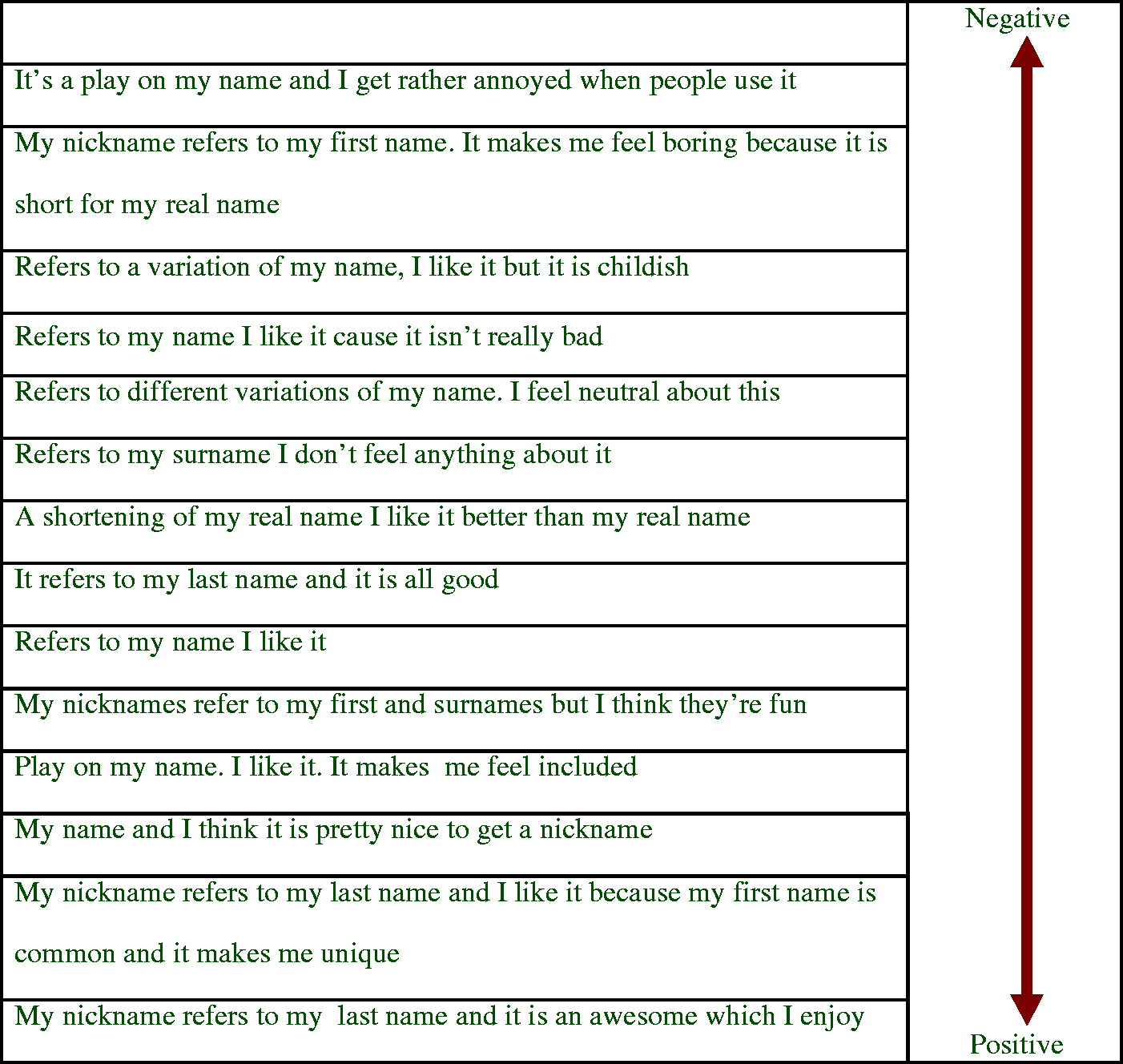
Following from this, students could consider whether particular types of nicknames are more likely to be viewed negatively than others. For example, in our corpus, the only nicknames for which there was a clearly negative evaluation were those referring to excess weight (e.g. Ham, Snowball and Fatty). Observations such as these could be used to spark a discussion on the boundary between nicknaming and name calling or other inappropriate naming practices. Students could also consider the way affection is encoded in nicknames, for example in names that highlight an individual’s vivacious personality (e.g. Bubbles, Chuckles) or sporting prowess (Victory).
Expressing and developing ideas
The third language sub-strand for which the topic of nicknames is useful is expressing and developing ideas. The learning outcomes focus on identifying how vocabulary choices contribute to specificity, abstraction and stylistic effectiveness. In the elaboration of this strand, examples include comparing and contrasting vocabulary choices in informative and narrative texts, considering how vocabulary is used to create precise information, abstract ideas and/or stylistic interpretations of texts, and identifying examples of acronyms, abbreviations and proprietary words which are used creatively in texts (http://www.australiancurriculum.edu.au/Elements/ACELA1561).
The meaning of names and nicknames is, in many respects, central to stylistic interpretation. Both nicknames and full names refer to the same person, but they are seldom interpreted as identical in meaning. Nicknames have an added advantage for the study of stylistic effectiveness, as they often take multiple forms. In our study, we recorded the nicknames, Bar Bar, Bar Bar Black Sheep, Bar Bar Blind Sheep, all from the surname Burr. This type of variation can be used to introduce complex chains of language-play and its various forms and show the desirability of innovation for both creativity and intimacy (everyone calls you X but only I call you Y).
Nickname formation in our study often contained sound-play such as rhymes formed by partial reduplication (e.g. Wacko Zacko, Anna Banana, Chubby Bubby, Claire Bear and Cooper Trooper). Such use is also reported in de Klerk and Bosch’s (1999) South African study. This type of information can usefully feed into discussing the appropriateness of other vocabulary in short stories, poems and the like. We also see other elements of wordplay such as blends (e.g. Grumpastair, or first–last name blends such as Mellis), puns (e.g. Woody for surname Jarrah) and in rare instances, potential back-formations 6 (e.g. G-reg).
Nicknames are also particularly useful for the discussion of acronyms and other shortening processes. Most of the nicknames based on initials in our data created initialisms such as CJ or KT, but a few resulted in pronounceable words, such as SAB, and one was extended to give AK47. We also saw plays on initial-based nicknames of famous people, such as K Rudd. 7 Students might reflect on the various processes at work that help form nicknames based around a person’s initial. There is also real potential to look at the way spelling conventions dictate how names – especially short forms – are written, an aspect which we explore under the next subheading.
A second theme in the language sub-strand expressing and developing ideas is the understanding of how spelling is used creatively in texts to achieve particular effects; for example as devices to show characterisation and humour and to represent accents and styles of speech. Both de Klerk and Bosch (1996) and Wierzbicka (1992) have noted that speakers often modify conventionalised nicknames with suffixes such as –ie and –s to create a form that better expresses solidarity between the speaker and the addressee. Nicknames, particularly those that are name based, often end in the conventional suffixes –i,/–y/–ie, and –s/z, which occurred in 31% of all the nicknames we collected, as illustrated in these examples:
–i/y/ie Dutchy, Kafufi, Moonie, Fitzy, Whitey 665 24%
–s/z Jules, Deeds, Hollz, Lawz 198 7%
These forms lend themselves to a discussion of spelling conventions, because, although the choice of one spelling over another may at first seem arbitrary, for the –i/y/ie alternation, both de Klerk and Bosch (1996, p. 529) and Wierzbicka (1992, p. 228) have concluded that the spelling of the suffix is affected by the gender of the name holder with –ie/–i used frequently for female names but only –y for male names. Interestingly though, this pattern did not hold true in our data where –y was overwhelmingly the most popular form (used in 75% of names with this suffix) and it was particularly dominant when the nickname was derived from a surname (87% of cases). As these are highly productive suffixes for nicknames, students could explore the competing influence of gender and nickname origin in determining how these forms are written. Such discussion might also include the desire to be unique, which seems to have at least partially motivated other spellings such as Dic and Anni found in our corpus, but it also provides avenues for exploration of other curriculum sub-strands, such as language variation and language for interaction.
Another good example is the orthographic representation of the –s/–z suffix. Both forms occurred in our data with single syllable nicknames (e.g. Jules, Hollz); however the –z form was almost never used with names of two syllables or longer in our study. The –s suffix was thus the unmarked form for longer names with this suffix (e.g. Jarvies) as well as the more common spelling more generally (55% of –s/z). As well as helping students understand patterning in language, observations such as these could reinforce the concept of the syllable and lead to discussion about the shortening processes applied to names of varied length.
Finally, under this strand, students might explore the issue of incipient standardisation in the spelling of nicknames. Many of the nicknames in our data had multiple spellings, for example of Ranga, Wranga, Wranger and Ranger, showing that it may take time for a neologism to settle on a preferred spelling. Where students spell names differently, they could also discuss the different orthographic conventions they drew upon in devising their representation, and the class could debate for example, which is the better spelling – Char char and CharChar (or indeed a third alternative).
Discussion and conclusion
Since nicknaming is highly creative and often emerges out of predictable word-formation processes, we suggest that it offers an ideal topic for linguistic analysis with secondary students. The linguistic as well as the sociolinguistic aspects of nicknames, i.e. how they are formed, on what they are based and why some nicknames stick with a person better than others, allow students to connect developing linguistic knowledge with language use in a way that is highly meaningful and relevant to their everyday lives.
Taking a bird’s eye view of our research, we believe it could be easily replicated by teachers in schools, and the study of nicknames could also be used in other ways, none of which run the risk of distraction from curriculum priorities since the study of nicknames can fit easily into the English curriculum. Even working at a basic level of analysis, the use of metalanguage and critical skills with which to analyse spoken text can be fostered through this type of project.
All three of the authors of this article noted the enthusiasm with which our participants in different schools responded to the questionnaire, often taking a considerable length of time to complete it and holding animated discussions of nicknames and their meaning amongst their social groups. This enthusiasm leads us to suggest that by engaging with students in data collecting, discussing and analysing a vibrant, everyday adolescent verbal behaviour such as nicknaming, teachers can invest in their students’ understanding of both structural features of language and social aspects of language variation. As many studies have shown (in particular, de Klerk & Bosch, 1997; Phillips, 1990), nicknames vary according to who uses them and for what purpose, providing teachers with the opportunity to introduce a key concept in linguistic and sociolinguistic analysis. An additional pedagogical benefit of analysing nicknaming as a social practice is that it presents the opportunity to discuss the relationship between name-calling and nicknaming and bring matters of social inclusion and exclusion to students’ attention.
In closing, the study of nicknaming provides a forum for exploring language structure and use, offering educators a rich potential resource for the teaching of language forms and structures in the senior secondary classroom. Our aims in this article have been twofold. We have attempted to apply a pedagogical dimension to the findings from our nicknames study and we have suggested a topic that may offer those teachers with limited confidence in linguistic analysis a springboard for language study with adolescent students. We trust that our article provides the necessary overview of nicknames as a form of linguistic creativity to enable educators to better understand these processes in their own contexts and to incorporate elements of these insights into their pedagogical repertoire.
Footnotes
Acknowledgements
We would like to thank the Victorian Department of Education and Early Childhood Development (reference no. 2010_000611) and Education Queensland (reference no. 550/27/948), the principals, the teachers and the students for their contributions to the study. We would also like to express our sincere appreciation to Catherine Cook for help with the data entry.
Funding
We would like to thank La Trobe University for their Faculty Start-Up grant for the initial funding of this project.
Conflict of interests
None declared.