



Abstract
In Australia, the teaching of pronunciation is embedded in the curriculum of a national adult migrant English program offering English as an additional language (EAL) tuition to newly arrived migrants. Students in the program who have had limited opportunities to develop print literacy in English or their first languages are offered tuition in pre-level EAL classes. Teachers of these students lack access to relevant training or research on oral skills pedagogies but are expected to integrate pronunciation teaching into their lessons. This article examines pre-level teachers’ pronunciation teaching practices in the Australian adult EAL context. The study introduced teachers to a practitioner research approach of professional learning through a series of exploratory practice (EP) focus group sessions. Using the lens of the theory of practice architectures, this article describes how teachers engaged in the EP process of puzzling to foster a praxis orientation towards the teaching of EAL pronunciation with preliterate adults. Findings revealed that the practices of puzzling facilitated the development of teachers’ understandings and enabled practices of pronunciation teaching to be tailored to their local teaching context. The puzzling process, initiated by the researcher in the first session, was taken up by teachers in subsequent sessions and fostered a praxis-oriented approach to learning viewed as important by teachers. The study has implications for pronunciation teaching research as it puts forward an innovative, practice architectures theoretical framing of EP and offers new insights into pronunciation teacher learning in the adult migrant EAL context.
Keywords
I Introduction
Pronunciation teaching is implicitly embedded in the curriculum of Australia’s adult migrant English as an additional language (EAL) program (DET, 2019), although without suggested teaching approaches and limited professional learning for teachers to support its implementation. The need for pronunciation teaching materials and teacher training contextualized to local needs of teachers and students in the program was highlighted in a large-scale survey of teachers (Burns, 2006) and associated research for several years (Burns & Joyce, 2007). However, in recent times, as pressure has increased on teachers to focus professional learning time to meet policy-driven agendas, such as assessment or curriculum compliance (Moore, 2022b; Slaughter et al., 2021), opportunities for professional learning about research-informed pedagogies to support students’ oral language and settlement needs have ‘all but disappeared’ (Tilney, 2022, p. 43) from the program.
In other areas of EAL teaching, the last 30 years have seen the development of exploratory practice (EP) (Allwright, 1997, 2003, 2005; Allwright & Hanks, 2009) as a practitioner research approach to professional learning for language teachers (Slimani-Rolls & Kiely, 2019). Of particular interest to this study, EP offers adult migrant EAL teachers opportunities to engage in reflective puzzling (Hanks, 2017) over pronunciation teaching practices. The process of engaging in puzzling and working towards a deeper understanding of these puzzles allowed teachers in this study to steer their professional learning and research focus towards the investigation of issues relevant to their students’ oral language and settlement needs and away from an institutional push towards professional learning focused on reporting and accountability processes (Slaughter et al., 2021). To date, there has been little research into the specific pronunciation teaching practices of teachers of pre-level adult EAL and little is known about the ways their teachers develop their understandings about these practices in the Australian adult migrant EAL context. This study sought to add an Australian adult migrant EAL perspective to this line of inquiry by exploring the pronunciation teaching professional learning practices of one group of teachers of pre-level adults in an EAL program.
The teacher participants in this study are teachers of adult migrant EAL students, most of whom are from refugee backgrounds, with interrupted formal schooling and low literacy in both their first language and English. The national program offers free EAL tuition to assist newly arrived migrants with settlement into Australia (AGDHA, 2022a). Students in the teachers’ classes are from Pre-level 1A and Pre-level 1B classes in such a program. In both pre-levels, 1 students’ exposure to formal English language education and alphabetic literacy is limited. In Pre-level 1A, ‘participants . . . are preliterate and . . . may have experienced trauma’, and in Pre-level 1B, ‘participants [may have] little or no formal education’ (DET, 2019, p. 72). Teaching oral skills such as pronunciation is considered a priority within the curriculum used in the national language program (Burns, 2006; Playsted & Burri, 2021; Slaughter & Choi, 2024), as English is the primary language used for spoken communication in many Australian vocational, educational and community settings. For teachers of preliterate, adult students beginning their English language learning journey in Australia, a recent shift in program goals from ‘functional English to vocational English’ (AGDHA, 2022b) has increased pressure to ‘teach to the test’ by conducting assessments that demonstrate students’ employment readiness, rather than developing their oral language learning and settlement needs (Hsieh, 2021).
As pre-level students are often from refugee backgrounds with interrupted formal schooling and low literacy in both their first language and English (Tarone et al., 2013), teachers require training in pedagogies that foreground oral approaches since the students have had limited exposure to print literacy. However, such training is lacking in postgraduate TESOL courses and EAL teacher education programs, and there are few ongoing professional learning opportunities for teachers to deepen understandings of pedagogies relevant to oral communication skills in the adult pre-level sector (Peyton & Young-Scholten, 2020). To address this gap, this study involved the implementation of a series of four EP group sessions as professional learning about pronunciation instruction in pre-level adult EAL. Hanks (2017) has described EP as ‘a process-oriented approach to exploring language learning and teaching, done by, and for, teachers and learners’, in which practitioners ‘puzzle about their own experiences of language learning and teaching’ (p. 82). Its principles (see Figure 1) prioritize the mutual development of understanding as a sustainable approach to teacher learning. In Australia, where a ‘disjuncture . . . between [teachers’] specialist knowledge and the translation of that knowledge into teaching practices’ (Slaughter et al., 2021, p. 27) exists, we posit that implementing EP as professional learning has potential to restore this disjuncture in the context of pronunciation teaching practices in pre-level adult EAL.
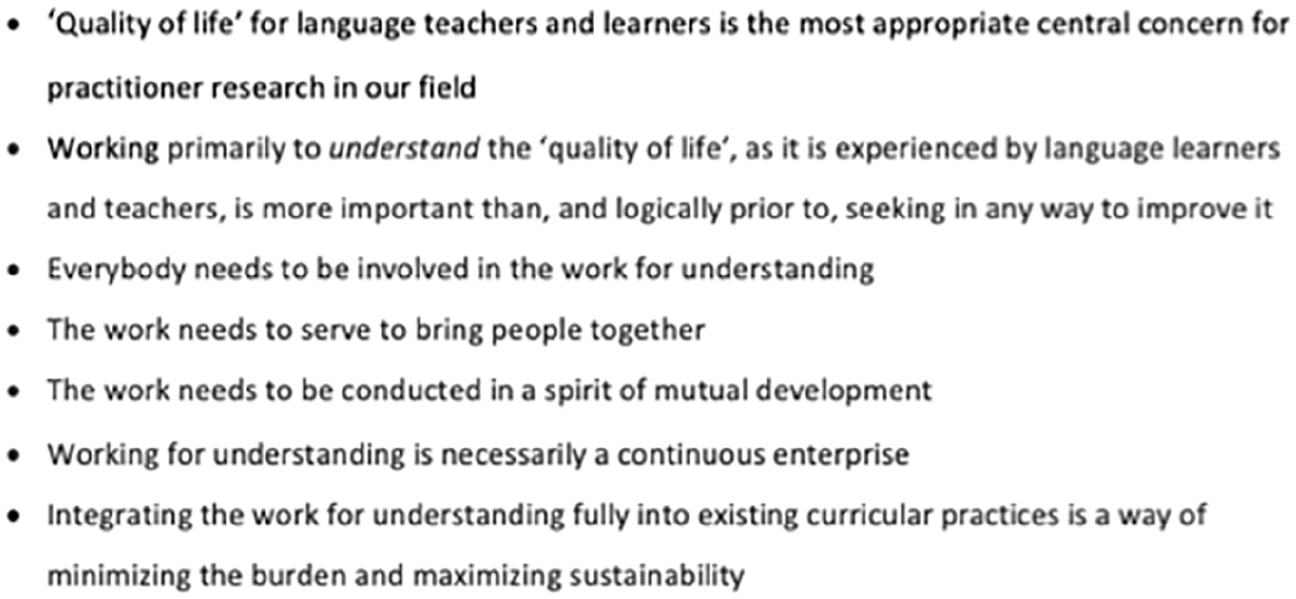
Seven principles of exploratory practice.
In this article, we first explore the nature of learning to teach pronunciation in adult EAL education. We then show how teachers’ development of understanding of practices of teaching pronunciation is constrained and enabled by the practice architectures of the national EAL program and the practices of puzzling in EP. Finally, we propose EP be integrated as a praxis-oriented approach to professional learning in pre-level adult EAL to engage teachers in the development of context-specific understandings that support their pronunciation teaching practices in these sites.
II Learning to teach pronunciation in Australian adult migrant EAL
In spoken English, pronunciation holds importance as the ‘initial layer of talk’ (Pennington & Rogerson-Revell, 2019, p. 7) that facilitates communication. It is a contested area in EAL teaching and research, as pronunciation pedagogical approaches have historically reinforced notions like the attainment of a standardized models of English accents or outdated concepts such as accent reduction (Brinton, 2022; Seargeant, 2016). Studies show that EAL teachers feel inadequately resourced to effectively integrate pronunciation into classroom practice (see, for example, Baker, 2014; Burri, 2016; Burri, Chen, & Baker, 2017; Burri et al., 2018; Couper, 2017; MacDonald, 2002). Although not explicitly assessed, the Australian program’s curriculum suggests teachers should integrate pronunciation teaching in pre-level adult EAL through ‘contextualized . . . units [of work] which focus on listening and speaking’, with a ‘goal [of achieving] intelligible pronunciation rather than “native like” proficiency’ (DET, 2019, Section 6.1).
Despite a recent policy change to remove hourly limits on access to English tuition in the national program (AGDHA, 2022b), thus, allowing students at emergent levels additional time to participate in the program, there is a persistent focus on vocational readiness and assessment at an institutional and policy level in the program (Hsieh, 2021). Teachers work within the constraints of completing mandated assessment tasks that are often not grounded in ‘needs-based pedagogy and good practice in assessing English learning’ (Moore, 2022a, p. 4). Nevertheless, teachers in the program strive to teach in ways that are informed by a ‘morally-committed and oriented’ (Kemmis, Wilkinson, et al., 2014, p. 25) approach towards the overall good of their students’ language learning and communication goals. Such goals include developing EAL literacy and confident, mutually intelligible spoken interactions to facilitate communication in a new, English-speaking environment. These goals underpin students’ motivation to learn about EAL pronunciation and teachers’ motivations to learn about teaching it (Yates, 2017).
There is limited literature on oral skills pedagogies to support teachers in integrating pronunciation teaching practices appropriate to pre-level adult EAL. Most research on pronunciation pedagogy in the TESOL field has foregrounded pedagogical approaches contextualized to advanced level students who are already literate (Levis & Echelberger, 2022; Sonsaat-Hegelheimer & McCrocklin, 2022). Echelberger et al. (2018) noted positive developments in teachers’ awareness and confidence to teach pronunciation in a US-based study with community adult education teachers. Research on teachers’ cognitions has explored the development of EAL teachers’ beliefs, knowledge across a variety of advanced level contexts (Baker, 2014; Burri, 2016; Burri, 2023; Burri, Baker, & Chen, 2017; Burri et al., 2018; Couper, 2017; Foote et al., 2011; Lazoroska & Guskaroska, 2020; Nguyen & Newton, 2021). Less research has contextualized pronunciation teaching to the current Australian migrant adult EAL context (MacDonald, 2002), in which broader social conditions underpin curriculum, teaching and learning in adult migrant education (Playsted, 2022). The current article addresses this gap as it sheds light on ways in which teachers in Australian adult migrant EAL program approach learning to teach pronunciation, and the factors that constrain and enable the development of their understandings about pronunciation teaching practices. Insights from the study have the potential to inform future pedagogical and professional learning practices in pre-level adult EAL teaching. The study is guided by the research question:
• What are teachers’ understandings of pronunciation teaching practices in the pre-level adult EAL context?
III The theory of practice architectures
The study drew on the theory of practice architectures (Kemmis & Grootenboer, 2008; Kemmis, Wilkinson, et al., 2014) as its underpinning theoretical framework. The theory brings to light the nexus between teachers’ pronunciation teaching and professional learning practices and the broader social conditions that exist in Australian adult migrant EAL education. The theory views practices of learning and teaching as ‘human activities [taking] place as elements of interconnected arrays of activities’ (Schatzki, 2018, p. 161). The ways in which these activities are arranged and shape each other make up a practice, for example, the practice of teaching EAL pronunciation. Teachers’ practices, from a practice architectures theoretical perspective, are composed of sayings, doings and relatings that ‘hang together’ in cultural-discursive, material-economic and social-political arrangements, forming the resources ‘found in or brought to the site [of the practice]’ (Kemmis, Wilkinson, et al., 2014, p. 38). The sayings, doings and relatings of a practice are happening and ‘bundled together amid existing site-based conditions and arrangements’ (Grootenboer & Edwards-Groves, 2024, p. 9) described as architectures (Kemmis & Grootenboer, 2008). The architectures of one practice (such as the practice of teaching in the national EAL program) can constrain and enable how other practices (such as the practices of teaching EAL pronunciation) unfold in a site.
In this study, assessment policies are resources brought into the site that form the social-political arrangements shaping the sayings, doings and relatings of teachers’ pronunciation teaching practices. What teachers say in relation to teaching EAL pronunciation is constrained by the social-political arrangements of a government policy that mandates completion of vocational readiness speaking tasks. Teachers use specialized language and the discourse of career guidance discussions, even if these are not relevant to a student’s expressed need or interest in learning spoken English. The policy also influences what teachers do as a pronunciation teaching activity, because their oral skills teaching activities can be constrained to learning and practising vocabulary necessary to complete specific speaking assessment tasks with their students. How teachers relate to their students in relation to teaching pronunciation is influenced by adopting a role as a deliverer of formal language assessment tasks in a vocational training program. Such system roles and lifeworld relationships are manifested in policy expectations of teachers as and the concrete realities of student lifeworlds with language goals based in personal, social or educational access goals. This study uses the theory of practice architectures (see Figure 2) to elucidate the distinctive conditions found in, and brought into, the site of pre-level adult EAL teaching.
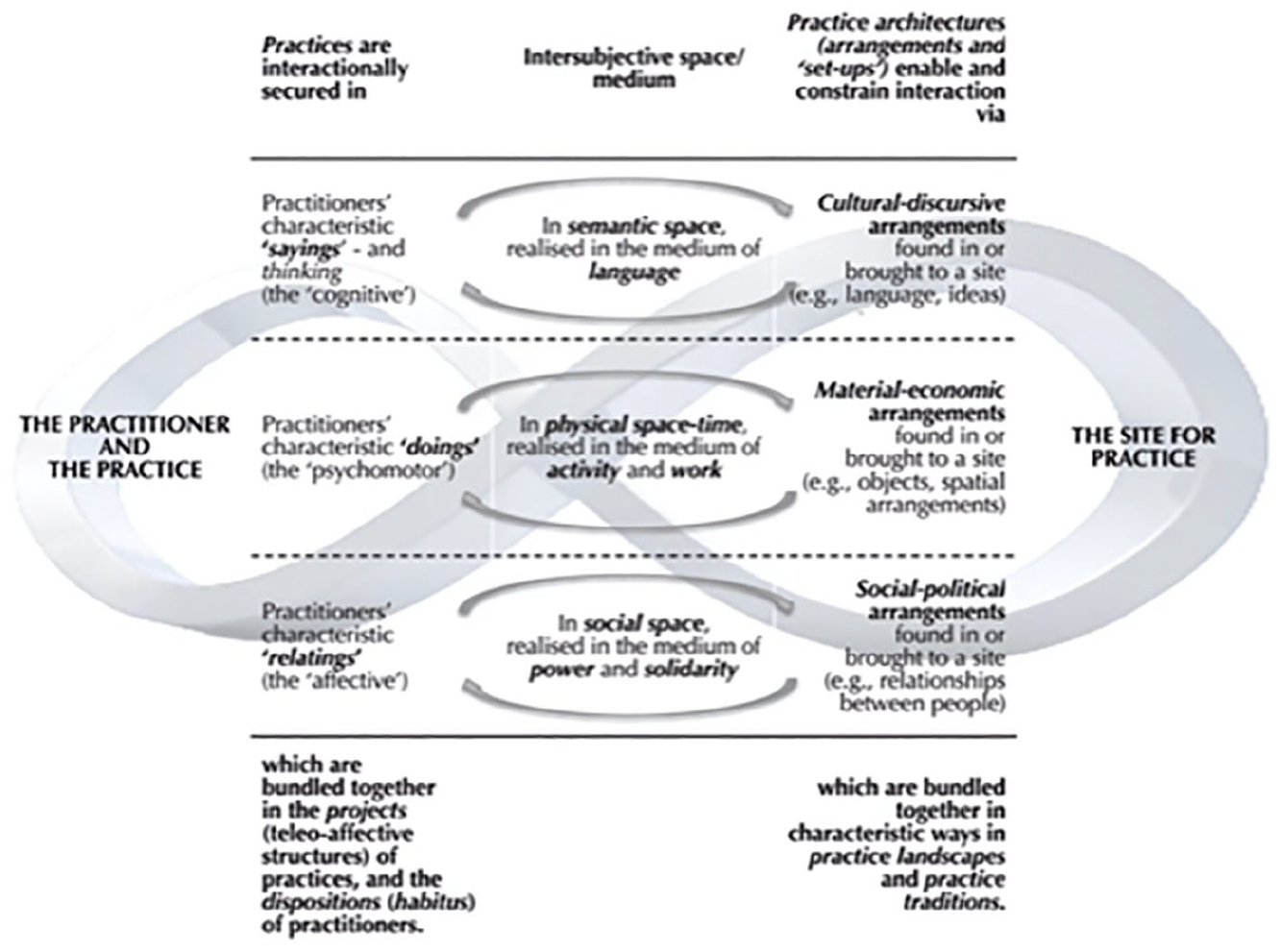
The theory of practice architectures.
1 A site-based ontological perspective
The theory of practice architectures takes a site-based ontological view of a practice, drawing on the theoretical work of Schatzki (2002). From this perspective, a site is not a ‘container-like context’ (Kemmis, Wilkinson, et al., 2014, p. 34) or only a geographical location for a practice. The site is composed of all the cultural-discursive, material-economic and social-political resources found and brought into it that make up the practice. By taking a site-based perspective, we can investigate the things that make a practice specific. A site-based ontological view can also explore how specific ‘site-based local conditions’ (Rönnerman et al., 2017, p. 9) shape, constrain and enable practices (Kemmis, Wilkinson, et al., 2014; Schatzki, 2002).
2 Practices as prefigured, but not predetermined
According to the theory of practice architectures, practices are located in a particular site and time, and external conditions may have ‘historically prefigured’ (Grootenboer & Edwards-Groves, 2024, p. 83) what happens in that practice. For example, teachers’ pronunciation teaching practices in pre-level adult EAL are prefigured by training in traditional TESOL methodologies that introduce the sayings, or linguistic discourses, of phonology and phonetic alphabets. These sayings form the cultural-discursive arrangements in which the practices of pronunciation teaching hang together. It can appear that teaching EAL in this context happens according to the TESOL training that has prefigured teachers’ practices. However, although practices are prefigured, they do not unfold according to ‘predetermined scripts’ (Kemmis, Wilkinson, et al., 2014, p. 33). For example, teachers’ pronunciation teaching practices in adult migrant EAL are prefigured by traditional TESOL pronunciation pedagogies that involve the use of phonetic alphabet charts. However, a teacher with early literacy training can introduce new sayings of literacy discourses (e.g. of sound-spelling awareness, phonics programs or theories of reading development) that in time unfold in new ways in the pre-existing spaces and practices of adult EAL pronunciation teaching. Understanding the arrangements of a site is a ‘necessary precursor’ (Williamson, 2023) to changing the practice, because the arrangements that form the architectures of the practice must change if new practices are to be enabled.
3 Praxis and a praxis-oriented teaching approach
The theoretical resources of practice architectures are used here to explore how conditions constrain and enable teachers’ praxis in their approaches to learning to teach pronunciation. Praxis is used in the neo-Aristotelian moral sense of acting with wisdom and prudence in a given situation (Ethics, VII) (Aristotle, 2003). A praxis-oriented view of teaching is ‘morally-committed’ as it aims for the ‘good of those involved’ (Kemmis, Wilkinson, et al., 2014, p. 26). A practice architectures view of individual and collective praxis is expressed as a ‘double purpose of Education: to help people live well in a world worth living in’ (Kemmis, Wilkinson, et al., 2014, p. 25). Edwards-Groves and Grootenboer (2015) noted that praxis-oriented teaching decisions are ‘about education and more than schooling’, ‘responsive to local circumstances and needs’ and ‘individual actions taken together influence . . . broader society’ (p. 159). A praxis-orientation towards pronunciation pedagogical training allows teachers to reflect on and identify untoward conditions (e.g. policy and institutional structures) that constrain their choices and decisions for teaching students in a way that responds to their expressed oral language needs. Oral language proficiency in English has been linked to positive settlement experiences for adult migrants in Australia (Blake et al., 2019). Praxis-oriented teaching approaches might involve engaging students in the choice of topics, vocabulary or individual English vowel or consonant sounds as focus areas. In this study, many students had children and grandchildren who were also learning EAL in local schools. To positively influence communities at a broader level may involve adult migrant EAL teachers learning to teach pronunciation with a focus on explicit literacy learning practices, to potentially strengthen connections with family literacy practices in their students’ homes. However, if policies dictating assessment and curriculum content constrain teachers to pre-teach vocabulary and sentence structures to prepare students for mandated, speaking assessment tasks, their praxis-oriented pedagogical choices and approaches are hindered.
4 Exploratory practice puzzling as a praxis-oriented approach to teacher learning
In the study, the EP concept of Quality of Life (QoL) can be seen as complementing the practice architectures understanding of praxis. Whereas quality in educational research often draws on ‘an instrumental, technicist understanding’ (Gieve & Miller, 2006, p. 40) of teaching and learning, QoL in the EP sense values teachers’ and students’ shared development of understanding as being of ‘greater intrinsic importance . . . than how productive or efficient classroom outcomes are by external standards’ (Gieve & Miller, 2006, p. 23). More recent literature has developed the understanding of QoL and highlighted its importance as the principle that ‘link[s] all the other principles [of EP] together’ (Hanks, 2017, p. 102). QoL is at the heart of teaching, learning and seeking to understand language classroom practices. In conceptualizing the nature of understanding in EP, Dawson (2020) also noted that QoL underpins different ‘forms and ways of knowing’ in the ongoing ‘work of understanding how to live well and act well in the classroom’ (pp. 54, 57). The position taken here is that Australian adult migrant EAL teachers’ pronunciation teaching practices are influenced by their purpose to support students’ QoL in and outside the classroom. QoL underpins teachers’ praxis-orientation towards pronunciation teaching practices in pre-level adult EAL.
A praxis-orientation to research is seen in EP’s principles that foreground a reflective, collaborative approach to teacher learning. Similar to views expressed by participants in Benson et al.’s (2018) narrative study, as the authors reflected on their involvement in collaborative professional development projects, EP afforded ‘just enough structure for sustained and meaningful reflection on practice’ (p. 16). Such a level of informal, collaborative and reflective professional learning is noted in recent literature as lacking in the current Australian adult migrant EAL environment (Moore, 2022b; Oliver et al., 2017; Slaughter et al., 2021; Tilney, 2022). In Australia, where there is a ‘disjuncture . . . between [teachers’] specialist knowledge and the translation of that knowledge into teaching practices’ (Slaughter et al., 2021, p. 17), EP has the potential to restore teachers’ expert knowledge to this under-researched area of language teaching (Neokleous et al., 2020). There has been a push in Australia for teachers to demonstrate quality through measurable outcomes of students’ progress on mandatory assessment tasks (Moore, 2022a). Rather than focus on demonstrating evidence of improved classroom practice (Groundwater-Smith & Mockler, 2007) through assessment outcomes, teachers’ commitment to praxis in this study could be seen in their commitment to invest classroom teaching time to focus on pronunciation in EAL (even though it is not formally assessed).
Praxis also underpins EP’s QoL approach to professional learning that establishes the process of puzzling (Hanks, 2017, 2019) – collaborative, reflective questioning over practices – as an essential practice in practitioner research. Puzzling allowed teachers to find time to ask why before they try out a new how (Allwright, 2015). As Banegas and Consoli (2020) have noted, puzzling is important in practitioner research, because ‘sometimes planning and acting [in action research projects] may start rather too early, [with] more time needed to identify and understand the issue(s) at hand’ (p. 182).
IV The study
Data reported on in this study were gathered during four EP focus group sessions with five teachers of pre-level adult EAL in an urban Australian teaching context named Hopeville College. 2 Hopeville College is located in a mid-low socioeconomic area in a Queensland city in Australia with a culturally and linguistically diverse population. In the five classes of the teachers participating in the study, teachers reported over 27 first languages represented among their student cohorts. Students ages ranged from 17–70+ years, with varied educational backgrounds and are required to attend classes on a part-time or full-time basis (according to their initial placement requirements in the program). Hopeville differs from many institutions where the national EAL program is offered because it only provides English language tuition, whereas most other institutions in Queensland deliver the program alongside certificate courses in vocational training (for example, many students who complete EAL training will go on to study at the same institution to complete qualifications in areas such as hospitality, aged care or childcare). Most students at the time of the study were from refugee backgrounds; however, in the national program, a rolling enrolment process means that class demographic information changes regularly.
1 Participants
Following university ethical approval (The University of Queensland Ethics Approval Number 2021/HE002299), purposeful sampling (Merriam & Tisdell, 2015) of pre-level EAL teachers was conducted in consultation with managers of teachers delivering the national EAL program. An introductory email was sent to an EAL program manager known to the lead researcher, who then approached teachers of pre-level classes in their regional campuses to offer opportunities for project participation. Four teachers (with the pseudonyms of Mika, Amy, April, and Julia) volunteered to participate across two campuses delivering the program, but one teacher was unable to continue in the study. Sarah, who heard about the study when she transferred to teach at Hopeville from a different campus, joined the study later, but only participated in some of the EP group sessions and an individual interview. Appendix A provides an overview of participating teachers’ backgrounds. The study reflects views expressed by the teachers and not their students.
2 Process
The EP group sessions were part of a larger study to understand the practices of teacher learning about pronunciation pedagogies. Data in the study were gathered across six months in three phases of research (see Appendix B). The study’s design was theoretically informed by the theory of practice architectures and the principles of EP. To examine practices, the architectures in which they exist and unfold and the ways in which these are experienced, research using the theory is based on ‘observations of actual practice as it unfolds in real-time, the artefacts which inform and arise from the practice, and participant’s accounts of practice’ (Grootenboer & Edwards-Groves, 2024, p. 48). Observational field notes recorded before and after the EP group sessions were maintained in a research journal throughout the duration of the study. EP’s methodological resources guided the design of the professional learning sessions, classroom observations and participant interviews (see, for example, Dikilitaş & Hanks, 2018; Slimani-Rolls & Kiely, 2019). Themes for each of the four EP Group sessions were adapted from phases described by Miller and Cunha (2017) regarding an EP professional learning course conducted with language teachers in Brazil (see Figure 3). The format of the first session followed an adapted structure deployed in introductory phases of professional development courses using an EP approach (see, for example, Dikilitaş & Hanks, 2018).

Exploratory practice (EP) focus group sessions.
First, the participating teachers were introduced by Playsted, the lead researcher, to the principles of EP and the theory of practice architectures that underpinned the research. They were then introduced to the notion of puzzling and invited to consider what puzzled them about issues they had encountered in their classrooms. The teachers’ ‘accounts of practices’ (Grootenboer & Edwards-Groves, 2024, p. 83) are expressed as what they puzzled over in relation to what they say, do and how they relate to each other and to the researcher in the EP group sessions. The lead researcher’s role in the study was to mentor teachers in the application of EP as a way of researching their classroom practices. EP often includes learners as co-researchers with teachers in a project, and puzzling can emerge within a class setting, with students and teachers collaboratively developing puzzles around a particular focus (Hanks, 2015; Kato & Hanks, 2022). A researcher may also be involved in the process of puzzling with teachers undertaking EP as professional learning (Lyra et al., 2003), and Hanks (2015) describes her dual role as a teaching colleague and researcher who mentored the puzzling process with teachers and students in an EAP course. She then captured the ways in which participants in her study ‘made sense of EP’ (p. 613) as they integrated puzzling practices into their classroom activities.
a Exploratory practice focus group sessions
In the first focus group session, the researcher introduced the practice architectures theoretical concept of praxis and its stance on education as serving a double purpose of ‘preparing students to live well in a world worth living in’ (Kemmis, Wilkinson, et al., 2014, p. v). Teachers engaged in theorizing and problematizing the field of adult migrant EAL education before being introduced to the notion of puzzling (Hanks, 2017) to better understand the practices of teaching pronunciation in the site of pre-level adult EAL. We explored examples of why questions accounted in reports of other EP professional learning workshops and courses (see, for example, Dikilitaş & Hanks, 2018; Lyra et al., 2003; Miller et al., 2021). The teachers were then invited to consider the question: ‘What puzzles you about teaching pronunciation in the program in which you teach?’
Prior to the second focus group, participating teachers and the lead researcher monitored what was going on (Miller & Cunha, 2017) in their pronunciation teaching practice. To facilitate this process, the researcher drew on research journal entries maintained before, during and after each EP group session, fields notes from an initial classroom observation of each teacher and interview data (see Appendix B). Teachers were emailed before and after the second EP group session to confirm their areas of pedagogical interest, drawing on resources available to them in the college’s small library. Teachers came to the second EP group session with mental and written records (Miller & Cunha, 2017) of puzzles relevant to pronunciation teaching practices and ideas about activities they might adapt. These topics informed our discussion and planning for the next phase of the research.
The third focus group involved additional planning around working to understand teachers’ pronunciation teaching puzzles. In this session, teachers were introduced to the EP term of Potentially Exploitable Pedagogical Activities (PEPAs) and discussed how they might integrate a pronunciation focus into classroom activities that were part of their existing teaching practices. The concept underpinning PEPAs in EP is to make use of ‘what is normally done in classrooms’ (Hanks, 2019, p. 9), such as routine classroom activities or professional tasks a teacher engages in, to integrate practice and research. The purpose of a PEPA is to better understand a puzzling issue encountered in practices. For example, preservice teachers in a study conducted by Miller et al. (2015) were puzzled by some students’ use of disrespectful nicknames when talking with others in the classroom. To better understand the issue, the preservice teachers adapted an English grammar activity about names of family members to explore different cultural understandings of naming (including the use of nicknames). Through the adaptation of the grammar activity, students engaged in reflective activities about naming and some developed new, respectful practices of naming in relation to their peers. PEPAs have been used effectively in EP studies to facilitate investigation of puzzles that participants have set themselves. For example, Banister’s (2023) EP study with his students involved reframing a familiar discussion activity to develop understandings of the vocabulary choices students made in peer-learning activities. This enabled students to contribute their perspectives and inform decision-making processes for future classroom activities. In the current study, we discussed possible ways to integrate a pronunciation focus in existing classroom activities to potentially minimize the burden of teaching pronunciation as an isolated skill.
The final focus group involved discussion and reflections about the six-month research process. In this session, teachers described their engagement in the collaborative work for understanding (Allwright & Hanks, 2009) about teaching pronunciation in the site. In this session, we discussed teachers’ needs to meet as a group for ongoing discussions about pedagogical practices and pronunciation-specific resources for their classes they would like to create or have access to, if they had time in the future.
3 Ethical dilemmas of researching professional learning practices with EP
Researching teachers’ practices for a doctoral study while mentoring them in the practices of researching their own practices was challenging. Ethical research is based on principles of beneficence towards those participating in the project (AARE, 1993). We felt a sense of responsibility towards teachers who had given up their time to learn about new teaching practices. From initial questionnaire responses at the beginning of the study about teachers’ motivations for participation, we knew they were keen to learn about new pronunciation teaching doings – teaching tips and resources – from the lead researcher as an incoming pronunciation teaching ‘expert’. We found, similar to Lyra et al.’s (2003) findings when establishing EP projects with teachers in Brazil, that introducing new practices of EP puzzling in the first session was initially unsettling for teachers with expectations of ‘finding solutions for their classroom problems’ (p. 152). This was expressed in teachers’ sayings about developing puzzles about pronunciation teaching practices:
So, it’s more questions rather than observations?
Can you give an example?
Yeah, I’m struggling with this.
Yeah, me too.
The lead researcher also grappled with reflexive puzzles about relatings between a researcher and research participants. She noted in her research journal, ‘In this project, I am always balancing “how does this answer the [doctoral study’s] research questions?” with “what does this actually give teachers to take with them into their practice?” ’. The phase of puzzling, as Miller and Cunha (2017) explained to teachers engaging in EP puzzling as professional learning, can be one in which there may be ‘questions which interest us but to which we may have no answers’ (p. 64). Maintaining a research journal and regular discussions as a research team helped to deal with the ‘messiness and discomfort’ (Boyle et al., 2023, p. 7) of practitioner research. The researcher was becoming part of the practices of teachers’ professional learning and her reflexivity was a necessary part of the work for understanding taking place.
4 Data gathering
The practice sites examined here are four one-hour long EP group sessions conducted with the participating teachers. The first three sessions were held in a computer skills classroom at the end of the teaching day. The final session was held in the College’s small library. Sessions took place approximately two weeks apart over the duration of data gathering and were scheduled in negotiation with the teachers to suit their available times for meeting together. The focus of each session was discussed in emails sent to each teacher a week prior to the session and at the beginning of each session. Near the end of each session, teachers and the researcher discussed preparation towards the next session. Each EP focus group session was audio recorded and transcribed using transcription software. Transcripts were emailed to participants for member checking and the final transcripts saved into NVivo 12. The researcher maintained reflexive journaling and observational field notes in a Word document before, during and after each session.
5 Data analysis
Following Grootenboer and Edwards-Groves (2024), Rönnerman et al. (2017) and Williamson (2023), analysis drew on a hybrid approach of deductive thematic analysis (Braun & Clarke, 2022; Fereday & Muir-Cochrane, 2006) After data were gathered and transcribed, transcripts, reflexive journal entries and field notes of the four sessions were organized into NVivo file folders labeled as theoretical, analytical and transformational phases. Parent nodes of the three phases were established in coding folders and child nodes as sayings, doings and relatings of pronunciation teaching puzzling practices were established, using practice architectures dimensions as a ‘preliminary organizing framework’ (Grootenboer & Edwards-Groves, 2024, p. 71). As analysis proceeded, new points of interest and questions were interpreted from the data, code labels were developed inductively and added as sub-nodes within sayings, doings and relatings nodes.
a Coding sayings, doings and relatings puzzles
To assist with identifying teachers’ puzzles about EAL pronunciation teaching practices as sayings, doings and relatings, we referred to initial coding schemes and themes developed in previous research on teachers’ understandings of these elements (Baker, 2014; Burns, 2006; Burri, 2016; Burri & Baker, 2021; Couper, 2017, 2021; Macdonald, 2002). For example, the construct of intelligibility was coded under teachers’ sayings related to puzzles about pronunciation teaching because teachers puzzled over how to define a student’s English speech as intelligible. A doings puzzle was coded as teaching sound and spelling because teachers puzzled over the ways in which resources for literacy teaching were integrated into their pronunciation teaching practices. Nativeness was established as a relatings puzzle because Mika puzzled about the legitimacy of her accent and non-native speaker status in relation to modelling an accent of English pronunciation to her students.
b Coding cultural-discursive, material-economic and social-political arrangements
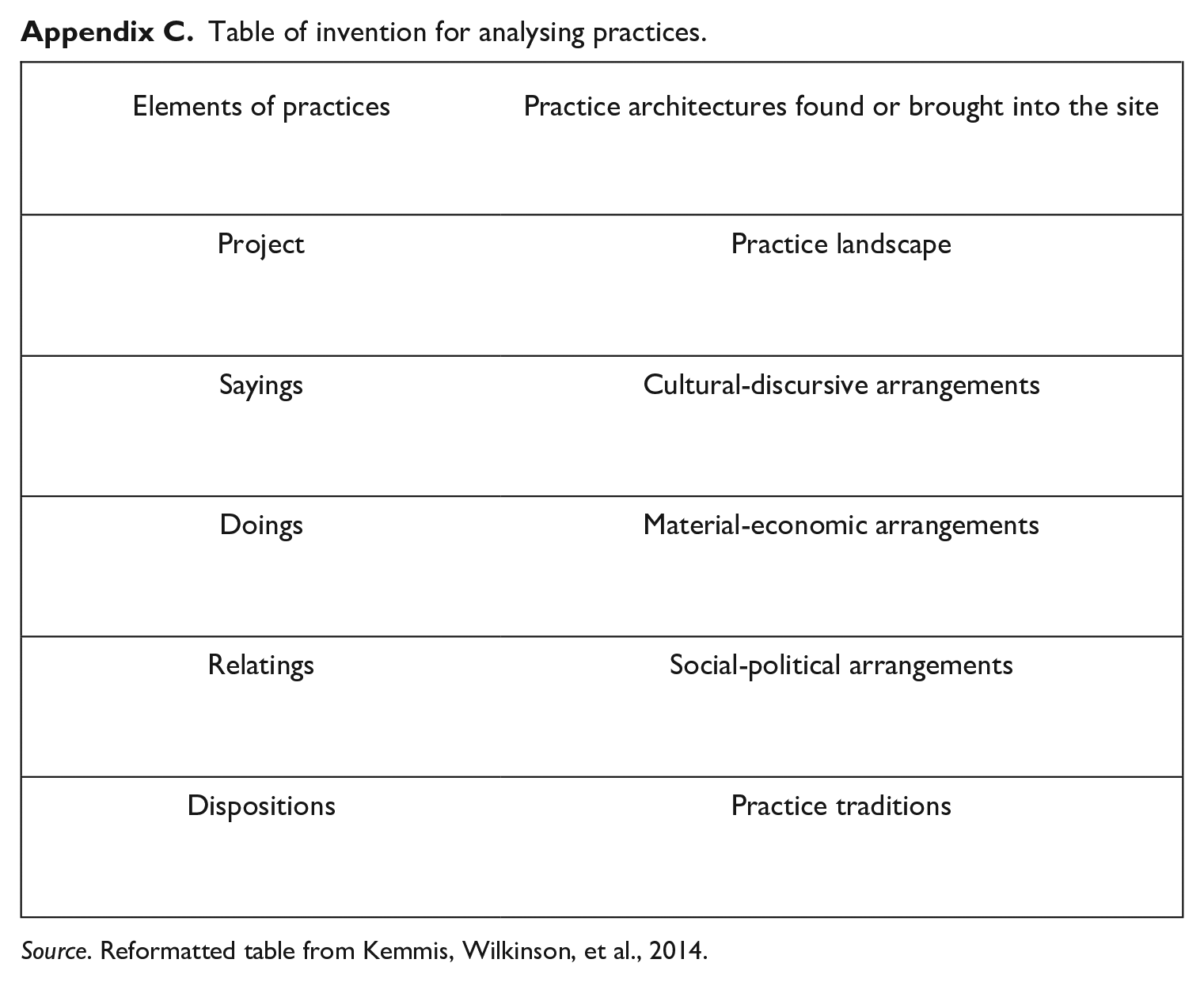
Analytical frameworks have been used in EP studies (Hanks, 2021; Kato, 2024) to analyse relationships between participants’ puzzling processes and the development of their understandings of practices. Following Williamson (2023), Kemmis, Wilkinson, et al.’s (2014) table of invention (see Appendix C) was used as an analytical framework to assist with the ‘organization, categorization and understanding’ (Williamson, 2023, p. 504) of data. The table can be used as a prompt to ‘help us think about relationships across the columns and between the rows’ (Kemmis, Wilkinson, et al., 2014, p. 227) and see how practices unfold in particular sites through time. The table of invention cells provided a guide to see and interpret connections and interdependent relationships (Kemmis, Wilkinson, et al., 2014) between participants’ puzzling practices and architectures.
Child nodes of cultural-discursive, material-economic and social-political arrangements were established in NVivo parent node folders in each of the three research phases to assist in identifying arrangements interpreted in the transcriptions of the four EP focus group sessions. To identify material-economic arrangements in which teachers’ puzzling practices unfolded during the course of the study, research field notes made before, during and after each EP session were referred to, as well as participants’ accounts during the EP group sessions. Analyses and sample questions used in the table of invention from previous analyses of practices (Kemmis, McTaggart, Nixon, 2014, pp. 153–154; Kemmis, Wilkinson, et al., 2014, pp. 233–235) guided the identification of arrangements. Preliminary nodes of the EAL program, TESOL, EP as Professional learning and B-EAL (beginner EAL) were established as cultural-discursive and social-political arrangements prefiguring and shaping how the practices of teachers’ puzzling about pronunciation teaching unfolded. The seven principles of EP were established as a priori code labels of arrangements of the practices of EP as professional learning. For example, during the first EP session, April’s comment ‘I don’t think any of us would be here, if all we were doing was ticking boxes’ was coded as relatings of Access to pronunciation pedagogical PL and then coded as the cultural-discursive arrangement of Quality of Life EP as professional learning. The discourse of teacher professional learning prefigured April’s sayings about what was involved in a professional learning session (as a mandatory box to tick for compliance to institutional requirements), but the arrangement of QoL was brought into the site of the College, potentially shaping future professional learning practices for these teachers.
c Searching for themes that connected practices and arrangements
To answer the study’s research question, the table of invention was employed to support the generation of themes related to teachers’ puzzling across the four EP group sessions. This enabled the connection of sayings, doings and relatings to cultural-discursive, material-economic and social-political arrangements (Rönnerman et al., 2017, p. 10). To define themes connecting EP practices of puzzling to the architectures in which these were situated, the lead researcher searched for connections between arrangements and practices across the four EP group sessions that suggested what enabled and constrained teachers’ puzzling practices. For example, from the first EP session’s data, Amy’s puzzling about constraints on her doings of pronunciation teaching practices (time is a physical resource), such as, ‘we have to spend more time teaching them about how to get a job than the [English language oral] skills that they need to get the job’, was considered next to Mika’s sayings from the second session related to teachers’ priorities for professional learning about pronunciation teaching as learning to be about practices that could ‘help [students] with something real, something that they would come outside this building and use. Like, you know, making up very simple questions so that they could actually ask a question when needed’. Social-political arrangements of government policies constrained teachers’ pronunciation teaching doings of time spent in class teaching oral skills for a vocational-training focused assessment task. As teachers continued to puzzle together in the EP sessions, cultural-discursive arrangements of EP’s QoL focus enabled doings of pronunciation pedagogical puzzling practices. In time, such puzzling practices have the potential to shape teachers’ practices as they learn about new doings and sayings of pronunciation teaching practices that might support their students’ oral needs at a social and community level.
Although distinctions are made between practices and architectures for the purpose of analysis in this study, the reality is that there is always an ‘interplay between enablements and constraints’ (Grootenboer & Edwards-Groves, 2024, p. 82). For example, during one session, malfunctioning IT equipment in the shared space of the computer classroom in which we had our EP sessions constrained the researcher’s doings of projecting PowerPoint slides on an interactive whiteboard as she had planned. Physically rearranging seating so teachers and the researcher were around one table without a focus on a PowerPoint presentation changed the doings and sayings of a researcher conducting a professional learning session to a more collegial discussion around a shared table. While the material-economic arrangements of IT equipment could be seen as constraining the research practices, these arrangements could also be seen as enabling a shift in power relations or relatings between the researcher as a pronunciation teaching expert to teachers as passive recipients of information being presented. As we searched for themes that helped to understand what teachers think, say, do and how they relate to others, we were also searching for links to conditions and arrangements that made these practices possible. By examining these connections, we sought to see how existing practices were held together, the conditions in which they were situated and the kinds of changes to these existing conditions that have the potential to ‘sustain new ways of working’ (Kemmis, 2022, p. 20).
V Findings and discussion
In this section, we describe the findings from the EP group sessions and discuss the significance of these findings in relation to research on second language (L2) pronunciation teacher education practices, teacher pronunciation pedagogical training/learning practices and research on teachers’ cognitions, as expressed in their practices of puzzling, or learning to teach pronunciation. Findings revealed that teachers’ understandings of pronunciation teaching practices were prefigured, shaped and constrained by discourses of TESOL training and early childhood literacy teaching, and by the practice architectures of the national EAL program. Practices of puzzling facilitated the development of teachers’ own local understandings (Breen, 2006; Kato, 2024) and enabled practices of pronunciation teaching to be tailored to the teaching context. Teachers’ puzzles often shifted during sessions from questions about pronunciation teaching practices to questions about arrangements that constrained their practices of teaching and professional learning more generally. The puzzling process, initiated by the researcher in the first session, was taken up by teachers in subsequent sessions and fostered a praxis-oriented approach to learning viewed as important by teachers.
1 Cultural-discursive arrangements constraining and enabling teachers’ puzzling practices
a Discourses of TESOL and literacy teaching
Teachers puzzled over discourses of pronunciation teaching practices that framed it as a skill to teach that was isolated from other areas of their teaching practices, such as literacy teaching. Teachers’ understandings of pronunciation teaching practices in the context of pre-level adult EAL are prefigured by cultural-discursive arrangements of their TESOL training. Such training views teaching pronunciation as ‘fundamentally different from teaching other skill areas’ (Brinton et al., 2022, p. 289), because it spans cognitive, visual, auditory and kinaesthetic dimensions. Teachers of pre-level adult EAL often focus on sound-spelling awareness and their sayings include the literacy discourses of phonics programs and theories of reading development. Constraints of understandings were evident in a puzzle about a student’s English spelling of their name.
Why does Sabina 3 sometimes write a B and sometimes write a D in the middle of her name?
But in speaking it . . . if she’s written a D, she’s not going to say Sadina. Is it to do with pronunciation or is it to do [with] reading? But if someone else picks it up, it will affect their pronunciation [of Sabina’s name]. Right?
We actually teach more literacy than we think we teach.
b Pronunciation teaching is enmeshed in pre-level literacy teaching
Puzzling facilitated a shift in teachers’ understandings during focus group discussions. For example, Julia’s first puzzle was ‘How to ensure pronunciation teaching is integrated into the teaching of all skills.’ The fourth session, when she reflected on a sound-letter matching activity she had used from an adult EAL literacy teaching resource, highlighted a changing perspective about the integration of pronunciation with other skills, ‘[There’s] so much we just put into our class but don’t think “oh, this is a pronunciation activity”.’ Although she used the literacy activity regularly, she had not previously considered it to be for pronunciation. Julia’s comment suggests that pronunciation teaching is shaped by, and can shape, other practices (e.g. literacy teaching) (Mahon et al., 2017). Amy also noted a shift in her perspective by the fourth session when she stated, ‘I think maybe I didn’t realize . . . the stuff that I was using was [sic] resources for teaching pronunciation.’ Pronunciation was not isolated from her practice as a teacher of preliterate adults in the migrant EAL program but was ‘enmeshed in [the] practice architectures and . . . site [of pre-level adult EAL]’ (Kemmis, Wilkinson, et al., 2014, p. 99). Throughout the research, learning about teaching pronunciation became less academic for Amy and more a creative, practical process in which she brought the ‘practices of learning [to teach pronunciation] into being’ (Kemmis, Wilkinson, et al., 2014, p. 100) in her everyday teaching practice.
c Implications for L2 pronunciation teacher education practices
Findings from this study point to a need for graduate TESOL preparation courses to include training in pre-level adult EAL literacy and pronunciation teaching in their instructional content. This builds on literature that has established the importance of explicit instruction in pronunciation pedagogies in tertiary TESOL education (Burri, Baker, & Chen, 2017; Burri et al., 2018).
In the current study, puzzling processes of pre-level adult EAL teachers shed light on how cultural-discursive arrangements of TESOL and literacy practices have constrained their practices in the site. Teachers’ puzzling in the EP sessions of this study also revealed that the practices of teaching alphabetic literacy are enmeshed in the practices of teaching pronunciation. Yet, despite the five teachers’ high levels of TESOL training and years of EAL teaching experience, only one teacher, April, had opportunities to develop her knowledge and skills in literacy teaching. This was through initial training in early childhood education rather than TESOL training (see Appendix A).
Couper’s (2021) research on teachers’ cognitions of teaching L2 pronunciation notes that a lack of training to teach sound-spelling connections makes this an area that most teachers of EAL pronunciation find confusing. Such puzzlement was evident in April’s and Amy’s discussion about a student’s spelling of their name, and Julia’s awareness when teaching a literacy activity that teachers often ‘don’t think “oh, this is a pronunciation activity”.’ Adequate preparation to confidently teach a range of levels is imperative for university TESOL training programs, yet most still focus on preparation to teach adult students who are already literate (Neokleous et al., 2020; Peyton & Young-Scholten, 2020). TESOL practices that isolate pronunciation pedagogical training from the practices of literacy teaching are inadequate for the needs of the growing numbers of educators working with preliterate adults. Confirming the findings of Burri et al. (2018), our study reflects the value of developing ‘context-sensitive pronunciation pedagogy’ (p. 319) in courses to better prepare TESOL teachers for diverse teaching environments, including those with adult students who are preliterate.
2 Material-economic arrangements constraining and enabling teachers’ puzzling practices
a Resources and time
Teachers puzzled over the material-economic arrangements of AMEAL funding that constrained their doings of teaching pronunciation through a lack of provision of Pre-level A and B resources they asked their employer for. During the first EP session, Amy asked, ‘Why is it so difficult to get the resources when we ask for them? Like, we know what we need and what we want, and it’s so hard to get it . . . sometimes it just feels like it’s easier just to go and buy it yourself.’ The material-economic arrangement of time as a resource also constrained Mika’s practices. This was expressed in her comment about time to prepare new resources for a new pronunciation-related activity she wanted to try as a PEPA, ‘I sometimes come and do it [prepare resources] on the days that no one pays me for. But I just do it. Because yeah, it makes my life easier for the next week or couple of weeks.’
b Gesture as a pronunciation teaching resource
The process of puzzling in EP focus group sessions also enabled new pronunciation teaching practices. One area which Julia had not considered in depth before engagement in the EP sessions was the use of gestures as a kinaesthetic resource for teaching pronunciation. In the second session, the teachers were introduced to haptic (movement, gesture and touch) pronunciation teaching resources that the researcher had used when working with preliterate adult EAL students (Playsted & Burri, 2021; Teaman & Acton, 2013). We then discussed the use of gestures in the literacy program that April and Amy worked with in their Pre-level A classes. Amy commented, ‘Well, we already do that [use gestures to indicate specific sounds in English] with our short vowels.’ April also reflected on her use of gestures to support students’ learning and practice of sounds, ‘Yeah, I loved watching how quickly they [students in her class] picked up . . . once we started using actions. They use [the gestures] when they’re trying to spell and then they’re like, “Oh!” and then I can see them working through it physically.’ In our final, reflective session, Julia noted a change in her pronunciation teaching practices as a result of learning from Amy, April and the researcher about ways to integrate gestures in pronunciation teaching. She reflected that, ‘I actually started using my hand a lot more, to show them exactly what I’m getting them to do. And now like, yeah, you see them with their own hands. So . . . I think that’s the one thing I’ve done differently, [because] of what I’m thinking about.’
c Implications for training in pronunciation pedagogy
Findings from this study point to a need for institutions to provide adequate time, funding and access to resources and pedagogical literature on literacy and pronunciation teaching in pre-level adult EAL. Teachers’ puzzles emphasized how material-economic arrangements of funding constrained their access to resources adequate for their pronunciation and literacy teaching practices.
A lack in adequate resourcing and funding (Moore, 2022b) for pre-level adult EAL pronunciation and literacy teachers has persisted in the Australian context despite decades of research foregrounding practitioners’ needs (Burns, 2006; MacDonald, 2002). Teachers of pre-level adult EAL continue to lack access to research, literature and resources that can support their practices (Slaughter & Choi, 2024; Tilney, 2022). Such needs are exacerbated by a lack of time for teachers to prepare, reflect on and discuss ways to integrate pronunciation teaching approaches that are suited to their students’ specific needs. Time given to puzzling in EP sessions enabled discussions that confirmed and extended teachers’ practices and learning. This is seen in April’s and Amy’s reflections on the use of gesture-supported approaches as something that ‘we already do’, and Julia’s comment regarding her experimentation with gestures to teach pronunciation as ‘one thing I’ve done differently, [because] of what I’m thinking about’.
These findings support those of recent Australian studies where collaborative professional learning highlighted how ‘practitioner research [can become] a ‘tool’ for experimentation and reflection and foster . . . teachers’ agency over their practice’ (Edwards & Burns, 2024, p. 17). Such findings show the potential of EP as an effective research methodology in the pre-level EAL pronunciation teaching context and warrant further research.
3 Social-political arrangements enabling and constraining teachers’ puzzling practices
a Assessment policies
Teachers puzzled about social-political arrangements in the national EAL program that constrained their doings of teaching pronunciation. For example, each teacher was required to conduct government-mandated oral assessments called Student Pathway Guidance (SPG) tasks with each student once a term. The tasks were based on a set of questions to prepare individual students for employment in Australia. In our focus group sessions, teachers discussed how conducting SPGs constrained teaching pronunciation, because they had to focus on teaching students how to answer set questions instead of oral activities that they viewed as more beneficial for their students.
Why does the government require students at this level to apply for jobs? . . . It’s one of those outside things [i.e. a social-political arrangement], but it’s a constraint of what we do.
Because we have to spend more time teaching them about how to get a job than . . .
the [English language] skills that they need to get the job.
At the end of every term we ask them those questions . . . when we do SPGs, we ask them like ‘What do you want to do in the future, what’s the plan? Are you planning to look for a job?’ And . . . some of my students they look at me, they go like, ‘Teacher – what job? I need English. Bad English,’ they say. And yeah, you feel stupid asking that question.
The example of a mandatory speaking assessment task could be considered part of the material-economic, cultural-discursive and social-political arrangements brought into the site. The questions on the assessment sheet constrain what teachers can do (doings) and say (sayings), how teachers relate (relatings) to students and students can say (and possibly think). Other questions teachers might see as priorities for fostering student interest areas of discussion or literacy development are constrained by the physical speaking assessment requirements. These questions direct the nature of the conversation and how the student is progressing in relation to the topic of ‘reach[ing] vocational English’ (AGDHA, 2022b, p. 7). However, teachers resisted the emphasis to focus on mandated assessment tasks and chose to spend time focusing on general oral skills, because this aligned with their motivation to support students as confident users of spoken EAL.
b Puzzling enables informal spaces for teacher learning
Introducing EP and its puzzling processes offered teachers an informal approach to professional learning that is lacking in the current adult migrant EAL teaching context (Slaughter et al., 2021; Tilney, 2022). When speaking about their previous experiences of professional learning organized at an institutional level, teachers expressed feeling a lack of employer understanding of the role and needs of pre-level teachers. Sarah commented, ‘I think that’s what they don’t understand – the powers that be – that this is a unique setting. It’s completely different from any other ESL.’
Reflecting on the EP focus group sessions, Sarah saw value in continuing these informal discussions because they minimized the burden (Allwright & Hanks, 2009) of professional learning for pre-level teachers. She commented, ‘It can be just the exchanges of ideas and exchanges of experience, rather than one person [in an official capacity as a PD organizer] doing all the work.’ As April put it, ‘It helps us to develop as teachers to be able to just converse about what we’re doing or the problem, or new ways we come at that.’ In a compliance-driven, employer-directed professional learning environment, informal EP focus group sessions provided an informal, collaborative space to explore challenges and issues that constrained their practices. The development of shared understandings of practices through puzzling involved more than the ‘acquisition of knowledge’ (Kemmis, 2021, p. 7) about academic pronunciation teaching terminology and concepts available in pronunciation teaching resources for teachers in adult migrant EAL.
Findings from this transformational phase of the study suggested its outcomes offered more than ‘surface level, practical changes’ (Banegas & Consoli, 2020, p. 183) or improvements in teachers’ pronunciation teaching skills resulting directly from their participation in the research. Transformation instead describes how this phase fostered teachers’ commitment to maintain ongoing, collaborative learning and focus on teaching to prepare adult migrant students to ‘live well’ (Kemmis, Wilkinson, et al., 2014, p. 25) in a new home country.
c Implications for research on teachers’ cognitions about pronunciation teaching
When reflecting on the contextual factors that influenced student teachers’ development of L2 pronunciation teaching cognitions, Burri et al. (2018) questioned ‘whether learning to teach English pronunciation is perhaps more context-specific than sometimes recognized’ (p. 321). Our findings lend support to this discussion, revealing how the site, or context, of pre-level adult EAL teachers’ pronunciation professional learning practices is one that is yet to receive adequate recognition in literature.
To recognize the influence of context on teachers’ cognitions also requires recognition of the social-political conditions that shape the context and development of pronunciation teaching practices. For example, this study has highlighted specific ways in which the practices of mandating assessment or compliance-focused professional learning have had ‘untoward consequences’ (Kemmis, 2022, p. 1) on pre-level adult EAL teachers’ QoL and praxis-oriented teaching approaches in an Australian context. In an EAL teaching context that is ‘completely different from any other ESL’ (Sarah), how are the voices of its practitioners being integrated into research that is ‘locally relevant’ to their context (Hanks, 2015, p. 628)? When ‘given the space and respect to explore their experiences’ (Hanks, 2024, p. 13), puzzles of pre-level adult EAL teachers offered insights that can guide pronunciation teaching research to explore issues important to their understudied context of L2 pedagogical research (Levis & Echelberger, 2022; Peyton & Young-Scholten, 2020). If adult migrant EAL education is viewed as praxis-oriented ‘towards the good for each person and the good for humankind’ (Kemmis, Wilkinson, et al., 2014, p. 107), an understanding of the social-political conditions that shape and prefigure teachers’ pronunciation teaching practices could support teachers to make visible and resist arrangements that constrain and enable these practices. Academic research that supports teachers to make such arrangements visible in pre-level adult EAL education has potential to inform pronunciation teaching and learning practices that are contextualized to the needs of students in this site.
Research on effective pronunciation pedagogical practices has emphasized the need for teachers to be able to assess their students’ needs and develop appropriate pronunciation and speaking goals with students as ‘co-participants in the teaching/learning process’ (Brinton, 2022, p. 284). Findings from this study contribute a pre-level adult EAL perspective to such research as they reveal how EP’s puzzling processes supported teachers to maintain a focus on developing appropriate pedagogies with their pre-level students’ oral language goals in mind. However, as April’s, Amy’s and Mika’s puzzling highlighted, their praxis-oriented endeavours to meet students’ expressed pronunciation needs were constrained by the requirement to teach oral language necessary to complete mandated vocational training assessment task. Whilst preparation for such tasks may be less time-consuming for teachers and students who are already literate, consideration needs to be given as to the appropriateness of these assessments for students who are engaging with print literacy at the same time as developing oral language skills in English (Gonsalves, 2022).
Teachers’ puzzling over mandatory pathway guidance speaking assessments in the AMEAL program highlights the need for institutions to consider how material-economic, cultural-discursive and social-political arrangements brought into a site enable and constrain teachers’ pronunciation teaching practices. Findings from this study support current research (Hsieh, 2021; Moore, 2022b) that highlights constraints of mandatory speaking assessment tasks on teachers’ praxis-oriented pronunciation pedagogical practices and the need for assessment policy changes at the social-political level. One outcome of the findings is to recommend inclusion of teachers of pre-level adult EAL to modify speaking assessment policies that have constrained their pronunciation teaching practices.
Viewing EAL pronunciation teaching through a practice architectures lens allows for an analysis of the ways in which social conditions (such as policy reforms) shape and reshape the practices unfolding in the teaching site. This can capture how practices, sites and practitioners are interdependent, how the work teachers and students do in EAL education is a social practice influenced by arrangements shaping their teaching and learning practices (Kemmis, Wilkinson, et al., 2014). A site-ontological understanding of teachers’ work in adult migrant EAL anticipates that these arrangements enable and constrain the ways they prioritize how and what they teach. Findings from this study point to the need for further research into external, site-specific arrangements that influence teachers’ cognitions and practices and develop context-specific understandings of pre-level adult EAL pronunciation learning and teaching.
VI Future research directions and conclusions
This study has provided insights into one, local context of preliterate adult EAL education. We anticipate that future research will develop understandings of the nature and role of literacy and L2 pronunciation teaching integration occurring in other adult migrant educational contexts. For example, the recent expansion in research on literacy education and adult L2 learning (LESLLA, 2024) offers potential insights into affordances of digital (Malessa, 2018) and plurilingual literacy practices (D’Agostino & Mocciaro, 2021) that could inform research on pronunciation and literacy practices.
At a time in Australia when professional learning has privileged training in assessment and institutional compliance over context specific EAL pedagogies (Moore, 2022b), EP has the potential to re-prioritize working for understanding as a continuous enterprise involving everybody (Allwright & Hanks, 2009) in collaborative, contextualized and pedagogy-focused professional learning. Future research will provide insights into the affordances of collaboration between teachers and researchers to develop pronunciation teaching practices in the pre-level adult EAL context.
This research comes at a time of advocacy for Australia’s adult migrant EAL program to restore its focus on pedagogical approaches, funding and assessment models that prioritize ‘migrant settlement, their access to education and employment, their individual and group wellbeing, and Australia’s vibrant and cohesive society’ (Moore, 2022b, p. 41). Policy changes in the shifting landscape have heightened the need for, but also exacerbated conditions mitigating, teachers’ professional learning to support meeting praxis-oriented goals. This study sought to describe how exploratory practice offered teachers of pre-level adult EAL opportunities that support these goals. Our hope is that that this research might contribute to the growing understanding of broader issues that constrain and enable teachers’ pronunciation teaching practices and foster practices that focus on Quality of Life for students and teachers in Australian adult migrant EAL.
Footnotes
Appendix
Table of invention for analysing practices.
| Elements of practices | Practice architectures found or brought into the site |
|---|---|
| Project | Practice landscape |
| Sayings | Cultural-discursive arrangements |
| Doings | Material-economic arrangements |
| Relatings | Social-political arrangements |
| Dispositions | Practice traditions |
Source. Reformatted table from Kemmis, Wilkinson, et al., 2014.
Acknowledgements
Sincere thanks to the study participants, and to Stephen Heimans, Sue Creagh, Ian Hardy and Rafaan Daliri-Ngametua for generously sharing their expertise and feedback in research discussions important to this study’s development.
Funding
The author(s) disclosed receipt of the following financial support for the research, authorship, and/or publication of this article: This research has received ethics approval through the University of Queensland Human Ethics Research Committee (Ethics application: 2021/HE002299) and support from the Australian Government Research Training Program.
