




Abstract
Objectives:
Autism spectrum disorders and personality disorders are spectrum conditions with shared clinical features. Despite similarities, previous attempts to synthesise literature on co-existing prevalence and shared traits have employed a unidirectional focus, assessing personality characteristics of individuals with an autism spectrum disorder diagnosis. Here, we assess the prevalence of autism spectrum disorder diagnosis and/or traits among persons diagnosed with a personality disorder.
Methods:
We systematically reviewed the English-language literature following Preferred Reporting Items for Systematic Reviews and Meta-Analyses guidelines, according to a pre-registered protocol (PROSPERO: CRD 42021264106). Peer-reviewed quantitative studies reporting the prevalence of autism spectrum disorder diagnosis or traits in persons with an established personality disorder diagnosis were included. Studies were critically appraised using the Appraisal tool for Cross-Sectional Studies.
Results:
Fifteen studies were identified, including 72,902 participants (median: 48, interquartile range: 30–77). Diagnoses included borderline, schizotypal and obsessive-compulsive personality disorders, and cohorts with unspecified personality disorder diagnoses. There was significant heterogeneity in diagnostic methodology and assessment tools used. We identified preliminary evidence of an increased prevalence of co-existing autism spectrum disorder diagnosis and traits among those diagnosed with a personality disorder, although significant limitations of the literature were identified.
Conclusion:
Our research suggests clinicians should consider conducting a careful developmental assessment when assessing service-users with possible or confirmed personality disorder. Future research directions may include larger studies featuring clinical control groups, an exploration of shared and differentiating behavioural-cognitive features of the two conditions, and investigation into potentially shared aetiological factors. Research investigating demographic factors that may contribute to potential diagnostic overshadowing would also be welcomed.
Introduction
Autism spectrum disorder (ASD) is a group of neurodevelopmental conditions with a prevalence of 1–2% (Roman-Urrestarazu et al., 2021). ASD is characterised by difficulties in social communication and restricted and repetitive behaviours/interests, emerging in early childhood (American Psychiatric Association, 2013). The aetiology is uncertain, although heritability is estimated between 64% and 91% with possible environmental influence (Modabbernia et al., 2017; Tick et al., 2016). Conditions including attention-deficit hyperactivity disorder (ADHD), anxiety, depression, personality disorders and psychosis are prevalent in ASD, and distinguishing between these co-occurring conditions can be challenging (Lai and Baron-Cohen, 2015; Lai et al., 2019).
Similar to ASD, personality disorders (PDs) are associated with behavioural-cognitive features and infer lifelong difficulties that can impact an individual’s functioning, social integration, relationships and education (Biskin, 2015; Gask et al., 2013). The Diagnostic and Statistical Manual of Mental Disorders (5th ed.; DSM-5) diagnostic criteria require an ‘enduring pattern of inner experience and behaviour that deviates markedly from the expectations of the individual’s culture’, which cannot be explained by another mental health condition (American Psychiatric Association, 2013). DSM-5 categorises PDs into three clusters: cluster A includes paranoid, schizoid, schizotypal PDs; cluster B includes antisocial (dissocial), borderline (emotionally unstable), histrionic, narcissistic PDs; and cluster C includes avoidant (anxious), dependent and obsessive-compulsive (anankastic) PDs. PDs can lead to severe distress, have high rates of comorbidity and are often highly stigmatised (Simonsen et al., 2019). The aetiology is uncertain, although both genetics and environmental factors are implicated, with heritability estimates between 30% and 80% (Fontaine and Viding, 2008).
Both ASD and PDs can be defined as egosyntonic ‘spectrum conditions’ with the spectrum representing a range of difficulties that are enduring and may be in harmony with one’s self-image. The conditions also share clinical features such as difficulties with social interactions, emotional dysregulation, impulsivity, alexithymia and self-injurious behaviour, alongside differences in cognitive style and idiosyncrasy (Lai and Baron-Cohen, 2015). Indeed, early attempts to delineate ASD used personality disorder terminology: Grunya Sukhareva described it as ‘schizoid psychopathy’, while Hans Asperger termed it ‘autistic psychopathy’, equivalent to the modern term ‘personality disorder’ (Sher and Gibson, 2021). Clinically, it can be challenging to differentiate between ASD and PD, especially in cases where individuals present for a diagnosis of ASD in adulthood, after having lived with a PD diagnosis for many years and possibly having developed camouflaging behaviours and ingrained personality traits (Cook et al., 2021; Lai and Baron-Cohen, 2015).
Distinguishing the two conditions with accurate and timely clinical diagnosis is important. Therapeutic strategies for individuals with ASD primarily consist of psychosocial interventions and environmental adaptations (Bishop-Fitzpatrick et al., 2013), whereas management of PDs typically includes psychological therapies (Budge et al., 2013; Gask et al., 2013). Delayed diagnosis may reduce the effectiveness of therapeutic interventions in both conditions (Bozzatello et al., 2019; Chanen and Thompson, 2018; Hyman et al., 2020). Furthermore, individuals with co-existing diagnoses of ASD and PD may have additional needs which require thorough assessment and management (Dell’Osso et al., 2021).
Understanding the prevalence of ASD diagnosis and traits among PD cohorts is therefore required to inform the clinical assessment and management offered to this clinical population. However, analysis of the previous literature reveals a unidirectional focus with data synthesis having been predominantly collated from cohorts previously diagnosed with ASD, neglecting the prevalence of ASD among cohorts diagnosed with PD (Rinaldi et al., 2021; Vuijk et al., 2018). When assessed in adult ASD cohorts, PDs from clusters A and C appear most strongly associated with ASD and may have a prevalence of up to 60% (Lai and Baron-Cohen, 2015; Lugnegård et al., 2012; Vuijk et al., 2018). Other reviews have been limited by assessing personality trait measures in non-clinical populations or by focusing on single PD diagnoses (Lodi-Smith et al., 2019; May et al., 2021; Vegni et al., 2021). Despite literature suggesting that diagnostic overshadowing may contribute to the potential misdiagnosis of autistic people with PD diagnoses, or that the different diagnoses may represent subgroups or precursors of each other, these concepts have not been rigorously assessed in systematic reviews to date (Lai and Baron-Cohen, 2015). While the onset of ASD precedes that of PD, the timing of diagnosis may not follow this pattern in clinical practice. A bidirectional analysis of the relationship between the two conditions is therefore necessary to explore co-prevalence and potential diagnostic overshadowing. This review aims to assess co-existing ASD diagnoses and traits in individuals with a clinical diagnosis of PD, to inform clinical assessment, diagnosis and management, and to identify directions for future research.
Methods
We conducted a systematic review of English-language literature relating to the prevalence of ASD diagnosis and traits among people with PD. The Preferred Reporting Items for Systematic Reviews and Meta-Analyses (PRISMA) approach was followed (Page et al., 2021). The protocol detailing review question, search strategy and inclusion/exclusion criteria was pre-registered with PROSPERO (CRD 42021264106).
Search strategy
Medline, CINAHL, EMBASE and PsycInfo were searched from inception to 29 June 2021. Search terms related to autism including ‘autis*’, ‘ASD’, ‘ASC’, ‘Asperger*’, ‘social communication’, ‘repetitive behavio*’, ‘social cognition’ and ‘mentali*’, and all personality disorder diagnoses, including ‘personality disorder’, ‘schizoid personality’, ‘schizotypal personality’, ‘paranoid personality’, ‘antisocial personality’, ‘borderline personality’, ‘histrionic personality’, ‘narcissistic personality’, ‘anankastic personality’, ‘anxious personality’, ‘avoidant personality’ and ‘dependent personality’. The full strategy is given in Supplementary Material. Authors of conference abstracts were contacted to identify further references.
Selection criteria
The titles and abstracts of all references were independently screened for eligibility by two authors. Full texts of eligible articles were assessed by two authors and disagreements resolved by a third author. Reasons for excluding a study were documented.
Inclusion criteria consisted of peer-reviewed empirical, quantitative studies of participants with a mean age of 12 years or over, reporting the prevalence of ASD diagnosis and traits in persons with an established PD diagnosis. Case reports, commentaries, clinical guidelines and review articles were excluded. Diagnoses of ASD and PD were limited to those in keeping with standardised diagnostic criteria (International Classification of Diseases [ICD] or Diagnostic and Statistical Manual of Mental Disorders [DSM]), and ASD traits conceptualised as those ascertained by a previously validated scale using clinical assessment or self or proxy questionnaires. Studies reporting personality trait measures in the general population were excluded. ASD diagnoses were inclusive of ASD, Asperger’s syndrome and pervasive development disorder. Studies reporting ASD trait scales without a comparison group, previously established cut-off score or population estimate were excluded due to lack of interpretability.
Data extraction, synthesis and critical appraisal
Relevant data were extracted using a standardised tool that included study aims, design, population, measures and diagnostic tools used, statistical analyses performed and relevant findings. A qualitative data synthesis was performed due to the heterogeneity of study populations, assessment measures and analyses. Statistics are reported in keeping with each primary study. The Appraisal tool for Cross-Sectional Studies (AXIS) tool was used to systematically critically appraise all included studies (Downes et al., 2016).
Results
Our search returned 5340 unique references (Figure 1). The full texts of 591 articles were retrieved and 15 articles met inclusion criteria; 5 articles solely reported co-existing ASD diagnosis, 8 articles solely reported co-existing ASD traits and 2 articles reported both diagnosis and traits (Table 1).
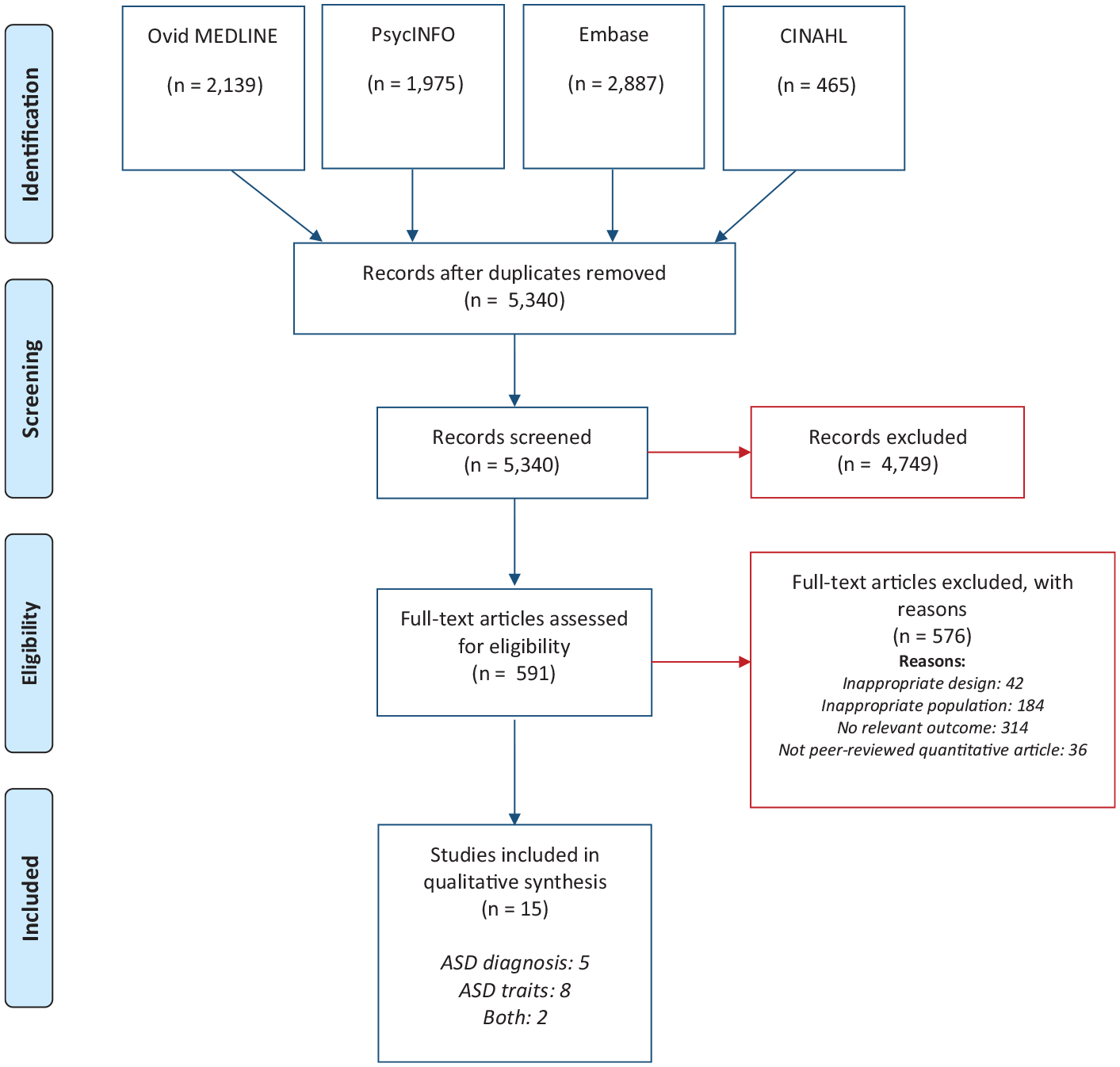
PRISMA flow diagram.
Included studies.
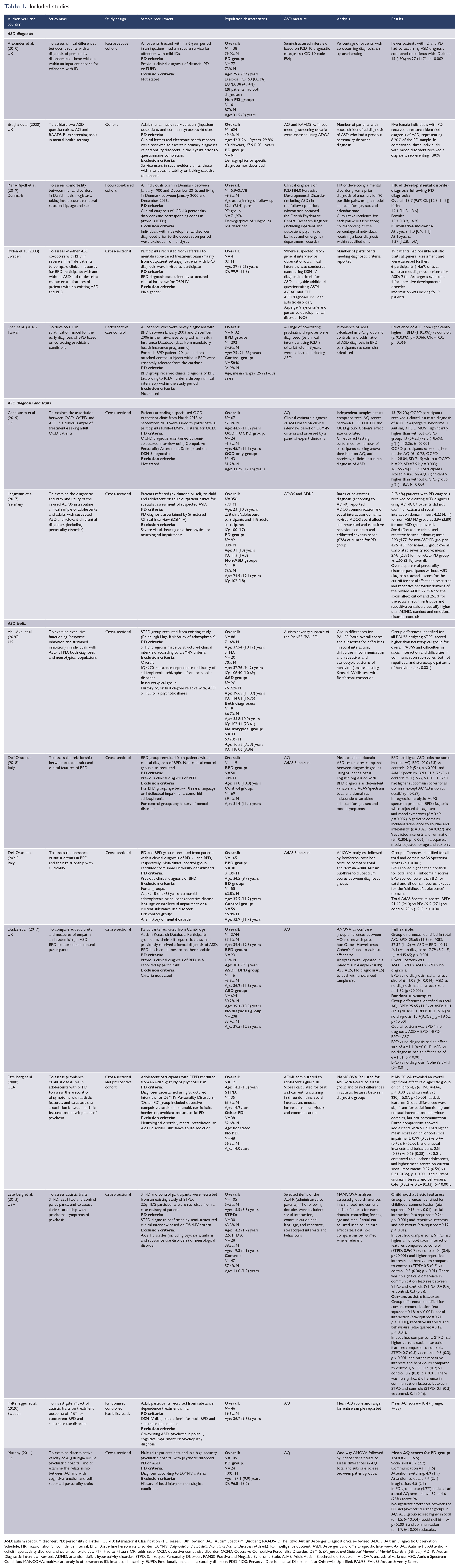
ASD: autism spectrum disorder; PD: personality disorder; ICD-10: International Classification of Diseases, 10th Revision; AQ: Autism Spectrum Quotient; RAADS-R: The Ritvo Autism Asperger Diagnostic Scale–Revised; ADOS: Autism Diagnostic Observation Schedule; HR: hazard ratio; CI: confidence interval; BPD: Borderline Personality Disorder; DSM-IV: Diagnostic and Statistical Manual of Mental Disorders (4th ed.); IQ: intelligence quotient; ASDI: Asperger Syndrome Diagnostic Interview; A-TAC: Autism-Tics-Attention-deficit hyperactivity disorder and other comorbidities; FTF: Five-to-Fifteen; OR: odds ratio; OCD: obsessive-compulsive disorder; OCPD: Obsessive-Compulsive Personality Disorder; DSM-5: Diagnostic and Statistical Manual of Mental Disorders (5th ed.); ADI-R: Autism Diagnostic Interview–Revised; ADHD: attention-deficit hyperactivity disorder; STPD: Schizotypal Personality Disorder; PANSS: Positive and Negative Syndrome Scale; AdAS: Adult Autism Subthreshold Spectrum; ANOVA: analysis of variance; ASC: Autism Spectrum Condition; MANCOVA: multivariate analysis of covariance; ID: Intellectual disability; EUPD: Emotionally unstable personality disorder; PDD-NOS: Pervasive Developmental Disorder - Not Otherwise Specified; PAUSS: PANSS Autism Severity Score.
Study design
ASD diagnosis
Of seven articles reporting prevalence of ASD diagnosis in PD cohorts, only two studies did so as a primary aim (Gadelkarim et al., 2019; Rydén et al., 2008). The remaining studies either primarily assessed the validity of ASD screening tools or assessed ASD co-prevalence in a range of psychiatric diagnoses, including PDs. Median sample size was 356 (interquartile range [IQR]: 67–6132), median age was 29.7 years (IQR: 25–32.1) and studies ranged from an exclusively female population to 79.0% male preponderance (median: 49.6% M, IQR: 34.9–79.0%). Only two articles provided data for IQ.
Four studies retrospectively assessed prevalence of ASD diagnosis made in naturalistic clinical settings (Alexander et al., 2010; Langmann et al., 2017; Plana-Ripoll et al., 2019; Shen et al., 2018) and three studies assessed prevalence of research-identified ASD diagnosis (Brugha et al., 2020; Gadelkarim et al., 2019; Rydén et al., 2008). Diagnosis was usually determined by clinical interview, sometimes in addition to supporting tools and school reports, with the exception of one study using Autism Diagnostic Observation Schedule (ADOS) scores alone (Brugha et al., 2020). Three studies assessed percentage prevalence of ASD in PD groups against a comparison group (Alexander et al., 2010; Gadelkarim et al., 2019; Shen et al., 2018) and one study reported hazard ratios (HRs) and cumulative incidence of ASD in PD groups (Plana-Ripoll et al., 2019). The remaining three studies lacked a comparison group.
ASD traits
Of 10 articles reporting prevalence of ASD traits, 5 studies did so as a primary aim (Dell’Osso et al., 2021; Dudas et al., 2017; Esterberg et al., 2008, 2013; Gadelkarim et al., 2019). The remaining studies primarily assessed the performance of ASD trait scales or the association between ASD traits and clinical features such as suicidality, cognitive functioning or psychotherapy treatment outcome. Median sample size was 112 (IQR: 88–165), median age was 35.5 years (IQR: 23–37.5) and studies ranged from 80.4% female preponderance to an exclusively male population (median: 51.1% M, IQR: 37.1–71.6%). Three studies provided data for IQ (median: 106.4, range: 96.8–113).
Traits were assessed using questionnaire scales in seven studies, structured assessment tools in one study and collateral interview in two studies. Trait scores were reported by subdomain in 7 of the 10 articles. The majority of studies compared ASD trait scores against a clinical (Abu-Akel et al., 2020; Dell’Osso et al., 2021; Dudas et al., 2017; Esterberg et al., 2008, 2013; Gadelkarim et al., 2019; Murphy, 2011) and/or non-clinical control group (Abu-Akel et al., 2020; Dell’Osso et al., 2018, 2021; Dudas et al., 2017; Esterberg et al., 2008, 2013), although two articles lacked statistical comparison with any control group.
Cluster A PDs
Schizotypal personality disorder
Three studies assessed the prevalence of ASD traits in people with schizotypal personality disorder (STPD; Abu-Akel et al., 2020; Esterberg et al., 2008, 2013). All three studies identified increased social interaction difficulties in STPD; one study also reported increased social communication difficulties (Abu-Akel et al., 2020) and two studies reported increased repetitive and stereotyped behaviours (Esterberg et al., 2008, 2013).
Two studies analysed ASD traits using the Autism Diagnostic Interview–Revised (ADI-R). A cohort of 35 participants with STPD had higher mean scores for childhood and current social impairment and unusual interests and behaviours compared to a mixed group of adolescents with unspecified PD or no PD diagnosis, although no group differences were identified for the communication domain (Esterberg et al., 2008). In the second study, 30 STPD participants had higher mean scores for childhood and current social impairment and unusual interests and behaviours compared to a control group of 47 adolescents, although no group differences were identified for the communication domain (Esterberg et al., 2013).
One study assessed ASD traits using the PANSS Autism Severity Score (PAUSS) of the Positive and Negative Syndrome Scale in a sample of 20 adults with STPD (Abu-Akel et al., 2020). Compared to neurotypical adults, the STPD group scored higher for overall PAUSS scores and the difficulties in social interaction and communication subdomain, but not for repetitive and stereotyped behaviours. No significant differences were identified in total or subdomain scores between the STPD and autistic participants.
Cluster B PDs
Borderline personality disorder
ASD diagnosis
Two studies reported the prevalence of ASD diagnosis in borderline personality disorder (BPD; Rydén et al., 2008; Shen et al., 2018). In a sample of 41 female patients referred for a Mentalisation-Based Treatment programme, 19 patients were suspected of having ASD based on initial clinical interview, and 6 patients met diagnostic criteria for ASD following further assessment, representing 14.6% of the total sample (Rydén et al., 2008). However, necessary data were lacking for nine patients who were excluded from further assessment. In addition, ASD was only assessed when the condition was clinically suspected, suggesting this estimate may be an underrepresentation of the sample’s true prevalence.
A retrospective case–control study of a Taiwanese health insurance database assessed the prevalence of psychiatric comorbidity across a 3-year period prior to BPD diagnosis in 292 patients newly diagnosed with BPD and 5840 controls (Shen et al., 2018). An odds ratio for ASD diagnosis of 10 was identified, although this was not statistically significant (p = 0.066). ASD case numbers were low in both BPD (1; 0.3%) and control (2; 0.03%) groups, suggesting a lack of statistical power.
ASD traits
Four studies assessed ASD traits in BPD using the AQ (Dell’Osso et al., 2018; Dudas et al., 2017; Kaltenegger et al., 2020) and AdAS (Dell’Osso et al., 2018, 2021) tools. Using the AQ, a study of 50 BPD and 69 non-clinical control participants found increased ASD traits among BPD participants in total (20.0 vs 12.9, p < 0.001), social skills (3.6 vs 1.5, p < .001), communication (3.2 vs 1.5, p < .001), attention switching (4.9 vs 3.2, p < 0.001) and imagination (3.6 vs 2.5, p = .001) domains. However, attention to detail domain scores did not reach statistical significance (4.7 vs 3.9, p = 0.059) (Dell’Osso et al., 2018). Another study assessed group differences in total AQ score between 23 adults with BPD and 3 comparison groups: those with ASD, those with no diagnosis and those with co-existing diagnoses of ASD and BPD (Dudas et al., 2017). Adults with BPD had higher mean scores than the control group (25.65 (11.3) vs 17.79 (8.2), d = 1.08; p = 0.014). The comparison between adults with BPD and those with ASD was only marginally significant (d = 0.51, p = 0.047), and not significant when the analysis was repeated in a random subsample. Adults with co-existing ASD and BPD had higher mean scores than those with ASD alone (40.19 (6.1) vs 32.32 (11.2), d = 0.71, p = 0.001), suggesting both diagnoses may have an additive effect on ASD trait scores. The remaining study using the AQ found that 46 adults with comorbid BPD and substance dependence had a mean AQ score of 18.47, although no statistical comparison was performed (Kaltenegger et al., 2020). While this mean score may be marginally higher than reported in previous validation studies, the significance of any potential difference is uncertain (Baron-Cohen et al., 2001; Ruzich et al., 2015). Furthermore, co-existing ASD diagnosis was an exclusion criterion for this study, suggesting the mean AQ score may be underestimated.
Regarding the AdAS tool, a study of 50 BPD participants found higher mean scores in total and all subdomain scores (childhood/adolescence, verbal communication, non-verbal communication, empathy, adherence to routine/inflexibility, restricted interests/rumination, hyper/hyporeactivity to sensory input; p < 0.001) compared to 69 non-clinical control participants (Dell’Osso et al., 2018). In logistic regression analyses, total AdAS scores predicted BPD diagnosis (B = 0.49, p = 0.002), as did subdomain scores for adherence to routine/inflexibility (B = 0.025, p = 0.027) and restricted interests and rumination (B = 0.304, p = 0.006). In another article, 48 BPD participants had higher mean total and subdomain AdAS scores compared to non-clinical controls (Dell’Osso et al., 2021). However, mean total and subdomain AdAS scores were lower for BPD participants compared to bipolar disorder participants, with the exception of the childhood/adolescence subdomain score.
Dissocial and borderline personality disorder
One retrospective cohort study assessed the prevalence of ASD diagnosis in participants with either dissocial or BPD, but did not present results separately by condition (Alexander et al., 2010). In a review of clinical case files of 138 offenders with an intellectual disability, admitted to a medium secure service, frequency of co-existing ASD diagnosis was lower for patients with dissocial PD or BPD compared to patients without PD, (15 (19%) vs 27 (44%), p = 0.002). Given the study methodology relied on clinical records rather than research-ascertained diagnoses, it is possible that diagnostic overshadowing contributed to the results. The generalisability of these findings to clinical PD cohorts is also unknown, given that all participants had a diagnosis of intellectual disability, unlike other studies included in this review.
Cluster C PDs
Obsessive-compulsive personality disorder
ASD diagnosis
In a cohort of 67 patients diagnosed with obsessive-compulsive disorder (OCD), research-ascertained diagnosis of ASD was higher in 24 participants with coexisting diagnoses of obsessive-compulsive personality disorder (OCPD) and OCD, compared to those diagnosed with OCD alone (13 (54.2%) vs 8 (18.6%); p < 0.001) (Gadelkarim et al., 2019). Of note, ASD diagnosis was ascertained through ‘clinical estimate diagnosis’. Although this process was based on DSM-5 criteria, it relied on a shorter assessment (between 30 and 45 minutes) and appeared to be made without collateral history-taking or standardised tools that would ordinarily be used in clinical diagnosis. The external validity of the study’s findings beyond the context of co-existing OCD diagnosis is unclear.
ASD traits
The same study also reported the prevalence of ASD traits using the AQ (Gadelkarim et al., 2019). Participants with comorbid OCD and OCPD had higher total AQ scores compared to those with OCD alone (28.04 (7.15) vs 22 (7.92); d = 0.78, p = 0.003). When a cut-off score of 26 was used, 16 (66.7%) participants with co-existing OCPD and OCD scored above this threshold, significantly more than the group with OCD alone (χ2(1) = 8.3, p = 0.004).
Unspecified PDs
ASD diagnosis
Three articles assessed the prevalence of co-existing ASD diagnosis in cohorts with unspecified PD (Brugha et al., 2020; Langmann et al., 2017; Plana-Ripoll et al., 2019).
One population-based cohort study used health registries of 5,940,778 individuals to identify prevalence of coexisting mental health diagnoses based on ICD-10 coding (Plana-Ripoll et al., 2019). For the 71,976 individuals with a PD diagnosis, the hazard ratio for a later additional developmental disorder diagnosis was 13.7 (95% CI: [12.8, 14.7]) and the cumulative incidence of developmental disorder was 1% (95% CI: [0.9, 1.1]) at 5-year and 1.37% (95% CI: [1.28, 1.47]) at 10-year follow-up. Hazard ratios were higher for women compared to men (15.3 (13.9–16.9) vs 12.4 (11.3–13.6)). Among those with a prior PD diagnosis, hazard ratios for developmental disorder were greater than organic, substance use, mood, neurotic, eating disorders and intellectual disabilities, but less than schizophrenia and behavioural disorders. Developmental disorder was defined according to the ICD-10 code ‘F84: Pervasive developmental disorders’. This diagnosis corresponds to ASD, with the exception of Rett Syndrome, which has a prevalence of 1 in 20,000–40,000 and is nearly always diagnosed in early childhood, making it an unlikely explanation for these results (Fu et al., 2020; Tarquinio et al., 2015).
Two articles primarily assessing the validity of ASD screening tools also reported the prevalence of co-existing ASD diagnosis in unspecified PD subgroups (Brugha et al., 2020; Langmann et al., 2017). A cohort of 624 patients were screened with the AQ and Ritvo Autism Asperger Diagnostic Scale–Revised (RAADS-R) questionnaires; those meeting screening criteria were further assessed using the ADOS instrument to confirm diagnosis (Brugha et al., 2020). Of 61 patients with a PD diagnosis, 5 females received a research-identified diagnosis of ASD, representing 8.20% of the PD sample. In comparison, 3 of 167 (1.80%) individuals with mood disorders received an ASD diagnosis, although statistical comparison was not conducted. In another study, 356 patients referred to outpatient clinics for specialist assessment of suspected ASD were assessed using the ADI-R tool (Langmann et al., 2017). Of 92 service-users with a PD diagnosis, 5 received a co-existing ASD diagnosis, representing a prevalence of 5.4%. However, the external validity of this study is unclear, given all participants had been referred following clinical suspicion of ASD.
ASD traits
Two studies assessed the prevalence of ASD traits in cohorts with unspecified PD (Langmann et al., 2017; Murphy, 2011). In the abovementioned study of patients referred for specialist assessment of suspected ASD, ADOS subdomain scores were also reported (Langmann et al., 2017). Over a quarter of 87 participants with PD scored above cut-off for the social affect (SA) and restricted and repetitive behaviour (RRB) domains of the revised ADOS, higher than ADHD, conduct and emotional disorder controls. However, group mean scores for the ‘communication and social interaction’ and ‘social affect and restricted and repetitive behaviour’ domains of the ADOS did not appear to differ between a group of 87 participants with PD and a larger cohort of 191 patients without ASD, although the latter group included participants in the PD subgroup and formal statistical comparison was not conducted. Furthermore, five participants with PD were excluded due to meeting diagnostic criteria for ASD, potentially limiting the validity of the mean scores.
In a separate group of 24 male patients detained in a high-security psychiatric hospital and diagnosed with a PD, mean AQ score was 20.5 (6.5) (Murphy, 2011). When cut-off scores of 26 and 32 were used, six (25%) and one (4.2%) participants scored above threshold, respectively. Compared to a group of 69 patients with psychotic disorders, no significant differences were identified. Compared to a group of 12 autistic patients, the PD group had lower total (d = 1.5, p < 0.001), social skill (d = 1.4, p < 0.001) and communication (d = 1.7, p < 0.001) AQ scores, although no significant differences were identified for the imagination, attention-switching and attention-to-detail subdomains. A regression analysis suggested that 45.7% of variability in AQ scores could be predicted by personality traits (as measured by the Millon Clinical Multiaxial Personality Inventory), with narcissistic and borderline profiles being positively associated, and histrionic and antisocial profiles being negatively associated, with total AQ score.
Critical appraisal
Critical appraisal results using the AXIS tool are reported in Supplementary Material. Potential sources of bias included a lack of justification for sample size, unclear study recruitment methodology, recruitment from single or potentially unrepresentative clinical sites and a lack of attention to factors affecting non-response.
A number of studies reported prevalence of co-existing diagnosis or traits as secondary data rather than a primary outcome, with at least one study lacking statistical power (Shen et al., 2018). There was significant heterogeneity between and within study populations; potential confounding factors included forensic history, referral to a specialist clinic for ASD assessment and co-existing diagnoses of psychiatric disorder, substance dependence and intellectual disability. IQ data were only provided in a minority of studies, which is significant as ASD trait scales are not widely validated for populations with varying intellectual abilities (Baron-Cohen et al., 2001). Heterogeneity in gender representation existed between study populations, with results presented by gender in only one study (Plana-Ripoll et al., 2019). A number of study populations were recruited from existing research studies or databases and at least four studies appeared to analyse data from the same two populations, potentially limiting their external validity (Dell’Osso et al., 2018, 2021; Esterberg et al., 2008, 2013).
Many studies lacked control groups of participants with clinical diagnoses, making it difficult to ascertain if ASD diagnosis and traits are specifically associated with PDs as opposed to general psychopathology. There was heterogeneity in how ASD diagnosis was made, including both research-ascertained diagnoses and diagnoses derived from naturalistic clinical records systems, which may limit external validity and reliability, respectively. Studies assessing clinical records often had short follow-up periods potentially underestimating prevalence, given that diagnosis of adult ASD is often made after prolonged contact with mental health services (Fusar-Poli et al., 2022). Studies featured different assessment tools and inconsistently considered developmental and collateral information. For instance, one study formally assessed ASD diagnosis only when it was clinically suspected and developmental information was readily available (Rydén et al., 2008).
There was also heterogeneity across ASD trait scales used. ASD traits were often assessed using self-report tools, which may exhibit limitations given the prevalence of alexithymia and anosognosia in PD populations (Martin et al., 2021; Nicolò et al., 2011). Interestingly, one study demonstrated apparent disagreement between assessment tools (Langmann et al., 2017). Despite a number of participants scoring above threshold scores for current ASD traits assessed by the ADOS instrument, these were considered ‘false positive’ scores due to the ADI-R (which assesses developmental symptoms) being used to confirm diagnosis in the study. Retrospective assessment using tools such as the ADI-R may feature recall bias and less reliably detect ASD in adult populations (Fusar-Poli et al., 2017; Kamp-Becker et al., 2021). Finally, there was inconsistent reporting of subdomain trait scores, which may be important given the fractionable-triad model of autism (Happé and Ronald, 2008).
Discussion
Our review identifies preliminary evidence of an increased prevalence of ASD diagnosis and traits among individuals diagnosed with BPD, STPD, OCPD and unspecified PD diagnoses. Regarding ASD diagnosis, all studies identified higher prevalence among PD cohorts compared to either within-study comparison groups or, where lacking, general population estimates of ASD (Bougeard et al., 2021), with the exception of one study conducted within a forensic institution (Alexander et al., 2010). This latter study may have been confounded by the co-prevalence of intellectual disability, previous offending behaviour and a high prevalence of ASD (44%) in the control group (Alexander et al., 2010). For ASD traits, PD cohorts had higher prevalence of total and subdomain ASD trait scores compared to non-clinical control populations, and a substantial proportion of PD participants scored above cut-off thresholds. However, there was no evidence of increased ASD trait scores when compared to cohorts diagnosed with bipolar or psychotic disorders (Dell’Osso et al., 2021; Murphy, 2011). No consistent pattern among the triad of ASD traits was identified when subdomain scores for social interaction, communication and restricted repetitive behaviour were analysed.
Together, this preliminary evidence suggests that individuals diagnosed with PD are more likely to meet diagnostic criteria for ASD and score higher on ASD trait measures compared to non-clinical control populations. There are many plausible reasons for this. Both conditions may share dimensional behavioural-cognitive features leading to diagnostic uncertainty and individuals fulfilling diagnostic criteria for multiple conditions. Examples might include social-emotional detachment and eccentricity (in STPD); interpersonal difficulties, affect dysregulation, alexithymia, feelings of emptiness and identity issues (in BPD); and preoccupation with details, orderliness and inflexibility (in OCPD) (Lai and Baron-Cohen, 2015). Further characterisation of the behavioural-cognitive phenotypes and distinguishing factors between conditions may clarify these nosological uncertainties. For instance, factor analysis has begun to clarify shared and condition-specific aspects of ASD and schizotypal personality (Ford et al., 2017) and the Coventry Grid aims to distinguish ASD from attachment difficulties (implicated in BPD), although it is yet to be validated (Davidson et al., 2022). Research into the aetiology of social cognition and mentalisation difficulties may prove fruitful, given the area may represent a shared neuropsychological feature of both ASD and PDs despite stemming from different research traditions (Gur and Gur, 2016; Herpertz and Bertsch, 2014; Hessels et al., 2016). Of interest is a study that identified prevalent contemporary ASD traits among PD participants despite the apparent absence of a developmental history suggestive of ASD (Langmann et al., 2017). It is unclear whether this represents the emergence of shared symptomatology at a later point in development, or from the under-reporting of early ASD behaviours by primary caregivers of PD participants.
The increased co-prevalence of PDs and ASD may also arise from shared aetiological factors in genetic, neurobiological, environmental or psychological mechanisms, leading to genuine comorbidity between the conditions. Research into shared endophenotypes of PDs and ASD, and their aetiological associations, may therefore benefit from novel approaches such as the HiTOP and RDoC methodologies (Michelini et al., 2021).
Alternatively, having undiagnosed ASD itself may predispose to the development of PD. Individuals with ASD experience higher rates of childhood maltreatment and abuse (Dinkler et al., 2017), experience a broader range of life events as traumatic (Rumball et al., 2020), experience unique challenges with attachment relationships (McKenzie and Dallos, 2017) and may engage in long-term camouflaging behaviours (Cook et al., 2021), all of which may feasibly impact personality development. One study identified a tentative association between ASD traits and exposure to abuse among individuals with BPD, suggesting that such factors may represent a possible mechanistic pathway for the association between ASD and PD (Dell’Osso et al., 2018).
It is also plausible that this review’s findings may arise, in part, from the effect of misdiagnosis. Factors including demographics (such as gender and age of presentation), clinical heuristics (such as self-injurious behaviour being perceived as a pathognomonic feature of PD (Brüne, 2016) or ASD being wrongly stereotyped as a problem with emotional empathy (Fletcher-Watson and Bird, 2020)) and other biases may lead to a diagnosis of PD being used preferentially to ASD, despite individuals fulfilling diagnostic criteria for the latter. Interestingly, studies employing researcher-led diagnostic assessment generally reported higher rates of co-prevalence compared to studies assessing co-existing ASD diagnosis from clinical records. It is unclear to what extent this may reflect bias in clinical practice, or clinical assessment offering insights which are not typically captured by structured assessment tools used in research settings. However, the literature suggests that patients diagnosed with missed ASD in adulthood are typically known to mental health services for many years prior, often have previous diagnoses of PD, and that these PD diagnoses are commonly displaced by the later ASD diagnosis rather than viewed as co-occurring (Fusar-Poli et al., 2022; Geurts and Jansen, 2012; Kentrou et al., 2021). Notably, this appears especially prevalent among women, suggesting possible diagnostic bias (Fusar-Poli et al., 2022; Kentrou et al., 2021).
Our review has urgent clinical implications. Despite significant limitations, numerous studies suggest a general trend of increased prevalence of ASD among individuals diagnosed with PD. Clinicians should therefore be mindful to consider a careful neurodevelopmental assessment when assessing and treating individuals diagnosed with a PD, given the importance of early ASD diagnosis (Elder et al., 2017) and the known under-recognition of ASD among certain groups, such as women and older adults (Lai and Baron-Cohen, 2015; Lockwood Estrin et al., 2021). This is especially important given the different treatment approaches used for each condition, and the potential harms of offering psychotherapy to primarily treat ASD (Bishop and Swendsen, 2021). Future research may better characterise the clinical needs of individuals with co-prevalent PD and ASD diagnoses, given such individuals may be at risk of adverse health outcomes including suicide (Dell’Osso et al., 2021). Research investigating service-user experiences of being diagnosed with these conditions would also be welcomed, given that clinical experience suggests ASD diagnoses generally resonate well with service-users, in contrast to PD diagnoses which are often highly stigmatised (Leedham et al., 2020; Lester et al., 2020; Sheehan et al., 2016).
Our review identifies a number of limitations of the current literature. There was a lack of well-designed studies to primarily answer our review question; evidence was often preliminary, derived from secondary data and sometimes lacked statistical power (Shen et al., 2018). Many PD diagnoses were not investigated in any study, including a surprising absence of empirical investigation into schizoid PD, despite conceptual similarities between the conditions (Wolff, 1998). Populations featured multiple potential confounding factors, unclear recruitment methodology and studies often lacked within-study statistical comparison with clinical control groups. Further studies are required to elucidate the specific associations between PDs and ASD, as methodological factors are known to impact ASD prevalence estimates (Williams et al., 2006). Importantly, only one study presented results by gender subgroups, and analysis of diagnostic patterns by gender may be a worthy focus of future research.
Limitations
Our review methodology also exhibits limitations. Quantitative meta-analytic data synthesis was not possible given significant heterogeneity in study design, clinical and demographic characteristics of study populations, and measurement scales used. This in part reflects the general dearth of evidence in the literature, and our review highlights significant gaps for future research. Each PD diagnosis was only assessed in a handful of studies, and significant confounding factors were present, hindering comparability.
Our focus on individuals diagnosed with a categorical PD diagnosis represents another potential limitation. The reliability of such diagnoses has been questioned, and categorical diagnosis remains controversial (Jablensky, 2002; Tyrer et al., 2007, 2015). Likewise, it is unclear how meaningful it is to study groups diagnosed with unspecified PD diagnoses, given that PDs themselves are heterogeneous groupings with differing diagnostic criteria. Nonetheless, categorical diagnosis remains the current mainstay of clinical practice and is therefore an important area of study due to clinical relevance and need, interpretability and standardisation. Future research investigating the association between ASD traits and other measures of PD, including dimensional approaches recently introduced in DSM-5, would be welcomed. Finally, our focus on the English-language literature represents a limitation, and it is possible that non-English publications of relevance were overlooked.
Conclusion
Our review identified preliminary evidence of increased prevalence of co-existing ASD diagnosis and traits among persons with PD, although the current literature exhibits significant limitations. Future research directions may include larger studies comparing the prevalence of ASD diagnosis and traits in PD cohorts to other psychiatric cohorts, assessment of the shared and distinguishing behavioural-cognitive phenotypes of ASD and PD, and identifying potentially shared aetiological factors and mechanistic pathways linking the two conditions. Clinical implications include a recommendation for clinicians to be mindful of neurodevelopmental history when assessing service-users with a PD diagnosis, given the apparently increased prevalence of co-existing ASD and related traits within this cohort.
Supplemental Material
sj-docx-1-anp-10.1177_00048674221114603 – Supplemental material for The prevalence of autism spectrum disorder traits and diagnosis in adults and young people with personality disorders: A systematic review
Supplemental material, sj-docx-1-anp-10.1177_00048674221114603 for The prevalence of autism spectrum disorder traits and diagnosis in adults and young people with personality disorders: A systematic review by George Gillett, Laura Leeves, Amy Patel, Andreea Prisecaru, Debbie Spain and Francesca Happé in Australian & New Zealand Journal of Psychiatry
Footnotes
Author Contributions
The project was conceived by Dr Gillett. The protocol was written by Dr Gillett, Dr Leeves and Ms Patel, reviewed by Dr Spain and Professor Happé and registered by Dr Gillett. Literature searching was conducted by Dr Leeves and Ms Patel and reference screening conducted by Dr Gillett, Dr Leeves, Ms Patel, Ms Prisecaru and Dr Spain. The manuscript was written by Dr Gillett, Dr Leeves, Ms Patel and Ms Prisecaru and revised by Dr Spain and Professor Happé. All authors read and approved the final manuscript.
Declaration of Conflicting Interests
The author(s) declared no potential conflicts of interest with respect to the research, authorship and/or publication of this article.
Funding
The author(s) disclosed receipt of the following financial support for the research, authorship and/or publication of this article: This work was carried out during protected time as part of a National Institute of Health and Care Research (NIHR) funded Academic Clinical Fellowship post (Dr Gillett) and King’s College London funded Undergraduate Research Fellowship posts (Dr Leeves, Ms Patel, Ms Prisecaru) although the project attracted no specific grant funding. Professor Happé is part funded by the NIHR Biomedical Research Centre at South London and Maudsley NHS Foundation Trust and King’s College London. The views expressed are those of the author(s) and not necessarily those of the NHS, the NIHR or the Department of Health.

Supplemental Material
Supplemental material for this article is available online.
References
Supplementary Material
Please find the following supplemental material available below.
For Open Access articles published under a Creative Commons License, all supplemental material carries the same license as the article it is associated with.
For non-Open Access articles published, all supplemental material carries a non-exclusive license, and permission requests for re-use of supplemental material or any part of supplemental material shall be sent directly to the copyright owner as specified in the copyright notice associated with the article.
