



Abstract
Objective:
Co-occurring population-level events, such as social unrest and coronavirus disease 2019, are observed in many societies today. Few studies have explored their combined mental health effects on young people. While self-focused rumination has been suggested to be a key mechanism underlying depression, the role of event-based rumination in mediating the impact of population stressors has yet to be elucidated.
Methods:
Data were collected from 6988 young people in a large-scale community online survey in Hong Kong. The survey assessed symptoms of post-traumatic stress disorder and depression, direct exposure to social unrest-related traumatic events, coronavirus disease 2019 pandemic-related events, personal stressful life events, event-based rumination and other individual risk factors.
Results:
High levels of comorbid post-traumatic stress disorder and depressive symptoms were observed. Logistic regression analysis revealed that probable post-traumatic stress disorder was associated with traumatic events (odds ratio = 1.73, 95% confidence interval = [1.64, 1.82]), pandemic-related events (odds ratio = 1.08, confidence interval = [1.01, 1.16]), stressful life events (odds ratio = 1.20, confidence interval = [1.21, 1.37]), high event-based rumination (odds ratio = 3.00, confidence interval = [2.58, 3.48]), lower resilience (odds ratio = 1.18, confidence interval = [1.15, 1.21]), higher smartphone reliance (odds ratio = 1.09, confidence interval = [1.05, 1.13]) and financial concerns (odds ratio = 1.25, confidence interval = [1.18, 1.33]). The odds for probable post-traumatic stress disorder was also significantly higher when two or more traumatic events were experienced (odds ratio = 4.03, confidence interval = [3.52, 4.62]). Factors associated with moderate-to-severe level depressive symptoms were similar. Event-based rumination significantly mediated between different types of external events (traumatic events, pandemic-related events, stressful life events) and both post-traumatic stress disorder and depressive symptoms.
Conclusion:
These findings suggest that diverse types of stressful events during population-level crises could add to personal stressors to affect mental health outcomes in young people. Among other protective and risk factors, event-based rumination presented as a prominent transdiagnostic mediator for different symptom dimensions which may be a potentially important target for early risk detection and intervention.
Introduction
The mental health of young people has been an area of increasing global concern (Patel et al., 2007). Youth is a period during which the maturation of some of the most important brain systems takes place (e.g. prefrontal cortex; Arain et al., 2013). This developmental period is also characterised by distinctive psychological processes, such as the increased need for autonomy, the consolidation of self-identity and the building of peer relationships (Patton et al., 2016). While most adult mental disorders emerge by the youth period (Kessler et al., 2007), help-seeking is often sub-optimal (Gulliver et al., 2010). As mental health trajectories during this period can have detrimental long-term consequences, special focus on youth mental health is becoming a priority in many settings (Colizzi et al., 2020; Patel et al., 2007).
Apart from intrinsic individual vulnerabilities, external events may also play a crucial role in determining the mental health of young people. Over the past year, the outbreak of coronavirus disease 2019 (COVID-19) has caused unprecedented disruptions to many societies globally (Chakraborty and Maity, 2020). At the same time, an increasing number of populations have also been facing a series of concurrent social unrest and protests (Ni et al., 2020). Both public health crises and social conflicts have been separately reported to produce detrimental effects on mental health (Ni et al., 2020; Vindegaard and Benros, 2020). However, limited studies have explored how these processes interact to impact young people in particular. Given the increased susceptibility to mental illnesses during this period, further research would be important and could benefit the timely development of effective responses.
Among the factors that may contribute to post-traumatic stress disorder (PTSD) and depressive symptoms, rumination has been suggested to play a key role as a transdiagnostic mediator between stressors and symptoms in young people (Michl et al., 2013). In contrast to the well-studied role of depressive-type rumination (Ehlers and Clark, 2000; Nolen-Hoeksema et al., 2008), few studies have explored the impact of event-based rumination on long-term mental health outcomes after recurrent conflicts (e.g. rumination about injustice; Silove et al., 2014). A study has recently suggested that rumination about COVID-19 may interact with resilience to impact depressive symptoms (Ye et al., 2020). How event-based rumination and resilience are linked to PTSD and depressive symptoms in young people in the context of co-occurring social unrest and COVID-19 is as yet unexplored.
Against this backdrop of events, we examined how social unrest-related traumatic events (TEs), pandemic-related events (PEs) and personal stressful life events (SLEs), as well as other individual vulnerabilities, may be associated with increased PTSD and depressive symptoms in young people. Apart from event-based rumination and lower resilience, other factors that have been identified to increase mental health risks especially in young people, including smartphone reliance (Haug et al., 2015) and financial concerns (Richardson et al., 2017), were also examined. We hypothesised that exposure to TEs, PEs and SLEs; high event-based rumination; lower resilience; smartphone reliance; and financial concerns will be associated with increased symptoms and that the effects of precipitating events on symptoms will be mediated by event-based rumination.
Methods
Study design and participants
This study analysed data from a group of 7028 young people (below 25 years) who participated in a larger online survey with unrestricted age range, collected between 21 February 2020 and 6 March 2020 (Wong et al., 2020). The survey originated from a mental health self-help tool that allowed individuals to obtain feedback about their levels of mental distress and suggestions for self-help and help-seeking. Users of the self-help tool were invited to participate in the current survey. Items on PTSD and depressive symptoms, exposure to traumatic and stressful events, event-based rumination and other related risk and protective factors were included. Contents of the tool were developed after rounds of discussions with local young people and mental health professionals. The study was approved by the Institutional Review Board of the University of Hong Kong/Hospital Authority Hong Kong West Cluster (Ref: UW 20-240).
Measures
Demographic and background information included gender and past psychiatric history (Table 1). Participants reporting their gender as ‘neither male nor female’ were excluded from the current analysis owing to the small sample size (n = 40). Early experience of adverse events included ‘parents absent from home continuously for a significant period of time’, ‘bullied at school’, ‘loss of a parent’, ‘physical abuse’, ‘emotional abuse’ and ‘sexual abuse’. Those who reported one or more experiences were considered to have past adversity.
Logistic regression models for probable PTSD and moderate-to-severe depressive symptoms.
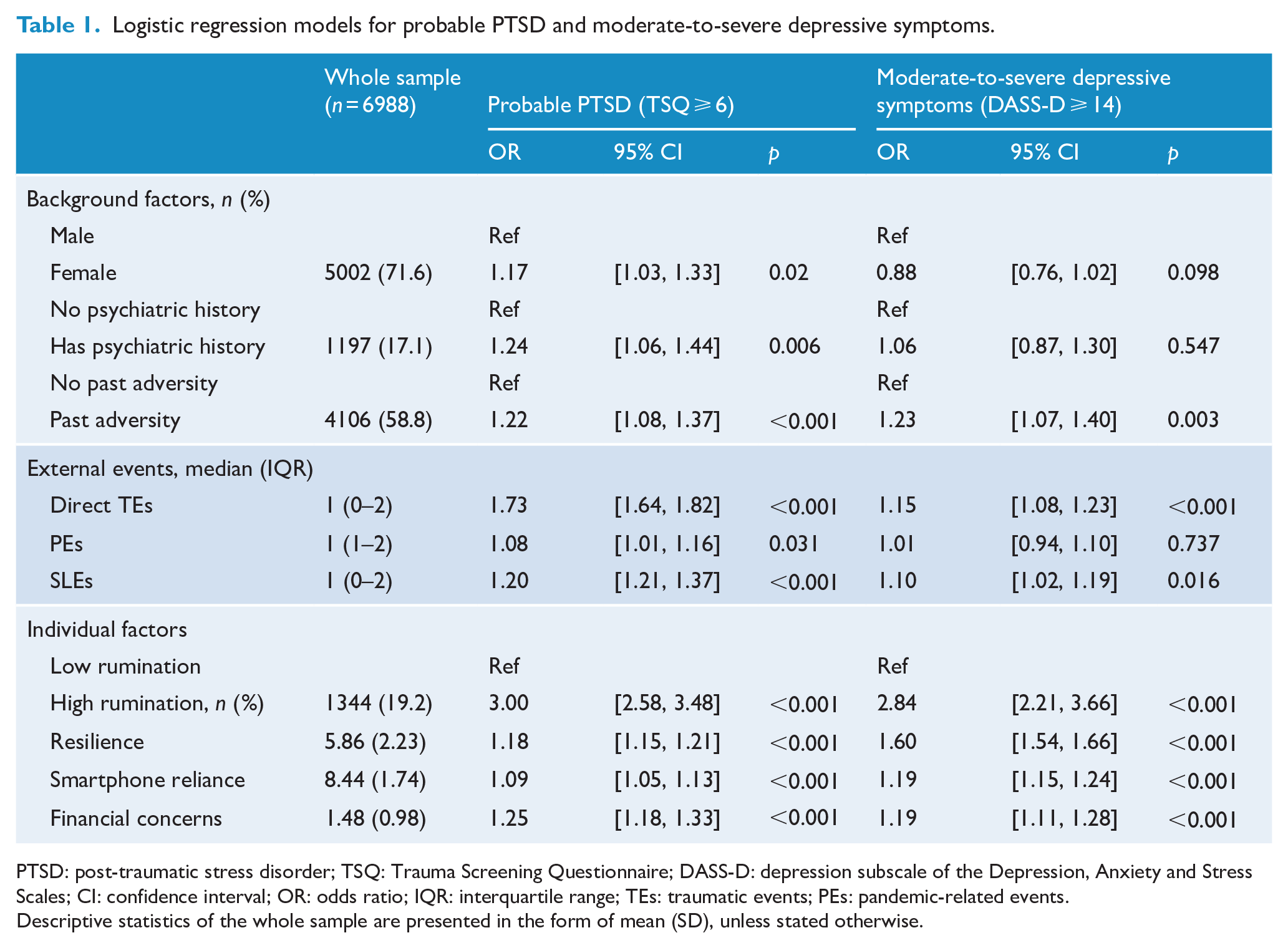
PTSD: post-traumatic stress disorder; TSQ: Trauma Screening Questionnaire; DASS-D: depression subscale of the Depression, Anxiety and Stress Scales; CI: confidence interval; OR: odds ratio; IQR: interquartile range; TEs: traumatic events; PEs: pandemic-related events.
Descriptive statistics of the whole sample are presented in the form of mean (SD), unless stated otherwise.
PTSD symptoms were assessed using the Trauma Screening Questionnaire (TSQ; Brewin et al., 2002). A score of six or above suggests probable PTSD (Brewin et al., 2002). The TSQ has been shown to have good reliability in a Hong Kong epidemiological sample (α = 0.93; Wu et al., 2019). Depressive symptoms were assessed using the depression subscale of the Depression, Anxiety and Stress Scales (DASS-D; Lovibond and Lovibond, 1995). A score of 14 or above suggests moderate-to-severe depressive symptoms. The DASS-D has been shown to exhibit moderate to good sensitivity (80.8%) and specificity (77.4%) in detecting major depressive disorder in the Diagnostic and Statistical Manual of Mental Disorders (4th ed.; DSM-IV; Tran et al., 2013). The Chinese version of the DASS-D has been validated and demonstrated good internal consistency (α = 0.82; Lu et al., 2018). In the present study, the alpha coefficient of the TSQ and DASS-D was 0.92 and 0.87, respectively, suggesting good reliability.
Three event checklists were used to assess exposure to TEs, PEs and SLEs. The checklists were designed to be context-relevant and were constructed after in-depth discussions with local community members. The TEs checklist included ‘personal experience of physical attack’, ‘sexual violence’, ‘arrest or detention’, ‘targeted verbal abuse’, ‘crowd dispersal by the use of force’ and ‘witnessing violent attacks on others’. Media exposure to trauma was also assessed with two items in the TEs checklist. Only direct exposure to TEs (six items) was included in the current analyses. PEs included ‘lack of protective gear’, ‘working in high-risk environments’, ‘placed under quarantine’, ‘family members or significant others affected’, ‘feeling lost about the future’ and ‘others’ (six items). SLEs included ‘conflict with family’, ‘conflict with friends’, ‘being bullied’, ‘being abused (physical, emotional, sexual)’, ‘self-initiated termination of employment or studies’, ‘dismissal from job or expelled from school’, ‘serious physical health conditions’, ‘passing away of a significant other’, ‘experience of legal actions or being charged’ and ‘others’ (10 items). Individual composite scores reflecting the number of stressful events experienced were separately computed for each of the three stressor types. The number of exposures for each stressor type was also further grouped into ‘no exposure’, ‘one exposure’ and ‘two or more exposures’.
Event-based rumination was assessed using eight survey items that referred to frequent repetitive thoughts relating to event-induced psychological reactions commonly reported during this period (i.e. anger, injustice, guilt and insecurity), to the extent that caused interference to other current tasks. The assessment consisted of the (1) severity of each of the four psychological reactions (4-point Likert-type scale, from ‘not at all’ to ‘totally’) and (2) frequency of rumination over these themes (4-point Likert-type scale, from ‘none’ to ‘nearly all the time’). The four rumination frequency items were summed to compute a composite rumination score. Those who reported high levels of rumination (rating ‘nearly all the time’ for any of the four rumination frequency items) were considered to be high ruminators.
To evaluate the content and face validity of the items on psychological reactions and event-based rumination, five mental health professionals and six laypersons were involved. The following criteria were applied: (1) content validity ratio (CVR) ⩾0.62 (Lawshe, 1975), (2) item-level content validity index (I-CVI) > 0.79 (Polit and Beck, 2006), (3) scale-level CVI (S-CVI) ⩾ 0.90 (Polit and Beck, 2006) and (4) impact score ⩾ 1.5 (Lacasse et al., 2002). All eight items met the above criteria (CVR = 0.64–1.00; I-CVI = 0.91–1.00; S-CVI = 0.95; impact score = 3.57–4.73). The composite rumination items also demonstrated good internal consistency (α = 0.84).
Resilience was assessed with three items (‘able to adapt to change’, ‘can deal with whatever comes’, ‘not easily discouraged by failure’) adapted from the Connor-Davidson Resilience Scale (CD-RISC; Connor and Davidson, 2003). The Chinese version of the full CD-RISC (Yu and Zhang, 2007) and 10-item version (CD-RISC-10; She et al., 2020) has been validated. In addition, we evaluated the internal consistency and construct validity of the three-item resilience measure in a separate epidemiological sample of young people by our team (n = 84, mean age = 20.02, SD = 2.80). Cronbach’s α for the three-item resilience measure was 0.74 in this epidemiological youth sample. Convergent and discriminant validity were assessed against depressive symptoms (using the Patient Health Questionnaire-9; Kroenke et al., 2001) and PTSD symptoms (TSQ; Brewin et al., 2002). The three-item resilience measure showed strong positive correlation with CD-RISC-10 (r = 0.88, p < 0.001) and negative correlations with symptoms of both depression (r = −0.33, p < 0.01) and PTSD (r = −0.23, p = 0.037). We reversed the items such that higher scores would reflect lower resilience. In the current study, the three-item resilience measure showed good reliability (α = 0.73).
Smartphone reliance was assessed using three survey items extracted from the Revised Chen Internet Addiction Scale (Chen et al., 2003), which is a widely applied and validated scale used for assessing smartphone reliance, including in Hong Kong (Mak et al., 2014). The three items were rated on a 4-point Likert-type scale (from ‘completely disagree’ to ‘completely agree’), which respectively assessed the impact of smartphone use on social and occupational functioning, its consumption of sleep and leisure time, and cravings and inability to control the impulse for smartphone use. Ratings of the three items were summed to create a composite score (α = 0.58).
Financial concerns during the period were assessed using the following direct item: ‘Since June 2019, have you worried about a lack of financial resources to handle your daily expenditures?’ The item was rated on a 4-point Likert-type scale (from ‘not at all’ to ‘extremely’). Other risk and protective factors were also assessed, including personal hope, positive reappraisal, and sleep and exercise patterns, which may be discussed elsewhere.
Statistical analysis
Statistical analyses were performed using SPSS V25.0 (IBM SPSS Statistics, New York, United States). The PROCESS macro was used for mediation analyses for continuous variables (Hayes, 2013). All tests were two-tailed with statistical significance set at p < 0.05. Descriptive data were generated for all variables (frequencies for categorical, means for continuous). Chi-square tests were performed to explore the effects of demographic variables and other potential correlates on PTSD and depressive symptoms. Gender, past psychiatric history and experience of past adversity were controlled for in all subsequent analyses.
Two separate multivariable logistic regression models were applied to identify correlates of probable PTSD and moderate-to-severe depressive symptoms, respectively. The variables tested in the models included exposure to direct TEs, PEs and SLEs, as well as high event-based rumination, lower resilience, smartphone reliance and financial concerns. Adjusted odds ratios (ORs) with 95% confidence interval (CI) are presented. Additional analyses were performed using the three individual items of smartphone reliance, separately, in replacement of the composite smartphone reliance score to determine their respective associations with PTSD and depressive symptom risks (Supplementary Material S1).
In addition, further analysis was performed using the three-level categorical variables for TEs, PEs and SLEs (i.e. no exposure, one exposure and two or more exposures) to determine the impact of stress exposure accumulation on symptom risks (Supplementary Material S2). A series of subgroup regression analysis were then performed separately based on the groupings of low vs high stress exposure as follows: (1) no direct TE vs one or more TEs, (2) none to one PE vs two or more PEs and (3) none to one SLE vs two or more SLEs. For each of these sets of subgroup analysis, the other two event types were also included in the model to assess how different types of stress exposure may interact to determine the final risks of PTSD and depressive symptom (Supplementary Material S3).
Separate mediation analyses were then performed to explore whether rumination would mediate between precipitating events significant in the logistic regression models and both PTSD and depressive symptoms, respectively. Two approaches to mediation were adopted. In the first, event-based rumination and symptoms were treated as continuous variables. Mediation indirect effects were tested using bootstrapping procedures (10,000 samples with 95% CI). In the second approach, rumination and symptoms were treated as binary variables as in the logistic regression analyses. Coefficients from the separate logistic regression models were first standardised for further testing (MacKinnon and Dwyer, 1993). We performed the analyses according to procedures outlined in Rijnhart et al. (2019), with detailed procedures provided in Supplementary Material S4. Estimates of the proportion mediated for all mediation analyses were generated according to the formula ab/(ab + c′) (MacKinnon et al., 2007).
Differences in symptoms, stress exposure, as well as other individual factors were also compared between low and high ruminators using chi-square test and independent t-test.
Results
A total of 6988 young people were included in this study. Seventy-two percent (n = 5002) were female, 17.1% (n = 1197) had a past psychiatric history and 58.8% (n = 4106) reported one or more experiences of past adversity. The mean scores of TSQ and DASS-D (PTSD and depressive symptoms) were 3.94 (SD = 3.67) and 21.50 (SD = 10.14), respectively. Based on this, 41.8% (n = 2918) met the criteria for probable PTSD (TSQ ⩾ 6) and 78.9% (n = 5513) met the criteria for moderate-to-severe depressive symptoms (DASS-D ⩾ 14). Thirty-eight percent (n = 2674) presented both probable PTSD and moderate-to-severe depressive symptoms. Among the sample, 32.6% (n = 2281) reported two or more direct TEs, 44.3% (n = 3095) reported two or more PEs and 32.3% (n = 2257) reported two or more SLEs.
Females were more likely than males to present moderate-to-severe depressive symptoms (79.5% vs 77.3%, p = 0.045), while the proportions between genders presented with probable PTSD were not significantly different (41.9% vs 41.5%, p = 0.78). Those with a past psychiatric history were more likely to present probable PTSD (55.6% vs 38.9%, p < 0.001) and moderate-to-severe depressive symptoms (86.6% vs 77.3%, p < 0.001). Similarly, those with at least one past adverse experience were more likely to present probable PTSD (47.3% vs 33.8%, p < 0.001) and moderate-to-severe depressive symptoms (82.5% vs 73.7%, p < 0.001).
Factors associated with probable PTSD and moderate-to-severe depressive symptoms
Table 1 presents the findings of the logistic regression models including ORs, 95% CI and significance level. Controlling for gender, past psychiatric history and past adversity, the first logistic regression model revealed that probable PTSD was significantly associated with more direct TEs (OR = 1.73, CI = [1.64, 1.82], p < 0.001), PEs (OR = 1.08, CI = [1.01, 1.16], p = 0.031), SLEs (OR = 1.20, CI = [1.21, 1.37], p < 0.001), high event-based rumination (OR = 3.00, CI = [2.58, 3.48], p < 0.001), lower resilience (OR = 1.18, CI = [1.15, 1.21], p < 0.001), higher smartphone reliance (OR = 1.09, CI = [1.05, 1.13], p < 0.001) and more financial concerns (OR = 1.25, CI = [1.18, 1.33], p < 0.001).
In the second logistic regression model, moderate-to-severe depressive symptoms were associated with more direct TEs (OR = 1.15, CI = [1.08, 1.23], p < 0.001), SLEs (OR = 1.01, CI = [0.94, 1.10], p = 0.016), high rumination (OR = 2.84, CI = [2.21, 3.66], p < 0.001), lower resilience (OR = 1.60, CI = [1.54, 1.66], p < 0.001), higher smartphone reliance (OR = 1.19, CI = [1.15, 1.24], p < 0.001) and financial concerns (OR = 1.19, CI = [1.11, 1.28], p < 0.001), but not with PEs (p = 0.737). Significance of the predictors in both logistic regression models remained unchanged when the composite smartphone reliance score was replaced by the three smartphone reliance items individually (see Supplementary Material S1).
Logistic regression analyses using the three-level categorical TEs, PEs and SLEs as predictors revealed significant additive effects of TEs and SLEs on probable PTSD and severe-to-moderate depressive symptoms (Supplementary Material S2). Compared to no TEs, the odds of probable PTSD was 1.86 (CI = [1.62, 2.13]) when one direct TE was experienced and 4.03 (CI = [3.52, 4.62]) when two or more direct TEs were experienced, both p < 0.001. Compared to no SLEs, the odds of probable PTSD was 1.24 (CI = [1.08, 1.44]) when one SLE was experienced and 1.91 (CI = [1.63, 2.24]) when two or more SLEs were experienced. For moderate-to-severe depressive symptoms, the odds were significantly higher when two or more TEs (OR = 1.43, CI = [1.21, 1.69]) and two or more SLEs (OR = 1.28, CI = [1.06, 1.54]) were experienced, both p < 0.001. No significant increase in odds was observed with only a single exposure. High rumination, lower resilience, higher smartphone reliance and more financial concerns remained significantly associated with higher risks in both PTSD and depressive symptoms. Details of the logistic regression findings are presented in Supplementary Material S2.
Subgroup analyses based on low vs high stress exposure for each of the three event types revealed that PEs were associated with probable PTSD only in those with no TEs (OR = 1.16, CI = [1.03, 1.29], p < 0.001) and those with no SLEs (OR = 1.12, CI = [1.03, 1.22], p = 0.011). Other patterns of associations remained unchanged (see Supplementary Material S3).
Mediating effects of rumination on PTSD and depressive symptoms
A series of mediation analyses were performed to determine the mediating effects of event-based rumination on the relationships between (1) TEs, PEs, and SLEs and PTSD symptoms, and (2) TEs and SLEs and depressive symptoms. The mediation models revealed event-based rumination to be a significant mediator in all the exposure-symptom relationships.
We first presented findings where event-based rumination and symptoms were evaluated as continuous dimensional variables. In mediation models with TEs as the exposure, and rumination as the mediator, the total variance explained in PTSD symptoms was 34.4%, of which rumination accounted for 36.6% of the total effect in the relationship (β = 0.45, SE = 0.02, CI = [0.41, 0.48]) (Figure 1(a)); the variance explained in depressive symptoms was 18.2%, of which rumination accounted for 76.9% of the total effect (β = 1.04, SE = 0.05, CI = [0.95, 1.13]). With PEs as the exposure, the variance explained in PTSD symptoms was 28.7%, of which rumination accounted for 93.7% of the total effect (β = 0.37, SE = 0.03, CI = [0.32, 0.43]). With SLEs as the exposure, the variance explained in PTSD symptoms was 30.7%, of which rumination accounted for 41.8% of the total effect (β = 0.40, SE = 0.02, CI = [0.35, 0.44]); the variance explained in depressive symptoms was 19%, of which rumination accounted for 43.4% of the total effect (β = 0.78, SE = 0.05, CI = [0.68, 0.88]). After rumination was added to the model, the direct effect of TEs and SLEs remained significant for both PTSD and depressive symptoms (all p < 0.01), while PEs were no longer significant for PTSD symptoms after rumination was added to the model.
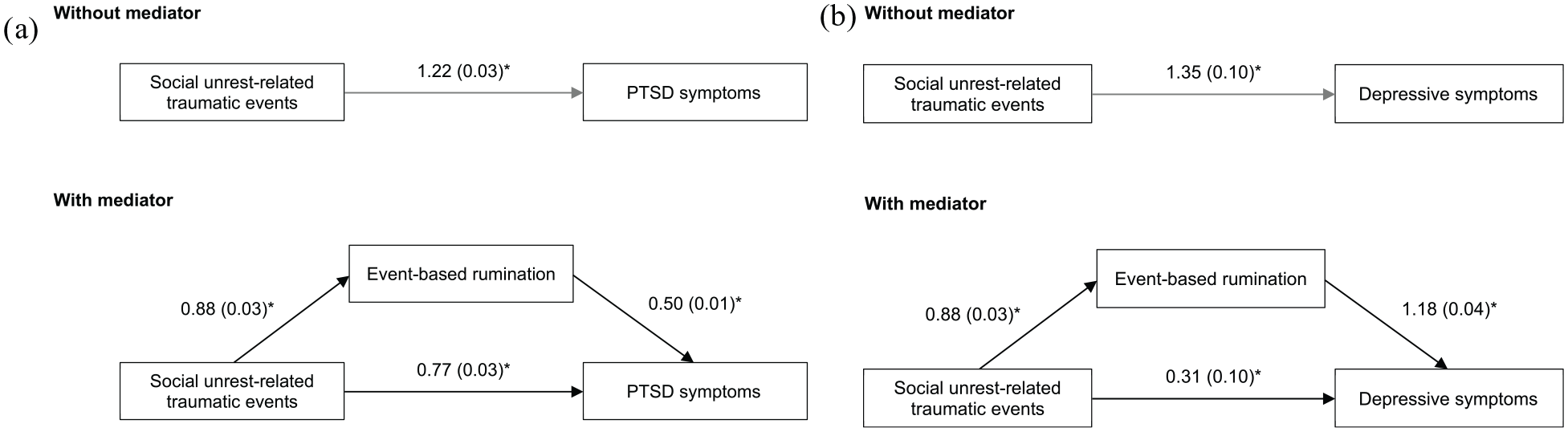
The mediating role of event-based rumination in the relationships between direct exposure to social unrest-related traumatic events and PTSD symptoms (a) and between social unrest-related traumatic events and depressive symptoms (b). Unstandardised regression coefficients and standard error are presented in the parentheses, *p < 0.001. PTSD: post-traumatic stress disorder.
In the second approach, mediation effects were tested with event-based rumination as a binary mediator and symptoms as binary outcomes (probable PTSD, moderate-to-severe depressive symptoms). With TEs as the exposure, the indirect effect and proportion mediated by high event-based rumination were 0.20% and 41.1%, respectively, for probable PTSD (Supplementary Figure S1a), and 0.22% and 66.7%, respectively, for moderate-to-severe depressive symptoms (Supplementary Figure S1b). With PEs as the exposure, the indirect effect and proportion mediated were 0.09% and 42.9%, respectively, for probable PTSD. With SLEs as the exposure, the indirect effect and proportion mediated were 0.19% and 44.3% for probable PTSD, and 0.20% and 56.6% for moderate-to-severe depressive symptoms. Further details on the computation of indirect effects and proportion mediated using binary event-based rumination and symptoms outcomes are presented in Supplementary Material S4.
Characteristics of high ruminators
Nineteen percent (n = 1344) of the sample reported high levels of event-based rumination. Compared to low ruminators, these participants were more likely to also present probable PTSD (73.9% vs 34.1%, p < 0.001) and moderate-to-severe depressive symptoms (94.2% vs 75.2%, p < 0.001). They were also more likely to have a past psychiatric history (25.6% vs 15.1%, p < 0.001) and past adversity (65.0% vs 57.3%, p < 0.001). Importantly, high ruminators reported greater exposure to TEs, t(1782.89) = −20.50, p < 0.001, PEs, t(1980.48) = −5.67, p < 0.001, and SLEs, t(1741.83) = −15.14, p < 0.001. Lower resilience, t(1894.58) = 16.25, p < 0.001, higher smartphone reliance, t(6986) = −16.38, p < 0.001, and more financial concerns, t(2024.54) = −13.67, p < 0.001, were also reported in high ruminators.
Discussion
Main findings and interpretations
This survey engaged a large number of young people in the community during a period of protracted social unrest and COVID-19. High levels of PTSD and depressive symptoms were observed. Additionally, we showed that TEs and SLEs were independently related to both PTSD and depressive symptoms. Of note, the odds of high-risk symptom outcomes were significantly higher when two or more exposures to external stressful events. Existing studies have consistently reported that comorbid PTSD and depressive symptoms are associated with a more severe clinical presentation and less favourable long-term outcome (Flory and Yehuda, 2015). The increasing co-occurrence of external stressful events in the global society should alert clinicians and healthcare professionals to the possibility of adverse outcomes particularly in young people, where early detection of risk and early intervention is called for.
Our study also showed that a high proportion of participants reported frequent rumination induced by external events. Rumination was associated with more intense PTSD and depressive symptoms. The mediation models suggested that event-based rumination may constitute an important transdiagnostic mechanism underlying the impact of external events. Notably, the experience of event-based rumination we examined in this study is distinct from the classic depressive-type rumination (Nolen-Hoeksema et al., 2008).
Apart from the depressive subtype, some researchers have proposed that rumination can also be categorised into anger rumination, which refers to a process of repeated, narrowed thinking about anger and its causes and consequences (Sukhodolsky et al., 2001). While both depressive and anger rumination involve a degree of self-focused attention, the latter can also be action-oriented, such that ruminating about anger may increase irritability and aggressive behaviours (Denson et al., 2011). Nonetheless, the existing literature on ruminative experiences wherein attention is not inwardly directed has primarily concentrated on anger, with limited consideration for other affects. We extended this approach to include rumination about not just anger, but also other event-induced psychological reactions commonly observed in the current societal context, namely feelings of injustice, guilt and insecurity.
Our findings highlighted the potentially important role of event-based rumination in the development of psychopathology. Previous studies have linked rumination to deficits in executive control (Whitmer and Gotlib, 2013) and dysfunctions in default mode networks (Sheline et al., 2009). In our sample, high ruminators were characterised by lower resilience, higher smartphone reliance, greater financial concerns, as well as having a psychiatric history and early adversity. Greater attention to these factors in young people may facilitate identification of those at higher risk.
Interestingly, we found that event-based rumination accounted for a large proportion of the impact of PEs on PTSD symptoms. Meanwahile, PEs were not directly associated with depressive symptoms. Although COVID-19 has been shown to have significant mental health consequences (Vindegaard and Benros, 2020), its direct psychological impact in the Hong Kong population may be less intense due to the relatively low fatality rate in the city. In addition, while all three types of external stressors independently contributed to increased PTSD risk in the whole sample, the impact of COVID-19 stress appeared to be greater among those with fewer experiences of TEs and SLEs. Considerations for the potential interactions between stressor types in their impact on mental health in young people may be important when tailoring specific interventions for this population.
Apart from event-based rumination, a number of individual factors were also associated with increased risks of probable PTSD and depressive symptoms. This included lower resilience, higher smartphone reliance and financial concerns. Our observation of the associations with resilience is consistent with previous findings (Wu et al., 2013) and supports the importance of enhancing resilience in young people as part of future protective measures.
Excessive reliance on smartphones has also been documented in the literature (Haug et al., 2015). Particularly in the context of COVID-19 where face-to-face socialisation is severely restricted, digital technology became uniquely important (Whitelaw et al., 2020). However, it has recently been shown that exposure to COVID-19 news could increase levels of distress and depressive symptoms (Olagoke et al., 2020). Reliance on smartphones may encourage the continuous revisiting of event-related information, which might in turn further trigger ruminative experiences and symptoms. The practice of daily media reporting of COVID-19 figures should be reviewed with these considerations.
In the context of combined social unrest and COVID-19 in addition to a range of global tensions, the economy of many communities has been substantially affected. In support of our current findings observed in a large sample of young people in Hong Kong, the long-term consequences of financial difficulties and financial worries on mental health have previously been documented (Richardson et al., 2017). The prospects of financial cuts and job losses during COVID-19 may further contribute to negative outcomes (Bareket-Bojmel et al., 2020). Accounting for such concerns in young people not only during but also after COVID-19 may be important for future interventions.
Strengths and limitations
This study utilised data from a large sample of young people during a turbulent period of co-occurring social unrest and COVID-19. Particularly in times of crisis, the use of a simple online tool allowed for timely collection of data from individuals otherwise difficult-to-reach (Wright, 2005). This may include not only those typically not ready to seek help due to stigma, but also those with concerns about the revelation of personal identity (especially during social unrest) and in-person contacts (especially during COVID-19). The observations as presented in this study enabled an integrative model of the role of event-based rumination and individual risk factors in the emergence of PTSD and depressive symptoms in young people.
We caution against directly generalising the findings to the general population or drawing conclusions about the direction of causality between variables. For instance, the relationship between rumination and symptoms is not to be interpreted using a simple cause-effect model. A richer interactive model is suggested, in which a two-way interaction exists. This perspective nonetheless does not rule out the potential effectiveness of interventions with rumination as the target in reducing symptoms, which has been demonstrated in some preliminary studies (Querstret and Cropley, 2013). Longitudinal study designs in the future would be helpful to explore how rumination may interact with symptoms over time to inform the design of preventive interventions.
The primary objective of the study was to examine the associations between symptoms and other potentially related factors. For this purpose, it has been suggested that online samples could robustly demonstrate patterns of associations (Heiervang and Goodman, 2011). Apart from event-based rumination, we were able to confirm the associations between a number of previously identified protective and risk factors and symptom outcomes in this study using simple measures. In contexts where more detailed assessments are possible, more elaborate measures may be adopted to examine the specific mechanisms which underlie event-based rumination as well as PTSD and depressive symptoms during ongoing population-level stress.
Conclusion
Using data from a large community online survey collected in the midst of multiple co-occurring major population-level stressful events, we showed that different types of stressors both independently and interactively contribute to the expression of PTSD and depressive symptoms. Among other factors, event-based rumination appeared to play an important mediating role in this process. Targeting event-based rumination, as well as factors associated with increased PTSD and depression risks such as lower resilience, higher smartphone reliance and financial concerns, may help to inform early intervention opportunities for young people. In the current global context, accessible and agile assessment tools may become an important means to collect timely information for informing work in early risk detection and effective responses to community crises.
Supplemental Material
sj-docx-1-anp-10.1177_00048674211025710 – Supplemental material for The impact of social unrest and pandemic on mental health of young people in Hong Kong: The transdiagnostic role of event-based rumination
Supplemental material, sj-docx-1-anp-10.1177_00048674211025710 for The impact of social unrest and pandemic on mental health of young people in Hong Kong: The transdiagnostic role of event-based rumination by Stephanie MY Wong, Christy LM Hui, Yi Nam Suen, Corine SM Wong, Sherry KW Chan, Edwin HM Lee, Wing Chung Chang and Eric YH Chen in Australian & New Zealand Journal of Psychiatry
Footnotes
Acknowledgements
We would like to thank Professor Pak Sham and Miss Catherine Fang for the statistical advice they have given and their continued support for this work. We are also grateful to those young people who had taken part in the online tool that contributed to this study.
Author Contributions
S.M.Y.W. and E.Y.H.C. designed the study, analysed the data and interpreted results, searched the published work, and wrote the paper. All authors revised the manuscript and approved the final version.
Declaration of Conflicting Interests
The author(s) declared the following potential conflicts of interest with respect to the research, authorship and/or publication of this article: E.Y.H.C. has received speaker honoraria from Otsuka and DSK BioPharma, research funding from Otsuka, participated in paid advisory boards for Janssen and DSK BioPharma, and received funding to attend conferences from Otsuka and DSK BioPharma, all outside the submitted work. All other authors declare no competing interests.
Funding
The author(s) received no financial support for the research, authorship and/or publication of this article.

Supplemental material
Supplemental material for this article is available online.
References
Supplementary Material
Please find the following supplemental material available below.
For Open Access articles published under a Creative Commons License, all supplemental material carries the same license as the article it is associated with.
For non-Open Access articles published, all supplemental material carries a non-exclusive license, and permission requests for re-use of supplemental material or any part of supplemental material shall be sent directly to the copyright owner as specified in the copyright notice associated with the article.
