




Abstract
Objective:
Defects in self-referential processing and perspective-taking are core characteristics that may underlie psychotic symptoms and impaired social cognition in schizophrenia. Here, we investigated the neural correlates of self-referential processing regardless of the perspective taken and third-person perspective-taking regardless of the target person to judge relevance in individuals at ultra-high risk for psychosis. We also explored relationships between alterations in neural activity and neurocognitive function and basic self (‘ipseity’) disorder.
Methods:
Twenty-two ultra-high-risk individuals and 28 healthy controls completed a functional magnetic resonance imaging task. While being scanned, participants were asked to take a first-person perspective or to put themselves in their close relative’s place thereby adopting a third-person perspective during judgments of the relevance of personality trait adjectives to one’s self and a close relative.
Results:
For self-referential (vs other-referential) processing, ultra-high-risk individuals showed less neural activity in the left ventromedial prefrontal cortex/medial orbitofrontal cortex, which was correlated with poor working memory performance. When taking a third-person perspective (vs first-person perspective), ultra-high-risk individuals showed more activity in the middle occipital gyrus.
Conclusion:
Taken together, our findings suggest that ultra-high-risk individuals already show aberrant neural activity during self-referential processing which may possibly be related to engagement of working memory resources.
Keywords
Introduction
The question of how our brains enable us to distinguish self from other arises in schizophrenia research because it may explain psychotic symptoms such as referential thinking (Lariviere et al., 2017; Pankow et al., 2016) and impaired social cognition related to self-reflection on feelings and knowledge (Shergill et al., 2014). Self-referential processing involves experiencing and reflecting on stimuli as pertinent to oneself (Northoff et al., 2006). During self-referential processing tasks, participants are typically asked to judge whether presented body parts or personality traits are related to themselves or others (Northoff et al., 2006). From a neurocognitive perspective, self-referential processing has been explained by two approaches: (1) computation of the similarity of stimuli to retrieved memories of one’s relevant behaviors or (2) comparison of stimuli with summary representations yielded from abstractions of one’s knowledge (Klein et al., 2002). Although interplay between these two sources of self-knowledge is difficult to rule out (Binder et al., 2009), episodic and semantic memory are believed to be functionally dissociable (Klein et al., 2002). From a phenomenological perspective, self-referential processing involves a basic sense of self, which include the senses of agency and ownership (Northoff et al., 2006).
The cortical midline structures (CMS), which consist of the medial prefrontal cortex (MPFC), anterior cingulate cortex and posterior cingulate cortex (PCC) with adjacent retrosplenium and precuneus, are activated during self-referential tasks (Northoff et al., 2006) (for meta-analysis, see van der Meer et al., 2010). From a neurocognitive perspective, different areas within the CMS may be involved in different aspects of self-referential processing—anterior CMS (i.e. MPFC) for semantic self-knowledge retrieval (Binder et al., 2009) and posterior CMS (i.e. posterior parietal cortex, precuneus and PCC) for autobiographical episodic memory retrieval (Wagner et al., 2005). From a phenomenological perspective, interactions between CMS and other brain areas may serve as a substrate for maintaining an integrated basic self (‘ipseity’), a first-person givenness of experience, although the precise role of the CMS in self-related processes remains to be characterized (Nelson et al., 2009). Accordingly, a number of researches investigating the self-referential processing in the aspects of neurocognitive function and basic self have been highlighted in the CMS.
Since neurocognitive deficits (Hoff et al., 2005) and basic self (‘ipseity’) disorder (Nelson et al., 2009) are one of core features in schizophrenia, studies investigating brain activity patterns of self-referential processing in schizophrenia have been focused on CMS alterations (Huang et al., 2016; Northoff and Duncan, 2016). Chronic schizophrenia patients with a clinically stable status (Holt et al., 2011), mixed status (Bedford et al., 2012; Menon et al., 2011; Pankow et al., 2016; Shad et al., 2012) or active psychotic status (Blackwood et al., 2004) consistently show reduced activation of anterior CMS, such as the ventromedial prefrontal cortex (VMPFC) (Blackwood et al., 2004; Holt et al., 2011; Pankow et al., 2016) and dorsomedial prefrontal cortex (DMPFC) (Bedford et al., 2012; Menon et al., 2011), and increased activation of posterior CMS, including the PCC and precuneus (Blackwood et al., 2004; Holt et al., 2011; Shad et al., 2012) (but see Lariviere et al., 2017). This overall anterior-to-posterior shift in neural activity may reflect alterations in neurocognitive processes, for example, schizophrenia patients may rely on retrieving detailed episodic memories which activated posterior CMS (Wagner et al., 2005) more than abstracted self-information which recruited anterior CMS (Binder et al., 2009) when making self-referential judgments (Holt et al., 2011). In fact, however, most previous studies (Bedford et al., 2012; Blackwood et al., 2004; Holt et al., 2011; Lariviere et al., 2017; Menon et al., 2011; Pankow et al., 2016; Shad et al., 2012) asked participants to judge self-relevance only while taking a first-person perspective (1PP), self-referential processing in reality is a dynamic process that encompasses not only reflecting on one’s self from a 1PP but also looking at oneself through others’ eyes (i.e. adopting a third-person perspective [3PP]) (D’Argembeau et al., 2007).
In addition to experiencing self as the judgment target, recognizing self as the perceiver is an important facet of one’s self-construct that can be investigated by comparing a participant’s own perspective against another person’s perspective (D’Argembeau et al., 2007). Perspective-taking, or ascribing mental states to others, constitutes one’s relations with others (Vogeley et al., 2004). Taking a 1PP centers one’s multimodal experiential space upon one’s own body, whereas taking a 3PP allows comprehension of another’s mental state by putting oneself in other’s place (Vogeley et al., 2004). Increased neural activity is observed in the somatosensory cortex when taking a 1PP and the frontopolar cortex when taking a 3PP (Ruby and Decety, 2003), suggesting that adopting a 3PP requires the inhibitory influence of the frontopolar area to suppress one’s self-perspective (Ruby and Decety, 2003). Impaired perspective-taking in schizophrenia patients has been studied with regard to deficits in theory of mind (ToM), which is the ability to attribute feelings and thoughts to one’s self and others (Brunet et al., 2003). During ToM tasks, schizophrenia patients generally show reduced activation of the DMPFC, temporal cortex and temporo-parietal junction (Brune et al., 2011; Brunet et al., 2003).
To investigate self-referential processing regardless of the perspective taken and perspective-taking regardless of the reference target, all combinations of referential processing (self-as-target vs other-as-target) and perspective-taking (1PP vs 3PP) should be considered. Using a design in which self-referential processing and perspective-taking were separately manipulated to decouple these interdependent processes, D’Argembeau et al. (2007) showed that (1) the VMPFC, anterior DMPFC, anterior cingulate cortex and precuneus are activated in self-referential processing rather than other-referential processing; (2) the posterior DMPFC, precuneus, inferior parietal cortex, temporal pole, lateral orbitofrontal cortex and lingual gyrus are activated in 3PP-taking rather than 1PP-taking; and (3) left DMPFC activity increases when self-referential processing interacts with perspective-taking, specifically when judgments of self (vs other) are considered from a 3PP (vs 1PP) (D’Argembeau et al., 2007).
Recent research on the pre-onset phase of schizophrenia is mainly based on individuals clinically defined as being at ‘ultra-high risk’ (UHR) for psychosis who present subthreshold psychotic symptoms with accompanying functional decline (Miller et al., 2003). Neurocognitively, UHR individuals show significant schizophrenia-like, but lesser extent of impairments (Hauser et al., 2017). Phenomenologically, UHR individuals showed basic self-disorder (Nelson et al., 2009), similar to schizophrenia patients. Therefore, UHR individuals may show altered neural activity during self-referential processing, although, to our knowledge, this has not been examined in previous neuroimaging studies. In regard to taking a 3PP, UHR individuals show reduced DMPFC activity and compensatory overactivation of the lateral prefrontal, PCC and precuneus areas during mental state attribution tasks (Brune et al., 2011).
In this study, we investigated the neural correlates of self-referential processing and perspective-taking in UHR individuals using a functional magnetic resonance imaging (fMRI) task which manipulated both dimensions in a 2 × 2 factorial design to examine (1) self-referential processing regardless of the perspective taken; (2) perspective-taking regardless of the reference target; and (3) the interaction between the two processes, particularly judgments about self (vs other) from a 3PP (vs 1PP). We also explored relationships between these neural correlates and measures of neurocognitive function and basic self-disorder. We hypothesized that putative ‘prodromal’ UHR individuals show reduced activity in anterior CMS, particularly the VMPFC, and increased activity in posterior CMS during self-referential processing compared with healthy control (HC) individuals based on previous findings in schizophrenia patients (Blackwood et al., 2004; Holt et al., 2011; Menon et al., 2011; Pankow et al., 2016). We hypothesized that UHR individuals show reduced posterior DMPFC activity during 3PP-taking based on previous studies utilizing ToM tasks in schizophrenia patients (Brune et al., 2011; Brunet et al., 2003) or UHR individuals (Brune et al., 2011). We hypothesized that UHR individuals would show abnormal neural activity specifically when inferring another person’s judgments of one’s own self. Finally, we expected that the neural correlates of self-referential processing, perspective-taking and their interaction are related to neurocognitive performance (i.e. working memory to enhance executive control and episodic memory to retrieve self-related events) and basic self-disorder in UHR individuals based on previous studies of the underlying components of self with regard to neurocognition (Binder et al., 2009; Wagner et al., 2005) and basic self-disorder (Nelson et al., 2009).
Materials and methods
Participants
Individuals at UHR for psychosis (n = 22) and HC individuals (n = 28) participated in this study. UHR individuals were recruited from the Green Program for Recognition And Prevention of Early Psychosis (GRAPE) project at Severance Hospital of the Yonsei University Health System in Seoul and included youth (15–35 years of age) who met Structured Interview for Prodromal Syndromes (SIPS) criteria (Miller et al., 2003). HC individuals were recruited from an Internet job advertisement. All participants were assessed for psychiatric disorders using the Structured Clinical Interview for DSM-IV (SCID-I) (First et al., 1996a, 1996b). Details regarding the recruitment strategy and comorbid psychiatric disorders in UHR individuals are provided in the supplementary material. All participants were assessed for basic self-disorder using the Examination of Anomalous Self-Experience (EASE) (Parnas et al., 2005), for working memory using 2-back task (Jeon et al., 2012) and for episodic memory using California Verbal Learning Test (CVLT): long delay free recall (CVLT delayed recall) (Delis et al., 1987).
Stimuli
A total of 40 trait adjectives (provided in the supplementary material) were selected from an analysis of Korean personality trait adjectives (Kim, 1985) based on three criteria: frequency of use, emotional vividness score and pleasantness score. Stimuli were presented using E-prime (version 1.0; Psychology Software Tools Inc., Pittsburgh, PA, USA).
Task description
The task (Supplementary Figure 1), based on that described by D’Argembeau et al. (2007), was designed to test self-referential processing regardless of the perspective taken and perspective-taking regardless of the reference target. By manipulating the target person to judge relevance and perspective taken by participants, four conditions were employed as follows: taking a 1PP when making judgments about self (1PP_self; for example, ‘I am a sincere person’), taking a 3PP when making judgments about self (3PP_self; for example, ‘According to my mother’s opinion, I am a sincere person’), taking a 1PP about a family member (1PP_other; for example, ‘My mother is a sincere person’) and taking a 3PP about a family member (3PP_other; for example, ‘According to my mother’s opinion, she is a sincere person’). Each participant was asked to identify their closest family member as the reference target and third person (‘mom’: n = 42; ‘dad’: n = 3; ‘older sibling’: n = 3; ‘younger sibling’: n = 2). Close relatives rather than public figures were used to minimize confounding effects, such as the amount of information known about the person (D’Argembeau et al., 2007). Participants were instructed to judge the extent of relevance of personality trait adjectives to one’s self or their close relative taking either a 1PP or 3PP.
All conditions were presented in a single session. There were 10 blocks per condition, with four trials per block. Each trial was a fixed duration of 5250 ms. Pseudo-randomized orders were generated to present one condition at a time. The same set of 40 trait adjectives was presented once in all conditions. Each block started with a cue sentence for 3000 ms to inform participants of the perspective to take and the reference person (1PP_self: ‘I am’; 3PP_self: ‘According to my close relative’s opinion, I am’; 1PP_other: ‘My close relative is’; 3PP_other: ‘According to my close relative’s opinion, he or she is’). Cue sentences, which consisted of truncated sentences, remained on the screen throughout the entire duration of the block, and trait adjectives appeared to complete the sentences. The sentences were located in the middle of the screen, and personality adjectives were changed serially. For each stimulus, participants chose one of four response types (1 = not at all, 2 = a little, 3 = quite well, 4 = completely). Participants responded by pressing one of four buttons on the response pad. Blocks were separated by intervals of 3000–12,000 ms, passively viewed with a fixation cross on a screen. Prior to scanning, a practice session was conducted to accustom participants to the task requirements.
Acquisition, pre-processing and analysis of fMRI data
Neuroimaging data acquisition and imaging pre-processing steps with parameter details are provided in the supplementary material. Brain responses were estimated at each voxel for each participant using a general linear model with block regressors. Block regressors looked for the four condition effects (1PP_self, 3PP_self, 1PP_other, 3PP_other). The realignment parameters were included into the design to account for any residual movement-related effect. Boxcar waveform representations of these block conditions were convolved with the canonical hemodynamic response. The contrasts of interest were the main effect of self as reference target [self > other: (1PP_self + 3PP_self) – (1PP_other + 3PP_other)], the main effect of 3PP-taking [3PP > 1PP: (3PP_self + 3PP_other) – (1PP_self + 1PP_other)] and the interaction between reference target and perspective (i.e. the specific effect of taking a 3PP with self as the reference target; (3PP_self – 3PP_other) – (1PP_self – 1PP_other)). The resulting set of voxel values constituted a map of t statistics. Contrasts were entered in a second-level analysis corresponding to one-sample and two-sample t-tests to assess the significance of within- and between-group effects, respectively; gender, age and years of education were included as covariates. Statistical activation maps were set at an uncorrected voxel-level threshold of p < 0.005 to balance between type I and II errors (Lieberman and Cunningham, 2009) considering our sample size (<100 subjects) (Carter et al., 2016), and the cluster-level threshold of p < 0.05 (cluster size ⩾224 voxels) was applied to limit type I error based on Monte Carlo simulations using AlphaSim software (courtesy of Douglas Ward, Medical College of Wisconsin; provided with AFNI software version 18.0/04 January 2018). Anatomical labeling, visualization of fMRI data and extraction of contrast estimates of regions of interest are provided in the supplementary material.
Statistical analyses
Two-sample t-tests and chi-square tests were used to analyze group differences in demographic data. Analysis of covariance (ANCOVA) with adjustment for gender, age and years of education were conducted to compare neurocognitive test and EASE total scores between groups. Repeated-measures analysis of variance (ANOVA) was conducted for behavioral data, with detailed methods provided in the supplementary material. Spearman’s correlation analysis was conducted to assess relationships among the peak parameter estimates of regions demonstrating between-group differences, clinical variables and behavioral outcomes. Holm–Bonferroni correction (Holm, 1979) was used to adjust the p-values for Spearman’s correlation coefficients. The threshold of significance was set at p < 0.05 for all statistical analyses.
Results
Demographic and clinical characteristics
Demographic and clinical characteristics of UHR and HC individuals are presented in Table 1. There was no significant difference between groups in gender or age. Compared with HC individuals, UHR individuals had significantly fewer years of education. ANCOVA with adjustment for gender, age and years of education showed that UHR individuals had significantly lower CVLT delayed recall scores and higher EASE total scores than HC individuals, whereas there was no group difference in 2-back task scores. Three UHR individuals had been taking atypical antipsychotics, aripiprazole 5 mg (n = 1), quetiapine 50 mg (n = 1), and blonanserin 16 mg (n = 1), at the date of fMRI scanning.
Demographic and clinical characteristics.
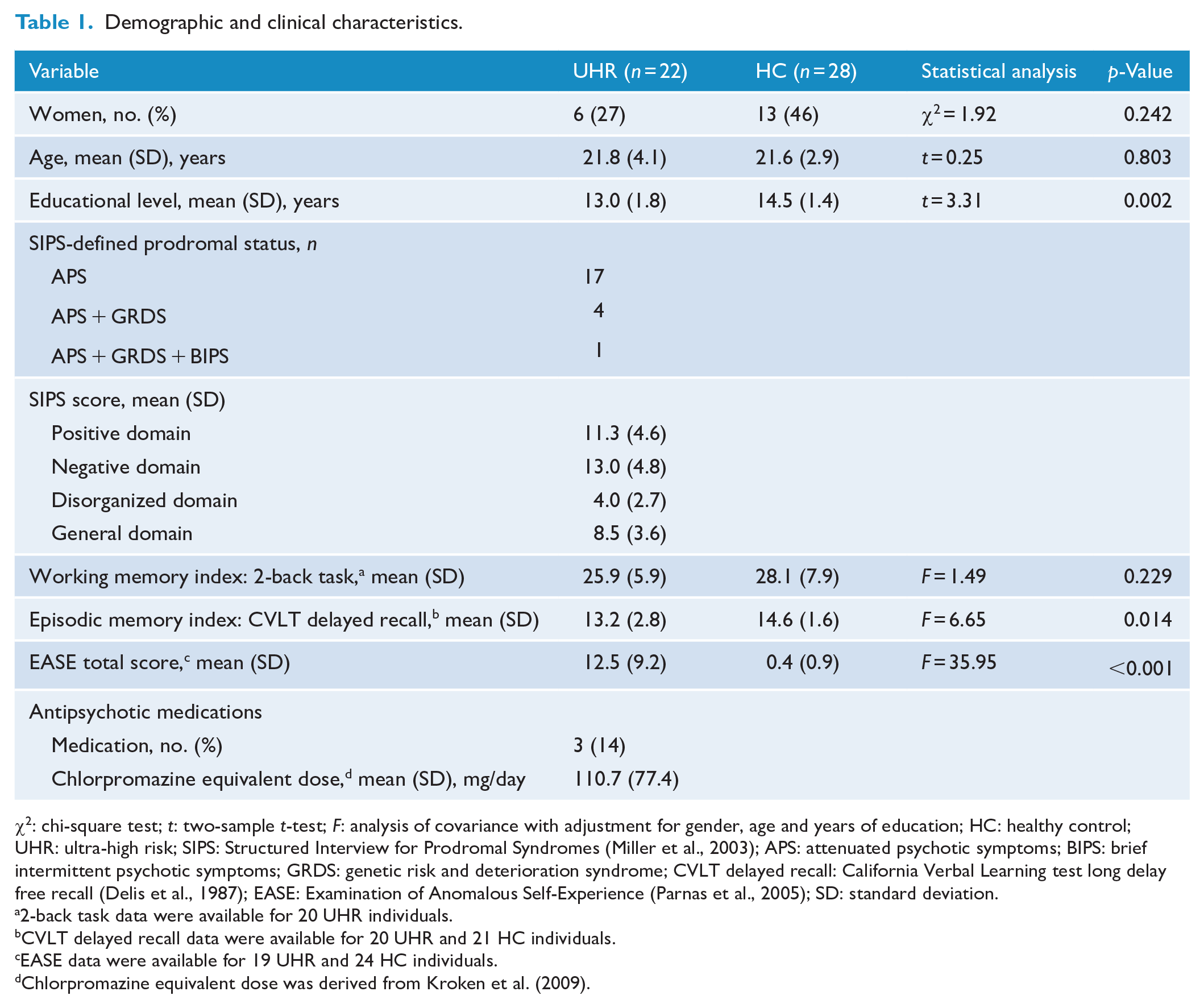
χ2: chi-square test; t: two-sample t-test; F: analysis of covariance with adjustment for gender, age and years of education; HC: healthy control; UHR: ultra-high risk; SIPS: Structured Interview for Prodromal Syndromes (Miller et al., 2003); APS: attenuated psychotic symptoms; BIPS: brief intermittent psychotic symptoms; GRDS: genetic risk and deterioration syndrome; CVLT delayed recall: California Verbal Learning test long delay free recall (Delis et al., 1987); EASE: Examination of Anomalous Self-Experience (Parnas et al., 2005); SD: standard deviation.
2-back task data were available for 20 UHR individuals.
CVLT delayed recall data were available for 20 UHR and 21 HC individuals.
EASE data were available for 19 UHR and 24 HC individuals.
Chlorpromazine equivalent dose was derived from Kroken et al. (2009).
Behavioral data
Detailed results for reaction times and numbers of responses are provided in the supplementary material. The repeated-measures ANOVA on mean reaction times showed that a 3PP [2091.6 (69.3) ms] took longer response times than a 1PP [1999.0 (61.4) ms], and other-as-target [2109.2 (69.4) ms] took longer response times than self-as-target [1981.3 (63.3) ms]. Reaction times significantly differed according to response type [1, 2, 3 and 4; 2170.4 (71.1), 2409.4 (65.9), 2131.7 (78.5) and 1469.5 (123.6) ms, respectively]. The analysis on the number of responses resulted in lower number of responses for UHR individuals [9.4 (0.1)] than for HC individuals [9.8 (0.1)], and lower number of responses for a 3PP [9.6 (0.1)] than a 1PP [9.7 (0.1)]. The number of responses significantly differed according to response type [1, 2, 3 and 4; 10.1 (0.6), 14.7 (0.7), 10.1 (0.6) and 3.6 (0.7), respectively].
fMRI data
Main effect of reference target: self vs other
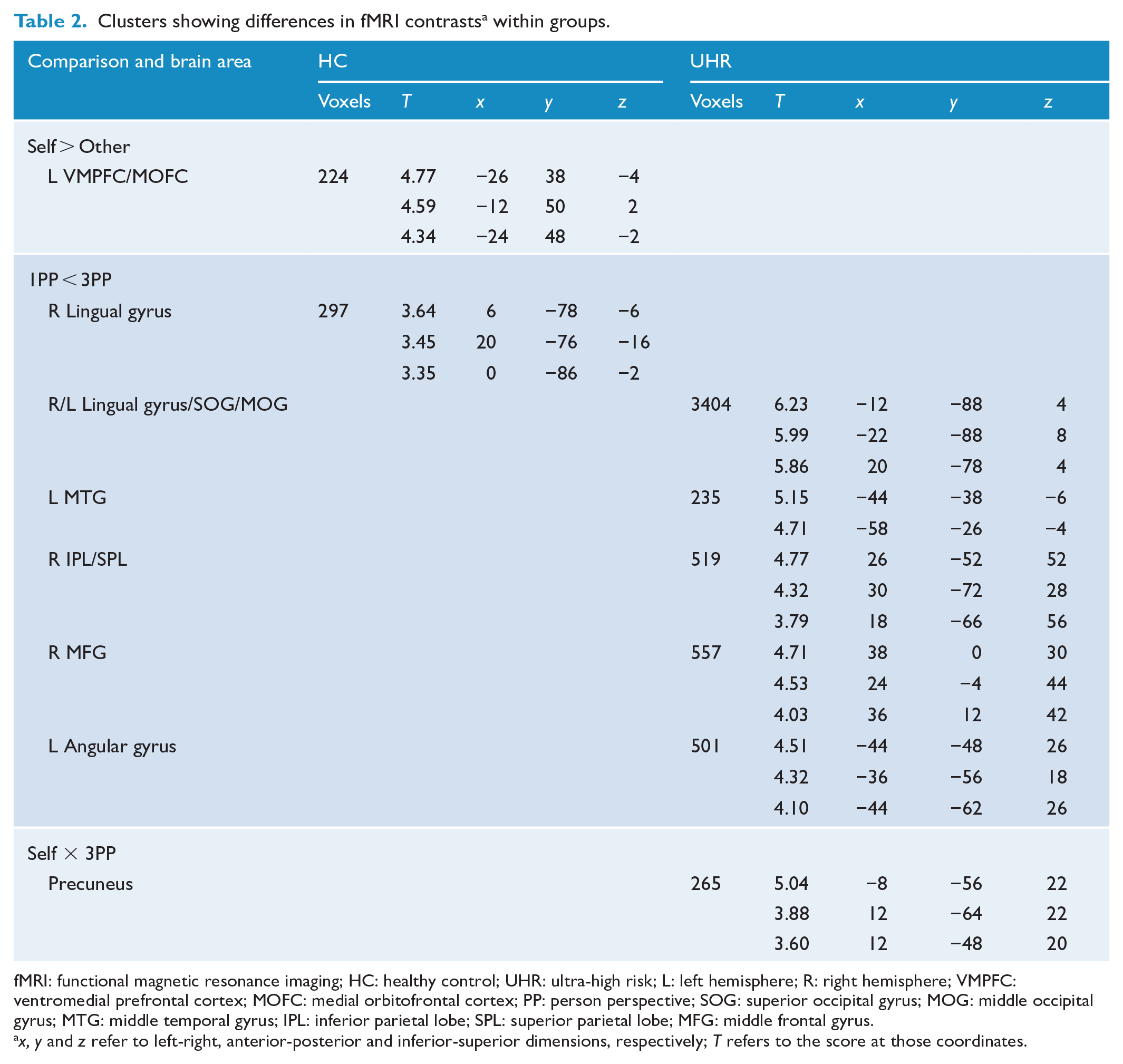
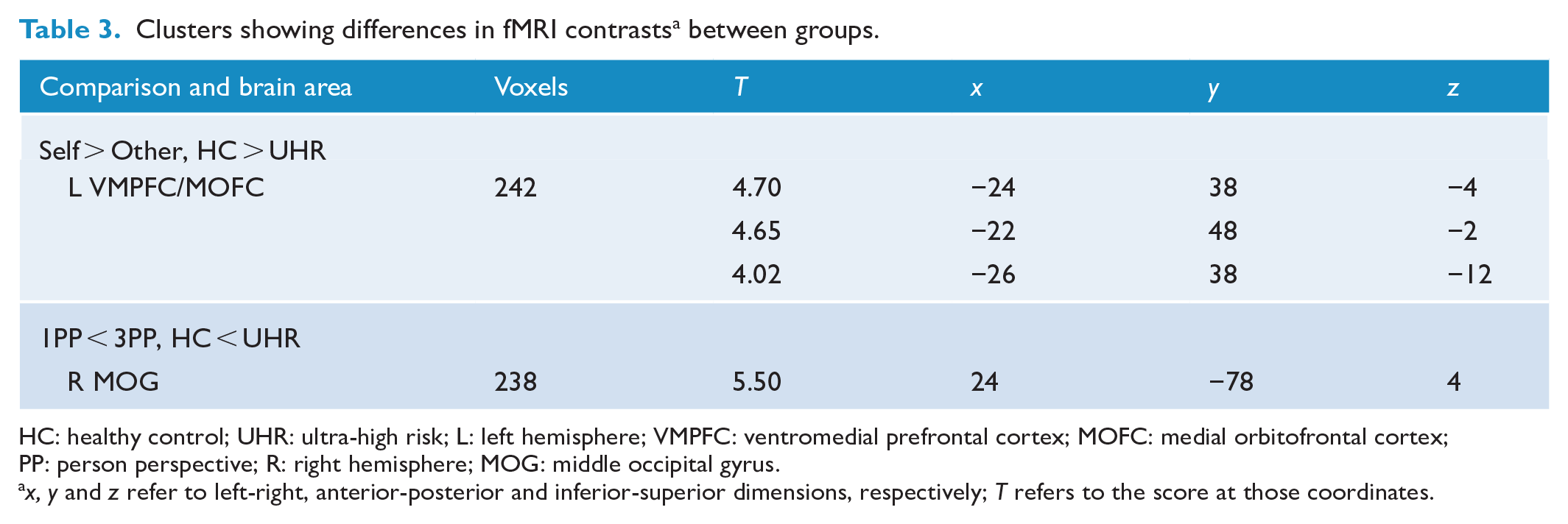
The left VMPFC/medial orbitofrontal cortex (MOFC) was significantly more active during the self-as-target condition than the other-as-target condition within HC individuals, whereas there were no significantly activated regions during the self-as-target condition within UHR individuals [self > other: (1PP_self + 3PP_self) – (1PP_other + 3PP_other)] (Table 2, Supplementary Figures 3A and 4A). UHR individuals showed significantly less activity in the left VMPFC/MOFC than HC individuals in the self-as-target condition (Table 3, Figure 1(A)). To rule out the confounding effect of treatment with antipsychotics in three UHR individuals, the same analysis was performed with medication-free UHR individuals (n = 19). The analysis yielded the identical results independent of treatment with antipsychotics.
Clusters showing differences in fMRI contrasts a within groups.
fMRI: functional magnetic resonance imaging; HC: healthy control; UHR: ultra-high risk; L: left hemisphere; R: right hemisphere; VMPFC: ventromedial prefrontal cortex; MOFC: medial orbitofrontal cortex; PP: person perspective; SOG: superior occipital gyrus; MOG: middle occipital gyrus; MTG: middle temporal gyrus; IPL: inferior parietal lobe; SPL: superior parietal lobe; MFG: middle frontal gyrus.
x, y and z refer to left-right, anterior-posterior and inferior-superior dimensions, respectively; T refers to the score at those coordinates.
Clusters showing differences in fMRI contrasts a between groups.
HC: healthy control; UHR: ultra-high risk; L: left hemisphere; VMPFC: ventromedial prefrontal cortex; MOFC: medial orbitofrontal cortex; PP: person perspective; R: right hemisphere; MOG: middle occipital gyrus.
x, y and z refer to left-right, anterior-posterior and inferior-superior dimensions, respectively; T refers to the score at those coordinates.
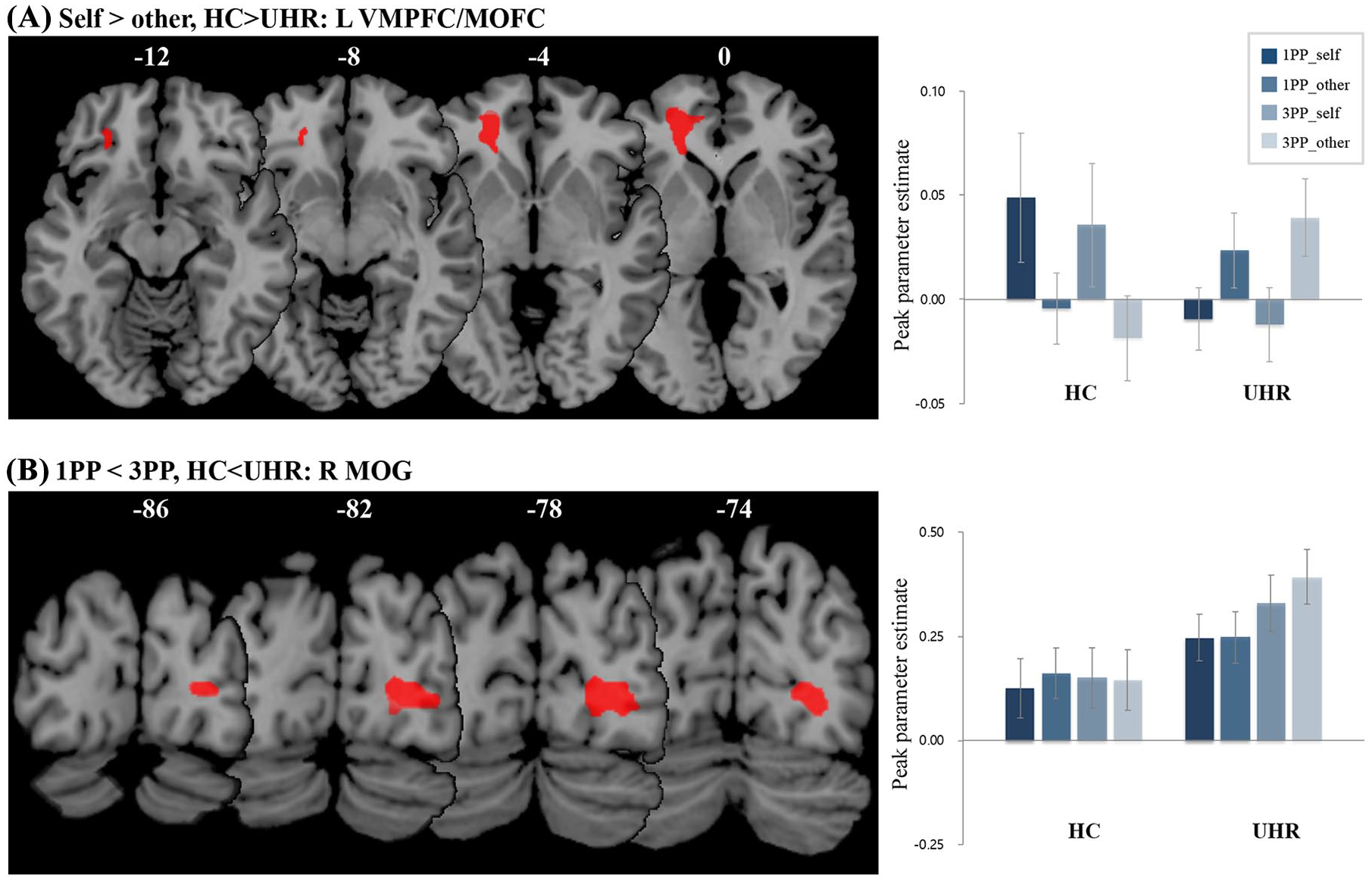
Differences in neural activity between HC and UHR individuals: (A) Target-self versus target-other for HC > UHR and (B) 3PP versus 1PP for HC < UHR.
Main effect of perspective-taking: 3PP vs 1PP
The right lingual gyrus was significantly more active during the 3PP condition than the 1PP condition within HC individuals, whereas the lingual gyrus, superior occipital gyrus, middle occipital gyrus (MOG), right inferior parietal lobe with superior parietal lobe, left angular gyrus, and right and left middle frontal gyrus were significantly more active during the 3PP condition than the 1PP within UHR individuals [3PP > 1PP: (3PP_self + 3PP_other) – (1PP_self + 1PP_other)] (Table 2, Supplementary Figures 3B and 4B–C). UHR individuals showed significantly greater activity in the right MOG than HC individuals in the 3PP condition (Table 3, Figure 1(B)). The results did not change when the analysis was repeated with medication-free UHR individuals to exclude the effects of antipsychotic medication in UHR individuals.
Interaction between perspective-taking and reference target
The precuneus was significantly more active when taking a 3PP in the self-as-target condition within UHR individuals [(3PP_self – 3PP_other) – (1PP_self – 1PP_other)] (Table 2, Supplementary Figures 3C and 4D). HC individuals showed no significantly activated regions in this specific condition. However, no significant effect of group on the interaction contrast was observed, hence this interaction is not discussed further.
Correlations among neural activity, clinical variables and behavioral outcomes within UHR group
Correlation analyses between the measure of working memory and the parameter estimates of neural activity showed that 2-back task scores were positively correlated with the peak parameter estimates of the left VMPFC/MOFC in the self-as-target condition when taking a 1PP (Spearman ρ = 0.58, Holm–Bonferroni corrected p = 0.047; Figure 2(A)) and 3PP (Spearman ρ = 0.57, Holm–Bonferroni corrected p = 0.047; Figure 2(B)). Neither episodic memory using CVLT delayed recall score nor basic self-disorder using EASE total score was correlated with neural activity in any region. There was no significant correlation between the psychotic symptoms using SIPS score and peak parameter estimates of the left VMPFC/MOFC responses.
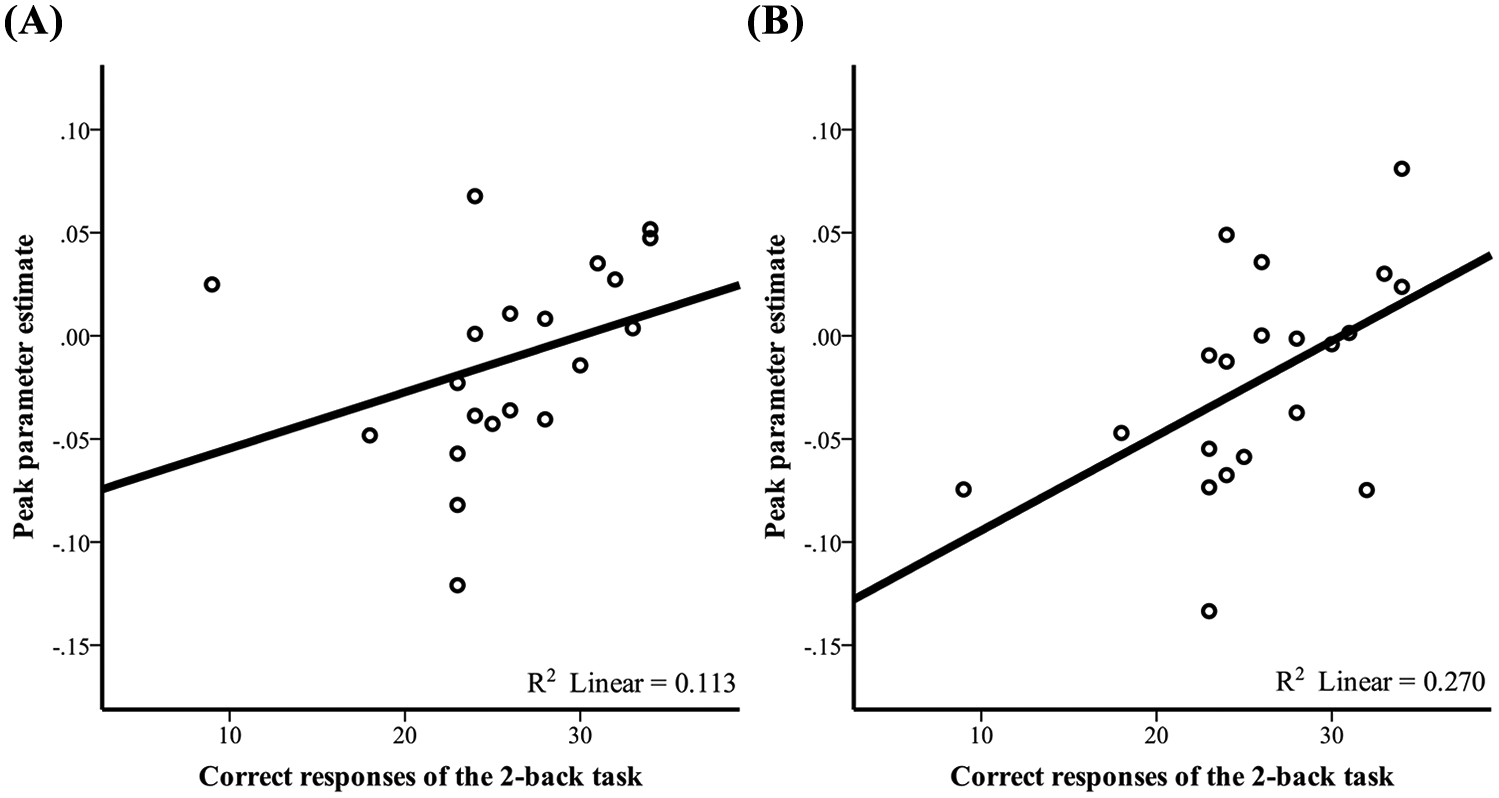
Correlation between working memory and VMPFC activation within UHR individuals (n = 20). Plots and regression lines of correlations between 2-back task score and parameter estimate of VMPFC/MOFC activity for judgment of self-relevance contrasts at MNI coordinates of peak voxel (−24, 38, −4) when taking a (A) 1PP or (B) 3PP.
Both reaction times and numbers of responses in four conditions (1PP_self, 3PP_self, 1PP_other, 3PP_other) were not correlated with the peak parameter estimates in any region. No significant correlation was found between reaction times or numbers of responses in all conditions and working memory performance.
Discussion
To our knowledge, this is the first study to investigate the neural correlates of self-referential processing and perspective-taking within individuals at UHR for psychosis using a factorial design in which both dimensions were manipulated to disentangle these interdependent processes. We further explored relationships between these neural correlates and measures of neurocognitive function and basic self-disturbance. When judging the relevance of self as a reference target from both a 1PP and 3PP, UHR individuals showed reduced activity in the left VMPFC/MOFC, which was correlated with poor working memory performance. When taking a 3PP during both self-referential and other-referential processing, UHR individuals showed higher activity in the right MOG.
Self-referential processing
Our observation of left VMPFC/MOFC activation during self-referential processing within HC individuals is consistent with several previous findings (D’Argembeau et al., 2007; Northoff et al., 2006). Recruitment of the VMPFC/MOFC during self-referential processing may reflect the judgment of stimuli based on degree of value to self-concept or endorsement of self-relevance. Within UHR individuals, however, we observed reduced left VMPFC/MOFC activity during self-referential processing. Both reaction times and numbers of responses were not correlated with the peak parameter estimates of the left VMPFC/MOFC within the UHR group, and those behavioral data were not correlated with working memory performance either. Therefore, the reduced neural activity in UHR individuals is likely not due to lower attention or effort during the self-referential task. In line with previous studies of chronic schizophrenia patients (Bedford et al., 2012; Blackwood et al., 2004; Holt et al., 2011; Menon et al., 2011; Pankow et al., 2016) showing reduced activation of anterior CMS (Bedford et al., 2012; Blackwood et al., 2004; Holt et al., 2011; Menon et al., 2011; Pankow et al., 2016), including the VMPFC (Blackwood et al., 2004; Holt et al., 2011; Pankow et al., 2016), during 1PP-taking during self-related tasks (but see Lariviere et al., 2017), our findings indicate that even putative ‘prodromal’ individuals may show abnormal VMPFC/MOFC activity during self-referential processing regardless of the perspective taken.
Clinically, reduced VMPFC/MOFC activity in UHR individuals may be a marker of the emergence of early, mild clinical symptoms, as this reduced activity is absent in at-risk individuals without behavioral manifestations but present after the onset of overt psychosis (Lariviere et al., 2017). Nonetheless, this possibility was not supported by our data which showed no significant correlation between the SIPS score and peak parameter estimates of the left VMPFC/MOFC responses in UHR group. From phenomenological perspective, lack of a correlation between the parameter estimates of the VMPFC/MOFC activity and EASE total score may not support the possibility of VMPFC/MOFC as a neural signature of basic self-disorder in UHR individuals. However, the nonsignificant correlation could be partially derived from the characteristic of our fMRI task which asked the participants to judge personality trait adjectives that may reflect the narrative level of self more than basic self. Recent restring-state studies observed an overlap between the neural substrate of self-referential processing and resting state activity in the CMS (Huang et al., 2016). It has been suggested that information related to self could be represented in resting state (Wolff et al., 2019), and the spontaneous activity in schizophrenia may reflect certain psychopathological symptoms such as the basic self-disorder (Northoff and Duncan, 2016). Therefore, further studies of resting state in UHR individuals may be needed to examine the relationship between the VMPFC/MOFC activity and basic self-disorder. From neurocognitive perspective, more plausibly, reduced left VMPFC/MOFC activity may be related to the neurocognitive control process of working memory in UHR individuals, as we found a correlation between left VMPFC/MOFC activity and 2-back task performance. A previous electroencephalography study found that self-referential processing induced an index of working memory, which was measured by left centromedial theta band event-related synchronization (Mu and Han, 2010). In consideration of that previous finding, the correlation between VMPFC/MOFC activation and working memory in UHR individuals may indirectly support that the reduced VMPFC/MOFC activation during self-referential processing in UHR individuals may possibly be related to engagement of working memory resources.
Interestingly, the pattern of contrast estimates of the VMPFC/MOFC appeared reduction in the self-targeted condition and increment in the other-targeted condition for UHR individuals compared to HC. A previous study based on forward models (Shergill et al., 2014), which is a basic model of differentiation between self and other, found that secondary somatosensory cortex in schizophrenia showed increased activity during self-generated movement and decreased activity in the absence of self-movement. The opposite pattern of our VMPFC/MOFC activity in UHR individuals may propose the possibility of a generalized failure of its function as the prediction substrate of the self.
Contrary to our expectation, posterior CMS, in particular the PCC, were not activated during self-referential processing within HC individuals and showed no differences in neural activity between groups. One explanation may be because the PCC is not unique to self-referential processing (van der Meer et al., 2010). Another possible explanation is that increased neural activity of posterior CMS may contribute to the onset of overt psychosis, as the increased activation of posterior CMS is typically observed in schizophrenia patients (Blackwood et al., 2004; Holt et al., 2011; Shad et al., 2012) but was not observed among our UHR individuals, who showed subthreshold clinical symptoms. From a phenomenological point of view, increasing severity of basic self disturbances may involve neural changes for coping with distress (Sass and Borda, 2015). Therefore, UHR individuals who do not yet greatly need compensatory effort as overt psychotic patients may not show activation of posterior CMS during self-referential processing.
3PP-taking
We found that taking a 3PP rather than a 1PP activated the lingual gyrus in HC individuals and lingual gyri with the adjacent superior occipital gyrus and MOG in UHR individuals. The activation of visual areas in the 3PP condition may be due to autobiographical memory retrieval (Svoboda et al., 2006), which can involve vivid imagery (Cui et al., 2007). When taking a 3PP, UHR individuals also showed greater neural activity in temporoparietal regions apart from the visual area, which may reflect the transfer of one’s own egocentric perspective onto another person’s axis (D’Argembeau et al., 2007), attention shifts to the content of retrieved memories (Cabeza et al., 2008) or the retrieval of autobiographical knowledge (Svoboda et al., 2006). This interpretation is supported by the observed slower reaction times for 3PP as compared with 1PP conditions in both groups. Also, between-group comparisons indicated that UHR individuals showed greater MOG activity when taking a 3PP than HC individuals. This result is compatible with the previous finding (Brune et al., 2011) that UHR individuals show compensatory overactivation of brain regions during a mental state attribution task. This possible compensatory overactivation of the MOG in UHR individuals may not be closely associated with episodic memory retrieval, as we found no correlation between MOG activity and CVLT delayed recall score.
Contrary to our hypothesis, we found no activation of the posterior DMPFC within HC individuals and no reduced activation patterns between 3PP and 1PP conditions within UHR individuals. This may be because our behavioral task did not require inhibition of responses from an egocentric reference frame, as the perspectives of one’s self and another person (especially a closely related person) tend to coincide (Keysar et al., 2003). It is also possible that as the DMPFC is one of the last areas to develop (Shaw et al., 2008), the 3PP condition may not have engaged this region in our young participants, as 3PP processes consolidate in parallel with neurodevelopmental maturation (Pfeifer and Peake, 2012).
This study has several limitations. First, antipsychotic-medicated subjects may have confounded the findings. However, only 3 of 22 UHR individuals were medicated in our study, and we yielded the identical results when the analysis was repeated with medication-free UHR individuals. Thus, the effects of antipsychotic medication on our tasks appear to be very limited to change the main findings. Second, UHR individuals had fewer years of education than HC individuals. However, years of education was entered as a covariate in our imaging analysis to reduce the influence of educational differences on self-related neural activity. Third, although the two groups had similar reaction times and numbers of responses, it would be informative to assess the accuracy of participants’ ratings as an index of self-awareness, similar to a previous study that measured the concordance of ratings between participants and their relatives (Klein et al., 1999). Follow-up studies including such a measure could increase our understanding of the relationship between self-awareness in UHR individuals and dysfunction of the VMPFC. Fourth, the less stringent voxel-level threshold, an uncorrected p < 0.005, could raise concerns about elevated type-I error in fMRI studies even though it has been frequently used when combining a voxel-level threshold with a cluster-extent threshold based on Monte Carlo simulation (Eklund et al., 2016). However, recent evidence suggests that it could be considerably overstated concerns (Cox et al., 2017). It has been discussed that in neuroimaging, relative to behavioral tasks that allow for variability among trials in timing or degree of cognitive processing, the Type II error may be likely to be increased by the thresholds taken to diminish Type I errors (Lieberman and Cunningham, 2009). In addition, it was suggested to apply a lesser stringent method when studies have less than 100 subjects (Carter et al., 2016) due to false-negative results. Furthermore, we believe the possibility of false-positive resulting is unlikely given that the less stringent threshold could be justified due to a great number of evidences that the VMPFC/MOFC is critical for self-related mental processing in lesion studies (Bertossi and Ciaramelli, 2016; Sui et al., 2015) and is activated in prior functional imaging studies of self-referential processing in healthy participants (D’Argembeau et al., 2007; Northoff et al., 2006; van der Meer et al., 2010). The fMRI results, however, should be interpreted with caution. Finally, UHR individuals, including those in our study, have comorbid illnesses such as depressive disorder and social phobia that could disrupt self-referential processing. Although patients with depressive disorder (Lemogne et al., 2012) or social phobia (Blair et al., 2008) are reported to show increased MPFC activation, further studies are needed to characterize self-reflection by brain activity response times in true-positive UHR populations.
In summary, when judging the relevance of personality adjectives to self as a reference target from both a 1PP and 3PP, UHR individuals showed reduced neural activity in the left VMPFC/MOFC, which was correlated with poor working memory performance. When taking a 3PP during both self-referential and other-referential processing, UHR individuals showed increased activity in the right MOG. These findings suggest that UHR individuals already show aberrant neural activity during self-referential processing, which may possibly be related to engagement of working memory resources.
Supplemental Material
Online_Supplementary_Material – Supplemental material for Reduced activation of the ventromedial prefrontal cortex during self-referential processing in individuals at ultra-high risk for psychosis
Supplemental material, Online_Supplementary_Material for Reduced activation of the ventromedial prefrontal cortex during self-referential processing in individuals at ultra-high risk for psychosis by Hye Yoon Park, Kyoungri Park, Eunchong Seo, Se Jun Koo, Minji Bang, Jin Young Park, Jee In Kang, Eun Lee, Seung-Koo Lee and Suk Kyoon An in Australian & New Zealand Journal of Psychiatry
Footnotes
Acknowledgements
We thank Mr Youn Kook Kim for technical assistance with neuroimaging data acquisition and Ms Jee Eun Min for support with clinical data management.
Declaration of Conflicting Interests
The author(s) declared no potential conflicts of interest with respect to the research, authorship and/or publication of this article.
Funding
The author(s) disclosed receipt of the following financial support for the research, authorship and/or publication of this article: This work was supported by the Basic Science Research Program through the National Research Foundation of Korea (NRF) funded by the Ministry of Science, ICT & Future Planning, Republic of Korea (grant number 2017R1A2B3008214).

Supplemental Material
Supplemental material for this article is available online.
References
Supplementary Material
Please find the following supplemental material available below.
For Open Access articles published under a Creative Commons License, all supplemental material carries the same license as the article it is associated with.
For non-Open Access articles published, all supplemental material carries a non-exclusive license, and permission requests for re-use of supplemental material or any part of supplemental material shall be sent directly to the copyright owner as specified in the copyright notice associated with the article.
