




Abstract
Objectives:
Suicide rates in India are among the highest in the world, resulting in an estimated 250,000 suicide deaths annually. How the media communicates with the Indian public on the topic of suicide has thus far gone without sufficient scrutiny. The objective of our study was to assess the quality of newspaper reporting of suicide-related news in India against World Health Organization suicide reporting guidelines.
Methods:
We used content analysis to assess the quality of suicide reporting against World Health Organization guidelines in nine of the most highly read daily newspapers in the southern state of Tamil Nadu between June and December 2016. Five of the nine newspapers under review were in the top 20 most circulated daily newspapers in the country.
Results:
A total of 1681 suicide articles were retrieved. The mean number of suicide articles per day per newspaper was 0.9%, and 54.5% of articles were 10 sentences or less. The vast majority (95.9%) of articles primarily focused on reporting specific suicide incidents. Harmful reporting practices were very common (e.g. a detailed suicide method was reported in 43.3% of articles), while helpful reporting practices were rare (e.g. just 2.5% gave contact details for a suicide support service).
Conclusions:
We observed that a daily diet of short and explicit suicide-related news was served up to readers of newspapers. Attempts should be made to understand the perspectives of media professionals in relation to suicide reporting, and to devise strategies to boost the positive contribution that media can make to suicide prevention.
Background
Suicide is a major global health problem. Worldwide, over 800,000 suicide deaths occur every year, and Asia accounts for up to 60.0% of suicide deaths (Beautrais, 2006; World Health Organization [WHO], 2014). Suicide rates in India are among the highest in the world with an estimated suicide death rate of 21 per 100,000 (cf. global suicide rate 11.4/100,000), equating to over 250,000 suicide deaths annually with far-reaching social, emotional and economic consequences (WHO, 2014). There are more suicide deaths in India each year than AIDS-related and maternal deaths combined (Patel et al., 2012), yet suicide attracts relatively less public health attention. In response to the magnitude of this issue, a public health approach to suicide prevention is gaining momentum in India, yet the manner by which the media communicates with the Indian public on the topic of suicide has thus far gone without scrutiny (Ponnudurai, 2015).
One of the few promising suicide prevention strategies at the population level is responsible media reporting of suicides (Krysinska et al., 2016; Turecki and Brent, 2016; Zalsman et al., 2016). Given the influence of mass media on public opinion, it is highly likely that media reporting will have a significant impact on the public’s awareness and attitudes about suicide and its prevention (Klimes-Dougan et al., 2016; Niederkrotenthaler et al., 2014). There are concerns that media reporting can be a source of misinformation, such as by offering simplistic, monocausal explanations that imply suicide is a solution to immediate triggers rather than being correlated with a complex array of proximal and distal risk factors (e.g. poor mental health, child sex abuse and cultural/religious attitudes towards suicide) (Beautrais et al., 2008; Hawton and van Heeringen, 2009). Mass media reports may also stigmatise suicide and reduce help seeking (Niederkrotenthaler et al., 2014), and can have insufficient consideration for persons bereaved by suicide deaths.
Furthermore, numerous studies have demonstrated that some media reports of suicide incidents can be a stimulus for imitation acts by vulnerable people (Niederkrotenthaler et al., 2010; Pirkis et al., 2006; Stack, 2005). Evidence suggests that the imitation risk is exacerbated by sensational and graphic reporting practices, such as by publishing a detailed description of the suicide method (Niederkrotenthaler et al., 2010), and mass media can also be an unwitting vehicle for disseminating new suicide methods (Cheng et al., 2017). Strategies to address this phenomenon have been associated with reduced suicide rates (Zalsman et al., 2016). Furthermore, research from Austria observed that suicide rates reduced following media reports about people who ‘mastered’ their suicidal crisis and implemented alternative actions to suicidal behaviour (Niederkrotenthaler et al., 2010). Such articles emphasised positive coping strategies and supports that can help to prevent suicide.
Given the above, the WHO and International Association for Suicide Prevention (IASP) have developed guidelines for media reporting of suicide, primarily for use in countries that don’t already have their own national guidelines (Department of Mental Health and Substance Abuse, 2008). However, implementation of the WHO guidelines has been varied, and anecdotal evidence suggests a high level of graphic and explicit media reporting of suicide in Asia (Beautrais et al., 2008; Fu et al., 2011; Fu and Yip, 2009; Ji et al., 2014), including in India where an increasingly literate rural population is driving the world’s fastest-growing newspaper market (Beautrais, 2006; Chandra et al., 2014; Ramadas et al., 2014; The Economist, 2016).
The objective of this study was to assess the quality of newspaper reporting of suicide-related news in India against WHO suicide reporting guidelines. Due to the large number of languages across India and the prohibitive level of resources required to fund a study with a broad national spread of newspapers published in a range of languages, we elected to undertake a comprehensive study of newspaper reporting in one state. We chose Tamil Nadu, which lies in the southernmost part of the Indian Peninsula and is the sixth most populous state in India with a population of 72 million. Tamil Nadu consistently has one of the highest suicide rates in India (22.8/100,000) resulting in 15,777 recorded suicide deaths in 2015 (i.e. 43 suicide deaths per day)(National Crime Records Bureau, 2015). The approach of focusing on one state also allows us to comprehensively track changes in media reporting in this state following upcoming efforts to engage with the media on this topic.
Methods
As part of the Suicide in Indian Media (SIM) project, we undertook a content analysis study of articles reporting suicide-related news in 9 of the 10 most highly read vernacular and English-language daily newspapers in Tamil Nadu over the 7-month (i.e. 214 day) period between 1 June and 31 December 2016. The 9 newspapers, all in the top 10 most highly read newspapers in the state, collectively have an estimated average daily readership of over 16,000,000 people in Tamil Nadu alone (Media Research Users Council, 2017). Five of the nine newspapers under review are in the top 20 most circulated daily newspapers in the country (Audit Bureau of Circulations, 2015), giving the findings relevance beyond Tamil Nadu.
To source the articles, the hardcopies of all 1926 (9 newspapers x 214 days) editions of the nine newspapers during the study period were hand searched by three trained research assistants (psychologists), allowing us to include several newspapers that didn’t have a strong online presence. Our search yielded 1681 suicide articles. We included articles that primarily reported on specific instances of non-fictional suicide events, including deaths, non-fatal attempts or ideation/threats. We also included articles that primarily contained general commentary on the issue of suicide, including discussion of high-risk groups, research findings, prevention programmes or initiatives, raising awareness of suicide, or commentary on any other aspect of suicide/suicide prevention. We excluded articles where suicide was only mentioned briefly (i.e. < 50% of the article) and articles with a focus on terrorist-related suicide bombings or euthanasia.
First, descriptive information was extracted from each article, including: name of newspaper, section of newspaper, number of sentences, the primary focus of the article (i.e. reporting on a suicide event versus a commentary-style article), the type of suicide event reported (i.e. suicide death, attempt, ideation/threat), whether or not the suicide event was connected to an instance of homicide-suicide or a suicide pact, and whether or not the article contained a report of a suicide event that also featured in other suicide articles (either in the same or a different newspaper).
Second, a quality assessment was undertaken to evaluate each article against the WHO suicide reporting guidelines (Department of Mental Health and Substance Abuse, 2008) (see Supplementary File 1). A comprehensive coding frame with definitions and examples for each item was designed to guide the coder in identifying a range of potentially harmful as well as helpful reporting characteristics (see Supplementary File 2). Each characteristic was coded as being either present (1) or absent (0).
A bi-lingual psychologist and researcher (MPsych, MPhil) extracted the descriptive information from each article, made the quality ratings, and entered the data into an Excel database designed for this purpose. We evaluated the inter-rater reliability of the quality assessment through a pilot study of 100 articles that were not part of the final sample. Two independent coders used the coding frame to assess the quality of the pilot study articles. Cohen’s Kappa ranged from 0.84 to 1.0, with an average of 0.95, indicating strong inter-rater reliability (McHugh, 2012). In addition, throughout the study, meetings were regularly held to seek agreement in relation to any minor doubts that arose during the coding process. Descriptive statistics were used to analyse the data that were extracted from the newspaper articles.
Results
Descriptive characteristics of the suicide articles
The number of articles reporting on suicide-related news varied considerably between newspapers (see Table 1). Of the 1681 articles, 29.6% were published in just one of the nine daily newspapers, Daily Thanti, while just 6.5% were published in New Indian Express. The average number of suicide articles per newspaper per day was 0.9 (range 0.5–2.3).
Frequency and density of suicide articles in nine major newspapers in Tamil Nadu between June and December 2016.
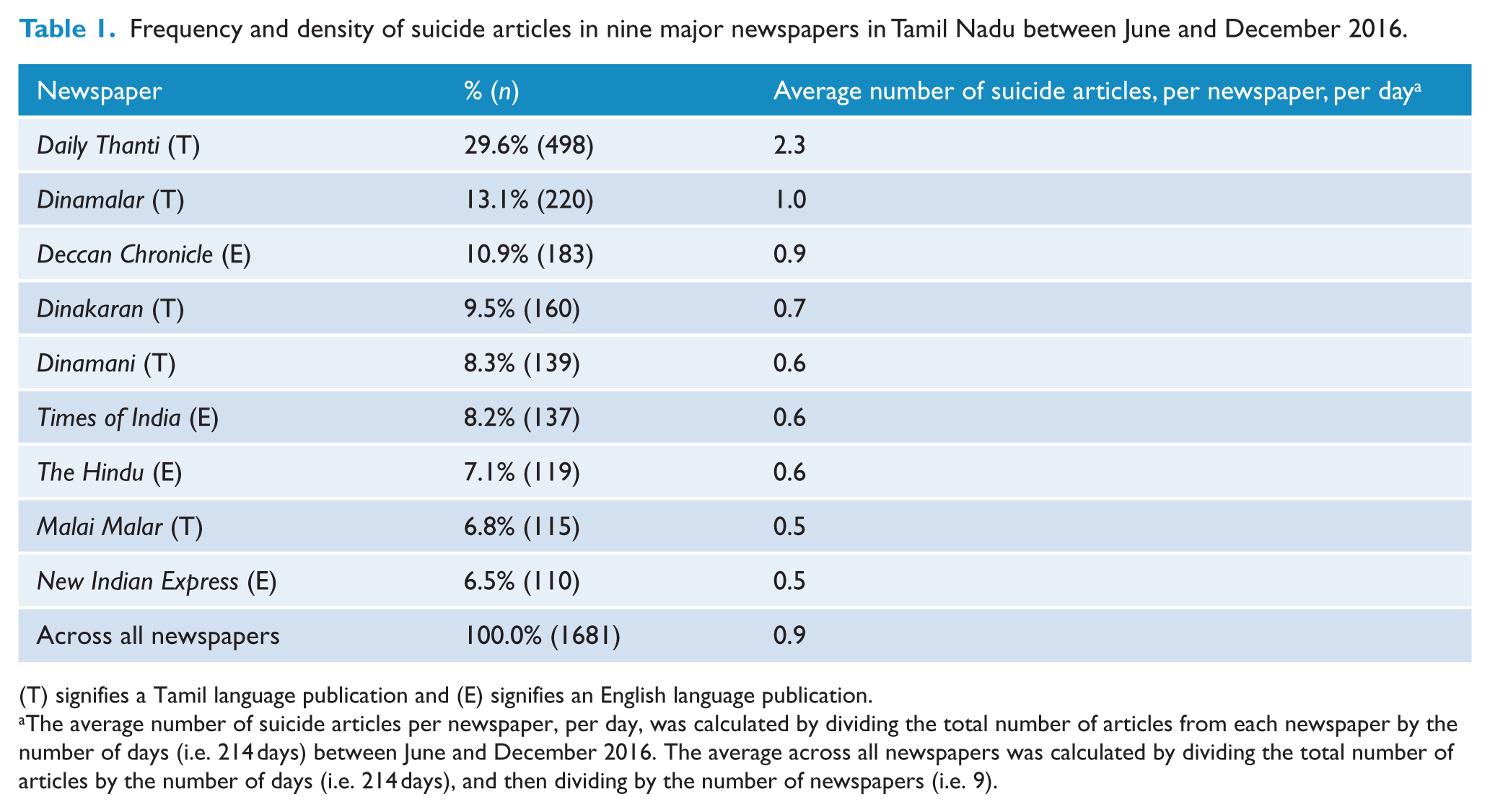
(T) signifies a Tamil language publication and (E) signifies an English language publication.
The average number of suicide articles per newspaper, per day, was calculated by dividing the total number of articles from each newspaper by the number of days (i.e. 214 days) between June and December 2016. The average across all newspapers was calculated by dividing the total number of articles by the number of days (i.e. 214 days), and then dividing by the number of newspapers (i.e. 9).
The majority were published in the main section of the newspaper (86.6%), as opposed to a supplement (13.4%) (see Table 2). The articles were typically brief, with a little over half (54.5%) being 10 sentences or less. Reports of suicide event(s) were the primary focus of the majority of articles (95.9%), with just 4.1% primarily focused on commentary on an aspect of suicide/suicide prevention.
Descriptive characteristics of suicide articles in Tamil Nadu between June and December 2016 (n = 1681).
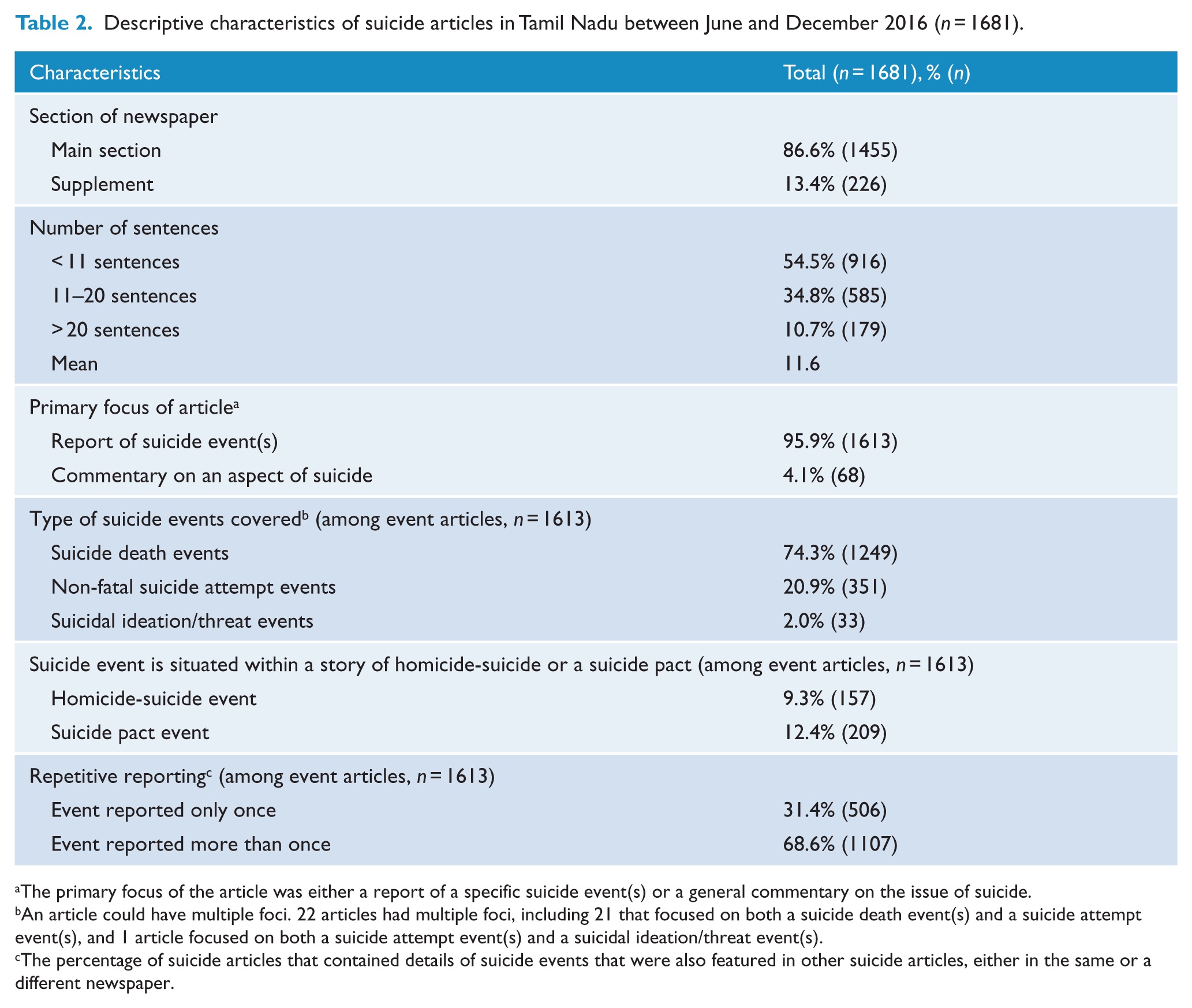
The primary focus of the article was either a report of a specific suicide event(s) or a general commentary on the issue of suicide.
An article could have multiple foci. 22 articles had multiple foci, including 21 that focused on both a suicide death event(s) and a suicide attempt event(s), and 1 article focused on both a suicide attempt event(s) and a suicidal ideation/threat event(s).
The percentage of suicide articles that contained details of suicide events that were also featured in other suicide articles, either in the same or a different newspaper.
In the 68 commentary articles, the most commonly discussed topics were suicide among farmers (32.4%, n = 22) and decriminalisation of suicide (13.2%, n = 9). The remaining commentary articles covered a disparate range of suicide/suicide prevention topics, including social media suicide prevention tools, suicide abetment legislation, stigmatising language around suicide, reducing access to guns, filicide-suicide, altruistic suicides, and suicides among a range of sub-population groups including women, youths, students, Dalits (members of the lowest caste), ex-servicemen, celebrities, and members of cults.
The most common type of suicide events reported were suicide deaths (74.3%), followed by suicide attempts (20.9%), and suicidal ideation/threats (2.0%). Among the articles reporting on these types of suicide events, a high proportion were connected to instances of homicide-suicide (9.3%) and suicide pacts (12.4%), relative to the rarity of these events, and, somewhat surprisingly, over two-thirds (68.6%) contained reports of suicide events that had also appeared in at least one other article.
Of the 33 articles reporting on instances of suicidal ideation/threats, only 1 (3.0%) took the approach of demonstrating how someone ‘mastered their suicidal crisis’ using positive coping strategies and supports. The remainder (97.0%, n = 32) were stories of incidents of people threatening suicide in response to frustrations or conflict, typically with institutions or family members. Frustrations or conflicts that were reported were broad ranging, such as perceived police inaction in response to a rape allegation, extensive court delays in a divorce hearing and parental refusal of their child’s choice of marital partner.
Assessing the quality of reporting against WHO guidelines
Several articles were prominently placed, with 4.9% of articles placed on the front page and 16.8% within the first three pages (see Table 3). The suicide method (92.7%) was almost always reported and in 43.1% of articles the method was described in detail (i.e. at least two specific details about how the method was implemented). Furthermore, 8.2% of articles named a public site as the location of a suicide death/attempt. Negative life events were reported in four out of five articles (81.3%); this extended to offering a monocausal explanation for a suicide event in 53.4% of articles and 9.5% of articles reported on details from a suicide note.
Quality assessment of reporting against World Health Organization suicide reporting guidelines.
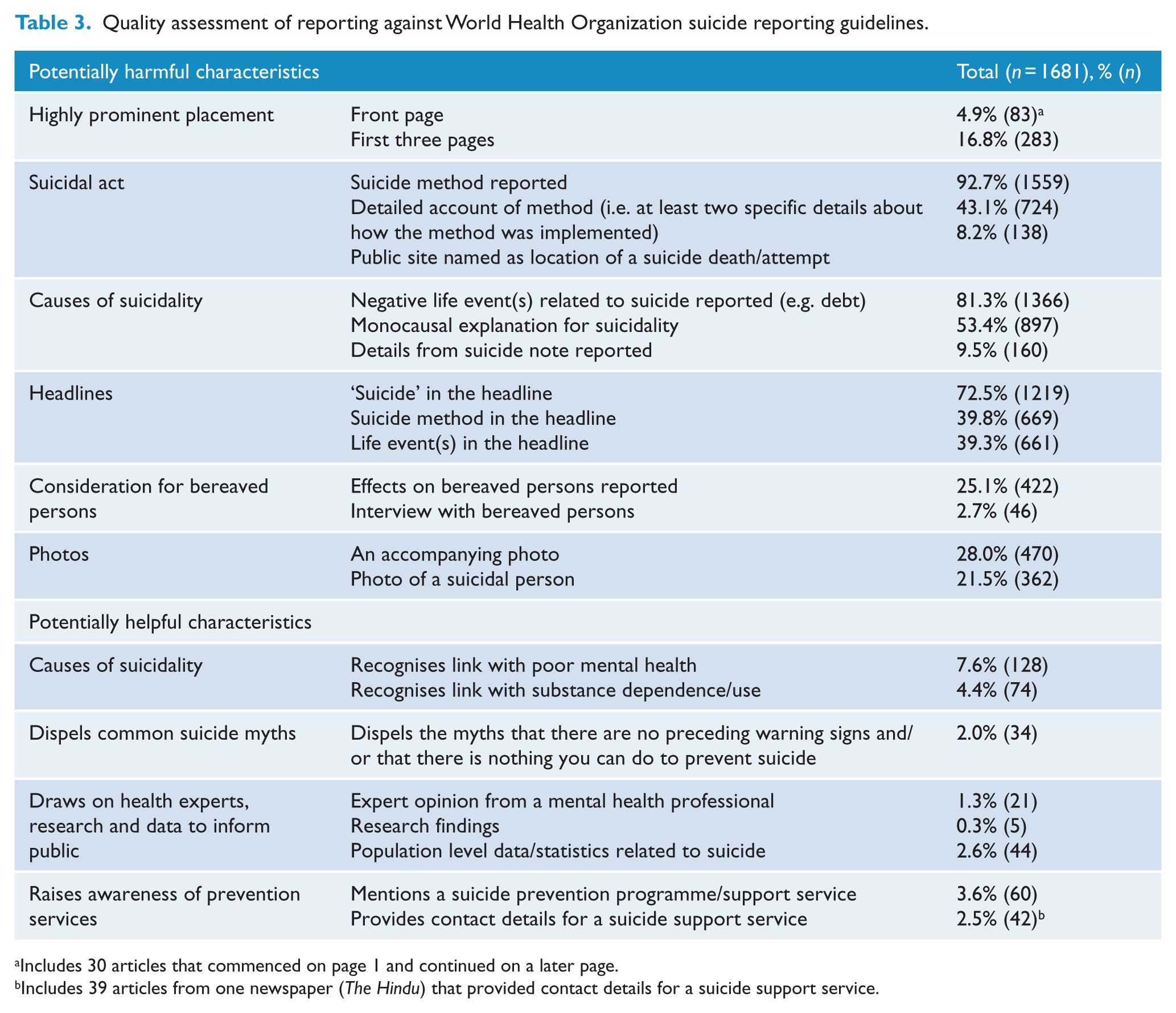
Includes 30 articles that commenced on page 1 and continued on a later page.
Includes 39 articles from one newspaper (The Hindu) that provided contact details for a suicide support service.
Headlines were particularly ‘eye-catching’, often containing the word ‘suicide’ (72.5%), a suicide method (39.8%) and/or a negative life event (39.3%) that was typically purported to be a causal factor in the suicide incident. For example, we observed the headlines ‘Debt trap: Three of a family commit suicide using lethal shots’ (New Indian Express, 13 June 2016) and ‘Girl blamed for poor cooking hangs herself ’ (Daily Thanti, 16 June 2016). Accompanying photos of suicidal persons were also common (21.7%), which goes against guidelines that caution the use of such photos unless family members have given explicit permission. In some instances, these photos were highly sensationalistic, for example, a photo of a suicidal person ablaze with bystanders attempting to douse the flames was published on a front page (Daily Thanti, 16 September 2016). Another common feature was a description of the effects of a suicide event on bereaved persons (25.1%), which was typically a description of the distress of finding the body of a friend or family member, for example, ‘when they broke open the door they were shocked to find [their 15 year old son] hanging from the ceiling fan’ (Deccan Chronicle, 13 June 2016). However, interviews with bereaved persons were very rare (2.7%).
Potentially helpful reporting characteristics were largely absent. The connection between mental health problems (7.5%) or drug/alcohol abuse (4.4%) and suicidality was infrequently made. Opinions from mental health professionals (1.1%), research findings (0.3%) and population-level suicide statistics (2.6%) were very rarely featured. Just 3.6% of articles mentioned a suicide prevention programme/service and only 2.5% gave specific contact details for a suicide support service such as a hotline.
The quality of reporting varied between newspapers (see Supplementary File 3). For example, 39 of 42 articles that reported contacted details for a suicide support service were from one newspaper (The Hindu).
Discussion
Responsible media reporting of suicide is advocated as an effective population-level suicide prevention strategy (WHO, 2014; Zalsman et al., 2016), aimed at reducing imitation suicide deaths, improving suicide-related attitudes and preventive practices, and showing due consideration to bereaved persons (Department of Mental Health and Substance Abuse, 2008; WHO, 2014). Our study found that a daily diet of short, explicit, repetitive, simplistic and potentially harmful suicide-related news was served up to readers of popular daily newspapers in Tamil Nadu, India, with a low level of adherence to WHO suicide reporting guidelines.
The high frequency of suicide articles and harmful reporting characteristics that we observed is consistent with concerns that adherence to guidelines is particularly low in Asia, where suicide deaths are highly newsworthy events (Beautrais et al., 2008; Fu et al., 2011; Fu and Yip, 2009; Ji et al., 2014). Considering the high suicide rate in some parts of Asia and the documented influence of media reports on imitative suicides, particularly when the report is of a celebrity (Chen et al., 2010; Cheng et al., 2007; Fu and Chan, 2013; Niederkrotenthaler et al., 2012), there is a clear need for the implementation and evaluation of strategies that engage the media in suicide prevention.
The suicide-related articles we examined did little to educate the public about the issue of suicide, consolidating findings from a small prior study of newspapers in the city of Bangalore (Chandra et al., 2014). Very few articles contained expert opinions from health professionals, research findings, suicide statistics or information about suicide prevention programmes, all of which are useful ways to educate the public about the issue of suicide and to inform that help is available for those in crisis. Very few articles reported in a way that served to dispel the myths that there is nothing you can do to prevent suicide and that there are no preceding warning signs. This is an unfortunate missed opportunity considering that a recent household survey in a major South Indian city found that over 50% of people believe in the myth that ‘suicide happens without warning’ (Poreddi et al., 2016). Similarly, few articles recognised the link between poor mental health and drug/alcohol abuse with suicidality, both major risk factors for suicide (Armstrong et al., 2014; Borges et al., 2017; Cavanagh et al., 2003; Cottler et al., 2005; Hawton and van Heeringen, 2009; Nock et al., 2008) and something that is a challenge to address in India where mental health literacy is low and stigmatising attitudes are prominent (Armstrong et al., 2011; Hofmann-Broussard et al., 2017; Shidhaye and Kermode, 2013).
It is critical to note that until early 2017 ‘attempt to commit suicide’ was a crime under the Indian Penal Code, as formulated by the British Raj (Ranjan et al., 2014). Consistent with this, it is often crime journalists who report on suicide incidents in India, and they have the relationship with the police who provide the information on these incidents. The recent decriminalisation of suicide may prove to be an important and timely catalyst, shifting suicide out of the criminal realm and into the health sphere. Responsible media reporting of suicide by health and social, rather than crime, journalists will be an important component of this progression.
It is unlikely media professionals in India will independently engage with the WHO media guidelines en masse without local advocacy, training and support, particularly given the intense pressures to quickly create commercially competitive content. One strategy that has improved reporting in Australia has been to develop national guidelines for media reporting of suicide (Pirkis et al., 2009), and it may be worthwhile considering the approach of developing media guidelines that are relevant to the Indian context and that have the support of the Indian Press Council. However, it will be important to learn from previous experiences elsewhere in the world. A recent review found that there is significant variability in the effect of media guidelines across countries. While guidelines typically improved the quality of reporting, journalists’ awareness, use and opinion of guidelines was generally low, and approaches centred on media consultation and collaboration had the greatest success (Bohanna and Wang, 2012). Media professionals may legitimately argue that it is in the public interest to report on newsworthy suicides and some could be sceptical about the association between media reports and imitative suicidal behaviour, viewing any restrictions as censorship that perpetuates ‘taboos’ around suicide (Bohanna and Wang, 2012; Collings and Kemp, 2010; Sinyor et al., 2016). To inform the development of national guidelines, further research should examine the perspectives of media professionals in India in relation to suicide reporting to enable a critical engagement with their concerns, as has been done elsewhere (Cheng et al., 2014). Any national guideline development process should be done with media professionals, rather than for them, and resources will be required for active dissemination strategies and ongoing training and monitoring (Hazell et al., 2006).
Moreover, rather than focusing exclusively on detrimental reporting practices, it can also be emphasised that media can make a positive contribution to suicide prevention (Bale, 2001). Media professionals emphasise their important role in ‘agenda-setting’, ‘framing’ stories, and ‘priming’ the audience to respond to issues in certain ways (Hollings, 2013), all of which could be harnessed to support rather than hinder suicide prevention.
There were some limitations to our study. We only looked at newspapers, and it would have been desirable to examine reports by other forms of mass media, including television given that ecological studies indicate a relationship between nonfictional television portrayal of suicide and actual suicides (Pirkis and Blood, 2001). Future research may also look at suicide content on social media, in light of recent studies highlighting the potential for copycat behaviour in connection to social media posts on celebrity suicides (Ueda et al., 2017). In addition, we only looked at newspapers from Tamil Nadu, however five of the nine newspapers were in the top 20 most read newspapers in the country and the English-language newspapers in particular have a broad readership across the country. Finally, we are unable to comment on the suicide articles relative to all other articles that were published during the study period.
Conclusion
Media reports of suicide events in India were found to be common and of low quality when assessed against WHO suicide reporting guidelines, creating risks for the population and missing valuable opportunities to educate the public about suicide and its prevention. There is a clear need for further research to examine the impact of the current reporting style. Collaborative strategies should be devised to foster the positive contribution that media can make to prevent suicide deaths.
Supplemental Material
ANP772343_Supplementary_File_2 – Supplemental material for Assessing the quality of media reporting of suicide news in India against World Health Organization guidelines: A content analysis study of nine major newspapers in Tamil Nadu
Supplemental material, ANP772343_Supplementary_File_2 for Assessing the quality of media reporting of suicide news in India against World Health Organization guidelines: A content analysis study of nine major newspapers in Tamil Nadu by Gregory Armstrong, Lakshmi Vijayakumar, Thomas Niederkrotenthaler, Mala Jayaseelan, Ramya Kannan, Jane Pirkis and Anthony F Jorm in Australian & New Zealand Journal of Psychiatry
Supplemental Material
ANP772343_Supplementary_File_3 – Supplemental material for Assessing the quality of media reporting of suicide news in India against World Health Organization guidelines: A content analysis study of nine major newspapers in Tamil Nadu
Supplemental material, ANP772343_Supplementary_File_3 for Assessing the quality of media reporting of suicide news in India against World Health Organization guidelines: A content analysis study of nine major newspapers in Tamil Nadu by Gregory Armstrong, Lakshmi Vijayakumar, Thomas Niederkrotenthaler, Mala Jayaseelan, Ramya Kannan, Jane Pirkis and Anthony F Jorm in Australian & New Zealand Journal of Psychiatry
Supplemental Material
Supplementary_File_1_WHO_media_guidelines – Supplemental material for Assessing the quality of media reporting of suicide news in India against World Health Organization guidelines: A content analysis study of nine major newspapers in Tamil Nadu
Supplemental material, Supplementary_File_1_WHO_media_guidelines for Assessing the quality of media reporting of suicide news in India against World Health Organization guidelines: A content analysis study of nine major newspapers in Tamil Nadu by Gregory Armstrong, Lakshmi Vijayakumar, Thomas Niederkrotenthaler, Mala Jayaseelan, Ramya Kannan, Jane Pirkis and Anthony F Jorm in Australian & New Zealand Journal of Psychiatry
Footnotes
Acknowledgements
We thank Ms Asha Ramia Veeraraghavachary, Mrs Thangaraj Fathima Roseline and Ms Nivetha Vincent from Voluntary Health Services in Chennai for their thorough work in hand searching the nine newspapers for the relevant articles for this study.
Declaration of Conflicting Interests
The author(s) declared no potential conflicts of interest with respect to the research, authorship and/or publication of this article.
Funding
This study was funded by The University of Melbourne and The Society for Mental Health Research.
Supplementary Materials
The data analysed for this manuscript are based on publicly available media reports published between June and December 2016. Researchers interested in accessing these media reports may contact the corresponding author.

References
Supplementary Material
Please find the following supplemental material available below.
For Open Access articles published under a Creative Commons License, all supplemental material carries the same license as the article it is associated with.
For non-Open Access articles published, all supplemental material carries a non-exclusive license, and permission requests for re-use of supplemental material or any part of supplemental material shall be sent directly to the copyright owner as specified in the copyright notice associated with the article.
