




Abstract
Objective:
This study aimed to examine whether high-risk personality dimensions increased susceptibility to bullying victimisation and perpetration among Australian adolescents.
Method:
Longitudinal cohort study of 527 secondary school students in Australia (baseline average age = 13 years, 67% female and 93% Australian-born). Bullying was measured using an amended version of the Revised Olweus Bully/Victim Scale. Personality was measured using the Substance Use Risk Profile Scale. The data were analysed using mixed models, examining the association between baseline personality scores and frequency of victimisation/perpetration 12 months later.
Results:
Baseline hopelessness and baseline impulsivity were positively associated with frequency of victimisation 12 months later. Baseline anxiety sensitivity was negatively associated with victimisation 12 months later for males. There was a positive association between baseline impulsivity and frequency of bullying perpetration 12 months later.
Conclusion:
High-risk personality dimensions predicted later bullying victimisation and bullying perpetration among Australian adolescents. This indicates that adding a personality-focused intervention for high-risk adolescents to existing universal bullying prevention approaches may be effective in improving the prevention of bullying among adolescents, as well as reducing other associated emotional and behavioural problems.
Introduction
Bullying is a significant problem affecting the well-being of children worldwide, with effects reaching into adulthood (Allison et al., 2009; Cross et al., 2011; Currie et al., 2012; McDougall and Vaillancourt, 2015; Thomas et al., 2017). There is strong evidence for the role of a number of individual risk factors for bullying victimisation and/or perpetration, including internalising behaviour, externalising behaviour, cognitions about the self and others, social competence, peer status and social cognitions (Álvarez-García et al., 2015; Arseneault et al., 2010; Cook et al., 2010; Hunt, 2015; Yeager et al., 2015). Current understanding of the aetiology of bullying victimisation and perpetration recognises the importance of both environmental and individual factors, and the interaction between these factors (Arseneault et al., 2010; Hunt, 2015). Therefore, expansion of bullying prevention to include important individual factors as well as established environmental factors should improve bullying prevention. While numerous individual risk factors for bullying have been identified, identification of additional risk factors, and furthering of knowledge of the specific associations, such as risk factors for particular populations of study and type of bullying involvement, could greatly improve bullying prevention.
Personality is an individual characteristic found to be important in numerous emotional and behavioural problems (Castellanos-Ryan et al., 2013; Krank et al., 2011; Shiner and Caspi, 2003). Personality can be understood as people’s tendencies to act, think and feel in particular and consistent ways (Shiner and Caspi, 2003). A child’s personality can shape how they experience, interpret and respond to the world around them, such as their interactions with others and perceptions about themselves and others (Shiner and Caspi, 2003). Social interactions are particularly affected by personality due to the wide range of skills required for social competence, such as emotional expression, emotional understanding, and emotional and behavioural regulation (Shiner and Caspi, 2003). The importance of personality in social interactions has clear implications for the role of personality in bullying. Indeed, numerous studies have found an association between personality and bullying (Bollmer et al., 2006; De Bolle and Tackett, 2013; Fanti and Henrich, 2015; Fanti and Kimonis, 2013; Fossati et al., 2012; Mitsopoulou and Giovazolias, 2015; Scholte et al., 2005).
This study extends previous research on personality associations with bullying by examining four specific personality dimensions found to be high-risk for other problems among adolescents: impulsivity, hopelessness, anxiety sensitivity and sensation seeking. Previous research has found these personality dimensions to be predictive of substance misuse, psychopathology and behavioural problems (Barrett et al., 2015; Castellanos-Ryan et al., 2013; Conrod and Woicik, 2002; Newton et al., 2016). Furthermore, a personality-focused group intervention incorporating psychoeducation about the participants’ dominant personality style, motivational interviewing and cognitive behavioural components has been found to be effective in reducing a number of psychosocial problems among adolescents, such as substance use, depressive symptoms, panic attacks, shoplifting and truancy (Conrod et al., 2013).
Previous research has found an association between impulsivity and both bullying victimisation and bullying perpetration (Fanti and Kimonis, 2013; Kokkinos et al., 2014). Only one unpublished study has been found that specifically examined the association between hopelessness and bullying; this study found that hopelessness was significantly associated with bullying victimisation 18 months post-baseline, but it did not examine bullying perpetration (Topper, 2011). However, a recent meta-analysis found that high neuroticism, a trait consistent with hopelessness, was associated with both bullying victimisation and bullying perpetration (Mitsopoulou and Giovazolias, 2015). Only one study has specifically examined the association between anxiety sensitivity and bullying; this study found no significant prospective association between anxiety sensitivity and bullying victimisation and did not examine bullying perpetration (Topper, 2011). There is strong evidence of a prospective relationship between anxiety symptoms generally and bullying victimisation (Hunt, 2015; Karlsson et al., 2014; Pabian and Vandebosch, 2016; Reijntjes et al., 2010), but only limited evidence of a prospective relationship between anxiety symptoms and bullying perpetration (Pabian and Vandebosch, 2016; Yang et al., 2013). No studies were found that specifically examined the association between sensation seeking and bullying, but studies on a similar trait, extraversion, have revealed a positive relationship between extraversion and bullying perpetration, and no relationship between extraversion and bullying victimisation (Scholte et al., 2005; Slee and Rigby, 1993a).
While there are numerous studies examining associations between personality and bullying, current research in this area has a number of limitations. First, existing studies in the area are primarily cross-sectional, with very few studies examining prospective associations (De Bolle and Tackett, 2013; Fanti and Kimonis, 2013). Second, there is very little research examining whether there are gender differences in the influence of personality on bullying behaviour (Mitsopoulou and Giovazolias, 2015). Finally, previous research on personality and bullying has largely focused on children and adolescents from Europe and the United States, limiting the interpretation of previous research for intervention in other regions.
This study aims to improve upon previous research on personality and bullying by examining prospective associations between high-risk personality dimensions and bullying among adolescents, examining an Australian sample, and examining sex differences. Specifically, this study aims to examine whether high-risk personality dimensions increase susceptibility to bullying victimisation and perpetration among Australian adolescents. If these personality dimensions are found to influence bullying involvement, personality-focused interventions previously found to be effective in reducing substance use and other emotional and behavioural problems among adolescents may also be used effectively in preventing and/or reducing bullying involvement. This is important, as prevention interventions that simultaneously target multiple problem behaviours via key characteristics are practical and cost-effective (Nation et al., 2003; Ttofi et al., 2016).
Based on the existing literature, the following hypotheses are proposed for this study:
Impulsivity will be associated with both victimisation and perpetration;
Hopelessness will be associated with both victimisation and perpetration;
Anxiety sensitivity will be associated with victimisation but not perpetration;
Sensation seeking will be associated with perpetration but not victimisation.
Method
Participants and procedure
This study examined longitudinal associations between personality and bullying involvement among the control group of the Climate and Preventure (CAP) study (n = 527). The CAP study is a trial of a comprehensive substance use prevention intervention for adolescents. A total of 190 schools were selected randomly from a list of all public and private schools in New South Wales and Victoria. A letter outlining the study aims and procedures was sent to school principals; 27 of the schools agreed to participate in the research (primarily based in Sydney). Students received information and consent forms about the study; only those students with both parent/guardian consent and their own consent were asked to complete the study surveys. Students were surveyed in a classroom setting using self-report questionnaires (78% response rate at baseline). Student responses were linked over time using a unique identification code to ensure confidentiality. Participation in the study was voluntary, and the students were made aware that the surveys were anonymous and confidential. A more detailed description of the CAP study participants and procedure is published elsewhere (Newton et al., 2012). This study focused on data at baseline and the 12-month follow up (90% follow-up rate for the control group) and examined the control group only so as not to be impacted by intervention effects.
Measures
Bullying was measured using an amended version of the Revised Olweus Bully/Victim Scale (Olweus, 1996) that included three items on bullying victimisation and three items on bullying perpetration. The original scale includes eight items to measure the prevalence of various forms of bullying victimisation and eight items to measure the prevalence of various forms of bullying perpetration. All 16 of the prevalence items were not used in this study due to the limitations of being part of a wider study. The amended version demonstrated similar internal consistency in the current sample to that found in previous studies of the original measure (α = 0.82) (Kyriakides et al., 2006). The bullying questionnaire provided the respondents with a definition of bullying, and then asked about frequency of bullying victimisation and perpetration in the past 6 months. Specifically, respondents were asked how often they had been bullied, including verbal, relational and physical bullying, and then were asked how often they had bullied others, again including items on verbal, relational and physical bullying. Each item included a 5-point scale (1 = never, 2 = only once or twice, 3 = two or three times a month, 4 = about once a week, 5 = several times a week). First, the prevalence of frequent verbal, relational and physical bullying victimisation and perpetration was calculated, defined as fortnightly or more frequent involvement as suggested by Solberg and Olweus (2003). Second, the three victimisation items were combined to create a ‘frequency of victimisation’ score, and the three perpetration items were combined to create a ‘frequency of perpetration’ score.
Personality was measured using the 23-item Substance Use Risk Profile Scale (SURPS) that includes four personality dimensions: anxiety sensitivity, hopelessness, impulsivity and sensation seeking (Woicik et al., 2009). Anxiety sensitivity is described as a fear of anxiety-related physical sensations; hopelessness refers to low mood, worthlessness and negative beliefs about oneself, the world and the future; impulsivity describes a pattern of rapid decision-making/action and poor response inhibition; and sensation seeking refers to an elevated need for stimulation and intolerance of boredom (Newton et al., 2016). The SURPS was devised via a factor analysis of items from a number of commonly used personality and symptom inventories (see Woicik et al. (2009) for a full list). Although the SURPS was originally designed to assess personality profiles that are high-risk for substance misuse, it has since been found to predict involvement in a range of emotional and behavioural problems among adolescents (Newton et al., 2016). The SURPS is a useful measure to include in studies of adolescents as it has good psychometric properties in adolescent samples, including being validated for Australian students, is brief, and has been successfully used in prevention trials for adolescent substance use and other emotional/behavioural problems (Castellanos-Ryan et al., 2013; Conrod et al., 2013; Krank et al., 2011; Newton et al., 2016; O’Leary-Barrett et al., 2010). Total scores were computed for each personality dimension.
Statistical analysis
Analyses were conducted in Stata 13. The ‘frequency of victimisation’ score and ‘frequency of perpetration’ score were both log transformed to correct for skewness. T-tests, Pearson’s correlations and one-way analyses of variance (ANOVAs) were conducted to identify demographic covariates and attrition variables. Pearson’s correlations were calculated to assess correlations between the personality dimensions. Analyses accounted for clustering at the school level using mixed-effects regression models. The analyses also accounted for demographic covariates, and shared variance between the personality variables (including all four personality dimensions within the one model). First, univariate models were conducted to examine the association between each personality dimension and victimisation and perpetration, including examining whether there was an interaction with gender. Second, multivariate models were run including all the personality dimensions to determine which personality dimensions were most strongly associated with victimisation and perpetration.
Results
Characteristics of the sample
Two-thirds of the participants at baseline were females (67%) and the average age was 13.4 years (standard deviation [SD] = 0.4). The majority of the students were born in Australia (93%), 4% were born in other English-speaking countries and 3% were born in non-English-speaking countries. The majority of students were followed up at 12 months (90%). Those who were lost to follow up were more likely than those followed up to have low grades, χ2(1, n = 522) = 12.888, p < 0.001, but did not differ for sex, χ2(1, n = 525) = 0.412, p = 0.52; country of birth, χ2(2, n = 504) = 0.801, p = 0.67; age, t(522) = –1.577, p = 0.12; frequency of victimisation at baseline, t(61.468) = 1.563, p = 0.12; or frequency of perpetration at baseline, t(506) = 1.711, p = 0.09.
At baseline, verbal, relational and physical victimisation and perpetration were all significantly higher among males (Table 1). At 12 months, verbal victimisation, physical victimisation and verbal perpetration were significantly higher among males than females (Table 1). Frequency of victimisation was significantly higher for males than females, t(258.425) = 2.872, p < 0.01, but was not associated with age (Pearson’s correlation = 0.027, p = 0.57), grades, t(450) = –0.025, p = 0.980, or country of birth, F(2, 441) = 0.625, p = 0.54. Similarly, frequency of perpetration was higher for males than females, t(215.712) = 5.127, p < 0.001, but was not associated with age (Pearson’s correlation = 0.046, p = 0.33), grades, t(450) = –0.147, p = 0.88, or country of birth, F(2, 441) = 0.360, p = 0.70.
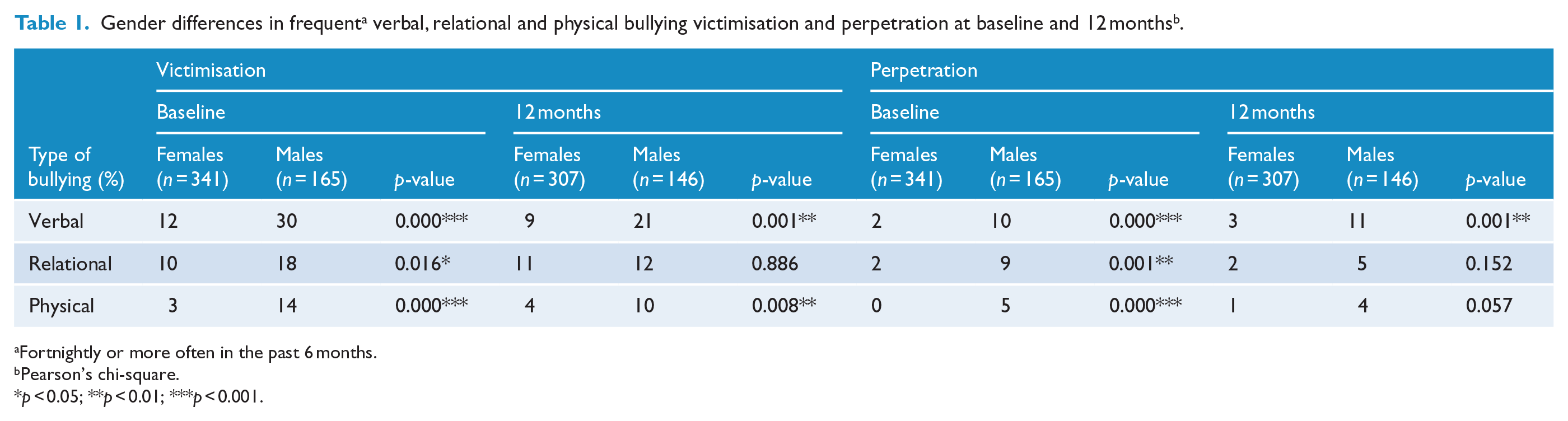
Fortnightly or more often in the past 6 months.
Pearson’s chi-square.
p < 0.05; **p < 0.01; ***p < 0.001.
Associations between personality dimensions at baseline and victimisation at 12 months
Correlations between the personality scores at baseline can be seen in Table 2. The strongest correlation was that between impulsivity and hopelessness, followed by the correlation between impulsivity and sensation seeking.
Correlations between personality scores at baseline.
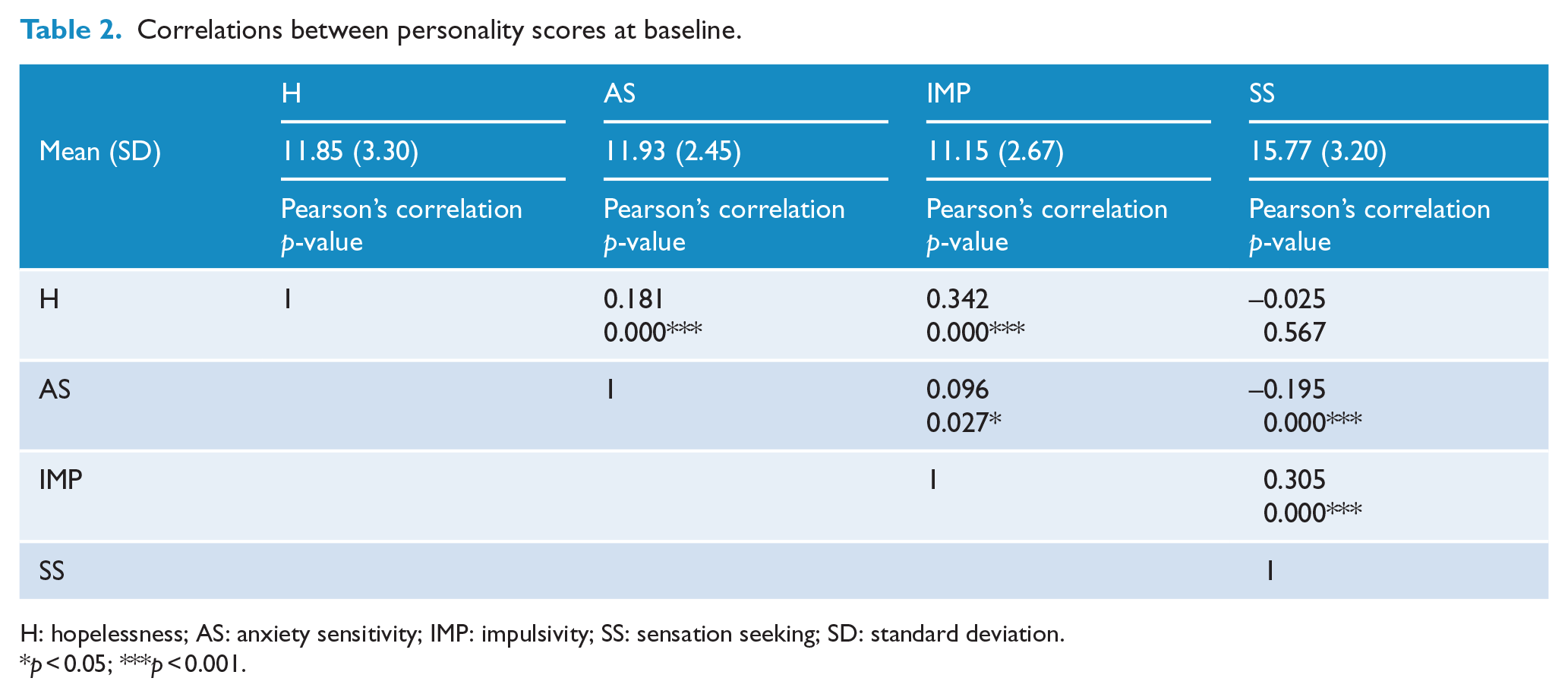
H: hopelessness; AS: anxiety sensitivity; IMP: impulsivity; SS: sensation seeking; SD: standard deviation.
p < 0.05; ***p < 0.001.
Univariate models were run for each of the personality dimensions, with the first step testing whether there was an interaction between the personality dimension and gender. The only significant interaction was for anxiety sensitivity (standardised coefficient = 0.070, standard error = 0.029, p = 0.02); therefore, the results for this personality dimension were examined separately for males and females. The remaining models were run with gender as a covariate. The results for the univariate models are shown in Table 3. As can be seen, baseline hopelessness and baseline impulsivity were both positively associated with victimisation 12 months later. Baseline anxiety sensitivity was negatively associated with victimisation 12 months later for males.
Univariate associations between personality types at baseline and bullying victimisation and perpetration at 12 months.
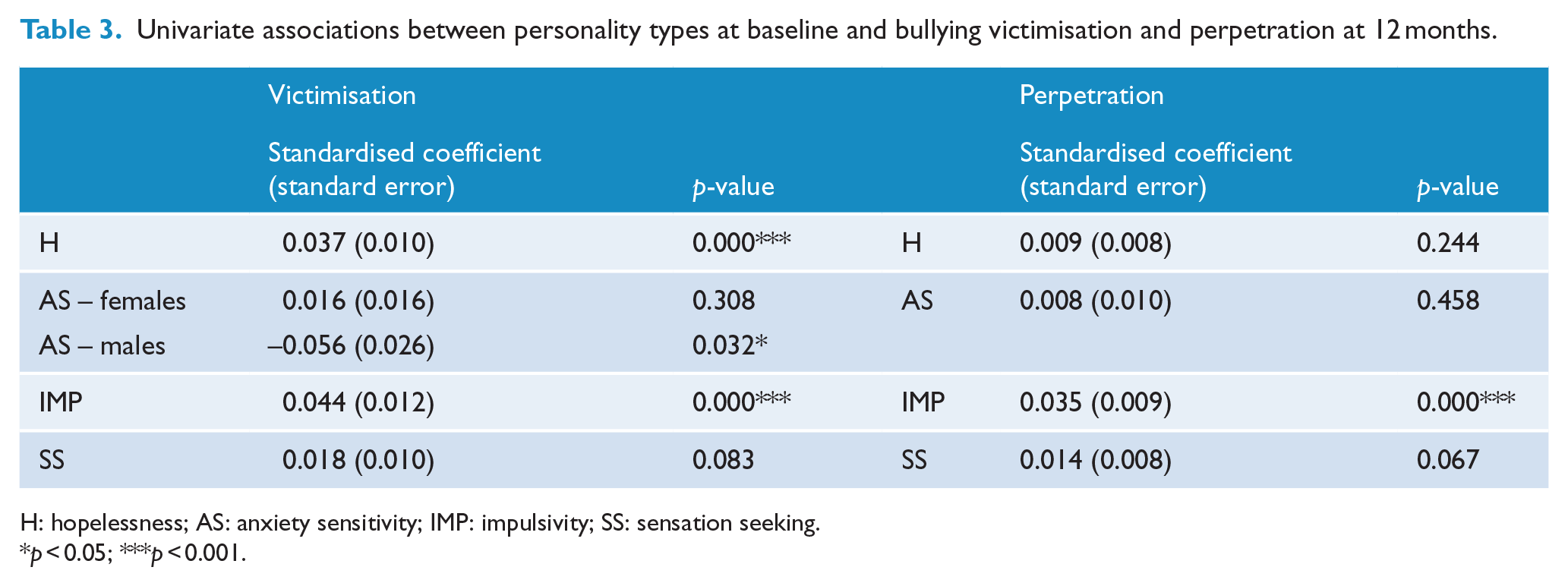
H: hopelessness; AS: anxiety sensitivity; IMP: impulsivity; SS: sensation seeking.
p < 0.05; ***p < 0.001.
Multivariate associations between baseline personality scores and frequency of victimisation at 12 months are shown in Table 4. There remained a positive association between baseline hopelessness and frequency of victimisation 12 months later and between baseline impulsivity and frequency of victimisation 12 months later when controlling for the other personality dimensions. Similarly, there remained a negative association between baseline anxiety sensitivity and later victimisation for males.
Multivariate associations between personality types at baseline and bullying victimisation and perpetration at 12 months. a
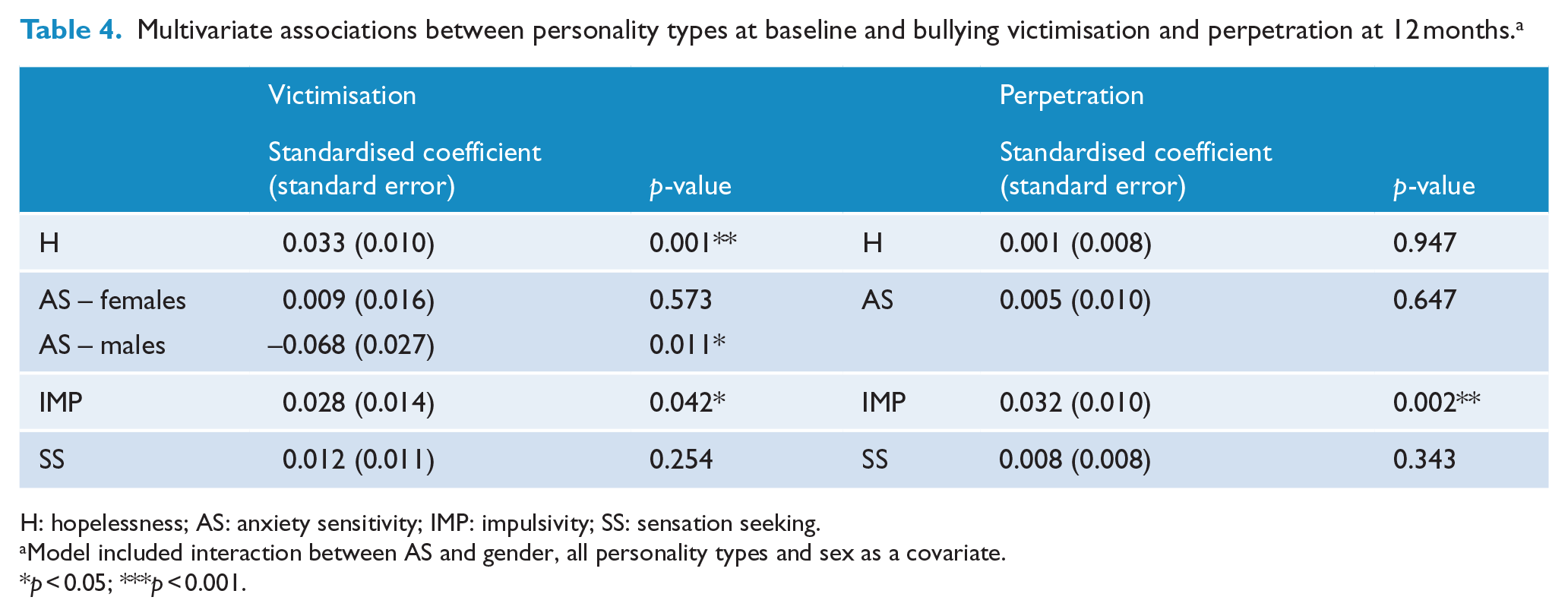
H: hopelessness; AS: anxiety sensitivity; IMP: impulsivity; SS: sensation seeking.
Model included interaction between AS and gender, all personality types and sex as a covariate.
p < 0.05; ***p < 0.001.
Associations between personality dimensions at baseline and bullying perpetration at 12 months
No significant interactions were found between gender, personality dimension and perpetration. Univariate models were consequently run for males and females combined, with gender as a covariate. The results for the univariate models are shown in Table 3. As can be seen, there was a positive association between baseline impulsivity and frequency of bullying perpetration 12 months later. A multivariate model was run with all of the personality dimensions; there remained a positive association between baseline impulsivity and frequency of bullying perpetration 12 months later (Table 4).
Discussion
Personality was found to be associated with bullying in this study, with significant prospective associations between high-risk personality dimensions and both bullying victimisation and bullying perpetration. Specifically, bullying perpetration was associated with high impulsivity, and bullying victimisation was associated with high hopelessness and high impulsivity, as well as low anxiety sensitivity for males. The current finding highlighting an association between impulsivity and bullying perpetration is consistent with previous research; it is likely that impulsivity causes adolescents to engage in reactive aggression in conflict situations and also hinders their ability to consider the negative consequences of bullying behaviour (Higgins et al., 2009). The lack of association between bullying perpetration and hopelessness in this study is in contrast with the findings of a recent meta-analysis that found neuroticism to be a risk factor for both bullying victimisation and bullying perpetration (Mitsopoulou and Giovazolias, 2015). It may be the case that neuroticism has been linked to bullying perpetration in previous studies due to the emotional reactivity component of this personality dimension; in this study, hopelessness is limited more to the negative affect component of neuroticism (Shiner and Caspi, 2003). Based on studies of extraversion, sensation seeking was hypothesised to be associated with bullying perpetration; however, this was not borne out by the data. Research is needed to understand the distinction between extraversion and sensation seeking when it comes to risk for bullying.
The findings for victim status were mostly in line with previous research, with bullying victimisation associated with high impulsivity and hopelessness, and no relationship between victimisation and sensation seeking; however, the inverse relationship between anxiety sensitivity and victim status for males was a surprising finding, given that anxiety is typically found to be associated with bullying victimisation (Hunt, 2015; Reijntjes et al., 2010). That is, while anxiety generally is associated with bullying victimisation, anxiety sensitivity appears to actually be a protective factor for bullying victimisation among males. A possible mechanism for the protective role of anxiety sensitivity in bullying victimisation could be the tendency of those high in anxiety sensitivity to engage in anticipatory avoidance behaviours in order to avoid social humiliation (Stewart and Kushner, 2001). For instance, higher anxiety sensitivity causes anticipatory anxiety about threatening situations; this could cause male adolescents with high anxiety sensitivity to avoid threatening situations, therefore reducing their risk of becoming a target of bullying. Similarly, one component of anxiety sensitivity is the fear of negative social outcomes; if the adolescent anticipates being ridiculed in a given situation, they may actively engage in behaviour to avoid that feared outcome, thereby reducing their risk of becoming a target of bullying. These findings are in line with the protective nature of anxiety sensitivity for adolescent drinking (Woicik et al., 2009). Further examination is needed to explore the association between anxiety sensitivity and bullying victimisation, particularly with regard to why it may be a protective factor among male adolescents but not female adolescents.
While the precise mechanisms involved in the association between personality and bullying have not been clearly substantiated, previous research indicates that personality mediates the cognitive and affective responses to bullying victimisation (Bollmer et al., 2006). It has been suggested that children high in neuroticism/emotional reactivity tend to experience a high degree of negative affect during peer conflict situations and interpret the behaviour of others in overly negative ways, which consequently is associated with higher levels of victimisation (Bollmer et al., 2006; Shiner and Caspi, 2003). As posited by Mitsopoulou and Giovazolias (2015), children high in neuroticism and impulsivity have difficulty regulating their emotions, leading to reactive behaviour that may exacerbate conflict situations. Hopelessness in this study also fits with a common avoidance strategy found to maintain bullying victimisation, known as internalising coping (e.g. blaming oneself and withdrawing; Kochenderfer-Ladd and Skinner, 2002). Therefore, personality characteristics such as hopelessness and impulsivity may maintain bullying victimisation due to the impact of such traits on the adolescent’s response to the initial victimisation. This should be a focus of future research as it has important implications for personality-focused bullying intervention; for instance, learning skills to manage hopelessness and impulsivity could help adolescents with these personality dimensions to respond differently to peers, and therefore cease the cycle of victimisation. Such skills could aid traditional bullying intervention, in supporting adolescents to make use of anti-bullying strategies, which otherwise would be impeded by their emotional reactivity and/or impulsivity.
This study has a number of limitations that should be considered. There were a small number of adolescents who did not complete the bullying questions (6% at baseline) or were lost to follow up (10%); although these adolescents tended to be more ‘high-risk’ on a range of variables, and as such, it is likely that the observed associations may have been underestimated. The measurement of bullying in this study was limited to school bullying and did not specifically assess cyberbullying; future research in a larger sample would be beneficial to determine whether different personality dimensions are associated with different types of bullying (such as verbal, relational, physical and cyber). This study examined victimisation and perpetration using total continuous scores. Previous research examining bullying categories (victim-only, bully-only and bully-victim) has found the groups to be distinct and has found bully-victims to exhibit the greatest dysfunction (Ford et al., 2017; Kelly et al., 2015a, 2015b); unfortunately, a categorical approach was not feasible in this study due to the small number of adolescents involved in perpetration only. The association between personality and bully-victim status is an important avenue to explore in future research.
Nonetheless, the current findings underscore the importance of continuing to examine the influence of a range of individual and environmental factors in bullying and also improved upon previous research in a number of ways. One of the main strengths of this study was the longitudinal sample, which allowed for an examination of prospective relationships, which is a major gap in the bullying literature. Also, this study examined adolescents from Australia; the only other study to do so was conducted over 20 years ago (Slee and Rigby, 1993b). This study accounted for shared variance between personality dimensions, allowing for a clearer examination of the role of specific personality dimensions in bullying involvement. This study is also one of the few studies to explore gender differences in the association between bullying and personality. Finally, this study examined four high-risk personality dimensions found to be predictive of a range of emotional and behavioural problems in adolescents. This is important, in that interventions targeting these high-risk personality dimensions that have been found to be effective for substance use and other problems may also be effective in preventing and reducing bullying involvement. Interventions focused on these characteristics could also teach bullying-involved adolescents helpful coping skills, thereby reducing the risk of other associated problems. For instance, in the hopelessness intervention, participants learn how to challenge negative thinking and develop positive ways of managing low mood, thereby reducing the risk of developing depressive symptoms and suicidal ideation, known to be common among those involved in bullying (Ford et al., 2017).
Bullying during childhood and adolescence is a major contributor to proximal and future mental disorders and therefore is a hugely important area for intervention (Scott et al., 2014). Targeting bullying at schools is a feasible intervention point that has the capacity to improve the well-being of countless people from childhood to adulthood.
Footnotes
Acknowledgements
The authors would like to acknowledge the chief investigators involved in the CAP trial, Professor Patricia Conrod and Associate Professor Tim Slade. They would also like to thank the associate investigators involved in the CAP trial, as well as the schools, teachers and students for their participation. The research team acknowledges the assistance of the NSW Department of Education and Communities for access to its schools (SERAP 2011201).
Declaration of Conflicting Interests
The author(s) declared no potential conflicts of interest with respect to the research, authorship and/or publication of this article.
Funding
The authors disclosed receipt of the following financial support for the research: Preparation of this manuscript was supported by grant APP1004744 from the National Health and Medical Research Council.