




Abstract
Objective:
Children of parents with severe mental illness have an increased risk of offending. Studies suggest that risk factors such as parental offending and social disadvantage may be associated with the increased risk. This paper assesses the impact of these risk factors on offending rates in the offspring of women with severe mental illness compared to offspring of unaffected women.
Methods:
This is part of a longitudinal record-linked whole-population study of 467,945 children born in Western Australia from 1980 to 2001 to mothers with severe mental illness and mothers with no recorded psychiatric illness. These data were linked to Western Australia corrective services data producing a dataset of 12,999 people with at least one offence (3.7% of birth cohort). Cox proportional hazard was used to calculate incidence rate ratios of offspring offending.
Results:
The offending rate for offspring of mothers with severe mental illness (cases) was almost three times the rate for offspring of unaffected mothers (comparison) with an unadjusted incidence rate ratio of 2.75 (95% confidence interval: [2.58, 2.93]). Adjusting for sex, indigenous status, socio-economic status and geographical remoteness reduced the rate ratio by 24% to incidence rate ratio 2.10, 95% confidence interval: [1.97, 2.23]. Adjusting for parental offending further reduced the rate ratio by 23% to incidence rate ratio 1.62, 95% confidence interval: [1.52, 1.72]. The mean age at first recorded offence was significantly lower for cases compared to comparison offspring.
Conclusion:
Children of mothers with a severe mental illness have a higher rate of offending than children of unaffected mothers, and social disadvantage and parental offending have a major impact on this rate. Services supporting these vulnerable children need to focus on improving the social environment in which they and their families live in.
Introduction
Few studies have examined parental history of mental disorder and its impact on the offspring’s risk of criminal offending. Research published to date suggests that children of parents with a mental illness have an increased risk of offending (Dean et al., 2012; Moffitt, 1987) and that the risk is particularly high if one or both parents have been diagnosed with schizophrenia or other severe mental illness (Heston, 1966; Kendler et al., 2015; Tehrani et al., 1998).
The dual associations of offending with mental illness (Joyal et al., 2007; Morgan et al., 2013) and social disadvantage (Freedman and Woods, 2013; Silver, 2000a) point to the need to take both factors into account when examining the impact of parental offending history on offspring offending behaviour. Since individuals with severe mental illness, as well as their offspring, are more likely than the general population to be exposed to social disadvantage (Morgan et al., 2008, 2012), it is possible that increased offspring offending may be primarily due to exposure to social disadvantage rather than parental mental health status. Social disadvantage can be assessed at the individual level (e.g. family income or unemployment, and parental education), or at the neighbourhood level (e.g. the average income for the area, unemployment rates and average educational attainment). Silver (2000a) found that the majority of studies examining risk factors for violence by people with a mental illness tended to focus on individual-level characteristics only, at the expense of ignoring area-level characteristics and overstating the explanatory power of individual-level characteristics (Silver, 2000a). However, within the criminological literature, there is stronger evidence that area-measures of disadvantage have stronger effects on crime, either directly or indirectly through social disorganisation than do individual measures (Pratt and Cullen, 2005; Silver, 2000b; Stark, 1987). One of the very few population-based studies (Dean et al., 2012) that examined the offending patterns of offspring of parents with a mental illness, and took into account both parental characteristics and social disadvantage, was also limited to using as a proxy for socio-economic status the single individual-level measure of fathers’ educational attainment. Dean et al. (2012) found a significantly increased rate of offending in offspring with at least one parent with a mental disorder (incidence rate ratio [IRR]: 2.03, 95% confidence interval [CI]: [1.96, 2.10]) which rose even higher if both parents had a mental illness (IRR 3.39, 95% CI: [3.08, 3.73], adjusted for gender). This was reduced (IRR 2.25, 95% CI: [2.04, 2.49]) after adjustment for fathers’ socio-economic position and a history of parental offending.
The aims of the present study were to use whole-population record-linked data for a large cohort of children (1) to compare the incidence rate of overall offending for offspring of women with a severe mental illness with the offending rate for offspring of unaffected women, (2) to investigate the impact of parental history of offending and exposure to social disadvantage on these offspring offending rates, (3) to examine differences in offending rates across offence categories and (4) to explore differences in age at first offence for offspring of women with a severe mental illness compared to offspring of unaffected women. In view of the literature, we expected to find elevated IRRs of offending for offspring of women with severe mental illness, which would reduce substantially when adjusted for exposure to parental offending and both individual- and area-level social disadvantage.
Method
Study population
This study is part of a programme of work designed to follow children of women with severe mental illness and to examine the contribution of familial liability and environmental exposures, including criminal offending, on the risk of developing a psychotic illness or other neuropsychiatric outcomes. It is a longitudinal record-linked whole-population study of children born in Western Australia from 1980 to 2001 to mothers with a severe mental illness (schizophrenia, unipolar major depression, bipolar disorder and other non-organic psychosis). The study identified all women who had ever had an inpatient or outpatient/community mental health service contact for a severe mental illness, International Classification of Diseases, Ninth Revision, Clinical Modification (ICD-9-CM) codes 295 to 298, recorded in the Western Australian Mental Health Information System from 1 July 1966 to 31 December 2002. Diagnoses coded in International Classification of Diseases, Revision 8 (ICD-8), International Classification of Diseases, Ninth Revision (ICD-9) and International Statistical Classification of Diseases and Related Health Problems, 10th Revision (ICD-10) were re-coded into ICD-9-CM codes for this study. The records of those women were linked to the Western Australian Midwives Notification System which covers all Western Australian births, including home births, ≥ 400 g or 20 weeks gestation since 1980, in order to identify children born between 1980 and 2001 to these women with a severe mental illness. Comparison children were those born in the same period to mothers with no known record of psychiatric illness. The full birth cohort consisted of 467,945 children. Fathers were identified for 464,622 children (99.3%) by linking to the birth registrations register. Details describing the structure of the study database have been published elsewhere (Morgan et al., 2011).
For this current study, we identified all children who had at least one recorded offence during the period 1993–2009 by linking the records of the birth cohort to corrective services records. The Western Australian Department of Corrective Services holds electronic records dating back to the early 1970s. The data cover offenders aged 10 years and older in Western Australia’s 14 public prisons, two privately run prisons, five work camps and one detention centre (Government of Western Australia, 2016), as well as offenders on probation, parole, other community orders and diversionary programmes for young people (Government of Western Australia, 2015). As the minimum age for inclusion on the Western Australian corrective services records is 10 years of age, offspring who had not reached 10 years of age by 2009 were excluded (N = 47,149). Since data on juvenile offending were not available for the period prior to 1993, any births prior to 1983 were also excluded (N = 59,778). The birth cohort was further linked to the Western Australian Death Register to flag any offspring who had died during the study period: those who had died prior to 10 years of age were excluded (N = 5228). After the exclusions, the birth cohort consisted of 355,790 offspring born in 1983–1999; 11,864 (3.3%) were born to mothers with a severe mental illness (case offspring) and 343,926 (96.7%) to mothers with no recorded psychiatric illness (comparison offspring).
Classification of offences
The Western Australian Department of Corrective Services uses the Australian Bureau of Statistics (ABS) Australian National Classification of Offences (ANCO) codes to classify offences (ABS, 1985). ANCO is a three-digit coding system, and for this analysis, ANCO codes have been grouped into five broad categories: violent offences (ANCO 111-299), for example, homicide and assault; property offences (ANCO 300-499), for example, break/enter and theft; offences against good order (ANCO 500-599), for example, disorderly conduct, breaching community orders and resisting arrest; drug offences (ANCO 600-699), for example, possession, importing, dealing and trafficking; and other offences (ANCO 700-911) which include serious driving offences. Since these data from the Department of Corrective Services are for convicted offenders, they cover only those offences serious enough to lead to a court appearance and a subsequent imprisonment or community order.
Indigenous status
Indigenous status was used as an individual-level measure of social disadvantage. It was recorded as positive if the offspring and/or either parent were identified as indigenous (of Aboriginal or Torres Strait Islander descent) in any of the data sources available. In most of the registers, these data were self-reported.
Socio-economic status
The area-level measure of social disadvantage that we used was socio-economic status as determined by Socio-Economic Indexes for Areas (SEIFA) (ABS, 2008). These are area-level measures derived by the ABS using principal components analysis of census data, and standardised against a mean of 1000 with a standard deviation of 100. We used the Index of Relative Socio-economic Disadvantage. For most cases, the smallest spatial unit (the census collection district) was used to determine level of disadvantage; postcode was used only where this was not available. The measure was based on a mother’s residence at the time of her child’s birth and the year of the index used was that available for the census closest in time to the date of birth. Index values were transformed into quintiles: those in the first quintile were identified as being the most disadvantaged and those in the fifth quintile the least disadvantaged.
Geographical remoteness
The geographical remoteness of the mother’s residence at time of a child’s birth was determined using an ABS census-derived area-level measure, the Australian Standard Geographic Classification–Remoteness Area (ABS, 2006). Remoteness Area categories are based on the road distance of a location from the nearest population centres providing access to goods and services, taking into account population size. They are classified as Major City, Inner Regional, Outer Regional, Remote and Very Remote.
Parental history of criminal offending
Records of mothers and fathers were linked to corrective services records to identify any record of parental history of offending. At time of data extraction, adult data were available for the period 1970–2008. Parental history of offending was categorised into four groups: father only with an offending history, mother only with an offending history, both parents with an offending history and no parental offending history.
Analysis
IRRs for a child having an offence history were estimated using the Cox proportional hazard regression and analysed using IBM/SPSS version 21. The observation period was from the 10th birthday of the child to 31 December 2009, or the date of death for children who had died in the study period, whichever came first; this covers children aged 10–26 years. The time to first recorded offence was calculated from the 10th birthday to the date of the first recorded offence, an observation time of up to 17 years. The basic model compared case offspring (born to a mother with a severe mental disorder) with comparison offspring, adjusted for measures of social disadvantage: indigenous status, socio-economic status and geographical remoteness. The final model was also adjusted for parental offending history. Because of large sex differences in offending rates in general population data (ABS, 2016), sex was included in all adjusted models. Rate ratios were calculated for all offspring and separately by sex, indigenous status and offence type. Univariate General Linear Modelling (GLM) was used to compare the age at first offence between case and comparison offspring. Variance inflation factor (VIF) (Kleinbaum et al., 1988) was used to measure collinearity among covariates using the collinearity diagnostic in IBM/SPSS version 21.
Results
Descriptive and bivariate analysis
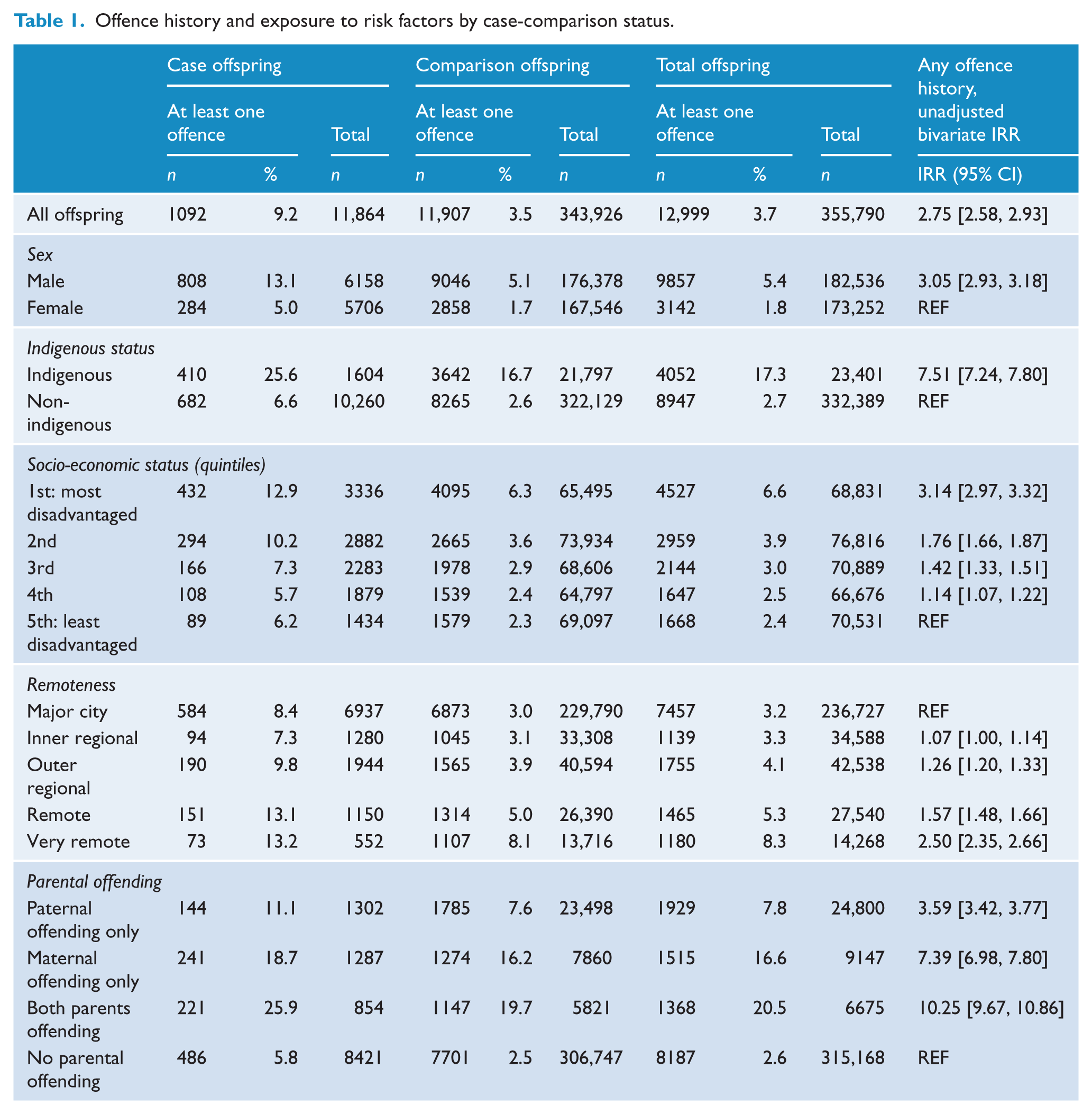
There were 12,999 offspring (3.7% of the birth cohort) with at least one recorded criminal offence. Offspring of mothers with severe mental illness (case offspring) had almost three times the rate of an offence history compared to offspring of mothers with no recorded psychiatric illness (comparison offspring): 9.2% versus 3.5%, respectively. This difference was significant: IRR 2.75, 95% CI: [2.58, 2.93] (Table 1). The proportion with an offence history was significantly higher for male compared to female offspring (5.4% vs 1.8%; IRR 3.05, 95% CI: [2.93, 3.18]) and for indigenous compared to non-indigenous offspring (17.3% vs 2.7%; IRR 7.51, 95% CI: [7.24, 7.80]). Thus, having a parent with an offence history elevated the risk of an offence history in the offspring. The highest IRR was for offspring where both parents had an offence history (IRR 10.25, 95% CI: [9.67, 10.86]); IRR was also high if the mother alone had an offence history (IRR 7.39, 95% CI: [6.98, 7.80]).
Offence history and exposure to risk factors by case-comparison status.
Multivariable model
When sex, indigenous status, socio-economic status and geographical remoteness were added to the model, the rate ratio decreased by 24% from IRR 2.75, 95% CI: [2.58, 2.93] to IRR 2.10, 95% CI: [1.97, 2.23] (Table 2). Adjusting for parental offending further reduced the rate ratio by 23%, producing an adjusted IRR of 1.62, 95% CI: [1.52, 1.72].
Incidence rate ratios (IRRs) of an offence history for case versus comparison offspring.
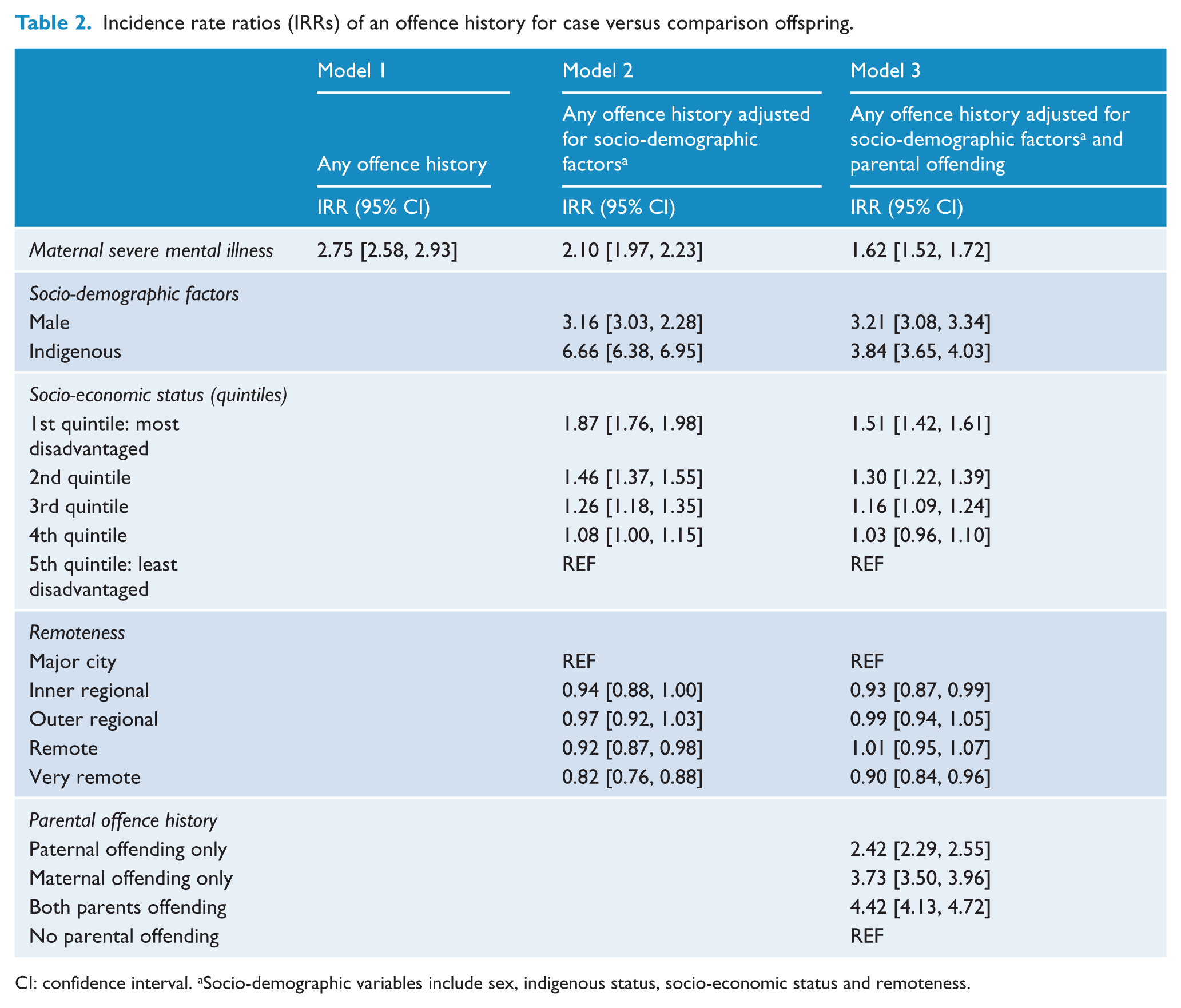
CI: confidence interval. aSocio-demographic variables include sex, indigenous status, socio-economic status and remoteness.
Collinearity was examined and found to be low (VIF < 3) (Kleinbaum et al., 1988).
To examine sex differences in the data, we removed sex from the list of covariates in Model 3 and ran the model separately for males and females. See Supplementary Table 1. While there was some shift in IRRs, the pattern of significance was the same for males and females, other than for being born in a very remote area, which dropped out of significance for males.
Finally, to assess the potential impact of paternal mental health status, this variable was added to Model 3. See Supplementary Table 2. While a history of paternal mental illness was significant (IRR 1.43, 95% CI: [1.36, 1.49]), the overall pattern of significance remained unchanged and the IRR for the relationship between maternal severe mental illness and offspring offending was barely affected.
Analysis by type of offence category
In all offence categories, case offspring had higher IRRs for offending (Table 3). As in the main multivariable analysis for any offence history in Table 2, adjusting for socio-demographic factors and parental offence history reduced the IRR by 50% for violent, property and good order offences and by 40% for drug and other offences.
Incidence rate ratios (IRRs) of an offence history for case versus comparison offspring by offence category.
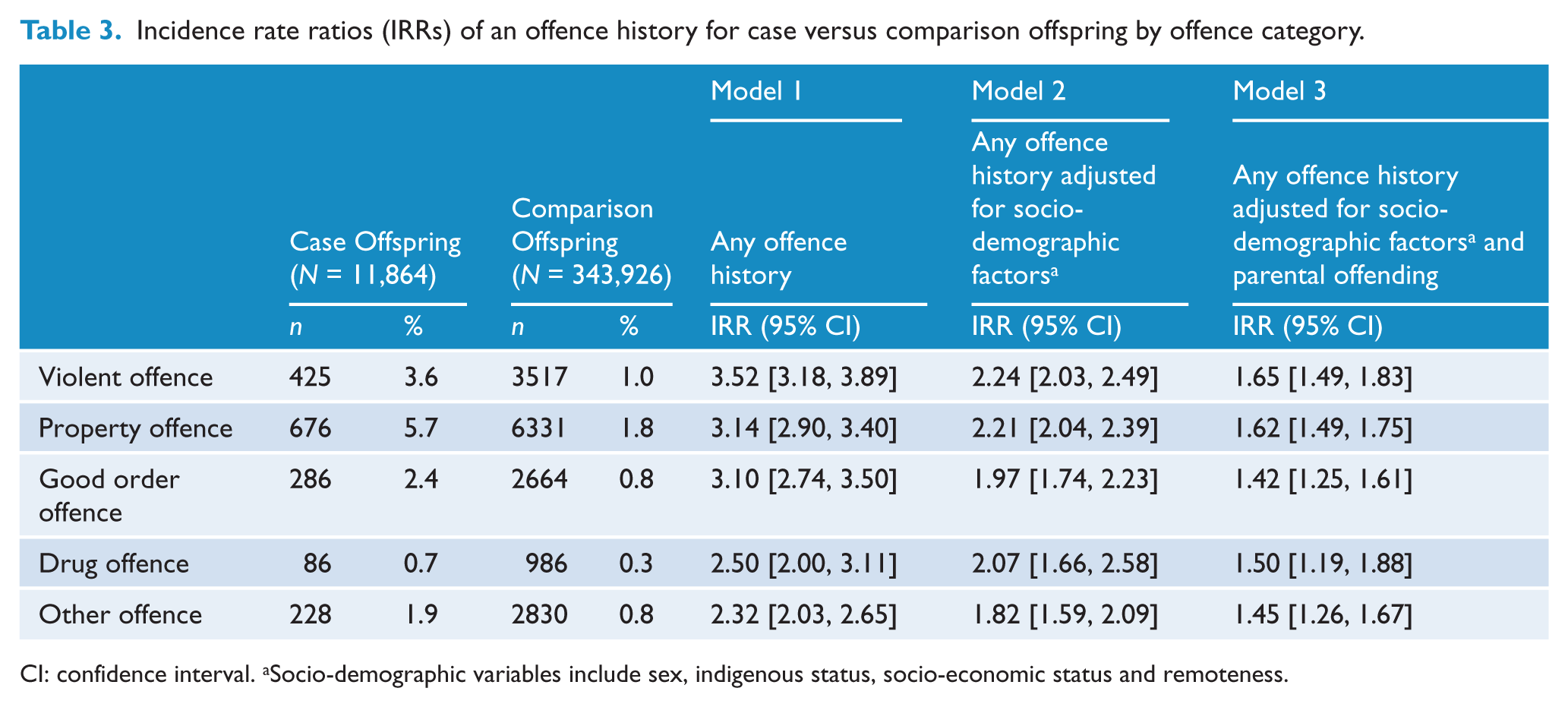
CI: confidence interval. aSocio-demographic variables include sex, indigenous status, socio-economic status and remoteness.
Age at the first recorded offence for offspring with an offence history
Case offenders had their first recorded offence at a younger age than comparison offenders, with 47% of case offenders having offended by the age of 14 years compared to 36% of comparison offenders (Figure 1). For case offenders, the mean age at first recorded offence was 14.9 years, and for comparison offenders, it was 15.4 years. Univariate GLM analysis showed a significant difference between the mean age at first recorded offence of case offenders and comparison offenders, with a mean difference of −0.50 (95% CI: [−0.65, −0.36]). When the model was adjusted for sex, indigenous status, socio-economic status, remoteness and parental offending, the mean age rose to 15.7 years for case offenders and 16.0 years for comparison offenders; the mean difference of −0.23 was still significant (95% CI: [−0.37, −0.08]).
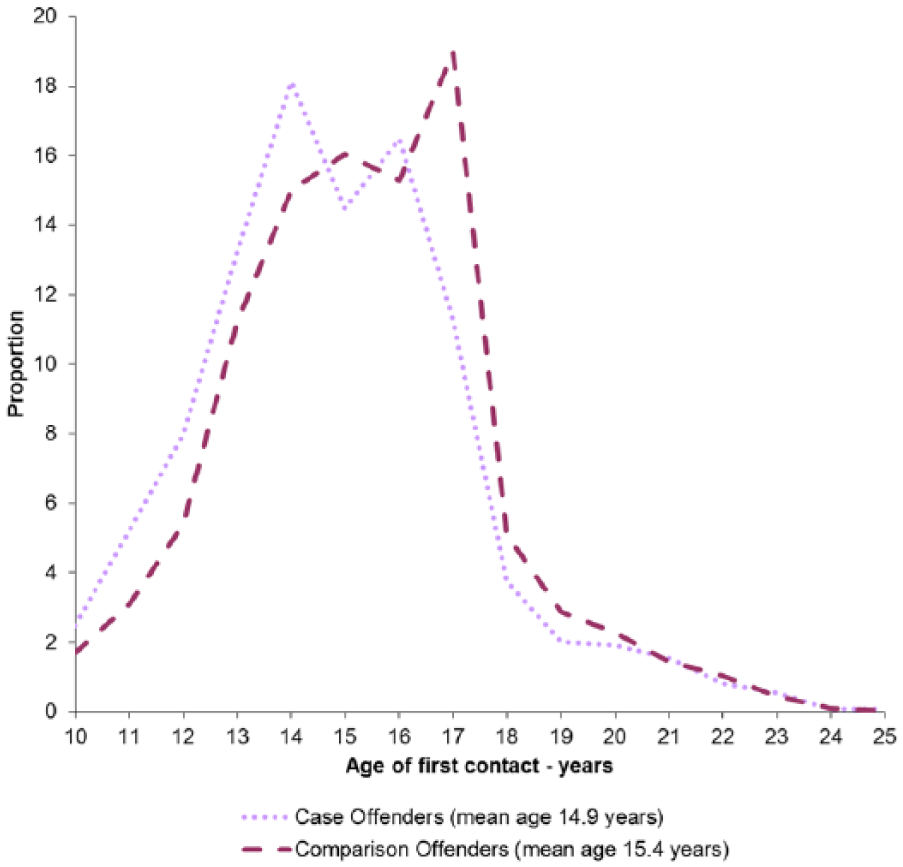
Age at first recorded offence, for subsample with an offence history.
Discussion
There is a dearth of research into the behavioural outcomes for children of mothers with severe mental illness. Our whole-population study meets a need for informative data in this area by examining the relationship between offspring criminal offending and maternal severe mental illness, taking into account important covariates that may impact on that relationship, namely, parental offending and both individual and area-level measures of social disadvantage.
By using whole-of-population data to compare the incident rate of offending in children of women with a severe mental illness (cases) with children of women with no recorded psychiatric history (comparisons), this study found that case children had an unadjusted incidence rate almost three times of that of comparison children.
Parental history of offending and exposure to both individual- and area-level social disadvantage had an impact on children’s offending rates. In the bivariate analyses, having a parent who had a history of criminal offending increased the IRR; this was markedly higher for children where both parents had offending histories resulting in the case children having an unadjusted bivariate IRR 10 times higher than comparison children. Indigenous status, our individual-level measure of social disadvantage, was associated with higher offending rates in case children, with an unadjusted IRR of 7.51 (95% CI: [7.24, 7.80]). Exposure to area-level social disadvantage had a smaller but still significant impact on offending rates in the unadjusted IRR. Being male was associated with higher offending rates in case children with an unadjusted IRR of 3.05 (95% CI: [2.93, 3.18]).
In keeping with our expectations, we found that, in the multivariable model, adjusting for sex, social disadvantage and parental offending reduced the IRR of offending in case compared to comparison children from 2.75 (95% CI: [2.58, 2.93]) to 1.62 (95% CI: [1.52, 1.72]), a reduction of 41%. If paternal mental illness was added to the model, it did not change the pattern of findings although it was itself significant.
Offending IRRs across offence categories also differed between case and comparison children. Case children had higher IRRs in all offence categories. The highest unadjusted IRR was for violent offences with an IRR of 3.52 (95% CI: [3.18, 3.89]). In keeping with the results for any offence history, rate ratios were reduced when adjusted for social disadvantage, parental offence history and sex, with rate ratios for violent, property and good order offences reduced by half (adjusted IRR 1.65, 1.62 and 1.42 respectively). There was also a significant difference between case and comparison children in the mean age at first offence, with almost 50% of case offenders committing their first offence by the age of 14 years, whereas by that age, only 36% of the comparison offenders had committed their first offence.
In line with previous studies, our results show that there is an association between parental mental illness and offending. Dean et al. (2012) is the most comparable study, being a study that utilised linked administrative registers, although our study can be distinguished from Dean et al.’s in a number of ways: (1) ours was a whole-population cohort, whereas Dean et al. took a 25% sample of the population; (2) our case children were defined by recorded maternal severe mental illness, with children of mothers with other mental illness excluded, whereas Dean et al. defined cases by all recorded parental mental illness; and (3) we were able to incorporate several measures of social disadvantage, while Dean et al. were limited to fathers’ educational attainment. Dean et al. (2012) reported an unadjusted IRR of 1.47 for offending for offspring with at least one parent with psychosis compared to those of unaffected parents. We speculate that the higher unadjusted IRR of 2.75 (95% CI: [2.58, 2.93]) in our study could be due to its primary focus on maternal, not parental, severe mental illness, especially given the exclusion of mothers with less severe, high prevalence disorders. It is conceivable that maternal severe mental illness may exert a greater impact on a child than paternal illness for a number of reasons. Since mothers are more likely to have greater involvement in child-rearing, we found that a maternal history of offending was more strongly associated with offspring offending than a paternal history of offending, with unadjusted IRRs of 7.39 (95% CI: [6.98, 7.80]) and 3.59 (95% CI: [3.42, 3.77]), respectively. Nonetheless, when we adjusted for social disadvantage, parental offending and sex, our IRR of 1.62 (95% CI: [1.52, 1.72]) was more similar to the adjusted IRR of 1.31 reported by Dean et al. (2012). The remaining difference may be explained partially by differences in population characteristics, especially indigenous status which had a high impact on offending rates in our study and has been the subject of extended commentary in Australian studies on criminal offending. The Australian Institute of Criminology reported that, in 2013, the indigenous imprisonment rate in Australia was 19 times higher than the non-indigenous rate, and the rate of community-based sentences was 13 times higher (Australian Institute of Criminology, 2016). By contrast to our results and those of Dean et al., Heston (1966) reported much higher rates: children of mothers with schizophrenia were almost four times more likely to have criminal behaviour recorded. However, Heston’s study was restricted to mothers with schizophrenia and the study’s sample size (N = 97) was small; both these differences may have contributed to Heston’s higher estimate.
When we examined the results by offence category, we found that violent offending had a higher rate ratio compared to the other offence categories in the unadjusted model, which is similar to what has been reported in other studies (Dean et al., 2012; Tehrani et al., 1998). However, the results in our final adjusted model show little difference between the offence categories.
We examined social disadvantage at both the individual level (indigenous status) and at the area level (neighbourhood socio-economic status) and found both had a significant impact on offending rates in both the bivariate and multivariate analyses. Similarly, Silver (2000a) found that African American status and neighbourhood disadvantage (among other factors) were significantly associated with offending among people with mental illness, although African American status lost its significance in the multivariate model. In other work using the Western Australian registers, Morgan et al. (2008) showed that the prevalence of arrest among people with schizophrenia was almost five times higher in areas of greatest disadvantage, as compared to that in areas of least disadvantage. It can be inferred that children of people with a severe mental illness are also more likely than other children to be living in disadvantaged areas, and are therefore at greater risk of also offending. Furthermore, using a nationally representative sample, Morgan et al. (2016) were able to show that people with psychotic illness were more likely than the general population to be exposed to other forms of social disadvantage that are risk factors for both offending and victimisation: they were more likely to be unemployed, to be homeless and not to have completed schooling. They were also more likely to have a lifetime history of alcohol abuse/dependence or illicit substance abuse/dependence.
Our data show that neighbourhood socio-economic status contributes less to offending rates than a person’s indigenous status. Part of the explanation may lie in the fact that indigenous children are more likely than non-indigenous children to be exposed to many forms of social disadvantage (Australian Institute of Health and Welfare [AIHW], 2015; Mitrou et al., 2014), with one study on Aboriginal and Torres Strait Islander children in Western Australia reporting that over 60% lived in the most disadvantaged quintiles of area-level social disadvantage (Shepherd et al., 2012).
In our adjusted models, we included an area-level measure of remoteness of residence from a major city. In many (Vassos et al., 2012), but not all (Suvisaari et al., 2014) European studies, increasing distance from major urban areas has been associated with better outcomes, including reduced risk of developing schizophrenia. In Australia, as the distance from a major urban centre increases, in many instances, so does the risk of isolation, lack of resources and poor access to social capital – with associated adverse outcomes. For example, there is good evidence that suicide rates are significantly higher in rural and remote areas than in urban areas, especially as this concerns young males in remote regions (Qi et al., 2014). In the unadjusted bivariate IRR, we found a dose response between increasing levels of remoteness and rate of offending (Table 1). Of interest, in Table 2, Model 2, adjusted for social disadvantage and sex but not parental offending, the impact of remoteness was slightly higher in urban areas than in more remote regions, suggesting that there are other aspects associated with remoteness that contribute to the significant unadjusted IRR.
Strengths and weaknesses
The present whole-population study uses prospectively collected data from administrative registers that have been in existence for a long time and that have not been affected by periods of discontinuity. The size of the dataset ensures that there is sufficient power for statistical analysis. Long periods of data collection allow for good coverage of events such as criminal convictions for both offspring and their parents. Using register data removes reliance on a person’s recall of past events, thereby reducing recall bias.
One limitation, however, is that registers have been set up primarily for administrative purposes, not research, which means that a limited number of recorded variables meet the specific requirements for research. In addition, not all variables in registers are mandatory, so there may be missing data for our study – for example, not all fathers were registered. Although this affects a small proportion of births (0.6%), fathers’ data were more likely to be missing for case children (1.2% vs 0.6%). However, we believe that this would have led to an attenuation of our findings. Importantly, linkage across registers increases both the variables available for analysis and reduces the level of missing information in some fields, for example, indigenous status.
Another limitation was our reliance on corrective services data alone. These services record convictions, and therefore only cover those events that have gone to court. The data do not include arrest events that did not lead to charges, nor cautions or appearances before juvenile justice teams, outcomes of some relevance to young offenders and which may be exerting some impact on the age at onset of offending.
Conclusion
The results from the present study demonstrate that children of mothers with a severe mental illness have a higher rate of offending than children of unaffected mothers, and that social disadvantage and parental offending have a major impact on this rate. Mothers with severe mental illness also are more likely than unaffected mothers to be exposed to social disadvantage, and therefore more likely to expose their children to this risk factor for offending. To reduce rates of offending in this vulnerable population of children, services supporting them need to, among other things, target and improve the social environment in which they and their families live.
Footnotes
Acknowledgements
We thank the Data Linkage Branch of the Western Australia (WA) Department of Health for linkage, extraction and client support services aspects of data provision. We also thank the custodians of the WA Department Hospital Morbidity and Mental Health Data Collections, the WA Midwives Notification System, the WA Department of Corrective Services and the WA Registry of Births, Deaths and Marriages for the provision of data. We thank Taryn Major for her statistical assistance. The paper cannot be considered as either endorsed by the Department of Corrective Services nor as an expression of its policies or views. Any errors of omission or commission are the responsibility of the researchers.
Declaration of Conflicting Interests
The author(s) declared no potential conflicts of interest with respect to the research, authorship and/or publication of this article.
Funding
This study was funded by National Health and Medical Research Council.
References
Supplementary Material
Please find the following supplemental material available below.
For Open Access articles published under a Creative Commons License, all supplemental material carries the same license as the article it is associated with.
For non-Open Access articles published, all supplemental material carries a non-exclusive license, and permission requests for re-use of supplemental material or any part of supplemental material shall be sent directly to the copyright owner as specified in the copyright notice associated with the article.
