




Abstract
Objective:
We aimed to examine the associations between exposure to unemployment and psychosocial outcomes over the period from 16 to 30 years, using data from a well-studied birth cohort.
Methods:
Data were collected over the course of the Christchurch Health and Development Study, a longitudinal study of a birth cohort of 1265 children, born in Christchurch in 1977, who have been studied to age 30. Assessments of unemployment and psychosocial outcomes (mental health, substance abuse/dependence, criminal offending, adverse life events and life satisfaction) were obtained at ages 18, 21, 25 and 30.
Results:
Prior to adjustment, an increasing duration of unemployment was associated with significant increases in the risk of all psychosocial outcomes. These associations were adjusted for confounding using conditional, fixed-effects regression techniques. The analyses showed significant (p < 0.05) or marginally significant (p < 0.10) associations between the duration of unemployment and major depression (p = 0.05), alcohol abuse/dependence (p = 0.043), illicit substance abuse/dependence (p = 0.017), property/violent offending (p < 0.001), arrests/convictions (p = 0.052), serious financial problems (p = 0.007) and life satisfaction (p = 0.092). To test for reverse causality, the fixed-effects regression models were extended to include lagged, time-dynamic variables representing the respondent’s psychosocial burden prior to the experience of unemployment. The findings suggested that the association between unemployment and psychosocial outcomes was likely to involve a causal process in which unemployment led to increased risks of adverse psychosocial outcomes. Effect sizes were estimated using attributable risk; exposure to unemployment accounted for between 4.2 and 14.0% (median 10.8%) of the risk of experiencing the significant psychosocial outcomes.
Conclusions:
The findings of this study suggest that exposure to unemployment had small but pervasive effects on psychosocial adjustment in adolescence and young adulthood.
Introduction
It has been widely accepted that unemployment is associated with adverse mental health and reduced well-being (Backhans and Hemmingsson, 2012; McKee-Ryan et al., 2005; Wanberg, 2012). Previous meta-analyses and reviews have linked unemployment to reduced psychological well-being (Luhmann et al., 2012; McKee-Ryan et al., 2005; Murphy and Athanasou, 1999; Paul and Moser, 2006), reduced life satisfaction (Herbig et al., 2013; McKee-Ryan et al., 2005; Paul and Moser, 2006), alcohol and substance use problems (Henkel, 2011; Herbig et al., 2013), and mental health problems, such as depression (Herbig et al., 2013; Murphy and Athanasou, 1999; Paul and Moser, 2006; Paul and Moser, 2009; Rantakeisu and Jönsson, 2003), anxiety (Herbig et al., 2013; Murphy and Athanasou, 1999; Paul and Moser, 2006; Paul and Moser, 2009; Rantakeisu and Jönsson, 2003) and suicidal behaviour (Classen and Dunn, 2012; Milner et al., 2013a, 2013b). Unemployment has also been linked to other adverse psychosocial outcomes, such as crime/criminal convictions (Gould et al., 2002; Lin, 2008), financial problems (Georgarakos et al., 2009; McCarthy, 2011) and interpersonal/relationship difficulties (Song et al., 2011).
While the associations between unemployment and psychosocial outcomes are well-established, the extent to which these associations reflect cause and effect associations requires further consideration. An important issue concerns the extent to which the associations between unemployment and psychosocial outcomes are explained by third or confounding variables (Greenland and Morgenstern, 2001; Ward and Johnson, 2008). This issue has been addressed in a number of studies in which associations between unemployment and psychosocial outcomes have been adjusted for observed confounding factors, such as socio-economic status, educational achievement and other related factors (Blakely et al., 2003; Daly and Delaney, 2013; Georgarakos et al., 2009; Rantakeisu and Jönsson, 2003; Salm, 2009).
A limitation of these studies is that they fail to control for non-observed sources of confounding. However, in studies that collect repeated-measures data, it is possible to control for non-observed confounders by using fixed-effects regression models (Allison, 2009; Hamerle and Ronning, 1995). Fixed-effects regression models provide a technique for adjusting an association between a time-dependent outcome Yt (e.g. crime) and a time-dependent predictor Xt (e.g. unemployment) for non-observed fixed factors α, providing that the factors α exert a fixed and constant effect on the outcomes Yt. A more detailed account of the fixed-effects regression model can be found in Allison (2009). Fixed-effects regression has been used to examine the associations between unemployment and a number of psychosocial outcomes (Fergusson et al., 2001), including: mental health problems (Schmitz, 2011), self-assessed health (Böckerman and Ilmakunnas, 2009), suicidal behaviour (Fergusson et al., 2007), criminality (Aaltonen et al., 2013), substance misuse (Popovici and French, 2013a, 2013b) and life satisfaction (Clark et al., 2010; Knabe and Rätzel, 2008).
A more complex issue concerns the possibility of reverse causation in which psychosocial burden leads to an increased risk of unemployment, rather than unemployment leading to psychosocial burden. The examination of reverse causality requires the availability of longitudinal data to fit cross-lagged or reciprocal models of causation (see the Methods section for more information on this approach) and has been addressed in a number of studies (Aaltonen et al., 2013; Böckerman and Ilmakunnas, 2009; Fergusson et al., 2001; Fergusson et al., 2007). The majority of these studies (Aaltonen et al., 2013; Böckerman and Ilmakunnas, 2009; Fergusson et al., 2001) concluded that unemployment is related to psychosocial disadvantage even after controlling for reverse causality.
Against this background, this article reports an investigation of the associations between unemployment and a wide range of psychosocial outcomes in a birth cohort studied from age 18 to 30. The aims of this research were:
To describe the associations between duration of unemployment and a series of psychosocial outcomes (mental health, substance abuse/dependence, criminal offending, adverse life events and life satisfaction).
To adjust the associations between duration of unemployment and psychosocial outcomes for confounding factors using fixed-effects regression models.
To examine patterns of reverse causality between duration of unemployment and psychosocial outcome variables.
An important feature of this analysis was to provide information on the consequences of unemployment on psychosocial outcomes, for a contemporary cohort of young adults, during the period 16–30 years when most cohort members had made their transition into the workforce.
Methods
Participants
Participants were members of the Christchurch Health and Development Study (CHDS) birth cohort. The CHDS is a longitudinal study of 1265 children born in the Christchurch (New Zealand) urban region over a 4-month period during 1977. This cohort has been studied at regular intervals from birth until age 30 (for details, see Fergusson and Horwood, 2001). At age 30, 987 (80%; 52% female) of the surviving cohort members (n = 1231) were interviewed. All phases of the study were subject to ethical approval by the Canterbury Regional Health and Disabilities Ethics Committee. All data were collected with the signed consent of the study participants.
Measures
Duration of unemployment
Cohort members were interviewed at ages 18, 21, 25 and 30 about their history of employment/unemployment since the previous assessment. Participants were questioned about any times when they were unemployed and seeking work since the previous assessment and about the duration of any unemployment. Using these data, a measure of the total duration of unemployment was constructed for each of the interview periods: 16–18, 18–21, 21–25 and 25–30 years. For the purposes of these analyses, the duration of unemployment was classified as: none, <3 months and 3+ months. This classification was used as the preliminary analyses showed that the risks of psychosocial problems did not increase after 3+ months of unemployment.
Mental health outcomes
At ages 18, 21, 25 and 30 years, participants were questioned about their experience of the following mental health problems during the 12 months prior to each assessment.
Major depression and anxiety disorder
Cohort members were questioned about symptoms of major depression and a range of anxiety disorders (generalised anxiety disorder, panic disorder, agoraphobia, social phobia, specific phobia) in the previous 12 months. Questioning was based on the relevant components of the Composite International Diagnostic Interview (CIDI; World Health Organization, 1993) and the criteria of the Diagnostic and Statistical Manual of Mental Disorders, fourth edition (DSM-IV; American Psychiatric Association, 1994). Using this information, dichotomous measures were constructed to reflect whether the participant met the diagnostic criteria for a diagnosis of a major depressive episode and any anxiety disorder in each of the following intervals: 17–18, 20–21, 24–25 and 29–30 years.
Suicidal ideation/attempt
Participants were questioned using custom-written survey items about the occurrence of suicidal thoughts (contemplating, considering or planning suicide) or attempts in the 12 months prior to each assessment.
Substance abuse/dependence
At the 18, 21, 25 and 30 year assessments, cohort members were questioned about problems associated with their use of alcohol or illicit drugs in the previous 12 months, using CIDI items to assess the DSM-IV symptom criteria for abuse/dependence. Using this information, participants were classified according to dichotomous measures reflecting whether they met the diagnostic criteria for alcohol abuse/dependence or illicit substance abuse/dependence in each of the time intervals: 17–18, 20–21, 24–25 and 29–30 years.
Criminal offending
At ages 18, 21, 25 and 30, participants were questioned about their involvement in criminal offending and any contacts with the justice system during the 12 months prior to each assessment. Two measures of criminal offending (property and violent offending; arrest/conviction) were used in this study.
Property and violent offending
At each assessment, cohort members were asked about any offences they had committed in the previous 12 months, using the Self-Report Delinquency Inventory (Elliott and Huizinga, 1989; Elliott et al., 1985). Selected items from this scale were used to define dichotomous measures reflecting whether the participant reported engaging in property or violent offending for each of the time intervals: 17–18, 20–21, 24–25 and 29–30 years. Violent crime was defined to include assault, fighting, use of a weapon, threats of violence against a person and related offences. Property crime included theft, burglary, breaking and entering, vandalism, arson and related offences.
Arrest/conviction
Participants were questioned as to whether they had been arrested for any reason or received a court conviction in the 12 months prior to the assessment. This information was used to construct dichotomous measures of arrest/conviction for each of the time intervals: 17–18, 20–21, 24–25 and 29–30 years.
Adverse life events
At ages 18, 21, 25 and 30 years, cohort members were questioned concerning life events that had occurred in the previous 12 months, using a life events scale based on the Social Readjustment Rating Scale (Holmes and Rahe, 1967) and Feeling Bad Scale (Lewis et al., 1984). Two life events measures were used in the analysis reflecting whether the participant reported serious financial problems and interpersonal/relationship difficulties (serious problems or constant arguments with a partner/spouse, parent, sibling or friend) for each 12-month period.
Life satisfaction score
Information about life satisfaction was collected at ages 18, 21, 25 and 30 using a custom-written scale which required respondents to rate their current satisfaction with 12 areas of their life: work, leisure time, partner relationships, relationships with people of the same sex, relationships with people of the opposite sex, social life, money, independence, daily interactions with others, family life, the future and life as a whole. Items were scored on a 4-point scale (1 = very unhappy, 4 = very happy) whereby higher scores indicated greater life satisfaction. Scale scores were created by summing responses to the 12 items to create a general life satisfaction measure. These scales had good internal consistency (α = 0.85–0.89). For the purposes of the present analysis, the life satisfaction scores were dichotomised for each year into those cohort members reporting a life satisfaction score in the lowest quintile of the distribution and those who reported a life satisfaction greater than the lowest quintile.
Sample size and sample bias
Sample size
The present analysis is based on 1056 sample members observed on at least one occasion from 18 to 30 years. However, not all participants were assessed at each age. The number of observations available for each assessment was: 1025 (18 years); 1011 (21 years); 1003 (25 years); 987 (30 years). Sample sizes for the duration of unemployment by psychosocial outcome analyses are reported in supplemental Table 1.
Sample bias
To examine whether selection bias due to the processes of sample attrition influenced our findings, the data were reanalysed using the data weighting method described by Carlin et al. (1999). These analyses produced essentially identical conclusions to the reported analyses, suggesting that the findings were unlikely to have been influenced by selection bias.
Statistical methods
Unadjusted associations between duration of unemployment and psychosocial outcomes
The first phase of the analysis examined the associations between duration of unemployment (classified as none, <3 months and 3+ months) and rates of dichotomous psychosocial outcomes: mental health, substance abuse/dependence, criminal offending, adverse life events and life satisfaction. This analysis pooled the repeated observations at ages 18, 21, 25 and 30 to obtain an estimate of the population-averaged association between duration of unemployment and psychosocial outcomes. Linkages between duration of unemployment and psychosocial outcomes were analysed using a general estimating equation modelling approach (Zeger and Liang, 1986). These models were extended to include tests of age and gender by unemployment interactions.
Adjustment for confounding
In the second phase of the analysis, to account for non-observed sources of confounding by fixed factors, adjusted estimates of the associations between duration of unemployment and psychosocial outcomes were obtained by fitting repeated-measures, conditional, fixed-effects logistic regression models to the outcomes (Allison, 2009; Hamerle and Ronning, 1995). These models were of the form:

where logit Pr(Yijt = 1) was the log odds of each outcome j reported by the ith respondent at each assessment t, and Xit represented the duration of unemployment at each assessment t. In this model, the αi represent individual specific terms that are assumed to reflect the effects of all fixed sources of variation in the outcome Yit.
Testing for reverse causality
Two approaches were taken to explore this issue. First, the fixed-effects regression models in equation 1 were extended to include lagged time-dynamic variables representing the respondent’s prior history of the outcome (Yijt-1) and experience of unemployment (Xit-1) at the preceding assessment. The models were of the form:

This analysis was supplemented by an attempt to fit a model of reciprocal causation based on the structural equation model developed by Boden et al. (2010).
Results
Associations between duration of unemployment and psychosocial outcomes
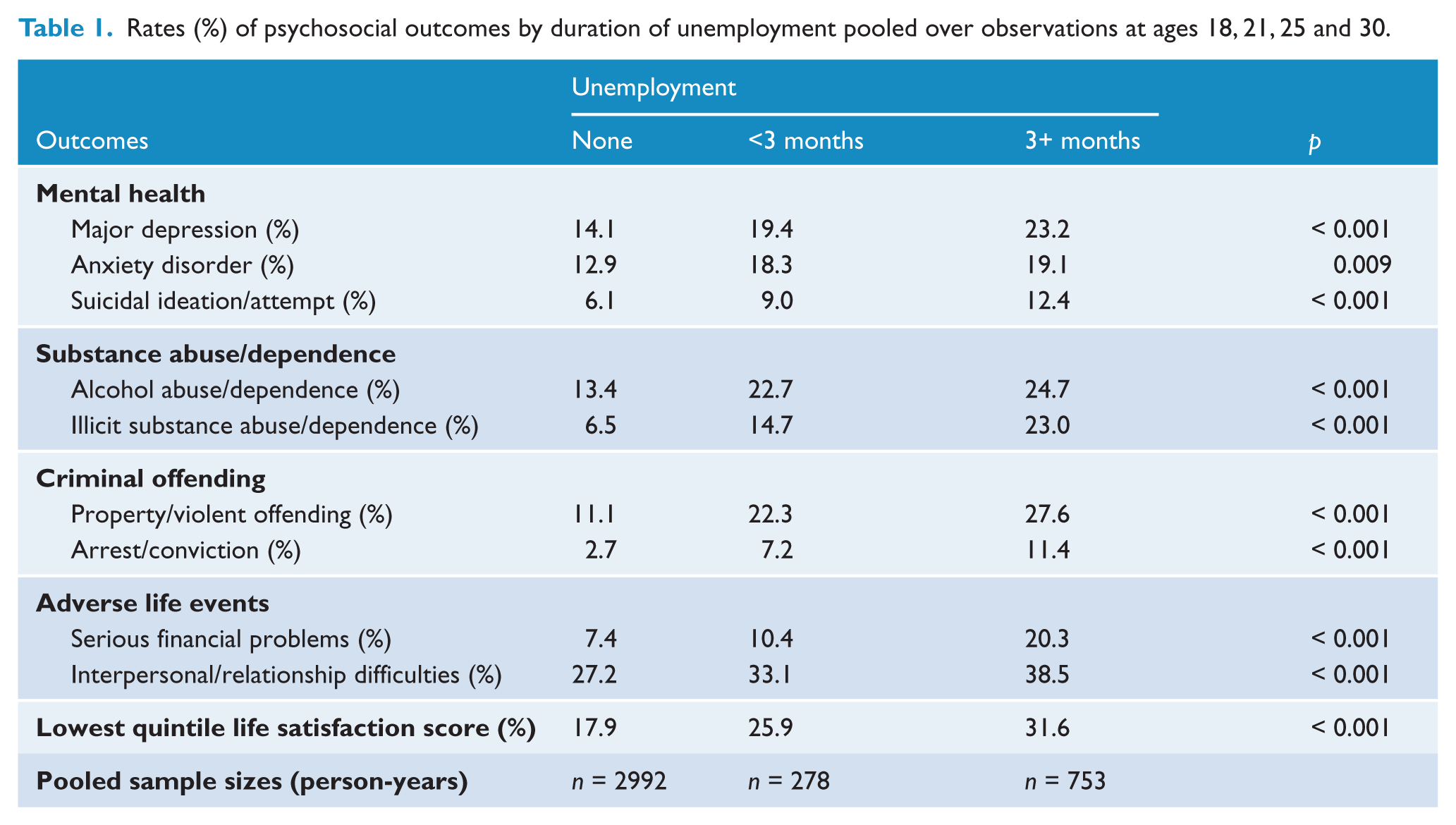
Table 1 shows the population-averaged associations between duration of unemployment and a series of outcome measures assessed in the 12-month period prior to 18, 21, 25 and 30 years. Population-averaged estimates were obtained by pooling the data over these time periods (supplemental Table 1 shows the information used to calculate these pooled estimates). Table 1 shows statistically significant (p < 0.01), linear relationships between duration of unemployment and mental health, substance abuse/dependence, criminal offending, adverse life events and life satisfaction. The analyses were extended to include multiplicative age by unemployment interactions and gender by unemployment interactions. Only one statistically significant interaction was found, suggesting a tendency for the association of unemployment with alcohol abuse/dependence to weaken with increasing age (p = 0.003).
Rates (%) of psychosocial outcomes by duration of unemployment pooled over observations at ages 18, 21, 25 and 30.
Adjustment for confounding by non-observed fixed factors
Table 2 summarises the results of the fixed-effects regression models fitted to the repeated-measures data. As noted previously, the fixed-effects model controls for all non-observed confounders, providing these confounders exert a fixed effect on the outcome variable.
Estimated effects of duration of unemployment on psychosocial outcomes before and after adjustment for confounding by non-observed fixed factors. a
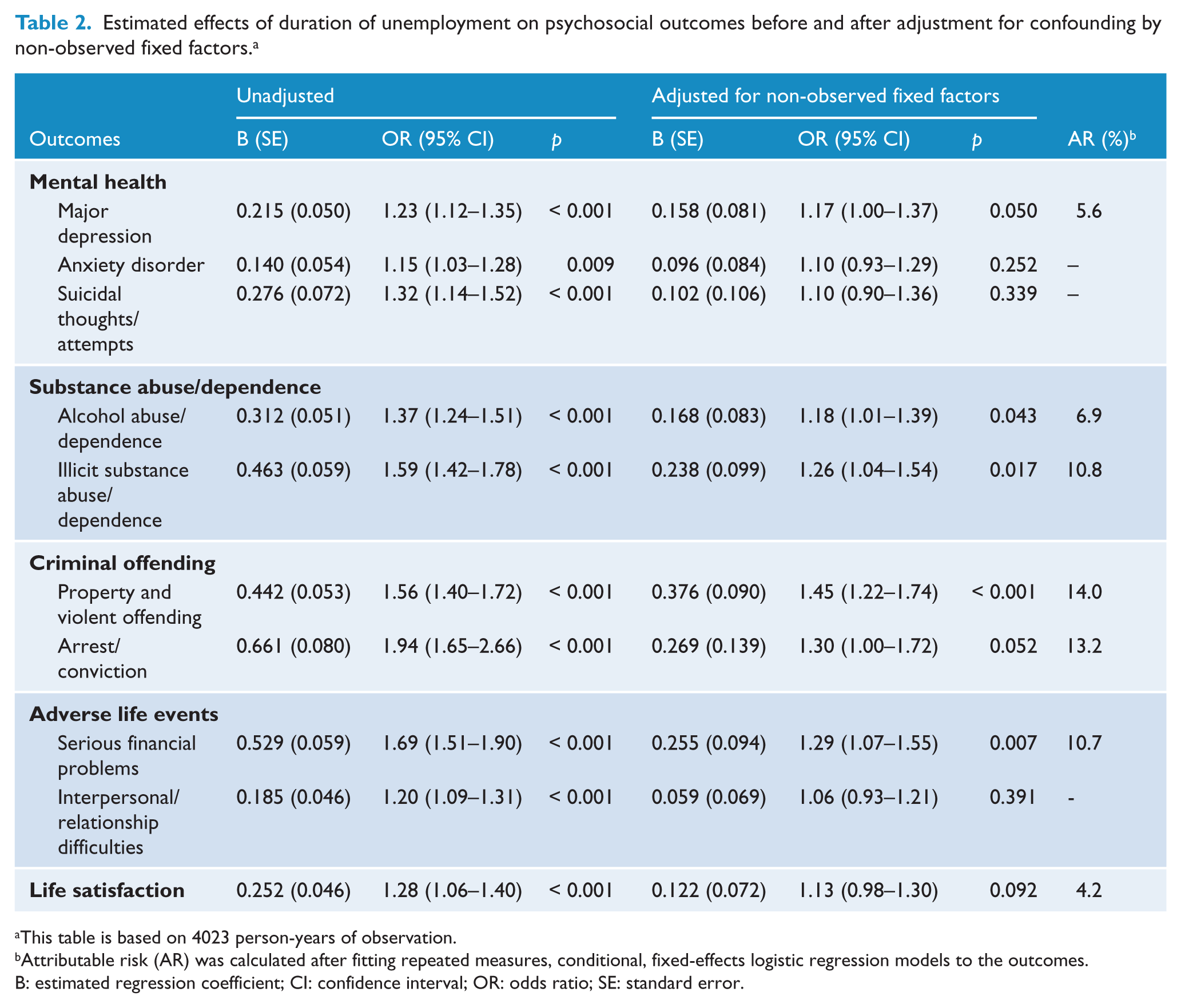
This table is based on 4023 person-years of observation.
Attributable risk (AR) was calculated after fitting repeated measures, conditional, fixed-effects logistic regression models to the outcomes.
B: estimated regression coefficient; CI: confidence interval; OR: odds ratio; SE: standard error.
The table shows the estimated regression coefficients (B) and standard errors (SE), odds ratios (OR) and 95% confidence intervals (CI), and tests of statistical significance (p) for the effect of unemployment on each outcome after adjustment for fixed effects. For comparative purposes, the unadjusted results are also presented. The table shows that following adjustment, there were statistically significant (p < 0.05) or marginally significant (p < 0.10) associations between duration of unemployment and major depression (p = 0.05), alcohol abuse/dependence (p = 0.043), illicit substance abuse/dependence (p = 0.017), property/violent offending (p < 0.001), arrest/conviction (p = 0.052), serious financial problems (p = 0.007) and life satisfaction (p = 0.092).
To summarise the effects of unemployment on the significant outcomes, estimates of the attributable risk (AR) were computed. Attributable risk measures the estimated reduction in each psychosocial outcome if unemployment was eliminated from the population (Fletcher and Fletcher, 2005). The estimates suggested that unemployment had only small effects on the overall rates of the outcomes. The values of AR ranged from 4.2% (life satisfaction) to 14.0% (property/violent offending), with a median of 10.8%.
Testing for reverse causality
The findings in Table 2 suggested that following control for non-observed fixed effects, exposure to unemployment was associated with increased risks of adverse psychosocial outcomes. These findings raise the important issue of the direction of causation between unemployment and these outcomes. It could be argued that unemployment may be a precursor for psychosocial problems, such as substance dependence or criminal offending; alternatively it may be suggested that these problems may lead to unemployment.
To examine these alternative explanations, the fixed-effects models in Table 2 were extended to include cross-lagged predictor variables (see Methods section). In these models, the associations between duration of unemployment and adverse psychosocial problems at time t were adjusted for lagged measures of prior history of psychosocial problems at time t-1. Table 3 shows the estimated associations between unemployment and adverse psychosocial outcomes after adjustment for lagged measures of these variables. Overall, the findings were similar to those reported in Table 2; for nine of the 10 outcomes, the strength of the association increased slightly after adjustment for previous history of these problems.
Estimated effects of duration of unemployment on psychosocial outcomes from conditional, fixed-effects regression models controlling for lagged measures of psychosocial outcomes.
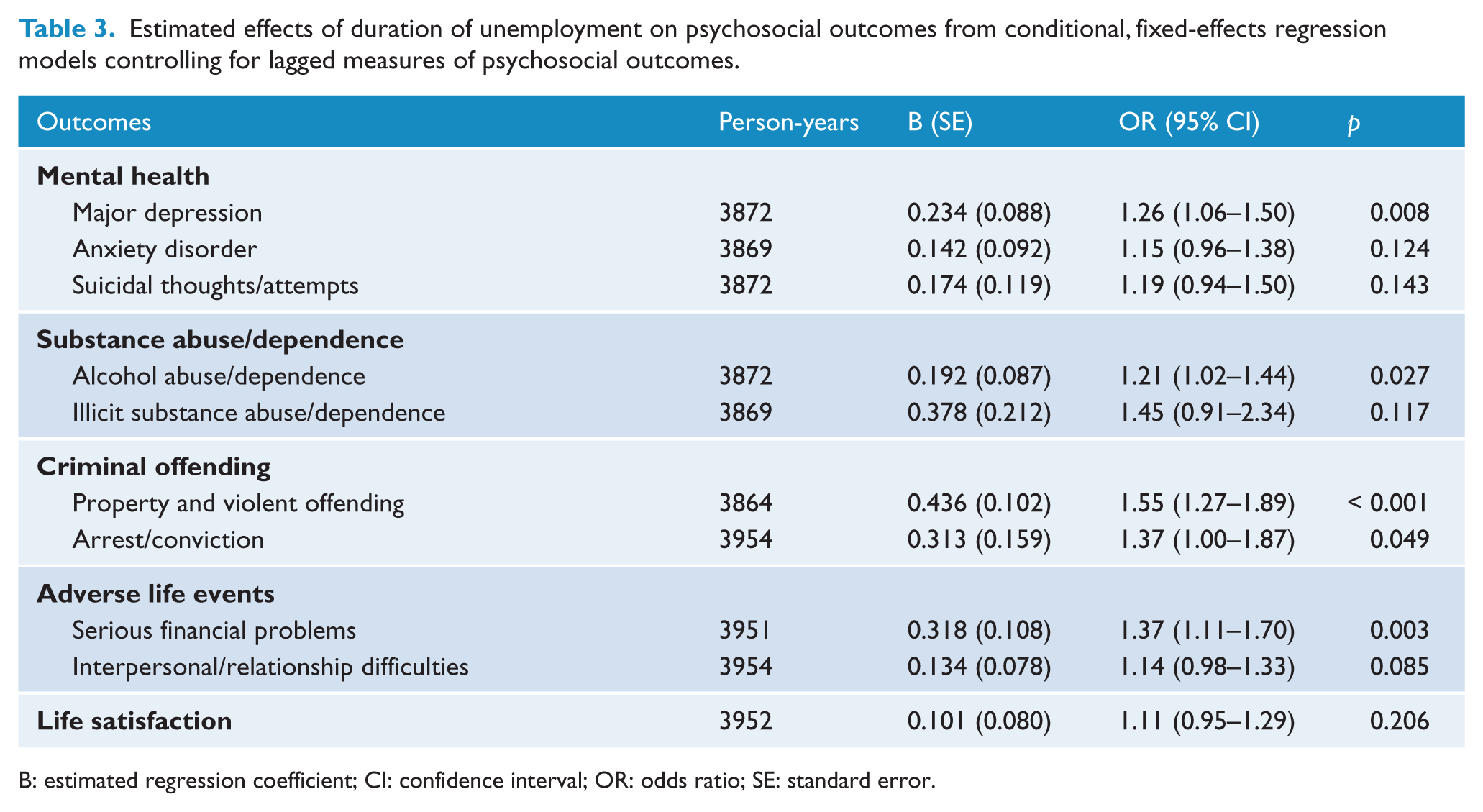
B: estimated regression coefficient; CI: confidence interval; OR: odds ratio; SE: standard error.
Discussion
In this study, we have examined the associations between duration of unemployment and rates of psychosocial adversity in a New Zealand birth cohort, studied up to the age of 30. The aims of this study were to examine the extent to which there were cause and effect associations between exposure to unemployment and a range of outcomes that spanned mental health, substance abuse/dependence, criminal offending, adverse life events and life satisfaction.
The first stage of the analyses showed pervasive and significant associations between the duration of unemployment and all outcomes. These findings are consistent with a large body of previous research that has found associations between unemployment and adverse life course outcomes (McKee-Ryan et al., 2005; Paul and Moser, 2009).
To address issues of confounding, the data were reanalysed using fixed-effects regression models. This analysis method controls for sources of non-observed confounding, providing these sources exert fixed effects on the outcome measures. The results of the fixed-effects regression analyses showed substantially reduced associations between unemployment and psychosocial outcomes, suggesting a large component of these associations was non-causal. However, significant or marginally significant associations remained between unemployment and a number of outcomes: major depression (p = 0.050), alcohol abuse/dependence (p = 0.043) and illicit substance abuse/dependence (p = 0.017), property/violent offending (p < 0.001), arrest/conviction (p = 0.052), serious financial problems (p = 0.007) and life satisfaction (p = 0.092). To assess the strength of the associations, AR estimates were calculated for these outcomes. This analysis suggested that unemployment exerted only weak effects on population rates of adversity, with values of AR ranging from 4 to 14% (median = 10.8%).
The analysis was then extended to consider possible reverse causal associations using two approaches. The first approach used methods of lagged regression and produced results that were consistent with the conclusion that there was a cause and effect association between unemployment and some outcome measures. Unfortunately, it was not possible to replicate these findings using a reciprocal cause, structural equation model, due to problems of model convergence.
Finally, tests of interaction showed that, with one exception, the effects of unemployment on psychosocial outcomes did not vary detectably with age or gender.
The present study has a number of strengths for examining associations between unemployment and psychosocial outcomes. These strengths included the use of a well-defined birth cohort with high sample retention rates, repeated-measures data on unemployment and a wide range of outcomes, and fixed-effects regression methods to control for non-observed sources of confounding. The net result of this is that the present study provides a more comprehensive and searching analysis of the links between unemployment and psychosocial well-being than has been the case in previous studies. However, a limitation of this study is that it is based on self-report interview data.
Finally, this study has important implications for ongoing political and social debates about the psychosocial consequences of unemployment. These debates have tended to polarise support into those who argue that unemployment has large effects on population well-being, and those who minimise the impact of unemployment. The present study leads to a middle-of-the-road position which suggests that while unemployment may have adverse consequences for a number of outcomes, these effects are relatively small.
Footnotes
Funding
This research was funded by grants from the Health Research Council of New Zealand, the National Child Health Research Foundation, the Canterbury Medical Research Foundation and the New Zealand Lottery Grants Board. Funding and/or grant number: HRC 11/792.
Declaration of interest
The authors report no conflicts of interest. The authors alone are responsible for the content and writing of the paper.
References
Supplementary Material
Please find the following supplemental material available below.
For Open Access articles published under a Creative Commons License, all supplemental material carries the same license as the article it is associated with.
For non-Open Access articles published, all supplemental material carries a non-exclusive license, and permission requests for re-use of supplemental material or any part of supplemental material shall be sent directly to the copyright owner as specified in the copyright notice associated with the article.
