




Abstract
Keywords
Introduction
With the exception of the minority views of climate change sceptics, there is widespread acceptance that human-induced global warming is occurring. Media dissemination of information about climate change frequently contains items highlighting the likely negative, even catastrophic consequences to our planet from these phenomena. Visual images, for example of ice caps melting and areas ravaged by floods, fires and drought, can be potentially alarming. Stokols et al. (2009) suggested that continual exposure to information engendered by modern technologies, such as the vivid and real time images on the internet, raise the salience of global crises and can engender anxiety or passivity in the face of seemingly overwhelming threats.
While the ways in which climate change is altering our physical, social and economic environment have been the subject of much research, the impact on people’s mental health is less well examined. We do know, however, that direct or indirect exposure to negative environmental impacts believed to be due to climate change, such as floods, fires or droughts, can cause psychological distress. Both New Zealand and Australia have experienced sustained periods of drought in recent years. For example, drought has been a major stressor affecting rural NSW communities since late 2001 and this has had a negative impact on people’s mental health in a number of ways. The residents of these farming communities report substantial distress in relation to the drought, with increased emotional stress and pressure on relationships (Sartore et al., 2007) and increased worry due to the experience of reduced income or income security (Fritze et al., 2008).
Because concern about climate change can create significant anxiety and distress about the future (Fritze et al., 2008), awareness of climate change as a global environmental threat can also have a psychological impact on people’s mental health. In recognition of the potential negative impact of climate change-related concern the Australian Psychological Society (2011) recently developed a tip sheet that presented suggestions for people experiencing climate change-related emotional distress. While there appears to be considerable discussion about how climate change can impact on people’s mental health generally, there is a paucity of literature examining the effect of climate change on people who are already living with a diagnosed mental health disorder. However, a recent publication by Wolf and Salo (2008) provides some insight into this issue.
Wolf and Salo (2008) documented what they claimed to be the first case of a person diagnosed with a ‘climate change delusion’. They describe how a 17-year-old boy diagnosed with major depressive disorder was convinced that if he drank water millions of people would die of thirst. He stopped drinking in an attempt to prevent this from happening and also started to check for leaking taps, so as to reduce water wastage.
Given that individuals currently living with anxiety disorders may be particularly vulnerable to increased anxiety and worry as a consequence of thinking about the future threat that climate change poses (Fritze et al., 2008), we were interested in exploring whether climate change had an impact on people with obsessive compulsive disorder (OCD). We were particularly interested in people with OCD whose dominant compulsions involve checking behaviours. People with checking compulsions often report this behaviour to be motivated by obsessions around harm coming to themselves or others (Vaccaro et al., 2010a). Checking behaviours then take shape as behaviours designed to reduce this harm, or to prevent catastrophic outcomes such as floods and fires (de Silva and Rachman, 1992). Specifically, in the current study we examined whether the obsessions and compulsions reported by patients presenting for OCD treatment for checking compulsions at our clinic were specifically associated with, and meaningfully related to, climate change. Additionally, if such concerns were identified, we were interested in assessing whether there were any gender or age differences or differences in the level of OCD severity, depression, anxiety and stress between individuals with climate change-related OCD concerns and those who did not express these concerns.
Full MEDLINE and PsycINFO searches using and combining the terms anxiety, obsessive compulsive disorder, obsessions or obsessive behaviour, compulsions or compulsive behaviour, environment, global warming, delusion, and climate change, revealed no articles documenting the role of climate change on the nature of OCD concerns experienced. As such we believe that this is the first published report in the literature documenting the role of climate change in influencing the type of obsessions and compulsions experienced by people with OCD.
Methods
Participants
The group comprised of 50 participants (29 male). Mean age was 38 years (SD 14.7, range 19–86). All had presented consecutively at the Anxiety Disorders Clinic at The University of Sydney seeking treatment for OCD checking subtype during the period March 2008 to November 2009. All cases met DSM-IV-TR (American Psychiatric Association, 2000) criteria for a current diagnosis of clinical OCD using the CIDI-Auto v2.1 (World Health Organization, 1997). Inclusion criteria included: (i) attaining a Yale–Brown Obsessive Compulsive Scale (Y-BOCS) (Goodman et al., 1989a,b) score of 16 or above, indicating symptoms in a clinical range; (ii) presence of significant compulsive checking (participants must have reported that they engaged in checking for at least 1 hour a day or identified checking as the OCD symptom they found most distressing or disruptive to their life); (iii) absence of any organic mental disorder, mental retardation or psychotic disorder; (iv) over 18 years of age; (v) any prior cognitive-behavioural treatment for OCD was completed at least 6 months prior to commencing this study; and (vi) if taking psychotropic medication must be on a stable dosage prior to commencing this study and must remain on the same dosage for the duration of the trial.
Procedure
Upon providing written informed consent, all participants completed the CIDI-Auto v2.1 (World Health Organization, 1997) and took part in a clinical interview conducted by the third author using the Y-BOCS (Goodman et al., 1989a,b). Demographic information was collected and participants also completed a number of self-report measures assessing obsessive compulsive, mood, anxiety and stress symptoms. Treatment (either exposure and response prevention or danger ideation reduction therapy) was conducted in 14 1-hour individual weekly sessions by the second author. Prior to commencing treatment, assessment of the types of obsessions and compulsions and the degree of anxiety they provoked were recorded by the second author. This assessment was conducted as part of routine clinical assessment. So as not to bias or artificially inflate climate change concern data, there was no explicit or direct questioning or probing of participants relating to climate change concerns. Instead only symptoms that were spontaneously reported through this clinical assessment were documented. Once the sample size had reached 50, content analysis of the clinical notes was conducted by the first author and the details of any additional OCD symptoms directly related to climate change phenomena that arose during treatment were recorded.
Measures
Yale–Brown Obsessive Compulsive Scale (Y-BOCS) (Goodman et al., 1989a,b)
The Y-BOCS measures the severity of OCD symptoms. It is a clinician-rated, 10-item scale, each item rated from 0 (no symptoms) to 4 (extreme symptoms). It assesses distress, frequency, interference, resistance and symptom control and provides an obsessions severity score (range 0 to 20), a compulsions severity score (range 0 to 20) and a total score (range 0 to 40).
Padua Inventory – Washington State University Revision (PI-WSUR) (Burns et al., 1996)
The 39-item PI-WSUR has five subscales measuring checking (PI-CHECK), contamination/washing (PI-WASH), dressing/grooming (PI-DRESS), thoughts of harm to self/others (PI-THTHRM), and impulses to harm self/others (PI-IMPHRM), with higher scores reflecting greater presence of these obsessive compulsive concerns. With a maximum total score of 156, the scale provides an indication of the severity of obsessive compulsive symptoms. The scale has a test-retest reliability of 0.76. With Cronbach’s alpha of 0.92 for the total scale, the PI-WSUR also possesses high internal consistency. The measure also demonstrates good discriminant and known-group validity.
Vancouver Obsessional Compulsive Inventory (VOCI) (Thordarson et al., 2004)
This is a comprehensive measure of OCD symptomatology with six subscales: checking, contamination, obsessions, hoarding, just rightness, and indecisiveness. The present study utilised the checking subscale, which consists of six items, to which participants responded on a 5-point Likert scale (0 = ‘not at all’ to 4 = ‘very much’). Examples include ‘I repeatedly check and recheck things like taps and switches after turning them off’ and ‘I repeatedly check that my stove is turned off, even though I resist the urge to do so’. Higher scores indicate a greater degree of checking compulsions. In clinical OCD samples, this measure demonstrates excellent test-retest reliability of 0.96. The VOCI demonstrates very good internal consistency of above 0.92. In addition, the measure demonstrates good known-group validity as well as convergent and divergent validity.
Beck Depression Inventory (BDI) (Beck et al., 1996)
The BDI is a measure of the negative effect associated with OCD. The second edition of the BDI (BDI-II, Beck et al., 1996) was used to measure depressive symptoms in this sample. The 21-item scale measures the somatic, cognitive and affective symptom domains of depression during the previous 2-week period. Each item is scored between 0 and 3, corresponding to statements regarding severity of symptoms; higher scores indicate greater severity of depression. The questionnaire has excellent test-retest reliability and internal consistency with Cronbach’s alpha of 0.92. Good known-group, convergent and divergent validity has been demonstrated.
Depression Anxiety Stress Scale (DASS-21) (Lovibond and Lovibond, 1995)
The DASS-21 is a short form of the 42-item DASS. The DASS-21 has three subscales measuring depression, anxiety, and stress symptoms experienced in the past week.
Results
Participant characteristics for the OCD climate change-related concerns (OCD CCC) and OCD non-climate change-related concerns (OCD n-CCC) groups
Fourteen of the 50 participants (28%) were identified as having OCD climate change-related concerns (OCD CCC). The majority of these participants (n = 10) were male (71%). Age ranged from 20 to 86 years (mean 41.64, SD 5.03). Current use of selective serotonin reuptake inhibitor (SSRI) medication was reported by five (36%) participants and five (36%) participants had previously undertaken psychological therapy.
Thirty-six of the 50 participants (72%) did not have any OCD climate change-related concerns (OCD n-CCC). The majority of these participants (n = 19) were male (53%). Age ranged from 19 to 79 years (mean 36.39, SD 2.12). Current use of SSRI medication was reported by seven (19%) participants and 13 (36%) participants had previously undertaken psychological therapy.
There were no significant differences between groups for age (z = −0.735, p = 0.462) or gender (z = −1.188, p = 0.235).
OCD severity, mood, anxiety and stress for the OCD CCC and OCD n-CCC groups
Table 1 presents the means, SDs, and z-tests of group differences for the VOCI (Thordarson et al., 2004), PI-WSUR (Burns et al., 1996), Y-BOCS (Goodman et al., 1989a,b), DASS-21 (Lovibond and Lovibond, 1995) and BDI-II (Beck et al., 1996). As can be seen from this table there were no significant differences between the OCD CCC group and the OCD n-CCC group on any of these measures.
Means, SDs and group differences for the VOCI, PI-WSUR, Y-BOCS, DASS and BDI-II.
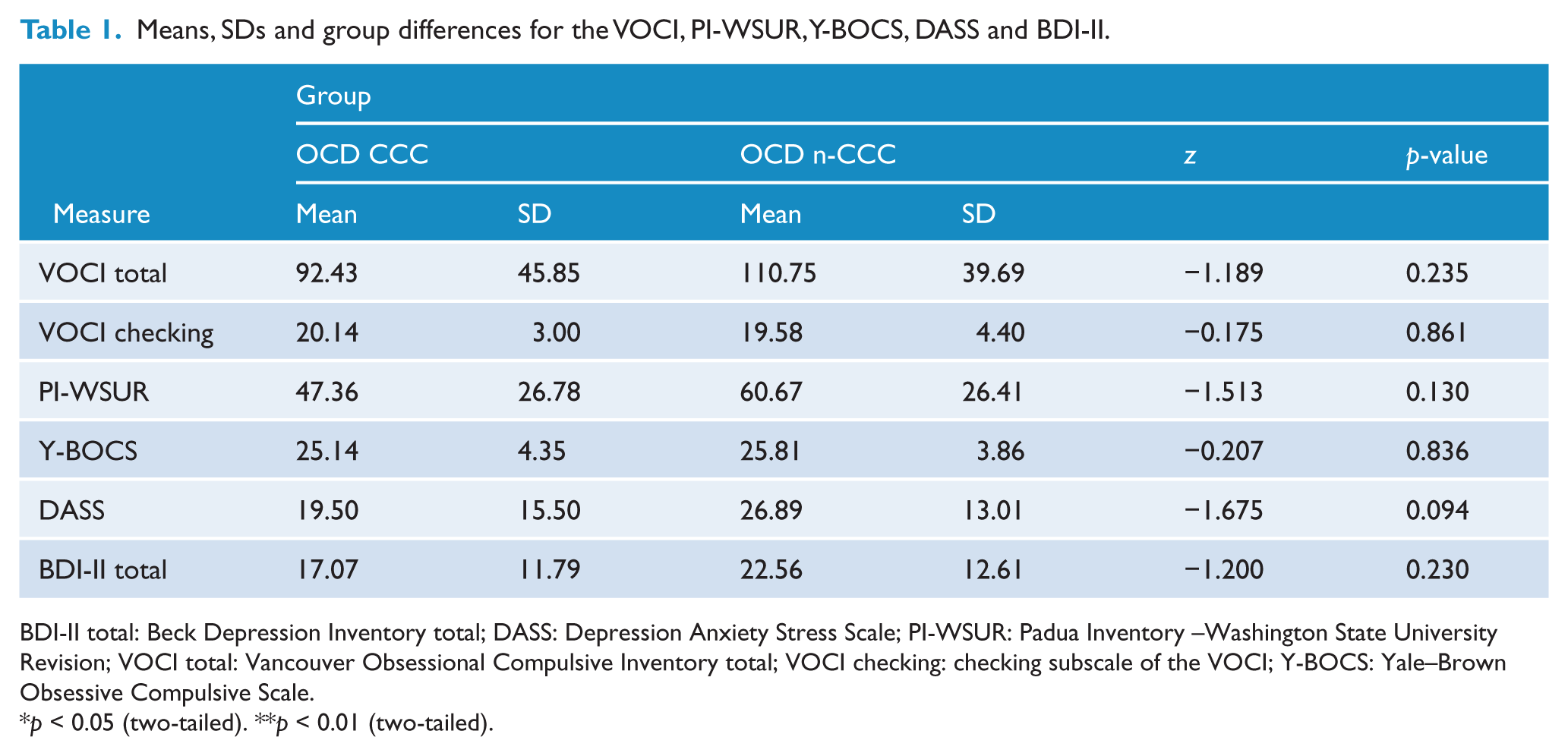
BDI-II total: Beck Depression Inventory total; DASS: Depression Anxiety Stress Scale; PI-WSUR: Padua Inventory –Washington State University Revision; VOCI total: Vancouver Obsessional Compulsive Inventory total; VOCI checking: checking subscale of the VOCI; Y-BOCS: Yale–Brown Obsessive Compulsive Scale.
p < 0.05 (two-tailed). **p < 0.01 (two-tailed).
The frequency and nature of climate change-related obsessions reported
Two of the 14 participants were concerned that increased air temperatures would result in rapid evaporation of the water in their pet bowls, leading to their pets dying of thirst if they didn’t check that the water bowls were filled. For both these people this was the only climate change-related obsession. Six of the 14 participants were concerned about wasting electricity by leaving a light or lights on and 10 of the 14 participants were concerned about wasting water from leaving a tap on. Five of the 14 reported concerns about both wasting electricity through leavings lights on and wasting water through leaving taps on. One participant was concerned that if they left the stove on they would waste gas. One participant had idiosyncratic concerns that global warming was contributing to a number of different problems including the floors cracking and the house subsequently falling down; pipes leaking; roof problems and white ants eating wooden structures in the house such as front and back doors and cupboard doors.
The frequency and nature of climate change-related compulsions reported
The compulsions reported appeared to be logically related to the obsessions experienced, because the compulsions reported for the two people who were concerned about their pets dying from thirst involved checking and rechecking the pet’s water bowl to ensure they held adequate water. All six people who were concerned about wasting electricity checked light switches after use, before leaving the house and at other times during the day or night. Additionally, one person’s checking of light switches involved looking at the light switch then touching the wall and door after each visual check; one person turned the light switches off and on several times as part of the ritual checking. All 10 people who were concerned about wasting water visually checked that the tap was in the off position and not releasing any drips after use, before leaving the house and at other times during the day or night. One of these participants engaged in a series of five turns of the tap in the on and then off position; one person touched the tap while looking at it and repeating out loud the phrase ‘it’s off’.
The participant who was concerned about leaving the stove on and wasting gas visually checked and rechecked that the stove was off by looking to see whether the stove light was visible or not. The participant who had concerns that global warming had contributed to the floors cracking and the house subsequently falling down checked the skirting boards visually and with their hands to see if any cracks were present. This participant was also concerned that their pipes were leaking or that there were roof problems and repeatedly performed visual checks of both the pipes and the roof for leaks or damage. This participant was also concerned that white ants were eating the house and visually inspected front and back doors and cupboard doors for signs of white ants or white ant damage, repeatedly opening and closing these structures to see if there were any audible signs of damage.
Discussion
This paper reports the presence of climate change-related concerns in 14 of the 50 consecutive patients with OCD checking subtype who presented for treatment at The University of Sydney Anxiety Disorders Clinic over a 21-month period beginning in March 2008. To our knowledge this represents the first documentation in the scientific literature of the significant impact of climate change on the nature of the concerns experienced by people with OCD checking subtype.
It is perhaps not too surprising that the concerns of some people with OCD might include those related to climate change because we know that OCD can be influenced by the world in which we live. More than three decades ago Akhtar et al. (1978) had observed that some obsessions or obsessive themes occurred more frequently than others. They investigated the socio-cultural determinants of the phenomenological aspects of obsessional neurosis in a sample of 82 Indians with obsessional neurosis. They suggested that “obsessions relating to dirt and contamination may have been a result of the socio-cultural preoccupation with matters of purity and cleanliness” (Akhtar et al., 1978: 160). Thus external factors such as religion, locality and socio-economic status were suggested to have a large impact on the content of the obsessions.
More recently it was seen that new obsessions could arise in tandem with current societal concerns. For example, obsessions about HIV/AIDS contamination did not exist before documentation of the newly discovered HIV virus and the media dissemination of the extent of the illness and mortality that could be experienced by people who contracted the virus. Fisman and Walsh (1994), for example, described obsessive ruminations related to AIDS contamination in two children, one 12-year-old boy and an 11-year-old girl. Several weeks before her symptoms began the 11-year-old girl had received information about AIDS in a class about health and some television shows she had watched about AIDS. Other similar cases have also been reported (Lewin and Williams, 1988).
While it is not particularly surprising that some people with OCD may have concerns related to climate change, what is surprising is the extent of these concerns in the current sample. No significant differences for age or gender were found between the group with climate change-related obsessions and compulsions and the group without such concerns. Additionally, there were no significant differences in OCD severity, mood disturbance or stress and anxiety between groups.
While compulsions involving checking taps and light switches are frequently observed in people with OCD, particularly those with the checking subtype, the feared consequences were clearly very different for the participants in the current sample. The repeated checking of taps occurred not because of fear of flood that would cause harm but because they didn’t want to waste water. The repeated checking of light switches occurred not because of fear of electrical fire that would cause harm but because they didn’t want to waste electricity which comes from fossil fuel-burning power plants that cause carbon dioxide emissions. Thus, participants were concerned about their own contribution to climate change and were keen to reduce their global footprint. They were also concerned about negative consequences based on climate change such as cracking floors, roof problems, pets dying from thirst and increased white ant activity.
Media coverage of the role of the individual’s behaviour and practices in reducing their carbon footprint and embracing more sustainable lifestyles is common. Further, psychological research on climate change has examined how to encourage more sustainable lifestyles and the investigation of psychological factors including individual perception of responsibility for environmental problems has also received some attention by psychologists (Uzzell, 2000).
Current media exposure frequently emphasises that to avert the potentially disastrous outcomes for our planet and its living creatures we have a responsibility as individuals to do what we can to reduce greenhouse gas emissions. Thus individuals can help address climate change by engaging in behaviours such as recycling and using less water and electricity. Many people have made climate change-related modifications to their behaviour. For example a recent Australian Bureau of Statistics household survey (Australian Bureau of Statistics, 2006) that collected information across a number of areas including household waste management and maintenance and use of transport found that the recycling activities (waste recycling or reuse) of Australian households grew from 91% in 1996 to 99% in 2006.
Further, it is possible that people who experience anxiety about what the world will be like in the future due to climate change may be told to curb their electricity use and recycle more as a way of decreasing their anxiety. That is, making individual behavioural changes to cut one’s global footprint may be seen as a way of decreasing anxiety because the person now feels that they are helping address the problem and have a sense of control in future outcomes. However, for people with OCD checking, it is possible that this approach can actually exacerbate the anxiety and contribute to further checking. Instead, we suggest that therapy for OCD checkers with climate change-related concerns that involves decreasing their concerns by reducing their probability and severity estimates of disastrous outcomes may be beneficial. The cognitive-based psychological treatment, danger ideation reduction therapy (Vaccaro et al., 2010b), could be one useful approach in this endeavour. However, given the relative scarcity of evidence for the efficacy of this particular treatment and for cognitive approaches in general, at this point in time the more widely accepted therapy of exposure and response prevention should be recommended.
Before concluding it should be acknowledged that because there are no objective self-report assessment instruments that have items directly related to OCD climate change concerns at present, the details of the OCD symptoms directly related to climate change phenomena reported in this paper were derived from the pretreatment assessment interview undertaken by the second author and the analysis conducted by the first author of the clinical notes written during treatment. While explicit or direct probing of participants relating to climate change concerns did not occur and only symptoms that were spontaneously reported were documented so as to not bias or artificially inflate climate change concern data, we acknowledge that it is not entirely possible for us to completely rule out potential bias in our method of eliciting the climate change-related content.
As such, we suggest that future research with people with OCD, including those with and without dominant checking concerns, needs to be conducted to see whether other researchers report findings similar to ours. Given the absence of objective assessment instruments that can be applied in this endeavour, and also because this is the first paper reporting a relationship between climate change and OCD symptom expression, we suggest that researchers adopt a similar methodology to that employed in the current study. If sufficient evidence of this phenomenon is found across studies, the development of a self-report instrument that could provide a more objective methodological approach may be warranted. Additionally, future research examining the presence of climate change-related concerns in other anxiety disorders such as generalised anxiety disorder and panic disorder may be worthwhile.
In conclusion, Wolf and Salo (2008) argued that their case of climate change delusion in a boy with major depressive disorder illustrated how delusions get modernised and reflect the concerns of contemporary life. Similarly, the findings of the current study demonstrated that climate change had an impact on the types of obsessions and compulsions experienced by people with OCD. Specifically, some OCD concerns became aligned with current issues or perceived dangers. This provides further evidence of how culture can influence psychiatric phenomenology.
Footnotes
Funding
This research was funded by a National Health and Medical Research Council (NH&MRC) Medical Project Grant. Jones MK, Menzies RG. (Chief Investigators) (2007-2009). Danger Ideation Reduction Therapy (DIRT) for obsessive-compulsive checkers: A randomized controlled trial.
Declaration of interest
The authors report no conflicts of interest. The authors alone are responsible for the content and writing of the paper.