




Abstract
Background
Maternal serum free beta human chorionic gonadotrophin (free β-hCG) is used as a biomarker in first trimester screening for fetal Down’s syndrome. Production of free β-hCG can occur in vitro in a time- and temperature-dependent manner; thus, the current Scottish screening protocol states samples must be received by the laboratory within 72 h. To assess the validity of the protocol, an audit was conducted to determine the impact of transit time on maternal serum free β-hCG multiple of median (MoM) values in the Scottish screened population.
Methods
Corrected MoM values from antenatal screening carried out over one year (April 2017 to March 2018) were stratified according to sample transit time and compared. To investigate possible environmental temperature effects, the data were split according to season and maternal serum free β-hCG concentrations from summer and winter compared.
Results
Of the 28,368 samples included in the study, 24,368 were received on the day of phlebotomy or after one day in transit. Only 1.5% of samples were received after 3 days in transit. The difference in maternal serum free β-hCG MoM values due to transit time was not significant. No statistical difference was found between maternal serum free β-hCG concentrations from samples collected in summer and winter months.
Conclusion
The current sample receipt protocol in use by the Scottish Down’s syndrome screening programme is fit for purpose.
Keywords
Introduction
The first trimester antenatal Scottish Down’s syndrome screening programme is commissioned by the National Services Division (NSD) with centralised laboratory analysis provided by NHS Lothian. First trimester maternal serum biomarkers are pregnancy associated plasma protein A (PAPP-A) and free beta human chorionic gonadotrophin (free β-hCG), known as the combined test. To account for changing concentrations of the biomarkers with increasing gestational age, concentrations are converted into multiple of median (MoM) values. Biomarker MoMs are corrected for maternal weight, gestational age, insulin dependent diabetes and maternal ethnicity. corrected MoMs along with the fetal nuchal translucency (NT) MoM are combined with the a priori age chance to calculate the combined chance of fetal Down’s syndrome. A disadvantage of maternal serum free β-hCG is its production in vitro from degradation of intact hCG over time. The degradation process can be accelerated by increasing temperature and prolonged contact of intact hCG with red cells.1,2,3 High maternal serum free β-hCG concentrations are associated with higher chance pregnancies; thus, previous publications4,5 considered the impact of degradation on MoM values. Disadvantages of these studies were the small number of samples used (n = ≤10) and that incubation experiments were conducted under laboratory conditions.4,5 Prior to centralisation of Scottish laboratory services for Down’s syndrome screening, an audit was conducted by the East region in 2013 to determine the relationship between transit time and maternal serum free β-hCG MoM values (L. Rashid, personal communication, March 2018). For data analysis, samples (n = 14,314) were categorised into groups according to transit time: <1, 1, 2 and 3 days. The maternal serum free β-hCG corrected median MoM levels increased with transit time from 0.982 to 1.192 for <1 day to 3 days in transit, respectively. As the laboratory provision for Down’s syndrome was centralised in 2016, a new audit was required to assess the impact of transit time on corrected free β-hCG MoMs from the entire Scottish screened population.
Methods
Transit stability study
All requests for first trimester Down’s syndrome screening from 01/04/17 to 31/03/18 were extracted from LifeCycle 4.0 Rev. 3 (PerkinElmer). Figure 1 shows 31,396 samples were received in serum separating tubes during the audit time period. Laboratory protocol states samples should be received within 72 h and for the ease of data collection this has been interpreted as 3 days. Samples were usually sent by post and transit time was calculated as the difference between the date of venepuncture and the date the sample was booked into the laboratory computer system. Samples were excluded if they were received after 3 days in transit or were from locations that centrifuge prior to posting (Figure 1). Samples received at the weekend were also excluded as they are centrifuged on receipt but not booked into the laboratory system until Monday (Figure 1). Exclusion criteria applied to first trimester Down’s syndrome screening sample data retrieved from 01/04/17 to 31/03/18.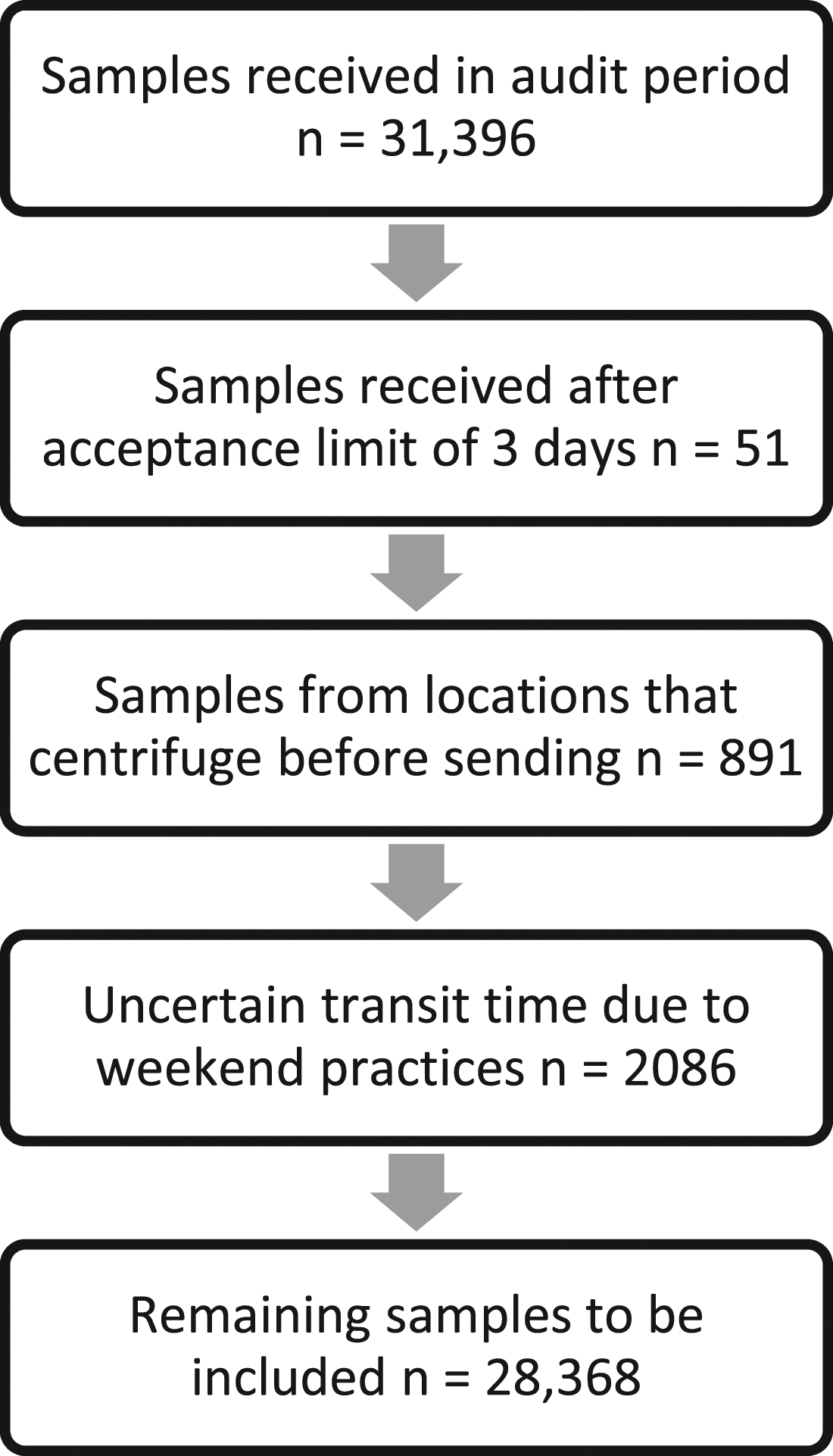
Seasonal investigation
Met office temperature data 6 from the latest available time period (1981–2010) was used to select two summer (June and July 2017) and two winter months (January and February 2018) for comparison. Average summer and winter temperatures were calculated from the monthly maximum and minimum temperatures for Edinburgh, Scotland. 6 Only samples that had spent 1 day in transit were used in this investigation to avoid transit time influencing maternal serum free β-hCG concentrations.
Data analysis
Median and quartile corrected MoM values were calculated for the transit stability study and median free β-hCG concentrations were calculated for the seasonal investigation. The Mann–Whitney test (Analyse-it) was used to test for significant differences between transit times and their respective free β-hCG median MoMs. Mann–Whitney tests were also used for comparing seasonal maternal serum free β-hCG concentrations and the biomarker correction factors of maternal weight and gestational age. Chi squared tests (Analyse-it) were used to compare the seasonal groups for maternal family origin, smoking status and presence of insulin dependent diabetes.
Results
Transit stability study
Following application of the exclusion criteria, 28,368 samples were included in the study. Figure 2 shows the majority of samples (79.9%) spent 1 day in transit post venepuncture. It was found that as transit time increased quartile and median corrected free β-hCG MoM values also increased (Figure 2), with median values ranging from 0.96 to 1.08 over the sample acceptance period. The greatest difference in median corrected free β-hCG MoM values (13%) was between samples received on the same day as venepuncture and those that spent 3 days in transit, followed by the difference between the 1 day median and the 3 days in transit median (8%). Due to the size of the 1 day in transit cohort (n = 22,660), this median was used as the baseline for hypothesis testing with each of the other transit times (Figure 2). No statistical difference was found between the baseline and each day, including the median MoMs which had greatest difference (baseline to 3 days) which had a p value of 0.284. Plot of maternal serum free β-hCG median and quartile corrected MoMs stratified according to days in transit. Lines denote significance testing, ns = not significant.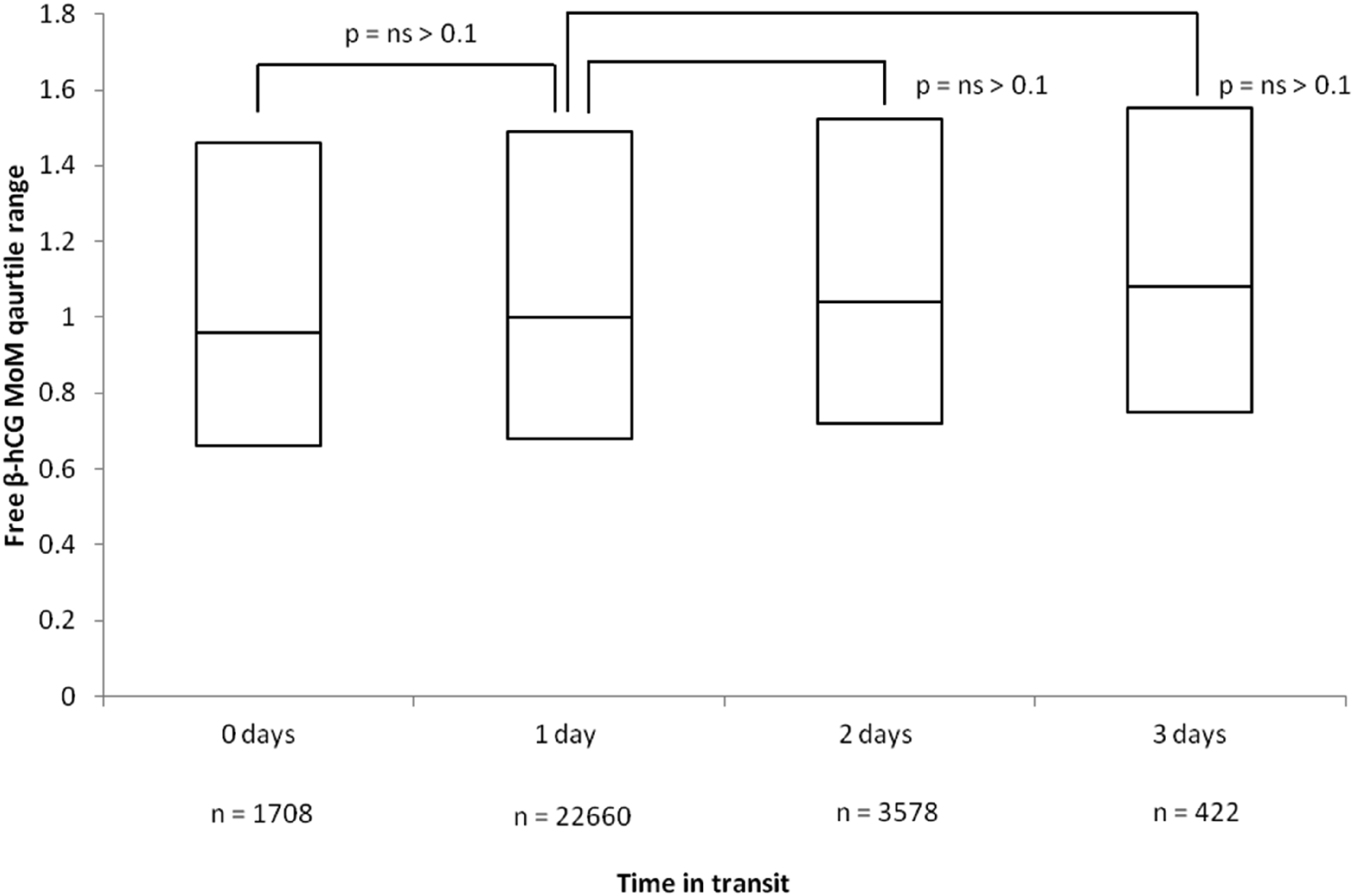
Seasonal investigation
Comparison of variables in summer and winter study groups.
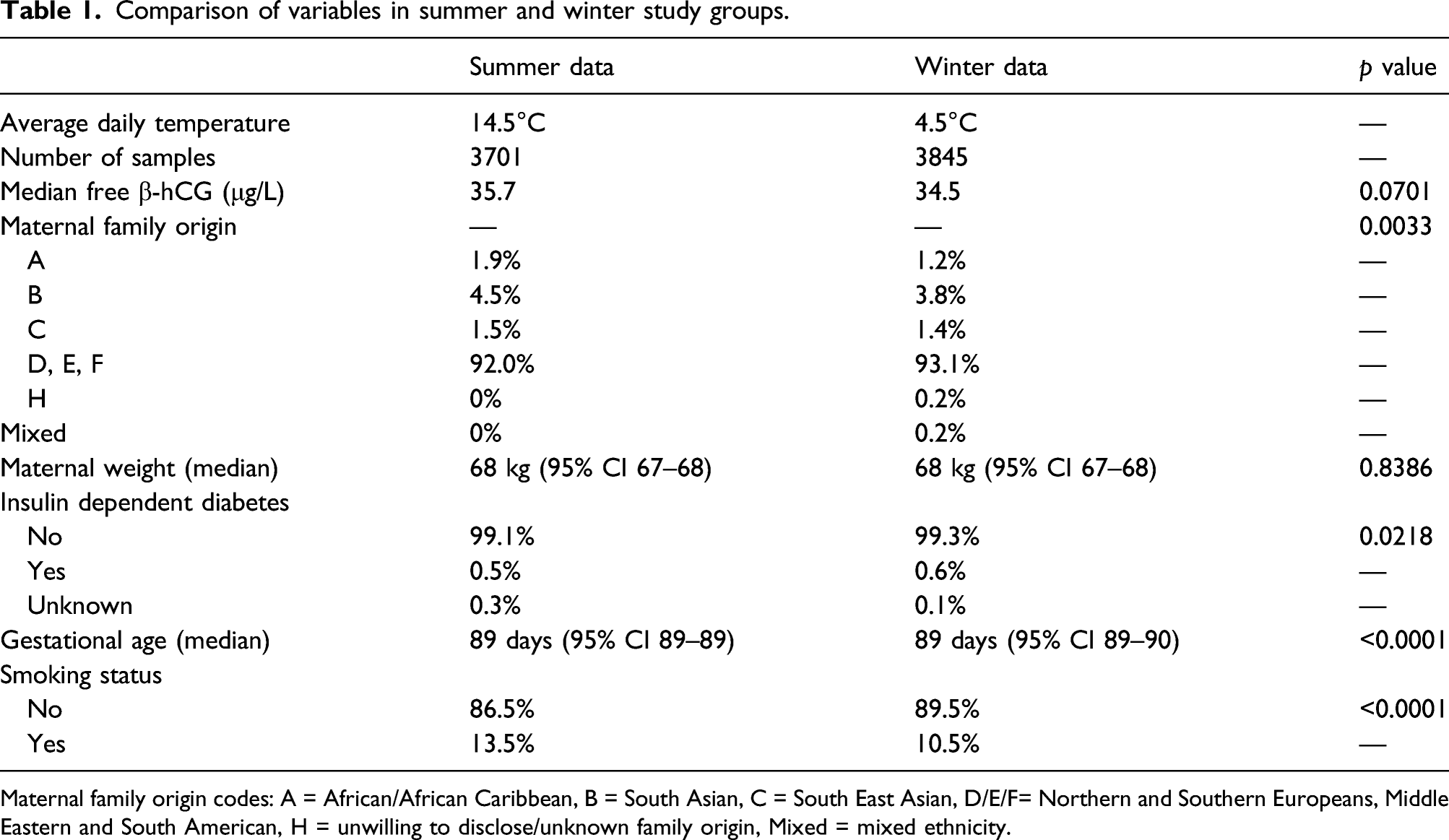
Maternal family origin codes: A = African/African Caribbean, B = South Asian, C = South East Asian, D/E/F= Northern and Southern Europeans, Middle Eastern and South American, H = unwilling to disclose/unknown family origin, Mixed = mixed ethnicity.
Discussion
Any perceived bias in maternal serum biomarker MoMs should be investigated by screening laboratories. For example, the false positive screening rate can be increased by 1% if maternal serum free β-hCG MoM is increased by 20% when measured at 9 weeks gestation. 7 . Thus two variables, transit time and seasonal variation were investigated by this study to determine if they contributed to changes in MoM values, which could have implications on the screen positive rate.
The laboratory provision of the Scottish Down’s syndrome screening service was centralised in 2016 and thus it was important to establish that postal conditions and the specified transit time limit was appropriate for the whole Scottish screened population. Regression analysis is used to define the relationship between biomarker concentrations and gestation and hence determine corrected MoM values specific to our population. The majority (79.9%) of samples are received after 1 day in transit, and as regression analysis is heavily influenced by this cohort, the free β-hCG median MoM from this group was set as the baseline for comparison. Samples 3 days in transit had the greatest difference (8%) from the baseline median, but the difference was not found to be significant (p value 0.284). Only 422 (1.5%) samples were received after spending 3 days in transit, thus the median MoM may be less statistically reliable.
In the seasonal comparison similar numbers of samples were received in summer 2017 and winter 2018. No significant difference (p value 0.0701) was found between winter and summer concentrations, but it has been reported7, 8, 9 that variables other than in vitro collection factors can alter maternal free β-hCG concentrations. For example, ethnicity affects maternal serum free β-hCG as increased concentrations are found in women of African or Caribbean origin but lower values are found South Asians.8,9 Thus, MoM values are corrected for gestational age and maternal factors of smoking status, presence of insulin dependent diabetes, family origin and weight by the LifeCycle software stated manufacturer above. As the seasonal study considers raw maternal serum free β-hCG, it was important to establish if any confounding factors had influenced the comparability of the data. Of the factors compared for the summer and winter groups, significant differences were found for smoking status and gestational age. Smoking causes a 4% decrease in free β-hCG concentrations 9 and there were 3% more smokers in the summer group compared with the winter group; thus, the smoking group may mask any seasonal increases that would have been seen in the raw median concentration. The median gestational age of pregnancies in both groups was the same at 89 days but the 95% confidence intervals for the data sets were 89–89 days and 89–90 days, respectively, for summer and winter. Maternal serum free β-hCG concentrations decrease by approximately 55% over the first trimester screening window. 10 Thus, the winter group may have a lowered median concentration relating to gestational age, however with the very small differences seen in free β-hCG concentrations (approximately 2–3% decrease per day) this contribution may not have been clinically significant.
In conclusion, the protocol of accepting whole blood samples for serum biochemical analysis within 72 h of venepuncture is fit for purpose. The data analysis showed that the seasonal groups were generally comparable and no season specific sample handling procedures are required at present. Thus, these factors are unlikely to significantly contribute to variations in the Scottish screen positive rate.
Footnotes
Declaration of conflicting interests
The author(s) declared no potential conflicts of interest with respect to the research, authorship, and/or publication of this article.
Funding
The author(s) received no financial support for the research, authorship, and/or publication of this article.
Ethical approval
Not applicable
Guarantor
RP
Contributorship
AB reviewed the literature and wrote the first draft of the article. All authors reviewed and edited the article and approved of the final version of the article.
