




Abstract
Abstract
Introduction
Novel psychotropic substances also known as legal highs are a major concern in UK prisons, fuelling violence and putting a strain on resources for inmates requiring medical treatment for adverse effects. We provide a clinical toxicology service including routine screening for novel psychoactive substances. In 2015, we were approached by Her Majesty Prison Service search dog training team to advise on which novel psychoactive substances to target, and again in 2016 to further provide analytical support to test five letters which the dogs positively identified for novel psychotropic substances during routine searches of prison mail rooms. Here we provide the first analytical confirmation that letters sent to inmates are being used to smuggle novel psychotropic substances into UK prisons.
Results
Novel psychotropic substances were detected on all five letters and these included the stimulants ethylphenidate, methiopropamine and methoxiphenidaine, the sedative etizolam and the third generation synthetic cannabinoids 5F-AKB-48, AB-FUBINACA, MDMB-CHMICA. Other compounds detected include the class A drug cocaine, class B drug methylphenidate and the cutting agents lignocaine, benzocaine and procaine.
Conclusion
Novel psychotropic substances smuggled into UK prisons is a major safety and security concern. By analytically confirming letters sent to inmates do contain novel psychotropic substances, we have produced categorical evidence to support anecdotal suggestions that novel psychotropic substances are entering UK prisons in this manner.
Keywords
Introduction
Legal highs also referred to as novel psychoactive substances (NPS), are designer drugs that mimic effects of classic drugs such as cannabis, cocaine and amphetamine. Typically, NPS are many times more potent than the drugs they mimic, and this increases the risk of overdose. 1 Clinical presentation as a result of NPS misuse varies, with mostly neurological symptoms reported.1,2 NPS use in UK prisons especially is a concern, as it is now considered endemic, fuelling violence, aggression and disruptive behaviour, and is also putting a strain on ambulance and hospital resources for prisoners requiring medical treatment.3–5 Between April 2012 and September 2014, the Prisons and Probation Ombudsman reported on 19 deaths of inmates known, or strongly suspected, to have been using NPS type drugs before their death. 3
A major problem in tackling NPS misuse in prisons is the availability of screening services.3–5 Conventional drug screening methods on urine or oral fluid for classic drugs such as cannabis, and cocaine will not detect NPS as they are chemically distinct. 1 This makes NPS attractive to those prisoners who want to avoid detection by traditional drug screening. Black Mamba or Spice, generic terms for any NPS that mimic the psychoactive effects of cannabis, is especially popular among prisoners, as the material is usually odourless and can therefore be smoked undetected.3–5 Her Majesty’s Inspectorate of Prisons (HMI Prisons) highlighted synthetic cannabinoid (notifications of infectious diseases [NOIDS]) as a concern in 64% of men’s prisons inspected in 2014–2015 and reported it to be the new ‘drug of choice’ in prisons in England. 5 Within our own NHS Trust located in a major UK City, we regularly see patients admitted from a nearby prison suffering the effects of NPS misuse, and in particular NOIDS. 6
We provide a specialist clinical toxicology service and are currently the only NHS laboratory to offer routine screening for NPS in the UK. In 2015, we were approached by Her Majesty’s Prison Service (HMPS) search dog training team to advise on which common NPS to target. NPS trained search dogs are now in active use across UK prisons.3,4 In 2016, we were again approached by HMPS to test five suspect letters identified by the search dogs. Here we provide the first analytical proof that letters sent to prisoners is a means of smuggling NPS into UK prisons.
Experimental
Chemicals and solutions
All solvents and water were purchased from Fisher Scientific® (Leicestershire, UK) and were of LC-MS/MS grade. Reference drugs used for ultra-performance liquid chromatography time of flight (UPLC-MS/TOF) were purchased from Cerilliant® Sigma-Aldrich (Texas, USA), LGC® (Luckenwalde, Germany) and Purechemicals.net (London, UK).
Detection of suspect letters
Search dogs were trained to detect the third generation synthetic cannabinoid AK-B48.6–8 Five letters were seized in prison mail rooms based on positive indications by the NPS search dogs. An example of the letters received and contents is shown in Figure 1. Permission to publish the findings of the analysis of these letters was given by the Chief Executive, HM Prison and Probation Service.
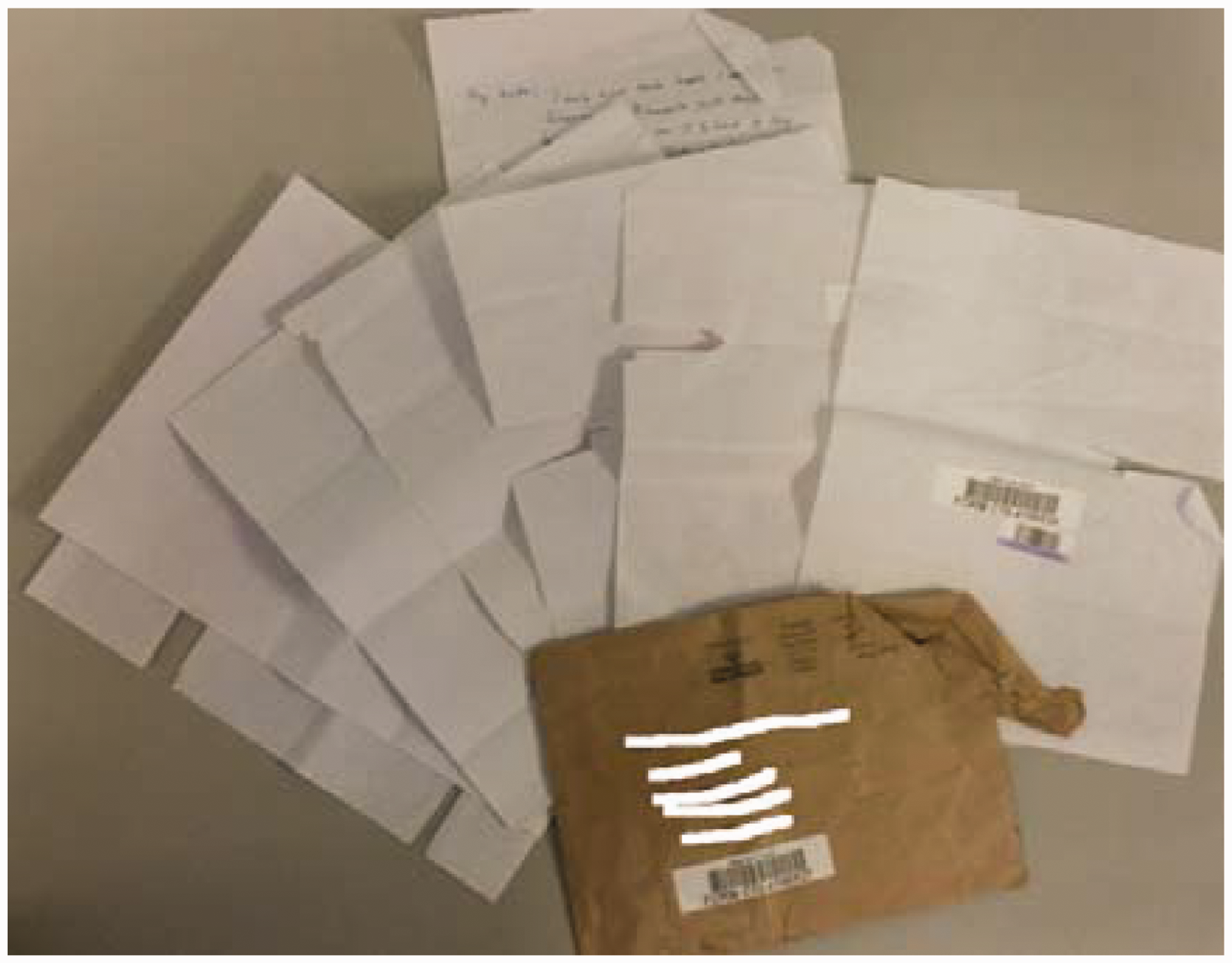
Example of suspect letter and contents received for NPS testing by UPLC-MSTOF. Note: Letter five is shown, contents are envelope containing letter written on half a torn page of blank paper and seven sheets of blank paper.
Letter analysis
The five letters with envelopes were hand delivered sealed in individual evidence bags. From each piece of paper or envelope, approximately 1 cm square of paper was removed from four different areas and placed into separate glass 10 mL screw top tubes with 0.5 mL of methanol. During this procedure, blank A4 paper was kept in the same area and was used as a blank control between the processing of each letter. Between the handling of each letter, operators’ gloves were changed and the scissors and work surface cleaned down with 50% methanol. Extracts were prepared from the letters and the blank A4 paper control samples by sonicating for 10 min followed by centrifugation for 5 min. The upper supernatant (100 µL) was then transferred to a Waters high recovery vial. The injection volume was 10 µL. A mobile phase blank was injected after the analysis of each extract to check for any carryover.
UPLC-MS/TOF analysis
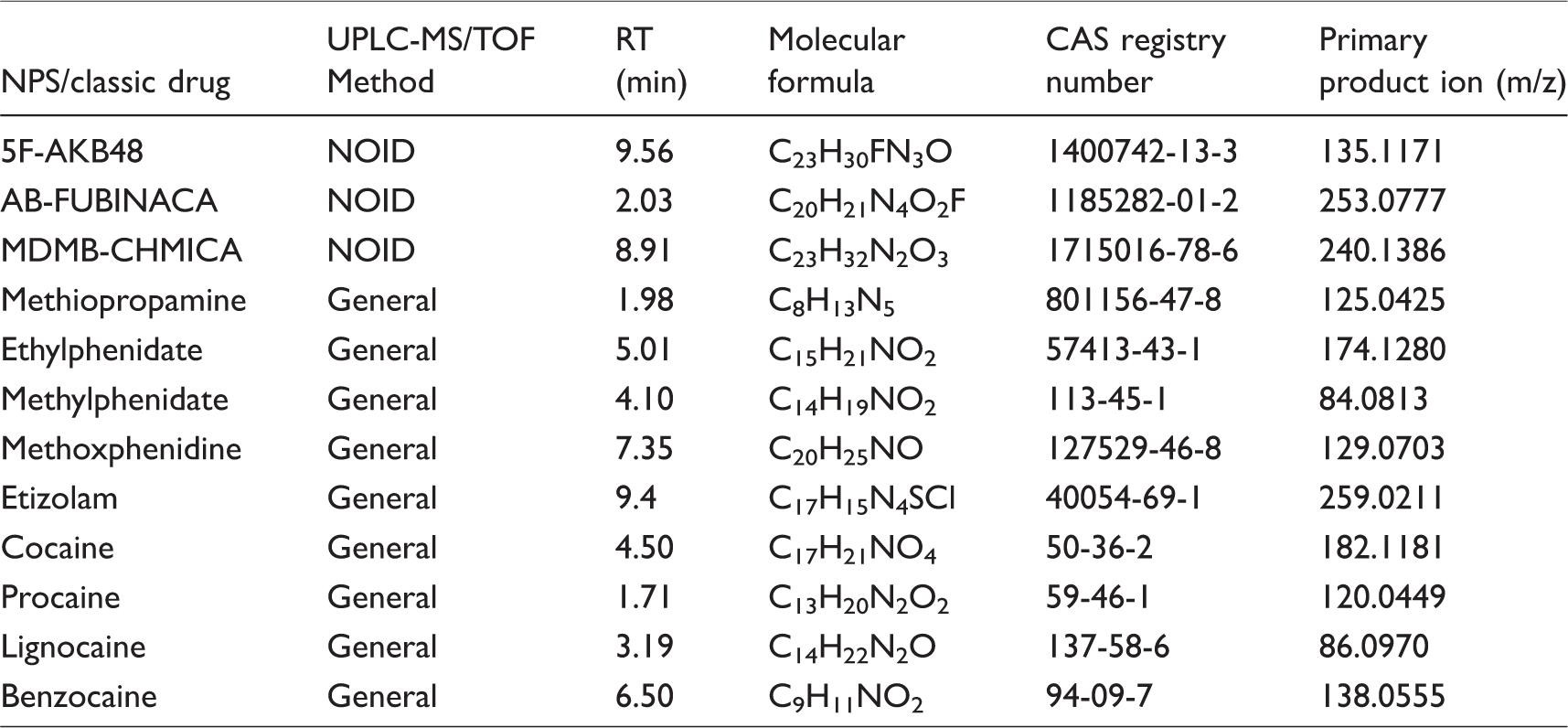
Extracts were screened for NPS and other compounds using a Waters ACQUITY UPLC® interfaced to a hybrid Waters Xevo G2 QTof detector, with electrospray ionization in positive ion mode (Waters, Co., Milford, MA, USA) and two qualitative methods as described previously.8,9 The first method for synthetic cannabinoids (NOID TOF method) includes a mass spectral library of over 100 first, second and third generation NOIDS and metabolites (total run time is 12 min).8,9 The second method is a general TOF drug screen as described by Rosano et al., 10 with additional compounds added in house with a mass spectral library of over 1300 drugs and metabolites including classic drugs of abuse, cutting agents, NPS and over the counter/prescription medications (total run time is 15 min).8,9 For both methods, leucine encephalin (2 ng/μL in 50/50 (v/v) acetonitrile/water containing 0.1%(v/v) formic acid) was used as a lockmass calibrant and analysed for two ions at 556.2271 Da and 120.0813 Da every 30 s at a flow rate of 5 μL/min throughout the run. Spectral data were processed using Waters MassLynx software (v4.1) with Waters Chromalynx application manager. Criteria used for compound identification were a mass accuracy of 5 ppm for both the parent compound (function one), and qualifier fragment (function two), an average isotope fit within 20% of the calculated ratio and a target RT ± 0.3 min.8–10 Mass spectral library information for all compounds detected, as well as which of the UPLC-TOF methods used, are shown in Table 1.
UPLC-MS/TOF mass spectral library information for all compounds detected on inmate letters.
Results
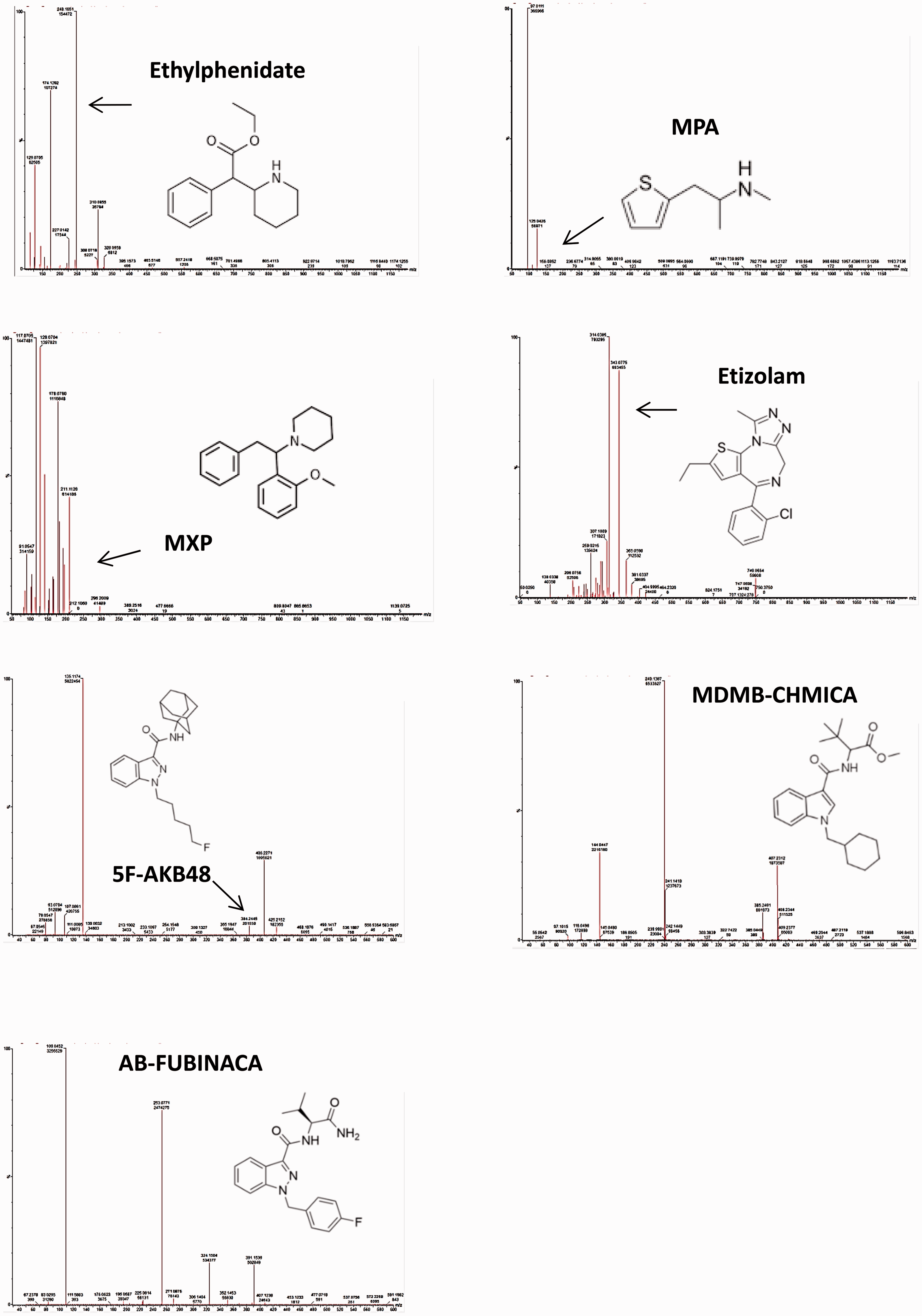
No compounds were detected in the blank A4 paper control extracts prepared after the handling of envelope and letters one to five. No carryover was observed in any of the mobile blanks analysed between extracts. Results of qualitative analysis using both the NOID TOF method and general TOF drug screen for all five letters are summarized in Table 2. Chemical compounds and extracted ion chromatograms for the seven different NPS detected are shown in Figure 2.
Summary of NPS results for five prisoner letters.
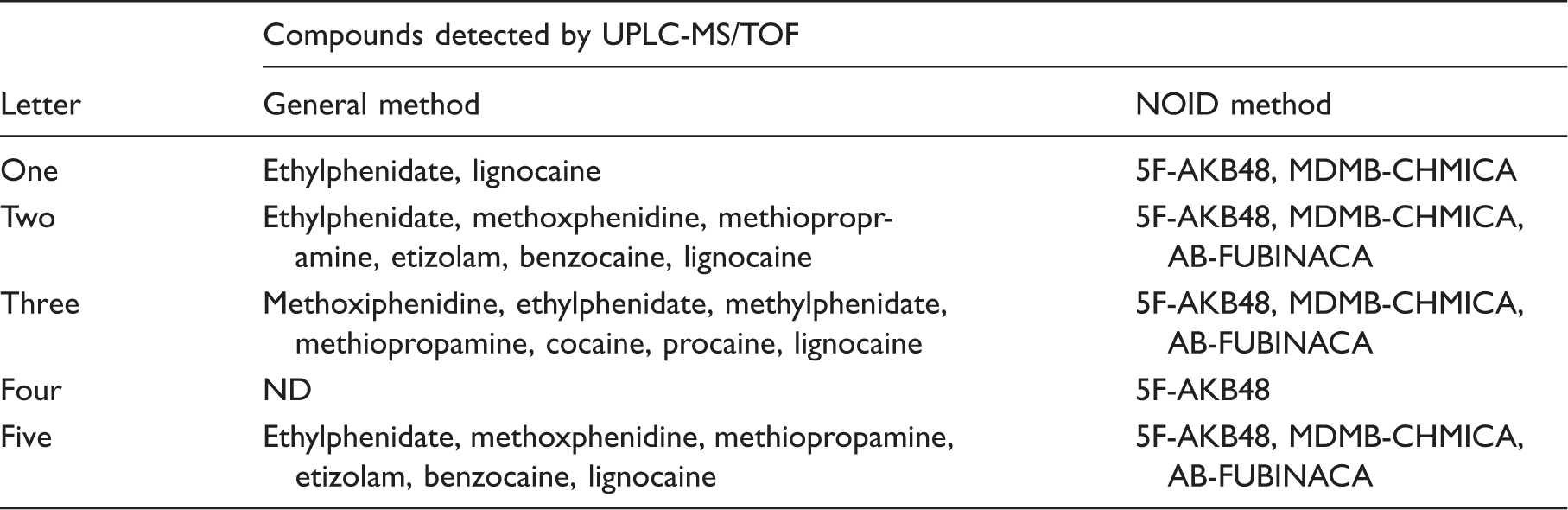
ND: none detected.
Letter one
All three pages were addressed to a single prisoner and included a handwritten letter and two children’s drawings. Four compounds were detected; lignocaine and the NPS ethylphenidate, and NOIDS 5F-AKB48 and MDMB-CHMICA.
Letter two
The contents were five handwritten letters signed by three different individuals addressed to two different but clearly related prisoners. On letters one to four, six compounds were detected, including the class B drug methylphenidate, and the NPS ethylphenidate, 5F-AKB48, AB-FUBINACA and MDMB-CHMICA. On letter five only, nine compounds were detected; lignocaine, benzocaine and the NPS ethylphenidate, methiopropamine (MPA), methoxyphenidine (MXP), etizolam, 5F-AKB48, AB-FUBINACA and MDMB-CHMICA.
Letter three
Contents were handwritten letter, two poems and a child’s drawing. Seven NPS were detected on all pages; MXP, MPA, ethylphenidate, 5F-AKB48, MDMB-CHMICA and AB-FUBINACA. In addition cocaine and procaine were detected on the handwritten letter.
Letter four
Contents were a single handwritten page on which just one NPS compound was detected, the synthetic cannabinoid 5F-AKB48.
Letter five
Contents were a short handwritten note and seven blank sheets of paper. The synthetic cannabinoid 5F-AKB-48 was detected on all pages. The NPS MPA and MXP were also detected on four of the blank sheets of paper and MPA on two. Lignocaine was detected on all seven blank sheets of paper.
Discussion
NPS pose a major threat to the wellbeing of prisoners and strategies are urgently required to prevent NPS being smuggled into UK prisons. Using qualitative UPLC-MS/TOF to screen five letters positively identified by HMPS NPS-trained search dogs, we have provided the first analytical proof NPS are being smuggled into UK prisons via impregnated letters sent to inmates. A total of 12 different compounds were detected on the five letters, including the UK class A drug cocaine, class B drug methylphenidate and seven NPS compounds; ethylphenidate, MPA, MXP, etizolam, 5F-AKB48, AB-FUBINACA and MDMB-CHMICA. All seven of these NPS compounds have been shown to cause adverse effects.6,11–21
Ethylphenidate is an analogue of the class B drug methylphenidate with effects that mimic stimulants such as cocaine.11,12 Adverse effects for ethylphenidate are poorly documented but include anxiety, paranoia, visual disturbance, chest pain, bizarre and violent behaviour, loss of fine motor control, a high risk of bacterial infection and local tissue damage. Of the four letters which tested positive for ethylphenidate, methylphenidate was also detected. We have also detected methylphenidate in legal high products which tested positive for ethylphenidate. 9 Ethylphenidate can be detected as a metabolite when methylphenidate is ingested with alcohol (ethanol). 13 The most likely source of the methylphenidate on both letters and in legal high materials containing ethylphenidate is the manufacturing process. 9 In recognition of the potential to cause harm, in April 2015, a temporary classification drug order (TCDO) was introduced in UK for ethylphenidate making it offense to supply. 12
MPA is an analogue of methamphetamine and mimics effects of 3,4-methylenedioxy-methamphetamine (MDMA, ecstasy) and amphetamine type compounds.14,15 Reported adverse effects include tachycardia, anxiety, panic attacks, sweating, headaches, nausea, difficulty breathing and vomiting, and in recognition of this potential to cause harm, a TCDO for MPA was introduced in UK in December 2015. 15 MXP is a dissociative anaesthetic with effects reported to be similar to ketamine and methoxetamine (hypertension, tachycardia, anxiety confusion, disorientation, dissociation and/or hallucinations).16,17 Etizolam, which was detected on page five of letter two only, is a short acting benzodiazepine analogue, with sedative and hypnotic effects typical of a benzodiazepine. 18 5F-AKB48, MDMB-CHMICA and AB-FUBINACA are all third generation NOIDS. Reported side-effects of NOIDS include catatonic states, dystonia, aggression, respiratory depression, hypotension and tachycardia.6–8,19–21 The other compounds detected, lignocaine, benzocaine and procaine can also be found in classic street drugs such as cocaine as cutting agents. 22 We have also previously detected these cutting agents when analysing actual legal high products. 9
Typically, NPS that mimic stimulants such as cocaine and amphetamine would be taken orally and therefore sold in powder or pill form. 2 NOIDS although available as a powder, are normally sold sprayed onto a herb based and smoked.1,8,9 On four out of the five letters, we detected a mix of both stimulant-type NPS and NOIDS. This explains anecdotal observations made by prison staff that prisoners have been seen licking, chewing as well as smoking their letters. As with classic drugs of abuse, the supply of NPS into prisons is profitable. 4 NOID-type NPS commonly referred to as Black Mamba are the most popular type of NPS used in prisons.3–5 The potential profit to be made on NPS smuggled into prisons is the most likely explanation for the inclusion of multiple blank sheets of paper in letter five.
The five letters all bore signs of being dipped in a liquid and then dried which is the most likely method used to transfer the NPS compounds to the paper. This was most evident on the children’s drawings in letter one with a clearly visible tide mark stain and crystalline residue present at the bottom of both pages. The finding of NPS on all the children’s drawings contained in letters one and three raises serious safe guarding concerns.
A further reason why inmates may be attracted to NPS is the reduced risk of penalties under the current legislative framework. 3 On 26 May 2016, the New Psychoactive Substances Bill came into effect making it an offense to possess, intend to consume for its psychoactive effect, or to know or suspect a substance is an NPS within any custodial institution. 23 In corrective institutions for this bill to be an effective, deterrent will be dependent upon the ability to detect covert means of NPS entering the prison system, as well as actual testing of materials, and clearly there is an urgent need for a UK strategy for this. Two of the letters we tested were sent by Royal Mail special delivery which requires a signature potentially allowing investigators to trace letters back to a supplying individual and therefore aiding prosecution.
The HMPS search dogs were all trained to detect the NOID type NPS AKB-48.3,4 We detected an analogue of AKB-48, 5F-AKB48 on all five letters, validating the search dogs training. Subsequent testing of these suspect materials to determine which if any NPS are present not only provides important confirmation but may also allow prison clinicians to explain changes in behaviour in inmates, further helping to identify those involved in NPS supply chain and add to published evidence of psychoactive effects of these compounds.
Footnotes
Declaration of conflicting interests
The author(s) declared the following potential conflicts of interest with respect to the research, authorship, and/or publication of this article: Both authors run a clinical toxicology service in the United Kingdom.
Funding
The author(s) disclosed receipt of the following financial support for the research, authorship, and/or publication of this article: Sandwell & West Birmingham Hospital NHS Trust, Department of Clinical Biochemistry.
Ethical approval
Not applicable.
Guarantor
LF and JB.
Contributorship
LF undertook the research and wrote the paper. JB edited the manuscript.