




Abstract
Introduction
Legal highs also known as novel psychoactive substances mimic the effects of classic drugs of abuse. Challenges to developing screening services for novel psychoactive substances include identifying which novel psychoactive substances are available to target. Using new techniques such as exact mass time of flight can help identify common novel psychoactive substances to target for screening patient samples by routine methods such as tandem mass spectrometry. We demonstrate this strategy working in our own clinical toxicology laboratory after qualitative analysis of 98 suspect materials for novel psychoactive substances by ultra-performance liquid chromatography with time of flight mass spectrometry.
Results
From July 2014 to July 2015 we received 98 requests to test a range of different suspect materials for novel psychoactive substances including herbs, tobacco, liquids, pills and powders. Overall, 87% of the suspect materials tested positive for novel psychoactive substances, and 15% for controlled drugs. Three common novel psychoactive substances were present in 74% of the suspect materials: methiopropamine, a methamphetamine analogue; ethylphenidate, a cocaine mimic; and the third generation synthetic cannabinoid 5F-AKB-48. For the 55 branded products we tested only 24% of the stated contents matched exactly the compounds we detected.
Conclusion
Testing suspect materials using ultra-performance liquid chromatography with time of flight mass spectrometry has identified three common novel psychoactive substances in use in the UK, simplifying the development of a relevant novel psychoactive substances screening service to our population. By incorporating this into our routine liquid chromatography tandem mass spectrometry drugs of abuse screen, then offers a clinically relevant novel psychoactive substances service to our users. This strategy ensures our clinical toxicology service continues to remain effective to meet the challenges of the changing drug use in the UK.
Introduction
The pattern of drug use in the UK has changed over recent years with novel (or new) psychotropic drugs (NPS), more commonly referred to as legal highs, gaining in popularity. Taking advantage of loop holes in the law by being sold as research chemicals not for human consumption, the Medicine Act (1968) and Misuse of Drugs Act (1971) do not apply. 1 Consequently, most legal highs can be freely sold in the UK, although this situation is likely to change in the near future with the introduction of the UK Psychoactive Substances Bill. 2
With attractive packaging and names often referencing popular programmes and celebrities, for example, Mr White, Clockwork Orange and Charley Sheen, legal highs are appealing, especially to youngsters. The term ‘legal high’ especially implies they are not harmful or addictive, and few people immediately associate these designer drugs with the controlled drugs they attempt to mimic, such as amphetamine, cocaine and cannabis. NPS packaging rarely includes any directions for use. Far more potent than the drugs they mimic, this increases the risk of overdose. In cases of drug abuse clinical presentation varies, with mostly neurological symptoms reported.3–8 Violence and aggressive outbursts are common making diagnosis and management more difficult and often necessitating patients being sedated.8,9 This also increases use of hospital resources such as CT scans and psychiatric team involvement. A presumptive diagnosis of NPS use also poses the risk of masking other serious conditions, and potentially delaying treatment.
Accurate and rapid screening would therefore prove helpful to clinicians for diagnosis and management of suspected NPS misuse. Unfortunately, most conventional toxicology screening methods do not detect NPS.10,11 Whilst a few commercial immunoassays do exist for NPS screening, 11 most laboratories rely on methods created in-house.7,8,12 One of the major issues when developing such services is deciding which of the many different NPS available to target. According to the latest update from the European Monitoring Centre for Drugs and Drug Addiction (EMCDDA) early warning system, 101 NPS alone were reported for the first time in 2014. 13 One strategy to determine which NPS to target is to test products on sale and a popular technique used is ultra-performance liquid chromatography with time of flight mass spectrometry (UPLC-MS/TOF).14,15 The advantage of UPLC-MS/TOF is not only the ability to accurately screen for thousands of compounds in a single analysis, but also to identify new compounds based on the elemental composition of parent and fragment ions. Other useful resources include the reports of the Home Office Annual Forensic Early Warning System (FEWS) 16 , and the Welsh Emerging Drugs & identification Substances Project (WEDINOS) website,17,18 which provide information on products sold in the UK and the NPS they contain.
We are a clinical toxicology laboratory within the NHS offering a testing service for NPS as well as classic drugs of abuse. In addition to biological samples, we also receive requests to test suspect materials for NPS by UPLC-MS/TOF. This information not only helps our users identify NPS abuse, but is an important part of our own toxicology vigilance system, allowing us to follow local trends in NPS use, as well as determine which NPS to target in our routine screening methods. To demonstrate this strategy, here we present the results for external requests received to test suspect materials for NPS by UPLC-MS/TOF over a year (July 2014 to 2015).
Experimental
Chemicals and solutions
All solvents and water were purchased from Fisher Scientific® (Leicestershire, UK) and were liquid chromatography tandem mass spectrometry (LC-MS/MS) grade. Reference drugs used for UPLC-MS/TOF were purchased from Cerilliant® Sigma-Aldrich (Texas, USA), LGC® (Luckenwalde, Germany) and Purechemicals.net (London UK). Currently, no standards are available for the synthetic cannabinoid N-cumyl-1-5-fluropentyl indazole-3-carboxamide (C-liquid). We held a UK Home Office Controlled Drug License over the study period license ref No: 124601.
Legal high material and preparation
Summary of herbal type suspect materials tested for NPS.

Source: TS: trading standards; P: prison seizure, MH: mental health trust request; A&E: includes our own and other NHS Trusts.
Stated contents: AO: Althaea officinalis (marshmallow), NS: None stated.
NPS: THC: tetrahydrocannabinol; ND: not detected.
For analysis, 1 mg/mL stocks were prepared in duplicate from all material types in methanol. A portion of material was weighed out using a Mettler Toledo A261 DeltaRange Balance (Zürich, Switzerland). Prior to weighing, pills were crushed into powder using a pestle and mortar. Extracts were prepared by sonification for 10 min followed by centrifugation for 5 min. Supernatants were then further diluted in methanol to give 1000 ng/mL extracts. The injection volume was 10 µL. Analysis of both extracts was performed on separate runs. After each extract a mobile blank was injected.
Instrumental analysis
Extracts were screened for NPS using a Waters ACQUITY UPLC® (binary solvent manager, sample organizer, sample manager and column manager) interfaced to a hybrid Waters Xevo G2 QTof detector, with electrospray ionization in positive ion mode (Waters, Co., Milford MA, USA). Waters MassLynx software (v4.1) with Waters Chromalynx application manager was used to process spectral data collected. Two separate qualitative methods were used for analysis. The first method includes a collision induced dissociation (CID) mass spectral library containing over 100 first, second and third generation synthetic cannabinoids (UPLC-MS/TOF NOID method) and uses a Waters ACQUITY UPLC® BEH C18 1.7µm 2.1 × 100 mm column, a gradient of 5 mmol/L ammonium formate pH3 (solvent A), and 0.1% (v/v) formic acid 100% acetonitrile (solvent B), mass range of 30–600 amu, collision energy for function one 6 eV and function two 20 to 60 eV. The total run time is 12 min. 19 For quality control a suitability standard containing four NOIDS at 100 ng/mL each in 50% methanol was included at start of each run (AB-FUBINACA C20H21N4O2F RT 2.03 min fragment ion (f): 253.077 m/z, 5F-PB22 C23H21N2O2F RT 6.19 min f: 232.1135 m/z, STS-135 C24H31FN2O RT 8.7 min f: 135.1164 m/z and AKB-48 C23H31N3O RT 10.66 min f: 135.1174 m/z.
The second method is a general screen (UPLC-MS/TOF general method) as described by Rosano et al. 20 with further mass spectra library additions performed in house. The CID library we use has over 1300 drugs and metabolites of which 10% are NPS. The total run time is 15 min. A suitability standard is analysed at start of each run containing 10 drugs at 100 ng/mL each in 50% methanol (codeine C18H21NO3 RT 1.71 min f:215.1072, amphetamine C9H13N RT 2.25 min f:91.0548, ketamine C13H16ClNO RT 3.15 min f:125.0158, tramadol C16H25NO2 RT 4.16 min f:58.0657, norbuprenorphine C25H35NO4 RT 5.08 min f:101.0966, buprenorphine C29H41NO4 RT 6.97 min f:414.2644, EDDP C20H23N RT 7.29 min f:234.1283, methadone C21H27NO RT 8.44 min f:265.1592, nordiazepam C15H11ClN2O RT 9.14 min f:140.0267, diazepam C16H13ClN2O RT 10.50 min f:193.0891). For both methods leucine encephalin (2 ng/µL in 50/50 (v/v) acetonitrile/water containing 0.1%(v/v) formic acid) was used as a lockmass calibrant and analysed for two ions at 556.2271 Da and 120.0813 Da every 30 s at a flow rate of 5 µL/min throughout the run.
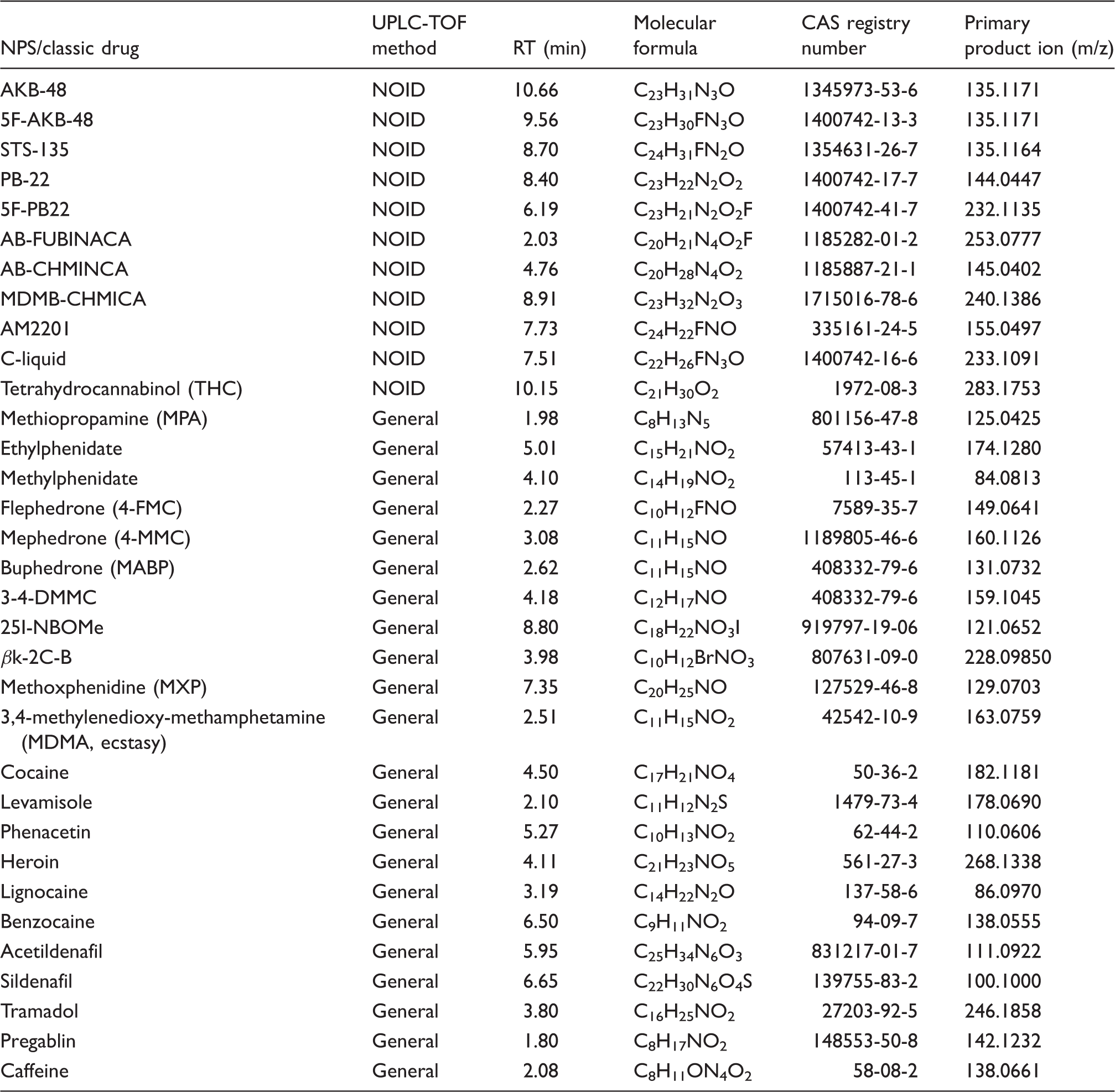
Criteria used for compound identification was a mass accuracy of 5 ppm for both the parent compound (function one), and qualifier fragment (function two), an average isotope fit within 20% of the calculated ratio and a target RT ± 0.3 min. 20 Mass spectral library information for all compounds detected, as well as which of the UPLC-TOF methods used, are shown in Table 5.
Results
The results of analysis of all 98 suspect materials are shown in Tables 1 to 4. For the 58 materials that came with the original packaging (branded products) the listed ingredients are also included. The only listed ingredient we were unable to detect using our methods was Althaea officinalis (AO), also known as marshmallow. No discrepancy in compounds detected was noted between the different extracts. No carryover was observed in mobile blank samples.
Herbal blends
Over the 12-month period we received 50 requests to test herbal type materials for NPS (Table 1). NPS were detected in 96% of the herbal materials we tested (96%) with synthetic cannabinoids (NOIDS) type NPS being the most common (94%). Nine different NOIDS were detected in all: AKB-48, its 5-fluoropentyl analogue 5F-AKB48, STS-135, PB-22 and its 5-fluoropentyl analogue 5F-PB22, AB-FUBINACA, AB-CHMINCA, MDMB-CHMICA and AM2201.
Most herbs were found to contain a mix of NOIDS with 5F-AKB48 (82%), and 5F-PB22 (76%), being the most common individual NOIDS detected. Controlled drugs were detected in 8% of the herbal materials tested. Two herbal samples, both small wraps, were found to contain the class B drug cannabis, with the detection of the major psychotropic marker tetrahydrocannabinol (THC). These were the only herbs to have the distinct pungent smell of cannabis. The rest either had no smell, or a pleasant, if not sickly fruity smell. One herb which had the appearance of a seed pod tested positive for the class B drug mephedrone. Only Super Skunk extra strong herbal blend contained no NPS or classic drugs.
Tobacco samples
Summary of tobacco type suspect materials tested for NPS.
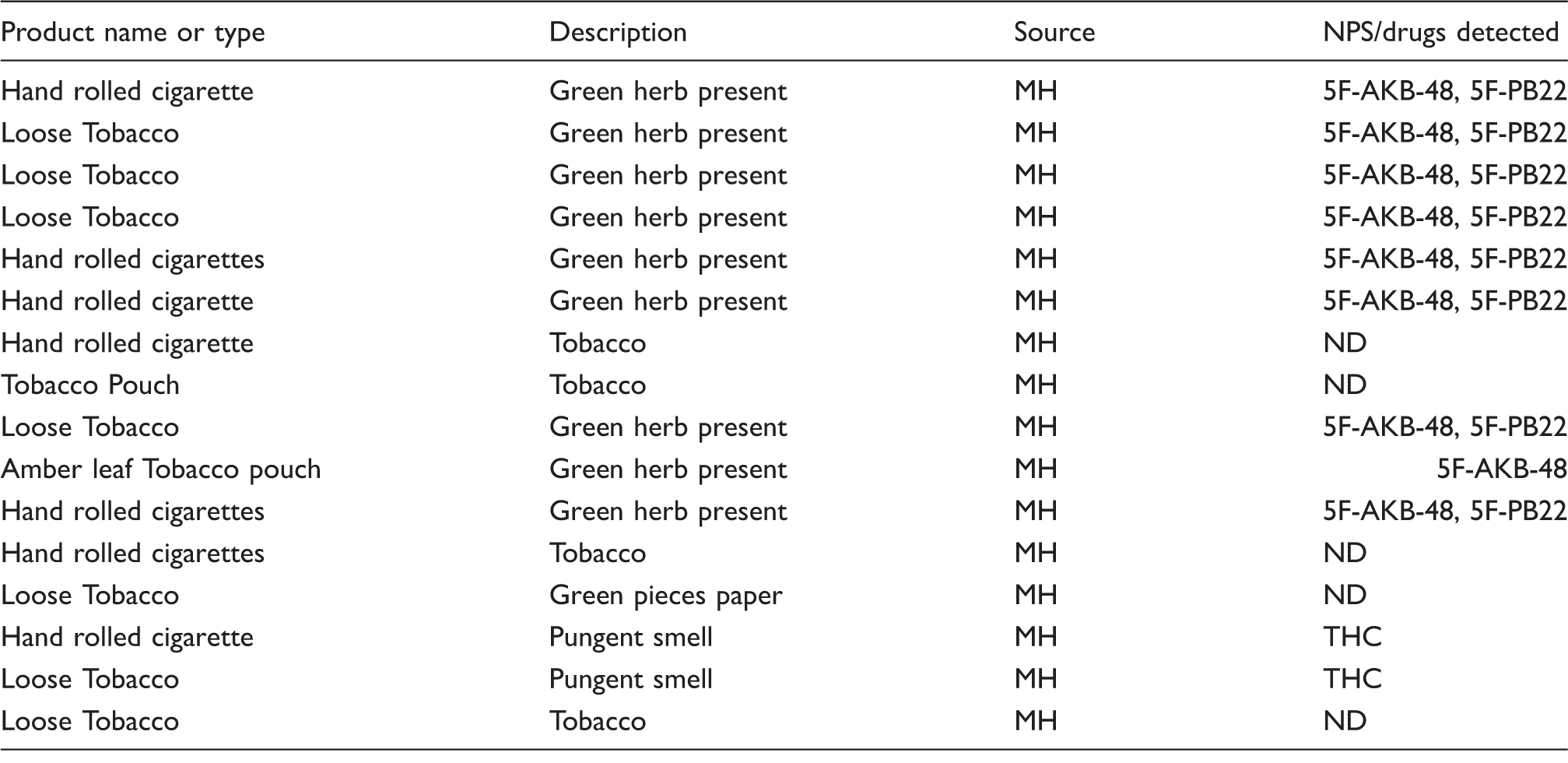
Source: MH: mental health trust request.
NPS: THC: tetrahydrocannabinol; ND: not detected.
Liquids
Summary of liquid type suspect materials tested for NPS.
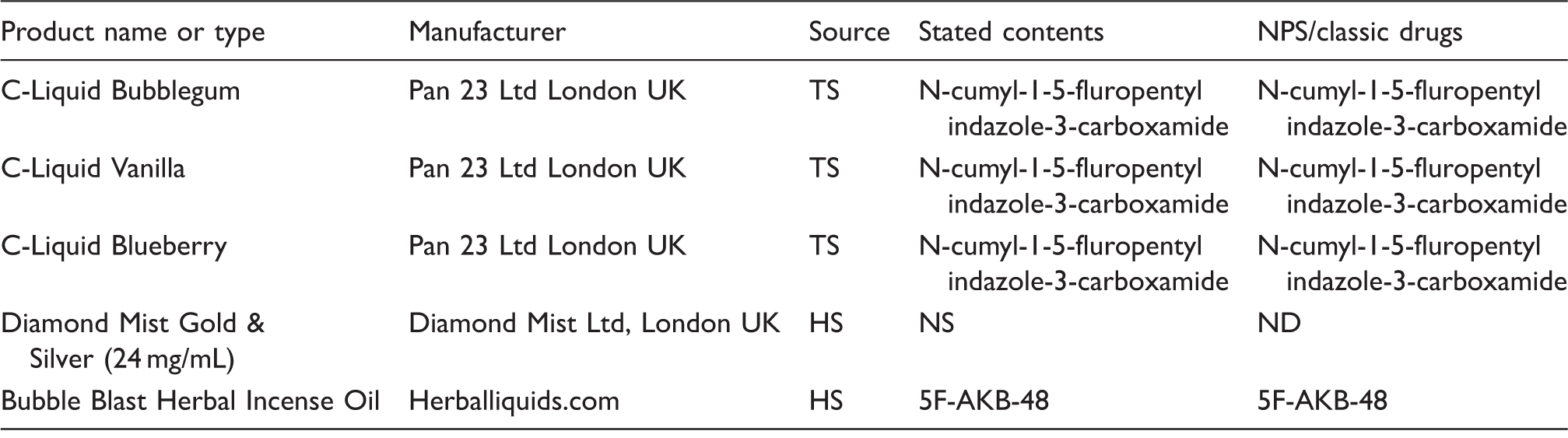
Source: TS: trading standards; HS: head shop purchase.
Stated contents: NS: none stated.
NPS: THC: tetrahydrocannabinol; ND: not detected.
Summary of powder/pill type suspect materials tested for NPS.
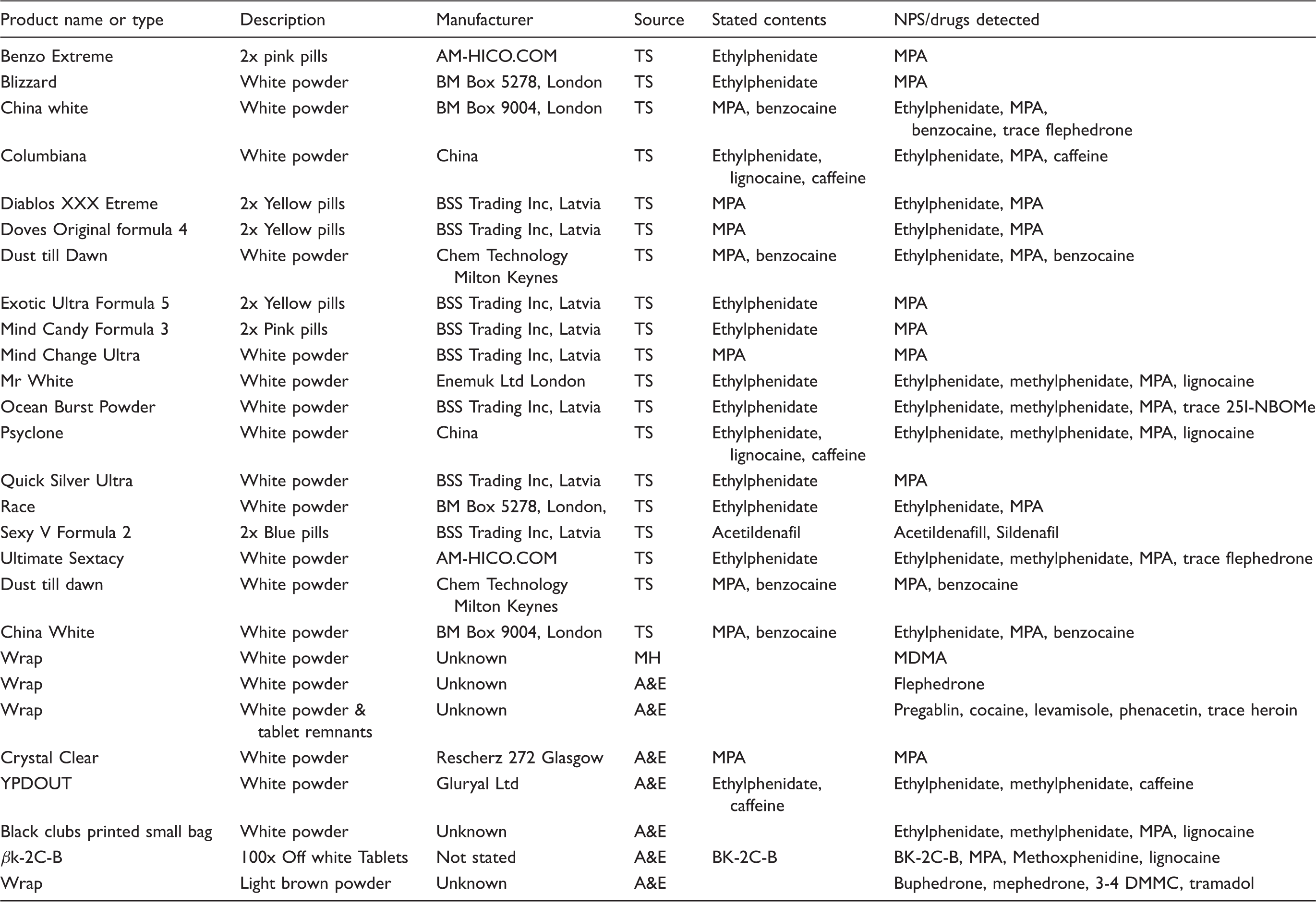
Source: TS: trading standards; MH: mental health trust request; A&E: includes our own and other NHS Trusts.
Stated contents: AO: Althaea officinalis (marshmallow); NS: none stated.
NPS: MPA: methiopropamine; MDMA: 3,4-methylenedioxy-methamphetamine; THC: tetrahydrocannabinol; ND: not detected.
UPLC-MS/TOF mass spectral library information for all compounds detected including Chemical Abstracts Service (CAS) Registry number.
Powder and pills
We received 27 requests to test powder or pills for NPS and the results are summarized in Table 4. The majority (89%) were found to contain NPS. In total, nine different NPS were detected: methiopropamine, ethylphenidate, 4-iodo-2,5-dimethoxy-N-[(2-methoxyphenyl)methyl]-benzeneethanamine monohydrochloride (25I-NBOMe), 2-amino-1-(4-bromo-2,5-dimethoxyphenyl)-ethanone monohydrochloride (βk-2C-B), methoxphenidine (MXP) and the synthetic cathinones buphedrone (MABP), mephedrone (4-MMC), flephedrone (4-FMC), and 3,4-dimethylmethcathinone (3-4-DMMC). The most common NPS were methiopropamine (74%) and ethylphenidate (48%), which were also detected together (44%).
At the time of analysis, class B drugs were detected in 37% of the powder/pills we tested (methylphenidate, MABP, 4-MMC, 4-FMC). Three of the white powders tested contained class A drugs, MDMA (ecstasy), 25I-NBOMe and cocaine/heroin. Over-the-counter/prescription medications were detected in 33% of the powder and pills (benzocaine, lignocaine and sildenafil, more commonly known as Viagra). Caffeine, lignocaine, benzocaine and phenacetin which are commonly used as cutting agents in classic drugs of abuse 21 were detected in 41% of the powder and pills.
Discussion
From 2014 to 2015, we received nearly a hundred external requests to test suspect materials for NPS, the majority of which were from the West Midlands area of the UK. Of these, 87% tested positive for NPS, and 15% for classic drugs of abuse. Overall, we detected 33 different compounds, including 20 different NPS and 5 classic drugs of abuse (Table 5). Just three compounds – the third generation NOID 5f-AKB-48,22,23 the methamphetamine analogue methiopropamine 7 and the cocaine mimic ethylphenidate 8 – were detected in the majority of all the materials we tested (74%). Both the annual FEWS report (2014) 16 and WEDINOS Philtre Annual Report (1st October 2013–30th September 2014) 18 highlighted 5F-AKB-48 as a common NPS. Three of the NPS detected, all third generation NOIDS (C-liquid, AB-CHMINICA and MDMB-CHMICA), were at the time of analysis new to our UPLC-MS/TOF NOID method and were identified from parent elemental composition and fragment ions using Waters Massfragment® software. 21 These NOIDS are all relatively new to the UK and were not included in the Advisory Council on the Misuse of Drugs’ (ACMD) review of NOIDS, which was published in November 2014. 23 Little is known about these new NOIDS although in June 2015 WEDINOS issued an alert for MDMB-CHMICA after the hospitalization of a young male in North Wales. 24 The adverse effects reported included dizziness, nausea, shortness of breath, chest pains, irregular heart beat and convulsions. Like us, WEDINOS also reported the detection of MDMB–CHMICA in Sweat leaf Obliteration and Vertex Pirate Edition legal highs. In July 2015, a further alert was issued by Public Health England warning of the toxicity of both MDMB-CHMICA and AB-CHMINICA. 25 C-Liquid is a designer NOID specifically for use in e-cigarettes and is available in three favours: blueberry, vanilla and bubble-gum. The suppliers, BRC fine chemicals, make the claim 3 mL of these C-liquids is equivalent to 5–6 g of herbal blends, although feedback from users on their own website would suggest its effects are far weaker. 26
Out of the 98 materials tested, the original packaging was available for 58. Of these 58 branded materials, 10% contained controlled drugs and these were more likely to be detected in powder/pills (37%) compared to herbs (8%) and tobacco (12.5%). The most common controlled drug detected was methylphenidate (Ritalin). Methylphenidate was only found in powder/pills, and always together with the NPS ethylphenidate. Ethylphenidate is formed from the ingestion of methylphenidate and ethanol.8,27 Our extraction procedure includes the addition of methanol. To ensure the methylphenidate was not a pre-analytical artefact, the extraction was repeated using water, with the same results. This led us to conclude the manufacture of ethylphenidate was the most likely source of the methylphenidate. In July 2015, a UK temporary class drug order (TCDO) was awarded to ethylphenidate. 28 Since this date, none of the materials we have tested have contained ethylphenidate or methylphenidate.
The other classified drugs detected in the branded products were the synthetic cathinone flephedrone (class B drug since April 2010 29 ), and the substituted phenethylamine 25I-NBOMe, which was given a TCDO in June 2013, and subsequently made a class A drug in June 2014.30,31 The origin of these drugs is less clear. The classic drugs detected (cannabis, cocaine, heroin and MDMA) were all found in unlabelled products.
With the availability of NPS screening services limited, many clinicians in our experience will use the information provided on packaging to determine what patients may have taken. For most of the branded materials we tested (54 out of 55), ingredients/contents were stated on the packaging, and these are compared to the actual NPS and drugs detected in Tables 1 to 4. For the herbal type products only five listed the actual herbal base used, AO, also known as Marshmallow. 33 Marshmallow was the only listed ingredient which we were unable to detect using our current methods. Despite claims to be research chemicals, only 26% of the listed ingredients/contents stated on the packaging matched exactly the NPS we detected, with nearly a quarter (24%) containing completely different NPS altogether.
Despite different names many of the branded materials had the same manufacturer and were found to contain the same NPS. For example, Exotic Ultra Formula, Mind Candy Formula 3 and Mind Change Ultra (BSS trading) all contained methiopropamine. Exodus Herbal Haze Incense, Psy-clone Herbal Incense and Exodus Damnation (MaryjoyUK) all contained the NOIDS 5F-AKB-48 and 5F-PB-22 (Tables 1, 3 and 4).
Without knowledge of NPS, based on the name and design of the packaging alone, some of the branded products had the potential to be very misleading. Ultimate Sextacy and Exotic Ultra Formula 3 would appear to be targeted towards increasing sexual performance and yet contained the same NPS (methiopropamine and ethylphenidate) as was found in products with names associated with classic drug abuse (Columbiana, Benzo extreme, China White). Only Sexy V formula 2 (BSS trading) actually contained sildenafil (Viagra) as well as the analogue, acetildenafil.
Only one product Super Skunk (extra strong) included instructions for use, stating it was a ‘legal intoxicating smoking mixture, to roll into a cigarette or to use in a pipe or water pipe’. No contents were listed, and we did not detect any NPS in this product. If we had detected any NPS, this product would clearly have been illegal to sell under current UK law.
The screening of suspected NPS materials is routine in our laboratory. As demonstrated here, the key benefits to our service are the ability to detect new as well as common NPS, which we can then target by incorporating into our routine screening services. By testing materials obtained locally we ensure that the NPS we target are specific to the population group we are screening. Being able to recognize brand names, and manufacturers means we are better able to advise clinicians of the most likely NPS to expect prior to any analysis, as well as ensure they are kept informed of any developments in NPS use. For example, the emergence of liquid NOIDS intended for E-cigarettes could have implications for our users implementing no smoking bans.
Significantly from our testing of suspect materials we have identified three common NPS in the majority of products available in our area (5F-AKB-48, methiopropamine and ethylphenidate). In our laboratory, we now routinely test for these three common NPS alongside classic drugs of abuse in both urine and oral fluid using our high throughput routine LC-MS/MS methods. In doing so, we keep the costs down for our users whilst still offering a clinically relevant toxicology service that includes NPS. Unlike classic drugs of abuse the fashion in NPS can change. 33 Already we have noted a reduction in ethylphenidate in response to the introduction of the TCDO in 2015. 28 Therefore, to ensure our clinical toxicology service remains relevant, we will continue to test suspect materials by UPLC-MS/TOF to follow local trends, and identify common NPS to target.
Footnotes
Declarations of conflicting interests
Both authors run a clinical service in the United Kingdom for Toxicology.
Funding
Sandwell & West Birmingham Hospital NHS Trust, Department of Clinical Biochemistry.
Ethical approval
Not applicable.
Guarantor
LF and JB.
Contributorship
LF undertook the research and wrote the paper. JB edited the manuscript.