




Abstract
Background:
Trace elements are commonly measured by inductively coupled mass spectrometry (ICP-MS). A 30-year-old man had a plasma selenium (Se) concentration on ICP-MS of 66 µmol/L (reference interval 0.45–1.40), a potentially lethal level, despite no history of Se exposure or toxicity symptoms. He had earlier undergone magnetic resonance imaging with a gadolinium (Gd) contrast agent, which is known to interfere with Se on ICP-MS. We aimed to adjust our method by monitoring a second Se isotope that is unaffected by Gd to detect this preanalytical interference.
Methods:
Plasma samples referred for trace metal testing had Se measured on ICP-MS (monitoring 78Se), which we modified to also monitor a second isotope (82Se). The modified method was then applied to a specimen with known Gd contamination.
Results:
Plasma Se results (n = 41) derived from monitoring the two different Se isotopes were similar with a good correlation (R2 = 0.991) over a range of 0.23–2.21 µmol/L. On repeat analysis, our patient had a Se concentration of 65 µmol/L using the 78Se isotope but only 1.43 µmol/L using 82Se.
Conclusion:
To avoid reporting a falsely elevated plasma Se result, we suggest that Se analysis by ICP-MS should include a second Se isotope for monitoring, that is not subject to Gd interference.
Keywords
Introduction
Selenium (Se) is an important trace element that is incorporated into ‘selenoproteins’ with various functions including as antioxidants, for thyroid hormone synthesis, cognition and in the immune and reproductive systems. 1 Plasma Se is a marker of Se status that is commonly measured by inductively coupled mass spectrometry (ICP-MS), a sensitive, multielement method. 2
Se measured by this method, however, is subject to interference from intravenous gadolinium (Gd)-containing contrast agents used in magnetic resonance imaging (MRI). 3 This is because a doubly charged 156Gd isotope has the same mass-to-charge ratio detected on ICP-MS as singly charged 78Se isotope. 3 No previous studies have described modifying the Se isotopes monitored in ICP-MS to avoid this interference. We aimed to adjust our method by monitoring a second Se isotope that is unaffected by Gd to detect this preanalytical interference.
Case report
A 30-year-old man with lethargy had plasma zinc measured by ICP-MS, giving a result of 8.5 µmol/L (reference interval (RI) 10.0–17.0). His plasma Se was incidentally found to be 66 µmol/L (RI 0.45–1.40), a potentially lethal level, despite not taking Se supplements, no identifiable occupational exposure (industrial, farming) and no toxicity symptoms. Assay interference was suspected, and inquiry identified that the patient had earlier in the day undergone MRI with a Gd contrast agent.
Methods
Sample collection
All patient samples (EDTA plasma) referred for trace metal testing to Canterbury Health Laboratories over a two-day period were assayed for Se by ICP-MS, which we modified to also monitor a second Se isotope. Subsequently, the modified Se method was applied to our sample with known Gd contamination.
Reagents and materials
Samples were diluted (1:25) in an ammonium EDTA and isopropanol solution, and an internal standard (germanium-72) was added prior to analysis. Aqueous standards were prepared from Agilent Multi-element Calibration Standard 2 A (Agilent Technologies, Santa Clara, CA, USA), and QC samples used were Seronorm Trace Elements Serum L-1 and L-2 (Seronorm, Billingstad, Norway). The assay CV (from QC data) was 3.9% (1.5 µmol/L) and 3.7% (2.2 µmol/L). The method detection limit was 0.01 µmol/L.
Instrumental conditions
The automated sample introduction system used was ASX-500 (CETAC Technologies, Omaha, NE, USA) and Se assayed on an Agilent 7700 Series instrument. The collision cell gas used was helium (flow rate 4.5 mL/min), and the nebulizer (MiraMist), torch and cones (nickel sampler and skimmer) were all from Agilent. The Se isotope routinely monitored in our method is 78Se, and in this study we also monitored 82Se.
Statistical analysis
Statistical analysis was performed using software from SigmaPlot (Systat Software, San Jose, CA, USA).
Results
Forty-one patient samples referred for trace metal testing were included (Se concentration range 0.23–2.21 µmol/L). The Se results derived from monitoring the two different Se isotopes were similar with a good correlation (R2 = 0.991) (Figure 1). The percentage difference between the two values was ≤8% for all samples except for one low-concentration (0.3 µmol/L) sample that had a difference of 13%. The modified method was then applied to our case with known Gd contamination, giving Se concentration of 65 µmol/L using 78Se but only 1.43 µmol/L using 82Se. 156Gd was also elevated in this sample.
Comparison of plasma selenium (Se) concentrations using two Se isotopes (78Se and 82Se) for monitoring by ICP-MS in 41 patient samples.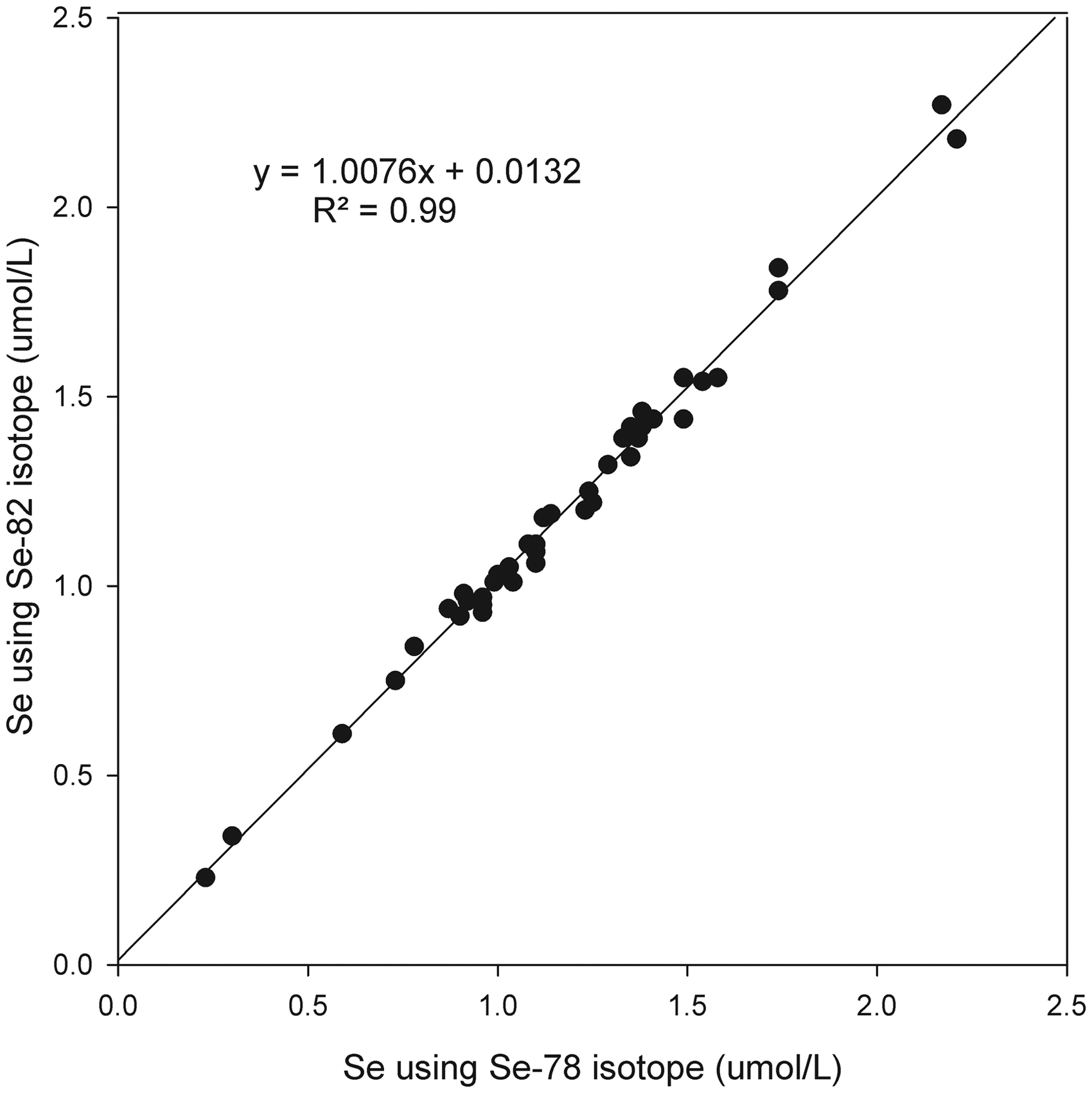
After adopting the method modification in our laboratory, a subsequent sample with discrepant Se results (9.37 µmol/L using 78Se but 0.49 µmol/L using 82Se) was received. This sample was from a 41-year-old man who underwent MRI with Gd contrast one day before collection. A repeat plasma sample four days after his MRI had Se concentration of 0.70 µmol/L using 78Se.
Discussion
Our study found that monitoring the 82Se isotope (in addition to 78Se) was a simple way to detect Gd interference. This was supported by our data showing similar Se concentrations in patient samples using the two isotopes, whereas in the two patients with known Gd contamination, the Se levels were clearly discrepant. Avoiding sample collection within four days of receiving contrast agents containing Gd (Mayo Medical Laboratories, Rochester, MN, USA) has been recommended but is difficult to ensure.
Another approach to prevent this interference involves modifying the collision/reaction cell gas (e.g. using hydrogen instead of either helium or a hydrogen/helium mixture). 4 The collision/reaction cell removes interfering molecular ions by either colliding or reacting with them. 4 Changing this gas, however, poses problems for multielement methods as it may inadvertently increase polyatomic interference for other analytes being measured, so in our instrument the manufacturer recommends helium be used for multielement testing (Agilent Technologies). Monitoring more than one Se isotope has also been suggested as a possible solution to Gd interference. 3 Trace elements exist as fractions of naturally occurring isotopes, and for Se, these are 80Se (50%), 78Se (24%), 82Se (9%), 76Se (9%), 77Se (8%) and 74Se (1%). 5 Although the most abundant isotope is preferred for monitoring, 80Se is interfered with by a molecular ion formed from argon gas (40Ar2+). 2 For this reason, 82Se was selected in our evaluation as a suitable secondary isotope to monitor. The 82Se isotope, however, should not be used as the sole isotope for monitoring due to potential polyatomic interference in patients with high bromide. 6
In conclusion, we describe a novel and simple method adjustment that is useful for detecting Gd interference with Se measurement by ICP-MS. To detect this interference and avoid reporting a falsely elevated Se result, we suggest that plasma Se analysis by ICP-MS should include a second Se isotope for monitoring that is not subject to Gd interference.
Footnotes
Declaration of conflicting interests
None declared.
Funding
This research received no specific grant from any funding agency in the public, commercial, or not-for-profit sectors.
Ethical approval
Not required.
Guarantor
PMG.
Contributorship
All authors were involved in designing the study. JBR and SG researched the literature and analysed the data. JBR wrote the first draft of the manuscript. All authors reviewed and edited the manuscript and approved the final version of the manuscript.