




Abstract
Multivariate regression models were optimized for the quantification of sulfuric acid (H2SO4) [0–8 M] and temperature (20 °C–80 °C) in the presence of ammonium sulfate ((NH4)2SO4 [0–0.6 M]) using Raman spectroscopy. Optical vibrational spectroscopy is a useful nondestructive technique for the in situ analysis of complex chemical systems notoriously difficult to monitor in situ and in real-time. Multivariate analysis, a chemometrics method, can be paired with these nondestructive optical methods for determining analyte concentration and speciation in complex solutions, such as dissociated species in polyprotic acids, e.g., H2SO4. The effect of temperature is often overlooked although it can have a major influence on speciation and the corresponding Raman spectra. Here, partial least squares regression models were optimized for the quantification of H2SO4 and its two deprotonated forms as a function of temperature. Measuring bisulfate as a function of temperature is particularly challenging owing to changes in the second dissociation constant. A designed training set effectively minimized the sample set size and trained a robust predictive model with percent root mean square error of <3% for H2SO4. The practical strategy employed here was demonstrated to be effective for building chemometric models that directly account for dynamic temperatures with static samples and is shown to be amenable to flow cell analysis applications with a simple calibration transfer for process monitoring applications.
This is a visual representation of the abstract.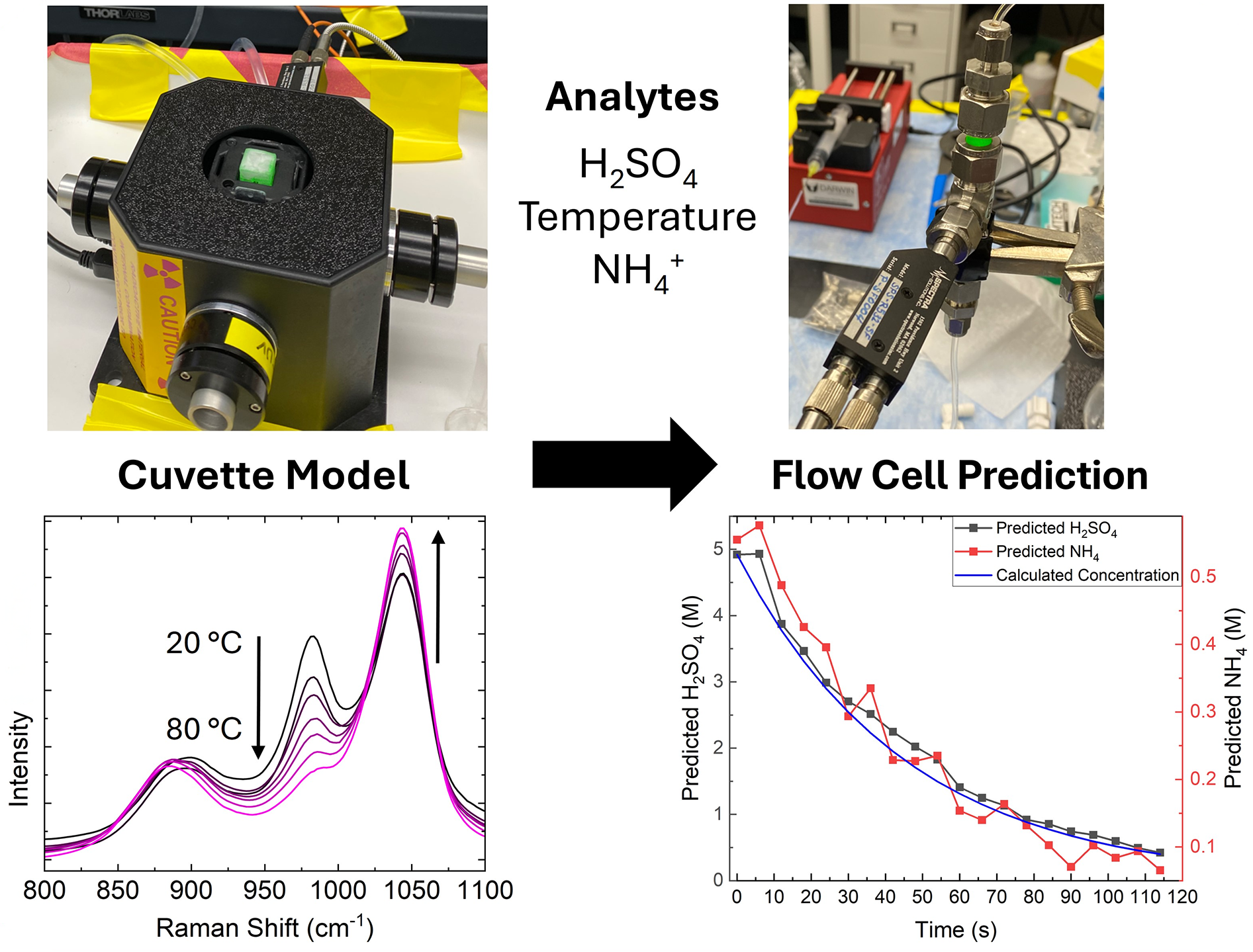
Get full access to this article
View all access options for this article.
References
Supplementary Material
Please find the following supplemental material available below.
For Open Access articles published under a Creative Commons License, all supplemental material carries the same license as the article it is associated with.
For non-Open Access articles published, all supplemental material carries a non-exclusive license, and permission requests for re-use of supplemental material or any part of supplemental material shall be sent directly to the copyright owner as specified in the copyright notice associated with the article.
