



Abstract
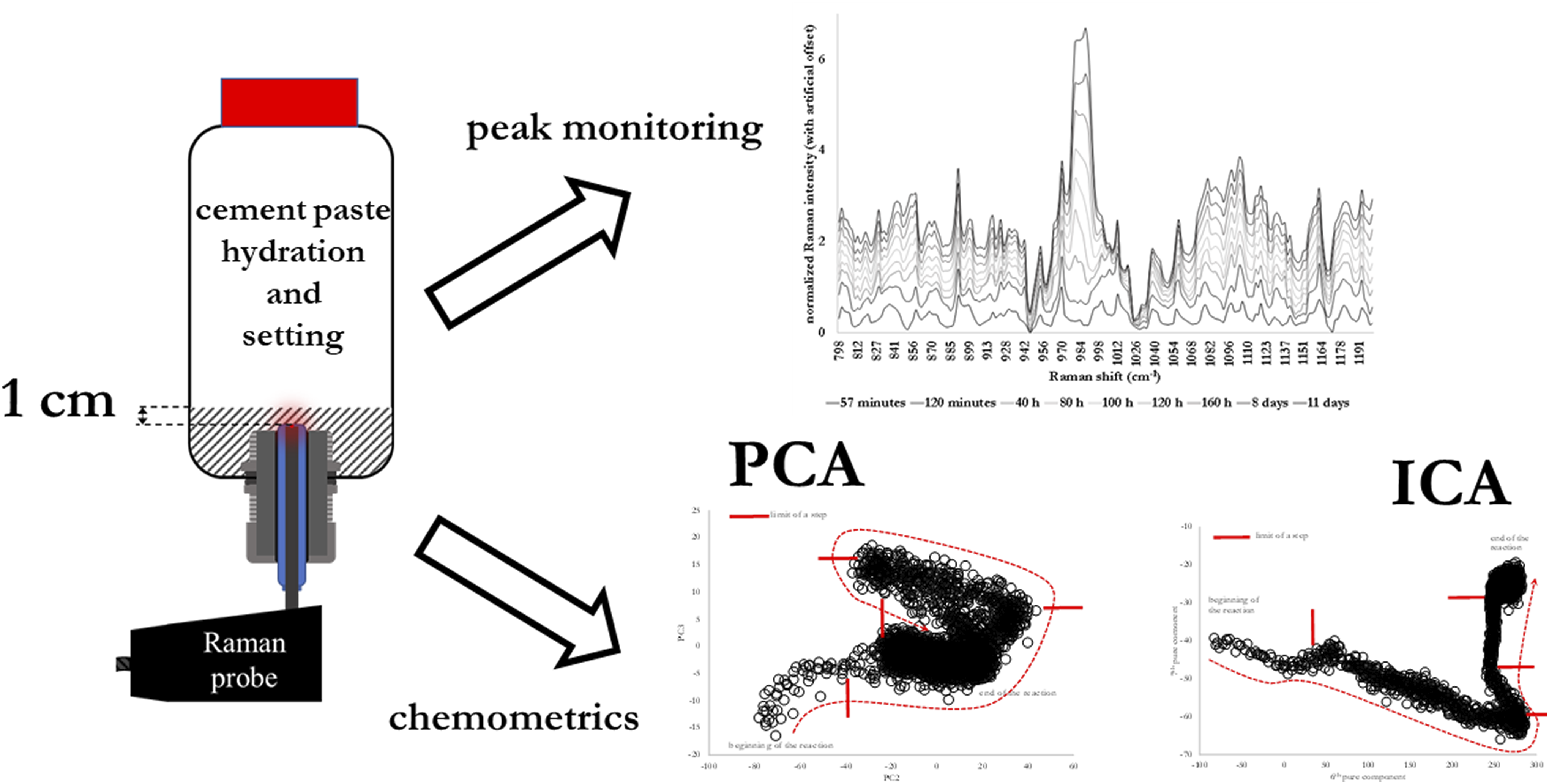
The addition of water is used to past by internal post-curing of hardening cement. Hydration and curing of cementitious are widely identified by non-destructive 1H nuclear magnetic resonance (NMR) measurements of transverse relaxation time and self-diffusion. However, those non-destructive analytical methodologies do not give a truly chemical characterization of the cement matrix during the hydration and curing process. Indeed, the NMR studies only the water dynamics of hydrating cement with internal post-curing. Recent research indicated chemometrics coupled with Raman spectroscopy allows for a better understanding of chemical processes. Recent advances in computing gave industries and research centers the opportunity to generate cost effective data. In this work, an original method is presented, which uses both a data analysis and a non-invasive, non-destructive Raman monitoring of the hydration reaction of a Portland cement. Data was then analyzed by means of chemometrics methods (principal components analysis (PCA), independent components analysis (ICA), and multivariate curve resolution-alternated least-squares (MCR-ALS) with SIMPLe-to-use Interactive Self-modelling Mixture Analysi (SIMPLISMA) and Orthogonal Projection Approach (OP initialization). Results were compared to the ones obtained with thermogravimetric analysis of this cement paste. Besides the consistency of results from both analytical measurements, chemometrics coupled to Raman spectroscopy accurately revealed the details of the setting without any samples collection. The acquisition frequency allowed a proper identification of the occurrence of each of the various phases involved in the hydration and setting process.
Keywords
Get full access to this article
View all access options for this article.
References
Supplementary Material
Please find the following supplemental material available below.
For Open Access articles published under a Creative Commons License, all supplemental material carries the same license as the article it is associated with.
For non-Open Access articles published, all supplemental material carries a non-exclusive license, and permission requests for re-use of supplemental material or any part of supplemental material shall be sent directly to the copyright owner as specified in the copyright notice associated with the article.
