



Abstract
Nowadays, novel biomaterials are under intense research because they are part of promising therapies for the treatment of age-related diseases such as osteoporosis and bone defects. In the presented study, composites of poly(ε-caprolactone) (PCL), micro and nano hydroxyapatite (µ-HAp and n-HAp) and carbon nanofibers (CNFs) were prepared. The influence of additives on polymeric matrix was analyzed using scanning electron microscopy (SEM), Raman micro-spectroscopy, Raman mapping, and two-dimensional correlation spectroscopy (2D-COS). The bioactivity in vitro was evaluated by a 21-day incubation of prepared membranes in simulated body fluid (SBF). It was concluded that additives can behave as crystallization nuclei of PCL, but they are also located across the entire surface of PCL spherulites, not only in the center. With an increasing content of HAp additives, polymeric spherulites become smaller. The type of HAp (µ-HAp or n-HAp) influences the PCL matrix differently, as confirmed by 2D-COS. The component whose addition leads to most significant changes in the polymer is CNFs; polymeric spherulites are small to the extent that they are not distinguishable, and the overall amorphousness of the polymer is the highest among all tested materials, as is its hydrophobicity. The bioactivity test indicated that the membrane with the greatest potential for use as a biomaterial in bone tissue engineering is one consisting of n-HAp (15 wt%) and CNFs, as very uniform coverage of the produced apatite was observed on the surface of this membrane after incubation in SBF.
This is a visual representation of the abstract.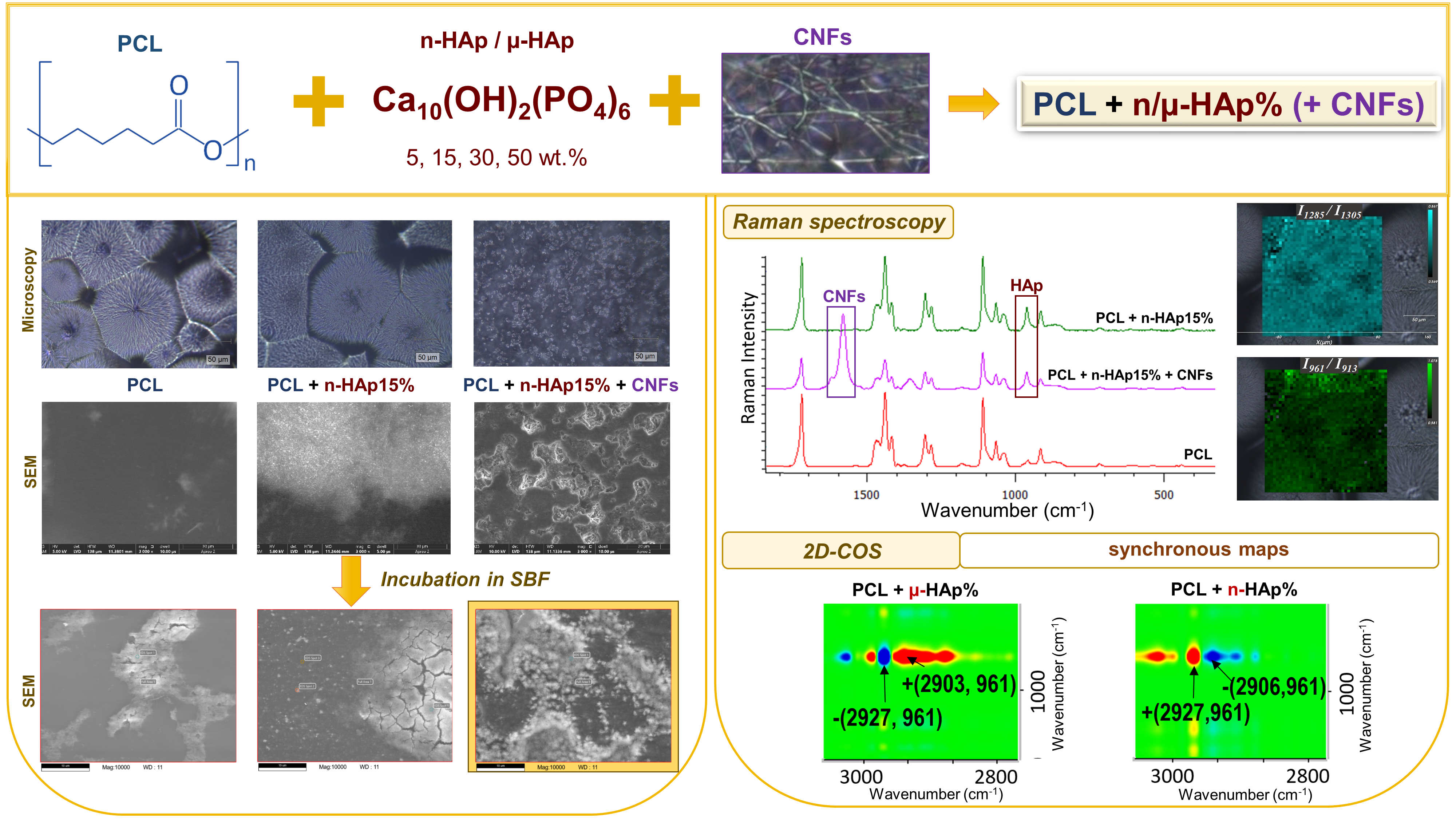
Keywords
Get full access to this article
View all access options for this article.
References
Supplementary Material
Please find the following supplemental material available below.
For Open Access articles published under a Creative Commons License, all supplemental material carries the same license as the article it is associated with.
For non-Open Access articles published, all supplemental material carries a non-exclusive license, and permission requests for re-use of supplemental material or any part of supplemental material shall be sent directly to the copyright owner as specified in the copyright notice associated with the article.
