



Abstract
This work presents a systematic analysis of solid–liquid interface interactions of cancer-relevant compounds using surface-enhanced Raman spectroscopy (SERS) combined with two-dimensional correlation spectroscopy (2D-COS). Experimental SERS data and 2D-COS maps for (diphenylphosphoryl)(pyridin-4-yl)methanol adsorbed on copper oxide (CuO) nanostructures (CuONSs) are reported for the first time, while previously published spectra of neurotensin (NT) and neuromedin C (NMC) were re-analyzed to construct corresponding 2D-COS maps. A novel approach was adopted, involving a generalized 2D-COS methodology, in which all data sets were processed using the same preprocessing steps and 2D-COS parameters. This strategy departs from conventional, case-dependent 2D-COS analyses and enables direct comparability across different molecular systems, even for complex spectra characterized by relatively low signal-to-noise ratios. As a result, the proposed workflow provides a reproducible, transferable, and broadly applicable analytical framework rather than system-specific analyses. Analysis of intensity variations, as well as synchronous and asynchronous correlations, allowed the identification of subtle spectral changes related to adsorption geometry and molecular orientation. Observed trends in band intensities provide a consistent and cross-system basis for assigning molecular interactions and surface orientations, demonstrating that 2D-COS can yield robust and mechanistically interpretable insights beyond what is accessible from conventional SERS spectra. These findings underscore the power of combining SERS and a standardized 2D-COS analysis to reveal dynamic molecular behavior at interfaces, offering a general framework for future studies on biologically and chemically relevant systems.
This is a visual representation of the abstract.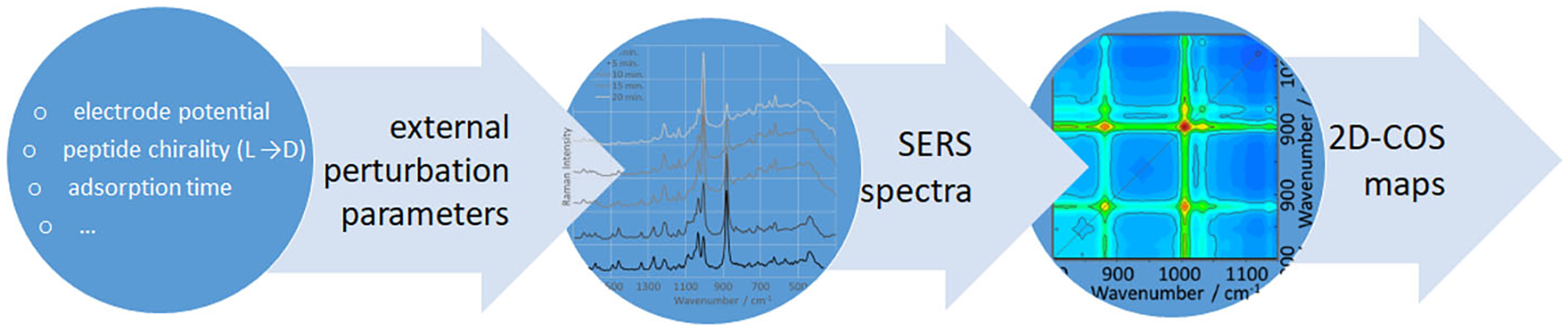
Keywords
Get full access to this article
View all access options for this article.